Memorandum in Support of Plaintiffs' Motions to Tax Counsel Fees and Litigation Expenses as Costs
Public Court Documents
1972
37 pages
-
Case Files, Swann v. Charlotte-Mecklenburg Hardbacks. Memorandum in Support of Plaintiffs' Motions to Tax Counsel Fees and Litigation Expenses as Costs, 1972. cf681cbb-2e34-f111-88b4-0022482cdbbc. LDF Archives, Thurgood Marshall Institute. https://ldfrecollection.org/archives/archives-search/archives-item/7a53db23-2308-4365-9181-100a88290eb7/memorandum-in-support-of-plaintiffs-motions-to-tax-counsel-fees-and-litigation-expenses-as-costs. Accessed October 16, 2026.
Copied!
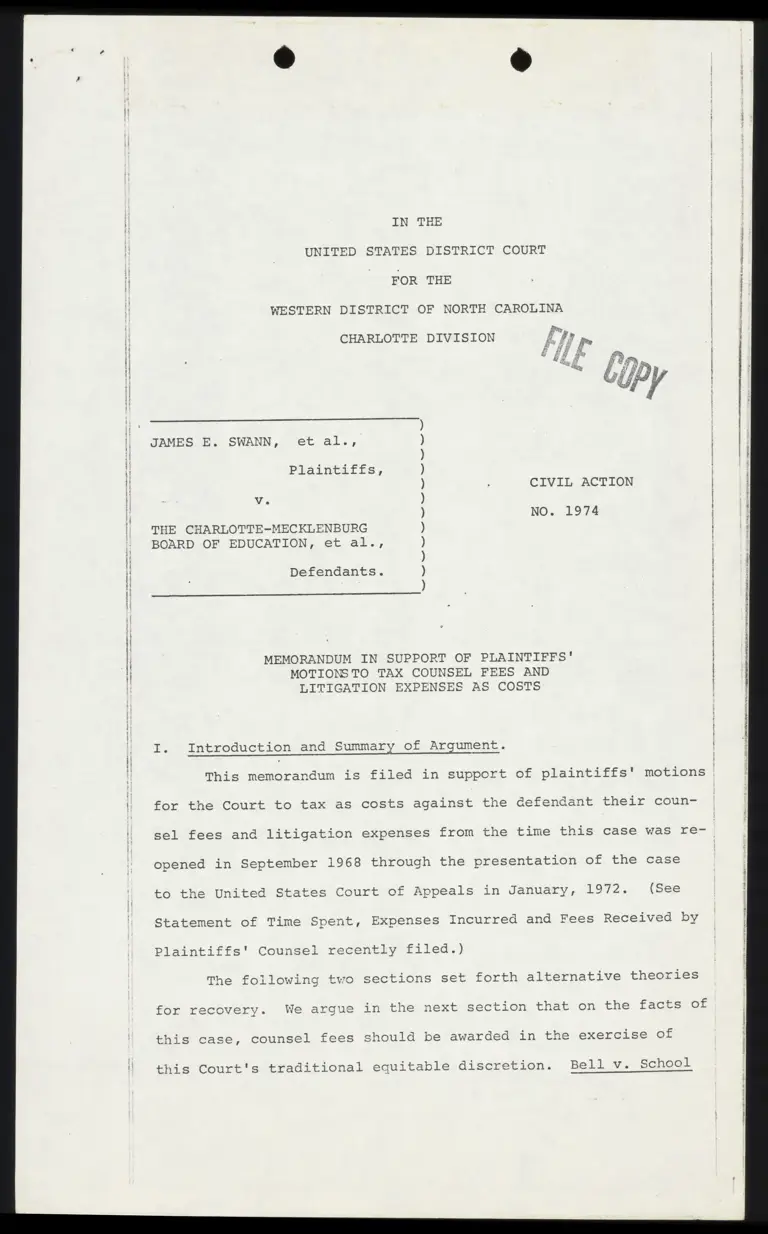
     [||da505d61-b598-462b-9498-d1ed80c3f80d||] IN THE

UNITED STATES DISTRICT COURT

FOR THE

WESTERN DISTRICT OF NORTH CAROLINA

CHARLOTTE DIVISION


JAMES E. SWANN, et al.,

Plaintiffs,
CIVIL ACTION

Ve

NO. 1974

THE CHARLOTTE-MECKLENBURG
BOARD OF EDUCATION, et al.,

Defendants.

N
r
”


a
?


Su
t”


S
a
?


N
i
”


at
?

N
a


at
?

“n
a

“o
v

“u
st


“o
w”


MEMORANDUM IN SUPPORT OF PLAINTIFFS’

MOTIONS TO TAX COUNSEL FEES AND

LITIGATION EXPENSES AS COSTS

I. Introduction and Summary of Argument.


This memorandum is filed in support of plaintiffs' motions |

for the Court to tax as costs against the defendant their coun-

sel fees and litigation expenses from the time this case was re-

opened in September 1968 through the presentation of the case

to the United States Court of Appeals in January, 1972. (See

Statement of Time Spent, Expenses Incurred and Fees Received by

Plaintiffs' Counsel recently filed.)

The following two sections set forth alternative theories

for recovery. We argue in the next section that on the facts of

this case, counsel fees should be awarded in the exercise of

this Court's traditional equitable discretion. Bell v. School


V
C
E
.


lH


EE
 S

E
PA

5


BA

B
A
I
.


A


a


5%

% »


Board of Powhatan County, 321 ».24 494 (4th Cir. 1963); Rolax v.

Atlantic Coast Line Rv. CO., 186 7.28 473 (4th Cir. 1951);


Bradley v. School Board of City of Richmond, Va., 53 F.R.D. 28,


33 (E.D. Va. 1971), apreal pending; Sprague v. Ticonic National


Bank, 307 U.S. 161, 164 (1939).

We also argue that counsel fees should now be awarded in

school desegregation litigation in order to afford full and ap-

priate relief and to effectuate the purpose of the civil

rights acts. Bradley v. School Board of City of Richmond, Va.,


53 P.R.D. 28, 41 (E.D. Va. 1971). :See also Clark Vv, Board of


Education of the Little Rock School District, 369 F.2d 661


(1966), 426 F.2d 1035 (8th Cir. 1971); Cato v. Parham, 293 F.,

Supp. 1375, 1378 {E.D. Ark, 1968), affirmed, 403 F.24 12, 16


(8th Cir. 1968). Cf. Newman v,. Piggle Park Enterprises, Inc.,

390 U.S. 400 (1968); Lee v. Southern Home Sites Corp., 444 F.2d


143 (5th Cir, 1871).

a
—
—
—
—
—
—
—
—


Although these arguments are stated separately, they are

in no way inconsistent. The development of school desegregation

law since Brown v. Board of Education, 347 U.S. 493 (1954) and


349 U.S. 294 (1955) has evolved from the experimentation and

experience of the lower federal courts. Swann v. Charlotte-


Mecklenburg Board of Education, 28 L.ed 2d 554, 561, 565 (1971).


Through this process, certain necessary features of adequate de-

segregation plans have evolved which are now required to afford

plaintiffs the full equitable relief to which they are entitled.

Swann v. Charlotte-Mecklenburg Board of Education, 28 L.ed 2d at |


568-570 (1971). it is our position that while counse fees might

not have been required in the early years of litigation follow-

ing Brown when "deliberate speed" and "good faith" were the tests

against which the first cautious steps were measured, counsel

fees and litigation expenses have now become necessary elements

of recovery since the Supreme Court substituted "now" for "de-

liberate speed" and "results" for "good faith", Green v. County


ws

1


S
C
A


Wo


P
H


R
A
 h

d
dd


N
3 i

& : !

i} » A
! t

ii
i

School Board of New Kent County, 391 U.S. 430 (1968); Alexander


 v. Holmes County Board of Education, 396 U.S. 19 (1969); and
    Carter v. West Feliciana Parrish School Board, 396 U.S. 290
    (1970). Just as a district court acted within its equitable

discretion in requiring that faculties be reassigned to achieve

the approximate racial ratios in each school as existed within

the school district as a whole (United States v. Montgomery


| County Board of Education. 395 U.S. 225-(1969)), district | I

courts have traditionally had the discretion to award counsel |

fees. We urge that what was once a discretionary matter with

I the District Court with respect to counsel fees has now become

ii an essential part of a desegregation he Provisions in a

desegregation order requiring teacher ratios only two years ago

2
E
R
E


AA


A
NA

S
M
N
O
 AB
E
S
i


15


seemed to be discretionary. Experience soon brought lower courts

to conclude that such provisions were a necessary feature of i

every desegregation plan (Nesbit v. Statesville City Board of | ;


Education, 418 F.2d 1040 (4th Cir. 1969); Swann v. Charlotte- | |


| Mecklenburg Board of Education, 431 F.2d 138 (4th Cir. 1970);


Singleton v. Jackson Municipal Separate School Districts, 1364


a


A
A
R


WI
P

a
,


(5th Cir. 1970)), and the Supreme Court quickly affirmed that i     judgment. Swann v. Charlotte-Mecklenburg Board of Education,


|
| 402 U.S. 1 (1971); Davis v. Board of Commissioners of Mokile

| County, 28 L.ed 2d 577. We think that the same is true with

respect to counsel fees and litigation expenses.


S
a
i
n
i


A
R


In the final section of this memorandum, we discuss what

we consider to be the appropriate standards the Court should

consider in setting counsel fees.

The facts and circumstances of this case which we think

o
l


G
E


S
A


A
N
I
A


ARS


Gg
PRY


ob

4
+1


bear upon the matter of counsel fees are summarized in the

section where we urge that fees should be awarded in the exer- 3

i cise of this Court's equitable discretion. |
|
|
| |

|
|


penses.

Argument

"§

This Court Should Award Counsel
Fees and Litigation Expenses
Because the School Board Totally
Defaulted in its Duty to Remedy
the Dual School System in
Charlotte-Mecklenburg and Sought
at Every Turn to Thwart This
Court's Orders.

There is no question that a district court has the

equitable discretion to award counsel fees and litigation ex-

Such power is part of the "historic equity jurisdiction |

of the federal courts ...." Sprague v. Ticonic National Bank,

a
 —

——
——

——
——

——
——


307 U.S. 161, 164 (1939); See also Guardian Trust Co. v. Kansas

City Southern Rv. Co., 28 F.24.233, 243-44 (8th Cir. (8th: Cir.


Bradley v.


In general, district court will exercise its

discretion to award counsel fees "for dominating reasons of

justice", Sprague v. Ticonic National Bank, supra., 307 U.S. at


ton of the lower court.

R. Co.,

167. Civil rights cases in this and other circuits indicate

that such litigation, brought to enforce rights of individuals

against the governmental bodies legally obligated to protect

those rights, will often call for such an award, in the discre-

0


A
0


4
B
T


$3
52

0
SO

AI


LS
 2
1

A


SPR


Sh

o
l


4


L5
H

B
E


oe

SA


fm


Sy
d

0
3%.

41
3 S

AT
IS

C
H
A
T
S
»
 8


School Board of City of Richmond, Virginia,

See e.g., Rolax v. Atlantic Coast Line


186 7.28 473, 481 4th Cir, 1951); Bell v. School Board


of Powhatan County, 321 F.2d 494 (4th Cir. 1963);


of Education of Little Rock, 449 F.24 493, 499 (8th Cir.


Cato v. Parhanm,


403 F.24 12,

by appellate courts only in the most extreme

Clark v. Board


1968) aff'd, 203%. ‘Supp. 1375, 1378 (&.D. Ark.

(8th Cir. 1968); and Lee v. Southern Home Sites


444 F.2d 143 (5th Cir. 1971). Such awards are set aside

Consolidated Gas Co., 265 U.85. 78, 83 Newton v.


* Brown and Carlisse v. Carolina Scenic Stage,


{4th Cir.

circumstances.

Carlisses


242 ¥.24 259,

In Bolax v. Atlantic Coast Line RB. Co.,


1/
a pre-Title VIIemployment discrimination suit, = the lower court

found for plaintiffs and awarded them counsel fees. The Fourth

Circuit upheld the action as consistent with the Sprague prin-

ciples:

«.. Ordinarily, of course, attorneys’
fees, except as fixed by statute,
should not be taxed as part of the
costs recovered by the prevailing
party, but in a suit in equity where
the taxation of such costs is essen-
tial to the doing of justice, they
may be allowed in exceptional cases.
The justification here is that plain-
tiffs of small means have been sub-
jected to discriminatory and oppres-
sive conduct by a powerful labor
organization which was required, as
bargaining agent, to protect their
interests. The vindication of their
rights necessarily involves greater
expense in the employment of counsel
to institute and carry on important
litigation than the amount involved
to the individual plaintiffs would jus-
tify their paying. In_such situation,

we think that the allowance of counsel
fees in a reasonable amount as a part
of the recoverable costs of the case
is a matter resting in the sound dis-
cretion of the trial,judge . . . .
(emphasis supplied) .—


We turn now to a summary of the evidence and facts of

this case which we would urge would require an award of counsel

fees "for dominating reasons of justice". At the outset, we

point out that the United States Supreme Court has had an op-

portunity to review the very voluminous record developed here


1/
“Compare Lea v. Cone Mills Corp., 438 F.2d 86 (4th

Cir. 1971); Robinson v. Loriliard Corp., 444 7.24 791 {4th Clr.

1871) ..s


In Bradley v. School Board of Richmond, 345 F.2d

310 (4th Cir. 1965), the Court refused to increase the award of
counsel fees directed by the District Court, emphasizing the
District Court's discretion in determining the propriety in the
amount of an award. 345 F.24 at 321. The Court there mentioned

that fees should be awarded where the school board's actions were

found to be "unreasonable, obdurant, obstinacy". As we set forth

hereinwe certainly view the School Board's action in those terms.

We would emphasize that the rules of the game were clearly dif-
ferent in 1968 with respect to immediacy and with respect to

results than they were in 1965.

oe


and has unanimously concluded "that the school board had totally

defaulted in. its acknowledged duty to come forward with an ac-

ceptable plan of its own, notwithstanding the patient efforts of

the District Judge who, on at least three occasions, urged the

Board to submit plans. As the statement of facts shows, these

findings are abundantly supported by the record. It was be-

cause of this total failure of the School Board that the Dis-

trict Court was obliged to turn to other qualified sources and

Dr. Finger was designated to assist the District Court to do

what the Board should have done." 28 L.ed 2d at 571.

Following the plaintiffs' motion for further relief in

September 1968, there were extensive hearings and this Court

entered a detailed opinion and order on April 23, 1969. 300

F. Supp. 1358. Despite Green v. County School Board of New


Kent County, 391 U.S. 430; Monroe v. Board of Commissioners, 391


U.S. 450 (1968); and Raney v. Board of Education, 391 U.S. 443


(1968) the School Board had taken no affirmative action to dis-

establish the dual structure which remained sustantially intact.

Well over a majority of the children attended racially identifi-

able schools. Faculties continued to reflect the dual structure.)

Substantially the same kind of free transfer plan which was corn |

sidered by the Supreme Court and found to be unconstitutional in

Monroe v. Board of Commissioners, supra., remained in effect.


The Board had done nothing to fulfill its affirmative duty which

was by that time apparent to all. The Court, however, rather

than dwell upon the failure of the Board to act, merely pointed

out the requirements of the law and required that the Board for-

mulate a corptahensive desegregation plan seeking, we would sup-

pose, to proceed in a "cooperative atmosphere". Kent v. Beasley,


IY, 389 7.284.178, 191 (8th Cir. 1967). Compare Cato v, Parham,
RN

supra., 393 7. Supp. at 1378,


The initial failure to act without any prodding from the

Court was paralleled in all subsequent proceedings by the Board's

-0 =


repeated failures to produce adequate plans even when directed ;

by the Court. The first default occurred in response to the

initial order of April 23, 1969. As the Court detailed in its

opinion and order of June 20, 1969, the plan as proposed would

have had minimal impact, if any, towards furthering the desegre-

gation of the schools. 300 F. Supp. 138. The cooperative spirit

which was evident in the first opinion and order of the Court

had been met by the School Board with immediate and open hos-

tility and recalcitrance.

The Court required that another plan be filed. The Court

reviewed this plan and approved it upon an interim basis for

the 1969-70 school vear. 306 F. Supp. 1299, One of the two

principal features of the plan was a declaration of policy

wherein the Board proposed to accept its affirmative constitution-

al duty to desegregate students, teachers, principals ated staff

at the earliest possible date. This feature of the plan was

readily accepted by the Court; but the promises that were made

were never kept. The second principal feature of the plan |

was the closing of five black schools and the reassigning of

those students to formerly white schools. The time being short,

the Court reluctantly approved that one-way proposal and codulvet |

another complete plan to be presented by November 17, 1969 for |

future years. The Court carefully reviewed the law and the

facts of the case as it had done in the previous decisions.

The reaction of the Board again was to defy the law as carefully

explained by the Court and to defy the specific orders of the

Court which it was obliged to follow.

Instead of finally assuming its duty, the Board sought

further delay and asked for an extension of time within which to

file its desegregation plan. The Court in an opinion of November

7, 1969, denied the defendant's request for an extension of time

noting the Supreme Court's decision in Alexander v. Holmes County


Board of Education, 396 U.S. 19 (1969) requiring desegregation


-] -


har. once”, 306 FF. Supp. 1299.

The Court also reviewed the results achieved by the Board

under its so called modified desegregation plan for the 1969-70

school year. The promises of results offered by the Board had

not been kept. Moreover, the Board which had secured approval of

an interim plan on the basis of its declared policy to achieve

actual desegregation employing any and all of the techniques of

clustering, pairing, zoning, transporeation, eto had again re-

i versed its field and was very clearly pursuing a policy of re-

sstance, recalcitrance and delay.

A plan of sorts was filed on November 17, as had been re-

quired by the Court. It was at best a skeletal proposal. (The |

Board claimed that there was Ynsurficlient time to produce a |

complete plan; the Court found at that time that the delay and

failure to produce a complete plan were the result of the Board's

failure to do what was ordered rather than any impossibility. ;

The correctness of this conclusion became abundant during the

later proceedings when it was shown how quickly a plan could be

produced when necessary.) The plan did not even plan to begin the

job which had been required of it by the Court and which the law

I required at any particular date in the future. The Court again | ;

reviewed the facts demonstrating beyond question that the school

system was unlawfully segregated and that the law required that

it be desegregated. 306 F. Supp. 1306. The plan was disapproved

and the Court indicated that a Court consultant would be appointed

to produce a plan but again indicated that the Board was free to

submit any plan of its own.

The Court appointed Dr. John A. Finger as a court consultant

and directed him to prepare a desegregation plan for the Court's

consideration. On February 5, 1970, the Court reviewed Dr.

Finger's plan and a plan which had been submitted by the School

Board. Features of the School Board's plan were approved where

they desegregated the schools. Where they did not, the Board

Se


was directed to implement the Finger Plan or some other plan

which would accomplish the necessary results. 311 F. Supp. 265.

The plan submitted by the defendant was, of course, done so with

the knowledge of the contents of the Finger Plan and the know-

ledge that it was to be filed by him.

The School Board continued its program of litigation rather

than desegregation. The Board appealed and sought a stay in the

Court of Appeals. On March 5, 1970, on the basis of the Board's

exaggerated assertions concerning the extent and costs of the

transportation required by the plan, the Court of Appeals stayed

a portion of the order relating to the elementary schools and

directed that the District Court make additional findings con-

cerning transportation. The plaintiffs sought unsuccessfully

to have the partial stay rescinded by the Supreme Court.

Prior to the $5ay order by the Court of Appeals, additional

persons who had sought to interfere with this Court's desegrega-

tion orders in collateral proceedings in state court were added

as parties defendant. A three-judge court was designated to

determine the constitutionality of the North Carolina Anti-Bussing

Statute which had been previously attacked by the plaintiff |

by way of a supplemental complaint in July of 1969 but had been

read and understood at that time by the defendants and the

Court not to interfere with the Board's affirmative duty to

desegregate its schools. However, once the generalized aby be-

came specific with the February 5, 1970 order, the Statute was

thought by state officials and these defendants to bar the kind

of relief which had been ordered. Following the order adding

additional parties defendant in February 25, 1970, the plaintiffs

filed another motion seeking to add more defendants who had

obtained another state court order interfering with the Board's

duty to deseéegregate.

Litigation proceeded both in this Court and before the

Three-Judge Court. The parties produced extensive evidence on

ee

T
T


——

—


f
r
p


0


£3


AN


NO
E
N


A
E

A
E


sq
77

SA
L

IP
S
N
R


E
B


Xa $


transportation and the Court made findings concerning transporta-

tion substantially the same as had been made in previous orders.

The Board's claims concerning transportation were found to be

highly inflated and experience has Bons this out. ;

Other attempts by private persons and state officials to

impede the February 5 order of the Court were made, were re-

sponded to by the plaintiffs and dealt with by the Court. The

Three-Judge Court convened on March 24, 1970 and subsequently

decided that the North Carolina Anti-Bussing Statute was clearly

unconstitutional, 312 F. Supp. 503.

A


tg

Y
E


i


Ss
T
E
T


eS


On May 26, 1970 the Court of Appeals affirmed this Court's

decision of February 5, as to the high school and junior high

school plan ordered but remanded to the District Court for fur- :

ther hearings concerning an elementary plan. 431 F.2d 138.

The Court of Appeals found, however, that the School Board had

A
T
H


S
I
E


(
E
R


A
A
S

W
T


entirely failed to develop and present an acceptable plan for

the desegregation of elementary schools.

The plaintiffs petitioned the Supreme Court of the United

  {i States for a writ of certiorari to review that portion of the

Court of Appeals' decision wherein it failed to approve of the

C
C
 pp


te

elementary plan directed by the District Court and moved for re-
m
m
,


lief, pendente lite. The Supreme Court granted certiorari, re-

instated this Court's February 5 order and allowed for the fur-

ther proceedings as directed by the Court of Appeals. 399 U.S.

926. Under the Court of Appeals' instruction, the School Board

was on notice once more, that its previous plan was inadequate.

However, in the further hearings in July, the Board continued to

rely on this plan. Two 'Finger" plans and a "Watkind' plan were

found by the Court to be reasonable. 318 7. Supp. 786. An

HEW plan was not found to be reasonable. The February 5 order

was left remaining in effect; however, once again, the Board was

given the option of implementing one of the plans or presenting

a workable plan of its own for implementation. The Supreme Court

-10-


affirmed this Court's orders of February 5 and August 3, 1970.

202 U.S. 1,

On October 5, 1971, this Court found that the results of

the plan were not as promised in several of the schools and that

| the Board should have known that these schools would have had as-

I signment patterns out of compliance because the racial identity

|! of the schools was caused by newly opened federally assisted hous-

| ing projects. Despite the Court's finding of non-compliance with

its duty to control the racial enrollment in the schools, the

Board did nothing at all to remedy the situation. Instead, it


simply let matters stand.

After the decision by the Supreme Court, the Board informed

the Court that it intended to file a desegregation plan. This

was the first indication that the Board would devise its own re-

spolise to its constitutional mandate which it had been specifi-

cally enjoined to fulfill for many months. However, the plan

it presented was rank with racially discriminatory features re-

quiring another round of litigation in the spring and summer
|

of 1971.

Plaintiffs have repeatedly urged through the course of |

these proceedings that the School Board was constantly in contenph

of this Court's orders. The Court referred on several occasions

to these motions indicating that they might be meritorious, but

declined to rule on them being of the opinion that to do so night

hinder rather than promote the required result -- the transforma-

tion of the school system from unconstitutinally segregated to a

“unitary non-racial school system. Nevertheless, the Board's

steady course of resistance to its obligations under the United

States Constitution required an extraordinary amount of work by

plaintiffs' lawyers, caused an enormous imposition upon the Court

and delayed the vindication of the constitutional rights of

black school children in Charlotte-Mecklenburg.

“lle

10
ct


pom


att


R
R
N
A


sol
d

i
o
n
d


AN


e
o
n


et
e

5
S
l


The contemptuous conduct of the defendants is relevant here

not only as it reflects upon their obstinancy but also because

of the traditional equitable power of the Court to award counsel

fees where the defendant's conduct has been found to be comtemp-

tuous. See Toledo Scale Co. v. Computing Scale Co., 261 u.S.


399, 426-28 (1923); Hayslip v,. Textag Co., 94 ¥., Supp. 423, 428


{¥.D. Ga.) aff'd 322 F.2d 435 (5th Cir, 1950); NLRB v. local 225,


430 ¥.24 1225, 1229 (3rd Cir, 1970), annot., 55 A.L.R. 28 979.

Certainly whereas here defendants' conduct is such that the

Court may make a finding of contempt, it is certainly appropriate

for the Court on the basis of such conduct to make a general

counsel fee award in its equitable discretion.

We think that the facts in this case are markedly more


compelling for an award of counsel fees than in Bradley v. School

Board of Richmond, Va., 43 F.R.D. 28, where fees were awarded.


The Court there said of the Richmond School Board:

At each stage of the proceedings
the School Board's position has
been that, given the choice between |
desegregating the schools and com-
mitting a contempt of court, they
would chose the first, but in any
event desegregation would only
come about by court order.
(53 F.R.D. at: 39)

This Board went considerably further than that. Time after time,

it refused to produce a plan when it had been required by this

Court, the Court of Appeals and the Supreme Court to do so.

Each time, in the words of the Supreme Court, it "defaulted".

Moreover, after giving this Court its assurances that it accepted

its affirmative duty to desegregate, it subsequently reneged on

that assurance. Additionally, both in 1969-70 and in 1970-71, it

failed to operate the schools according to the then outstanding

Court orders. Indeed, it showed contemptuous conduct time and

again and Green had produced no response whatsoever from the

Board.

It might be said that "political realities" compelled the

2.

et

A
S
G


1
ST


8


PI


BE


PS
E

44
55


0
6
0


M
T

A
I

1

J
P


53


FA

P
A
R
S
N


r4
l
N


course of conduct which was followed by the Board. Judge

Merhige has answered that claim:

It is no argument to the con-
trary that political realities may
compel school administrators to
insist on integration by judi-
cial decree and that this is. the
ordinary, usual means of achieving
compliance with constitutional
desegregation standards. If such
considerations lead parties to mount
defenses without hope of success,
the judicial process is nonetheless
imposed upon and the plaintiffs are
callously put to unreasonable and
unnecessary expense. (53 F.R.D. at

39.)
of conrseiis this case, the Court has found on several occasions

that the political opposition to the Constitution which was ex-

pressed in Charlotte was led and inflamed by some of the de-

fendants themselves. Rather than attempting to obey the law and

to explain the necessity under our Constitution for obeying the

law to the citizens of Charlotte, thé Board insisted on holding

out the false hope that this Court's orders could be disobeyed

and that desegregation could be avoided. We think that this is

exactly the kind of case where the exercise of a district court's

I equitable discretion to award fees and expenses should be in- |

voked as was done in Rolax and in Bell.

ig

The Court Should Award Counsel
Fees To Afford Full and Appro-
priate Relief in a School Desegre-
gation Case and to Effectuate the
Purposes of the Civil Rights Acts.

Judge Merhige recently awarded substantial counsel fees to

plaintiffs in the Richmond School case because "the character of

school desegregation litigation has become such that full and

appropriate relief must include the award of expenses of litiga-

tion. This is an alternative ground for today's ruling."

Bradley v. School Board of Richmond, Va., 53 F.R.D. 28, 41 {2.5


-13--


va. 1971), appeal pending. We urge this Court to adopt a simi-

lar holding. Judge Merhige's decision which in effect states

a


l
l
.


3
%

Bq


AE
E
R
e


a general rule that fees should be allowed as a normal course to

prevailing plaintiffs in school desegregation cases is the appli-

cation of reasoning which was first expressed by the Court of

" Appeals in the Little Rock School case in 19661

The Board is under an immediate
and absolute constitutional duty to | i
afford non-racially operated school : :
programs, and it has been given | :
judicial and executive guidelines Bu
for the performance of that duty.
If well known constitutional
guarantees continue to be ignored

i or abridged and individual pupils
I! are forced to resort to the courts

for protection, the time is fast
approaching when the additional

|! sanction of substantial attorneys

ts fees should be seriously considered |

t by the trial courts. Almost solely
| because of the obstinate, adamant,

- and open resistance to the law, the

| educational system of Little Rock |

has been embroiled.in a decade of Jon

| costly litigation, while constitu-
"tionally guaranteed and protected
rights were collectively and indivi-
vidually violated. The time is
coming to an end when recalcitrant
state officials can force unwilling
victims of illegal discrimination
to bear the constant and crushing
expense of enforcing their constitu-
tionally accorded rights, Clark v.
Board of Education of Little Rock
School District, suprg , 369 F.24 :
671. (Bth Cir. 1966) .=

P
A
T
E


A
A


TTA


VST


E
T


nu


TL


7ARA
T
E
 A

N
CA
E S
N
C
 D
NB


SR
R

MOR
IN

TY
B
E


LR


EN


AR
I

op


A


We strongly urge that with the advent of the clearly

established affirmative duty imposed upon a school board to pro- |


duce desegregation results, (Green, supra.) and that these


| 3/
t ~~ "Most recently the Court of Appeals in that case

awarded counsel fees on appeal under the same rationale. 449

F.2d 493,499 (8th Cir. 1971). See also Cato v. Parham, 293

¥. Supp. 1375, 1378 {E.D. Ark. 1968), aff'd 403 P.24 12,16 (8th

Cir. 1968); Nesbit v. Statesville City Board of Education, 418

P.24 1040, 1043 (4th Cir. 1969).  (Plaintiffs-appellees in the

Halifax and Amherst County cases to recover "their costs and

reasonable counsel fees, including reasonable out-of-pocket

expenses, to be determined by the District Judge.")


“ld


4 | #

results are to be accomplished "now" (Green, supra.) and "at


once" (Alexander v. Holmes County Board of Education, supra.;


Carter v. West Feliciana Parrish School Board, supra.), the time


has long since expired.

The doctrine is, we submit, by this time a fully justi-

fied and necessary interpretation of 42 U.S.C. Section 1983 in

school desegregation suits. See "Allowance of Attorneys Fees

in Civil Rights Actions", 7 Columbia Journal of Law and Social

Problems, 381, 386 (1971), recommending that this rationale be

adopted.

a/ 5/
Section 1983, like companion Sections 1981 and 1982,

are parts of the Civil Rights Acts passed in the decade follow-

ing the Civil War to guarantee equal treatment to the freed-

6/
man. The Fourth Circuit has emphasized, in an action arising

under Section 1983 that it

authorizes federal courts in
civil rights cases. to grant broad
relief 'in equity, or other proper
proceeding' and is designed to pro-
vide a comprehensive remedy for the
deprivation of constitutional rights.

Smith v. Hampton Training School for Nurses, 360 F.2d 577, 581


(4th Cir. 1966). In that case, not only were discharged black

nurses ordered reinstated with back pay, but the case was re-

manded to the district court "to fashion any other appropriate

Tellef in light of this opinion.” Id. at 582.

While Section 1983 does not specifically provide for a

counsel fee award, neither does it prohibit it nor establish an


4/
— E.g.,s Sanders v. Dobbs Houses, Inc., 431 F.2d 1097

(5th: Cir. 1970); cf. JOnes V. Alfred RI. Mayer CoO., 392 U.S.
409, 441 n. 78 (1968).

57
“Jones v. Alfred H. Mayer Co., 392 U.S. 409 (1968).

6/
“Basista v. Welr, 340 7.24 74, 86 (34d Cir. 1965).


“lB


R
R


di
on


eid

l
h


ci


da
e

Me
di
a

AT
E
A
M
A


A
R


LS
I
H
E


©
A
T
T


14

T
O

S
R
A


145


7/
intricate remedial scheme from which a Congressional intent

to exclude such an award may fairly be implied. Compare

Fleischmann Distilling Corp. v. Maier Brewing Co., 386 U.S.


712. (1967) with Mills v. Electric Auto-Lite Co., 396 U.S.

8/
375 (1970),


Awarding counsel fees in school desegregation cases

brought under Section 1983 will effectuate federal policy.

The plaintiffs in such actions are but nominal petitioners on


7/

: “The provisions of the 1964 Civil Rights Act regarding

school desegregation clearly do not provide an alternative

remedy. 42 U.S.C. Section 2000c-6 permits suits by the Attorney

Geheral of the United States against local school districts main-

taining segregated schools, upon complaint to him, but no new

cause of action or even administrative remedy is made available

to private parties, as is true of the Public Accommodations Act

(Title II, 42 U.S.C. Section 2000a-3) or the 1968 Fair Housing

Act {Title VIIT, 42 U.8.C. Section 3612).
: In fact, the 1964 Civil Rights Act specifically pre-

served the existing remedy, 42 U.S.C. Section 2000c-8, indica-

ting a Congressional intention that its policies be implemented

through privately initiated litigation as well as suits by the

United States. (Even if a new enforcement mechanism had been

established, no repeal of Section 1983 could have been implied.

i See Jones v. Alfred H. Mayer Co., 392 U.S. 490 (1968); Sanders

!! v. Dobbs Houses, Inc., 431 F.2d 10927 (5th Cir. 1970)).

8/
“Mills is the most recent example of a line of cases |

commonly referred to as "fund cases" where the lawyer for the

plaintiff is permitted to recover his fees from the proceeds of

the litigation or from the treasury of an organization to which

plaintiff and others sharing his interest belong. These cases

support, we think, the rule we urge here. Although it is not

commonly thought that a school desegregation case produces a

fund, we think they provide a very strong analogy in our favor,

The Mills case involved a recovery of fees from a corporation

against the corporation. The Court found that this success

"benefitted" the corporation by correcting its wrongful action.

By the same token, plaintiffs in a successful school desegrega-

tion case "benefit" a school board by forcing it to operate law-

fully thus justifying a fee recovery from it. The burden of

this fee recovery would, thus, be spread among the taxpayers as

a whole just as the Mills case effectively spread the burden

among all the corporate shareholders. But compare Bradley, supra.

at 35-36.


4
C
R
A


3
00

T
A

D
A
M
A


546
57

1%
NI
N

RE
 C
2

DA

0


ME
NS


d
f


A

I
N
E
 S
P

ANY
S
E


“lw


/
behalf of all students. They cannot and should not be expected

|


to finance such proceedings from their own resources. The inves-

tigation, research and presentation of expert and fact witnesses

require the expenditure of tremendous amounts of time by capable

counsel, aside from the actual trial hearings. To undertake to

pay the reasonable value of such services is only within the

financial ability of the rich. School Boards, on the other hand,

have at their command in their defense able and experienced

lawyers compensated from public funds, as well as their own staff

--the very persons enjoined by law to render and perform the


duties sought to be enforced in such litigation. Bradley. supra.

at 40.

Just as courts have looked to more recently enacted stat-

uted in determining the remedial scope of 42 U.S.C. Section 1982,

Lee v. Southern Home Sites Corp., 444 F.2d 143, 146 (5th Cir.


1971), so too does the Civil Rights Act of 1964 support the de-

claration of a vigorous enforcement policy under Sedtion 1983.

The basis for the enactment of the provisions regarding

school desegregation in the Civil Rights Act of 1964 was Congres-

sional dissatisfaction with the slow pace of implementing the

constitutional principles of Brown v. Board of Education, 347


U.S, 483 (1954); 349 U.8. 294 (1935), See, e.g., H. R, Rep. 914,}

88th Cong., 2d Sess., 2 U.S. Cong. Code & Adm, Ness 2394. As

noted above (n. 5), Congress specifically recognized that pri-

vately initiated litigation (brought under Section 1983), as well

as suits initiated by the United States, would serve to vindicate


0/
"The plaintiffs in desegregation suits are truly

"private attorney[s] general," Newman v. Piggie Park Enterprises,
Inc., 390 U.S. 400, 402 n. 4, who performed valuable public ser-

vices. See Parham v. Sou sthwestern Bell Tel.Co., 433 7.28 421,

429-30 (8th Cir. 1970); Lea v. Cone Mills Corp., 438 F.2d 86
(4th Cir. 1971); Robinson v, Lorillard Corv., 444 F.24 7°21 (4th
Cir. 1971); Clark v. American Marine Corp., 304 7. Supp. 603, 611
(£.D. La. 1969) Dobbins Local 212, 1BEW, 252 ¥. Supp. 413
(S.D. Ohio, 1963); Hammo v. Housing Auth. & Urban Renewal
Agency, 323 .F. Supp. 536 (Db. Ore. 1271); cf. Mills V. Electric
auto-Lite Co., 396 U.8..375, 396 (1970).


  {


=3


«) Zo


its policy. 42 U.S.C. Section 2000c~8. In these circumstances

it is entirely appropriate that the federal courts award counsel

fees in Section 1983 school desegregation lawsuits to "encourage

individuals injured by racial discrimination to seek judicial

llewman Vv. Piggie Park Enterprises, Inc., 390 U.S.
10/

400, 402 (1968) .

relief ...


Such a policy is consistent with the general approach of

federal courts in construing federal statutes. "The existence

of a statutory right implies the existence of all necessary and

i. appropriate remedies. ..." Sullivan v. Little Hunting Park, Inc.,


396 U.8% 229, 239 (1.969); Bell v, Hood, 327 U.8. 678 (1946);


Cf. Textile Workers Union v,. Lincoln Mills, 353 U.S. 448 (1957);


accord, Lakewood Homes, Inc. v. Board of Adjustment, 23 Ohio


Misc. 211, 258 N.E. 24:470, 502-04 (Ct. Common Pleas 1970).

Other courts have held counsel fees appropriate under

this rationale. E.g., Newbern v. Lake Lorelei, Inc., Civ.


No. 6871 (S.D. Ohio, March 12 and April 22, 1969), see 308

F. Supp. 407 (S.D. Ohio 1968) (Sections 1981, 1982); Lee v.

Southern Home Sites Corp., 444 F.2d 143, 147-48 (5th Cir.

I
1971) (Section 1982)°


I


10/-
~ The fact that Congress did not add a counsel fee

award provision, as in Title II, 42 U.S.C. Section 200a-3(b), is
not dispositive since in the 1964 Civil Rights Act, Congress did
not create a new enforcement scheme for private litigants but
rather specifically approved of the old. 42 U.S.C. Section 2000c-
8. Compare Fleischmann Distilling Co. v. Maier Brewing Co., 386
U.S. 714 (1967). Language to the contrary in Williams v. Kim-
brough, 415 F.28 874, 875 n. 1, Cert. denied, 396 U.S, 1061 {1970)
and Xemp v. Beasley, 352 ¥.24 14, 23 (8th Cir. 1965) rests upon |
the sort of strict Fleischmann-like analysis of statutes which
the Supreme Court disavowed in Mills v. Electric Auto-Lite Co.,
396 U.8. 375 (1970).


1Y/
~ Unreported actions involving discrimination in the

sale or leasing of property in which attorneys' fees have been
awaréed include: Turner v. Lazarus, d/b/a Johnson & Lazarus,
Realtors, No. 50366 (N.D. Cal., Nov. 22 and Dec. 3, 1968); Vaughn
v, Ting Su, No. 49643 (¥.D. Cal., July 1% and Dec. 3, 1968);
Tightfoot v. Odum, No. 11,647 (N.D..Ga., June 29, 1970); Brown Vv.
arth, InC., 2 Race Rel. LIL. Sur. 111 (M.D. Tenn. 1970): Phillips


“lw

E
E


A

P
R
A


A
T


AR
S

NE
AL


pe

a
b
y


The adoption of the standard which we advance would not

mean that all school boards would of necessity be obligated to

pay attorneys fees to counsel for plaintiffs in all desegrega-

tion cases irrespective of their particular conduct. The rule

which would apply would be the rule which the Supreme Court has

enunciated where counsel fees are to be awarded in furtherance

of a statutory policy:

. « « One who succeeds in ob-
taining an injunction . .
should ordinarily recover an
attorney's fee unless special cir-
cumstances would render such an
award unjust.


Newman v. Piggie Park Enterprises, Inc., 390 U.S. 400, 402 (1968).

Thus, it might be that plaintiffs might not be entitled to coun-

sel fees had they obtained an injunction in January, 1970 re-

quiring a school district which had already achieved desegrega-

tion of all its schools’ student bodies, to complete an already

substantial faculty desegregation program by reassigning faculty

for the second semester in accordance with the system-wide ratio,

as announced in December, 1969, Nesbit v. Statesville City Board


of Education, 418 F.2d 1040 (4th Cir. 1969). That is not this


case.

Such a rule would substantially further suits by "private

attorneys] general," Newman v. Piggie Park Enterprises, Inc.,


id, at 402 n. 4. It will encourage speedy resolution of school

desegregation cases in which school boards now gain premiums

by delay, see Swann, 402 U.S. at 13-14, and it should help re-

duce the burden of school litigation in the federal courts in


1l/ cont'd ~~

v. Pinehurst Realty Co., 2 Race Rel, L. Sur. 33 (M.D. Tenn.

(1970); Pina v. Homsi, Civ. No. 69-666-G (N.D. Mass., July 10,
1969); Terry v. Elmwood Cemetery, Civ. No. 69-490 (N.D. Ala.
Jan. 29, 19270), see 307 F. Supp. 369 (N.D. Ala. 1969); People
Vv. Doughtie, Civ. Ho. 1150-8 (M.D. Ala. Nov. 18, 1971).


=]0m-

I


T
s


o
F


Sa

f
w


e
T


sa


FA
G

R
Y


S
R
A


S
R
R


Cy


SR


the future.

In summary, we quote again from Judge Merhige:

53 FP«.R.D. at 42.

The private lawyer in such a

case most accurately may be described
as "a private attorney general." What-
ever the conduct of defendants may
have been, it is intolerable anomalous
that counsel entrusted with guaranty-
ing the effectuation of a public
policy of nondiscrimination as to
a large proportion of citizens should
be compelled to look to himself or
to private individuals for the re-
sources needed to make his proof.
The fulfillment of constitutional
guaranties, when to do so profoundly
alters a key social institution and
causes reverberation of untraceable
extent throughout the community, is
not a private matter. . . . Under the
Civil Rights Act courts are required
fully to remedy an established wrong,
Griffin v. County School Board of
Prince Edward County, 377 U.S. 218,
232-234, 84'S. Ct. 1226, 12 1..E4d24
256 (1964), and the payment of fees
and expenses in class actions like
this one is a necessary ingredient
of such a remedy.

-20-

B
L

T
E


J


B
a
v
i


Ri
ve


AL
LL


Re

l
Sr


©
a


S
R


rot

i
a


JI

The Amount of the Fee

In the preceding two sections we have urged that counsel fees

and litigation expenses should be awarded to plaintiffs. This

section is a discussion of the considerations which should be

applied in determining the amount of the fee and expenses to be

awarded.

Initially, we would urge that the fee in this case should be

set in accordance with traditional professional standards. In

setting the fee, it should not matter that the relief sought and

obtained by plaintiffs was not monetary but injunctive.

"It scarcely requires mention that the

significance of legal precedence is not con-

fined by the amount of money immediately in

issue . . + « If [a party} ultimately suc-

ceeds . . . [he] should be awarded reason-

able fees according to professionally ac-
cepted standards. Despite the small sum

immediately recoverable, the case is im-

portant to the parties and they are warranted

in making reasonable expenditures in prose-

cuting or defending."

Brotherhood of Railroad Signalmen v Southern Ry. Co., 380 F. 24 59,


68-69 (4th Cir. 1967), Cert. Den. 389 U.S. 958 (1967). In the

same case, the Fourth Circuit mentioned some of the professionally

accepted standards:

: "In determining reasonable attorney's

fees, factors to be taken into account are

the importance and complexity of the issue

being litigated, the quality of the legal

services and the time required for prepa-

ration and court appearances,"

ye fy


380 F. 2d at 69. The Court then mentioned an additional

consideration which we think is particularly relevant here. That

is the compensation of the defendants' attorneys.

"The standards applied in compensating

attorneys for the opposing party in litigat-

ing the self same issue give .some indication

of the importance of the case and are a

relevant consideration in fixing the fese."

Ibid. Counsel for the defendants have reported that they have

received fees and reimbursement for expenses from the School

Board for these proceedings beginning with plaintiff's Motion for

Further Relief in 1968 through April of 1971 in the following $

amounts:

ANALYSIS OF LEGAL COSTS

Analysis of invoices July 1, 1968, through April 30, 1971, from
the two firms involved with the desegregation case shows the
following breakdown between fees and expenses:


*Total fees billed by the firm of Weinstein, Waggoner, et al,
under the Swann caption totaled $84,205.00. Mr. Waggoner estimates
that 80% of fees billed relate directly to the desegregation case.
The balance of the fees represent attendance at Board meetings
and other services not directly involved with the defense of the
desegregation case.l2

Fees Expense Total

Ervin,Horack and McCartha $57,616.13 S 676.07 $58,292.20

Weinstein, Waggoner, et al 66,564 .00% 8,248.69 74,812.69 |

$124,180.13 $8,924.76 $133,104.89 |
‘

We would think that compensation to plaintiffs counsel should not

be. appreciably less than what defendants' counsel has received;

we, of course, would concur in a determination that plaintiff's


12/ This statement was introduced as a exhibit in June of 1971.
We accept its accuracy. However, we would point out that it does
not reflect payments for the hearings in the summer of 1971 or
the most recent appeal.

iL oe 00


counsel should receive more.

A. The Professionally Accepted Standards for Compensating

Attorneys.


The appropriate factors to be considered have been variously

stated. An early articulation of the standards was set forth in


In Re: Osofsky, 50 P. 24 9253, 927 (s.D, MN. ¥Y. 1931):

(1) The time which has fairly and

properly to be used in dealing with the

case; because this represents the amount

of work necessary. (2) The quality of

skill which the situation facing the |
attorney demanded. (3) .The skill em-

ployed in meeting that situation. (4)
The amount involved; because that deter-

mines the risk of the client and the

commensurate responsibility of the lawyer.

(5) The result of the case, because that

determines the real benefit of the client.

(6) The eminence of the lawyer at the bar,

or in the specialty in which he may be

practicing." :

ER
_


Accord, Brotherhood of Railroad Signalmen v Southern Ry Co., Supra;


Clark v American Marine Corp., 320 F. Supp. 709 (E. D. La. 1970),


Affirmed, 437 F. 2d 959 (5th Cir. 1971); Bradley v School Board

pa
in


cs
s

a.


of City of Richmond, Supra; U, S. Vv Grav, 319 F. Supp. 871 (D.R.T.

1 1970) ; Canons of Professional Ethics, American Bar Association, |

(Canon 12), 56 A.L.R. 2d 192 (1957); Code of Professional |

Responsibility, Ethical Consideration No. 2-18 (ABA Code") and !

Disciplinary Rule No. 2-106 (B) ("ABA Rule"), American Bar

o
t

i


Association; Local Rule 14, Local Rules of Court, United States

District Court for the Western District of North Carolina ("Local

Rule 14"); Canon 12, North Carolina State Bar.

— 3


Judge Rubin in setting fees in Clark, a case arising under

Title II of the Civil Rights Act of 1964, reviewed the above

matters and stated:

"No desire for the appearance of pana-

tology requires the citation of the many
decisions that have considered what is a

reasonable attorney's fee in a situation

where the amount is fixed by neither sta-

tute nor contract. They are listed in

dizzying number in Annotation: Amount of

Attorney's Compensation in Absence of

Contract or Statute Fixing Amount, 56 ALR

2d 13 (1957) and in the ALR 2d Later Case

Service, the wonderful Blue Book

Congress certainly intended any

award under the statute to be reasonable

by traditional standards. (Emphasis added).


320 .F. Supp. at 711, Affirmed Per Curiam, 437 F. 24 959 (5th Cir.


1970). We proceed with a discussion of the several factors which

we think bear upon the award which should be made in this case.

l. Time and Labor Required, (ABA Code, ABA Rule, Local


Rule 14, Canon 12. Counsel for the wlatatites have submittal a

detailed, itemized statement which indicates the time which they

have spent on the case. The time listed shows a total of 2,340

hours. As we have said in that statement, we consider that total

to significantly understate the time actually and necessarily

spent on the case. It omits dozens of conferences, formal and

informal, scores of telephone calls and gives little indication

of the total and complete demanCswhich the case placed upon the

time, energy and resources of plaintiffs' attorneys which we are

sure that this Court appreciates. See Bradley, Supra, at 43.


I


—
_
—
—
.


2. Exclusion From Other Employment, (ABA Rule, Canon 12).


Plaintiffs' statement concerning fees states that there were

significant periods when Chambers and Stein, the two most senior

members of their law firm, were required to devote their full time

and attention only to the litigation of this case and as the

statement indicates, for only the most nominal compensation. See

also the docket index of the proceedings in this case. Their

representation, therefore, necessarily precluded them from working

on their other legal work and from taking on new work. It also

affected the earning power of the firm as a whole, affecting the

other partners and employees. Few cases make the kind of total

demands which this case has made upon the attorneys for the parties.

It is, of course, a particular hardship for a small, young law

firm such as the firm which represented the plaintiffs.

As the statement indicates, the case also required the full

attention of James M. Nabrit, III, the associate counsel of the

| NAACP Legal Defense and Educational Fund, Inc. Mr. Nabrit, as

associate director, directly under the Director Counsel of that

organization, is responsible for the supervision of more than

twenty attorneys handling a variety of Civil Rights cases across

the country. This case, therefore, put a severe strain upon that

organization as well as upon the local law firm and necessarily

precluded Nabrit from attending to many other matters.

Moreover, in this connection, this Court should notice that

Wily £

BG
A

I
E
R

N
E


E
R
T


4
8

RTI


50


PAC

A
E


YR
S
E


BE


9
7
(
R
A
I
D
E
R

R
P
E


A
H
R


N
S

S
E


1
D
E
R


most attorneys would avoid a case of this kind which seeks to

vindicate minority rights in an atmosphere of resistance or

outright hostility to their efforts," Bradley, Supra, at 40,


See also Sanders v Russell, 401 F. 2d 241, 245 (5th Cir. 1968);

NAACP v BUTTON, 371 U. S. 415, 443.


3. Novelty or Complexity of the Issue, (ABA Rule, Canon

12, Local Rule 14). We have asserted all along that the Board's

legal duty to take affirmative action to desegregate its schools

has been abundantly clear since Green. However, the defendants

put plaintiffs to the task of proving every aspect of the

constitutional violations which were present in this very large

and complex school eten, Detailed evidence was marshaled on

issues such as site selection, school capacity, zone lines, the

effect of transfer policies, eupioyment practices and so on.

I Plaintiffs were also called upon to try in a district court for

the first time the issues of private and governmental discrimina-

tion as they affected school segregation as required by the Court

of Appeals' decision in Brewer v School Board of City of Norfolk,


Virginia, 397 F. 2d 37,41 (4th Cir. 1968). The Court is fully


aware, in order to make an adequate showing on these issues, re-

quires a marshaling of an enormous amount of evidence in order for

the discrimination which existed to fully appear.

Once the constitutional violation was established, in the

face of the Board's insistence that it be Tittonted, the plaintiffs

then were required to litigate each detail of the appropriate

==

0
H


A


A
Y

I
E


FR


E
E


remedy. Again, the Board insisting that proposed remedies were

impossible required plaintiffs' counsel to refute, almost item by

item, the Board's claims of impracticality and expense and to

dereniivake the workability of the plan. The Board's default

in its failure to present anything approaching an acceptable plan

made this phase of the litigation oes saty.

We would suggest that the case has been enormously complex

and many of the issues have been novel, even though the novelty

and complexity of the case was occasioned by the Board's un-

reasonable insistence at every step that there be Litigation

rather than integration.

4, Amount Involved and Results Obtained, (ABA Code, ABA


Rule, Local Rule 14, Canon 12). The plaintiffs, of course,

sought no monetary relief from the School Board; they sought an

equitable decree to vindicate constitutional rights of the

highest order. See Brown v Board of Education, Supra; Swann Vv


Charlotte-Mecklenburg Board of Education, 402 U. S. 1. Therefore,


the plaintiffssought a great deal although it was nd money.

See Brother of Railroad Signalmen v Southern Ry Co., Supra.


We would suggest that the results which the plaintiffs

obtained in this case have been very great indeed. The overwhelm-

ing number of children in the school system were attending segre-

gated schools with segregated faculties when plaintiffs sought

relief in 1968. Today, the schools and faculties are integrated.

Because of the defendants' insistence on litigation, this

27

T
r


A
D


AT


RP
E
E
A
D


A
E
A


(I
T
A
I


a
t
a


t
i
o


pe
rw
ag


e
r

e
e


case became a case of national importance. The decisions by this

Court, the Court of Appeals and the United States Supreme Court

have had an enormous impact on school systems throughout the

South and across the country. Some have suggested that the

Supreme Court decision equals in importance the decisions in

Brown. We know that this Court is fully aware of the importance

of the case and it is for this court to determine the role of

plaintiffs' counsel in obtaining the Fesulls which were achieved.

5. Fee Customarily Charged in the locality for Similar


Services, (ABA Rule, ILocal Rule 14, Canon 12). Since October,


1970, the North Carolina Bar Association has recommended a mini-

mum fee for litigation in federal courts of $35.00 per hour for

cine spent in trial or hearings and $30.00 per hour for time on

all other matters. The recommendation also provides "These

minimum hourly rates should be increased or decreased when justi-

fied by the nature of the controversy, the skill and the experience

of the attorney or the results obtained." We would hope that the

Court would agree with us that the minimum hourly rates suggested

by the State Bar should be substantially increased on the basis

of all the other factors discussed herein. In a recent ehinlovhient]

discrimination case a district judge in California awarded counsel

fees of $30,000 which represented an hourly rate of approximately

$75.00 per hour. Lea H, Rosenfeld v Southern Pacific Company,


No. 67-1377-F (C.D. Cal. Dec. 2, 1971), A copy of the decision

on fees is being presented to the Court. In Bradley the district

-20=

SA

A
I


T
A
M
A
S


BO
R
L
A
S


Te
I


judge awarded fees in the amount of $43,355.00 and expenses in

the amount of $13,064.65 for considerably less litigation than

13/
has been involved in this case. See also the statement of

the Fourth Circuit in Brotherhood of Railroad Signalment v


Southern Railway Co., Supra, that the compensation to defendants’


lawyers is a relevant factor to consider.

"6. Fixed or Contingent Fee, (ABA Rule, Local Rule 14,


Canon 12). The plaintiffs in this case did not undertake to pay

the attorneys for representing them. The local counsel have been

reimbursed their out-of=pocket expenses by the NAACP Legal Defense

and Educational Fund, Inc., of New York City, a non-profit legal

aid.organization,which hasasits primary purpose the vindication

of the rights of black people in the courts. The legal Defense

WE DE
Fund has also compensated local counsel on a nominal basis. |

In other civil rights cases where counsel fees have been

| awarded, the courts have held that reasonable fees should be

  | granted regardless of whether the individual plaintiffs were

| obligated to pay any fees, Miller v Amusement Enterprises, Inc.


426 F. 2d 534 (5th Cir. 1970), and regardless of whether the

F
A
I
R
E


I


S
E
R
R
E


R
E
A
D
Y


|
AN
G

E
N

F
r


attorneys were salaried employees of a legal aid agency. Clark

v_American Marine Corp., Supra, 320 F. Supp. at 711. We would


L
A
I


J
E
E

R
N
 A

HE


urge that once it is determined that fees should be awarded, then

ER
BA
RI
O

the Court should determine what is reasonable in light of all the

other factors discussed herein.

7. Experience, Reputation and Ability of Counsel, (ABA


13 ‘Although the defendants appealed the counsel fee award in
Bradley, they did not challenge the amount of the award.

14 /We would doubt that the $12,750.00 which local counsel have |

received in fees in this case from the Legal Defense Fund would

cover the secretarial assistance which was necessary for prepar- |

ing the papers in these proceedings.

~20


AS

S
R
R

B
R


A
E


A
R
E

R
T
D


Fe


Code, ABA Rule, Local Rule 14, Canon 12). We leave to the

determination of this Court the experience, reputation and ability

of plaintiffs' counsel. Both of the principal local attorneys

R
d


l
l


have practiced regularly before this Court and have practiced in

the community where the Court is located. We also assume that

the Court has sufficient knowledge to judge the out-of~state

Bp
o
l


t
T


A

R
R


A)


attorney who has worked extensively on the case. We note that

di
ct
) Local Rule 14 C(7) speaks of "experience of counsel in similar

cases." Both of the local counsel have been engaged in school

desegregation litigation extensively since they began practicing

ad
i t
d

B
c

A


Ts
i s
D


a

law. They have represented plaintiffs in more than 30 school

districts in this state and many of the district court and Court

of Appeals decisions in those cases are found in the West Report-

ing Services. The out-of-state attorney in this case has been

litigating school desegregation cases in district courts, in five

Courts of Appeals and in the United States Supreme Court for about

13 years.

This factor which we think the court should consider also

fairly encompasses several of the matters set out in In Re

Asofsky, quoted above, including "to the guality of skill which

the situation facing the attorney demanded. (3) the skill

employed in meeting that situation . . . (6) the eminence of the

lawyer at the bar or in the specialty in which he may be practic-

ing." Judge Merhege, in setting fees in Bradley, made judgments

on these factors. 53 F.R.D. at 40, 42-43, See also Clark,

320 F. Supp. at 712; Rosenfeld v SouthemPacific Co., Supra,


(Slip Opinion at 3-4).

2
a

S
B
I
R


MI
SA

TT

I
N
G
A


Sf


NR
A

-30~
4

:


B. The Amount of Fee Requested.


Plaintiffs submit that in light of the strong and compelling

‘reasons which we think would justify an award of reasonable

attorneys’ fees in this case and in light of the professionally

accepted standards for detemmining fees as discussed above, we

would ‘request the Court to Bet fees in the amount of $130,000.00.

C. Other Litigation Expenses.


In addition to reasonable counsel fees and normally recover-

able costs, plaintiffs request full. compensation for their out-of

pocket litigation expenses as detailed in the statement of fees

and expenses which they have filed. Of course, these are the kinds

of expenses an attorney regularly charges to his client and an

adequate award of attorneys' fees must necessarily include them.

Expenses of this kind were awarded by the District Court in Bradley,

: |

53 F.R.D. 43-35. See also Sprague v Ticonic National Bank, Supra,


307 U. S. 161, 164-165 (1939). Plaintiffs, therefore, request

‘that their expenses in the amount of $26,262.88 be taxed as costs.
to
o
d
e
s


_—


CONCLUSION

For the foregoing reasons, plaintiffs respectfully request

that the Court order the defendants to pay plaintiffs their counsel

fees in the amount of $130,000.00 (One-hundred-thirty-thousand

Dollars) and their litigation expenses in the amount of $26,262.88

(Twenty-six~-thousand-two-hundred-sixty-two and 88/100 Dollars) as

part of the costs plaintiffs are entitled to recover in this action.

Respectfully submitted,

“31


J. LeVONNE CHAMBERS

ADAM STEIN

Chambers, Stein, Ferguson & Lanning

237 West Trade Street

Charlotte, North Carclina 28202

CONRAD O., PEARSON .

203 1/2 East Chapel Hill Street

Durham, North Carolina

JACK GREENBERG

JAMES NABRIT, III

NORMAN CHACHKIN

10 Columbus Circle

New York, New York 10019

33%


CERTIFICATE OF SERVICE

The undersigned hereby certifies that he has this day

served copies of the foregoing Memorandum in Support of Plaintiffs’

Motions to Tax Counsel Fees and Litigation Expenses as Costs by

depositing a copy of same in the United States mail, postage

prepaid, addressed to: |

William J. Waggoner, Esq.

Waggoner, Hasty & Kratt -

723 Law Building

Charlotte, North Carolina

This day of ' 39712.


Attorney for Plaintiffs


o * |
. / - J |

1 exe, TYRE & BROWN ‘ ! ih
IERMNICHE XK. BROWN aging iH

2 PAYSON WOLFF : 2 il
STANLEY P. GOLD : . . Hg al 8

3 6400 Sunset Building Ee, nie 3 He :
Los Angeles, California 90028 lls BE ony ff 8

4 463-4863 Ss ph oT, EPEC, 4 pd :

; ben £0 HB
§ LOUIS M. BROWN : . [3 i

900 Gateway East Building ide - iE

é los Angeles, California 9C067 a a é 1 i

277-1010 .r : i
7 7 ii 1

. Attorneys for Plaintiff ’ {il i

8 s i 8
Hi

: ) UNITED STATES DISTRICT COURT ry THE
.

if; 8

. 4 10 : CENTRAL DISTRICT OF CALIFORNIA 10 a 1

: . ro : : : i

n : <M i
12 LEAH ROSENFELD, ; ) ; 12 ie 3

. : ) : "
«i : 13 Plaintiff, ) Civ. No. 67-1377-F 3 oe

) | | if
17 vs. ) u i

° 15 SOUTHERN PACIFIC COMPANY, a ) FINDINGS OF FACT =X SER i|
Delaware corporation, et al., ) CONCLUSIONS OF 1:4 EH

' I | ) RE ATTORNEYS' FEZS 15 i} J
Defendants.) ie 3

7 : ) : Rl ;

18 Ri ; % SHE
. * ifl

¥ The Court in its Summary Judgment of NoverZzar 22, LJ

20 1968, having found as a fact that plaintiff Leah Rossnfeld hzd 2

21 necessarily employed counsel to represent her in this action a : :

> Hy i§
22 [Rosenfeld v. Southern Pacific Company, 293 F. Supp. 1219, 122: 22 iH I

; . : ; : + #

F. 23 (C.D. Calif. 1968)], to wit, the firm of Gang, Tyre & Zrcgwn, 3 IF IRL
: 13. [8

24 Frank G. Wells, Hermione K. Brown, Payson Wolff of counsel, im 2° § i
4 e ¢ : ‘HR if

25 association with Louis M. Brown, and having reserved juigment 3 4h I
32 1

| 26 with respect to the awarding of attorneys' fees [id., 223 7. 2k i

| tok
i 27 Supp. at 1227); and the parties having filed their reszzctive 7 b 8
} 5 a : { 4

# written memeranda on the question of an award of artcoroyzt leizr: Ho

! 2 and the Equal Employment Opportunity Commission having Iiled 2 & ¥

. ; : i
. © its Brief Amicus Curiae concerning the propriety of zwzriing i v3

: 31 attorneys' fees; and the matter having duly come on for hrering 58 Eg t

32 on Ontober 18, 1971, and on XNovemhar 19, 1971; and evidznce 4 t

E

|

i
a » —— a x : S Yr H

en RL Li rs os : i $
SL Ss i TT ¥ §

i
:
i

§

|
{

i §
§
}
i


R
U
P
P

v
e


-—


1 having boon heard and considered, the Court now makes its Find- !

2 ings of Fact and Conclusions of tas as follows: 2

3 faa 3

4 "FINDINGS OF FACT | 4

$ 1. Plaintiff was the prevailing party in this action S

§ against defendant Southern Pacific Company, within the meaning 6

g of 42 U.S.C. §2000e-5(k) . Although plaintiff did not receive a 7

g monetary award, she did receive prospectively, as a result of 8

¢ the judgment in this action, substantial benefits under Title ?

10 VII of the Civil Rights Act .of 1964 with respect to job protec- 10

11 tion and job promotion possibilities in her occupation which had n

12 previously been denied her; and women generally will receive the 12

13 same benefits as a result of the judgment in this action. n

4 2. Substantial expenditures of time and effort on the LE

15part of plaintiff's aforementioned attorneys were necessarily in-1

16 curred in the conduct of the litigation against defendant 16

17 Southern Pacific Company. : ea : LY

18 3: Among the factors to be considered as guicss in 18

19 determining ressonable attorneys' fees are: (a) The tima Szvotad 19

2 and the results obtained by said attorneys; (b) the experience, 2

2lreputation and ability of the attorneys rendering the servicsas; 2

22(c) the novelty and difficulty of the questions of law and 2 22

23fact involved, and the skill consequently required to periccx ef=23

24€ectively; (d) whether the fee is fixed or contingent; and 24

25(e) the fees which are customarily charged in the comaunits Zor 25

2%similar legal services. 26

27 4. The affidavits of Frank G. Wells, Hermione X. 4

28Brown, Payson Wolff and Barbara Schlei were by stipulaticn zd- a

mitted as evidence. All the statements contained therein azz a

" Mtrue. 3.

3 > 5. The law firm of Gang, Tyre & Bown is a highly an

3rcspected, experienced and competent law firm in the City ¢f Los *

ce DQ


BE
R
n


© t
on

ol
}

E
J


Lk


TR

:
1; |:


: I

1 Angeles, california, and the members thercof who primarily ! : b

2 rendered their services in this litigation are of similar stand- 2 {|

3 ing.
. : 3 §

4; | 6. his action was one of precedential significance A

5 in a new and fast developing field of law, and involved many. 5

é complex and difficult legal issues.
6

7 7. <The decisions of plaintiff's attorneys in regard 7

: 8 to the conduct of this litigation, and their manner of handling g

¢ the issues herein were designed to fix, and were successful in ?

: 10 fixing, the Court's attention quickly and precisely on the prin- 10

1 cipal legal issue and in obtaining a favorable resolution n

12 thereof. In particular the decisions to approach ‘the entire Rea

: 13 litigation by way of motion for summary judgment and to empha- B

i Wu size the statutoxy rather than the constitutional rights of un. i!

* 15 plaintiff were significant factors in the successful outcome of bi

| .. 16 the litigation.
a : 16 11

RY 8g. From the commencement of the litigation to Ll 1

; 18 October, 27, 1971, partners of Gang, Tyre & Brown expended not 18 : {

| ; : 9 less than 369 hours of their time, and associates in that firm 9 1]

2 expended approximately 38 hours of their time, in the conduct of ® H

re 21 this action directly or indirectly against defendant Southern 21 il

: 22 Paci fic: Company. he : 7 28 |

| ; 23 : 9. ‘The legal services involved were rendered over 23 : : 1

t 24a period of almost 4 years and entailed not only hearings before 24 1%

25 the United States District Court, but also an appeal to the 2 i:

! 26 Court of Appeals for the Ninth Circuit, a remand on the issue ] 1

| 27 of mootness and further briefing of, and appearance on, that z7 I

i 28 issuc.
zn | ]

2 10. Based upon the fees customarily charged by other 2 21

law firms in the legal community of Los Angeles of a reputation kN pt

a.

31and standing similar to those of plaintiff's attorncys herein,

32the fue for the services rendered by plaintiff's attorneys herein?

te Rim

«eM mma pr -


1 would be in excess of $30,000. : : L

y 0 11. The fee of $30,000 requested by plaintiff's 2

3 attorneys herein for the services rendered by them up to the 3

4 date hereof is fair and reasonable. He

5 ’ 5

& CONCLUSIONS OF LAW i |

7 1, Plaintiff Leah Rosenfeld is the prevailing party 7

8 against defendant Southern Pacific Company in this action. 8

9 2. Under 42 U.S.C. §2000e-5(k), the Court, in its 9 i

10 discretion, may award to plaintiff a reasonable attorneys' fee 10 i

11 as part of costs. : rl : SRA }
: : : !

2 : 3. This is a proper case for the Court to exercise 12

13 its discretion in the making of such an award of attorneys’ 13

s or : : 4 fees, and the making of the award of attorneys' fees to plain- I&

I5tiff's attorneys, as hereinafter set forth, is a proper exercisz 15

16 of the Court's discretion. : 5 SE : 14

| : 7 7 4. The sum of $30,000.00 is a reasonable attorneys’ 17

| 1B fee to be allowed to plaintiff's attorneys, Gang, Tyre & Brown x

| ¥¥ and Louis M. Brown, for their services to plaintiff in this ti

% action up to the date of the Judgment re Attorncys' Fees horecii. -

| To the extent that any of the above Findings of Fu: a

3 : iv : 22 arc deemed to be Conclusions of law, or to the extent that «iy --

23 of the above Conclusions of Law are deemed to be Findin i of 2?

24 Fact, the same shall be deemed Conclusions of Law or Fislings ps

25 Fact, as the case may be. *i : lr ghia Ee

26 : isin : 2

ry copatedt [limi er i, 1971. ky

: pe : pe - 7
i hated .
: 2?

: x : 23
shi te J. ETE

Ne. . kK)

: . TON ted State eure” die

- Bw

i
:

3

: - ois 3 ie —

Pr emm—— gn + -—

ry .
BS deft Cl ito a se chi TT ET TTT eg EO BA I WP ef YT RT A AR CE a sad ERE 7 ER Er ———— |

-

a
n


A


e
e


bd


ia

T
E


A
T
 1

Cr
d

bP


in
s

at
t

ea
e.


“
y
e
r


T
i
n


Pw


i
{
{

{ f
i
i

E
R


P
T
R [||da505d61-b598-462b-9498-d1ed80c3f80d||]