Reply Brief of Appellant Dallas County District Judge Entz
Public Court Documents
April 26, 1993
24 pages
-
Case Files, LULAC and Houston Lawyers Association v. Attorney General of Texas Hardbacks, Briefs, and Trial Transcript. Reply Brief of Appellant Dallas County District Judge Entz, 1993. c14fae86-1c7c-f011-b4cc-6045bdffa665. LDF Archives, Thurgood Marshall Institute. https://ldfrecollection.org/archives/archives-search/archives-item/7a6985e7-f7c8-449b-a042-d72339f50cc0/reply-brief-of-appellant-dallas-county-district-judge-entz. Accessed September 26, 2026.
Copied!
    ¢ HUGHES & LUCE, L.L.P. #
A REGISTERED LIMITED LIABILITY PARTNERSHIP

INCLUDING PROFESSIONAL CORPORATIONS

1717 MAIN STREET

SUITE ZBCO


1021 MAIN STREET DALLAS, TEXAS 7520 11 CONGRESS AVENUE

SUITE I300 (214) 939-5500 SUITE 900

HOUSTON, TEXAS 77002 FAX (214) 839-6100 AUSTIN, TEXAS 7870

(713) 754-5200 TELEX 730836 (312) 482-6800

FAX (713) 754-5206 FAX (512) 482-6859

Direct Dial Number
(214) 939-5581

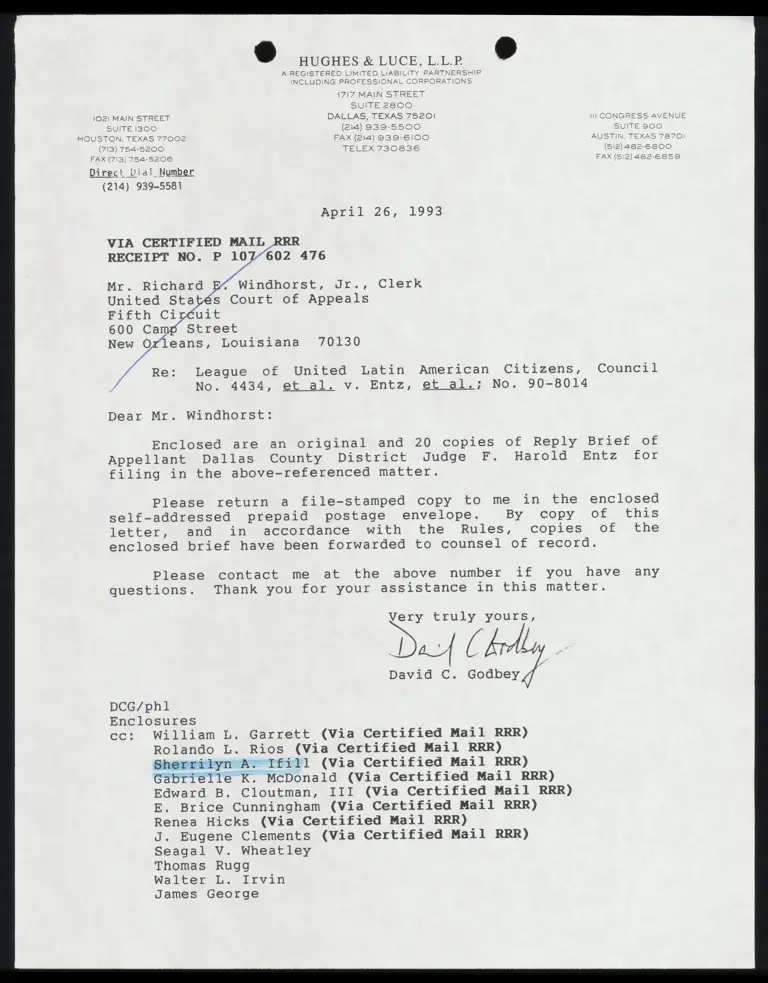
April 26, 1993

VIA CERTIFIED MAIL

RECEIPT NO. P 1077602 476


Mr. Richard

United Sta

{ Windhorst, Jr., Clerk
s Court of Appeals

New O Louisiana 70130

/ Re: League of United Latin American Citizens, Council

NO. 4434, eft al, v. Entz, et.al. Ro. 90-8014

Dear Mr. Windhorst:

Enclosed are an original and 20 copies of Reply Brief of

Appellant Dallas County District Judge F. Harold Entz for

filing in the above-referenced matter.

Please return a file-stamped copy to me in the enclosed

self-addressed prepaid postage envelope. By copy of +this

letter, and in accordance with the Rules, copies of the

enclosed brief have been forwarded to counsel of record.

Please contact me at the above number if you have any

questions. Thank you for your assistance in this matter.

Very truly yours,

Daf (belly.
David C. Godbey

DCG/phl
Enclosures

cc: William L. Garrett (Via Certified Mail RRR)

Rolando L. Rios (Via Certified Mail RRR)

Sherrilyn A. Ifill (Via Certified Mail RRR)
Gabrielle K. McDonald (Via Certified Mail RRR)

Edward B. Cloutman, III (Via Certified Mail RRR)

E. Brice Cunningham (Via Certified Mail RRR)

Renea Hicks (Via Certified Mail RRR)

J. Eugene Clements (Via Certified Mail RRR)

Seagal V. Wheatley
Thomas Rugg
Walter L. Irvin
James George


IN THE UNITED STATES COURT OF APPEALS

FOR THE FIFTH CIRCUIT

No. 90-8014


LEAGUE OF UNITED LATIN AMERICAN
CITIZENS (LULAC), et al.,

Plaintiffs-Appellees,

V.

DALLAS COUNTY DISTRICT JUDGE F. HAROLD ENTZ, et al.,

Defendants-Appellants.


On Rehearing En Banc Following
Remand from the United States Supreme Court


REPLY BRIEF OF APPELLANT DALLAS COUNTY
DISTRICT JUDGE F. HAROLD ENTZ


Robert H. Mow, Jr., P.C.

David C. Godbey
Bobby M. Rubarts

OF HUGHES & LUCE, L.L.P.

1717 Main Street
Suite 2800
Dallas, Texas 75201

(214) 939-5500
901 Main Street

ATTORNEYS FOR
DEFENDANT -APPELLANT
JUDGE F. HAROLD ENTZ

April 26, 1993


IN THE UNITED STATES COURT OF APPEALS

FOR THE FIFTH CIRCUIT

No. 90-8014


LEAGUE OF UNITED LATIN AMERICAN
CITIZENS (LULAC), et al.,


Plaintiffs-Appellees,

V.

DALLAS COUNTY DISTRICT JUDGE F. HAROLD ENTZ, et al.,

Defendants-Appellants.


On Rehearing En Banc Following

Remand from the United States Supreme Court


REPLY BRIEF OF APPELLANT DALLAS COUNTY

DISTRICT JUDGE F. HAROLD ENTZ


Robert H. Mow, Jr., P.C.

David C. Godbey
Bobby M. Rubarts

OF HUGHES & LUCE, L.L.P.

1717 Main Street
Suite 2800
Dallas, Texas 75201

(214) 939-5500
901 Main Street

N
E


E
E


5


B
B


T
O


E
O


B
E


EG
E

E
h


G
E


=


e
e


ATTORNEYS FOR
DEFENDANT-APPELLANT
JUDGE F. HAROLD ENTZ

April 26, 1993


TABLE OF CONTENTS

TABLE OF CONTENTS

TABLE OF AUTHORITIES

I. THE ROLE OF RACE IN RACIALLY

POLARIZED VOTING «ie

A.

B.

The Race of the Candidate Matters

The Role of the Causation Inquiry

11. TEXAS' INTERESTS IN ITS JUDICIAL

SYSTEM ARE COMPELLING .

A.

CONCLUSION.

A Compelling State Interest Can
Preclude a Finding of a Violation

of Section 2

Texas Has a Compelling Interest in

Linking the Geographic Electoral Base

with the Area of a Court's Primary

Jurisdiction

1. Primary Jurisdiction.

2. Linkage Is a Compelling State
Interest. vio viv iv We eee

3. Section 2 Cannot Require
Experimental Voting Systems
Consistently With Federalism.

Texas Has a Strong Interest In

Judicial Independence

CERTIFICATE OF SERVICE.

Page

18

19


TABLE OF AUTHORITIES


CASES

City of Mobile v. Bolden,

446 U.S. 55 (1980)


City of Rome v. United States,
446 U.S. 156 (1980)


Marbury v. Madison,

5'U.8. {1 Cranch) 137 (1803)

Nipper Ys U-Haul 2 J

516 S.W.2d 467 (Tex. Civ. App.--1974 xx writ)


Oregon v. Mitchell,

400 U.S. 112 (1970).


Thornburg v. Gingles,

478 U.S. 30 (19856)


Whitcomb v. Chavis,

403-U.8.. 755 (1971).


STATUTES AND REGULATIONS


U.S. CONST.

Art, Iv, 8 4

V.5 CONST.

amend. V

10

12

14


No. 90-8014


IN THE UNITED STATES COURT OF APPEALS

FOR THE FIFTH CIRCUIT


LEAGUE OF UNITED LATIN AMERICAN

CITIZENS (LULAC), ef al.,

Plaintiffs-Appellees,

Y.

DALLAS COUNTY DISTRICT JUDGE F. HAROLD ENTZ, et al.,

Defendants-Appellants.


REPLY BRIEF OF APPELLANT DALLAS COUNTY

DISTRICT JUDGE F. HAROLD ENTZ

Appellant Dallas County District Judge F. Harold Entz

("Judge Entz") offers this reply brief showing that the

District Court's unprecedented intrusion into the judicial

structure of the State of Texas either misapplied the Voting

Rights Act or exceeded the constitutionally permissible scope

of federal control over intrinsic state functions.

I. THE ROLE OF RACE IN RACIALLY POLARIZED VOTING

The core disagreement between the panel majority and

Judge Higginbotham's dissent 1s the definition of racially

polarized voting. Judge Higginbotham's (and Judge Entz's)

definition requires voting patterns to be polarized according

to the race of the candidate. The panel majority and

plaintiff-appellees suggest that racially polarized voting

occurs simply when voters of one race vote differently than


voters of another race, without regard to the race of the

candidates in the analyzed elections. Under Judge

Higginbotham's and Judge Entz's view of racially polarized

voting, if partisan voting best explains any divergent voting

patterns, this necessarily precludes a finding of racially

polarized voting. Simply, voting patterns are explained by

party affiliation rather than race. Thus, contrary to

plaintiff-appellees’ contention, partisan voting is not

offered as an affirmative defense to proven dilution; rather,

it provides an explanation for divergent voting patterns,

yielded through a searching and practical evaluation of

political reality, that, if applicable, precludes a finding of

racially polarized voting and, thus, precludes a finding of

dilution.

The plaintiff-appellees and amicus Department of Justice

("DOJ") confuse the issue underlying the different views of

racially polarized voting with inflamatory discussions

regarding racial animus, intent, and the role of partisan

voting. Those discussions obscure the controlling question:

Does the race of the candidate matter under section 27 In

light of the history of section 2, case law construing it, and

general constitutional principles, the answer must be yes;

otherwise, section 2 is unconstitutional.

A. The Race of the Candidate Matters


The inquiry begins with City of Mobile Vv. Bolden, 446


U.S. 55 41980). The Supreme Court held that the Fourteenth


and Fifteenth Amendments require a showing of discriminatory

intent and that disparate results in electoral outcomes do not

establish a constitutional violation. The Court also held

that section 2 was coterminous with the Fifteenth Amendment

and therefore also required a showing of discriminatory

intent. Through the 1982 amendments to section 2, Congress

attempted to avoid the Court's holding. Contrary to the

Houston Lawyers' Association's view, see HLA En Banc Brief at

4 n.3, Congress cannot and did not "overrule" City of Mobile


vy. Bolden. See Marbury v. Madison, 5 U.S. (1 Cranch) 137


(1803) (Marshall, C.J.). Rather, it purported to use its

enforcement powers under the Fourteenth and Fifteenth

Amendments to enact a results test.

As Judge Entz stated in his principal brief, he seriously

doubts whether section 2 is a valid exercise of Congress’

enforcement powers. See Judge Entz's En Banc Brief at 32-35.

Assuming for the moment, however, that it was, section 2 must

still fall within the context and scope of that enforcement

power. Stated differently, section 2 must be a reasonable

means or method of addressing the evil the amendments were

designed to prohibit: intentional discrimination on the basis

of race. Plaintiff-appellees cannot avoid the fact that, at

bottom, section 2 can exist only as a remedy designed to

combat intentional discrimination.

This does not mean that the net Congress casts cannot

reach unintentional discrimination. Congress certainly


posseses enforcement powers under the enabling clauses of the

Fourteenth and Fifteenth amendments to regulate what is

otherwise perfectly constitutional behavior if such control is

a reasonable method of promoting the purposes of the

amendment. For this reason, the Supreme Court upheld section

5's preclearance requirement as constitutionally permissible

given Congress' explicit finding that changes to voting

systems in particular southern states often were mere

pretenses for continued intentional exclusion of minorities

from the voting process. City of Rome v. United States, 446


U.S. 156 (1980). But Congress cannot simply enact whatever it

desires in a vaccuum and blithely assert authority under the

Civil War amendments; the statutory approach must be

reasonably calculated to achieve the end sought by the

amendments ms the prevention of intentional racial

discrimination in voting. Oregon v. Mitchell, 400 U.S. 112,

128 (1570).

Under plaintiff-appellees' view of racially polarized

voting, evidence that black voters prefer white Democrat

candidates and white voters prefer black Republican candidates

proves a violation. If Congress so intended, Congress would

necessarily have determined that partisan affiliation is an

appropriate surrogate for intentional racial discrimination.

Aside from the fact that no evidentiary record in the

legislative history supports such a presumed intention, the

enforcement power of the Civil War amendments do not permit


such an illogical leap. Plaintiff-appellees thus confront a

problem: in trying to distance their interpretation of section

2 from any issues relating to intentional discrimination, they

loosened the tether so much that section 2 would have left its

mooring to the Civil War amendments.

The interpretation of racially polarized voting that

Judge Entz offers, on the other hand, would be a reasonable

Congressional surrogate for intentional discrimination. if

voters of different racial groups vote one way when the

candidates are of one race and differently when the candidates

are of a different race, that might well indicate the presence

of discriminatory intent. Although that pattern might reflect

something else -- such as voters preferring candidates who

would promote the interest of their socio-economic class

coupled with racial disparities in the distribution of wealth

—- Congress is entitled under its enforcement powers to make

that approxmation.

Aside from the constitutional considerations in the

inquiry of whether the race of the candidate matters, the

  Supreme Court in Thornburg v. Gingles has indicated that the

race of the candidate matters. 478 U.S. 30 (1986) Judge Entz

will not repeat the vote counting exercise conducted in Judge

Higginbotham's dissent or Judge Wood's Reply Brief. See

Dissent at 28-34; Judge Wood's Reply Brief at 6=0,) Five

Justices voted that the race of the candidate must be part of

the racially polarized voting inquiry.


B. The Role of the Causation Inquiry


Judge Entz will briefly address the role causation plays

in the section 2 analysis. At the risk of belaboring basics,

Judge Entz must distinguish between correlation and

causation. If two events tend to happen together, they are

correlated. A statement that two events (A and B) are

correlated does not imply anything about causation. Event A

may cause Event B, Event B may cause Event A, or some third

factor may cause both. A statement that events are correlated

is merely descriptive, i.e., the events are related; it is not

explanatory and does not purport to say what caused the

relation. Moreover, statistical techniques such as regression

analyses speak only to correlation and say nothing regarding

causation.

Judge Entz has advocated only one burden on section 2

plaintiffs -- that they be required to show a correlation

between voting patterns in racial voting groups and the race

of the candidate, for example, that black voters vote for

black candidates and that white voters do not. Such a showing

provides a mere descriptive statement and does not attempt to

explain why a particular pattern might exist. Specifically,

this evidentiary burden would not require a plaintiff to prove

that white voters do not vote for black candidates due to

racial discrimination. Judge Entz believes that on a proper

evidentiary record Congress could establish as plaintiff's


evidentiary burden a showing that voters cast their votes in

accordance with the race of the candidate, rather than why

they vote that way.

Thus, Judge Entz does not necessarily disagree with

plaintiffs that they need not prove discriminatory intent in

the electorate. Judge Entz does agree with Judge

Higginbotham, however, that the race of the candidate must

matter because the underlying constitutional norm at issue is

one of eliminating racial discrimination in voting. Judge

Entz recognizes that by stating the inquiry in terms of

correlation rather than causation he differs slightly from

Judge Higginbotham's views. The thrust of the position is the

same however: racially polarized voting under section 2 must

relate to the race of the candidate because the underlying

constitutional norm section 2 seeks to promote is the

prevention of intentional discrimination in voting.

A corollary of this view is that demonstrating that

another description of voting patterns, such as partisan

voting, better fits the voters" behavior necessarily

establishes that the voting patterns are not best described as

racially polarized. Thus, if the evidence shows that minority

voters vote for Democratic candidates, regardless of their

race, and most white voters usually vote for Republican

candidates, regardless of their race, then partisan polarized

voting more aptly describes these voting patterns than does

racially polarized voting.


Plaintiff-appellees complain that this inquiry places an

untenable evidentiary burden on them to prove not only the

subjective intent of voters, but also to negate all other

possible explanatory factors. That is not true. First, as

discussed above, this evidentiary burden does not require

plaintiffs to prove why white voters vote against black

candidates, but only to show that, in fact, that happens. A

plaintiff could easily show, for example, that regression

analysis indicates a correlation between the race of the

candidate and the race of the voter. A plaintiff also might

show that within a party, candidates of one race win fewer

votes than candidates of another race.

The supposed dilemma of requiring plaintiffs to disprove

all other possible explanatory factors is easily resolved.

Place the evidentiary burden of showing that factors other

than race better describe voting patterns on the defendants.

Plaintiffs' evidentiary burden would be quite simple: just

show that voters of one race do not vote for candidates of

another race. Then defendants can attempt to show a better

description. The trier of fact would then decide which

proffered description was best.

Judge Entz believes that this view of section 2 comports

with common sense, as well as the Constitution and Supreme

Court decisions. If a (presumed numerical majority) white

electorate is willing to support black Republican candidates

and a white Democrat favored by black voters loses, then


admittedly the candidate preferred by minority voters is not

elected. But the minority community's favored candidate did

not lose because of race, but because of political

affiliation. The Civil War amendments were not intended to

protect against political preferences, but against racial

discrimination in voting. Whitcomb Vv. Chavis, 403 U.S. 75%


(1571).

II. TEXAS' INTERESTS IN ITS JUDICIAL SYSTEM ARE COMPELLING

A. A Compelling State Interest Can

Preclude a Finding of a Violation of Section 2


Plaintiff-appellees argue variously that this Court should

consider the state's interest only in remedy, that this Court

should not weigh the state's interest against the other

factors in the totality of circumstances, or that courts have

always considered the state's interest a factor. Those

positions are wrong. Judge Entz will not duplicate Judge

Higginbotham's discussion of the Supreme Court's Houston

Lawyers,’ opinion, which stated that a court must weigh a

state's interest against factors tending to show dilution and,

moreover, that a state's interest can preclude such a

finding. This Court intended the Zimmer factor of a tenuous

state interest to detect those instances when the purported

state interest was a pretextual sham, disguising a racially

discriminatory motive. Zimmer did not contemplate showing an

affirmative state interest supporting the practice and

weighing against dilution. As Judge Entz stated in his

principal brief, Houston Lawyers' contemplates the possibility


that Texas' interest is compelling. Judge Entz will now

address two such compelling interests that preclude a finding

of dilution.

B. Texas Has a Compelling Interest in Linking

the Geographic Electoral Base with the Area

of a Court's Primary Jurisdiction


1. Primary Jurisdiction. -- Plaintiff-appellees seek to


cloud the state's interest in linkage with numerous

trivialities. Judge Entz acknowledges that Texas' district

judges have judicial power statewide, or statewide

jurisdiction. Nipper v. U-Haul Co., 516 S.W.2d 467, 470 (Tex.


Civ. App. -- 1974 Beaumont, no writ). That expansive judicial

power allows, for example, Dallas County Judge McDowell to

travel to San Antonio pursuant to a change of venue and still

retain judicial authority to conduct Walker Railey's trial in

Bexar County. That the constitutional reservoir of judicial

power expansively reaches statewide, however, does not mean

that the statutory grant to exercise that power, through venue

rules, is equally as expansive.

Texas' venue rules essentially guarantee that if a case is

to be tried in a particular county, it must have a factual

nexus of some type with that county, whether it be that events

pertinent to the dispute took place there, or a criminal

offense occurred in that county, or that a party lives or

conducts business in that county, or the county or city

ordinance at issue would apply there. If a case is pending in

a county, though, almost invariably some connection exists

-10=


with that county and its disposition will affect that county.

Likewise, the decisions of judges sitting in those cases will

touch the lives of the residents of the county.

Plaintiff-appellees and DOJ point to certain limited

exceptions to this general rule that they believe vitiate

Texas' interest in linkage. An elected judge certainly may

request the help of a visiting judge (which still preserves

electoral accountability). Similarly, docket equalization

might result in a transfer of a case. And, theoretically, a

county could vote to subdivide into smaller judicial districts

(even though no county has ever done so and even though that

would still preserve the linkage between electoral

accountability and judicial power). The fact remains,

however, that those hypothetical circumstances happen either

rarely or never.

Plaintiff-appellees and DOJ apparently think that a state

interest, like virginity, exists only in a pure, pristine

state; any transgression and it vanishes forever. That ls

nonsense. By far, the norm in Texas courthouses is that the

cases heard there are connected to and affect the forum county

and thus will be heard by a judge elected by the residents of

that county. This standard procedure exists and it is the

unquestionable policy of the state of Texas to link primary

jurisdiction to the electorate, notwithstanding the occasional

exception.

=11-~


2. Linkage Is a Compelling State Interest, -—- Texas’


policy of linkage flows from fundamental notions of what it

means to be a democracy. Contrary to plaintiff-appellees

strawman, Judge Entz does not justify Texas' interest in

linkage based on the prospect that a voter might someday

become a litigant. Litigants do not have a constitutional

right to vote on the judges before whom they may appear.

Rather, Texas' interest in linkage flows from the right of

citizens to select those elected officials whose job is to

make decisions that affect the area where the citizens live

and, thus, to make those officials accountable to the people

whom they serve. (Although Judge Entz still does not believe

that judges represent their constituents, he does agree that

judges are servants of the people.)

A fundamental principle of democracy teaches that people

are entitled to vote for those elected officials who are

granted decisionmaking authority over the place where they

live. The Guaranty Clause of the Constitution embodies that

principle. Uv.S. Const.:, art." 1V, § 4. Judge Entz is not

saying that people have a right to vote for anybody whose

decisions may affect them; for example, a decision by the

Texas Legislature might affect residents of Louisiana, but

Louisiana residents are not entitled to representation in the

Texas Legislature. The guiding principle is that citizens are

entitled to an electoral voice in the selection of elected

l=


officials charged with decisionmaking authority over the place

those citizens live.

In the case of a multi-member body that makes collegial

decisions, such as a legislature or city council, properly

apportioned single member districts may provide that electoral

voice. In the case of a solo decisionmaker, however, such as

a district judge or a governor, that electoral voice can be

spoken only by permitting all residents to vote in the

election.

The point may be clearer in the context of a single

office, such as the governor. One could conceive of some form

of gubernatorial "time-sharing," in which each of ten regions

across the state in turn elected the governor. Over time all

ten regions would have an equal say in the selection of the

governor, and areas with large minority populations would

escape the dilution of at large gubernatorial elections. Such

a system would be flagrantly unconstitutional, of course,

because at any given time it would disenfrancise 90% of the

electorate in violation of the Guaranty Clause and fundamental

concepts of democracy and due process.

The same disenfranchisement would happen if Dallas County

were divided into 37 mini-districts (or Harris County into 59)

with county-wide primary jurisdiction. The voters would be

disenfranchised from voting in the vast majority of elections

of the judges with decisionmaking authority over their lives.

That is equally as unconstitutional as the gubernatorial


time-sharing example. The fact that it is done multiple times

does not make it constitutional; 37 wrongs don't make a right.

2. Section 2 Cannot Require Experimental Voting Systems


Consistently With Federalism. - Judge Entz notes his


astonishment at DOJ's cavalier suggestion that Texas could

simply divide its counties into numerous mini-districts, for

both elections and jurisdiction, and thus preserve linkage.

DOJ Brief at 23. First, that position reflects a "least

restrictive alternative" analysis created out of whole cloth.

This Court considers whether Texas has a strong reason for its

system, not whether other experimental methods of judicial

election could be devised that might also accommodate that

interest. In that connection, HLA's interest in cumulative

voting in its brief, see HLA Brief at 16, appears pretextual,

since it did not seek such a remedy in its purported

"settlement" with the Attorney General.

Second, DOJ exposes its naive view of the complexity of

the Texas' court system and underestimates the difficulty of

actually implementing its off-the-cuff proposal. Would DOJ

follow the constitutional requirement of a jury pool from the

judicial district in which an offense was committed and

subdivide the jury venire as well? See U.S. Const. amend. V.

Would each mini-district have its own specialized courts? If

not, would different venue lines and jury venires exist for

each type of specialized court? What would happen to

county-wide case administration and docket equalization?

~Y¥4


Development of a working court system that complies with all

constitutional imperatives is not a trivial task. To propose

that this Court require Texas to reinvent its system under the

authority of section 2 in an offhand manner reflects a view of

section 2 that makes a mockery of federalism.

Thus, the State of Texas has a compelling interest in

tying the jurisdictional base of a court to that court's

electoral base. That interest is not only compelling, it is

constitutionally mandated.

C. Texas Has a Strong Interest In Judicial Independence


Texas also justifies its county-wide jurisdiction on the

basis that it preserves judicial independence by striking a

balance between accountability and a large electorate.

Plaintiff-Appellees and DOJ believe they have beaten that

argument by noting that a divided Harris County district would

still be larger than some sparsely populated rural districts.

That counter argument fails for at least three reasons.

First, judicial independence from undue local influence

is a matter of degree. DOJ and plaintiff-appellees seem to

think that there is some magic number of residents that will

secure independence in a district. If the number of residents

exceeds the magic number, surely a judge will be independent;

if the number of residents falls below the magic number,

certainly the judge will be corrupt. That 1s absurd. The

state interest in judicial independence is one of degree that

must be balanced against other competing considerations. The

15


fact remains, however, that the risk of undue influence, or

the risk of public perception of influence, increases as the

size of a district decreases. Texas can reasonably conclude

that in urban counties it needs the additional margin of

protection that county-wide elections will provide.

Second, DOJ's and plaintiff-appellees' response relies on

an unstated assumption that a portion of Houston or Dallas

with a population of 100,000 people poses the identical risks

of undue influence as does an area in west Texas with like

population. Once stated, the assumption's weaknesses seem

apparent. Texas could reasonably assume that an urban area

with its higher crime rates and more complex structures might

pose a greater risk of undue influence per capita than would

idyllic rural areas.

Third, the counterargument assumes that no other factors

affect a legislature's consideration of undue influence and

the size of judicial districts. Thus, they argue, since the

Texas Legislature has created rural districts in sparsely

populated areas with fewer residents than Dallas County, that

establishes a floor population that is safe from undue

influence. But other considerations do affect the size of

judicial districts. In particular, the Texas Legislature

considers geographic proximity to the courthouse and it seems

quite reasonable for the Texas Legislature to determine that

judicial redress must be fairly close to every Texas citizen.

To accommodate that need, some rural districts may have a

~-16~


smaller population than urban districts. As a consequence, of

course, the existence of "local" justice in rural Texas is not

unknown. In urban areas, however, that competing balance of

proximity to the courthouse is not an issue and the Texas

Legislature could reasonably give greater weight to insulating

the judiciary from undue influence.

For these reasons, DOJ's and plaintiff-appellees' counter

argument to the state interest in judicial independence

fails. That state interest strongly supports a finding of no

dilution. Judge Entz must note that DOJ at one time also

viewed Texas interest in judicial independence as

significant: wli1lf Texas consistently elects trial or

appellate judges at-large in order to ensure the appearance of

fairness and impartiality in the judicial process, its

interest may not be just 'strong' but ‘'compelling.’'” Brief

for the United States as Amicus Curiae Supporting Reversal at

17-23, Houston Lawyers' Ass'n v. Attorney General of Texas and


League of United Latin American Citizens v. The Attorney


General of Texas, Nos. 90-813 and 90-974, In the Supreme Court


of the United States, October Term, 1990. Judge Entz suggests

that DOJ's change of heart follows from the intervening change

in administrations and a new policy agenda to promote -- not

from a different conclusion reached after more reflection on

the question.

17


CONCLUSION

Therefore, for the reasons stated, Judge Entz requests

that the en banc Court reverse the decision of the District

Court and render judgment in favor of the defendants.

Respectfully submitted,


Lo WO


Robert H. Mow, Jr., P.C.

David C. Godbey
Bobby M. Rubarts

OF HUGHES & LUCE, L.L.P.

1717 Main Street

Suite 2800
Dallas, Texas 75201

(214) 939-5500

ATTORNEYS FOR DALLAS COUNTY
DISTRICT JUDGE F. HAROLD ENTZ

-l8~


CERTIFICATE OF SERVICE


I certify that I served two copies of the foregoing brief

by certified mail, return receipt requested, on William VL.

Garrett, Garrett, Thompson & Chang, 8300 Douglas, Suite 800,

Dallas, Texas 75225; Rolando Rios, Milam Building, 115 E,

Travis Street, Suite 1024, San Antonio, Texas 78205; Sherrilyn

A. Ifill, NAACP Legal Defense and Educational Fund, Inc., 99

Hudson Street, ith Floor, New ' York, New York 10013;

Gabrielle K. McDonald, Walker & Satterthwaite, 7800 N. Mopac,

Suite 215, Austin, Texas 78759; E@ward B. Cloutman, 111,

Cloutman, Albright & Bower, 3301 Elm Street, Dallas, Texas

75226-1637; Renea Hicks, Office of the Attorney General, P.O.

Box 12548, Capitol Station, Austin, Texas 78711-2548;

J. Eugene Clements, Porter & Clements, 700 Louisiana, Suite

3500, Houston, Texas 77002-2730; E. Brice Cunningham, 777

South R.L. Thornton Freeway, Dallas, Texas 75203; James P.

Turner, Department of Justice, P. O. Box 66078, Washington,

B.C. 20035-6078; Joseph Jamail, Jamail & Kolius, 1 Allen

Center, 500 Dallas Street, Suite 3434, Houston, Texas

77002-4793 in accordance with the Federal Rules of Appellate

Procedure this 26th day of April, 1993.