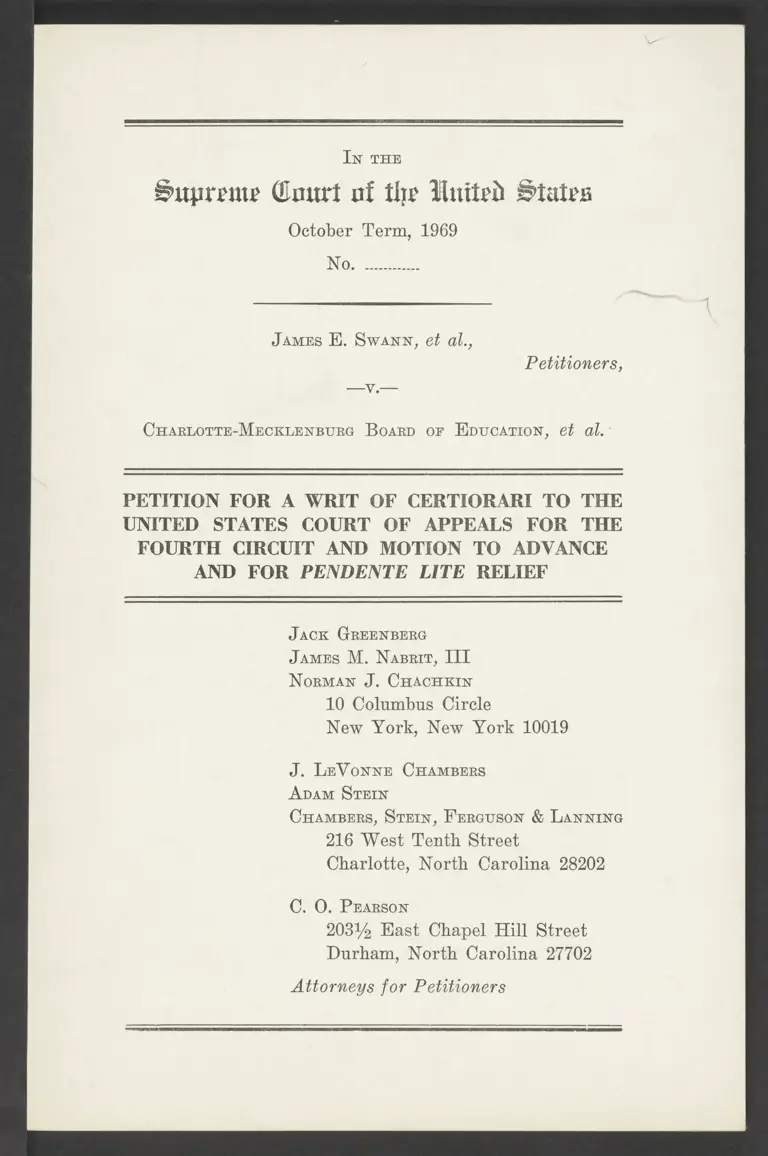
Petition for Writ of Certiorari to the Fourth Circuit and Motion to Advance and for Pendente Lite Relief

Public Court Documents
April, 1970

Petition for Writ of Certiorari to the Fourth Circuit and Motion to Advance and for Pendente Lite Relief preview

62 pages

Date is approximate.

Cite this item

  • Case Files, Swann v. Charlotte-Mecklenburg Working Files. Petition for Writ of Certiorari to the Fourth Circuit and Motion to Advance and for Pendente Lite Relief, 1970. d84b8722-2e34-f111-88b4-0022482cdbbc. LDF Archives, Thurgood Marshall Institute. https://ldfrecollection.org/archives/archives-search/archives-item/7aa1cf2b-c910-499a-bd3c-47e1fae86b80/petition-for-writ-of-certiorari-to-the-fourth-circuit-and-motion-to-advance-and-for-pendente-lite-relief. Accessed June 02, 2026.

    Copied!

     [||110c61e9-5493-4639-91cd-bf49b37bc71d||] Ix THE 

Supreme Court of the Huiten States 

October Term, 1969 


James KE. Swany, ef al., 

Petitioners, 
—V.— 

CHARLOTTE-MECKLENBURG BoarDp or EbucatioN, et al.- 


PETITION FOR A WRIT OF CERTIORARI TO THE 

UNITED STATES COURT OF APPEALS FOR THE 

FOURTH CIRCUIT AND MOTION TO ADVANCE 

AND FOR PENDENTE LITE RELIEF 


JACK (GREENBERG 

James M. Nasrrr, 111 

NormaN J. CHACHKIN 

10 Columbus Circle 

New York, New York 10019 

J. LEVox~E CHAMBERS 

Apam STEIN 

CuamBEers, STEIN, FERGUSON & LANNING 

216 West Tenth Street 

Charlotte, North Carolina 28202 

C. O. Pearson 

203, Kast Chapel Hill Street 

Durham, North Carolina 27702 

Attorneys for Petitioners 


PAGE 

Opmiong Below oon ie aii ae ei. 1 

Jurisdiction... 3 

Questions. Presented oi. .o init datie iliais. 3 

Constitutional Provisions Involved ...................ooceonenee.. 4 

Statement... 4 

LInfroducion ni. i... 4 

2: Proceedings Below... oo... 5 

3. The Charlotte-Mecklenburg County School Sys- 

fem nn 1968-69 . .................. 018 0 9 

4. The Schools Today '......... =.......0 0 LL. 14 

5. The Plan Ordered by the District Court ............ 16 

Reasons for Granting the Writ: 

INtroQUOLION oo coerce icons ces secon asensess sins 24 

INDEX 

I. This Court School Desegregation Decisions 

Support the District Court’s Holding That the 

All-Black and Predominantly Black Schools in 

Charlotte Are Illegally Segregated and Should 

Be Reorganized so That no Predominantly 

Black Schools Remain. The Court of Appeals 

Erred in Substituting a Less Specific Desegre- 

PAtion BOR .....cocceiior sini sniseisssmssesseinsss 27 

A. The Remedial Goals Set by the Courts 

Below ee... eee 27  


il 

PAGE 

B. The Dimensions, Causes, and Results of the 

Dual System in Charlotte—The Nature of 

the Constitutional Violation ...................... 30 

C. The Decision Below Conflicts with Ap- 

plicable Decisions of This Court ............... 34 

II. The Court Below Erred in Not Accepting the 

Distriet Court’s Decision That Its Desegrega- 

tion Plan Was Feasible and in Setting It 

Aside as “Unreasonable,” Particularly in the 

Absence of Any HKqually Kffective and Ex- 

peditions Alternate Plan... .. 40 

CONCLUBION .... coool cain choir inissines tatitsans ons anny 03 

Table of Cases: 

Alexander v. Hillman, 296 U.S. 222 (1933) ... ........ 45 

Alexander v. Holmes County Board of Education, 396 

ES.19(1960) .............. 7,25, 29, 41, 45, 46 

Bell v. Maryland, 378 U.S. 296. (1964) ... ......... ..... 32 

Bell v. School Board of Powhatan County, Va., 321 

2d 494 (4th Cir. 1963) ............ o.oo... 42 

Bowman v. The School Board of Charles City County, 

382 F.2d 326 (1967), rev’d sub nom. Green v. County 

School Board of New Kent County, 391 U.S. 430 

GALE ER Le ATE C0 De LL i ERED 5 

Brewer v. School Board of the City of Norfolk, 397 

P2037 (4th Civ. 1968) ................. LL 33 

Brown v. Board of Education, 347 U.S. 483 (1954) ....24, 25, 

34, 38, 51 

Brown v. Board of Education, 349 U.S. 294 (1955) ....24, 34, 

35, 44, 45, 46 


iil 

PAGE 

Carter v. West Feliciana Parish School Board, 396 

TS. 200 (A070)... es 7,45, 46 

Continental Illinois Nat. Bank & Trust Co. v. Chicago 

BR1L&P.Co,24US. 648 (1933) ......... cco... 44 

Cooper v. Aaron, 338 U.8..1 (1958) .........cccorncirnnns 34, 35, 49 

Dowell v. Board of Education, 244 F. Supp. 971 (W.D. 

Okla. 1965), affirmed, 375 F.2d 158 (10th Cir. 1967), 

coft. denied, 387 U.S, 931 (1967) .................. 32, 36, 42 

Dowell v. Board of Education of the Oklahoma Public 

Schools, 3906 U.8.°269 (1969) ..... i... 7, 45, 46 

Eason v. Buffaloe, 198 N.C. 520, 142 S.E. 496 (1930) .... 32 

Green v. County School Board of New Kent County, 

391 U.S. 430 (A968) co... 6, 29, 35, 37, 
38, 43, 45, 46 

Griffin v. School Board, 377 U.S, 218 (1964) ............... 45, 50 

Henry v. Clarksdale Municipal Separate School Dist., 

409 1.24 682 «(5th Cir. 1969) onli 36 

Holland v. Board of Public Instruction of Palm Beach 

County, 258 F.2d 730 (5th Cir. 1958) ................ 32, 36 

In the Matter of Peterson, 253 U.S. 300 (1920) ............ 42 

Keyes v. School District Number One, Denver, 303 F. 

Supp. 279 (D. Colo. 1969), stay vacated, 396 U.S. 

1213. (1969) o.oo eet aise sine 36 

Monroe v. Board of Commissioners, 391 U.S. 450 

QUOBRY ein ti rir ss sistsiaia suena eet cnsnbusies 6, 25 

Nesbit v. Statesville City Board of Education, 418 F. 

24 1040 (4th Cir. 1969) ........... cocci rcencens 7 


| 

| 
i 
I | 
| 


1v 

PAGE 

Northeross v. Board of Edueation, 397 U.S. 232 

(ITT0) i i di ii As via bien 36, 46 

Phillips v. Wearn, 226 N.C. 290, 37 S.E.2d 895 (1946) 32 

Raney v. Board of Education, 391 U.S. 443 (1968) ........ 6 

Rogers v. Hill, 239 U8, 582 (1033) ei 44 

Scott v. Spanjer Bros., Inc., 298 F.2d 928 (2nd Cir. 

{LUE a EE La ee 42 

Shelley v, Kraemer, 334 US. 1 (1948)... 32 

Swann v. Charlotte-Mecklenburg Board of Kducation, 

243 TF. Supp. 667 (W.D. N.C. 1963), affirmed, 369 

P2020 (4th Cir. 1986) ............ ier: 1 

United States v. Corrick, 298 1.8, 435 (1936) ................ 44 

United States v. Greenwood Municipal Separate School 

District, 406 P.24 1086 (5th Cir. 1969) ................... 36 

United States v. Indianola Municipal Separate School 

District, 410 F.2d 626 (6th Cir. 1969) .......................... 36 

United States v. Montgomery County Board of Educa- 

tion, 390 US. 225 (1969) ......... cio 46 

United States v. W. T. Grant, 345 U.S. 629 (1953) ........ 44 

Vernon v. R. J. Reynolds Realty Co., 226 N.C. 58, 36 

SK24 710 C1048)... en 32 

Statutes: 

8 UU B.0, S41 cele cists serinisie 4 

98 U.S.C SUIBA(1) o.oo io iene ccnesiivnsssmsncisiines 3 

MBUS.C. $1343... ie eee 5 

OUSCaIes 5 


PAGE 

Other Authorities: 

McCormick, Some Observation Upon the Opinion Rule 

and Expert Testimony, 23 Texas L. Rev. 109 (1945) 42 

“On the Matter of Busing: A Staff Memorandum from 

the Center for Urban Education”, February 1970 .... 52 

1969 Report of the Governor’s Study Commission on 

the Public School System of North Carolina _........... 23 

Ble RN Ped B. Crim PL 1BURC, 49 

Statement of the United States Commission on Civil 

Rights Concerning the “Statement by the President 

on Elementary and Secondary School Desegrega- 

tion, April 12,1970... ..... a... 39, 53 

9 Wigmore, Evidences, $563 .........omeeonieicnisnins 42 

9 Wiomore, Evidence, § 2484... NL 42 

R
N
 
T
R
 

=
—
—
—
—
=
=
=
=
—
—


Ix THE 

Supreme Court of the United States 
October Term, 1969 

No. 


James E. SwaNN, et al., 

Petitioners, 
—_V.— 

CrARLOTTE-MECKLENBURG BoarDp or EbpucatioN, et al. 


MOTION TO ADVANCE AND FOR 

PENDENTE LITE RELIEF 

Petitioners respectfully move that the Court advance its 

consideration and disposition of this case. It presents 

issues of national importance which require prompt reso- 

lution by this Court for the reasons stated in the annexed 

petition for a writ of certiorari. It would be desirable for 

the issues to be decided before the beginning of the next 

school term in September 1970 in order to guide the many 

courts and school boards now making plans for the coming 

year and to reduce somewhat the possible necessity for 

reorganizations of systems after the 1970-71 school term 

is underway. 

Wherefore, petitioners pray that the Court: 

1. Advance consideration of the petition for writ of 

certiorari and any cross-petition' or other response thereto 

1 On June 8, 1970, the Charlotte-Mecklenburg Board of Educa- 
tion voted in a public meeting to file a petition for certiorari 
seeking review of the decision below. We believe the board also 
desires expeditious consideration of its views. 


2 

during the current term, or if need be during the Court’s 

vacation or such special or extended term as may be con- 

venient ; 

2. If the Court determines to grant the petition for 

certiorari, arrange such procedures as will permit prompt 

decision on the merits as the Court may deem appropriate, 

including either summary disposition without argument? 

or a special term for argument.®? If the Court decides to 

hear argument, it is suggested that the Court consider the 

case on the original record without printing or alternatively 

to permit reproduction of the appendix record used in 

the court of appeals by other than standard typographic 

means. 

Petitioners also seek pendente lite relief pending dis- 

position of the petition for certiorari comparable to that 

granted by the Court in Carter v. West Feliciana Parish 

School Board, 396 U.S. 226 (1969), and companion cases, 

namely, an order providing in substance that: 

(1) The respondents shall take such preliminary steps 

as may be necessary to prepare for the complete and timely 

implementation of the district court’s order of February 5, 

1970, as amended by the district court, in the event this 

Court should uphold the district court order on the merits; 

and 

2 Comparable issues have been decided without the necessity for 
argument in such cases as Bradley v. School Board, 382 U.S. 103 
(1965) ; Rogers v. Paul, 382 U.S. 198 (1965) ; Dowell v. Board of 
Education, 396 U.S. 269 (1969); Carter v. West Feliciana Parish 
School Board, 396 U.S. 290 (1970) ; Northeross v. Board of Educa- 
tion, 397 U.S. 232 (1970). 

3 In 1957 the Court extended its term to hear arguments during 
July. Wilson v. Girard, 354 U.S. 524 (1957). Special terms were 
convened to consider Cooper v. Aaron, 358 U.S. 1 (1958) ; Rosen- 
berg v. United States, 346 U.S. 273 (1953) ; and Ez parte Quirin, 
317 U.S. 1 (1942). 


3 

(2) The respondents shall take no steps which are in- 

consistent with or will tend to prejudice or delay full im- 

plementation of the February 5 order as amended at the 

beginning of the next school term.   Such an order is obviously necessary to avoid the possi- 

bility that the passage of time while the case is being 

reviewed here will unnecessarily prejudice the substantive | 

rights of petitioners to attend a unitary system “at once”. 

Alexander v. Holmes County Board of Education, 396 U.S. ! 

19 (1969). 

i 

| 

Respectfully submitted, 

JACK (GREENBERG 

James M. Nasrrr, 111 

NorMAN J. CHACHKIN 

10 Columbus Circle 

New York, New York 10019 

J. LEVoxxe CHAMBERS 

ApaM STEIN 

CmamBERs, STEIN, FERGUSON & LANNING 

216 West Tenth Street 

Charlotte, North Carolina 28202 

C. O. Pearson 
20314 East Chapel Hill Street 

Durham, North Carolina 27702 

Attorneys for Petitioners 


IN THE 

Supreme Court of the United States 
October Term, 1969 

No... 


James E. SwANN, ef al., 

Petitioners, 
-—V— 

CHARLOTTE-MECKLENBURG BoArp or EbucatioN, ef al. 


PETITION FOR A WRIT OF CERTIORARI TO THE 

UNITED STATES COURT OF APPEALS 

FOR THE FOURTH CIRCUIT 

Petitioners pray that a writ of certiorari issue to review 

the judgment of the United States Court of Appeals for 

the Fourth Circuit, entered in the above entitled case on 

May 26, 1970. 

Opinions Below 

The opinions of the courts below directly preceding this 

petition! are as follows: 

1. Opinion and order of April 23, 1969, reported at 300 

F. Supp. 1358 (Appendix hereto 1a).? 

t Earlier proceedings in the same case are reported as Swann Vv. 
Charlotte-Mecklenburg Board of Education, 243 F. Supp. 667 
(W.D.N.C. 1965), affirmed 369 F.2d 29 (4th Cir. 1966). 

2 The appendix of opinions below is printed in a separate volume 
because it is voluminous. 


10, 

11. 

16. 

17. 

18. 


2 

Order dated June 3, 1969, unreported (40a). 

Order adding parties, June 3, 1969, unreported 
(44a). 

Opinion order of June 20, 1969, reported at 300 F. 

Supp. 1381 (46a). 

Supplemental Findings of Fact, June 24, 1969, 300 

F. Supp. 1386 (57a). 

Order dated August 15, 1969, reported at 306 F. 

Supp. 1291 (58a). 

Order dated August 29, 1969, unreported (72a). 

Order dated October 10, 1969, unreported (75a). 

Order dated November 7, 1969, reported at 306 F. 

Supp. 1299 (80a). : 

Memorandum Opinion dated November 7, 1969, re- 

ported at 306 F. Supp. 1301 (82a). 

Opinion and Order dated December 1, 1969, reported 

at 306 F. Supp. 1306 (93a). 

. Order dated December 2, 1969, unreported (112a). 

. Order dated February 5, 1970, unreported (113a). 

Amendment, Correction, or Clarification of Order 

of February 5, 1970, dated March 3, 1970, unreported 

(134a). 

Court of Appeals Order Granting Stay, dated March 

9, 1970, unreported (135a). 

Supplementary Findings of Fact dated March 21, 

1970, unreported (136a). 

Supplemental Memorandum dated March 21, 1970, 

unreported (159a). 

Order dated March 25, 1970, unreported (177a). 


3 

19. Further Findings of Fact on Matters raised by 

Motions of Defendants dated April 3, 1970, unre- 

ported (181a). 

20. The opinions of the Court of Appeals filed May 26, 

1970, not yet reported, are as follows: 

a. Opinion for the Court by Judge Butzner (184a). 

b. Opinion of Judge Sobeloff (joined by Judge 

Winter) concurring in part and dissenting in 

part (201a). 

c. Opinion of Judge Bryan dissenting in part 

(215a). 

d. Opinion of Judge Winter (joined by Judge 

Sobeloff) concurring in part and dissenting in 

part (217a). 

21. The judgment of the Court of Appeals appears at 

226a. 

22. The opinion of a three-judge district court in an 

ancillary proceeding in this case dated April 29, 

1970, not yet reported, appears at 227a. 

Jurisdiction 

The judgment of the Court of Appeals was entered on 

May 26, 1970 (226a). The jurisdiction of this Court is 

invoked under 28 U.S.C. Section 1254 (1). 

Questions Presented 

1. Whether the trial judge correctly decided he was 

required to formulate a remedy that would actually in- 

tegrate each of the all-black schools in the northwest 

quadrant of Charlotte immediately, where he found that 


4 

government authorities had created black schools in black 

neighborhoods by promoting school segregation and hous- 

ing segregation. 

2. Whether, where a district court has made meticulous 

findings that a desegregation plan is practical, feasible and 

comparatively convenient, which are not found to be clearly 

erroneous, and the plan will concededly establish a unitary 

system, and no other acceptable plan has been formulated 

despite lengthy litigation, the Court of Appeals has discre- 

tion to set aside the plan on the general ground that it 

imposes an unreasonable burden on the school board. 

Constitutional Provisions Involved 

This case involves the Equal Protection Clause of the 

Fourteenth Amendment to the Constitution of the United 

States. 

Statement 

1. Introduction 

Petitioners are here seeking review of an en banc® deci- 

sion of the United States Court of Appeals for the Fourth 

Circuit setting aside certain portions of an order of District 

Judge James B. McMillan of the Western District of North 

Carolina which had required the complete desegregation 

of the Charlotte-Mecklenburg County public school system. 

Three members of the court, in a plurality opinion written 

by Judge Butzner, agreed with the lower court that the 

school board had an affirmative duty to employ a variety 

3 One judge did not participate. Prior to argument, Judge 
Craven entered an order disqualifying himself. He had sat and 
decided the case as a district judge when it first came to trial in 
1965 (243 F. Supp. 667) and was of the opinion that this previous 
participation barred him from hearing the case as a circuit judge. 
28 U.S.C. § 47. 


5 

of available methods, including busing, to disestablish its 

dual school system, but thought that the extent of busing 

required by the district court to desegregate the elementary 

schools was unreasonable (184a). Judges Sobeloff and 

Winter viewed Judge McMillan’s decision as appropriate 

and would have affirmed (201a, 217a). Judge Bryan who 

would have reversed the entire order expressed disapproval 

of busing to achieve racial balance which he found the 

order to require for junior and senior high school students 

as well as elementary. 

2. Proceedings Below 

Black parents and students brought this action in 1965 

to desegregate the consolidated school district of Charlotte 

City and Mecklenburg County, North Carolina pursuant 

to 28 U.S.C. §1343 and 42 U.S.C. §1983. The North 

Carolina Teachers Association, a black professional or- 

ganization intervened seeking desegregation on behalf of 

the black teachers in the school system. This current phase* 

* The case was first tried in the summer of 1965. (243 F. Supp. 
667 (1965)) The plaintiffs challenged an assignment plan where 
initial assignments were made pursuant to geographic zones from 
which students could transfer to schools of their choice. Plaintiffs 
complained that many of the zones were gerrymandered and that 
the zones of ten rural and concededly inferior black schools which 
the board claimed would be abandoned within a year or two over- 
lapped white school zones. They also attacked the free transfer 
policy which had resulted in the transfer of every white child ini- 
tially assigned to black schools as had the previous minority to 
majority transfer policy. Underlying plaintiffs’ specific grievances 
was their general assertion that the Constitution required the 
school board to take active, affirmative steps to integrate the schools. 
Also under attack was the board’s policy looking to the “eventual” 
non-racial employment and assignment of teachers. 

The district court approved the assignment plan but required 
“immediate” non-racial faculty practices. 

The court of appeals affirmed. (369 F.2d 29 (1966)) The deci- 
sion noted that the 10 black schools had in fact been closed. The 
court held, as it did the following year in Bowman v. The School 
Board of Charles City County, 382 F.2d 326 (1967), rev’d sub nom. 
Green v. County School Board of New Kent County, 391 U.S. 430 
(1968), that the school board had no affirmative duty to disestab- 
lish the dual system. 


6 

of the litigation began in 1968 when the plaintiffs, relying 

upon the Green trilogy,” again sought the desegregation 

of the schools. 

District Judge James B. McMillan first heard testimony 

in March, 1969 and entered his initial opinion the following 

month (300 F. Supp. 1358; 1a) judging the school system 

to be illegally segregated and requiring the board to submit 

a plan for desegregation. HExtensive proceedings followed 

over the next twelve months. He rejected the first plan 

submitted and called for another, found the second plan 

inadequate but accepted it as an interim measure for the 

1969-70 school year, again required a new plan which after 

review was also found unacceptable.” On December 1, 1969, 

> Green v. County School Board of New Kent County, 391 U.S. 
430 (1968); Monroe v. Board of Commassioners, 391 U.S. 450 
(1968) ; and Raney v. Board of Education, 391 U.S. 443 (1968). 

§ Judge McMillan has provided an excellent summary of the pro- 
ceedings in the district court in his Supplemental Memorandum of 
March 21, 1970 (159a). 

"The first plan was rejected on June 20, 1969 (46a). The court 
found that the board had sought from the staff a “minimal” and in- 
adequate plan, that the staff produced such a plan and the board 
thereupon eliminated its only effective provisions before submitting 
it to the court. 

The second plan was found inadequate on August 15, 1969 (58a) 
but was accepted for the 1969-70 school year only because it prom- 
ised some measure of desegregation and the court felt there was 
not sufficient time prior to the opening of the new school term for 
the development and implementation of a more effective plan. The 
failure of the board to accomplish what the plan had promised was 
determined on November 7, 1969 (82a). 

The third plan was not a plan at all, but simply a statement of 
guidelines as to how the board intended to produce a plan. The 
guidelines promised no particular results and were thus rejected 
on December 1, 1970 (93a). 

Judge Sobeloff traces this history in an extensive footnote (213a, 
n. 9). He concludes “[T]he above recital of events demonstrates 
beyond doubt that this Board, through a majority of its members, 
far from making ‘every reasonable effort’ to fulfill its constitutional 
obligation, has resisted and delayed desegregation at every turn.” 


7 

following the court’s patient but unavailing efforts to secure 

from the board an acceptable desegregation plan, the failure 

of the board to carry out its minimal interim plan for 1969- 

70 which had been “reluctantly” accepted by the Court in 

August of 1969 and the mandate of Alexander v. Holmes 

County Board of Education, 396 U.S. 19, that schools are 

to be desegregated “at once”, Judge McMillan decided to 

seek assistance from an outside educational consultant to 

assist him in devising a unitary system (93a). The follow- 

ing day the court appointed Dr. John A. Finger, Jr. a 

Professor of Education at Rhode Island College who was 

directed to work with the administrative staff to prepare a 

plan for the court’s consideration (112a). The board was 

invited again to submit another plan (93a). 

On January 20, 1970, plaintiffs requested that Dr. Finger 

bring in his plan so that the schools could be desegregated 

“at once”.! The Finger plan and a fourth board plan were 

filed with the court in early February. Judge McMillan 

held further hearings and entered an order on February 5 

8 Plaintiffs’ request followed the controlling decisions in Alez- 
ander v. Holmes County Board of Education, 396 U.S. 19 (1969) ; 
Dowell v. Board of Education of the Oklahoma City Public Schools, 
396 U.S. 269 (1969) ; Carter v. West Felictana Parish School Board, 
396 U.S. 290 (1970) ; and Nesbit v. Stateswille City Board of Educa- 
tion, 418 F.2d 1040 (4th Cir. 1969). 

This was not the first request by plaintiffs for immediate relief. 
In September of 1969 the plaintiffs’ motion for a finding of con- 
tempt and for immediate desegregation had led to the court’s find- 
ing in November that the board had not accomplished, during the 
1969-70 school year, what it had been ordered to do (80a). 

The plaintiffs were required to file a variety of other motions as 
well, such as motions for contempt, objections to patently defective 
plans, motions enjoining school construction, motions to vacate 
state court orders, motions to add new defendants and motions to 
enjoin state officials from interfering with orders of the court. 
Despite these and other efforts in the district court, the court of 
appeals and this Court, the schools are no more desegregated now 
than in September 1968 when this round of litigation commenced. 


8 

directing the desegregation of the students and teachers 

of the elementary schools by April 1, 1970, and of the junior 

and senior high schools by May 4, 1970 (113a).® The order 

was based upon the plan submitted by the board and Dr. 

Finger. 

The school board appealed and sought a stay in the court 

of appeals. On March 5, 1970, the court of appeals stayed 

a portion of the order relating to.the elementary schools 

and directed that the district court make additional find- 

ings concerning the cost and extent of the busing required 

by the February 5 Order (135a). The plaintiffs applied to 

this Court to have the partial stay rescinded; the appli- 

cation was denied. 

The district court received additional evidence pursuant 

to the directives of the court of appeals and entered a 

supplemental Memorandum (159a) and Supplemental Find- 

ings of Fact (136a) on March 21, 1970.1° 

? The order was slightly modified on March 3, 1970 (134a). 

1» The supplemental findings were amended in certain respects on 
April 3, 1970, in response to a motion by defendants (181a). 

During this period there were also proceedings concerning the 
North Carolina anti-busing law : 

“In June of 1969, pursuant to the hue and ery which had 
been raised about ‘bussing,” Mecklenburg representatives in the 
General Assembly of North Carolina sought and procured pas- 
sage of the so-called ‘anti-bussing’ statute, N.C.G.S. 115-176.1 
[supp. 1969]” (161a). 

Plaintiffs were granted leave to file a supplemental complaint in 
July, 1969 and to add the State Board of Education and State 
Superintendent of Public Instruction as defendants to attack the 
statute. At that time the statute did not appear to the court to be 
a barrier to school desegregation (see 58a, 64a). 

However, in the spring of 1970, the Governor and other state 
officials directed that no public funds were to be expended for the 
transportation of students pursuant to the district court order of 
February 5 and several state judges issued ex parte orders of 
similar effect acting under color of the state statute. (See 277a, 
229a-230a.) (Continued on p. 9) : 


9 

The opinions and judgment of the court of appeals were 

filed on May 26, 1970. The court decided by a vote of 4 to 2 

to vacate and remand the judgment of the district court 

for further proceedings. A majority for the judgment was 

created by the vote of Judge Bryan joining with the three 

members of the court subscribing to the plurality opinion 

written by Judge Butzner, although Judge Bryan dissented 

from the views expressed in the plurality opinion.* 

3. The Charlotte-Mecklenburg County School System 
in 1968-69 

The plaintiffs presented to the district court detailed 

evidence about the school system, such as the number and 

location of the schools, the grades served, the kinds of 

programs offered, the achievement of the students in the 

different schools, the racial distribution of students and 

faculties in the system, and the changes which had oc- 

curred over the years. The plaintiffs also showed by expert 
  

At the plaintiff’s request Judge McMillan added the Governor, 
other state officials and one group of state court plaintiffs as defen- 
dants and determined at that point that the constitutionality of the 
state statute was at issue. He therefore requested and the Chief 
Circuit Judge appointed a three-judge court. The court convened 
in Charlotte on March 24 and on April 29, 1970, the court entered 
its decision (227a) declaring unconstitutional the portions of the 
statute prohibiting the assignment of any student “on account of 
race, creed, color or national origin, or for the purpose of creating 
a balance or ratio of race, religion or national origins,” the “in- 
voluntary bussing of students in contravention of [the statute]” 
and the use of “public funds . . . for any such bussing.” The 
court, however, denied plaintiffs’ prayer for injunctions. 

11 The judgment was vacated in its entirety. Judge Butzner’s 
reason for this action was to give greater flexibility to the develop- 
ment of a new elementary plan. Judges Winter and Sobeloff thought 
it was improper to invite the reconsideration of the portions of 
the plan already found acceptable. The judgment expressed Judge 
Bryan’s hope that “upon re-examination the District Court will 
find it unnecessary to contravene the principle stated . . .” in his 
dissent. 


10 

testimony the rigid racial segregation of the population in 

Charlotte and in Mecklenburg County and its causes. 

The court carefully analyzed the voluminous evidence 

before it. Over the course of the litigation below, the dis- 

trict court made extensive findings of fact.’? Each succeed- 

ing order reflects a comprehensive analysis of new submis- 

sions of evidence by the parties and the cumulative evidence 

already before the court. The court of appeals has ac- 

cepted the district court’s findings (184a). 

Judge McMillan’s first opinion on April 23, 1969, gave 

a detailed description of the school system, the community 

which it serves and the extent of racial segregation within 

the schools (1a). We only summarize here some of the 

salient facts contained in the April opinion. 

During the 1968-69 school year, students were assigned 

to the schools under the same plan as approved by the 

district court in 1965—initial assignments by geographic 
zones with freedom of transfer restricted only by school 
capacities. 

The Charlotte-Mecklenburg school system serves more 

than 84,000 pupils residing in the city of Charlotte and 

Mecklenburg County. In April, 1969, there were 107 schools, 

including 76 elementary schools (grades 1-6), 20 junior 

high schools (grades 7-9) and 11 senior high schools (grades 
10-12). The system employed approximately 4,000 teachers 
and nearly 2,000 other employees. The racial composition 

of the students in the system was approximately 71% white 

12 Signicant findings are contained in eight of the orders leading 
to this appeal : Opinion and Order, April 23, 1969 (1a); Opinion 
and Order, June 20, 1969 (46a) ; Order, June 24, 1969 (57a) ; Order, 
August 15, 1969 (58a) ; Memorandum Opinion, November 1 1969 
(32023 Opinion and Order, December 1, 1969 (93a) ; Order, Febru- 
ary 1970 (113a) ; Supplemental Findings of Fact, March 21, 
1970 *t136a) ; and Further Findings, ete. (181a). 


11 

and 29% black. The residential patterns of the county were 

sufficiently integrated so that most of the county school 

zones included both black and white students. No all-black 

schools remained in the County. In the City, however, the 

residential areas were and are generally segregated by 

race,’ and most schools were racially identifiable. 

The court found that 14,000 of the 24,000 black students 

in the system were attending schools which were at least 

99% black. The court further found that most of the de- 

segregated city schools were in transition from a previously 

all-white enrollment to all-black.* 

The school system had been growing at approximately 

3,000 students per year, requiring an on-going school con- 

struction program. With few exceptions, the size and place- 

ment of the recently constructed schools produced either 

all-white or all-black new schools.* 

13 Most of the evidence concerning residential segregation was 
produced at the March 1969 hearings. The April order describes 
the housing patterns and some of the forces which created them. 
The matter was examined again in subsequent orders, particularly 
the Order of November 7, 1969 (82a). The court’s conclusion was 
that housing segregation in Charlotte has been substantially deter- 
mined by governmental action. 

14 In June, after further analysis of the data, the court concluded 
that approximately 21,000 of the 24,000 black students in the system 
lived within the city of Charlotte and that nearly 17,000 of them 
were attending black or nearly all-black schools. The figure is even 
greater if the black students attending schools which are rapidly 
becoming all-black are included. 11 schools served 5,502 white 
pupils and no black pupils in 1954, served 5,010 pupils of which 
35% were black in 1965 and in 1968 served 5,757 students, 
81% of whom were black. The court also found that nearly 
19,000 of the more than 31,000 white elementary students attended 
schools which were nearly all-white. (There are only 150 black 

students attending these schools.) More than one-half of the 14,741 
white junior high school students attend schools with a total 
black population of 193 (50a). 

15 The new black schools were generally “walk-in” schools while 
the white schools were placed some distance from the areas which 
they serve (14la; 142a). 


12 

The court found faculties segregated. The great ma- 
jority of the 900 black teachers were teaching in black 
schools. There was less than one white teacher per black 
elementary school. The two black high schools had teach- 
ing staffs more than 90% black. 

The court concluded that the board’s policies of zoning, 
free transfer and its school placement had contributed 
to and continued an unlawfully segregated public school 
system. It also concluded that the faculties had not been 
desegregated as required by the 1965 order. The board 
was directed to produce plans for the active desegregation 
of the pupils and faculties by May 15, 1969. 

On appeal, Judge Butzner agreed that the system was 

unlawfully segregated in April of 1969: 

“Notwithstanding our 1965 approval of the school 
board’s plan, the district court properly held that the 
board was operating a dual system of schools in the 
light of subsequent decisions of the Supreme Court . ..” 
(184a, 185a-186a).1¢ 

The district court further found that the impact of 
segregation on black students in the system had resulted 
in the denial of equal educational opportunities. Compara- 
tive test results showed a wide disparity in achievement 
between students attending all-black schools and students 
attending white and integrated schools (58a, 65-a-68a, 93a, 
97a-99a, 136a, 144a-145a). 

The court also found that the residential segregation 
was far from benign or de facto. The school board by gerry- 
mandering zone lines (53a-54a) and other practices, to- 
gether with the activities of other governmental agencies, 
had a significant impact upon the creation of Charlotte’s 

6 Both Judges Sobeloff and Winter concurred in this conclusion 
(201a, 217a). 


13 

ghetto. Again, the three circuit judges subscribing to the 

plurality opinion and Judges Sobeloff and Winter con- 

curred in these findings. As Judge Butzner summarized: 

The district judge also found that residential pat- 

terns leading to segregation in the schools resulted in 

part from federal, state, and local governmental action. 

These findings are supported by the evidence and we 

accept them under familiar principles of appellate re- 

view. The district judge pointed out that black resi- 

dences are concentrated in the northwest quadrant of 

Charlotte as a result of both public and private action. 

North Carolina courts, in common with many courts 

elsewhere, enforced racial restrictive covenants on real 

property [footnote omitted] until Shelley v. Kraemer, 

334 U.S. 1 (1948) prohibited this discriminatory prac- 

tice. Presently the city zoning ordinances differentiate 

between black and white residential areas. Zones for 

black areas permit dense occupancy, while most white 

areas are zoned for restricted land usage. 

The district judge also found that urban renewal pro- 

jects, supported by heavy federal financing and the 

active participation of local government, contributed 

to the city’s racially segregated housing patterns. The 

school board, for its part, located schools in black 

residential areas and fixed the size of the schools to 

accommodate the needs of immediate neighborhoods. 

Predominantly black schools were the inevitable result 

(186a).1" 

17 In addition to the activities of the governmental agencies pro- 
ducing the discriminatory zoning (13a, 167a) and the urban re- 
newal program (13a, 167a) mentioned by Judge Butzner, there was 
substantial evidence showing that long range planning by the City 
Council projects present segregation into the future (167a), that 
public housing officials had overtly discriminated until recent years 
and has reenforeed racial segregation by its site selection (167a) 
and that those officials responsible for planning and building streets 
and highways have created racial barriers. 


4. The Schools Today 

During the 1969-70 school year the schools were operated 

under a desegregation plan submitted to the court in July 

1969. The plan provided for the transportation of 4,245 

inner-city black students to outlying white schools. Of these 

children 3,000 were to come from 7 schools which were being 

closed and 1,245 from overcrowded black schools. The plan 

proposed some further faculty desegregation but would 

retain all other racially discriminatory features of the 

school system. The board did propose, however, to study 

its building programs and such measures as altering at- 

tendance lines, pairing, clustering and other techniques in 

order to develop a comprehensive desegregation proposal 

for the future. 

The plaintiffs objected to the plan on the grounds that 

it left many schools segregated for yet another year and 

placed the full burden of desegregation upon black children. 

The court, in an order entered on August 15, 1969 (58a), 

approved the proposed pupil reassignments for the 1969- 

70 school year “only (1) with great reluctance, (2) as a 

one year temporary arrangement and (3) with the distinet 

reservation that ‘one-way bussing’ plans for the years after 

1969-70 will not be acceptable.” The board was ordered 

to file a third plan by November 17, 1969, “making full 

use of zoning, pairing, grouping, clustering, transportation 

and other techniques . .. having in mind as its goal for 

1970-71 the complete desegregation of the entire system to 

the maximum extent possible.” 8 

Upon application of defendants, the court modified the 

August 15 order on August 29 to allow for the reopening 

8 The board explicitly refused to follow these directives. Each 
of the next two plans submitted by the board rejected the tech- 
niques of “pairing, grouping [and] clustering”. See n. 20, infra. 


15 

of a black inner-city school to serve up to 600 inner-city 

children who chose not to be transported to suburban white 

schools (72a). 

The plan did not accomplish what was expected. The 

court later found that “the ‘performance gap’ is wide” 

(84a). 

In substance, the plan which was supposed to bring 

4,245 children into a desegregated situation had been 

handled or allowed to dissipate itself in such a way 

that only about one-fourth of the promised transfers 

were made; and as of now [March 21, 1970] only 767 

black children are actually being transported to 

suburban white schools instead of the 4,245 advertised 

when the plan was proposed by the board (164a). 

In the November, 1969 Memorandum Opinion the court 

set out in detail the racial characteristics of the school 

system during the 1969-70 school year (82a, 83a-88a). The 

court concluded that there had been no real improvement 

from the segregated situation found during the previous 

school year. 

Of the 24,714 Negroes in the schools, something 

above 8,500 are attending “white” or schools not 

readily identifiable by race. More than 16,000, how- 

ever, are obviously still in all-black or predominantly 

black schools. The 9,216 in 100% black situations are 

considerably more than the number of black students 

in Charlotte in 1954 at the time of the first Brown 

decision. The black school problem has not been 

solved. 

The schools are still in major part segregated or 

“dual” rather than desegregated or “unitary.” (86a). 

Analyzing the same figures in a later order, the court 

pointed out that “Nine-tenths of the faculties are still  


16 

obviously ‘black’ or ‘white.’ Over 45,000 of the 59,000 white 

students still attend schools which are obviously white.” 

(93a, 97a). 

The court also determined that the free transfer provi- 

sion in the board’s plan negated any progress which the 

July plan might have produced.® It also found that 

attempts to desegregate the schools by altering attendance 

lines would continue to fail as long as students could 

exercise a freedom of choice (87a-88a). 

The court of appeals shared Judge McMillan’s view that 

the system was still segregated during the 1969-70 school 

year (188a). 

5. The Plan Ordered by the District Court 

In the decision of December 1, 1969, in which the court 

announced than an educational consultant would be ap- 

pointed, 19 principles were stated for his guidance (93a, 

103a-108a). Dr. Finger’s instructions included: “all the 

black and predominantly black schools in the system are 

illegally segregated . ..” (106a); “efforts should be made 

to reach a 71-29 ratio in the various schools so that there 

will be no basis for contending that one school is racially 

different from the others, but . . . variations from that norm 

may be unavoidable” (105a); “bus transportation to elim- 

inate segregation [and the] results of discrimination may 

19 The court had made similar findings in June: 

Freedom of transfer increases rather than decreases segrega- 
tion. The School Superintendent testified that there would be, 
net, more than 1,200 additional white students going to pre- 
dominantly black schools if freedom of transfer were abolished. 
(51a-52a) 

Moreover, during the choice period prior to the 1969-70 school 
year, just two white students out of 59,000 elected to transfer to 
black schools and only 330 black students out of 24 ,000 chose to 
transfer to white schools (Id.) 


17 

validly be employed” (109a); and “pairing, grouping, 

clustering, and perhaps other methods may and will be 

considered and used if necessary to desegregate the 

schools” (107a). | 

Dr. Finger’s work is described in the Supplemental 

Memorandum of March 21, 1970: 

Dr. Finger worked with the school board staff mem- 

bers over a period of two months. He drafted several 

different plans. When it became apparent that he 

could produce and would produce a plan which would 

meet the requirements outlined in the court’s order 

of December 1, 1969, the school staff members prepared 

a school board plan which would be subject to the 

limitations the board had described in its November 

17, 1969 report.?* The result was the production of 

two plans—the board plan and the plan of the con- 

sultant, Dr. Finger. 

The detailed work on both final plans was done by 

the school board staff. (169a) 

Both plans were presented to the court.* 

a. High Schools—The school staff had developed a plan 

which produced a white majority of at least 64% in each 

20 The board’s two most significant limiting factors were: (1) 
Rezoning was the only method to be employed ; the board rejected 
such techniques as pairing, grouping and clustering; (2) a school 
sought to be desegregated would be at least 609% white; thus, the 
board’s plan for elementary schools produced some schools between 
57% and 70% white, eight schools 1% to 17% white, two schools 
0% white and no schools between 18% and 58% white (126a-128a). 

The court of appeals found as the district court had that these 
limiting factors were improper (197a-198a). 

21 Description of the plans are found in several of the decisions 
below. See, Order, February 5, 1970 (113a, 119a-121a) and tables 
(123a-133a) ; Supplemental Findings, March 21, 1970 (136a, 146a- 
152a) ; Supplemental Memorandum, March 21, 1970 (159a, 169a- 
172a) ; Opinion of Court of Appeals (184a, 190a-191a).  


18 

of the ten high schools including the presently all-black 

West Charlotte (see Exhibit B, 123a). The board accom- 

plished this result by restructuring attendance lines. Dr. 

Finger’s proposal used the board’s new zones and assigned 

an additional 300 pupils from a black residential area to 

Independence High School which would have had only 23 

black students under the board’s plan. Judge McMillan 

adopted the Finger modification. This portion of the plan 

was approved on appeal. Judge Butzner wrote: 

The transportation of 300 high school students from 

the black residential area to suburban Independence 

School will tend to stabilize the system by eliminating 

an almost totally white school in a zone to which other 

whites might move with consequent tipping or re- 

segregation of other schools. (195a) 

b. Junior High Schools—During the 1969-70 school year 

the board operated 19 junior high schools. Five were all 

or predominantly black; eight were more than 90% white. 

(See Exhibit D, 124a.) The board, by rezoning eliminated 

several of the black schools. One school, however, Pied- 

mont, remained 90% black. Additionally, four schools 

would be more than 90% white.2? 

Dr. Finger devised a plan which would integrate all the 

junior high schools. Twenty of the schools would have 

white populations ranging from 67% to 79% and the re- 

maining school would be 91% white. The plan employed 

rezoning and satellite zones.? 

2 Two new junior high schools are scheduled to open in the 
1970-71 school year. Both proposed plans contemplate assigning 
students to these new schools. It is significant that under the board 
plan one of the schools would be 100% white and the other 91% 
white (124a). 

>% A “satellite zone” is an area which is not contiguous with the 
primary zone. 


19 

The district court approved of the board’s plan except 

as to Piedmont, and gave the board four options: (1) re- 

zoning to eliminate the racial identity of the remaining 

black school, (2) two-way transportation of pupils between 

Piedmont and white schools, (3) closing Piedmont, or (4) 

adopting the Finger Plan. The board reluctantly chose to 

employ the Finger Plan. 

Judge Butzner found the plans for junior and senior 

high schools by use of satellite zones together with trans- 

portation “a reasonable way of eliminating all segregation 

in these schools” (195a). 

c. Elementary Schools—The board in restructuring at- 

tendance lines for the 76 elementary schools was unable to 

affect a majority of the students attending racially identi- 

fiable schools. As the court of appeals observed, “Its 

proposal left more than half the black elementary pupils 

in nine schools that remained 86% to 100% black, and 

assigned about half of the white elementary pupils to 

schools that are 86% to 100% white.” (191a; see Exhibit 

H, 126a-128a.) 

The Finger Plan also employed rezoning: 27 schools 

were rezoned, and 34 schools were desegregated by group- 

ing, pairing and transportation between zones.?* Judge 

McMillan described the plan: 

Like the board plan, the Finger plan does as much by 

rezoning school attendance lines as can reasonably be 

accomplished. However, unlike the board plan, it does 

not stop there. It goes further and desegregates all 

the rest of the elementary schools by the technique of 

2¢ The designated clusters are shown in Exhibit K (132a-133a). 
The zones of ten schools remained substantially unchanged.  


20 

grouping two or three outlying schools with one black 

inner city school; by transporting black students from 

grades one through four to the outlying white schools; 

and by transporting white students from the fifth and 

sixth grades from the outlying white schools to the 

inner city black school. 

The “Finger Plan” itself . . . was prepared by the 

school staff .... It represents the combined thought 

of Dr. Finger and the school administrative staff as 

to a valid method for promptly desegregating the ele- 

mentary schools . . .”. (150a-151a) 

Under the plan the elementary schools would be from 60% 

to 97% white with most of the schools about 70% white. 

(See Exhibit J, 129a-131a.) 

Judge McMillan found the board plan to be inadequate 

and directed that the Finger Plan or some other plan 

which would accomplish similar results be implemented. 

The court of appeals agreed that the board plan was un- 

acceptable. “The district court properly disapproved the 

school board’s elementary school proposal because it left 

about one-half of both black and white elementary pupils 

in schools that were nearly completely segregated” (197a). 

The court of appeals, however, decided that the extent of 

transportation required by the Finger Plan was unreason- 

able and directed further proceedings for the development 

of another plan. 

d. Transportation—The district court’s order required 

additional transportation to be provided. The plurality 

opinion approved of the increments of transportation to 

accomplish the junior and senior high assignments but 

determined that the elementary school busing was excessive. 


21 

During the 1969-70 school year, the board operated 280 

school buses transporting 23,600 of its 84,000 students. 

Another 5,000 students rode public transportation at a re- 

duced fare. The principal’s monthly bus reports show that 

between 10,000 and 11,000 of those riding school buses were 

elementary students. The average annual cost per child 

was about $20.00 or about $472,000.00 out of a total budget 

of about 57 million dollars, almost all of which was reim- 

bursed by the state.?® The buses average 1.8 one-way trips 

per day carrying an average of 83.2 students, averaging 

40.8 miles (136a, 138a).%" 

25 Judge McMillan made detailed and elaborate findings concern- 
ing the extent and cost of busing in the Charlotte system, the state 
and the county, in his Supplemental Findings of March 21, 1970 
(135a). (See also Further Findings, ete. of April 3, 1970.) The 
court had examined the transportation system in previous decisions 
as well (la, 22a-23a, 40a, 47a-48a, 113a, 116a-117a). 

?6 See Further Findings, ete., April 3, 1970 (181a-182a). The 
district court had originally understood the average cost to be about 
$40.00 per pupil (la, 22a-23a, 136a, 138a). The state reimburses 
local school boards for operating expenses for transportation for 
those students who are eligible under state law. The original cost 
of the bus is borne by the local board but the state replaces worn 
out buses (181a-182a). 

Pupils eligible for transportation are those children who live 
more than 1% miles from school and who live either in the county 
or in portions of the city which have been annexed since 1957. Ad- 
ditionally, the state pays the transportation costs for children who 
live within the pre-1957 city limits who attend schools outside of 
the pre-1957 limits (136a, 141a). 

All but a few hundred of the children to be bused under the court 
approved plan would be eligible for transportation at state, rather 
than local expense (155a). 

*T The overall figures for the state show a higher percentage of 
students riding buses than in Charlotte. During the 1968-69 school 
year about 55% of all students in North Carolina rode buses to 
school; 70.9% were elementary students. (Elementary students are 
defined by the state for these purposes as students in grades 1 
through 8.)  


22 

Judge McMillan’s Findings as accepted by the court of 

appeals show the added transportation under the plan 

ordered on February 5 to be: 


No. of No. of Operating 

Pupils Buses Costs 

Senior High 1,500 20 $ 30,000 

Junior High 2,500 28 , 50,000 

Elementary 9,300 90 186,000 

Total 13,300 138 $266,000%® 

The initial one-time? capital outlay for the buses would be 

$745,200.%° 

The board itself had proposed the busing of 4,200 black 

inner-city children for the 1969-70 school year to outlying 

suburban schools as a desegregation measure (58a, 63a- 

65a). The board’s February 2 plan proposes to bus approxi- 

mately 5,000 additional students, about half of whom are 

elementary pupils. A major portion of this busing is within 

the City (155a, 192a). Moreover, there is nothing novel 

28 These are the figures determined by the court of appeals (191a) 
by applying the district court’s Further Findings, ete. of April 3, 
1970 (181a) to its Supplemental Findings of March 21, 1970 (136a). 

The board had claimed much greater increases in the extent and 
cost of additional busing, but the district court, after carefully 
analyzing the data, found the board’s figures to be exaggerated (see 
“Discount Factors,” 136a, 152a-154a). The court’s findings are also 
consistent with the transportation requirements projected by the 
board for its plan to transport 3,000 Negro children to the suburbs 
for the 1969-70 year. (See Report filed in summer of 1969, Volume 
II, Item 18 of printed Appendix filed in Court of Appeals.) 

29 Obsolete buses are replaced by the state. See note 24, supra. 
30 The district court observed that there was at least 3 million 

dollars worth of vacant school property which had been abandoned 
pursuant to the 1969-70 desegregation plan (157a) and which, as the 
board had pointed out in its report in the summer of 1969, could be 
disposed of to produce necessary “desegregation” funds. (See Vol- 
ume II, Item 18 of printed Appendix filed in Court of Appeals.) 


23 

about city children riding school buses. Children living in 

the city but outside of the 1957 city limits are bused. 

Many city boards of education, such as Greensboro, provide 

transportation for city children with local funds. The 

present state superintendent of public instruction, his pre- 

decessor and the prestigious 1969 Report of the Governor’s 

Study Commission on the Public School System of North 

Carolina have all recommended that transportation be pro- 

vided for children, city as well as rural, on an equal basis 

(136a-140a). 

The bus trips required for the paired elementary schools 

would be straight-line non-stop trips (143a), would be 

shorter and would take less time than the average bus 

trip in the system or in the state (137a). 

34. 

(f) The average one-way bus trip in the system 

today is over 15 miles in length and takes nearly an 

hour and a quarter. The average length of the one- 

way trips required under the court approved plan for 

elementary students is less than seven miles, and would 

appear to require not over 35 minutes at the most, 

because no stops will be necessary between schools 

(153a).2! 

Busing was a technique employed by the board to main- 

tain its dual system as recently as 1966 (138a) ; even today, 

school buses transport white students to outlying white 

schools while Negro students walk to their all-black schools 

(141a, 142a). 

31 The court later explained how these figures were developed : 
The average straight line mileage between the elementary 

schools paired or grouped under the “cross-bussing” plan is 
approximately 51% miles. The average bus {rip mileage of 
about seven miles which was found in paragraph 34(f) was 
arrived at by the method which J. D. Morgan, the county school 
bus superintendent, testified he uses for such estimates—taking 
straight line mileage and adding 25%. (Emphasis in original; 
153a.)  


24 

REASONS FOR GRANTING THE WRIT 

Introduction 

This case merits review on certiorari because it involves 

important legal questions about implementing Brown v. 

Board of Education, 347 U.S. 483 (1954), and 349 U.S. 294 

(1955), and because it will have important practical con- 

sequences with respect to school desegregation. In peti- 

tioners’ view the major questions presented are the related 

issues about the proper formulation of specific desegrega- 

tion goals and the proper standard for appellate review 

of a decision on the feasibility of a desegregation plan. 

In Part I, infra, we submit that on this record the dis- 

trict judge was correct in his specific formulation of the 

goal of eliminating each predominantly black and all-black 

school. We believe the court of appeals erred by substi- 

tuting a less concrete and complete goal requiring “all rea- 

sonable means to integrate the schools” but that not every 

school “need be integrated.” 

The decision below announces a legal rule of great con- 

sequence. The court below, by a narrow vote (actually three 

members of the court), has explicitly announced a new rule 

of law to govern all school desegregation cases. The new 

legal principle requires that in each case a court must 

decide whether the goal of complete desegregation of all 

schools 1s a reasonable goal. Thus we have not merely an 

issue about the reasonableness of methods of desegregation 

but rather an issue about the reasonableness of the goal of 

desegregation—whether the court thinks desegregation is 

worthwhile given the circumstances of the district. 

As Judge Sobeloff has stated so clearly in dissent, the 

new rule portends serious consequences for the general 

course of school desegregation: 


25 

. . . Handed a new litigable issue—the so-called rea- 
sonableness of a proposed plan—school boards can be 

expected to exploit it to the hilt. The concept is highly 

susceptible to delaying tactics in the courts. Everyone 

can advance a different opinion of what is reasonable. 

Thus, rarely would it be possible to make expeditious 

disposition of a board’s claim that its segregated sys- 

tem is not “reasonably” eradicable. Even more per- 

nicious, the new-born rule furnishes a powerful incen- 

tive to communities to perpetuate and deepen the 

effects of race separation so that, when challenged, 

they can protest that belated remedial action would be 

unduly burdensome.” (212a-213a) 

As thus framed, the issue of appropriate goals for de- 

segregation plan is one which merits this Court’s expedi- 

tious attention. The struggle to implement Brown may 

founder on the new rule that segregation must be ended 

only where it is “reasonable” to end “black” and “white” 

schools. This Court’s decision in Alexander v. Holmes 

County Board of Education, 396 U.S. 19 (1969), may be of 

little effect if a kind of reasonableness test on desegregation 

timing is replaced by a similar test for deciding the goal. 

In Part II, infra, we urge that the court of appeals ap- 

plied an inappropriate standard for appellate review of 

an equitable remedy in setting aside the district court’s 

elementary school plan as “unreasonable.” Where no equally 

expeditious and effective plan is available, we think it con- 

trary to this Court’s decisions for an appeals court to 

strike down an effective plan which has been reliably found 

to be feasible and workable. Moreover, the appellate court’s 

view that the remedy was too onerous was influenced by its 

erroneous determination that it was unnecessary to inte- 

grate every school in Charlotte, as discussed in Part L  


26 

In addition to these clear legal issues, the case should 

also be reviewed because the ultimate decision in this case 

will have enormous practical impact on the future of public 

school desegregation. The case is singular in a number of 

respects. The decision of the district judge on February 

9, 1970, which has now been set aside in important part, 

immediately assumed national significance and became the 

focus of much public attention because it promised the 

complete desegregation of every school in an urban school 

system. There was this promise of complete desegregation, 

notwithstanding the complexity of a system with 106 

schools and more than 84,000 pupils, the recalcitrance of 

the locally elected school board, and the concentration of 

most Negro residences in one area where a number of all- 

black schools were maintained. Recent years have seen 

considerable school desegregation progress in smaller towns 

and rural areas of the South. This is partly because avail- 

able remedies are more obvious in small school systems. 

But most often Negro plaintiffs have been unable to accom- 

plish anything more than partial desegregation in urban 

systems. 

Judge McMillan’s decision in the Charlotte case finds a 

way to break the pattern and integrate every school in 

North Carolina’s largest school district. The Fourth Cir- 

cuit’s decision reversing the plan for elementary school 

desegregation blots out the rays of hope that complete 

school desegregation will be accomplished in urban schools. 

The result on this appeal clearly signals to every district 

judge and school board that a cautious “go-slow” approach 

to using busing to eliminate all-black schools is in order. 

Judge MecMillan’s decisions signaled that substantial de- 

segregation can be accomplished; the reversal signals that 

it will not be accomplished. So the result of the case has 

assumed transcending importance. What the Fourth Cir- 

cuit did speaks as loudly as what it said. What the court 


27 

did, of course, was overturn one of the first desegregation 

orders that ever required complete urban school desegrega- 

tion in the circuit. 

We hasten to add, particularly in view of our request 

for expedition and our suggestion that summary disposi- 

tion might be appropriate, that the case may well be con- 

trolled by settled decisions. Although the opinion below 

raises the new legal issues we have discussed, they need 

not necessarily be decided in the terms in which the court 

of appeals posed the issues. Given the findings of the 

district judge, which are not clearly erroneous, the deseg- 

regation plan for Charlotte may be ordered implemented 

in September without breaking any new legal ground. The 

district court’s decision is supported by a complete record 

proving that the existing school system is unconstitutional 

and that a feasible remedy is at hand. The meticulous 

and painstaking decisions of the district court are ample 

support for a decision that the plan should be implemented 

as scheduled. 

I. 

This Court’s School Desegregation Decisions Support 

the District Court’s Holding That the All-Black and Pre- 

dominantly Black Schools in Charlotte Are Illegally 

Segregated and Should Be Reorganized So That No 

Predominantly Black Schools Remain. The Court of 

Appeals Erred in Substituting a Less Specific Desegre- 

gation Goal. 

A. The Remedial Goals Set by the Courts Below. 

This case involves whether it was proper, on the record 

and findings made, for the district judge to require that 

the racially segregated dual system in Charlotte-Mecklen- 

burg be thoroughly reorganized so that each of 25 remain- 


28 

ing all-black or predominantly black schools in the system 

will be integrated. Understanding of the issue is aided if 

we analyze the particular facts of the Charlotte case as 

well as the general legal principles which apply in school 

segregation cases. 

On December 1, 1969, nearly five years after this suit 

was filed by Negro plaintiffs seeking desegregation, Dis- 

trict Judge McMillan held that: 

On the facts in this record and with this background 

of de jure segregation extending full fifteen years since 

Brown I, this court is of the opinion that all the black 

and predominantly black schools in the system are 

illegally segregated . . . (106a). 

Thereafter, on February 5, 1950, when a concrete plan had 

been designed by the court’s expert consultant after work- 

ing for two months with the local school superintendent 

and his staff, it was apparent to Judge McMillan that there 

was a feasible way to eliminate the black schools he had 

found to be illegal. He thus ordered that “no school be 

operated with an all-black or predominantly black student 

body” (116a), and the plan was ordered under which the 

percentage of black students would vary in individual 

schools from a high of 41% black to a low of 3% black 

(156a). Thus the district court first found the black schools 

illegal, and then found that their continuation was need- 

less and that there was an available remedy for the uncon- 

stitutional situation. 

This seemingly straight-forward sequence of events has 

been nullified and the mandate of the appeals court now 

requires that desegregation planning for Charlotte’s 76 

elementary schools begin anew. Petitioners believe that the 

court of appeals has not stated the goal of desegregation 

planning in suitably specific terms to satisfy the consti- 


29 

tutional requirement and that the distriet court’s formula- 

tion was proper, at least for the Charlotte-Mecklenburg 

system. 

The court of appeals ruling, in the practical context of 

the case, requires that some indefinite number of ele- 

mentary pupils will remain in predominantly black and 

perhaps all-black schools. The opinion for three members 

of the court, by Judge Butzner, states that “not every 

school in a unitary system need be integrated” and that 

while boards “must use all reasonable means to integrate 

the schools” sometimes “black residential areas are so large 

that not all schools can be integrated by using reasonable 

means” (189a). This view acknowledges that the black 

schools are the product of illegal segregation practices, but 

suggests that the problem is essentially intractable and that 

there is in effect a wrong without a remedy. The wrong is 

not remedied if you discount as we do, the three alterna- 

tives to integrating the black schools mentioned by Judge 

Butzner, e.g., providing an integrated school for each child 

in later years, relying on the black pupils’ use of a free 

transfer right to leave the black schools, and establishing 

special integrated programs at the all-black schools. None 

of these suggestions represents a complete substitute for 

the constitutional right to attend school in a system where 

racial identification of the schools has been removed and 

there are “just schools.” Green v. County School Board of 

New Kent County, 391 U.S. 430, 442 (1958). The first 

method merely postpones the right and does not grant it 

“now and hereafter” (Alexander v. Holmes County Board 

of Education, 396 U.S. 19 (1969)). The second method— 

free transfers for blacks—has proven illusory and only a 

partial answer in Charlotte-Mecklenburg. Green, supra, and 

Monroe v. Board of Commissioners, 391 U.S. 450 (1958). 

The third method by its own terms is limited to periph- 

eral activities not central to the daily classroom experience  


30 

of grade school children, and fails to remove the racial 

identifiability of the schools. 

We believe that Judge McMillan was correct, and that 

the court below was in error, in defining an appropriate 

specific desegregation goal for Charlotte. Judge McMillan’s 

findings and conclusions that the all black schools and 

predominantly black schools in Charlotte-Mecklenburg are 

unconstitutionally segregated were accepted by all mem- 

bers of the court below except Judge Bryan, who wrote a 

separate dissenting opinion. Fortunately, this case contains 

an unusually detailed and extensive factual record, and 

meticulous findings which explain how racial segregation 

was created in the Charlotte system. The detailed record 

showing how the dual system was created makes the case 

an appropriate one to consider the important questions 

relating to remedial measures. We set out in detail in the 

next subsection the findings about the causes of school seg- 

regation, the related findings about the governmental re- 

sponsibility for housing segregation in Charlotte, and the 

particular findings about the effects of the denial of equal 

educational opportunity on black children in this locality. 

In a succeeding subsection we discuss the governing legal 

principles which support Judge MecMillan’s statement of 

the desegregation goal. 

B. The Dimensions, Causes, and Results of the Dual System 
in Charlotte—The Nature of the Constitutional Violation. 

Judge McMillan found that governmental authorities had 

created black schools wn black neighborhoods in Charlotte 

by promoting school segregation and housing segregation. 

The board ‘“gerrymandered” or manipulated school atten- 

dance areas to promote segregation, selected sites and the 

sizes of schools to promote segregation, and used the school 

transportation system to promote segregation. The court 


31 

found that the extensive residential segregation which con- 

centrated 95% of the city’s Negroes in Northwest Charlotte 

was promoted by public authorities, including school prac- 

tices and those of other government agencies. 

Judge McMillan summarized the results by noting that 

although the slightly more than 24,000 Negroes in the sys- 

tem were but 29% of the total school population, more than 

16,000 Negroes were in 25 all-black or predominantly black 

schools, including more than 9,000 in 11 100% black schools 

(165a). He concluded that: “The 9,216 in 100% black situ- 

ations are considerably more than the number of black 

students in Charlotte in 1954 at the time of the first Brown 

decision. The black school problem has not been solved” 

(166a). At the same time, more than two-thirds of the 

white pupils (45,012 out of a total of 59,828) were in 57 

schools readily identifiable as white schools (165a). Less 

than one-fifth of the pupils in the system attended 24 

schools not readily identifiable by race (165a-166a). 

Judge McMillan summarized the findings about how this 

extensive segregation came about in these words: 

The black schools are for the most part in black resi- 

dential areas. However, that does not make their 

segregation constitutionally benign. In previous opin- 

ions the facts repecting their locations, their controlled 

size and their population have already been found. 

Briefly summarized, these facts are that the present 

location of white schools in white areas and of black 

schools in black areas is the result of a varied group 

of elements of public and private action, all deriving 

their basic strength originally from public law or state 

or local governmental action. These elements include 

among others the legal separation of the races in 

schools, school busses, public accommodations and 

housing; racial restrictions in deeds to land; zoning 


32 

ordinances; city planning; urban renewal; location of 

public low rent housing; and the actions of the present 

School Board and others, before and since 1954, in 

locating and controlling the capacity of schools so 

that there would usually be black schools handy to 

black neighborhoods and white schools for white neigh- 

borhoods. There is so much state action embedded in 

and shaping these events that the resulting segregation 

is not innocent or ‘de facto’ and the resulting schools 

are not ‘unitary’ or desegregated (166a-167a). 

The Fourth Circuit accepted these conclusions (186a- 

187a), and also pointed out as one aspect of this, that North 

Carolina Courts had enforced racial restrictive covenants 

on property prior to Shelley v. Kraemer, 334 U.S. 1. See 

e.g. Phillips v. Wearn, 226 N.C. 290, 37 S. E. 2d 895 (1946) 

(Involving property in Mecklenburg); Eason v. Buffaloe, 

198 N.C. 520, 142 S.E. 496 (1930) ; Vernon v. R. J. Reynolds 

Realty Co.,226 N.C. 58 36 S. E. 2d 710 (1946). These racial 

restrictive covenants enforced by injunctions and damage 

suits were the functional and practical equivalent of res- 

idential segregation laws and ordinances. 

Nor was the decision below unique in recognizing the inter- 

relationship between school segregation and state respon- 

sibility for residential segregation. See Holland v. Board 

of Public Instruction of Palm Beach County, 258 F. 2d 730, 

732 (5th Cir. 1958) ; Dowell v. Board of Education, 244 F. 

32 Shelley was argued in this Court on this basis (by the Solicitor 
General among others) as Mr. Justice Black has described : 

This type of agreement constituted a restraint on alienation 
of property, sometimes in perpetuity, which, if valid, was in 
reality the equivalent of and had the effect of state and munie- 
ipal zoning laws accomplishing the same kind of racial dis- 
crimination as if the State had passed a statute instead of 
leaving this objective to be accomplished by a system of private 
contracts. (Bell v. Maryland, 378 U.S. 226, 329 (1964), Mr. 
Justice Black, dissenting.) 


33 

Supp. 971, 975-977 (W.D. Okla. 1965), affirmed 375 F. 2d 

158 (10th Cir. 1967), cert. denied 387 U.S. 931 (1967), both 
involving residential segregation ordinances. Cf. Brewer v. 

School Board of the City of Norfolk, 397 F. 2d 37, 41-42 

(4th Cir. 1968). 

Judge McMillan also made explicit findings based upon 

his examination of the local system about the harm that 

segregation was inflicting upon black children. Judge Mec- 

Millan found “that segregation in Mecklenburg County 

has produced its inevitable results in the retarded educa- 

tional achievement and capacity of segregated school chil- 

dren.” (66a-67a). Sixth grade students in black schools 

were on the average achieving at a fourth grade level, 

whereas there were substantially higher levels in integrated 

and white schools. (20a; 67a; 97a-99a). The District Judge 

wrote that: 

“This alarming contrast in performance is obviously 

not known to school patrons generally. 

It was not fully known to the court before he studied 

the evidence in the case. 

It can not be explained solely in terms of cultural, 

racial or family background without honestly facing 

the impact of segregation. 

The degree to which this contrast pervades all levels 

of academic activity and accomplishment in segregated 

schools is relentlessly demonstrated. 

Segregation produces inferior education, and it 

makes little difference whether the school is hot and 

decrepit or modern and air-conditioned. 

It is painfully apparent that “quality education” can 

not live in a segregated school; segregation itself is 

the greatest barrier to quality education. 

As hopeful relief against this grim picture is the un- 

contradicted testimony of the three or four experts 

who testified, some for each side, and the very interest- 


34 

ing experience of the administrators of the schools of 

Buffalo, New York. The experts and administrators 

all agreed that transferring underprivileged black chil- 

dren from black schools into schools with 70% or more 

white students produced a dramatic improvement in 

the rate of progress and an increase in the absolute 

performance of the less advanced students, without 

material detriment to the whites. There was no con- 

trary evidence. (In this system 71% of the students 

are white and 29% are black.) (67a-68a) 

Legally, of course, the case does not depend on any such 

local findings of harm. “The right of a student not to be 

segregated on racial grounds in schools so maintained is 
indeed so fundamental and pervasive that it is embraced in 

the concept of due process of law.” Cooper v. Aaron, 358 

US. 1, 19 (1958). But it is well to remember that the 

segregation system condemned by Brown is a massive in- 

tentional disadvantaging of the Negro minority by the 

white majority. See Black, “The Lawfulness of the Segrega- 

tion Decisions,” 69 Yale L. J. 421 (1960). That disad- 

vantage 1s not dissipated so long as the dual system is in- 

tact. The district judge perceived that its elimination is 

an urgent task. 

C. The Decision Below Conflicts With Applicable Decisions of 
This Court. 

The district court’s decision that each of the predomi- 

nantly black and all-black schools in Charlotte-Mecklenburg 

must be reorganized on an integrated basis is in conformity 

with this Court’s decisions defining the nature of the duty 

to desegregate public schools which was first declared six- 

teen years ago in Brown v. Board of Education, 347 U.S. 

483 (1954). Browm II spoke of the need “to achieve a 

system of determining admission to the public schools on 


35 

a nonracial basis.” Brown v. Board of Education, 349 U.S. 

294, 300-301 (1955). In Cooper v. Aaron, 358 US. 1, 7 

(1958), the Court wrote of the duty of “initiating deseg- 

regation and bring about the elimination of racial discrim- 

ination in the public school system.” Green v. County 

School Board of New Kent County, 391 U.S. 430 (1968), 

made it clear that Brown requires more than nondiscrimi- 

natory admission of Negroes to “white” schools. Green 

held that Brown was addressed to the whole system of 

segregation in which “racial identification of . . . schools 

was complete, extending not just to the composition of 

student bodies . . . but to every facet of school operations 

...” (391 U.S. at 435). Under Green these dual systems 

must be abolished; the task is the “dismantling of well- 

entrenched dual systems” (391 U.S. at 437), and ‘“disestab- 

lishing state-imposed segregation” (id. at 439). The Green 

decision states that a “unitary, non-racial system of public 

education was and is the ultimate end to be brought about” 

(ed. at 436), that discrimination must be eliminated “root 

and branch” (ud. at 438), and that the Constitution re- 

quired “abolition of the system of segregation and its 

effects” (ud. at 440). The courts are to render decrees 

“which will so far as possible eliminate the discriminatory 

effects of the past as well as bar like discrimination in the 

future” (id. at 438, note 4). The courts are to “retain juris- 

diction until it is clear that state-imposed segregation has 

been completely removed” (td. at 439). A call for the 

complete abolition of racially identifiable schools is sounded 

by the command that the plan “promise realistically to 

convert promptly to a system without a ‘white’ school and 

a ‘Negro’ school, but just schools” (id. at 442). 

Judge McMillan addressed himself to the most obvious 

remaining characteristic of the dual system in Charlotte— 

the 25 black schools which serve the bulk of the black 

population. By the time Judge McMillan wrote his opinion  


36 

on December 1, 1969, the school board had failed despite 

three orders to present a plan which eliminated the black 

schools. Judge McMillan perceived that school segregation 

could not be justified or excused on the basis of segregated 

neighborhood patterns where the state itself was respon- 

sible for Fourteenth Amendment purposes for the housing 

segregation as well as the school segregation.’* Thus he 

faced the practical problem of formulating specific instruc- 

tions and criteria for the men preparing a desegregation 

plan. He believed that the concern was “primarily not with 

the techniques of assigning students or controlling school 

populations, but with whether those techniques get rid of 

segregation of children in public schools. The test is prag- 

matic, not theoretical” (61a). In order to guide his court 

appointed consultant in preparing a plan, Judge McMillan 

stated simple legal guidelines and criteria. They are in the 

spirit of Green and are entirely unexceptionable: 

2. Drawing school zone lines, like “freedom of trans- 

fer,” is not an end in itself; and a plan of geographic 

zoning which perpetuates discriminatory segregation 

is unlawful . . . [citations omitted]. 

12. Fixed ratios of pupils in particular schools will 

not be set. If the board in one of its three tries had 

33 Dowell v. Board of Education, 244 F. Supp. 971, 975-977 (W.D. 
Okla. 1965), affirmed, 375 F.2d 158 (10th Cir. 1967), cert. denied, 
387 U.S. 931 (1967); Holland v. Board of Public Instruction of 
Palm Beach County, 258 F.2d 730, 732 (4th Cir. 1968). Geographic 
zoning plans are acceptable only if they tend “to disestablish rather 
than reinforce the dual system of segregated schools.” United 
States v. Greenwood Municipal Separate School District, 406 F.2d 
1086, 1093 (5th Cir. 1969) ; Henry v. Clarksdale Municipal Separate 
School Dist., 409 F.2d 682 (5th Cir. 1969) ; United States v. In- 
dianola Municipal Separate School District, 410 F.2d 626 (5th Cir. 
1969) ; Keyes v. School District Number One, Denver, 303 F. Supp. 
279 and 289 (D. Colo. 1969), stay vacated, 396 U.S. 1215 (1969) 
(Justice Brennan in Chambers). And see this Court’s decision in 
Northeross v. Board of Education of Memphas, 397 U.S. 232 (1970). 


| | 


37 

presented a plan for desegregation, the court would 

have sought ways to approve variations in pupil ratios. 

In default of any such plan from the school board, the 

court will start with the thought, originally advanced 

in the order of April 23, that efforts should be made 

to reach a 71-29 ratio in the various schools so that 

there will be no basis for contending that one school 

is racially different from the others, but to understand 

that variations from that norm may be unavoidable. 

* * 

14. Where pupils live must not control where they 

are assigned to school, if some other approach is neces- 

sary in order to eliminate racial segregation . . . [cita- 

tions omitted]. 

15. On the facts in this record and with this back- 

ground of de jure segregation extending full fifteen 

years since Brown I, this court is of the opinion that 

all the black and predominantly black schools in the 

system are illegally segregated . . . [citations omitted]. 

* * * 

17. Pairing of grades has been expressly approved 

by the appellate courts . . . [citations omitted]. Pair- 

ing, grouping, clustering, and perhaps other methods 

may and will be considered and used if necessary to 

desegregate the schools. 

18. Some 25,000 out of 84,000 children in this coun- 

ty ride school busses each day, and the number eligible 

for transportation under present rules may be more 

than 30,000. A transportation system already this mas- 

sive may be adaptable to effective use in desegregating 

schools. 

The court of appeals decision that some indefinite num- 

ber of black schools may remain conflicts with Green. There  


38 

is no warrant in Green for anything less than complete 

dismantling of the dual system. The holding that racial 

identifiability of schools need not be redressed threatens, as 

Judge Sobeloff has suggested, to water down or temper 

the duty to convert to a unitary system (203a). The con- 

clusion that the board need accomplish only so much de- 

segregation as seems “reasonable” poses a fundamental 

threat to the principle of Brown I. As Judge Sobeloff 

wrote, dissenting, “the conclusion of the majority that, all 

things considered, desegregation of this school system is 

not worth the price” is a “conclusion neither we nor school 

boards are permitted to make” (210a). 

The district court had power under the Green decision to 

require much more than a minimal sort of plan. The court 

was not bound to accept school board proposals designed 

to search out the gray area between a dual system and a 

unitary system to satisfy minimum desegregation require- 

ments. On the contrary, the court was empowered to strike 

at the roots as well as the branches of the segregated sys- 

tem. The court was empowered to root out segregation so 

thoroughly that it is unlikely to occur again. The opinion 

below in part recognizes this by approving the trial judge’s 

efforts to prevent re-segregation of desegregated schools 

at the high school level.?* But the essential thrust of the 

decision conflicts with this idea. It seems clear that the 

opinion approves the continuation of some majority black 

schools. But experience in Charlotte has demonstrated the 

difficulty of maintaining stable desegregation in majority 

black schools. Frequently such schools fast become all- 

black as neighborhood patterns change in an oft-repeated 

pattern of white flight from Negro neighborhoods and 

3¢ The court below approved the trial judge's effort “to stabilize 
the system by eliminating an almost totally white school in a zone 
to which other whites might move with consequent ‘tipping’ or 
resegregation of other schools” (195a). 


39 

schools. Judge McMillan’s plan was designed to cope with 

this problem by eliminating all racially identifiable schools 

so that this factor would no longer play a part in the 

community. 

The court of appeals’ goal of obtaining as much integra- 

tion as is “reasonable” in the jurisdiction must leave every 

board or court which seeks to apply the formula essen- 

tially at sea. The standard of reasonableness was adopted, 

says the court, because “some cities . . . have black ghettos 

so large that integration of every school is an improbable, 

if not unattainable, goal.” But, of course, the Finger plan 

demonstrates that this goal is not unattainable in Char- 

lotte-Mecklenburg. And Charlotte-Mecklenburg, the largest 

school system in North Carolina, is fairly representative 

of the desegregation problem in the cities of the Fourth 

Circuit. The United States Commission on Civil Rights 

had recently made the same point: 

It is a mistake to think of the problems of deseg- 

regation and the extent that busing is required to 

facilitate it solely in the context of the Nation’s rela- 

tively few giant urban centers such as Chicago, New 

York, or Los Angeles. In most of our cities the tech- 

niques necessary to accomplish desegregation are rela- 

tively simple and creates no hardships. The experience 

in communities which have successfully desegregated 

could easily be transferred to cities of greater size. 

(Statement of the United States Commission on Civil 

Rights Concerning the “Statement by the President 

on Elementary and Secondary School Desegregation”, 

April 12, 1970.) 

Judge Butzner’s decision suggests that complete deseg- 

regation can be obtained only in “towns, small cities, and 

rural areas” by the available techniques. But this very 


40 

record demonstrates that the technology is available to 

design desegregation plans for a city the size of Charlotte 

which will do the job of desegregating the schools. In part 

IT which follows, we shall discuss the evidence about the 

workability of this plan. 

IL. 

The Court Below Erred in Not Accepting the District 

Court’s Decision That Its Desegregation Plan Was Fea- 

sible and in Setting It Aside as “Unreasonable,” Par- 

ticularly in the Absence of Any Equally Effective and 

Expeditious Alternate Plan. 

The district judge in this case faced an acute practical 

problem in formulating a remedy to redress the violations 

of the Constitutional rights of black children in the Char- 

lotte-Mecklenburg system. The system is large with 84,542 

pupils in 106 schools. School segregation is still extensive 

with more than three-fourths of the children still in racially 

identifiable “white” schools or “black” schools. Some of the 

integrated schools have rapidly moved through a tempo- 

rary integration to an all-black re-segregated situation. 

The free transfer plan was a conspicuous failure. To make 

matters worse, the school board refused to accept its duty 

of preparing an adequate plan. The board attacked the 

judge’s decisions in public forums and the state legislature 

enacted an anti-busing law to nullify his decisions. The 

board did not even deliver on desegregation promises in 

its interim plan for 1969-70. In the summer of 1969 the 

black community had protested “one-way” desegregation in 

the interim plan by which only black pupils were bused to 

white schools and formerly black schools were abandoned. 

White parents groups were aroused against “busing” by 

televised school board meetings decrying the destruction 


41 

of “neighborhood schools.” Against this background in 

October 1969, the board requested a delay in filing a deseg- 

regation plan. The judge regretfully concluded: 

The school board is sharply divided in the expressed 

view of its members. From the testimony of its mem- 

bers, and from the latest report, it cannot be concluded 

that a majority of its members have accepted the 

court’s orders as representing the law which applies 

to the local schools. By the responses to the October 10 

questions, the Board has indicated that its members do 

not accept the duty to desegregate the schools at any 

ascertainable time; and they have clearly indicated 

that they wntend not to do it effective in the fall of 

1970. They have also demonstrated a yawning gap 

between predictions and performance.” (90a-91a) 

Judge McMillan had no choice but to deny the requested 

delay in view of this Court’s then recent decision in Alex- 

ander v. Holmes County Board of Education, 396 U.S. 19 

(October 29, 1969). The school board then filed a third plan 

which the court later held “contains no promise or likeli- 

hood of desegregating the schools” (93a). 

The singular thing about this case is that faced with this 

panoply of obstacles and difficulties, the district judge 

promptly found a means to completely integrate every 

school. He adopted the reasonable procedure of: (1) writ- 

ing detailed legal guidelines for the preparation of a de- 

segregation plan, (2) appointing the court’s own expert 

consultant to devise a plan, and (3) ordering the profes- 

sional staff of the Charlotte school system to work with 

the court’s expert and give him full cooperation.?® The 

35 The board was ordered to provide the consultant with work 
space, pay his fees and expenses, give him stenographic assistance, 
the help of business machines, draftsmen, and computers, as well as  


42 

procedure worked. By February 5, 1970, about two months 

after the expert’s appointment, the court was able to ap- 

prove the plan. Over plaintiffs’ objection, and at the board’s 

request, implementation was postponed until later in the 

spring to enable the board to make further preparation. 

The decision of the court of appeals approved the plan 

for junior and senior high schools rejecting the school 

board’s appeal in this regard. But the elementary school 

plan was struck down because three judges of the court 

below held it was not “reasonable,” and a fourth judge 

thought the plan undertakes the illegal objective of “achiev- 

ing racial balance” by busing pupils. 

To summarize petitioners’ position briefly, we think the 

ground for disapproving the elementary plan—that the bus- 
  

access to all the board’s studies, including computer studies, of 
desegregation plans. The school staff was ordered to provide the 
consultant with “full professional, technical and other assistance” 
(110a). The Fourth Circuit approved this procedure citing Justice 
Brandeis’ opinion In the Matter of Peterson, 253 U.S. 300 (1920). 
See also, Scott v. Spanjer Bros., Inc., 298 F.2d 928 (2nd Cir. 
1962) ; 9 Wigmore, Evidence § 2484 (3rd Ed. 1940), 2 Wigmore, 
Evidence § 563; McCormick, Some Observation Upon the Opinion 
Rule and Expert Testimony, 23 Texas L. Rev. 109, 131 (1945) 
(cases recorded as early as the 14th Century); cf. Rule 28 Fed. 
R. Crim. P., 18 U.S.C. (providing for court appointed experts in 
criminal cases). The appointment of a court-appointed expert panel 
to devise a school desegregation plan was approved in Dowell v. 
Board of Education, 244 F. Supp. 971, 973 (W.D. Okla. 1965), 
aff'd 375 F.24 158, 162 (10th Cir. 1967), cert. demied, 387 U.S. 
931 (1967). If a court has the equity power to award plaintiffs 
counsel fees against a foot-dragging school board (Bell v. School 
Board of Powhatan County, Va., 321 F.2d 494 (4th Cir. 1963)), 
a fortiori, the court can take the milder course of taxing costs nec- 
essary to enable the judge to frame his decree. This is all the more 
appropriate because the case so plainly involves the public interest. 

36 After the court of appeals stayed part of the plan pending 
appeal, the district judge concluded that the integration require- 
ment was no longer so urgent and postponed the entire plan until 
September 1970. Petitioners unsuccessfully opposed each delay and 
cross-appealed the delay order. The school year ended without any 
Fourth Circuit action on petitioners’ motion to set aside the stay. 


43 

ing involved is too onerous for the board—is in Judge 

Winter’s phrase, “insubstantial and untenable” (218a). 

Judge McMillan has ordered a very feasible and sensible 

plan. It promises to eliminate segregation immediately. 

There is no other plan in the record which is equally effec- 

tive. The district court’s determination that the plan is 

feasible is supported by substantial evidence and the find- 

ings to this effect were accepted on appeal as not clearly 

erroneous. Acceptable procedures were used to formulate 

the plan. There is no basis for concluding as a matter of 

law that the plan is “unreasonable.” There was no abuse 

of discretion in formulating the remedy. The arguments 

about illegal busing to achieve racial balance and the neigh- 

borhood school theory are also legally insubstantial. 

The district court acted within the limits of its discretion 

in fashioning an equitable remedy for the present uncon- 

stitutional system. The Finger Plan meets the principal 

test established by Green v. County School Board of New 

Kent County, 391 U.S. 430 (1968), in that it does promise 

to dismantle the dual system and provide a unitary system 

of schools. It will produce a system without a single school 

which might be labeled a “white” school or a “black” school. 

The elimination of racially identifiable schools promised by 

this plan produces the result called for by Green, supra. 

If there was some proposal in the record which would be 

equally effective or more effective in eliminating segrega- 

tion, there would be room for discussion about which plan 

is most desirable. But, Judge McMillan demonstrated that 

he was prepared to accept school board alternatives which 

produced equal results in accomplishing desegregation. He 

preferred such “home-grown products” even where he be- 

lieved the expert consultant’s proposals were more efficient. 

But an essential finding which supports the Finger Plan for 

elementary schools is Judge MecMillan’s conclusion that it 


4d 

was necessary to adopt a plan of this type to accomplish 

the result of desegregation. The court found: 

Both Dr. Finger and the school board staff appear 

to have agreed, and the court finds as a fact, that for 

the present at least, there is no way to desegregate 

the all-black schools in Northwest Charlotte without 

providing (or continuing to provide) bus or other 

transportation for thousands of children. All plans 

and all variations of plans considered for this purpose 

lead in one fashion or another to that conclusion. 

(146a) 

Judge Sobeloff’s dissenting opinion, noted that “The 

point has been perceived by the counsel for the board, who 

have candidly informed us that if the job must be done 

then the Finger plan is the way to do it” (204). 

The elementary plan ought to be upheld if the case is 

governed by the traditional rule for appellate review of a 

chancellor’s decree in equity. The prevailing rule is that 

equitable discretion in framing remedies is necessarily 

broad and that a strong showing of abuse of discretion 

must be made to reverse such a decree. United States v. 

W. T. Grant Co., 345 U.S. 629 (1953); Continental Illinois 

Nat. Bank & Trust Co. v. Chicago R. I. & P. Co., 294 U.S. 

648, 677 (1935); United States v. Corrick, 298 U.S. 435 

(1936) ; Rogers v. Hill, 289 U.S. 582 (1933). In order to 

set aside the equity decree the appellant “must demonstrate 

that there was no reasonable basis for the district judge's 

decision,” and thus that the remedy is so lacking in ra- 

tionality as to amount to an abuse of discretion. Umited 

States v. W. T. Grant Co., supra, 345 U.S. at 634. 

This Court’s decisions in school cases have relied on 

traditional equitable principles on remedial issues. In the 

second Brown decision the Court invoked the tradition of 


45 

equity which was said to be “characterized by a practical 

flexibility in shaping its remedies and by a facility for 

reconciling public and private needs” (349 U.S. at 300). 

The Brown II Court cited with approval a passage in 

Alexander v. Hillman, 296 U.S. 222, 239 (1935), stating. 

Treating their established forms as flexible, courts of 

equity may suit proceedings and remedies to the cir- 

cumstances of cases and formulate them appropriately 

to safeguard, conveniently to adjudge and properly to 

enforce substantial rights of all the parties before 

them. 

In Griffin v. School Board, 377 U.S. 218, 232-233 (1964), 

the Court said that “relief needs to be quick and effective,” 

and that a federal court could require a county to levy 

taxes if necessary to maintain a non-diseriminatory public 

school system. Green v. County School Board, 391 U.S. 

430, 439 (1968), emphasized that in formulating a remedy 

district courts were to assess “the circumstances present and 

the options available in each instance.” In United States v. 

Montgomery County Board of Education, 395 U.S. 225, 

235 (1969), the Court emphasized that “in this field the 

way must always be left open for experimentation.” In 

the Montgomery County case the Court reversed a court 

of appeals decision which labeled the district judge’s order 

too rigid and inflexible in favor of the trial court’s “more 

specific and expeditious order.” Finally, in decisions this 

term the Court has limited the discretion of the courts 

to delay relief by making it plain that the “standard of 

allowing ‘all deliberate speed’ for desegregation is no 

longer constitutionally permissible.” Alexander v. Holmes 

County Board of Education, 396 U.S. 19 (1969); Carter v. 

West Felictana Parish School Board, 396 U.S. 290 (1970); 

Dowell v. Board of Public Education of Oklahoma City, 

396 U.S. 269 (1969). 


46 

There is nothing in this development of school desegrega- 

tion law since Brown which warrants the departure from 

the traditional rule of appellate review announced by the 

plurality opinion of Judge Butzner for the court below. 

This new test of “reasonableness” enables the reviewing 

court to set aside the trial court’s discretion on the ground 

that the appeals court majority would prefer another 

mode of relief albeit less effective. This runs exactly 

counter to the spirit of Greem which declares that the 

result—actual desegregation—is the imperative thing and 

that the methodology of desegregation plans is secondary. 

It also runs counter to the philosophy of Alexander, 

Carter and Dowell, supra, which place a premium on the 

immediate implementation of constitutional rights pending 

the completion of litigation. The reasonableness test allows 

so much scope for unpredictable reversals of those decrees 

which accomplish actual desegregation as to substantially 

nullify Alexander. The reasonableness test signals the 

need for trial courts to adopt a “go-slow” cautious ap- 

proach. Although busing is approved in principle in the 

opinion below, the result makes it clear that busing must be 

limited. The standard of “reasonableness” is broad and 

vague, but it does not allow broad discretion for trial courts 

to order busing. Any plan found objectionable by a school 

board can colorably be said to be “unreasonable” justifying 

at least a stay pending appeal. The “reasonableness” test 

is “deliberate speed” in a new guise. 

The district court’s decision that the Finger Plan is 

feasible is in any event supported by substantial evidence. 

It was error for the court of appeals to substitute its own 

finding of “unreasonableness” where there was no claim 

that the district court’s findings were clearly erroneous. 

Cf. Northcross v. Board of Education, 397 U.S. 232, 235 

(1970) As Judge Sobeloff has shown, in dissent, “there 

is no genuine dispute” on the feasibility of the plan; it is 

“simple and quite efficient” (206a). Here are the facts. 


47 

The Finger Plan requires transportation of pupils to 

accomplish desegregation. The system now transports 

23,600 pupils by school bus and another 5,000 by common 

carrier.’ The school board’s proposed plan would bus 

about 5,000 additional children®® but still would not 

desegregate the system, leaving 10 Negro schools.?* The 

board’s plan by busing about 8,000 more children than the 

board’s proposal (a total of about 13,000 more than at 

present)*® will eliminate racial identifiability from every 

school in the system. The court of appeals affirmed the 

order as to secondary students (1,500 senior high and 

2,000 junior high pupils), but reversed the requirement 

as to elementary pupils (9,300 pupils, including 1,300 in 

schools to be simply rezoned, and 8,000 involved in cross 

busing between paired schools).* 

The court carefully considered the busing from the 

standpoint of the children. The crucial finding is this: 

The court finds that from the standpoint of distance 

travelled, time en route and inconvenience, the children 

bussed pursuant to the court order will not as a group 

travel as far, nor will they experience more incon- 

venience than the more than 28,000 children who are 

already being transported at state expense. (143a) 

At present the average one-way trip in the system is over 

15 miles requiring one hour and fourteen minutes.*? Eighty 

percent of the buses in the system require more than one 

37 See 138a. 
38 See 155a. 
39 The board plan would produce 9 elementary schools 83% to 

100% black serving over half of the entire black elementary popula- 
tion (120a). In this plan Piedmont Junior High would be 90% 
black and shifting toward 100% black; segregation would actually 
increase by 1% more black pupils (124a). 

40 See 157a. 
2v10id. 
42 See 142a, 153a. 


48 

hour for a one-way trip now.** The average one-way trip 

under the court plan “for elementary students is less than 

seven miles, and would appear to require not over 35 

minutes at most, because no stops will be necessary between 

schools.”** 

Judge Butzner’s opinion approves “bussing [as] a per- 

missible tool for achieving integration, but . . . not a pan- 

acea.” He wrote that in deciding on busing boards “should 

take into consideration the age of the pupils, the distance 

and time required for transportation, the effect on traffic, 

and the cost in relation to the board’s resources.” This 

ruling is enlightened and progressive as used to approve 

busing plans for secondary schools. But it fails to satisfy 

constitutional requirements, if it means, as it apparently 

does, that these factors are to be weighed in determining 

whether schools will be integrated at all. There is no sug- 

gestion in the opinion that the majority found the Finger 

plan wanting in terms of the “age of the pupils”, since 

busing elementary pupils is an established tradition in this 

system. There was no suggestion that the times and dis- 

tances involved were excessive since they plainly compared 

favorably with the present practice. The determination to 

reverse the elementary plan is put entirely on the cost 

factor. 

To begin with, the court below states the cost issue not 

in dollar terms, but in terms of the increased percentage 

of busing. Thus the cost is not considered in terms of its 

“relation to the board’s resources” but only in relation to 

present expenditures for busing. Even on this basis the 

plan will require less busing in Charlotte than the state- 

wide average of 54.9% of the pupils (137a). But the 

43 See 142a. 
* See 153a. “The average straight line mileage between the 

elementary schools paired or grounded under the ‘cross-bussing’ 
plan is approximately 5% miles.” (183a) The trip mileage was 
arrived at by the bus superintendent’s method of taking straight 
line mileage and adding 25%. 


49 

“board’s resources” in this context are much broader than 

the local funds because in North Carolina transportation 

costs are largely met by the State, which replaces all buses 

after the local authorities make the first purchase, and bears 

most of the operating costs. The total annual cost per 

pupil is about $20 in the system. (Note that the $39.92 

figure mentioned several times in opinions is erroneous 

and is corrected to $20 at 181a-182a.) Virtually the entire 

cost is borne by the State, except for one-time bus purchase 

costs and incidental administrative costs and parking ex- 

penses. The capital outlay required for the elementary 

busing is $5,400 per bus for 90 vehicles, or $486,000. This 

investment will bring not only vehicles with useful lives of 

ten or more years but also the right to have them per- 

petually replaced at no further local cost by the state board 

of education. Operational costs (reimbursed by the State) 

for the added elementary busing were found to be $186,000 

annually (191a, 181a-182a). 

When these expenditures are considered in the context 

of the local budget figures and the state budget figures 

they are so small as to be insignificant. The 1969-70 budget 

for Charlotte-Mecklenburg is $57,711,344, and future years 

may bring even larger expenditures. Between six and seven 

million dollars represents capital outlay and debt service. 

School construction is not included in these figures. In 

1968-69 the state’s education budget was over 3.59 billion 

dollars and this included over $14 million spent on trans- 

portation for an average of 610,760 pupils daily. Given this 

financial framework, the decision below that there is a 

financial barrier to integrating the local school system 

cannot be sustained. The appropriate principle was stated 

in Cooper v. Aaron, 358 U.S. 1, 19, where a unanimous 

court declared that: 

State support of segregated schools through any ar- 

rangement, management, funds or property cannot be 


00 

squared with the Amendment’s command that no state 

shall deny to any person within its jurisdiction the 

equal protection of the laws. 

We live in a society where it is a commonplace for gov- 

ernment to spend vast sums to protect the constitutional 

rights of our citizens. New York City in recent weeks is 

reported to have spent a million dollars for overtime police 

protections for pro- and anti-war demonstrators in the 

streets. Kxamples could be proliferated. The rights of 

black children to an equal educational opportunity cannot 

be sacrificed on the ground that it costs too much to grant 

equal treatment. If necessary, the federal courts may even 

command that the money be levied and spent to redress 

denial of constitutional rights. Griffin v. School Board, 377 

U.S. 218 (1964). But this case involves merely a decision 

about how existing resources are allocated. As a matter 

of fact, at the time of the judge’s supplemental findings 

of March 21, 1969, the state board of education (a defen- 

dant in this case) had “approximately 40 brand new school 

busses and 375 used busses in storage, awaiting orders from 

school boards” (157a). “The problem is not one of avail- 

ability of busses but of unwillingness of Mecklenburg to 

buy them and of the state to furnish or make them available 

until final decision of this case” (157a-158a). 

Judge Sobeloff found the majority’s conclusion with re- 

spect to the elementary plan so inconsistent with the deci- 

sion approving the use of busing, satellite zoning, and 
similar techniques for secondary students that he said the 
“decision totally baffles me” (211a). The major distinction 
between the busing which is approved and that which is 
rejected is that the secondary plans primarily increased 
busing of black students to formerly white schools while 
the elementary plan requires busing of white children as 
well as Negroes. We are unlikely to ever end the dual 


01 

school systems until it becomes accepted that the incon- 

veniences incident to reorganizations of the school systems 

will not be borne by black pupils alone but will be shared 

by the white community. Equal protection does require 

that desegregation plans be generally equitable and not 

place the entire burden on blacks. Judge McMillan an- 

nounced at the time he approved the interim plan for 

1969-70 that he would not again approve a plan for one-way 

busing (69a-70a). He wrote that: 

If, as the school superintendent testified, none of the 

modern, faculty-integrated, expensive, “equal” black 

schools in the system are suitable for desegregation 

now, steps can and should be taken to change that con- 

dition before the fall of 1970. Unsuitability or inade- 

quacy of a 1970 “black” school to educate 1970 white 

pupils will not be considered by the court in passing 

upon plans for 1970 desegregation. (70a) 

Judge McMillan’s plan should be approved as an intelli- 

gent effort to comply with the Brown decision. When first 

considering the idea of eliminating all racially identifiable 

schools by a percentage formula he pointed out that: 

. . 1t would be a great benefit to the community. It 

would tend to eliminate shopping around for schools; 

all the schools, in the New Kent County language, 

would be “just schools”; it would make all schools 

equally “desirable” or “undesirable” depending on the 

point of view; it would equalize the benefits and bur- 

dens of desegregation over the whole county . . .; it 

would get the Board out of the business of lawsuits and 

real estate zoning and leave it in the education busi- 

ness; and it would be a tremendous step toward the 

stability of real estate values in the community and 

the progress of education of children. Though seem- 

ingly radical in nature, if viewed by people who live 

in totally segregated neighborhoods, it may like sur-  


52 

gery be the most conservative solution to the whole 

problem and the one most likely to produce good educa- 

tion for all at a minimum cost. 

This record shows that there is no reason not to use 

school buses to integrate the schools except to keep them 

segregated. Busing is a legitimate technique of educa- 

tional administration. In Charlotte schools today, the walk- 

in neighborhood school is primarily a phenomenon in the 

black neighborhoods. Of 17,000 children in black schools, 

only about 541 are now transported to school (142a); no 

black school depends very much on school buses. By con- 

trast, white schools have the opposite pattern, and “sub- 

urban schools, including the newest ones, have been located 

far away from black centers, and where they cannot be 

reached by many students without transportation” (ibed.). 

The Center for Urban Education recently said that “Riding 

the yellow school bus is as much a symbol of American 

education in 1970 as the little red schoolhouse was in 1900. 

And, until recently, it had conveyed no emotional overtones 

other than nostalgia for lost youth.” (“On the Matter of 

Busing: A Staff Memorandum from the Center for Urban 

Education”, February 1970.) The Civil Rights Commission 

has made the same point: 

Thus the arguments that some now make about the 

evils of busing would appear less than ingenuous. 

The plain fact is that every day of every school year 

18 million pupils—40 percent of the Nation’s public 

school children—are bused to and from school, and 

the buses log in the aggregate more than two billion 

miles—nine billion passenger miles—each year. It 

also should be understood that the overwhelming ma- 

jority of school busing has nothing to do with deseg- 

regation or achieving racial balance. The trend toward 

consolidation of schools, for example, particularly in 

rural areas, requires extensive busing. It causes no 

i
m
 
—
—
—


—
 

i —
—
—
—
—


53 

disruption to the educational routines of the children 
and 1s treated as normal and sensible. 

* * * 

In the Commission’s view, the emphasis that some 

put on the issue of busing is misplaced. As most 

Americans would agree, it is the kind of education 

that awaits our children at the end of the bus ride 

that is really important. 

(Statement of the United States Commission on Civil 

Rights Concerning the “Statement by the President 

on Elementary and Secondary School Desegregation”, 

April 12, 1970) 

CONCLUSION 

For the foregoing reasons it is respectfully submitted 

that the petition for certiorari should be granted to review 

the judgment of the United States Court of Appeals for 

the Fourth Circuit. 

Respectfully submitted, 

JACK GREENBERG 

James M. Nasri, 111 

NorMmAN J. CHACHKIN 

10 Columbus Cirele 

New York, New York 10019 

J. LEVonNxE CHAMBERS 

ApAaM STEIN 

CuaMmBERS, STEIN, FERGUSON & LANNING 

216 West Tenth Street 

Charlotte, North Carolina 28202 

C. O. Pearson 

2031, Kast Chapel Hill Street 

Durham, North Carolina 27702 

Attorneys for Petitioners [||110c61e9-5493-4639-91cd-bf49b37bc71d||] 

Copyright notice

© NAACP Legal Defense and Educational Fund, Inc.

This collection and the tools to navigate it (the “Collection”) are available to the public for general educational and research purposes, as well as to preserve and contextualize the history of the content and materials it contains (the “Materials”). Like other archival collections, such as those found in libraries, LDF owns the physical source Materials that have been digitized for the Collection; however, LDF does not own the underlying copyright or other rights in all items and there are limits on how you can use the Materials. By accessing and using the Material, you acknowledge your agreement to the Terms. If you do not agree, please do not use the Materials.


Additional info

To the extent that LDF includes information about the Materials’ origins or ownership or provides summaries or transcripts of original source Materials, LDF does not warrant or guarantee the accuracy of such information, transcripts or summaries, and shall not be responsible for any inaccuracies.