Motion for Order Vacating Stay of Injunction and Reinstating Injunction
Public Court Documents
May 1, 1962
8 pages
-
Case Files, Bush v. Orleans Parish School Board. Motion for Order Vacating Stay of Injunction and Reinstating Injunction, 1962. bf16b644-d2fd-f011-8406-0022482cdbbc. LDF Archives, Thurgood Marshall Institute. https://ldfrecollection.org/archives/archives-search/archives-item/7c5b2510-0163-4e01-94ef-8e7c156b7711/motion-for-order-vacating-stay-of-injunction-and-reinstating-injunction. Accessed October 07, 2026.
Copied!
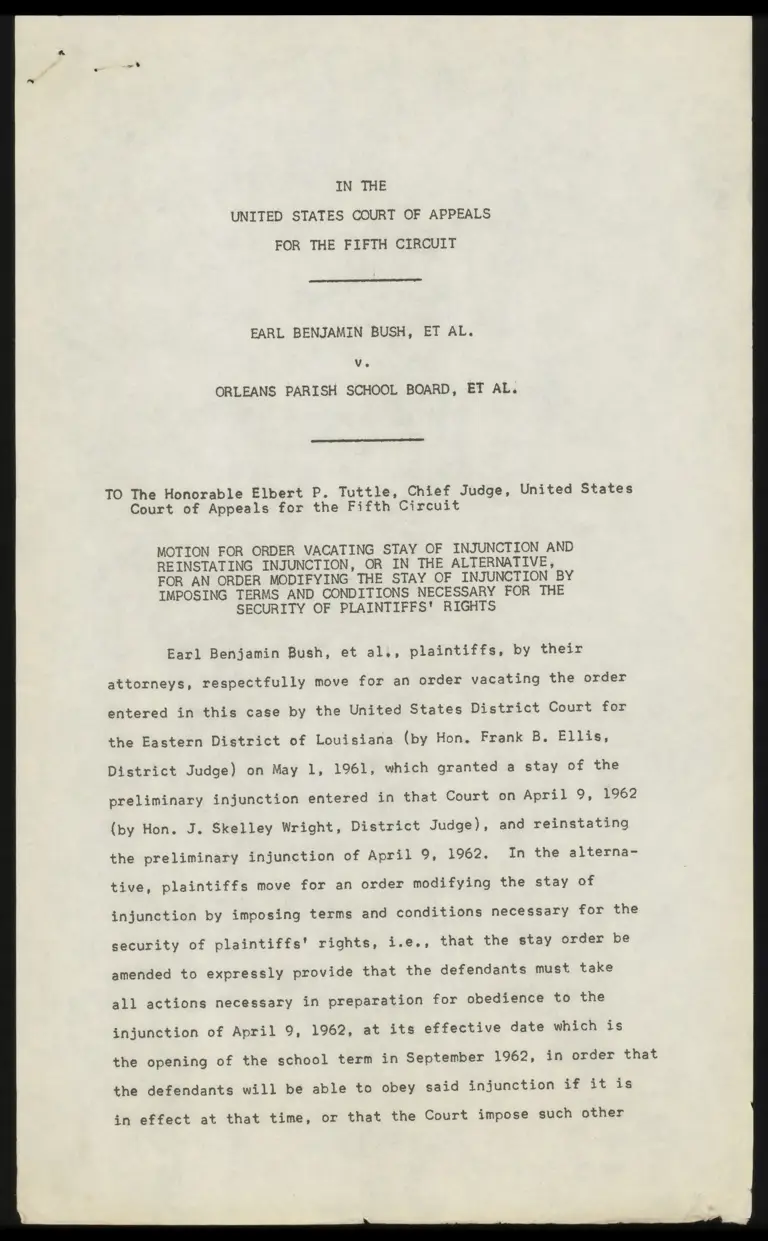
    IN THE

UNITED STATES COURT OF APPEALS

FOR THE FIFTH CIRCUIT

EARL BENJAMIN BUSH, ET AL.

Ve.

ORLEANS PARISH SCHOOL BOARD, ET AL.

TO The Honorable Elbert P. Tuttle, Chief Judge, United States

Court of Appeals for the Fifth Circuit

MOTION FOR ORDER VACATING STAY OF INJUNCTION AND

REINSTATING INJUNCTION, OR IN THE ALTERNATIVE,

FOR AN ORDER MODIFYING THE STAY OF INJUNCTION BY

IMPOSING TERMS AND CONDITIONS NECESSARY FOR THE

SECURITY OF PLAINTIFFS' RIGHTS

Earl Benjamin Bush, et al,, plaintiffs, by their

attorneys, respectfully move for an order vacating
the order

entered in this case by the United States District
Court for

the Eastern District of Louisiana (by Hon. Frank B. Ellis,

District Judge) on May 1, 1961, which granted a stay of the

preliminary injunction entered in that Court on April 9, 1962

(by Hon. J. Skelley Wright, District Judge), and reinstating

the preliminary injunction of April 9, 1962, In the alterna-

tive, plaintiffs move for an order modifying the stay of

injunction by imposing terms and conditions neces
sary for the

security of plaintiffs' rights, i.e., that the stay order be

amended to expressly provide that the defendants
must take

all actions necessary in preparation for obedience to the

injunction of April 9, 1962, at jts effective date which is

the opening of the school term in September 1962, in order that

the defendants will be able to obey said inju
nction if it is

in effect at that time, or that the Court impose such other


terms and conditions as it may deem proper. As grounds for

said motion, plaintiffs submit the following:

1. This school segregation case has been before the

courts through prolonged and complicated litigation. Earlier

opinions in this case are reported as indicated in footnote

one of the opinion below dated April 3, 1962 (Exhibit No. 1,

attached). The present proceedings result from motions filed

by the plaintiffs and intervenors, Negro school children in

New Orleans, seeking injunctive relief upon assertions that the

defendant Orleans Parish School Board has failed to comply with

prior orders of the trial court with respect to desegregation

of the public schools. On March 5, 1962, the District Court

held a hearing at which it received oral testimony and docu-

mentary evidence submitted by all parties. After considering

the evidence and briefs filed by the parties, the District

Court on April 3, 1962, filed an opinion containing detailed

discussion of the facts and law governing the case. A copy of

this opinion is appended hereto as Exhibit No. 1. Zhereafter,

on April 9, 1962, this Court entered a preliminary injunction

in accordance with the opinion of April 3, 1962. This injunc-

tion modified an earlier injunction entered May 16, 1960. A

copy of the order of April 9, 1962, is attached hereto as

Exhibit No. 2.

2. In summary, the District Court's opinion of April 3,

1962, found that the defendant school board had failed to file

a plan of desegregation for the Orleans Parish schoolsas ordered

by the District Court on July 15, 1959, and did not contemplate

submitting a desegregation plan; that the school board continues

to maintain a dual system of segregated schools based on race,

this being accomplished by dividing the City into separate Negro

and white school attendance districts; that since September

1960, the defendant has not complied with the Court's desegrega-

tion order of May 16, 1960, which provided that all first grade


children might "at their option" attend either the "formerly

all white public schools nearest their homes
or the formerly

all negro schools nearest their homes": that instead of comply-

ing with the court's order, the board had pursued a special

testing and screening program for first grade
Negro pupils

seeking to attend schools other than the ones to
 which they

were assigned under the segregated system; and that under this

pupil assignment program only four Negro
first grade children

out of 134 applicants were allowed to transfe
r to white schools

nearest their homes during the 1960-61 term,
and eight Negro

children of 66 applicants were allowed to tra
nsfer during the

1961-62 term. The Court concluded that the procedures follo
wed

by the defendant in assigning pupils for the 1960-61 and 1961-


62 school terms was not in compliance with
the order of the

Court and further said that:

To assign children to a segregated school system and

then require them to pass muster under a pupil place-

ment law is discrimination in its rawest form.

The court also found that there was substantial

inequality in the school facilities maint
ained for white and

Negro children by the defendants, particularly
 with regard to

cevere overcrowding in the Negro schools, "platooning” (less

than full-time sessions) of Negro children, and the use of

school building areas not planned for class
room use in the Negro

schools. The Court said that:

Even under the separate but equal test, the
se

inequalities may not be maintained. It would

be unconscionable to compel Negroes, 67 years

after Plegssy v. Ferguson, supra, to continue to

submit to these conditions.

3. On or about April 17, 1962, defendant Orleans Parish

School Board filed a Motion For New Trial asking that the Court

set aside the order of April 9, 1962. This motion was originally

noticed for hearing on May 2, 1962: hearing is now scheduled to

be held May 8, 1962. A copy of the motion for new trial is

attached hereto as Exhibit No. 3. After filing the Motion For

v3


New Trial, counsel for the defendant notified plaintiffs’

counsel on April 23, 1962, of the Board's intention to appear

before the Hon. Frank B, Ellis, District Judge, on the after-

noon of April 24, 1962, to present a Motion For a Stay of the

order of April 9, 1962, pending disposition of the Motion For

New Trial. On April 24, the Motion For a Stay was filed and

counsel for all parties appeared before the court in chambers.

A copy of the Motion For a Stay is attached hereto as Exhibit

No. 4. The Court took the motion under advisement pending sub~-

mission of memoranda and, on May 1, 1962, entered an order

granting the stay as requested by the defendant board. The

stay order provided:

This cause came on for hearing "in camera" with

counsel for both parties present on a former day on

defendants' motion to stay the temporary injunction

of April 9, 1962, pending disposition of their

motion for a new trial.

The court, having considered the briefs and

argument of counsel is ready to rule.

It is ordered that the defendants' motion to

stay the temporary injunction of April 9, 1962,

pending disposition of a motion for a new trial

be, and the same is hereby granted, on the condi~-

tion that this stay shall of no way affect the

order of May 16, 1960,

Pending the hearing and study of a motion for

a new trial on matters which this court as consti-


tuted is considering for the first time, a stay of

the temporary injunction is deemed appropriate.

F.R.C.P. 62(b). This stay in no way reflects the

ultimate disposition of the motion for a new

trial.

4. The grounds upon which the defendant sought and

obtained a stay of the preliminary injunction were that du
ring

the pendency of the motion for a new trial and the antici-

pated time which might elapse before the motion for ne
w trial

is determined, and the additional time which might elapse if

the motion is granted before the final decision on the me
rits

of the action, the defendant would be jrreparably harmed since

during this period the defendant must prepare for the reg
is-

tration, assignment and transfer of students for
the September

ll -


1962 school term. Defendants asserted that they would not

have sufficient time to properly prepare for the opening of

school in September 1962, using their prior pupil assignment

procedures, unless the stay is granted. The defendants' asser-

tions in this regard are made in their memorandum in support

of the motion for a stay, relevant portions of which are

quoted in the margin below,

The defendants' own asserted justification for the stay

(which is that unless they take action now, they will be unable

to properly prepare for the assignment of students for September

1962) demonstrates that the present stay order is actually a

determination that the preliminary injunction will not be effec-

tive as of September 1962 in accordance with its terms. Thus

the stay order amounts to a modification of the injunction by

relieving defendants of their obligation to take present action


which they insist is necessary to prepare to obey the injunc-

tion. The stay order postpones defendants' obligation to take

preparatory steps necessary to carry out the injunction bey
ond

the time within which such preparation must be completed if

they are to be meaningful. Defendants have argued to the trial

court that after the current school term ends and the summer

vacation period begins they will not have adequate personnel
 to

carry out the assignment program they desire to undertake.

Defendants Memorandum stated: . :
1/ "In the instant case, defendant has filed a motion for a new

trial, and the hearing of said motion has been set for May

8, 1962. It is reasonable to assume that the Court might

take the motion under advisement after the hearing. It is

also reasonable to assume that if a new trial is granted

herein, there will be an additional lapse of time before
the

new trial is held, and a further lapse of time before a judg-

ment is rendered after the new trial.

"In the interim, defendants must prepare for a new

school term, which begins in September of 1962.
 The cur-

rent school term is drawing to a close, and it is imperative

that defendants make and carry out, without furt
her delay,

plans for the registration, assignment, and transfer of

students for the September term,

"It is a matter of common knowledge that the parochial

school system in the City of New Orleans has alre
ady conducted

it § registration for the coming school term,

“By


Accepting this assertion, arguendo, it is apparent that the

defendants own argument indicates that the stay should be vacated.

1f defendants have any reason to believe that the injunction

will ultimately be set aside, they may make preparations to

assign pupils on that assumption, but at the same time should

also be making preparations to obey the Court's order in the

event that they are wrong. Defendants should not be permitted

to sit on their hands and to do nothing so that they can later

claim unreadiness to obey the injunction if it is ultimately

upheld. In this connection, it is relevant to note that defend-

ants have already publicly announced that they would go ahead

with preparations for following their prior pupil assignment

practices even before the stay order was granted.

5. The school board has made no showing of any kind to

demonstrate irreparable harm to it from being required merely

to make preparations to obey the court's order pending deci-

sion of the motion for new trial. Even if the injunction is

set aside, defendants can have suffered no harm by making such

preparations, particularly since they have already begun pre-

paring to follow their prior procedures without reference to

the stay order. The harm which plaintiffs would suffer if the

injunction is eventually sustained but its enforcement is

frustrated because defendants have been permitted to utilize

the time obtained through the stay to render obedience more

difficult, is plain and substantial. By this means, plaintiff

would be deprived of enjoyment of their adjudicated rights even

if they prevail on the merits.

(Continued)

"The record in the case at bar shows that the defendants

adopted its procedure for the assignment, transfer and con-

tinuance of all pupils for the school year 1961-1962 on

April 24, 1961 (See Exhibit P-5). Since April 24, 1962 is
now upon us, if the judgment previously entered herein is

not stayed, defendants will not have sufficient time to

properly prepare for the opening of school in September of

this year."


6. A cursory examination of defendants' motion for a

new trial reveals that on its face it fails to state a basis for

the relief requested since it is a patent attempt to relitigate

old matter previously presented to and considered by the trial

court. There is no claim of newly discovered evidence and the

assertions that the judgment is contrary to the law and con-

trary to the facts are arguments which might be urged on appeal

but are inappropriate basis for seeking new trial. There is

clearly no basis for a claim that the trial court's opinion of

April 3, 1962, contained manifest or obvious errors of law or

fact which justify relitigation of the same issues of fact and

law before the same court. The Court may weigh the likelihood

that the motion for a new trial affords a sound basis for the

relief prayed in determining whether a stay should be granted

pending that motion. Where, as here, the motion for new trial

is obviously insufficient, no stay should be granted.

7. This Court has power to vacate the stay and restore

the injunction pending disposition of the motion for new trial

pursuant to Title 28, U.S.C., §1651. Since the stay order

sought to be vacated is by legal operation and effect a modi-

fication of the injunction previously entered, this is an

appropriate occasion for the exercise of the power to restore

the injunction under the All-Writs Act (28 U.S.C. §1651). The

Court's powers under the All-Writs Act may clearly be exercised

on a basis consistent with Rule 62(c), Federal Rules of Civil

Procedure to restore an injunction or to impose conditions upon

the grant of a stay pending appeal. This is all the more appro-

priate where the stay order determines the outcome of the litiga-

tion as certainly as a ruling on the merits, but may be otherwise

unreviewable.

Respectfully submitted,

James M. Nabrit, III
Jack Greenberg
Constance Baker Motley
10 Columbus Circle
New York 19, New York

“7 -


A. P., Tureau
Ernest Morial
A. M, Trudeau
1821 Orleans Avenue
New Orleans, Louisiana

Attorneys for Movants

CERTIFICATE OF SERVICE

I hereby certify that on this the lst day of May, 1962,

I served a copy of the foregoing Motion for Order Vacating Stay

of Injunction and Reinstating Injunction, or in the Alternative,

for an Order Modifying the Stay of Injunction, Etc., and the

attached Exhibits, on Samuel I. Rosenberg, Esq., attorney for

defendant Orleans Parish School Board, by mailing a copy of same

addressed to him at 747 National Bank of Commerce Building,

New Orleans 12, Louisiana, via United States mail, air mail

special delivery, postage prepaid.

James M. Nabrit, III
Attorney for Movants