Memphis Police Report and Procedures
Unannotated Secondary Research
-
Case Files, Garner Working Files. Memphis Police Report and Procedures, e876e9c1-33a8-f011-bbd3-000d3a53d084. LDF Archives, Thurgood Marshall Institute. https://ldfrecollection.org/archives/archives-search/archives-item/7d22edf9-e48b-40f4-afea-c2683a4c9b20/memphis-police-report-and-procedures. Accessed September 28, 2026.
Copied!
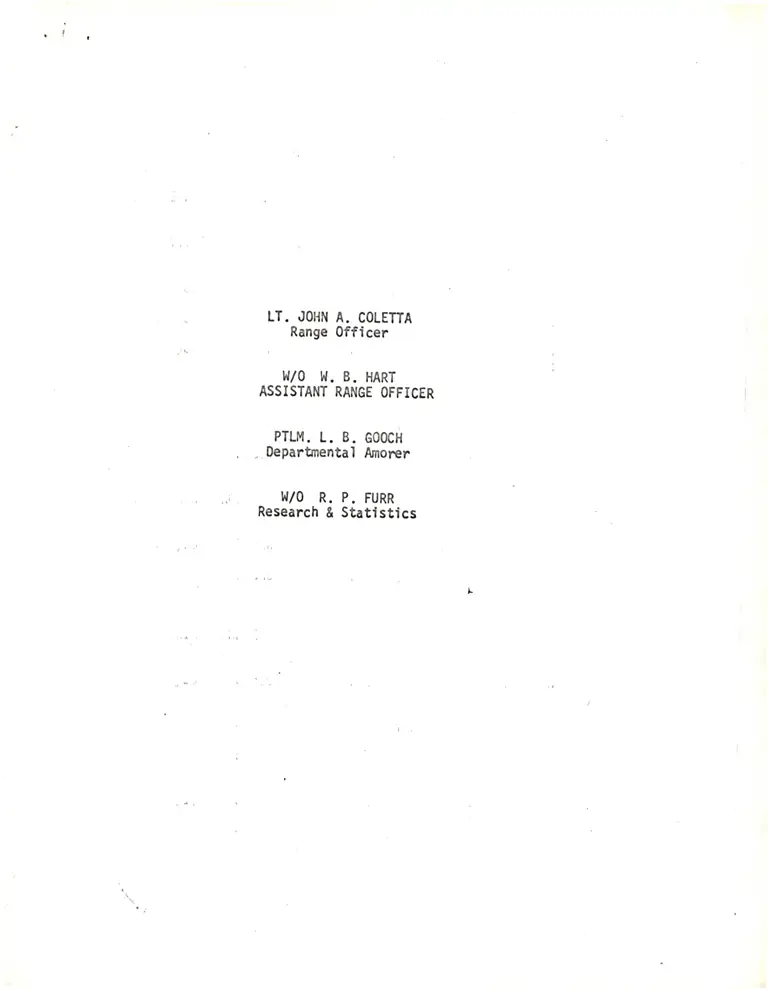
LT. JOHN A. COLEHA
Range Officer
W/0 W. B. HART
ASSISTANT RANGE OFFICER
PTLM. L. B. GOOCH
, Departmental Amorer
W/0 R. P. FURR
Research & Statistics
TABLE OF CONTENTS
Chapter
I.
II
III.
IV.
V.
VI.
VII.
VIII.
Inspection of Service Revolver, Shotguns, and
Leather Goods, Rules, Regulations, Policies,
Procedures on all Weapons Purchase, Repairs, and
Reporting Regarding Weapons Competitive Shooting
Firearms Safety
Range Procedures
Field Procedures
Home Procedures
Knowledge of Guns and Ammunition
History
Nomenclature
Fundamentals of Single Action Marksmanship
The Five Basics
Range Exercises (single action)
Liability and Tactics on Ethical use of Weapons
Bullet Effectiveness and Potential on the Human Body
Specific Tactics
Fundamentals of Double Action (combat) Marksmanship
Courses of Fire and Standards of Qualification
Basic Recruit
In-Service
Practical Courses
Care and Maintenance of Weapons
Field Inspection Procedures for Handgun
Riot Shotgun
History and Explaination
Method for visual check and operations check
Proper method of Loading and unloading
Shotgun Courses
13
n
34
40
41
47
52
53
56
57
60
61
67
70
IX. Raids Against Barricaded Persons
Planning
General and Specific Tactics
72
i.
TABLE OF CONTENTS
Chapter
X.
XI.
XII.
Sniper Incidents
Weapons and Tactics
Tactics and Protective Measures
Police Chemical Agents
History, Types, Use
First Aid
Additions and Deletions
88
102
c.
D.
All service revolvers obtained by officers of this department
must be approved by the Firearms Section prior to being recorded as an
approved service weapon, and only those revolvers so approved and
properly recorded may be carried by officers while o^ or off duty.
MEMPHIS POLICE DEPARTMENT SERVICE REVOLVERS - All officers who were
issued MPD guns must carry them. No other gun will be approved for on
duty use. Should this officer be promoted and desire to carry a
smaller gun. he must turn in his MPD revolver and comply with above
regulations.
Authorization of any type magnum or automatic weapons as special
service weapons by members of this department must be made by the
Range Officer with the approval of the Chief of Police.
REPAIRS OF SERVICE REVOLVERS - When a question arises as to the condi-
tion of a service revolver, or the necessity of having it repaired,
the Firearms Section will be contacted where authorized personnel will
inspect the revolver and advise of its condition and any necessity
for repair.
In cases where repairs are deemed necessary to service revolvers,
it will be turned in to the Firearms Section for inspection and any
necessary repairs will be made. A replacement gun will be issued for
the period of the time required to make such repairs.
AMMUNITION - All officers will carry .38 special factory loaded
ammunition as issued and approved by the Memphis Police Department.
Reloaded or target ammunition will not be allowed except in target
practice. No officer will carry any armunition which has been plated
or altered, nor ammunition having metal cased bullets, nor any govern
ment ball ammunition. Ammunition will be replaced during in-service
firearms training.
3.
E. LEATHER GOODS
1. Belt
A wide substantial belt which is contained within the
belt loops to insure the holster being held stationary,
or a two belt arrangement in which the outer belt is
secured firmly to the inner belt by keepers or other
positive means which insures the holster being kept
stationary in it's proper position.
2 . Holster
Open holsters equipped with a safety strap to contain the
weapon. (No flap, crossdraw, shoulder, clamshell or trick
operated holsters are permitted, both on or off duty).
3. Bullet loop
The type which fits the belt and is worn on the holster
side to contain six (6 ) or twelve (1 2 ) rounds (no pouches,
mechanical devices, strippers or plastic loaders are
permitted),
4. Handcuff cases
One which is worn on the belt, contains the handcuffs
which must be secured and are easily accessible.
Any officers employed prior to 1961 may carry their service
gtm as per prior policy.
F. USE OF FIREARMS (Order G-72-6^
1. P U RPOSE - The purpose of this departmental order is to define
the circumstances under which deadly force and non-deadly
prevent an offense from being committed
nd to effect an arrest. As used in this order, DEADLY FORCE
means force calculated to cause serious physical injury or
tA. f o r c f
ing the use of the night stick and chemical mace or similar
w c c ip o n s •
2 . PRC p E D U p - The discharge of any firearm by police personnel
accidental or intentiona] will be reported by letter to the
commanding officer as soon as possible after such discharge
whether it be on duty or off duty. A copy of this letter^
=taff Chief of Police, Chief of Field and
R a n g e . I n t e r n a l Affairs Bureau, and the Firing
an injury or death, the officer inyolyed will
fy his commanding officer immediately. It shall be the
responsibility of the commanding officer to notify immediately
the Homicide Bureau and the Internal Affairs Bureau. The ^
commanding officer shall secure the scene.
4.
The officer involved will report to the Police Range within
three days, unless health prevents it, for the purpose of
being interviewed as to the circumstances ol the discharge.
This policy ap[>l ics only to the discharge of i irearms covered
by this order.
3 . NQK-DEADLY FORCE - An officei' may use non-deadly force which
is reasonably necessary to effect an arrest or prevent or
attempting to prevent the (..scape from custody of a person whom
he reasonably believes to have committed an offense; reasonable
force mpiy be used to the extent that the officer reasonably
believes such to be necessary to defend himself or a third
person from what he reasonably believes to be the use or
imminent use by the suspect of non-deadly physical force.
4 . DEADLY FORCE - Deadly force may be used when after an officer
has exhausted all other reasonable means to apprehend or
otherwise prevent the commission of an offense and:
A. 1) It is in defense of himself from death or serious bodily
injury when attacked or,
2 ) It is in the defense of another person from death or
serious bodily injury when attacked, or,
3 ) There is a substantial risk that the person whose arrest
is sought will cause death or serious bodily harm if his
apprehension is delayed.
B. The offense committed or being committed by the suspect is:
1) A felony or an attempt to commit a felony involving the
use or attempted use or threatened imminent use of physi
cal force against any person or,
, 2 ) Kidnapping, murder in the first or second degree,
* voluntary manslaughter, arson, arson involving the use
of firebombs, rape, assault and battery with intent to
carnally know a child under twelve years of age, assault
and battery with intent to commit rape, burglary in the
first, second or third c^egree, grand larceny, assault to
commit murder in the first or second degree, assault to
commit voluntary manslaughter, armed robbery, robbery, or
any attempt to commit such crimes.
C. The offense committed or attempted by the suspect is a felony
and in the course of resisting arrest or attempting to escape
from custody the person is armed with a firearm or other deadly
weapon or the officer reasonably believes the suspect to be
armed with a firearm or other deadly weapon.
5 . FIREARMS SHALL NOT BE DISCHARGED
A. As warning shots; or
B. From a moving vehicle or to stop a fleeing vehicle except as
provided for in Paragraph 4 . ; or
C. The officer does not have a clear field of fire and cannot be
reasonably certain that the suspect will be hit and the poten
tial for harm to innocent bystanders or their property is great.
5.
offei^Ier ^"y person for any misdemeanor
B. To effect an arrest of any person for escape from the
commassion of any misdemeanor offense.
G. THE POLICE SHOTGUN
1. The regulation police shotgun for the Memphis Police
Department is the Remington, model 8 7 0, 12 gauge, pumn
bv weapon is owned and issued
u L d L ^ shoulder weapon may be
and . ̂ ;>°se owned by the department
and designated for special details or anti-sniper work.
employed by this department
r •5° Pi’oficient with the police shotgun in
to Its use, care, cleaning, loading and un-
t L g h t ^ b v ' ' t h r F / " ® ’̂®''^c°" mechanical operation as
taught by the Firearms Section, Police Training Academy.
shotguns and shells will be made
sJ b i l l t f o f supervisors. It is the r e s p L - ®
fhnf ^ the officers using these weapons to insure
in ioiri^w cleaned as the condition warrants it and
c h e S d a n v through a visual and operations
check daily. Should any question arise as to the orooer
condition or mechanical function of any shotgun or Shells
t (they) will be taken to the Firing Ranir̂ a fr>»v • *
replacement or repairs. inspection,
Periodically each gun will be rall<»H -iw ̂ *.u
b u c \ 1 h o t 's h :J n " i e ? l ! L l ? P - s o n u t / ^ ^ f o r
“ c o n ” o r b u o k s h o t ®
- - o r L ^ f i o r T p i c i ^ ?
I. POLICE RIFLES
Policies and Procedures governing the use of police rifle®
.ro v e G ! r “ p o l ie 'f s h o t S ; "
following circurn-
H.
6.
CHAPTER V
LIABILITY AND TACTICS ON ETHICAL USE OF WEAPONS
THE COMMON LAW
1. Defense of life both in the protection of the citizen and in the
protection of the individual officer, keeping in mind that only
the amount of force tliat is reasonably required may be used.
(Cited case — McAndrew vs Mularchek 1959, 56NJ) v;herein the
Supreme Court of New Jersey used strong language in attaching
blame to the city when a Reserve Patrolman, appointed by the
Borough of Keansburg, New Jersey had knowledge of this officer
working at a local club where he was involved in an incident
where he fired at the plaintiff after the plaintiff became in
volved in an argument with him. The Supreme Court commented
that "if Mularchek reasonably believed that he was in danger
of bodily harm and reasonably believed that it was necessary
in order to avert that harm to fire a warning shot (as dis
tinguished from a shot to injure) in the direction of McAndrew
and did not intend that the bullet should strike him, but it
did strike him because of Mularchuk's lack of skill or training
in handling the gun, a jury v/ould be justified in finding lia
bility on the part of the borough.
2. In the prevention of flight of fleeing felon a strong ethical
reaction will follov; if deadly force is indiscriminately em
ployed. This law is greatly modified in the various states but
in the state of Tennessee it has been held that deadly force may
34.
be used only as a last resort after all other means of apprehen
sion have failed, keeping in mind that the safety of innocent
persons must alv/ays be a prime factor in the judgement of whetlier
to use or not to use this deadly force. Generally this is con
strued to mean that the action taken by a police officer using
split second judgement must later hold to a "reasr'r.able person"
justifible action on the part of a policeman. The safety factors
and hazards i’S involved in usingdtjsdly force must be seriously
considered, taking into account the chance of success as well as
background and surrounding features before it may be employed.
Governmental agencies have been held immune to the criminal
action and to criminal law suits in some states; hov;ever statutes
have been enacted waiving sud; immunity. In other instances where
a statute mentions only the state itself, there still remains the
question of whether it includes and applies to municipalities.
All indications are that governmental tort immunity is on the
way out as part of the American legal system and many municipali
ties have recognized this fact and some have even gone to tiie
extent of aquiring liability insurance. (Steinhardt vs the Town
of Northbay Village, Florida 1961, 132 So 2d 764)
The actions of individuals whether acting as an agent or not
of a police agency have been held subject to individual criminal
prosecution as well as, subject to individual civil law suits.
A California case (Murphy vs Murray 1925, 74 Cal. APP-726,241
P 938) attempts to define what constitutes legal conduct of an
officer making an arrest. The officers were informed that a
35.
citizens home had just been robbed. While on the scene investi
gating, the policeman v/as told by a neighbor that tv/o men were
running from the rear of the house. The officer started in
pursuit, told them he was an officer and ordered them to stop.
They continued to run and he fired three shots in the air. One
of the men stopped, the other continued to run into a v/ooded
area. The officer called into the grove of trees for the nan to
come out, when he did not, the officer fired into the grove to
"intimidate the fellow and make him come out". On proceeding into
the v/ooded area, they found the man was mortally wounded. It
turned out that the night was holloween and the two men v;ere boys
16 years of age who had just engaged in a prank. A suit for
wrongful death against the police officer and the chief of police
resulted in a verdict for damages against the officer but not the
chief.
B. The general direction of current law in various jurisdictions closely
follows ethical (cultural) expectations.
1. Governmental agencies are held liable for negligent actions of
their agents and also held negligent in failing to properly equip
and train their agents. However, individuals are still held
liable for his actions both criminally and civially. The basis
of this statement is made by the case wherein a police officer
was off duty, dressed in civilian clothes in his apartment, re
moved his revolver from the holster preparatory to using the
bathroom. At the time, he wore an off duty holster attached to
left side of a belt which supported his trousers. He took the
loaded gun from his holster with his right hand with the intention
36.
of placing it on a water tank. When it was a foot or so away
from his body, it discharged, the bullet going through a 6 1/2"
wall and struck a small child who was in a bathtub in an adjoining
apartment. The injury proved to be very serious and permanent
with the result that when the case was tried before a jury, a
verdict of $130,000. was returned on behalf of thp child and a
further one of $45,000. in favor of the parents. The verdicts
were against both the City of Newark, New Jersey and Patrolman
Thomas. (Peer vs the City of Newark, November 1961, 71 NJ
Super 12,176 A 2d 249). In this case, two firearms experts were
called upon by the Plaintiff and it was found that the officer
v/as subjected to an inadequate training program which although
were conducted along FBI guidelines did not comprenhensively
deal with off-duty training or an adequate amount of retraining.
2. Firearms instructors and the courses which are taught by them as
well as training methods used are increasingly called to account
by the courts.
3. A liability formula - WR+HR=LLP
WR = v;eapon reliability which considers the original condition,
the care and maintenance it it receives and the general techni
cal qualities of the gun (for instance, caliber of gun vs use
of its subjection. Therefore the current 38 special caliber
and shotgun ammunition issued by the department for general duty
use is adequate for the metropolitan area)
HR = human reliability which involves the maturity and emotional
stability of the individual officer coupled with the amount and
37,
and quality of training he receives. Note: While training
cannot develop guaranteed maturity, it will lessen tne probabi-
lity of poor judgement being excerised.
LLP = Legal liability potential. Considering recent court
decisions, they have increased both in the amounts awarded and
in the scope of liability to both the individual and the government
agency.
C. POLICE TACTICS IN THE USE OF FIREARMS
1. Tactics may be defined as an art of maneuver, performed for the
purpose of bringing a combat situation to a successful conclusion,
a. Police combat tactics must be employed within the framework
of law and the lawful use of force.
2. Factors influencing the type of tactics.
a. Public opinion.
b. Departmental policy.
c. Moral responsibility.
d. Legal duty.
3. Police offiers must be thoroughly trained in their jurisdiction
laws and in the use of their equipment.
a. Type of action taken will vary with each situation, however,
certain basic principles are common to many cases.
4. Weapon should always be readily accessible,
a. Worn at the same body oosition.
(1) Behind belt loop on strong side.
(2) Firearms training teaches and instills instinctively
where the officer should reach for his weapon.
38.
K. RANGE EXERCISES - 25 YARD DOUBLE ACTION COURSE
7 yds ■- crouch 12 rds 35 sec. (R
15 yds •- P.S. 6 rds 12 sec.
25 yds •- kneeling 6 rds
weak hand 6 rds 90 sec.
strong hand 6 rds
stand no
support 6 rds 12 sec.
prone 6 rds
v;eak hand 6 rds 90 sec.
strong hand 6 rds
Possible of 300
This is the course that will be used for in-service qualification, minimum
qualification 210.
Any officer who fails to meet this minimum is required to report back to
the range within thirty (30) days for a second attempt. If he fails his
second attempt, he shall not be allowed to carry a firearm until he meets
this standard. The initial re-qualification shall be conducted and compen-
sation given to the officer. Any subsequent attempts shall be on the
Officer s time and will not be compensated. Every officer must undergo
this requalification once each fiscal year.
A certificate of proficiency will be issued to each officer who successfully
fires the scores as reflected.
210 - 255 MARKSMAN
256 - 279 SHARPSHOOTER
280 - 291 EXPERT
* 292 - 300 DISTINGUISHED EXPERT
53.
PRACTICAL COURSES
A. MULTIPLE BANK & RUNNING MAN COURSE
1. Multiple Bank (5 Electrical Targets) (Reload from Loops)
7 yds 10 shots 5 shots in 7 sec. Hip D.A.
15 yds 10 shots 5 shots in 7 sec. Point S. D.A.
25 yds 5 shots 5 shots in 10 sec. Stand no
support D.A.
25 rds. 4 pts. ea. hit
Possible of 100
B. RUNNING MAN TARGET
15 yds 1 run Point S. D.A.
6 shots - 3 across and 3 back
C. NIGHT FIRING COURSE
7 yds 6 rds,
4
5
15 yds 6
4
1 shot on ea. blink hip (Reholster ea.
time)
4 on 1 blink
Dark
2 shot on ea. blink Point S. (Reholster)
Dark
56.