The Good News Club v. Milford Central School Brief of Amici Curiae
Public Court Documents
January 12, 2001
-
Brief Collection, LDF Court Filings. The Good News Club v. Milford Central School Brief of Amici Curiae, 2001. e64896ad-b39a-ee11-be36-6045bdeb8873. LDF Archives, Thurgood Marshall Institute. https://ldfrecollection.org/archives/archives-search/archives-item/7d785b8b-8ceb-4f41-87b6-1d14c8a7d36b/the-good-news-club-v-milford-central-school-brief-of-amici-curiae. Accessed October 25, 2026.
Copied!
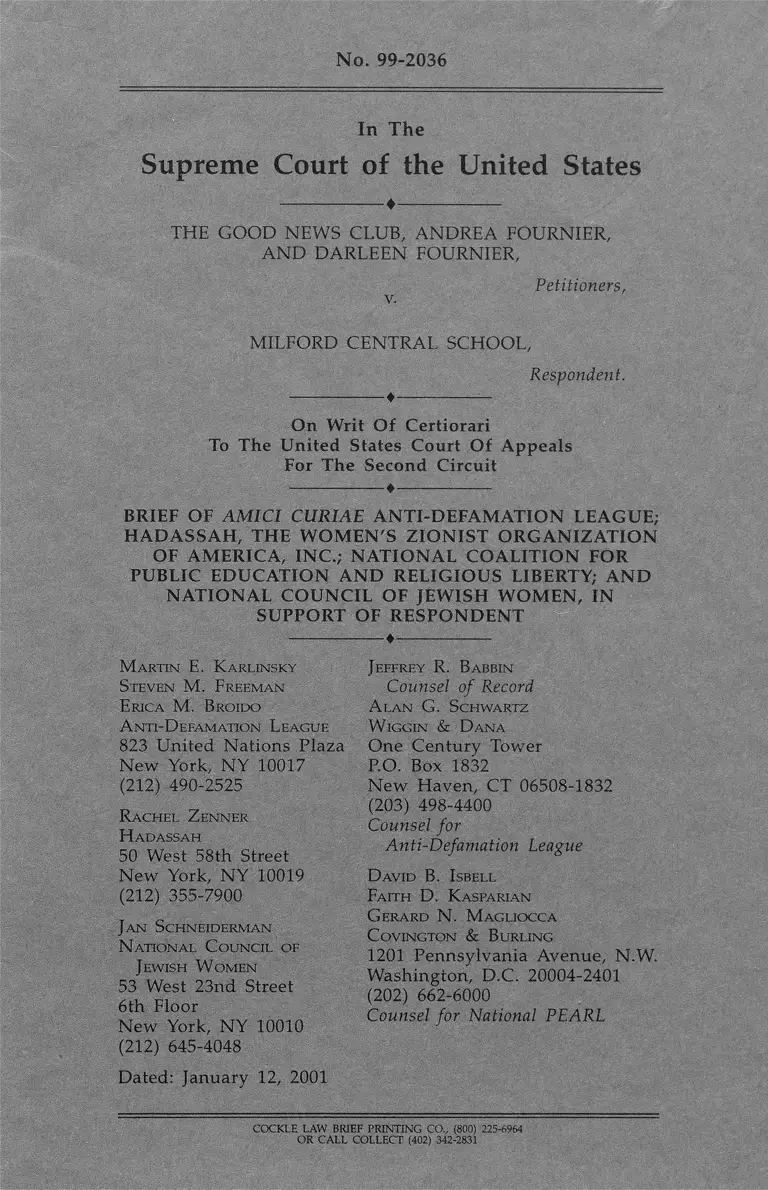
No. 99-2036
In The
Supreme Court of the United States
---------------- ♦ - — — ------- -
THE GOOD NEWS CLUB, ANDREA FOURNIER,
AND DARLEEN FOURNIER,
Petitioners,
v.
MILFORD CENTRAL SCHOOL,
Respondent.
----- -— - — - ♦ -------------—
On Writ O f Certiorari
To The United States Court O f Appeals
For The Second Circuit
-----------------♦ -----------------
BRIEF OF A M ICI CURIAE ANTI-DEFAM ATION LEAGUE;
HADASSAH, THE W O M EN 'S Z IO N IST ORGANIZATION
OF AM ERICA, INC.; NATIONAL COALITION FOR
PUBLIC EDUCATION AND RELIG IO U S LIBERTY; AND
NATIONAL COUNCIL OF JEW ISH WOMEN, IN
SUPPORT OF RESPO N D EN T
— ♦ -----------------
J effrey R. B abbin
Counsel o f Record
A lan G. S chwartz
W iggin & D ana
One Century Tower
P.O. Box 1832
New Haven, CT 06508-1832
(203) 498-4400
Counsel fo r
Anti-Defamation League
D avid B . Isbell
Faith D. K asparian
G erard N. M agliocca
C ovington & B urling
1201 Pennsylvania Avenue, N.W.
Washington, D.C. 20004-2401
(202) 662-6000
Counsel fo r National PEARL
M artin E. K arlinsky
S teven M . F reeman
E rica M . B roido
A nti-D efamation L eague
823 United Nations Plaza
New York, NY 10017
(212) 490-2525
R achel Z enner
H adassah
50 West 58th Street
New York, NY 10019
(212) 355-7900
J an S chneiderman
N ational C ouncil of
J ewish W omen
53 West 23nd Street
6th Floor
New York, NY 10010
(212) 645-4048
Dated: January 12, 2001
COCKLE LAW BRIEF PRINTING CO., (800) 225-6964
OR CALL COLLECT (402) 342-2831
1
TABLE OF AUTHORITIES............................................... ii
INTEREST OF AMICI CURIAE....................................... 1
SUMMARY OF ARGUMENT........................................... 2
ARGUMENT........................................................................ 4
I. RESPONDENT DID NOT VIOLATE PETI
TIONERS' FREE SPEECH RIGHTS....................... 4
A. Respondent's Policy Is Reasonable................ 5
B. Respondent's Policy Is Viewpoint Neutral. . 9
II. THE ESTA BLISH M EN T CLAUSE BARS
RESPONDENT FROM ALLOWING PETI
TIO N ERS' PROPOSED USE OF PUBLIC
SCHOOL FACILITIES.................................. 17
A. A Reasonable Elementary School Student
Would Not Understand the Distinction
Between Government Speech and Private
Speech ..................... 19
B. The Good News Club's Meetings Would
Have the Appearance of a School-Spon
sored, After-School Program........................... 24
C. The Good News Club Would Be One of Only
a Few Private Groups Meeting on Public
School Premises..................................... 27
D. To Allow the Good News Club to Meet at
the Milford Central School Would Consti
tute an Unprecedented Erosion of Establish
ment Clause Values........................................... 29
CONCLUSION.................................................................... 30
TABLE OF CONTENTS
Page
11
C a se s
Ambach v. Norwick, 441 U.S. 68 (1979)............... 2, 11, 30
Bell v. Little Axe Indep. Sch. Dist. No. 70, 766 F.2d
1391 (10th Cir. 1985).................................................. 21, 22
Board of Educ. of the Westside Community Schs.
(Dist. 66) v. Mergens, 496 U.S. 226 (1990)..........passim
Bronx Household of Faith v. Community Sch. Dist.
No. 10, 127 F.3d 207 (2d Cir. 1997)^..................... 10, 11
Brown v. Board of Educ., 347 U.S. 483 (1954)................. 2
Brown v. Woodland Joint Unified Sch. Dist., 27 F.3d
1373 (9th Cir. 1994).......................................................... 22
Campbell v. St. Tammany's Sch. Bd., 206 F.3d 482
(5th Cir. 2000), reh'g denied, 231 F.3d 937 (5th
Cir. 2 0 0 0 )...................................... ............................. 11
Capitol Square Review & Advisory Bd. v. Pinette, 515
U.S. 753 (1995)............................... 18, 19, 21, 22, 24, 28
Cornelius v. NAACP Legal Defense & Educ. Fund,
Inc., 473 U.S. 788 (1985)............................. 5, 6, 7, 9, 14
County of Allegheny v. ACLU Greater Pittsburgh
Chapter, 492 U.S. 573 (1989)............................. 12, 18, 19
Edwards v. Aguillard, 482 U.S. 578 (1987)
................................................................ 6, 11, 19, 20, 22, 25
Engel v. Vitale, 370 U.S. 421 (1962)................................. 10
Good News/Good Sports Club v. School Dist. of Ladue,
28 F.3d 1501 (8th Cir. 1994)...................................
TABLE OF AUTHORITIES
Page
22
Ill
TABLE OF AUTHORITIES - Continued
Page
Illinois ex rel. McCollum v. Board of Educ., 333 U.S.
203 (1948)....................................................6, 8, 11, 25, 27
Lamb's Chapel v. Center Moriches Union Free Sch.
Dist., 508 U.S. 384 (1993).......................................passim
Lamb's Chapel v. Center Moriches Union Free Sch.
Dist., 959 F.2d 381 (2d Cir. 1992). . ........................20, 26
Lee v. Weisman, 505 U.S. 577 (1992) .. 10, 11, 19, 25, 26, 29
Lubbock Civil Liberties Union v. Lubbock Indep. Sch.
Dist., 669 F.2d 1038 (5th Cir. 1982)................. ........... 26
Lynch v. Donnelly, 465 U.S. 668 (1984) ......................12, 18
Marsh v. Chambers, 463 U.S. 783 (1983)......................... 19
Peck v. Upshur County Bd. of Educ., 155 F.3d 274
(4th Cir. 1998)................................................................... 22
Perry Education Ass'n v. Perry Local Educators'
Ass'n, 460 U.S. 37 (1983)................................................. .6
Quappe v. Endry, 772 F. Supp. 1004 (S.D. Ohio
1991), aff'd, 979 F.2d 851 (6th Cir. 1992)................... 28
Rosenberger v. Rector & Visitors of Univ. of Va., 515
U.S. 819 (1995)........................................................... passim
Santa Fe Indep. Sch. Dist. v. Doe, 120 S. Ct. 2266
(2000).................................................................... 18, 26, 29
School Dist. of Abington Township v. Schempp, 374
U.S. 203 (1963).................................................... 11, 20, 25
School Dist. of Grand Rapids v. Ball, 473 U.S. 373
(1985), overruled in part on other grounds by
Agostini v. Felton, 521 U.S. 203 (1997)............... passim
IV
TABLE OF AUTHORITIES - Continued
Page
Stone v. Graham, 449 U.S. 39 (1980)................................ 12
Tilton v. Richardson, 403 U.S. 672 (1971)....................... 20
Wallace v. Jaffree, 472 U.S. 38 (1985)................. 10, 19, 25
Widmar v. Vincent, 454 U.S. 263 (1981)
12, 15, 18, 20, 23, 28
S ta tu tes
20 U.S.C. § 1011k(c)............................................................ 12
20 U.S.C. § 1062(c)(1).......................................................... 12
20 U.S.C. § 1066c(c)............................................................ 12
20 U.S.C. § 1068e..................................................................12
20 U.S.C. § 1103e..................................................................12
20 U.S.C. §§ 4071-4074........................................................ 22
20 U.S.C. § 8897................................................................. 12
25 U.S.C. § 1803(b)............................................................. 12
25 U.S.C. § 1813(e)............................................................. 12
25 U.S.C. § 2503(b)(2)......................................................... 12
25 U.S.C. § 3306(a)............................................................. 12
29 U.S.C. § 2938(a)(3)..........................................................12
42 U.S.C. § 604a(j)............................................................... 13
42 U.S.C. § 2753(b)(1)(C)....................................................13
42 U.S.C. § 3027(a)(14)(A)(iv).......................................... 13
42 U.S.C. § 5001(a)(2)......................... 13
V
42 U.S.C. § 9807(a)(9).......................................................... .13
42 U.S.C. § 9858k(a).............................................................. 13
42 U.S.C. § 9920(c)..................................... 13
42 U.S.C. § 13791(b)(B)(iv)................................................... 13
L eg isla tiv e H ist o r y
130 Cong. Rec. S19231 (daily ed. June 27, 1984)........ 23
130 Cong. Rec. H20934 (daily ed. July 25, 1984)........ 23
S. Rep. No. 98-357 (1984), reprinted in 1984
U.S.C.C.A.N. 2348 ........................................................... 23
M isc e l l a n e o u s
Patricia A. Adler & Peter Adler, Peer Power: Pre
adolescent Culture and Identity (1998).......................... 21
Allisonville Christian Church Website (visited Jan
uary 8, 2001) <http://home.att.net/~allisoncc/
children.htm>....................................... ..........................10
First Union Methodist Church Website (visited
January 8, 2001) <http://www.gbgm-umc.org/
Schenectady/Children%20and%20 Worship.
htm> .............................................. 10
Fowler V. Harper, Fleming James, Jr. & Oscar S.
Gray, The Law of Torts (2d ed. 1986).......................... 22
Wayne R. LaFave & Austin W. Scott, Jr., Criminal
Law (2d ed. 1986)....................................................
TABLE OF AUTHORITIES - Continued
Page
22
http://www.gbgm-umc.org/Schenectady/Children%20and%20_Worship.htm
http://www.gbgm-umc.org/Schenectady/Children%20and%20_Worship.htm
http://www.gbgm-umc.org/Schenectady/Children%20and%20_Worship.htm
VI
TABLE OF AUTHORITIES - Continued
Page
National Center for Education Statistics, Schools
Serving Family Needs: Extended-Day Programs in
Public and Private Schools (U.S. Dep't of Educ.
Feb. 1997)..................................................................... 26, 27
Jean Piaget & Barbel Inhelder, The Psychology of the
Child (1969)................................................................. 20
Jean Piaget, The Stages of the Intellectual Develop
ment of the Child, in Readings in Child Develop
ment and Personality 291 (Paul Henery Mussen
et al. eds., 4th ed. 1997)................................................ 20
Restatement (Second) of Torts § 464 (1965)..................... 22
Patricia S. Seppanen et al., National Study of Before
and After School Programs (U.S. Dep't of Educ.
1993).................................................................................... 26
Williston on Contracts (4th ed. 1993).................... 22
1
INTEREST OF AM ICI CURIAE1
The Anti-Defamation League ("ADL") was organized
in 1913 to advance good will and mutual understanding
among Americans of all creeds and races and to combat
racial and religious prejudice in the United States. ADL
has always adhered to the principle that these goals and
the general stability of our democracy are best served
through the separation of church and state and the right
to free exercise of religion. To that end, ADL has filed
amicus curiae briefs in many cases before this Court. ADL
is able to bring to the issues raised in this case the
perspective of a national organization dedicated to safe
guarding all persons' religious freedoms.
Hadassah, the Women's Zionist Organization of
America, Inc. ("Hadassah"), is the largest women's and
the largest Jewish membership organization in the United
States with over 300,000 members nationwide. Founded
in 1912, Hadassah is known for funding and maintaining
health care institutions in Israel and has a proud history
of protecting the rights of the Jewish community in the
United States. Hadassah has long been committed to the
principle of strict separation between church and state
that has served as a guarantee for religious freedom and
diversity. In an effort to uphold this fundamental princi
ple, Hadassah has participated as amicus curiae in many
cases before this Court.
The National Coalition for Public Education and Reli
gious Liberty ("National PEARL") is a diverse coalition of
grassroots and national religious, educational and civic
organizations that seeks to preserve religious freedom
and the separation of church and state in public educa
tion. National PEARL has participated in an amicus capac
ity in many cases before this Court.
1 No counsel for any party authored this brief in whole or
in part. No person or entity, other than amici curiae, their
members or their counsel made a monetary contribution to the
preparation and submission of this brief.
2
The National Council of Jewish Women, Inc.
("NCJW") is a volunteer organization, inspired by Jewish
values, that works to improve the quality of life for
women, children and families and strives to ensure indi
vidual rights and freedoms for all. Founded in 1893, the
NCJW has long adhered to the view that religious liberty
and separation of church and state are constitutional
principles that must be protected and preserved in our
democratic society. The NCJW has 90,000 members in
over 500 communities nationwide.
SUMMARY OF ARGUMENT
1. This Court has long recognized "[t]he importance
of public schools in the preparation of individuals for
participation as citizens, and in the preservation of the
values on which our society rests." Ambach v. Norwick, 441
U.S. 68, 76 (1979); see Brown v. Board of Educ., 347 U.S. 483,
493 (1954). Petitioners question whether a public elemen
tary school may open itself as a forum to certain specified
types of speech and still exclude from that limited forum
religious worship, instruction and indoctrination targeted
at the school's children.2 Amici support respondent's cate
gorical exclusion of that speech as both a reasonable,
viewpoint-neutral limitation, consistent with the Free
Speech Clause of the First Amendment, and as a limita
tion mandated by the Establishment Clause of the First
Amendment.
2. a. Respondent's policy is a reasonable limitation
on use of a public school. Just as the government may
2 Although respondent's policy provides broadly that
school premises may not be used by any organization for
"religious purposes," school officials have interpreted the
policy to exclude only religious worship, instruction and
indoctrination. See J.A. at N4 ("I would interpret [the policy to
exclude] conducting religious services, providing religious
instruction or to an extreme, religious indoctrination into a
philosophy or a belief.").
3
exclude potentially divisive political speech from the
workplace to avoid controversy and the appearance of
political favoritism, a public school may choose to open
itself only to those categories of speech that will further
the interests of the community and the school and to
exclude those categories of speech - whether religious,
political, commercial or other - that may divide the com
munity. While the public school is designed to promote
cohesion among a heterogeneous democratic people, the
Good News Club is designed to do quite the opposite: to
label people as "saved" or "unsaved" and, thus, to pro
mote religious belief in general and Christian belief in
particular.
b. In addition to being reasonable, respondent's
policy is viewpoint neutral because it excludes an entire
category of speech - namely, religion as it is expressed
through religious worship, instruction and indoctrination
- from a limited public forum. The Good News Club's
speech in its evangelizing meetings is distinct from the
kinds of speech permitted under the school's policy. The
Club's meetings are overt religious exercises, equivalent
in all but name and locale to conventional children's
services at churches and synagogues across the country.
The distinction between religion as supplying an editorial
viewpoint and religious worship, instruction and indoc
trination as a subject matter is well recognized in both
case law and federal statutory law. While excluding this
subject matter may in some instances also exclude a point
of view, this Court's precedents are clear that the First
Amendment is violated only if speech is excluded from
the limited public forum solely to suppress the point of
view.
3. The Establishment Clause stands as an indepen
dent bar to the Good News Club's proposed after-school
program for elementary school students because it pro
hibits the public school from appearing to take a position
on questions of religious belief. Here, in light of (1) the
young age and cognitive limitations of the Good News
Club's target audience; (2) the Club's proposed use of a
4
classroom setting immediately after school, very likely
side by side with school-sponsored programs that extend
the day for so many of the nation's elementary school
students; and (3) the nature of the elementary school
forum and the relatively small number of other private
groups meeting there, it would have appeared to a rea
sonable observer that the public school was "sponsoring"
or "endorsing" the Good News Club's meetings.
4. To affirm the Court of Appeals' judgment, this
Court need only agree with - and address - one of these
two propositions, either that the Free Speech Clause per
mits respondent's limitation on outside use of the school
or that the Establishment Clause mandates the limitation.
On the other hand, to reject both, and thereby reverse the
Court of Appeals' judgment, would undermine the ability
of a public school to determine for itself what subjects are
appropriate for inclusion in the educational forum and
would weaken the well-recognized distinction, central to
the concept of public education, between secular learning
on the one hand and religious worship, instruction and
indoctrination on the other. Petitioners' constitutional
views, if adopted by the Court, would thus constitute an
unprecedented erosion of Establishment Clause values
that - because of the age of the students involved here
and the role of public schools in imparting democratic
values to young students - would reverberate well
beyond this particular case. A new generation of children
would grow to maturity associating public schools with
religious worship and religious learning. This should not
be a price that public schools, or the children they edu
cate, must pay for simply accommodating secular groups
like the Girl Scouts and the 4-H Club.
A R G U M E N T
I. R E S P O N D E N T D ID N O T V IO L A T E P E T IT IO N E R S '
FR E E SP E E C H R IG H T S
It is well established that "[t]he necessities of confin
ing a forum to the limited and legitimate purposes for
5
which it was created may justify the State in reserving it
for certain groups or for the discussion of certain topics."
Rosenberger v. Rector & Visitors ofUniv. ofVa., 515 U.S. 819,
829 (1995). Where the State has reserved a forum for
discussion of only certain topics - as even petitioners
acknowledge is the case here, see Pet. Br. 15-17; see also
Pet. App. C12 (District Court opinion) - a restriction on
speech is permissible so long as it is "reasonable in light
of the purpose served by the forum" and viewpoint neu
tral. Rosenberger, 515 U.S. at 829 (internal quotation marks
omitted); accord Lamb's Chapel v. Center Moriches Union
Free Sch. Dist., 508 U.S. 384, 392-93 (1993); Cornelius v.
NAACP Legal Defense & Educ. Fund, Inc., 473 U.S. 788, 806
(1985).
A . R e s p o n d e n t's P o licy Is R e a s o n a b le
Respondent's exclusion of religious worship, instruc
tion and indoctrination,3 both in general and as applied
to the Good News Club specifically, is plainly reasonable.
In Cornelius, this Court held that a federal policy exclud
ing legal defense and political advocacy organizations
from participating in a charity drive aimed at federal
employees was reasonable in light of the forum's purpose
and the surrounding circumstances. See 473 U.S. at
808-10. Observing that a government's decision to restrict
access to a limited public forum need only be reasonable -
not "the most reasonable or the only reasonable limita
tion," id. at 808 - the Court ruled that "avoiding the
appearance of political favoritism" and "avoiding contro
versy" were reasonable bases to exclude such organiza
tions from participation in the drive, id. at 809. As the
Court concluded, "The First Amendment does not forbid
a viewpoint-neutral exclusion of speakers who would
disrupt a [limited public] forum and hinder its effective
ness for its intended purpose." Id. at 811.
3 See supra note 2.
6
Excluding religious worship, instruction and indoc
trination from public school premises similarly avoids
unwarranted controversy and the appearance of favori
tism. Just as the government may exclude categories of
speech so as to " 'insure[ ] peace' in the federal work
place," id. at 810, a public school is surely entitled to open
itself only to those categories of speech that will further
the interests of the school and the community in cohe
siveness and to exclude those categories of speech -
whether religious, political, commercial or other - that
may divide that community. See Perry Education Ass'n v.
Perry Local Educators' Ass'n, 460 U.S. 37, 52 (1983)
("[Exclusion of the rival union may reasonably be con
sidered a means of insuring labor-peace within the
schools."); see also Cornelius, 473 U.S. at 810 ("[T]he Gov
ernment need not wait until havoc is wreaked to restrict
access to a [limited public] forum." (emphasis added)).
That this case involves a forum created by, and iden
tified with, a public school makes the policy of excluding
religious worship, instruction and indoctrination all the
more reasonable. First, state and local school boards are
"afforded considerable discretion" in the operation of
public schools. Edwards v. Aguillard, 482 U.S. 578, 583
(1987). Second, religion is a particularly divisive matter in
the public school context. In the oft-quoted words of
Justice Frankfurter, "[t]he public school is at once the
symbol of our democracy and the most pervasive means
for promoting our common destiny. In no activity of the
State is it more vital to keep out divisive forces than in its
schools . " Illinois ex rel. McCollum v. Board of Educ., 333
U.S. 203, 231 (1948) (opinion of Frankfurter, J.) (emphasis
added); see id. at 216-17 ("[T]he public school must keep
scrupulously free from entanglement in the strife of
sects."). "[J]ust as religion throughout history has pro
vided spiritual comfort, guidance, and inspiration to
many, it can also serve powerfully to divide societies and
to exclude those whose beliefs are not in accord with
particular religions or sects . . . . " School Dist. of Grand
7
Rapids v. Ball, 473 U.S. 373, 382 (1985), overruled in part on
other grounds by Agostini v. Felton, 521 U.S. 203 (1997).4
Respondent had good reason to believe that the Good
News Club's activities in particular would be contrary to
the mission of a public elementary school, and therefore
would "disrupt [the] forum and hinder its effectiveness."
Cornelius, 473 U.S. at 811. The core purpose of the Good
News Club is to persuade impressionable elementary
school children - that is, "children of tender years, whose
experience is limited and whose beliefs consequently are
the function of environment as much as of free and
voluntary choice," Ball, 473 U.S. at 390 - to follow "the
Word of God" and to accept Jesus Christ as their "per
sonal Savior." E.g., Lodging at BB4 ("How to Lead a Child
to Christ").5 To this end, the Good News Club teaches
that some children are "saved" (those who accept Jesus
Christ as their Savior) and others "unsaved" (those who
do not); and that some children - the "saved" - are going
to go to Heaven while the rest are not. See, e.g., J.A. at
P25, P64-65; Lodging at S12, S17, BB5, BB8, BB10.
Thus, for example, the Good News Club's teacher
"challenges" the "saved" children to "[s]top and ask God
4 There is a particular risk of appearance of favoritism if
only members of a locally dominant faith have the numbers and
resources to maintain an after-school religion club. If there were
only one or two Jewish, Hindu, or Buddhist children in a school,
they could not realistically join clubs analogous to the Good
News Club. These children would feel isolated from their
classmates - and feel less welcome on school property - solely
because of their religions.
5 The Good News Club is one of the "prim ary m inistries" of
the Child Evangelism Fellow ship, Inc. That organization 's
statement of interest in its amicus curiae brief here, at App. 1,
makes clear that its "w hole purpose is to evangelize boys and
girls with the Gospel of the Lord Jesus Christ and to establish
(discipline) them in the local church for Christian living." See
also Lodging at DD1 (advocating "H elping You Evangelize
Children").
8
for the strength and the 'want' . . . to obey Him" and
"invites" the "unsaved" children "to trust the Lord Jesus
to be your Savior from sin" and to "receive Him as your
Savior." Lodging at BB18, BB24; see also J.A. at P64-65,
P67-68, P70-71, P75. Club materials teach young and
impressionable children that while believers in Jesus
Christ "will also be raised [to Heaven], . . . [i]f a person
does not receive the Lord Jesus as Saviour, he will not be
able to go to Heaven." Lodging at S12, S17. And during
meetings, the children pray to "receive Jesus as their
personal Savior"; listen to "missionary stories" that
"spread[ ] the gospel" and encourage acceptance of Jesus
Christ as the Savior; and sing songs with references to
God and Jesus Christ. E.g., J.A. at P16-17, P22-23, P25,
P28, P66-67, P109; Lodging at BB11, BB47.
In short, while the public school is "[d]esigned to
serve as perhaps the most powerful agency for promoting
cohesion among a heterogeneous democratic people,"
McCollum, 333 U.S. at 216 (opinion of Frankfurter, J.), the
Good News Club is designed to do quite the opposite: to
label children as either "saved" or "unsaved" and, thus,
to promote religious belief in general and Christian belief
in particular. Indeed, the Good News Club expressly
teaches that adherence to a particular faith is essential to
one's standing in the community - that those who "have
received the Lord Jesus as [their] Savior from sin
. . . belong to God's special group - His family." Lodging
at S6. Thus, whether or not the Good News Club is
nominally open to anyone, see J.A. at C2, and whether or
not the Club teaches or promotes "any particular Chris
tian sect's doctrine or theology," id. (emphasis added),
respondent's officials were well justified in believing that
the Good News Club's meetings would be inconsistent
with the purpose of the public school forum. Respon
dent's limitation on the use of its school building was
9
reasonable, and so long as that limitation was also view
point neutral, the Constitution requires no more.6
B. Respondent's Policy Is Viewpoint Neutral
In addition to being reasonable, respondent's policy
is viewpoint neutral because it excludes a distinct cate
gory of speech from a limited public forum. An exclusion
of speech on the basis of content is permissible in a limited
public forum. See Lamb's Chapel, 508 U.S. at 392-93. Lamb's
Chapel simply does not hold that any and all bans on
religious activities in a limited public forum violate the
First Amendment. Respondent's limitation on use of its
forum is an exclusion of content - of an entire subject
matter - and not an exclusion solely of particular view
points bearing on a secular subject matter. The exclusion
is not arbitrary, as shown in the discussion of "rea
sonableness," above. It is also not discriminatory, as it
applies to all speech - that is, to all viewpoints (including
differing sectarian viewpoints) - on the excluded subject
matter of religion as it is expressed through religious
worship, instruction and indoctrination.
Petitioners self-servingly characterize their speech as
"instruction of morals from a religious perspective." E.g.,
Pet. Br. 22. Notwithstanding this effort, however, the
record clearly demonstrates that the Good News Club's
speech at its meetings is different in kind from the speech
permitted under the Milford Central School policy -
including, for example, meetings of the Boy Scouts, the
6 Respondent's policy is of course animated by some of the
considerations underlying the Establishment Clause. See infra
P a rt II (a rg u in g th a t re sp o n d e n t w as req u ir ed by the
E stab lishm en t C lause to exclu d e the Good N ew s C lu b 's
activities from school premises). Nevertheless, for purposes of
the reasonableness inquiry, the school need only show that its
policy is reasonable in light of the forum 's purposes, see
Cornelius, 473 U.S. at 809, without regard to Establishm ent
Clause principles.
10
Girl Scouts and the 4-H Club. The Good News Club's
meetings include vocal group prayers, memorization and
recital of Bible verses and Scripture, religious songs and
discussions based on Bible readings. See, e.g., J.A. at
P16-18, P22-23, P25-26. These are "overt religious exer
cise^]." Lee v. Weisman, 505 U.S. 577, 588 (1992); see
Wallace v. Jaffree, 472 U.S. 38, 72 (1985) (O'Connor, }.,
concurring in the judgment) (calling group vocal prayer
and Bible readings "manifestly religious exercisers]");
Engel v. Vitale, 370 U.S. 421, 424-25 (1962) (discussing the
"religious activity" of prayer). They are equivalent in all
but name and locale to conventional church or synagogue
services. Cf. Bronx Household of Faith v. Community Sch.
Dist. No. 10, 127 F.3d 207, 215 (2d Cir. 1997) (describing
"church worship services" as "including] hymn singing,
communion, Bible reading, Bible preaching and teaching"
(internal quotation marks omitted)).
To the extent the Good News Club's meetings differ
from conventional religious services - the meetings
involve, for example, prizes, candy and games - this is
simply because the Club tailors its evangelizing meetings
to its young and impressionable audience. Indeed, the
Good News Club's meetings are virtually indistinguish
able from children's services commonly held at churches
and synagogues across the country, which often involve
singing, puzzles, art, stories and prayer.7
Nor does it matter that the Good News Club's meet
ings contain an "instructional" element. First, that ele
ment of petitioners' meetings does nothing to change the
7 See, e.g., First Union Methodist Church Website (visited
January 8, 2001) <h ttp ://w w w .gbgm -u m c.org /sch en ectad y/
Children%20and%20W orship.htm> (describing "Children and
W orship," a "service that is designed for [children] to be age
appropriate scripture (story telling) and w orship"); Allisonville
Christian Church Website (visited January 8, 2001) <h ttp :/ /
hom e.att.net/~allisoncc/children.htm > (describing "Children's
Worship: Godly Play," a service for children including singing,
story telling, art and food).
http://www.gbgm-umc.org/schenectady/Children%20and%20Worship.htm
http://www.gbgm-umc.org/schenectady/Children%20and%20Worship.htm
http://home.att.net/~allisoncc/children.htm
http://home.att.net/~allisoncc/children.htm
11
essential or overall nature of their speech. Second, the
distinction between religious instruction and secular
instruction is not one merely of perspective. To the con
trary, religious and secular instruction serve fundamen
tally different purposes. See, e.g., School Dist. of Abington
Township v. Schempp, 374 U.S. 203, 223-25 (1963) (distin
guishing religious instruction from "nonreligious moral
inspiration" and "teaching of secular subjects");
McCollum, 333 U.S. at 226 (opinion of Frankfurter, J.)
(distinguishing between "secular instruction in subjects
concerning religion" and "sectarian teaching"). Religious
instruction is designed first and foremost to train adher
ents of a particular religion in the tenets of that religion's
faith and practice. It is not designed, as secular education
is, to "prepar[e] . . . individuals for participation as
citizens." Ambach v. Norwich, 441 U.S. 68, 76 (1979).
Petitioners' suggestion that no line can be drawn
between religion as a viewpoint and religious worship,
instruction and indoctrination as a subject matter is with
out merit. First, although the distinction between content
and viewpoint is not always a precise one, see Rosenberger,
515 U.S. at 831, there is no reason to believe that officials
would not usually be able to draw the requisite distinc
tions, see, e.g., Campbell v. St. Tammany's Sch. Bd., 206 F.3d
482, 487 (5th Cir. 2000), reh'g denied, 231 F.3d 937 (5th Cir.
2000) (per curiam); Bronx Household, 127 F.3d at 215. In
fact, in the present case - as in Campbell and Bronx House
hold - public officials were able to determine from the
face of petitioners' application that their proposed use
was for an excluded subject matter.
Moreover, the task of distinguishing between "overt
religious exercise[s]," Lee, 505 U.S. at 588, and other
forms of speech is hardly foreign to the law. Indeed, the
lines that respondent's officials must draw in implement
ing their policy are no different from, or more difficult to
draw than, the lines that courts and public officials are
required to draw under current law - for example,
between teaching the Bible as a religious text and teach
ing it as literature, see, e.g., Edwards, 482 U.S. at 606-08
12
(Powell, ]., concurring); Stone v. Graham, 449 U.S. 39, 42
(1980) (per curiam), or between "religious" Christmas
displays and "secular" Christmas displays, see, e.g.,
County of Allegheny v. ACLU Greater Pittsburgh Chapter,
492 U.S. 573, 611-13 (1989); Lynch v. Donnelly, 465 U.S.
668, 679-86 (1984). See generally Widmar v. Vincent, 454
U.S. 263, 271 n.9 (1981) (noting that "the Establishment
Clause requires the State to distinguish between 'religious'
speech . . . and 'nonreligious' speech" (emphasis added)).
Any number of federal statutes contemplate the same sort
of line-drawing without constitutional infirmity.8
8 See, e.g., 20 U.S.C. § 1011k(c) ("[N ]o project assisted with
funds under subchapter VII of this chapter . . . shall ever be used
for religious worship or a sectarian activity . . . . "); 20 U.S.C.
§ 1062(c)(1) ("N o grant may be made under this chapter for any
educational program, activity, or service related to sectarian
instruction or religious worship, or provided by a school or
department of divinity."); 20 U.S.C. § 1066c(c) ("No loan may be
made under this part for any educational program, activity or
service related to sectarian instruction or religious worship . . . . ");
20 U.S.C. § 1068e ("The funds appropriated under section 1069f
of this title may not be used . . . for . . . any religious worship or
sectarian activity . . . . " ) ; 20 U .S.C. § 1103e ("The funds
appropriated under section 1103g of this title may not be
used . . . for . . . any religious worship or sectarian activity . . . . ");
20 U.S.C. § 8897 ("N othing contained in this chapter shall be
construed to authorize the making of any payment under this
chapter for religious worship or instruction."); 25 U.S.C. § 1803(b)
("Funds provided pursuant to this subchapter shall not be used
in connection with religious worship or sectarian instruction.”); 25
U.S.C. § 1813(e) ("No construction assisted with funds under
this section shall be used for religious zoorship or a sectarian
activity . . . . "); 25 U.S.C. § 2503(b)(2) ("Funds provided under
any grant made under this chapter m ay not be used in
connection with religious zoorship or sectarian instruction."); 25
U.S.C. § 3306(a) ("None of the funds made available under this
subchapter may be used . . . for any religious zoorship or sectarian
activity."); 29 U.S.C. § 2938(a)(3) ("Participants shall not be
employed under this chapter to carry out the construction,
13
Petitioners seek to blur the line between subject mat
ter and viewpoint by trying to place themselves simul
taneously on both sides of it. They propose a seemingly
simple truth: religion is both the subject matter and the
viewpoint of their speech. See Pet. Br. 22-24. But even
accepting this premise, the conclusion does not follow
operation, or maintenance of any part of any facility that is used
or to be used for sectarian instruction or as a place for religious
worship . . . . "); 42 U.S.C. § 604a(j) (''No funds provided directly
to in stitu tio n s or organ ization s to provid e serv ices and
administer programs under subsection (a)(1)(A) of this section
sh a ll be exp en d ed for sectarian worship, instruction, or
proselytization."); 42 U.S.C. § 2753(b)(1)(C) (allow ing federal
grants to be used for student work-study that "does not involve
the construction, operation, or maintenance of so much of any
facility as is used or is to be used for sectarian instruction or as a
place for religious worship"); 42 U .S.C. § 3027(a)(14)(A )(iv)
(requiring a state seeking federal aid for construction of a center
for the elderly to promise that "the facility will not be used and
is not intended to be used for sectarian instruction or as a place
for religious zoorship"); 42 U.S.C. § 5001(a)(2) (providing federal
grants to support volunteer pro jects for the elderly, but
excluding "projects involving the construction, operation, or
maintenance of so much of any facility used or to be used for
sectarian instruction or as a place for religious zoorship"); 42 U.S.C.
§ 9807(a)(9) ("[N ]o participant will be employed on projects
involving . . . the construction, operation, or maintenance of so
much of any facility as is used or to be used for sectarian
instruction or as a place for religious worship."); 42 U .S.C .
§ 9858k(a) ("N o financial assistance provided under this
subchapter . . . shall be expended for any sectarian purpose or
activity, including sectarian worship or instruction.''); 42 U.S.C.
§ 9 9 2 0 (c ) ("N o fund s p ro v id ed d ire c tly to a re lig io u s
o rg an iza tio n to p ro v id e a ss is ta n ce u nd er any p rogram
described in subsection (a) shall be expended for sectarian
zoorship, instruction, or proselytization."); 42 U .S .C .
§ 13791(b)(B)(iv) ("Religious organizations . . . shall not provide
any sectarian instruction or sectarian zoorship in connection with
an activity funded under this subchapter . . . . " ) (emphases
added to all).
14
that respondent's exclusion of their meetings violates the
Constitution. This Court has made clear that the Free
Speech Clause is violated only if the government
excludes speech from a limited public forum "solely
because [it deals] with [an otherwise includible] subject
from a religious standpoint." Lamb's Chapel, 508 U.S. at
394 (emphasis added); accord Cornelius, 473 U.S. at 806
("[T]he government violates the First Amendment when
it denies access to a speaker solely to suppress the point of
view he espouses . " (emphasis added)). Thus, where
- as here - there is evidence that the government has
excluded speech at least in part for a reason "other
than . . . that the presentation would have been from a
religious perspective," Lamb's Chapel, 508 U.S. at 393-94,
the mere fact that a religious perspective is also excluded
does not give rise to a constitutional violation.9
Were the test otherwise, the government's authority
to limit the use of a limited public forum to certain
subject matters would become meaningless, because pri
vate speakers could always evade the limitations by com
bining speech on an excluded subject matter with a
modicum of speech on an otherwise included subject
matter. On petitioners' view of the law, for example, a
religious group could require a public school to open
itself to religious worship merely by including in the
religious service a sermon on a secular subject like child
rearing. This cannot be the law, for the government
would then have lost its ability to "confin[e] a forum to
the limited and legitimate purposes for which it was
created." Rosenberger, 515 U.S. at 829.
9 By referring to the Good News Club's speech as having an
"ad d itio n al lay er," the C ourt of A ppeals recognized that
religion can be both a subject m atter and a viewpoint - and that
the Constitution is violated only when religion is excluded solely
on the basis of viewpoint. Pet. App. A15; see also id. at A16 ("We
conclude . . . that the Good News Club is doing something other
than simply teaching moral values." (emphasis added)).
15
Petitioners incorrectly rely on Rosenberger to argue
that the First Amendment does not distinguish between a
religious subject matter and a religious perspective. See
Pet. Br. 20-21.10 The speech in Rosenberger was a news
paper - what the Court called "a pure forum for the
expression of ideas," 515 U.S. at 844 - and its exclusion
by the public university from a Student Activities Fund
("SAF") was based on "editorial viewpoint ]," Id. at 831;
see also id. at 844 ("[T]he student publication is not a
religious institution, at least in the usual sense of that
term as used in our case law . . . . "). Here, by contrast,
the Good News Club did not seek meeting space for a
journalistic venture, but rather meeting space in which to
engage in an evangelizing religious activity involving
religious worship, instruction and indoctrination.
Respondent's limitation on its forum excluded speech
that was inherently part of the religious activity, and not
an editorial viewpoint in an exchange of ideas.
Nothing in Rosenberger precludes the drawing of an
intelligible distinction between religion as a viewpoint
and religious worship, instruction and indoctrination as a
subject matter, and then constitutionally excluding the
latter from a limited public forum. To the contrary, the
Rosenberger Court merely held that the university had not
drawn this distinction in excluding the student news
paper from the SAF:
10 Reliance on Widmar for this point is even more plainly
misplaced. See, e.g., Amicus Curiae Brief of Douglas Laycock
15-16. Widmar held that a state university's prohibition on use of
its buildings "for purposes of religious worship or religious
teaching" was an impermissible content-based restriction. 454
U.S. at 267-75. The forum in Widmar, however, was an open
public forum. Accordingly, the Court did not consider a subject-
based exclusion of religious worship and teaching in a more
limited public forum, and the Court did not conduct a limited
public forum analysis.
16
[T]he University does not exclude religion as a
subject matter but selects for disfavored treat
ment those student journalistic efforts with reli
gious editorial viewpoints. Religion may be a
vast area of inquiry, but it also provides, as it did
here, a specific premise, a perspective, a stand
point from which a variety of subjects may be
discussed and considered. The prohibited per
spective, not the general subject matter, resulted in
the refusal [to fund the student newspaper], for
the subjects discussed were otherwise within the
approved category of publications.
Id. at 831 (emphasis added); see id. at 832 ("[T]he Univer
sity justifies its denial of SAF participation to [the student
newspaper] on the ground that the contents . . . reveal an
avowed religious perspective.").11 In the present case,
however, Milford Central School did not exclude the
Good News Club's speech because - let alone "solely
because," Lamb's Chapel, 508 U.S. at 394 - religion pro
vided its "specific premise," "perspective," or "stand
point"; instead, the school excluded the Good News
Club's speech because religious worship, instruction and
indoctrination constituted its subject matter.
Finally, petitioners raise the specter of excessive
entanglement between church and state, apparently argu
ing that allowing a school to make the distinction
11 In arguing that Rosenberger rejected any legal distinction
between religion as a subject matter and religion as a viewpoint,
petitioners rely heavily on the fact that the dissent in Rosenberger
characterized the university 's guidelines as excluding "the
entire subject matter of religious apologetics." 515 U.S. at 896
(Souter, d issen tin g ); see Pet. Br. 20-21. H ow ever, the
d isag reem en t b etw een the m a jo rity and th e d isse n t in
R osen berger w as not over w hether the govern m en t m ay
constitutionally exclude speech from a limited public forum on
the ground that religion constitutes its subject matter, but rather
over whether the university had done so. See 515 U.S. at 896
(Souter, J ., d issenting) ("T h e C ourt, of cou rse, reads the
Guidelines differently . . . . ").
17
between religious worship, instruction and indoctrination
and speech from a religious perspective is itself constitu
tionally impermissible. See Pet. Br, 24-26. This argument
is without merit. Indeed, petitioners' supposed concern is
contrary to their own stated position that one cannot
draw a subject matter distinction between their speech
and that of others. That is, petitioners' entanglement
argument presupposes that the school district can legit
imately distinguish between the subject matter of peti
tioners' religious speech and the subject matters of other
groups' secular speech. Moreover, a broad and categorical
exclusion of religious worship, instruction and indoc
trination - even when such speech includes a sermon or
other expression of religious views on an otherwise
includible subject - minimizes the entanglement between
church and state, because then the state need not monitor
each individual service or lesson plan.
In sum, unlike the school in Lamb's Chapel and the
university in Rosenberger, respondent did not exclude
speech on the basis of a religious viewpoint. To the con
trary, private individuals and groups were expressly per
mitted to discuss those subjects otherwise permitted
under the school's policy from a religious perspective.
See, e.g., J.A. at G6, N14-15. Instead, respondent excluded
an entire category of speech from school premises. This
limitation was reasonable and was applied without dis
crimination against any particular viewpoint. Nothing in
the Constitution, or in this Court's jurisprudence, forbids
that policy. II.
I I . T H E E S T A B L IS H M E N T C L A U SE B A R S R E S P O N
D E N T F R O M A L L O W IN G P E T IT IO N E R S ' P R O
P O S E D U S E O F P U B L IC S C H O O L F A C IL IT IE S
Had the Milford Central School embraced the Good
News Club as an after-school program for its elementary
school students, it would have violated the Establishment
Clause. Stated otherwise, the Establishment Clause
stands as an independent bar to petitioners' proposed
activities on school premises, regardless of the presence
18
or absence of valid limitations on the use of the forum
under the Free Speech Clause. Indeed, the Milford Cen
tral School could have justified its exclusion of the Good
News Club's meetings solely by reference to the compel
ling state interest in complying with the Establishment
Clause. See, e.g., Capitol Square Review & Advisory Bd. v.
Pinette, 515 U.S. 753, 761-62 (1995) ("There is no doubt
that compliance with the Establishment Clause is a state
interest sufficiently compelling to justify content-based
restrictions on speech."); accord Lamb's Chapel, 508 U.S. at
394-95; Widmar, 454 U.S. at 271.
Whatever else it may mean, the Establishment
Clause, "at the very least, prohibits government from
appearing to take a position on questions of religious
belief or from 'making adherence to a religion relevant in
any way to a person's standing in the political commu
nity.' " County of Allegheny, 492 U.S. at 594 (quoting Lynch,
465 U.S. at 687 (O'Connor, J., concurring)) (emphasis
added). Allowing impressionable elementary school stu
dents to join with petitioners for religious worship,
instruction and indoctrination in a school classroom,
immediately after school, would violate these prohibi
tions.
In arguing to the contrary, petitioners emphasize
their view that the Good News Club would be meeting on
public school premises pursuant to a formally neutral
access policy. See Pet. Br. 30-39. However, this Court
stated only last Term that "the Establishment Clause for
bids a State to hide behind the application of formally
neutral criteria and remain studiously oblivious to the
effects of its actions." Santa Fe Indep. Sch. Dist. v. Doe, 120
S. Ct. 2266, 2278 n.21 (2000) (internal quotation marks
omitted). In Justice O'Connor's words, "[N]ot all state
policies are permissible under the Religion Clauses sim
ply because they are neutral in form." Capitol Square, 515
U.S. at 777 (O'Connor, J., concurring in part and concur
ring in the judgment).
Thus, the crucial question for Establishment Clause
purposes is whether, notwithstanding Milford Central
19
School's formally neutral access policy, a reasonable
observer would conclude from the Good News Club's
meeting on school premises that the government was
"lending its support to the communication of a religious
organization's religious message." County of Allegheny,
492 U.S. at 601; see also Capitol Square, 515 U.S. at 777
(O'Connor, concurring in part and concurring in the
judgment) ("[Wjhen the reasonable observer would view
a government practice as endorsing religion, . . . it is our
duty to hold the practice invalid."). In light of (1) the
young age and cognitive limitations of the Good News
Club's targeted audience; (2) the fact that the Good News
Club's meetings would take place in a classroom setting
immediately after school, when many students attend
school-sponsored, after-school programs; and (3) the
small number of other outside groups meeting on school
premises at the same time, amici submit that the answer
to this question is plainly yes.
A. A Reasonable Elementary School Student
Would Not U nderstand the D istin ctio n
Between Government Speech and Private
Speech
First and foremost, the age of the students involved
in this case - six to twelve year olds - compels the
conclusion that the Milford Central School was required
to deny the Good News Club's application to conduct
religious worship, instruction and indoctrination on
school premises. Indeed, to hold otherwise would repre
sent a marked departure from existing law.
In analyzing whether government action would be
perceived as an endorsement of religion, this Court has
long placed great emphasis on the age and cognitive
maturity of the likely audience. See, e.g., Lee, 505 U.S. at
593-94; Board of Educ. of the Westside Community Schs.
(Dist. 66) v. Mergens, 496 U.S. 226, 250-51 (1990) (plurality
opinion); Edwards, 482 U.S. at 583-84; Ball, 473 U.S. at 390;
Wallace, 472 U.S. at 81 (O'Connor, concurring in the
judgment); Marsh v. Chambers, 463 U.S. 783, 792 (1983);
20
Widmar, 454 U.S. at 274 n.14; Tilton v. Richardson, 403 U.S.
672, 685-86 (1971); Schempp, 374 U.S. at 252-53 (Brennan,
J., concurring). In Widmar, for example, the Court explic
itly relied on the cognitive maturity of university stu
dents in concluding that they would be able to
distinguish between private speech and government
speech. See 454 U.S. at 274 n.14. And in Mergens, a plu
rality of the Court extended the reasoning of Widmar to
high school students: "We think that secondary school
students are mature enough and are likely to understand
that a school does not endorse or support student speech
that it merely permits on a nondiscriminatory basis . . . .
[Tjhe few years difference in age between high school
and college students [does not] justif[y] departing from
Widmar." 496 U.S. at 250 (plurality opinion) (internal
quotation marks omitted).12
The many years of difference in age between elemen
tary school students and college students, however, do
justify departing from Widmar in this case. See, e.g.,
Edwards, 482 U.S. at 584 n.5 (acknowledging the distinc
tion between university students and younger students
and stating that " '[t]his distinction warrants a difference
in constitutional results' " (quoting Schempp, 374 U.S. at
252-53 (Brennan, J., concurring)). Research in psychology
indicates that six- to twelve-year-old children are sub
stantially less cognitively mature than adolescents, and
less likely to understand abstract concepts like justice or
diversity. See, e.g., Jean Piaget & Barbel Inhelder, The
Psychology of the Child passim (1969); Jean Piaget, The
Stages of the Intellectual Development of the Child, in Read
ings in Child Development and Personality 291 (Paul Henry
12 Lamb's Chapel, like Mergens, involved a high school. See
Lamb's Chapel v. Center M oriches Union Free School Dist., 959 F.2d
381, 383-84 (2d Cir. 1992). Moreover, student age was not an
issue in that case because the film series on child rearing was
directed toward an adult audience. See id. at 384.
21
Mussert et al. eds., 4th ed. 1997).13 Similarly, psychologi
cal research reveals that elementary school students are
highly susceptible to peer pressure. See, e.g., Patricia A.
Adler & Peter Adler, Peer Power: Preadolescent Culture and
Identity passim (1998).
This research supports the common-sense assump
tion that, in the context of programs held immediately
after the "formal" school day on school premises, a rea
sonable elementary school student would not understand
the "crucial difference between government speech
endorsing religion, which the Establishment Clause for
bids, and private speech endorsing religion, which the
Free Speech and Free Exercise Clauses protect." Mergens,
496 U.S. at 250 (plurality opinion). Instead, the objective
observer in the position of an elementary school student
at the Milford Central School would mistakenly believe
that the Good News Club's meetings were sponsored or
endorsed by his or her school.14 Similarly, an elementary
13 See also Bell v. Little Axe Indep. Sch. Dist. No. 70, 766 F.2d
1391, 1404 & n . l l (10th Cir. 1985) (discussing expert testimony
that "a child between the ages of 6 and 11 does not have the
cognitive ability to 'appreciate the difference between his point
of view and that of som ebody else. It 's as if he sim ply
assim ilates and takes, unthinkingly, what other people have
taught to him ' ").
14 The fact that there is no evidence in the record that
students were confused during the time the Good News Club
met on school prem ises pursuant to the D istrict C ourt's
preliminary injunction is immaterial. See Pet. Br. 38. As Justice
O'Connor explained in Capitol Square, the endorsem ent test does
not focus "on the actual perception of individual observers, who
naturally have differing degrees of know ledge," but on "the
perspective of a hypothetical observer." 515 U.S. at 779-80
(O 'C onnor, ]., con cu rrin g in part and con cu rrin g in the
judgment).
22
school student faced with his or her peers attending the
Good News Club's meetings would very well feel coerced
by peer pressure to attend and to "receive [Jesus Christ]
as [his or her] Savior." Lodging at BB24. Those students
forbidden to attend by their parents would correspon
dingly feel excluded, different and diminished within
their own school.
These conclusions are further reinforced by the near
uniform judgments of courts - including this Court - and
of Congress. In the Establishment Clause context alone,
courts have routinely taken note of the cognitive limita
tions of young children. See, e.g., Edwards, 482 U.S. at
583-84; Ball, 473 U.S. at 390; Peck v. Upshur County Bd. of
Educ., 155 F.3d 274, 287 n * (4th Cir. 1998); Good News/
Good Sports Club v. School Dist. ofLadue, 28 F.3d 1501, 1509
& n.18 (8th Cir. 1994); Brown v. Woodland Joint Unified Sch.
Dist., 27 F.3d 1373, 1378-79 (9th Cir. 1994); Bell, 766 F.2d at
1404-05 & n .ll. Courts have noted the same cognitive
limitations in other legal contexts as well. See, e.g., 3
Fowler V. Harper, Fleming James, Jr. & Oscar S. Gray, The
Law of Torts § 16.8 & n.18 (2d ed. 1986) (discussing courts'
treatment of children in the tort law context); Wayne R.
LaFave & Austin W. Scott, Jr., Criminal Law § 4.11 (2d ed.
1986) (same in the criminal law context); 5 Williston on
Contracts ch. 9 (4th ed. 1993) (same in the contract law
context).15
Similarly, Congress specifically dropped elementary
schools from coverage under the Equal Access Act, 20
U.S.C. §§ 4071-4074, in the wake of vociferous objections
15 This case law undermines the argument of some amici
that the "reasonable child" is "a creature unknown to the law."
Amicus Curiae Brief of Child Evangelism Fellowship, Inc. et al. at
9. Indeed, the "reasonable child" is a creature well known in tort
law. See, e.g., Restatement (Second) o f Torts § 464, at 507 (1965); see
also Capitol Square, 515 U.S. at 779-80 (O'Connor, J., concurring
in part and concurring in the judgm ent) (noting that "the
applicable observer [for Establishm ent Clause purposes] is
similar to the 'reasonable person' in tort law ").
23
from legislators that elementary school students would be
unable to distinguish private speech from school-spon
sored speech. See, e.g., S. Rep. No. 98-357, at 43-49 (1984),
reprinted in 1984 U.S.C.C.A.N. 2348, 2389-94; see also 130
Cong. Rec. S19231 (daily ed. June 27, 1984) (statements of
Sen. Metzenbaum and Sen. Hatfield); id. at H20934 (daily
ed. July 25, 1984) (statement of Rep. Schumer); cf. Mergens,
496 U.S. at 251 (plurality opinion) (noting that the Court
does "not lightly second-guess such legislative judgments,
particularly where the judgments are based in part on
empirical determinations"). A failure to recognize a dis
tinction between this case and Widmar and Mergens would
mark a significant retreat from these considered judgments
about the cognitive limitations of young children.
Petitioners' assertion that elementary school students'
impressionability is a "two way street" is wholly without
merit. See Pet. Br. 35; see also Laycock Br. 26-27. First and
foremost, it finds no support in the jurisprudence of this
Court. To the contrary, as the cases cited above demon
strate, this Court has long recognized that the "union
between church and state is most likely to influence chil
dren of tender years, whose experience is limited and
whose beliefs consequently are the function of environ
ment as much as of free and voluntary choice." Ball, 473
U.S. at 390. Second, it simply defies common sense to
argue that elementary school children would infer from
the fact that the Good News Club meets away from school
- as the Club once did, in a local church, see Pet. App. H2,
1 12 - that the Milford Central School is hostile toward
religion. To draw this conclusion, a student would have to
be aware, at a minimum, that the Good News Club sought
to meet at the school; that the school did not permit the
Good News Club to do so; that this decision was made
because the Good News Club is religious; and that the
school allows other, nonreligious groups and groups
merely with a religious perspective to meet at school. Only
a truly remarkable elementary school student - not the
benchmark reasonable student - would be aware of these
facts, let alone draw the insupportable inference from
24
these facts that the Milford Central School is hostile
toward religion. Such a remarkable student would no
doubt also be aware that the Establishment Clause manda
ted the school's decision, and thus that any such inference
was without foundation.
The age of the students in this case also undermines
petitioners' argument that the Milford Central School
could counteract any misimpression of endorsement
through some sort of disclaimer. See Pet. Br, 35-36. To be
sure, a plurality of this Court reasoned in Mergens that the
school board's "fear of a mistaken inference of endorse
ment is largely self-imposed, because the school itself has
control over any impressions it gives its students." 496
U.S. at 251 (plurality opinion). However, the plurality's
reasoning explicitly rested on the assumption that students
would "reasonably understand" a statement from the
school that its official recognition of the club "evinces
neutrality toward, rather than endorsement of, religious
speech." Id..; see also Capitol Square, 515 U.S. at 782 (O'Con
nor, J., concurring in part and concurring in the judgment)
(noting that "the reasonable observer . . . would certainly
be able to read and understand an adequate disclaimer"
(emphasis added)). Where, as here, the audience is incapa
ble even of reasonably understanding such a statement -
indeed, where such a statement would likely cause addi
tional confusion among the young children targeted - the
"fear of a mistaken inference of endorsement" is not self-
imposed, but rather unavoidable.
B. The Good News Club's Meetings Would Have
the Appearance of a School-Sponsored, After-
School Program
The probability that a reasonable elementary school
student would believe that the Good News Club meetings
were sponsored by the Milford Central School would be
greatly enhanced by the fact that those meetings would
take place in a classroom setting immediately after the end
of the formal school day. This factor is particularly salient
in today's world because many elementary school students
25
are effectively, if not actually, required to "attend" school
immediately after the "formal" school day. Accordingly,
allowing the Good News Club to meet at that time and in
that setting would be, for Establishment Clause purposes,
tantamount to allowing a religious group to conduct reli
gious worship, instruction and indoctrination during school
hours.
This Court has long been "particularly vigilant in
monitoring compliance with the Establishment Clause in
elementary and secondary schools." Edwards, 482 U.S. at
583-84; see id. at 584-85 (citing cases in which the Court has
invalidated statutes "which advance religion in public ele
mentary and secondary schools"); see also Lee, 505 U.S. at
592. Public schools hold a unique place among govern
ment institutions in Establishment Clause jurisprudence.
"Families entrust public schools with the education of
their children, but condition their trust on the understand
ing that the classroom will not purposely be used to
advance religious views that may conflict with the private
beliefs of the student and his or her family. Students in
such institutions are impressionable and their attendance
is involuntary." Edwards, 482 U.S. at 584.
The Court's vigilance has been particularly pro
nounced with respect to religious activities that take place
during the school day because such activities raise two
related, but distinct, concerns. First, as a result of manda
tory attendance requirements, the emulation of teachers
and peer pressure, such activities pose a high "risk of
compulsion." Lee, 505 U.S. at 596; see Edwards, 482 U.S. at
584; Wallace, 472 U.S. at 60 n.51; Schempp, 374 U.S. at 252-53
(Brennan, J., concurring); McCollum, 333 U.S. at 209-10.
Second, because such activities blur the line between pub
licly sponsored school activities and privately sponsored
religious activities, they heighten the probability that a
reasonable observer in the position of a student will
believe that the government is endorsing religion. As the
Court explained in Ball, "In this environment, the students
would be unlikely to discern the crucial difference
between the religious school classes and the 'public school'
26
classes, even if the latter were successfully kept free of
religious indoctrination." Ball, 473 U.S. at 391.
This case implicates both of these important concerns.
The Good News Club proposes to meet in a public school
classroom immediately after the end of the formal school
day, when students remain on school grounds by virtue of
the state's "compulsory education machinery." Lubbock
Civil Liberties Union v. Lubbock Indep. Sch. Dist., 669 F.2d
1038, 1046 (5th Cir. 1982). Thus, this case is a far cry from
Lamb's Chapel, in which a religious group sought to use a
public school auditorium or gymnasium between the
hours of 7 p.m. and 10 p.m. for the purpose of showing a
film series to adults. See Lamb's Chapel, 959 F.2d at 384; see
also Lamb's Chapel, 508 U.S. at 395 (relying in part on the
fact that the film series would not have been shown "dur
ing school hours" in concluding that the Establishment
Clause was not violated). Flere, unlike in Lamb's Chapel, an
objective elementary school student would have felt peer
pressure to attend the religious group's meetings - to join
his or her classmates as one of the "saved" by receiving
Jesus Christ as the Savior, not to mention also wanting to
receive candy and prizes - and would reasonably have
believed that the meetings were sponsored by the school
in which they were held.
To hold that the school day's ending bell alone makes
a difference for Establishment Clause purposes would, in
today's world, be "formalistic in the extreme." Lee, 505
U.S. at 595; see id. ("Law reaches past formalism."); see also
Santa Fe, 120 S. Ct. at 2280. Recent studies reveal that
almost 30% of public elementary schools and combined
primary-secondary schools now sponsor school-based,
extended-day programs. See, e.g., National Center for Edu
cation Statistics, Schools Serving Family Needs: Extended-Day
Programs in Public and Private Schools (U.S. Dep't of Educ.
Feb. 1997). See generally Patricia S. Seppanen et al., National
Study of Before & After School Programs (U.S. Dep't of Educ.
1993). Moreover, with the increasing labor force participa
tion of mothers with young children and the increasing
numbers of single-parent families, the need for - and,
27
consequently, the availability of - such programs is only
likely to grow. See, e.g., National Center for Education
Statistics, supra. Since the elementary school students who
attend these programs are incapable of leaving the school
premises on their own, many public school students are
effectively - if not actually - required to "attend" school
following the end of the "formal" school day.16 The Good
News Club in all likelihood wants to meet immediately
after the final bell sounds in order to include as many of
these young students as possible in its evangelical meet
ings. For these students, the Good News Club meetings in
public school classrooms would be no different than reli
gious classes in public school classrooms during (i.e., in
the final period of) the "formal" school day. Just as this
Court held the latter unconstitutional in 1948, see
McCollum, 333 U.S. at 209-10, it should leave no doubt that
the Good News Club meetings would be unconstitutional
today.
C. The Good News Club Would Be One of Only a
Few Private Groups Meeting on Public School
Premises
The presence or absence of a broad spectrum of pri
vate groups in a government forum is another important
factor in measuring a religious group's access to the forum
against the principles of the Establishment Clause. Thus,
for example, in Rosenberger, the religious student
newspaper "compete[dJ with 15 other magazines and
16 In M erg en s , the p lu ra lity fou nd c o n s titu tio n a lly
significant the Equal Access A ct's application only to student
meetings during what is clearly "noninstructional tim e." 496
U.S. at 251 (plurality opinion) (citing 20 U.S.C. § 4071(b)). For
high school students, who not only can organize their own
meetings but also are always able on their own accord to leave
sch o o l p re m ises a fte r sch o o l, the d is tin c tio n b e tw een
" in s tr u c t io n a l tim e " and "n o n in s tru c tio n a l tim e " is a
meaningful one. The same cannot be said for elementary school
students.
28
newspapers for advertising and readership/' 515 U.S. at
850 (O'Connor, J., concurring); in Capitol Square, the public
square was a "space in which a multiplicity of groups,
both secular and religious, engage[d] in expressive con
duct," 515 U.S. at 782 (O'Connor, J., concurring in part and
concurring in the judgment); in Lamb's Chapel, the school
property at issue was "heavily used by a wide variety of
private organizations," 508 U.S. at 392; in Mergens, there
was a "broad spectrum of officially recognized student
clubs" and "students [were] free to initiate and organize
additional student clubs," 496 U.S. at 252 (plurality opin
ion); and in Widmar, "the forum [was] available to a broad
class of nonreligious as well as religious speakers" - over
100 recognized student groups in all, 454 U.S. at 274.
In each of these cases, the vibrant nature of the gov
ernment forum weighed heavily against any appearance of
government endorsement. As justice O'Connor explained
in Rosenberger, "The widely divergent viewpoints of these
many purveyors of opinion, all supported on an equal
basis by the University, significantly diminishes the dan
ger that the message of any one publication is perceived as
endorsed by the University. . . . Given this wide array
of . . . viewpoints . . . , any perception that the University
endorses one particular viewpoint would be illogical." 515
U.S. at 850 (O'Connor, J., concurring); see Mergens, 496 U.S.
at 252 (plurality opinion) ("To the extent that a religious
club is merely one of many different student-initiated
voluntary clubs, students should perceive no message of
government endorsement of religion."); Widmar, 454 U.S.
at 274 ("The provision of benefits to so broad a spectrum
of groups is an important index of secular effect.").
In the present case, by contrast, any perception that
respondent endorses one particular group meeting on
school premises after school would be not only logical, but
well-nigh inescapable. An elementary school is not, like a
university or a public square, a forum designed for robust
intellectual debate and inquiry. Rather, it is "by . . . nature
and historical mandate a protected enclave for the regu
lated nurture of its students." Quappe v. Endry, 772 F. Supp.
29
1004, 1011 (S.D. Ohio 1991), aff’d, 979 F.2d 851 (6th Cir.
1992) (table). Consistent with this, only three private groups
apart from the Good News Club have met on respondent's
premises. See Pet. App. E4, % 21; Lodging at Yl-2, Zl,
AA3-4.17 Thus, there is no "broad spectrum" of officially
sanctioned private groups meeting at the Milford Central
School immediately after the end of the "formal" school
day. Mergens, 496 U.S. at 252 (plurality opinion). Instead,
the Good News Club would be one of only a few such
groups, and the danger that its message would be per
ceived as sponsored or endorsed by the school would be
grave indeed.
D. To Allow the Good News Club to Meet at the
Milford Central School Would Constitute an
Unprecedented Erosion of Establishment Clause
Values
This Court has repeatedly emphasized, in both word
and example, that "[e]very government practice must be
judged in its unique circumstances" to determine whether
it constitutes an endorsement of religion. Santa Fe, 120
S. Ct. at 2282 (internal quotation marks omitted); accord
Lee, 505 U.S. at 597. Only last Term, the Court cautioned
that in making such determinations, it is important to
"keep in mind the myriad, subtle ways in which Establish
ment Clause values can be eroded." Santa Fe, 120 S. Ct. at
2281 (internal quotation marks omitted). In light of the
17 Moreover, it is not clear from the record when these other
private groups meet on school grounds - that is, whether they
m eet im m ed iate ly after sch ool, as the Good N ew s Club
proposes to do, or whether they meet in the evening or on
weekends. Thus, it may be that the Good News Club would be
the only outside group meeting on school grounds immediately
after the "form al" school day. Cf. M ergens, 496 U.S. at 252
(plurality opinion) ("To the extent that a religious club is merely
one o f many different . . . clubs, students should perceive no
message of government endorsement of religion." (emphasis
added)).
30
unique circumstances discussed above, and the fundamen
tal role that public schools play "in the preparation of
individuals for participation as citizens, and in the preser
vation of the values on which our society rests," Ambach,
441 U.S. at 76, allowing the Good News Club to extend the
school day for elementary school children by offering reli
gious worship, instruction and indoctrination on public
school grounds would result in an unprecedented erosion
of Establishment Clause values that would reverberate
well beyond this particular case.
CONCLUSION
The judgment of the Court of Appeals should be
affirmed.
Respectfully submitted,
M a r t in E . K a r l in sk y
S t e v e n M . F r eem a n
E r ic a M . B r o id o
A n t i-D efa m a tio n L ea g u e
823 United Nations Plaza
New York, NY 10017
(212) 490-2525
R a c h e l Z en n er
H a d a ssa h
50 West 58th Street
New York, NY 10019
(212) 355-7900
J a n S c h n e id e r m a n
N a tio n a l C o u n c il o f
J e w ish W o m en
53 West 23nd Street
6th Floor
New York, NY 10010
(212) 645-4048
J e ff r e y R . B a b b in
Counsel of Record
A l a n G . S c h w a r tz
W ig g in & D a n a
One Century Tower
P.O. Box 1832
New Haven, CT 06508-1832
(203) 498-4400
Counsel for
Anti-Defamation League
D a vid B . I sb e l l
F a ith D . K a spa r ia n
G e r a r d N. M a g l io c c a
C o v in g t o n & B u r l in g
1201 Pennsylvania Avenue,
N.W.
Washington, D.C. 20004-2401
(202) 662-6000
Counsel for National PEARL
Dated: January 12, 2001