Exhibits No. 1-4
Public Court Documents
April 3, 1962 - April 9, 1962
15 pages
-
Case Files, Bush v. Orleans Parish School Board. Exhibits No. 1-4, 1962. b45e9b70-d2fd-f011-8406-0022482cdbbc. LDF Archives, Thurgood Marshall Institute. https://ldfrecollection.org/archives/archives-search/archives-item/7e4c52a6-b715-4d53-9e9f-822ebd039c99/exhibits-no-1-4. Accessed October 07, 2026.
Copied!
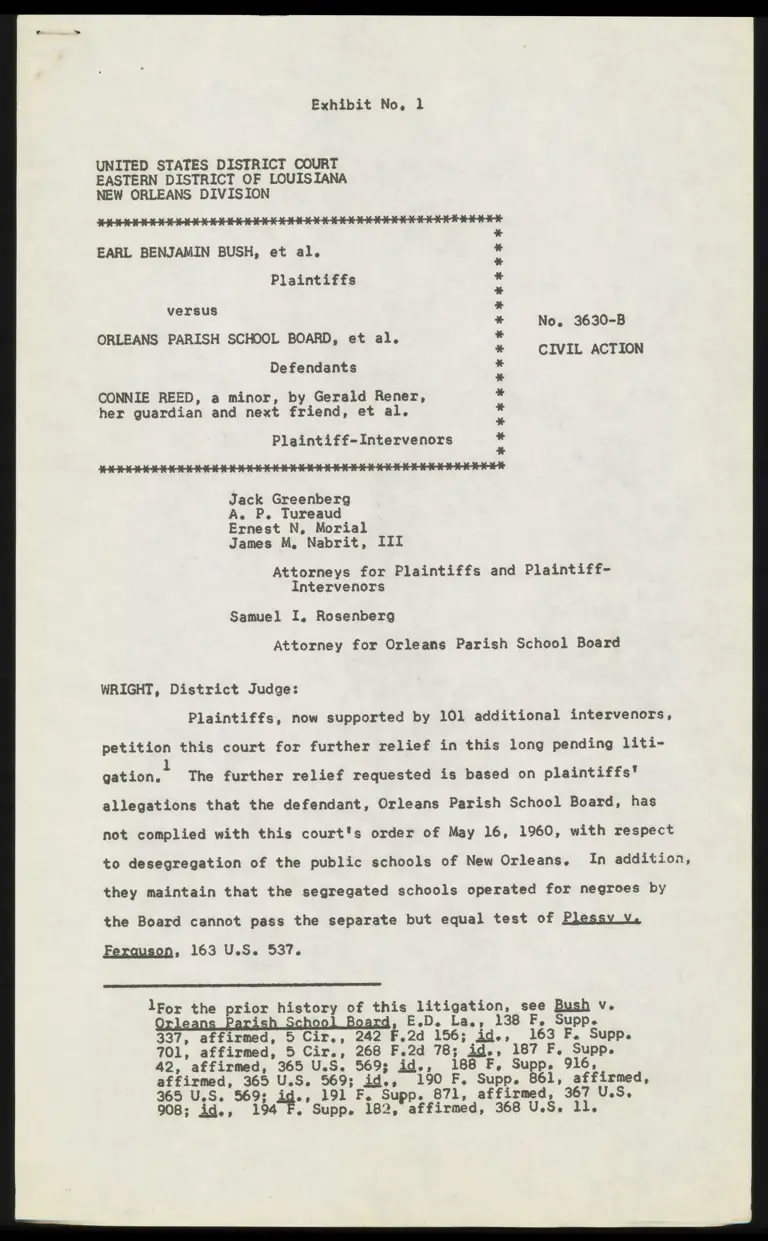
    Exhibit No, 1

UNITED STATES DISTRICT COURT
EASTERN DISTRICT OF LOUISIANA
NEW ORLEANS DIVISION

PRVEVIVEVEVIVEVEVEVEVEVENEETTR SORE TR REE AEE ed
*

EARL BENJAMIN BUSH, et al, *

Plaintiffs *

versus *
* No, 3630-B

ORLEANS PARISH SCHOOL BOARD, et al. *
* CIVIL ACTION

Defendants *

CONNIE REED, a minor, by Gerald Rener, *

her guardian and next friend, et al. *

Plaintiff-Intervenors * | | | |
Jack Greenberg
A. P., Tureaud
Ernest N, Morial
James M, Nabrit, III

Attorneys for Plaintiffs and Plaintiff-
Intervenors

Samuel I, Rosenberg

Attorney for Orleans Parish School Board

WRIGHT, District Judge:

Plaintiffs, now supported by 101 additional intervenors,

petition this court for further relief in this long pending 1liti-

astion.’ The further relief requested is based on plaintiffs’

allegations that the defendant, Orleans Parish School Board, has

not complied with this court's order of May 16, 1960, with respect

to desegregation of the public schools of New Orleans, In addition,

they maintain that the segregated schools operated for negroes by

the Board cannot pass the separate but equal test of Plessy Vv,

Ferguson, 163 U.S. 537.

lFor the prior history of this litigation, see Bush v,

Qrleans Parish School Board, E.D. La., 138 F, Supp.
337, affirmed, 5 Cir,, 242 F.2d 156; id., 163 F. Supp.
701, affirmed, 5 Cir., 268 F.2d 78; id,, 187 F. Supp.
42, affirmed, 365 U.S. 569; id., 188 F, Supp, 916,

affirmed, 365 U.S. 569; id,, 190 F, Supp, 861, affirmed,

365 U.S. 569; id., 191 F. Supp. 871, affirmed, 367 U.S.


On May 16, 1960, when the defendant failed to file a

plan of desegregation? of the Orleans Parish schools as ordered

by this court, this court filed one. The court's plan simply

provides that beginning September, 1960, all children entering

the first grade may attend either the formerly all white public

schools nearest their homes or the formerly all negro schools

nearest their homes, at their option, There is a further provision

for transfers not based on consideration of race.”

The Orleans Parish School Board maintains a dual system

of segregated schools based on race? This segregation is accom-

plished by dividing the city geographically into negro school

districts and white school districts based upon the residence and

race of the children attending such schools. On the opening of

school in September, 1960, instead of complying with the court's

desegregation order, the Board announced a testing program° for

any first grade child electing a school other than the one to

which he would be automatically assigned under the Board's segre-

gated system,® This program involved four steps consisting of

20n February 15, 1956, this court ordered the School Board

to desegregate the Orleans Parish public schools "with

all deliberate speed." On July 15, 1959, after no action

in compliance had been taken, the Board was ordered to

file a desegregation plan. To date no Board plan has

been filed and it was admitted at the hearing that sub-

mission of a plan is not in contemplation. This court

will, therefore, continue to order desegregation on an

ad hoc basis until an acceptable plan for integration of
the Orleans Parish schools is forthcoming.

3The order reads:

"IT IS ORDERED that beginning with the opening of school

in September, 1960, all public schools in the City of

New Orleans shall be desegregated in accordance with

the following plan:

"A, All children entering the first grade may attend

either the formerly all white public school nearest

their homes, or the formerly all negro public school
nearest their homes, at their option.

“B, Children may be transferred from one school to

another, provided such transfers are not based on
consideration of race."

4Enrollment in the Orleans Parish schools as of October 18,
1961, is as follows: White 37,845; Negro 55,820.

SThis testing program was promulgated pursuant to the
Louisiana Pupil Placement Act. La.R.S, 17:10] et seq.
The constitutionality of the Act is not attacked in
these proceedings.

6The testing program applied only to the first grade and

there only to children requesting "transfer,"

-8e


(1) a review of the "transfer" application form and verification

of the information contained therein, (2) testing of the petition-

ing pupils to determine "scholastic aptitude," "intelligenc
e or

ability" and "adequacy of pupil's academic preparation or
 readi-

ness for admission to school or curricula," (3) "test interpreta-

tion and personal evaluation to consider" ten listed crite
ria

relating generally to education, psychology, home environ
ment and

health, and (4) a "general administrative review and preparation

of recommendation to Orleans Parish School Board to consider"
all

of the information collected, the "choice and interests
" of pupil,

as well as the possibility or threat of friction
 or disorder among

pupils or others, and the possibility of breach of peace
 or ill

will or economic retaliation within the community.’ The bulletin

announcing the program further provides that pupils permi
tted to

transfer under these procedures and criteria "may be rea
ssigned

to the school to which they are assigned by virtue of th
eir place

of residence by order of the Orleans Parish School Boa
rd if they

do not make satisfactory adjustment to the newly assig
ned situa-~

tion,*S The announcement further requires the separation of

pupils by sex in each class desegregated under this program,


An analysis of the test program demonstrates that the

Board, instead of allowing children entering the first gr
ade to

make an election as to the schools they would attend, a
ssigned

all children to the racially segregated schools in their r
esiden-

tial areas. Then, after being so assigned, each child wishing to

"While these broad criteria were upheld as valid element
s

of a pupil placement law, Shuitlessorth v. Birmingham
, N.D. Ala,, 162 F, Supp. 372, affirmed,

358 U.S. 101, the application of such criteria to deny

admittance or transfer on the ground of potential ra
cial

disturbance would be improper, Cooper ¥, Aaron, 358 U.S.

1, 16, See Buchanan v. Warlev, 245 U,S. 60, 81,

BThis portion of the program in effect "repeals"
the statu-

tory criteria since it leaves ultimate pupil assignment

in the unfettered discretion of the Board, This absence

of permissible standards for placement sealed the fate

of Louisiana's first pupil placement law. Bush v., Orleans

Parish School Board, E,D, La,, 138 F, Supp, 337, 341,

affirmed, 5 Cir,, 242 F, 2d 156, See Higa County Ve

567, affirmed, 4 Cir., 252 F.2d 929.

wd


exercise his right to elect pursuant to the court's plan of desegre-

gation was subjected to the testing program, No children other

than first grade were required to take the tests. Pursuant to

this testing program, four negro first grade children out of 134

applicants were allowed to "transfer" to the white schools nearest

their homes during the school year 1960-61, and eight negro

children of 66 applying successfully overcame the hurdles of the

1961-62 testing program. Consequently, 12 of the 13,000-odd negro

children entering the first grade in the years 1960-61 and 1961-62

were admitted to and are attending "white" schools,

The Board maintains that it was justified in applying

the pupil placement law to the desegregation order of this court

in an effort to make certain that the children applying to "trans-

fer" were intellectually and psychologically acceptable in the

schools they sought to attend. The Board makes no explanation

for its failure to test all children seeking to enter the first

grade, or any other grade, in an effort to determine whether or

not they were intellectually and psychologically acceptable in

the segregated schools to which they were automatically assigned.

This failure to test all pupils is the constitutional vice in

the Board's testing program. However valid a pupil placement act

may be on its face, it may not be selectively applied: Moreover,

where a school system is ssareagted,t” there is no constitutional

basis whatever for using a pupil placement law, tt A pupil place-

ment law may only be validly applied in an integrated school

The admission of thirteen Negro pupils, after a scholastic
test, which the white children did not have to take, out of
thirty-eight who made application for transfer, is not
desegregation, nor is it the institution of a plan for non-

racial organization of the Memphis school system,"
0s, et a e «sy 6 Cirv,,

F.2d (2/23/62), p. 10, slip opinion, See also
Mannings v. Board of Public Instruction, 5 Cir., 277 F.2d

370, 374; Jones v, School Board of City of Alexandria,

282 F,2d 256, 258.

10uopviously the maintenance of a dual system of attendance
areas based on race offends the constitutional rights of
the plaintiffs and others similarly situated and cannot
be tolerated, ¥* %* * ¥ In order that there may be no doubt
about the matter, the enforced maintenance of such a dual
system is here specifically condemned,"

i i a, supra, 76.

llCompare Gibson v. Board of Public Instruction of Dade
County, 5 Cir,, 246 F,2d 913, 914; id., 272 F.2d 763, 767.

wil]


system, and then only where no consideration is based on race,

To assign children to a segregated school system a
nd then require

them to pass muster under a pupil placement law is discrimination

in its rawest form,

The plaintiffs, together with intervenors, also complain

of the crowded conditions in the defendant's negro schools
, as

compared to the white, The evidence shows that 5,540 negro elemen-

tary school children are on platoon, but no white.
The evidence

shows further that the average class size in the
negro elementary

schools is 38.3 pupils compared to 28.7 in the white,
 13 that the

pupil-teacher ration in the elementary schools is 36,0 to 1 for

negro, 26.1 to 1 for white, and that negro classes are conducted

in classrooms converted from stages, custodians' quarters,
libraries

and teachers! lounge rooms, while similar class
room conditions do

not exist in the white schools, Even under the separate but equal

test, these inequalities may not be maintained, It would be

unconscionable to compel negroes, 67 years after Plessy
v, Feragusor.

supra, to continue to submit to these conditions.

The Board states that in the next two or three years,

when its present building program is completed, most of
the pla-

tooning and the crowded conditions in the negro scho
ols will be

eliminated. But the Board®s projection gives no facts or figures,


12uThe Pupil Assignment Law might serve some purpose
in the

administration of a school system but it will not serve

as a plan to convert a biracial system into a non-racial

one." Northcroes. et al, v. Bd, of Educ... et al., supra,
p. 6, slip opinion, See also id., p. 8: "Since that

decision PBooun v. Board of Education, 347 U.S, 483],

there cannot be "Negro! schools and ‘white! schools,

There can now be only schools, requirements for adm
ission

to which must be on an equal basis without regard to race.”

13The maximum class size for elementary schools prescrib
ed by

the Louisiana State Board of Education is 35 pupils.
As of

October 18, 1961, in the white elementary schools 7.4 per

cent of the regular classes had over 36 pupils, w
hile in

the negro elementary schools 75.6 per cent of the cl
asses

had over 36 pupils.

l4gee Sweatt v,. Painter, 339 U.S, 629; Wilson v, Board of

Supervisors, E.D. La., 92 F. Supp, 086, affirmed, 340 U.S.

909.


nor does it make allowance for the increase in the school popula-

tion to be anticipated, based on the current birth rate, The

Board also suggests that in two successive elections property

owners of New Orleans have voted down proposals for tax increases

to defray the increased cost of operating the public schools in

New Orleans, and that this failure has caused the crowded condi~

tions in the negro schools, Whether New Orleans will have adequate

public schools is, of course, the responsibility of her taxpayers.

But whatever is provided, inadequate as it is, must at least be

made available on an equal basis to all school children,

Generations of negroes have already been denied their

rights under the separate but equal doctrine of Elessy v. Ferguson,

supra, and, at the present pace in New Orieans, generations of

negroes yet unborn will suffer a similar fate with respect to their

rights under Brown unless desegregation and equal protection are

secured for them by this court,

The School Board here occupies an unenviable position,

Its members, elected to serve without pay, have sought conscien-

tiously, albeit reluctantly, to comply with the law on order of

this court. Their reward for this service has been economic

reprisal and personal recrimination from many of their constituents

who have allowed hate to overcome their better judgment, But the

plight of the Board cannot affect the rights of school children

whose skin color is no choice of their own. These children have

a right to accept the constitutional promise of equality before

the law, an equality we profess to all the world.

IT IS ORDERED that the order of this court dated May 16,

1960, be, and the same is hereby, amended to read as follows:

(A) Beginning with the opening of school in September,

1962, all children entering, or presently enrolled in,

the public elementary schools of New Orleans, grades 1

through 6, may attend either the formerly all white

public schools nearest their homes or the formerly all

negro public schools nearest their homes, at their

option,


(B) Children may be transferred from one school to

another, provided such transfers are not based on con-

siderations of race.

(C) As long as the defendant, Orleans Parish School

Board, operates a dual school system hesed on racial

sagregation, the Louisiana Pupil Flacement Act shall

not be applied to any pupil,

Injunction to be drafted by the court,

s/ J. Skelley Wright

UNITED SIALES DISTRICT JUDGE

New Orleans, Louisiana

April 3, 1962


Exhibit No, 2

UNITED STATES DISTRICT COURT
EASTERN DISTRICT OF LOUISIANA
NEW ORLEANS DIVISION

3 3 3 3 He JI HIE IE IIA IIH HH FI III IIH HII Te FHT He He 3 Fee He

CONNIE REED, a minor, by Gerald Rener,
her guardian and next friend, et al.,

Plaintiff-Intervenors

*

EARL BENJAMIN BUSH, et al., *
*

Plaintiffs *
*

versus x
*

ORLEANS PARISH SCHOOL BOARD, et al., *
* No. 3630-B

Defendants *
* CIVIL ACTION
*

*
*

*
2%

Fi I 3 Fe JIE Ho Ho I HHH A Foe I He HoH Fe SFI HH IFN IH IK He HIN HHH H

TEMPORARY INJUNCTION

This case came on for hearing on plaintiffs' and intervenors'

motion for further relief and temporary injunction.

It being the opinion of the court that plaintiffs and intervenors

are entitled to further relief;

It is ORDERED that the motion to intervene be, and the same is

hereby, GRANTED,

It is further Ordered that the Orleans Parish School Board, its

agents, representatives, attorneys, and all other persons who are

acting or may act in concert with them, be, and they are hereby,

restrained, enjoined and prohibited from assigning pupils in any

manner AnCORSLatant with the following plan:

(A) Beginning with the opening of school in September, 1962, all

children entering, or presently enrolled in, the public elementary

schools of New Orleans, grades 1 through 6, may attend either the

formerly all-white public schocls nearest their homes, or the formerly

i/
all negro public schools nearest their homes at their option,

1/ This means that each child entering or attending grades 1
through 6 may elect to go to either the white school in his
or her residence district or the negro school in his or her
residence district as shown on the defendant's maps of the

City of New Orleans outlining the school district for each

race.


(B) Children may be transferred from one school to another

provided such transfers are not based on considerations of race.

(C) As long as the defendant, Orleans Parish School Board,

operates a dual system based on racial segregation, the Louisiana

Pupil Placement Act shall not be applied to any pupil.

/s/ J. Skelley Wright
UNITED STATES DISTRICT JUDGE

New Orleans, La,
April 9, 1962


Exhibit No, 3

UNITED STATES DISTRICT COURT

FOR THE EASTERN DISTRICT OF LOUISIANA

NEW ORLEANS DIVISION

EARL BENJAMIN BUSH, ET AL.,
PLAINTIFFS,

VS.

ORLEANS PARISH SCHOOL BOARD,
ET AL.,

CIVIL ACTION

DEFENDANTS, NO. 3630-B

CONNIE REED, ET AL.,
PLAINTIFF -INTERVENQRS

e
s

8

8
%


V
W


‘ 2
%


A


[
1
]


t
e


h
e


r
h


EEE EEE EEE EEE RE EEE EE EE EEE EE
EE

MEE EEEREERERERE EI EEE A BE EE ® ® ov 1
]


1
)


o
e


a
e


w
e


1
]


o
e


»
e


o
e
 [


o
e


h
k


e
o


o
e


o
e


e
e


0


o
t


PY
]

o
t


Y
d


»
e


[1
]

BE
.

w
e


(1
)

o
e


MOTION FOR NEW T
RA aay

et =
© 0 5 0 060 00 508 0 60 ° PE EEE EEE NEN ENEEEEE BS]

EEE EEE EER EE RE RR ER EE ER EE ERI
RE EE RE L 1

]


N
M


*»


a
k


\
M
d


t L
J


*
°
e


e
o


\
a
n


A


L 1
]


o
n


h
e


n
e


A
A


L
L


LJ


*
e


w
e


L 1
]


a
n


*
®


1
]


a
e


11
]

L 1
]


a
n


Defendant, Orleans Parish School Board, moves the Court to set

aside the temporary injunction entered herein on the 9th day of April,

1962, and to grant defendant a new trial, on the grounds that:

1. The judgment is contrary to law, in that:

(a) The Orleans Parish $chool Board has made a

prompt and reasonable start toward full com-

pliance with the May 17, 1954 ruling of the

United States Supreme Court, and this Court

may, and should, find that additional time is

necessary to carry out the ruling in an ef-

fective manner,

(pb) It is not true that during the period of

transition to a racially non-discriminatory

school system, the Louisiana Pupil Placement

Law (R.S. 17:101) may "only be validly applied

in an integrated school system." (Opinion, p. 4)

(c) No plaintiff, or plaintiff-intervenor, has

exhausted the administrative remedies provided

for in Louisiana Act 492 of 1960, (R.S. 17:101,

et seq.), nor have any of them exercised the

option given to them in earlier orders of this

Court to attend "...either the formerly all

white public school nearest their home, or the


- Page 2 =~

formerly all negro public school nearest the
ir

home..."3 and the pleadings do not allege that

they have so done.

(d) No pupil, whose application for transfer was

denied, has filed, in writing, with the Orleans

Parish School Board objections to the assignm
ent

of the pupil to a particular school; or has re-

quested by petition, in writing, assignment or

transfer to a designated school, or to another

school to be designated by the Board, all as is

provided for in R.S. 17:106; and no such pupil

appears as either plaintiff, or plaintiff-inte
rvenor.

(e) The constitutionality of Louisiana Act 492 of 19
60

is not here attacked (See fn. 5 of opinion). Its

provisions are therefore binding upon defenda
nts,

plaintiffs, plaintiff-intervenors, and the Cou
rt;

and injunctive relief can be granted only to
 those

who allege, and prove, that they have exhausted the

administrative remedies set forth in the sta
tute,

and the rights which they claim must be ass
erted

as individuals, and not as a class or group.

(f) It is not a proper function of this Court to secure

desegregation for "generations of negroes
yet un-

born" (Opinion, p. 6). NOthing in the United States

Constitution or in Brown v. Topeka gives t
o a child

the right to attend a school of his choice solely

because of his race. The simple requirement is that

no child shall be denied admission to a school of his

choice on the basis of race or color. The constitu-~

tion does not require desegregation, it merely forbids

discrimination.


- Page 3 ~-

2. The judgment is contrary to fact, in that, it is based

largely upon a finding that school facilities for negroes are unequal

to those for whites: The findings are erroneous in the following

respects:

(a) While some few "negro classes are conducted in

classrooms converted from stages, custodians’

quarters, Tibraties and teachers' lounge rooms,"

similar classroom conditions exist in the white

schools. (Opinion, p. 5)

(b) When the present building program of the Orleans

Parish School Board is completed, all platooning

in negro schools will be eliminated, even after

making allowance for the increase in the school

population to be anticipated, based on the current

birth race. (Opinion, p. 5)

(c) A vast preponderance of building funds spent in

the last ten (10) years have been for negro schools

(Exhibit OPSB__3__).

(d) Ten Million ($10,000,000.00) Dollars of Orleans

Parish School Bonds were delivered on April 4, 1962;

and this enabled Defendant to begin its current

construction program. On April 9, 1962 Defendant

awarded a construction contract for the construction

of twenty (20) additional classrooms at the Woton

School and twenty (20) additional classrooms at

the Dunn School; and in addition, Defendant authorized

the construction of sixty-four (64) portable classrooms.

The bulk of the funds available for the current

construction program of the defendant is already

earmarked for construction which will eliminate the

inequalities complained of,


- Page 4 ~-

3. The Court erred in enjoining the Orleans Parish S
chool

Board, et als., from assigning pupils in any manner inconsis
tent

with the plan set forth by the Court, in that:

(a)

(b)

(c)

(d)

School authorities have the primary responsibility

for elucidating, assessing, and solving, varied

local school problems. In assuming this responsi-

bility, the Court has stripped Defendant of its

administrative powers, and allows each child in

the system to decide which school he will attend.

The plan requires the present non-segregated admi
ssion

of all negro children, whether qualified or
not, on

the theory that this is a guaranteed constitutional

right, but the United States Supreme Court has he
ld

that a District Court might conclude that justifi
ca-

tion exists for not requiring the present non-

segregated admission of even qualified negro chil
dren.

Its order seeks to require the desegregation of


all six elementary grades in one fell swoop, and


prohibits the use of the Louisiana Pupil Placement

Law during the transitional period. No other School

Board in the deep South has been ordered to take

such drastic, sweeping, sudden action, and the Court

of Appeals for the Fifth Circuit reversed a simil
ar

order issued to the Dallas School Board and order
ed

the District Court to accord school authorities a

reasonable further opportunity to promptly meet

their primary responsibility in the premises.

The plan handed down by the Court is impractical
,

and is virtually impossible to comply with.
If

school children are permitted to go to schoo
ls of


- Page 5 -

their choice, without regard to attendance areas,

distances, school bus routings and other pertinent

factors, some of the schools would be crowded be-

yond their capacity and others would be practically

vacant.

WHEREFORE, Defendant prays that the above Motion be granted.

'

Samuel I, Rosenberg
Attorney for the Orleans Parish School
Board
747 National Bank of Commerce Building
New Orleans 12, Louisiana
JAckson 2-5128.


yy x Exhibit No. 4

UNITED STATES DISIRICT COURT

EOR_THE EASTERN DISTRICT OF LOUISIANA

NEW ORLEANS DIVISION

EARL BENJAMIN BUSH, ET AL.,
PLAINTIFFS,

VS.

ORLEANS PARISH SCHOOL BOARD,
ET AL.,

CIVIL ACTION

DEFENDANTS, NO. 3630-B

CONNIE REED, A MINOR BY
GERALD RENER, HER GUARDIAN
AND NEXT FRIEND, ET ALS.,

PLAINT IFF-INTERVENORS
$ & 99 0 6 5 5 08 OW 6 OO 0% 4° 00
® 9 5 FO 0 0° 0 Pe SSP Oe ED OES

e
e

9
%

3
¢


0
6

#
6


9
9
%

g
o

0
9

2
8

9
s

P
S


\.

* ® ® 4 06 ¢ & 0
¢ & & 0 0° 8

MOTION FOR STAY OF EXECUTION PENDING DISPOSITION OF MOTION FOR
NEW_TRIAL

a © 00 0 0 ® ® 5 6 8 9 68 SS SO SB Se 2s
« © © 9 0° 0° ® ® 5 4 8 5 9 0 9 Se "PO SHE Se w

h


® 6 5 9 © © 0 95 5 6 8 OO SS Se 9 Oe see vs
» 2 9» 2" O° 9 LB

Defendant, Orleans Parish School Board, moves the Court

for an order staying execution of, or any proceedings to enforce,

the judgment entered in favor of plaintiffs and plaintiff-intervenors

herein, on April 9, 1962, pending disposition of defendants’ motion

for a new trial, on the ground that irreparable injury might other-

wise result to defendant.

Samuel I. Rosenberg
Attorney for Orleans Parish School
Board,
747 National Bank of Commerce Building
New Orleans 12, Louisiana
JAckson 2-5128.

[Defendants' Proposed Order Omitted]