Correspondence from Blacksher to Judge Thompson
Public Court Documents
March 19, 1986
3 pages
-
Case Files, Dillard v. Crenshaw County Hardbacks. Correspondence from Blacksher to Judge Thompson, 1986. 4208707d-b8d8-ef11-a730-7c1e527e6da9. LDF Archives, Thurgood Marshall Institute. https://ldfrecollection.org/archives/archives-search/archives-item/80028de9-9a69-4fda-b7b5-d91a3b6fd4bf/correspondence-from-blacksher-to-judge-thompson. Accessed September 13, 2026.
Copied!
    i # » } ov


Nee

BLACKSHER, MENEFEE & STEIN, P.A.

ATTORNEYS AT LAW
405 VAN ANTWERP BUILDING

PF. O. BOX 1051
MOBILE, ALABAMA 36633-10851

JAMES U. BLACKSHER March 19, 1986 TELEPHONE
LARRY T. MENEFEE (205) 433-2000
GREGORY B. STEIN

WANDA J. COCHRAN

Hon. Myron H. Thompson
United States District Judge
Middle District of Alabama
Federal Courthouse
Montgomery, AL 36104

RE: Dillard, et al. v. Crenshaw County, Alabama, et al.
Civil Action No. 85-T-1332—N

Dear Judge Thompson:

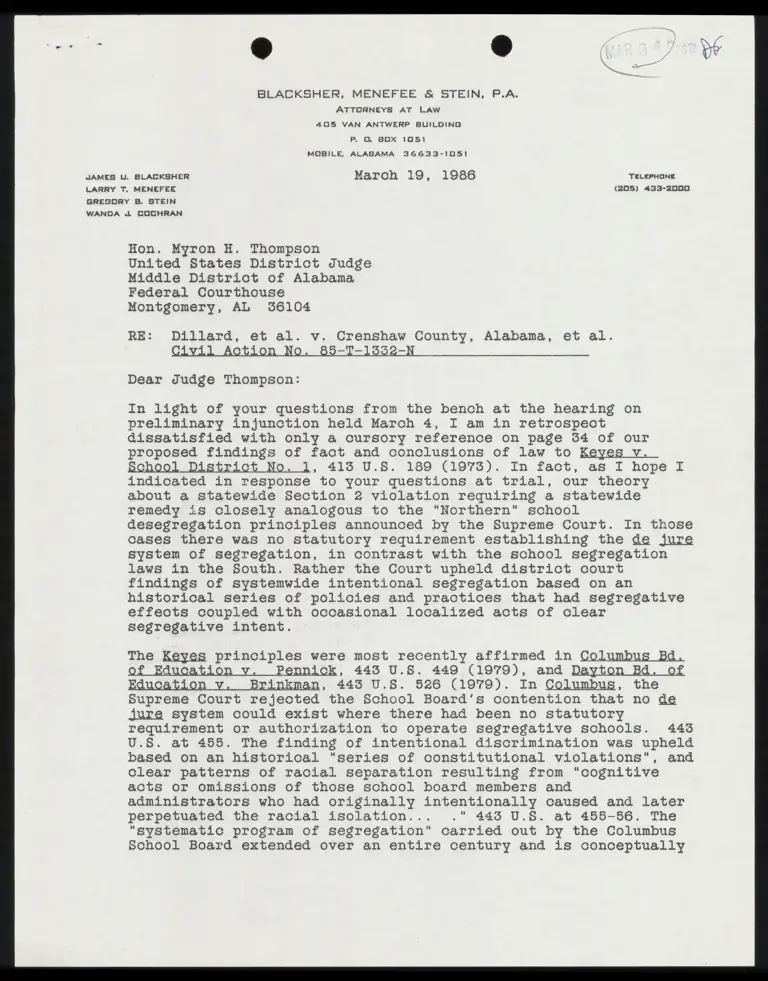
In light of your questions from the bench at the hearing on
preliminary injunction held March 4, I am in retrospect
dissatisfied with only a cursory reference on page 34 of our
proposed findings of fact and conclusions of law to
School District No. 1, 413 U.S. 189 (1973). In fact, as I hope I
indicated in response to your questions at trial, our theory
about a statewide Section 2 violation requiring a statewide
remedy is closely analogous to the "Northern" school
desegregation principles announced by the Supreme Court. In those
cases there was no statutory requirement establishing the de Jjure
system of segregation, in contrast with the school segregation
laws in the South. Rather the Court upheld district court
findings of systemwide intentional segregation based on an
historical series of policies and practices that had segregative
effects coupled with occasional localized acts of clear
segregative intent.

The Keyes principles were most recently affirmed in Columbus Bd.
of Education v. Pennick, 443 U.S. 449 (1979), and t
Education v. Brinkman, 443 U.S. 526 (1979). In Columbus, the
Supreme Court rejected the School Board's contention that no de
Jure system could exist where there had been no statutory
requirement or authorization to operate segregative schools. 443
U.S. at 455. The finding of intentional discrimination was upheld
based on an historical "series of constitutional violations", and
clear patterns of racial separation resulting from "cognitive
acts or omissions of those school board members and
administrators who had originally intentionally caused and later
perpetuated the racial isolation... ." 443 U.S. at 455-586. The
“systematic program of segregation" carried out by the Columbus
School Board extended over an entire century and is conceptually


Hon. Myron H. Thompson
March 19, 1986
Page Two

indistinguishable from the systematic program of manipulation of
the at-large election systems for county commissions conducted
for over a century by the Alabama Legislature. See 443 U.S. at
456. The Court held that it was not necessary for the Columbus
plaintiffs to demonstrate that "all schools were wholly black or
wholly white in 1954... ." 443 U.S. at 456. Instead, "[plroof of
purposeful and effective maintenance of a body of separate black
schools in a gubstantial part of the system itself is prima facie
proof of a dual school system and supports a finding to this
effect absent sufficient contrary proof by the Board, which was
not forthcoming in this case." 443 U.S. at 458 (emphasis
added).

Equally significant were the findings in Dayton, where the
establishment of two or three one-race schools through the
history of the school system was found to be highly probative of
systemwide racial motives, particularly when coupled with the
weight of all the historical practices and policies. The Supreme
Court approved the district court’s conclusion that the School
Board’'s "intentional segregative practices cannot be confined in
one distinct area"; they "infected the entire Dayton public
school system." 443 U.S. at 536-37. Thus, the patterns of proof
of intentional racial discrimination in these northern school
desegregation cases parallel the proof in the instant case: a
series of policies and practices in particular historical
contexts that had clear racial impact throughout the jurisdiction
controlled by the decisionmakers whose motives were in question;
localized instances of clear racial intent that confirm the
inferences supplied by the historical patterns; and a strong
national mandate to dismantle the vestiges of historical
segregation. The case for systematic, historical, racially
discriminatory motives on the part of the Alabama Legislature is
even clearer in the instant case than in the northern school
desegregation cases, because we have produced "smoking gun”
statements connected with the 1953 anti-single shot law and the
1961 numbered post law.

An additional point from Keyes, Columbus and Dayton is the
requirement that the jurisdiction found guilty of intentional
segregation proceed immediately to dismantle the discriminatory
system root and branch. The duty to dismantle extends throughout
the system, even where no localized acts of discrimination have
been demonstrated. E.g., Dayton, supra, 443 U.S. at 537.


Hon. Myron H. Thompson
March 19, 1986
Page Three

In light of Congress’ purpose in 1982 amending the Voting Rights
Act, the national mandate for elimination of all vestiges of
discriminatory structures that dilute black voting strength is
just as strong as the national mandate to desegregate the
schools.

Best regards.

Very respectfully,

BLACKSHER, a
s

‘Japes U. Blacksher
: WP


CC All Counsel


STEIN, P. A.