Brief of Respondents
Public Court Documents
1970
111 pages
-
Case Files, Swann v. Charlotte-Mecklenburg Hardbacks. Brief of Respondents, 1970. f1a691fe-2d34-f111-88b4-0022482cdbbc. LDF Archives, Thurgood Marshall Institute. https://ldfrecollection.org/archives/archives-search/archives-item/8176f601-f547-48c6-a6c1-b3b147d95253/brief-of-respondents. Accessed October 15, 2026.
Copied!
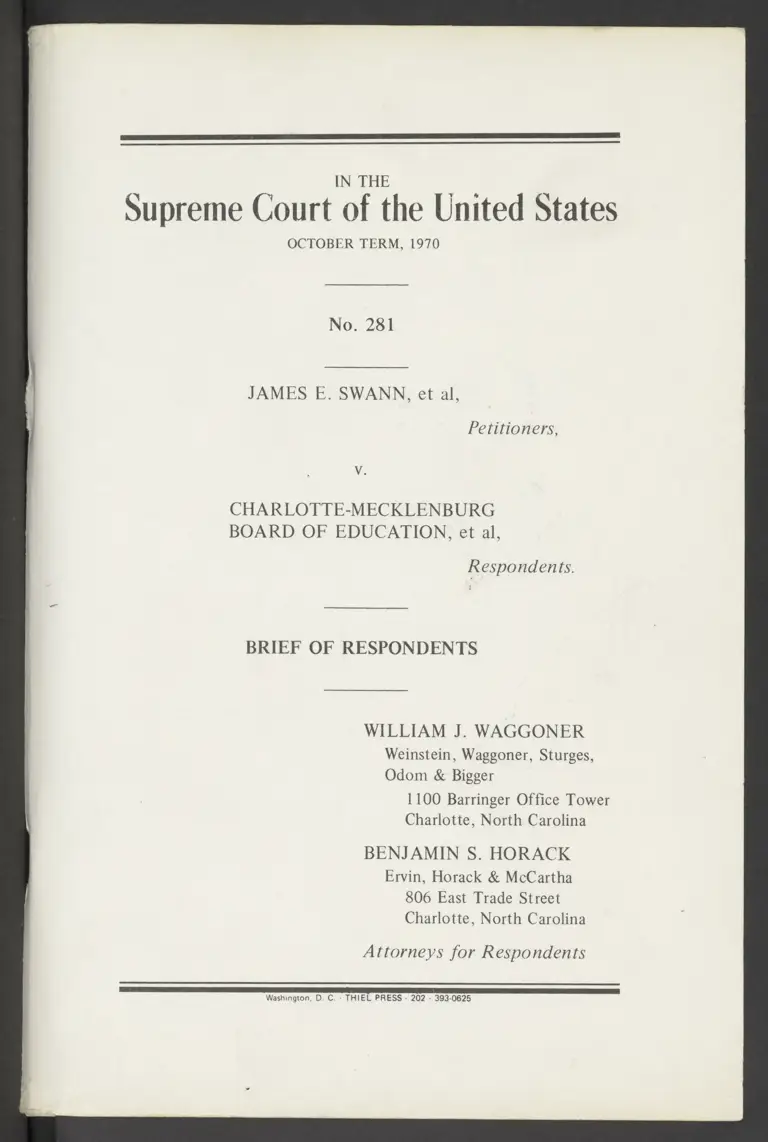
     [||98621d70-d147-4949-9966-9323be89b8a6||] IN THE

Supreme Court of the United States
OCTOBER TERM, 1970

JAMES E. SWANN, et al,

Petitioners,

V.

CHARLOTTE-MECKLENBURG
BOARD OF EDUCATION, et al,

Respondents.

BRIEF OF RESPONDENTS

WILLIAM J. WAGGONER

Weinstein, Waggoner, Sturges,

Odom & Bigger

1100 Barringer Office Tower

Charlotte, North Carolina

BENJAMIN S. HORACK

Ervin, Horack & McCartha

806 East Trade Street

Charlotte, North Carolina

Attorneys for Respondents


Washington, D. C. - THIEL PRESS - 202 - 393-0625


(i)

TABLE OF CONTENTS

INTRODUCTORY STATEMENT REGARDING BRIEF .....

OPINIONS BELOW ..... ........0 aussi daihisionnqs

JURISDICTION .. . ...... csv es issssosinsnansainnss

QUESTIONSPRESENTED .......... ccorcremevis-v:s:

CONSTITUTIONAL AND STATUTORY PROVISIONS

INVOLVED ..... - csisiviin iahisiin ihomis vititlnni eli «vv 0»

PRELIMINARY STATEMENT 0... x cevnsivviinindic bin» nin 5s

STATEMENTOFTHECASE  ....... +... veer. vrs>

SUMMARY OF ARGUMENT ..........c..ccirsrscnna

ARGUMENT

I. General Discussion of Constitutional Problems and

Concepts... io. ahi bis Wn tiideicc simahe vv 0s

A. A Child’s Constitutional Right Guaranteed by

the Fourteenth Amendment Is To Go to School

in a Unitary System. If the School Is Part of

Such a System, He Has Been Accorded that

BUN CL ii aban ait si
B. A Unitary System Is One Within Which No

Child Is Excluded from any School Because of

Race. If a Desegregation Plan Promises Realis-
tically To Accomplish This, It Is Constitutionally

Acceptable Notwithstanding a Residue of Pre-

dominately Black or White Schools that Remain
for Reasons Unrelated to Race’. . ...... ....00.

C. A “Rule of Reason” Rather than a “Rule of

Absolutes” Should be the Standard by Which To
Judge the Sufficiency of a Desegregation Plan . ....

D. The Distinction Between De Facto and De Jure

Is Not a Valid Standard by Which To Determine

Whether a School System Is Unitary . . . . .........

E. The Constitution Does Not Require Racial Balanc-

ing in Schools or Bussing of Children Outside

Geographic Attendance Zones To Effect Such Bal-

WW


bo


DD


ee


24

26


F.

(ii)

ancing. Balancing and Compulsory Bussing In-

fringe on the Personal Rights and Liberties of the

ChildrenInvolved  ....................

1. Racial Balancing and the Bussing To Achieve
It Were the Bases for the Decisions of the
Trial Court and Court of Appeals ......

Racial Balancing and Compulsory Bussing
Required by the District and Circuit Courts
Violate the Constitutional Rights of the

Children Involved ...... i... ovis ose

A Neighborhood Plan Fairly Administered

Without Racial Bias Satisfies the Constitu-

tional Requirements of a Unitary System

The Compulsory Bussing Approved by the
Court of Appeals Is Violative of the Provi-

sions of Section 401(b) and 407(a)(2) of the

Civil Rights Act of 1964 [42 U.S.C. 2000c

(b) and 2000c-6(a)(2)] Which Expressly

Prohibits a United States Court To Order
Transportation To Achieve Racial Balance

Schools vo. oouts cieiis os cp anie nv

Racial Balance—the Harbinger of Massive Court

Involvement in Social Theories «cv: vvnens

IL. Discussion of Constitutional Principles Applied to

Desegresation Plans... 1 ........../......,

A. General Statement Regarding Desegregation Plans
Involved inthisCase , ... . coc. oi cian nns os

The Board Plan Converts the Charlotte-Mecklen-

burg Schools to a Unitary System. The Fourth
Circuit Joined in the Error of the Trial Court by

DisapprovingthatPlan. . ........,........

B.

1.

2.

The Board Plan Squares With the Conversion
Checklist Prescribed by Green  ........

The Board Plan Based on Geographic Attend-

ance Zones Gerrymandered To Achieve

Maximum Racial Mix Fully Complies with

Constitutional Requirements for Desegrega-

tion of the Charlotte-Mecklenburg Schools

and Their Student Bodies . . ..........

PONE Wr Me ty J

eo eo oo oo

ede ee

oss ee

48

48

52

56

87

60

63

69

69

70

70

71


(iii)

C. The Court Approved Finger Plan Exceeds Consti-

tutional Requirements by Requiring Racial Bal-

ancing and the Bussing To Implement It. The

Fourth Circuit Joined in the Trial Court’s Errors

by Disapproving the Board Plan and Misapplying

tsOvn Ruleof Reason... ............ 2200, 76

1. An Analysis of the Court Approved Finger

Plan Shows the Racial Balancing Imposed

Upon the Charlotte-Mecklenburg Schools .... 77

(a) Elementary Schools ..et oid iiiile. 77

(b) JuniorHigh Schogls 7.0... J Jou, 78

C) SemiorHighSchools ........... ......: 79

2. The Court-Approved Finger Plan Is Unrea-

sonable and Proper Consideration Was Not

Given to the Burdens Which that Plan
Imposes on the Charlotte-Mecklenburg Sys-
1 Dasara ss lassen oline sigs dS lg 80

D. The HEW Elementary Plan Is Educationally Un-

sound, Requires Racial Balancing, Fosters Reseg-

regation and Is Unveasonable . i.e or onic winnie

E. The Elementary Plan of the Board Minority Is

Incomplete and Unlawfully Exceeds Constitu-
tional Requirements by Requiring Complete Ra-

cial Balancing of Every Elementary School and

the Bussing To Implement It. The District Court

Erred in Approving that Plan as a Reasonable

Altermative.x 1) cd oa 0h dais, Jo BDL Aa I 88

F. The Earlier Draft of the Finger Elementary Plan Is

Incomplete and Unlawfully Exceeds Constitu-

tional Requirements by Requiring Racial Balanc-

ing. The District Court Erred in Approving that
Plan as 2 Reasonsble Alternative. ........ oc... 90

G. In Assessing the Effectiveness of a Desegregation

Plan, a Rule of Reason Requires that Due Con-

sideration Should be Accorded School Boards and

Administrators in Controlling the Destiny of

PublicBducation” ................... ia... 91

CONCLUSION .... i060 000 000000 vuisies Sutin die on 93


(iv)

Brief Appendix

Statistical Data Relating to the Charlotte-Mecklenburg
Scheolsand the Board Plan ................... 5." A-1

Maps Showing Desegregation Plans (Filed as Separate
Appendix):

Board Elementary Plan. . . ............ .. i... conv No. 1

Board Rezoned Elementary Plan (Superimposed Upon
1969-70 Attendance Areas) . . ...... ......ccvssn No. 2

Court-Approved Finger Flementary Plan . . ........... No. 3
HEW Elementary Plan. . ~. 7... 2. sic 00s No. 4

Board Minority Elementary Plan. 1... 0 ovina... on No. §

Board Junior High Plan. oc... 0s onielc tteininnn on ins No. 6

Court-Approved Finger Junior High Plan. ............ No. 7

Board Senior Hisch Plan. .". ....... a: von. No. 8
Court-Approved Finger Senior High Plan. . . .......... No. 9

TABLE OF AUTHORITIES

Cases:

Alexander v. Holmes, 396 U.S. 19 (1969) ....... 12,28, 29, 30, 61

Baldwin v. State of New York, U.S.  ,90 S.Ct. 1886

(1970). 0h. ons ndlnini. Ja, Jovi dildnidisaicidn us 38

Bivins v. Bibb County Board of Education, 419 F.2d 1211

SthCit. 1976)... . 7. tn or. sss ssa rnnns 91

Brinson v. State of Florida, County of Dade, 273 F. Supp.

840. (S.D. Fla. 1967)... . sib: voir torn tn rit rns spe vise 38

Brown v. Board of Education, 347 U.S. 483 (1954) ........ passim

Brown v. Board of Education, 349 U.S. 294 (1955) ........ passim

Building Service Employees International Union v. Gazzam,
339US. 991 (1950). .... 0... oe ee. 61

Cooperv, Aaron, 358 US. 1 (1958) .................: 44, 64

Coxv. Louisiana, 379 US. 536 (1965) ........c0+2:s24: 37

Deal v. Cincinnati Board of Education, 419 F.2d 1387, (6th

Cir. YIB9) bis ainliihah oiviin inne socituins win iv iniin,s 31, 43, 53,58

Deal v. Cincinnati Board of Education, 419 F.2d 209, (6th

Cir1966). 0°. cL. cai a ss es 57

Dennis v. United States, 341 US. 494 (1951) ............. 37.40


(v)

Duncan v. Louisiana, 391. U.S. 145 (1968) cc vou. sna. uy 37

Ellis v. Board of Public Instruction of Orange County, 423

F203. (Sth Civ. 1970) Juuviiiivianns cunt vt ont 5 0 31

Gideon v. Wainwright, 372 US. 335(1963) ...........:. 38

Gilbert v. Minnesota, 254 US. 323 (1920) .......... . .. .. 37

Gitlow v. People of the State of New York, 268 U.S. 652
(928)... .. aa aT 37

Goss v. Board of Education, City of Knoxville, Tennessee,

373 US. 6831963). run. Lh ol al Jn a rani, 7, 64

Goss v. Board of Education, City of Knoxville, Tennessee,
406 F.2d. 1133 (6th Cir. 1969)... ....0 oval Jo. anes. 31

Green v. New Kent County, 391 US. 430 (1968) ........ passim

Hawthorne v. Lunenburg County, 413 F.2d 53 (4th Cir.
5h EES Ba a el a 10

Meyer v. Nebraska, 260 U.S. 39041923) ........... .... 68

Mohammad v. Sommers, 238 F. Supp. 806 (E.D. Mich.
1964) uo... a aaa ui 37

Northcross v. Board of Education, 397 U.S. 232 £1970) +... ... 28

Norwood v.. Tucker, 287 F.2d 798 (83th Cir. 1961). ....... ... 64

Pierce v. Society of Sisters, 268 U.S. 510 (1925)... ......0ouvu 40a 67

Plessy'v. Ferguson, 1631U.8.337 (1896): &..ivuu 35,44,45,75

Reynolds v. Simms, 3770.8. 333.1(1964Y ... i... Bn 67

Ross v. Eckels, Houston Independent School District, No.
10444, F.Supp. | (SD: Texas l970) 5 nivel oui ih 33,54

Schenck v. United States, 249 U.S. 47 (1919) ~............ 37

Shelley v. Kraemer, 334 USic1 (0948y. vol Soon pn 47

Sparrow v. Gill, 304 F. Supp. 86 M.D.N.C. 1969) ........... 19

Swann v. Charlotte-Mecklenburg Board of Education, 242
ESupp.667{1965) ..,............. ............... 8

Swann v. Charlotte-Mecklenburg Board of Education, 369
Bad 201006) . +... sn dst cE iF a 8, 44

Times Film Corporation v. City of Chicago, 365 U.S. 43
qee1y................. =... 37


(vi)

United States v. Greenwood Municipal Separate School

District, 406. F.2d 1085. (5th Cir. 1969) .. i cioioivis iu 20 midi os 31

United States v. Jefferson County Board of Education, 372
F.2d, 836 (5th Cir. 1966) Aff’d on rehearing, en banc,

330F.2d4 383th Cir. 1967) ......... 35, 54, 55, 60, 62, 63, 64

United States v. Montgomery County Board of Education,

305 US. 22501969)... i ivr vi vnenpnine indie 9, 14,51

Statutes:

Civil Rights Act of 1964, 42 U.S.C. 2000c(b) and 2000c-6

(AX) is +h soni esse iy i sis rr a Be be 2a 4,60, 61, 62

N.C.Gen. Stat. Secs. 115etSeg. ... cua inaiiiiio. Seinen 53

Other Authorities:

Bickell, The Supreme Court and the Idea of Progress (1970). . . . . 74

110 Congressional Record, Page 12717, June 4, 1964... .. 63

Nations Schools, June 1970, page 100, “Forced Busing

Vetoed by 90% of Schoolmen”  .............. 0. +c. 72

Petitioners’ Brief in Green v. New Kent County, October

Term 1967, No. 693 ©... .... cc: rvesidasisns 57, 59, 64, 65

PROFILE, Metromedia Radio News, February 27, 1970 ... 58

Racial Isolation in the Public Schools—Summary of a

Report by the Commission on Civil Rights (1967) ...... 20, 47, 56

SCHOOL DESEGREGATION: A Free and Open Society,

(116 Cong. Rec. §4351, Daily Ed., March 24, 1970) . . . . .. .. 58,91

United Press International Release, May 17, 1970 .......... 45

NUSIW. 3164 (1952)... . vac bn shi cable a i 64, 74

Webster's Seventh New Collegiate Dictionary (1967)... ...... 35


IN THE

Supreme Court of the United States
OCTOBER TERM, 1970

No. 281

JAMES E. SWANN, et al,

Petitioners,

v.

CHARLOTTE-MECKLENBURG
BOARD OF EDUCATION, et al,

Respondents.

BRIEF OF RESPONDENTS

INTRODUCTORY STATEMENT REGARDING BRIEF

The briefs submitted in the companion cases Nos. 281

and 349 are identical. This statement is made so that this

Court may be spared the inconvenience of a separate detailed

analysis of both briefs.

Case No. 281 relates to the Petition filed by the plaintiffs

for a review of the decision of the Circuit Court of Appeals


2

for the Fourth Circuit. Case No. 349 relates to the Cross-

Petition of the defendants from the same decision. The plain-

tiff’s Petition in case 281 was granted on June 29, 1970. Al-

though action on the defendants’ Cross-Petition has been de-

ferred until the convening of this Court at its October 12,

Term, 1970, this Court has advised that both cases will be

heard on October 12, 1970, and has instructed the defend-

ants to file briefs in both cases. The two cases have not been

consolidated for briefing.

Each of the two cases involves the same school system,

the same orders of the district court and Circuit Court and

the same issues. In order to be of as much assistance as possi-

ble to this Court, it is prudent that one comprehensive pre-

sentation shall be made. It is for this reason that, although

separate briefs are filed, their text and content are the same.

OPINIONS BELOW

The opinions of the courts below are set forth in Brief for

Petitioners filed in No. 281 on pages 1 through 3 thereof.

JURISDICTION

The judgment of the Court of Appeals for the Fourth

Circuit was entered on May 26, 1970. The jurisdiction of

this court is invoked under 28 U.S.C. 1254(1). The Petition

for Writ of Certiorari was filed in this court on July 2, 1970.

On August 31, 1970, the Chief Justice deferred action on

Cross Respondents’ pending Petition for Writ of Certiorari

and directed filing of briefs and set this case for oral argu-

ment on Monday, October 12, 1970.


3

QUESTIONS PRESENTED

1. Did the Court of Appeals join in the error of the trial

court in rejecting the desegregation plan offered by the Board

of Education where 68% of the black students would attend

schools in which their race was in the minority and where

the remaining 32% of the black students would attend

schools having white ratios of 17% to 1% and these black

students would be taught by a predominantly white faculty

and further where such black students were offered more

generous freedom of transfer than that offered by the custo-

mary majority to minority transfers?

2. Did the Court of Appeals join in the error of the trial

court in rejecting the plan for desegregation of the 72 ele-

mentary schools prepared and offered by the Board of Edu-

cation, where the plan left no all-black schools, though nine

of 72 schools had white ratios of 1% to 17% and black

students attending those schools would have an untrammeled

right to transfer to any one of the 63 remaining elementary

schools, and upon departure from elementary schools would

be assured of a desegregated education during the remainder

of their schooling?

3. Did the Court of Appeals join in the error of the trial

court in rejecting (by the trial court’s offering the Board a

“Hobson’s choice”) the Board plan for desegregation of

junior high schools where only one of 21 junior high schools

would have more than a 39% black student ratio and the

remaining predominately black school would house 758

black and 84 white students and have a predominately white

faculty by imposing a requirement on the Board to create

nine black satellite districts containing approximately 2,700

black students and assigning them to predominately white

suburban junior high schools?

4. Did the Court of Appeals join in the error of the trial

court in rejecting the Board plan for desegregation of senior

high schools where the plan provided that no school would

have more than a 36% black ratio and that each school would


4

have a predominately white faculty and in imposing a fur-

ther requirement upon the Board that 300 black students re-

siding in four designated grids would be bussed a substantial

distance from the northwestern part of the city to a high

school serving the extreme southeastern portion of the

county?

5. Did the Court of Appeals join in the error of the trial

court in imposing racial balances in junior and senior high

schools in contravention of Title 42 U.S.C. 2000(c)(b) and

6(a)(2) (Sections 401(b) and 407(a)(2)) of the Civil Rights

Act of 1964.

CONSTITUTIONAL AND STATUTORY
PROVISIONS INVOLVED

This case involves the equal protection clause of the Four-

teenth Amendment of the Constitution of the United States,

Section 401(b) and 407(a)(2) of the Civil Rights Act of

1964 [42 U.S.C. 2000(c)(b) and 6(a)(2)].

PRELIMINARY STATEMENT

The principal question presented by the several appeals

herein relates to whether or not the Charlotte-Mecklenburg

public school system may retain one or more predominately

black schools. If the absolutists are to prevail, then the pre-

sentation which follows is wholly irrelevant. The Court of

Appeals held that no such absolute requirement exists as

desegregation of the predominately black schools will be

adjudged by the ‘“‘test of reasonableness.”

In order to answer the question, one must have an under-

standing of this school system. The system involves 103

schools, 4 kindergarten programs and one learning academy,

which last year served approximately 84,500 students of

which 29% were black and 71% were white. The system is
expected to grow by an approximate 3,000 students this


5

school year. In comparison to other school systems in this

nation, the system ranks 43rd largest.

As an urban school district, it shares the same problem of

other urban school systems. Since 1954, the black student

population has increased from 10,000 to 24,000 students and

during this period eleven formerly all-white schools are now

almost entirely black (691a). The transition has been rapid.

In 1965 these eleven schools housed a 35% black student

population. During the 1969-70 school year, these schools

housed an 81% black population and the areas in which this

transition has taken place are located generally in the older

white neighborhoods. Charlotte has experienced phenomenal

growth and, therefore, the older neighborhoods are primarily

located near the center of the city, which serves as the base

for the expanding black areas as whites on the economic

move improve their position; blacks improving their position

take over the white homes. This had led to the transition of

schools from white to black. Today, 95% of the black stu-

dents reside in the northwestern inner-city quadrant or the

fringes thereof.

The Board was in the process of combating this problem

by construction of schools in areas which would offer more

stable desegregation, the most notable of which were Olym-

pic High School, originally scheduled for construction in a

predominately black neighborhood, and Randolph Junior

High which was also scheduled for construction in a similar

neighborhood (72a-73a).

Further efforts of the Board involved closing and consoli-

dating of twenty schools; creation of a single athletic league;

nondiscriminatory employment practices; substantial desegre-

gation of school faculties with total desegregation to follow

for the 1970-71 school year; cross racial assignment of prin-

cipals; appointment of black professionals to ranking admini-

strative positions; board appointment of a black member to

the Board of Education; elimination of the dual bus system;

nondiscrimination with respect to teacher salaries, school

fees, school lunches, library books, instructional materials,


6

quality of school buildings, use of federal funds, course

offerings and evaluation of students; merger of the black and

white PTA Councils; operation of specialized and supple-

mentary programs implemented to increase desegregation;

redesigning of freedom of choice so that its only effect

would increase desegregation and give racial stability to the

schools; gerrymandering of attendance lines to promote

maximum racial desegregation and other techniques designed

to create and promote racial stability (681a-683a, 1265a-

1266a).

The rural areas of the school system do not offer such

difficult problems in desegregation as the races are scattered

and, therefore, as with most rural systems, these schools

present substantial stable desegregation (313a).

Freedom of choice has neither perpetuated nor made sub-

stantial inroads on the desegregation problem. The super-

intendent estimated that approximately 1,200 (565a) white

students had left predominately black schools where they

would have been mixed in varying degrees with approxi-

mately 16,000 blacks.

In 1957 Charlotte led the South in opening its schools

to students of both races. However, it is admitted that there

were few students who took advantage of this option. Con-

solidation of the city and county systems, the two largest

in the state, occurred in 1961, creating a school system hav-

ing an east-west span of 22 miles and a north-south span of

36 miles and comprised approximately 550 square miles.

The City of Charlotte contains 64 square miles, making it

larger than the District of Columbia. The county is nearly

twice the size of the City of New York.

In 1965 a plan was devised by the Board embracing free-

dom of choice, rezoning and non-racial assignment of faculty

which entirely abolished the former dual system under the

law as then understood. That plan was approved by the

district court in 1965 and by the Court of Appeals in 1966.

The plan led to the abolition of all dual auxiliary programs

and services, such as transportation, athletic leagues, PTA’s,

etc.


7

Consistent with racial anonymity, racial identification of

students and faculty was completely removed from all school

records. Because of this, during the course of this litigation,

requests for racial information created a substantial burden

on the school system in producing this data.

The plan proposed by the Board eliminates 8 of the 17

predominately black elementary schools, four of the five

predominately black junior high schools and establishes ten

senior high schools so that no high school will have more

than a 36% black ratio. It reduces the number of blacks

attending predominately black schools to 7,497. (Compare

district court’s finding of 16,000 previously). Faculties will

be racially balanced.

These exemplary steps have been taken by a school board

which petitioners variously label as “recalcitrant,” “‘contemp-

tuous,” “lawless” and similar characterizations.

STATEMENT OF THE CASE

The plan for desegregation offered to the district court

by the Charlotte-Meckienburg Board of Education would

place 68% of the 24,000 black students in predominately

white schools and the remaining 32% would attend schools

having a black ratio of 83% to 99%. No other school sys-

tem of similar size and complexity in this nation has the

degree and volume of desegregation offered by this plan.

The exemplary proposal of the Board was summarily re-

jected by the district court for the reason that this system

would not be permitted to have a predominately black

school. The district court therefore ordered racial balancing

of the schools served by the system.

The present action was instituted in 1965 which resulted

in the district court’s approval of the plan then offered by

the Board. The salient features of the plan related to school

closings, school consolidation, freedom of choice (as sug-

gested by Goss v. Knoxville, 373 U.S. 683 (1963)), rezon-

ing, nonracial assignment of teachers, and nonracial records

of students. Circuit Judge Craven, then district judge, noted:


8

As a general proposition, it is undoubtedly true that
one could deliberately sit down with the purpose in

mind to change lines in order to increase mixing of

the races and accomplish the same with some degree

of success. I know of no such duty upon either the

school board or the district court. The question is
not whether zones can be gerrymandered for the as-

sumed good purpose of racial mixing, but whether
gerrymandering occurred for the unconstitutional

purpose of preventing the mixing of races. I am

unable to find from the evidence a sufficient show-

ing of the unconstitutional purpose with respect to

any school zone . .. Swann v. Charlotte-Mecklenburg

Board of Education, 242 F. Supp. 667 (1965).

The holding of the district court was affirmed by the Court

of Appeals for the Fourth Circuit in Swann v. Charlotte-

Mecklenburg Board of Education, 369 F.2d 29 (1966).

Following the Supreme Court decision in Green v. New

Kent County, 391 U.S. 430 (1968), and companion cases,

the petitioners filed a motion for further relief alleging dis-

crimination in teacher salaries, school plants, facilities and

numerous other areas, and in addition sought further desegre-

gation. During the course of the hearings conducted in

March 1969, the district court noted that it was familiar

with the fact that in this system black teachers as a group

were paid higher salaries than white teachers for the reason

that they had longer tenure and had more graduate educa-

tion (93a).

In its order of April 23, 1969, the district court found

there was no racial discrimination or inequality with ref-

erence to the use of federal funds for special aid to the

disadvantaged, use of mobile classrooms, the quality of

school buildings and equipment, coaching of athletics, parent-

teacher association contributions and activities, school fees,

school lunches, library books, elective courses, individual

evaluation of students and gerrymandering (293a-302a).


0

The district court further noted that school location in

Charlotte had followed residential development including its

de facto patterns of segregation (305a).

With respect to the motives and judgment of the School

Board, the district court found that the schools had been

operating pursuant to ““. . . the general understanding of

1965 about the law regarding desegregation.”” The Board

had “achieved a degree and volume of desegregation of

schools apparently unsurpassed in these parts, and have ex-

ceeded the performance of any school board whose actions

have been reviewed in the appellate court decisions.” The

schools served by this system were ‘in many respects models

for others”, and ‘the rules of the game have changed and

the methods and philosophies which in good faith the Board

have followed are no longer adequate to complete the job

which the courts now say must be done ‘now’.” (311a-312a).

The court then concluded:

The school board has an affirmative duty to promote

faculty desegregation and desegregation of pupils and

to deal with the program of the all-black schools
(313a). (Emphasis added)

Thereupon, the district court directed the Board to sub-

mit a plan for complete desegregation of teachers to be effec-

tive for the 1969-70 school year and to submit a plan and

time table for the desegregation of pupils to be predomi-

nantly effective in the fall of 1969 and completed by the

fall of 1970 (314a-315a). The plan submitted pursuant to

the order of April 23 was found inadequate by the district

court and submission of a new plan by August 4 was di-

rected.

During the interim, this Court decided the case of United

States v. Montgomery, 395 U.S. 225 (1969), which for the

first time indicated limited racial ratios in faculty could be

required by the courts.! In accordance with Montgomery,

Ln Montgomery, supra, page 236, the court noted: “. . . Petitioners

on the other hand, do not argue for precisely equal ratios in every
school under all circumstances .... As the United States, Petitioner in


10

supra, the Board of Education proposed a plan for desegre-

gation which would produce substantial faculty? and stu-

dent desegregation for the school year 1969-70 and proposed

a comprehensive computer-assisted study for the purpose of

restructuring attendance lines for the year 1970-71. It was

estimated that the study would require approximately six

months to complete (487a). On August 15, 1969, the district

court entered an order (579a) in which it noted the repudia-

tion by the Fourth Circuit of the Briggs v. Elliott dictum on

July 11 in Hawthorne v. Lunenburg, 413 F.2d 53 (4th Cir.

1969) (581a). The trial judge found that the Board had

acknowledged its affirmative duty to desegregate pupils,

teachers, principals, and staff members at the earliest possible

date (583a) and had dramatically exceeded its goal in desegre-

gating former all black faculties (584a). It approved the

reassignment of consenting inner-city black students to out-

lying white schools for the school year 1969-70.3 Further,

No. 798, recognizes in its brief, the district court’s order is designed as

a remedy for past racial assignment . ... We do not, in other words,
argue here that racially balanced faculties are constitutionally or legally
required.”

2The Board reported: “With reference to faculty desegregation,
substantial changes have been made as indicated on Exhibit “A” (498a-
502a). With few exceptions, schools having black or nearly all black
students have white faculties ranging from 40 to 50 percent of the
faculty of such schools. By the school term 1970-71, further faculty
desegregation will be experienced.” (495a).

3The Board proposed offering transportation to the reassigned black
students and made extensive efforts to secure their acceptance of
reassignment. The court stated:

However, this part of the plan is not compulsory. Students
who want to remain in the comfort of their area may elect to
attend the Zebulon Vance School (Irwin Avenue) instead;
alternatives also are provided for the junior high students.
(587a).

In response to objections to reassignment of blacks, the district court
stated:

No legal authority is cited that the Constitution prohibits
transportation of consenting black children from an inferior
educational environment into a better environment for the


11

the court approved in principle the proposed restructuring

of attendance lines and other factors for the 1970-71 school

year, but rejected them for lack of specific detail and time

table. Results of the desegregation of faculties commended

by the district court appears in the record (642a-649a).

In view of the fact that it was impossible to complete

the computer restructuring of attendance lines within the

time limited, motion was made for additional time in which

to present the plan. The district court responded by pre-

senting interrogatories to the Board and issuing its last be-

nign statement on behalf of the Board as follows:

Nearly six months after the original order, faculty

desegregation is well along and there have been a
number of substantial improvements in the stated

policies of the Board, including the stated assump-

tion of the duty by the Board to desegregate the

schools “‘at the earliest possible date.” Limited steps

purpose of complying with the constitutional requirement of
equal protection of laws. (589a). (Emphasis added.)

The Board pointed out that it could not specify the number of students
who might object to such assignments (493a).

Nevertheless, later the district court unjustly condemned the Board

for not carrying out the plan as “advertised.” (658a). “The perform-
ance gap is wide.” (659a).

At the request of black community leaders, the Board proposed and
secured a modification to permit substitution of Irwin Avenue Junior

High School for the Zeb Vance school for black students exercising
freedom of choice to attend a black elementary school in the inner
city. The district court denied the Board the opportunity of upgrading
the education for these black students by imposing restrictions on
innovative programs for such students unless provided for all blacks
who transfer to white schools (593a). The Board was forced to
abandon innovative programs for these blacks as such programs require

full student participation or segregation of black students in the white
schools.

“The Board proposed completing the computer restructuring of

attendance lines within six months or February 1, 1970 (487a). Fur-
thermore, implementation was directed for the school year beginning

1970-71. (457a and 315a).


12

have been taken toward compliance with pupil de-

segregation provisions of the original order . . .

(601a).

Pending application for an extension of time, this Court

announced its decision in Alexander v. Holmes County, 369

U.S. 19 (1969), and the district court held that as a result

of Alexander, discretion to grant an extension was prohibited

(667a). The district court in its November 7, 1969, order

then proceeded to severely criticize the Board for not imple-

menting its 1969-70 desegregation plan. The district court

stated ‘“‘the plan has not been carried out as advertised”

(658a) and ‘the ‘performance gap’ is wide” (659a). It is

difficult to reconcile this criticism in the face of the district

court’s previous defense of the right of the Board to trans-

port consenting black students to outlying schools and in

view of faculty desegregation that resulted in precisely the

figures estimated by the Board (589a and 584a). The dis-

trict court reversed its earlier finding ““. . . Location of

schools in Charlotte has followed the local pattern of resi-

dential development, including its de facto patterns of segre-

gation” (305a) and substituted *“. . . There is so much state

action imbeded in the shaping of these events that the re-

sulting segregation is not innocent or ‘de facto’, and the

resulting schools are not ‘unitary’ or desegregated.” The

district court further found that freedom of choice had

tended to perpetuate segregation by allowing children to

leave schools where their race would be a minority (662a).
The district court noted that the school system ranked high

with reference to desegregation in comparison with the 100

largest school systems, but held this to be immaterial (664a).

>The evidence clearly shows that only 1,200 white students had left
predominately black schools (665a) (housing a total of 16,000 blacks).
This would therefore appear to fall under the de minimus rule. Com-
pare the limited number of students who sought freedom of choice and

the infinitesimal effect it had on desegregation for the school year
1969-70 (6352-638a).


13

For reasons not understood, the attitude of the district

court changed with increasing frequency to condemnation

or misconstruction of whatever the Board proposed. It

assumed that the Board’s computer program, designed to

promote stability by a 40% limitation on black student assign-

ments, precluded white students from attending predomi-

nately black schools. Obviously, if the computer designed a

school on a 50/50 ratio, the whites would soon leave the

attendance district. The Board has no intention of devising

attendance districts which would offer such instability.

However, after the best efforts of the computer had been

exhausted, those white students residing in the ultimate at-

tendance zones populated predominately by blacks, would

nevertheless be assigned to those schools. The district court

simply misconstrued one step of the Board plan as constitut-

ing the final plan.

In fairness to the district court and the petitioners, the

Board on October 19, 1969, gave advance notice that its plan

would be unable to eliminate each all-black school (665a).°

The district court, continuing its castigation of the Board,

said the Board had ‘demonstrated a yawning gap between

predictions and performance.” (666a). The court thereupon

directed the filing of a plan for desegregation ten days later

on November 17, notwithstanding the fact that the Board

had reaffirmed February 1, 1970, as the earliest date for

presentation of a comprehensive plan.

Therefore, faced with this unrealistic time table, the Board

was compelled to present an admittedly incomplete plan for

desegregation (670a) and report (680a) in which the Board

took a strong position for the purpose of attempting to de-

termine the meaning of a “unitary system’ and related terms.

Attention is directed to the fact that the Board predictions

with reference to desegregation of elementary schools was

substantially accurate as disclosed by the following:

® At this point, the Board had been admonished to “deal with the
problem of the all black schools” (313a).


14

Percentage Projected No. Board Final Plan,


Black of Schools No. of Schools

Students Nov. 17, 1969 Feb. 2, 1970

0-10% 21 20
11-40% 44 43

41-100% 7 9

It would therefore appear that the Board performed as

“advertised”. There was no wide “performance gap” and
there was no ‘‘yawning gap between predictions and per-

formances.”” The court was further advised in August that

the Board plan would be complete approximately the first

of February 1970, and the Board performed (726a).

On December 1, 1969, the district court again miscon-

strued the computer instructions as being the results of a

finalized plan. Although the Board proposed that each

faculty would be predominately white at each school, the

court seemed to take offense at the fact that there was no

promise of total balance (700a). Compare Montgomery,

supra, which countenances schools having 83% black facul-

ties.

In response to the inquiries of the Board, the district

court outlined some of the parameters of its notions of a

desegregated system, which included pro rata distribution

of teachers by race and that “all the black and predominately

black schools in the system are illegally segregated” (711a

and 714a). The district court further held that any plan

should seek to reach a 71-29 ratio so that one school would

not be racially different from the others though variations

may be unavoidable (710a). It is believed that the absolutes

of the district court’s legal position began to crystalize with

She order of November 7, 1969.7” This has resulted in the


"In the order of November 7, 1969, and all subsequent orders,
namely, December 1, 1969, February 5, 1970, March 21, 1970 and

August 3, 1970, resulted in reversal of facts previously found in favor

of the Board and many inferences resolved against the Board together
with misconstruction of many of the facts presented to the court. The
Board attempted to correct many of the findings by Objections and
Exceptions thereto (1239a) and Objections and Exceptions to Findings
of Fact dated August 14, 1970.


15

failure of the court to make any subsequent findings fav-

orable to the Board.

The district court then disapproved the Board’s plan for

further desegregation and directed desegregation of faculties

on a three-to-one ratio effective not later than September 1,

1970, and indicated that a court consultant would be ap-

pointed. This was accomplished by order of the court dated

December 2, 1969, wherein the court appointed Dr. John

Finger as the court’s consultant, a witness who had prev-

iously testified on two occasions for the plaintiffs and had

offered earlier desegregation plans. The order of December

1 did not suggest implementation of pupil desegregation

would be advanced to a date earlier than September 1, 1970.

The Board was invited to continue working on its plan (714a-

716a).

The Board submitted its completed plan on February 2,

1970 (726a). The plan utilized computers to achieve a maxi-

mum racial mix of 71% white and 29% black in each school

where possible by restructuring attendance lines. One hun-

dred (100) of the 103 schools would have a racial mix, leav-

ing only three all-white schools. Sixty-eight per cent (68%)

of the black students would attend schools having less than

40% black population. Thirty-two per cent (32%) of the

black students would attend nine elementary and one junior

high schools which would have black ratios of 83% to 99%

under the Board plan (R. Br. A-4-6, A-10). This plan re-

duced the number of blacks in predominately black schools

from 16,197 to 7,497 and the number of predominately

black schools from 22 to 10.

The plan for desegregation submitted by the Board in-

cluded imposition of faculty ratios of approximately three-

to-one, white predominating, in each school and proposed

implementation of its plan for the school year 1970-71 in

accordance with the various court orders. The Board plan

would require the in-district transportation of approximately

5,000 additional students, who would qualify for such trans-

portation under state law.


16

The court consultant’s plan was submitted contempora-

neously with that of the Board on February 2, 1970, which

effectively adopted in many respects the Board’s geographic

zoning plan and engrafted upon it the features of pairing

of distant elementary schools and creation of satellite dis-

tricts in predominately black inner-city areas whose stu-

dents were assigned to distant predominately white outlying

secondary schools.

On February 2, 1970, the court conducted a hearing lim-

ited solely to the question of time required for implemen-

tation. It refused to hear any evidence with reference to the

merits of the two plans before the court. On February 4,

1970, the Board made a motion for hearing on its plan and

for the opportunity to examine the court consultant, who

resides in Rhode Island and beyond the process available

to the Board. In response thereto, the court permitted a

short hearing severely limited as to time on the following

day and declined to direct the consultant to be present for

examination. The Board was compelled to submit substan-

tial evidence nunc pro tunc (848a-900a).

On the same day, February 5, 1970, the court entered

its order, in which the court found in part as follows:

The Board plan, prepared by the school staff, relies

almost entirely on geographic attendance zones, and

is tailored to the Board’s limiting specifications. It

leaves many schools segregated. The Finger plan

incorporates most of those parts of the Board plan

which achieve desegregation in particular districts by

rezoning; however, the Finger plan goes further and

produces desegregation in all the schools in the sys-

tem.

Taken together, the plans provide adequate supple-

ments to a final desegregation order (819a).

Although the court stated ‘“‘the order which follows is not

based on any requirement of ‘racial balance’ . . .” (821a),

the court then adopted the entire plan of the court consul-

tant and thereby directed racial balancing with reference to

the various schools:


17

A. The Board’s pupil assignment plan for senior high

schools was approved® upon condition that 300 black stu-

dents residing in four grids suggested by the court consultant

would attend Independence High School. Therefore, the

court consultant’s sole recommendation with reference to

high schools was approved, although no school under the

Board plan would house more than a 36% black ratio.

B. With respect to junior high schools, the Board plan

was approved” upon condition that the only junior high

school out of 21 which would remain predominately black

would be desegregated by giving the Board a ‘“‘Hobson’s

choice” of furnishing transportation and increasing blacks

in attendance at several outlying schools and in default of

rezoning (which had been fully explored), two-way trans-

portation of students (which is cross bussing to which the

Board is opposed) or closing the junior high school (whose

classrooms are desperately needed to minimize the already

serious overcrowding which exists at the junior high level).

None of the alternatives were accepted. Therefore, the

Board was directed to implement the court consuitant’s plan,

which provided for establishing nine satellite attendance dis-

tricts (containing 2,760 students) in inner-city black areas

for attendance at nine distant predominately white suburban

schools.

C. With respect to elementary schools, the court adopted

the court consultant’s plan which utilized the Board’s rezon-

ing!® and engrafted upon it the features of pairing and group-

ing nine inner-city black schools with 24 suburban white


8The Board plan for senior high schools eliminated the one all black
senior high school, West Charlotte, and established black ratios of 17%
to 36% for nine of the ten schools. The remaining school, Independ-
ence, would house a 2% black ratio. (748a).

?The Board plan for junior high schools eliminated four of the five
predominately black schools and the remaining school, Piedmont,
would have a 90% black ratio or 758 black students (747a).

10The Board plan reduced the number of przdominately black

elementary schools from 17 to 9 (744a-746a).


18

schools, thereby necessitating extensive cross-bussing.!! Ap-

proximately 10,300 students would be involved in the ele-

mentary cross assignments.

The Board plan contemplated transporting only those stu-

dents eligible for transportation under state law which would

result in furnishing additional transportation to approxi-

mately 5,000 students (871a-875a). The order of desegre-

gation imposed substantial additional transportation require-

ments upon the school system (880a-884a) which were

compiled by the transportation office of the school sys-

tem as follows:

Finger Plan

Additional Students No. of Buses First Year Cost


23,000 526 $4,199,439.00

Board Plan

Additional Students No. of Buses First Year Cost

4,935 104 $ 864,767.00

Supplementary findings of the court dated March 21,

1970, (1217a-1219a) reflect a finding that transportation as

ordered by the court would show the following totals:

Court Estimates

Additional Students No. of Buses First Year Cost

13,300 138 $1,011,200.00"2


11The Board transportation office estimated these students would
travel fifteen miles each way per day (860a). The district court esti-
mated the school to school distance at seven miles (1261a).

12The district court found that the cost of 138 buses would be

$743,200.00. The annual operating cost of $532,000.00 was reduced

by one-half in its order of April 3, 1970 (1259a), resulting in a total of
$1,011,200. The district court amended its February 5 order by order
dated March 3, 1970 (921a) to provide that transportation should be
offered only to those city students who lived in an area which had

been rezoned as a result of the court order. The Board accordingly
submitted revised estimates which reduced the requirements for addi-


19

Extensive objections and exceptions (1239a) were filed by

the Board with reference to the findings of the district court

dated March 21, 1970, and the Court of Appeals noted that

it was difficult to furnish reliable predictions with respect

to transportation estimates (1271a).

On appeal, the Court of Appeals approved the provisions
of the order of the district court with reference to assign-
ment of faculty and assignment of students to secondary
schools and reversed and remanded for further considera-
tion the assignment of pupils attending elementary schools
(1262a). In doing so the Court of Appeals noted that the
voluntary faculty desegregation of the Board was in com-
pliance with other orders of that court (1263a). The find-
ing of the district court with reference to residential pat-
terns leading to segregation resulting from federal, state and
local government action was affirmed on ‘“‘familiar principles
of appellate review.”!3

tional transportation to 19,285 students and 422 buses at a first year
cost of $3,406,687.00. Thereafter, State Board of Education, pursuant
to Sparrow v. Gill, 304 F. Supp. 86 (MDNC 1969) authorized trans-
portation of all city students residing a mile and a half from their
school. Accordingly, this reinstated the original estimates of the local
transportation staff.

B3In view of the importance of other issues in this case, the Board
does not deem it appropriate to fully controvert the very shallow and
incompetent evidence upon which the district court’s findings were
made on November 7 reversing its prior findings without benefit of
further evidence or hearing. We would point out several areas. With
respect to racial restrictive covenants, the only evidence was a 1946
North Carolina Supreme Court case enforcing such restrictions. Other
evidence of racial restrictions or the extent thereof is absent from the
record. Blacks have for many years purchased homes in predominately
white neighborhoods. Plaintiffs’ evidence (31a-34a) discloses that rela-
tively small black areas have taken over large white communities. As
a result, blacks predominated in 11 former all white schools (591a).
Although older black and white neighborhoods were zoned industrial
in 1947, no substantial inroads were made in these neighborhoods by
industry (254a), industrial zoning in residential areas was substantially
curtailed (254a) and existing zoning generally follows existing land use
(261a). Urban redevelopment assisted the displaced persons in finding


20

The reforms the Board undertook to create a unitary

school system were applauded by the Court of Appeals

(1265a). Noting the district court’s holding “that the Board

must integrate the student body of every school” (1266a)

the Court of Appeals gave a partial answer to the unitary

school question in holding:

. . . first, that not every school in a unitary system

need be integrated; second, nevertheless, school
boards must use all reasonable means to integrate

the schools in their jurisdiction; and third, if black

residential areas are so large that not all schools can

be integrated by using reasonable means, the school

boards must take further steps to assure that pupils

are not excluded from integrated schools on the basis

of rice... (12673)

The Court of Appeals thereupon adopted . . . the test of

reasonableness—instead of one that calls for absolutes—be-

cause it has proved to be a reliable guide in other areas of

the law. . .” (12673).

Although Piedmont Junior High School was a formerly all

white facility, and nearly all white in 1965 (25 blacks)

(691a), the Court of Appeals noted that this school was now

in the heart of the black residential area (1268a), a school

which could not be desegregated by rezoning. This school

precipitated the creation of nine satellite junior high school

districts for the purpose of eliminating this one predomi-

nately black junior high school.

new homes but had no power to direct the location to which they

moved (265a). Furthermore, there is no evidence that any citizen was

so directed. Many other examples could be cited.

It is noted the findings of the district court, although largely unsup-
ported, closely parallel those of the U.S. Commission on Civil Rights
with respect to separation of races in 75 representative cities scattered

throughout this nation. Racial Isolation in the Public Schools—
Summary Report by the Commission on Civil Rights (1967).


2!

The Court of Appeals, utilizing the district court’s un-

realistic transportation estimates, found its approval of the

secondary portion of the desegregation plan precluded ap-

proval of the elementary plan. The combined plans would

represent a 56% increase in pupils transported and the num-

ber of buses would be increased by 49%. The Circuit Court

acknowledged that the Board *“. . . should not be required

to undertake such extensive additional busing to discharge

its obligation to create a unitary school system.” (1276a).

The Court of Appeals thereupon vacated the judgment of

the district court and remanded *‘. . . the case for reconsidera-

tion of the assignment of pupils in the elementary schools,

and for adjustments, if any, that this may require in plans

for the junior and senior high schools.” (1277a).

On remand, the district court had before it five elemen-

tary, two junior and two senior high school plans. An under-

standing of these plans will be facilitated by reviewing the

separate map appendix to this brief.

Pursuant to the suggestion of the Court of Appeals, the

Board met with representatives of HEW and sought to par-

ticipate in the development of a new desegregation plan.

Although the Department of Health, Education and Wel-

fare obtained from the Board all the information it desired,

it refused to accept the Board offers to assist it in develop-

ing a plan (Tr. 197, July 15, 1970). Nevertheless, the Board

reconsidered all the techniques of desegregation in an effort

to develop a new. plan (Tr. 10-20, July 15, 1970). After

presentation of the HEW plan on June 26, it was reviewed

by the Board and rejected by a unanimous vote. Neverthe-

less, the Board presented the HEW plan to the district court

for its consideration.

A hearing was convened on July 15, 1970, at which time

the district court again reviewed the February 2, 1970 Board

plan and the February 5, 1970 court approved Finger plan.

The district judge also considered the HEW plan, a plan pre-

pared by minority of Board members, and an earlier draft

of a plan considered by the court consultant.


22

The Board and court approved plans have been described

earlier herein.

The HEW plan’s salient features involved utilization of

the Board restructured lines and then clustering a group of

school districts contiguous to each other for specialized grade

assignment to a particular school, for instance, one school

might house grades 1 and 2, a second school grade 3, etc.

Many of the districts involved in these clusters were desegre-

gated by the Board’s rezoning.!?

A four-member minority of the Board presented an ele-

mentary plan which utilized the 1969-70 school zones,

grouped 72 elementary schools within eighteen separate clus-

ters, many of which were far removed from each other. The

court’s attention is invited to the map (R. Map Appendix),

which gives a clear picture of what this plan does to the

elementary schools of the Charlotte-Mecklenburg system.

It was an obvious successful attempt at racial balancing, as

all 72 elementary schools would house black ratios ranging

from 27% to 34%. Students chosen for attendance outside

their district would be selected on a lottery basis. (R. Ex.

45, July 15, 1970). Dislocations and transportation require-

ments were essentially equivalent to those of the court or-

dered Finger plan (Order, August 3, 1970).

Petitioners, calling Dr. Finger as their witness, had him un-

veil a draft of a preliminary plan previously prepared by

him. Basically, the plan was Dr. Finger’s attempt to restruc-

ture attendance zones. Finding his rezoning attempts left

14Cluster or zone number IV of the HEW plan grouped all white
Pinewood, nearly all black Marie Davis with Sedgefield (38% black)
and Collinswood (33% black). This plan was roundly condemned for
the reason that an elementary student in such a zone would attend
four elementary schools in six years and it interfered with the educa-

tional programs and organizations of the school system. It also

involved substantial transportation and utilized many schools that

already had the approximate racial ratio of the entire system. Most of
the groupings were near-black or predominately black (R. Ex. 1 and 2,

July 15, 1970).


23

approximately 6,800 black elementary school children in

inner-city black schools (Tr. 264, July 15, 1970), he then

developed walk-in attendance zones for black students at

those schools who would comprise approximately 30% of

the capacity of the school. The blacks would attend these

schools for six years. Whites residing generally in the inner

perimeter of the city limits would be transported to such

schools. Blacks who were not assigned to the inner city

schools would be transported for six years to suburban white

schools. The grade structure of the suburban schools was

rearranged on a 3-3 basis with grades 1 - 3 in one school and

a school in a contiguous area would have grades 4 - 6. Stu-

dents in the contiguous zones would attend these two schools

along with blacks from the inner city schools. Dr. Finger

admitted the plan was incomplete (Tr. 263, July 15, 1970)

and contains a complex grade structure (Tr. 258, July 15,

1970). The enormous amount of dislocation and transpor-

tation is apparent. As the district court found:

26. All plans which desegregate all the schools will re-

quire transporting approximately the same number

of children. In overall cost, if a zone pupil assign-
ment method is adopted, the minority Board plan

may be a little cheaper than the Finger plan. (Order,
August 3, 1970).

The district court characterized three of the plans as ‘‘rea-
sonable”: the court ordered (Finger) plan, the minority
board plan and the earlier draft of a Finger plan. The Board
was given the “option” of adopting any one of these plans
for the elementary schools. The Board met and found the
three alternate plans to be unreasonable and the court or-
dered (Finger) plan was thereupon imposed by order of
August 7, 1970.

The Board filed notice of appeal to the Court of Appeals
for the Fourth Circuit on August 14, 1970, and has made
application to this Court for permission to supplement the
record or, in the alternative, that the motion be considered
as a writ of certiorari to the Court of Appeals for the Fourth
Circuit pursuant to Rule 20 of the Rules of the Supreme
Court. No action has been taken thereon at this writing.


24

SUMMARY OF ARGUMENT

Both the district court and the Fourth Circuit have mis-

applied the Constitutional imperatives of Brown I, Brown II

and Green as they apply to the Charlotte-Mecklenburg

schools. In doing so, both of these Courts erred in disapprov-

ing the Board plan and imposing upon this System require-

ments that are unlawful and unwarranted by the facts in this

case.

The basic error stems from the misconception of the rights

guaranteed black and white children by the Fourteenth

Amendment and the goal to be achieved by a dismantling

of a dual system and the establishment of a unitary one.

Although disclaiming any intent to require racial balancing,

the orders imposed upon the Charlotte-Mecklenburg System

are based upon the proposition that student assignments at

each school must be fashioned in a manner which will achieve

or approximate the 70% white - 30% black racial ratio of

the system at large. This false premise in turn is founded

on the erroneous notion that each black or white child has

an individual guaranteed right to attend a school having the

prescribed racial mix. Any fair interpretation of the orders

of the trial judge point unerringly to the conclusion that he

deemed that presumed right to be an absolute one that can-

not be diluted or denied by reason of circumstances, costs,

disruptions or educational or administrative considerations.

Tacitly, the Circuit Court also espoused racial balancing as

its goal—but sought unsuccessfully to temper the absolutism

of the district court with a test of reasonableness, to which

on remand the trial judge gave only thinly veiled lip service.

The Board is in general agreement with the employment of

a Rule of Reason in appraising desegregation plans. But in

this case, the Fourth Circuit misapplied its own Rule of

Reason and in effect the district court ignored it. Racial

balancing is not required by the Constitution and when im-

posed by a court violates the prohibitions of the Civil Rights

Act of 1964.


25

Contrary to these erroneous views, the pronouncements of

this Court make it clear that the guaranteed right of a child

is to attend a school system within which discrimination

originating from the old state-imposed dualty has been eli-

minated. If such discrimination has been eradicated and if

schools are fairly operated and administered on a nonracial

basis, a dual system has been dismantled and a unitary one

has been established within which no child is excluded be-

cause of his race or color. Nondiscriminatory geographic

attendance zones, including those promoting the neighbor-

hood school concept, establish a unitary system—notwith-

standing a residue of predominately black schools that remain

for reasons totally unrelated to race.

A corollary to the requirement of racial balancing is the

burden of massive bussing and dislocation of children to

achieve the goal of 70% white—30% black ratio in the

schools of the Charlotte-Mecklenburg System. This balancing

and the bussing to implement it impinges upon the Constitu-

tional rights of children, both black and white, who may

not wish to be assigned and moved out of their neighbor-

hood attendance zones for the sole purpose of promoting

the presumed rights of other children.

The February 2, 1970, Board plan is based on geographic

attendance zones that were drastically gerrymandered to

promote desegregation. This plan severely strains, but main-

tains the basic benefits of the neighborhood school concept.

By this technique, the Board satisfactorily desegregated all

but 10 of its 103 schools. All but a small handfull of the

black children who remain in these 10 schools will have a

desegregated school experience for at least one-half of their

12 years of schooling. The Board itself sought to achieve in

as many schools as possible a maximum racial mix. By doing

so, the Board proposal exceeds Constitutional imperatives.

The compulsion of court orders cannot be employed to

coerce a school system to do what the Constitution does

not require.


26

The Board plan is reinforced by majority to minority trans-

fers to promote stable desegregation, prevent resegregation

and afford blacks that remain in the 10 predominately black

schools an opportunity to attend a predominately white

school with free transportation to accomplish the move.

The teachers at each school are assigned on a ratio of 3 to 1

which is the ratio of white to black teachers in the system.

The staff, extra-curricular activities, transportation, facilities,

programs and other facets of the system are nondiscrimina-

tory and thoroughly desegregated, and are employed to pro-

mote integration throughout the system.

The Board plan effectively establishes a unitary system.

Both the district court and the Fourth Circuit erred in dis-

approving that plan and supplanting it with one or more

alternatives designed to racially balance each school, with

the consequent bussing and movement of children that the

Board considered unnecessary, impractical, costly, disruptive,

educationally unsound and not required by the Constitution.

ARGUMENT

I. GENERAL DISCUSSION OF CONSTITUTIONAL PROB-
LEMS AND CONCEPTS.

A. A CHILDS CONSTITUTIONAL RIGHT GUARAN-

TEED BY THE FOURTEENTH AMENDMENT IS TO

GO TO SCHOOL IN A UNITARY SYSTEM. IF THE
SCHOOL IS PART OF SUCH A SYSTEM, HE HAS

BEEN ACCORDED THAT RIGHT.

It is unarguable that the negro and white children in the

Charlotte-Mecklenburg system must be and will be accorded

their Constitutional rights in full measure. However, the dis-

trict court’s misconception of the nature of those rights is

succinctly stated in its August 3, 1970, Order (Pets’ Br. Al):

The issue is not the validity of a ‘system’, but the

rights of individual people.

Of course, the Constitutional rights of a black or white child

under the Fourteenth Amendment are individual and per-


27

sonal, but the question remains: What is the essence of that

right—the right to do what? The trial judge concludes that

the right is an absolute one of each child to be in a desegre-

gated school and presumably in a desegregated classroom

within the school—regardless of the rights of white children,

circumstances, problems peculiar to urban areas, costs, dis-

ruptions, educational considerations and other factors which

prevent a color blind school system from achieving the ideal

racial mix in every one of its schools.

This view does not comport with the previous declarations

of this Court. Briefly stated, it is our understanding that

this Court has defined the right guaranteed a negro or white

child by the Fourteenth Amendment as being the right to

attend a school in a system where no state-imposed discrim-

ination exists and has prescribed the attendant affirmative

duty of a school board to establish such a system. This right

and duty are summarized in Green v. New Kent County,

391 U.S. 430 (1968):

[I]t was such dual systems that 14 years ago Brown [
held unconstitutional and a year later Brown II held

must be abolished; school boards operating such

school systems were required by Brown II “to effec-
tuate a transition to a racially nondiscriminatory

school system” . .. Id at 435. (Emphasis added)

. . . Brown II commanded the abolition of such dual

systems . . . Id. at 437. (Emphasis added)

School boards such as the respondent then operat- !
ing State-compelled dual systems were nevertheless

clearly charged with the affirmative duty . .. to con-

vert to a unitary system in which racial discrimina-
tion would be eliminated root and branch . .. The

constitutional rights of Negro school children ar-
ticulated in Brown [ permit no less than this . . . Id.
at 437-38 (Emphasis added) |

The thrust of Brown v. Board of Education, 347 U.S.

483 (1954) and Brown v. Board of Education, 349 U.S. 294 |
(1955) and all that this Court has said since those landmark

decisions point unerringly to the validity of this proposition:

|


28

State-imposed dual systems must be abolished and must be

replaced with unitary systems. The Constitution does not

guarantee to a child the right to attend a school having any

particular racial complexion. The Fourteenth Amendment

secures for him only the privilege to attend a school that is

part of a unitary system which is comprised of ‘just schools”

(Green, supra, at 442)—schools that are operated and ad-

ministered without any vestige of discrimination. Once a

conversion or transformation to a unitary nondiscriminatory

system has been accomplished, every child in that system

has been accorded his rights. Those who contend for a par-

ticular racial mix or balance in each school propose a per-

version of the commands of Brown I and II and Green.

It is by these standards that the plan of the School Board

in this case must be judged. An analysis of that plan clearly

demonstrates that it realistically will achieve the nondis-

criminatory unitary system the Constitution requires. The

oppressive plan of the district court does not conform with

these standards. In spite of disclaimers, its objective is the

racial balancing of each one of the schools of the Charlotte-

Mecklenburg system.

B. A UNITARY SYSTEM IS ONE WITHIN WHICH NO
CHILD IS EXCLUDED FROM ANY SCHOOL BE-

CAUSE OF RACE. IF A DESEGREGATION PLAN
PROMISES REALISTICALLY TO ACCOMPLISH THIS,

IT IS CONSTITUTIONALLY ACCEPTABLE NOT-

WITHSTANDING A RESIDUE OF PREDOMINATELY

BLACK OR WHITE SCHOOLS THAT REMAIN FOR

REASONS UNRELATED TO RACE.

The now familiar definition of a unitary system is one

“within which no person is to be effectively excluded from

any school because of race or color.” Alexander v. Holmes,

396 U.S. 19 (1969); Northcross v. Board of Education (Bur-

ger, Chief Justice, concurring opinion) 397 U.S. 232 (1970).

Unhappily for school boards charged with the responsibility

of fashioning a unitary system, this definition only begins,


20

not ends, inquiry regarding the necessary ingredients and

characteristics of a unitary system.

This Court is well aware of the diversity and change of

opinion both among and within courts that have been wrest-

ling with the scope and meaning of this definition. This

ought not to be. We hope this Court will find an oppor-

tunity in this case to put some meat on the bare bones of

this definition which will give instruction and guidance to

school boards and will help dispel the disparity that pres-

ently characterizes the findings of fact, conclusions and

opinions of the lower courts.

Brown I and II, the Green triad and Alexander v. Holmes

are of some help—but not much for practical application

“in the field.” From these cases, we understand a unitary

system to have at least these attributes: It is “nonracial.”

It is “racially nondiscriminatory.” It is what is left after

a “‘well-entrenched dual system’ has been “dismantled.” It

is one in which “racial discrimination” is “eliminated root

and branch.” It is one within which no child is “effectively

excluded because of race or color.” Running through all

of these criteria is one common theme: If a system is es-

tablished that does not discriminate against the race of a

child and thereafter operates on a color blind basis, a former

dual system has been transformed, converted and, we pre-

sume, purged.

It is worth noting that the 2-school rural residentially

mixed New Kent County involved in Green typifies the sys-

tems stricken down by Brown [I and II, a fact which is spe-

cially commented upon at page 435:

The pattern of separate ‘“‘white” and “Negro” schools

in the New Kent County school system established
under the compulsion of state laws is precisely the

pattern of segregation to which Brown I and Brown II

were particularly addressed, and which Brown [I de-
clared unconstitutionally denied Negro school child-

ren equal protection of the laws. Racial identification

of the system’s schools was complete, extending not
just to the composition of student bodies at the two


30

schools but to every facet of school operations—
faculty, staff, transportation, extracurricular activi-

ties and facilities. In short, the State, acting through

the local school board and school officials, organized

and operated a dual system, part “white” and part

“negro.”

It was such dual systems that 14 years ago Brown [
held unconstitutional and a year later Brown II held

must be abolished; school boards operating such

school systems were required by Brown II “to ef-
fectuate a transition to a racially nondiscriminatory

school system.” 349 U.S. at 301, 75 S.Ct. at 756.

The Green triology formed the primary vehicle for the last

detailed pronouncements of this Court concerning some of

the characteristics of a dual and non-dual system. The fac-

tual context within which the teachings of Green were made

presents considerable difficulties when these guides are ap-

plied to a complex urban system like Charlotte-Mecklenburg—

particularly when that system has long since abandoned

the discriminatory practices that were so flagrantly involved

in New Kent County.

In identifying a unitary system, the Alexander v. Holmes

definition embodies two basic aspects: (1) effective exclu-

sion and (2) the reason for exclusion—i.e. because of race.

The word “exclude” means to shut out. It implies keep-

ing out hwat is already outside. That a person remains out-

side does not necessarily mean that he is excluded. The

idea of shutting out suggests affirmative action on the part

of someone to accomplish the exclusion. If a person out-

side is afforded an opportunity to come inside, he is not

barred or excluded. This opportunity must be a reasonable

one. If the opportunity accorded a person is unreasonable,

he may be said to be effectively excluded.

The Holmes definition does not prohibit all exclusion—

only invidious ones based on race or color. There are any

number of reasons why a child can fairly be required to

attend one school instead of another: capacity, distance,


31

cost, disruptions, location of residence, age, travel, safety,

administrative problems, educational considerations and a

host of other factors that have absolutely nothing to do with

his race or color.

If, in the operation of a school system, these factors are

honestly, realistically and reasonably applied without the

slightest degree of racial discrimination, the system is none-

theless unitary even though by reason of these factors some |

black children remain in predominately black schools.

The Fourth Circuit correctly comes to this conclusion in

the Charlotte-Mecklenburg case (1267a):

. [W]e hold: First, not every school in a unitary

system need be integrated . . .

. . . [1lf a school board makes every reasonable ef-
fort to integrate the pupils under its control, an

intractable remnant of segregation, we believe, should

not void an otherwise exemplary plan for the crea-

tion of a unitary system. Ellis v. Board of Public
Instruction of Orange County, 423 F.2d 203 (5th Cir.
1970).

This view agrees with the trend of lower court decisions

which may be summarized as follows: The maintenance of

some all-black or all-white schools in a given school system

will not automatically invalidate a desegregation plan nor

will it automatically indicate a shirking of responsibility by

school board officials so long as the segregation is the result

of housing patterns and means are made available whereby

black children in the all-black areas may transfer to predom-
inately white schools. The operation and maintenance of a
particular school building, attended only by negro or white
children, is not per se unconstitutional. United States v.
Greenwood Municipal Separate School District, 406 F.2d
1085, 1093 (5th Cir. 1969), Ellis v. Board of Public Instruc-
tion of Orange County, 423 F.2d 203 (5th Cir. 1970), Goss
v. Board of Education, City of Knoxville, Tennessee, 406
F.2d 1183 (6th Cir. 1969), Deal v. Cincinnati Board of Edu-
cation, 419 F.2d, 1387 (6th Cir. 1969).


32

The trial judge who heard the Charlotte-Mecklenburg case

is out of step with this trend and obviously disagreed with

the opinion of the Court of Appeals for the Fourth Circuit.

On February 5, 1970, the trial judge ordered (822a); “That

no school be operated with an all-black or predominantly

black student body.” The district court did not retreat from

this position in its August 3, 1970, Order (Pets.’ Br. Al)

issued after the conclusion of hearings held pursuant to the

Circuit Court directives. This misconception of what the

Constitution requires lies at the heart of the unlawful orders

of the district court and the unwarranted findings of fact

which the trial judge used to support his erroneous conclu-

sions.

C. A “RULE OF REASON” RATHER THAN A “RULE

OF ABSOLUTES” SHOULD BE THE STANDARD BY

WHICH TO JUDGE THE SUFFICIENCY OF A DE-

SEGREGATION PLAN.

We approve the test of reasonableness adopted by the

Court of Appeals—instead of one that calls for absolutes

(1267a-1268a):

We adopted the test of reasonableness—instead of
one that calls for absolutes—because it has proved

to be a reliable guide in other areas of the law. Fur-

thermore, the standard of reason provides a test for

unitary school systems that can be used in both rural

and metropolitan districts. All schools in towns,

small cities, and rural areas generally can be inte-

grated by pairing, zoning, clustering or consolidating

schools and transporting pupils. Some cities, in con-

trast, have black ghettos so large that integration of

every school is an improbable, if not an unattainable,

goal. Nevertheless, if a school board makes every

reasonable effort to integrate the pupils under its

control, an intractable remnant of segregation, we
believe, should not void an otherwise exemplary

plan for the creation of a unitary school system.

Ellis v. Board of Public Instruc. of Orange County,
No. 29124 Feb, 17, 1970 F.2d. (5th Cir.)


33

Such a test is consistent with the equitable principles eluci-

dated in Brown II which made it clear that desegregation

plans and the means of implementing them should take into

account a variety of local problems and conditions—includ-

ing by implication those specifically itemized by the Court

of Appeals (age of pupils, board resources, costs, effect of

bussing on traffic and the distance and time for transporta-

tion).

In the name of common sense, what standards other than

“reasonable” ones should be applied to test the efficacy of

desegregation plans? In fashioning and effectuating decrees,

Brown [II directed that trial courts be guided by equitable

principles. The very concept of equity presupposes the

application of fairness, practicability and reason. Equity is

employed where absolutes are inappropriate.

As stated in Green, supra:

There is no universal answer to complex problems
of desegregation; there is obviously no one plan that

will do the job in every case. The matter must be

assessed in the light of the circumstances present and

the options available in each instance. Id. at 439.

The August 3, 1970, Order of the district court (including

its findings of fact) clearly shows that the trial judge gave

only lip service to the test of reasonableness directed by the

Court of Appeals. The recital of a few evidences of this

lip service will suffice at this point: “The circuit court’s

reasonableness order is vague’ (Pets.” Br. A7); “reservations”

about the pertinence of a rule of reason are expressly ac-

knowledged (Pets.” Br. A31); the size of a system is imma-

terial (Pets.” Br. A10); “ ‘Busing’ is still an irrelevant issue”

(Pets.” Br. A10); current long distance bussing of kindergar-

ten children is cited as justification for bussing thousands

1SWith tongue-in-cheek solemnity, the district judge in Ross ».
E'ckels, Houston Independent School District, F. Supp. (5.D.
Texas 1970), in commenting on the practical problem occasioned by
Buffalo Bayou, proclaimed: “A child is not required to swim or fly to
school.”


34

of elementary youngsters (Pets.” Br. A16, A18); “There is

no way to decide what remnant shall be determined intracta-

ble” (Pets.” Br. A18); “cost and inconvenience’ are not per-

tinent considerations (Pets.” Br. A31).

In view of the reservations entertained by the district

court about the pertinence of a Rule of Reason, it is not

surprising that upon remand the trial judge concluded that

his own prior orders were “reasonable” —notwithstanding the

determination of the Fourth Circuit that the trial judge’s

earlier mandate regarding the elementary plan was unrea-

sonable. This reaffirmation by the district court of its own

prior conclusions evidences a subjectivity that does not

square with either the directions of the Court of Appeals

or with the equitable principles decreed by this Court.

It is incomprehensible that two dissenting members of the

Court of Appeals (Judges Sobeloff and Winter) should find

a “test of reason” so frightening. They find it undefined,

subjective, ambiguous and pernicious (1288a, 1289a, 1290a,

1302a, 1303a). They say it threatens dire consequences of

delay and exploitation. (1290a).

In his dissent Judge Sobeloff rejects what he calls (1291a)

the “slippery test” of reasonableness because it implies that

desegregation is not “worth the price” (1288a). This mis-

conception is echoed by the plaintiffs’ assertion (Br. 58)

that the Circuit Court’s reasonableness rule demonstrates a

departure from the educational goal of desegregation laid

down in Brown I and II and reinforced by Green.

This unwarranted conclusion misconstrues the goal sought

to be achieved. Green, supra, succinctly defined that goal:

[S]chool boards operating such school systems (i.e.
dual systems) were required by Brown II “to effec-

tuate a transition to a racially nondiscriminatory

school system’ . . . The transition to a unitary, non-

racial system of public education was and is the ul-
timate end to be brought about . . . Id. at 435-36

(Emphasis by Court).


35

And at 437-38, school boards were charged with:

[T]he affirmative duty to take whatever steps might

be necessary to convert to a unitary system in which

racial discrimination would be eliminated root and
branch.

Regardless of the prior dualty of a school system prev-

iously operated under the authority of Plessy v. Ferguson,

163 U.S. 537 (1896) or otherwise, from these teachings it

follows that if a current desegregation plan of a school

board realigns its schools and its assignment policies in a

fashion that effects a conversion to a nonracial, nondiscrimi-

natory system, the commands of this Court have been

obeyed. ‘Discrimination’ is defined as ‘“‘the act, practice,

or an instance of discriminating categorically rather than in-

dividually.” Webster's Seventh New Collegiate Dictionary

(1967). Within the context of desegregation, if the opera-

tion and administration of a school system does not counte-

nance such acts and practices on account of race, discrimina-

tion has been eliminated.

It is for the courts to appraise the plans proffered by a

school board to determine whether the results achieved are

genuinely founded on considerations that are completely dis-

associated from any degree of racial discrimination. When

judged by the peculiarities of local problems, conditions and

circumstances, the plan of the Charlotte-Mecklenburg School

Board ought not to be supplanted by a court plan that com-

ports with the subjective views of a trial judge that absolutes

are required.

In his dissent in United States v. Jefferson County Board

of Education, 380 F.2d 385 (5th Cir. 1967), Judge Gewin

(Bell concurring) responded to the champions of absolutism:

. . . No consideration is given to any distinction in

any of the numerous school systems involved. Urban

schools, rural ones, small schools, large ones, areas
where racial imbalance is large or small, the relative

number of Negro and white children in any particu-

lar area, or any of the other myriad problems which

are known to every school administrator, are taken


36

into account. All things must yield to speed, uniform-

ity percentages and proportional representation. There

are no limitations and there are no excuses. This

philosophy does not comport with the philosophy
which has guided and been inherent in the segrega-

tion problem since Brown II. As the Court there

stated:

Because these cases arose under different local con-
ditions and their disposition will involve a variety
of local problems, we required further argument
on the question of relief. (349 US. p. 298, 75
S.Ct. p. 755). Id at 403.

In appraising the efficacy of desegregation plans, even

courts espousing the Rule of Reason have been prone to

place undue emphasis upon tangible factors such as num-

bers of buses and numbers of dollars—with very little direct

consideration of the effect of such plans upon the educa-

tional processes of a particular system. After all, education

is what Brown I and II professed to be all about.

We believe that judicial restraint should be employed in

assessing the impact of a particular desegregation plan upon

the educational program of a local system lest the excesses

of plans devised by absolutists tear to shreds the fabric of

the educational process that the decisions of this Court were

designed to improve and promote for all children—black and

white.

This is not meant to imply that courts should refrain from

looking behind the judgments of school boards and adminis-

trators to ascertain whether or not they are in fact being

employed as a guise to circumvent the commands of Brown

I and II and Green. We suggest, however, that the judiciary

should beware lest court-devised plans throw the education

baby out with the bath water.

The Fourth Circuit (1267a) explained its reasons for adopt-

ing a Rule of Reason:

We adopt the test of reasonableness—instead of one

that calls for absolutes—because it has proved to be

a reliable guide in other areas of the law. (Emphasis

added)


37

The soundness of the explanation assigned by the Court of

Appeals for its adoption of this test should require no docu-

mentation, except for those encumbered by a predisposi-

tion for absolutes.

The “other areas of the law” referred to by the Court of

Appeals include the construction and application by this

Court of a variety of fundamental individual rights guaran-

teed by the Constitution. By way of example we call atten-

tion to only a few.

Some of the limitations on Freedom of Religion are sum-

marized in Mohammad v. Sommers, 238 F. Supp. 806 (E.D.

Mich. 1964):

[In the interest of the public weal, there are many

limitations which bound religious freedom. Gen-

erally, it can be said that these limitations begin to

operate whenever activities in the name of religion

affect or collide with the liberties of others or of the
public, or violate public policy. Witness this but par-

tial lists of instances of such conflicts which have

all been resolved against the claims of religion: Sun-

day closing, spiritualistic readings, selective service,

parading in the streets, practice and advocacy of
polygamy, vending periodicals in the streets, fluorida-

tion of water, compulsory school attendance, child

labor regulations, compulsory vaccination, blood

transfusion, surgery and medical attention. Id. at
808.

Numerous limitations have been imposed upon the Right

of Free Speech. For example, see Cox v. Louisiana, 379 U.S.

3536 (19635); Gitlow v. People of the State of New York,

268 U.S. 632 (1925); Times Film Corporation v. City of

Chicago, 365 U.S. 43 (1961)—*‘It has never been held that

liberty of speech is absolute”; Schenck v. United States, 249

U.S. 47 (1919); Gilbert v. Minnesota, 254 U.S. 325 (1920)

“it is not absolute—it is subject to restriction and limitation;

Dennis v. United States, 341 U.S. 494 (1951).

The same is true of the Right to Trial by Jury. Of interest

is what this Court said in Duncan v. Louisiana, 391 U.S. 145


38

(1968), holding that a jury trial for petty offenses was not

required by the Sixth and Fourteenth Amendments:

And in Baldwin v. State. of New York, _ U.S,

. . . [Tlhe possible consequences to defendants from

convictions for petty offenses had been thought in-
sufficient to outweigh the benefits to efficient law

enforcement and simplify judicial administration re-

sulting from the availability of speedy and inexpen-

sive nonjury adjudications. These same considerations
compel the same result under the Fourteenth Amend-

ment. Id. at 1453. (Emphasis added)

90 mer

S.Ct. 1836 (1970)

One who is threatened with the possibility of im-

prisonment for six months may find little difference
between the potential consequences which face him,

and the consequences which face appellant here.
Indeed, the prospect of imprisonment for however
short of time will seldom be viewed by the accused

as trivial or “petty” matter and may well result in
quite serious repercussions affecting his career and

his reputation. Where the accused cannot possibly

face more than six months imprisonment, we have
held that these disadvantages, onerous though they

be, may be outweighed by the benefits which result

from speedy and inexpensive nonjury adjudications.
Id. at , 90 S. Ct. at 1890. (Emphasis added)

With reference to the Right to Counsel as expounded by

this Court in Gideon v. Wainwright, 372 U.S. 335 (1963),

the Court in Brinson v. State of Florida, County of Dade,

273 F. Supp. 840 (S.D. Fla. 1967), at 845-47 had this to

say:

. . The right to counsel should not be treated as
an abstract theorem, but rather as a means of achiev-

ing the most perfect justice possible in a given situa-

tion. The essence of the right is to protect those

charged with crimes from wrongful conviction. How-

ever, that right is qualified by practical exigencies . . .

The right to counsel guaranteed by the Sixth and
Fourteenth Amendments is not an absolute right,


39

nor are any of the rights guaranteed by the Constitu- ]

tion ‘“absolute.”’ See Creighton v. State of North |
Caroling, 257 F. Supp. 806 (E.D.N.C. 1966). As |

stated in that case, the Constitution was not written
to provide an exercise in abstract idealism but as a
practical guide for the management of the affairs of

the country and the protection of the rights of its
citizens. In today’s complex society there can be
no. truly. absolute’ rights. . Thus, the right to fice
exercise of the religion of one’s choice is on its face

absolute, but in application is limited since a reli-

gion requiring illegal activities would not be consti-

tutionally protected. One cannot refuse to pay taxes
because of religious scrupples, nor can one engage in

polygamy or any other practice directly harmful to

the safety, morals, health or general welfare . . . The

“absolute” right to free speech has been quaiified

and curtailed by libel and slander laws. Such right,

on occasion, must be subordinated to other values |

and considerations. Dennis v. United States, 341 U.S. |
494. 71:8.Ct. 857, 95 L.Ed. 1137 (1950). Iii does

not confer the right to persuade others to violate

the law. Bullock v. United States, 265 F.2d 683

(6th Cir. 1958) . . . Neither does such right preclude
Congress from excluding obscene matter from the

mails or from punishing person advocating overthrow
of the government by force. United States v. Bryan,
167 F.2d 241. Likewise, the ‘absolute’ right to

counsel in all criminal prosecutions must be quali-
fied by practical exigencies and, unless this is done,
the necessities of sound judicial administration would
be disregarded and the administration of justice

. thrown into senseless chaos. (Emphasis added)

Without belaboring the point further, these examples are

cited to demonstrate the futility of a Rule of Absolutes and

the necessity for a Rule of Reason. As the dissenting opinion |

of Judges Sobeloff and Winter and the orders of the district

court suggest, if a test of reasonableness is slippery and in-

applicable to an evaluation of a school board’s efforts to

convert to a unitary system, a consideration of costs, disrup-


40

tions, buses, administrative problems, and impact on educa-

tional programs become totally unnecessary and irrelevant.

If such be true, there would be no need for complex desegre-

gation plans and much of the elapsed time since Brown [I and

II has been wasted.

To the contrary, we subscribe to what this Court said in

Dennis v. United States, supra:

Nothing is more certain in modern society than the

principle that there are no absolutes, that a name, a

phrase, a standard has meaning only when associated

with the considerations which gave birth to the no-

nomenclature. Id. at 866.

Green gave birth to a major portion of the nomenclature

applied to measure school systems and desegregation plans.

We find little evidence of any disposition on the part of the

absolutists to heed the admonition suggested by Dennis that

there are differences, which should reasonably be taken into

account, between the 2 rural schools (1300 pupils) of New

Kent County and the 103 primarily urban schools (84,500

pupils) of Charlotte-Mecklenburg.!® The absolutists spring-

board from the nomenclature of Green to rationalize their

own views, without taking into account the limitations of

the ruling of this Court in that case:

[A]ll we decide today is that in desegregating a dual
system a plan utilizing “freedom of choice’ is not an

end in itself. Id. at 440. (Emphasis added)

If the review of the Charlotte-Mecklenburg case does noth-

ing else, we hope standards and guidelines for desegregation

16The trial judge glibly dismisses the differences in his August 3
Order (Pets.’ Br. A10): “The principal difference between New Kent
County, Virginia, and Mecklenburg County, North Carolina, is that in

New Kent County the number of children being denied access to equal
education was only 740, whereas in Mecklenburg that number exceeds

16,000.” Even this reference to 16,000 leaves an erroneous impression.

Under the Board plan only 7,497 black youngsters will attend pre-
dominately black schools. See statistical data relating to the Charlotte-

Mecklenburg schools and the Board plan attached hereto at A-3.


41

plans will be evolved that are sufficiently clear and definite

to curtail the temptation of some lower courts to rely on

their personal educational and social philosophies in judging

plans and the system for which they are formulated.

D. THE DISTINCTION BETWEEN DE FACTO AND DE

JURE IS NOT A VALID STANDARD BY WHICH TO

DETERMINE WHETHER A SCHOOL SYSTEM IS

UNITARY.

A major thrust of the district court’s sweeping orders is

based upon its findings that such segregation as remained

in the Charlotte-Mecklenburg schools was the result of de

jure, not innocent de facto, action of federal, state and local

authorities. These findings are summarized in the opinion

of the Court of Appeals (1264a):

The district judge also found that residential pat-
terns leading to segregation in the schools resulted
in part from federal, state and local governmental
action. These findings are supported by the evi-

dence and we accept them under familiar principles
of appellate review. The district judge pointed out

that black residences are concentrated in the north-

west quadrant of Charlotte as a result of both public
and private action. North Carolina courts, in com-

mon with many courts elsewhere, enforced racial

restrictive covenants on real property until Shelley

v. Kraemer, 334 U.S. 1 (1948) prohibited this dis-

criminatory practice. Presently the city zoning ordi-

nances differentiate between black and white resi-

dential areas. Zones for black areas permit dense

occupancy, while most white areas are zoned for

restricted land usage. The district judge also found

that urban renewal projects, supported by heavy fed-
eral financing and the active participation of local
government, contributed to the city’s racially segre-

gated housing patterns. The school board, for its

part, located schools in black residential areas and
fixed the size of the schools to accommodate the


42

needs of immediate neighborhoods. Predominately

black schools were the inevitable result. The inter-

play of these policies on both residential and educa-
tional segregation previously has been recognized by

this and other courts.

These findings were employed as a justification by both

the trial judge and the Court of Appeals for the disapproval

of the Board’s plan that would desegregate all but 10 of the

system’s 103 schools and place 100% of the black and white

children in schools with thoroughly integrated teaching staffs

and 68% of the blacks in 93 predominately white schools—

with almost all of the remaining black children being sched-

uled to attend such schools for at least one-half of their 12

years of schooling. These de jure findings are in marked con-

trast to earlier findings of the district court in its April 23,

1969, Order (311a-312a):

A word about the School Board.—The observations

in this opinion are not intended to reflect upon the
motives or the judgment of the School Board mem-

bers. They have operated for four years under a

court order which reflected the general understand-

ing of 1965 about the law regarding desegregation.

They have achieved a degree and volume of desegre-

gation of schools apparently unsurpassed in these
parts, and have exceeded the performance of any

school board whose actions have been reviewed in

appellate court decisions. The Charlotte-Mecklenburg

schools in many respects are models for others. They

are attractive to outside teachers and offer good edu-

cation. The problem before this court is only one

part (albeit a major part) of the educational problem.

The purpose of this court is not to criticize the School

Board, but to lay down some legal standards by which

the Board can deal further with a most complex and

difficult problem. The difference between 1965 and

1969 is simply the difference between Brown of

1965 and Green v. New Kent County of 1968. The

rules of the game have changed, and the methods

and philosophies which in good faith the Board has

followed are no longer adequate to complete the job


43

which the courts now say must be done “now”. (Em-

phasis added)

Of particular interest is the district court’s April 23, 1970,

finding:

. .. Location of schools in Charlotte has followed the

local pattern of residential development, including

its de facto patterns of segregation. (305a) (Empha-
sis added)

Six months later, in its November 7, 1969, Memorandum

Opinion (661a-662a) the district court gratuitously and with-

out the benefit of further evidentiary hearings reversed its

previous findings that segregation in Charlotte was de facto.

The trial judge attributed to the School Board every real or

fancied ill that beset the Charlotte-Mecklenburg community

and stemmed from federal, state, local and private action,

including, among others, public accommodations and hous-

ing, racial restrictions in deeds, zoning ordinances, urban

renewal, low rent housing and placement of neighborhood

schools.

The unfairness and artificiality of these attributions is

underscored by a comparison of the district court’s find-

ings in this case with those of the Sixth Circuit in Deal v.

Cincinnati Board of Education, supra, wherein the Court

considered the same factors, and arrived at a diametrically

opposite result and concluded:

In our opinion, the burden of righting wrongs alleged

to have been committed by public or private agencies
ought not to be foisted upon Boards of Education,

which have enough problems of their own to solve

in providing proper education for the young. Id. at
1392.

In Deal, supra, the Court observed that in Cincinnati due

to residential patterns there was a large concentration of

negroes in one portion of the city and schools had been lo-

cated to serve the neighborhoods where the children live.

The Court in Deal referred to an Ohio statute that required

the selection of school sites in areas of the heaviest concen-

tration of children and declared that:


44

Even in the absence of such a statute, it would seem

prudent to locate the schools where they will be

easily accessible and convenient to most of the
children and without the necessity of bussing the
children or their crossing dangerous thoroughfares.

The Board should consider locations in areas that
are being developed where large population increases

are anticipated, and locations in areas where the

Board already owns property.

We, of course, are mindful of the holding of this Court in

Cooper v. Aaron, 358 U.S. 1 (1958) which is frequently cited

for the proposition that as agents of the state a local school

board is responsible for conditions created by state officials.

This holding was made within the context of the violent,

disruptive and overt action generated by Governor Faubus

and other state officials to thwart the rezoning efforts of

the local school board. In the case of Charlotte-Mecklenburg

it is manifestly unsound, unfair and unrealistic that the ac-

tions of others should be arbitrarily attributed to its School

Board as justification for the excessive order approving the

disruptive and costly plan of the district court and disapprov-

ing the plan proposed by the Board.

It is common knowledge that prior to 1954 Charlotte-

Mecklenburg maintained a dual system, sanctioned by the

laws of the State of North Carolina promulgated under the

authority of the “separate but equal” doctrine of Plessy v.

Ferguson, supra, stricken down by Brown I and 11,

Following the mandates of Brown I and II, in order to

achieve further racial mixing Charlotte-Mecklenburg adopted

a plan of redistricting that in 1966 was found by the Court of

Appeals for the Fourth Circuit to comply with the Constitu-

tion as then understood. Swann v. Charlotte-Mecklenburg

Board of Education, 369 F.2d 29 (1966). Thereafter, in

furtherance of additional desegregation, the Board initiated

a number of actions which were applauded by the district

court in its April 23, 1969, Order (298a-301a, 311a-312a).

Following Green and in response to the orders of the dis-

trict court the School Board submitted its plan that on


45

February 5, 1970, was disapproved by the district court in

favor of its own-—reciting in support of its action that the

local system was tainted by the de jure factors referred to

above.!”

The history of this case, the 1966 Circuit Court approval

of geographic zones, the Board’s initiative to promote deseg-

regation and the results which will be achieved by the Feb-

ruary 2, 1970, plan of the Board compels an answer to this

question: When, if ever, can a school system born under

the ill-fated star of Plessy v. Ferguson purge itself of the de

jure stigma reserved for systems that once-upon-a-time had

the dualty that Plessy condoned?

We suggest that the distinction between de jure and de

facto is invalid and artificially contrived. In doing so, it is

not our purpose to whitewash the Charlotte-Mecklenburg

system by pointing a finger at other systems in other parts

of the nation that have escaped the lash of oppressive court

orders because they operate behind the mask of de facto

segregation. We do suggest, however, that the de jure - de

facto standard is not an appropriate test by which to judge

a school board’s compliance with the commands of Brown

I, Brown II and Green. Schools everywhere should be meas-

ured by the same yardstick.

In Charlotte-Mecklenburg, 68% of the blacks during the school
year 1969-70 attended predominately black schools. Under the Board
plan this percentage is dramatically reduced to 32% (see A-3 Appendix
attached to this brief). Comparable information derived from HEW
figures reflects the following percentages of black students at pre-
dominately black schools: New York City, 86%; Los Angeles, 96%:
Detroit, 91%; Philadelphia, 90%; Milwaukee, 88%: San Francisco, 54%;
Boston, 77%; and Cincinnati, 78%.

The percentages of black students attending schools housing 95%
to 100% black students in other cities is as follows: Baltimore, 76%:
Cleveland, 80%; Washington, 89%; St. Louis, 86%; Newark, 75%:
Buffalo, 61%; Gary, Indiana, 80%. In Chicago, 76% of the blacks
attended schools less than 2% white. Source: United Press Inter-
national Release, May 17, 1970.


46

The flaw in the de jure - de facto dichotomy is that from

the moment Brown I was announced all federal, state and

local laws requiring or permitting segregation were void and

of no effect. On and after May 31, 1955, there plainly could

be no de jure racial discrimination in any school system in

the United States. What was left, North and South, was

segregation in the schools in fact.

The de jure concept was never of any importance except

as a handle upon which to hang state action and an affirma-

tive duty to dismantle. If one accepts an affirmative con-

ception of the Constitution, the de jure idea becomes worth-

less and the North and South distinctions intolerable.'®

If separation by race in the public schools renders educa-

tional opportunities inherently unequal and if accomplish-

ment of a social purpose is really the true goal, it ought to

be purely of historical interest and wholly irrelevant how

the practice originated, whether by law, custom or ghetto

economics.

It is abundantly clear that social reform is the goal that

the trial judge sought to achieve in Charlotte-Mecklenburg:

Segregation per se is unlawful; educational opportunities

and performances are not controlling—*‘Segregation would

not become lawful, however, if all children scored equally

on the [achievement] tests” (Pets.” Br. A15); “no school

[shall] be operated with an all-black or predominately black

student body” (822a); the “pupils of all grades [shall] be

assigned in such a way that as nearly as practicable the

various schools at various grade levels have about the same

proportion of black and white students” (822a); the School

Board shall “maintain a continuing control over the race of

children in each school . . . to prevent any school from

becoming racially identifiable” (823a); the School Board

shall “implement a continuing program, computerized or

otherwise, of assigning pupils and teachers during the school

18genator Abraham Ribicoff, of Connecticut, has described this
double standard as “monumental hypocricy.”


47

year as well as at the start of each year for the conscious

purpose of maintaining each school and each faculty in a

condition of desegregation” (824a).!® One embarked upon
a crusade for social reform finds both opportunity and justi-

fication in the de jure precept. By way of illustration, it

seems rather strained that private racial deed restrictions

negated by Shelley v. Kraemer, 334 U.S. 1 in 1948 should

be relied upon in support of nefarious state action now. The

same is true of the purported effects of federal financing

and other governmental action over which the school board

has no control.

It is inescapable that an all-black school in Washington

or Baltimore is just as unequal as an all-black school in

Charlotte or Atlanta. People are pretty much the same

everywhere and race prejudice now and in the past has not

been confined to the southern part of the United States.?°

If social reform were to be candidly admitted as the objec-

tive, we could more profitably concern ourselves with what

is reasonably practicable for a school board to do to correct

"9Even if arguendo the de jure - de facto distinction were to be

accepted, such a requirement of continued maintenance and control
over the race of children in each school would seem to exceed the

authority of a district judge, once he concludes that a desegregation

plan has dismantled a dual system and has established a unitary one.

After this has been accomplished, any future segregation would be

de facto—not de jure.

20Racial Isolation in the Public Schools, Summary Report by the

Commission on Civil Rights (1967), at 3:

Although school segregation was sanctioned by law and offi-
cial policy in Southern cities until 1954, there is a legacy of
governnientally sanctioned school segregation in the North as
well. State statutes authorizing racially separate public schools
were on the books in New York until 1938, in Indiana until
1949, and in New Mexico and Wyoming until 1954. Although
not sanctioned by law in other States, separate schools were
maintained for Negroes in some communities in New Jersey,
Illinois, and Ohio, as late as the 1940s and 1950s. In some

cities such as New Rochelle, N.Y. and Hillsboro, Ohio, the

courts found that school district lines have been gerry-
mandered for the purpose of racial segregation.


48

social inequities—North and South—rather than having our

attention diverted to how a particular school system may

have gotten that way. Further, it would obviate the necessity

for artifically contrived rationales to support a trial court

desegregation order, which in this case the Court of Appeals

accepted ‘‘under familiar principles of appellate review.”

E. THE CONSTITUTION DOES NOT REQUIRE RACIAL

BALANCING IN SCHOOLS OR BUSSING OF CHIL-

DREN OUTSIDE GEOGRAPHIC ATTENDANCE ZONES

TO EFFECT SUCH BALANCING. BALANCING AND

COMPULSORY BUSSING INFRINGE ON THE PER-
SONAL RIGHTS AND LIBERTIES OF THE CHILDREN

INVOLVED.

The test of reasonableness adopted by the Court of

Appeals—instead of one that calls for absolutes—can be the

only sensible standard. Transportation may be employed

on a ‘reasonable’ basis as a legitimate tool to effectively

desegregate an otherwise dual system. However, this still

leaves open to question the circumstances under which and

the purposes for which bussing may be or should be imposed

upon a school system.

The mandate of the Constitution does not require racial

balancing or compulsory bussing outside of normal attend-

ance zones to achieve such balancing if the attendance areas

are fairly drawn.

1. Racial Balancing and the Bussing to Achieve

It Were the Bases for the Decisions of the

Trial Court and Court of Appeals.

The net effect of the trial court orders of February 3,

1970, and August 3, 1970, was to require racial balancing

at all three instructional levels and the bussing necessary to

implement it—regardless of cost or disruptions. The net

effect of the Court of Appeals decision was to impose racial

balancing at the junior and senior high levels and to authorize


49

it at elementary level—tempered only by its test of reason-

ableness with reference to the amount of bussing involved.

In its August 3, 1970, Order the district court asserts

that ¢ ‘Racial balance’ is not required by this court, merely

racial diversity.” (Pets.’ Br. A10). This was merely a

reaffirmation of its previous denials that its prior denials

that its prior orders were not based upon a requirement of

“racial balance” (710a, 821a). A careful consideration of

the various orders of the district court clearly shows that

contrary to the trial judge’s disclaimers his rulings were in

fact premised upon the proposition that a racial balancing

of the Charlotte-Mecklenburg schools is required by the Law

of the Land.

In its April 23, 1969, Order (310a) the trial court enter-

tained doubts about its power to order a racial ratio in the

various schools of the Charlotte-Mecklenburg system:

Counsel for the Plaintiffs says that since the ratio

of white to black students is about 70/30 the School

Board should assign children on a basis of 70% white

and 30% black and bus them to all schools. This
Court does not feel that it has the power to make

such a specific order.

In its December 1, 1969, Order (7103) the trial judge

acknowledged that his previously expressed doubts had been

dispelled:

. . .[T]he court will start with the thought, originally

advanced in the order of April 23, that efforts should

be made to reach a 71/29 ratio in the various schools

so that there would be no basis for contending that

one school is racially different from the others, but
to understand that variations from that norm may

be unavoidable.

In his February 5, 1970, Order (8223) the trial judse

abandoned temporarily any pretense concerning racial balanc-

ing as a requirement when he directed:

That pupils of all grades be assigned in such a way
that as nearly as practicable the various schools at


50

various grade levels have about the same proportion

of black and white students.

The Court of Appeals likewise disavowed any purpose to

require racial balancing of the Charlotte-Mecklenburg schools.

In his dissent, Circuit Judge Bryan cut through the sematics

employed by both the district court and his colleagues on

the Court of Appeals (1293a-1294a):

The Court commands the Charlotte-Mecklenburg

Board of Education to provide busing of pupils to

its public schools for “achieving integration”. (Ac-

cent added) “[A]chieving integration” is the phrase-

ology used, but actually, achieving racial balance 1s

the objective. Busing to prevent racial imbalance is

not as yet a Constitutional obligation. Therefore,

no matter the prior or present utilization of busing

for this or other reasons, and regardless of the cost

consideration or duplication of the bus routes, I

think the injunction cannot stand.

Without Constitutional origin, no power exists in the

Federal courts to order the Board to do or not to do

anything. I read no authority in the Constitution,

or in the implications of Brown v. Board of Educa-

tion, 347 US. 483 (195349), and its derivatives,

requiring the authorities to endeavor to apportion

the school bodies in the racial ratio of the whole

school system.

The majority opinion presupposes this racial balance,

and also busing to achieve it, as Constitutional imper-

atives, but the Chief Justice of the United States has

recently suggested inquiry on whether “any particu-

lar racial balance must be achieved in the school; . . .

(and) to what extent transportation may or must be

provided to achieve the ends sought by prior holdings

of the Court.” . ..

I would not, as the majority does, lay upon Char-

lotte-Mecklenburg this so doubtfully Constitutional

ukase. (Emphasis by Judge Bryan.)


51

In expressing his approval of the district court’s plan at

all three instructional levels, Circuit Judge Winter in his

dissenting opinion candidly acknowledges that racial balanc-

ing per se should be required and cites as his justification

the teacher ratios discussed in United States v. Montgomery

Board of Education, 395 U.S. 225 (1969). Judge Winter

concludes: “if in a proper case strict application of a ratio

is an approved device to achieve faculty integration, I know

of no reason why the same should not be true to achieve

pupil integration . . .” (1301a-1302a).

Having had substantial integration of its faculties in the

past, with the opening of its schools this fall Charlotte-

Mecklenburg has in each of its 103 schools a white-black

teacher ratio of about 3 to 1, which is the racial ratio of

faculty members throughout the system. The School Board

believes these assignments to be beneficial for both black

and white children. However, we do not agree with the

district court or Circuit Judge Winter that racial balancing

of teachers can be cited as support for the proposition that

children can or should be racially balanced as a Constitu-

tional requirement. Teachers are under no compulsion to

teach in a particular system. Teacher assignments occasion

little, if any, inconvenience for the teacher and no costs or

disruptions are imposed upon the school system. By con-

tract they are employed by a system to apply their teaching

talents wherever needed. If dissatisfied, they are free to quit

and move to a system where employment contracts and

conditions are more to their personal likings. Children must

attend the school to which they are assigned and have no

option to escape the unpalatable effects of their forced

participation in a program of racial balancing designed to

accommodate others.

In United States v. Montgomery County Board of Educa-

tion, supra, at 236, this Court observed that the petitioners

in that case did not argue “for precisely equal ratios in every

single school under all circumstances” and that the United

States did not argue that ‘racially balanced faculties are

constitutionally required.” As noted above, in apparent


52

agreement with the principle of racial balancing of school

children, Circuit Judge Winter sought to temper the import

of the district court order with the mollifying comment that

“deviations from the overall ratio” had been permitted to

“accommodate circumstances” with respect to particular

schools. To one wedded to the proposition that racial

balancing and ratios is the desired objective, circumstances

and practical problems will seldom be asserted to prevent

the achievement of this goal.

2. Racial Balancing and Compulsory Bussing

Required by the District and Circuit Courts
Violate the Constitutional Rights of the Chil-

dren Involved.

In its February 2, 1970, Plan the School Board concluded

with a statement of its conviction that its duty is to protect

the rights of all children (741a):

. . . The Board understandably is prone to exercise

caution lest, in protecting the rights of some of its
citizens, it tramples on the rights of others in the

absence of a clear mandate of the Supreme Court.
(Emphasis added.)

This concern of the Board was well-founded. The compul-

sory cross and satellite bussing requirements of the district

court and the Court of Appeals will violate the individual

rights guaranteed by the Fourteenth Amendment of those

blacks and whites caught up in the forced mass movement

of children away from their neighborhoods and out of their

normal attendance zones for the sole purpose of achieving

the racial balancing prescribed by those orders. It is ironic

that the counterpart of the compulsion outlawed by Brown

[ and II is now employed in the name of the Constitution.

Is it trite to suggest that two wrongs do not make a right?

It is obvious that a school board must necessarily have

wide latitude in the establishment of attendance zones for

orderly administration of the various schools in its system


53

and that, if these zones are fairly conceived on a nondis-

criminatory basis, the children may be compelled to attend

the school to which they are assigned under the applicable

compulsory attendance laws. (See N.C.G.S. Sec. 115-116

et seq.) Absent an unlimited freedom of choice arrange-

ment (which the Charlotte-Mecklenburg Board has not pro-

posed), the right of a child to go to a particular school is, of

course, not absolute, but circumscribed by the inherent

power of a school board to make reasonable attendance

assignments to conform to the needs of the school system

and the community it serves.

Whether or not the Board as an elective body could law-

fully have required cross and satellite bussing to effect the

compulsory mass movement of children may be open to

question. Suffice it to say, the Board did not choose to go

to this extreme. The point now at issue is whether the

judiciary under the mandates of the district court and the
Court of Appeals infringed upon the individual constitu-

tional rights of the children and their parents—black and

white—who do not want to be bussed or balanced. In

requiring this compulsory bussing those orders exceeded any

Constitutional requirement, by excluding children from

attending nearby schools solely on account of their race.

Deal v. Cincinnati Board of Education, supra, at 1391-92

(6th Cir. 1969) addressed itself to this matter:

It is the contention of appellants that the Board
owed them a duty to bus white and Negro children

away from the districts of their residences in order

that the racial complexion would be balanced in
each of the many public schools in Cincinnati. It is

submitted that the Constitution imposes no such

duty. Appellants are not the only children who

have constitutional rights. There are Negro, as well

as white, children who may not want to be bussed

away from the school districts of their residences,
and they have just as much right to attend school in

the area where they live. They ought not to be

forced against their will to travel out of their neigh-


54

borhoods in order to mix the races. (Emphasis
added.)

The district judge in Ross v. Eckels, Houston Independent

School District, supra, asked an interesting question:

Our hypothetical student well might say to the
Superintendent of Instruction, “You are excluding
me from School A, two blocks from my home,

because I am black, and for no other reason. How
can you do this when the Supreme Court of the

United States in its latest pronouncement on the

subject imposes on you the duty ‘to operate as [a]

unitary school system within which no person is to

be effectively excluded from any school because of

race or color?” 1 would be interested to know how

this question would be answered. (Emphasis added.)

From time immemorial, the public school has been a focal

point of community and family life. The location of a parti-

cular school is a major consideration for parental decisions

regarding the location of their homes and the neighborhood

in which they choose to live. Obviously, affluent whites and

blacks are normally better able to make this choice than

poor whites and blacks. Nevertheless, some poor people

prefer that their children attend the school serving the areas

of their residence. To afford disadvantaged parents the
flexibility of greater options for the education of their chil-

dren than their existing economic or social status may per-

mit and to bring these available options made in line with

those enjoyed by the more affluent citizens are worthwhile
objects of any desegregation plan. But it is quite a different

matter for a judicial decree to compel bussing to a distant

school outside the normal attendance zones—whether the
parents like it or not. A court mandate that requires this

coercion to achieve what it conceives to be a worthy social

purpose (i.e. racial balance) is judicial paternalism.

The dissenting opinion of Judge Bell (concurred in by

Judge Gewin) in United States v. Jefferson County Board

of Education, supra, involving the desegregation of numerous

deep south schools, speaks to the matter at hand (at 411):


35

Then there is the matter of personal liberty. Under

our system of government, it is not to be restricted

except where necessary, in balance, to give others
their liberty, and to attain order so that all may enjoy

liberty. History records that sumptuary laws have

been largely unobserved because they failed to recog-

nize or were needlessly restrictive of personal liberty
. They (the majority opinion) cast a long shadow

over personal liberty as it embraces freedom of asso-
ciation and a free society. They do little for the

cause of education. (Emphasis added.)

In Jefferson County, supra, Judge Gewin in his own

dissent (concurred in by Judge Bell) expressed similar views

. There must be a mixing of the races according

to majority philosophy even if such mixing can only

be achieved under the lash of compulsion . .. Ac-

cordingly, while professing to vouchsafe freedom

and liberty to Negro children, they have destroyed

the freedom and liberty of all students, Negro and

white alike. There must be a mixing of the races,

or integration at all costs, or the plan does not work

according to the opinion. Such has not been and is

not now the spirit or the letter of the law . .. When

our concepts as to proportions and percentages are

imposed on school systems, notwithstanding free
choices actually made, we have destroyed freedom

and liberty by judicial fiat; and even worse, we have

done so in the very name of that liberty and freedom

we so avidly . . . embrace. (Emphasis added.)

The majority in Jefferson, supra, and other courts have

sought to justify infringement upon the rights of students

in the majority where segregation is said to rest upon de jure

action.

The distinction between de facto and de jure is not a

valid test by which to measure the liberties of either black

children or white children. It is fair to assume that both

black and white school children are blissfully unaware of

any such distinction or of the circumstances that are relied


56

upon by some to justify unequal treatment. The personal

rights and liberties of one child should not be sacrificed to

promote those of another.

3. A Neighborhood Plan Fairly Administered
Without Racial Bias Satisfies the Constitu-

tional Requirements of a Unitary System.

The neighborhood school concept?! is one that the Board

considers to be beneficial to the children and enhances the

support that comes when children and parents identify them-

selves with a particular school and its programs. Fragmenta-

tion of this type of association is not in the best interest of

our schools.

In its April 23, 1969, Order the district court volunteered

its own educational philosophy in opposition to the neigh-

borhood school (306a):

Today people drive as much as forty or fifty miles

to work; five or ten miles to church; several hours

to football games; all over the country for civic

affairs of various types. The automobile has exploded
the old-fashioned neighborhood . . . If this court
were writing the philosophy of education, he would
suggest that educators should concentrate on plan-
ning schools as educational institutions rather than

as neighborhood proprietorships . . .

To the contrary, all too many of our present day relation-

ships have become institutionalized and depersonalized. We

believe this trend to be unwholesome. Close relationships

among teachers, parents and children should to the maxi-

mum extent be encouraged and undergirded. The neighbor-

hood school plays an important part in fostering such

relationships—particularly at the elementary level where the

21Geographical zoning is the common method of determining

school attendance and the neighborhood school is the predominant

attendance unit. Racial Isolation in the Public Schools—Summary of

a Report by the Commission on Civil Rights, page 3, (March 1967).


57

ties between home, school and after-class acitvities are an

important part of the educational process of children in

their early formative years. In a metropolitan system such

as ours the ideal may not always be achieved. This should

not be a reason for dismantling and abandoning the neigh-

borhood school. ??

From the beginning there has been this marked contrast

between the views of the trial court and those of the Board

regarding the pertinence of the neighborhood school. The

School Board responded to the pressure of the trial court

when it submitted its February 2, 1970, plan—a plan which

retained, but severely strained, the principle of the neighbor-

hood school. Deal v. Cincinnati Board of Education, 324

F.2d 209 (6th Cir. 1966) succinctly stated the case for the

neighborhood school:

Appellants, however, pose the question of whether

the neighborhood system of pupil placement, fairly
administered without racial bias, comports with the

requirements of equal opportunity if it nevertheless
results in the creation of schools with predominately
or even exclusively Negro pupils. The neighborhood
system is in wide use throughout the nation and has
been for many years the basis of school administra-

tion. This is so because it is acknowledged to have

several valuable aspects which are an aid to educa-
tion, such as minimization of safety hazards to chil-

dren in reaching school, economy of cost in reducing
transportation needs, ease of pupil placement and

221¢ js interesting to note that in the brief filed by petitioners with
this Court in Green, supra, October Term, 1967, No. 695, substantially

the same view of the importance of the neighborhood school was
expressed at page 14 of that brief: “Prior to the relatively recent con-
troversy concerning segregation in large urban systems, assignment by

geographic attendance zones was viewed as the soundest method of
pupil assignment. This was not without good reason; for placing
children in the school nearest their home would often eliminate the
need for transportation, encourage the use of schools as community
centers and generally facilitate planning for expanding school popu-
lations.”


58

administration through the use of neutral, easily

determined standards, and better home-school com-
munication.

This appraisal was reaffirmed in Deal v. Cincinnati Board of

Education (1969) supra, wherein the Court observed that

the neighborhood school concept was not only sanctioned,

but required, by statute in the State of Ohio.

In his policy statement of March 24, 1970, entitled

SCHOOL DESEGREGATION: A Free and Open Society

(116 Cong. Rec. S4351, Daily Ed. March 24, 1970), the

President of the United States addressed himself at length

and in depth to the important role that the neighborhood

school plays in the education of our public school children.

He said in part:

The neighborhood school will be deemed the most

appropriate base for such a [unitary] system.

Transportation of pupils beyond normal geographical
school zones for the purpose of achieving racial
balance will not be required.

An earlier statement?® by Robert Finch, then Secretary
of Health, Education and Welfare, with particular reference

to the Charlotte case, underscored some of the ill-effects of

a dismantling of the neighborhood schools:

We have a very confused set of decisions—that go to
both ends of the spectrum with regard to the ques-

tion of bussing, for example. We have a decision

out of the Fifth Circuit involving Orange County,

Florida, which says in effect the neighborhood school

is the important concept, and that must be preserved

at all costs, and that’s where the dollars ought to be

allocated.

Then you have decisions like Charlotte, in the Caro-

linas, in Los Angeles, which I think are totally

unrealistic, because they say that you shall take the

23PROFILE, a production of Metromedia Radio News, Feb. 27,

1970, Transcript at 7-8.


59

percentages in the district as a whole and apply those

and force those on each district—or, each school

within that district.

And in the case of Charlotte, they have to buy 400

new buses; in the case of Los Angeles, they have to

buy, I guess, better than 500 new buses, with all that
goes with that, and when you have that kind of a

situation, that’s not the best use of your resources,
because you’re trying desperately to keep the doors
open, to pay faculty, to pay janitors. But beyond
that, it’s not the best educational experience, because

to haul young children, for an hour or more, across
long distances, as you have particularly in the Los
Angeles situation, means they can’t get any tutoring

after school, the parents can’t—have great difficulty

in getting to the teacher to talk about their child;

they can’t take part in athletic events, or dramatic

events or extracurricular events, and it’s not good

educational policy.

So that I feel very strongly that those decisions are

moving in the wrong direction.

In the Charlotte-Mecklenburg case, the trial court quite

obviously considered the neighborhood school to be unim-

portant and irrelevant. The Court of Appeals, though not

addressing itself per se to the neighborhood school concept,

nevertheless disapproved the geographic zones at all three

instructional levels which the Board in its considered judg-

ment had proposed to achieve a unitary system while retain-

ing the basic benefits of the neighborhood school.?*

2%In commenting upon the complexities of ineffective freedom of
choice plans, the petitioners in Green, supra, at page 15 of their brief,
recommended the simplicity of disestablishing dual zones by conver-
sion to compact attendance areas close to home: “The easiest method,
administratively, was to convert the dual attendance zones into single

attendance zones, without regard to race, so that assignment of all
students would depend only on proximity and convenience. With
rare exception, however, southern school boards, when finally forced

to begin desegregation, rejected this relatively simple method . ...”

|

| |

i §i

fi
i
k
f

|


60

The School Board plan clearly demonstrates a good faith,

conscious and effective effort to keep its neighborhood

school attendance areas—drastically gerrymandered to pro-

mote maximum desegregation. This plan satisfies the Con-

stitutional requirement that a unitary system be established

within which no child is excluded because of race or color.

4. The Compulsory Bussing Approved by the Court
of Appeals Is Violative of the Provisions of Section
401(b) and 407(a)(2) of the Civil Rights Act of
1964 [42 U.S.C. 2000c(b) and 2000c-6(a)(2)]
Which Expressly Prohibits a United States Court

To Order Transportation To Achieve Racial Bal-
ance in Schools.

The Court of Appeals has read into the Civil Rights Act

of 1964 interpretations which are not fairly warranted by

the plain and intelligible language of the Act or supported

by its legislative history. In so doing, it has joined the

error committed by the Court of Appeals for the Fifth

Circuit in Jefferson, supra, which reached its conclusion by

a strained illogical analysis of this Act and the legislative

history.

The clear language of the Act makes no distinction

between de facto and de jure segregation and the legislative

history expressly disclaims any sectional or tenuous distinc-

tions adopted bv the Court of Appeals and the cases on

which it relies. If it were otherwise, Congress would have

expressly so stated and the proponents of the bill would

have made it so known.

The Courts have been unwilling to give any definitive

statement with respect to the term “desegregation” and,

therefore, it became incumbent upon Congress to supply

an answer in this void. 42 U.S.C. 2000c¢c(b) provides as

follows:

“Desegregation” means the assignment of students to

public schools and within such schools without


61

regard to their race, color, religion or national origin,

but “desegregation” shall not mean the assignment
of students to public schools in order to overcome

racial imbalance.

It is therefore apparent that Congress in expressing a defini-

tion of ‘desegregation’ in a positive manner stated that no

student would be excluded from his school on account of

race, color, religion or national origin. This is the language

of Alexander v. Holmes, supra. Congress also negatively

stated ‘desegregation’ does not mean assignment to over-

come racial imbalance.

In order to give further meaning to its definition, Congress

by 42 U.S.C. 2000c(a) provides in part as follows:

. . .[P]rovided that nothing herein shall empower

any official or court of the United States to issue
any order seeking to achieve a racial balance in any

school by requiring the transportation of pupils or
students from one school to another or one school

district to another in order to achieve such racial
balance, or otherwise enlarge the existing power of
the court to insure compliance with Constitutional

standards. . . .

The term ‘“‘desegregation’ has taken on such national con-

cern and importance that a Congressional definition may

properly be regarded as a statement of public policy.

Although the courts may take action with reference to

establishing public policy, it primarily rests with the law-

makers to determine public policy. In Building Service

Employees International Union v. Gazzam, 339 U.S. 991

(1950), the Supreme Court held:

The public policy of any state is to be found in its

Constitution, acts of the legislature, and the deci-

sions of its courts. Primarily, it is for the lawmakers

to determine the public policy of the state. (p. 787)

Twin City Pipeline Company v. Harding Glass Co.,
283 US. 353, 357, 51 8.Ct. 476,478, 735 1. Ed.

1112, 33 ALR. 1168.


62

Having primary responsibility, and acting to fill a void left

by the courts, the public policy as expressed by the Congress

of the United States is binding upon the judiciary.

Shortly after the Civil Rights Act of 1964 became the law

of the land, the Circuit Court for the Fifth Circuit by a

three-judge panel in United States v. Jefferson County Board

of Education, 372 F.2d 836 (1966) commonly referred to as

Jefferson I, and en banc in United States v. Jefferson County

School Board, 380 F.2d 385 (1967), commonly referred to

as Jefferson II, undertook to dissect that Congressional

enactment. In Jefferson I the Court acknowledged the

supremacy of the legislature in the establishment of national

policy in the constitutional scheme of things and the

restraints that should be employed by the judiciary in run-

ning counter to such a declaration policy:

More clearly and effectively than either of the other
two coordinated branches of government Congress

speaks as the voice of the nation. (at page 850)...

When Congress declares national policy, the duty the

other two coordinated branches owe to the nation

requires that, within the law, the judicial and execu-

tive respect and carry out that policy. (at 856) . ..
We shall not permit the Courts to be used to destroy

or dilute the effectiveness of the Congressional

policy. (at 356)...

Having made these pronouncements, the panel in Jefferson I

abandoned these professed restraints and adopted a rationale

by which it came to unwarranted conclusions that clearly

thwarted the legislative policy as expressed in the Civil

Rights Act of 1964%° expressly forbidding racial balancing

25The remarks of Hubert Humphrey, then Majority Whip, made

during the course of Senate deliberations are a clear down-to-earth

expression of the legislative intent:

. . .[T)he Constitution prohibits segregation, it does not

require integration. The busing of children to achieve racial

balance would be an act to effect the integration of schools.

In fact, if the bill were to compel it, it would be a violation,

because it would be handling the matter on the basis of race

and we would be transporting children because of race. The


63

and the use of transportation to achieve it. This error was

perpetuated by the majority in Jefferson II and other courts

relying upon the ill-considered reasoning of these cases.

Judge Bryan in his dissent in the Charlotte-Mecklenburg

case clearly recognizes congressional hostility to the prin-

ciple of ‘“‘racial balance”:

Even construed as only incidental to the 1964 Civil

Rights Act, this legislation in 42 United States Code

§2000c¢-6 is necessarily revealing of Congress’ hostile
attitude toward the concept of achieving racial bal-

ance by bussing. It unequivocally decried in this

enactment ‘any order [of a Federal Court] seeking
to achieve a racial balance in any school by requiring
the transportation of pupils or students from one

school to another . . . to achieve racial balance . . .

The opinions and orders of the Court of Appeals and of

the district court are based on the premise that balancing

of the races in each of the Charlotte-Mecklenburg schools

is the optimal objective. Those opinions and orders con-

travene the prohibition of the Civil Rights Act of 1964.

F. RACIAL BALANCE-THE HARBINGER OF MASSIVE

COURT INVOLVEMENT IN SOCIAL THEORIES.

The Supreme Court is now being asked by petitioners to

direct this School Board to engage in another experiment

in efforts to seek some educational or social goal which has

eluded them and will continue to do so for years to come.

It is well known that social balance, social equivalence,

bill does not attempt to integrate the schools, but it does
attempt to eliminate segregation in the school systems. The
natural factors such as density of population, and the distance
that students would have to travel are considered legitimate
means to determine the validity of a school district, if the
school districts are not gerrymandered, and in effect delib-
erately segregated. The fact that there is a racial imbalance
per se is not something which is unconstitutional. 110 Cong.
Rec. p. 12717, June 4, 1964.


64

educational equivalence and related concepts will not be

accomplished by the blacks over night. All the sociologists

and educators agree on this point.

The theory advanced by the petitioners in the original

Brown case, supra, was not that every child would be

entitled to go to a non-segregated school, but rather that

the children would be distributed to the schools by drawing

attendance lines on a natural basis. 21 U.S.L.W. 3164 (Dec.

16, 1952). This position was pursued in Cooper v. Aaron,

358 U.S. 1 (1958) where petitioners sought enforcement

of a plan which proposed to “develop school attendance

areas consistent with the location of white and colored

pupils with respect to the present and future physical facili-

ties of the Little Rock school district.” Norwood v. Tucker,

237 F.2d 798 (8th Cir. 1961).

The theory of freedom of choice was successfully urged

upon this Court in Goss v. Knoxville, 373 U.S. 683 (1963)

and was openly embraced by the Department of Health,

Education and Welfare under the Civil Rights Act of 1964

and by the Fifth Circuit in United States v. Jefferson, 380

F.2d 385 (1967).

Petitioners’ attorneys in Green, supra, (Oct. term, 1967,

#695), on page 15 of their brief, argued:

After Brown, southern school boards were faced with

the problem of “effectuating a transition to a racially

non-discriminatory system’ (Brown II at 301). The
easiest method, administratively, was fo convert the
dual attendance zones into single attendance zones,

without regard to race, so that assignment of all

students would depend only on proximity and con-

venience. '®

161ndeed, it was this method that this Court alluded in

Brown II when it stated “[t]o that end, the courts may con-
sider problems related to administration, arising from . . .
revision of school districts and attendance areas into compact
units to achieve a system of determining admission to the
public schools on a non-racial basis” (349 U.S. at 300-301).
(Emphasis added.)


65

Similar expressions appear throughout petitioners’ brief

in Green.

Notwithstanding petitioners’ arguments in Green, and

notwithstanding appellate approval of the existing attend-

ance lines of the Charlotte-Mecklenburg system, the Board

gerrymandered so as to produce a maximum racial mix in

schools and proposed to totally desegregate faculties. It has

gone far beyond the requirements of Brown, Green and the

position of the NAACP throughout all Supreme Court pro-

ceedings. Now the NAACP seeks total racial balance. Why?

For years, the courts and school systems have been advised

that dramatic improvement in the performance of black stu-

dents could be expected upon the attainment of desegrega-

tion. The Coleman Report teaches there is a tendency for

blacks to improve in desegregated schools. The achieve-

ment tests of this system (R. Ex. 64, July 15, 1970) disclose

that the improvement brought about by desegregation is in-

deed slight. Perhaps the reason is that this system has been

offering educational equivalence in its facilities and programs

for some years (298a-302a).

The disappointing results of school desegregation brings

to the forefront the environmentalists who have consistently

maintained that the environment and attitudes of a child

are the largest determinants in achieving equivalence. How

will the courts meet this problem? Will it require massive

economic assistance to families in the lower economic

strata? Perhaps the court will be persuaded that the atti-

tudes and environment of the blacks may be enhanced by

enlarging the school board’s responsibility with respect to

food, clothing and shelter, all of which may best be

resolved by placing these children in state maintained

boarding educational centers. If the court has at that time

accepted the racial balance theory, then in view of the sub-

stantial transportation times which children encounter in

traveling to and from these centers, it is a simple step of

mental gymnastics to require full attendance of whites in

these educational centers so as to further satisfy the peer


66

group advocates. If this Court embraces the principle of

racial balancing, it will have adopted the proposition that

the constitutional rights of one child may be submerged to

promote the presumed rights of another.

Even this will not produce total social mixing sought by

petitioners and additional areas of court intervention will

be requested which the court must be prepared to face. For

instance, the district court conjectured that public housing

has been concentrated by action of federal officials. Obvi-

ously, the concentration of blacks in large public housing

projects would perpetuate segregation not only in the

schools but in neighborhoods. Will the court limit the size

of public housing projects and the distance between such

projects so as to assure dispersal of blacks?

Related questions arise in the area of private residential

housing which the district court said perpetuated segrega-

tion. Will this Court ultimately require a private owner of

a subdivision to include a prescribed quota of homes for

blacks only in each block of a residential development?

Will transportation be required in remote suburban areas

for those blacks who customarily use public transportation?

Numerous other questions relate to what extent this

Court will require local public authorities to inaugurate

plans for the racial residential balancing of entire communi-

ties. If community balancing is required, will judicial con-

trol over power possessed by local building licensing officials

be used to establish and maintain such balancing? Will local

governments be required to submit for court approval plans

for desegregation of entire cities? Will such plans be subject

to continued judicial review and supervision?

Another area which petitioners may pursue through the

courts relates to school grading, IQ and achievement tests

administered by the school system. Obviously, those stu-

dents who perform poorly in school on such tests are less

likely to get the desired employment positions. The remedy

which may be urged upon the courts is that such grading is

unfair to minority groups with different cultural back-


67

grounds. Therefore, all students should be automatically

promoted as having received the same education and given

the same certificate on graduation. In the eyes of the

prospective employer, all students would possess the same

educational qualifications. Is this Court prepared to foist

this theory upon the nation?

Recently, this Court had occasion to pass upon the

unconstitutionality of disproportionate district representa-

tion which resulted in the ‘“one man one vote rule.” Reyn-

olds v. Sims, 377 U.S. 533 (1964). School boards are now

being faced with demands by black students that student

organizations, cheerleaders, school officers, class officers

and other positions ordinarily determined by popular vote

be accorded blacks pro rata and without regard to the vote

of the majority. If this Court should direct pro rata repre-

sentation in the schools, then this Court must be prepared

to answer similar demands of these black students when

they move into the adult world which does not permit

racial ratios in elective offices. Will this Court direct that

minority groups be permitted to select a pro rata number

of seats in Congress, state legislatures and other positions

of government?

It is quite obvious that this Court would be unwilling to

order the adults of this society to such extremes in an

attempt to attain social racial balances. Are children any

less citizens by reason of their youth? Certainly not, as

they are accorded the full spectrum of constitutional rights

and obligations conferred on adults, other than the right to

vote. This being true, this Court cannot justify taking from

the children involved their personal preferences, their time,

their right to free association and the host of other rights

they possess as citizens which would be sacrificed in being

involuntarily transported to a school beyond the area in

which they reside—solely for the purpose of satisfying a

racial balance numbers game. The rights of one child and

the child’s parents to be free of standardization by the state

is clearly enunciated in Pierce v. Society of Sisters, 268 U.S.

510, 534 (1925);


68

. . . The fundamental theory of liberty upon which

all governments in this union repose excludes any
general power of the state to standardize its children

by forcing them to accept public instruction from

public teachers only. The child is not the mere
creature of the state. Those who nurture him and

direct his destiny have the right, coupled with the

high duty, to recognize and prepare him for addi-

tional obligations. (Emphasis added.)

In describing the word “liberty”, this court held in Meyer v.

Nebraska, 262 U.S. 390, 399 (1923), as follows:

While this court has not attempted to define with

exactness the liberty thus guaranteed, the term has
received much consideration and some of the in-

cluded things have been definitely stated. Without
doubt, it denotes not merely freedom from bodily

restraint, but also the right of the individual to
contract, to engage in any of the common occupa-

tions of life, to acquire useful knowledge, to marry,

establish a home and bring up children, to worship

God according to the dictates of his own con-
science and generally to enjoy those privileges long

recognized at common law as essential to the orderly

pursuit of the happiness of men ... The established

doctrine is that this liberty may not be interfered

with under the guise of protecting the public interest

by legislative action which is arbitrary or without rea-
sonable relation to some purpose within the com-

petency of the state to effect. ..

If this Court directs racial balance in the child’s world,

then there is no constitutional prohibition which would pre-

vent the court ordering racial balance in the adult world.

The Constitution as written and as developed contains no

premise upon which to undergird such reckless appropria-

tion of the constitutional rights of its citizens, be they chil-

dren or adults. Mr. Justice Reynolds in Meyer v. Nebraska,

supra, describing the totalitarian ancient state of Sparta,

stated:


69

. . . In order to submerge the individual and develop

ideal citizens, Sparta assembled the males at seven
into barracks and entrusted their subsequent educa-

tion and training to official guardians. Although
such measures have been deliberately approved by
men of great genius, their ideas touching the rela-

tion between individual and state were wholly differ-

ent from those upon which our institutions rest; and
it hardly will be affirmed that any legislature could

impose such restrictions upon the people of the state

without doing violence to both the letter and spirit

of the Constitution.

Will the courts tread where it has forbidden the legislature

to walk?

II. DISCUSSION OF CONSTITUTIONAL PRINCIPLES TO

DESEGREGATION PLANS.

A. GENERAL STATEMENT REGARDING DESEGREGATION

PLANS INVOLVED IN THIS CASE.

When the Fourth Circuit heard this case, there were two

plans before it, both of which related to all three instruc-

tional levels: The February 2, 1970, plan of the Board and

the February 5, 1970, plan of the district court, which the

trial judge later reapproved and reinstated in his orders of

August 3 and August 7, 1970. After remand by the Court

of Appeals, during the course of the hearings held pursuant

to the Circuit Court directives, three other desegregation

plans were presented for the elementary level: the HEW

plan, a plan prepared by a minority of the Board and an

earlier draft of a plan prepared by the court consultant

Dr. John A. Finger. In his August 3, 1970, Order, the trial

judge disapproved the HEW plan and found the other two

to be reasonable alternatives. Having appealed to the Fourth

Circuit from the August 3 and August 7 Orders, the School

Board on September 3, 1970, filed with this Court a motion

for leave to supplement the record, or in the alternative for

a Writ of Certiorari to the Court of Appeals, so that this


70

Court would have before it the complete record of the

proceedings that culminated in the August 3 and August 7

Orders—including the three additional plans referred to

above. As this brief is being prepared no action has been

taken by this Court upon the Board’s motion of Septem-

ber 3. On the assumption that the motion will be granted,

this brief addresses itself to all five plans.

In an effort to be of the greatest possible assistance to

this Court, as a separate appendix to this brief the School

Board has filed a total of 9 maps (color coded where appro-

priate) to show graphically the attendance areas, pairings,

clusters and other information concerning all of the plans—

with the exception of the earlier Finger draft that was too

indefinite for adaption to a graphic portrayal. Careful

consideration of these maps is earnestly invited with the

hope that this Court will find them to be a convenient

means of getting a quick accurate picture and comparison

of the various desegregation proposals.

B. THE BOARD PLAN CONVERTS THE CHARLOTTE-

MECKLENBURG SCHOOLS TO A UNITARY SYSTEM.

THE FOURTH CIRCUIT JOINED IN THE ERROR OF
THE TRIAL COURT BY DISAPPROVING THAT PLAN.

1. The Board Plan Squares with the Conversion
Checklist Prescribed by Green.

In Green, supra, this Court (commenting upon the typical

pattern of state-imposed dualty found in New Kent County

and outlawed by Brown I and II) observed at 435:

. . . Racial identification of the system’s schools was

complete, extending not just to the composition of

student bodies at the two schools but to every facet
of school operations—faculty, staff, transportation,

extracurricular activities and facilities . . . (Emphasis

added.)

This itemization has been used by courts as a checklist by

which to measure the effectiveness of desegregation efforts.


71

The administrative staff and school faculties of the

Charlotte-Mecklenburg system are now thoroughly inte-

grated. In its April 23, 1970, Order the district judge made

specific findings that there was no discrimination with

respect to the “other facets” referred to in Green, as well

as a number of others (298a-301a). The Fourth Circuit also

took note of these (1265a-1266a). In addition the Board has

inaugurated many other innovative programs.

Most of these policies and practices were undertaken by

the Board on its own initiative, a circumstance that prompted

the district court to state that nothing in its April 23, 1969

Order shall be construed as any reflection on the good faith

motives or judgment of the School Board which had

“achieved a degree and volume of desegregation of schools

apparently unsurpassed in these parts and have exceeded the

performance of any school board whose actions have been

reviewed in appellate court decisions. The Charlotte-

Mecklenburg schools in many respects are models for

others.” (311a-312a).

Since the petitioners do not controvert the findings of

the trial judge in giving Charlotte-Mecklenburg a clean bill

of health with respect to these ‘other facets,” the only

one at issue in this case involves the question of whether

the Board plan effectively eliminates discrimination in the

schools and student bodies of this system.

2. The Board Plan Based on Geographic Attendance

Zones Gerrymandered to Achieve Maximum Racial

Mix Fully Complies with Constitutional Require-

ments for Desegregation of the Charlotte-Mecklen-
burg Schools and Their Student Bodies.

The pivotal issue in this case is whether the School Board’s

desegregation plan based on comprehensively restructured

geographic attendance zones satisfies the Constitutional

requirement of a unitary system in a situation where these

zones are established to promote the maximum amount of

desegregation possible by the employment of this tech-


72

nique.?® This issue involves a consideration of the extent

to which a school board may employ this technique as a

means of preserving some semblance of the neighborhood

school concept which it, together with most school systems

and educators, believe to be beneficial.?’

Of the maps previously referred to, the Court’s attention

is invited to Map Nos. 1, 6 and 8 showing the elementary,

junior high and senior high restructured zones of the Board

26The Board plan is supplemented by a majority to minority
transfer program designed to promote desegregation and to prevent

resegregation. It allows any black child in a school having more than
30% of his race to attend one that is less than 30% black, but permits
a white child to transfer only if his present school is more than 70%
white and the one to which he seeks assignment is less than 70%
white. To encourage blacks to take advantage of this option, trans-

portation is provided for those chosing to move from their neighbor-
hoods.

27Compare article appearing in NATION'S SCHOOLS, June, 1970,
page 100, entitled “Forced Busing Vetoed by 90% of Schoolmen’:

Although nearly 40 per cent of the nation’s school super-
intendents think the Nixon Administration is vacillating on
its enforcement of school desegregation, 90 per cent agree
with the President’s recently stated reservations about com-
pulsory busing . . .

Despite the various shadings of opinion on enforcement
policy, most schoolmen reported unequivocal opposition to
busing as a means for achieving desegregated schools. Judging
form their comments, for a sizeable majority of superintend-
ents the neighborhood school represents, as one New Yorker
expressed it, “a fundamental principle in American public
education.” Objections to busing fell mainly into the follow-
ing categories:

Busing is an infringement on the rights of parents and
students.

Busing is a poor solution to the problem of desegregating
the schools since the long-term answer depends on the alter-
ation of residential housing patterns.

Busing is too expensive a solution, when money could be
better spent to upgrade educational programs in poverty area
schools . . .

How administrators voted: . . .


73

plan and Map No. 2 showing the new elementary zones

superimposed upon the previous attendance areas. ?®

Under the Board plan, 100 of the 103 schools in the
Charlotte-Mecklenburg System would have some degree of

racial mix, leaving only three all-white schools. 68%

(16,709) of the black students would attend 93 schools with

less than 40% black student bodies? —leaving the remaining
32% of the black pupils in the 10 schools having white
ratios of 17% to 1%.3° These 10 predominately black

schools remained in spite of the Board’s best efforts to

achieve a more satisfactory racial mix in them by means of

the drastically gerrymandered attendance lines. Of these 10

schools, 9 are elementary?! and 1 is a junior high school.3?

2. Do you think busing of students should be imple-
mented to achieve desegregation, even if it means a weaken-
ing of the neighborhood school concept?

10% Yes 90% No...

The opinion poll survey, conducted monthly by the editorial
staff of NATION’s SCHOOLS, is based on a five per cent
proportional sampling of 14,000 school administrators in 50
states. This month’s poll brought a 40 per cent response.

28Some of these maps reflect slight adjustments occasioned by
“rounding off” the square corners of the computer lines to conform
them to identificable landmarks.

29This represents a 100% increase over 1969-70, when 8,858 blacks
attended 73 predominately white schools. In March of 1965 only 343
blacks attended 22 white schools. Several predominately white schools
slightly exceed 40% black.

30See Appendix attached to this brief for statistical data pertaining
to the Board plan.

31Under the Board plan, these 9 elementary schools have the

following black-white ratios: Bruns Ave. (90-10); Marie Davis (88-12);
Double Oaks (99-1); Druid Hills (96-4); First Ward (99-1); Lincoln
Heights (99-1); Oaklawn (99-1); University Park (85-15); and Villa
Heights (83-17). (A Plan for Student Desegregation—Systems Asso-
ciates, Inc., page 31.)

32Under the Board plan, Piedmont Junior High has a black-white

ratio of 90% (B)-10% (W). (A Plan for Student Desegregation— Systems
Associates, Inc., page 31.)


74

The remaining predominately black schools are located in

the inner-city core which is populated for the most part by

blacks, many of whom due to shifting housing patterns had

moved into previously white areas. In its March 21, 1970,

Supplemental Findings of Fact (1208a), the trial court

acknowledged:

Both Dr. Finger and the school board staff appear

to have agreed, and the court finds as a fact, that
for the present at least, there is no way to desegre-

gate the all-black schools in Northwest Charlotte

without providing (or continuing to provide) bus or
other transportation for thousands of children. All

plans and all variations of plans considered for this
purpose lead in one fashion or another to that con-
clusion. (Emphasis added.)

In formulating its plan, the Board to a very significant

degree has elected to exceed Constitutional requirements.

It materially altered the compactness of neighborhood

school areas.® It introduced into each school a precise
black-white teacher ratio. It sought to achieve a 70/30

33Brown II recognized that an acceptable desegregation plan may
employ geographical rezoning if done fairly and in good faith to effect
““a revision of school districts and attendance areas into compact units
to achieve a system of determining admission to the public schools on
a non-racial basis.” A pertinent historical note is made by Alexander
M. Bickell in his recent book, The Supreme Court and the Idea of

Progress:

At the first argument of Brown v. Board of Education in
1952, Justice Frankfurter asked the future Justice Thurgood
Marshall, then counsel for the Negro children, whether a
decision in his favor would “entitle every mother to have her
child go to a non-segregated school?” Mr. Marshall replied
in the negative. “What will it do?” Justice Frankfurter pur-
sued. Mr. Marshall replied: “The School Board, I assume
would find some other method of distributing the children
by drawing district lines.” The only requirement would be,
Mr. Marshall added, that the lines be drawn ‘“‘on a natural ba-
sis,” and not be gerrymandered so as to enclose or exclude
Negro neighborhoods. Bickell, The Supreme Court and the
Idea of Progress, p. 117 (1970). See also 21 U.S.L.W. 3164
(1952).


75

racial mix in as many of the 103 schools as possible—a goal

which the Board maintains cannot be required by judicial

fiat. Because of neighborhood patterns, only an intractable

remnant of black children will be assigned to the 10 inner-

city black schools. Any of these who wish to leave their

neighborhoods are encouraged to do so by the majority to

minority transfer policy and are provided the transportation

with which to accomplish the move. Of those who remain,

almost all are assured of a desegregated school experience

for one-half of their 12 years.3

By any reasonable standard the Board plan dismantles

whatever remained of the old dual system that years ago

was maintained under the permissiveness of Plessy v. Fer-

guson and the compulson of State law. Any vestige of

racial discrimination or identification has been obliterated.

All facets of the Charlotte-Mecklenburg schools—including

student bodies, faculty, staff, transportation, extracurricular

activities and facilities—are desegregated. No child is

excluded from any of the 103 schools because of race or

color. As stated by the Court of Appeals (1268a), an

intractable remnant of segregation ‘should not void an

otherwise exemplary plan for the creation of a unitary

system.”

A consideration of the pro-desegregation gerrymandered

zones of the Board excludes any inference that they were

formulated for any purpose other than a color conscious

one to promote maximum desegregation of the Charlotte-

Mecklenburg Schools. The Board has acquitted its affirma-

tive duty to convert to a unitary system.

Both the trial judge and the Court of Appeals erred when

340f the 32% black children who will remain in predominately
black schools 6,739 are assigned to 9 (out of a total of 72) elementary
schools and 758 will attend 1 (out of a total of 21) junior high school.
All 10 of the high schools are desegregated. Under the Board plan all
of the 758 junior high students will advance to the predominately
white high schools and all but a small handful of the elementary
youngsters will advance to the 20 desegregated junior high schools.


76

they disapproved the Board plan—errors premised upon the

faulty notion that more racial balancing should be super-

imposed upon that which the Board itself elected to under-

take. By so doing, the Circuit Court exceeded the bounds

of its own test of reasonableness.

C. THE COURT APPROVED FINGER PLAN EXCEEDS
CONSTITUTIONAL REQUIREMENTS BY REQUIRING

RACIAL BALANCING AND THE BUSSING TO IMPLE-

MENT IT. THE FOURTH CIRCUIT JOINED IN THE

TRIAL COURT’S ERRORS BY DISAPPROVING THE

BOARD PLAN AND MISAPPLYING ITS OWN RULE OF
REASON.

This controversy revolves around the trial court’s Febru-

ary 5, 1970, Order requiring long distance bussing to racially

balance the elementary, junior high and senior high schools

of the Charlotte-Mecklenburg system. The plan adopted by

the trial court and ordered into effect was prepared by Dr.

John A. Finger, Jr., a Professor of Education at Rhode

Island College, who had previously appeared as a witness

for the plaintiffs.>®> The objectionable features of the Finger

plan were basically occasioned by his adding to the Board

plan the paired and clustered schools and satellite areas that

he considered necessary to comply with trial court instruc-

tions to eliminate the 10 schools that remained predomin-

ately black under the Board plan and to create a racial

balance in one senior high school (981a). Upon appeal, the

Fourth Circuit approved the secondary plans of the district

court, but disapproved its elementary plan as being unreason-

ably onerous. Upon remand (August 3, 1970, Order) con-

trary to the Circuit Court ruling the trial judge concluded

35The Fourth Circuit in commenting on the use of Dr. Finger as

court consultant cautioned against the use of a partisan witness, but

concluded that his dual role did not cause him to be faithless to the

trust imposed on him and therefore, “the error, if any, in his selection,

was harmless.” (1279a).


77

that his own elementary plan was reasonable and reaffirmed

his February 5 Order at all three instructional levels.

1. An Analysis of the Court Approved Finger Plan
Shows the Racial Balancing Imposed Upon the
Charlotte-Mecklenburg Schools.

The following is a brief summary of the consequences of

balancing requirements at all three instructional levels which

were prescribed by the February 5 and August 3 Orders of

the district judge—those at the secondary level having been

approved by the Circuit Court and those at the elementary

level having been held by the Circuit Court to be unreason-

able because too extensive and onerous.

(a) Elementary Schools

The most burdensome part of the trial court’s order is the

long distance cross-bussing of about 10,300 elementary chil-

dren to eliminate 9 predominately black inner-city schools

by pairing them with 24 predominately white suburban

schools—requiring the bussing of 5,150 black first, second,

third and fourth graders to the white schools and 5,150

white fifth and sixth graders to the black schools.

It is ironic that, under court compulsion it is proposed

to reinstate the dual bus system Charlotte-Mecklenburg

abandoned years ago. Once again, buses for whites only

and buses for blacks only will be passing each other on the

streets of Charlotte.

This Court’s attention is invited to Map 3 which shows

more clearly than can any written description the practical

effect of the racial balancing edicted by the court plan at

the elementary level. The long streamers on that map are

designed to assist this Court in identifying the 9 inner-city

predominately black schools that are paired with the 24

white suburban schools for the sole purpose of achieving

the optimal 70/30 racial mix the trial judge adopted as his

goal.


78

These are the 9 elementary schools in which the School

Board was unable to attain a more satisfactory mix 3® because

the concentration in black neighborhoods is so great that

pulling in whites from adjoining areas would cancel out the

desegregation achieved under the Board plan in the nearby

schools.

In disapproving the trial judge’s elementary plan, the

Fourth Circuit did not quarrel with the racial balancing

goal sought to be realized. Under its test of reasonableness,

the Court of Appeals merely concluded that, based on the

trial court’s estimates, the resulting increase of 39% in the

number of elementary students bussed and 32% in the pres-

ent bus fleet was too extensive and too onerous (1276a).

The dissenters, Judges Sobeloff and Winter, were delighted

with the results and the means of attaining them.

(b) Junior High Schools

The Board plan proposed to restructure the attendance

lines of the 21 junior high schools so that all but one of them

would not have more than 38% black students. In spite of

the Board’s best efforts, the one remaining school (Piedmont

Junior High) housing about 840 pupils was left 90% black

and 10% white. As was the case with the 9 elementary

schools, the Board was unable to achieve further mixing of

Piedmont Junior High because of the adverse domino effect

upon the nearby junior highs where satisfactory racial ratios

had been accomplished.

In order to reduce the percentage of blacks in this one

school from 90% (758 pupils) to 32% (243 pupils), the court

consultant reshuffled the Board’s proposed attendance zones

for the junior high schools and provided for satellite bussing

36The results of the School Board plan regarding these 9 schools
are summarized in footnote No. 31 at page 72 of this brief. Even

under the Board plan in 4 of these 9 schools the student bodies would
be comprised of 10%-17% whites, a mix considered completely accept-
able by many courts.


79

of inner-city black youngsters to nine predominately white

suburban junior high schools. This proposal of Dr. Finger

was approved by the trial court and the Court of Appeals.

Map No. 7 shows the junior high zones restructured by

district court and the streamers on that map identify the

various inner-city schools from which black youngsters will

be bussed to outlying schools. As indicated, all of these
changes were occasioned by the insistence of both the dis-

trict court and the Court of Appeals that the 90% black-10%
white ratio at Piedmont is not good enough. The extensive

court imposed surgery was undertaken notwithstanding the

fact that the Board had already produced satisfactory ratios

in all of the schools involved in the reshuffle, with the single

exception of Piedmont, a school nearly all white 5 years ago

(691a).

According to Board estimates these changes prescribed
by Dr. Finger require the bussing of 4,741 additional chil-
dren—6,129 under the Finger plan v. 1,388 under the Board
plan (881a, 872a). All of this is directed to effect a reduc-
tion of black students at 1 of the 21 schools (Piedmont) by
only 515 students. These dislocations and the cost of the

bussing required to accomplish this racial balancing cannot

stand up under the test of reason or the requirements of
the Constitution.

(c) Senior High Schools

In some respects, the court action at the senior high
school level evidences the most glaring, if not the most
extensive, example of racial balancing. Under the Board
plan all 10 high schools were desegregated—9 of them 17%-
36% black and 1 (Independence High) with 2% black. This
plan was adopted by the trial court and approved by the
Circuit Court with one exception: 300 black students
residing in the inner core of the City must be bussed from
the area of their residence through center city traffic a dis-
tance of about 12 or 13 miles to Independence High School
located in white suburbia.


80

Reference is made to Map No. 9 for a graphic illustration

of the practical result of Dr. Finger’s modification requiring

the bussing of the 300 blacks from the inner city satellite

area to Independence High.

The Court of Appeals referred to the bus mileage for the

black youngsters as being about the same as the average of

other bus routes serving Independence High (1273a)—but

neglected to observe that the existing bus routes were pri-

marily in rural and suburban areas, rather than in the con-

gested inner city areas which would be traversed by the 300

black students.

Under the Board plan these 300 children would have

attended a thoroughly desegregated high school having a

racial composition of 36% black and 64% white. The only

purpose served by the court-directed shifting of these 300

was to make a white school less white. Is the time and

safety of these black children irrelevant? They were assured

of a desegregated education.

2. The Court-Approved Finger Plan Is Unreasonable
and Proper Consideration Was Not Given to the

Burdens Which that Plan Imposes on the Charlotte-

Mecklenburg System.

The reservations of the district court regarding the pertin-

ence of the Fourth Circuit’s Rule of Reason and its prefer-

ence for a Rule of Absolutes impaired a proper and full

consideration of the Board’s evidence and the practical and

educational problems confronting the Charlotte-Mecklenburg

System within the context of a complex urban setting.

In his August 3 Order (Pets.’ Br. Al et seq) after eight

days of testimony at the hearing that the Circuit Court

required, the district judge did not make a single finding

of fact favorable to the School Board. The same is true

with reference to the March 21, 1970 Supplemental Find-

ings of Fact (1198a) made after hearings that were also held


81

pursuant to Circuit Court directions.3” These findings indi-

cate appalling disdain of the Board’s evidence.

The School Board filed objections and exceptions to the

findings of fact set forth in both of those Orders. The dis-

trict court took no material action with respect to the

Board’s motions that these findings of fact be modified to

conform to the evidence. The objections and exceptions to

the March 21 findings appear at Appendix 1241a-1254a.

Those submitted in response to the August 3 findings will

be printed and filed with this Court as part of an additional

appendix. A careful consideration of those objections and

exceptions will assist this Court in appraising the conclusions

of the district court.3®

Due to limitation of space it is practical to discuss only

a few of the areas wherein the findings of the trial judge

failed to conform to the evidence.

There was a marked disparity between the estimates of

the trial court and those of the experienced transportation

staff of the schools regarding the additional number of

children to be transported under the Finger plan and the

number of busses required—13,300 (138 busses) according

to the judge and 23,384 (526 busses) according to the staff.

As the Court of Appeals observed (1271a), anyone’s esti-

mates rest on many variables. This is, of course true, but

the judge’s drastic discount factors (1215a) were unwar-

ranted. The trial court’s computations ignore the fact that

37 At the February 5, 1970 hearing the trial judge repeatedly stated
that the evidence regarding transportation costs and other such data
was irrelevant and indicated his impatience with the whole subject.
(For example, see Tr. 111-14, 128-30, 133-134, 150-151, 153.) On
March 5, 1970, the Fourth Circuit granted a stay of the February 5,
1970 Order with directions that the district court make supplemental
findings of fact regarding transportation, the stay being left undis-

turbed by this Court.

38 Among other portions of the record that this Court may find
particularly helpful are the affidavit of J. D. Morgan and its attach-
ments (853a-890a), the affidavit of William C. Self (850a-852a) and
affidavits of Herman J. Hoose (894a-897a, 1038a-1040a).


82

the long routes through the city traffic will hamper the use

of multiple bus trips and will occasion the need for hard-to-

get adult drivers unless class schedules of student drivers

are severely staggered to accommodate transportation. The

court presumes that a bus can make 1.8 trips per day which

was the 1969-70 experience of the system with its rural

routes. This conclusion disregards the evidence showing that

the 1.8 average includes empty bus trips by the driver, that

(excluding empty bus trips) last year’s average on primarily

rural trips were 1.49 overall and 1.06 at the elementary

level, that the length of trips includes not only school to

school but the meanderings of routes to pick up children,

that some busses must operate with under-capacity loads

when necessary to pick up pockets of children in out-of-

the-way areas and that busses in inner-city traffic should

not be overloaded. In computing the additional children

to be transplanted, the trial judge ignores the evidence that

a space must be provided for each child assigned to a bus

whether or not he is absent on a particular day, that due

to familiarity with specific schools and community areas

the school staff reduced where appropriate the eligible chil-

dren who would not utilize the busses and that almost all

of the children in the low economic areas would be depend-

ent upon school bus transportation.

The district court’s justification of the great expansion

of the existing fleet resulting fiom its order by reference

to the pre-existing transportation (280 busses; 23,000 chil-

dren) is unwarranted and ignores the problems occasioned

by the mass movement of children and busses over the

streets and arteries of the inner-city and its perimeter

already saturated and glutted to the breaking point—parti-

cularly during rush hour traffic. School busses having a 35

mile speed limit will be thrown into the stream of arteries

moving 40-50 miles per hour. The city traffic engineer

acknowledged that at present some school busses are being

operated in congested areas—but equated the practice to a

tolerable amount of ‘smallpox’ that should not be con-

sciously turned into an ‘“‘epidemic.” Overloaded busses on


83

rural routes cannot sensibly be cited to support the wisdom

of overloading busses operating cross-town in the congestion

of inner-city rush hour traffic—particularly with immature

drivers.

The trial judge’s findings imply the availability of un-

limited funds from State and local sources with which to

defray the extensive cost of the additional bussing imposed

upon the Charlotte-Mecklenburg System—citing in support

the size of the budgets for the State of North Carolina, the

County of Mecklenburg and the local school system and

implying that, if the local community gets financial assist-

ance from the State, it is therefore “free.” The evidence

shows that the School Board has no control over the State

budget, that the funds it gets from Federal and State sources

are nondiscretionary and earmarked primarily for teacher

salaries, instructional services and special programs, that the

current local school budget permits the educational programs

(severely beset by inflation and growing pains) to just about

stay even and that diversion of funds to finance a greatly

expanded transportation system will curtail the availability

of funds for educational pursuits. To the extent the judge

implies money from the State is ‘““free” he overlooks the

fact that the State gets its money from the taxpaying public

and the source thereof is immaterial in applying a Rule of

Reason. In seeking to minimize the cost of busses to

implement the Finger plan for the 1970-71 school year, the

district court takes refuge in the willingness of the State

to lend the Charlotte-Mecklenburg System obsolete busses

(14 to 16 years old) on a one-year basis as a supplement to

the existing fleet.>® This overlooks the obvious fact that

39Paragraph 14 of the order dated August 3, 1970, carries with it
an implication of the Board’s prior concealment of ownership of addi-
tional busses totaling 107. Common sense dictates that a bus fleet of
280 would require approximately 20 spare busses which could not be
used for regular runs as they are required for use as substitutes while
other busses are out of service. The 29 activity busses, although titled
in the Board, are owned by the individual schools and for limited use,
500 to 600 miles annually (Tr. 1043, July 15, 1970). Delivery of


84

the capital outlay burden of acquiring busses is merely post-

poned to another day. The judge minimizes the cost and

problems of reconditioning these obsolete busses and ignores

the lack of wisdom of using them in congested traffic.

The district judge completely discounts other increased

costs occasioned by an extensive expansion of the System’s

bus fleet (1218a). For example, the costs of additional

supervisory, mechanical and clerical personnel; of additional

drivers (the expense being greatly increased to the extent

adults are used); of additional service and gasoline trucks

and other equipment; of improving and constructing bus

parking areas for loading and unloading children where

insufficient or non-existent; of new and improved rights of

way for safe and efficient circulation to, from and within

school grounds (R. Ex. 47, 49-53, 65-68; 853a; P. Ex. 15).

In finding No. 3 of the August 3, 1970 order, the dis-

trict court implies that desegregation will close the gap in

the academic performance of the blacks. The test results

of this System disclose that the improvement is slight.

Popular attitudes, which are apparently shared by the

district court, are that desegregation eliminates or nearly

eliminates the disparity of educational achievement between

black and white children. Results of desegregation are

material on the question of reasonableness but the district

court’s comparisons are meaningless in this regard. The

Coleman Report makes a general finding that desegregation

tends to hold that blacks advance without retarding the

whites. Achievement statistics compiled by the Board

relating to the performance of black students attending

schools which have been desegregated since 1965 reflect

that the improvement of the black students is indeed slight.

For example, elementary schools which have been so dese-

busses subsequent to the last hearings created the 30 used bus category,
busses which are 14 to 15 years old. The 28 new busses were clearly
scheduled for future delivery. This example is cited as an indication
of the district court’s predisposition to downgrade Board actions and
representations.


85

gregated (Cornelius, Huntersville and Davidson) found that

their black third-grade students performed on an average

school level of second grade, first month, whereas pre-

dominantely black schools (First Ward, Irwin Avenue and

Amay James) found that their third-grade black students

performed at an average school level of first grade, ninth

month, or a grade differential of one school month. Black

students attending those schools at the sixth grade level

performed at an average school level of fourth grade, third

month at the desegregated schools; and third grade, ninth

month at the predominantely black schools, or a difference

of three school months improvement experienced by the

blacks attending desegregated schools for a period of six

years. In making these comparisons, the Board acknowl-

edges that the sampling is small and that the performance

of individual black students in some cases substantially

exceeds the performance of the group, and conversely, other

black students do not perform as well as the group. The

primary purpose of the Board in reporting this information

was to disclose to the district court that educators and

courts must rely on other means to bring about educational

equivalence. In determining priorities to bring about this

equivalence, the courts are ill-fitted to adjudge the various

techniques, including the very expensive and disruptive

technique of long distance bussing. Determination of such
priorities should be left with the educators, who after having

made extensive efforts at desegregation, should be permitted

judgments based on sound educational consideration. (R.

Ex. 64, July 15, 1970).

In an attempt to justify findings that bussing is a desirable

and safe practice, the court (Findings Nos. 2, 4, 6, 13 and

32 of August 3 Order) refers to the present transportation

of elementary youngsters and of kindergarten children. This

observation is irrelevant to the question of how much of

such bussing should reasonably be required or permitted

under the circumstances existing in the Charlotte-Mecklen-

burg School System. The implication of the trial judge’s

findings are at odds with the conclusions of the educators:


86

Bussing of elementary children away from their neighbor-

hoods is educationally unsound and should be minimized,

not increased; the school day of young children should be

shortened and not lengthened to accommodate bus sched-

ules; unattended immature children at bus pickup points

is neither desirable nor safe; staggered schedules and multiple

pickups should be minimized; bus transportation interferes

with after-school activities which are an important part of

the educational process; bussing of young children away

from their neighboring schools dilutes the interchange

between home and school which is most important at the

elementary level. Transportation should be built around

education, rather than make education serve transportation.

Dr. Self stated the matter succinctly (Tr. 138, July 15,

1970):

[O]ur computations have assumed that we would
begin with the concept that the transportation sys-

tem serves the educational program. And instead

of operating our schools in such a way as to accom-

modate a bus fleet, we’d like to try to have the bus
fleet serve the schools.

In submitting its estimates, the School Board readily

acknowledged that if savings could be realized through

educationally sound staggering of school schedules, the use

of busses for multiple trips, a reasonable and safe degree

of overloading and other economies it would do so.

The foregoing are recited as typical examples of the

treatment that was accorded by the trial judge to the evi-

dence of the School Board regarding the practicability and

desirability of the massive bussing occasioned by the court

approved Finger plan. The district court’s findings clearly

show its unreasonable view of the Rule of Reason.


87

D. THE HEW ELEMENTARY PLAN IS EDUCATIONALLY

UNSOUND, REQUIRES RACIAL BALANCING, FOS-
TERS RESEGREGATION AND IS UNREASONABLE.

The HEW elementary plan was built upon the restruc-

tured lines of the Board plan which were used to form

seven different clusters within each of which 3 or 4 ele-

mentary schools were grouped together. Each school within

a cluster serves one, two or three grades. The clusters

proposed by HEW are shown on Map No. 4. The HEW

plan had the dubious distinction of being shot down in

flames by the district court, Dr. Finger, the school staff,

the Board majority and the Board minority—by everyone

except the HEW representatives.

The trial court’s August 3 Order (Pets.” Br. A28) out-

lines its objections to the plan. In rejecting the plan we

agree that the trial judge was right—but for the wrong

reasons. The district court’s complaints are primarily based

on the failure of the HEW plan to do a complete job of

racial balancing.

The Board’s rejection of the HEW plan was prompted by

a variety of practical and educational reasons. The plan

requires the bussing of about as many children as do the

Finger and Minority plans (R. Ex. 47, Tr. 136). In terms

of what is accomplished by the plan, the transportation

costs are prohibitive (R. Ex. 47, 50, 52 and 61a).

The proposed grade structure which in 4 of the 7 pro-

posed clusters would require children to attend 4 different

schools during the course of their elementary education,

was severely criticized as being educationally unsound (Tr.

24, 112, 265), imposing a rigidity that would effectively

preclude experimentation with programs of ungraded classes

(Tr. 24-27, 99) and would necessitate a complete change in

teacher assignments (Tr. 110). The head of the HEW team

admitted that aside from desegregation he would not recom-

mend this organization of the elementary schools (P. Ex. 4,

p. 68). The proposed grade structure unnecessarily increases

transportation requirements (Finger, Tr. 228, 233).


88

Four of the 7 HEW clusters result in a 50-57% black

enrollment, a condition that promises resegregation (Tr. 30,

100, 112, 229). The cluster arrangement brings together a

predominately black school and several other schools which

were already desegregated (Tr. 31-34, 111, 230, 267). It

overpopulates some schools and underpopulates others,

compounding the system’s housing problem (Tr. 30).

As stated by Dr. Finger (Tr. 267), the HEW plan has

little to recommend it. We agree.

E. THE ELEMENTARY PLAN OF THE BOARD MINOR-

ITY IS INCOMPLETE AND UNLAWFULLY EXCEEDS

CONSTITUTIONAL REQUIREMENTS BY REQUIR-

ING COMPLETE RACIAL BALANCING OF EVERY

ELEMENTARY SCHOOL AND THE BUSSING TO IM-
PLEMENT IT. THE DISTRICT COURT ERRED IN

APPROVING THAT PLAN AS A REASONABLE AL-

TERNATIVE.

The elementary plan was developed by a 4-member minor-

ity of the School Board. In his August 3 Order the trial

judge approved the Minority plan as a reasonable alterna-

tive available for implementation by the Board. This plan

was rejected by the Board.

The plan groups all of the 72 elementary schools within

18 separate clusters, many of which are far removed from

each other and all of which occasion massive dislocation of

elementary children. This Court’s attention is invited to

Map No. 5 which gives a clear picture of what this plan

does to the elementary schools of the Charlotte-Mecklenburg

System.

The authors of the plan acknowledge that its purpose is

to racially balance the 72 elementary schools of the system.

The plan is educationally unsound (Tr. 68, 174). In its vari-.

ous clusters the Minority plan includes schools that are al-

ready desegregated (Tr. 180-181, 297).


89

A random selection for the assignment of children is re-

quired within the clusters by the use of a complicated lottery

system (Tr. 69, 118). The plan would occasion great admin-

istrative difficulties and would involve the problem of select-

ing children from year to year and could require elementary

children of the same family to attend different schools (Tr.

120).

The plan will require the bussing of about the same num-

ber of children as would be transported under the Finger

and HEW plans (August 3 Order). The burden of this amount

of transportation had been declared by the Fourth Circuit,

which accepted the district court’s discounted estimates, to

be too onerous and hence unreasonable with reference to

the Finger plan. The transportation system required to im-

plement the plan would be complex and cumbersome and

would involve the mass movement of children within the

congested areas of the city (Tr. 225, 239). Both Dr. Finger

and the Superintendent observed that the Minority plan in-

volved very long-distance bussing for a large number of child-

ren (Tr. 265) and could not be implemented without a heavy

network of transportation (Tr. 119). Both Dr. Finger and

the Superintendent agreed that education should be con-

trolled by the educators rather than by a transportation sys-

tem (Tr. 138, 303).40

The plan would require the closing of Double Oaks School

in spite of the fact that the schools of the system are pres-

ently overcrowded with a 12% overcapacity.

The Board’s objections to the Minority plan include all

of the exceptions which it has to the court-approved Finger

plan discussed elsewhere in this brief—as well as those pecu-

liar to the Minority proposal. The racial balancing that this

plan envisions is 100%. Every one of the 72 elementary

schools are involved in this complete reshuffling to achieve

the 70/30 racial mix of each student body. In spite of the

*OThis is a rather remarkable concession on the part of Dr. Finger,
whose own plan occasions massive cross and satellite bussing of chil-
dren through the most congested parts of the City.


90

weaknesses, defects, costs and disruptions of this plan that

were pointed out by both the School staff and the court’s

consultant, Dr. Finger, the trial judge found it to be rea-

sonable. This conclusion is unwarranted and underscores

once again that racial balancing is the basic, but erroneous,

precept which undergirds this and every other order of the

district court.

F. THE EARLIER DRAFT OF THE FINGER ELEMEN-
TARY PLAN IS INCOMPLETE AND UNLAWFULLY

EXCEEDS CONSTITUTIONAL REQUIREMENTS BY
REQUIRING RACIAL BALANCING. THE DISTRICT

COURT ERRED IN APPROVING THAT PLAN AS A

REASONABLE ALTERNATIVE.

This draft of Dr. Finger is illustrated by Plaintiff’s Exhibit

10. At the hearings preceding the August 3 Order, only a

minimal amount of attention was accorded this proposal

which was prepared by Dr. Finger in the early days of his

appointment as court consultant. It had been abandoned

in favor of the one which the consultant evolved by the use

of the restructured lines of the Board plan and which was

adopted by the judge’s February 5 Order.

Dr. Finger himself did not recommend this early draft

(Tr. 263). He described it as an incomplete plan that he

prepared only ‘to illustrate what some of the elements are

that enter into the problem of determining how a desegrega-

tion plan should be prepared” (Tr. 263). Dr. Finger pointed

out that the plan has a “complex grade structure’ (Tr. 258).

It will require transporting about the same number of ele-

mentary children as the court-approved February 5 and

Board Minority plans (August 3, Order).

The purpose of this draft of Dr. Finger was to achieve

racial balancing of elementary schools, which the court

consultant admitted (981a). It is not a reasonable alterna-

tive.


91

G. IN ASSESSING THE EFFECTIVENESS OF A DESEG-

REGATION PLAN, A RULE OF REASON REQUIRES
THAT DUE CONSIDERATION SHOULD BE AC-
CORDED SCHOOL BOARDS AND ADMINISTRA-

TORS IN CONTROLLING THE DESTINY OF PUBLIC

EDUCATION.

President Nixon defined the role of a school board:

In devising local compliance plans, primary weight

should be given to the considered judgment of local

school boards—provided they act in good faith, and
within Constitutional limits. President Nixon’s March

24, 1970, policy statement entitled SCHOOL DE-

SEGREGATION: A Free and Open Society, supra.

If it were otherwise, the admonition of Judge Coleman in

Bivins v. Bibb County Board of Education, 419 F.2d. 1211

(5th Cir. 1970), is pertinent:

Some of these days, the Courts are going to have

. . . to free themselves of their tragic failures in the
role of school administrators and get back to their
primary functions.

The Charlotte-Mecklenburg School Board is an elective

body and, as such, is charged with the responsibility of exer-

cising its own judgment regarding the needs of the system

and the best interest of its children.

It is the School Board’s duty to determine whether the

dollars allocated to it by other elective officials (the Board

of County Commissioners for Mecklenburg County) for the

education of our children shall be spent for books or buses.

It is for the Board to determine whether the existing trans-

portation system shall be expanded or contracted, whether

it is educationally good or bad to stagger the opening and

closing of schools at any particular grade level, whether after

school activities will suffer, whether inconveniences and dis-

ruption to children and parents are justifiable, whether over-

loaded buses are acceptable or safe, whether the time of

children in transit is justifiable and how the host of other

value judgments and policies shall be made to administer


92

effectively a large complex metropolitan school system

charged with awesome responsibility of providing 84,500

school children in 103 schools with a quality education.

Books, bricks and buses (and all that they imply) are part

of the tools to be used in the educational process. How and

when these tools are used must be left to the good faith

decision of local school boards or the boards should be dis-

established and the administration of school systems should

be turned over the courts.

In his findings of fact, the trial court justified his rulings

requiring extensive and disruptive transportation by calling

attention to the extent that the system already was involved

in burdensome bussing. This rationale is unsound. The rea-

sonableness of a desegregation plan should not be measured

by the worst aspects of a school program.

The fact that last year the Charlotte-Mecklenburg school

system transported 23,000 children with 280 buses, the

opening and closing of some of its schools were staggered,

in some schools after-school activities were impaired, some

school buses travelled over congested traffic arteries, some

elementary children waited for the school bus by the side

of the road at 6:30 in the morning and others got home at

5:00 in the afternoon, some buses were overloaded and some

children had to stand up, some buses were unsound and

should have been replaced—is no answer to the administra-

tive and educational problem of how much of this is desira-

ble, tolerable or necessary in a system as large and complex

as Charlotte-Mecklenburg. A court mandate that edicts racial

balancing and forced bussing supplants the value judgments

of the elected school board and the educators on its adminis-

trative staff. An overdose of judicial paternalism and con-

trol will ultimately sign the death warrant for public educa-

tion.


93

CONCLUSION

For the foregoing reasons, it is respectfully submitted
that:

1. The judgment of the Fourth Circuit be affirmed only
in so far as it vacated the judgment of the district court.

2. The judgment of the district court, including its Orders
of August 3 and August 7, 1970, be reversed; and

3. This matter be remanded to the district court with
instructions to approve the implementation of the February
2, 1970, plan of the School Board as one complying with
the Constitutional requirements for a unitary school system.

Respectfully submitted,

William J. Waggoner

Weinstein, Waggoner, Sturges,

Odom and Bigger

1100 Barringer Office Tower

Charlotte, North Carolina

Benjamin S. Horack

Ervin, Horack & McCartha

806 East Trade Street

Charlotte, North Carolina

Attorneys for Respondents and

Cross Petitioners


A-1

SUMMARY OF RESULTS
FROM RESTRUCTURED SCHOOL ATTENDANCE LINES


1969-1970 1970-1971

Y% No.of No.of No.of No.of
Black Students Schools Students Schools


Elementary Schools. . All White 6,607 9 6,437 8

1- 5 9519 17 2477 4

| 6-10 7349 11 5,603 8

| 11-15 3,595 6 5311 10
| 16-41 6,516 12 17626 33


42-100 11,312 17 . 1,242 9
Error a M2

Totals 44.898 73 44,898 72

Junior High Schools .. All White -0- -0- 557 1
1- § 4,539 3 1,875 2
6-10 6,372 5 524 1

11-15 876 I 1,282 1
16-41 5,049 5 16,227 15
42-100 4,563 5 842 1
Error Co 92

Totals 21,390 19 21399 21

High Schools .. ......... All White -0- -0- -0- -0-
1- 5 2,133 1 1,264 1
6-10 1,592 1 -0- -0-

11-15 5,398 3 -0- -0-
16-41 4,287 2 15,895 9
42-100 3,902 3 -0- -0-
Error a 13

Totals 172,312 10 17312 - 10

Total All Schools ........ All White 6,607 9 6,994 9
1-5 16191 21 35616 7
6-10 15313 17 6,127 9

11-15 9,869 10 6,593 11

16-41 15852 19 49.748 57

42-100 19,777 26 8,084 11

Error 447

Totals 83,609 102 83,609 104


*Figures presume present inner-city bussing remains in effect.


A-2

POPULATION CHARACTERISTICS OF THE SYSTEM


Black

Elementary 13,162

Junior High 5,931

High School 4,139

(Error) :

23.232

Number of Students

White

31,534

15.376

13,020


59.930


Total % Black

44,696 30

21,307 28

17,139 26

447 0.5

83,609 28


A-3

BLACK STUDENT POPULATION DISTRIBUTION


Black Students in Predominantly Black Schools

ElementarySchools ...... ............................ 0... 6,739

Junior HighSchools.... ...... hc vv nn naan 758

Senior HighSchools ....................................oii -0-

7,497

% of Black Students in Black Schools == 2s - 32%

BLACK STUDENT DISTRIBUTION BASED ON

RESTRUCTURED ATTENDANCE LINES


% of ’ Number of % Black Students
Black Students Black Students by Integration %

0- 5% 121 5

6- 10% 436 2.0

11- 15% 855 3.8

16- 41% 14,246 61.4

42-100% 7,497 32.3


23,155 100.0


ELEMENTARY SCHOOLS

Results of Attendance Line Restructing Projected for 1970-71%


1969-70 69-70 Over
Enroll- % Black White Total Rated (Under) %

School ment Black Students Students Students Capacity Capacity Black

Albemarle Road ....... 514 1 4 469 473 432 41 1

Allenbrook  .... ....... +. 513 12 59 496 555 540 15 11

Ashley Park ...... 601 4 155 421 576 621 (45) 27

Bain Ll aan 768 4 25 706 731 702 29 3

Barringer Sed 875 98 203 320 523 486 37 39

Berryhill Ln 789 14 247 574 821 836 (15) 30

Beverly Woods. ............. 732 9 8 648 656 540 124 1
Billingswalle.................... . 610 100 j13 325 438 594 (156) 26 >

Brimmwood ..... ........ 686 1 2 663 665 540 225 0 i=
Bruns Avenue ........... “ 784 99 624 73 697 675 22 90

Chantilly a 492 1 142 303 445 432 13 32

Clear Creek... 295 17 43 266 309 297 12 14

Collimswood ................ 554 20 224 448 672 621 51 33
Comelius ..... ......... 432 45 182 265 447 459 (12) 41

Coiswold ..._...... + 560 4 128 449 577 540 37 24

Davidson aa. 280 36 102 174 276 324 (48) 32

Marie Davis estan 691 100 666 82 748 756 (8) 88

Derita Sho 851 19 152 595 747 783 (36) 20

Devonshire ln 903 0 0 925 925 648 277 0

Dilworth : ees. 449 25 241 376 617 567 50 39

Double Oaks rr 836 100 825 3 828 675 153 99

Druid Hills ae 475 99 465 20 485 486 (1) 96

Eastover ER a f} 157 478 635 648 {13) 25


1969-70 69-70 Over


Enroll- % Black White Total Rated (Under) %
School ment Black Students Students Students Capacity Capacity Black

Elizabeth ............. Wilmer, 517 71 112 294 406 405 1 28
Enderly Park ............ 374 1 119 238 357 297 60 33
First Ward .................. 820 100 770 7 177 702 15 99

Hickory. Giove ................ 603 12 74 556 630 459 17 12
Hidden: Valley ............... 1,100 0 1 1,077 1,078 648 438 0
Highland ,..........  ....... .374 18 76 237 313 297 16 24

Hoskine.... ... .............. 241 5 124 219 343 297 46 36

Huntersville .................... 689 22 130 554 684 675 9 19

Huntingtowne Farms ..... 610 1 3 614 617 594 23 1
Idlewild... ........ ...... ..653 9 59 549 608 594 14 10

hrwin Avenue... ............. 315 100 277 7 284 837 {553) 98
Amyliames ..... .. ... 476 99 90 169 259 243 16 35° F
Lakeview .................. .364 78 119 285 404 378 26 29
Lansdowne... ........ 877 9 79 719 798 756 42 10
Lincom Heights ....... ...... 711 100 903 6 909 648 261 99

longCreck ............... .. 335 36 259 S523 782 837 55 33
Matthews... 888 10 81 837 918 945 (27) 9

Merry Oaks... 442 0 0 557 557 486 71 0

Midwood... ... 488 2 116 401 517 459 58 23

Montclaire ................. 718 0 1 781 782 675 107 0
MyersPark................ 478 5 150 314 464 432 32 32

Nations Ford ................... 728 6 177 548 725 621 104 24

Newell...  ... ....... 512 14 64 436 500 594 (94) 13

Oskdale............... 586 12 202 460 662 540 122 31

Oakhurst ........... .... . 621 1 92 504 596 594 2 iS

Oaklawn... ..... 613 100 597 3 600 594 6 99


1969-70 69-70 Over
Fnroll- Yo Black White 1 otal Rated (Under) “eo

School ment Black Students Students Students Capacity Capacity Black

Park Road 592 7 41 570 oll 540 71 7

Paw Creck 636 4 83 602 ORS 774 (89) 12

Paw Creek Annex 301 10
Pineville 521 28 123 379 50) 486 16 25

Pincwood 674 0 () 900 900 648 $4 3 0

Plaza Road 450 20) 181 350 531 459 72 34

Rama Road RIO (0 3 7-44 747 648 94 0

Sedgefield 551 l 223 304 S587 540 47 IR

Sclwyn 0648 5 32 459 491 486 S 7
Shamrock Gardens 515 (0) 84 496 580 486 04 15

Sharon 453 20 91 42} 512 459 53 18

Starmount 737 3 67 838 905 648 257 7 >
Statesville Road 855 39 160 553 713 549 164 23 =)

Steele Creek S14 | 195 475 670 378 292 29

Thomasboro 60) 0 135 111 92 729 1X3 1S

Tryon Hills 488 66 200 342 542 S13 29 37

Tuckascegee 636 9 57 510 S567 540 2] 10
University Park 825 100 235 132 867 648 214 8S
Villa Heights 1,017 91 877 170 1.047 810 237 83

Westerly Hills 585 8 144 332 476 405 71 30

Wilmore 463 49 153 250 403 378 25 38

Windsor Park 749 0 I 782 783 0648 135 0

Winterficld 736 7 52 653 705 648 57 7

TOTALS 44 898 13.462 31.534 44.6906

MLhese projections are based on 1969-70 enrollment by map location code or “grid”. This population data contains an error of ap
proximately 0.5% and therefore, projected enrollment does not exactly equal actual enrollment.


A-7

POPULATIONS OF PREDOMINANTLY BLACK
ELEMENTARY SCHOOLS


Projected Number of Students


School Capacity White Black Total Blick

Bruns Avenue ............... 675 73 624 697 90

Marie Davis a. 756 82 666 748 90

Double Oaks ................ 675 3 825 828 99

DruidHills................. 486 20 465 485 96

Fist Word ............... 702 7 770 777 99

IrwinAvenue ............... 337 4; 277 284 97

Lincoln Heights... 648 6 903 909 99

Oaklawn ........... .... 594 3 597 600 99

University Park ............. 648 132 135 867 85

Villa Heights ...... ae 310 170 877 1,047 84


Totals... ...0,831 503 6,739 17,242 .


A-8

ELEMENTARY SCHOOLS

With Predominately Black Student Populations


1969-1970 Projected for 1970-1971 %

!. Barringer... ... 98%

2. Billingsville ........... 100%

3. Bruns Avenue ....... ..99% Bruns Avene ........... 90%

4. MareDavis ............. 100% MarieDavis ................. 90%

5. Double Oaks ........... 100% Double Oaks . 99%

6. Druid Hills wha 99% DruidHills.. = > 96%

7. Elizabeth ne 71%

3. First Ward... 100% First Ward 99 %

9. Irwin Avenue ... .... 100% IrwinAvente .......... 97%

10. Amy James .............. 99%

11. Lakeview... .«.. ... 78%

12. LincoinHeights .... .... 100% Lincoln Heights ............ 99%

13. Oaklawn... .......... 100% Oaklawn... 99%

14. Tryon Hills... 66%

15. University Park... 100% University Park... .. 85%

16. Villa Heights ..... . 91% VilaHeiohts ... .. .. 84%

NOTE: Irwin Avenue closed.


A-9

ELEMENTARY SCHOOLS

With 99 or 100% White Populations*


School % Black School % Black

Albemarle Road... ...... 1 Albemarle Road ............... 1

BeverlyWoods ................ BeverlyWoods................ 1

Boarwood .................. 1 Briarwood... 0

Chantilly... .... .... 1

Devonshire .................... 0 Devonshire... ....... 0

EnderlyPark................... 1

Hidden Valley ................ 0 Hidden Valley... 0

Huntingtowne Farms ........ 1 Huntingtowne Farms ........ 1

MerryOaks .............0 Merry Oaks .................. 0

Montclaire .................... 0 Montclaire... 0

Opkhurst: ........0 oo. 1

Pinewood... 0 Pinewood ................... 0

RamaRood .................... 0 RamaRoad .................. 0

Sedogefield ..-................. 1

Shamrock Gardens ........ . 0

StceleCreek ......... 1

Thomasboro: ................. 0

WindsorPark ............... ... 0 WindsorPark..................... 0
*If present inner-city bussing is discontinued, Lansdowne, Park Road, and
Sharon Schools will be 100% white as they would also have been in 1969-70.


JUNIOR HIGH SCHOOLS

Results of Restructured Attendance Lines


69/70 69/70 ; Over
Enroli- Je Number of Students Rated (Under) %

School ment Black Black White Total* Capacity Capacity Black

Albemarie Road 1,058 6 19 783 802 948 (146) 2
Alexander 1,140 32 309 699 1,008 874 127 30

Cochrane 1,631 5 571 1,150 1.721 1,190 531 33

Coulwood re 876 12 313 531 864 704 160 36
Eastway : 1,417 4 375 971 1,346 1,093 253 28

Alexander Graham 1.141 10 261 888 1,149 996 153 23
Hawthorne 1.068 56 276 704 980 850 130 28

Kennedy 863 94 325 540 865 801 64 38

McClintock 1,381 7 25 1,048 1.0723 923 150 2 >

Northwest 1.053 100 296 685 981 1,068 (87) 30 >

Piedmont 498 89 758 84 842 631 211 90

Quail Hollow 1.576 10 138 1,144 1,282 1,238 44 11
Randolph 999 29 327 703 1,030 672 58 31

Ranson 808 32 295 558 8353 851 2 35

Sedgefield 976 17 234 612 846 337 69 28

Smith 1,491 4 330 957 1,287 1.093 194 26

Spaugh 1,126 25 346 752 1,098 826 272 2
Williams 1,081 100 336 222 1,058 801 257 32

Wilson 1.216 6 346 795 1.141 1.044 7 30

Carmel —_— — 2 335 557 558 (1) 0

1. H. Gunn —_— —_— 49 475 524 558 (34) 9

21,399 5,931 13,376 21.307 18,796 2,389

These projections are based on 1969-70 enrollment by map location code or “grid”. This population data contains an errcr of ap-
proximately 0.5% and therefore. projected enrollment does not exactly equal actual enrollment.


SENIOR HIGH SCHOOLS

Results of Restructured Attendance Lines


Over Over

fr mmmowens py pay UE, Gan School ment Black Black White Total * Growth Capacity Growth Capacity Capacity Black

West 1,592 9 494 998 1,492 73. 1.374 193 1,660 (93) 33

Olympic 888 42 201 687 888 50 807 131 1,100 (162) 23

Harding 1,356 47 395 692 1,087 25 1,202 (90) 1,300 (188) 36

West Charlotte 1,658 100 597 1,045 1,642 50 1,593 99 1,800 (108) 36 >
‘South : 2.133 S 482 1,846 2,328 130 1,523 935 2,200 278 2! -

Myers Park 2.000 i2 426 1,883 2,309 -50 1,679 530 2,200 59 18

Garinger 2,640 19 721 1914 2,635 50 1.874 811 2450 235 27

East : 2,152 11 360 1,716 2076 150 1,700 526 2,200 26 17
Independence 1,246 11 23 1.241 1264 100 1,047 317 1,400 (36) 2

North ; 1,647 28 440 998 1,438 0 1,158 280 1,650 (212) 31
17.312 4,139 13,020 17,159 600 13,957 3.802 17.960 (201)

* These projections are based on 1969-70 enrollment by map location code or “grid”. This population data contains an error of ap-
proximately 0.5% and therefore, projected enrollment does not exactly equal actual enrollment. [||98621d70-d147-4949-9966-9323be89b8a6||]