Mulkey v. Reitman Supplemental Amici Brief
Public Court Documents
February 1, 1966
-
Brief Collection, LDF Court Filings. Mulkey v. Reitman Supplemental Amici Brief, 1966. 2f1356f1-be9a-ee11-be36-6045bdeb8873. LDF Archives, Thurgood Marshall Institute. https://ldfrecollection.org/archives/archives-search/archives-item/81eca42b-b387-4204-854b-ec09f08957dc/mulkey-v-reitman-supplemental-amici-brief. Accessed October 06, 2026.
Copied!
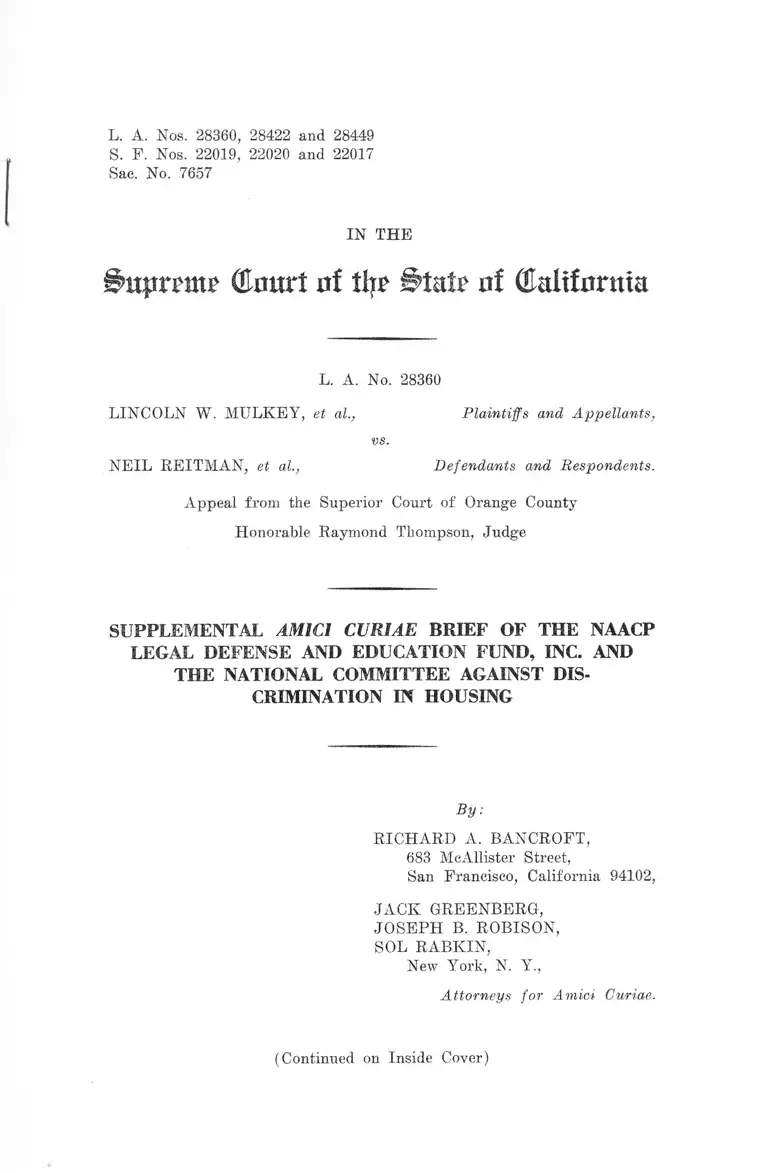
L. A. Nos. 28360, 28422 and 28449
S. F. Nos. 22019, 22020 and 22017
Sac. No. .7657
IN THE
iktprme (Eimrt of the Bint? of CMttoma
L. A. No. 28360
LINCOLN W. MULKEY, et al., Plaintiffs and Appellants,
vs.
NEIL REITMAN, et al., Defendants and Respondents.
Appeal from the Superior Court o f Orange County
Honorable Raymond Thompson, Judge
SUPPLEMENTAL AMICI CURIAE BRIEF OF THE NAACP
LEGAL DEFENSE AND EDUCATION FUND, INC. AND
THE NATIONAL COMMITTEE AGAINST DIS
CRIMINATION IN HOUSING
B y:
RICHARD A. BANCROFT,
683 McAllister Street,
San Francisco, California 94102,
JACK GREENBERG,
JOSEPH B. ROBISON,
SOL RABKIN,
New York, N. Y.,
Attorneys for Amici Curiae.
(Continued on Inside Cover)
L. A, No. 28422
W ILFRED J. PRENDERGAST and CAROLA EVA PRENDERGAST,
on behalf o f themselves and all persons similarly situated,
Cross-Defendants and Respondents,
VS.
CLARENCE SNYDER, Cross-Complainant and Appellant.
Appeal from the Superior Court of Los Angeles County
Honorable Martin Katz, Judge
L. A. No. 28449
THOMAS ROY PEYTON, M.D., Plaintiff and Appellant,
vs.
BARRINGTON PLAZA CORPORATION, Defendant and Respondent.
Appeal from the Superior Court of Los Angeles County
Honorable Martin Katz, Judge
Sac, No. 7657
CLIFTON HILL, Plaintiff and Appellant,
vs.
CRAWFORD MILLER, Defendant and Respondent.
Appeal from the Superior Court of Sacramento County
Honorable William Gallagher, Judge
S. F. No. 22019
DORIS R. THOMAS, Plaintiff and Appellant,
vs.
G. E. GOULIAS, et al., Defendants and Respondents.
Appeal from the Municipal Court of the
City and County of San Francisco
Honorable Robert J. Drewes, Judge; Honorable Leland J.
Lazarus, Judge, and Honorable Lawrence S. Mana, Judge
S. F. No. 22020
JOYCE GROGAN, Plaintiff and Appellant,
vs.
ERICH MEYER, Defendant and Respondent.
. Appeal from the Municipal Court of the
City and County of San Francisco
Honorable Robert J. Drewes, Judge; Honorable Leland J.
Lazarus, Judge, and Honorable Lawrence S, Mana, Judge
S. F. No. 22017
REDEVELOPMENT AGENCY OF THE CITY OF FRESNO, a public
body, corporate and politic, Petitioner,
VS.
KARL BUCKMAN, Chair man of the Redevelopment Agency of the City
of Fresno, Respondent.
Petition for Writ of Mandate
L. A. Nos. 28360, 28422 and 28449
S. F. Nos. 22019, 22020 and 22017
Sac. No. 7657
IN THE
Supreme (Eottrt nf tip §>tntv of CHaltfontia
L. A. No. 28360
LINCOLN W. MULKEY, et al., Plaintiffs and Appellants,
vs.
NEIL REITMAN, et al., Defendants and Respondents.
Appeal from the Superior Court of Orange County
Honorable Raymond Thompson, Judge
L. A. No. 28422
WILFRED J. PRENDERGAST and CAROLA EVA PRENDERGAST,
on behalf o f themselves and all persons similarly situated,
Cross-Defendants and Respondents,
vs.
CLARENCE SNYDER, Cross-Complainant and Appellant.
Appeal from the Superior Court of Los Angeles County
Honorable Martin Katz, Judge
L. A. No. 28449
THOMAS ROY PEYTON, M.D., Plaintiff and Appellant,
vs.
BARRINGTON PLAZA CORPORATION, Defendant and Respondent.
Appeal from the Superior Court of Los Angeles County
Honorable Martin Katz, Judge
Sac. No. 7657
CLIFTON HILL, Plaintiff and Appellant,
vs.
CRAWFORD MILLER, Defendant and Respondent.
Appeal from the Superior Court of Sacramento County
Honorable William Gallagher, Judge
2
S. F. No. 22019
DORIS E. THOMAS, Plaintiff and Appellant,
■ vs.
G. E. GOULIAS, et al., Defendants and Respondents.
Appeal from the Municipal Court of the
City and County of San Francisco
Honorable Robert J. Drewes, Judge; Honorable Leland J.
Lazarus, Judge, and Honorable Lawrence S. Mana, Judge
S. F. No. 22020
JOYCE GROGAN, Plaintiff and Appellant,
vs.
ERICH MEYER, Defendant and Respondent.
Appeal from the Municipal Court of the
City and County of San Francisco
Honorable Robert J. Drewes, Judge; Honorable Leland J.
Lazarus, Judge, and Honorable Lawrence S. Mana, Judge
S. F. No. 22017
REDEVELOPMENT AGENCY OF THE CITY OF FRESNO, a public
body, corporate and politic, Petitioner,
■vs.
KARL BIJCKMAN, Chairman of the Redevelopment Agency of the City
o f Fresno, Respondent.
Petition for Writ of Mandate
SUPPLEMENTAL BRIEF OF AMICI CURIAE NAACP LEGAL
DEFENSE & EDUCATION FUND, INC. AND NATIONAL
COMMITTEE AGAINST DISCRIMINATION IN HOUSING*
This Court has asked for supplemental briefs dealing
with the impact of the United States Supreme Court’s
decision in Evans v. Newton, 86 8. Ct. 486, on the above-
entitled pending cases. Amici curiae submit that Evans v.
* The interest of the NAACP Legal Defense & Education Fund, Inc.
is stated in its amicus curiae brief previously filed in these proceedings.
The interest of the National Committee Against Discrimination in Hous
ing is described in the amici curiae brief of Philip Adams et al. also
previously filed.
3
Newton is highly persuasive authority for the proposition
that Article I, Section 26 of the California Constitution
violates the Fourteenth Amendment to the United States
Constitution.
In Evans v. Newton, the City of Macon, Georgia became
involved in the administration of a public park under a
private will which limited use of the park to white persons.
The city had recognized in recent years that, under the
Fourteenth Amendment, it could not exclude Negroes from
the park. See Pennsylvania v. Board of Trusts, 353 TJ.S.
230. A suit was brought in the Georgia courts by the Board
of Managers of the park against the City to compel it to
resign as trustee so that the provision of the will requiring
exclusion of Negroes could be observed. The City there
upon tendered its resignation which was accepted and pri
vate trustees were appointed by the state court. The only
reason for the appointment of the private trustees was to
enable Negroes to be excluded from the park.
The Supreme Court of the United States reversed on
grounds which are pertinent to the subject cases. The
Court pointed out that “ The action of a city in serving as
trustee of property under a private will serving the seg
regated cause is an obvious example” of “ [CJonduct that
is formally ‘private’ ” but which has “ become so entwined
with governmental policies or so impregnated with a gov
ernmental character as to become subject to the constitu
tional limitations placed upon state action.” Evans v.
Newton, 86 S. Ct. at 488. The essence of the opinion was
that the state-private involvement which brought about
Fourteenth Amendment control had not become “ disen
tangled.” Id. at 490.
The same week that the court decided Evans v. Newton,
the United States Court of Appeals for the Fourth Circuit
4
decided Hawkins v. North Carolina Dental Society, No.
9612. We bring this opinion to the attention of this Court
because, while dealing with a different fact situation, it
applies the same principle. In the Hawkins case, the plain
tiff, a Negro, sued for admission as a member of the North
Carolina Dental Society, basing his claim primarily upon
the fact that members of the society, by statute, elected
the State Board of Dental Examiners, a governmental body.
Following the filing of the case, the state repealed the
statute. The court nevertheless took note of the fact that,
in actual practice, the Dental Society still exercised the
powers it had had under the statute. Accordingly, the court
held that the limitations of the Fourteenth Amendment still
applied and that the plaintiff was entitled to admission to
this state agency.
Each of these cases, Evans and Hawkins, deals with a
different type of situation but each has in common the
characteristic that once Fourteenth Amendment control at
taches, repeal of legislation or of an arrangement that
involved the Amendment does not automatically remove the
influence of the Fourteenth Amendment from the situation.
At the very minimum the burden is upon those formerly
controlled by the Fourteenth Amendment to show that
there has been complete “ disentanglement.”
In this case, the State of California had enacted fair
housing legislation. This legislation was not a mere fortui
tous sally into the area of housing regulation, but was
designed to implement “cherished aims of American feel
ing.” Railway Mail Association v. Corsi, 326 U.S. 88, 98
(1946). It was a recognition by the State that it had a duty
under its police power to take action against housing dis
crimination in order to prevent and eliminate the clear and
present danger of serious social evil resulting from such
discrimination. It was designed to implement the equal
5
protection clause of the Fourteenth Amendment which
states that no state may deny “equal protection of the
laws.”
By the fair housing legislation which Article I, Section
26 purported to annul, certain property rights were con
ferred not only on Negro American citizens but also on
all other members of the community to be protected from
these evils. Those property rights were conferred not only
to secure the protection of equal laws but pursuant to
Congressional enactment of federal policy. See 42 U.S.
Code Section 1982:
All citizens of the United States shall have the same
right, in every State and Territory, as is enjoyed by
white citizens thereof to inherit, purchase, lease, sell,
hold, and convey real and personal property. R. S.
§1978.
California, having recognized its constitutional obliga
tion and having secured a remedy to protect the rights of
Negro and all other citizens in certain property, cannot
now divest those rights. Indeed, Evans v. Newton and
Hawkins v. North Carolina Dental Society are but particu
lar examples in a racial context of the constitutional rule
provisionally established by the Supreme Court of the
United States in Truax v. Corrigan, 257 U.S. 312, 329:
It is true that no one has a vested right in any par
ticular rule of the common law, but it is also true that
the legislative power of a State can only be exercised
in subordination to the fundamental principles of right
and justice which the guaranty of due process in the
Fourteenth Amendment is intended to preserve, and
that a purely arbitrary or capricious exercise of that
power whereby a wrongful and highly injurious in
6
vasion of property rights, as here, is practically sanc
tioned and the owner stripped of all real remedy, is
wholly at variance with those principles.
Implicit in the Evans and Hawkins rulings is the concept
that it is the fact rather than the legal structure of unequal
protection that determines application of the Fourteenth
Amendment. The State will not be allowed to avoid its
constitutional obligation by attaching or removing labels
or by fraudulently seeming to wash its hands of a respon
sibility which it cannot in truth avoid.
Over a period of years, the State of California enacted
a series of laws which recognized that its pre-existing legal
system resulted in unequal opportunity, because of race,
to obtain a “ necessary of life.” Block v. Hirsh, 256 U.S.
135, 156. In Evans, the Supreme Court said, “ . . . when
private individuals or groups are endowed by the State
with powers or functions governmental in nature, they
become agencies or instrumentalities of the State and sub
ject to its constitutional limitations.” 86 S. Ct. at 488. It
also quoted its earlier holding in Marsh v. Alabama, 326
U.S. 501, 509, that a State may not permit private enter
prises “ to govern a community of citizens so as to restrict
their fundamental liberties . . . ”
By nullifying its laws against discrimination in housing,
California has done what these cases say it may not do.
It has restored the system under which every housing unit
placed on the market by private enterprise carries a label
marking it as available for either one race or another,
but not for all. It has given private builders the power
not merely to “ govern” communities but to create them in
a manner that restricts “fundamental liberties.”
It is also important that the Court, in Evans, recognized
that discrimination in the park in question might not have
7
been unconstitutional if the City had never been involved
but that the involvement of the City created a “momentum”
that could not simply be turned off by City withdrawal.
86 S. Ct. at 489. So here, the State, recognizing the funda
mental inequality in housing opportunity created under its
laws, undertook to exercise its police power to bring about
equality. Its present reversal of that decision constituted
affirmative action in support of inequality that violated “ the
mandates of equality and liberty that bind officials every
where.” Nixon v. Condon, 286 U.S. 73, 88.
Respectfully submitted,
R ic h a r d A. B a n c r o f t ,
J a c k G re e n b e r g ,
Attorneys for NAACP Legal Defense
and Educational Fund, Inc., Amicus
Curiae,
J o se ph B . R o b is o n ,
S ol R abicin ,
Attorneys for National Committee
Against Discrimination in Housing
February 1966
MEILEN PRESS INC. — N. Y. C. otgggs*