Swint v. Pullman-Standard Brief for Defendants-Appellees
Public Court Documents
May 12, 1973
-
Brief Collection, LDF Court Filings. Swint v. Pullman-Standard Brief for Defendants-Appellees, 1973. 638640a3-c59a-ee11-be37-00224827e97b. LDF Archives, Thurgood Marshall Institute. https://ldfrecollection.org/archives/archives-search/archives-item/83c8ffe1-1555-4ae2-984e-6b17bc16686e/swint-v-pullman-standard-brief-for-defendants-appellees. Accessed September 21, 2026.
Copied!
p 77- U
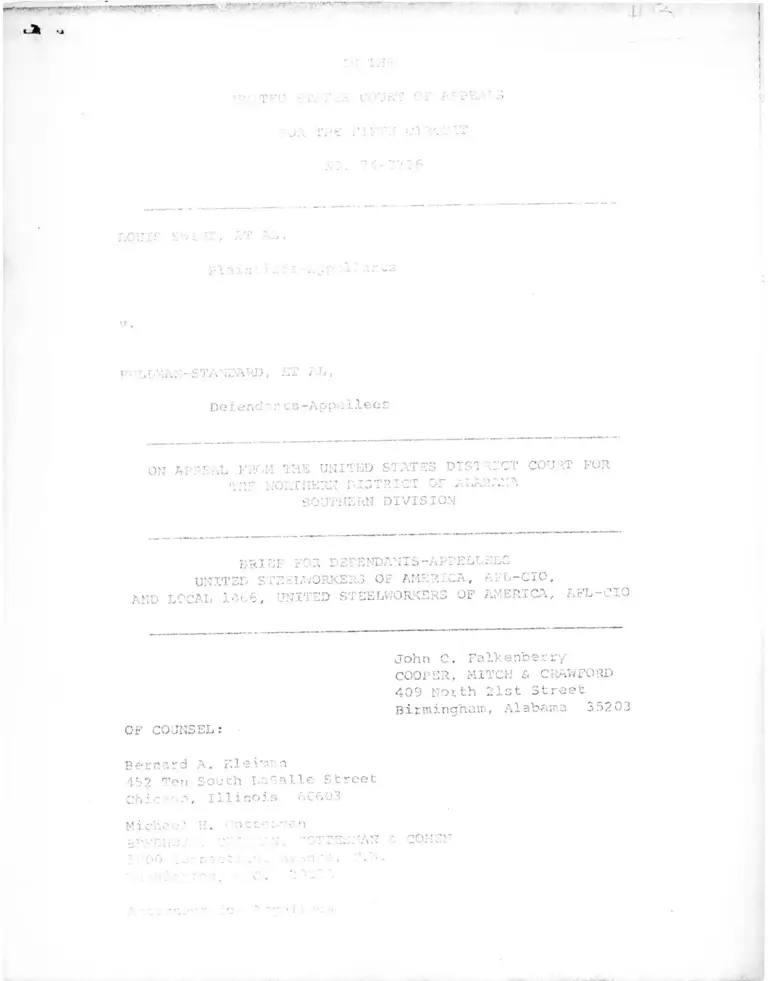
tt?:/TFD STU1U-S COURT OF APPEALS
FOR THE FIFTH CIRCUIT
NO. 74"372 £
ij
i
iiij
LOUIS SUI1TT, FT AT.
P1 a 1 n * i _. r ' .i..
v.
P v; i, t ,\]AN -- S T A NDA R D ,
Doter,d3 n c5- Ap pe11 e e s
or: APPEAL FROM THE UNITED STATES DISTRICT COURT FOR
THE NORTHERN DISTRICT OF 'i
SOUTHERN DIVISION
AND
UNITED
LOCAI
BRIEF FOR DEFENDAN
5T, STEELWORKERS OF AMERICA,
JNITED STEELWORKERS OF1466
AFL-CIO,
AMERICA, At■’L -CIO
John C. Falkenberry
COOPER, MITCH & CRAWFORD
409 North 21st Street
Birmingham, Alabama 35203
OF COUNSEL:
Bernard A. Kleiman
452 Ten South LaSalle Street
Chicago, Illinois 60603
Michael H. Gotteaman
b tik DHO:• ■' . CL.; • . > t ^ m -n. . _ C . :N . -7 i i.
1 00 0 C o n n e c t ! ... h v i n a o
h i n n t o n , D . C . N̂.' oe '.'
COHEN
*. u. i.. - y. r. - j , , -• r C • ' *’?• ? " i } • ' O S
IN THE
UNITED STATES COURT OF APPEALS
FOR THE FIFTH CIRCUIT
NO. 74-3726
LOUIS SWINT, ET AL,
Plaintiffs-Appellants
v.
PULLMAN-STANDARD, ET AL,
Defendants-Appellees
ON APPEAL FROM THE UNITED STATES DISTRICT COURT FOR
THE NORTHERN DISTRICT OF ALABAMA
SOUTHERN DIVISION
CERTIFICATE OF INTERESTED PARTIES
The undersigned counsel of record for Appellees
certifies that the following listed parties have an interest
in the outcome of this case. These representations are
made in order that the Judge of this Court may evaluate
possible disaualifications or recusal pursuant to Local Rule
13(a):
Plaintiffs-Appellants:
Louis Swint and Willie Johnson
Plaintiff-Intervenor:
Clyde Humphrey
The class of black employees at the Bessemer Plant of
Pullman-Standard company.
Defendant-Appellee:
Pullman-Standard Company, a division of Pullman, Inc.
Defendants-Appellees:
United Steelworkers of America, AFL-CIO, and its Local Union
No. 1466.
International Association of Machinists and Aerospace ’Workers,
AFL-CIO, and its Local Lodge 372.
United Steelworkers of America
AFL-CIO and Local 1466, United
Steelworkers of America, AFL-CIO
TABLE OF CONTENTS
Page
QUESTIONS PRESENTED .............................. 1
COUNTER-STATEMENT OF THE CASE..................... 2
COUNTER-STATEMENT OF THE FACTS ............ ....... 6
ARGUMENT......................................... 2 0
I. the DISTRICT COURT CORRECTLY DETERMINED
THAT THE DEPARTMENTAL SENIORITY SYSTEM
WAS NOT DISCRMINATORY................... 22
II. THE DISTRICT COURT CORRECTLY DETERMINED
THAT THERE WAS NO RACIAL DISCRIMINATION
IN THE WORK WITHIN THE SAME JOB CLASS,
OR BECAUSE OF THE FAILURE TO POST JOB
VACANCIES............................... 2 6
A. WORK WITHIN THE SAME JOB CLASS
("JOB PICKING")..................... 27
B. JOB POSTING......................... 30
CONCLUSION........................................ . 31
TABLE OF CASES AND AUTHORITIES
CASES
Page
Bradley v. Southern Pacific Co., 486 F. 2d 516,
517-518 (5th Cir. 1973)..................... 21
Chaney v. City of Galveston, 368 F. 2d 774 (5th
Cir. 1973)................................ 21
Franks v. Bowman Transportation Co., 495 F. 2d 398
(5th Cir. 1974)........................... 23
Heard v. Mueller Company, 464 F. 2d 190 (6th Cir.
1972)....... 23
Local 189, Paoermakes v. United States, 416 F. 2d
980 (5th Cir. 1969)....................... 23
Martin v. Thompson Tractor Co., 486 F. 2d 510
(5th Cir. 1973)........................... 21
Smith v. Delta Air Lines, Inc., 486 F. 2d 512
(5th Cir. 1973)........................... 21
STATUTES
Title VII of the Civil Rights Act of 1964, 42 U.S.C.A.
§§ 2000e et seq.
The Civil Rights Act of 1866, 42 U.S.C.A. § 1981.
IN THE
UNITED STATES COURT OF APPEALS
FOR THE FIFTH CIRCUIT
NO. 74-3726
LOUIS SWINT, ET AL,
Plaintiffs-Appellants
v.
PULLMAN-STANDARD, ET AL,
Defendants-Appellees
ON APPEAL FROM THE UNITED STATES DISTRICT COURT FOR
THE NORTHERN DISTRICT OF ALABAMA
SOUTHERN DIVISION
BRIEF FOR DEFENDANTS-APPELLEES
UNITED STEELWORKERS OF AMERICA, AFL-CIO,
AND LOCAL 1466, UNITED STEELV70RKERS OF AMERICA, AFL-CIO
QUESTIONS PRESENTED
1. Did the District Court correctly find and determine
that the defendants' contractually established seniority,
-2-
transfer and oromotion practices, as modified by an affirmative
action program, neither presently discriminate nor perpetuate
any past discrimination?
2. Did the District Court correctly determine that
black employees were not discriminated against because of the
failure of the Company to post job vacancies?
3. Have Appellants failed to establish that the findings
of the District Court were "clearly erroneous"?
We submit that each cruestion should be answered in the
affirmative and that this Court therefore must affirm the
decision of the District Judge.
COUNTER-STATEMENT OF THE CASE
The initial complaint, filed by plaintiffs Louis Swint
and Willie Johnson on October 19, 1971, contained typical,
broad-based individual and class allegations that defendants
Pullman-Standard, a division of Pullman, Inc. (hereinafter
"Pullman" or "Company"), United Steelworkers of America,
AFL-CIO (hereinafter "Steelworkers") and Local 1466, United
-3-
Steelworkers of America, AFL-CIO (hereinafter "Local") were
guilty of racially discriminatory employment practices violative
of Title VII of the Civil Rights Act of 1964, 42 U.S.C.A.
§ 2000e, et sea, and the Civil Rights Act of 1866, 42 U.S.C.A.
2
§ 1981.
A final pre-trial conference was held on June 4, 1974,
and the broad, general issues were narrowed by the District
Court to five specific claims, four of which were class issues
and one relating to allegations by individual employees, as
follows:
1
(1) Whether the departmental seniority system,
even as modified by an affirmative action agreement
with the Department of Labor, perpetuates past dis
crimination in the assignment, of black employees to
less desirable departments.
(2) Whether the Company has discriminated in
the assignments of work to persons having the same job
classification (JC) or job title.
(3) Whether the Company has discriminated in
the selection of blacks as supervisory employees.
(4) Whether the Company's failure to post job
vacancies or changes in job assignments discriminates
against blacks.
1. Both the Steelworkers and its Local 1466 may be referred
to collectively throughout as "the Union".
2. Plaintiff Johnson's complaint was filed under 42 U.S.C.A.
§ 1981 only.
-4-
(5) Was there discrimination in the individual
discharge cases of Plaintiff Swint and Intervening
Plaintiff Clyde Humphrey?-^
The District Judge also permitted Dlaintiffs to join
the International Association of Machinists and Aerospace
Workers ("IAM") and its Local Lodge 372 as parties defendant,
inasmuch as the overcill class relief sought by the plaintiffs
involved possible, though limited modifications of the collec-
4
tive bargaining agreement between the Company and the IAM.
These parties did not resist joinder, despite the fact that
they had never been named in any EEOC charges or directly
involved in the specific issues of the case.
The case proceeded to trial on July 8, 1974. At the
close of the plaintiffs' evidence, both the Steelworkers and
Local 1466 filed motions for involuntary dismissal pursuant to
Rule 41(b), Federal Rules of Civil Procedure, as to the indi-
3. Humphrey was granted leave to intervene as a party plaintiff
under 42 U.S.C.A. § 1981 to protest his reinstatement from dis
charge without backpay.
4. Both the IAM and Local Lodge 372 were added as defendants
pursuant to an express provision in the June 4th pre-trial order
that no claim for monetary relief was made against them. (R.
Doc. 7 & Doc. 8). Both defendants appeared and participated at
trial, to the limited extent that the evidence concerned the IAM
bargaining unit.
-5-
vidual claims of Swint and Humphrey that the Union had failed
to fairly and aderruately represent them following their dis-
5
charge by the Company. Plaintiffs' counsel confessed the
Union's motions to be well-taken, and the Court dismissed the
claims against the Union by the two individuals. (Tr. 1220-21,
6
1224).
The entire trial consumed some 16 days in July and
August, 1974. On September 13, 1974, the District Judge filed
his Memorandum of Opinion, which expanded the "affected class"
seniority remedy of the Department of Labor affirmative action
agreement to include several additional departments, and ordered
that agreement binding on the Union defendants. (R., Doc. 16,
7
pp. 19-20). As to all remaining issues, however, the Court found
5. Grievances for both individuals were appealed by the Union
to separate arbitration hearings. Following a lengthy hearing,
Swint's discharge was sustained by the arbitrator. (Co. Exh. 257,
259). The Union was successful in reinstating Humphrey to his
former job, but the arbitrator denied the Union's claim for back
pay. (Co. Exh. 247). This issue is not on appeal.
6. "Tr." refers to the trial transcript. "R" will refer to
the official record on appeal.
7. Although the Steelworkers and Local 1466 never formally
signed the agreement, neither opposed its implementation by the
Company.
6-
that the defendants' contested employment practices were not
discriminatory, and entered judgment for the defendants.
Plaintiff Louis Swint filed a timely notice of appeal
on September 16, 1974. (R. Doc. 18).
COUNTER-STATEMEMT OF THE FACTS
The Steelworkers' Union has a long-standing collective
bargaining relationship with Pullman-Standard, dating back to
the 1940's, when, under the leadership of black Pullman
employees, the Union won the right to represent most of the
production and maintenance employees at the Company's Bessemer
8
plant. (Tr. 3499-3500; R. Doc. 16, p. 20). From the Union's
very beginning, blacks have played a major role in the life of
Local 1466 and have shared the responsibilities of leadership
with their white counterparts. As the District Court found,
the policies of Local 1466 "over the years have been shaped as
much by blacks as by whites." (R. Doc. 16, p. 20).
8. Maintenance employees in two deoartments. Tool and Die
IAM and Maintenance IAM, are reoresented by the International
Association of Machinists and Aerosoace Workers and its Local
Lodge 372. All other oroduction and maintenance jobs fall
within the Steelworker jurisdiction.
-7-
Black steelworkers have held virtually every major
elected office in Local 1466, as well as many appointed posi
tions, including president, vice-president and chairman of
the grievance committee. (Tr. 1883, 3500-03). In addition,
both blacks and whites have serviced Local 1466, as the
representatives of the International Union. (Tr. 3522). It
is against this background that the trade union movement and
the push for Negro rights have progressed together at Pullman-
Bessemer.
The Steelworker bargaining unit is composed of a highly
fluctuating work force, which may vary from as few as 200
employees to as many as 2800, depending on the size and
frecruency of orders for railroad cars received by the Company.
Seldom does the level of employment remain constant for much
more than a week at a time. (R. Doc. 16, p. 2, n. 4).
Approximately one-half of the employees are black, a ratio
that has existed since 1965. (Id., p. 4; Pi. Exh. 10, 20).
Departments of varying size are found at the Bessemer
facility, although most employees are assigned to six major
-8-
departments of a total of 25 departments. Departmental
seniority, the total length of service by an employee in a
particular department is, and has long been, the standard by
which employees compete for promotions, layoffs and recalls.
Although no formal lines of progression exist in any of the
departments, and despite the fact that blacks traditionally
have been assigned to all but a few of the smaller departments,
a number of jobs within various departments became segregated
by race, because of the Employer's assignment practices, not
governed by the collective bargaining agreement.
In 1963, the Union successfully negotiated the first
"non-discrimination clause" into its collective bargaining
agreement with Pullman, which proscribed racial discrimination
and for the first time permitted grievances of a racial nature
to be submitted to arbitration. (Tr. 1396-97; Co. Exh. 264).
As ear3y as the 1950’s Local 1466 had, without success, filed
9
9. The Court found that almost 77% of the employees were
assigned to work in the Welding, Steel Erection, Paint &
Shipping Track, Punch & Shear, Steel Construction and Maintenance
Departments, with more than 50% being employed in Welding and
Steel Erection. (R. Doc. 16, p. 2). Of these, only the
Maintenance Department is not in the Steelworker unit.
-9-
grievances for blacks who desired to train for and promote to
jobs held only by white men. (Tr. 3505).
In November, 1964, the Union took the initiative to
again attempt to desegregate white-only jobs and filed a
grievance on behalf of five black buckers, requesting that
they be given the opportunity to work as riveters, jobs never
held by blacks. (Union Exh. 507). When the Company denied the
grievance, the Union appealed to arbitration, and obtained a
favorable award from Arbitrator Whitley McCoy, which forbade
the continuance of segregated job classifications and ordered
the Company to allow blacks access to the riveter classification.
10
(Tr. 3507-09; Union Exh. 508).
The McCoy decision thus became the "ground-breaker"
for the desegregation of jobs throughout the plant (Tr. 3510),
and was shortly followed by a similarly successful grievance
10. The opinion of the District Court leaves the erroneous
impression that the non-discrimination clause was part of the
contract, but without vitality and not enforced by the Union,
for many years prior to the McCoy Award. (R. Doc. 16, p. 5,
n. 13). Actually, the rivet driver grievance was filed during
the first year after the non-discrimination clause became part
of the agreement.
-lo
ll
for black welder-helpers who desired to become welders.
In 1968, the Department of Labor, through its Office of
Federal Contract Compliance ("OFCC"), as the result of its
compliance reviews at Pullman under the Executive Orders,
identified four "low-ceiling" departments, to which predominately
12
blacks were assigned, and five traditionally all-white depart-
13
ments, and began negotiations with Pullman to disestablish
the racial characteristics of these departments. (Tr. 1423-24).
The Union was neither advised of nor invited to the 1968
negotiations, and was never consulted until after a memorandum
of understanding had been signed between the Company and OFCC
in January, 1969.
The OFCC then allowed the Company 60 days to obtain
union concurrence since the agreement was inconsistent with
portions of the then effective labor agreement primarily
seniority. (Tr. 1435, 1457-58, 1464-65). In November, 1969,
11. Despite the fact that Plaintiffs, in brief, refuse to give
credit where credit is due, it was the Union alone who opened
the door to improving job opportunities for black employees by
demanding an end to racially segregated classifications.
12. Janitor, Tool & Die, Truck, and Steel Miscellaneous
Departments.
13. Template, Powerhouse, Airbrake Pipe Shop, Inspection, and
Plant Protection Departments.
-11-
at a meeting attended by OFCC, Pullman, and the Union, the
Union presented its own proposals for modifying seniority,
which were considerably broader than the remedies provided in
the Memorandum. (Union Exh. 502). The proposal was flatly
rejected by the OFCC. (Tr. 1462).
Frustrated because of OFCC's insistence that it accept
seniority changes that it was neither invited nor permitted
to negotiate about, the Union had no alternative but to refuse
to sign the Memorandum. (Tr. 1457). Subsequent negotiations
were held to update the agreement, and the Union was again
largely, though not entirely, ignored. (Tr. 1458-59). These
negotiations resulted in the 1972 Memorandum of Understanding,
which provided an affected class seniority remedy for blacks
transferring out of the four low-ceiling departments or to the
five predominately white ones, and which is described in detail
in the opinion of the District Court. (R. Doc. 16, p. 6).
Although the Union never signed either OFCC Memorandum,
neither the Steelworkers nor Local 1466 has opposed the imple
mentation of the affected class remedies contained in the
documents and members of the affected class have received full
-12-
benefit of such remedies just as if provided by the collective
bargaining agreement. (Tr. 1445). The District Court's
opinion, making the 1972 Agreement binding upon the Union,
creates no additional substantive rights for members of the
class.
Appellant's brief represents that there were 1,645
white employees in the Welding Department in 1964 assigned
to JC 10 jobs. (Pi. Br. p. 10). No citation to the record is
made for this misstatement, which is refuted by the 1964
seniority list (Pi. Exh. 2) which contains the following infor
mation concerning JC 10 employees (Welders, Arc Production;
Welders-Burners, Production; and Burners) in the Welding
Department;
(1 )
On List
6-1-64
Names 580
Lined out
(terminated by
6-1-65) 62
Promoted to salaried
Foreman 3
Those remaining
6-1-65
(2 )
New Hires 6-1-64
to 6-1-65______
325
152
0
Total
_CLL-±.-(2.)
905
214
3
515 173 688
-13-
This list contains the names of 130 persons who were hired
between June 1, 1965, and July 9, 1965, nine of which are lined
out. No doubt the seniority list continued to be used while
the June 1, 1965, seniority list was being prepared. The
total number of employees who held JC 10 positions at any time
during the 13 month period is 1,035. One page in the list
appears twice by mistake in the exhibit, which lists 14 names
as JC 3.0, and which if added by mistake would make a total of
1,049. The figure given in the brief of 1,646 is at least
60% above any reasonably correct figure, and actually appears
to be off by more than 300% from the total as of June 1, 1964,
and over 200% from the total as of June 1, 1965. There appears
to have been a big turnover during this year with from 500 to
700 on the seniority list at all times, many of whom were often
on layoff. The representation is simply a gross inaccuracy, and
is explained only as being the result of improper addition.
The same error appears in Plaintiffs' Exhibit 61, supposedly
an analysis of the 1964 work force.
This error might be passed off as insignificant except
that it reoccurs at page 44 of the brief (see the table in
footnote 62), appearing as the absurd assertion that 61.7%
t
-14-
of all whites in the plant in June, 1965, worked in the
Welding Department. This statistic misses the mark by about
200% and renders the entire table meaningless. This table
purports to demonstrate "clear error" in the trial court's
statistical findings, but as such, it appears to be of little
or no value, and instead indicates the correctness of the
District Judge's decision.
Similar inaccuracies appear in brief at page 12, foot
note 17. There, it is represented that in 1964, in the Paint
and Shipping Track Department, there were 98 white and 44
black employees in JC 7 classifications. The true fact, as
shown by Plaintiffs' Exhibit 2, is that as of June 1, 1964,
there were only six JC 7 employees, all of them black Helpers-
Shipping Track, and two other employees, both black, were
promoted from Spray Painter (JC 6) to Helper-Shipping Track
(JC 7) between June 1, 1964, and June 1, 1965. There was a
large turnover during 1964-65 in the classification of
Helper-Paint (JC 4), involving both black and white employees
and the Appellants appear to have arbitrarily and erroneously
called over 100 of these employees Helpers-Shipping Track.
The latter is always a small classification, and new hires
generally come into the department at JC 4, as Helpers-Paint.
-15-
(Pl Exh. 1-10). In 1964 there was a large turnover of
Helpers-Paint and none involving Helpers-Shipping Track. Com
pare the numbers of Helpers-Shipping Track as shown by
Plaintiffs' Exhibits 11-20:
'62 '64 '66 '67 '68 '69 '70 '71 '72 '73
Black 5 44 0 8 9 6 6 6 5 9
White 1 98 0 0 0 0 0 1 1 1
Total 6 142 8 8 9 6 6 7 6 10
This tabulation or addition error as to 1964 stands out like a
sore thumb, and if the least effort had been made to check the
figures, it would have been discovered that seme 136 Helpers-
Paint had been erroneously counted as Helpers-Shipping Track
in Plaintiffs' Exhibit 12. A complete audit of the figures
would no doubt reveal countless additional errors. The table
in footnote 17 with this one error corrected would show:
JC 11 10 9 8 7 6 4
White 5 4 2 1 0 4 127
Black 0 0 0 0 8 22 107
% Black 0 0 0 0 100 84.6 41.5
The suggestion is erroneous, therefore that the median JC for
-16-
whites was 7 and for blacks was 6. The corrected table shown,
assuming the other figures are accurate, that the median job
class for both races would be JC 4. However, the table is
helpful for any purpose inasmuch as it does not reflect the
size of the work force at any particular time, nor does it
show any promotions, new hires, or terminations, during the
year. The record shows, as to Helpers-Paint. (JC 4) of both
races on the 1964 seniority list (pi. Exh. 2):
On List Added to List
6-1-64 6-1-64 to 6-1-65 Total
Names 94 142 236
Lined out (terminated
between 6-1-64 and
6-1-65 20 79 99
Promoted 33 8 41
Those remaining 6-1-65 74 63 137
Comparison suggests there are other errors in footnote 17 as well
because the 100% turnover apparently was not taken into consid
eration at all.
There are numerous other erroneous and meaningless
statistics scattered throughout the brief, but space does not
permit factual rebuttal of each such inaccuracy.
-17-
Plaintiffs' assertion that blacks have been discrimina-
torily passed over for promotions is the subject of further
inaccurate factual statements. As an example of this alleged
discrimination, they cite the supposed desire of Louis Pinkard,
a black employee and a member of the grievance committee of
Local 1466, to receive a riveter's job. (Pi. Br. p. 26). The
suggestion that Pinkard "has constantly requested a riveter's
job" (Id.,- p. 26) is pure fabrication. The sole record ref
erence cited in support of the assertion establishes only the
following testimony.'
0. [By Hr. demon] Mr. Pinkard, have you ever been offered
ci riveter's job?
A. No, never have been; I asked for one.
Q. When did you request a riveter's job?
A. I think it was 1968, I think it was running a wood chip
car ^̂ nd they were needing a lot of rivet buckers.
Foreman Moss came to me and asked me to buck rivets
[a temporary promotion from JC 6 to JC 8]. I told him
I didn't have a desire to buck rivets, but I would li.ke
to drive them. [JC 11] He said I would have to buck
them first. I said, I didn't want to do it. (Tr. 1214)
Pinkard's failure to become a riveter has nothing to do with
race, and there is no foundation for the claim that pinkard
has been "passed over in favor of several junior whites" who
became riveters. What plaintiffs neglect to mention is that
-18-
their own exhibit shows eleven black riveters and only two
white riveters who are junior to Pinkard. The difference is
that they desired to learn how to drive rivets; he did not.
(Pi. Exh. 10).
Plaintiffs' "Statement of the Facts" is so fraught with
incorrect, misleading, and contextually inaccurate statements
that specific rebuttal of each such instance is impossible.
However, some obviously erroneous representations must be dealt
with, particularly with regard to Appellants' analysis of
statistical evidence.
Likewise without support is the suggestion that "only
on one occasion" has Pullman "notified ACs of possible vacancj.es"
under the OFCC Memorandum. (Pi Br. p. 32). Again the record
citation given (Tr. 1570) does not support this contention;
rather, the transcript shows that members of the affected class
received seven formal interviews and numerous informal ones.
(Tr. 1542-48; 1804-25).
One of the trial issues, the claim that blacks are dis-
criminatorily assigned to less desirable positions within the
same job classification than are whites, revolved around the
recurring though totally false assertion that "senior black
riveters are frequently assigned the undesirable job of riveting
-19-
the tar-covered roof of railcars ahead of junior whites".
(Pi Br. p. 21). The record citation once more not only fails
to contain the fact suggested, it conclusively establishes
(1) that tar compound does not cover the tops of boxcars,
(2) that welders on the roof position do not crawl around on
"the tar-filled roof of a (sic) 8-10' railcar" (Pi. Br. p. 59),
and (3) that only a bead or seam of tar is used to seal water
out of the cars. (Tr. 1314-19). Such "red-herrings" confuse
and cloud the actual, important facts throughout.
-2 0-
ARGUMENT
Of the five issues decided by-the District Court, two
require no detailed response by these Appellees. The individual
claims against the Union by Plaintiff Swint and Intervenor
Humphrey were disposed of by motion at the conclusion of the
plaintiffs' evidence and are not on appeal.
The allegations regarding the failure of Pullman to
appoint blacks to supervisory positions is not, as it has
never been, directed to the Union. Selection of foremen and
other supervisors is solely a management function, not affected
by the Steelworker bargaining agreement in any way. The Union
simply has neither rights nor responsibilities regarding foremen.
The Union's argument will thus be limited to the remaining
issues -- seniority, job assignments and job posting, although
only the seniority issue directly relates to the collective
bargaining agreement between the Steelworkers and Pullman. Job
assignments and posting are however of interest to the Union,
and some response is thus appropriate.
This case does not involve complicated issues of law.
This Court must decide only v/hether the opinion and order of
-21-
the District Judge was based on the evidence presented or
whether, as Appellants suggest, the findings are "clearly
erroneous" under Rule 52(a), Federal Rules of Civil Procedure.
Accordingly, a careful reading of the Memorandum of Opinion
reveals that the findings of the court below are indeed based
on the evidence presented at the lengthy trial and can lead
only to the conclusion that the case must be affirmed.
That the "clearly erroneous" rule applies to discrimina
tion cases in the same manner that it applies to all other
types of cases is now well-settled. Martin v. Thompson
Tractor Co., 486 F. 2d 510 (5th Cir. 1973); Smith v. Delta
Air Lines, Inc., 486 F. 2d 512 (5th Cir. 1973); Bradley v.
Southern Pacific Co., 486 F. 2d 516, 517-53.8 (5th Cir. 1973)
In Chaney v. City of Galveston, 368 F. 2d 774 (5th Cir.
1973), this court articulated the standard to be applied in
determining whether findings of fact are clearly erroneous as
follows:
"A finding is clearly erroneous when,
although there is evidence to support it,
the reviewing court on the entire evidence
is left with a definite and firm conviction
that a mistake has been committed. Where
-22-
the evidence would support a conclusion
either way, a choice by the trial judge
between two permissible views of the
weight of the evidence is not clearly
erroneous, and the fact that the judge
totally rejected an opposed view im
peaches neither his impartiality nor
the propriety of his conclusions"
(Footnotes omitted.) [368 F. 2d at
776) .
Plaintiffs' lengthy brief attempts only to discredit
the findings of the trial judge by re-arguing only their
interpretation of the statistical evidence. That, interpretation
was carefully weighed by the District Court, but was ultimately
rejected based on the evidence as a whole. Appellants have
utterly failed to show clear error as they must.
I. THE DISTRICT COURT CORRECTLY DETERMINED
THAT THE DEPARTMENTAL SENIORITY SYSTEM
V7AS NOT DISCRIMINATORY.
It has become fashionable for plaintiffs to insist,
in virtually every Title VII case, that an existing seniority
system be amended to cure presently existing effects of
historic racial discrimination. Here, in seeking a change
-23-
from departmental to plant-wide seniority, plaintiffs lose
sight of the most elementary requirement of the Act -- that
seniority provisions are illegal only if they tend to per
petuate or lock in the effects of past discrimination.
Heard v. Mueller Company, 464 F. 2d 3.90 (6t.h Cir. 1972).
T3ie decisions of this court are in accord. See, e.g. Local
189 Papormakers v._United States, 416 F. 2d 980 (5th Cir.
1969); FrarVks v. Bowman Transportation Co. , 495 F. 2d 398
(5th Cir. 1974).
Indeed, the Act itself does not proscribe any facially
neutral, "bona fide" seniority system, one which does not
have a . discriminatory effect. 42 U.S.C..A. § 2000e-2(h).
Unable to prove any present effects of pact discrimination,
plaintiffs nonetheless seem to argue that any departmental
seniority system is per se violative of Title VII and thus
due to be modified. As the District Court specifically
recognized, this is not the lav;. (Opinion, p. 9). CF.
Heard v. Mueller Co., supra, at 193.
At the heart of their contention that departmental
seniority should be eliminated at Pullman-Bessemer is plaintiffs'
continued reference to the existence of "one-race" departments.
-24-
In 1964, goes the argument, there were eight all-white depart
ments which somehow perpetuate historic discrimination. Of the
eight departments listed, one (Boiler House) has not operated
14
since 1966, two (Maintenance IAM and Tool A Die IAM) are
not in the Steelworker bargaining unit, and the remaining five
were made subject to the "transfer-in" provision of the OFCC
agreement. Under the agreement, black employees hired prior
to April 30, 1965, may transfer into vacancies in any of the
five departments, with the privilege of taking their plant
seniority with them.
Similarly, employees in the four so-called "all—black"
or "low ceiling" departments receive, under the OFCC Agreement,
the right to transfer out to any vacancy in any department with
the carryover of full plant age. Although the District Court
found past discrimination in the Company's assignment of
employees to these departments along racial lines, any such
discrimination was remedied by the transfer provisions of the
OFCC plant.
14. The two IAM Departments are accessible with full seniority
carryover to qualified affected class members. (Opinion p. 6,
n. 18).
-25-
All of the other departments at the Bessemer facility,
where the vast majority of the work force and the greatest job
opportunities may be found, were always open to employees
without regard to race. Thus, black employees have accrued
seniority in all of the non-OFCC departments comparable to
whites employed there.
That blacks earned seniority in virtually every depart
ment -- and all major ones -- at Pullman may explain the
absence from this trial of the now traoitional cl.aim that black
employees were deterred from interdepartmental transfers
because of the accompanying loss of seniority. Testimony of
this nature was almost totally absent from this trial. Mô .t.
black witnesses who desired additional job opportunities pre
ferred higher rated joes in their own department.
If historical job discrimination existed at Pullman
it took the form of segregated job classifications within
desegregated departments, brought about by the employer's
assignment practices. F'or example, employees of both races were
assigned to the Steel Erection department, but only whites were
permitted to become riveters? blacks were relegated to lower
-26-
rated positions such as assembler or bucker.
Because blacks did accumulate seniority in the depart
ments, in 1965 when the Union won for black buckers the right
to drive rivets ending job segregation forever, those blacks
received the full benefit of their departmental seniority.
With it, they gained the vehicle needed to propel them to their
"rightful places" — jobs, rather than departments, previously
denied them. Surely the Act requires no more.
Little can be said to amplify or explain the expertly
written discussion of the seniority issue by the District Court
The opinion itself is so obviously well-grounded in the evidene
of the case that this court must conclude, as did the trier of
fact, that this contractually - established departmental
seniority system, as modified by the OFCC agreement, is free of
the taint of any racial discrimination.
II. THE DISTRICT COURT CORRECTLY DETERMINED THAT
THERE WAS NO RACIAL DISCRIMINATION IN THE
WORK WITHIN THE SAME JOB CLASS, OR BECAUSE
OF THE FAILURE TO POST JOB VACANCIES.
Plaintiffs do not directly attack the Union regarding
either of these issues, primarily because neither arises from
the collective bargaining agreement. Indeed, both are claims
-27-
against the Company which alone controls the employement practice
complained of. However, because both issues do directly affect
bargaining unit members, some brief comment as to each is
warranted.
A. WORK WITHIN THE SAME JOB CLASS ("JOB PICKING")
Pullman, in the exercise of its management perogatives,
has retained the right to assign work within any job classifica-
15
tion and department, with a single exception. The company has
doggedly resisted regular efforts by the Union over the years
to secure for all employees the right to use seniority to select
his work assignment. As it now stands, the vast majority of
production and maintenance employees have no right to choose
any job, but are rather assigned to positions by foremen.
"Job Picking", to use the language of the shop, has long
been a major issue between the Company and the Union (Tr. 3420-
29) and is likely the most hotly contested single bargaining
issue in any recent contract negotiation. The Union, in addition
15. The Local Working Agreement permits employees performing
sub-assembly jobs in the Welding Department to select their
assignments, using seniority, at tne start-up of production on
all orders for 100 railroad cars or more. (Co. Exh. 262).
-28-
to having bargained regularly but unsuccessfully for broadened
"sign-up" rights, has also pursued a number of arbitration
cases hoping to expand the right to select job assignments.
These have likewise resulted in failure; but for the welainq
sub-assembly eigreement, employees have no right to select any
job.
The right to select jobs, more than any other single
subject, has been the focal point for union solidarity in bar
gaining, among both white and black members. Not surprisingly
then, job picking was the trial issue if the volume of testimony
is a valid indicator. Far more complaints were aired that
foremen refused to assign employees to jobs they preferred than
on all other issues combined, including plant seniority. The
real issue for the class members was unquestionably the right
to sign up for the job they liked best.
Also without surprise, the Union agreed with plaintiffs
throughout this litigation that broadened rights of job selection
using seniority was desirable, not only for blacks, but for all
bargaining unit employees. On the other hand, the Union consis
tently disagreed with the plaintiffs' contention that the issue
-29-
was a racial one. and held to the position ultimately adopted
by the District court, that "dissatisfaction with work e a s e
ments at Pullman is basically an employer-employee dispute,
not a black-white problem".
Many meters of Local 1460. white and black. were frankly
aismayed that the trial Judge did not deliver to them the
coveted brass ring never reached in bargaining. Despite the
frustrations of such members, the Union recognises that the
court's decision was eminently correct and that it merely re
flected a position often taken by the steelworkers in Title
VII matters - that the Court’s jurisdiction is limited to
enforcement of the antidiscrimination laws, and beyond that not
to interfere with the collective bargaining process. The Court
did not, as indeed it may not, substitute what it believed
to be a better, more beneficial system absent discriminatory
practices which might otherwise compel judicial action.
Plaintiffs’ claims of discrimination in job assignments,
such as the "tar-covered roof" contention, were simply
supported by the testimony. The court properly found no dis
crimination by Pullman in assigning work within the same job .
class.
-30-
B. JOB POSTING
Even less need be said about the failure to post job
vacancies than earlier issues. The District court, though
somewhat surprised, found that the informal, word-of-mouth
method of advertising job vacancies v/ns a satisfactory and
workable system from the point of view of both white and black
employees.
The Local, more than any other party, knows the procedure
to be successful from its enforcement of seniority rights for
employees of both races to insure that vacancies are indeed
filled by the most senior, qualified employee, according to the
bargaining agreement. The Union's role in seeing that vacancies
are properly filled is vital to the success of the system.
The Court found.
"It should be noted in this regard
that at Pullman's Bessemer plant the union
officials {day a far more active role in
monitoring and ferreting out violations of
employees' seniority rights than this court
has found at other plants, and that these
union positions are shared rather evenly
between blacks and whites." (Opinion,
p. 32).
-31
Plaintiffs do not dispute this finding, that the Union
has enforced seniority rights of all employees in the filling
of vacancies. In brief, they have retreated frOm their origi
nal position regarding formal posting, now suggesting that
only vacancies in "all-white" departments need be publicized.
However, the record does not support that the failure to post
vacancies has been discriminatory or that it perpetuates past
discrimination.
To require such a practice, while perhaps desirable
from the point of view of all employees, is not required to
redress any violation of the Act.
CONCLUSION
Based on the record and on the opinion of the District
Court, which is soundly supported by the record, one conclusion
is inescapable — this Union has done its job at Pullman-
-32-
Bessemer. The Court should affirm the findings of the court
below.
COOPER, MITCH & CRAWFORD
409 North 21st Street
B i r nui-Rgh am,
(John C.
Alabama 35203
Falkenberry (j
OF COUNSEL:
Bernard A. Kloiman
452 Ten South LaSalle Street
Chicago, Illinois 60603
Michael H. Gottesman
BREDIIOFF, CUSHMAN, GOTTESMAN A COHEN
1000 Connecticut Avenue, N .W .
Washington, D. C. 20036
Attorneys for Appellees, United
Steelworkers of America, AFL-CIO,
and Local 1466, United Steelworkers
of America, AFL-CIO
CERTIFICATE OF SERVICE
I hereby certify that I have served two (2) copies
of the foregoing Brief for Appellees, United Steelworkers of
America, AFL-CIO, and Local 1466, United Steelworkers of
-33-
America, AFL-CIO, upon the following counsel of record in this
case by depositing same in the United States Kail with postage
prepaid:
C. V. Stelzenmuller, Esquire
Thomas, Taliaferro, Forman, Burr
£: Murray
1600 Bank for Savings Building
Birmingham, Alabama 36203
U. VJ. demon, Esquire
Adams, Baker & demon
1600 - 2121 Building
Birmingham, Alabama 35203
Marilyn Holifield, Esquire
10 Columbus Circle
Suite 2030
New York, Ncw York 10019