Campaign Plaintiffs’ Supplemental Reply Memorandum of Law In Support of Plaintiffs’ Motion for Summary Judgment
Public Court Documents
December 2, 1996
24 pages
-
Case Files, Campaign to Save our Public Hospitals v. Giuliani Hardbacks. Campaign Plaintiffs’ Supplemental Reply Memorandum of Law In Support of Plaintiffs’ Motion for Summary Judgment, 1996. 2deaff81-6835-f011-8c4e-002248226c06. LDF Archives, Thurgood Marshall Institute. https://ldfrecollection.org/archives/archives-search/archives-item/8730b5a4-8d2c-4038-822c-b60a064e3e6f/campaign-plaintiffs-supplemental-reply-memorandum-of-law-in-support-of-plaintiffs-motion-for-summary-judgment. Accessed October 06, 2026.
Copied!
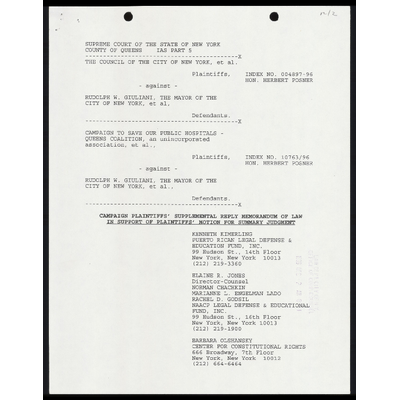
    SUPREME COURT OF THE STATE OF NEW YORK
COUNTY OF QUEENS IAS PART 5

THE COUNCIL OF THE CITY OF NEW YORK, et al.

Plaintiffs, INDEX NO. 004897-96

HON. HERBERT POSNER

- against -

RUDOLPH W. GIULIANI, THE MAYOR OF THE
CITY OF NEW YORK, et al,

Defendants.

CAMPAIGN TO SAVE OUR PUBLIC HOSPITALS -

QUEENS COALITION, an unincorporated
association, et al.,

Plaintiffs, INDEX NO. 10763/96

HON. HERBERT POSNER
- against -

RUDOLPH W. GIULIANI, THE MAYOR OF THE
CITY OF NEW YORK, et al.,

Defendants.

CAMPAIGN PLAINTIFFS’ SUPPLEMENTAL REPLY MEMORANDUM OF LAW
IN SUPPORT OF PLAINTIFFS’ MOTION FOR SUMMARY JUDGMENT


KENNETH KIMERLING
PUERTO RICAN LEGAL DEFENSE &
EDUCATION FUND, INC.
99 Hudson St., 14th Floor

New York, New York 10013

(212) 219-3360

ELAINE R. JONES

Director-Counsel
NORMAN CHACHKIN

MARIANNE L. ENGELMAN LADO

RACHEL D. GODSIL

NAACP LEGAL DEFENSE & EDUCATIONAL

FUND, INC.

99 Hudson St., 16th Floor

New York, New York 10013

(212) 219-1900

BARBARA OLSHANSKY
CENTER FOR CONSTITUTIONAL RIGHTS
666 Broadway, 7th Floor
New York, New York 10012

(212) 664-6464


SUPREME COURT OF THE STATE OF NEW YORK
COUNTY OF QUEENS IAS Part 5

THE COUNCIL OF THE CITY OF NEW YORK, et al.

Plaintiffs, INDEX NO. 004897-96
Hon. Herbert Posner

- against -

RUDOLPH W. GIULIANI, THE MAYOR OF THE
CITY OF NEW YORK, et al,

Defendants.

CAMPAIGN TO SAVE OUR PUBLIC HOSPITALS -

QUEENS COALITION, an unincorporated
association, et al.,

Plaintiffs, INDEX NO. 10763/96
Hon. Herbert Posner

- against -

RUDOLPH W. GIULIANI, THE MAYOR OF THE
CITY OF NEW YORK, et al.,

Defendants.

CAMPAIGN PLAINTIFFS’ SUPPLEMENTAL REPLY MEMORANDUM OF LAW
IN SUPPORT OF PLAINTIFFS’ MOTION FOR SUMMARY JUDGMENT


PRELIMINARY STATEMENT


Defendants’ plan to sublease a public hospital operated by the

Health and Hospitals Corporation ("HHC") for the benefit of all New

York residents and especially the indigent to a for-profit

corporation to be operated for the economic gain of its

shareholders violates the HHC Act.

In response to the fiscal and operational crisis facing New

York City’s municipal hospitals in the late 1960s, HHC was created

to provide "high quality, dignified and comprehensive care and

treatment for the ill and infirm, particularly to those who can


least afford such services.! HHC is a public benefit corporation

and as a public benefit corporation "is in all respects for the

benefit of the people of the state of New York and of the city of

New York, and is a state, city and public purpose. "?

Defendants claim that in turning over the operation and

control of a public hospital to PHS-New York, a for-profit

corporation, HHC is not "‘getting out of the hospital business.’

It is simply performing that same business in a different way."

Supplemental Affirmation of Daniel Turbow § 3. [hereinafter Turbow

Aff. 1. If this transaction takes place, what will Coney Island

Hospital be? Will it be a public hospital or a private for-profit

hospital? Defendants have decided not to answer this question and

to pretend that the only significance of the transaction is cost

savings for the City. However, if PHS-NY-controlled Coney Island

Hospital is to be a public hospital, it must guarantee access of

health care to the indigent. It does not. If-it is to be a

private for-profit, its purpose is at odds with HHC’s public

purpose and violates the HHC Act. The City’s attempt to create a

hybrid public-for-profit hospital violates the HHC Act. It is this

commingling of its status as a public hospital with its status as

a for-profit private hospital that violates .the law. HHC cannot

use its resources including its hospital for a non-public purpose.


1 ee Unconsolidated Laws § 7382 [hereinafter "HHC Act"]; New

York State Constitution Article XVII, §8 3 & 4; 1970 Lease Between
the City of New York and HHC [hereinafter "1970 Lease"] Art. II, §
2.1.

2? HHC Act '§ 7353.


The sublease and transfer of control of Coney Island Hospital to

PHS-NY violates the public purpose requirement of the HHC Act.

This transfer of a hospital is contradistinction to the

purchase of services. HHC can purchase services from a private,

and even a profit-making private, corporation. However, it cannot

consistent with its public purpose turn over one of ics "public"

hospitals to a private for-profit corporation. Defendants are not

merely proposing a management contract with a for-profit

corporation, but the total transfer of control and operation of an

entire HHC facility to a for-profit corporation for a term of 198

years. In sum: defendants plan to transfer complete control over

the provision of health care for tens of thousands of Brooklyn

residents to a corporation whose mission under state law is to make

a profit for its shareholders for the next 198 years. This plan

without any doubt violates the HHC Act.

Moreover, the proposed sublease requires HHC to reimburse PHS-

NY for its provision of care to the indigent once a "trigger point"

is reached.® Accordingly, HHC funds will be used to subsidize a

for-profit corporation at the expense of other HHC facilities.

Defendants do not address the illegality of the plan under the

HHC Act. Instead, defendants contend that the Proposed Sublease

will result in sufficient care to the indigent to satisfy the HHC

Act. Turbow Aff. § 4. Defendants are wrong on this score as well.

The Proposed Sublease does not guarantee that PHS-NY will


3
Proposed Sublease of Coney Island Hospital to Primary

Health-Systems-New York, Inc. § 28.05(c) at p. 75 [hereinafter
Proposed Sublease] attached as Exhibit A to Turbow Aff.

3


treat continue to provide access to care without regard to ability

to pay. The Proposed Sublease does not even require that PHS-NY

treat a specific number of uninsured patients; instead, it

establishes a dollar cap on PHS-NY’s obligation to serve the

indigent .*

Moreover, if PHS-NY exceeds its dollar cap in any given year,

the Proposed Sublease allows PHS-NY to "manage access to health

care in such manner as it may deem appropriate so as to avoid

"Excess Incurrence’" of indigent care."® HHC facilities cannot

similarly "manage access to care" to reduce or limit the care

provided to the indigent. Allowing PHS-NY to do so is clearly at

odds with the HHC'’s mission of providing care to the indigent.

The Proposed Sublease also allows PHS-NY to close or greatly

reduce services that are costly to provide but essential to serve

the i111 and infirm of New York City.° For example, expensive but

essential services for the chronically ill, persons living with

AIDS, asthmatics, and diabetics could be drastically cut by PHS-NY

to ensure profit for its shareholders.

Finally, as a newly incorporated corporation with no history

of operating hospitals, PHS-NY has no history to support its claim

that it will guarantee access to care.’ It plans to contract with


Proposed Sublease § 28.05 at p. 75.

Id. at 75,

Id. at 67-68.

? Affidavit of Judith B. Wessler, M.P.H., attached hereto, at
pp. 10-12 [hereinafter "Wessler Aff."].

4


Primary Health Services, Inc. ("PHS") to manage the hospital, which

itself has no experience running a facility with the level of

indigent care and complexity of patient population of Coney Island

Hospital.® In fact, PHS-NY’s short history of operations of

hospitals in Cleveland does not bode well for indigent care.

Initial reviews of PHS’s operations raise serious questions about

PHS’s commitment to serving the poor.°

In sum, defendants’ plan to sublease Coney Island Hospital to

PHS-NY violates the HHC Act for three reasons: {1) BHC is not

empowered by the HHC Act to transfer control of an entire HHC

facility to a for-profit corporation; (2) HHC is not empowered to

subsidize a for-profit corporation’s operation of a health care

facility; and (3) the Proposed Sublease does not ensure the

continued provision of care to the indigent required by the HHC


Act.

ARGUMENT

I. The Proposed Sublease of Coney Island Hospital to a For-Profit
Corporation Violates the HHC Act

A. HHC’s Purely Public Purpose


In 1969, New York City’s municipal health system faced

"chronic crisis and steady deterioration" in its provision of

health care to the indigent. Letter of James M. Hester, President,

School of Medicine, New York University to Counsel to the Governor,

May 20, 1969, Governor’s Bill Jacket to Chapter 1016, 1969 at 26;


2 51d,

I


See HHC Act § 7382. In order to restore the municipal health

system and to protect and promote the health, welfare and safety of

New York residents, the State Legislature passed the HHC Act. HHC

Act § 7382.

HHC is created for "the benefit of the people of the state of

New York and of the city of New York, and is a state, city and

public purpose." HHO: Act § 7382, The Act provides that "the

exercise by such corporation of the functions, powers and duties as

hereinafter provided constitutes the performance of an essential public

and governmental function." HHC Act § 7382 (emphasis added).

Under the State Constitution, the HHC Act, the Lease between

HHC and the City, and HHC’s by-laws, HHC is obligated to provide

care to all the residents of the City of New York, regardless of

ability to pay. New York State Constitution, Article XVII, §§ 3 &

4; HHC Act § 7382; HHC Lease, Article II, § 2.1; HHC By-Laws,

Article II (B) (attached to Supplemental Reply Affirmation of Rachel

D. Godsil Esq. as Exhibit A [hereinafter "Godsil Aff."]). HHC'’s

purpose is to "[elxtend equally to all we serve comprehensive

health services of the highest quality in an atmosphere of human

care and respect." HHC By-Laws, Article II (B). The Lease between

the City and HHC provides that "the hospitals under [HHC’s]

jurisdiction and the services that it will render are particularly

for those who can least afford such services." 1970 Lease, Art.

11, 38 2.2.

Moreover, since the purpose for which a for-profit corporation

operates 1s antithetical to the purpose of a public benefit

:


corporation, such a transfer runs directly contrary to the purpose

of the HHC Act. A for-profit corporation is created to provide an

economic benefit to its shareholders. PHS-NY was incorporated on

June 25, 1996 in the State of New York. As a for-profit

corporation with general shareholders, PHS-NY has the "direct

object of promoting private ends." 14 N.Y. Jur.2d Business

Relationships § 23. The courts have recognized the "ultimate goal"


of any corporation under state law is to "provide maximum economic

returns to its shareholders." Alpert v. 28 William Street Corp.,


124 Misc.2d 512, 478 N.Y.S.2d4 443, 449 (N.Y. Co. 1983); see also 1


J.D. Cox et al., Corporations § 1.2 (1995) (defining business

corporation as an association of persons "in a business enterprise

with the object of economic gain"). Under New York law, the

directors of PHS-NY, who are charged by law with managing the

corporation’s affairs, N.Y. Bus. Corps. Law § 701 (McKinney’s

1986), owe their duty to the corporation and its stockholders in

their quest for economic gains. See Cohen v. Cocline Products,


‘Inc., 308 N.Y. 119, 123, 127 N.E.2d 206 (1955).

It is inimical to the purposes of the HHC Act to suggest that

the statute contemplates the transfer of an entire HHC. health

facility to a for-profit corporation with the core purpose of

seeking profits for its shareholders as the appropriate mechanism

for pursuing HHC’s corporate purpose. Surely, had this been

intended, the Legislature would have made an express provision for


such a step.

B. HHC’s Operational Mandate


In fact, the HHC Act provides a very specific mandate to HHC:

to provide health care to the citizens of the City of New York.

While the HHC Act grants HHC broad authority to carry out that

mandate, it explicitly enumerates those powers. HHC is empowered

to "operate, manage, superintend, and control any health facility

under its jurisdiction." HHC Act § 7385(7). It may "exercise and

perform all or part of its purposes, powers, duties, functions or

activities through one or more wholly-owned subsidiary public

benefit corporations." HHC Act § 7385(20). HHC may also provide

health and medical services through affiliation and other

agreements or leases with "any person, firm or private or public

corporation or association." HHC Act § 7385(8). HHC may borrow

money and issue negotiable notes or bonds. HHC Act § 7385(4).

The HHC Act very specifically sets forth HHC’s authority to

acquire or dispose of entire health facilities in sections 7385(6)

and 7387(4). Under § 7385(6), HHC is empowered to acquire and to

dispose of real property, including health facilities, "for its

corporate purpose," provided that it holds a public hearing and

obtains the consent of the board of estimate. HHC Act § 7385(6).

If the corporation determines that the use and occupancy of a

health facility or any other real property is no longer required


1" The root of the problem here is that instead of having the
privatization issue debated properly by the State Legislature by
suggesting an amendment to the HHC Act, defendants chose to amend

the statute by fiat.


for its corporate purposes and powers, HHC may "surrender its use

and occupancy to the City" or otherwise dispose of the facility

"and ite the proceeds derived from the sale, lease or other

disposition thereof for its corporate purposes." HHC Ach .§

7387 (4) .

Given the specific delineation of the scope of HHC’s

authority, at issue here is not whether HHC can, within its state

mandate, permissibly contract with a for-profit corporation for a

discrete set of services. It clearly can. The issue presented is

whether the HHC Act permits HHC to turn over complete control of

the operation of an entire HHC facility to a for-profit

corporation. The practical significance of the distinction is

considerable. In a contract for services with a for-profit, HHC

establishes the parameters of the provision of health services with

HHC’s public purpose underlying those decisions. By contrast, if

HHC transfers control, the for-profit makes decisions about the

parameters of the provision of health services with the purpose of

economic gain underlying those decisions. No provision of the

Act permits HHC to transfer an entire health facility that is needed to

provide health care to the indigent to a for-profit corporation.

Defendants argue that they are empowered to close hospitals

under the Act, and therefore, that they are empowered to sublease


" As is discussed infra in Part II, PHS-NY is empowered by
the Proposed Sublease to cut services that are essential to
indigent New Yorkers. Particularly troublesome examples include
services to persons living with AIDS, asthma care, and care to the
chronically ill. See Infr Part II(B).


9


hospitals to a for-profit corporation.'?Turbow Aff. at 6-7.

However, § 7387 (4) of the HHC Act, the provision that allows HHC to

close a hospital, states that "[i]f the corporation determines that

the use and occupancy of any real property is no longer required

for its corporate purposes and powers, " it may either "surrender

its use and occupancy to the city" or have the power "to sell,

lease or otherwise dispose of said real property at public or

private sale or as part of a contract, lease or other agreement

entered into under the terms of this act and to use the proceeds

derived from the sale, lease or other disposition thereof for its

corporate purposes." HHC Act § 7387(4). In other words, if HHC

determines that a hospital is no longer necessary for it to provide

health services to the people of New York City, and particularly,

the indigent, it may either return the hospital to the city or

dispose of the hospital, and use the funds to provide health care

to the indigent.

Here, as defendants admit, defendants propose to provide the

health care they are statutorily and constitutionally required to

provide by transferring Coney Island Hospital to a for-profit

corporation to operate and manage. Turbow Aff. at 2. They have

not decided that health care is not needed in Coney Island. The

HHC Act does not empower HHC to carry out its purposes by turning


2 The federal cases defendants cite for this proposition,
Bryan v. Koch, 627 7.24 612 (24 Cir. 1980, aff'g 492 F. Supp. 212
{(S.D.N.Y.) and Jackson v. HHC, 419 F. Supp. 809 (S.D.N.Y. 1976) are
inapplicable. Both involved challenges under the Fourteenth
Amendment to the United States Constitution and Title VI of the
1964 Civil Rights Act, not the HHC Act.


10


over its assets to a for-profit corporation.

C, The Proposed Sublease Results in HHC Subsidizing a For-
Profit Corporation in Violation of the HHC Act


The possible diversion of funds allowed by the Proposed

Sublease to an HHC facility controlled by a for-profit entity for

reimbursement of care to the indigent also clearly contravenes the

terms of the HHC Act. Specifically, the Proposed Sublease provides

for HHC to reimburse PHS-NY for the provision of care to the

indigent for any year in which the cost of that care exceeds a

"Trigger Point." Proposed Sublease § 28.05 at p. 75.

Accordingly, HHC funds are promised to an HHC facility operated by

a for-profit corporation. This violates the HHC Act.

The Act provides that:

The city shall . . . enter into an agreement . . . with the

corporation . . . whereby the corporation shall operate the hospitals
then being operated by the city for the treatment of acute and
chronic diseases . . . the city shall include in its expense
budget an appropriation of tax levy for the services provided
by the corporation

HHC Act § 7386(1) (a) (emphasis added). HHC is reimbursed by the

City for HHC’s operation of the hospitals consistent with HHC'’s

corporate purposes. HHC is not empowered to use City funds to

reimburse a for-profit corporation for providing those services in

a facility managed by the for-profit corporation for its

shareholders’ profit. If defendants are correct and economic gains

are realized from increased efficiency or superior management,


This provision does not, however, require PHS-NY to provide
access to care to the indigent. For a more complete description of
this provision of the Proposed Sublease, see infra Part II (A).


11


those gains go directly to the PHS-NY shareholders’ pockets -- not

to the HHC system. Under the Proposed Sublease, HHC may well be in

a position of transferring much-needed funds to PHS-NY when PHS-NY

shareholders are taking home considerable profit.

The illegality of mingling the assets of a health facility

with the sole purpose under state law of providing care with a for-

Crofit corporation with the purpose under state law of providing an

economic benefit to its shareholders has been addressed elsewhere.

In Michigan and California, mergers of for-profit hospitals and

not-for-profit hospitals were found to violate those states’ not-

for-profit laws. See Kelley wv. Michigan Affiliated Healthcare


System, Inc., No. 96-8384B-CZ, September 5, 1996 Court Ruling,

Michigan Circuit Court (attached as Exhibit B to Godsil Aff.) ;

Decision of Daniel E. Lungren, Attorney General for the State of

California, November 8, 1996 (attached as Exhibit C to Godsil Reply

Aff.). While these cases involved not-for-profit hospitals and the

states’ not-for-profit laws, and not public benefit corporations,

the legal principles involved are similar.

tn Michigan. ons mosion Lot summary judgement, the Court held

that a local not-for-profit hospital would be committing an ulira vires

act by entering into a partnership with a for-profit health care

conglomerate. The Court found that the partnership would violate

the Nonprofit Corporation Act because "no one is entitled to profit

from [the] operation" of a not-for-profit hospital. Michigan

Ruling at 5. The Court noted that a sale of the hospital to the

for-profit conglomerate would be permitted if the proceeds were

2


used purely for charitable purposes and that a management contract

with a for-profit may be acceptable, but concluded that a joint

venture would be prohibited because it would result in

impermissible commingling of charitable assets with for-profit

assets generating profits to the for-profit and its shareholders.

Michigan Ruling at 8.

Similarly, in California, the Attorney General determined that

a provision of the Articles of Incorporation of a not-for-profit

health organization would be violated if it merged two of its

hospitals into a for-profit entity. The Articles of Incorporation

require that the assets of the two hospitals be used for the

purpose of "acquiring and operating a non-profit charitable

hospital and medical center in the City of San Diego." Attorney

General Letter at 2. The Attorney General stated that "the

transfer of these hospitals into the for-profit LLC constitutes an

abandonment and breach of that trust." Id. at 2. The Attorney

General plans to initiate legal proceedings if the merger is not

halted. Id, at 6.

The issue at bar involves a public benefit corporation rather

than a not-for-profit and thus is even more compelling. The

Michigan court and the California Attorney General both found that

the commingling of the assets of a not-for-profit with a for-profit

was impermissible because the not-for-profits were required by

state law or their internal corporate documents to use their assets

solely for their charitable purposes -- and not for the economic

gain of another corporation’s shareholders. Here, HHC was created

13


to fulfill a vital public purpose, HHC Act § 7382, and must use any


assets to fulfill that purpose, see, e.g., HHC Act § 7387(4). It

is clearly impermissible for HHC to commingle its assets with PHS-

NY, a for-profit corporation.

ITI. The Proposed Sublease to PHS-NY Endangers Health Care to the


Poor

Contrary to defendants’ characterization of this transaction,

Turbow Aff. at 3, the Proposed Sublease departs drastically from

HHC’s mission to provide indigent New Yorkers adequate access to

health care regardless of ability to pay. The Proposed Sublease

fails to guarantee access to care for the poor, does not ensure

that necessary services will be available to the indigent, provides

for insufficient monitoring of access to care, and may impede the

ability of HHC as a whole to fulfill its mission. Moreover, there

is no evidence to suggest that PHS-NY is qualified to operate so

complex and important a hospital.

A. Proposed Sublease Fails to Provide Access to Care for the
Uninsured and Underinsured


The Proposed Sublease does not guarantee that PHS-NY will

treat everyone who needs care regardless of ability to pay. See

Affidavit of Judith B. Wessler, M.P.H. §§ 15 - 19. The Proposed

Sublease does not even require that PHS-NY treat a specific number

of uninsured patients. Instead, Article 28 of the Proposed

Sublease establishes a cap on PHS-NY’s obligation to serve the

indigent and defines PHS-NY’s level of obligation in terms of

dollar amounts. Proposed Sublease § 28.01 at pp. 74, 75. These


provisions represent a complete departure from HHC’s practice of

seeing all patients without regard to insurance status or ability

to pay and contravene HHC’s mission.

In particular, PHS-NY is required to absorb the costs of care

only up to a specified "trigger point." The trigger point will be

established annually based on HHC’s audited charity care expense

for Coney Island Hospital’s most recent fiscal year inflated

annually and multiplied by 115%. Proposed Sublease § 28.01 at p.

75. After the "trigger point" is reached, HHC will be obliged to

reimburse PHS-NY for costs incurred above the trigger point

("excess incurrence") for one year. ‘Proposed Sublease § 28.01 at

p. 75. Although the City has represented that it will reimburse

HHC for such outlays, there is no provision detailing how such

expenditures will be budgeted and what impact they might have both

on HHC’s annual budgeting process and on the allocation of funds

among HHC’s other facilities.

After the first year of reaching the trigger point, the

Proposed Sublease explicitly permits PHS-NY to "manage access to

health care in such manner as it may deem appropriate so as to

avoid ‘Excess Incurrence’" of indigent care if the costs of

providing services to the poor exceed PHS-NY’s cap in any given

year. Proposed Sublease § 28.01 at p. 75. HHC facilities cannot

similarly "manage access to care." This provision is clearly at

odds with the mission of the public hospitals.

The Proposed Sublease also explicitly states that after the

first year that PHS-NY reaches the trigger point, HHC cannot

15


require PHS-NY to provide indigent care beyond the trigger point:

"[N]Jothing herein shall give Landlord [HHC] the right to require

Tenant [PHS-NY] to provide Indigent Care in excess of such amount."

Proposed Sublease § 28.01 at p. 75.

While defendants assert that the 115% cap will be sufficient

to provide indigent care until well after the year 2000, see Turbow

Aff. at 3, defendants current projections of the number of

uninsured patients reliant on Coney Island Hospital for care and,

thus, its analysis of the likelihood that HHC will be required

under the Proposed Sublease to reimburse PHS-NY for indigent care,

are erroneous. Wessler Aff. at 10. Among other things, they

drastically underestimate the impact of recent changes in federal

Medicaid eligibility. For example, Appendix A of the SEQRA Report,

attached to the Turbow Aff., states that 66% of the immigrants in

Coney Island Hospital’s primary catchment area are refugees and

thus remain eligible for Medicaid under the Personal Responsibility

and Work Opportunity Reconciliation Act of 1996. Appendix A at 10.

Yet the analysis fails to calculate the impact of the Act on the

one-third of immigrants who might no longer be eligible.

B. PHS-NY Is Authorized to Drastically Reduce Services
Accessible to the Indigent


The Proposed Sublease would allow PHS-NY to significantly

alter the number and types of services available to the indigent at

Coney Island Hospital and does not require either that such

decisions comport with community health needs or that PHS-NY

guarantees continued access to these services.

In particular, the Proposed Sublease distinguishes between

16


"Core" services and "Non-core" services. Under Article 28 of the

Proposed Sublease, PHS-NY would continue to provide core services,

including "Emergency Medicine, Medicine, Obstetrics/Gynecology,

Pediatrics, Psychiatry, Rehabilitation Medicine and General

Surgery," "to substantially the same degree as provided by Coney

Island Hospital on the day prior to Commencement Date." Proposed

Sublease § 28.01 at 67-68. By contrast, the Proposed Sublease

would allow PHS-NY to change the ways and means of delivering "non-

core" services (which include dental care, cardiology, urology,

endocrinology, ophthalmology, orthopedic surgery, podiatry,

anesthesiology, oral surgery, cardiac cath, pharmacy, surgical

subspecialties and all other services not listed as "core") at PHS-

NY’s "reasonable discretion." Proposed Sublease § 28.01 at 68.

PHS-NY can thus make changes, including the closure of a non-

core service or the transfer of the non-core service to another

site or provider, without any effective limitation. Before closing

or transferring the department, PHS-NY must ‘only give HHC notice,

providing HHC with the opportunity to provide input. The Proposed

Sublease grants HHC no recourse should PHS-NY reject HHC'’s

recommendations.

The Proposed Sublease would allow PHS-NY to transfer

responsibility for performing inpatient and outpatient "non-core"

services off-site to other providers, including its affiliates,

Brooklyn Hospital and New York University Hospital, without any

assurance that these providers will accept referred patients

without regard for ability to pay. Neither the Proposed Sublease

17


nor any other publicly available document provides any assurance

regarding the accessibility of services to the uninsured if

patients are referred to private providers (eg, for lab work or

private practices for follow-up patient care).

PHS-NY could, therefore, close or greatly reduce "non-core"

services that are crucial to community health but costly to

provide. Such services might include, example, care for the

chronically ill, for diabetics, asthmatics or persons living with

AIDS. Such decisions would be inconsistent with HHC’s orientation,

which prioritizes the provision of public health services and

places emphasis on primary care. |

Moreover, the list of "core" services contained in the

Proposed Sublease specifies the categories by department, not

services. Available documentation contains no list of services by

department. Thus, it is unclear, for example, which of Coney

Island Hospital’s 90 out-patient clinics (including allergy,

asthma, diabetes, cardiac rehabilitation, out-patient surgery,

hearing, geriatrics continuing care, pre-natal, alcoholism, and

family planning clinics, for example) PHS-NY will continue to

provide.

The Proposed Sublease would allow PHS-NY to change the ways

and means of delivering even "core" services and to alter the

services offered within the enumerated departments. PHS-NY could,

after proceeding through a notification and arbitration process,

even close a "core" department without getting HHC'’s approval for

reasons related to changes in government reimbursement mechanisms,

18


for example. Proposed Sublease § 28.01 at 68.

C. Proposed Sublease Inadequately Provides for Monitoring
Access to Care


Despite defendants’ protestations to the contrary, Turbow Aff.

at 4, the Proposed Sublease does not provide for effective outside

monitoring or the involvement of other city agencies. It instead

puts monitoring in the hands of a new community advisory board and

HHC. Proposed Sublease § 28.01 at 69-72. These bodies do not have

the capacity to perform effective oversight to ensure that PHS-NY

continues to provide access to care.

In addition, community advisory boards at HHC facilities

currently have responsibility for oversight over planning and

budgeting, areas that affect access to care and the types of

services provided. Wessler Aff. at 16-17. These responsibilities

are not included under the Proposed Sublease.

D. Proposed Sublease May Impede the HHC System as a Whole
From Fulfilling its Mission


The Proposed Sublease and publicly available documentation

fail to address the impact of the loss of Coney Island Hospital to

the HHC system and to HHC’s ability to carry out its mission

throughout the City. Id. at 15-16. The City has stated that HHC

will benefit from PHS-NY’s payments for the purchase of Coney

Island Hospital, due at the time of closing. Turbow Aff. at 4.

The City has offered no analysis, on the other hand, of the costs

of withdrawing Coney Island Hospital from the HHC system. In the

past three to five years, HHC has been reorganizing to take

advantage of the benefits of its position as a multi-site system

19


with purchasing power and multiple points of entry. With the

health care financing and delivery system experiencing tremendous

change and, particularly, with the growth of managed care, the

viability of HHC as a whole may be affected by the disposition of

HHC’s Coney Island facility. Already, following the announcement

that Coney Island would be privatized, Coney Island was removed

from HHC’s Brooklyn/Staten Island Network and has realized little

benefit from HHC’s networking, or regionalization, efforts.

Wessler Aff. at 16.

The Proposed Sublease also fails to specify whether PHS would

participate in HHC’s managed care program, Metroplus, and, thus,

whether low-income Metroplus enrollees would maintain continuity of

care should they require services in Southern Brooklyn.

E. PHS-NY’s and PHS, Inc.’s Track Records in Service to the
Indigent Bodes I11 for Indigent Care in Brooklyn


Finally, the track records of PHS-NY and PHS, Inc. do not

provide any basis for concluding that this transaction will ensure

continued access to care for the indigent. Wessler Aff. at 10-12.

First, PHS-NY is a for-profit corporation established in June, 1996

for the purpose of subleasing Coney Island Hospital, PHS-NY has

never operated any other hospital and it has no institutional track

record. Id. at 10. PHS, Inc., itself only incorporated two years

ago, and its reputation thus far is largely based on two hospitals,

St. Alexis and Deaconess, acquired in Cleveland within the past two

years. Id. at 11. The little documentation available indicates

that PHS, Inc. is, at best, ill prepared to accept responsibility

for Coney Island Hospital’s indigent patient population. Id.

20


Coney Island Hospital is 450 bed facility operating with an

‘occupancy rate of nearly 90%. Id. The Hospital annually receives

more than 300,000 outpatient department visits, and discharges

17,000 to 18,000 patients from its inpatient beds. Id. It serves

a diverse, multi-lingual community and maintains residency programs

in internal medicine, general surgery, orthopedics, urology,

pediatrics, obstetrics, gynecology and anesthesiology,

ophthalmology, and osteopathy. Id. PHS, Inc., has never operated

a comparable institution. Id. St. Alexis and Deaconess are both

relatively small hospitals with much lower occupancy rates, few

salaried physicians, and no residency programs. Id. Neither St.

Alexis nor Deaconess offer the type of extensive clinic system

relied upon by Coney Island patients. Id. Coney Island Hospital

receives more than 60,000 emergency room visits per year, a figure

almost twice as high as that at St. Alexis and Deaconess combined.
= ;

PHS, Inc.’s performance in Cleveland also raises substantial

questions about its commitment to providing access to care for the

uninsured. According to data provided by PHS for the years 1993

through 1996, total levels of uncompensated care have dropped

significantly since PHS, Inc., assumed control of St. Alexis and

Deaconess. Id. at 12. A report by New York City Comptroller that

relies on figures supplied by PHS shows significant declines in the

amount of care provided to the uninsured working poor and the total

uncompensated care after PHS assumed control of St. Alexis and

Deaconess. See Report of the Comptroller of the City of New York,

21


Attached to Wessler Aff. as Appendix A.

Documentation provided by PHS and HHC'’s own initial reviews of

PHS’s current operations in Cleveland raise a number of additional

unresolved questions about both PHS’s commitment to serving the

poor and the degree to which PHS diverts resources to

administrative costs and profits. Wessler Aff. at 12. According

to Dr. Walid Michelen, HHC’s Senior Vice President for Medical &

Professional Affairs, who visited PHS hospitals in September, 1996,

he had been informed that these two hospitals "subtly" turned away

indigent care patients. See September 16, 1996 Memorandum from

Walid Michelen, Attached to Wessler Aff. as Appendix B. In

addition, HHC staff have raised concerns regarding PHS’s practice

of discontinuing and outsourcing services, its policy in Cleveland

of taking 30% of net revenues for profit and overhead, exclusive of

systems, and the possibility that PHS, Inc., plans to transfer

Coney Island Hospital after consummating the transaction with HHC.

Wessler Aff. at 12.

* * *

In sum, the Proposed Sublease with an untested for-profit

corporation fails to guarantee access to care for the poor, does

not ensure that necessary services are delivered, provides for

insufficient monitoring, and may impede the ability of the HHC as

a whole to fulfill its mission.

CONCLUSION


For the foregoing reasons, it is respectfully requested that

defendants’ motion for summary judgment be denied, and plaintiffs’

22


cross-motion for summary judgment be granted, together with such

other and further relief as the Court shall deem just and proper.

Dated: New York, New York
November 29, 1996

RESPECTFULLY SUBMITTED,

KENNETH KIMERLING
PUERTO RICAN LEGAL DEFENSE &
EDUCATION FUND, INC.
99 Hudson St., 14th Floor

New York, New York 10013

(212) 219-3360

ELAINE R. JONES

Director-Counsel
NORMAN CHACHKIN

MARIANNE L. ENGELMAN LADO
RACHEL D. GODSIL
NAACP LEGAL DEFENSE & EDUCATIONAL
FUND, INC.

99 Hudson St., 16th Floor

New York, New York 10013

(212) 219-1900

BARBARA OLSHANSKY
CENTER FOR CONSTITUTIONAL RIGHTS

666 Broadway, 7th Floor
New York, New York 10012

(212) 664-6464

ATTORNEYS FOR PLAINTIFFS

23