Correspondence from Leventhal to Judge Keady; Memorandum in Support of Counsel Fees
Public Court Documents
October 11, 1974
13 pages
-
Case Files, Norwood v. Harrison - Hardbacks. Correspondence from Leventhal to Judge Keady; Memorandum in Support of Counsel Fees, 1974. 872ba088-722e-f111-88b4-0022482cdbbc. LDF Archives, Thurgood Marshall Institute. https://ldfrecollection.org/archives/archives-search/archives-item/877f2dcc-f8ca-440d-833d-8d776c5e84ca/correspondence-from-leventhal-to-judge-keady-memorandum-in-support-of-counsel-fees. Accessed October 16, 2026.
Copied!
     [||3d89c839-3f87-454a-b4a0-18b5818edb3c||] ¥ »

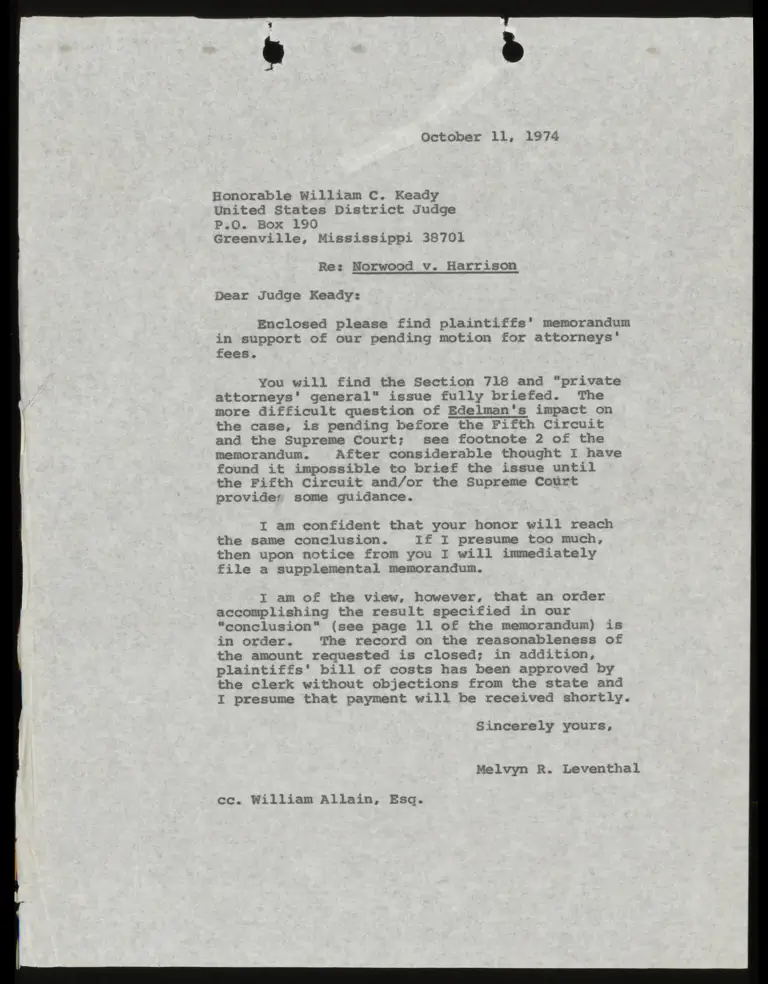
October 11, 1974

Honorable William C. Keady
United States District Judge
P.O. Box 190
Greenville, Mississippi 38701

Re: Norwood v. Harrison


Dear Judge Keady:

Enclosed please find plaintiffs' memorandum
in support of our pending motion for attorneys’

fees.

You will find the Section 718 and "private
attorneys' general” issue fully briefed. The
more difficult question of Edelman's impact on

the case, is pending before the Fifth Circuit

and the Supreme Court; see footnote 2 of the
memorandum, After considerable thought I have
found it impossible to brief the issue until

the Fifth Circuit and/or the Supreme Court
provides some guidance.


I am confident that your honor will reach
the same conclusion. If I presume too much,
then upon notice from you I will immediately
file a supplemental memorandum.

I am of the view, however, that an order
accomplishing the result specified in our

"conclusion" (see page ll of the memorandum) is

in order. The record on the reasonableness of
the amount requested is closed; in addition,
plaintiffs’ bill of costs has been approved by
the clerk without objections from the state and
I presume that payment will be received shortly.

Sincerely yours,

Melvyn R. Leventhal

cc. William Allain, Esq.


IN THE UNITED STATES DISTRICT COURT

FOR THE WESTERN DISTRICT OF MISSISSIPPI

WESTERN DIVISION


DELORES NORWOOD, et al., -

Plaintiffs, :

— : No. WC 70-53-K

D.L, HARRISON, et al., :

Defendants. e
e


MEMORANDUM IN SUPPORT


OF COUN! FERS

Introduction

August 15, 1974, the Court established a schedule for

the submission of the issues raised by plaintiffs' July 30,

1974, motion for an award of attorneys' fees. Plaintiffs

were directed to file affidavits in support of the amount

claimed, and defendants were required to enter any objections

through counter-affidavits filed within 20 days after the

submission of plaintiffs' affidavits. On August 16 and 22,

1974, plaintiffs submitted affidavits requesting a total of

$31,379.00 of which $28,979.00 was for services rendered by

undersigned counsel, and $2,400.00 for services rendered by

James M. Nabrit, 111, Esq. Defendants did not file counter-

affidavits, or otherwise contest the reasonableness of the

amount of the fee sought; accordingly, the sole issue presented

by the pending motion is whether defendants are liable for

such fees.


I. A \NTS ARE LIABLE FOR AN AWARD OF >

COUN N SI 3d Ly FEE 1S AS 5 Pf ART OF COS TS


Plaintiffs maintain that defendants are liable for

counsel fees on two independent grounds. First, counsel fees

are required by Section 718 of the Emergency School Aid Act of

1972, 20 U.,85.C. §1617. Second, counsel fees are required

in this case by the "private attorney general" rule adopted by

the Fifth Circuit in Lee v. Southern Home Sites Corp., 444 F.2d


143 (5th Cir. 1971)

(A) Section 718

Section 718 of the Emergency School Aid Act of 1972,
te

20. U.5.C. §l617, provides:


“the United States against
ti : State (oF

ited States

fatinre to
this chapter

basis of race, or for di

| lat ion of

chat the proceedings were Cy £0
bring about compliance, may allow the prevail-
ing party, other than the United States, a

reasonable attorney's fee as part of the costs.
[ Emmy ohas 1g s Added ] .

Section 718 clearly contemplates the instant case:

(a) a "final order" was entered in this action by the district

court on July 12, 1974; (b) the order was directed against an

agency of the State enjoining conduct covered by the statute;

(c) although a portion of counsel's input occurred prior to the

| effective date of the Act, the Supreme Court has held that an

award of fees does not turn on whether the work was performed

subsequent to the effective date of the Act; (d) similarly,

although the statute suggests that the district court has

"discretion" the Supreme Court has held that an award must be


made absent extraordinary circumstances.

(i) A Final Order was Entered in this Action


The court's July, 1974, order upon which we have |

moved for attorneys' fees, provides for the retention of

jurisdiction by the district court and contemplates further

hearings and orders; nevertheless, it is clearly "final"

within the meaning of Section 718:

To delay a fee award until the
entire litigation is concluded
would work substantial hard-
ship on plaintiffs and their
counsel, and discourage the
institution of actions despite
the clear congressional intent
to the contrary evidenced by
the passage of §718. A district
court must have discretion to
award fees and costs incident to

the final disposition of interim

Ol Board


The Supreme Court has thus defined a "final order”

[1] as one which achieves the "final disposition of [an] interim

matter." This Court's July, 1974, order definitively disposes
nN

16
9]

 of all substantive issues raised by this litigation, resolve

De the question of textbook aid for the overwhelming majority of

Mississippi private schools and fully satisfies the Bradley

standard.

(ii) §718 provides for the award of fees in cases

charging violations of the Fourteenth Amendment as it pertains

to elementary and secondary education. Although this language

of the statute clearly covers the instant litigation, plaintiffs

can go a step further: it is clear from the legislative history

of §718, that Congress was deeply concerned with state support

for segregationist academies formed in the wake of public school

desegregation and expected §718 to assist in litigation
|
{

challenging such activity. Three excerpts from the Section 718

congressional debates effectively illustrate the point:


SENATOR MONDALE:

. There have been allegations by the National
Education Association that several thousand
black teachers have been fired in the South,

or demoted. I would like to see lawsuits


brought on that. There has been testimony
that some schools have taken public property


Ls a gp n ~ = Le

away to segregated private


pr ——" -

ec TO SE ee so
me 3 SW

. . . . Unfortunately they

have Tot. been forthcoming.

Vol.-"117 Cong. Rec, at 10762.


We have to look upon this matter in the
light of the crisis in the area of school
desegregation enforcement today. 1 do
not think that one percent of the cases
which should be brought are being brought.
Hundreds of black tea orgs who have been


fired are walking the streets, with no
one to help them, no one to bring lawsuits
on their behalf. School property is being


to private [segre


Vol. 117 Cong. Rec. 11343

to segregation academies . . . in my
learly violate[s] the proscr

tion of the 14th Amendment. And "what

this bill does. in essence. 1s that it

says a party is entitled to pursue his
remedy [of an attorney's fee] if there
igs a violation of . . +. the l4th Amendment
to the Constitution of the United Stat

Senator Mondale, Vol, 117 Cong. Rec.
followed, by Senator Cook, 117 Cong. Rec.

11725-26"

The legislative history therefore compels a holding


J

{
3


0


that the statute's reference to an award of an attorney's fee

in cases challenging "discrimination on the basis of race . .

in violation of . . . the Fourteenth Amendment" permits no

distinction between cases aspiring the attainment of fully

unitary public school systems and cases challenging state

support for segregated private academies.


Y/ Senators Mondale and Cook introduced the Section 718
legislation. Vol, 117 Cong. Rec. 11338-11345; Vol. 117 Cong.Rec.
11520-23, 11724-26. No provision comparable to Section 718
was ever introduced in the House. U.S. Code Cong. & Admin. News,

92 Cong. 248 Session, 1972, p.2668.


(iii) A subatancial portion of the services

rendered by undersigned counsel were performed prior to July 1,

1972, the effective date of Section 718. See Pub. L. 92-318,

§2 (c)1l. Although the statute is silent on whether pre-Act :

counsel fees may be awarded, the Supreme Court has fully

i

considered and unanimously resolved this question in plaintiffs

favor. Bradley v. Richmond School Board, supra, 40 L.Ed. 2d


at pp. 487-494. There the Court upheld a district court's

award of attorneys' fees, in a school desegregation case, for

pre-July, 1972 services, and held that section 718 mandates

such awards provided only that the case was pending on July 1,

1972.°440 L.Ed. 24. at 494).

This action, filed in September 1970, was intensively

litigated from that date through this Court July, 1974 order;

the case was pending in July, 1972 :(in the Supreme Court) and it

ve i ~~

is therefore subject to the holding of Bradley, supra.

(iv) Although Section 718 suggests that a court

"may" award counsel fees its discretion has been largely

removed by the Supreme Court's holding in Northcross v. Board

    of Fducation, 412 U.S. 427 (1974). HNorthcross established the

principle that attorneys' fees in Section 718 cases must be

awarded "unless special circumstances would render such an award

unjust: "
Section 718 tracks the wording of

§204 (b) of the Civil Rights Act of 1964,
78 Stat 244, 42 USC §2000 a-3(b), which
provides that, in an action seeking to
enforce Title II of that Act, "the court,
in its discretion, may allow the prevail-
ing party, other than the United States,
a reasonable attorney's fee as part of
the costs v.'v is «Y In Newman vy. Pigaie
Park Enterprises, Inc. 390 US 400, (1968),
we held that, under §204 (b), "one who
succeeds in obtaining an injunction under
that Title should ordinarily recover an
attorney's fee unless special circumstances


would render such an award unjust." Id.,
at 402. The similarity of language in
§718 and §204(b) is, of course, a strong ;


indication that the two
should be

Moreover, "the two provisions

share common raison d'etre.

plaintiffs in school cases are
att -orneys general' vindicati
poiicy in the same sense
in Title II actions. The

both provisions wa the
‘to encourage ind uals in

racial discrimina tO
yelieft  -, eo te

a.

for

ivid

1 1 on

ot
~

cng kr
CA


Johnson V..
471 F. 29 84, 86 (CAS 1972 Vo

Newman v. Piggic Entexrp:

at 402, 2d

werefo ) that, a

3}, if other regud rements.
sfied, the succes

plaintiff; should ordinarily x
an attorney's fee unless speci
circumstances would render
award unjust.” 390 US. at

§718 are sati
= fu [1

may have good faith,

sucl
402.

statutes

interpreted pari passu.

The

‘private
ing national

as are plaintiffs
enactms

ame
ed 2 oY

dic et

Combs,

Gaorl ny


oo ver

a3 a

Tian

counsel fees. See Newman v. Piggie Park Enterprises


380 U.S. 400, 402 There are no

in this case which would render an award of

unjust.

For the foregoing reasons, section

an award of attorneys' fees in the

for services rendered prior and subsequent to

date of the Act; the only obstacle is

discus sed infra, pp. 10-11.

couns

718

full amount

requires

requested -

the effective

the Eleventh Amendment,


ant OF

Sa

circumstances”

el fees


(B) Private Attorney General Rule


Even in the absence of an express statutory authorization,

the Fifth Circuit requires that counsel fees be awarded to any

successful plaintiff who, as a result of the litigation,


vindicates important public policies. In Lee v. Southern

Home Sites Corp., 444 F.24 143 (5th Cir. 1971), a housing


discrimination case under 42 U.S.C. §1982, the appeals court

We hold that attorney's fees
are part of the effective remedy
a court should fashion to Saxe.

out the congressional policy em
bodied in Section 1982 ie vi

The recent case of Mills v. Electric
Auto-Lite Co., 1970, 396 U.85. 375,


e vo Gemonstrateg that iL is proper
to award attorney's fees when this
remedy effectuates congressional
policy ow Te ul Section 10982 “3s nok

tute providing detailed remedies,
and thus the policy of effectu
congressional purpose does not militate
against an award of attorney's fees.
Adit ionally, here as in Mil:
strong congressional policy
rights declared in §1982. Awarding
attornev's fees to succesaful plaintiffa

would facilitate the enforcement of
that policy through private litigation.
444 F.24 at 145.

Counsel fees were to be awarded to successful plaintiffs

"unless special circumstances would render such an award unjust.”

444 F.2d at 147. The Fifth Circuit has also applied the

private attorney general rule to litigation under §1981 to

enjoin employment discrimination by local government agencies,

cooper v. Allen, 467 F.2d 836, 841 (5th Cir. 1972) and to an


award of counsel fees in litigation under the Voting Rights Act

of 1965, Fairley v, Patterson, 493 F.24 598, 606 (5th Cir.


1974).

in Callahan v. Wallace, 466 F.24 59 (5th Cir. 1972)


an action under §1983 challenging police practices, the Fifth

Circuit directed that counsel fees be awarded because "plaintiffs

attorneys rendered a public service." 466 F.2d at 62. The

ia ie


private attorney general rule also requires an award of

attorneys' fees in actions successfully charging racial

discrimination in the dismissal of Bla ck teachers. Cornist Ve

Richland Parish School Board, 495 F.2d 189, 192 (5th Cir.1974)

The private attorney general rule although formulated by the

th Circuit has been adopted by six other circuit courts

of appeals. Knignt v, Auciello, 453 ¥.24 853 (lst Cir. 197

National Resources Defense Council Inc., v. Environmental


Protection Agency,484 F.2d 1331, 1333-34 (lst Cir. 1973);

  v. Thompson, 494 F.2d 885 (9th Cir. 1974);


y PS
- f

Fowler v. Schuarzwalder, 498 F.2d 143 (8th Cir. 1974); Wilderness

Society v. Norton, 495 P.24 1026, '1029-1037 (D.C. Cir. 1974

Donahue v. Staunton, 471 2.24 475 (7th Cix. 1972); Morales

v. Haines, 486 F.2d 88 382 (7th Cir. 1973) y Milburn wv.

-


ar, i{8o, 73-1259, 6th Cir.) (Opinion dated August 5, 197

™n 3% least 22 cases fedaral Aistrich courts have awarded

counsel fees under the private attorney general rule, without

regard to proof of "unreasonable, obdurate obstinacy." See


1187, 1217-1218 (D. Md. 1973) (Employment discrimination; 42

    U.85.C. 881981, 1983) Stanford Daily v. Zurcher, 366 F.Supp.

21-26 (N.D. Cal. 1973) (unlawful search and seizure; 42 U.S

$1983); Ross v, Goshi, 351 F.Supp. 94%9,955-56 (D. Hawaii 1972);

18,

Jinks v, Mavs, 350 P.Supp. 1037, 1038 (N.D. Ga. 1972) (employ-

nent discrimination; 42 U.S.C. §1©83); Holt v, Hutto, 363


P.Supp. 194, 217 (E.D. Ark. 1973) (prison conditions; 42:U.S5.C.

§1983); Newman v. State of Alabama, 349 F.Supp. 278, 286 (M.

Ala, 1972) {hospital conditions; 42 U.S.C. §1983}); Sims v.

Amos, 340 F.Supp. 691, 693-95 (M.D. Ala. 1972) (reapportion-

ment; 42 U.S.C. §1983) aff'd U.S. ; NA A.C.P. VV.


Allen, 340 F.Supp. 703, 707-710 (M.D.Ala. 1972) (employment

Mayor and City Council of Baltimore, 359 F.Supp.

@ C.


La Raza discrimination; 42 U.S.C. §1983).


Unida v.

57 F.R.,D. 94, 980102 (M.D. Cal, (environmental protection):

of Correc Services, Kirkland v. New York State Dept.


374 F.Supp. 1361, 1381-82 (S.D.N.Y. (employment discrimina-

| Men of Allen County tion: 42 U.S.C. £51981, 1983);


Ohio 1973) (prison conditions; v, Palr, 376 F.Supp, 483, 485

374 F.Supp. 136-140
- TE 1000 ; Tonk 1 ro 42 0.5.C. §1983) Th onen v, Jenkins,

o>


No
 (E.D. N.C. 1974) (free speech

Vv. Lynn, 364 F.Supp. 834, 84


Protection); Calnetlcs Corp.


(C.D. Cal. 1973) {Clayton Act

344 F.Supp. 387 (M.D. Ala.

Lyle Va Teresi, 327 F.Supb.

conduct; 42 U.85.C. § 1983);

(S.D. Miss. 1971) (employmen

1283): Ford v., White, (8.0.

August Kh. 1972). Jordon wv,


(conditions

rimina tion,

(Opinion da


(opinion dated March 9, 1¢73),

{eth Cir. 1974) (opinion

Opelika City Schools, 63 F.
Or amerae emasgn


dated July 18,

  Delaware Citizens (employment discrimination; 42 U.S.C. §1983);

62 F.R.D. for Clean Air, Inc,, v. Stauffer Chemical


(1274) (environmental protection);

Philadelphia Police, etc.v.


1973) (police misconduct; 42 U.S.C.

¥iison, 356 P.Supp. 35,42

§1983) ; Smith v. Citv of Ba

also Doherty v.

42 U.8.CL

st Cleveland,


42 U.S.C. (N.D. Ohio, 1973) (employment discrimination;

Brown v. Ballas, 331 F.Supp.


(housing

Hammond v. discrimination; 42 U.S.C. §1982); Housing Authority,


discrimination; 328 F.Supp. 586, 588 (D. Ore.


1971) (housing


42-U.5.C.  €1983); Stevens Vv. Dohs, Inc,, 3

(E.D. N.C. 1974) (housing discrimination;


73 F.Supp. 618,620

42 U.S.C. '§1982).

Manifestly, Delores Norwood and other plaintiffs in this

litigation, acting as "private attorneys' g

"vindicated a national policy of high prior

20 L.Ed. 2d at--49°3,.-n.27. The relief obta

immediate termination of more than $200,000.

segregated private schools and effectively

annual expenditures by defendants in behalf

This litigation has effectively vindicated

commitment - articulated by Congress and th

courts - to the uprooting of all forms of

[)

institutions practicing racial discriminati

within the private attorneys' general rule,

of counsel fees.

II. Section 718 and the "private atto

principle are not at odds with the Eleventh

-

that Amendment does not apply to an award o

i}

fees against state officials.

III. Alternatively, the Fourteenth Ame

the Eleventh Amendment and to the extent tha

between these two provisions the latter mus


2/ The impact of the Eleventh Amendment a
the very issue presented in this case, is b
Court: Jordan v. Gilligan, 6th Cir, No, 73-
petition for writ of certiorari pending. S.
Term, 1974. For the convenience of the Cou
this memorandum, the petition for writ of c


The impact of Edelman upon attorneys
the state 1s also pending before the Fifth
Colliery, 489 F.28 298 {5th . Cir. 1973), end
argument, October 4, 1974).

eneral, have

ity," Bradley, supra,

ined resulted in the

in state aid to

foreclosed comparable

of such schools.

our Nation's

e highest federal

state support for

on, and clearly fall

requiring an award

rneys' general”

Amendment because

Ff costs or counsel

ndment supercedes

vt there i:

+ aconkroY.

nd Pleiman upon
efore the Supreme
1973, July #18,1974,
Ct. No. + , October

rt, we submit with
ertiorari in that ca

fees awarded against
Circult inuCates v.
anc pending (oral

oo
SE

a conflict


CONCLUS ION


For the foregoing reasons plaintiffs respectfully

urge the Court to hold: (a) that plaintiffs are entitled

to attorneys' fees in the amounts specified in their

affidavits on file, subject only to a determination of

whether the Eleventh Amendment as construed in Edelman v. Jord hi
an,


forecloses the award against the state tre @easury; on this

latter question plaintiffs respectfully urge the Court to hold


At the moment there is a pronounced disagreement
among the YAR ous circuit courts of appeals on Edelman's
11m v1 orneys' Faas, Three circuit


the states:

     TL


496

does not resolve the broader question of
extent the Bieventh

reconciled or whether the Four I ;
Eleventh so as to result in a different st -andard in cases
charging racial discrimination. S
Marshall, note 2, in Edelman V. JOrc


an.


Undoubtedly, this Court must wait for the dust to
settle.


the case in abeyance pending resolution by the Fifth Circuit

of Gates v. Collier and/or resolution by the Supreme Court


MELVYN R. LEVENTHAL

10 Columbus Circle

Room 2030

New York, N.Y. 10019

"TT thn rt CY Tr IY? T TT

Cp R i id FH OF he Bl Vi » 5


G TEs LAr J - ee 7S pdr few JF wy fee ~ I Pn #1 Mig 11 3 . si my. 1 hereby certify that on this llth day of October, 1974

1 served one copy of the foregoing Memoranc
i TA 1 ’ ¥

sundae Feed upuil Cuulisel Lor aerendants Dy mailing same to

Q fe omy de on I Pe
lalesS, airmail ~

~


him at the address set forth below, via United dap

postage prepaid.

v DE ua William Allain, Esq.
Suns Aves, P.O. Box 220

ia | Jackson, Mississippi 9205 [||3d89c839-3f87-454a-b4a0-18b5818edb3c||]