McCleskey v. Kemp Motion for Leave to File Brief Amici Curiae and Brief Amici Curiae in Support of Petitioner
Public Court Documents
August 21, 1986
-
Brief Collection, LDF Court Filings. McCleskey v. Kemp Motion for Leave to File Brief Amici Curiae and Brief Amici Curiae in Support of Petitioner, 1986. cc42366c-bc9a-ee11-be36-6045bdeb8873. LDF Archives, Thurgood Marshall Institute. https://ldfrecollection.org/archives/archives-search/archives-item/882677b1-69f4-4930-a2e9-5cd30f0b6a86/mccleskey-v-kemp-motion-for-leave-to-file-brief-amici-curiae-and-brief-amici-curiae-in-support-of-petitioner. Accessed October 06, 2026.
Copied!
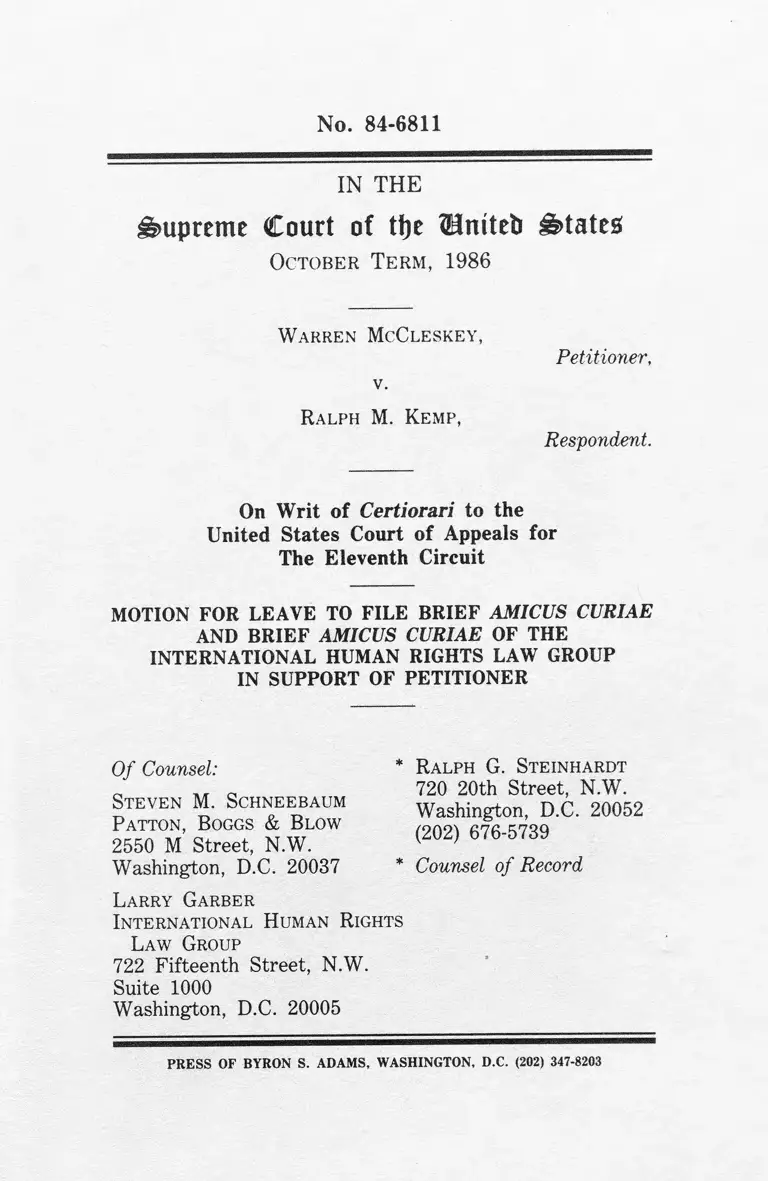
N o. 84-6811
IN THE
Supreme Court of tj)e ?Hruteb S ta tes
O c t o b e r T e r m , 1986
W arren McCleskey,
v.
Ralph M. Kemp,
Petitioner,
Respondent.
On Writ of Certiorari to the
United States Court of Appeals for
The Eleventh Circuit
MOTION FOR LEAVE TO FILE BRIEF AMICUS CURIAE
AND BRIEF AMICUS CURIAE OF THE
INTERNATIONAL HUMAN RIGHTS LAW GROUP
IN SUPPORT OF PETITIONER
Of Counsel:
Steven M. Schneebaum
Patton, Boggs & Blow
2550 M Street, N.W.
Washington, D.C. 20037
Larry Garber
International Human Rights
Law Group
722 Fifteenth Street, N.W.
Suite 1000
Washington, D.C. 20005
* Ralph G. Steinhardt
720 20th Street, N.W.
Washington, D.C. 20052
(202) 676-5739
* Counsel of Record
PRESS OF BYRON S. ADAMS, WASHINGTON, D.C. (202) 347-8203
MOTION OF THE
INTERNATIONAL HUMAN RIGHTS LAW GROUP
TO FILE BRIEF AMICUS CURIAE
IN SUPPORT OF PETITIONER
Pursuant to Rule 36.3 o f the Rules o f this Court,
the International Human Rights Law Group (the Law
Group) moves for leave to file the attached brief A m i
cus Curiae in support o f Petitioner. The Law Group
is a non-profit organization o f international lawyers
and scholars, which, through litigation, publication,
and other public activism, seeks to prom ote respect
for human rights norms in all nations, including the
United States.
By order dated October 7, 1985, this Court allowed
the Law Group to file a brief Amicus Curiae in sup
port o f the petition for a writ o f certiorari in this
case. Having argued in favor o f the propriety o f re
view, the Law Group now m oves to file a brief on
the merits. In particular, Amicus wishes to submit
for this Court’ s consideration the argument that the
en banc decision below approved an admittedly ra-
cially-discriminatory system for the imposition o f the
death penalty, which violates perem ptory norms of
international law. In failing to consider international
law as a relevant source o f the rule o f decision, the
Eleventh Circuit’ s opinion violates the Supremacy
Clause o f the Constitution as interpreted. A t a min
imum, the decisions o f this Court oblige the Eleventh
Circuit to consider international standards in deter
mining whether Petitioner’ s sentence was “ cruel and
unusual” within the meaning o f the Eighth Am end
ment.
Amicus also brings a unique institutional perspec
tive to these proceedings. Between 1980 and 1984,
2
the Law Group sought to litigate the very issues of
race discrimination raised in this case before the In
ter-Am erican Commission on Human Rights, an in
strumentality o f the Organization o f Am erican States.
On October 3, 1984, the Commission held the Law
Group’ s petition inadmissible on certain procedural
grounds and in particular on the representation o f
the United States that U.S. courts should be allowed
to consider the Law Group’ s data and argumentation.
Amicus files this brief in order to lay before this
Court these legal and empirical submissions.
Amicus is not aware o f any other presentation o f
these data or arguments to this Court. Counsel for
Petitioner has consented to the filing o f this brief.
Amicus sought the consent o f counsel for Respondent
who declined to provide it, necessitating this motion.
Respectfully submitted,
Ralph G. Steinhardt
720 20th Street, N .W .
W ashington, D.C. 20052
(202) 676-5739
Counsel o f Record for the
International Human Rights
Law Croup
August 21, 1986
1
TABLE OF CONTENTS
Table of A uthorities ..................................,.............. ii
Interest o f the Amicus ............................................. 1
Summary of Argument .............................. 2
Argument ...................................................... 4
I. DATA SUBMITTED TO THE INTER-AMER
ICAN COMMISSION ON HUMAN RIGHTS
ESTABLISH THAT THE DEATH PEN
ALTY IS IMPOSED IN A RACIALLY DIS
CRIMINATORY MANNER IN THE STATE
OF GEORGIA........................................................ 4
II. THE EXISTENCE OF RACIAL DISCRIMI
NATION AS ACKNOWLEDGED BY THE
COURT OF APPEALS FOR THE ELEV
ENTH CIRCUIT EN BANC VIOLATES A
PEREMPTORY NORM OF INTERNA
TIONAL LAW ..................................................... 8
III. THE ELEVENTH CIRCUIT WAS RE
QUIRED TO CONSTRUE THE GEORGIA
DEATH PENALTY STATUTE CONSIST
ENTLY WITH PERTINENT INTERNA
TIONAL LAW AND FAILED TO DO SO. . 12
Conclusion ....................................................................... 17
Page
11
TABLE OF AUTHORITIES
Cases: Page
Barcelona Traction Light and Power Co., Ltd., [1970]
I.C.J. Rep. 32 .... ................................................... 11
Blonder-Tongue Laboratories, Inc. v. University of
Illinois Foundation, 402 U.S. 313 (1971) ...... 4
Chisolm v. Georgia, 2 Da. 419 (1793) 13
Coker v. Georgia, 433 U.S. 584 (1977) 15
Cook v. United States, 488 U.S. 102 (1983) 15
Eddings v. Oklahoma, 455 U.S. 104 (1982) 4
Enmund v. Florida, 458 U.S. 782 (1982) .............. 16
Fernandez v. Wilkinson, 505 F. Supp. 787 (D. Kan.
1980), affd sub nom. Rodriguez-Fernandez v.
Wilkinson, 654 F.2d 1382 (10th Cir. 1981) ..... 14
Filartiga v. Pena-Irala, 630 F.2d 876 (2d Cir.
1980) 14
First National City Bank v. Banco Para el Com-
mercio Exterior de Cuba, 103 S.Ct. 2591
(1983) 13
Lauritzen v. Larsen, 345 U.S. 571 (1953) ............. 15
Legal Consequences for States of the Continued Pres
ence of South Africa in Namibia (South West
Africa) Notwithstanding Security Council Reso
lution 276, [1971] I.C.J. Rep. 57 .. ............ 11
McCleskey v. Kemp, 753 F.2d 877 (11th Cir. 1985)
(en banc) ................................................................ 3, 7, 8
McCulloch v. Sociedad Nacional de Marineros de
Honduras, 372 U.S. 10 (1963)............................... 15
Murray v. The Charming Betsy, 6 U.S. (2 Cranch)
64 (1804) ........................................................... . 15
The Nereide, 13 U.S. (9 Cranch) 388 (1815).............. 13
North Sea Continental Shelf Cases, [1969] I.C.J. Rep.
37 14
The Paquete Habana, 175 U.S. 677
(1900) ..................... ...... ......................... 3, 12, 14, 16
Ill
Procunier v. Navarette, 434 U.S. 555 (1978) ........ 4
Respublica v. DeLongchamps, 1 U.S. 119, 1 Dali. I l l
(O.&T. Pa. 1784) ................................................... 14
South West A frica Cases (Second Phase), [1966] I.C.J.
4 10
Spinkelink v. Wainwright, 578 F.2d 582 (5th Cir.
(1978), cert, denied, 404 U.S. 976 (1979) ....... 6
Talbot v. Seeman, 5 U.S. (1 Craneh) 1 (1801) ...... 15
Trop v. Dulles, 356 U.S. 86 (1958) ................... 3, 15, 16
Vance v. Terrazas, 444 U.S. 252 (1980) ................ 4
Village o f Arlington Heights v. Metropolitan Hous.
Dev. Corp., 429 U.S. 252 (1977) 17
Ware v. Hylton, 3 U.S. (3 Da.) 199 (1796) ............ 13
Weinberger v. Rossi, 456 U.S. 25 (1982) ............... 15
Wood v. Georgia, 450 U.S. 261 (1981) .................... 4
Treaties, Declarations, Statutes, and Regulations
American Convention on Human Rights, signed Nov.
22, 1969, OAS Official Records OEA/Ser. K/
XVI/i.i, Doc. 65, Rev. 1, Corr. 1 (Jan. 7,
1970) ......................................................................... 9
American Declaration on the Rights and Duties of
Man, O.A.S. Res. XXX, adopted by the Ninth
International Conference of American States,
held at Bogota, Colombia (1948), OEA/Ser. L ./
V/I. 4 Rev. (1965) ............................................... 10
Declaration of Social Progress and Development,
adopted Dec. 11, 1969, G.A.Res. 2542, 24 U.N.
GAOR, Supp. (No. 30) 49, U.N. Doc. A/7630
(1969) ........................................................................ 10
Table of Authorities Continued
P a g e
IV
Declaration on the Promotion Among Youth of the
Ideals of Peace, Mutual Respect and Under
standing Between Peoples, adopted Dec. 7, 1965,
G.A. Res. 2037, 20 U.N. GAOR, Supp. (No. 14)
40, U.N. Dec. A/6015 (1965) ............................. 10
The International Convention on the Elimination of
All Forms of Racial Discrimination, opened fo r
signature March 7, 1966, 660 U.N.T.S. 195 .. 9
International Covenant on Civil and Political Rights,
adopted Dec. 16, 1966, G.A. Res. 2200A, 21 U.N.
GAOR, Supp. (No. 16) ......................... . 9
International Covenant on Economic, Social, and Cul
tural Rights, adopted Dec. 16, 1966, G.A. Res.
2200A, 21 U.N. GAOR, Supp. (No. 16) ........... 9
Organization of American States Charter, signed
April 30, 1948, entered into force December 13,
1951, 2 U.S.T. 2394, T.I.A.S. No. 2361 ........ 9
United Nations Charter, signed June 26, 1945, en
tered into force October 24, 1945, 59 Stat. 1031,
T. S. No. 993 ........................ ................................. 9
United Nations Declaration on the Elimination of All
Forms of Racial Discrimination, adopted Nov.
20, 1963, G.A. Res. 1904, 18 U.N. GAOR Supp.
(No. 15) 35, 36, U.N. Doc. A/5515 (1963) ..... 10
Universal Declaration of Human Rights, G.A. Res.
217A (III), U.N. Doc. A/810 (1948) ................. 10
Vienna Convention on the Law of Treaties, adopted
May 22, 1969, entered into force, Jan. 17, 1980,
U. N. Doc. A/CONF. 39/27 (1969), reprinted in
63 AMER. J. INT’l L. 875 (1969), 8 INT’L LEG.
MAT. 679 (1969) ................................................... 8
Legislative Materials:
S. Exec. Doc. L., 92d Cong., 1st Sess. (1971) ...... 9
Miscellaneous:
Table of Authorities Continued
P a g e
V
Table of Authorities Continued
P a g e
American Law Institute, Restatement of
Foreign Relations Law of the United States
(Revised) (1986) ............................................... . 12, 13
Baldus, et al., Monitoring and Evaluating Contem
porary Death Sentencing Systems: Lessons From
Georgia, 18 U.C. DAVIS L. REV. 1375
(1985) ................................................... .................7
Barnett, Some Distribution Patterns for the Georgia
Death Sentence, 18 U.C. DAVIS L. REV. 1327
(1985) 7
Gross, Race and Death: The Judicial Evaluation of
Evidence of Discrimination In Capital Sentenc
ing, 18 U.C. DAVIS L. REV 1275 (1985) .... 7
Henkin, International Law as Law in the United
States, 82 MICH. L. REV. 1555 (1984) ......... 13
Lillich, “ The Role of Domestic Courts in Enforcing
International Human Rights Law,” Guide To In
ternational Human Rights Practice (1984) ..... 11
McDougall, Lasswell, & Chen, Human Rights and
World Public Order (1980)..................................... 11
McKean, Equality and Discrimination Under Inter
national Law (1983) ............................................ 11
Memorial of the United States, The Case Concerning
United States Diplomatic and Consular Staff in
Tehran (United States v. Iran), [1980] I.C.J.
Pleadings 181 (January 1980) ................ ....... . 10
Op. Att’y Gen. 27 (1972)............... .............................. . 13
Santa Cruz, Racial Discrimination, U.N. Doc. E/CN.
41 Sub. 2/307/Rev. 1, 28 (1971)............................ 10
Zeisel, Race Bias in the Administration of the Death
Penalty: The Florida Experience, 95 HARV. L.
REV. 456 (1981) ................................................... 7
IN THE
rnpreme Court of tf)e H m teti
October Term, 1986
>tatesf
No. 84-6811
W a r r e n M c C l e s k e y ,
v.
R a l p h M . K e m p ,
Petitioner,
Respondent.
On Writ Of Certorari to the
United States Court of Appeals
For the Eleventh Circuit
BRIEF AMICUS CURIAE OF THE
INTERNATIONAL HUMAN RIGHTS
LAW GROUP IN SUPPORT
OF PETITIONER
INTEREST OF AMICUS
The International Human Rights Law Group is a
non-profit organization of international lawyers and
scholars which seeks to promote the observance of
international human rights norms by providing legal
assistance and information to individuals and groups
on a pro bono basis; representing clients in interna
tional forums; and participating amicus curiae in U.S.
litigation involving international human rights norms.
2
The Law Group respectfully submits and intends to
demonstrate that this case requires consideration of
relevant human rights law.
The Law Group also has a unique and direct in
stitutional stake in the resolution o f this case. In 1980,
the Law Group petitioned the Inter-Am erican Com
mission on Human Rights, an instrumentality o f the
Organization o f Am erican States (the Commission), to
declare that capital sentences in the United States
are imposed in a racially discriminatory manner. In
particular, the Law Group argued that the death pen
alty is imposed disproportionately on those defendants
the victims o f whose crimes are white and that such
discrimination based upon the race o f the victim was
in violation o f treaties to which the United States is
a party. A fter receiving statistical evidence similar to
that presented below by Petitioner herein, the Com
mission held the Law Group’s petition inadmissible on
procedural grounds, and effectively deferred the Law
Group’ s international claims pending an authoritative
disposition o f the issue by Am erican courts.
The Law Group submits this brief in order to lay
before this Court the race discrimination data sub
mitted to the Commission, and to demonstrate that
the en banc court below failed to construe the Georgia
death penalty statute consistently with binding inter
national law, thereby com mitting reversible error.
SUMMARY OF ARGUMENT
With remarkable candor, the en banc Court of
Appeals for the Eleventh Circuit accepted the factual
findings o f Petitioner’ s studies, namely that no factors
other than race could account for the marked increase
in capital sentences am ong those defendants whose
3
victims were white. Indeed, the court below expressly
“ assumfed] the validity o f the research” and acknowl
edged “ that it proves what it claims to prove.”
McCleskey v. Kemp, 753 F.2d 877, 886 (11th Cir. 1985)
(en banc). The conclusion as a matter o f law that this
evidence established no violation o f the Eighth and
Fourteenth Amendments to the U.S. Constitution does
not exhaust the legal analysis the court was required
to undertake. In particular, the en banc court failed
to consider international law as a pertinent source o f
the rule o f decision. Under The Paquete Habana, 175
U.S. 677 (1900) and its progeny, the Georgia death
penalty statute should have been considered in light
o f the perem ptory norm o f international law con
demning racial discrimination—a customary norm to
which the United States is bound beyond peradven-
ture. The failure to consider an applicable source or
guarantor o f Petitioner’s rights is reversible error. At
a minimum, the case should be remanded to the E lev
enth Circuit Court o f Appeals for its analysis o f the
limits imposed by this international obligation on the
discretion o f State officials to administer the death
penalty.
In addition, under Prop v. Dulles, 356 U.S. 86 (1958)
and its progeny, the Eleventh Circuit should have
consulted international standards in determining the
contours o f the Eighth Am endm ent’s ban on cruel
and unusual punishment.
Confining itself to the argument that each o f Ques
tions Presented 1 through 5 should have been con
sidered in light o f applicable international law,1
1 Although the international issues raised by Amicus were not
presented to the courts below, this Court has established that
4
Amicus offers no opinion as to the circuit court’ s
disposition o f purely dom estic legal issues.
ARGUMENT
I. DATA SUBMITTED TO THE INTER-AMERICAN
COMMISSION ON HUMAN RIGHTS AND TO THE
COURT BELOW ESTABLISH THAT THE DEATH
PENALTY IS IMPOSED IN A RACIALLY DIS
CRIMINATORY MANNER IN THE STATE OF
GEORGIA.
On August 6, 1980, Amicus submitted a petition to
the Inter-Am erican Commission on Human Rights, an
instrumentality o f the Organization o f Am erican
States, alleging that the United States imposed the
death penalty in a racially discriminatory manner. The
data submitted to the Commission established a pro
nounced pattern o f racially-based disparities in death
sentencing based on the race o f the victim. In par
ticular, the evidence showed that a person convicted
in the State o f Florida o f m urdering a white person
was ten times more likely to receive the death penalty
than one convicted o f m urdering a black person.2 In
it has the power to consider relevant issues raised in a case “ in
the interest of justice,” irrespective of whether those issues were
previously raised, Wood v. Georgia, 450 U.S. 251, 265 n. 5
(1981). The exercise of that power is especially appropriate in
capital cases. Eddings v. Oklahoma, 455 U. S. 104 (1982). See
also, Vance v. Terrazas, 444 U.S. 252 (1980); Procunier v. Na
varette, 434 U.S. 555, 559-60 n. 6 (1978); Blonder-Tongue Lab
oratories, Inc. v. University of Illinois Foundation, 402 U.S.
313, 320-21 n. 6 (1971).
2 The data are described in the affidavit of Professor William
J. Bowers, which is attached hereto in the Appendix. The Florida
data appear on pp. 2a and 5a.
5
Texas, the ratio was eighteen to one.3 In Georgia,
where this litigation arose, it was twelve to one, a
figure which reinforces the conclusions of the study
submitted by Petitioner herein. More specifically, the
Law Group’s statistician, Professor William Bowers
of Northeastern University, produced the following
tabulation:
PROBABILITY OF RECEIVING THE DEATH
SENTENCE FOR CRIMINAL HOMICIDE BY RACE
OF OFFENDER AND VICTIM IN GEORGIA FROM
THE EFFECTIVE DATE OF THE POST-FURMAN
STATUTE THROUGH 1977*
Estimated Persons Probability
Number of Sentenced of a Death
Race of Offender Offendersb to Death Sentence
White 1082 41 .038
Black 2716 49 .018
Race of Victim
White 1265 76 .060
Black 2529 25 .005
Offender/Victim
Racial Combinations
Black Kills White 258 37 .143
White Kills White 1006 39 .039
Black Kills Black 2458 12 .005
White Kills Black 71 2 .028
All Offenders 3798 90 .024
a Data Sources: Supplementary Homicide Reports on criminal horn-
icide data from April 1973 through December 1976, supplied by the
Uniform Crime Reporting Program, Federal Bureau of Investigation,
United States Department of Justice, Washington, D.C.; (2) Supple
mentary Homicide Reports on criminal homicide data for 1977, supplied
3 Id., at pp. 4a and 7a.
6
by the Criminal Activity Reporting Unit, Georgia Bureau of Investi
gation, Georgia Crime Information Center, Atlanta, Georgia; (3) Vital
Statistics tabulations on willful homicide from April 1973 through De
cember 1977, supplied by the Office of Health Services Research and
Statistics, Division of Physical Health, Atlanta, Georgia; (4) Persons
sentenced to death from April 1975 through December 1977, supplied
by Georgia Committee Against the Dealth Penalty, Atlanta, Georgia.
b The estimated number of offenders for a given category is obtained
by multiplying the reported number of offenders in that category for
the years 1976, 1977 (sources: 1, 2) by a victim-based adjustment factor
to correct for undercoverage. The adjustment factor 4.453 equals the
number o f homicide victims from April 1973 through December 1977
(source: 3) divided by the number of homicide victims in the years 1976,
1977 (sources: 1,2).
Thus, although black defendants on average were
less likely than white defendants to receive the death
sentence (.018 versus .038), black defendants who
killed white people were more likely than any other
group to receive that sentence by several orders o f
magnitude. And when the data are controlled for
defendant’ s race, as noted, the defendant o f either
race who kills a white person is twelve times more
likely to be sentenced to death than the defendant o f
either race who kills a black person (.060 versus .005).
In the proceedings before the Inter-Am erican Com
mission, the United States never challenged the va
lidity o f these data or the statistical methods employed
to produce them. Rather, the United States opposed
the petition almost exclusively on the grounds that
dom estic remedies for the redress o f such discrimi
nation had not been exhausted, despite the denial o f
certiorari in Spinkelink v. Wainwright, 578 F.2d 582
(5th Cir. 1978), cert, denied, 404 U.S. 976 (1979). The
United States assured the Commission that U.S.
courts, including this Court, remained receptive to
evidence dem onstrating the fact and extent o f dis
crimination, and that they would respond fully and
7
fairly to any such demonstration. Opposition o f the
United States, Case 7465, Inter-American Commis
sion on Human Rights (June 16, 1981). In light o f
this representation and on other procedural grounds,
the Commission denied the petition on October 3,
1984, noting that the statistical evidence submitted
was more appropriately directed to a dom estic court
in each individual case.
The Law Group’ s data, unchallenged and stark as
they are standing alone, becom e especially compelling
in light o f other consistent and sophisticated dem
onstrations o f the same phenomenon, including the
Baldus study in the instant litigation and multiple
reports in the scholarly literature. See e.g., Zeisel,
Race Bias in the Administration o f the Death Penalty:
The Florida Experience, 95 H ARV . L. R E V / 456
(1981); Gross, Race and Death: The Judicial Evalu
ation o f Evidence o f Discrimination in Capital Sent
encing, 18 U.C. DAVIS L. REV. 1275 (1985); Barnett,
Some Distribution Patterns fo r the Georgia Death Sen
tence, 18 U.C. D AVIS L. RE V . 1327 (1985); Baldus,
et a l, Monitoring and Evaluating Contemporary
Death Sentencing Systems: Lessons From Georgia, 18
U.C. D AVIS L. REV. 1375 (1985). To Am icus’s
knowledge, the only sustained attack on any o f these
studies is the en banc court’s treatment o f the Baldus
study in the decision below. Though lengthy, that at
tack suffers from inconsistency4 and an apparent un
4 Despite its apparent rejection of the Baldus data in parts of
its opinion, the en banc court was also willing to “ assume the
validity of the research.” 753 F.2d at 886, acknowledging “ that
it proves what it claims to prove.” Id.
fam iliarity with rudim entary m athem atics.5 The
evidence remains persuasive that there exists a
marked, significant disparity in the susceptibility o f
certain categories o f defendants to the ultimate sanc
tion and that that disparity is determined by race.
The values placed on white and black lives in Georgia
are demonstrably unequal.
II. THE EXISTENCE OF RACIAL DISCRIMINATION
AS ACKNOWLEDGED BY THE COURT OF
APPEALS FOR THE ELEVENTH CIRCUIT EN
BANC VIOLATES A PEREMPTORY NORM OF IN
TERNATIONAL LAW.
The right to be free from official governm ent-spon
sored discrimination on the basis o f race is so uni
versally accepted by nations as to constitute a
perem ptory norm o f international law.6 It is included
5 For example, the Eleventh Circuit focused on the “ .06” dis
parity by race of victim in overall death sentencing rates, as
reported by Baldus. It consistently viewed this as a six percent
disparity, 753 F.2d at 896, 899. But the figure is in fact a six
;percentage point disparity, raising the overall death sentence rate
from .05 to .11, a percentage increase of 120%, not 6%.
Petitioner and other Amici offer a thorough critique of the
Eleventh Circuit’s statistical acumen. See Motion for Leave To
File Brief Amici Curiae and Brief Amici Curiae For Dr. Peter
W. Sperlich, Dr. Marvin E. Wolfgang, Professor Hans Zeisel
and Professor Franklin E. Zimring in Support of the Petition
for Writ of Certiorari, filed herein on June 27, 1985.
6 A peremptory norm of international law is a “ norm accepted
and recognized by the international community of states as a
whole as a norm from which no derogation is permitted and
which can be modified only by a subsequent norm of general
international law having the same character.” Vienna Conven
tion on the Law of Treaties, adopted May 22, 1969, entered into
force, January 17, 1980, U.N. Doc. A/Conf. 39/27 (1969), re-
9
in such fundamental texts as the Charter of the
United Nations7, and the Charter of the Organization
of American States,8 both of which are treaties ra
tified by and binding upon the United States. Similar
prohibitions are found in every comprehensive inter
national treaty pertaining to human rights9 and in
printed in 63 AMERICAN J. INT’L L. 875 (1969), 8 INT’L
LEG. MAT. 679 (1969). Although the Vienna Convention has
been signed but not ratified by the United States, the Depart
ment of State, in submitting the Convention to the Senate, stated
that it “ is already recognized as the authoritative guide to cur
rent treaty law and practice.” S. Exec. Doc. L., 92d Cong., 1st
Sess. (1971) at 1.
7 U.N. Charter, signed June 26, 1945, entered into force Oc
tober 24, 1945, 59 Stat. 1031, T.S. No. 933, at Article 55(c).
8 O.A.S. Charter, signed April 30, 1948, entered into force
December 13, 1951, 2 U.S.T. 2394, T.I.A.S. No. 2361, at Article
3(j).
9 International Convenant on Civil and Political Rights, adopted
December 16, 1966, G.A. Res. 2200A, 21 U.N. GAOR, Supp.
(No. 16), Articles 2(a), 13, 26; International Covenant on Eco
nomic, Social, and Cultural Rights; adopted December 16, 1966,
G.A. Res. 2200A, 21 U.N. GAOR, Supp. (No. 16), Article 2(2);
American Convention on Human Rights, signed Nov. 22, 1969,
OAS Official Records OEA/Ser. K/XVI/i.i, Doc. 65, Rev. 1, Corr.
1 (Jan. 7, 1970), Articles 22(7) 22(9), 24; The International Con
vention on the Elimination of All Forms of Racial Discrimination,
opened for signature March 7, 1966, 660 U.N.T.S. 195, Articles
1, 2. The United States has signed but not yet ratified each of
these treaties. Under Article 18 of the Vienna Convention on
the Law of Treaties, supra, the United States is obliged not to
defeat the object and purpose of these conventions prior to their
entry into force. In addition, those international agreements to
which the United States is not a party may nevertheless create
or evidence a customary norm which is equally authoritative and
equally binding. North Sea Continental Shelf Cases, [1969] I.C.J.
Rep. 37. Other treaties which prohibit racial discrimination are
10
numerous international declarations and resolutions.* 10
The m ost authoritative o f these—the Universal D ec
laration o f Human Rights11—sets forth in various
form s a basic guarantee o f rights and freedom s “ with
out distinction o f any kind, such as race . . . [or] na
tional or social origin,” id., at Articles 2, 7, and 14.
In international adjudication, the United States itself
has invoked those provisions as evidence o f the core
human rights protected by international law .12 The
renunciation o f official racial discrimination is re
flected as well in the laws and constitutions o f a vast
majority o f states,13 and is conceived as the center
catalogued in Appendix B to Amicus' Brief in Support of Petition
for Certiorari, filed herein on July 8, 1985, at 8a-9a.
10 United Nations Declaration on the Elimination of All Forms
of Racial Discrimination, adopted Nov. 20, 1963, G.A. Res. 1904,
18 U.N. GAOR Supp. (no. 15) 35, 36, U.N. Doc. A/5515 (1963);
American Declaration of the Rights and Duties of Man, O.A.S.
Res. XXX, adopted by the Ninth International Conference of
American States, held at Bogota, Columbia (1948), OEA/SER.L./
V/I. 4 Rev. (1965), Articles II, XXCII; Declaration of Social
Progress and Development, adopted Dec. 11, 1969, G.A. Res.
2542, 24 U.N. GAOR, Supp. (No. 30) 49, U.N. Doc. A/7630
(1969), Articles 1, 2; Declaration on the Promotion Among Youth
of the Ideals of Peace, Mutual Respect and Understanding Be
tween Peoples, adopted Dec. 7, 1965, G.A. Res. 2037, 20 U.N.
GAOR, Supp. (No. 14) 40, U.N. Doc. A/6015 (1965), Principles
1, 3.
11 G.A. Res. 217A(III), U.N. Doc. A/810 (1948).
12 Memorial of the United States, The Case Concerning United
States Diplomatic and Consular Staff in Tehran (United States
v. Iran), [1980] I.C.J. Pleadings 181, n. 3 (January 1980).
13 Santa Cruz, Racial Discrimination, U.N. Doc. E/CN. 41
Sub. 2/307/Rev. 1, 28 (1971). See South West Africa Cases (Sec
ond Phase), [1966] I.C.J. 4, 299 (Tanaka, J., dissenting).
11
piece o f contem porary human rights norms in the
writings o f international law scholars.14
Recognizing this consistent and universal condem
nation o f racial discrimination, the International Court
o f Justice has concluded that “ the principles and rules
concerning the basic rights o f the human person, in
cluding protection from . . . racial discrimination,”
constitute an international obligation o f all states.
Case Concerning The Barcelona Traction Light and
Power Co., Ltd., [1970] I.C.J. Rep. 32. The Interna
tional Court has also concluded that
to establish . . . and to enforce distinctions,
exclusions, restrictions, and limitations exclu
sively based on grounds o f race, colour, de
scent or national or ethnic origin . . .
constitutes a denial o f fundamental human
rights [and] is a flagrant violation o f the pur
poses and principles o f the [U.N.] Charter.
Legal Consequences fo r States o f the Continued Pres
ence o f South A frica in Namibia (South West Africa)
Notwithstanding Security Council Resolution 276,
[1971] I.C.J. Rep. 57. The cumulative power o f this
international consensus has led the Am erican Law
Institute to include “ systematic racial discrimination”
in its authoritative catalogue o f fundamental viola
tions o f customary international law. Am erican Law
14 See e.g., Lillich, “ The Role of Domestic Courts in Enforcing
International Human Rights Law,” International Human Rights
Practice (1984); McDougall, Lasswell & Chen, Human Rights and
World Public Order 581-611 (1980). See generally, McKean,
Equality and Discrimination Under International Law (1983);
Henkin, The Rights of Man Today (1978).
12
Institute, Restatement o f Foreign Relations Law o f the
United States (Revised) § 702(f) (1986).15 16
Thus, the prohibition against governm ent-sponsored
racial discrimination is firmly grounded in all o f the
traditional sources o f custom ary international law set
out by Mr. Justice Gray in The Paquete Habana, 175
U.S. 677, 700 (1900). That norm, stated in com pre
hensive and unqualified language, has never been lim
ited in any authoritative way to demand some
incontrovertible showing o f individualized intent. Sim
ilarly, apparently unlike the Eighth and ̂ Fourteenth
Am endm ents as read by the Eleventh Circuit, it ad
mits no defense o f degree. Although international law,
like dom estic law, will not redress trifles, racial dis
crimination o f the type admittedly and repeatedly
dem onstrated in this case plainly falls within the cus
tom ary international prohibition.
ITT THE ELEVENTH CIRCUIT WAS REQUIRED TO
’ CONSTRUE THE GEORGIA DEATH PENALTY
STATUTE CONSISTENTLY WITH PERTINENT
INTERNATIONAL LAW AND FAILED TO DO SO.
It is axiomatic that international law is part o f the
law o f the United States and that, under the Su
prem acy Clause o f the U.S. Constitution1̂ as inter
preted, it “ must be ascertained and administered by
the courts o f justice o f appropriate jurisdiction, as
often as questions o f right depending upon it are duly
presented for their determ ination.” The Paquete Ha
bana, 175 U.S. 677, 700 (1900). This basic principle
15 The ALI adopted the revised Restatement of Foreign Re
lations Law at its meeting in Washington, D.C., on May 14-15.
1986.
16 U.S. Const., Art. VI, Sec. 2.
13
has been accepted by this Court from the earliest days
o f the Republic, Chisolm v. Georgia, 2 Da. 419, 474
(1793) (“ Prior . . . to that period [the date o f the
Constitution], the United States had, by taking a place
am ong the nations o f the earth, becom e amenable to
the law o f nations” ); Ware v. Hylton, 3 U.S. (3 Da.)
199, 281 (1796); The Nereide, 13 U.S. (9 Cranch) 388,
423 (1815). It has received fresh confirmation as re
cently as 1983 in Justice O’Connor’s opinion for the
Court in F irst National City Bank v. Banco Para el
Commercio Exterior de Cuba, 103 S.Ct. 2591, 2598
(1983). The executive branch has reached the same
conclusion. See e.g., Op. Atty. Gen. 27 (1972): “ The
law o f nations, although not specially adopted by the
Constitution or any municipal act, is essentially part
o f the law o f the land.” 17
The “ law o f nations” which the courts are directed
to apply includes treaties to which the U.S. is a party,
as well as customary international law or “ interna
tional common law ,” which arises out o f the practice
o f states acting in a particular manner because they
feel themselves legally bound to do so. This state
practice may be deduced from treaties, national con
stitutions, declarations and resolutions o f intergov
ernmental bodies, public pronouncements by heads o f
state, and empirical evidence o f the extent to which
17 See generally American Law Institute, Restatement (Revised)
of the Foreign Relations Law of the United States, § 131, Com
ment D (“ The proposition that international law and agreements
are law in the United States is addressed mainly to the courts.
They are to apply international law or agreements as if their
provisions were enacted by Congress.” ); Henkin, International
Law as Law in the United States, 82 MICH. L. REV. 1555,
1560 (1984).
14
custom ary law rules are observed. See North Sea Con
tinental Shelf Cases, [1969] LC.J. Rep. 37. Unlike
treaties which specify obligations only for their sig
natories, custom ary international is binding on all na
tions by virtue o f membership in the international
community. Consent is unnecessary, and ad hoc ob
jection is unavailing.
As a matter o f United States law, custom ary inter
national law also creates enforceable rights and ob
ligations for individuals. Thus, in The Paquete Ha-
bana, supra, this Court held that the customary
international law o f prize in time o f war created rights
in an individual whose boat had been seized in vio
lation o f those norms. See also Respublica v. De-
Long champs, 1 U.S. 119, 1 Dali. I l l (0 . & T. Pa.
1784); Filartiga v. Pena-Irala, 630 F.2d 876 (2d Cir.
1980) ; Fernandez v. Wilkinson, 505 F. Supp. 787 (D.
Kan. 1980), affd on other grounds sub nom., Rodri-
guez-Fernandez v. Wilkinson, 654 F.2d 1382 (10th Cir.
1981) . As The Paquete Habana teaches, when juris
diction is clear, custom ary rights by their nature are
enforceable by individuals in U.S. courts.18 Any other
disposition would erect the anomoly o f a right without
a remedy. Thus, in construing the Georgia death pen
alty statute and Petitioner’ s sentence thereunder, the
Eleventh Circuit Court o f Appeals was obliged to
“ ascertainQ and administer^” international law, in
sofar as “ questions o f right” depend upon it. 175 U.S.
at 700.
18 The self-execution doctrine, generally critical in treaty anal
yses, is irrelevant—indeed meaningless—in the context of cus
tomary international law, the intent of whose draftsmen
necessarily defies discovery.
15
The argument here is not that international law in
any sense displaces dom estic law. It is rather that
statutes enacted by Congress or the state legislatures
“ ought never to be construed to violate the law o f
nations, if any other possible construction rem ains.”
Weinberger v. Rossi, 456 U.S. 25, 33 (1982), quoting
M urray v. The Charming Betsy, 6 U.S. (2 Cranch)
64, 118 (1804). See also, Talbot v. Seeman, 5 U.S. (1
Cranch) 1, 43 (1801); Cook v. United States, 288 U.S.
102 (1983); Lauritzen v. Larsen, 345 U.S. 571, 578
(1953); McCulloch v. Sociedad Nacional de Marineros
de Honduras, 372 U.S. 10, 21 (1963). Thus, for ex
ample, the State o f Georgia could not by statute sus
pend the customary laws o f war or diplomatic
immunity within its territory. So too is its imple
mentation o f racial discrimination in the imposition
o f capital punishment a forbidden departure from
binding customary international norms.
A t a minimum, this Court should reverse the de
cision below on the ground that the Eighth Am end
ment to the Constitution, as interpreted in light o f
international norms, prohibits death sentences tainted
by racial discrimination. See Rodriguez-Fernandez, su
pra, 654 F.2d at 1388. In Trop v. Dulles, 356 U.S.
86, 101 (1958), this Court emphasized that the Eighth
Am endm ent “ must derive its meaning from evolving
standards o f decency that mark the progress o f a
maturing society.” In determining the content o f these
“ evolving standards,” the Court noted that the vast
majority o f nations did not employ denaturalization
as a punishment for desertion and concluded that such
punishment would be “ cruel and unusual” within the
meaning o f the Eighth Amendment. 356 U.S. at 102-
103. Similarly, in Coker v. Georgia, 433 U.S. 584
16
(1977), this Court held that the imposition o f the death
penalty for the rape o f an adult woman was “ cruel
and unusual,” referring explicitly to international
standards. 433 U.S. at 596, n. 10. The Court recently
turned again to the “ climate o f international opinion”
in determining that the death sentence was cruel and
unusual when imposed on a defendant who had not
intended to kill his victim. Enmund v. Florida, 458
U.S. 782, 796 n. 22 (1982).
Plainly then, customary international standards are
entitled to persuasive weight under the decisions of
this Court. As demonstrated above, there is no cus
tom ary norm more powerful or well-established than
the prohibition o f governm ent-sponsored racial dis
crimination. Under Trop, Coker, and Enmund, there
fore, petitioner’ s Eighth Am endm ent claim should
have been assessed in this light.
Obviously, the en banc court below made no attempt
to discharge its burden under either The Paquete Ha-
bana to apply international law or Trop and its prog
eny to consult international standards in determining
the “ evolving standards o f decency” protected by the
Eighth Amendment. The en banc court did not ad
dress the relevant norms o f international law as in
corporated into federal common law, nor did it address
whether the racial disparities alleged by Petitioner fall
within the scope o f the international prohibition. In
stead, on the issue o f discrimination, the en banc court
o f appeals contented itself with considering only the
contours o f dom estic law. The court’s apparent ne
glect o f the perem ptory norm o f international law
prohibiting racial discrimination cannot be squared
with this Court’ s consistent adherence to the law of
nations as providing the rule o f decision, whenever a
17
litigant’ s rights may be framed in its terms. In short,
the en banc court’s failure to assess international law
issues raised by its acceptance that the showing o f
discrimination was valid constitutes error which should
be reversed by this Court.
CONCLUSION
“ Sometimes a clear pattern, unexplainable on
grounds other than race, em erges from the effect o f
the state action even when the governing legislation
appears neutral on its fa ce .” Village o f Arlington
Heights v. Metropolitan Hous. Dev. Corp., 429 U.S.
252, 266 (1977). This is such a case. Data collected
by Petitioner and by Amicus in parallel international
proceedings demonstrate that unequal sanctions are
attached to the taking o f white and black lives in the
State o f Georgia. Although the structure and precise
results o f these studies may vary, the conclusion does
not. That the court below was willing to concede the
discrim inatory im pact makes its affirm ation o f
Petitioner’s sentence all the more erroneous. In ad
dition, the en banc court’ s failure to consider the in
ternational law issues relevant to this case violates
the Supremacy Clause o f the Constitution as inter
preted, and ignores the decisions o f this Court which
establish the fundamental role o f international law in
the law o f the United States and its persuasive role
in interpreting the Eighth Amendment.
18
For all o f these reasons, Amicus respectfully urges
this Court to reverse the decision o f the court o f
appeals below.
Respectfully submitted,
O f Counsel:
Steven M. Schneebaum
Patton, Boggs & Blow
2550 M Street, N .W .
Washington, D.C. 20037
* Ralph G. Steinhardt
720 20th Street, N .W .
W ashington, D.C. 20052
(202) 676-5739
* Counsel o f Record
Larry Garber
International Human Rights
Law Group
722 Fifteenth Street, N .W .
Suite 1000
W ashington, D.C. 20005
APPENDIX
la
APPENDIX
AFFIDAVIT OF PROFESSOR WILLIAM BOWERS
I am a sociologist with particular training in statistics and
computer applications to sociology. I graduated from Wash
ington and Lee University in 1957 and received my doctorate in
sociology in 1966 from Columbia University. I am presently a
professor of sociology at Northeastern University, Boston,
Massachusetts, and Director of that University’s Center for
Applied Social Research.
Since approximately 1972, I have been engaged in research,
study, and writing on the use of the death penalty in the United
States. I am the author of numerous articles on the subject and
of the book Executions in America, published in 1974.
Together with the Assistant Director here at the Center,
Glenn L. Pierce, and others, I have supplied the figures and
statistics on race-victim death sentencing disparaties con
tained in appendices A and B of this complaint. These figures
are accurate to the best of our abilities and reflect sustained
research and the use of widely-accepted statistical methods.
I believe, on the basis of my research and analysis, that the
broad pattern of race-victim death sentencing disparities com
plained of in the foregoing document remain unremedied by
state or federal authorities and therefore continue today.
(signed) William Bowers___________
Professor William Bowers
SS: Commonwealth of Massachusetts
County of Suffolk
Subscribed and sworn to before me this 11th day of April,
1980.
(signed) Philip C. Boyd
Notary Public
My Commission Expires:
Nov. 28, 1980
SEAL
2a
FLORIDA
PROBABILITY OF RECEIVING THE DEATH
SENTENCE FOR CRIMINAL HOMICIDE BY RACE
OF OFFENDER AND VICTIM IN FLORIDA FROM
THE EFFECTIVE DATE OF THE POST-FURMAN
STATUTE THROUGH 1977
Estimated Persons Probability
Number of Sentenced of a Death
Race of Offender Offenders’1 to Death Sentence
White 2265 72 .032'
Black 2606 61 .023
Race of Victim
White 2439 122 .050
Black 2432 11 .005
Offender [Victim
Racial Combinations
Black Kills White 286 48 .168
White Kills White 2146 72 .034
Black Kills Black 2320 11 .005
White Kills Black 111 0 .000
All Offenders 4871 133 .027
Data Sources: (1) Supplementary Homicide Reports on criminal homicide
data from January 1973 through December 1976, supplied by the Uniform
Crime Reporting Program, Federal Bureau of Investigation, United States
Department of Justice, Washington, D.C.; (2) Supplementary Homicide
Reports on criminal homicide data for 1977, supplied by the Uniform Crime
Reports Program, Department of Law Enforcement, Tallahassee, Florida;
(3) persons sentenced to death from January 1973 through December 1977,
supplied by Citizens Against the Death Penalty, Jacksonville, Florida.
aThe estimated number of offenders for a given category is obtained by
multiplying the reported number of offenders in that category for the years
1976, 1977 (sources: 1, 2) by victim-based adjustment factor to correct for
undercoverage. The adjustment factor 3.484 equals the number of homicide
victims from January 1973 through December 1977 (sources: 1, 2) divided by
the number of homicide victims in the years 1976, 1977 (sources: 1, 2).
3a
GEORGIA
PROBABILITY OF RECEIVING THE DEATH
SENTENCE FOR CRIMINAL HOMICIDE BY RACE
OF OFFENDER AND VICTIM IN GEORGIA FROM
THE EFFECTIVE DATE OF THE POST-FLYMAN
STATUTE THROUGH 1977
Estimated Persons Probability
Number of Sentenced of a Death
Race of Offender Offenders'1 to Death Sentence
White 1082 41 .038
Black 2716 49 .018
Race of Victim,
White 1265 76 .060
Black 2529 14 .005
Offender [Victim
Racial Combinations
Black Kills White 258 37 .143
White Kills White 1006 39 .039
Black Kills Black 2458 12 .005
White Kills Black 71 2 .028
All Offenders 3798 90 .024
Data Sources: (1) Supplementary Homicide Reports on criminal homicide
data from April 1973 through December 1976, supplied by the Uniform
Crime Reporting Program, Federal Bureau of Investigation, United States
Department of Justice, Washington, D.C.; (2) Supplementary Homicide
Reports on criminal homicide data for 1977, supplied by the Criminal Ac
tivity Reporting Unit, Georgia Bureau of Investigation, Georgia Crime In
formation Center, Atlanta, Georgia; (3) Vital Statistics tabulations on willful
homicides from April 1973 through December 1977, supplied by the Office of
Health Services Research and Statistics, Division of Physical Health, Atlan
ta, Georgia; (4) Persons sentenced to death from April 1975 through De
cember 1977, supplied by Georgia Committee Against the Death Penalty,
Atlanta, Georgia.
aThe estimated number of offenders for a given category is obtained by
multiplying the reported number of offenders in that category for the years
1976, 1977 (sources: 1, 2) by a victim-based adjustment factor to correct for
under cover age. The adjustment factor 4.453 equals the number of homicide
victims from April 1973 through December 1977 (source: 3) divided by the
number of homicide victims in the years 1976, 1977 (sources: 1, 2).
4a
TEXAS
PROBABILITY OF RECEIVING THE DEATH
SENTENCE FOR CRIMINAL HOMICIDE BY RACE
OF OFFENDER AND VICTIM IN TEXAS FROM THE
EFFECTIVE DATE OF THE POST-FURMAN
STATUTE THROUGH 1977
Estimated Persons Probability
Race of Offender
Number of
Offendersa
Sentenced
to Death
of a Death
Sentence
White 3771 38 .010
Black 2940 29 .010
Race of Victim
White 3964 71 .018
Black 2740 2 .001
Offender/Victim
Racial Combinations
Black Kills White 344 27 .078
White Kills White 3616 37 .010
Black Kills Black 2597 2 .007
White Kills Black 143 0 .000
All Offenders 6711 73 .011
Data Sources: (1) Supplementary Homicide Reports on criminal homicide
data from January 1974 through December 1976, supplied by the Uniform
Crime Reporting Program, Federal Bureau of Investigation, United States
Department of Justice, Washington, D.C.; (2) Supplementary Homicide
Reports on criminal homicide data for 1977, supplied by the Uniform Crime
Reporting Bureau, Texas Department of Public Safety, Austin, Texas; (3)
Vital Statistics records on willful homicides from January 1974 through
December 1977, supplied by the Bureau of Vital Statistics, Texas Depart
ment of Health, Austin, Texas; (4) persons sentenced to death from January
1974 through December 1977, supplied by the Office of Court Administration,
The Supreme Court of Texas, Austin, Texas.
“The estimated number of offenders for a given category is obtained by
multiplying the reported number of offenders in that category for the years
1976, 1977 (sources: 1, 2) by a victim-based adjustment factor to correct for
undercoverage. The adjustment factor 2.473 equals the number of homicide
victims from January 1974 through December 1977 (source: 3) divided by the
number of homicide victims in the years 1976, 1977 (sources: 1, 2).
FLORIDA
PROBABILITY OF RECEIVING THE DEATH
SENTENCE FOR FELONY TYPE MURDER BY RACE
OF OFFENDER AND VICTIM IN FLORIDA FROM
THE EFFECTIVE DATE OF THE POST-FURMAN
STATUTE THROUGH 1977
Estimated Persons Probability
Number of Sentenced of a Death
Race of Offender Offendersa to Death Sentence
White 307 54 .176
Black 251 50 .199
Race of Victim
White 432 97 .224
Black 122 7 .057
Offender/Victim
Racial Combinations
Black Kills White 136 41 .301
White Kills White 296 54 .182
Black Kills Black 115 7 .061
White Kills Black 7 0 .000
All Offenders 558 104 .186
Data Sources-. (1) Supplementary Homicide Reports on criminal homicide
data from January 1973 through December 1976, supplied by the Uniform
Crime Reporting Program, Federal Bureau of Investigation, United States
Department of Justice, Washington, D.C.; (2) Supplementary Homicide
Reports on criminal homicide data for 1977, supplied by the Uniform Crime
Reports Program, Department of Law Enforcement, Tallahassee, Florida;
(3) persons sentenced to death from January 1973 through December 1977,
supplied by Citizens Against the Death Penalty, Jacksonville, Florida.
“The estimated number of offenders for a given category is obtained by
multiplying the reported number of offenders in that category for the years
1976, 1977 (sources: 1, 2) by victim-based adjustment factor to correct for
undercoverage. The adjustment factor 3.484 equals the number of homicide
victims from January 1973 through December 1977 (sources: 1, 2) divided by
the number of homicide victims in the years 1976, 1977 (sources: 1, 2).
6a
GEORGIA
PROBABILITY OF RECEIVING THE DEATH
SENTENCE FOR FELONY-TYPE MURDER BY RACE
OF OFFENDER AND VICTIM IN GEORGIA FROM
THE EFFECTIVE DATE OF THE POST-FURMAN
STATUTE THROUGH 1977
Estimated Persons Probability
Number of Sentenced of a Death
Race of Offender Offendersa to Death Sentence
White 196 37 .189
Black 338 42 .124
Race of Victim
White 316 69 .218
Black 218 10 .046
Offender [Victim
Racial Combinations
Black Kills White 134 34 .254
White Kills WLite 183 35 .191
Black Kills Black ' 205 8 .039
White Kills Black 13 2 .154
All Offenders 534 79 .148
Data Sources: (1) Supplementary Homicide Reports on criminal homicide
data from April 1973 through December 1976, supplied by the Uniform
Crime Reporting Program, Federal Bureau of Investigation, United States
Department of Justice, Washington, D.C.; (2) Supplementary Homicide
Reports on criminal homicide data for 1977, supplied by the Criminal Ac
tivity Reporting Unit, Georgia Bureau of Investigation, Georgia Crime In
formation Center, Atlanta, Georgia; (3) Vital Statistics tabulations on willful
homicides from April 1973 through December 1977, supplied by the Office of
Health Services Research and Statistics, Division of Physical Health, Atlan
ta, Georgia; (4) Persons sentenced to death from April 1973 through De
cember 1977, supplied by Georgia Committee Against the Death Penalty,
Atlanta, Georgia; (4) Persons sentenced to death from April 1973 through
December 1977, supplied by Georgia Committee Against the Death Penalty,
Atlanta, Georgia.
aThe estimated number of offenders for a given category is obtained by
multiplying the reported number of offenders in that category for the years
1976, 1977 (sources: 1, 2) by a victim-based adjustment factor to correct for
undercoverage. The adjustment factor 4.453 equals the number of homicide
victims from April 1973 through December 1977 (source: 3) divided by the
number of homicide victims in the years 1976, 1977 (sources: 1, 2).
7a
TEXAS
PROBABILITY OF RECEIVING THE DEATH
SENTENCE FOR FELONY-TYPE MURDER BY RACE
OF OFFENDER AND VICTIM IN TEXAS FROM THE
EFFECTIVE DATE OF THE POST-FURMAN
STATUTE THROUGH 1977
Estimated Persons Probability
Number of Sentenced of a Death
Race of Offender Offenders“ to Death Sentence
White 411 34 .083
Black 294 27 .092
Race of Victim
White 551 63 .114
Black 151 2 .013
OffenderfVictim
Racial Combinations
Black Kills White 173 25 . .144
White Kills White 378 34 .090
Black Kills Black 121 2 .016
White Kills Black 30 0 .000
All Offenders 705 61 .087
Data Sources: (1) Supplementary Homicide Reports on criminal homicide
data from January 1974 through December 1976, supplied by the Uniform
Crime Reporting Program, Federal Bureau of Investigation, United States
Department of Justice, Washington, D.C.; (2) Supplementary Homicide
Reports on criminal homicide data for 1977, supplied by the Uniform Crime
Reporting Bureau, Texas Department of Public Safety, Austin, Texas; (3)
Vital Statistics records on willful homicides from January 1974 through
December 1977, supplied by the Bureau of Vital Statistics, Texas Depart
ment of Health, Austin, Texas; (4) persons sentenced to death from January
1974 through December 1977, supplied by the Office of Court Administration,
The Supreme Court of Texas, Austin, Texas.
“The estimated number of offenders for a given category is obtained by
multiplying the reported number of offenders in that category for the years
1976, 1977 (sources: 1, 2) by a victim-based adjustment factor to correct for
undercoverage. The adjustment factor 2.473 equals the number of homicide
victims from January 1974 through December 1977 (source: 3) divided by the
number of homicide victims in the years 1976, 1977 (sources: 1, 2).