Gaines v. Dougherty County Board of Education Transcript of Record
Public Court Documents
January 1, 1963
-
Brief Collection, LDF Court Filings. Gaines v. Dougherty County Board of Education Transcript of Record, 1963. e2aab0a9-b29a-ee11-be36-6045bdeb8873. LDF Archives, Thurgood Marshall Institute. https://ldfrecollection.org/archives/archives-search/archives-item/8915e4ad-5f0c-4e4e-a4f2-13381bcde977/gaines-v-dougherty-county-board-of-education-transcript-of-record. Accessed October 06, 2026.
Copied!
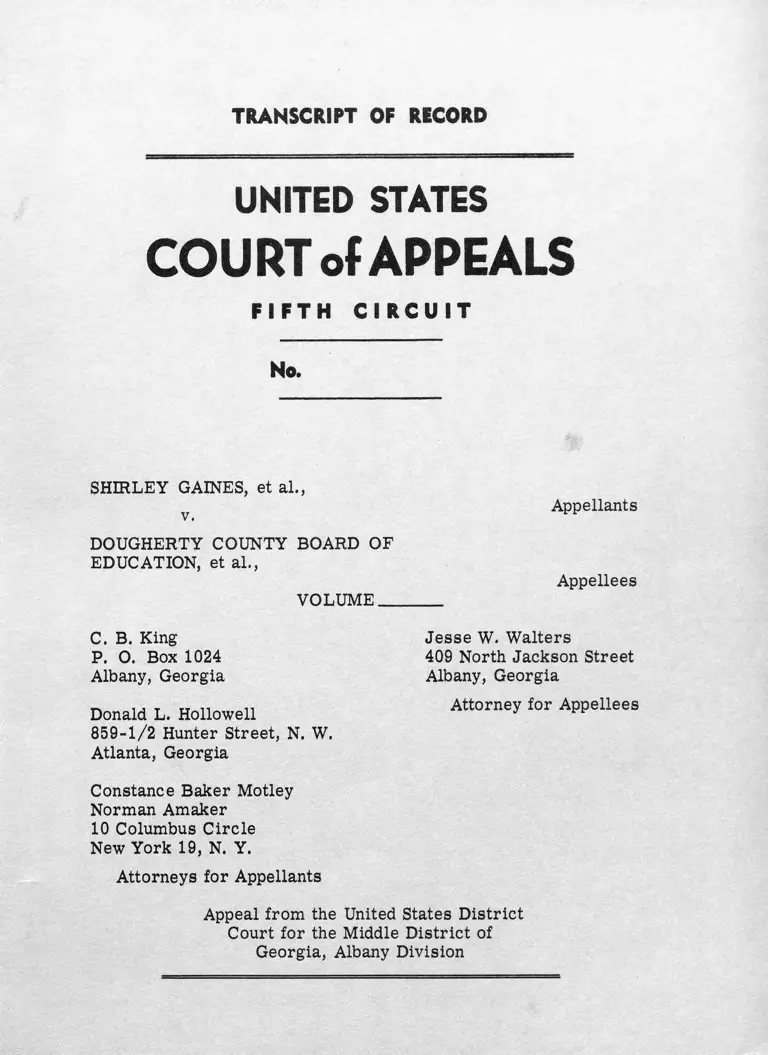
TRANSCRIPT OF RECORD
UNITED STATES
COURT of APPEALS
F I F T H C I R C U I T
No.
SHIRLEY GAINES, et al.,
v.
C. B. King
P. 0. Box 1024
Albany, Georgia
Donald L. Hollowell
859-1/2 Hunter Street, N. W.
Atlanta, Georgia
Constance Baker Motley
Norman Amaker
10 Columbus Circle
New York 19, N. Y.
Attorneys for Appellants
Appellants
Appellees
Je sse W. Walters
409 North Jackson Street
Albany, Georgia
Attorney for Appellees
DOUGHERTY COUNTY BOARD OF
EDUCATION, et al.,
VOLUME _
Appeal from the United States District
Court for the Middle District of
Georgia, Albany Division
Complaint 1
Motion for Preliminary Injunction l6
Answer 20
Order of July 12, 19&3 23
Defendants1 Plan of Desegregation 30
Plaintiffs' Objections to Defendants'
Desegregation Plan 34
Hearing on Objections to Plan - August 22, 1963 37
Defendants 1 Witnesses:
Joel J. Cordell
Direct 38
Cross 48
Redirect 85
Recross 88
Redirect 94
Recross 97
Redirect 104
T. R. Finley
Direct 106
Cross 107
Defendants1 Argument 110
Plaintiffs 1 Argument 125
Defendants 1 Rebuttal 141
Opinion and Order of August 27, 1963 146
Notice of Appeal 157
Designation of Record 159
I N D E X
COMPLAINT
(Filed April 5> 1363)
UNITED STATES DISTRICT COURT
FOR THE
MIDDLE DISTRICT OF GEORGIA
ALBANY DIVISION
SHIRLEY GAINES, PATRICIA ANN GAINES, MARIAN
GAINES, minors, by MONROE GAINES, their
father and next friend,
and
SHIRLEY ANN LAWRENCE, EUNICE LAWRENCE, KAREN
LAWRENCE and LEONARD LAWRENCE, by EUNICE
LAWRENCE, their mother and next friend,
and
WILLIE JAMES DAVIS, and JEFFERSON DAVIS, JR.,
minors, by JEFFERSON DAVIS, SR., their father
and next friend,
and
ROOSEVELT MATHIS and HENRY LEE MATHIS, minors,
by ANNIE PEARL MATHIS, their mother and next
friend,
and
EDDIE MAUD McKENDRICK, minor, by her father
and next friend, the Reverend SILAS McKENDRICK,
and
DIANNE YOUNG, minor, by MARY P. YOUNG, her
mother and next friend,
Plaintiffs
v s .
DOUGHERTY COUNTY BOARD OF EDUCATION, a public
body corporate,
and
LOUIS A. PEACOCK, President of the DOUGHERTY
COUNTY BOARD OF EDUCATION,
and
JOHN P. VENTULETT, HOLLIS STANFORD, HERBERT
HALEY, GEORGE H. JOINER, ERNEST BOND and J. L.
DAVIS, members of the Board of Education,
and
J. J. CORDELE, Superintendent of Schools of
Dougherty County, Georgia,
CIVIL ACTION
NO. 764
Defendants
1.
2
The jurisdiction of this Court is invoked pursuant
to the provisions of Title 28., United States Code., Section
1343(3)i this being a suit in equity authorized by law, Title
42, United States Code, Section 1983, to be commenced by any
citizen of the United States or other person within the juris
diction thereof to redress the deprivation, under color of
statute, ordinance, regulation, custom or usage of a State,
of rights, privileges and immunities secured by the Constitu
tion and laws of the United States. The rights, privileges
and immunities sought to be secured by this action, are
rights, privileges and immunities secured by the due process
and equal protection clauses of the Fourteenth Amendment to
the Constitution of the United States, as hereinafter more
fully appears.
2 .
This is a proceeding for a permanent injunction
enjoining the Dougherty County Board of Education, its mem
bers and the Superintendent of Schools of Dougherty County,
Georgia from continuing their policy, practice, custom and
usage of operating a compulsory biracial school system in
Dougherty County and for relief as hereinafter more fully
appears.
3.
The plaintiffs in this care are Laurita Anderson,
William Gilchrist Anderson and Vale Jeanita Anderson, minors,
by W. G. Anderson, their father and next friend; Shirley
Gaines, Patricia Ann Gaines, and Marian Gaines, minors, by
Monroe Gaines, their father and next friend; Shirley Ann Lawrence,
3
Eunice Lawrence* Karen Lawrence* and Leonard Lawrence* by
Eunice Lawrence* their mother and next friend; Willie James
Davis and Jefferson Davis* Jr.* minors* by Jefferson Davis*
Sr., their father and next friend; Roosevelt Mathis and
Henry Lee Mathis* minors* by Annie Pearl Mathis* their mother
and next friend; Eddie Maud McKendrick* minor* by her father
and next friend* the Reverend Silas McKendrick; and* Dianne
Young* minor* by Mary P. Young* her mother and next friend.
4.
Plaintiffs are all members of the Negro race and
bring this action on their own behalf and on behalf of all
other Negro children and their parents in Dougherty County
who are similarly situated and affected by the policy* prac
tice* custom and usage complained of herein. Plaintiffs are
all citizens of the United States and the State of Georgia*
residing in Dougherty County* Georgia. The minor plaintiffs
and other minor Negro children similarly situated are elig
ible to attend and are presently attending public schools in
Dougherty County which are under the jurisdiction* management
and control of the defendants which are all limited by
defendants to attendance by Negro children* pursuant to the
policy* practice* custom and usage of defendants of operating
a compulsory biracial school system. The members of the class
on behalf of which plaintiffs sue are so numerous as to make
it impracticable to bring them all individually before this
Court* but there are common questions of law and fact
4
involved, common grievances arising out of common wrongs and
common relief is sought for each plaintiff and for each mem
ber of the class. The plaintiffs fairly and adequately repre
sent the interests of the class.
5.
The defendants are the Dougherty County Board of
Education, a public body corporate; Louis A. Peacock,
President of the Dougherty County Board of Education; John
P. Ventulett, Hollis Stanford, Herbert Haley, George H.
Joiner, Ernest Bond, and J. L. Davis, members of the Board
of Education; and, J. J. Cordele, Superintendent of Schools
of Dougherty County, Georgia. The defendant Dougherty County
Board of Education and its members are charged by the laws
of the State of Georgia with the duty of operating a system
of free public schools in Dougherty County and said Board is
presently operating public schools in said county pursuant
to said laws. Defendant J. J. Cordele, as the Superintend
ent of Public Schools of Dougherty County, is the chief
administrative officer of said Board.
6.
Plaintiffs allege that defendants herein, acting
under color of the authority vested in them by the laws of
the State of Georgia, have pursued and are presently pursu
ing a policy, custom, practice and usage of operating the
public school system of Dougherty County, Georgia, on a
5
racially segregated basis. This racially segregated school
system came into existence pursuant to the requirements of
state law, but it is presently continued, perpetuated and
maintained by defendants as a matter of policy, custom and
usage. This racially segregated public school system operat
ed by defendants consists of 17 "white" schools which are
limited to attendance by white students only and which are
staffed by white teachers, white principals and other white
professional personnel. Said white schools are located in
various parts of the City of Albany and Dougherty County, and
regardless of location, these schools may be attended by
white children only. Said racially segregated public school
system, operated by defendants consists also of 9 "Negro"
schools which are limited to attendance by Negro students
only and which are staffed by Negro teachers, principals and
other Negro professional personnel. Said Negro schools are
likewise located in various parts of the City of Albany and
Dougherty County, and, regardless of location, these schools
may be attended by Negro children only. Albany is the only
city in Dougherty County, Georgia.
Pursuant to said policy, custom and usage, many
Negro students, including some of the minor plaintiffs, who
reside nearer to schools limited to white students are requir'
ed to attend schools limited to Negro students which are far
removed from the places of their residences. In some in
stances, some of the minor plaintiffs and other minor Negroes
6
similarly situated are required to travel as much as five
miles to attend a Negro school, whereas they reside nearer
a white school. Attendance at the various public schools of
Dougherty County is determined solely upon the basis of
race and color.
The assignment of professional personnel is also
determined solely by the race and color of the children at
tending the particular school and the race and color of the
personnel to be assigned.
The educational programs of the white and Negro
schools are administered and supervised separately by white
personnel in the case of white schools; the educational
program of the Negro schools are separately administered
and supervised by a "Supervisor of Colored Schools."
A dual set of school zone or attendance area lines
is also maintained. One set relates to the white elementary
schoolsj another set relates to the Negro. These lines
overlap where Negro and white school children reside in the
same residential area. Certain white elementary schools
"feed into" certain white junior high schools as prescribed
by defendants; and all white junior high schools "feed into"
the one white high school of Dougherty County. Whereas all
Negro elementary schools "feed into" one Negro junior high
school and the latter in turn "feeds exclusively into" the
system’s one Negro high school.
7
Plaintiffs allege that all of defendants' budgets
relating to the operation of the schools contain racial
designations based on the fact that there is in operation a
compulsory biracial school system. All new school construc
tion plans proposed, adopted and executed by defendants are
based upon the fact that there is in operation a compulsory
biracial system of schools. All funds appropriated and
expended by defendants are also appropriated and expended
by defendants separately for Negro schools and separately for
white schools.
7.
8.
Plaintiffs and others have physically presented
themselves to defendants for purposes of registration, en
rollment and attendance in the public school system of
Dougherty County, Georgia on a racially non segregated basis,
pursuant to which, plaintiffs have requested defendants to
cease segregation in the public school system of Dougherty
County based on race and to comply with the decision of the
United States Supreme Court in the School Segregation Cases.
Defendants have continued, however, to pursue the policy,
practice, custom and usage of operating a compulsory biracial
school system in Dougherty County, Georgia and have failed
and refused to present a plan for desegregating the public
school system of Dougherty County.
8
On or about January 25, 19^3, C. B. King, Esq.,
attorney for the plaintiffs wrote the president of defendant
school board requesting on behalf of the named plaintiffs,
an end to the unconstitutional policy and practice of racial
segregation in the Dougherty County School System. Accompany
ing the aforesaid letter (a copy of which is attached to this
complaint as Exhibit "A" and made a part hereof) was a peti
tion signed by the plaintiffs herein and other Negro parents
residing in Dougherty County in which the signers thereof
requested the defendant Board of Education to comply with the
decision of the United States Supreme Court holding racial
segregation in the public schools unconstitutional and to
reorganize the dual racial school system of Dougherty County
into a unitary nonracial system. A copy of this petition is
made a part of this complaint and is attached hereto as
Exhibit "B".
Defendants to the date of filing of this complaint
have neither responded to the letter and petition nor taken
any action to comply with the demands set forth in these
documents.
9.
1 0 .
Plaintiffs, and members of the class which they
represent, are injured by the refusal of defendants to cease
operation of a compulsory biracial school system in Dougherty
County. The operation of a compulsory biracial school system
9
in Dougherty County violates rights of the plaintiffs and
members of their class which are secured to them by the due
process and equal protection clauses of the Fourteenth Amend
ment to the Federal Constitution, The plaintiffs, and members
of their class, are injured by the policy of assigning teach
ers, principals and other school personnel on the basis of
the race and color of the children attending a particular
school and the race and color of the person to be assigned.
The injury which plaintiffs and members of their
class suffer as a result of the operation of a compulsory bi-
racial school system in Dougherty County is irreparable and
shall continue unabated unless and until defendants are en
joined by this Court, Any other relief to which plaintiffs
and those similarly situated could be remitted would be at
tended by such uncertainties and delays as to deny substantial
relief, would involve a multiplicity of suits, cause further
irreparable injury and occasion damage, vexation and incon
venience, not only to the plaintiffs and those similarly
situated but to defendants as public officials.
11.
Plaintiffs allege that as a result of the operation
of the school system on a racially segregated basis many parts
of the school curriculum are open only to white pupils and
white teachers,
WHEREFORE, plaintiffs respectfully pray that this
Court advance this cause on the docket and order a speedy
10
hearing of this action according to law and after such
hearing:
1. Enter a decree enjoining defendants, their
agents, employees, successors and all persons in active con
cert and participation with them from operating a compulsory
biracial school system in Dougherty County, Georgia;
2. Enter a decree enjoining defendants, their
agents, employees, successors and all persons in active
concert and participation with them from continuing to main
tain a dual scheme or pattern of school zone lines or attend
ance area lines based on race and color;
3. Enter a decree enjoining defendants, their
agents, employees, successors and all persons in active con
cert and participation with them from assigning pupils to
schools in Dougherty County on the basis of race and color
of the pupils;
4. Enter a decree enjoining defendants, their
agents, employees, successors and all persons in active con
cert and participation with them from assigning teachers,
principals and other professional school personnel to the
schools of Dougherty County on the basis of the race and color
of the person to be assigned and the race and color of the
children attending the school to which such personnel is to
be assigned;
5. Enter a decree enjoining defendants, their
agents, employees, successors and all persons in active con
11
cert and participation with them from approving budgets,
making available funds, approving employment and construc
tion contracts, and approving policies, curricula and programs
which are designed to perpetuate or maintain or support com
pulsory racially segregated schools.
In the alternative, plaintiffs pray that this Court
enter a decree directing defendants to present a complete
plan, within a period of time to be determined by this Court,
for the reorganization of the entire school system of
Dougherty County into a unitary nonracial system which shall
include a plan for the assignment of children on a nonracial
basis; the assignment of teachers, principals and other pro
fessional school personnel on a nonracial basis; the drawing
of school zone or attendance area lines on a nonracial basis;
the allotment of funds, the construction of schools, the
approval of budgets on a nonracial basis; and the elimination
of any other discrimination in the operation of the school
system or in the school curricula which are based solely upon
race and color. Plaintiffs pray that if this Court directs
defendants to produce a desegregation plan that this Court
will retain jurisdiction of this case pending court approval
and full and complete implentation of defendants' plan.
Plaintiffs pray that this Court will allow them
their costs herein and grant such further, other, additional
12
or alternative relief as may appear to the court to be
equitable and just.
Respectfully submitted,
C. B. King
P. 0. Box 1024
Albany, Georgia
Constance Baker Motley
Norman C. Amaker
10 Columbus Circle
New York 19, New York
Attorneys for Plaintiffs
13
EXHIBIT "A"
C. B, KING
Attorney-at-Law
Post Office Box 1024
Albany, Georgia
Telephone HEmlock 2-0879
January 23, 1963
Mr. Louis A. Peacock, President
Dougherty County Board of Education
Old C & S Bank Building
Dear Sir:
Please be advised that I have been retained by the persons
hereinafter named, their children and/or wards, for purposes
of securing educational advantages for the latter, consonant
with what our Federal Constitution has been interpreted to
mean by the United States Supreme Court.
A definition of the demands of my clients, put upon the
Dougherty County Board of Education, is more fully set out
in the enclosed petition.
The persons whom I represent are: Mrs. Dorothy M. Scrivens,
Mrs. Vessie L. SIntleton, Mrs. Eunice Lawrence, Mrs. Annie
Pearl Mathis, Monroe Gaines, Mrs. Luella Hilson, J. F. Davis,
Rev. Samuel B. Wells and their respective children and/or
wards.
A response to this communication and the demands of the en
closed petition is respectfully requested, by this office,
immediately following your next Board meeting or, in the
alternative, within thirty (30) days from this date, which
ever occurs first.
Respectfully yours,
/s/ C. B. King
CBK: Awb C. B. .King
Enel
l4
EXHIBIT "B"
P E T I T I O N
TO THE DOUGHERTY COUNTY BOARD OF EDUCATION OF DOUGHERTY COUNTY,
GEORGIA AND THE HONORABLE CHAIRMAN THEREOF:
WE, the undersigned, are Negro parents or guardians of
Negro pupils presently enrolled in Negro elementary schools and
Negro junior and senior high schools in Dougherty County,
Georgia, which are under the supervision, management and control
of the Dougherty County Board of Education.
The undersigned show to the Board that they duly presented
their children and/or wards, on September 4, 1962, at the duly
appointed hour, at appropriate schools within said Board's super
vision, management and control, for purposes of said children's
enrollment; that the Principals of the respective schools, in
which enrollment was sought, denied the enrollment of said child
ren and referred said children to the Superintendent of the
Schools of the County and State aforesaid; and that the said
superintendent denied the enrollment of the children aforesaid
on grounds based solely on race.
The undersigned, herewith, petition the Dougherty County
Board of Education to comply with the decision of the United
States Supreme Court holding racial segregation in the public
schools unconstitutional by reorganizing the dual racial school
system of Dougherty County into a unitary non-racial system which
would include the reassignment of all pupils and all professional
personnel on a non-racial basis, the construction of schools on
a non-racial basis, the approval of school operating budgets,
curricula, and extracurricula activites on a non-racial basis
15
and the elimination of all other distinctions based wholly on
race and color.
This 25th day of January, 19 6 3.
/*/
Name Dorothy M. Scriven
Address 130 Blaylock Street
Number of children enrolled 1
Schools in which enrolled_______
Monroe High School
Name Mrs. Eunice Lawrence
Address 1007 S. Harding Street
Number of children enrolled 4
Schools in which enrolled_
Lincoln Hgts., Carver Jr. Hi
Monroe Hi
Name /s/ Annie Pearl Mathis
Address 712 Wilson Avenue
Number of children enrolled 2
Schools in which enrolled
Jackson Hgts.
Name /s/ Monroe Gaines
Address 619 Holloway Avenue
Number of children enrolled 3
Schools in which enrolled
Coachman,Carver Jr.Hi., Monroe
Hi
Name /s/ Mrs. Luella Hilson
Address 1305 S. Van Buren St.
Number of children enrolled 3
Schools in which enrolled____
Monroe Hi
Name /s/ J. F. Davis
Address 1010 S. Jefferson St.
Number of children enrolled 2
Schools in which enrolled
Carver Jr. Hi & Monroe Hi
Name /s/ Silas McKendrick
Address 441 Gaines Drive
Number of children enrolled J3
Schools in which enrolled____
Flintside & Monroe Hi
Name Vessie Singleton
Address 216 Sixth Street
Number of children enrolled —
Schools in which enrolled__________ _
Monroe High School
Name W. G. Anderson
Address 914 Cedar Avenue
Number of children enrolled 3
Schools in which enrolled_
Hazard, Carver Jr. Hi. Monroe Hi.
Name /s/ Mrs. M. P. YOUNG
Address 833 Corton Avenue
Number of children enrolled 2
Schools in which enrolled
Carver Jr. Hi and Monroe Hi
Name /s/ Rev. Samuel B. Wells
Address 321 Merritt Avenue
Number of children enrolled 4
Schools in which enrolled_
Carver Jr. Hi., Hazard
Name ___________________
A d d r e s s __________________
Number of children enrolled
Schools in which enrolled
Name_________ _________
Address_____________________
Number of children enrolled
Schools in which enrolled
Name______________________ _
Address _________________ _
Number of children enrolled
Schools in which enrolled
16
/(Caption Omitted/7
MOTION FOR PRELIMINARY INJUNCTION
(Filed May 2, 19 6 3)
Come now the plaintiffs, by their undersigned Attorneys,
and, pursuant to Rule 63 of the Federal Rules of Civil Procedure,
move this Court for a preliminary injunction enjoining the defen
dants, their appointees, agents, employees, successors, attorneys
and all persons in active concert and participation with them
from pursuing a policy, custom, practice and usage of operating
the public school system of Dougherty County, Georgia, based
upon allegations of the said plaintiffs' complaint and for cause
shows the following:
I
That unless restrained by this court, the defendants
will continue to pursue a policy, custom and practice of racial
segregation in the administration of the Dougherty County Public
School System against the plaintiffs and other members of their
class, solely because of their race. The issuance of a prelimin
ary injunction herein will not cause undue inconvenience or loss
to the defendants but will prevent Irreparable injuries to the
plaintiffs and members of their class, similarly situated; that
said plaintiffs have no speedy and adequate remedy at law.
II
The counsel for the defendants has not answered the
complaint of the plaintiffs herein, though said complaint was
filed with this Court on April 5* 1963; that counsel for the
17
defendants have requested an extention of time for filing de
fensive pleadings in said case; that the court has ordered an
extension, pursuant to said request, of forty-five (45) days.
Ill
That unless this Honorable Court grants this motion for
a preliminary injunction before the commencement of the 19^3
School Term of the Albany, Dougherty County, Georgia Schools, the
plaintiffs will be irreparably Injured by a denial through de
ferment of the aforesaid relief sought by them.
WHEREFORE, plaintiffs respectfully pray for the relief
hereinafter set out and for an order setting a date for a hearing
of this motion at the earliest possible date:
1. Enter a decree enjoining defendants, their agents,
employees, successors and all persons in active concert and par
ticipation with them from operating a compulsory biracial school
system in Dougherty County, Georgia;
2. Enter a decree enjoining defendants, their agents,
employees, successors and all persons in active concert and par
ticipation with them from continuing to maintain a dual scheme or
pattern of school zone lines or attendance area lines based on
race and color;
3. Enter a decree enjoining defendants, their agents,
employees, successors and all persons in active concert and
participation with them from assigning pupils to schools In
Dougherty County on the basis of race and color of the pupils;
4. Enter a decree enjoining defendants, their agents,
employees, successors and all persons In active concert and
18
participation with them from assigning teachers, principals and
other professional school personnel to the schools of Dougherty
County on the basis of the race and color of the person to be
assigned and the race and color of the children attending the
school to which such personnel is to be assigned;
5. Enter a decree enjoining defendants, their agents,
employees, successors and all persons in active concert and
participation with them from approving budgets, making available
funds, approving employment and construction contracts, and ap
proving policies, curricula and programs which are designed to
perpetuate or maintain or support compulsory racially segregated
schools.
In the alternative, plaintiffs pray that this Court
enter a decree directing defendants to present a complete plan,
within a period of time to be determined by this Court, for the
reorganization of the entire school system of Dougherty County
Into a unitary non-racial system which shall include a plan for
the assignment of children on a nonracial basis; the assignment
of teachers, principals and other professional school personnel
on a nonracial basis; the drawing of school zone or attendance
area lines on a nonracial basis; the allotment of funds, the
construction of schools, the approval of budgets on a nonracial
basis; and the elimination of any other discrimination in the
operation of the school system or in the school curricula which
are based solely upon race and color. Plaintiffs pray that If
this Court directs defendants to produce a desegregation plan
19
that this Court will retain jurisdiction of this case pending
court approval and full and complete implementation of defendants'
plan.
Plaintiffs pray that this Court will allow them their
costs herein and grant such further, other, additional and
alternative relief as may appear to the court to be equitable
and just.
RESPECTFULLY SUBMITTED,
/s/ C, B. King
C. B. KING
P. 0. Box 1024
Albany, Georgia
CONSTANCE BAKER MOTLEY
NORMAN C. AMAKER
10 Columbus Circle
New York 19j New York
ATTORNEYS FOR PLAINTIFFS
20
/caption omitted/
A N S W E R
Now come the Defendants and subject to their Motion to
Strike file this their answer to plaintiffs' petition and for
answer show the court as follows:
1 .
The defendants deny the allegations of Paragraph 1 of the
Complaints.
2 .
The defendants admit the allegations of Paragraph 2 of
the Complaint.
3.
The defendants admit the allegations of Paragraph 3 of
the Complaint.
4.
Answering Paragraph 4 of the Complaint,, the defendants admit
that plaintiffs are all members of the Negro race but it is
alleged and believed that the plaintiffs do not represent other
Negro children and their parents in Dougherty County. Further
answering Paragraph 4, the defendants say there is no common
wrong committed against the plaintiffs by defendants.
5.
The defendants admit all of the allegations of Paragraph 5
of the Complaint with the exception of the allegation that
Louis A. Peacock is President of the Dougherty County Board of
Education. Mr. Peacock has, subsequent to the filing of this
21
suit* removed from Dougherty County, Georgia., and resigned as a
member of the Board of Education.
6.
Answering Paragraph 6 of the Complaint, the defendants admit
that a dual education system is being operated in Dougherty
County, Georgia. The defendants further say that the reason a
dual educational system is being operated in Dougherty County,
Georgia, is to afford the students of all races the best pos
sible education. The defendants further show that no student in
the Dougherty County School System is being deprived of any
right, constitutional or otherwise, as a result of the dual
educational system. The remainder of Paragraph 6 of the Com
plaint is admitted.
7.
The defendants admit the allegations of Paragraph 7 of the
Complaint,
8.
Answering Paragraph 8 of the Plaintiffs’ Complaint, the
defendants deny that the plaintiffs and others have physically
presented themselves to the defendants for the purpose of
registration, enrollment and attendance in the public school
system of Dougherty County, Georgia, on racially non-segregated
basis and that the plaintiffs have physically requested the
defendant to cease segregations in the public school system of
Dougherty County based on race and to comply with the decision
of the United States Supreme Court in the school segregation
cases.
22
Further answering Paragraph 8, the defendants say that no
decision of the United States Supreme Court or any other court
is in effect ordering the defendants to operate one school sys
tem rather than a dual school system.
The defendants further say that they, nor any of them, have
ever been a party in any court proceeding involving the matter
of operation of schools.
9.
The defendants admit Paragraph 9 of the Complaint.
1 0 .
The defendants deny Paragraph 10 of the Complaint.
1 1 .
The defendants deny Paragraph 11 of the Complaint.
WHEREFORE, the defendants having fully answered pray that
they be discharged.
PERRY, WALTERS & LANGSTAFF
By
Attorneys for Defendants
23
IN THE UNITED STATES DISTRICT COURT
FOR THE MIDDLE DISTRICT OF GEORGIA
ALBANY DIVISION
------------------ ------ ---------- ---- ----- FILED AT
SHIRLEY GAINES, PATRICIA ANN GAINES,
MARIAN GAINES, minors, by MONROE
GAINES, their father and next friend,
and others,
Plaintiffs,
v,
DOUGHERTY COUNTY BOARD OF EDUCATION,
a public body corporate, and others,
Defendants.
ELLIOTT, District Judge:
This is a proceeding seeking to enjoin the Dougherty
County Board of Education, its members and the Superintendent
of Education of Dougherty County, Georgia, from operating a
bi-racial school system in Dougherty County. Subsequent to the
filing of the original complaint the Plaintiffs made application
for temporary injunction and the matter came on for hearing
before the Court on July 8, 19 6 3. The Court heard evidence and
arguments of counsel and now files this opinion which is Intend
ed as compliance with the provisions of Rule 52, Federal Rules
of Civil Procedure.
The Plaintiffs in this case are all members of the Negro
race and they bring this action on their behalf and on behalf of
the other Negro children in Dougherty County who are similarly
4:05 PM
JULY 12, 1963
/ V _____________
Deputy Clerk,
U.S. District
Court
CIVIL ACTION NO. 764
24
situated and affected. The Plaintiffs are all citizens of the
United States and of the State of Georgia residing in Dougherty
County. They are all eligible to attend the public schools in
Dougherty County and all of the circumstances indicate that this
is a proper class action insofar as the question of assignment
of pupils in the public school system of Dougherty County is
concerned.
The Dougherty County Board of Education, and its members
and other officials named as Defendants in the complaint, have
the duty of operating a system of public schools in Dougherty
County and said Board is presently operating such public schools
in the County.
The Court has jurisdiction of this litigation pursuant to
the provisions of I 1343(3) of Title 28 of the United States
Code, this being a suit in equity authorized under the provisions
of § 1983 of Title 42 of the United States Code, it being alleged
that the rights sought to be secured by this action are of the
nature which are guaranteed by the due process and equal pro
tection clauses of the Fourteenth Amendment to the Constitution.
There are approximately 20,000 students in the Dougherty
County School system and of these approximately 12,600 are white
students and approximately 7*400 are Negro students, the system
being about 63^ white and 37$ Negro. For many years past and at
present the Defendants have operated the school system as a dual
educational system under which all white students attend schools
separate and apart from Negro students and Negro students attend
25
schools separate and apart from white students. All of the
teachers who teach In the white schools are white and all of the
teachers who teach in the Negro schools are Negroes. All of the
teachers, both white and Negro, are paid the same basic salary as
related to their education and experience. The training and
qualifications of the Negro teachers and the white teachers is
about the same. There are six specially trained teachers for
retarded or exceptional children in the white schools and four in
the Negro schools. There is one white visiting teacher and one
Negro visiting teacher. The pupil-teacher ratio is a little
lower in the Negro schools than it is in the white schools, there
being on the average about one less in number of pupils per
teacher in the Negro schools than in the white schools. Generally
the curriculum is the same in the Negro schools and the white
schools, there being some minor variations which are related to
the desires of the students. There is one qualified librarian
assigned to the white schools and one qualified librarian as
signed to the Negro schools. There are two vocational schools.
These schools are ungraded. One of these schools is attended
exclusively by Negro children and the other is attended exclusive
ly by white children. School zones or attendance areas are
established and maintained separately for the Negro schools and
for the white schools, and from an administrative standpoint
there is one supervisor or coordinator for the white elementary
schools and there is one supervisor or coordinator for the Negro
elementary schools.
26
The school budget is not set up or administered on the
basis of race. The annual budget is established and administer
ed on the basis of the total number of pupils in the entire
school system of the county without regard to race* there being
no disparity or difference between the budget as it pertains to
the white race or the Negro race. All instructional supplies,
textbooks, equipment, etc., needed to operate the schools are
purchased from funds provided in the budget and the same amount
of money per student is spent by the Board of Education for the
education of Negro students as is spent for the education of
white students. Generally school facilities have been provided
for the two races on an equal basis. In fact, in some instances
the provisions for Negro pupils have been superior to that for
whites, as is evidenced by the fact that the only air condition
ed school in Dougherty County is a Negro school and this is one
of the few air conditioned schools in the State of Georgia.
No Negro parent has ever appeared before the Board of
Education and complained about the dual system that is operated.
No Negro parent or child has ever appeared before the Board and
sought to discuss the matter with the Board. No Negro parent
or Negro student has ever made a written application to the
Defendants requesting a transfer from an all-Negro school to an
all-white school. No Negro parent or Negro student has ever
appeared before the Board at the time of any Board meeting and
orally requested a transfer from an all-Negro school to an all-
white school.
27
All students, Negro and white, in the Dougherty County
school system were assigned to designated schools for the 1962-63
school term in May, 1962, this being normal procedure. Between
May, 1962 and the opening day of school in September, 1962 no
complaint was made by any person to the Defendants concerning
such assignments which had been made the previous May. On the
opening day of school in September, 1962 a number of Negro parents
and Negro children appeared at white schools and requested admit
tance to such schools. Such admittance was refused.
In the latter part of January, 1963 one of the attorneys
representing the Plaintiffs in this action communicated by letter
with the Dougherty County Board of Education requesting the Board
to reorganize the dual school system Into a unitary non-racial
system. Attached to the communication was a petition signed by
eleven Negro parents of school-age children requesting the
reorganization. The Dougherty County Board of Education did not
reply to this communication.
Assignment of pupils for the school year beginning Septem
ber, 1963 were made in May, 1963 and white pupils have been as
signed to white schools and Negro pupils have been assigned to
Negro schools as in the years past. Since these assignments were
made no application for transfer or complaint concerning school
assignments has been made to the Defendants, Teacher contracts
are ordinarily entered into in May of each year for the forth
coming school year beginning in September and such contracts were
entered into in May, 1963 for the coming school year and assign
28
ments for teachers have already been made. No Negro teacher
has at any time registered a complaint with the Board concerning
teacher assignments nor has'any Negro teacher registered a com
plaint with the Defendants concerning the operation of the public
schools in Dougherty County.
Textbooks, work books and instruction supplies for all of
the schools have already been ordered for the coming year based
upon the assignments that have been made. Some of the schools
are presently overcrowded and there are four school buildings
under construction at the present time, but they will not be
completed in time for use at the beginning of the 19^3 school
year.
In recent months the subject of desegregation of the school
system has been discussed at length at meetings of the Defendant
Board of Education, but at the time of the hearing in this matter
no definite action had been taken in that direction.
It is obvious from the foregoing that the Dougherty County
Board of Education has sought in good faith to provide adequate
educational facilities for all of the children of all races in
Dougherty County In a manner sincerely deemed by them to be
best, but it is likewise obvious that their ideas of proper
school administration do not coincide with those expressed by
the Supreme Court of the United States, for the Defendants are
operating a racially segregated school system and the Supreme
Court of the United States has held in Brown v. Board of Educa
tion of Topeka. 347 U,S, 483, and subsequent cases, that to do
29
so is in violation of the constitutional rights of the Plain
tiffs.. This Court is hound hy that Court's decree. It is the
duty of this Court in these circumstances to order an end to
the segregated system. This we will do.
It is clear that it is in the best interest of all con
cerned., the Plaintiffs, the Defendants and the general community,
that this change be brought about In an orderly fashion. The
Defendants have assured the Court that they will in good faith
abide by any order which the Court might enter. However, any
peremptory order issued by the Court would of necessity be hap
hazard and probably ill-conceived. The better approach is for
the Board to design in good faith a plan of desegregation of the
public school system of Dougherty County, Georgia under which
the Board will with reasonable promptness eliminate school as
signments based upon race. The Defendants are required to do
this and will submit such plan to the Court for approval or
disapproval within thirty days from the date of the filing of
this opinion. At the same time the Defendants will furnish a
copy of the proposed plan to Counsel for the Plaintiffs, and the
Plaintiffs will within ten days thereafter file written ob
jections thereto, If there be any. If written objections to
the plan as submitted are filed by the Plaintiffs the Court will
promptly set the matter down for hearing.
Since we are requiring a prompt submission of a desegre
gation plan we see no necessity at this time for the granting of
a temporary injunction as requested by the Plaintiffs.
30
The Court is not at this time ruling on the question of
assignment of teachers and other professional personnel.
The Court retains jurisdiction of this matter for further
proceedings and the entry of such further orders as may be
deemed appropriate in the light of the developing circumstances.
IT IS SO ORDERED this 12th day of July, 19 6 3.
J. ROBERT ELLIOTT
United States District Judge
/CAPTION OMITTED/
PLAN FOR ADMINISTERING THE PUBLIC
SCHOOL SYSTEM OF DOUGIiTERY COUNTY,
GEORGIA WITHOUT REGARD TO RACE.
(Submitted August 12, 19 6 3)
Pursuant to the Order of this Court rendered on the 12th
day of July, 19 6 3, the Dougherty County Board of Education sub
mits to this Court for its consideration a plan for administer
ing the public school system of Dougherty County, Georgia with
out regard to race and color of pupils; and
WHEREAS, the United States District Court For The Middle
District of Georgia, Albany Division, in the case of Shirley
Gaines, Patricia Ann Gaines, Marian Gaines, minors by Monroe
Gaines, their father and next friend, and others, Plaintiffs,
31
vs. Dougherty County Board of Education, a public body corporate,
and others, Defendants, directed the Dougherty County Board of
Education to present to the Court a plan of desegregation of the
public school system of Dougherty County, Georgia under which
the Board will with reasonable promptness eliminate school as
signments based upon race; and
WHEREAS, this Board is mindful of the duty placed upon it
by the foregoing ruling and is further mindful of its duty to
provide all students, regardless of race, adequate educational
opportunities; and
WHEREAS, this Board is of the opinion that it cannot
comply with its duty of providing adequate educational opportuni
ties to all students by making any change in the operation of
its schools during the 1963-1964 school term. All assignments
of both pupils and teachers for such term have been made, all
text books, work books and instruction supplies for such term
have already been ordered and were ordered based upon the as
signments that have been made. To effect any change in the
operation of the school system of Dougherty County, Georgia for
the school year 1963-1964 would create problems which could not
be solved in the best interest of the educational opportunities;
Now, therefore,
BE IT RESOLVED by the Dougherty County Board of Education
as follows:
1.
Beginning with the 1964-1965 school term the Dougherty
County Board of Education will follow the plan of assignment
32
of pupils as stated below:
(1) All pupils enrolled in the Dougherty County school
system for the 1963-1964 school terra will be assigned for the
1964-1965 school terra to the schools they attended in the 1963-
1964 term* except those pupils, who, through promotion, will be
assigned to a school of higher classification.
(2) Pupils being promoted from an elementary to a junior
high school, or from a junior high school to a senior high
school, will be assigned to the higher ranking school to which
they would have been assigned under the plan of assignment in
effect for the school year 19 6 3-1964.
II
(1) Beginning with the school term 1964-1965, and each
school year thereafter, all pupils entering the first grade may
select the school of their choice without regard to race or
color if proximity to school, building capacity and transporta
tion permits.
XXX •
There is hereby established a county wide registration
for school attendants and the same will be held beginning the
first Monday in April of each year and continuing through
Friday of that same week. All pupils shall register at the
school they are then attending, even though he or she may be
promoted to a school of higher classification. The registra
tion hours shall be from 9:00 A.M. until 5:00 P.M.
Students who will be entering the first grade in Septem
ber of 1964 shall be registered by their parent or guardian and
33
such registration shall take place at the school which the
student desires to attend.
All requests for assignment to he made will be acted
upon by the Dougherty County Board of Education not later than
the 1st day of June of each year., and the parent or guardian
notified of the action of the Board by mail postmarked not
later than the 1st day of June. If such request for assignment
is denied, the parent or guardian has the right, on or before
the 10th day of June to request in writing a hearing before the
Dougherty County Board of Education to have the request further
considered. In the case of all such requests for hearing, the
parent or guardian shall be notified of the time and place of
the hearing, such hearing to be held on or before June 20th.
The provisions of Paragraph II hereof shall be effective
step by step for one additional grade each year, to Illustrate:
Effective with reference to the second grade in the Fall of
1965; effective with reference to the third grade in the Fall of
1966, etc.
Respectfully submitted,
PERRY, WALTERS & LANGSTAFF
By:
Attorneys for Defendants
34
/ c a p t i o n o m i t t m /7
PLAINTIFFS' OBJECTIONS TO DEFENDANTS' PLAN FOR ADMINISTERING
THE PUBLIC SCHOOL SYSTEM OF DOUGHERTY COUNTY, GEORGIA
WITHOUT REGARD TO RACE
(Filed August 14, 1963)
Plaintiffs herewith object to defendants' Plan For Admin
istering The Public School System of Dougherty County, Georgia
Without Regard To Race on the following grounds:
1. The plan submitted to this Court fails to afford to
plaintiffs minimum effective relief commencing in the 1963-64
school year. At this late date, more than nine years after the
school desegregation decision of 1954, plaintiffs are entitled
to minimum effective relief that will require defendants to make
a start toward desegregation of the Dougherty County public
schools commencing in the 1963-64 school year. Davis, et al. v.
Board of School Commissioners of Mobile County, et al., (5th Cir.,
No. 20657, July 9, 1963)1 Armstrong, et al. v. Board of Education
of Birmingham, et al.,(5th Cir. No. 20595* July 12, 19 6 3); Stell
v. Savannah-Chatham County Board of Education, et al., (5th Cir.,
No.20557 M-S, May 24, 19 6 3).
2. The plan should more clearly provide for the admission
of new pupils entering the first grade or coming into the County
for the first time on a non-raclal basis.
3. The plan fails to provide for the abolition of the
presently existing dual school zones without which there cannot
be any compliance with the 1954 decision of the United States
Supreme Court, Augustus v. Board of Public Instruction, 306 F.2d
35
862, 869 (5th Cir. 1962). The plan as presently constituted
calls for assignment of school children within the framework of
the presently existing segregated dual school system and as such
continues the denial of plaintiffs' constitutional rights,
4. Nothing appears from the defendants' plan to support
the period of delay in the completion of the desegregation pro
cess. Defendants have not shown that the 12-year period contem
plated under the plan is "necessary in the public interest" and
"consistent with good faith compliance at the earliest practic
able date" as required by Brown v. Board of Education, 349 U.S.
294 (1955). The United States Supreme Court in its most recent
terra has made it clear that this Brown decision "never contem
plated that the concept of 'deliberate speed' would countenance
indefinite delay in eliminating racial barriers in schools ..."
Matson v. City of Memphis, _ _ U.S. ___, 10 L.ed 2d 529, 534
(1963).
5. The plan fails to provide for the assignment of teachers
and other supervisory personnel on the basis of qualification and
need without regard to race and color.
6. There are no provisions made by which the named plain
tiffs are assured of securing their personal and present right
to a desegregated education.
7. The plan fails to provide for the desegregation of the
presently existing separate vocational schools nor does it pro
vide for the desegregation of any other special educational pro
grams now conducted or which may be conducted in the future.
WHEREFORE, plaintiffs pray that pursuant to this Court's
36
opinion and order of July 12, 1963 that the court will promptly
set a hearing on plaintiffs objections to the plan and that upon
such hearing the court will grant plaintiffs minimum effective
relief by requiring defendants to institute, immediately, proce
dures whereby a start toward desegregation of the Dougherty County
public schools will be made in the 1963-64 school year due to
commence on September 3* 19 6 3. Plaintiffs further pray that
defendants plan as presently constituted be disapproved and a
revised plan for the desegregation of the public school system
of Dougherty County be submitted which plan shall provide for a
complete abolition of the presently existing dual school zones
in all grades effective with the commencement of the 1964-65
school year and which will provide that assignments of pupils to
those grades be made without regard to race or color. Said plan
should also encompass provisions for the reassignment of teachers
and other supervisory personnel on a non-racial basis and meet
the other specific objections Indicated above.
Plaintiffs further pray that this Court will retain juris
diction of this cause for the purpose of granting such further
relief as may be mandated by future developments.
Respectfully submitted,
C. B. KING
221 South Jackson Street
Albany, Georgia
CONSTANCE BAKER MOTLEY
NORMAN C. AMAKER
10 Columbus Circle
New York, New York 10019
Attorneys for Plaintiffs
37
HEARING ON OBJECTIONS TO PLAN
ALBANY, GEORGIA
9:30 A. M.,
AUGUST 22, 1963:
THE COURT: In Civil Action No. 764 an order
was entered requiring the Defendants to submit a plan
of administering the school system of Dougherty County,
without regard to race; and, pursuant to that order,
a plan has been filed, and subsequent to the filing of
the plan, the Plaintiffs in the action have filed their
objections to the plan within the time specified in the
Court's order.
So, we are here today for the purpose of considering
the plan and the objections thereto. Suppose we have
an announcement of the appearances for the parties at
this time for the Plaintiffs. Who appears for the
Plaintiffs?
* * *
THE COURT: Now, as I conceive the situation
to be at the moment, as I stated initially a moment ago,
a plan having been submitted pursuant to the Court's
order and objections having been filed thereto within
the time specified in the Court's original order; and
since we are here for the purpose of considering the
plan and the objections that have been filed to it, as
I conceive the situation at the moment, the burden is
upon the Defendants, the parties who submitted the plan,
to justify the plan in the light of the requirement of
HEARING ON OBJECTIONS TO PLAN 38
the Court's order and in the light of the objections
which have been filed to the plan by the Plaintiffs,
In other words, I conceive the proper procedure
to be that the Defendants will proceed with whatever
presentation the Defendants wish to make in support of
the plan and in response to the objections which have
been filed by the Plaintiffs.
So, you may proceed, Mr. Walters.
* * *
MR. JOEL J. CORDELL
witness called in behalf of Defendants,
being first duly sworn, testified on
DIRECT EXAMINATION
BY MR. WALTERS:
Q What is your name, please?
A J. J. Cordell.
Q Do you have any official capacity with the Dougherty
County school system, Mr. Cordell?
A I am Superintendent of Education.
Q How long have you been Superintendent of Education
in the Dougherty County School System?
A Since it was organized in 1951.
Q Mr, Cordell, where did you attend school? What
are your educational qualifications?
A I attended and did my undergraduate work at Mercer
University and my graduate work at the University of South
Carolina; and I attended Columbia University, in addition
to that.
HEARING ON OBJECTIONS TO PLAN 39
Q. When did you complete your formal education, Mr.
Cordell?
A Well, I received my Master's Degree in 1938. Since
that time I have done some post-graduate work at Columbia
University.
Q Following the receipt of your Master's Degree in
1938, what vocation or occupation did you enter into?
A I remained in the educational field. I was in the
educational field at the time and I remained in the educational
field.
Q, And since that time where have you taught and where
have you been located?
A Since 1938 I was at North Augusta, South Carolina
at the time. I was principal of the high school. And in 1943
I came to Albany as principal of the Albany High School; and
in 1945 I went to Griffin as principal of the Griffin High
School; came back to Albany in 1947 as Assistant Superintendent
of the City Schools; and then in 1948, Superintendent of the
City schools; and then in 195I* when there was a merger of the
City and County schools, I became Superintendent of the now
merged County system.
Q And have you been Superintendent of the Dougherty
County school system since that time continuously?
A I have.
Q Mr. Cordell, are you familiar with the plan which
has been presented to this Court for the administering of
the public school system of Dougherty County, Georgia, without
regard to race?
HEAR IN? ON OBJECTIONS TO PLAN 40
A I am.
Q Mr. Cordell, have you given any time and thought to
this plan?
A I have given the larger portion of my time to it
for the last several months.
Q Have you during that time, Mr. Cordell, had occasion
to investigate, to make investigation of other school systems
that have been faced, with the same problems that we are now
faced with?
A Yes, I have.
Q Mr. Cordell, in connection with the opening of the
schools in September, on September 3 of this year, have
teacher assignments been made for these schools?
A Yes.
Q When were they made, Mr. Cordell?
A Well, during the summer. I don't knowj they
weren't all made at one time, naturally but during the summer
it's been made and at this date it is practically complete.
Q Have student assignments for the coming year already
been made, Mr. Cordell?
A Yes.
Q And when were they made?
A They were made before school closed last year.
Q Getting back to the teacher assignments, Mr.
Cordell, have you had any Negro teacher to come to you and
request that they be reassigned to teach in what we will
refer to as formerly an all white school?
A No.
HEARING ON OBJECTIONS TO PLAN 41
Q Do you hold meetings with both white and Negro
teachers?
A Yes.
Q Has any complaint ever been registered with you as
Superintendent of the Schools by any Negro teacher as to their
assignment?
A No.
Q Getting back now, Mr. Cordell, to pupil assignment,
which you testified, I believe, were made in the spring of
1963 for the coming year, have you any, have you had any
application by any Negro student to be transferred to what
I will refer to as a previously all white school?
A No.
Q, Have you had any complaint from any Negro parent
or student relative to the assignment of the school that's
been made?
A No.
Q Mr. Cordell, how many pupils attended the public
school system of Dougherty County during the school year
1962-1963?
A The total enrollment was over 22,000.
Q I hand you a memorandum, did you give me that
memorandum relative to the number of students, and so forth?
A Yes, this is taken from my annual report.
Q And from that memorandum, how many students were
attending the school system, public school system, in 1962-63?
A 22,788.
HEARING ON OBJECTIONS TO PLAN 42
Q And. of that number how many were white students?
A 14,608.
Q, And of that number how many were Negro students?
A 8,180.
Q, Now, Mr. Cordell, have all arrangements - strike
that - When does the school term begin for the 1963-64 term?
A Starts 12 days from tomorrow, September 3.
Q September 3?
A Yes.
Q How much money, roughly speaking, is spent per year
on public education in Dougherty County, Georgia?
A Well, 4|- million dollars in operating expenses,
roughly.
Q Then, it would be safe to say, xrould it not, Mr.
Cordell, that this is an undertaking and, if we refer to it
as a business, one which requires considerable planning and
considerable groundwork for the operation of the schools?
A Yes sir.
Q Has all of the planning and all of the groundwork
been laid for the opening of the school system in 1963*
September 3?
A Practically completed, yes.
Q If I understand your testimony correctly, then would
it be fair to say that the only thing left to do in connection
with the opening of the schools is to open the doors on
September 3 and accept the pupils?
A That’s virtually true.
HEARING ON OBJECTIONS TO PLAN 43
Q Mr. Cordell, are you— you are familiar, of course,
that the plan which has been filed with this Court for the
administering of the school system without regard to race
has set forth a beginning date of September of 1964, are you
not?
A That's right, yes sir.
Q In your opinion, as an educator, Mr. Cordell, would
the year's delay, which has been requested of this Court, be
absolutely essential for an orderly administration of the
educational system of Dougherty County, Georgia?
A I think it is.
Q Mr. Cordell, are you primarily concerned with the
education of all students or are you concerned with integra
tion or segregation?
A My business Is education and that's my responsibility
to this community and that's my first Interest.
Q Has that always been your first interest?
A Absolutely.
Q, Now Mr. Cordell, for any change to take place at
this date in regards to the operation of the public school
system of Dougherty County, Georgia, on September 3, 1963*
can you give us some of the problems that you would be con
fronted with?
A Well, the first thing would be the mere mechanics
of it. That having already been settled, that would be one
thing. Then, of course, I think the major problem and the
greatest difficulty would be the matter of our problem of
HEARING ON OBJECTIONS TO PLAN 44
acclimating this community to that kind of a change; and to
do that I think maybe that, first of all, the Board of
Education and I have got to determine exactly what!s to be
done. When we get through with that, we've got to explain
this matter and go into details with the principals. Prom
there we've got to go to the teachers. Prom there we've got
to go to the leaders of this community. And it's going to be
a matter for every Board member to take a certain number of
leaders of this community and talk to them and to advise
them concerning the necessity for doing this thing, and of
our serious intention of doing it and that we are trying to do
it in a manner that would be both acceptable and would be to
the best interest of every child in this community education
ally.
Q Mr. Cordell, is there any endeavor on your part as
head administrator of the school system of Dougherty County,
Georgia, to act other than in good faith in connection with
this transition period?
A Absolutely not.
Q Now, Mr. Cordell, objections have been filed to the
plan that has been presented, requesting that this Court order
a complete and total desegregation of the public school system
of Dougherty County in September of 1964:
What investigation, what planning has been done,
both by you, your staff and the Board of Education, and what
conclusions and opinions have you reached in regard to the
orderly best method for the transition period of a change
HEARING ON OBJECTIONS TO PLAN 45
in what I will refer to as a life-long social change?
A Me have had consultants to talk to the Board. Me
have visited other school systems, where they have integrated
their schools; and they have cautioned us about this one thing
more than any other, that we take time to prepare the com
munity for this kind of a change; and that to do that, it
would take time. One particular community, for instance,
suggested six months preparation schedule, and suggest that
it would at least take that much. And that has been, I think,
possibly of the information that we have received, that has
been one of the outstanding things and one of the things
that throughout the whole thing has come to us as a precaution
and as a suggestion.
Q, In your opinion, Mr. Cordell, Is the most effective,
I would change that word "effective"- is the most desirable
method for the educational processes of this community to
have this transition take place over a period of years at a
grade per tiem, at a grade per year?
A I am sure that it is.
Q Do you believe with such a plan, Mr. Cordell, that
the transition will be orderly and harmonious with a minimum
of difficulty as pertains to the educational facilities of
this community for both races?
A I think it will.
Q Mr. Cordell, I believe you testified that your
school begins on September 3; and, of course, It runs,
this school year runs until June of 1964, does it not?
hearing on objections to plan 46
A That1s right.
Q Is your school year divided into quarters, semesters
or how is it divided?
A Well, we have semesters. We have half year as a
partial break in most of the schools. In the elementary
schools that's not such a significant thing but in the
higher grades it is.
Q, Is there any promotion period during the year from
one class to another? I might really refer to that as
more or less a mid-term vacation or a half year breaking
point, Is that right?
A There's no promotion at that time.
Q Students remain in the same class and with the
same teacher, do they not?
A That1s right.
Q Mr. Cordell, are you familiar and do you know the
temper of the community in which you are head administrator
of the school system?
A I think I do.
Q Are you close to the people, both white and Negro,
in this community?
A Reasonably so; I think I am.
4 In your considered opinion, Mr. Cordell, would the
delay of the beginning of this plan until September, 1964,
materially aid and help in this transition that we have been
referring to?
A Yes sir, it would.
HEARING ON OBJECTIONS TO PLAN 47
Q. Do you think in your considered opinion., Mr.
Cordell, that beginning in September of 1964 this transition
could begin - I think I have already asked this question,
Your Honor, but I wanted to make sure - with harmony and with
little difficulty?
A I think it would.
Q If the plan as presented is approved relative to
the beginning date, have you and your staff made any plans
for completely and thoroughly discussing this matter with
teachers, students and parents of students?
A Yes. You mean if it begins - give me that question
again, please?
Q If the Court approves the beginning date of this
plan as September, 1964, have you and your staff made any
plans during the delay period to act to properly and thorough
ly discuss this matter with parents of students?
A We have.
Q Teachers, students?
A Yes.
Q And business leaders?
A That1s right.
Q And does this apply to both races, Mr. Cordell?
A Yes.
Q Mr. Cordell, do you think from an educational stand
point that you, without a terrible disruption of the educational
standards of this community, could begin a transition in
September of 1963?
HEARING ON OBJECTIONS TO PLAN 48
A I don't see how we could begin it without a very-
serious disruption.
MR. WALTERS: The witness is with you.
CROSS EXAMINATION
BY MRS. MOTLEY:
Q, Mr. Cordell., do you want to state again your reasons
for saying that this plan which you propose should not commence
in September,, 1963?
A Well, as I stated, I think, first, the mechanics of
the thing, to begin withj that we start school 12 days from
tomorrow, that Is September 3; and that we have completed
plans, the procedures, for the opening day of school; and it
would be very difficult to change that at this point. That's
the first thing.
The second thing is that, since we have not had
time and we would not have time between now and then to talk
to principals and teachers and students and community leaders
concerning the necessity of this thing, concerning the merits
of the plan, concerning the reasons why we're having to do it,
and to convince them that vie are presenting a plan that vie
feel like is educationally sound, that it would be in the
best interest of, not only one race, but for both races in
this community: I don't think we have a chance to do that
between now and September 3.
Q Now, do you have any other reasons why you think
this plan which you have proposed could not go into effect
in September, 1963?
HEARING ON OBJECTIONS TO PLAN 49
A Well, I think that's reason enough there.
Q You haven't any other?
A Oh, I wouldn't say that I don't have any other. At
the moment I don't think of any particular reason. I think
that covers it very well.
Q All right, let's go to your first reason, the
mechanics of it: Am I correct in understanding that your
plan proposes, the 1964-65 beginning date, that persons
entering the First Grade present themselves at a school
for registration of their choice; is that right?
A Yes, prior to the date, prior to September, 1965.
We don't do it on that date. We would set up a period for
that, yes.
THE COURT: You said September, 1965; do you
mean September, 1964?
The Witness: '64 that's right. I meant '64.
____Q Mrs. Motley: And what's the date on which these
First Graders will present themselves?
A I believe it's the first week in April.
Q And this is wholly a matter of choice on the part
of the parent, that the parent will select the school that his
or her child will attend, is that right?
A That's right.
Q And once the parent appears at a school in April,
'64, what happens then, in terms of the mechanics?
A Well, they would make, fill out a formal application,
which we would provide, giving us information on the school
hearing on objections to plan 50
that they desire to attend and such other pertinent informa
tion as we might have to have. And then, we would, of course,
take those applications and with action by the Board deter
mine on the basis, I believe we've stated on the basis of
proximity to the school, the facilities available and the ■
transportation problems involved, whether or not we could do
that; whether or not we could accept it, whether or not it
could be done.
Q Now, do you want to explain how that application
would differ from an application made on September 3, 1963,
by a group of students moving into Dougherty County for the
first time? Suppose you had 200 students to move into
Dougherty County next week: would they have to stay out of
school a year?
A No.
Q You'd put them in the school system, wouldn't you?
A That's right.
Q Allright. Now, do you want to explain how this
application, which is going to be made in April, 1964 under
your plan, differs from the application which would now be
made by 200 new students coming into the school system of
Dougherty County on September 3, 1963?
MR. WALTERS: May it please the Court, solely in
the interest of time, counsel was not present at the
original hearing on this matter; there is no issues in
this case whether at the present time or in the past
that Dougherty County school system has been operated
hearing o n objections to plan 51
as a dual school system. I think that's what counsel
is driving at, and that has been submitted in this Court,
and I see where it's serving no purpose to go into it.
I simply make the objection in the interest of time.
The plan that has been presented, of course, calls
for a continuation of the existing system until September
of 1964. I think the plan is clear on its face; but I
see where that has no bearing on this.
THE COURT: I don't know how she intends to
develop it from there. Go ahead.
A The Witness: Well, of course, in 1963 white
children would go to the nearest white school, provided we
had facilities for them there and provided we had transporta
tion facilities that we could handle them at that time.
___ Q Mrs. Motley: No, I'm interested in this applica
tion form. I understand the whites would go where they went
before. I'm trying to get at the mechanics of it, as you said.
I want to know how the form or application blank will differ
from the application blank which 200 students entering the
school system in September, 1963 would have to make?
A When I said "mechanics", I mean actually this:
the change in enrollment, the change in the number of text
books which have to be in the school and change in that kind
°f thing, not in the mechanics actually of enrolling in the
school system; but the procedure for beginning school. That's
what I had reference to when I said the mechanics of opening
school. 1 didn't say the mechanics of enrollment. I meant
hearing on objections to plan 52
and said the mechanics in opening school,, the procedures to
be followed in opening school. Principals have been informed.,
teachers have been informed, and procedures have been set up,
and that's the type of mechanics that I had reference to. I
didn't have reference to the mechanics of enrollment.
Q All right, you say the pupils have already been
assigned for 1963, is that right?
A They have.
Q You say the teachers have already been assigned for
1963, is that right?
A That1s right.
Q The books have already been assigned, is that right?
A Well, they've been alloted, yes,* that's right.
Q, Now, I'm asking you, if you had 200 students to move
into Dougherty County in September, 1963* whether those students
would be accommodated in the school system?
A Yes.
Q Or whether they would have to remain out of school
a year?
A They would be accommodated; they would be enrolled
in the schools.
Q And they would simply go up to school and fill out
a blank and give their name and age and so forth, wouldn't
they?
A Yes, that's right.
Q And you'd get them in school in a day.or so, wouldn't
you?
hearing on objections to plan 53
A Try to.
Q I can’t hear you?
A I'd try to; If we had room for them., we would.
Q Well, If you didn't have room for them?
A We’d make provision for them as quick as we could.
Q You would what?
A We would make provision for them as quickly as we
could.
Q When this plan goes into effect in April, 1964, you
won't have any idea, would you, how many Negro students would
be seeking admission to white schools until they have applied,
would you?
A No.
Q So that, you may have a small number:or a large
number, isn't that right?
A That's right.
Q And if this plan went into effect in September,
1963, the same would be true, wouldn't it?
A Yes.
Q You may have just a few Negroes or a large number,
isn't that right?
A That's right.
Q But you don't know, do you?
A No.
Q But you're nevertheless saying that the plan can't
So into effect, is that right?
A Well, we have to presume the largest number possible
HEARING ON OBJECTIONS TO PLAN 54
and. in that case It would be considerable. As you say* I
don't know ehther it’s a small number or whether it's a
large number but to agree to do it, we'd have to presume that
a large number would; in fact, the total number possible would
do it.
Q Do you have any information as the Superintendent
of the Schools, and you've worked on this plan for many
months, as you say, do you have any information, which would
lead you to believe that a large number of Negro students
in Dougherty County would at this late date seek transfers
to white schools?
A No.
Q, Do you have anything to base that on?
A No.
Q I can't hear you?
A No, I don't have any information on that.
Q All right, now suppose the Plaintiffs in this
case, do you know the Plaintiffs in this case, the minor
Plaintiff students?
A I read their names; that's as much as I know.
Q There are about 12 of them, aren't there?
A I think so.
Q Suppose those 12 students should apply for admission
to a white school in the next day or so, do you want to state
specifically what mechanics you feel are involved, which you
could not handle with respect to the admissicn of 12 students?
A Well, we could handle the mechanic s of that all
HEARING ON OBJECTIONS TO PLAN 55
right but we ivould actually - this Board of Education here
has never had a policy to do something special for anybody.
Now, if we did that, then we would be doing something that
would not apply to the entire school system, would not apply
to the entire enrollment of the schools, and it would be a
violation of a policy of the Board of Education, first of
all. And it would be in special interest of a special group
and we couldn't defend it. I couldn't defend it.
Q You couldn't defend it because these people would be
or you would be doing something special for them?
A We would be giving them a privilege or responsi
bility, whichever way you want to take it, that we would
not be giving to any other group or any other persons.
Q Whenever you put Negroes in white schools, that's
going to be a departure from the policy, Isn't it?
A That's right, yes.
Q Now, you say you could take care of the mechanics
of the admission of these 12 Plaintiffs, right?
A The mere mechanics, yes.
0. All right, now let's get to your second reason why
this plan can't go into effect in September, 19 6 3: do you
mean to suggest that this community is totally unaware of
what's been happening in this Country since 195^* when the
Supreme Court held racial segregation of schools unconsti
tutional?
A No, they're not totally unaware of it.
Q Pardon me?
hearing on objections to plan 56
A They're not totally unaware, no.
Q The people in this community know,, don't you think,
that the courts have repeatedly ordered school boards to
start desegregation in September of a school year in the
middle of the summer, and that school boards like Mobile
and Birmingham and Savannah and Macon County, Alabama, and
Huntsville, Alabama, have been ordered to start desegregation,
don't you think they know that?
A I'm not sure that the rank and file person knows
that; no, I'm not sure of that.
Q You mean they don't know anything about what's going
on?
A Well, I wouldn't be sure that they knew that, no.
Q Do you think the School Board knows, about those
other school boards that have been ordered to desegregate
in September?
A Well, if they did, I'm not sure whether they know
that or not. I presume they know that, yes. But you said
the middle of the summer. This Is 12 days now In our case,
within 12 days from the opening day of school.
Q Do you think your school board knows that on
August 16, less than a week ago, Justice Black of the Supreme
Court denied Mobile's application for a stay of the order
requiring them to desegregate as of September 3?
A I don't know whether they know that or not.
I didn't know until today myself.
HEARING ON OBJECTIONS TO PLAN 57
Q All right now3 I want to know more specifically
what you mean by community attitude being a reason why the
plan could not go into effect in September, 1963?
A Well, this is a social change that would change
customs in this community that have existed for years; and
it's something that can't be done in 12 days time. It's
something that we will make a desperate effort and I believe,
if given a reasonable length of time, that we can explain our
position to this community, that we can explain to them the
reason why we're doing this and the type of plan that we've
presented; that we have entered into it seriously. This Board
of Education has directed me to help develop a plan that was
educationally sound, not to evade anything, not to try to
shirk our responsibility anywhere in it, but to provide and
to formulate a plan that was educationally sound, that would
be best for the entire population, school population.
And in order to get the cooperation and the
acceptance and reasonable response of this community, we're
going to have to explain that In detail, beginning with the
leaders of this community, the teachers, even the students,
and most particularly the parents; and, if we are given time
to do that, then, I think that we can do this in a smooth
and orderly fashion.
Unless we are given time to do it, then I am not
ln position to know how much of a disruption we would have.
I'm sure we'd have a disruption in our operation, which
HEARING ON OBJECTIONS TO PLAN 58
would seriously affect the entire school system.
Q, You say you're sure you would have a disruption
under what circumstances?
A For the very fact that the rank and file and even
the leaders in this community, they don't know what our plan
is yet. We actually don't have - we aren't in position to
even talk to them about the plan because we ourselves don't
have an approved plan. And for that reason we can't go to
them and start talking about the thing because we don't know
what we're talking about. And we can't possibly do that until
we know exactly what we have to work with; and when we get it,
then we can go at it. But we just can't walk up to a man
and say "Here's a plan now, we're going to put it In opera
tion a week from now, and I want you to be quiet about It."
I can't see how we could.
Q Well, suppose the Court should postpone the opera
tion of the plan, as you suggest, until September, '64, and
order the Plaintiffs admitted; do you want to explain what
disruption you're talking about?
A State that question again?
Q I say, suppose the Court should, as you suggest,
Postpone the operation of the plan until 1964, because you
say you haven't explained it to the community, and should order
you to admit these 12 Plaintiffs, and the plan will go Into
effect next year: I want to know what disruption you're
talking about?
hearing on objections to plan 59
A We’d have the same disruption that we'd have if we
put the whole thing Into effect.
Q Now, let’s get to what disruption; do you want to
explain that?
A Well, that’s just a change overnight of something
that we haven't done as a traditional thing over these years;
and the first thing we'd say, why would this particular group,
why do we allow them to do this, when we haven't done it
across the board for everybody. We couldn't possibly do it.
We would be in an untenable position. We couldn't possibly
defend it, taking out 12, 10, 7 or whatever it might be, that
few, and admit them to the schools in that manner, without
doing it system-wide.
Q Now, do you have anything other than community
opposition to desegregation, which you say would prevent the
admission of the 12 Plaintiffs in September, 1963?
A Yes, I have - my objection is mainly this, that we
are giving special privileges to a very small number, that
we can't - this is a public body and it applies to everybody,
and we can't take a few people and give them or grant them a
special privilege. That adds to the matter because that
carries into another field of being unfair to the rank and
file students.
Q Do you have anything else as to why these 12 can't
be admitted then?
A I don't think of anything right now. I might think
HEARING ON OBJECTIONS TO PLAN 60
of something later.
Q Now, what do you say is going to happen next year,
which is going to make it easier for you to in April of 1964
to admit Negroes? Be specific, what's going to happen?
A You mean what am I going to do?
Q What changes are going to take place?
A All right, I hope that we can, first of all, start
with the Board of Education and that the Board of Education
will direct me to proceed with whatever plan is approved;
and at that time we will try to define and decide definitely
on the various facets of this thing, so that we will under
stand; so that they will understand and I will understand.
And I'll move from there to our supervisors in
the schools and from there to the principals and we will
explain this entire plan and the reason for it and the pro
cedure that we hope to follow, by having meetings with them
first and explaining in detail the plan, the reason for it;
and that we can defend it, we think, educationally.
And from there we'd move to the teachers and explain
the same thing to the teachers, with the hope that we can
give them time to reconcile themselves to the thing, and
that it is best for the entire school system.
And I believe that, given time to think about it,
they will see our position and see that it is best educationally
and from there, we would talk to civic groups.
First of all, we want to get to the communication
hearing on objections to plan 6l
people and get their support and their cooperation., and
follow that to the PTA's in all the schools and talk to these
parents about how we intend to do it, and why we think it's
good and we think that they have a responsibility in it, as
well as I and as well as the Board of Education; and that
in this responsibility, first of all, if they're going to be
responsible, they need to know all of the information that we
have concerning it, and it will just take time to do.
Now, that's about what we would plan to do. That
would be roughly my plan.
Q And this plan, which simply provides that In the
1964--65 school year children entering the first grade will
have a choice of schools, Is something you think that if
you explain it to the community will bring about a vast
change in community attitude between now and next April?
A I hope it would bring about a change enough that
it would be acceptable and that we could administer it,
and I believe we could.
Q But you can't point to anything specific or
definite, which would lead you to believe that just talking
to people about it, telling them that the first grade will
te integrated, is going to bring about some great change;
I mean you just hope that, isn't that so?
A Well, a part of it is hope and a part of it is faith
ln this community, that they will do what —
Q. I mean, is there anything specific?
hearing on objections to plan 62
A Well, those are not tangible things but I have faith
enough In this community to believe that the leadership of
this community through the Board of Education and the
Superintendent of Schools and the principals have come to
the conclusion that this Is necessary and that we have devised
a plan that is the best plan that we can devise for this
purpose, and we're given time to let these people in this
community digest it, then, I think maybe that it will go
all right," otherwise, it would be questionable.
Q All right, now do you want to state again your
reasons for saying that this plan should proceed one grade
a year for a period of 12 years?
A Well, that the natural - when we formulated this
plan, we tried to preserve the quality of education in this
community. I mean by that that we wanted it to be smooth,,
that we'd start with the First Grade and we'd move the same
children or a group of children on into the Second and so on
all the way through] that the thing would flow freely and
smoothly; and we felt like we could defend that educationally.
That's why we suggested the First Grade. And I believe that,
and that's the reason for submitting the plan in that manner.
Q I don't understand what you mean when you say
"preserving the quality of education" in the community?
A Well, the mere fact that this kind of a social
change wouldn't completely disrupt our educational processes
here; in other words, that there wouldn't be a disturbance
HEARING ON OBJECTIONS TO PLAN 63
of that kind, the mere fact that we mix these people, that
within itself in this area, as we've done heretofore, could
come up with something that could disrupt our educational
processes and cripple the school system.
Q, You mean the community hostility to desegregation?
A Well, if you want to put it that way, yes.
Q But other than that community hostility to
desegregation, you don't have any other reason why this
should take 12 years?
A Well, the fact that it would be a smooth operation
for both childrenj in other words, educationally sound. We
wouldn't take a group and skip several gradesj but we'd start
with the first grade and move the thing on up togetherj and
we feel like that that would be a smooth operation and we
could do it that way. But to go faster than that would not
be smooth and we could not guarantee to preserve what we now
have as well.
Q None of the minor plaintiffs will be entering the
first grade in September, 1946, will they?
A I don't think so. I'm not sure about that. It
seems to me there's one there, there's one of the Plaintiffs
that we didn't have on our roll and I presume that's a First
Grade student. I don't remember the name but I remember
there was one.
Q Be in the First Grade in September, '63?
HEARING ON OBJECTIONS TO PLAN 64
A I presume so. Nov/, I couldn't, I don't know the
age because we had no record on this particular one. I
don't know, it could be next year, I don't know, since v/e
have no record.
Q So that, under your plan the Plaintiffs, who brought
this suit, will never see any desegrated education, isn't
that right?
A I expect that may be right.
Q Maybe? Do you have some doubt about it?
A Well, they might go to another school; I don't know.
Q. You mean they might move out of Georgia, is that it?
A Yes, that's right.
Q Nov/, do I understand you to say that in the upper
grades, which I gather you mean the high schools, you have
a two-semester system during the year?
A Well, in certain courses. Now, the only significant
place, in certain courses there would be a. half unit credit
given for certain courses; and that's the most significant
thing that we have about a semester operation.
Roughly, a half a year is a half a year, of
English, we'll say. But you might have a particular course
that would end at the half year and be a half a unit for it.
Anh that's about the extent that v/e have the semester operation.
Q Now, I believe that you said that for the school year
1962-63, you had a total of 22,788 pupils in the County, is
hearing on objections to plan 65
that right?
A That1s right.
Q Do you know how many of your schools In the County
are over--crowded for September, '63?
A September, s63? Me don’t have too many over-crowded
conditions.
0 Well, which ones do you have?
A I can’t tell you right off right now. We haven't
actually started school yet to begin with but I guess that
the Albany High School is overcrowded considerably. I guess
that:s our worst situation.
Q The high school Is the most crowded?
A The Albany High School, yes.
Q How over-crowded is that?
A Oh, 20 per cent.
Q Do you have double sessions there?
A No.
Q Now, throughout the school year, you have students
to move, don’t you, from one area of the County to another?
A Yes.
Q Do those children change schools when they move,
or do they stay in the old school?
A They have had a preference. Our policy most gener-
ally has been this,, that if it created a transportation
Problem and they wanted school transportation they probably
hearing on objections to plan 66
would have to move; but if the parents wanted to continue to
transport them to the school that they were in and it was
past the middle of the year, then we permitted that.
Q Now, referring to page 3 of your plan, paragraph 2,
do you want to read that please, paragraph numbered Roman
numeral II?
A (Reading); "Beginning with the school term 1964-65
and each school year thereafter all pupils entering the
First Grade may select the school of their choice without
regard to race or color, if proximity to school, building
capacity and transportation permits".
Q In other words, the choice Is qualified by three
conditions, is that, the choice of schools?
A Yes.
Q The first is proximity to the school?
A Yes.
Q Now, does that mean that the student must live
near the school in order to be admitted?
A I think that's the first requirement, yes.
Q All right, the second is building capacity. Does
that mean there has to be a seat for that student in the
school before he can be admitted?
A Well, that's continuing our present policy. There
are students now who are not going to their nearest school
because of the crowded conditions, and it might be possible
hearing on objections to plan 67
that they would have to go to a school that's not the nearest
school because there would be too many who live nearer that
school for the school to accommodate them; and they'd have
to go to a school that probably might not be the nearest
school. That kind of thing exists today.
Q Nell, this says that the "student may go to the
school of his or her choice"; but if there is a capacity
problem, he can't go, is that right, to the nearest school?
Isn't that right?
A Yes, that doesn't usually exist for very long. If
we have that kind of condition, we try to remedy it one way
or another,
Q Well, I'm asking you whether under this plan, if
a student, a Negro student, applies to the white school that
he lives across the street from and yos find that it's 10
per cent.overcrowded, does this provision in your plan
mean that he could not go there automatically, if that's
one of the conditions?
A I wouldn't say it would mean that automatically,
because we wouldn't do it automatically. We would take
these applications and do our best - we're not trying to
ovade this thing; what we're trying to do is to state some
thing here that we can do; and we know today that in certain
instances as we operate today that there are more people who
live nearer to one school than that school can accommodate.
HEARING ON OBJECTIONS TO PLAN 68
Consequently, they have to go to another school. Nov;, I
don’t think there would be any abuse made of that. We're
trying not to make any absude of it as it now stands,* but
that, I think, would have to be in there for it to be a
realistic statement.
Q So that, this choice business is going to run
into some difficulty, because these Negro students or white
students may all choose to go to the same school, might they
not, and what are you going to do then?
A I don’t think we'll have any problem of that kind.
Q You don’t think there will be?
A No.
Q I thought you just said that you did have that
problem, that some students cannot go to the school of their
choice?
MR. WALTERS: Nov;, Your Honor please, I don’t think
this witness has testified that they had a problem where
all of the students of this community wanted to go to
one school. I think that’s what counsel is suggesting.
He does state that in some areas that they might have a
problem, where a school would be in a crowded community
and there would be more students living in that immediate
area than that school could accommodate,; and in those
instances it might be absolutely necessary to send some
students to a school farther from their home than the
hearing on objections to plan 69
Mr. Walters:
ones that were there. He hasn’t certainly intimated that
all students applied to go to any one school.
THE COURT: I think she was imagining such a
situation. He can respond to the imagined situation.
Go ahead, Mrs. Motley.
A The Witness: Certainly, it's possible, it’s possible.
As I’ve said before, it’s possible that any student or any
group of students might make application that they all
wanted to go to this particular school and it’s possible
that there would be more to make application than could go,
yes.
___Q Mrs. Motley: I want to know how this Is going
to operate in that situation, as I thought I understood you
to say you already had situations —
A It would apply without respect to race. Actually it
would apply to any group of students,- it wouldn’t necessarily
be either. It might be white, it might be colored. But
that's possible for that kind of condition to come up.
Q Let me ask you this: How do you now take care of
this situation, where you have too many students living near
a school, how do you now divide them?
A We probably would transport them to another school;
if It was beyond their walking distance, we would transport
them to a school that did have facilities for them.
hearing o n objections to plan 70
Q But you assign them, don't you., to another school,
if they can’t go to the nearest school?
A If that’s necessary, yes.
0 All right, now, as I understand the evidence in this
case, it shows that the students are now assigned to schools
pursuant to school zone lines, isn't that right?
A Yes.
Q The elementary grades?
A Yes.
Q Since you only have one high school for Negroes and
one for whites?
A That1s right.
Q Now, do you want to explain how this plan would
operate in conjunction with those school zone lines?
A Well, if this plan went into effect, the zone lines
virtually would be abolished.
Q You mean —
A I believe they would, yes. This would be the basis
for school attendance, would be proximity to school, would
be the determining factor as to what school they attended.
And, of course, that might - then, I think it might go down
to the actual distance of the individual student and that
eventually might establish some kind of a line, but it would be
on the basis of where the individual student lives.
Q Well, let's see if we can’t clarify this: Under the
HEARING ON OBJECTIONS TO PLAN 71
present set up you have school zone lines, those lines being
that if you live within that zone, you go to that school,
is that it?
A Yes.
Q And you draw those lines with reference to the
capacity of the school and the children in the area, you
draw the line so that the school is filled, don't you?
A As closely as we can do that, yes.
Q All right, now when this plan goes into operation
in April, 1964, I want to know what happens to those school
zone lines?
A As far as the First Grade is concerned and the
portion affected by the plan, they would disappear.
Q They would disappear?
A Yes.
Q And the people would have their choice cf school,
right?
A On the basis of their proximity to the school, yes.
Q And that would apply to Negro and white?
A Exactly.
Q How many do you have going in the First Grade in
September, 1963?
A I don't know, I don't know that.
Q You don’t have any idea?
A Oh, there's over 2,000 but I don’t know the number, but
hearing on objections to plan 72
more than 2,000.
Q You have more than 2,000 First Graders going in,
in September, 1963?
A That's right.
Q And you're now saying that in September, 1964,
approximately 2,000 students are going to be able to choose
the schools that they will attend, is that it?
A On the basis of proximity to the schools.
Q How do you do that?
A Well, I think it would be this. If they live,
if they're attending a school at that time, not attending
their nearest school at that time, then they would make
application to attend their nearest school.
Q This is First Graders, who have never been in school
A Well, if they lived in an area, then they might
make application to attend the nearest school to where they
live.
Q In other words, in April, 1962 - '64, I'm sorry -
assuming you have the same approximate number of children
entering the First Grade, what this plan amounts to is that
ln April, 1964 you are going to have 2,000 people selecting
schools, isn't that right?
A That's right.
Q And then, what happens to those applications, you
âve 2,000 people? Describe the procedure that this plan
hearing on objections to plan 73
proposes with respect to those applications?
A Well, they would, so far as I can see, they would
attend the nearest school and they would be accepted at the
nearest school, provided that the capacity of that school
was enough, large enough to take care of the number of
applicants, the number of people who wanted to attend. If
it was not, then they would have to attend another school.
Q All right, what other school? How is that determina
tion going to be made? Suppose you had 500 that wanted to
go to one school. Afer all, they have a choice, Negro and
white. You may end up with 500 ail applying for one school
because it’s air-conditioned or something like that.
I want to know what criteria are going to be used to
determine -who goes to that school?
A Well, the three here, the criteria that we have set
up; and, beyond that, we probably would take possibly the 500
nearest to the school, if we use proximity.
Q Well, let's say that this is a school for 200
students: I want to know how you then assign the 300, who
can’t get in there?
A Well, to the next nearest school.
Q They would go to the next nearest school, and so on?
A Yes.
Q And when you get to the next nearest school, you
find that 100 too many have elected over there,* you might
hearing on objections to plan 74
find that?
A Yes, it might be.
Q And then, what happens?
A Well, we'd follow the same procedure until we had
found a place for them. That's what we do now.
Q Now, wouldn't it be sinp ler to just draw school zone
lines for the First Grade and everybody who lives in that
zone, regardless of color, go to that school?
A I don't think it would.
Q Why not?
A Well, we're dealing with individual persons here
and there would be places where we would leave some out
who are actually probably nearer that school. We have that
problem now. We have the problem now; we draxv a line on
various things. We draw a line for transportation purposes,
for instance; and say, if you live within a mile and a half
°f school, you're entitled to transportation; and we draw a
line and say people in this zone will be transported. And
this parent will come to me and say "Well, I actually live
nearer to the school." So, when we start dealing with
individual people, a line won't do the job.
Q Well, you now assign students to schools in the
elementary grades on the basis of school zone lines, except
that you have separate lines for Negro schools, is that right?
A Yes, we have separate lines; that's right, for both
hearing on objections to plan 7 5
Q Then, you deal with the overcrowding in each particu
lar zone, which develops as a result of those lines, right?
A Yes.
Q How often do you review those lines, every year, to
see how many you're going to have in school?
A Yes, every year.
Q And then, you try to draw the line, don't you, to
fit the capacity of the school, don't you?
A Yes, if we can. We can't do it though. We never —
we don't do it.
Q Not accurately every time?
A You can't do it accurately any time.
Q You always have a few under or over, is that right?
A That's right.
Q And then, you deal with that few under and over,
don't you?
A That's right.
Q Wouldn't that be simpler than letting 2,000 people
choose their own schools?
A I don't think so.
Q Why not?
A Because we couldn't deal with the individual.
%>pose an individual protests this thing and came up and
“aid "x live nearer this school," And the line, just because
e had an artificial line there, we'd send him to another
hearing o n objections to plan 76
school. I think we'd want to know exactly how far he lives
from the school and that's the reason for dealing with
his proximity to the school.
q Well, you do that now on the lines, don't you?
A Yes, but what I'm saying is, it doesn't work. We
have people to protest it and we have trouble with It. We
have trouble in some instances right now.
Q All right now, what is this third criterion in
paragraph numbered Roman numeral II on page 3 of your plan,
transportation: Do you want to explain that?
A Well, there's a State Board of Education policy that
any person that lives a mile and a half from a school is
entitled to transportation and that, of course, we try to
apply that across the board to everybody; and there are
various problems that arise with transportation. For instance,
we might get in position to where we'd have to send a bus to
some one student, or some such thing as that. And that,
el course, would be extravagant and unreasonable. And so,
that enters into the picture sometimes.
I don't know that transportation In this particular
instance would be as significant. I'm certain it wouldn't be
as significant a thing as proximity but there could be a
Possibility. For Instance, we might have a family that
wanted transportation that lived within a mile and a half
of the school, and under the present policy we couldn't give
hearing on objections to plan 77
them transportation. Or we might not have - there might be
various types of problems that would arise from the transpor
tation matter. I don’t think there would be too many or
too serious.
Q How many do you transport now?
A We transport about 5500.
Q. 5500?
A Yes.
Q Are those in the City of Albany?
A All over the County.
Q All in the County?
A No, there’s some - if they live a mile and a
half from the school they’re entitled to transportation!
and most students who live a mile and a half from school
ask for transportation. Some don’t but most of them do.
Q But the bulk of your transportation is in the County
is that right?
A The bulk of it, yes,
Q, Do you have any idea how many students in the City
are transported?
A No, I don't; I don't have that,
0, Now, all of these minor plaintiffs live in the City
Albany, don't they?
A I'm not sure that they do,
Q. You haven't investigated the minor Plaintiffs at all
hearing on objections to plan 78
A I think I can say that they do.
Q They do?
A I think they do, yes.
Q Now, to summarize this matter of the school zone
lines, this plan envisions that the school zone lines
remain, but as to the First Grade they would virtually
disappear, right?
A That’s right.
Q So that, your plan does not make any provision for
the redrawing of school zone lines, is that right?
A No.
Q I can’t hear you?
A No, it doesn’t.
Q Now, what does this plan envision with respect to
the separate vocational schools that you have here?
A Well, the vocational school is a joint operation
with the State of Georgia, the State Board of Education and
the Dougherty County Board of Education, And there’s nothing
in this plan about It because it's a joint operation with the
State Board of Education and the Dougherty County Board of
Education; and such plan as is presented would have to be
Presented with the approval of the State Board of Education;
and for that reason It's not in this plan here.
Q How is it a joint operation with the State?
A Well, a 50-50 operation. When they built it, the
hearing on objections to plan 79
State Board of Education shared 50-50 in the cost of building
it and in the operation of it, they pay the salaries and we
maintain the buildings; and the maintenance operation, we
pay for the maintenance and operation of the building .
Q What do they have to say about the students who
attend that school?
A Well, they attend - since they do that, then students
from surrounding counties are eligible to attend the school;
and we agree to accept students from surrounding counties,
because it is a State, partially a State operation, and goes
across county lines for operation, for students, for getting
students,
Q. Does the State Board require that these schools be
segregated?
A Does the State Board require that? That's never
been> that issue has never come up, with the State of Georgia,
with the State Board.
Q That is the policy of the local Board, isn't it?
A Yes. Well now, of course, whatever policy we had,
course, when we operate the school, we assume it would be
operated as we operate the school system. Now, any change
n ̂ at would have to come, would have to be approved by the
04. j
ai:e Board of Education since they are joint sponsors of
these schools.
Q So that, you envision that if you change the policy
hearing on objections to plan 80
with respect to the vocational schools and admit Negroes
to the white one, you'll have to get the approval of the
State Board, is that it?
A That would be necessary.
Q You say that would be necessary; now, what do you
have to base that on?
A Well, because that's a change in the agreement
that we originally had. In other words, when we formulated
this partnership agreement, it was on a segregated basis,
and any change in that would be a change in our contract
with them and we'd have to get their consent or their per
mission, or they would have to agree to it.
Q You mean, you have an agreement with the State
Board?
A Exactly; we do.
Q That these schools be operated on a segregated
basis?
A That1s right.
Q Do you have that in writing?
A Oh, we have the agreement and I — the fact that
we ̂ ave one for white and one for Negroes, it is obvious
khat it was that kind of thing.
Q Well, I'm asking you whatever is written says?
A I couldn't say that I do have it in writing, no.
ôn't know whether we do or not.
hearing on objections to plan 8 1
Q Now, does this plan make any provision for the
admission of new students coming into the County for the
first time in grades above the First Grade on a non-racial
basis?
A As this plan progressed, they would become a part
of it, the First Grade students for the first year, the
Second Grade the second year and so on.
Q, Well, let's take 1964 when it goes into effect and
a student moves into Dougherty County that’s in the Fifth
Grade, does this plan provide for the admission of that
student on a non-racial basis?
A No; no, it doesn't.
Q Now, when this plan goes into effect in April, 1964,
as we pointed out earlier, and Negroes make a choice to go
to certain schools, it may turn out that they're not near
to that school, that it's overcrowded and that you have to
provide transportation for those 2 or 3 Negroes who want to
goto that particular school if it's more than a mile and a
half: there's nothing in this plan which sort of guarantees
that some Negroes will be admitted in 1964, is there?
A Well, this plan applies to everybody and I think
have agreed that we would assign them without regard to
?acei and we'd do that.
Q Now, let me ask you this: Do you understand that
the Supreme Court's decisions in the school segregation cases
hearing on objections to plan 8 2
requires school boards to make a start toward desegregation;
do you understand that?
MR. WALTERS: Your Honor pleases, this witness is
not a lawyer.
MRS. MOTLEY: I'm asking him if he understands It.
MR. WALTERS: He has not qualified as an expert on
legal matters. I think these are matters for the Court
to determine, what the Supreme Court decisions say and
not this witness. His testimony relative to that can't
help this Court in any manner in this regard. That's the
province of the Court to determine what the Supreme
Court's decision holds and not a mere layman, as far
as the law is concerned.
THE COURT: Do you insist on that question?
MRS. MOTLEY: Well, the Superintendent says to this
Court that he has a plan of desegregation, that he has
studied this for many months, that he has consulted with
others, who have had the same problem; and I'm asking
him whether he understands, as the administrator of
this plan, that the Supreme Court's decisions require
that the school boards make a start with whatever plan
they have toward desegregation. And If he doesn't under
stand that, then he can say so. I'm asking him what he
understands the Supreme Court's decisions to require.
THE COURT: Well, can you answer the question?
hearing on objections to plan 83
A The Witness: I ’m not familiar with the technicalities
of the Supreme Court decision, no.
__Q Mrs. Motley: And you're not able to demonstrate to
this Court, are you, that this plan will in 1964 result in
the admission of some Negroes to white schools?
A I can assure you that it will.
Q All right, now we want to know how that can be
assured?
A Well, there are some who live, their nearest school
they live nearer today; there are some today who live
nearer to schools that are being operated all white schools
than tĥ r do to schools that are Negro schools; and some of
those students will be admitted; probably all that make
application, but certainly there will be some that will be.
Q And you can say to this Court that you're sure
that there are some white schools where Negroes live closer
than they do to Negro schools, which are under-enrolled and
4ich would not involve any transportation problem; so
•̂at, if those Negroes apply, they would go In, is that right?
A They probably will, yes.
4 Probably will?
A Yes, under this plan, they would.
̂ In other words, it's not certain, is it? First,
°U Ve Sot to have a Negro to apply, isn't that right?
A That's right.
HEARING ON OBJECTIONS TO PLAN 84
Q Then, you've got to have a Negro who lives nearer
to a white school, isn’t that right?
A That1s right.
Q, And then, you've got to have room in that school for
that student, isn't that right?
A That’s right.
Q And then, you have to have a student that doesn't
have any transportation problem, isn't that right?
A Yes.
Q So, you've got four factors operating there, all of
which must come together, in order for the Negro to get in?
A That’s right.
Q So that, if no Negro applies next year, you're not
going to have any desegregation, are you?
A I wouldn't think so.
Q And if it turned out that all of the Negroes who
live next to white schools and those schools were somehow
filled, they wouldn't get in, would they?
A I couldn't say that all would, but it would be
applied to probably the people, without regard to race, who
live nearest to the school. It would probably be applied
that way.
Q You mean —
A When we say proximity, we could come down to the
200 or the 300 or the 100 or the 500 who live nearest to that
hearing on objections to plan 85
school without regard to race,
Q Well, let's stick with building capacity for a
minute: You mean if the school is filled to capacity with
whites, you're going to put some whites out to put in a
Negro who applies?
A To deal with proximity here, that probably would
eventually happen, yes.
MRS, MOTLEY: Those are all of the questions for
this witness.
REDIRECT EXAMINATION
BY!«„ WALTERS:
Q Mr. Cordell, is this plan going to be administered
without any regard to race?
A Absolutely.
Q Do you and the School Board believe that there is
still a vestige in this Country of freedom of choice and,
no colored people apply to go to a school, they will not
ks forced to go?
A I would think so, yes sir.
Q Counsel asked ycu if you knew how many, could have
any idea at this date as to how many Negro students might
aPPly, if the Court orders this plan to take effect now
SePtember of 1963; and I believe your answer was, of course,
y°u couldn't have any idea how many might apply to go to
school?
HEARING ON OBJECTIONS TO PLAN 86
A That1s right.
Q Counsel also asked you the same question if you
had any idea how many might apply to go a previously all
white school in April of 1964, to begin in September of
1964; and I believe your answer was of course, you had no
Idea?
A That1s right.
Q, But Isn't it true, Mr. Cordell, that after the
applications are made in April of 1964 that you will have
6 months in which to make your plans for the actual admission?
A Yes.
Q, Now, I believe you stated in response to —
A It might be 5 months. We would have a reasonable
length of time, I would say that.
Q, I believe you stated that if the Court ordered the
individual Plaintiffs in this case to be admitted to schools
of their choice or transferred in September of 1963* that
the actual mechanics relative to the making of the assign
ments could be handled; I believe your testimony on that was
you could.
Are the mechanics or the handling of this what Is
disturbing you as to this social change in September of '63?
A No, not — that's a minor problem.
Q, Now, I'll ask you again, Mr. Cordell, if in any
discussion of this matter with the Board of Education in the
HEARING ON OBJECTIONS TO PLAN 87
past several months, has anyone or has any effort been made
on your part or on the part of the Board of Education to
design a plan for the education of the children of this
community, which would be subterfuge, by fraud or by any
means defeat the orders of this Court?
A No, absolutely not.
Q Have you designed a plan which you as an educator
feel will, with a minor amount of disruption of the educa
tional processes of this community, be the best for all
people?
A Yes sir.
MRS. MOTLEY; Of course, all of these questions are
leading, Your Honor.
THE COURT: I realize that but in the circumstances
— All right, Mrs. Motley, do you have anything further.
MR. WALTERS: Just one second.
____Q Counsel has asked you relative to the places of
residence and proximity to schools of the minor Plaintiffs:
has anyone on your staff made any investigation as to this?
A As to where they live?
Q Yes?
A Yes.
Q And who was that?
A Mr. Finley, T. R. Finley.
Q That's all.
hearing on objections to plan 88
RECROSS EXAMINATION
BY MRS. MOTLEY:
Q, Excuse me, did I understand you to say that when
these students apply under the plan in April, 1964, you would
have 6 months to decide?
A I said we would have a reasonable length of time.
Q Doesn't your plan say you have to notify them by
June 1st?
A Well, that would be a reasonable length of time.
Q That's not 6 months, Is It?
A No.
Q And from April - what's the week in April, the first
week in April?
A The first week.
Q To June 1st, is about 2 months, isn't it?
A Yes.
Q And during that time you're going to have 2,000
approximately, based on what you have this year, students
going into the First Grade, all of whom will exercise a
choice under this plan, right?
A Ri ght.
Q So that, in a period from April, the first week in
APril, the first Monday, to the 1st of June, you will have
1:0 pass on 2,000 applications?
A It might be possible.
HEARING ON OBJECTIONS TO PLAN 89
Q It might be possible?
A Yes.
BY THE COURT:
Q Well* let's clear that up. I think the question and
answer would be confusing if simply read in black and white
later. Let's clarify that: What you mean by that, I
gather Mr. Cordell, is that there is no doubt in your mind
but what it will be possible for you to process the applica
tions?
A Oh yes.
Q Well, you say "oh yes"; do you mean there is doubt
in your mind?
A No, we could process the applications.
Q There's no doubt in your mind that you could process
them?
A No sir.
Q What you mean, when you say it might be possible, is
you don't know how many applications you would have?
A The uncertainty, the uncertain quantity is the number
who would, the 2,000; but even if they did, we could process
them.
BY MRS. MOTLEY:
Q I thought this plan applied to everybody, regardless
°f race? You mean it only applies to Negroes?
A This says they would automatically go to the nearest
hearing on objections to plan 90
school; and if they were not attending - in other words, as
we are operating now, if the people in that area were not
attending the nearest school, they would make application to
attend their nearest school, regardless of whether it was
formerly all white or all Negro,
Q Mr. Cordell, we're talking about people who've
never been in school? Is that right?
A That *s right.
Q And, as I understand this plan, it applies to
everybody in '64 who have never been in school?
A That's right.
Q And based on the number you have this year, 2,000,
you may have 2,000 next year; then, this plan applies to
2,000 people, doesn't it?
A There would be 2,000 enrolled but there wouldn't
necessarily be 2,000, who would ask - who would go, who
would ask to go to their nearest school that have heretofore
been attending a school that was not their nearest school.
Q So that, as a matter of fact, the plan will apply
°nly to Negroes seeking admission to white schools, isn't
that right?
A Not necessarily. We might have others, just anybody.
Q You mean you might have whites trying to go to
tfegro schools?
A We might.
hearing on objections to plan 91
Q Is that what you mean?
A Me might have - well, we would have whites who
have not been attending their nearest school probably, They
might actually ask for transportation to go to their nearest
school, ask for a transfer to their nearest school,
Q Let me direct your attention again to the plan,
page 3, paragraph —
THE COURT: Maybe, Mrs. Motley - I thought we were
about through with this witness but since we are not -
suppose we take a recess at this time of about 10 minutes.
RECESS: 11:10 AM to 11:20 AM - AUGUST 22, 1963
___Q Mrs, Motley: Do you still have the plan, Mr.
Cordell?
A Let's see . , . (Witness securing plan from counsel's
table). . .
I would like to direct your attention to page 3 of your
plan, paragraph numbered Roman Numeral III; it's the second
Paragraph under Roman Numeral III: do you want to read that,
please?
A "Students who will be entering the First Grade in
September of 1964 shall be registered by the parent or
guardian, and such registration shall take place at the
School which the student desires to attend. "
Q So, that means that every student entering the First
Grade in September, '64, will register at the school he or
hearing on objections to plan 92
she desires to attend, doesn't it?
A That's right.
Q Now, under this plan, you then take those 2,000
applications from First Graders and you then consider those
2,000 applications under these three criteria that you have
set forth in paragraph No. 2, don't you?
A Yes, whether they are - yes, we would.
Q So that, this plan applies to all students entering
the First Grade in September, 1964, doesn't it?
A Yes.
Q And those 2,000 applications must be reviewed by your
staff, and applied to those applications will be these three
criteria, is that right?
A Well, we would expect that they would, that the
registration would be distributed among all of our schools
and that the principals would - if there's no question about
the proximity or no question about any of these particular
features here, that they would be accepted at that school
without any further, as we do it now, if there's no question
about it. They would be, the actual processing would be
distributed among all the schools.
Q Well, what's the point of the plan? I don't under
hand, what's the point of the plan?
A 'Well, the point of the plan is that they have a choice
°f the school that they want to request to attend.
HEARING ON OBJECTIONS TO PLAN 93
Q And if everybody registers in a school and it turns
out that there's no problem as to capacity, the nothing
happens, isn't that right; everything is just fine?
A Well, if it's determined that they are registering
at their nearest school, there would be no problem.
Q Well, I thought you said a minute ago that, if
everybody was accommodated, that that would be the end of It,
and you wouldn't have to look into proximity, capacity or
transportation?
A I don't know as I said that. I said they could go
to their school of their choice to register and then, if
to the principal, for instance, it was obvious that there
was no question about their eligibility for that school on
the basis of these matters here, there would be no further
problem In their registration or in their application.
Q. In other words, this plan is going to be administered
by the principals, in the first instance, is that right?
A That would be their — that's right.
Q And then, anyone aggrieved by the action of the
principal then what?
A Well, they would eventually - then they could
appeal possibly to the Superintendent's office; and then,
if they're aggrieved there, they can appeal to the Board of
Education.
Q That's not in the plan, is it?
HEARING ON OBJECTIONS TO PLAN 94
A Well, that's our usual procedure of any aggrieved -
Q I mean, that's not in here? Is that in there,
what you have there?
A That's not stated as such here, no; but that's stated
in the policy of the Board of Education.
MRS. MOTLEY: I think those are all the questions.
THE COURT: Anything further, Mr. Walters?
REDIRECT EXAMINATION
BY MR. WALTERS:
Q Just about two other questions, Your Honor: Now,
Mr, Oordell, was it the intention of the Board to include
in its plan every simple mechanics that would go into the
registration of these pupils?
A It would be practically impossible to do that.
0, Now, just to clarify this matter, as I understand
its I would ask you whether or not it is or is not true that
at the spring registration date of April, the first week in
4>ril of 1964, of course, all of the students entering the
school system in the First Grade for the first time would
b6 registered, as I understand the plan, by their parent or
guardian,* and the registration would take place at the school
which the student desires to attend; is that correct?
A That's right.
Q Now, of course, that load of registration would be
HEARING ON OBJECTIONS TO PLAN 95
distributed throughout the entire school system,, in all
schools having First Grades?
A Yes.
Q Now, is it or is it not true that these matters,
these applications would, of course, of necessity be first
processed by the principals of those schools?
A Yes.
Q And is it or is it not true that the students,
whose applications or who desire to go to that school,
based upon the criteria established In the plan, would be
acted upon by those principals, without regard to race?
A That's right.
Q, Now, is it or is it not true that the principals
would then transmit all of the applications to you, with
their recommendation of approval or disapproval of the
requested assignment?
A That would be true.
Q Is it or is it not true then that you and your staff
in all probability would review the ones that had been denied
and would in some instances overrule, in all probability, the
principal?
A Yes.
Q, Is it or is it not true that then all of the appli
cations - and I would say it would probably be true, I'm
sure counsel would recognize the fact - that possibly 95
HEARING ON OBJECTIONS TO PLAN 96
per cent, of the applications, as far as the Board of Educa
tion is concerned, would simply be approved?
A Yes sir.
Q Is it or is it not true that the ones that up to
this point had been disapproved would at that time under
this plan be reviewed by the Board of Education?
A That's right.
Q Is it or is it not true that then the plan provides
for the Board of Education to notify each and every applicant
as to whether or not their request for assignment has been
approved or disapproved by the 1st day of June?
A That's in the plan.
Q Is It or is it not true that the plan then provides
that any person who is dissatisfied with the action of the
Board would have the right, and would be so notified by the
Board on or before the 10th day of June, to request a hearing
before the Board?
A Yes.
Q Again, Mr. Cordell, is it your intention as the head
administrator of the school system of Dougherty County,
Georgia, to administer this plan without regard to race?
A Absolutely.
Q Mr. Cordell, prior to September, 19 6 1, did you have
had any indication ever been given to you that anybody in
bhis community, white or Negro, was dissatisfied with the
banner in which the public schools were being operated?
HEARING ON OBJECTIONS TO PLAN 97
A No, in fact, we had a delegation of highly respected
Negro citizens, who came to the Board of Education at a
regular meeting and at that time Dr. J. H. Ellis was their
spokesman; and they stated that they realized that the
PTA's had been in close communication with the Board of
Education, but they did not, were not members of the PTA;
that they represented civic clubs, and that they would like
to state to the Board that they were not interested in
integrating the schools, that they were satisfied with that
particular phase of it, but they did want good school facili
ties; and recommended to the Board of Education at that
time that the Board make an effort to acquire the Cardinal
baseball property down on Newton Road for a new high school.
That was the request that they made of the Board and the
Board immediately started proceedings to acquire it and did
and constructed a high school down in that area.
Q I think that1s all.
THE COURT: When was that?
The Witness: About 1959.
RECROSS EXAMINATION
BY MRS. MOTLEY:
Q Were any of these Plaintiffs involved in this?
A No.
Q, Let me ask you this, in other words, if no Negro
applies in April, 1964, I think you admitted before there
HEARING ON OBJECTIONS TO PLAN 98
wouldn’t be any desegregation, is that right?
A That’s right.
Q And it is your understanding that, despite the
Supreme Court’s decision, there’s no duty on the Board to
disestablish the dual school system, is that it?
A I think the Board is trying to maintain freedom
of choice there. If they want to apply, if they want to
go — they make application and they would have their choice.
Q Well, that’s what I can never get clear, how this
freedom of choice actually operates, when you've got all of
these other criteria that tend to limit that freedom of
choice? You have schools that are crowded and transportation
problems and proximity problems; and it’s not clear to me
whether it’s freedom of choice or these three criteria control?
A Well, the only thing I can tell you is this, if
they're not going to the nearest school that they live to
at that time and they want to make application to attend
that school, they can do it. If they don’t want to make
application, they don't necessarily have to do it. And that's
all I — that's the plan that we intend.
Q, So that, the primary thing is proximity to school,
right?
A That1s right.
Q And application?
A Yes.
HEARING ON OBJECTIONS TO PLAN 99
0 And If no Negro applies., you just go on and operate
segregated schools., right?
A That's right.
THE COURT: Is that a fair question, Mrs. Motley?
Is that a fair question of the witness, to put it to him
that way?
MRS. MOTLEY: I think that's the issue. He keeps
saying there's freedom of choice and I can't see any
choice, freedom of choice, when he's got three factors
operating, which limit or restrict that free choice.
BY THE COURT:
Q Let me ask him one question right there and it may
help us both. I had intended to ask this question at the
end, if nobody else had. So, let me ask it right here and
it may help all of us:
Mr. Cordell, I presume you are, not only familiar
with the things that are taken into consideration in the
Dougherty County school system in assigning pupils to par
ticular schools, but I presume, because of the fact that
you have been connected with other school systems in the
past and have some familiarity with other school systems,
that you know generally what is taken into consideration in
most school systems, in deciding to which school a pupil is
to be assigned, don’t you?
A Yes sir.
HEARING ON OBJECTIONS TO PLAN 100
Q You generally are familiar with that ?
A Yes sir.
Q And isn't it generally true - and the reason I ask
this is because I used to be a school teacher myself and I
think I have some basis and some information about this thing -
isn't it generally true that in most school systems that, in
assigning a pupil to a school,, ou take into consideration
the proximity to the school, the building capacity and the
transportation problem that may be involved? Aren't those
the three things that are generally taken into consideration?
A Yes sir.
Q, Now, here in Albany, you have taken into consideration
another thing, you have heretofore taken into consideration a
fourth thing, and that is race?
A Yes.
Q That's what you've done and that Is what is here
complained about. So, heretofore you have taken into consider
ation proximity to schools, building capacity and transporta
tion problems and race?
A Yes.
Q Now, as I understand your plan, what you propose to
do, is you propose to eliminate that item of race?
A That's right.
Q, You propose to continue to take Into consideration
the matter of proximity to schools, building capacity and
HEARING ON OBJECTIONS TO PLAN 101
transportation problems?
A That's right,
Q. And you Intend to take that into consideration with
regard to white students who apply to go to some particular
school, or with regard to Negro students who apply to go to
some particular school?
A Yes.
Q, You intend to take those three things into considera
tion?
A That's right.
Q Is that true?
A Yes sir.
Q But do I understand that you do not intend to take
into consideration in any manner, either directly or indirectly,
the question of the race of the student who may be applying
to be assigned to some particular school?
A That's right.
Q Have I stated it accurately?
A Accurately, yes sir.
Q Do you intend in any way - and I, of course, expect
a good faith answer to this question, Just as I am presuming
that the plan has been submitted in good faith - do you intend
in any way to instruct or suggest or coerce or in any way
cause whoever passes upon these applications for admission
to a particular school, to use the matter of proximity, or the
HEARING ON OBJECTIONS TO PLAN 102
matter of building capacity or the matter of transportation
problem, as a subterfuge for taking into consideration the
question of race?
A No sir.
Q Do you intend to apply the tests of proximity to
school, building capacity and transportation furnished to
ail alike, without discrimination with regard to race?
A Yes sir.
Q And that is a good faith answer to the Court's
question?
A Absolutely.
THE COURT: Now, that is what I wanted to know
and maybe that clarifies this choice question.
MRS. MOTLEY: Of course, this may be in the area
of argument, which we will argue later to the Court,
but I think that it's clear from his testimony that he
is taking into consideration another factor, at least
as to September, 1963, in addition to proximity, capacity,
transportation and race, he is taking into consideration
community hostility to desegregation.
THE COURT: Of course, I recognize he's taking
that into consideration as one of the overall problems
that he mentions as to why he doesn't feel the plan
should go into effect in September, 1963., as I understand
it.
HEARING ON OBJECTIONS TO PLAN 103
MRS. MOTLEY: And what I was trying to bring out
is whether he saw anything which would eliminate con
sideration of that fifth factor in 1964. So that, I
think that we have five factors operating here and not
just four.
THE COURT: Yes, I agree with you to the extent
that that does appear, that that is a thing that h e ’s
taking into consideration in September, 1963,* which he
says will no longer be taken into consideration, come
this first registration in April, 1964, as I understand
it.
MRS. MOTLEY: The reason that this factor is important
is because it prevents him from dropping the fourth one
which is race, which you asked him if he was going to drop.
THE COURT: I understand.
MRS. MOTLEY: And the point is, if he relies on
community hostility, he can never drop race but race
would continue to operate.
THE COURT: Sure. Well, as I understand his
testimony, he is not, he and the Board are not simply
relying on community hostility. He has mentioned that
as one of their problems that they feel can be overcome
within a period of some months of communication and such
as that, as I understand his testimony.
Now, were yo u concluded, Mrs. Motley? Here yo u t h r o u g h
wit h the witness? B e c a u s e I i n t e r r u p t e d yo u to ask h i m
that q u e s t i o n myself.
HEARING ON OBJECTIONS TO PLAN 104
MRS. MOTLEY: Yes.
THE COURT: Because I had intended to ask him that
at some time and this seemed to be an appropriate time to
do it. But now, you go ahead if you care to.
MRS. MOTLEY: Excuse me, I will see if there is
anything further.
____ Q. Now, let me ask you this, in conclusion: With
respect to September, 1963,5 this community hostility, you
heard the discussion between the Judge and myself, right?
A Yes.
Q, This community hostility is a major consideration,
so far as you are concerned, for having this plan go into
effect in September, 1963.5 isn't it - having it not go into
effect then?
A Yes; yes, that's true.
Q That's all.
REDIRECT EXAMINATION
BY MR. WALTERS:
Q, Now, it is also true there are many other factors
in the administration of the schools that enter into this
request for delay, are there not?
A There are.
Q That's all.
BY THE COURT:
Q I have just one further question that I Twant to ask:
HEARING ON OBJECTIONS TO PLAN 105
Mr. Cordell* with regard to the matter of vocational schools*
as I understand it* you have one vocational school that is
operated for white students and one vocational school that
is operated for Negro students?
A Yes sir.
Q Is that the situation at the present time?
A Yes sir.
Q Are those vocational schools graded?
A No sir* they're not graded.
Q They’re ungraded?
A Ungraded* that’s right.
Q What educational background does a person
have to be admitted to one of the vocational schools* what
previous education must he have had?
A Preferably* a high school education but not abso
lutely necessary* depending on - that is for some courses;
electronics* for instance* the requirements would be a high
school education; but maybe some of the building trades* that
wouldn’t necessarily be true. But at least a reasonable
amount* I would say 6th or 7th Grade would be an absolute
minimum for those building trades.
Q 6th or 7th Grade?
A Yes sir.
Q, In other words* the age of the person who goes to the
vocational schools* the minimum age* ordinarily would be the
HEARING ON OBJECTIONS TO PLAN 106
age in which a student would, normally be in about the 8th
Grade, from then on up?
A Well, there Is another requirement from an age
standpoint, that they be at least 16 years old.
Q I was coming to that. In other words, a person
to attend a vocational school Is required to be at least
16 years of age?
A That's right, yes sir,
Q, Does that applj/ In both of the schools?
A In both of the schools, yes sir.
THE COURT: All right, anything further?
MRS. MOTLEY: No sir.
THE COURT: You may go down
MR. T. R. FINLEY
witness called in behalf of Defendants,
being first duly sworn, testified on
DIRECT EXAMINATION
BY MR. WALTERS:
Q You are T. R. Finley?
A That’s correct.
Q Mr. Finley, have you, at my request, investigated
the place of residence of the minor Plaintiffs that have
brought this suit?
A Yes, I have.
HEARING ON OBJECTIONS TO PLAN 107
Q Have you also Investigated at my request the schools
that they are presently attending or will attend in September
of this year?
A That’s correct.
Q Mr. Finley, in connection with proximity from their
residence to the schools they are attending, is each and
every person that has brought this suit attending the
school containing the grade that they are attending that
is closest to their home?
A That Is correct.
MR. WALTERS: The witness is with the Court.
CROSS EXAMINATION
BY MRS. MOTLEY:
Q What is your position in the school system?
A Coordinator of white elementary schools.
Q, Do you know any areas in the City of Albany, where
Negroes live closer to white schools?
A I'm sure that there would be areas.
Q You don't know any?
A Well, there would be.
Q Well, what area?
A Well, of course, in the Broad Street area, Broad
School area. You mean would they be closer to white schools?
Q Yes?
A There are; we do have.
HEARING ON OBJECTIONS TO PLAN 108
MR. WALTERS: Now, if Y.our Honor pleases, the
Defendants will readily admit that there are areas;
in fact, that's already in the record in the previous
hearing on this matter.
THE COURT: Mrs. Motley, the record in the previous
hearing, as a matter - well, I don't know where I
Included it in my findings previously made or not -
but I think it is admitted that that is true, that there
are areas at the present time where Negro students live
closer to white schools than they do to the school which
they are attending, and vice versa, I think.
____ Q, Mrs. Motley: Yes, but what I was going to get at
was whether, with the operation of this plan, which is based
on proximity to schools, whether we would end up, with that
criterion, with no Negroes attending white schools, or how
many, if he knew the area. That is what I was trying to
develop.
You don't know any specific area?
A There are some areas, I'm sure.
Q You mentioned Broad Street area; any others that
you recall?
A No.
MRS. MOTLEY: That's all.
MR. WALTERS: Now, Your Honor please, I believe that
in this particular Instance and in this particular locality.
HEARING ON OBJECTIONS TO PLAN 109
Mr, Walters:
The Court, having heard days and weeks of testimony
relative to the racial situation as existing in this
community, I think it would certainly he proper for this
Court to take judicial knowledge of this prior testimony,
without having to burden this record with such testimony,
I think, Your Honor, if any Judge in the
United States meets the criterion as established in
the Brown case as being closer to the situation and
familiar with the situation existing in the particular
locality, that Your Honor fits that description to the
Nth degree.
And with that, the Defendants rest.
THE COURT: Do you have anything you wish to
present for the Plaintiffs, Mrs. Motley?
MRS. MOTLEY: May we have just a few minutes at the
table?
THE COURT: Yes.
(Counsel for Plaintiffs conferring at table)
MRS. MOTLEY: We don't have any further testimony,
Your Honor.
THE COURT: Both sides then announce closed then,
Insofar as any testimony is concerned, as I understand it
is that correct?
MR. WALTERS: That's correct, Your Honor, as far as
the Defendants are concerned.
HEARING ON OBJECTIONS TO PLAN 110
THE COURT: All right, If counsel wish to be
heard from at this time orally, I'll be glad to hear from
counsel, the propounder of the plan first and from
the objectors to the plan next.
MR. WALTERS: Does Your Honor have any desire as to
the length of time that we might have to cover this
matter?
THE COURT: No, I will give you a free reasonable
range.
MR. WALTERS: May it please the Court, of course,
this entire matter stems from the 195^ decision of the
Supreme Court of the United States, In the case of Bro wn
v. Topeka Board of Education. In that case, as I view it
and as I read it and as I understand it, the Supreme
Court of the United States held that it was unconstitu
tional, a violation of the Fourteenth Amendment of the
Constitution of the United States, to deny any person the
right to attend a school, with the denial being based
upon race, color or creed of that individual.
The Supreme Court, of course, recognizing that it
was rendering a decision that would disrupt, would over
turn social customs and social conditions that had
existed for 100 years, recognizing that it was in fact
reversing itself in holding as it did, recognizing that
it was not a matter to be dealt with lightly, that it was
HEARING ON OBJECTIONS 10 PLAN 111
Mr. Walters:
a matter that was going to require good faith, not only
on the part of communities of white, but also on the part
of the colored people of the community," recognizing that
this was a matter that was going to have to be worked
out between all parties concerned, rightly stated and
rightly held that It was in no position to furnish or
frame a decree, but transmitted these particular cases
back to the Court from which they came, and quote:
"While giving weight to these public and private
considerations, the courts will require that the
defendants make a prompt and reasonable start toward
full compliance with our May Y J , 195^ ruling."
Now, of course, I don't care to get into any argu
ment as to whether or not that thereby became the law
of the land or the law of the case, but I will say that
the Defendants in this case were not a part or parcel of
that decision. They were not a party to it and, of
course, could not be bound by Its decree until some
court had taken some further action.
And the Supreme Court said that, "Once such a
start Is made" — and they weren't talking about the
Supreme Court of the United States; they were talking
about the District Court — "the courts may find that
additional time is necessary to carry out the ruling in an
HEARING ON OBJECTIONS TO PLAN 112
Mr. Walters:
"effective manner."
I think that the Courts the Supreme Court, in 195^
were looking with foresight as to the situation that
exists right here in Albany, Dougherty County, Georgia,
were recognizing that these problems would arise and
additional time might be required. The Supreme Court
said that that would have to be done in good faith, and
I don't think that there's a soul in this courtroom, a
soul in this community or a soul in the United States
that can say that these Defendants are not acting in
good faith in this matter.
These Defendants, who are serving as members of the
Board of Education of Dougherty County, have one para
mount duty to perform, and that is. to afford educational
opportunities and educational advantages for all people.
The^r are looking and searching for the problem and the
best means to do that, with a minimum of difficulty and
with a minimum of disruption of the educational processes
in this community.
(Reading from Brown v. Topeka): "To that end, the
courts may consider problems related to administration."
And I don't think, Your Honor please, that anyone can
say that 12 days before the opening of a school term,
that to change the social customs and change the operation
HEARING ON OBJECTIONS TO PLAN 113
Mr. Walters:
of school sys t e m f r o m the m a n n e r in w h i c h it has b e e n
o p e r a t e d for 100 years, that there aren't a d m i n i s t r a t i v e
problems. And the Supr e m e Court said that Y o u r H onor
should c o n sider these things.
(Reading from B r o w n v. Topeka): — ". . . aris i n g
f r o m the p h y s i c a l c o n d i t i o n of the school plant., the
school t r a n s p o r t a t i o n system, personnel, r e v i s i o n of
school d i s t r i c t s and a t t e n d a n c e areas .. . on a n o n r a c i a l
basis, and r e v i s i o n of local laws an d r e g u l a t i o n s w hich
m a y be n e c e s s a r y . . . ”
Nov;, the Court said in that case that all of these,
that the D i s trict Courts in any of these cases - and
I c e r t a i n l y have no argument wit h the Supreme Court -
that the D i s t r i c t Courts should r e t a i n J u r i s d i c t i o n of
these m a t t e r s u n t i l the t r a n s i t i o n has o r d e r l y t a k e n
its effect, should r e t a i n this m a t t e r u n d e r its c o n s i d e r
ation.
Now, they have objected to our plan, If Your Honor
please, in that It does not require a beginning date of
September of 19 6 3. We say that under the original Brown
decision, and we recognize, and I am sure that counsel
will call Your Honor's attention to the Memphis case,
where Mr. Justice Goldberg said that it might not, that
conditions toda3̂ might not be the same as they were in
HEARING ON OBJECTIONS TO PLAN 114
Mr. Walters:
1954 and that deliberate speed might not mean the same
thing.
But vie are sure that Your Honor is familiar with the
Fifth Circuit Court of Appeals case of Augustus v. Board
of Public Instruction, 306 F. 2d, beginning at page 862j
and where Judge Rives wrote the majority opinion. And
this opinion, if Your Honor please, was written on July
24, 1962, and Judge Rives at that time, recognizing that
there were administrative problems and that there were
other problems related to the administration of schools
and to the change in this social order, if I might call
it that, recognized at that time -
"It is probably too late, without undue confusion
and I urge the Court at all times to keep in mind that
we are dealing with a problem bigger than segregation
or integration. We are dealing with the problem of
the educational facilities of all of our youth, both
black and white, and as Justice Rives said: "It is
probably too late, without undue confusion, to require
the elimination as to any grade of such dual districts
in time for the 1962 fall term." And he goes on to say
that it should provide for the elimination of all dual
school districts on racial lines at the earliest prac
ticable time. "If it appears too late for such elimination
HEARING ON OBJECTIONS TO PLAN 115
Mr. Walters:
"as to any grade In time for the 1962 fall term, then the
plan should provide for such elimination as to the first
two grades for the 1963 fall term."
There, he was not 12 days from the opening of
school.
Now, if Your Honor please, I am sure, in connection
with this, that your attention will be called to the
decisions of the Fifth Circuit Court of Appeals which
have been rendered this summer in Mobile, in Birmingham
and in Savannah, wherein the Fifth Circuit required and
ordered that a plan be submitted, which would call for
the elimination of one grade at least by the opening of
this school term.
I call your attention to the Mobile case, and I
say to you and I say to this Court, that it has no
parallel with the instant case. Mobile, in my opinion,
could not under any stretch of the Imagination demonstrate
any good faith or any effort on the part of the Defendants.
As a matter of fact, in the Mobile case, no answer had
been 11 led to the case. The Defendants did not even
admit that they operated a dual educational system. A
hearing had been set in June on the matter for November
24 of 1963, as 4 remember - that date might not be
exactly right - and the Fifth Circuit Court of Appeals
HEARING ON OBJECTIONS TO PLAN llo
Mr. Walters:
could not say, and as they say, they didn't know what
would happen after that hearing; but I think this Court
can say and can rule In this case that this record
clearly demonstrates that these Defendants are not by
subterfuge, not by fraud or anything else, going to
attempt to try to defeat the rights of any person.
The Birmingham case, I say, had the same similarity
as the Mobile case. As a matter of fact, the Birmingham
case, as I recall it, had been pending for some three
years in the court with no action having been taken on it.
The Savannah case was a case wherein the District
Judge had refused to grant an injunction, had refused
to order the defendants to submit a plan, had refused in
every way; and the Fifth Circuit Court of Appeals said
and ordered him to require a plan.
But in none of them, Your Honor, was it 12 days prior
to the opening of the school.
Now, if Your Honor please, I think that this matter-
demands a finding by this Court that the delay requested
by these Defendants In good faith should be granted.
Their second objection to the plan is that it should
more clearly provide for the admission of new pupils
entering the First Grade or coming into the County for
the first time, on a non-racial basis.
HEARING ON OBJECTIONS TO PLAN 117
Mr. Walters:
Now, frankly. Your Honor, I may be lacking In my
capabilities of expressing in this plan more clearly
a provision for a nonracial basis, but I don't know how
it can be expressed In any clearer terms, that students
entering the First Grade in the fall term of 1964 will
be permitted to request assignment to the school of their
choice, without regard to race. I think it's as clear
as Mr. Webster can put it. 1 do not know what they
mean actually by that objection.
Nov/, their third objection states that it fails to
provide for the abolition of the presently existing dual
school zones, without which there cannot be any com
pliance with the 1954 decision of the United States
Supreme Court.
Nov/, I say, if Your Honor please, that it does
away with, it abolishes all school zones as to the grade
affected year by year. The Fifth Circuit Court of Appeal
had this problem in the Atlanta plan, in the recent
attack on the Atlanta plan," and Judge Bell, in writing
for the majority, said that these lines were abolished
year by year by year.
Naturally, under the plan in Atlanta and under the
plan in Dougherty County, it takes time for the
complete abolition of these lines. I think we've
HEARING ON OBJECTIONS TO PLAN 118
Mr. Walters:
complied with the law. I think we’ve complied with the
decision in Brown v. Topeka. I don't think Brown meant.,
Your Honor please, that this good faith stem or that the
burden is just on one party.
I might call your attention to the evidence that has
been presented in this case, that no Negro has ever
applied to this Board of Education or these Defendants
for a transfer.
I might call your attention to the evidence In this
case that a delegation of representative Negroes came
to these Defendants and said "We do not want integrated
schools, we would ask you to give us good s c h o o l s a n d
I say, Your Honor, and I think that Your Honor can take
into consideration the evidence presented at the last
term of this Court: There is not one question In any
body's mind in this courtroom that this Board of Education
has done exactly what they were requested by the Negro
citizens of this community. They have given them, not
only good, but excellent schools.
Now, if Your Honor please, they say that nothing
appears from Defendants' plan to support the period
in the completion of the desegregation process; that we
have not shorn that the 12 year period contemplated under
this plan is necessary in the public Interest and
HEARING ON OBJECTIONS TO PLAN 119
Mr. Walters:
consistent with good faith compliance at the earliest
practicable date. And they cite, as I stated they probably
would, the statement of Mr. Justice Goldberg In the
Watson v. City of Memphis case.
Now then, Your Honor, I say that vie can't go any
further than to the case that pertains to the State of
Georgia, the Latimer case or the Atlanta case, as I will
refer to it, wherein the City of Atlanta, Fulton County,
had a plan, which provided that it begin at the 12th Grade
and then go down year by year.
I call your attention that the Court in that case
gave the Atlanta Board one year to begin. Recently, or
this past summer, an attach was made on that plan, with
the request that it be stepped up; and the Fifth Circuit
Court of Appeals aid that they saw no reason to speed It
up.
I might say, Your Honor, that these Defendants have
studied, they have worked, they have put in untold
number of hours and they are attempting to let the system
of education in Dougherty County run just exactly like
the Flint River, and that1s to flow smoothly throughout
this entire transition period, with a minimum of disruption;
not taking into consideration race, segregation, integra
tion, but their paramount responsibility to provide
HEARING ON OBJECTIONS TO PLAN 120
Mr, Walters:
educational facilities for all people., regardless of race.
Now, if Your Honor please, their next objection is
that the plan fails to provide for the assignment of
teachers and other supervisory personnel on the basis
of qualification and need, without regard to race or
color. As I understand Your Honor’s prior ruling, that
matter was not being passed upon by Your Honor. You did
not request or order that it be submitted in the plan,
but you did hold that you were retaining that matter in
your jurisdiction for any action if it became necessary,
that you were not ruling on it.
But be that as it may - and I do not think under
Your Honor's order that the Defendants were required to
deal with that problem - I say to Your Honor that I have
heard no evidence of any supervisory personnel or teachers
requesting any transfer. I do not think, Your Honor
please, that the minor Plaintiffs or the Plaintiffs in
this case, who do not have enough interest to even come
into the courtroom, not enough interest in what they
claim is a denial of their constituional rights to come
into this courtroom - there's not a one of them here —
I don't think that they can say that they represent the
supervisory personnel of the Dougherty County school system
as a class.
HEARING ON OBJECTIONS TO PLAN 121
Mr. Walters:
I do not think that the decision of the Supreme Court
or the Fifth Circuit Court of Appeals., or any other court,
has ever held that they must be assigned on the basis
without regard to race. Again., be that as it may, the
Fifth Circuit in that Escambia County case held that
Judge Carswell was In error, on motion to strike, in
requiring that such allegations be stricken from the
Plaintiffs1 pleadings and that It should be determined
after a full hearing on the matter. But they also said that
the District Judges were not void of discretion, that they
were not void of discretion in this matter] and that in
the exercise of their sound discretion, the District Court
may well decide to postpone the consideration and deter
mination of that question, until the desegregation of the
pupils had either been accomplished or had made substan
tial progress.
I assume that is what Your Honor intended to do by
your prior order.
Now, Your Honor please, they object to the plan
that there are no provisions made by which the named
Plaintiffs are assured of securing their personal and
present right to a desegregated education. I know of
no decision that says that anyone is entitled, as a matter
of right, to a desegregated education. I think that the
HEARING ON OBJECTIONS TO PLAN 122
Mr. Walters:
decisions hold that it is the denial of their right to
admission to the schools on a criterion of which race is
the basis.
The evidence in this case shows that whatever plan
this Court orders that these Plaintiffs will still attend
the schools that they would request.
And I call Your Honor!s attention to the case of
Madison Board of Education of Davidson County, where
this identical problem, and this is a District Court case,
was heard and the District Judge in that case, said:
"With respect to the request of the four individual
Plaintiffs, naming them, to be admitted to schools as
exceptions to said desegregation plan, the Court is of
the opinion that to grant such exceptions would be in
effect to invite the destruction of the very plan which
the Court has held Is for the best interest of the students
of the second system of Davidson County, It is not a
plan" -
And I say if in the Davidson School district it
could be made, It can clearly be made In our Instant case.
"It is not a plan designed to deny the constitutional
rights of anyone. It is a plan which is designed to
effect an orderly, harmonious and effective transition
from a racially segregated system to a racially non-
HEARING ON OBJECTIONS TO PLAN 123
Mr. Walters:
"segregated system of schools, taking into account the
conditions existing in this particular locality;
and the Court cannot see how these individual Plaintiffs,
who brought this action, would be entitled to any differ
ent treatment from any other children who attend the
schools of Davidson County and who are members of the
class represented by the Plaintiffs."
The Plaintiffs brought this action, Your Honor
pleases, as a class action. That has also been discussed
in the case of Black v. Potts, which is a Texas case; and
of course, that Court held, as I recall it, that it was
a class action and those plaintiffs could not request
and were not entitled to any preferential treatment from
the balance of the class that they represented.
We say, if Your Honor pleases, just as was said in
the Davidson case, that to make exceptions invites
destruction; and I again reiterate, these Defendants do
not want destruction, but these Defendants want to
comply with their duty to provide education for all
people and not destruction. I think that counsel here
representing these Plaintiffs recognize that. I don’t
think, I know that some of them ha.ve been in every
segregation case in the United States, and I don't think
that they can say that they have ever been in a case
HEARING ON OBJECTIONS TO PLAN 124
Mr. Walters:
anywhere, where the Defendants came into court In better-
good faith, attempting to work with the Court and attempt
ing to work with the community to preserve - to preserve
education rather than to destroy it.
Your Honor please, the next objection that they
make involves the vocational schools. They say the plan
fails to provide for desegregation of presently existing
separate vocational schools, nor does it provide for the
desegregation of any other special program, educational
program, now conducted or which may be conducted in the
future.
I readily admit that there Is no provision anywhere
in the plan for the vocational schools. There is no
provision anywhere in this plan for other special educa
tional programs. I assume that they are referring to
classes for retarded children and such classes as that.
The only thing I can say with regard to that, if
Your Honor please, is that these Defendants, as these
classes are Integrated, will comply with the balance of
these special programs just as they comply with the rest
of their schools. If the Court wants, is of the mind
that it needs to be put in writing, we will be happy to
write it out.
I cannot make that statement relative to the
HEARING ON OBJECTIONS TO PLAN 1 2 5
Mr. Walters:
vocational schools., for the simple reason that I at this
state do not know what controls, what rights the State
Department of Education has in it. I will certainly
investigate this matter and advise the Court. But I don't
think that this Court in this case at this time, If the
State Department of Education has come control, has any
jurisdiction over the schools in this case. I just
simply make that statement about it.
Now, if Your Honor please, I have talked too long;
you're familiar with this matter. I would, as I under
stand it, the rule, reserve if I have any time left for
conclusion.
PLAINTIFFS1 ARGUMENT
MRS. MOTLEY: May it please the Court, I think it
is clear from the testimony of the Superintendent that
all of the objections to this plan which we have raised
have been sustained by his own testimony. As a matter of
fact, it appears from the face of the plan that the plan
makes no provision for the prompt and reasonable start
toward desegregation in September, 19 6 3; but the plan
by Its terms would have the plan start next year.
You may recall from the testimony of Mr. Cordell,
the Superintendent, that his only reason for not having
the plan start in September, 1963* is this community
HEARING ON OBJECTIONS TO PLAN 126
Mrs. Motley:
hostility to desegregation. The Supreme Court has ruled
repeatedly, particularly in the Little Rock case of
Cooper v. Aaron, which has been cited in the brief, I
believe in our memorandum, or certainly in our prior
brief, that community hostility in the Court!s decision
is not a factor which the Court could take into consider
ation.
So, I would say that there's nothing in this record,
no legally cognizable reason, for postponing the start
which this plan proposes for one year. There just isn't
any. He says if 9 or 10 people apply, there would be
no problem as far as the mechanics are concerned. And
I think this Court knows that if 200 white students were
to move into Dougherty County tomorrow, those students
would be somehow absorbed In the school system on
September 3 .
So, there has been presented here by his testimony
no legal, cognizable reason to postpone a start toward
desegregation of the school system of this County in
September, 19 6 3.
And we have made a number of objections, all of
which the Court need not pass on at this moment, but
the one which we urge is the first one; and that is,
that there is no provision for starting in '63. And I
HEARING ON OBJECTIONS TO PLAN 127
Mrs. Motley:
think it's clear from the Supreme Court decision in the
second Brown case, that this Court’s duty at this junc
ture, while giving consideration to these other problems
in this case and these other objections, that this Court•s
duty nevertheless is to require a prompt and reasonable
start toward desegregation.
Now, very recently, Mobile was one of the communi
ties which was ordered to start desegregation in September
1963, and they took their case to Mr. Justice Black of
the Supreme Court, in an effort to get a stay of the
Fifth Circuit's order, which required them to make a start
in September, 19 6 3. And they urged, of course — I don’t
know whether you've seen it, I just have a copy of it —
but in their motion to Justice Black, they said it’s too
late, all of the students are assigned and the teachers
are assigned] so, it is too late to do anything,” and we
want to do it next year.
But Justice Black, in denying their application for
a stay, pointed out that here’s a school board 9 years
after the Brown decision coming into court, saying we
can’t make a start; and he says that in the Watson case,
Watson v. The City of Memphis, the Supreme Court very
recently said that it’s just too late for the school board
to come into court and expect the court to listen to a
HEARING ON OBJECTIONS TO PLAN 128
Mrs, Motley:
plea for time, when the record shows that the school
board hasn't done anything in nine years.
And that's what we have precisely in this case.
Your Honor found as a fact that there has been no
desegregation in Dougherty County in the past nine years
and no start has been made. And as Justice Black said,
when we are presented with a record of that kind, then
there is no discretion in the District Court to deny an
injunction under the second Brown case. The duty of the
District Court is to require that a start be made.
And since the testimony, in addition, this morning
gives no reason for not starting it in September, 1963,
we say that clearly there is no discretion in this Court
to deny what would amount to an injunction, requiring a
start toward desegregation In September,1963.
Now, Mr. Finley in his testimony said, "Well, all
of the Plaintiffs live near to Negro schools." And I
suppose this testimony was brought out to suggest, as
counsel, I believe, also alluded to this, that these
Plaintiffs would stay right where they are, because they
live near to Negro schools. But you remember the testi
mony of the Superintendent, who says this is a free
choice, that's what we want, free choice; we're going
to do away with the zone lines, and this is free choice.
HEARING ON OBJECTIONS TO PLAN 129
Mrs. Motley:
But then, they say, the Plaintiffs can't; no, they live
near Negro schools.
So that, I would say that there is no free choice
in this plan. What they mean to say is that those Negroes
who live near Negro schools, that's where they're going
to stay, and that' s the criterion we would invoke -with
respect to that.
Now, the question is whether the fact that all of
the Plaintiffs live near to Negro schools precludes them
from bringing a class action of this kind to get the
school system desegregated. Nov;, the Fifth Circuit
has already had that problem before it, and that was
in the case of Holland v. The Board of Public Instruction
of Palm Beach County, Florida, 258 F. 2nd 730, decided in
1958. There, a single Negro student brought a suit to
desegregate the school system of Palm Beach County, a county
school system such as here, And the Defendants said, "Well,
he lives in that school district, and according to the
geographical zoning which is applicable to everybody,
that's the school that he would attend. The Fifth
Circuit said at page 732, "that the Plaintiff was
ineligible to attend the school to which he applied
would not, however, excuse a failure to provide non-
segregated schools."
HEARING ON OBJECTIONS TO PLAN 130
Mrs. Motley:
And then, they pointed out in this opinion that
they had asked for briefs, further briefs on several
questions. One of the questions was whether a single
plaintiff could maintain this class action. And in this
opinion they said:
"The present case resembles, but is not now pleaded
as a class action. Upon remand, the complaint may be,
and probably will be, amended so as to meet the require
ments of Rule 23, Federal Rules of Civil Procedure, and
so forth. Without such amendment, we think that the
District Court has Jurisdiction to enter a declaratory
Judgment and to relieve the plaintiff from a deprivation
of his rights under the Constitution as construed by the
Supreme Court." That with the amendment it can proceed
as a class action.
But the point being that a plaintiff, who lived
right there but didn't go to school in that zone, had
a right to bring an action in the Federal District Court,
could not get himself admitted to that school but could
get the school system desegregated.
And in the Brown case, the Supreme Court talks about
the transition from a segregated to a desegregated system
and says these are class actionsj and the reason we want
to hear further argument and reargument is because of the
HEARING ON OBJECTIONS TO PLAN 131
Mrs. Motley:
large number of people involved. In other words., the
opinion was directed to the operation of a segregated
school system. It was no action brought by those
Plaintiffs to gain admission to a particular white
school. They brought an action in Brown to enjoin the
operation of a segregated school system. And If
I understand the argument of the Defendants, their
argument is that, Brown notwithstanding, we can go on
and operate a segregated school system; we don't have
any duty under Brown to disestablish the segregated
schools which we've set up; that burden Is on the Negro;
they have to come forward and apply for admission to
a white school.
In the Armstrong case, which the Fifth Circuit
decided just the other day, the Birmingham case, July
12, the Fifth Circuit said this:
"The district court's opinion referred to the
reluctance of any Negro child, quote 'to take the initia
tive In bringing about the Integration of the public
schools 1."
Now, wasn't that what the attorney for the Defendants
was just lamenting, that the Plaintiffs aren't even here;
that some other Negroes came into the School Board and
said "All we want Is better facilities." The Fifth Circuit
HEARING ON OBJECTIONS TO PLAN 132
Mrs. Motley:
said,, "The burden of initiating desegregation does not
rest on Negro children or parents or on whites, but on
the School Board."
So, the Fifth Circuit has already ruled contrary
to their contention, that they have the burden of
initiating desegregation in Dougherty County, not the
Negroes.
THE COURT: Well, are you contending that it Is
the duty of the Dougherty County School Board to go out
and recruit some Negro children to come to a white school?
MRS. MOTLEY: No sir. I'm saying that the Dougherty
County School Board set up two systems of schools here,
one for whites and one for Negroes, and that those systems
are maintained by the drawing of separate school zone lines
for whites, whereby all white children are assigned to
schools, and a separate system of zoning for all Negro
schools, whereby all Negroes are assigned to Negro schools.
The duty on the School Board here, as the Fifth Circuit
said in the Augustus case to which they refer, is to do
away with the dual school zone lines as the very minimum,
I think is their language; that's the minimum requirement
of desegregation.
Now, in addition, as I said, they set up two separate
school systems; and it was clearly Implied from the
HEARING ON OBJECTIONS TO PLAN 133
Mrs. Motley:
testimony of Mr. Cordell that the Negro system Is inferior,
because he said the Negroes came and said, "Now, we're not
interested in integration, we just want better schools,
and we want you to build a school" and so forth. So,
what you have is a separate system, an inferior system
for Negroes and all Negro teachers assigned to Negro
schools and principals and they even have a Negro super
visor. So, we say that the Brown case requires the
integration of those two systems.
Now, when you draw school zone lines, as the Holland
case pointed out, you may very well end up with some
schools with all Negroes or all white, assuming there's
no gerrymandering of those lines. Now, that's the duty
to desegregatej and that's different from saying that
the School Board has a duty to go out and get Negroes
and force them, as they say, to white schools. We agree
with them that the Brown decision doesn't require a
school board to force Negroes to attend white schools.
THE COURT; Or vice versa?
MRS. MOTLEY: Yes, or vice versa.
THE COURT: Of course, that is not what is being
contended in New York and Chicago and places up there?
MRS. MOTLEY: Well, what's being contended there,
as I understand It, is that in these areas of all Negro
HEARING ON OBJECTIONS TO PLAN 134
Mrs. Motley:
houses, the School Board has inferior facilities for
Negroes, they haven't changed the school zone lines, and
there’s a certain psychological damage flowing to the
Negro children in that kind of situation. That is what
I understand the contention to be there.
In the New Rochelle case, for example, many people
refer to that as a case where Negro children were per
mitted to go outside of their area to attend white
schools. But, as the district judge pointed out, he was
not ruling that the school board had a duty to just
disperse Negroes all over, and he wasn't ruling on this
question of de facto segregation; but when he came right
down to it, what he found was the official school board
acting to maintain segregation in that area; and that was
what he was really enjoining. And that is really the
contention of these northern communities, that the
school officials have taken action to maintain or increase
segregated school situations.
But anyway, in Dougherty County, where the school
zones are drawn, some whites may be forced to Negro
schools; and then, they will want to say, "We can't
force those whites to attend Negro schools". They can
go to a private school. But the whites do not have any
right to demand of the State that they go to a white
HEARING ON OBJECTIONS TO PLAN 135
Mi’s. Motley:
school* That's the Brown decision. So,, if the school
board assigns children on some fair and reasonable basis,
such as school zone lines, and you have some whites who
are thereby compelled to attend school with Negroes, they
may feel that they don't want to attend school with
Negroes, so they will get out of the school system; but
they don't have any right to demand of the school board
that they attend a school only with whites.
And the Supreme Court ruled recently in the Goss
case that the school can't give them a choice to attend
school only with whites, on the ground that they are a
minority in the Negro schools.
So, I think the distinction has to be drawn between,
as you say going out and getting Negroes and forcing them
to go to white schools, and the duty of the school boards
to disestablish the biracial systems which they established
and that's the duty that they're trying to avoid.
THE COURT: Well, Mrs. Motley, wouldn't be the
effect, if the school board allows students of the
first grade and then one additional grade each year
to attend the school of their choice within the criteria
that applies to everybody, isn't that an automatic doing
away with the dual system, insofar as that grade is
concerned? I noticed during the course of your questioning
HEARING ON OBJECTIONS TO PLAN 1 3 6
The Court:
that that wasn't, at least that did not appear to be
your thinking, but it did appear to be the thinking of
Mr. Walters.
Why isn't that a destruction, a doing away with
the dual system, insofar as that stair-step approach
to it is concerned, one grade at a time or two grades
or whatever it is, because the thing that creates the
system, the thing that makes it exist, is the assignment
of pupils; and that's what we've already ordered the
Board to submit, a plan to remedy the assignment of
pupils based on race? Nov/, if they eliminate the
assignment based on race, starting with the First Grade
and the Second and then the Third, then the Fourth and
so on, every time that is done with respect to those
grades, isn't that a destruction of the dual system, in
so far as those grades are concerned?
MRS. MOTLEY: No sir, I don't think that within the
context of this situation we’re dealing with, as they
say a long established policy of segregation, that the
duty to desegregate is met by saying everybody has a
choice of school.
As I understand the Brown decision, the School Board,
who originally assigned us to these segregated schools,
must now reassign us on some non-racial basis; and not
HEARING ON OBJECTIONS TO PLAN 137
Mrs. Motley:
suddenly say that you now have a choice,, which obviously
can't be effectuated because, as was pointed out here,
if you had a school system of 100 students in three
schools to accommodate maybe 300 people, then sure,
everybody then has a choice of schools and that's fine.
But when you get to 20,000 students or 22,000 students, as
was brought out from the Superintendent, it is manifestly
impossible for everybody to have a choice of schools. So,
this Is an illusion and it's not, as a matter of fact,
a remedy for desegregation, and it Isn't going to work;
everybody can't choose the school they want to go to.
The Board is going to have to assign them, and they
assign them under the segregated system. They suddenly
say "Well, we can't assign any more; in an integrated
sjrstem we have to let everybody have freedom of choice."
But there's no such thing. This is wholly illusory, as
we have demonstrated.
And what's going to happen here is that people are
going to be assigned, depending upon the capacity of the
school, proximity to school and transportation. And when
we say the school zone lines ought to be re-drawn to do
away with the dual system, that's what it comes down to
and not free choice; but when you ask them about it, they
say, "oh freedom of choice", this goes for everybody, and
HEARING ON OBJECTIONS TO PLAN 138
this is doing away with segregation; and we say that it
is not. And what the School Board has to do here is itself
reassign everybody on some reasonable non-racial basis;
and then., if somebody wants to transfer, they can
consider these criteria again as a basis for the transfer,
capacity and so forth.
But the Board here, what it would like to do, is
just avoid the duty to desegregate and say to the Negro
community, "Now, you all can apply and we'll consider
whether you live near the school or whether we have room
for you" and so forth. If we don't, the schools will
just be operated on segregated basis.
Moreover, the Brown decision is not limited to the
assignment of pupils. It encompasses the whole segregated
system and the system here consists of more than assignment
of pupils. As the record shows, the teachers are all
assigned on a segregated basis, and Negro supervisors for
Negro schools, and so forth. You have a whole system here
of segregation which we've attacked, not just the assign
ment of students. And we say the Brown case requires the
destruction of the dual system.
Now, coming back to our first point, which is one
I really want to urge here, about making a start. As the
Holland case points out, the fact that the Plaintiffs
HEARING ON OBJECTIONS TO PLAN 139
Mrs. Motley:
would not be In white schools does not negate the necessity
of the School Board making a start toward desegregation,
eliminating the dual school system.
And I think that the record here demonstrates that
there is no reason why in September, 1963, if freedom of
choice is operative, why these Plaintiffs cannot have
their choice of schools or other Negroes. And I asked
the Superintendent and he said he had nothing on which to
suppose a large number of Negroes would now suddenly rush
forward and try to get in white schools. As he said,
they haven't got that much interest to even come into
court, implying, as he knows full well, that this is not
going to happen.
So, all they will have is a few Negroes applying
for admission to white schools. And if they act on those
applications fairly in the next few days, that I think
would constitute a reasonable start for desegregation.
And then we can get back to all of these other objections
to the plan; and certainly one of the things that they
are going to have to do is to redraw the school zone
lines; and the Fifth Circuit has already ruled on that.
Now, we don't say they would be required to do that
in September because it's too late. But, as the Fifth
Circuit required in Mobile and Birmingham and Savannah,
HEARING ON OBJECTIONS TO PLAN 140
Mrs. Motley:
what they're going to have to do is to consider the
applications of Negroes for admission to white schools.
Now, in Alabama, they have that Alabama Placement Law
and they said consider those applications under that
law. In other words, you've got to make a start and that
is all that they were required to do. And like Justice
Black told Mobile, "You're up here complaining about
you've got to reorganize 75,000 pupil school system, you
don't have to do any such thing; all the Fifth Circuit
has told you to do is make a start, and that's what you're
going to have to do at this late date, August 16, 19 6 3. "
That's about 7 days ago. And the District Court has not
yet even approved their plan.
So, the fact that there's only 12 days remaining
here is not crucial because all of these school boards
are in the same predicament. They have all argued that
we have assigned everybody, teachers all assigned,
books all purchased, and so forth. So, everybody can
use that as an excuse and you'd never get any desegre
gation. That would be true every July and September.
But the point is, despite all of your usual and
normal educational problems of assignment of teachers
and so forth, nevertheless you're going to have to
desegregate these schools, and the time to do so is now.
HEARING ON OBJECTIONS TO PLAN 141
Mrs. Motley:
As a matter of fact, under Watson the time to be finishing
is now. And what we have here is a school board 9 years
later that says we can't even put in a few students; and
I say that is legally unjustified by this record or by
anything which the Superintendent has said today. There's
nothing here on which this Court can find that they can't
put in a few Negroes in September, absolutely nothing.
THE COURT: Anything further?
MRS. WALTERS: I would just like to comment on one
thing: Counsel seems to lay great stress on Mr. Justice
Black's denial of the stay in the Mobile case. I think
I pretty well distinguished the Mobile case at the outset.
The Mobile decision was rendered by the Fifth Circuit
Court of Appeals on July 9 of 19 6 3. I might say that in
all probability it was rendered without the Fifth Circuit
having the benefit of any record in it. But the Fifth
Circuit says this, in connection with the Mobile case:
"....there is nothing on the present record to
afford either the District Judge or this Court any
assurance that the requested forebearance will produce
effective results. The Defendants have not even answered
as yet. They have filed a motion to dismiss for failure
to state a claim. Although it seems to be acknowledged on
all hands that a racially segregated system is still
HEARING ON OBJECTIONS TO PLAN 142
Mr. Walters:
"maintained, the Defendants' legal position under this motion
is that the Plaintiffs have not set forth a claim entitl
ing them to relief. So far as this record shows, the
Defendant school authorities have not to this day ever
acknowledged that the present system is constitutionally
invalid or that there is any obligation on their part to
make any changes at any time. At this late date the
Plaintiffs, who represent Negro children who are presently
being denied constitutional rights, are entitled to
minimum effective relief. With the trial date now fixed
in November, it means that effective relief is denied for
another school year with no assurance that even at such
later date anything but a reaffirmation of the teaching
of the Brown decision will be forthcoming."
I call Your Honor's attention to the most recent
pronouncement that I can find in the Fifth Circuit as
it pertains to Georgia, wherein Judge Bell states:
"Our decision must also be rendered upon a considera
tion of the most recent pronouncements of the Supreme
Court, Goss v. Board of Education, City of Knoxville,
and Watson v. City of Memphis, which make it plain that
the time available for the transition from segregated to
desegregated school systems is, with the passage of years,
since the Brown decisions, becoming more sharply limited.
HEARING ON OBJECTIONS TO PLAN 143
Mr. Walters;
"Indeed, we so stated in an opinion theretofore rendered
in the Mobile case. But, on the same day, where a
District Court had refused a temporary injunction in a
school case, the same panel ordered an immediate start
on a one grade per year basis. This is said to point
up that each case stands to a large extent on its own.
There is no circuit-wide formula or minimum by which to
measure steps forward or backward, and no decision has
so suggested. Good faith and substantial progress are the
indispensible ingredients."
Now,if Your Honor please, in the Instant case,
just as the Supreme Court said in Brown, you are the
one to frame the decree in this case; you, who are
familiar with the circumstances existing today; you,
who are familiar with the circumstances that have existed
for the last 100 years; you,in your wise wisdom, in your
equitable jurisdiction, are to frame a decree, which
in good faith will make substantial progress. That's
all the Defendants on this Board of Education ask of this
Court or any other court in Atlanta or Washington or
anywhere, is to give them an opportunity to preserve
the educational opportunities for all people in this
community. They don't want freedom of choice apparently
but I say to this Court and I say to them, that freedom of
HEARING ON OBJECTIONS TO PLAN 144
Mr. Walters:
choice, I hope forever lives in this Country. It is the
one thing that we might have left today. It is sub
stantial, it is paramount to the continuation of this
Country.
These people have asked for a one year delay to
begin this plan. They have assured this Court, and I
don't think this Court has any idea that their assurances
were made in bad faith. They have assured this Court
that the plan they propose will be administered without
any regard to race. I will stand that they will
administer it and that they will do it in good faith,
and that race will not be considered.
THE COURT: All right, anything further from
anybody? . . .
Mr. Joiner, how soon, what is the earliest hour you
can let me have the record in this case? I don't know
whether you were taking all of the argument or not, and
I don't mean that portion of the record, but I mean the
evidentiary portion of the record; what is the earliest
you can let me have it?
THE REPORTER: Your Honor, I can put it in the mail
Sunday.
THE COURT: So, I can have it Monday Morning?
THE REPORTER: Yes sir.
HEARING ON OBJECTIONS TO PLAN 145
THE COURT: Well, I want, of course, the benefit
of the record in the case in the writing of my decision
in this matter; and, as soon as I get the record, which
it is indicated will be Monday, I will proceed to give
it prompt consideration and make a prompt decision,
which I anticipate will be the early part of next week.
I will file my decision at that time and counsel for both
sides will, of course, be sent copies by the Clerk,
Since we have concluded this matter, we will stand
in adjournment.
HEARING ADJOURNED: 12:50 PM - AUGUST 22, 1963
IN THE UNITED STATES DISTRICT COURT
FOR THE MIDDLE DISTRICT OF GEORGIA
ALBANY DIVISION
146
SHIRLEY GAINES, PATRICIA ANN GAINES, )
MARIAN GAINES, minors, by MONROE j
GAINES, their father and next friend, )
and others, j
Plaintiffs, )
v. <
DOUGHERTY COUNTY BOARD OF EDUCATION, )
a public body corporate, and others, )
j CIVIL ACTION NO. 764
Defendants, )
ELLIOTT, District Judge:
In this class action brought by members of the Negro race
seeking to enjoin the school authorities in Dougherty County,
Georgia, in which is located the City of Albany, Georgia, from
operating a bi-racial school system, this Court on July 12, 1963
directed the Board to design and submit a plan under which the
said Board would with reasonable promptness eliminate school
assignments based upon race. This plan was to be submitted
within thirty days of the date of the Court's order. Such a
plan was submitted within the time prescribed and when the Plain
tiffs made certain objections to the plan further hearing was
had with regard to the matter and we now have for determination
the question whether the plan submitted is adequate for the pur
pose intended. This opinion is intended as being supplemental
147
to our previous opinion dated July 12, 1963 and all of our find
ings previously made with respect to factual matters are incor
porated herein by reference.
In testing the plan submitted we should remind ourselves
of a fact seemingly often overlooked by those who are anxious for
rapid social change, this being that the chief function and pri
mary concern of the Board of Education is not the preservation of
the status quo in race relations, nor is it the advancement of
social revolution. The Board's primary duty is to provide good
educational facilities and operate them In an orderly manner and
in an atmosphere free from turmoil and tension. While it is this
Court's duty to order an end to the segregated system, which we
have done, we deem it no less proper that we accord to the local
school authorities superior knowledge with respect to the
mechanics of a plan and the timing of its effectiveness.
The plan submitted by the Board is similar to plans which
have been heretofore approved by other district courts and by the
appellate courts upon review. It provides for the desegregation
of the first grade beginning with the school term September, 1964
and it will thereafter become effective step by step for one addi
tional grade each year, thus extending through the second grade in
1965* through the third grade in 1966, etc. It is provided that
the first registration unde^ the plan shall take place in April,
1964 and that students who will be entering the first grade in
September, 1964 will be registered by their parent or guardian at
the school which the student desires to attend, regardless of
148
whether that school may have previously been a school designated
as a Negro school or whether It may have been previously designated
as a white school. In other words, the student may select the
school of his choice without regard to race or color and if other
basic considerations which are uniformly applied In assigning all
students to all schools permit, the student will be assigned to
the school of his choice. These are the basic considerations:
the student1s proximity to the school, the building capacity, and
any unusual transportation problems which might be involved. It
is anticipated that the normal net effect will be that pupils will
attend the school located nearest their residence.
Counsel for the Plaintiffs have criticized the plan as
being an "illusion", suggesting that this freedom to register in
the school of the pupil’s choice is not bona fide and that those
responsible for assigning the pupils will hide behind a pretense
of lack of building capacity, absence of proximity and fictitious
transportation problems as justification for refusing to assign
Negro pupils to the school of their choice. In other words, we
are asked to simply presume that the members of the Board have
submitted the plan hypocritically and in bad faith. Let us con
sider this.
Anyone who has ever had any occasion to have any knowledge
concerning the practicalities of the administration of a public
school system is aware that in determining the school to which the
particular pupils should be assigned it is necessary to consider
the proximity of a child to a school to be attended, the physical
capacity of the building which houses the school, and economical
149
transportation arrangements In getting the children to school if
they are to be transported. If these basic considerations were
not taken into account there could be chaos in the operation of
the system because one school might be hopelessly overloaded and
another school might be used hardly at all. It is not new for the
Dougherty County Board of Education to take these things into con
sideration. They have always done so. In addition, they have
heretofore taken into consideration the race of the pupil. So,
under this plan the consideration of race will be entirely elimi
nated, but the other three basic factors will still be considered
as they should and must be. During the course of the hearing the
following questions were propounded to the Superintendent of Edu
cation by the Court and the following answers were given in
response:
THE COURT: Mr. Cordell, 1 presume you are not only
familiar with the things that are taken
into consideration in the Dougherty County
school system in assigning pupils to par
ticular schools, but I presume, because of
the fact that you have been connected with
other school systems in the past and have
some familiarity with other school systems,
that you know generally what is taken into
consideration in most school systems in de
ciding to which school a pupil is to be
assigned, don't you?
150
I®. CORDELL:
THE COURT:
MR. CORDELL:
THE COURT:
MR. CORDELL:
THE COURT:
MR. CORDELL:
THE COURT:
MR. CORDELL:
THE COURT:
Yes sir.
You generally are familiar with that?
Yes sir.
And isn't it generally true - . . .
that in most school systems that, in
assigning a pupil to a school, you take into
consideration the proximity to the school,
the building capacity and the transportation
problems that may be involved? Aren't those
the three things that are generally taken
into consideration?
Yes sir.
Now, here in Albany, you have taken into
consideration another thing, you have
heretofore taken into consideration a
fourth thing, and that is race?
Yes.
That's what you've done and that is what
is here complained about. So, heretofore
you have taken into consideration proxi
mity. to schools, building capacity and
transportation problems and race?
Yes.
Now, as I understand your plan, what you
propose to do, is you propose to eliminate
that item of race?
1 5 1
MR. CORDELL: That’s right.
THE COURT: You propose to continue to take into con
sideration the matter of proximity to
schools* building capacity and transpor
tation problems?
MR. CORDELL: That’s right.
THE COURT: And you intend to take that into consider
ation with regard to white students who
apply to go to some particular school* or
with regard to Negro students who apply to
go to some particular school?
MR. CORDELL: Yes.
THE COURT: You intend to take those three things into
consideration?
MR. CORDELL: That's right.
THE COURT: Is that true?
MR. CORDELL: Yes sir.
THE COURT: But do I understand that you do not intend
to take into consideration in any manner*
either directly or indirectly* the question
of the race of the student who may be apply
ing to be assigned to some particular school?
MR. CORDELL: That’s right.
THE COURT: Have I stated it accurately?
MR. CORDELL: Accurately* yes sir.
THE COURT: Do you intend in any way - and I* of course,
1 5 2
i'lR. CORDELL:
THE COURT:
MR. CORDELL:
THE COURT:
MR. CORDELL:
expect a good faith answer to this question,
just as I am presuming that the plan has
been submitted in good faith - do you intend
in any way to instruct or suggest or coerce
or in any way cause whoever passes upon these
applications for admission to a particular
school, to use the matter of proximity, or
the matter of building capacity or the matter
of transportation problem, as a subterfuge
for taking into consideration the question
of race?
No sir.
Do you intend to apply the tests of proxi
mity to school, building capacity and
transportation furnished to all alike,
without discrimination with regard to race?
Yes sir.
And that is a good faith answer to the
Court’s question?
Absolutely.
The Court believes that Mr. Cordell, Superintendent of Education,
is an honorable man. The Court is also impressed that the members
of the Board of Education, all of whom were present at the hearing,
are men of integrity who submitted this plan in good faith and
that the plan will be administered as indicated by the Superinten
ds t. If it develops that the plan is not fairly administered
1 5 3
this will be readily detected and easily remedied.
Another contention of counsel for Plaintiffs Is that there
is no guarantee under this plan that there will be any actual inte
gration of the races in the first grade in the year 1964, counsel
pointing out that there is no assurance that any Negro child will
choose to register at what has previously been an all-white school
We do not deem it the duty of the Board of Education to enforce
integration. We do deem it their duty not to enforce segregation.
By making it possible for children of both races to choose the
school which they prefer to attend and by assigning the pupils to
the schools without regard to racial consideration the Board will
have discharged their duty.
The Plaintiffs also urge that the plan should be put in
effect beginning with the school year which starts in September,
1963, which would be only six days hence. In this connection it
is noted that the assignment of pupils for the school year begin
ning next week were made in May, 1963 and since these assignments
were made there has been no application for transfer or complaint
concerning school assignments. Teacher contracts for this year
were entered into in May, 1963 and all teachers have already been
assigned. Since these assignments have been made there have been
no complaints with respect to them. All textbooks, work books and
instruction supplies for all the schools are already on hand and
distribution has been planned for this year based upon the assign
ment of pupils already made. Some of the schools are presently
overcrowded and there are four school buildings under construction
1 5 4
at the present time, but they will not be completed in time for
use in the beginning of the 1963 school year. The Defendant Board
of Education points out that many administrative problems would be
created if the Board is required to put the plan into effect next
week, and in addition to the administrative problems, they urge
that some time is needed to prepare the community for the change.
This Court understands the Board's problem and has intimate know
ledge of the community circumstances involving race to which the
Board refers. The people of all races residing in Albany and
Dougherty County, Georgia have been abused by agitators, castigated
by commentators and larruped by litigators to a degree unprece
dented. A surcease from sensation is what is desired by the great
majority of the community's citizens, both white and Negro, who
have the best interests of the community at heart, and in this day
of quiet improvement the last thing that is needed is a precipi
tate rake of the judicial claw over racial wounds only partially
healed. Everything considered, we are convinced that for us to
order any degree of desegregation into effect by September 3 , 1963
would be at variance with the concept of "deliberate speed" and
would be a rash act causing unnecessary confusion in the adminis
tration of the schools to the injury of all pupils in the system,
white and Negro.
We find the plan submitted to be reasonable and adequate to
accomplish the desired results. We believe that it has been sub
mitted in good faith and that all persons responsible for the
administration of the plan will readily abide the orders of this
1 5 5
Court. The plan is approved and will go into operation as sche
duled. We are not at this time ruling on the question of assign
ment of teachers and administrative personnel, as originally
suggested by Plaintiff's complaint, nor are we dealing at this
time with the question of the vocational schools which are un
graded, but in which the minimum age requirement is sixteen years.
These are matters which will be an appropriate subject of the
Court's attention when the plan for assignment of pupils without
regard to race has progressed to an extent that would justify
further consideration of these features.
Only one further thing need possibly be said. It was
suggested by counsel in oral argument that the nominal Plaintiffs
in this case who are of various ages and in various grades in the
schools should be admitted to the schools next week as exceptions
to the desegregation plan. The Court is of the opinion that to
grant such exceptions would have the effect of inviting the de
struction of the very plan which the Court has held is reasonable
and adequate for the school system of Dougherty County. The plan
which we approve is designed to bring about an orderly and effec
tive transition from a racially segregated system to a racially
nonsegregated system, taking into account the conditions which
exist in the community. The nominal Plaintiffs brought this
action as a class action and they would not simply by virtue of
the use of their names be entitled to any different treatment from
that accorded any other children who attend the schools of Dough
erty County and who are members of the class which they represent.
156
To give them special status would not only accord them unwarranted
preferential treatment, but would in fact destroy the plan which
we have just approved.
The Court retains jurisdiction o'f this matter for further
proceedings and the entry of such further orders as may be deemed
appropriate in the light of developing circumstances.
IT IS SO ORDERED, this 27th day of August, 19 6 3.
Jo ROBERT ELLIOTT
UNITED STATES' DISTRICT JUDGE
1 5 7
/CAPTION OMITTEEy7
NOTICE OF APPEAL
Notice is hereby given that SHIRLEY GAINES, PATRICIA ANN
GAINES and MARIAN GAINES, minors, by MONROE GAINES, their
father and next friend, and others, plaintiffs in the above
captioned case, hereby appeal to the United States Court of
Appeals for the Fifth Circuit from the order of the United
States District Court for the Middle District of Georgia, Albany
Division, in which the latter court denied the relief sought by
the plaintiffs aforesaid, to-wit: the submission of a plan by
the Dougherty County Board of Education under which the Board
aforesaid would, with reasonable promptness, eliminate school
assignments based upon race so as to make possible the admission
of the plaintiffs aforesaid, and others similarly situated, to
schools in Dougherty County, Georgia, on a non-racially segre
gated basis for the school year commencing September 3# 1963, l"or
the reason that such a plan as that advanced by the plaintiff
aforesaid "would be at variance with the concept of "deliberate
speed" and would be a rash act causing unnecessary confusion in
the administration of the schools to the injury of all pupils in
the system, white and Negro."
Said order xvas entered by the court aforesaid in this
action as of August 2 7 , 1963.
158
/s/ C. B, KING _____
ATTORNEY FOR APPELLANTS, Shirley
Gaines, Patricia Ann Gaines and
Marian Gaines, minors, by Monroe
Gaines, their father and next
friend, and others
Piled 9-3-63
159
/CAPTION OMITTEE7
PLAINTIFFS' DESIGNATION OF CONTENTS
OF RECORD ON APPEAL
Plaintiffs herewith designate the following portions of the
record of proceedings, pleadings, etc., as the record on appeal
in the above captioned cause:
1. Complaint.
2. Motion For Preliminary Injunction.
3. Answer.
4. Opinion and Order of July 12, 19 6 3.
5. Defendants' Plan for administering the public school
system of Dougherty County, Georgia without regard to race.
6. Plaintiffs' Objections to Defendants' Plan.
7. Transcript of Hearing on Plaintiffs' Objections.
8. Opinion and Order of August 27, 19&3.
9. Notice of Appeal.
10. This Designation.
CONSTANCE BAKER MOTLEY
NORMAN C. AMAKER
10 Columbus Circle
New York 19, New York
C. B. KING
221 South Jackson Street
Albany, Georgia
Attorneys for Plaintiffs