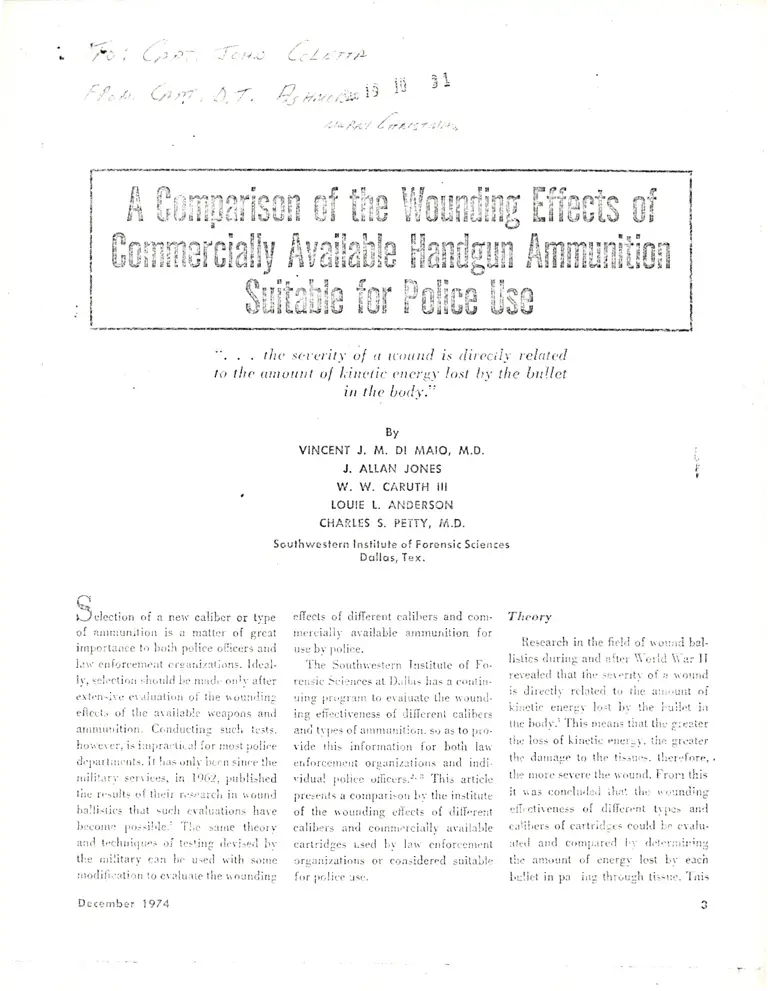
A Comparison of the Wounding Effects of Commercially Available Handgun Ammunition Suitable for Police Use
Unannotated Secondary Research
December, 1974
-
Case Files, Garner Working Files. A Comparison of the Wounding Effects of Commercially Available Handgun Ammunition Suitable for Police Use, 1974. b2d16dbb-33a8-f011-bbd3-000d3a53d084. LDF Archives, Thurgood Marshall Institute. https://ldfrecollection.org/archives/archives-search/archives-item/89a34b9e-e586-47c0-8fd8-d36f618e6506/a-comparison-of-the-wounding-effects-of-commercially-available-handgun-ammunition-suitable-for-police-use. Accessed September 29, 2026.
Copied!
•» f-'T' w' C /r.C C r i. ' ~r/i-
C/t i>7' A ^ n . ... 3 l
- - a F c / rrAo: -r'. ; - >
r
k P e>. I Mf ;fr: fj s î* H .i |j j r. f. 8 :; ,T» r?
i n I d u e i L m [fctc^ y y y y y U E i i i | ^ L i i y s ^ j i d 0
r n m m j i r n b p y B ^ / > ^ ? b h ! o k* |J S 21' t !. ̂ t j I y i! it-3 a 3 V a ^ I ' i s i J ^ ̂L f k t' £ s 3 a y w r u ii
fpi»? fi*
1 : i L a :l 0 • ,
I
/Tfe " " F 5 If B» S H
L y i i j ' i i y f e u i s U i j y i j y y y y
■'. . . tJic ■'̂ cvciity of (i icouikJ ks dirccih related
to the amount of Idnctic eneri’:y lost hy the bullet
in the body."
By
VINCENT J. M. D! MAIO, M.D.
J. ALLAN JONES
W. W. CARUTH III
LOUIE L. ANDERSON
CHARLES S, PETTY, M.D.
Southwestern Institute of Forensic Sciences
Dcrilas, Tex.
Q
t j election rif a r.eic caliber or type
of aniinunitioa is a niatter of great
importance fri both police officers ami
ia\c enforcetnent creani/rition?. Ideal
ly, selection slir.iild ire madr on'\- alter
extendi',e e\ aliialion of the Uinindin;'
eflcct.-. o) the a\aiial>!c ■.ceaj)on,s and
arnimmition. Crinducting sue!, te.sts.
lio'.veve:', is iaijiraetisa! for most police
dcpai tiuents. It ii.A.s uiilv ]'•( cn since the
iiiili’ary serv ices, in l',)f>2, juihli^hed
the n-.ults of theii rc.-j'arcli i.’i uoimd
hallistlc; that such cv aluation.- have
l.r-eomc j>os-i!ilc.' The same theoiv
and tccluii,jii>'s of tc>'ing devi-p.l hv
the military ca:i he used with some
niodifi.-ation to c\alu:Ue the \soundini:
effects of dilTerent calibers and coni-
meieiall)' available ainmuiiition for
use hv I'olice.
The .SiiUthv.estern Institute of Fo
rensic .''cis-nccs at D.dla- has a contin-
'.i!!ig progiain to e\aiuate the wound
ing etTectivenes.s of dilTerent calibers
arid t\ pes of amnuiiiilion. so as to pro
vide this information for Ijoth law
taifoicemeiit oiaani/ations and indi-
'■idua! j'oliee uincers.--’ Tliis articis!
presciits a comparison liv tlifr institute
of tlie wounding etTects of diif'-rent
calil)er.s ami commerciaiiv uvaila!>Ie
cartridges used lo- law onforcenient
orga.'ii/ations or considered snitahle
for police jsf.
Theory
Hcscarch in tlie field of woit.’id bal
listics during and c.ftei o'.ld \\ ar II
revealed lliat tiie se\entv- of wound
is directly related to tiic atmmnt of
kinetic energy Irut liv tlie i-u’del in
Itie iiodv.' '! ids meaii= ttiat tiie gieatcr
tiie loss of kinetic ener_\. tlif; greater
li’ t' damage to tlie tisstic.--. ihei-sfore, ,
tlie itioie severe tlie ivouml. i'roi'i this
it was concluded di.;-. tie: I'lc.ind'iig
eil'ctiveness of dilTerent t\ pcs ami
Oii'iher.s of carlrid..ts could be evalu
ated and cotnp.ired I '.' dc!en;iii-'ng
tiie amount of energy lost by each
I'uilet in pa ing througli tis'Ue. Tnis
December 1974
lu’fame more workalile v̂■̂ en
?ulisc(|urnt re.-carcli icsealed tluU for
pN[ierinicntiil |)urjio~es ' lock? of 20
j erct'iu "clatin al 10 ̂ C could be &u’h-
?ti!ulcd for human tissue.' At tlii?
|»ciiul. it should he pointed o\it that it
is m.t the total amount of kint'-ic
energv that a l)ullet lose? in tissue that
is of importance; rather, it is the on
er,cv dcliM'ied to vital organs, i.e.,
brain, hcait. hings. and liver, th.at
cau?c‘s iiicai'.acitalion. In view of tiu?,
blocks of gelatin lo cm in depth are
used for testing. Penetration by a bul
let be\ond 15 cm ( a[i])roximately 6
inchest is not important, because L̂e-
vond this de])th the bullet v̂ould have
struck or bypassed the major organs
or would have exited from the hody.-' ̂
Using the aforementioned research
tlieories and techni([ues, it is now jios-
sihle to compare the wounding effect
of different calibers and types of car-
tridues hv dt|termining the amount of
kinetic energy lost by bullets passing
through a gelatin block.
Molhods
The tests were conducted at a range
of 15 feet from mur/lc to gelatin block,
usina weapons of the type commonly
earrie<l by jjolice officers: a Smith &
\\ esson 9 mm. Model 39 semiauto
malie pistol; a Colt .3f! Super semi-
TAHI.E I
Kinatir. Encipy Lost In Cfdatin Jilochs by I'nrious Brands o j 9 rnni
ParabrUmn Cm tridnes ■
nuilet .Mozzle Kinetic
Mamiraetorrrr w t St\ tc ’ % clouit V encrfTv lost
(firairi'i) -1-1 SI)I s I SI)
(ft/s) (ft-ll.)
W ineho.stcr........... 11.5 F.MJ 1,132:1; 37 107±.15
Aiorma................... l i e lA U 1,I65-J:3() 110.-U13
R em in gton ........... 121 F.M.T l ,1 0 8 ± l l 110+22
Stnilii & W os.son. ICO FAU 1,2192:18 129:r9
D o ................... 115 ICM.J 1,175 1:36 130 + 21
D o ................... 115 F.M.T-SWC l,160i-28 176-J;27
W inehesler ’ ........ 100 SP 1,305±21 271 ± 60
Smith tS: Wesson. 115 JHP 1,156±30 323;t21
R em in gton ........... 115 JUP 1,196 ±18 330 ± 11
Super \ e l ............. 90 JUP 1,382+17 .377 ± 1 5
* F.MJ— full fYicta! j a c k f l , F.M.f-S'i\C— full
S F — so ft p o in t , J l lP — ja r k e t o d l io l low p o in t .
- S I )— starulard <leviation,
̂ ‘ 'IV>’.vcr jK>int,”
m eta l ja ek et -sem i^ v a d cu Iter
TABLE II
K inetic Enemy Lost in Gelatin Blochs by I ’uriotis Brands o f .38
automatic pistol: a Colt .15, Model
1911 A-1 semiautomatic pistol; a
Smith & Wesson .33 Special revolver.
Model 15 with a bin barrel; a Smith
k Wesson .357 .Magnum revolver.
Model 23 \\ ith a 1-in barrel: a Smith.?;
W esson .11 .Me.gmim revolver, .Modd
53 'Ailh a bin hanel; and a Smith X
W esson .1 f Magnum revolver, Model
29 witli a bin barrel. Firing.? were
made through 20 jiereent gelatin
blocks 16 cm in height, 16 cm m
width, and 15 cm in depth which were
kept at a tempe.ature of 10 ̂ C. Gela
tin speeifiealK' ])rodueed for such
.-ludli'- was ii-ed.' I Iw \elocily of each
hnllel prior to entering the block, a?
well as on exilimr, Acas determined.
. iti t o , *3o Super, and .13 in to . inirnnnilion
Hlillct .Mii/,/,te Kinetic
Cal iber/ c i:;! 11 StNie '■ M‘locil> encr^v lost
mamj faeJ urer (,'Z rains) s 1 Sl)2 s o
(ft/s) (ft-lh)
.38 Auto
R em ington . . 130 FM.1 1,0312:11 !01g;5
.38 .Super
W inefi>'ster. . 130 F.MJ 1,208 + 21 138 + 76
Sujier \ i,d . . . 107 JllP 1,281+20 376 ± 1 7
.15 .Arilo
(^ /f lem in gton . . 230 F.AI.I 8 I2 ± 8 117±6
.\orma........... 2,30 J1FP 812±2 l 170.+ 18
\ m r o n ........... 180 ■Mlenii” 979±21 1882:11
R em in gton . . 185 JHP 91 f ± l l 272:1; 11
Super A e l . . . 190 JHP 1,0.53±17 319±51
----------- ----- ---------- _ --------- ..— —----- ---------
' 1M |—ftifl mtlal jarl ,el, — jai-kotrd lioIloA> point, Humi" —lu minpher-
leal J a e K e l I il -o f t p o i o l .
" ,*sI)— s ta o i !a r< ! iIo\ ra t io n .
It
li
tl
h.
I
i!
b
hi
F
If
u
a I
9
T
j-
10
th
in
in
rc
FBI Low Enforcement Bulletin
lisin;’, t'vo rliionoginph-'. The kinetic
enci';:> was couijaiti'il, using the
foinmla kE- II I ■“/ 2 .,., witli II' being
ti’f 'aeight of the ljullel. I tlic vefocity,
aiifl g the gravitational nrceleration.
Ihilhls were recovercil and weighed
to determine any loss of weiglit in
passing through the hlock, as this
would alter the detei inination of the
exit kinetic, cnengy.
Ilcsidis
9 inm PurnheUum iLugCT)
Idle 9 mm is truly an international
round, used hv more military and j)o-
lice grou])s throughout the world
than any other caliber. Onh recently
has it begun to gain [)opularity in the
I'nited State.', with, the introduction of
the Sjiiith & \\’esson Model 39 and
Model 59 semiautomatic pistols. Table
1 gives the loss of kinetic energy in
gelatin blocks by the 9 mm Parabel-
lum cartridges tested. The six full
metal jacket (F.MJ ) loadings tested
were equal or superior in wounding
effectiveness to the 230 grain (gr)
FMJ .15 Automatic loadings (table
II) and markedly superior to the tra
ditional 153 gr round nose (KN) .33
Special loading.- i table 1111. This su
periority is slniwn by the greater
amounts of kinetic energv lost bv the
9 nun bullet.- in the gelatin blocks.
The 9 mm .Smith & W'esson full metal
jacket, semiwadcutter (FMJ-SWCl
lor'ding lost the most kinetic energv of
die full mcial ja.cket rounds, equaling
some of the .3i.l .special jacketed soft
point and imllow point loadings. The
9 mm Winchester ft)0 gr "l^ower
Point’ " jacketed soft jroint (J.FP)
showed even better jierformance, be
ing .siirpas.-ed in the .33 Siiecial loatl-
ings by only three of the hollow point
rounds. The 9 mm jacketed hollow
jjoiiit (.HIP) loadings make tiiis car
tridge su[)erior to most .33 Special
loadings and a number of the .357
Magnum .soft point and hollow jioint
loading.s.
T AP.i .i : m
Kinrtir Kncray Lost in CfInliii fllocks by ,3H S[><‘rial . ini rnnni lion
liollet Mu//h‘ Kirulic.Mami fad iir<*r >V4M̂Kt Sl\Ic ' A cloci tA t'n<T;:A lo*.t(liraiii-) ±1 SD- ■ i .S,'»
(I't/s) (It-l!,)
lî .‘m in g lo n ........................ 200 KN 061 ± 10 57 ± 7
\̂\ inchixsler........... 153 KN 789±13 72 sc 5
Kom itigton ........... 153 SAAC 775 ± 16 3'3 ±.3
D o................... 153 KN 713 ± 9 T7±18
T’fdt-ral ........................................ 158 KN 810 ± 8 79--3
AN iiK'lie.ster........... 200 KN 078 ±11 3fri-5
Do.................... 1.58 SAAC: 801±10 9 1 - 5
R em iiiu t 'm ........... 1.53 KN 989±18 97 ± 8
AN iaehosicr ........... 1.53 SAAC 930 ±27 1 3 0 ± n
AN o l e r n ................. L50 MI" 972 ± 2 0 I30±22
Ivem inglon.......... 118 AVC 719 ±17 1 n ± 7
iSorma................... 158 JHP 792±21 H 0 ± 2 9
SjH’cr ...................... 125 JSP 1,093 ±37 159 ± 3 2
Smith & Wesson. 158 JHP 909 ±19 3 i 1
D o.................... 110 JHP 1,077 ±11 188 ± 8
Su{)cr A e l .............. 110 JSP 1,M 7±42 195 ±21
iMlt ( 'min'.'ton........... 125 JHP 9 n ± 1 5 239 ± 8
Super AT‘l .............. n o JHP 1,089± 12 2 5 9 -1 1
AN im lic.sler.......... 158 HP 951 ±11 261 ± 3
Smith iN AA esson. 125 JHP 1,189 ±37 295 ± 3 2
R c m in " lo i i .......... 95 JHP 1,2 i0 ± 15 312±3
N orm a................... n o JHP 1 1 3z 3 9 i ; - n
̂ KN—rmiml ( . — tfm 11 r, MT— nutal 1, \vc—V.U.I-
riiUer, .IH!'—iiU'kcUd hollow jloint, JSI*-—jarUeled >oft jn.int. i i ! * — ho I loAv'
j>oin t.
* S I ) -—sliiu(Jar<l dc\ ia l ion .
.38 Super ami .38 Automatic
1 he .33 .Super cartridge .should be
u.sed In jnefercnce to the .38 Auto
matic ill all modern .38 seniiaiitomatic
pistols f table 11). Ih.th cartridges are
loaded with. 130 gr F.M.T hiillets. Roth
of those .38 auto cartridges are imuph-
ly conqiarable in wounding elective-
ness to the 9 nmi F.MJ-KN hullets,
with the .33 Supiir .-omewhat superior
to the .38 auto cartridge. The Sniier
Vel 107 gr .HIP rnoie than douhle.s the
wounding effectiveness of the .33
Su[)er cartridge, making it as effective
as the 9 mm hollou point loading-.
.45 Automatic
This has been the ofhrial U.S. ,\rmy
carliidue îiu'c 1911, and nia.nv nn'lis
leave arisen concerning its effective-
ne.ss. Contrarv to these st.iiics. the
standard mililarv loading witii a 239
■jr I .MJ hiilirt is no more . fl-.-ctive
'nan the traditional 9 mm IM.I rnund.
iioth of these li'adings !o-e about tlie
'.mic kinetic cncig'. in gri.itin hi"cks.
The Aorrna JlIP and .Amron ■■Itemi"’
1 .1 jacketed soft point' are somewhat
more efreetive llian the tradilii.ma! .15
FMJ loading I table II). The Norma
JHP does mt exp-and in e ither gelatin
December 1974
■ir the iuimjn t'0(h. It m;iv cause fuiif'-
ti'Uiiiig iliiriciilties in some cutis, he-
catisc of tile exjioscd lead tip. d lie
,\niron lajund may also cause func-
tiouiiic diinrullies, liecause of tlie
sltort. stubbv nature of the bullet u itli
tin exjH'. r̂tl lead tip. The .15 Super \ e!
j l lP i ' three times as effectiie as the
FMJ military rnnnd. The Super Vel,
like the .\orma liollow point, does
not expand =icnificantlv in either gela
tin or tile bndv. The increased uound-
ing elTectiveness of this round is due
to its increti'ed velocity and the blunt
nose diape. necessitated by the hollow
point at the tip. Tlie Iveniington 1R5
gr JllP fulls between the Amron and
the Super Vel rounds in its wounding
effectiveness. The amount of kinetic
energy lost by the Super Vel .-1-5 JIIP
load and that lost hy the three 9 mm
JllP loadings tested is essentially the
same. Thus, the wounding capability
of these cartridges is also equal.
.38 Special
\elocily round is commerciallv avail
able and sold to the general public,
dhe high velocity round is signifi
cantly .superior to the rounrl nose
Imllets and other semiwadcutter
bullets. ,\n unexpected finding, first re
ported in our previous study, was the
e.xcclleiit performance of the target
wadcutter bullet, which lost IT)- ft-lb
of energy in the gelatin block, making
it one of the better of the all lead load
ings.'
Two jacketed soft point loadings
were evaluated, the Speer 125 gr J5P
and the Super Vel 110 gr JSP. The
latter one showed better performance,
losing a greater amount of kinetic
energy in the gelatin block.
The JHP cartridges showed great
variation in performance, depending
on the brand and bullet weight. As a
general rule, the higher the velocity,
the better the performance. The Nor-
shoot, however, lipcausc of jmcoiL.(lil
p~f'oMn'|s Mm'y th-'-- Pemington 1*>.5
gr J11P rvas the .sccoiid nio.st elTective
round/ During the present tests, it
dropped from second to sixth place.
This was a^narentlv due to ihe fact
that the mu/./le velocity was reducejj
from 1155-/21 feet per second fft/^)
to 9T1±15 ft s, Tn addition, the
quAiaier ap|ears to liav>- been rli.any-cd
from hall to (lake. T lie I’ eininetnn 0.5
gr J11 P loM all it' enerev m [lip.
l̂ toc’kT'ihe only hnllmv
point bullet tested wa~ the V inrhester
loR jrM IP. Thi- round showed ex
cellent t>erfornialTce~and was~~iileasant_
lQ_£ilQi>t.
.357 .Magnum.
The standard 158 gr lead SWC load
ing in this round lost 166:^19 ft-lh
of energy in a gelatin block (table
IV). The hollow points, with two ex-
The .38 Special is the cartridge
most widely used hy police in the
United States. In tlie past few years,
many laiv enforcement organizations
have expressed dissatisfaction with
the wourulitig effectiveness of this car
tridge. Ilevause of this dissatisfaction,
many organizations have begun using
the new high velocity .38 Special load
ings or have shifted to the use of other
weapons, such as tlie .357 or .11 Mag
num. The traditional 158 gr round
nose i’R\) loadings for the .38 Sjiecial
are rela!i\elv ineffective, losing only
72 to 79 ft-lh ( foot-pound.sl of energy
in the gelatin block (table f i l l . One
brand of the 200 gr PN is less effec
tive than the 158 gr KN, ivliile another
brand is .-̂ liglilU' more effective. Win-
clipster oilers a 158 gr lead semiwad
cutter iSWCl cartridge in either a
stand,ird velocit'’ or a high velocity
loading. 1 lie standard velocity round
is apparently a special loading for
some police ageneies. while the high
J S I '—jiirlvutcil M>ft point.
̂ S I ) —'St iunK ird
\s
it
.M
in
a I':
in
m:
Vi
in
tlie
Sp-
loa
roi
formance of all the .38 SpCyipl c.Tr- hlncl'< The most elfective round test- tioi
tridges tested. It was unpleasant to ed was the Remington 125 gr JHP, ant
TABLE IV
K in et ic En ergy Los t in Gelatin Bloch 'S 357 .Magnum . i mm unit ion /•:/;
nuiict .Muzzle Kinetic
Manu f.icturfr \v <*i;iht Stj le ' volocit V cner<!v lost
(praiiis) ± i SD
(ft/s) (ft-ii,)
K em in gton ........... 1.58 SW'C l , I 9 1 i l 9 166±19 —
cstern ................. 158 .5 IT l,206i:51 209 ±-44 .41
Sniiili lit Wesson. 158 . m r 1,060 ± 2 3 212;::15
D o ................... 158 .JSP 1,078 ±53 280 ± 5 0
D o .................... 125 ■JHP 1.153 ± 43 280 ±47
K en iin gton ........... 158 .JSP l,217±25 28 4 ± 29 .44
W estern ................. 158 JSP 1,180 ± 22 .334 + 31
RiMiiiiiglon........... L58 JllP 1,170 ± 2 5 369 ± 3 6 .14
Sii per V e l .............. no JHP 1,296 ± 74 371 + 36
Sm ith tS; Wesson. 110 JHP I,.337 ± 5 9 393 + 36
W estern ................. 110 JHP 1,282 ±25 393±12
D o .................... 158 JHP 1,169 ±31 102±19
R e m in g ton ........... 125 JHP 1,331 ± 27 423±27
’ SVrT!-—.*;<*miwaflruttcr, MT—inctui lippe;). JII!'—j:u4ictiil ljol!o\»' point, I
j.ail-
1 •,
FBI Law finforcement Bullatin Dec
c
it
'
j.-t
..:(i
'a')
; i M
:' I u'
-ti’ r
cx-
:,r.t
■;-lh
I [lie
e:<-
the
est-
HP.
Vviiic'h lo.'l 123:t:27 fl-11) of energy.
It is of interest that the Smith & \\ es-
?on ].5;i gr JSP outjiei formed its liol-
!o k point version of the same weigiit
and that the Smitli & W esson 12.3 gr
JlIP cartrirlgc in .'I!! Special and .3.37
Magnum are equal in wounding ef
fectiveness. The hollow and soft load
ings for the .337 rartridges as a group
are otdy slightly superior in ^̂ •cû d-
ing effer liveness to the 0 nitn and .38
Sjteeial hollow ])oinl cartridges.
.41 Magnum
This round rvas developed to fdl the
gap hetween the .357 and .'I-l- -3Iag-
iiuins. Two loads are available, a 210
gr lead SWC and a 210 gr JSP (table
V ). I'he seiniwadcutter load is inferior
in wounding cfi'cctiveiiess to almost all
the .357 cartridges, most of the .38
Specials n i ’ 's, and all of the 9 mm HP
loadings. The jacketed soft point
round is superior to all the aforemen
tioned calibers: horvever. it is unpleas
ant to shoot, with its heavy recoil.
.44 Magnum
In wounding elTertix'eiiess, niensurcil
by loss of kinetic energy in gelatin
blocks, this is the most rdfecti\'e ealilrer
tested ( tahk' Vl. Lnforinnately, the
availalile loadings are extremely un
pleasant to shoot, because of the heavy
recoil. Rased on tlie high exit velocities
and energies from gelatin blocks, this
cidiber rvill prohaldy jjass through a
body, endangering innocent hvstand-
ers. Because of excessive recoil, this
caliber should he used only by an ex
perienced shooter. The, .4d- Magnum
as piesently loaded is essentially a
hunting round, rather than a police
load.
Some police officers, to avoid the
excessive recoil of the .-l-l Magnum,
load their weaj.'on witli .44 Sjiecial
rounds. Our tests revealed, however,
that this latter cartridge, factory load
ed with a 246 gr bullet, is less effiective
than almost all .33 Special cartridges.
TABT.E y
K inetic Energy Lost in Gelatin Blocks by Various Brancl.s o f .41
Magmiin, .44 Special, and .44 Magniun Cartridges
C alt i jer /
r ra m u fa c lu rrr
r.uUvt
M ci<i:h I
(t;rains)
8 l> 3e *
Mu77.1o
>eIocilv
.SIP
( f t / s )
K in e t ic
enerfrv lost
-i;TSl>
,41 IMagiuini
Uonungt o n .
D o .......
, 1 1 .'Special
I io in ington .
.11 -Magnuru
llon iingtoti .
Super \ c l . .
W in d ie s tc r .
R em in g to n .
D o .........
210
210
246
210
lao
210
210
210
SWC
.JSP
R.\
.ISP
.DIP
Jfli*
SWC
.]!TP
961 ± 20
i , 239 ± 33
660 ±18
1,2,31 ± 30
1,112 ±13
1 .268-23
1,263 ±31
1,221± 13
188 ± 36
300 ± -1.8
69:r;3
5 !3± 60
365 ± 89
621 ± 3 9
636 ±-15
639 ± 38
' S W C — .-enviwaOi'uUer, .T-Sl’— ^^jucKelcO so f t p o in t , f ! \ — roiirnl no-;c, j I H ’-
ja c lsc ted p o in t .
3 — f j i i i x l a r d ( leN ia t ioa .
December 1974
('onchision
The cartridges tested for this report
are a good representation of currently
available commercial handgun ammu
nition. Choice of a ['articular caliber
or cartridge by an individual or de
partment dcjjends not only on the
wounding effiectiveness of the purticu-
kir ammunition or caliber, but also
on: the weapon to be used; the aver
age police oflicer’s tolerance to recoil;
“ The problem of re
coil and muzzle hla.sts
and its effect on officers
should be considered
nhen choosing u nexc
caliber or cartridge."
the duties to be [terformed: whether
(he new ammunition will endanger in
nocent bystanders; public relations;
and the economic question of a
changeover in caliber or ammunition.
Our research was concerned princi
pally with the effectiveness of differ
ent calibers and brands of ammuni
tion. In our testing, we did collect
some additional data and lm[jiessions
that might influence the choice of a
weapon and caliber. .An example is
tb.e severe recoil of the .41 Magnum
and .44 Magnum, which, we feel,
make them unsuitable for general
police use. In addition, these rounds
t?;id to overpenetrate and tlms are
capabie. of injuring iaiiocent by
standers.
/ 'in the semiautoinatic [dsiol field,
j we found that the 9 mm loadings are
pleasant to shoot, Iti view of the wide
range and the excellent [)crformances
of the 9 i7im loadings, as well as tl.e
equality in wounding effectiveness
with the .15 .Automatic, the 9 mrn is
j uM̂ jably the be.st a va i la hi e call her for
}x>lice use, if a semiautomatic [listiil
is to he used. In revolver.-, the ,38
is still the best ov r̂.-i!! cajiher
the new liiizli velocity loaflitiL’ ,̂
t!ii< toiiml can nou' ilujilicatc the i)cr-
forii’.auces of many of the .357 cac-
triilye.'. Some of tlie liitrli \elocity
loadin;rs for the .‘Aii should not be fireJ
in at}J 'or alloy frame revolvers
due to the extremt* pressure de\eloped.
Fne {)rnblem of recoil and muzzle
blasts and its effect on officers sliould
be coii'idered ’.vhen choosinc: a new
caliber or carlridae. Beginning with
the .357 Magnum and jirogressing to
the .1 1 Magnum, there is an increas
ing tendency towards flinching, pro
duced by tlie greater recoil in these
weapons. Fear of the weapon and/or
ammunition used in the magnum
cartridge class works to neutralize any
added benefits from these rounds. If
a jiolice officer fears his gun, he is
unable to fire it well and any advan
tage gained by new high velocity-
loadings or a larger caliber is lost.
The problem of public relations
may come up, ^sjiecially with the use
of hollow point ammunition. Myths
have arisen about the terrible wounds
caused by hollow point ]>istol bullets.
Such stories arc complete nonsense.
Pistol bullets, even the new high
\elocity loadings, are in reality low
%ciocity [trojectiles. At autopsy, one
cannot -[.'ecifically tell from the extent
of th e injury if an individual has been
shot by a .-33 Special 153 gr R\ lead
bullet travelling at 789 ft/s or a 110
gr Norma HP at 1334 ft/s.
■Similar stories concerning mutilat
ing injuries hn\e arisen about the
magnum calibers and the ..15 .\uto-
matic. These cartridges and calibers
again do not cause jiarticularly mu
tilating injuries. The wounds pro
duced usually cannot be differentiated
from those of the traditional 153 gr
BN .33 Special bullet.
A final point to be made in dis
cussing our evaluation of different
lirands of ammunition has to do with
( hanges in manufacturing of ammuni
tion. Many of the ammunition manu
facturers will change the type of
powder and powder loadings in their
cartridges rvithout any notice. I.ess
commonly, they rvili alter the con
struction of the bullet loaded in a
cartridge. Such changes can alter the
ballistic [lerformances of the fired
bullets. This was demonstrated in the
case of the .33 Special Remington 125
gr JHP cartridge, mentioned previ
ously. Therefore, before adoption of
a particular cartridge, it would be best
to check with the manufacturer to see
if he has made any alteration in the
loading for this particular cartridge.
Any loading change in which there is
a decrease in velocity may cause a sig
nificant decrease in performance.
REFERENCES
’ Ri*y**r, J. r . (i^ilitor): “ Woiiii'l nalli-tirs.”
of Ini'* 5 ur?'’ o;i General, Department of the .Army; U.S.
Cov<*rnmr-nf Printin;: Otfu-p, Washington, D.C., 1962.
-DiMaio, V. J. M., J. A. Jones, ami C. 5 . Petty:
“ Ammtinitlon for Polit-e.’ * A comparison of the woun'I*
ing ctTrcts of cornrnircially available cartrlilgcs, J
Police Sri and Administration, 1 :26f*-27S, 1973.
-■*niMain, V. J. M.. J. A. Jones, W. W. Caruth,
I-. f.. An'l'Tson, and C. S. Potty; “ The Effcctivrncsi
of Kevolvrrs and Small Automatic Pi*tols”
(in nrep.irjtion).
LD! l Oli'S ?\OTK: Malrrud and arli(drs piihlislipd in tlw 1'1>1
!.(ur ]-.ttjorcvnu‘ nt Ihillnlin arc solely fo r the informalion and
assistame o f laiv enforcem ent ineinhers. ]\ hile brand names
and companies may he mentioned from time to time, this is
done in a strictly ohjeeliie manner to help present stories iti
their entirely from aathorilalire sources. In snrh inslanees,
l/iildii alion o f the article in the HI should not. under
an\ ( hull rn stances, he const rued as fin enilorsement or an ap-
proval o f any partii iiliir iirodiict, s<>ri iri'. or eniiipmenl hy tin'
} HI.
LAW ENFORCEMENT
OFFICERS KILLED.
According to informalion col
lected through the FRFs Uni
form Crime Reiiorting Program,
five law enforcement officers
were killed due to criminal ac
tion in Sejilemlier 1974.
During the first 9 months of
1971, 95 local, coimtv. State,
and F ederal law enforcement of-
fic ers were killed due to crimi
nal action. In the same period in
19i,3. Ril olficers were slain.
FMrty-two otlicers \sere killed
in the Southern States, 26 in
the North Central States, 14 in
the Western Stales, 9 in the
Northeastern States, and 4 in
Puerto Rico. Twenty-eight of
ficers were slain handling dis-
tiirhance calls, 18 while attempt
ing arrests for crimes other than
robbery or burglary, 17 in con
nection with rohherv matters,
11 rvhile investigating suspi
cious jicrsons, 6 in connection
with burglary matters, 5 while
making traffic stops, 6 in un
provoked or premeditated am-
Inish-lype attacks, and 4 while
handling prisoners.
All hut two of the oflicers j
were killed hy firearms. Hand
guns were used in 65 of the
killiims.
AGGRAVATED
ASSAULT
During calendar year 1973,
there were an estimated -116,270
aggravated assaults in tlie Na
tion. 1 his is a 7-percenl increase,
or 27,300 additiomd olTcnses
o\cr 1972.
FBI Law Enforcement Bulletin