Motion for Oral Argument on Pending Motions Concerning Representation
Public Court Documents
June 19, 1990
3 pages
-
Case Files, LULAC and Houston Lawyers Association v. Attorney General of Texas Hardbacks, Briefs, and Trial Transcript. Motion for Oral Argument on Pending Motions Concerning Representation, 1990. c4e8860c-1c7c-f011-b4cc-7c1e52649b7e. LDF Archives, Thurgood Marshall Institute. https://ldfrecollection.org/archives/archives-search/archives-item/8a383fb2-33dd-4dac-b012-f15e321dc36d/motion-for-oral-argument-on-pending-motions-concerning-representation. Accessed October 06, 2026.
Copied!
    UNITED STATES COURT OF APPEALS
FIFTH CIRCUIT

LEAGUE OF UNITED LATIN
AMERICAN CITIZENS, et al.,

Plaintiffs-Appellees,

VS. No. 90-8014

JIM MATTOX, et al.,
Defendants-Appellants. on


Go
n

Co
n

Lo
n

Ao
n

Ao
n

Un


Un


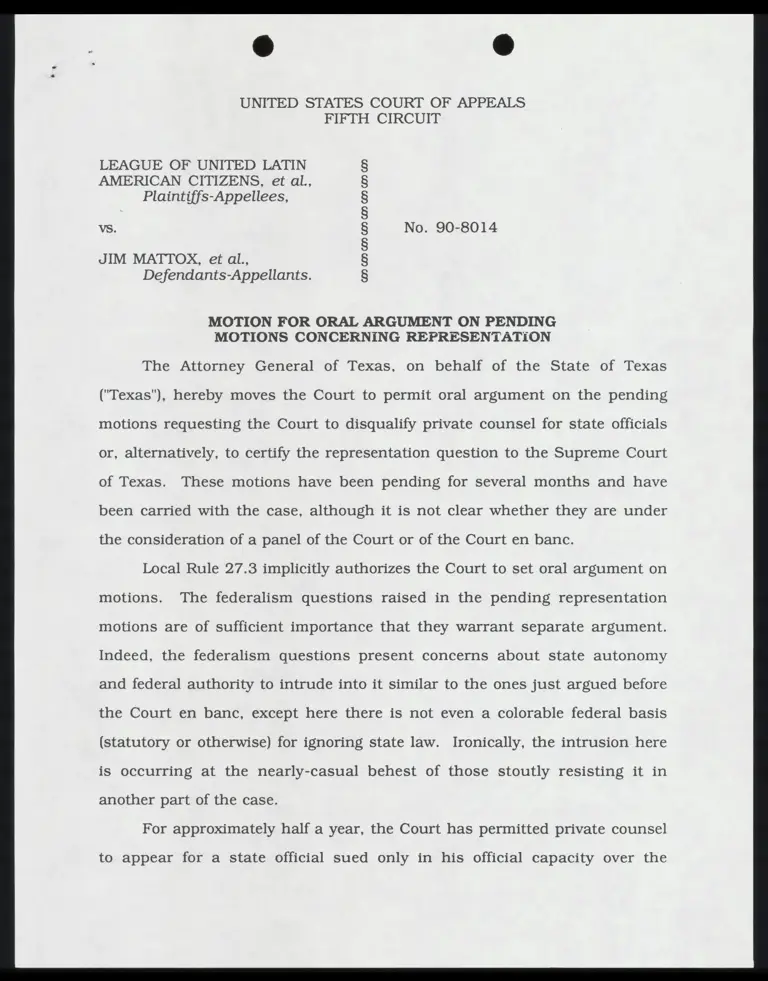
MOTION FOR ORAL ARGUMENT ON PENDING
MOTIONS CONCERNING REPRESENTATION

The Attorney General of Texas, on behalf of the State of Texas

("Texas"), hereby moves the Court to permit oral argument on the pending

motions requesting the Court to disqualify private counsel for state officials

or, alternatively, to certify the representation question to the Supreme Court

of Texas. These motions have been pending for several months and have

been carried with the case, although it is not clear whether they are under

the consideration of a panel of the Court or of the Court en banc.

Local Rule 27.3 implicitly authorizes the Court to set oral argument on

motions. The federalism questions raised in the pending representation

motions are of sufficient importance that they warrant separate argument.

Indeed, the federalism questions present concerns about state autonomy

and federal authority to intrude into it similar to the ones just argued before

the Court en banc, except here there is not even a colorable federal basis

(statutory or otherwise) for ignoring state law. Ironically, the intrusion here

is occurring at the nearly-casual behest of those stoutly resisting it in

another part of the case.

For approximately half a year, the Court has permitted private counsel

to appear for a state official sued only in his official capacity over the


repeated objections of the Attorney General of Texas who is the only official

authorized by state law (which governs here on this question) to appear

before this Court on behalf of state officials sued in their official capacity.

Thus, there has been a daily derogation of the state constitutional authority

vested in the elected legal representative of the people of Texas with

absolutely no explanation of its legal basis. In effect, a rule of law has been

established which overrules a prior panel decision without citation to any

authority. This new legal principle permits unilateral usurpation of state

allocations of fundamental state power through the unilateral actions of

private attorneys acting at the behest of state officials who simply ignore

their state constitution. One of the most troubling aspects of these actions

is that written entreaties that this crucial matter be confronted by the Court

have proven unavailing.

That the Court probably would not view the rule of law that has been

effectively established to be a rule of law that it would conclude is warranted

suggests that the matter deserves full consideration. Such full consideration

can come only with the presentation of oral argument. Simply ignoring the

question makes law, but, especially on a matter of such importance to

concerns of federalism and comity, such an approach seems antithetical to

the function of federal courts. If the Court intends to rule that the Texas

Constitution may be disregarded here (a legally baseless proposition), then

Texas urges the Court to do so in a written opinion after oral argument on

the question. At this point, all Texas knows is that its constitution is being

ignored. It does not know why.


Respectfully submitted,

JIM MATTOX
Attorney General of Texas

MARY F. KELLER
First Assistant Attorney General

Crd is. 2A
RENEA HICKS
Special Assistant Attorney General


JAVIER GUAJARDO
Assistant Attorney Gerieral

P. O. Box 12548, Capitol Station
Austin, Texas 78711-2548
(512) 463-2085

CERTIFICATE OF SERVICE

I certify that on this 19th day of June, 1990, I sent a copy of the
foregoing document by first class United States mail, postage prepaid, to
each of the following: William L. Garrett, Garrett, Thompson & Chang, 8300
Douglas, Suite 800, Dallas, Texas 75225; Rolando Rios, Southwest Voter
Registration & Education Project, 201 N. St. Mary's, Suite 521, San Antonio,
Texas 78205; Sherrilyn A. Ifill, NAACP Legal Defense and Educational Fund,
Inc., 99 Hudson Street, 16th Floor, New York, New York 10013; Gabrielle K.
McDonald, 301 Congress Avenue, Suite 2050, Austin, Texas 78701; Edward
B. Cloutman, III, Mullinax, Wells, Baab & Cloutman, P.C., 3301 Elm Street,
Dallas, Texas 75226-1637; J. Eugene Clements, Porter & Clements, 700
Louisiana, Suite 3500, Houston, Texas 77002-2730; Robert H. Mow, Jr.,
Hughes & Luce, 2800 Momentum Place, 1717 Main Street, Dallas, Texas
75201; John L. Hill, Jr., Liddell, Sapp, Zivley, Hill & LaBocn, 3300 Texas
Commerce Tower, Houston, Texas 77002; Walter L. Irvin, 5787 South
Hampton Road, Suite 210, Lock Box 122, Dallas, Texas 75232-2255; James
George, Jr., Graves, Dougherty, Hearon & Moody, NCNB Tower, Suite 3500,
515 Congress Ave., 6th & Congress, Austin, Texas 78711; Paul Strohl, 100
Founders Square, 900 Jackson Street, Dallas, Texas 75202; Susan
Finkelstein, Texas Rural Legal Aid, Inc., 201 N. St. Mary's, Suite 600, San
Antonio, Texas 78205; and Seagal V. Wheatley, Oppenheimer, Rosenberg,
Kelleher & Wheatley, Inc., 711 Navarro, Sixth Floor, San Antonio, Texas

CV diohs,
Renea Hicks


-3-