SC Electric and Gas Company v Flemming Motion to Affirm
Public Court Documents
October 1, 1955
17 pages
-
Brief Collection, LDF Court Filings. SC Electric and Gas Company v Flemming Motion to Affirm, 1955. aa7a36e0-c49a-ee11-be37-00224827e97b. LDF Archives, Thurgood Marshall Institute. https://ldfrecollection.org/archives/archives-search/archives-item/8acd115b-13b6-45d1-af8c-a0bba15bedf8/sc-electric-and-gas-company-v-flemming-motion-to-affirm. Accessed October 06, 2026.
Copied!
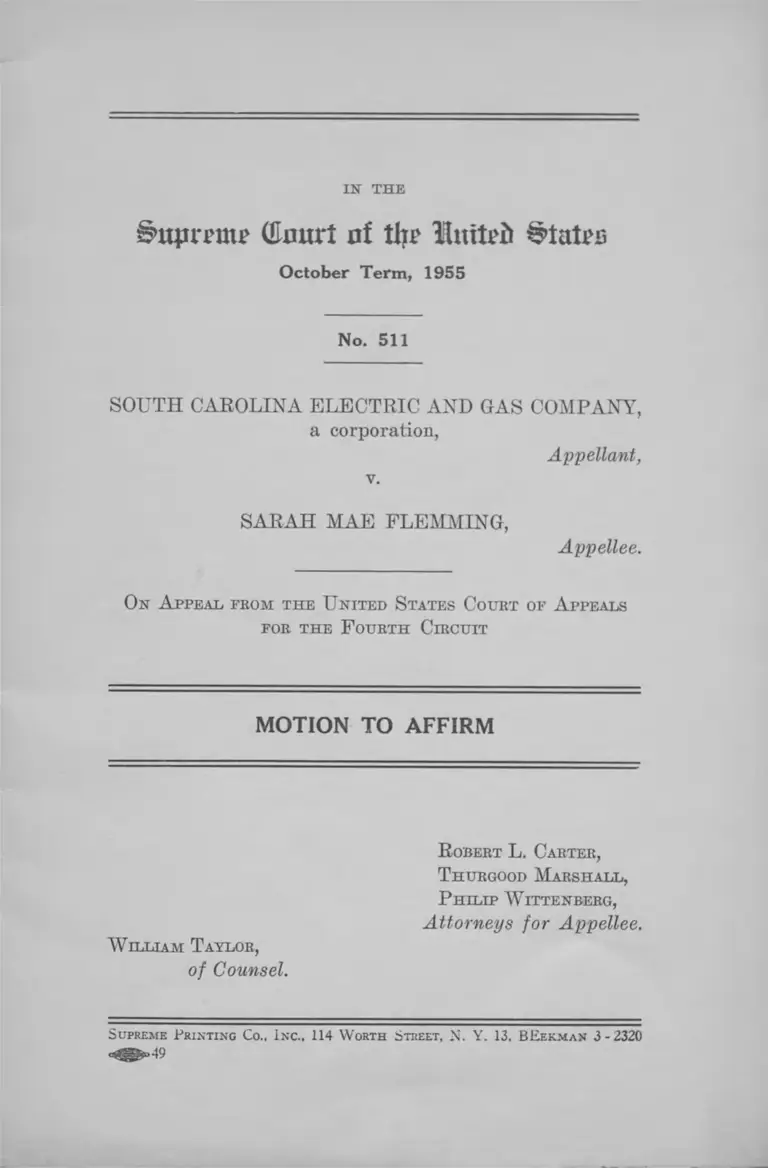
IN TH E
§>uju*ruu> (Eciurt nf tin' United States
October Term, 1955
No. 511
SOUTH CAROLINA ELECTRIC AND GAS COMPANY,
a corporation,
Appellant,
v.
SARAH MAE FLEMMING,
Appellee.
On A ppeal from the U nited S tates Court of A ppeals
for the F ourth Circuit
MOTION TO AFFIRM
W illiam Taylor,
of Counsel.
R obert L. Carter,
T hurgood Marshall,
P hilip W ittenberg,
Attorneys for Appellee.
Supreme Printing Co.. I nc., 114 W orth Street, N. Y. 13. BEekman 3-2320
<*̂ §£■>49
TABLE OF CONTENTS
PAGE
Statement ..................................................................... 1
S ta tu te s ......................................................................... 4
Argument ...................................................................... 6
Table of Cases Cited
Bolling v. Sharpe, 347 U. S. 497 ................................ 6, 7, 8
Brown v. Board of Education, 347 U. S. 483 ......... 6, 8
Buchanan v. Warley, 245 U. S. 6 0 ............................ 6, 8
Dawson v. Mayor, 220 F. 2d 386 (CA 4th 1955)........ 8
Dawson v. Mayor, — U. S. — ..................................... 6
Henderson v. United States, 339 U. S. 816 ......... 7, 9,10,11
Holmes v. City of Atlanta, — U. S. — ..................... 6
Keyes v. Carolina Coach Co., — I. C. C. — ............. 7
Mitchell v. United States, 313 U. S. 8 8 ...................... 9
Moore v. Atlantic Coast Line R. Co., 98 F. Supp. 375
(E. D. Pa. 1951) ........................................................... 12
Morgan v. Virginia, 328 U. S. 374 ............................ 7, 8
National Association for the Advancement of Colored
People v. St. Louis-San Francisco Ry. Co., —
I. C. C. — .............................................................. 7
Picking v. Penn. R. R. Co., 151 F. 2d 240 (CA 3rd
1945) .............................................................................. 12
Plessy v. Ferguson, 163 U. S. 537 .............................. 4, 6, 9
Shelley v. Kraemer, 334 U. S. 1 ................................ 6, 9
Sweatt v. Painter, 339 U. S. 629 ................................ 9
11
Statutes Cited
PAGE
S. C. Code, § 58-1402 (1952) ....................................... 4,11
S. C. Code, § 58-1403 (1952) ....................................... 5,11
S. C. Code, § 58-1406 (1952) ....................................... 5,11
S. C. Code, § 58-1422 (1952) ....................................... 5,11
S. C. Code, § 58-1461 (1952) ....................................... 6,11
S. C. Code, §58-1491 (1952) ...................................... 2,11
S. C. Code, §58-1492 (1952) ..................................... 2, 11
S. C. Code, § 58-1493 (1952) ....................................... 2,11
S. C. Code, § 58-1494 (1952) ....................................... 2,11
S. C. Code, § 58-1495 (1952) ....................................... 2,11
S. C. Code, § 58-1496 (1952) ....................................... 2,11
Title 28, United States Code:
Section 1343(3) ................................................... 11
Title 42, United States Code:
Section 1981 ........................................................ 11
Section 1983 ........................................................ 11
Title 42, United States Code:
Section 3(1) .......................................................... 7,9
Section 316(d) ...................................................... 7
IN TH E
Supreme (Ernirt of % THinttb
October Term, 1955
No. 511
S outh Carolina E lectric and Gas Company,
a corporation,
Appellant,
v.
S arah Mae F lemming,
Appellee
On A ppeal from the U nited S tates Court of A ppeals
for the F ourth Circuit
-------------------------------o-------------------------------
MOTION TO AFFIRM
Pursuant to Rule 16 of the Revised Rules of the
Supreme Court of the United States, appellee moves that
the judgment and decree of the Court of Appeals be
affirmed on the ground that the questions raised in this
appeal are without substance in law or fact and that the
judgment of the court below is clearly correct and in
accord with the decisions of this Court.
Statement *
On June 22, 1954, appellee, an American citizen of
Negro origin, boarded a bus owned by appellant, a public
service carrier engaged in the business of passenger trans
portation within the City of Columbia, South Carolina, pur
suant to franchise or certificate of public convenience. The
2
bus, like others in appellant’s fleet, had an exit at the
front and rear, a long vertical seat on either side of the
aisle, followed by several rows of horizontal seats and a
long back seat at the rear extending across the entire width
of the bus.
Title 58, Sections 58-1491-58-1493, Code of Laws of South
Carolina, 1952, makes segregation of the races on motor
vehicle carriers mandatory. Under Section 58-1491 failure
by the carrier to enforce segregation in its vehicles con
stitutes a misdemeanor, rendering the carrier subject to
penalties up to $250 for each offense. Under Section 58-
1493 a bus driver may be charged with a misdemeanor for
failure to enforce segregation and fined up to $25 for each
offense. Section 58-1495 subjects passengers to fines not
in excess of $25 for violations of the state’s policy, and
Section 58-1496 empowers the bus driver to eject passen
gers from the bus who refuse to comply with the carrier’s
regulations designed to enforce racial segregation and pro
tects the driver and carrier from suit for damages result
ing from such ejection.
Section 58-1493 empowers the bus driver to change the
designation of space “ so as to increase or decrease the
amount of space or seats set apart for either race . . .
But no contiguous seats on the same bench shall be occu
pied by white and colored persons at the same time.”
Under Section 58-1494 a “ driver, operator or person in
charge of any such vehicle, in the employment of any com
pany operating it, while actively engaged in the operation
of such vehicle, shall be a special policeman and have all
the powers of a conservator of the peace in the enforce
ment of the provisions of this article and in the discharge
of his duty as such special policeman in the enforcement
of order upon such vehicle.”
To comply with these provisions appellant has adopted
and enforces a policy, custom, rule, regulation or practice
3
pursuant to which white persons are seated from the from
to rear of its buses and Negro passengers from rear to
front. This policy, custom, rule, regulation or practice,
adopted and enforced under color of state law, makes it
unlawful for a Negro to occupy a seat in appellant’s bus
in front of or beside a white person, and conversely it is
unlawful for any white person to occupy a seat in back of
or beside a Negro.
When appellee boarded the bus in question, white per
sons were sitting in the forward section of the bus. Pur
suant to appellant’s policy that section of the bus thereby
became the “ white” section, and all Negro passengers had
to take seats in back of those occupied by white persons.
All seats to the rear of those occupied by white persons
became the “ colored” section and were all occupied, and
many Negro passengers were standing when appellee
boarded the bus. Because of the crowded condition of the
bus, appellee stood in the forward or “ white” section of
the bus. Thereafter, a white passenger left the bus, and
appellee took the seat vacated which resulted in her sitting
in front of one or two white passengers, and the alterca
tion resulting in the instant lawsuit ensued.
The bus driver in a loud and threatening tone ordered
appellee to get up from the seat she had taken. She did
not obey at once, and he repeated his order. In fear of
further humiliation and possible bodily harm appellee left
the disputed seat and prepared to leave the bus by the
front exit, although as yet some distance from her desired
destination. The driver permitted white passengers to use
this exit but ordered appellee to leave by the rear door,
and he struck her to enforce his command.
Appellee, having suffered physical injury, humiliation
and embarrassment resulting from the state’s policy, com
menced the instant litigation, an action for damages, in
4
the district court on the ground that the South Carolina
statutes requiring racial segregation on intrastate motor
vehicle carriers are unconstitutional and void, and that
appellant’s enforcement of the state’s unconstitutional
policy violated appellee’s rights under the Fourteenth
Amendment. The district court held that Plessy v. Fer
guson, 163 U. S. 537, was controlling and granted appel
lant’s motion to dismiss on the merits. Its decision is
reported at 128 F. Supp. 469. The Court of Appeals re
versed on the ground that the state’s policy is unconstitu
tional in that the “ separate but equal” doctrine of Plessy
v. Ferguson was no longer a correct statement of the law
and could not be applied to intrastate commerce. It is
reported at 224 F. 2d 752. This appeal followed.
Statutes
Appellant in its jurisdictional statement has set forth
some of the statutory law which should be considered in
connection with this appeal. In addition to the statutes
cited by appellant the following statutes are evidence of
the control the state exercises over appellant’s operation,
and are, therefore, important to the disposition of this
appeal:
§ 58-1402. Transportation by motor vehicle for com
pensation regulated.
No corporation or person, their lessees, trustees
or receivers, shall operate any motor vehicle for the
transportation of persons or property for compen
sation on any improved public highway in this State
except in accordance with the provisions of this
chapter and any such operation shall be subject to
control, supervision and regulation by the Commis
sion in the manner provided by this chapter.
§ 58-1403. Certificate and payment of fee required.
No motor vehicle carrier shall hereafter operate
for the transportation of persons or property for
compensation on any improved public highway in
this State without first having obtained from the
Commission, under the provisions of article 2 of
this chapter, a certificate and paid the license fee
required by article 3.
§ 58-1406. Penalties.
Every officer, agent or employee of any corpora
tion and every other person who wilfully violates
or fails to comply with, or who procures, aids or
abets in the violation of, any provision of articles 1
to 6 of this chapter or who fails to obey, observe or
comply with any lawful order, decision, rule, regu
lation, direction, demand or requirement of the Com
mission or any part or provision thereof shall be
guilty of a misdemeanor and punishable by a fine
of not less than twenty-five dollars nor more than
one hundred dollars or imprisonment for not less
than ten days nor more than thirty days.
§ 58-1422. Revocation, etc., of certificates; appeal.
The Commission may, at any time, by its order,
duly entered, after a hearing had upon notice to the
holder of any certificate hereunder at which such
holder shall have had an opportunity to be heard
and at which time it shall be proved that such holder
has wilfully made any misrepresentation of a mate
rial fact in obtaining his certificate or wilfully vio
lated or refused to observe the laws of this State
touching motor vehicle carriers or any of the terms
of his certificate or of the Commission’s proper
orders, rules or regulations, suspend, revoke, alter
or amend any certificate issued under the provisions
6
of articles 1 to 6 of this chapter. But the holder of
such certificate shall have the right of appeal to
any court of competent jurisdiction.
§ 58-1461. Commission to supervise carriers; rates.
The Commission shall supervise and regulate
every motor carrier in this State and fix or approve
the rates, fares, charges, classification and rules and
regulations pertaining thereto of each such motor
carrier. The rates now obtaining for the respective
motor carriers shall remain in effect until such time
when, pursuant to complaint and proper hearing,
the Commission shall have determined that such
rates are unreasonable.
Argument
1. There can no longer be doubt that the “ separate but
equal” doctrine of Plessy v. Ferguson, pursuant to which
states have enforced and maintained racial segregation
and discrimination in both public and private institutions,
is no longer a reliable yardstick to determine whether a
state has met its obligations under the Fourteenth Amend
ment to the Constitution of the United States. It must be
conceded, of course, that this Court has not expressly
rejected the application of Plessy v. Ferguson to intra
state commerce. On the other hand, the “ separate but
equal” doctrine has been steadily restricted and expressly
repudiated in other areas, and these decisions indicate, we
submit, that the Plessy' decision is no longer controlling,
Brown v. Board of Education, 347 U. S. 483; Bolling v.
Sharpe, 347 U. S. 497 (public education); Buchanan v.
Warley, 245 U. S. 60; Shelley v. Kraemer, 334 U. S. 1
(housing); Dawson v. Mayor, — U. S. —, and Holmes v.
City of Atlanta, — U. S. —, decided November 7, 1955
(public recreational facilities and activities). Further,
7
Morgan v. Virginia, 328 U. S. 374 (which invalidated the
application of state laws requiring segregation to inter
state commerce) and Henderson v. United States, 339 U. S.
816 (which states in effect, if not in terms, that enforcement
of the “ separate but equal” doctrine constitutes a for
bidden discrimination under the Interstate Commerce
Act)1 cast serious doubt on the doctrine’s validity in intra
state commerce.2 No valid reason exists, we submit, which
warrants maintenance of “ separate but equal” in intra
state commerce when it has been abandoned in other areas.
The truth of the matter is that the “ separate but equal”
doctrine has been riddled unto death. It is at war with
the Court’s present, interpretation of the Fourteenth
Amendment, and all its rationale has been rejected by
this Court. No longer will a mere showing that equal
facilities are made available to the Negro group suffice
to sustain a racial classification as was the case when the
Plessy doctrine was considered controlling. For this Court
has now taken the position that racial classifications are
suspect and must be subjected to the most careful scrutiny.
See Bolling v. Sharpe, supra, where the Court said at
pages 499, 500:
Classifications based solely upon race must be
scrutinized with particular care, since they are con
1 Title 49, United States Code, Section 3(1).
2 The doctrine was dealt another blow in National Association for
the Advancement of Colored People v. St. Louis-San Francisco Ry.
Co., — I. C. C. —, and Keyes v. Carolina Coach Co., — I. C. C. —,
decided November 7, 1955, by the Interstate Commerce Commission,
in which the Commission found that segregation in interstate railroad
coaches, buses and station waiting rooms constitutes an undue preju
dice and disadvantage in violation of the Interstate Commerce Act
(Title 49, United States Code, Section 3(1)) and the Motor Car
riers Act (Title 49, United States Code, Section 316(d)), even
though “separate but equal” facilities are provided for Negro passen
gers.
8
trary to our traditions and hence constitutionally
suspect. As long ago as 1896, this Court declared
the principle “ that the Constitution of the United
States, in its present form, forbids, so far as civil
and political rights are concerned, discrimination
by the General Government, or by the States, against
any citizen because of his race.” And in Buchanan
v. Warley, 245 U. S. 60 . . . the Court held that a
statute which limited the right of a property owner
to convey his property to a person of another race
was, as an unreasonable discrimination, a denial of
due process of law.
Although the Court has not assumed to define
“ liberty” with any great precision, that term is
not confined to mere freedom from bodily restraint.
Liberty under law extends to the full range of con
duct which the individual is free to pursue, and it
cannot be restricted except for a proper govern
mental objective. . . .
Nor is the police power argument relied upon by the
Court in 1896 persuasive today. See Buchanan v. Warley,
supra; Morgan v. Virginia, supra. As the Court of Ap
peals for the Fourth Circuit said in Dawson v. Mayor,
supra, 220 F. 2d 386, 387, “ segregation cannot be justified
as a means to preserve the public peace merely because
the tangible facilities furnished to one race are equal to
those furnished the other.”
Moreover, the great body of legal authority cited to
support the decision reached in the Plessy case were lower
state and federal decisions upholding segregation in the
public schools. These authorities were repudiated in
Brown v. Board of Education, supra, and Bolling v. Sharpe,
supra.
9
The “ separate but equal” doctrine has been rejected
in all material respects. All that remains is the formality
of expressly overruling Plessy v. Ferguson in the field of
intrastate commerce, the only area where the “ separate
but equal” doctrine has been applied by this Court. We
respectfully urge the Court to take this opportunity to
overrule the Plessy case and thereby grant this trouble
some concept a final repose.
2. Henderson v. United States, supra, suggests that
racial segregation in transportation is a prohibited dis
crimination forbidden under Section 3(1) of the Interstate
Commerce Act. Undue prejudice and disadvantage pro
hibited under Section 3(1) of the Act has been given the
same meaning by this Court as the Fourteenth Amend
ment’s mandate of equal protection of the laws. For ex
ample, compare the statement in Sweatt v. Painter, 339
U. S. 629, 635, that rights under the Fourteenth Amend
ment are personal and present with that in Mitchell v.
United States, 313 U. S. 88, 97, concerning the personal
character of rights under Section 3(1) of the Interstate
Commerce Act; and compare the statement in Shelley v.
Kraemer, 334 U. S. 1, 22, that indiscriminate discrimina
tion is not equality under the Fourteenth Amendment with
a similar pronouncement in Henderson v. United States,
supra, at 825, concerning equality under the Interstate
Commerce Act.
In the Henderson case, the Court struck down a car
rier regulation pursuant to which a table for four persons
was permanently reserved in the carrier’s dining car for
the exclusive use of Negro passengers, while the remaining
tables were reserved exclusively for white persons. The
Court found the regulation invalid as it did not prevent
the possibility that a Negro might be denied service where
the table reserved for Negroes was in use, but there were
vacancies in the other part of the dining car. The Court
said on this point at pages 824, 825:
10
The right to be free from unreasonable dis
criminations belongs, under §3(1), to each particu
lar person. Where a dining car is available to
passengers holding tickets entitling them to use it,
each such passenger is equally entitled to its facili
ties in accordance with reasonable regulations. The
denial of dining service to any such passenger by
the rules before us subjects him to a prohibited dis
advantage. Under the rules, only four Negro pas
sengers may be served at one time and then only at
the table reserved for Negroes. Other Negroes who
present themselves are compelled to await a vacancy
at that table, although there may be many vacancies
elsewhere in the diner. The railroad thus refuses
to extend to those passengers the use of its exist
ing and unoccupied facilities. The rules impose a
like deprivation upon white passengers whenever
more than 40 of them seek to be served at the same
time and the table reserved for Negroes is vacant.
Under the Henderson formula, it is impossible to main
tain segregation in railway dining cars or in any area
of limited space, because no regulation requiring racial
segregation can avoid the possibility that a member of the
segregated group may be denied service or the use of the
facility in question, where space may be available in that
portion of the facilities barred to members of his racial
group.
Application of that reasoning to the instant case would
necessarily condemn the state law here involved. Under
South Carolina law no Negro or white person may occupy
contiguous space on the same seat on appellant’s buses.
To comply with these requirements appellant enforces
regulations which seat white persons front to rear and
11
Negro passengers rear to front, and no Negro may sit
beside or in front of a white person. Thus, a situation
must necessarily occur, as in the instant case, when a seat
is available beside or in front of a white person, and a
Negro passenger must remain standing because all seats
which the regulations permit him to occupy are filled.3
3. That federal jurisdiction exists is clear. Appellee
alleged in her complaint that her action arose under the
fourteenth Amendment and under Title 42, United States
Code, Sections 1981 and 1983 and invoked federal jurisdic
tion under Title 28, United States Code, Section 1343 (3).
Appellee’s basic contention is that Title 58, Section 58-1491
to 58-1496, inclusive, Code of Laws of South Carolina,
1952, set out in Appendix C to appellant’s jurisdictional
statement makes the carrier a state instrumentality for the
enforcement of the state’s policy of segregation on appel
lant’s buses. Further, Sections 58-1402, 58-1403, 58-1406,
58-1422, 15-1461 (cited swpra at pages 4-6) clearly demon
strate that, insofar as enforcement of racial segregation is
concerned, the carrier must enforce the state’s policy or risk
3 It is also of interest that the Interstate Commerce Commission
in the two cases decided on November 7th past, cited ante, which
held that the Interstate Commerce Act bars segregation in inter
state railway coaches, buses and waiting rooms, even though equal
facilities are provided, quotes the following language appearing at
page 825 in the Henderson case in support of its conclusion that seg
regation is a prohibited discrimination under the Interstate Com
merce A ct:
We need not multiply instances in which these rules sanc
tion unreasonable discriminations. The curtains, partitions
and signs emphasize the artificiality of a difference in treat
ment which serves only to call attention to a racial classifica
tion of passengers holding identical tickets and using the same
public dining facility.
12
loss of its right to operate its business within the state.
Unquestionably, appellant was acting under color of law
in promulgating and enforcing regulations designed to
accomplish on its buses the racial segregation required by
state law. Both bus driver and the carrier became the
state’s instruments for the purpose of effecting its policy.
Neither Picking v. Penn R. R. Co., 151 F. 2d 240 (CA
3d 1945), nor Moore v. Atlantic Coast Line R. Co., 98 F.
Supp. 375 (E. D. Pa. 1951), is contrary or in conflict with
the decision below in this case. Apparently, the reason for
their citation is the suggestion in both cases that employ
ees of private corporations engaged in passenger trans
portation could not be held to act under color of law with
out a showing that they conspired with state officials or
purported to act as state officials. As a general statement,
this may well be true, but there was no showing in either
case cited of a statutory scheme which empowered and
required the carrier to enforce the state’s policy. Such
is the situation here. The state requires that intrastate
motor vehicle carriers maintain and enforce segregation in
the operation of their vehicles. The state’s policy could
not be enforced in the abstract, and it delegated to the
carrier the authority to promulgate and enforce regula
tions that would effectuate the statutory policy. For
that purpose, therefore, the carrier necessarily became a
state instrumentality, and as such its action is within the
reach of the Fourteenth Amendment.
13
Conclusion
Wherefore, for the reasons hereinabove indicated, it is
respectfully submitted, the judgment of the Court of
Appeals is correct and this motion to affirm should be
granted.
R obert L. Carter,
T hurgood Marshall,
P hilip W ittenberg,
Attorneys for Appellee.
W illiam T aylor,
of Counsel.