Reply Brief of Defendants-Appellants
Public Court Documents
May 18, 1977
20 pages
-
Case Files, Bolden v. Mobile Hardbacks and Appendices. Reply Brief of Defendants-Appellants, 1977. f8c39d86-cdcd-ef11-b8e8-7c1e520b5bae. LDF Archives, Thurgood Marshall Institute. https://ldfrecollection.org/archives/archives-search/archives-item/8b87cb90-e780-4a6c-abd8-567591262d79/reply-brief-of-defendants-appellants. Accessed September 20, 2026.
Copied!
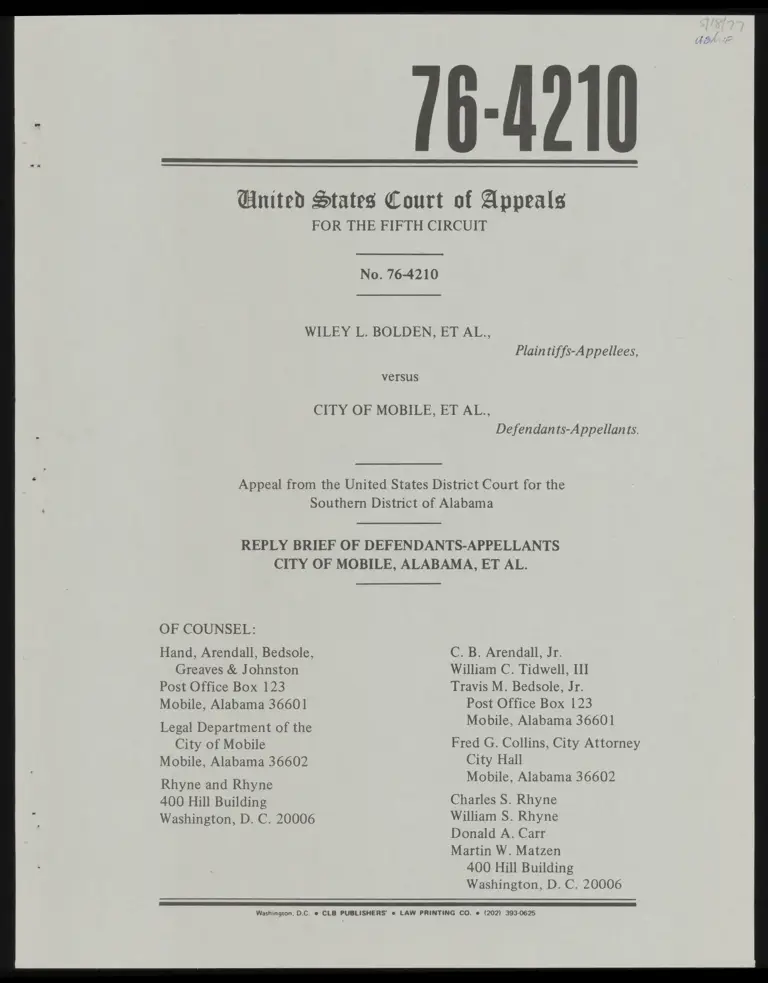
    United States Court of Appeals

FOR THE FIFTH CIRCUIT


No. 76-4210


WILEY L. BOLDEN, ET AL.,

Plaintiffs-Appellees,

versus

CITY OF MOBILE, ET AL.,

Defendants-Appellants.


Appeal from the United States District Court for the

Southern District of Alabama


REPLY BRIEF OF DEFENDANTS-APPELLANTS

CITY OF MOBILE, ALABAMA, ET AL.


OF COUNSEL:

Hand, Arendall, Bedsole, C. B. Arendall, Jr.

Greaves & Johnston William C. Tidwell, 111

Post Office Box 123 Travis M. Bedsole, Jr.

Mobile, Alabama 36601 Post Office Box 123

Legal Department of the Mobile, Alabama 36601

City of Mobile Fred G. Collins, City Attorney

Mobile, Alabama 36602 City Hall
Rhyne and Rhyne Mobile, Alabama 36602

400 Hill Building Charles S. Rhyne

Washington, D. C. 20006 William S. Rhyne
Donald A. Carr

Martin W. Matzen

400 Hill Building

Washington, D. C. 20006


Washington, D.C. @ CLB PUBLISHERS’ e¢ LAW PRINTING CO. » (202) 393-0625


IN THE

UNITED STATES COURT OF APPEALS

FOR THE FIFTH CIRCUIT


No. 76-4210


WILEY L. BOLDEN, ET AL.,
Plaintiffs-Appellees,

versus

CITY OF MOBILE, ET AL.,
Defendants-Appellants.


Appeal from the United States District Court
for the Southern District of Alabama


REPLY BRIEF OF DEFENDANTS-APPELLANTS
CITY OF MOBILE, ALABAMA, ET AL.


The District Court squarely held, and was squarely wrong in

holding, that the Supreme Court's decision in Washington v. Davis,


426 U.S. 229 (1976), is inapplicable to voting cases such as this

one. As subsequent Supreme Court decisions have made abundantly

clear, proof of racially discriminatory purpose is essential when-

ever facially neutral official action is challenged under the Equal

Protection Clause. Plaintiffs did not, and could not prove that

Mobile's City Commission form of government was adopted or has


operated with any such invidious purpose. The record amply refutes

1

any such claim. (Tr. 24-25, 36-37; D.Br. 4-7, 8-17, 48-61).

Plaintiffs in their brief try to take the sting out of the Su-

preme Court's recent decisions in Village of Arlington Heights wv.


Metropolitan Housing Development Corp., U.S. 97 8/Ct., 555


(1977); United Jewish Organizations of Williamsburgh, Inc. Vv. Carey,


U.S. ,-97 5.Ct. 996 (1977); Board of School Commissioners of

Indianapolis v. Buckley, U.S. , 97 8.Ct. 802 (1977): and

Austin Independent School District v. United States, U.S. ’


97 S.Ct. 517 (1976), with four equally lame arguments.

First, Plaintiffs say (P.Br. 31-44) that the discriminatory

purpose which needs be shown in vote dilution cases is not really

"purpose" but rather only "systemic" effect. Second, they argue

(P.Br. 24-31) that they did establish below an attenuated "tort

theory" of discriminatory purpose. Third, they say (P.Br. 22, 50-65)

that their failure to prove impermissible racial intent is insulated

by the clearly erroneous standard of review, because the District

Court made "findings" on each of the factors articulated by this

Court in Zimmer v. McKeithen, 485 F.2d 1297 (5th Cir. 1973), aff'd


sub nom. East Carroll Parish School Board v. Marshall, 424 U.S. 636:


(1976). Finally, Plaintiffs urge (P.Br. 70-75) that the judicial


LThe following abbreviations are used throughout:

“Pr. _" = citation to page in trial transcript

"p.Br, . " « citation to page in brief of Plaintiffs-

Appellees

"D.Br., = Pia citation to page in initial brief of

Defendants-Appellants


- 3 -


interventionism which the District Court's decision represents

should be tolerated by this Court because the strong-mayor-council

system it legislated into effect is superior to the Commission form

of government maintained by Mobile for more than sixty-five years,

and because an affirmance by this Court will not impact the more

than 500 local governments employing the Commission form or the

thousands of local governments employing at-large elections.

I. PLAINTIFFS UTTERLY FAILED TO PROVE THAT MOBILE'S
COMMISSION FORM OF GOVERNMENT WAS ADOPTED OR
MAINTAINED FOR RACIALLY DISCRIMINATORY PURPOSES.
THE RECORD PROVES IT WAS NOT.

The District Court held that "dilution" cases such as this are

a genus apart from other Equal Protection challenges to facially neu-

tral governmental action. Although the Supreme Court had recently

held in Washington v. Davis, supra, that discriminatory intent or


purpose is an essential element of proof that such official action

violates the Fourteenth Amendment, the District Court concluded that

Davis was inapplicable here. 423 F.Supp. at 398; D.Br. 30-31. The

Court's decision is therefore based on the erroneous premise that

Plaintiffs need not prove racial purpose or intent in the adoption or

maintenance of Mobile's at-large Commission government.

In fairness to that Court, subsequent decisions of the Supreme

Court have since made it absolutely clear that proof of invidious

intent or purpose is a universal regnirensnt for any Equal Protection

challenge to facially neutral gfficiar action, and have provided clear

guidance to the Federal Courts as to how this burden of proof may be

met. Arlington Heights, supra, 97 S.Ct. at 563-65; Austin Independent


School District v. U.S., supra, 97 8.Ct. 517, vacating 532 r.2é 380


{5th Cir. 1976) ("Austin II") in light of Davis; Board of School


Commissioners of Indianapolis v. Buckley, supra, 97 S.Ct. 802 ("In-


dianapolis"), vacating 541 P.2d4 1211 (7th Cir, 1976) in light of


Davis and Arlington Heights; United Jewish Organization of Williams-


burgh, Inc. v. Carey, supra, 97 S.Ct. at 1009-10, and id. at 1017


(Stewart, J., concurring).

Despite, or perhaps because of, these decisions, Plaintiffs con-

tinue to press the argument that no such proof of racial intent or

purpose was required of them. P.Br. 31-44. If Plaintiffs are to

prevail here, it must be on this point of constitutional law. For

the District Court's ancillary findings with respect to racial pur-

pose are palpably wrong in light of the holdings of the Supreme

Court in such cases as Davis and Arlington Heights.


Plaintiffs argue that the constitutional principle established

in these cases has no application to cases involving "systemic" dis-

crimination, relying principally on Castaneda v. Partida, U.S. ’


45 v.s.L.W. 4032 (U.S. Mar. 22, 1977) (jury selection), and the line

of legislative reapportionment cases beginning with Baker v. Carr,

369 U.S. 186 (1962). P.Br. 36-44. Plaintiffs' exception for "systemic"

discrimination would swallow the rule, and is wholly without merit.

Most forms of government action operate against entire

classes of individuals, and are inherently systemic in nature. Yet

the Supreme Court has not hesitated to require proof of discriminatory

purpose where such action is challenged under Equal Protection princi-

ples. In Davis, for example, plaintiffs challenged an employment test

which was "used throughout the federal service." 426 U.S. at 234, and

>
Se,


id. at 255 (Stevens, J. concurring). Absent proof of purposeful

discrimination, the Court upheld the test despite its disproportion-

ate impact upon black police candidates in the District of Columbia.’

426 U.S, at 246.

And in Arlington Heights, the Court of Appeals had found that


the city's long-standing policy favoring single family dwellings

had caused it to become a virtually all white community. 97 S.Ct.

at 560. Against this background, the Circuit Court thought, the

city's refusal to rezone to permit low-cost multi-family dwellings

amounted to "exploiting" existing segregation, and that this decision

must therefore serve some "compelling interest" to support its racially

discriminatory impact. Id. at 560-561. Absent proof of racial moti-

vation, the Supreme Court reversed. Similarly, Equal Protection actions

brought to remedy school SSorenusion Vhvieiably require evaluation of

the "system", yet proof of discriminatory purpose is an indispensable

element of proof. See Indianapolis and Austin II, supra; cf. Milliken


v. Bradley, 418 U.S. 717 (1974).

Plaintiffs rely on Castaneda, supra, as an example of the appro-


priate "systemic" approach for Fourteenth Amendment adjudication. But

both the majority and the dissenting Justices agreed that proof of

discriminatory purpose was essential under Davis and Arlington Heights.


45 U.S.L.W. at 4305 (per Blackmun, J.), 4310 (Powell, J. dissenting).

The majority held that Plaintiffs' stark statistics indicating gross

underrepresentation of Mexican Americans under Texas' "key man" system

for selecting grand juries constituted prima facie evidence of "purpose-


ful discrimination" which was unrebutted by the State. Id.at 4307. The

dissents rejected the sufficiency of these statistics. Id. at 4308


(Burger, C.J. dissenting), 4309 (Powell, J. dissenting). No member

of the Court would have waived the purpose requirement because a

"system" was under scrutiny, as Plaintiffs now urge.

Plaintiffs' reliance on the "one man, one vote" cases is equally

misplaced. P.Br. 41-42. For example, in Reynolds v. Sims, 377 U.S.


533 (1964), Alabama defended its legislative apportionment scheme on

the basis of a claim to unfettered State power to weight the votes

of its citizens according to their place of residence. Applying a

rational basis test, the Court struck down Alabama's apportionment

as violative of Equal Protection. 377 U.S. at 565-66, Weighting

votes by geographical areas, the Court held, bore no rational relat-

ionship to any permissible purpose of apportionment. Id. Such a

system was a "crazy quilt", 377 U.S. at 588 (Clark, J. concurring),

entirely "lacking in rationality," id. (Stewart, J. concurring).

Whether this apportionment scheme might have been struck down as in-

tentionally discriminatory against urban voters was a question neither

asked nor answered by the Court.

This principle of numerical equality, established as a consti-

tutional baseline of rational apportionment, is fully satisfied by

Mobile's at-large electoral system. Plaintiffs understandably do

not challenge the City's choice of government as irrational. Instead,

they claim invidious discrimination against black citizens. Proof of

racially discriminatory purpose or intent is necessary to sustain

their claim. The cases of this Court are fully consistent with the

decisions of the Supreme Court requiring that such purpose be shown.

D.Br. 27-31.


- 7] -


II. THE DISTRICT COURT'S ANCILLARY TREATMENT OF

RACIAL PURPOSE IN THIS CASE IS FLATLY CONTRADICTED

. BY RECENT DECISIONS OF THE SUPREME COURT REQUIRING

THAT PURPOSE BE SHOWN.

The District Court erroneously concluded that Washington wv.


Davis simply had no application to its decision of this case. 423

F.Supp. 394, 398; D.Br. 30-31. The Court did not, therefore, con-

duct the "sensitive inquiry" on the question of purpose so essential

to a correct decision here. Arlington Heights, supra, 97 S.Ct. at


This is reflected in the Court's ancillary findings on the in-

tent issue, which entirely fail to comport with Davis and subsequent

cases involving the question of proof of racial purpose.

564. The Court's first theory was denominated the "tort standard."

423 F.Supp. at 398.2 The Court acknowledged that, as in McGill, 535

F.2d 277, 281 (5th Cir. 1976), the Alabama Legislature had enacted

Mobile's Commission government in a "race-proof situation." 423 F.Supp.

at 397. Blacks at that time had already been disenfranchised. Id. But

the Court circumvented McGill with this remarkable analysis:

"A legislature in 1911, less than 50 years

after a bitter and bloody civil war which

resulted in the emancipation of the black

slaves, should have reasonably expected

that the blacks would not stay disenfran-

chised. It is reasonable to hold that the

present dilution of black Mobilians is a nat-

ural and foreseeable consequence of the at-

large election system imposed in 1911." Id.

The Court indicated no concern whatsoever at attributing such


2ngowever, this court prefers not to base its decision

on this theory." Id.


- 8 =

prescience to State legislators, whose scheme "was brought to

fruition in 50 odd years. . ." 148.7

The District Court's "tort" theory is squarely contradicted

not only by McGill, supra, but by the holding of the Supreme Court


in Arlington Heights. There, local zoning officials refused to


permit construction of a multi-family complex for low-to-moderate

income persons with full awareness that this decision would tend to

exclude blacks from their virtually all-white village, 97. 8.Ct. at

559-560. Yet the Court held that Plaintiffs had failed even to

prove that the zoning decision was "motivated in part by a racially

discriminatory purpose." 1d. at 566 n. 21. If the "fort" theory

adopted by the District Court here were correct, Arlington Heights


would necessarily have been decided differently.

And in Austin II, supra, 532 F.2d at 390, this Court held that


the school board's neighborhood school pupil assignment policy had

as its "natural, foreseeable, and inevitable result" the maintenance

of segregated schools. This, the Court said, made the inference

"inescapable" that such discrimination was intended. Id. The Supreme

Court has vacated Austin II in light of Washington v. Davis. 97 S.Ct.


517 (per curiam). The concurring opinion indicates specific concern


with the fact that, as to segregative intent, "the opinion below appar-

ently gave controlling effect to the use of neighborhood schools." Id.

(Powell, Jodo

The "tort" theory of the District Court, relying (423 S.Supp. at

396) upon Austin II, is equally insufficient as a matter of law to


support its decision. Where, as in Mobile, the official policy or


31n Taylor v. McReithen, 499 F.24 893, 904 (5th Cir. 1975),
Judge Wisdom properly termed such a theory "ludicrous."


E


action challenged is both facially neutral and serves legitimate

governmental interests, it is the teaching of Arlington Heights


and Austin II that such action shall not be struck down on the


basis of imputed, as contrasted to actual, discriminatory purpose.

In another ancillary finding on the issue of purpose, the District

Court found that in Mobile there exists a "'current' condition of di-

lution of the black vote resulting from state legislative inaction. . hy


423 F.Supp. at 398 (emphasis original). Here, this theory is simply a

permutation of the Court's "tort" theory, applied to "inaction" instead

of "action." It is equally deficient as a matter of law.

Particularly because the legislative action necessary to avoid

the Court's condemnation would have required not merely redistrict-

ing but a complete restructuring of Mobile's existing system of gov-

ernment, it is surprising that the Court did not consider the proba-

bility that legislative inaction here resulted from purely neutral,

not racial, considerations.


4plaintiffs here rely on the testimony of State Senator

Roberts, and bald innuendo unsupported by the record.

P.Br. 30, citing Tr. 735-36. During the pendency of

this litigation (Tr. 733), the Senator introduced

legislation to change the City's government to a

mayor-council plan in which seven councilmen were to

be elected by single-member district, with two members

of the council plus the mayor to be elected at large.

Tr. 727-28. The "major reason" for its introduction

was the Senator's belief that this would be "a better

form of government." Tr. 729. He acknowledged that

this was a view as to which "reasonable men may reas-

onably differ" (Tr. 740), and had attempted to alleviate

somewhat the "tendency" of councilmen "to be concerned

just with their particular district" by providing two

at-large seats. Tr. 731. The Senator also felt that

he had written the bill in such a way as to eliminate

"interference" by councilmen with parochial concerns

"in the day to day operations of the city." Tr.738.

Senator Roberts did not testify that his bill failed

to pass for reasons other than racially neutral legis-

lative disagreement with its policies and effectiveness.

Tr. 736. Na
Se ~~,


-' 10 -

The Alabama Legislature was under no affirmative duty to maxi-

mize the political power of black Mobilians. Nevett v. Sides, 533

F.24 1361, 1365 (5th Cir. 1976); Turner v. McKeithen, 490 F.24 191,


197 n. 24 (5th Cir. 1973). In light of thie undisputed evidence that

black voters are an effective political force in the City (D.Br. 8-10

40-43), it is clear that "legislative inaction" has not had the

"natural and foreseeable consequence" of relegating blacks to polit-

ical ineffectiveness, deliberately or otherwise.

Tesielative awareness that blacks might fare better politically

under single-member districting does not convert inaction into intent-

ional discrimination. In Arlington Heights, for example, zoning offic-


ials were well aware that existing policies had the effect of main-

taining the "nearly all white" status of the village, and the Court of

Appeals had held that they "could not simply ignore this problem."

97 S.Ct. at 560. Yet the Supreme Court upheld the maintenance of

these policies for reasons racially neutral, despite their exclusion-

ary effect. 1d. at 566.

Similarly, in Austin II this Court found segregative intent in


the school board's maintenance of its neighborhood school policy,

where "'[a]lffirmative action to the contrary would have resulted in

desegregation'." 532 F.2d at 390. Its decision was vacated in light

of bavis. 97 S.Ct. 517. Indeed, application of the District Court's

"inaction" theory would have required a different outcome in Davis

itself, where the polices department apparently continued to administer

its employment test despite its awareness that a disproportionate

number of black applicants failed. 426 U.S. at 252.

The District Court here based its decision upon the erroneous


“ll «

legal conclusion that proof of discriminatory purpose or intent was

unnecessary to Plaintiff's case. 423 F.Supp. at 398; D.Br. 30-31.

The Court's ancillary findings on this issue are equally erroneous,

and provide no independent basis for affirmance of its judgment. As

Defendants—-Appellants have shown (infra pp. 1-2) the record clearly

supports no finding of invidious purpose, either direct qr circum-

stantial.

III. THE DISTRICT COURT'S LEGAL ERROR IN EQUATING
THE RIGHT TO ACCESS WITH A RIGHT TO PROPORTIONAL
REPRESENTATION IS NOT INSULATED BY THE "CLEARLY
ERRONEOUS" STANDARD OF REVIEW.

Plaintiffs assert (P.Br. 22, 50) that all of the foregoing is

irrelevant because the District Court found as a fact that Mobile's

Commission form of government operates to deny blacks access to the

political process within the meaning of Zimmer, and because they say

Mobile does not challenge that finding as clearly erroneous.

On any proper application of the principles set forth by this

Court in Zimmer v. McKeithen, 485 F.2d 1297 (5th Cir. 1973) (en banc),

aff'd sub nom. East Carroll Parish School Board v. Marshall, 424


U.S. 636 (1976), Mobile's Commission form of government and at-large

electoral system clearly pass constitutional muster. The District

Court has erred in its application of Zimmer to the facts of this case.

Quite clearly, any finding as to the presence vel non of a

Zimmer factor represents as much a legal as a factual conclusion.


Sup] a lack of access to the process of slating can-
didates, [2] the unresponsiveness of legislators to
their particularized interests, [3] a tenuous state
policy underlying the preference for multi-member
or at-large districting, or [4] that the existence of

past discrimination in general precludes the effec-
tive participation in the election system. . ." 485
F.2d at 1305 (footnote omitted).


-12<

Such conclusions of "ultimate" fact

"may be reviewed by an appellate court
without the strict application of the
clear [ly] erroneous doctrine of Rule
52{a)., . +" ‘Hawkins v,., Town Qf Shaw,
437 7.2& 1286, 1294 n. 1 (53th Cir. 1971)
(Bell, J. concurring specially), citing
Industrial Instrument Corp. v. Foxboro Co.,

307 F.248 123, 786 n. 2 (5th Cir, 1962).


-~

More generally,

"pindings of fact that are induced by an
erroneous view of the law are not binding.
Nor are findings that combine both fact
and law, when there is error as to the
law." 5A J. Moore, Federal Practice
452.03[2], at 2664 (1975) (footnotes omitted).


Thus, factual conclusions which "reflect the application of an

improper legal standard" are not "insulated" by the clearly erron-

eous standard of Rule 52(a). Martinez v. Dixie Carriers, Inc.,


529 F.2d 457, 469 (5th Cir. 1978).

Particularly in cases of constitutional magnitude, it is es-

pecially important

"to distinguish between issues of fact that
are here foreclosed and issues which,
though cast in the form of determinations
of fact, are the very issues to review [for]
which this Court sits." Watts v. Indiana,

338 U.8. 49, 51 (1949).


In earlier "dilution" cases, this Court has never hesitated to

closely examine the facts, and to reverse where the court's ultimate

factual conclusions were either inadequately supported by the record

or induced by an erroneous view of the law. See Bradas v. Rapides


Parish Police Jury, 508 F.24 1109 (5th Cir. 1973); McGill v. Gadsden


County Commission, 535 F.2d 277 (5th Cir. 1976); Nevett v. Sides,


533 v.24 1361 (5th Clr, 1976).


-il3 -


The District Court correctly found that black Mobilians were

able to register, vote, and run for election without any hindrance

whatsoever. D.Br. 8, 36. But the fact that no black had ever been

elected to the City Commission indicated to the Court that "local

political processes are not equally open. . ." 423 F. Supp. at 387-

88; D.Br. 37. The Court held to this view despite its recognition

that only three black candidates had ever run for the City Commission,

and that these "young, inexperienced" candidates were of such limited

appeal even to black voters that they failed even to carry black wards.

423 P.Supp. at 388; D.Br. 11-12, 37.

Plaintiffs indisputably failed to prove that any black candidate

for City Commission had suffered defeat in Mobile's at-large elections

as a result of voting putatively polarized along racial lines. In this

respect, their reliance upon the recent decision in Parnell wv. Rapides

Parish School Board, 425 F. Supp 399 (W.D.La. 1976), is wholly incong-


ruous. P.Br. 54 n.51. Parnell was a new action initiated following

this Court's reversal of Bradas, a case decided "'on inadequacy of

proof.'" 1Id.; Parnell, supra, 425 F. Supp. at 406.

In Bradas, supra, 508 F.2d at 1112, the "single glaring fact" that


no black had ever been elected was held by this Court to be insufficient

to suport "judicial nullification of a reapportionment plan", despite

the fact that several qualified blacks had run for office, id. at 11lll.

But in Parnell, more conclusive evidence was presented. Black incum-

bents, who had been elected under the single-member plan in force

pending this Court's decision of the Bradas appeal, were subsequently

defeated in multi-member elections characterized by racially polarized


“ Ld -


voting in extremis. 425 F.Supp. at 402, 405, Plaintiffs there also

proved that in that "one-party Parish," neither the

"Party nor a dominant white slating organi-
zation has nominated, endorsed or slated

any blacks." 1Id., at 405.

In the absence of any evidence that qualified black candidates

for the Mobile City Commission had similarly run and been defeated,

the District Court here accepted Plaintiffs' bootstrap argument that

the failure of black candidates even to try Mobile's political process

itself took on constitutional significance. D.Br. 37. Black "discour-

agement" effectively became the sole, and wholly inappropriate, touch-

stone for the Court's conclusion that plack Mobilians are presently

denied access to the City's political processes,

In so concluding, the District Court entirely neglected to con-

sider, much less address, the undisputed evidence that black voters

have real political clout in Mobile and Plaintiff black leaders' own

testimony that such clout has produced responsive Commissioners. D.Br.

8-10, 40-43. Obviously the Court thought that the ability of black

voters to elect black Commissioners was the sole proper test of "access”

under Zimmer and the "dilution" precedents of the Supreme Court. This

view of the law, and the resultant findings of fact, are clearly in’

error. D.Br. 31-43. For the Supreme Court has repeatedly "rejected the

proposition that members of a minority group have a federal right to

be represented in legislative bodies in proportion to their number in

the general population." Beer v. United States, 425 U.S. 130, 136 n.8


(1976).


- 15 =


IV. THE DISTRICT COURT IMPROPERLY ASSUMED A LEGISLATIVE

ROLE IN DISCOUNTING MOBILE'S STRONG AND LEGITIMATE

INTEREST IN ITS COMMISSION FORM OF GOVERNMENT AND

SUBSTITUTING THE COURT'S OWN POLITICAL PREFERENCE.

The District Court's decision invalidating Mobile's at-large

Commission form of government comes down to a simply mistaken and

sheerly polibiend judgment reiterated by Plaintiffs on appeal

(P.Br. 68-75) that a single-member districted strong mayor-council

form would be better, and would ameliorate conditions for blacks

generally.

Mobile does not assert that its Commission form of government and

at-large electoral system are necessarily the "best" for all times

and all communities. Mobile does assert that its system serves im-

portant policy considerations relating to a city-wide perspective in

government, and that that system in no way precludes black participation.

(D.Br. 8-12, 40-43, 50-54). Mobile does assert that in the present con-

text of diminishing racial polarization (D.Br. 10-11) in the City, a

change to a strong mayor-council single-member district system with its

inherently divisive, parochial and segregative effects (D.Br. 54-61)

will only disserve the policies of integration.

The relative merits of the various systems of local government as

they operate in different circumstances are a matter for legitimate

debate among lawyers and political scientists :®

"In short, any electoral system confers

advantages and disadvantages - sometimes


plaintiffs correctly state (P.Br. 73 n. 72 continued) that the

quotation appearing at D.Br. 52-53 is incorrectly cited. Its source

was J. Rehfuss, "Are At-Large Elections Best for Council Manager

Cities?", 61 Hational Civic Review 236 (1972), which attributed this

quotation to R. Lineberry, E. Fowler, "Reformism and Public Policies

in American Cities," 61 American Political Science Review 701 (1971).

Tne quotation accurately states the third conclusion reached by

Lineberry and Fowler at page 715 of their article.


“. 16 =~

some of both on the same persons. No

system can possibly do perfect justice


to all under all circumstances." E.

Banfield, J. Wilson, City Politics 88

(1965).

Yet Plaintiffs' deem Mobile's City Commission "odiously anti-

democratic." P.Br. 71. The City's at-large electoral system is

clearly the feature they find objectionable. This is a feature

shared by over 67% of all city governments, and over 40% of all

county governments, D.Br., 53.

Plaintiffs argue that at-large elections burden their consti-

tutional right to an "effective vote." P.Br., 68. By "effective"

they can only mean assured black ability to elect one or more black

Commissioners. For the record clearly establishes that black Mobil-

ians have real electoral power under the present at-large system.’

D.Br. 8-10, 40-43. The Constitution plainly requires no greater

measure of "effectiveness." D.Br. 30-35.

Plaintiffs unabashedly suggest that if Mobile's at-large elect-

oral system operates to burden voting effectiveness as they define it,

the City could not justify such a burden on the basis of any governmen-

tal interest because Mobile lays no claim to "the only good form of

government." P.Br. 68-69. If Mobile could not justify use of at-large

elections in a form of government to which they are necessary, then no

local government could justify them in connection with a form of govern-

ment as to which they are optional. In its essence, as well as its

potential effect, Plaintiffs' is the per se invalidity argument which

has been repeatedly rejected by this Court. E.g. Zimmer, supra, 485
rr


and it is not at all speculative that black Mobilians
will ultimately have more electoral clout under the
at-large system. Mobile's black population has in-
creased rapidly since 1970, when the Census showed a
black population of 35.4%. See N.Y. Times, May 8, 1977,
at 22, col. 3 (data of National Rural Center).

or


«il

F.2d at 1304 ("It is axiomatic that at-large and multi-member dis-

tricting schemes are not per se unconstitutional."); Bradas, supra,


508 F.2d at 1113. (Absent proof of racial purpose, fact that black

voting power is "diminished to some extent" does "not suffice.")

Here, Plaintiffs have aggregated decades of social and political

problems experienced or perceived by black Mobilians. Their assertion

is that all are attributable to the City's political system, which must

therefore be scrapped. Plaintiffs suggest that in order for them to

obtain betterment of conditions for blacks, this Court must sustain

the no-fault constitutional principle on which the District Court

relied. Yet if they sought a constitutional remedy for alleged City

discrimination in employment or provision of municipal services, Plain-

tiffs would clearly be required to prove invidious racial purpose Or

intent 8 Washington v. Davis, supra, 426 U.S. at 244 n.12.2 Neither


precedent nor reason supports their argument that a lesser standard

of proof should be accepted because they seek the global "remedy" of

disestablishing Mobile's existing form of government.


8The numerous cases cited by the District Court in

which the Federal Courts have acted to redress dis-

crimination within Alabama clearly demonstrate that

relief is indeed available wherever plaintiffs ade-

quately prove their claims.

9The Davis Court expressly disapproved Hawkins v.

Town of Shaw, 461 P.2d 1171 (5th Cir. 1972) (en


banc), to the extent it "rested on or expressed

the view that proof of discriminatory racial pur-

pose is unnecessary in making out an equal pro-

tection violation..." with respect to municipal

services.


“18 w-

V. CONCLUSION

This Court should reverse the judgment and resultant orders

of the District Court and order the dismissal of this case.

By

Respectfully submitted,

»

C.B. Arendall, Jr.
William C. Tidwell, IIT

Travis M. Bedsole, Jr.
Post Office Box 123
Mobile, Alabama 36601

Fred G. Collins
City Attorney
City Hall
Mobile, Alabama 36602

Charles S. Rhyne
William S. Rhyne
Donald A. Carr
Martin W. Matzen

400 Hill Building
Washington, D.C. 20006

Attorneys for Defendants-Appellants

wiry Plas


Charles S. Rhyne


CERTIFICATE OF SERVICE

I certify that two copies of the foregoing brief have been

served upon opposing counsel of record by placing the same pro-

perly addressed in the United States Mail with adequate postage

affixed thereto this 134 day of May, 1977.

Sn Lada


Attorney for a


ants