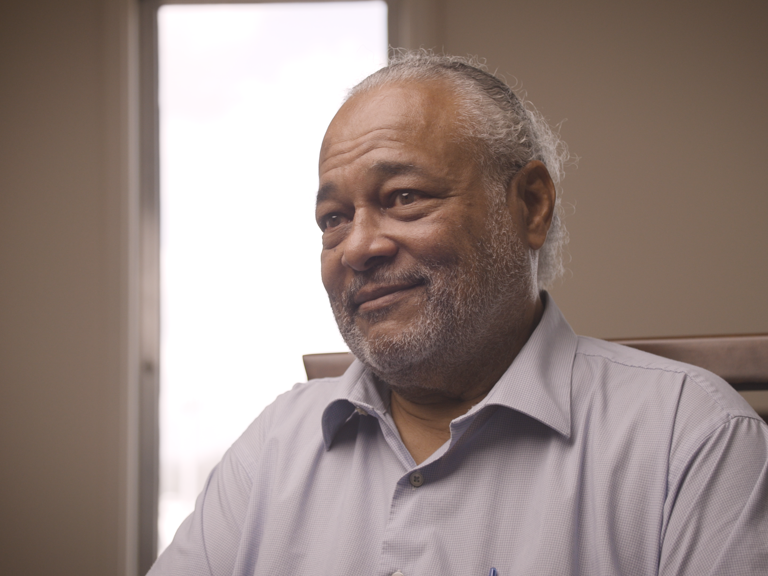
Gideon T. Carter III Interview transcript
Oral History
25 pages
This item is featured in:
-
Interview with Gideon Carter III for the Legal Defense Fund Oral History Project,, conducted by Alissa Rae Funderburk Conducted in collaboration with the Southern Oral History Program at University of North Carolina at Chapel Hill.
Copied!
     [||55819a4d-f00d-4369-8052-06968e57bd78||] Legal Defense Fund Oral History Project

Gideon T. Carter III

Interviewed by Alissa Rae Funderburk

February 9, 2025

Baton Rouge, Louisiana

Length: 01:06:29


Conducted in collaboration with the Southern Oral History Program at University of North Carolina

at Chapel Hill

LDF Archives, Thurgood Marshall Institute, NAACP Legal Defense & Educational Fund, Inc.


  2


This transcript has been reviewed by Gideon T. Carter III, the Southern Oral History Program, and

LDF. It has been lightly edited, in consultation with Gideon T. Carter III, for readability and clarity.

Additions and corrections appear in both brackets and footnotes. If viewing corresponding video

footage, please refer to this transcript for corrected information.


  3


[START OF INTERVIEW]

Alissa Rae Funderberk: [00:00:01] This is Alissa Rae Funderberk, the Mellon-funded oral

historian for the Margaret Walker Center at Jackson State University. I am acting as an interviewer

on behalf of the Southern Oral History Program at the University of North Carolina at Chapel Hill. It

is Sunday, February 9th, 2025, and I am in Baton Rouge, Louisiana with Gideon T. Carter III in his

law office to conduct an interview for the NAACP Legal Defense Fund Oral History Project. Thank

you, Mr. Carter, very much for having me here and sharing your story. For the record, do we have

your permission to record this interview?

Gideon T. Carter III: [00:00:38] You do.

ARF: [00:00:38] Thank you. Can you say and spell your full name for the record as well?

GTC: [00:00:44] Gideon, T, Carter, III, G-I-D-E-O-N, middle initial T, last name C-A-R-T-

E-R, III.

ARF: [00:00:56] Thank you. To start, can you tell me when, where, and to whom you were

born?

GTC: [00:01:02] I was born in Baton Rouge in 1955. My parents are Gideon T. Carter, Jr.

And Mary Deemer Carter.

ARF: [00:01:14] Can you tell me a little bit about your family?

GTC: [00:01:20] Yes, my grandfather was a Baptist preacher in Baton Rouge. Of course, I

never knew him, though. He died around 1942. Shortly after his death, my dad enlisted in the

military, Army. I think he was artillery, and he graduated that year, before he enlisted in the military,

which was around 1942. After he came back from the war, he went back to high school. Because

when he left, high school only went to the 11th grade. When he came back they had added that 12th

grade, so he went back to do the 12th grade. Then he went to college at Southern University, from

which he graduated around 1954. At the same time, my mother's family moved from Hammond,

Louisiana in 1948, when her parents sold the farm and moved to Baton Rouge, when the youngest


  4


two kids, she was a family of 12, when the youngest two were getting ready to go off to college, they

moved from Hammond and located right outside the Southern University campus. And so my mother

also went to Southern University, graduated around 1953, [19]54. My parents met when they both

became school teachers. They met in Ponchatoula, Louisiana. That's where I grew up. So they didn't

know each other at Southern, but they met when they both became teachers in Ponchatoula. And of

course, my mother was from Hammond. Ponchatoula's five miles from Hammond, so she went back

home to teach.

ARF: [00:03:16] That's so funny that they didn't meet at university, but they did as teachers.

Can you tell me a little bit about what it was like growing up in Ponchatoula?

GTC: [00:03:26] It was a small town, roughly a population of around 4,500. Hard to describe

the town, mostly rural farming community, farming and fishing community. Of course, the schools

were segregated. There was the Black school on one side of town that went from first grade to ninth

grade. Then there was the white school, white high school, and elementary and middle schools on the

other side of the town. So, at the Black schools that went from grades one through nine, once you

graduated from ninth grade, and there was a ninth-grade graduation at the time, you went to

Hammond, five miles north, to go to high school, 10th, 11th, and 12th grade. And after that, if you

decided to go on to college, you went wherever you decided to go for college from there. But of

course, as I stated, the schools were segregated. And then after Brown, roughly 10 years after Brown,

most of the school desegregation cases were filed in Louisiana, and that would have been around

1965, and most of the cases in Louisiana were filed by A. P. Tureaud, who was a civil rights attorney

in New Orleans, and Thurgood Marshall, yes, the famous Thurgood Marshall who everyone knows,

and a lot of those cases were also LDF cases, NAACP Legal Defense Fund cases. I'll give you a little

background, so I was born in 1955, roughly one year after Brown One, and several months before

Brown Two. Rolled forward 10 years, 1965, I was in fifth grade when the school desegregation case


  5


in my home parish was filed. Roll forward another 50 plus years, and I'm now one of the lead

attorneys in that school desegregation case that is still going on and being litigated today.

ARF: [00:05:41] It's crazy. But let's roll back a little bit. We went really forward there. Can

you tell me a little more about how your parents met, their careers as teachers, and then what else it

was that they went on to do?

GTC: [00:06:03] Okay, so my dad started out as an Industrial Arts teacher, my mother as a

Home [Economics] teacher. About a year, maybe two years after my dad started teaching, the

principal at the school where he taught passed away, it was an elderly gentleman who he considered

as his mentor. Since my dad was the only other male teacher at the school, they appointed him as

principal, even though he didn't have the credentials. For the next 30 years or so, my dad acquired

the credentials to continue to serve as principal of that school. Later during his career, around 1966,

they were commissioning to build a new elementary school in Ponchatoula. And of course, this was

after the school desegregation case was filed. He decided to go to that elementary school, which he

named after his mentor. The name of that school is D.C. Reeves. 1968 is when the school system

under supervision of a federal court initiated what they called the Freedom of Choice program where

kids were able to choose what school they wanted to go to, basically was supposed to be another race

school. Of course, white kids didn't do that. Black kids did. So I decided to go to the white high

school in eighth grade. My parents were still teaching at a Black school at the time. And then a year

later, 1969, 1970, that Freedom of Choice program was declared to be unconstitutional by the U.S.

Supreme Court, and they integrated the school system. At that time, they demoted a lot of the Black

administrators in the parish. If you were a principal, you may have been bumped down to a

classroom teacher. Of course, that didn't happen to my dad. For whatever reason, he never told me

why. I can only speculate, knowing who my dad was, I can only speculate why he didn't get bumped

down. My mother was moved to the high school to co-teach Home Economics, along with a white

teacher. My dad remained at the school that he opened and named after his mentor.


  6


ARF: [00:08:58] As educators, did your parents speak at home about what was happening

with the Brown v. [Board] or school desegregation or any of the politics surrounding that?

GTC: [00:09:12] Not really, because I think for the most part during that time, Black parents

didn't really talk to their kids about what was going on, especially with civil rights and school

desegregation. We may have learned about what was going on from watching the TV news, if it was

on the news, which was really rare during the time, to see in the South what was going on on the

national landscape, especially if it had anything to do with civil rights. We kind of learned by what

was going on in the community because when the lawsuit was filed in Tangipahoa Parish, one of the

named plaintiffs was M.C. Moore, so the suit was named Moore, et al. v. Tangipahoa Parish School

System. We knew at the time what happened with the Moore family because they were involved in

that litigation. What they did to that family was absolutely unbelievable. They were shooting into

their house during the night. They lost their jobs. They lost their business. And to this day, they have

not recovered from that. They're still a prominent family in the community. So that's how we learned.

And then there were marches that went through the community during the mid to late [19]60s, early

[19]70s. There was civil rights activity going on in the area, and there were marches that were led

through the community. And going back to the [19]60s in particular, I remember a time when the

Klan burned a cross down the street from my house. We talked about that because we experienced it.

ARF: [00:11:16] Your parents didn't speak about politics, but can you speak to how their

careers, their work ethic, may have impacted you as you were growing up, how you may have

planned for your future career?

GTC: [00:11:34] Yes, growing up in my household there was never a conversation about,

"Are you going to college?" That was just never the topic. The topic was, "Where are you going?"

[Laughter] I have three siblings, one brother and two sisters. That was never the conversation, "Are

you going to college?" We just knew that it was going to happen, and we were free to pick wherever

we wanted to go. My family were educators, both sides of my family. My mother's family, my dad


  7


was an only child. Some of his family were educators. Most of my mother's family were educators.

The story I like to tell is that both sides of my family, they got out of slavery and they never looked

back. They always progressed forward. They were prominent in their communities. They were

community leaders. They were involved in the community. They were educators. Going forward in

terms of career, well, I'm a lawyer. I've been a lawyer now for 40 years. Prior to that, I was self-

employed. I've basically been self-employed for about the past 50 years. Going through high school,

becoming a lawyer was never my dream. I never imagined that I would become a lawyer. I had a

completely different plan for my life. It didn't work out that way. So, if you ask me, "Why did I

become a lawyer?" I'm going to tell you, "I was called to become a lawyer," because I wanted to do

something else. Apparently, God had another plan for me. So here I am.

ARF: [00:13:50] Can you speak a little bit to what sense of your own social consciousness

you may have had when you were around high school age and having these conversations about

where you're going to go to college? What were you thinking about in terms of politics, race, society

in general?

GTC: [00:14:16] Our social consciousness developed around associating with our families.

They were socially conscious, they were involved in their communities, so likewise the kids were

socially conscious, and we were required to be involved. For instance, I remember when my

grandfather, Grandfather Deemer, was trying to become a registered voter back in the 1950s. I was a

young child then, but I remember the conversations. The social consciousness developed through

association with my families. It was not like they were teaching me, it was expected.

ARF: [00:15:09] You went on to attend Louisiana State University, correct?

GTC: [00:15:15] That's correct.

ARF: [00:15:15] How did you come to choose that school and what was your experience like

there?


  8


GTC: [00:15:23] I chose LSU because of the career path that I chose for myself. I thought

perhaps that that would be the best place for me to go. My career path was, I intended to be a

medical doctor. I went to LSU and my undergraduate major was pre-med, biology, zoology, and then

I changed to microbiology. My undergraduate degree is in microbiology, I'm a scientist, and that fit

very well into me becoming a lawyer because the thought process is about the same, the analytical

requirement in terms of analyzing facts and moving forward from that collection of facts in terms of

developing a case or litigation strategy. LSU was the place, because LSU also had a medical school,

which I envisioned applying to medical school at LSU, which was in New Orleans at the time. I'm

talking about basically a 50 mile radius from where I grew up, and if you know anything about

Louisiana, that's what they say about us. Most of us never move more than 50 miles from where we

grew up.

ARF: [00:17:03] You just love it so much.

GTC: [00:17:06] [Laughter] Apparently! It's the whole family structure, though. Most

families in Louisiana remain within that 50-mile geographic area.

ARF: [00:17:20] I imagine it makes for a more tight-knit community.

GTC: [00:17:23] Yes, it does. You basically always know family. You're always growing up

around family, and you see the family dynamics developing.

ARF: [00:17:35] That's really nice. So you wanted to be a doctor, a medical doctor.

GTC: [00:17:41] Yes.

ARF: [00:17:42] When did that change?

GTC: [00:17:46] When I applied to medical school and I applied to law school as well,

because some of my friends were always telling me, "Gideon, you need to be a lawyer," and I said,

"Oh, OK, so I'm going to take the LSAT and apply to law and medical school." Well, I didn't get

accepted to medical school, but I got accepted to law school, go figure. [Laughter] I had no political


  9


science background, no pre-law background. All of my background was science. Since I was

accepted, I decided to go to law school, and I've never looked back.

ARF: [00:18:33] Tell me more about that. Your friends just randomly one day were like,

"You know, you'd be a good lawyer?"

GTC: [00:18:41] I guess I was always arguing and I guess they were probably impressed or

offended that I usually won the argument. [Laughter]

ARF: [00:18:52] Wow, so you applied to law school on the suggestion of some friends, you

got in, surprisingly, and decided to go. What was the reaction from your family, folks in the

community, your fellow students?

GTC: [00:19:17] I guess my family may have been a little disappointed that I didn't follow

what they thought was my dream, but then my position was, "I'm going to law school, I'll still be a

professional." And when I get out of law school my dream then was to open a law practice, not to go

to work for somebody as a lawyer, but to open my own law practice which is what I did.

ARF: [00:19:47] Can you tell me about your experience at law school?

GTC: [00:19:57] That's hard to describe. The Southern University Law Center. My

experience at law school is hard to describe. It was friendly. I enjoyed the professors. I guess I could

say they enjoyed having me in their classes because we never got cross with each other, and I

graduated and here I am.

ARF: [00:20:30] That was the early [19]80s, right?

GTC: [00:20:32] Yes, that was 1980 to [19]83.

ARF: [00:20:37] When you're attending these classes and you're thinking about the type of

lawyer you want to be, what were the things that were influencing you in those decisions?

GTC: [00:20:53] The areas of law that I was studying in law school, but I never thought

about becoming a civil rights lawyer. In fact, constitutional law was my worst subject in law school.

[Laughter] That's basically what civil rights practice is, it's constitutional law. I didn't really get


  10


involved in civil rights or school desegregation until later during my practice. I worked for lawyers

who were civil rights lawyers, and I did research for them, civil rights type of research. But I didn't

get involved in school desegregation until around 1998. I had done some research for the lawyers

prior to that time, but I was not actively involved in any of the cases, either as a law clerk or a

student lawyer. In 1998, one of my friends and my mentor, [a] lawyer who I considered as my

mentor who has since passed away, called me and he said, "Gideon, I need your help. I need you to

enroll in this case," and this was the East Baton Rouge Parish School desegregation case, Davis, et

al. v. East Baton Rouge Parish School System. He said, "They want me to settle the case, but I can't

do that because they're not desegregated. So I need your help." So, I enrolled in the case, and that

was an LDF case. So we were co-counsel with the Legal Defense Fund.

ARF: [00:22:55] And what was the name of that lawyer?

GTC: [00:22:57] Robert Williams. Robert C. Williams, because he always emphasized

Robert C. Williams, because there was another Robert Williams in Baton Rouge and he wanted to

make the distinction.

ARF: [00:23:11] Another lawyer?

GTC: [00:23:13] No, he was an educator.

ARF: [00:23:17] What a coincidence. So, before we get into the school desegregation cases

that you worked on, can you tell me about those first few years of practicing law? You said you

wanted to open your own practice.

GTC: [00:23:35] I didn't move, I lived in Baton Rouge at that time. I was living in Baton

Rouge, so I drove to Hammond every day. I opened my first law office in Hammond, along with

another friend of mine who was also a lawyer. He had opened a practice in Hammond a year prior to

me graduating from law school and passing the bar. When I passed the bar, I went to Hammond to

open my law practice along with him. His name was Al Clark. He was from Hammond, also a

former professional football player. That was around 1985, and it was basically a civil law practice.


  11


We did personal injury work, criminal law, and other civil type issues in the community. We were

also actively involved in that community in social activities and other civil rights issues, but we

weren't litigating civil rights issues at that time.

ARF: [00:24:42] Can you tell me more about that community? You said you were involved

in community issues. What issues?

GTC: [00:24:48] That was in Hammond. Community issues in Hammond is like five miles

north of Pontchatoula where I grew up. And there's also a university in Hammond, Southeastern

University. It was a much larger community, population 15 to 20,000. There were a lot of issues

going on in Hammond around school desegregation, police misconduct, employment discrimination,

and we were not litigating those issues but we were involved in whatever protests or discussions

were going on regarding those issues in the community.

ARF: [00:25:32] And what about your personal life at that time? You're starting a law

practice with a fellow former classmate, a friend I suppose, Al Clark. What else was going on in your

life when you're trying to get this career going?

GTC: [00:25:49] A year before that I got married. 1984, [laughter] and a year later by the

time I started practicing in Hammond, we were having our first child. But we were still living in

Baton Rouge. We never moved to Hammond. I drove to Hammond every day, which was one way

about 50 miles. It was an easy drive though because leaving Baton Rouge in the morning, there was

no traffic going that way, coming back to Baton Rouge, afternoon, evening, there was not traffic

coming back into Baton Rouge, it was always going in the opposite direction. I continued to do that

for ten years until I moved my practice to Baton Rouge, and that was around January of 1994.

ARF: [00:26:45] And what prompted that move?

GTC: [00:26:48] My wife and my children. [Laughter]

ARF: [00:26:53] They were tired of the commute.


  12


GTC: [00:26:55] They were wondering, "Uh, dad, when are you coming home?" [Laughter] I

didn't want to hear that anymore. I decided to shut it down in Hammond and open things up in Baton

Rouge.

ARF: [00:27:14] So now, what did you know about LDF before you began collaborating

with them on cases in Louisiana?

GTC: [00:27:22] Other than Thurgood Marshall's association, very little. I had no association

with them at all.

ARF: [00:27:36] So how did you come to work with them?

GTC: [00:27:39] As what they call a cooperating attorney. In [19]98, when I enrolled in the

East Baton Rouge Parish school desegregation case, I became co-counsel with them. We

collaborated on school desegregation issues. I would regularly attend their Lawyers Training

Institute, Civil Rights Lawyers' Training Institute, and my co-counsel had already been a cooperating

attorney with LDF since back in the 1970s.

ARF: [00:28:22] And who was that?

GTC: [00:28:22] Robert Williams. So, Robert Williams introduced me to LDF and it's like

LDF and I became friends immediately and we're still friends to this day.

ARF: [00:28:40] Oh, that's lovely. So East Baton Rouge was your first school desegregation

[case]?

GTC: [00:28:45] Yes.

ARF: [00:28:46] With LDF?

GTC: [00:28:47] Yeah.

ARF: [00:28:47] And how did that case pan out?

GTC: [00:28:52] That case was, in fact, settled while I was involved and I think the final

settlement was signed off on by the court around 2003. And after that, I became involved in other


  13


school desegregation cases. Not all of them were LDF cases, though some didn't have either LDF or

the government involved. It was just private plaintiffs in some of them.

ARF: [00:29:26] After that point, did school desegregation make up a lot of your practice?

GTC: [00:29:33] It was the major litigation component of my practice. But my practice has

remained mostly a civil law practice for the entire 40 years. I did a little state criminal practice. I did

some federal criminal practice, but it's mostly been a civil law practice. And when I say civil law, I

make the distinction between civil practice and being an injury lawyer, I've never been an injury

lawyer. I have done those cases, but I don't consider myself as an injury lawyer. If you ask me what

type of lawyer I am, I would probably tell you that I'm a civil rights lawyer.

ARF: [00:30:27] Around when do you think that became the case that you considered

yourself a civil rights lawyer?

GTC: [00:30:32] Even before I got involved in the school desegregation case, I was

considering myself as such because, even though I had not been introduced to LDF, I knew what

they did and I liked what they did, when I became involved in school desegregation cases, I became

more excited about the civil rights practice. And it's continued to this day. I don't do a whole lot of

other civil rights cases. Like, I don't do employment discrimination anymore. I don't do police

misconduct cases anymore, but I have done all of that.

ARF: [00:31:18] So LDF had a reputation and you liked it.

GTC: [00:31:22] Absolutely, and their reputation in Louisiana was more school

desegregation and voting rights. I've not done any voting rights, but I'm aware of their presence and

what they do in the state.

ARF: [00:31:37] Well, let's talk a little bit more about the school desegregation cases that

you have been involved in for these last 40 years, right? We talked a little about East Baton Rouge,

but it seems like there was also Pointe Coupee.

GTC: [00:31:58] Pointe Coupee.


  14


ARF: [00:32:00] St. Martin, St. John the Baptist, I don't even know how to pronounce this

one, Tangipahoa?

GTC: [00:32:08] Tangipahoa, that's my home parish.

ARF: [00:32:10] Tangipahoa, Jefferson Parishes, could you talk a little bit about each of

these cases, the folks particularly that you worked with, either the other local attorneys that there

were, or LDF attorneys that came in, and your strategies?

GTC: [00:32:35] The Jefferson Parish case is not an LDF case. It only involved private

parties and private attorneys. I got involved in that case because the Jefferson Parish School System

wanted to settle their case, and it was still on the court's docket in the Eastern District, which is in

New Orleans. They wanted to settle the case. They had to get lawyers involved to represent them and

to represent the plaintiffs. So again, I was contacted by my mentor, Robert Williams. He told me

about the case. He didn't want to get involved in it. I took on the job representing the private

plaintiffs in the Jefferson Parish case, and that case was named Dandridge, et al. v. The Jefferson

Parish School System, Dandridge, D-A-N-D-R-I-D-G-E. I, along with a local lawyer who was hired

by the Jefferson Parish School System, and the system's lawyers proceeded to write a consent order

to finally settle that case. Which was again done before 2010. I'm thinking the court finally signed

off on it around 2009. But we basically wrote the consent order for that case. Neither LDF nor the

government were involved in that case. Pointe Coupee is another case that LDF is not involved in.

Department of Justice is involved in the case, but I represent private plaintiffs in that case and with

no assistance from LDF, only from the government. Tangipahoa Parish is another case that is not an

LDF case nor is the government involved in that case. I represent private parties in that case. The

other cases I'm involved in are LDF cases. I'm in the case as co-counsel with LDF, and in many

instances, I've had to file motions to enroll the LDF lawyers pro hac vice because they're mostly out

of state. In order to enroll them in the case, they have to partner up with a Louisiana lawyer. When I

enrolled in the case, as far as the court is concerned, they're working under my supervision, which is


  15


really not the reality of it. I'm really working under their supervision because when it comes to

school desegregation cases, I consider LDF to be the "it," that's what they do.

ARF: [00:35:38] So, let's focus, perhaps, on one case. You worked as a cooperating attorney

with LDF attorneys, Deuel Ross, Christopher Kemmitt, and Rachel Kleinman, sorry if I'm

pronouncing these names wrong, but on the Banks, et al. v. St. James Parish School Board case. That

was one of the ones that was originally filed in 1965. But needed, I suppose, new negotiation more

recently in 2016. Can you talk about the issues that case was dealing with?

GTC: [00:36:18] Well, in most of these cases that are still open on courts’ dockets, in

Louisiana, all issues are still on the table. In fact, Banks v. St. James is still being litigated today. We

had a trial in Banks v. St. James in April last year, and we're still waiting on the decision.

ARF: [00:36:40] Wow. So when you say all issues, for me, a non-civil rights attorney.

GTC: [00:36:49] The "green factors." And those who may be listening to this interview,

when I say "green factors," they basically know what issues that I'm talking about with respect to

school desegregation cases. Issues such as facilities, student and teacher assignment, transportation,

extra-curricular activities, and other equity issues involved in the original school desegregation

litigations that were initiated around 1965, all of those issues are still on the table because these

school systems have not desegregated and they're still resisting to this day.

ARF: [00:37:27] So what are the strategies that you and the LDF team used when you were

relitigating, [were] in court last April?

GTC: [00:37:40] Again, all the issues are on the table. That's basically what we're litigating.

And the strategy is to get the best possible outcome for the clients who we represent, and our client is

basically the Black community. We're seeking the best possible outcome from these cases for our

clients.

ARF: [00:38:13] And you said you're still awaiting a decision on that?

GTC: [00:38:15] We're still awaiting a decision on that one.


  16


ARF: [00:38:19] If the decision is a win, what would that look like?

GTC: [00:38:25] Well, let me give you a little history about winning.

ARF: [00:38:28] [Laughter]

GTC: [00:38:29] We've already won these cases. We won all of these cases around 1970.

Basically what we're doing now is assisting the court in implementing its orders. When we are

relitigating some of these issues, we're basically assisting the court in implementing and enforcing its

orders. I don't really consider an outcome in these cases a loss, because we've already won. Any

outcome that we have is a win for our clients, unless of course, we're in a court that rules against

some issue that we're presenting and it has a negative impact on the Black community. But for the

most part, we're representing the Black community. And we're seeking the best possible outcome for

the people who we represent.

ARF: [00:39:31] You said this, "the best possible outcome," but what would the best possible

outcome look like, tangibly, for your client?

GTC: [00:39:39] That the school system continues to dismantle that old system of running

segregated schools, of running schools that are for Black kids and schools that are for white kids. If

you apply what's called the "color-blind test," when I walk into a school facility, I should not be able

to determine whether that's a Black school or a white school based upon what I see when I walked

through the door, because they should all be equal.

ARF: [00:40:25] Fair enough. Another, I think, similar case on my list here is the Thomas v.

School Board of St. Martin Parish with Monique Lin-Luse and Angel Harris in 2016, and then again

with Deuel Ross and Kevin Eli Jason in 2022. Would you say this case had the same issues?

GTC: [00:40:52] That case is on the docket in the Western District. I think it was back

around 2007 to 2009 that the chief judge in the Western District ordered that all of these cases be

returned to the active docket for final resolution. And Thomas v. St. Martin Parish was the first case

in the Western District that was put back on the active docket, and the school system immediately


  17


challenged the jurisdiction of the court to continue to allow us to litigate in that case. Of course, we

won that issue in the district court, the school system appeal to the Fifth Circuit Court of Appeal. The

Fifth Circuit Court of Appeal agreed with the District Court, so the case has been moving forward

since that time. And we've had several trials in that case since it was reopened, and we've been

successful. We've been the prevailing party again going forward. In the Thomas v. St. Martin Parish

case, and it's still being litigated to this day.

ARF: [00:42:10] But that sounds encouraging.

GTC: [00:42:12] It's encouraging that we're able to win on issues that affect the Black

community and, in fact, affect Black students in that school system and we've made tremendous

strides in dismantling that system of segregated schools in St. Martin Parish.

ARF: [00:42:37] That's good. Can you tell me a little bit about how you personally prepared

for that case?

GTC: [00:42:47] [Laughter] Wow, that's interesting. Well, when that case was put back on

the active docket, it required quite a bit of investigation, which I was involved in, and quite a bit of

research, in terms of researching the court record to determine what had happened in the case up

until that point. That was the preparation. Reviewing the docket to determine the history of the case

and what needed to be done going forward.

ARF: [00:43:26] Do you find it particularly difficult to be litigating these cases over such a

long period of time?

GTC: [00:43:35] It's not really difficult, because the record is there. In most instances, the

court record is there, and you can see what went on in the case on the record. Now, what went on off

the record, is a different question. And that's where the difficulty may arise, because we have no

historical perspective in many instances to rely upon, because most of the people who were

originally involved in these cases are all now deceased. The younger community, some of them don't


  18


even know that there's a school desegregation still going on in their parish, and they're usually kind

of surprised when they learn about what we're doing in their school system.

ARF: [00:44:26] I wonder if their knowledge or involvement, by "them" I mean this

community, the students, the schools themselves, would that be something that helped at all? I just

think of the protests and the national outrage, right, of the Civil Rights Movement back in the

[19]60s, and there doesn't seem to be attention on school desegregation now. Would greater attention

help?

GTC: [00:45:08] Probably yes, and I'm going to qualify that because the courts are not

always as friendly in these school desegregation cases today like they were compelled to be in the

[19]60s and early [19]70s. You could consider it an uphill battle, in some instances, in convincing

the court, because we have to teach judges about school desegregation. A lot of judges on the bench

now have no idea what this is all about. They have to become educated as well in order going

forward to be able to make rulings and decisions in our cases.

ARF: [00:46:05] The judges not being knowledgeable about school desegregation, is that

because of this amount of time that's passed? Is it that they're thinking, perhaps, this has already been

done and handled?

GTC: [00:46:23] Well, when you say, "Not knowledgeable," or when I say, "Not

knowledgeable," what I mean is most federal judges have never handled a school desegregation case.

They have to come up to speed also with respect to the issues and the law involved, and they rely on

the same record that we do in addition to arguments from both sides regarding the issues involved in

the case.

ARF: [00:46:52] That does seem like it would be an uphill battle. Can you tell me a little bit

about the folks from LDF that you've worked with, your opinions on their practice, their

involvement, their willingness to come to Louisiana? What are your impressions of [them]?


  19


GTC: [00:47:17] I use one word to describe them: stellar. They're all stellar civil rights

lawyers. I've never met any other lawyers with the knowledge that they have regarding civil rights

issues, whether it be school desegregation, voting rights, or anything else civil rights related that they

litigate. That is what they do. LDF, we refer to LDF as "Thurgood Marshall's Law Firm," when he

litigated Brown v. Board of Education. NAACP-LDF, Thurgood Marshall's law firm. It's an honor

just to work with them.

ARF: [00:48:13] Well, that's a fine compliment. So besides yourself and these excellent LDF

lawyers, who else is involved in these ongoing cases?

GTC: [00:48:31] [In] some of the cases, Department of Justice is involved. What do they call

it, the educational equity or something division [Educational Opportunities Section] of the

Department of Justice in Washington, D.C.

ARF: [00:48:54] And for the St. Martin Parish, what do you think the implications of

potentially not being successful might be? Or, do we not think about that?

GTC: [00:49:14] That's not an option.

ARF: [00:49:30] Okay. Also, I have on this list Harris v. St. John Parish.

GTC: [00:49:38] Yes.

ARF: [00:49:40] Can you tell me anything about that case?

GTC: [00:49:44] That's also an LDF case. When I first enrolled in that case, I was the only

lawyer for the plaintiffs enrolled, and I was basically monitoring because that case was not being

litigated. The school system was reporting on an annual basis, and I would get the reports and review

the reports. LDF probably reviewed the reports, and I think Department of Justice is involved in that

case as well, so they reviewed the reports. Initially, there was no litigation going on until we brought

up some issues before the court going forward to try and finally resolve the case.

ARF: [00:50:28] So, explain that to me, the case wasn't being litigated because the reports

were satisfactory?


  20


GTC: [00:50:38] Apparently, the reporting was satisfactory. No one saw any issues that

needed to be brought before the court in the case. It went on like that for several years until LDF

became more actively involved, and it was at that point that we decided to bring some issues back up

before the court to be discussed or litigated and we brought that back up in the form of a status

conference to discuss the case and what we were going to do going forward with the case.

ARF: [00:51:16] And where does that stand now?

GTC: [00:51:19] Oh, let's see. We recently had a conference with the judge I'm thinking

probably around last summer. We're trying to get a scheduling order together going forward to

determine where we're going to go with the case. But there's no final resolution that has been worked

out yet. There are some issues regarding some schools in the area because St. John the Baptist Parish

is right in the middle of what we call "Cancer Alley." And some of the schools are directly affected

by some of the plants that are producing deadly chemicals in the area. Those are some issues that are

coming before the court and that are coming before the school board, that the school board has to

decide probably independent of anything that the court may rule. The court right now is reluctant to

rule on any environmental issues regarding that case, but the school system, they are looking at the

environmental issues that are affecting their schools.

ARF: [00:52:32] You say the court is reluctant to rule on environmental issues, why would

that be?

GTC: [00:52:38] Because environmental issues are not part of school desegregation.

ARF: [00:52:47] But they're part of this case?

GTC: [00:52:48] Not really, because the environmental issues are still not an issue in this

case, but whether or not the school system can close a school and move the students is part of the

case, and that is something that we're looking at. The environmental issues are being separately

litigated in the area and being addressed by the broader community.


  21


ARF: [00:53:12] I see. That's interesting. So would this case be affected by the litigation that

is happening for the environmental issues?

GTC: [00:53:35] Probably. Some of this case has already been influenced by the

environmental issues that are being litigated because some of the information that we were able to

use regarding a school that was being directly affected by an environmental issue came as a result of

what was being litigated in one of those cases and some of those protests that were going on in

community over how the petrochemical industry in that parish was affecting education and the

community.

ARF: [00:54:15] I’ve never, you know, I'm not from Louisiana, so I haven't heard of this

issue. You mentioned the area being called Cancer Alley. Can you speak a little bit more about what

these effects are and why it is something that this school desegregation case has to consider?

GTC: [00:54:38] The area south of Baton Rouge to just north of New Orleans is considered

as Cancer Alley because of the large incidence of cancer cases that arise in that area that it's alleged

or directly linked to the petrochemical industry in the area. If you travel from Baton Rouge to New

Orleans along the river, on both sides of the river, there are petrochemical companies, and there are

still new companies being built and expanded daily in that area. That has become an environmental

concern, and the impact, especially in the St. John the Baptist Parish situation, has been tremendous

because there's a large incident of cancer which the community attributes to the petrochemical

industry that operates in their parish. We can't litigate that in the school desegregation case because

that issue is not part of the school desegregation case. We can't even bring it up as an issue because

it's a separate case. It's a separate issue. It's being litigated independently of our case.

ARF: [00:56:22] What I'm curious about is knowing the facts that this is an issue, cancer,

you're litigating a desegregation case, but what is it that you seek if you're closing schools in the

area? Where are the students going to go? What is the goal?


  22


GTC: [00:56:49] When students are moved from one facility to another facility, the

consideration is, "How does this affect desegregation?" The goal is always toward more

desegregation rather than resegregating the school system. Those students have to be reassigned so

that their reassignment doesn't create a segregated school.

ARF: [00:57:20] Okay, thank you thank you for clarifying that for me. I think that's all of the

cases, are there any other cases that we should discuss that you can think of?

GTC: [00:57:38] Well, there's the St. Mary case that's open now.

ARF: [00:57:43] Can you tell me a little about that?

GTC: [00:57:45] That one was recently put back on the active docket. And, again, the school

system is seeking to have the case dismissed, and of course we're defending this against dismissal,

because again, we don't believe that the system has done all that they can in order to dismantle that

dual system of education in the St. Mary Parish. With respect to other school desegregation cases,

LDF probably has maybe as many as ten-plus cases in the Western District that are still on the docket

in the Western District that have not been put back on the active docket. Now the interesting thing in

St. Martin and St. Mary Parish is the state has now become involved in these cases. Since 1965, the

state has had zero involvement in these cases. Now, our attorney general and our governor has taken

an interest in these cases, but they're not seeking to participate in the remedy. They're seeking to have

the cases dismissed, and that's what we're defending. I believe, I don't know what LDF thinks about

this, but I believe they're using St. Mary as a test case because they're challenging the jurisdiction of

the court to continue to keep this case on the open docket rather than to dismiss it. They're seeking to

have the case dismissed without a resolution or without them participating in a remedy to dismantle

what we think is still a dual school system that's being operated in the St. Mary Parish.

ARF: [00:59:50] That sounds fishy.

GTC: [00:59:51] Just think of how it smells! [Laughter]


  23


ARF: [01:00:04] [Laughter] Well, I think I only have a couple more questions for you here.

Is there anything else that I haven't asked you about that you wanted to get on the record today?

GTC: [01:00:15] Nothing I can think of, I think you've asked me about more than I expected.

[Laughter]

ARF: [01:00:21] All right then, well, what do you want the public today to know about the

Legal Defense Fund and its work?

GTC: [01:00:33] The work that LDF does in communities across the country and especially

in the South is very important work, especially because there are very few private lawyers who are

interested in or litigating these issues. LDF is it, and the work they do is very important.

ARF: [01:01:06] When you say there are very few private lawyers, the few who are doing

this work, is there any kind of like community amongst you supporting each other in this?

GTC: [01:01:27] Well, in LDF there is, but in Louisiana there is not, because I can name the

only lawyers in Louisiana who are even involved in school desegregation. There are two. Two

private attorneys, at this point, working in school desegregation, and that other lawyer is my co-

counsel in the Tangipahoa Parish case. In my other cases, I'm the only private lawyer. Before she

enrolled in the Tangipahoa Parish case, my other co-counsel in the Tangipahoa Parish case passed

away about a year and a half ago. Before he passed, there were only two lawyers, statewide, involved

in litigating school desegregation cases. I had most of the cases. He was involved in two of them.

ARF: [01:02:29] What was his name?

GTC: [01:02:30] Nelson Taylor.

ARF: [01:02:34] Nelson Taylor, and the other? Your co-counsel now?

GTC: [01:02:37] Cassandra Butler.

ARF: [01:02:44] Following up, what would you want the public to know specifically about

your work with LDF?


  24


GTC: [01:02:54] Well, as I stated earlier, I consider my association with LDF to be an honor.

Just to be in association with stellar civil rights lawyers, it's an honor, I learn a tremendous amount of

information regarding these issues from them. I'm a litigator. I know how to litigate cases, but I don't

necessarily have the research, background, information, and historical facts needed in order to go

forward in these types of cases. Tangipahoa Parish and Pointe Coupee Parish are probably the

exception, and in those two cases, I use what I’ve learned from LDF in my litigation and negotiating

with respect to those two cases. Same thing when I was involved in the Jefferson Parish case, I used

my experience with LDF in order to represent the Black community in the Jefferson Parish case.

ARF: [01:04:15] So there's a ripple effect, even when they're not directly involved, their

fingerprints are still [there].

GTC: [01:04:22] Absolutely. I mentioned the LDF Lawyers Training Institute. Are you

familiar with that? It's a seminar that they conduct annually that I've been attending for probably the

past 35 years.

ARF: [01:04:44] Every year.

GTC: [01:04:50] Yeah.

ARF: [01:04:51] Final question, what do you think is the most important area of civil rights

legislation today?

GTC: [01:04:59] Voting rights.

ARF: [01:05:02] Why?

GTC: [01:05:05] Because you're experiencing a rollback of voting rights today. You're

seeing it on a daily basis. What my forefathers shed blood for is being lost if nobody does anything

about it.

ARF: [01:05:36] Just a follow up to that, where is the most need for litigation and change

when it comes to that issue of voting rights?

GTC: [01:05:46] You mean geographically? Nationwide.


  25


ARF: [01:05:59] Well, that's all the questions I have for you today.

GTC: [01:06:02] Okay, I hope I've been helpful.

ARF: [01:06:05] You've been very helpful. I've certainly learned a lot and I thank you so

much for your willingness to sit down with me and answer all these questions on behalf of the Oral

History Program at UNC and the LDF. Thank you so much for being a part of this oral history

project.

GTC: [01:06:27] Thank you for inviting me.

[END OF INTERVIEW] [||55819a4d-f00d-4369-8052-06968e57bd78||]