U.S. Supreme Court Asked to Review Convictions in South Carolina Sit-Ins
Press Release
June 8, 1962
-
Press Releases, Loose Pages. U.S. Supreme Court Asked to Review Convictions in South Carolina Sit-Ins, 1962. af1b4c30-bd92-ee11-be37-6045bddb811f. LDF Archives, Thurgood Marshall Institute. https://ldfrecollection.org/archives/archives-search/archives-item/8c30ccf2-015c-49f0-a7bb-7a10a67cff4d/us-supreme-court-asked-to-review-convictions-in-south-carolina-sit-ins. Accessed October 08, 2026.
Copied!
    PRESS RELEASE

NAACP LEGAL DEFENSE AND EDUCATIONAL FUND
1O COLUMBUS CIRCLE + NEW YORK19,N.Y. © JUdson 6-8397

DR. ALLAN KNIGHT CHALMERS JACK GREENBERG CONSTANCE BAKER MOTLEY
Prasident Director-Counsel Associate Counsel

Bes

U. S. SUPREME COURT ASKED TO REVIEW
CONVICTIONS IN SOUTH CAROLINA SIT-INS

June 8, 1962

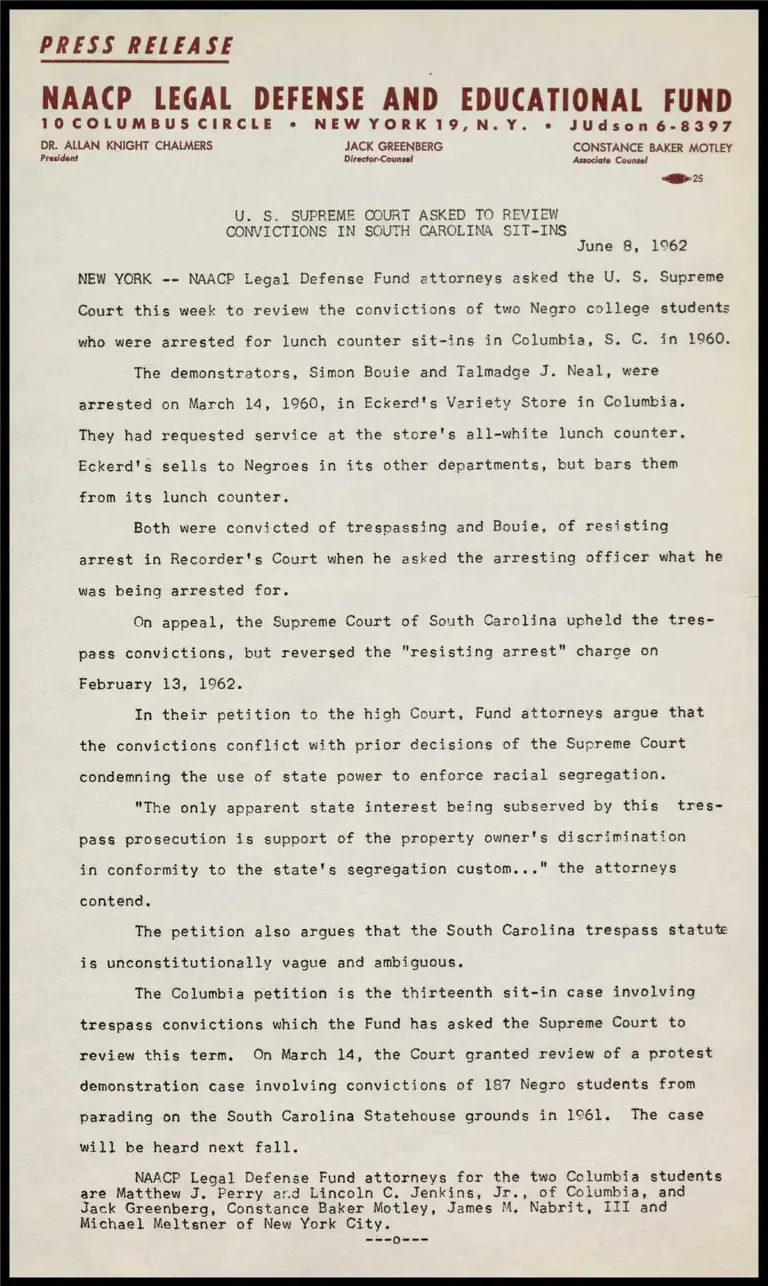
NEW YORK -- NAACP Legal Defense Fund attorneys asked the U. S. Supreme

Court this week to review the convictions of two Negro college students

who were arrested for lunch counter sit-ins in Columbia, S. C. in 1960.

The demonstrators, Simon Bouie and Talmadge J. Neal, were

arrested on March 14, 1960, in Eckerd's Variety Store in Columbia.

They had requested service at the store's all-white lunch counter.

Eckerd's sells to Negroes in its other departments, but bars them

from its lunch counter.

Both were convicted of trespassing and Bouie, of resisting

arrest in Recorder's Court when he asked the arresting officer what he

was being arrested for.

On appeal, the Supreme Court of South Carolina upheld the tres-

pass convictions, but reversed the "resisting arrest" charge on

February 13, 1962.

In their petition to the high Court, Fund attorneys argue that

the convictions conflict with prior decisions of the Supreme Court

condemning the use of state power to enforce racial segregation.

"The only apparent state interest being subserved by this tres-

pass prosecution is support of the property owner's discrimination

in conformity to the state's segregation custom..." the attorneys

contend,

The petition also argues that the South Carolina trespass statute

is unconstitutionally vague and ambiguous.

The Columbia petition is the thirteenth sit-in case involving

trespass convictions which the Fund has asked the Supreme Court to

review this term. On March 14, the Court granted review of a protest

demonstration case involving convictions of 187 Negro students from

parading on the South Carolina Statehouse grounds in 1961. The case

will be heard next fall.

NAACP Legal Defense Fund attorneys for the two Columbia students
are Matthew J. Perry ard Lincoln C. Jenkins, Jr., of Columbia, and
Jack Greenberg, Constance Baker Motley, James M. Nabrit, III and
Michael Meltsner of New York City.

<ccoue=