Gibson v. Dade County, FL Board of Public Instruction Appellees' Brief
Public Court Documents
May 13, 1957
-
Brief Collection, LDF Court Filings. Gibson v. Dade County, FL Board of Public Instruction Appellees' Brief, 1957. 8ca21353-b39a-ee11-be36-6045bdeb8873. LDF Archives, Thurgood Marshall Institute. https://ldfrecollection.org/archives/archives-search/archives-item/8dbc97e6-21b4-49b6-bb0a-2324c4f1d8f6/gibson-v-dade-county-fl-board-of-public-instruction-appellees-brief. Accessed October 06, 2026.
Copied!
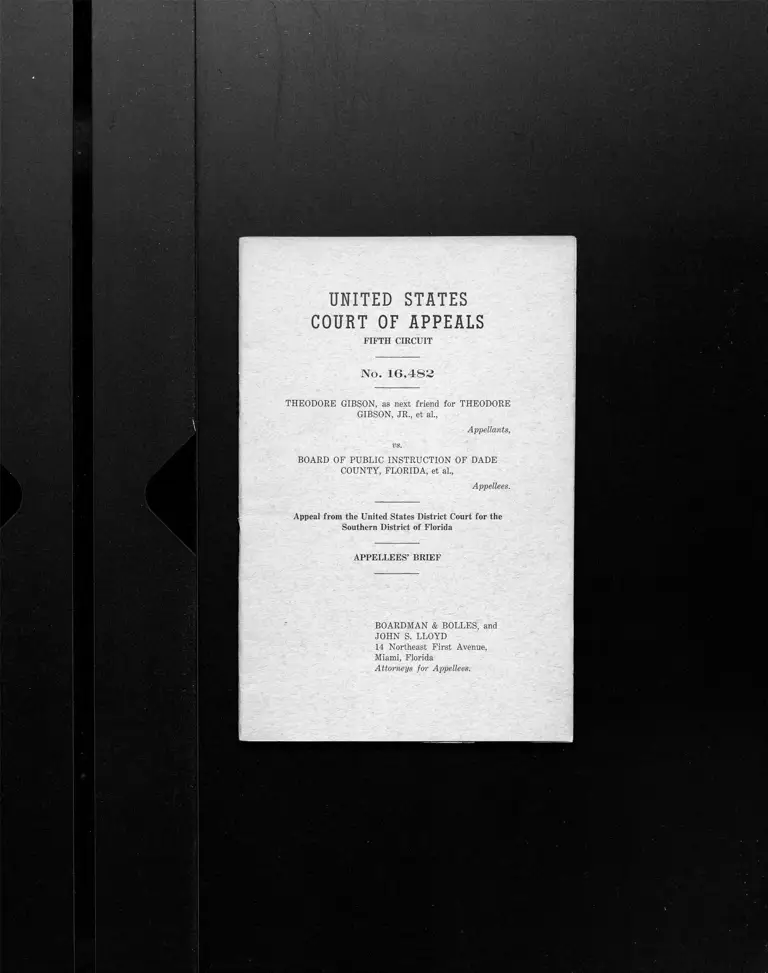
UNITED STATES
COURT OF APPEALS
FIFTH CIRCUIT
No. 16,482
THEODORE GIBSON, as next friend for THEODORE
GIBSON, JR ., et a l ,
Appellants,
vs.
BOARD OF PUBLIC INSTRUCTION OP DADE
COUNTY, FLORIDA, et al.,
Appellees.
Appeal from the United States District Court for the
Southern District of Florida
A P P E LLE E S’ BR IEF
BOARDMAN & BOLLES, and
JOHN S. LLOYD
14 Northeast F irst Avenue,
Miami, Florida
Attorneys for Appellees.
STATEM
SPECIFI
ARGUM3
CONCLE
APPENE
28 U.S.
Chapte
TABLE OF CASES
Page
Alabama State Federation of Labor, Local Union 103,
United Brotherhood of Carpenters & Joiners v.
McAdory, 325 U. S. 450 (1945) ................................... 4
Avery v. Wichita Falls Independent School District
5th Cir. 1957) 241 F. 2d 230...... ...................... ... ......H, 12
Bell v. Rippy (N. D. Tex. Dallas Div.) 133 F. Supp.
811...................................................................................... 11
Billings Utility Co. v. Advisory Committee, Board of
Governors, C.C.A. Minn., 135 F. 2d 108 (1943) 7
Briggs et al. v. R. N. Elliot, et al., 132 F. Supp. 776
(1955) ........................................................................... - 8
Brown v. Board of Education of Topeka, Kansas, 347
U. S. 483, 74 S. Ct. 686. ................................ ............... 3, 5,14
Bush v. Orleans Parish School Board, E. D. La., 138
F. Supp. 337, 340 (1956) a f f ’d ____F. 2 d ------ (5th
Cir. 1957) ................-....... -................... ........................... 9,10
Carson v. Board of Education of McDowell County,
227 F. 2d 789............... -............. -....... ........................ 14,16
Evans v. Members of the State Board of Education
(D. Del. 1956) 145 F. Supp. 873..................... .......... - 10,12
Hawkins, State ex rel v. Board of Control (Fla.) 83
So. 2d 20 ....... ................................................................... 4,10
Heywood v. Public Housing Administration (5th Cir.
1956) 238 F. 2d 698................................. ................... U , 12
TABLE OF CASES (Continued)
Page
Highland Farms Dairy v. Agnew, 300 U. S. 608, 616-
617, 81 L. Ed. 835, 842 ........................ ............................ 14
Hood v. Board of Trustees of Sumter County, South
Carolina, et ah, 232 F. 2d 626 Cert, den., 352 U. S.
____, 77 S. Ct. 95,1 L. Ed. 2d 76 ................................... 16
Jackson v. Rawdon (5th Cir. 1956) 235 F. 2d 93..,-.... 10,11
Maryland Cas. Co. v. United Corp. of Mass., I l l F.
2d 443 .......... ........................ ........ .................................... 6
New Discoveries v. Wisconsin Alumni Research Foun
dation 13 F. Supp. 596 .................................................. 6
Polhemus v. American Medical Association, C.C.A.
N. M., 145 F. 2d 357 (1944) ........................... ............... 7
Public Service Comm, of Utah v. Wycoff Co., 344
U. S. 237 (1952) .......................................... .................... 5
School Board of City of Charlottesville v. Allen (4th
Cir. 1956) 240 F. 2d 59 Cert. den. 353 U. S . ____,
1 L. Ed 2d 664 ............. ................. . ................ .............10,11
Swank v. Patterson, C.C.A. Ariz., 139 F. 2d 145 (1944) 7
United Public Workers of America (C.I.O.) v.
Mitchell, 330 U. S. 75 (1957) .......... ............................ 5
Whitmore v. Stillwell (5th Cir. 1955) 227 F. 2d 188...10,11
UNITED S T A T E S
COURT OF A P P E A L S
FIFTH CIRCUIT
No. 16,482
THEODORE GIBSON, as next friend for THEODORE
GIBSON, JR ., et al.,
Appellants,
( VS'
BOARD OF PUBLIC INSTRUCTION OF DADE
COUNTY, FLORIDA, et a l,
Appellees.
Appeal from the United States District Court for the
Southern District of Florida
A P P ELLEE S’ BR IEF
STATEMENT OF THE CASE
The statement of the case contained in appellants’
brief is substantially correct and accurate and is, therefore,
adopted by the appellees, except where the same is con
trary to the record. It is pointed out that the trial court
granted appellees’ motion to dismiss the original complaint
heretofore filed in this cause by the appellants.
SPECIFICATION OF ERRORS RELIED UPON
The appellants submit the following specification of
errors on which they rely:
1. The court below erred in dismissing the complaint
on the grounds that it failed to set forth a justi
ciable case or controversy.
2. The court below erred in ruling that the absence
of an allegation in the complaint that the appel
lants have sought admission to integrated schools
and have been denied admission by appellees, in
violation of appellants’ constitutional rights, di
vested the court of the power to proceed further
in the case.
3. The court below erred in ruling that the statement
of policy of appellees to continue to maintain ra
cially segregated schools did not vest the court
with jurisdiction to determine this cause.
4. The court below erred in ruling that there is
presently no act of appellees constituting any de
privation of any of appellants’ rights, and that it
could not act because no plan of desegregation
had been submitted by appellees for the court’s
consideration.
It is noted that the appellants, on December 28, 1956,
filed their Statement of Points on Appeal (R. 16) which
differs from the Specification of Errors now relied upon.
It is therefore presumed by the writer that such points
that have not been included in the Specification of Errors
Relied Upon have been abandoned by the appellants.
ARGUMENT
While the appellants submitted four specifications of
error for disposition by this court, all of them may be
argued as one point as follows:
The Amended Complaint Sets Forth a Justiciable
Case or Controversy Upon Which A Federal Court Should
Exercise Its Judicial Power.
The lower court answered this in the negative.
The trial court’s order dismissing the cause without
prejudice for the reasons stated therein (R. 10-13) was
correct and should be affirmed by this honorable court.
THE AMENDED COMPLAINT DOES NOT SET
FORTH A JU ST IC IA B LE CASE OR CONTROVERSY.
Appellants requested the court to rule on a moot issue.
In their amended complaint, appellants prayed for a
declaratory judgment and injunctive relief (R. 5). They
prayed the court to enter its declaratory judgment de
claring that Article XII, Section 12 of the Constitution of
the State of Florida and Section 228.09, Florida Statutes,
and the segregation of the infant plaintiffs because of their
race violate the Fourteenth Amendment of the United
States (R. 5).
Such a declaratory judgment or decree would be use
less repetition because such has already been declared, not
only by the United States Supreme Court in Brown v.
Board of Education of Topeka, Kansas, 347 U. S. 483, 74
4
S. Ct. 686, but also by the Florida Supreme Court in Haw
kins, State ex rel, v. Board of Control, (Fla.) 83 So. 2d 20,
where the Florida court declared that it was its inescapable
duty to abide by the United States Supreme Court’s de
cision. This issue, therefore, is moot.
It is well settled that the federal courts will not render
advisory opinions or rule in moot cases.
In support of this contention, the appellees cite for
the court’s consideration f r o m Anderson’s treatise,
“ Actions for Declaratory Judgments” , paragraph 65 on
page 131 of Volume I, entitled “ Courts do not deliver Ad
visory Opinions or Decide Moot Cases” :
“ It is definitely a sound rule of law that courts
do not sit to grant judgments in abstract, fic
titious, hypothetical or moot cases, but to redress
grievances and to prevent wrongs.”
In Alabama State Federation of Labor, Local Union
103, United Brotherhood of Carpenters & Joiners v. Mc-
Adory, 325 U. S. 450 (1945), the United States Supreme
Court stated, at page 461:
“ The requirements for a justiciable case or con
troversy are no less strict in a declaratory judg
ment proceding than in any other type of suit
. . . This court is without power to give advisory
opinions . . . It has long been its considered
practice not to decide abstract, hypothetical or
contingent questions . . . or to decide any con
stitutional question in advance of “ the necessity
for its decision . . . or to decide any constitu-
tional question except with reference to the par
ticular facts to which it is to be applied.”
See also Public Service Comm, of Utah v. Wycoff Co.
344 U. S. 237 (1952), and United Public Workers of
America (C.I.O.) v. Mitchell, 330 U. S. 75 (1957).
A PPELLA N TS A L L E G E D IN SU FFIC IEN T
FACTS IN TH EIR COMPLAINT TO R EFLE C T THE
EX IST E N C E OF AN ACTUAL CONTROVERSY.
In their prayer for injunctive relief, the appellants
prayed that the appellees be ordered to present a plan of
desegregation and be restrained from requiring the ap
pellants to attend or not to attend public schools because
of their race (R. 5, 6).
Appellants alleged that on September 7, 1955, they
had petitioned the appellee School Board to abolish segre
gation in the public schools of Dade County as soon as
practicable in conformity with the decision of the U. S.
Supreme Court in Brown v. Board of Education, supra.
(R. 4). They then stated that the appellee Board did not
desegregate the schools, but continued to adhere to a policy
adopted by the appellee Board on August 17, 1955, which
stated, at that time, that until further notice the school
system of Dade County would continue to be operated on
a segregated basis (R. 4).
Then the appellants included in their complaint the
bare conclusion, unsupported by any ultimate facts, that
the appellee Board had refused to desegregate the schools
operated and maintained by it as soon as was practicable
(R. 5).
Iff
'
6
The amended complaint is barren, however, of any
allegation that the appellants had been forced to attend
or not to attend any school because of their race or had
been denied the right to attend any school became of their
race.
Thus, there is no allegation in the amended complaint
to serve as a basis for granting the appellants the relief
prayed for that the appellees be enjoined from requiring
the appellants to attend or not to attend schools in Dade
County because of their race.
The appellants, by using mere conclusions rather
than any concrete allegations of substantial ultimate facts,
and by their prayers for relief unsubstantiated by any
concrete allegations, merely asked the lower court to give
an opinion advising what the law would be on something
even less than a hypothetical state of facts. The lower
court properly refused to give such an opinion. See Mary
land Cas. Co. v. United Corp. of Mass., I l l F. 2d 443.
On the contrary, the lower court correctly noted that
a court must deal with realities (R. 12) and require that
these realities be set forth in concrete allegations as ulti
mate facts in the complaint. See New Discoveries v. Wis
consin Alumni Research Foundation, 13 F. Supp. 596.
The following federal cases show clearly that the
statements contained in appellants’ complaint to the effect
that the appellants’ rights are being violated and that the
appellee Board has refused to desegregate the schools as
soon as is practicable are merely conclusions and not ulti
mate facts sufficient to state a cause of action.
In the case of Polhemus v. American Medical Asso-
ciation, C.C.A. N.M., 145 F. 2d 357 (1944) the federal
court held that an allegation in general terms that an
action involved a violation of the plaintiff’s rights under
certain provisions of the federal constitution were mere
conclusions and not statements of ultimate fact.
In Swank v. Patterson, C.C.A. Ariz., 139 F. 2d 145
(1944), it was ruled that in determining the federal court’s
jurisdiction, a statement in a complaint that by the de
fendant’s acts the plaintiff was denied benefits and rights
afforded to him by the Fourteenth Amendment of the
United States Constitution was merely a conclusion and
not sufficient to state a cause of action.
Further, in the case of Billings Utility Co. v. Advisory
Committee, Board of Governors, C.C.A. Minn. 135 F. 2d
108 (1943), it was held that the characterization of acts
as arbitrary, capricious and tyrannical was not an alle
gation of fact, but a statement of pleaders’ conclusion.
On the basis of the previously cited cases, we submit
there is no actual controversy existing within the purview
of the allegations of the amended complaint that would
authorize the federal court to proceed under 28 U.S.C.
Sec. 2201.
The allegation of the statement of policy of the Board
of Public Instruction of Dade County, Florida, contained
in Paragraph 5 of the amended complaint is not sufficient
to vest the federal court with jurisdiction, which was one
of the reasons for the lower court’s dismissal of the
amended complaint.
8
There is no allegation in the amended complaint that
a request was made for admission to a school and the same
refused on the basis of race or color.
The decision of the special three judge court in the
case of Harry Briggs, J r . et ai. v. R. N. Elliot, et al.,
132 F. Supp. 776, decided on July 15, 1955, in the United
States District Court, Eastern District of South Carolina,
is pertinent to the issue involved here because in its decree
the court stated exactly what the U. S. Supreme Court has
decided and what it has not decided with respect to segre
gation in the schools.
We quote directly from the decision in Briggs, et al.,
v. Elliott, et al., supra:
“ . . . It is important that we point out exactly
what the Supreme Court has decided and what it
has not decided in this case. It has not decided
that the federal courts are to take over or regu
late the public schools of the states. It has not
decided that the states must mix persons of dif
ferent races in the schools or must require them
to attend schools or must deprive them of the
right of choosing the schools they attend. What it
has decided, and all that it has decided, is that a
state may not deny to any person on account of
race the right to attend any school that it main
tains. This, under the decision of the Supreme
Court, the state may not do directly or indirectly
but if the schools which it maintains are open to
children of all races, no violation of the constitu
tion is involved even though the children of dif
ferent races voluntarily attend different schools
as they attend different churches.”
Appi
regarding
the appel
tain sufi
the appe
school be<
We
of the oi
cases, tin
and had
App
not nece;
mainly o
E. D. La
------ (5t
other cas
API
NOT n :
THEY 1
SION T<
The
the othe:
erroneou
For
that a ji
admittec
public sc
statutes
tution.
9
Appellants’ complaint, barren as it is of any allegation
regarding a specific instance of a refusal on the part of
the appellee Board to admit them to a school, does not con
tain sufficient allegations of ultimate fact to show that
the appellants are being denied the right to attend any
school because of their race.
We note the existence of one paramount fact in each
of the original school segregation cases. In each of these
cases, the plaintiffs sought admission to a particular school
ancl hacl been denied it„
Appellants, however, contend that such a request is
not necessary. To support this contention, appellants rely
mainly on the case of Bush v. Orleans Parish School Board,
E. D. La., 138 F. Supp. 337, 340 (1956) a f f d ----- F. 2d
____ (5th Cir. decided March 1, 1957), as well as certain
other cases which they cite.
A PPELLA N TS’ CONTENTION THAT IT WAS
NOT N ECESSA RY FOR THEM TO ALLEG E THAT
THEY HAD SOUGHT AND BE EN DENIED ADMIS
SION TO A PARTICULAR SCHOOL IS ERRONEOUS.
The case of Bush v. Orleans Parish School Board, and
the other cases relied on by appellants in support of this
erroneous contention cannot apply to the instant situation.
For instance, in the Bush case, supra, the court stated
that a justiciable issue existed because the defendants had
admitted that they were maintaining segregation in the
public schools under their supervision pursuant to the state
statutes and the appropriate article of the state consti
tution.
Thus in the Bush case, the defendants and the State
of Louisiana itself were acting under the theory that the
state’s segregation laws were still in effect in spite of
the Brown decision. There can be no such theory in the in
stant case because of the decision of the Florida Supreme
Court in Hawkins, State ex rel. v. Board of Control, supra.
Further, at the time of the institution of this suit,
there was a valid pupil assignment law in existence in the
State of Florida. Chapter 31380, Laws of Florida, was
enacted by the Legislature of the State of Florida during
the 1956 Second Extraordinary Session, entitled “An Act
Relating to the Management of the Public Schools” . This
law conforms to the requirements of the implementation
decision in the Brown case.
Thus, the Bush case is not applicable to the instant
case because Louisiana law required that the school sys-
ems there be operated on a segregated basis, while there
was no such requirement in Florida at the time of the
institution of this suit.
Appellants also cite the following cases in support of
their stated position:
Jackson v. Rawdon (5th Cir. 1956) 235 F 2d 93;
School Board of City of Charlottesville v. Allen
(4th Cir. 1956) 240 F. 2d 59, Cert. den. 353 U. S.
----- 1 L. Ed. 2d 664;
Whitmore v. Stillwell (5th Cir. 1955) 227 F. 2d
188;
Evans v. Members of the State Board of Educa-
cation (D. Del. 1956) 145 F. Supp. 873;
11
Avery v. Wichita Falls Independent School Dis
trict (5th Cir. 1957) 241 F. 2d 230;
Bell v. Rippy (N. D. Tex. Dallas Div.) 133 F.
Supp. 811;
Heywood v. Public Housing Administration (5th
Cir. 1956) 238 F. 2d 698.
None of these cases can be applicable to support the
position of the appellants with regard to the situation in
the case at bar, as a brief analysis of them will show.
For instance, in Jackson v. Rawclon, supra, there was
only one high school, Mansfield High School, in the school
district involved, and the plaintiffs alleged they sought
admission to that high school and were denied solely be
cause they were colored.
In Whitmore v. Stillwell, supra, the situation involved
a junior college to which the plaintiffs had applied for ad
mission in 1952. This court held that the plaintiffs did
not have to reapply before instituting suit because they
had already applied and had been refused and there was
no showing that the school had changed its policy after the
Brown decision.
How can Whitmore v. Stillwell, a case in which there
was an application to a school, apply to a situation where
there has been no such application?
In School Board of City of Charlottesville v. Allen,
supra, the state school segregation laws were still in effect
as fa r as the State was concerned, as they were in the Bush
12
case, and it was shown that the two school boards involved K
were both upholding these state segregation laws. lants m
where t
Further, in the Charlottesville case, the pupil place- were m
ment law recently enacted by the Virginia General As- instant
sembly had not yet become effective, and the provisions additioi
of the code of Virginia applicable at the time of the institu- h a segre
tion of the suit had been met by the plaintiffs in the k each ca
Charlottesville situation. for an
| of color
In Evans v. Members of Board of Education, supra, were a<
there was a refusal to desegregate a public school by both segregs
the local Clayton Board of School Trustees and the State . the cas
Board of Education in response to a petition presented to which 1
them both to do so by the plaintiffs in that case.
O i
The court in the Evans case, also found that defend- case th
ants’ alleged failure to formulate a plan for integration not tal
was done under “color of state law” . the Un
lower c
In Avery v. Wichita Falls Independent School Bis- | because
trict, et al. supra, the plaintiffs lived in an area served by 1 lawful
a white school, made application to that school, and were
refused on racial grounds.
the fac
The case of Heywood v. Public Housing Administra- insuffi
tion, supra, involved an action brought by negroes against ing to
public housing administrations where the negroes claimed Court
they were not even permitted to make application for white
housing projects. This case is clearly not applicable to the A
facts in the case at bar. There definitely are not sufficient is whe
facts alleged in appellants’ amended complaint to show that reiters
they were not permitted to apply to any school, nor do they trover
make any such claim.
It is clearly apparent from the cases cited by appel
lants in support of their position that in each of these cases
where the court held that a justiciable issue existed there
were more facts than were alleged by the appellants in the
instant case. In each case there were other elements in
addition to a mere Board policy to continue the schools on
a segregated basis for an unannounced period of time. In
each case where the court held that it was not necessary
for an application to a school and a refusal on the basis
of color in order to create a justiciable issue, the defendants
were acting under what they considered to be a valid state
segregation law requiring segregated schools. In some of
the cases there was an application to a particular school,
which had been refused.
On the other hand, the lower court noted in the instant
case that it believed that every member of the Board would
not take lightly his oath to “ support the constitution of
the United States and the State of Florida” (R. 12). The
lower court had every right to indulge in this presumption
because an administrative body is presumed to act in a
lawful manner until it is proven otherwise.
The lower court, therefore, correctly determined that
the facts before it in appellants’ amended complaint were
insufficient to show that the appellee Board was not plan
ing to obey the mandate of the United States Supreme
Court to desegregate the schools as soon as practicable.
As heretofore noted, the prime point in this discussion
is whether or not a justiciable controversy existed, and we
reiterate our contention that there is no justiciable con
troversy presented by appellants’ amended complaint.
But suppose, for the sake of argument only, we admit
the existence of a true controversy.
THE A PPELLA N TS HAVE NOT EXH A U STED
TH EIR ADM INISTRATIVE REM ED IES.
Nowhere in the amended complaint is there an allega
tion that the appellants have availed themselves of and
exhausted the administrative remedies available to them
under existing state law. Any argument based on the prop
osition that relief would have been denied still does not
relieve the appellants from the necessity of exhausting their
administrative remedies before application to the courts
for relief.
In Highland Farm s Dairy v. Agnew, 300 U. S. 608,
616-617, 81 L. Ed. 835, 842, the court held:
“ . . . One who is required to take out a li
cense will not be heard to complain, in advance
of application, that there is danger of refusal
. . . He should apply and see what happens.”
A very recent decision containing cogent reasons for
the affirmance of the ruling of the lower court in this case
was handed down by the Court of Appeals for the Fourth
Circuit in the case of Carson v. Board of Education of
McDowell County, 227 F. 2d 789. This case was decided
subsequent to the decisions in the Brown case, supra, and
involved an action by negro children against a local school
board alleging discrimination on account of race and color
because plaintiffs were not allowed to attend a certain
public school. A state statute existed which provided an
administrative remedy for persons who felt aggrieved with
respect to their enrollment in the public schools of the
state. This statute is substantially similar to the law pres
ently existing in the State of Florida, popularly known as
the “ Pupil Assignment Law” . In referring to the North
Carolina School Assignment Act, the federal court stated,
at page 790:
“ . . . An administrative remedy is thus pro
vided by state law for persons who feel that they
have not been assigned to schools that they are
entitled to attend: and it is well settled that the
courts of the United States will not grant in
junctive relief until administrative remedies have
been exhausted.” (Citing cases)
In discussing the applicability of the rule to the al
leged discrimination, and in submitting the case to the state
forum, the court said:
“ This rule is especially applicable to a case such
as this, where injunction is asked against state or
county officers with respect to the control of
schools maintained and supported by the state.
The federal courts manifestly cannot operate the
schools. All that they have the power to do in the
premises is to enjoin violation of constitutional
rights in the operation of schools by state author
ities. Where the state law provides adequate ad
ministrative procedure for the protection of such
rights, the federal courts manifestly should not
interfere with the operation of the schools until
such administrative procedure has been exhausted
and the intervention of the federal courts is shown
to be necessary. As said by Mr. Justice Stone in
16
Matthews v. Rodgers, supra, (284 U. S. 525) :
‘The scrupulous regard for the rightful inde
pendence of state governments which should at q’fo
all times actuate the federal courts, and a proper
reluctance to interfere by injunction with their
fiscal operations, require that such relief should
be denied in every case where the asserted federal
right may be preserved without it.’ Interference
by injunction with the schools of a state is as
grave a matter as interfering with its fiscal
operations and should not be resorted to ‘where
the asserted federal right may be preserved
without it.’ ”
The McDowell Comity case, supra, was subsequently
followed by the circuit court in the affirmance of a dis
trict court’s denial of relief in Hood v. Board of Trustees
of Sumter County South Carolina, et al., 232 F. 2d 626,
cert, den., 352 U. S . ----- -, 77 S. Ct. 95, 1 L. Ed. 2d 76. In
the Hood case, as in the McDowell case, negro children
brought an action in the federal district court against local
school officials before availing themselves of the adminis- ►
trative remedies provided by the South Carolina statute
in cases of school placement disputes.
Thus, even if it were determined that a justiciable
controversy existed in the instant case, appellants would
not be entitled to the relief they seek because they have
not exhausted the administrative remedies available to
them.
CONCLUSION
The order of the lower court should be affirmed.
Respectfully submitted,
BOARDMAN & BO LLES and
JOHN S. LLOYD,
Attorneys for Appellees
14 Northeast F irst Avenue
Miami, Florida
By
Edward F. Boardman
within
taxes, a:
Territor
pleading
of any i
or not f
laration
ment o:
amende*
AN
schools
policies
tions ar
suant tl
authori;
groups;
ing for
areas ai
all purs
repealir
effectiv
WI
public \
la
APPENDIX
28 U.S.C. Section 2201 of Title 28
Creation of Remedy.-—In a case of actual controversy
within its jurisdiction, except with respect to Federal
taxes, any court of the U. S. and the district court or the
Territory of Alaska, upon the filing of an appropriate
pleading, may declare the rights and other legal relations
of any interested party seeking such declaration, whether
or not further relief is or could he sought. Any such dec
laration shall have the force and effect of a final judg
ment or decree and shall be reviewable as such. As
amended August 28,1954, c. 1033, 68 Stat. 890.
CHAPTER 31380
SEN A TE BILL NO. 11-XX
AN ACT relating to the management of the public
schools at the local level; prescribing student admission
policies with power to make appropriate rules and regula
tions and providing for the review of actions taken pur
suant thereto; prescribing the duties of certain officials;
authorizing the creation of advisory committees and study
groups; authorizing employment of legal counsel; provid
ing for surveys; authorizing redistricting of attendance
areas and reallocation of school bus transportation routes;
all pursuant to the police and welfare powers of the State ;
repealing Section 230.23(6)g., Florida Statutes; providing
effective date.
W HEREAS, this Act is enacted under the police and
public welfare powers of the State to promote the health,
safety, good order and education of the people within the
State of Florida.
Now, therefore,
BE IT ENACTED BY THE LEGISLATURE OF
THE STATE OF FLORIDA:
Section 1. The county board of public instruction
of the several counties are hereby authorized and directed
to provide for the enrollment in a public school in the
county of each child residing in such county who is qual
ified under the laws of this state for admission to a pub
lic school in such county. The authority of each such board
in the matter of the enrollment of pupils in the public
schools shall be full and complete. No pupil shall be en
rolled in or admitted to attend any public school in which
such child may not be enrolled pursuant to the rules, reg
ulations and decisions of such board.
Section 2. In the exercise of the authority conferred
by Section 1 of this Act upon the county boards of public
instruction each such board shall provide for the enroll
ment of pupils in the respective public schools located
within such county so as to provide for the orderly and
efficient administration of such public schools, the effec
tive instruction of the pupils therein enrolled, and the
health, safety, education and general welfare of such pu
pils. In the exercise of such authority the board shall pre
scribe school attendance areas and school bus transpor
tation routes and may adopt such reasonable rules and reg
ulations as in the opinion of the board shall best accom
plish such purposes. The county boards of public instruc
tion shall prescribe appropriate rules and regulations to
implement the provisions of this subsection and other
applicable laws of this state and to that end may use all
means legitimate, necessary and proper to promote the
health, safety, good order, education and welfare of the
public schools and the pupils enrolling therein or seeking
to enroll therein. In the accomplishment of these objec
tives the rules and regulations to be prescribed by the
Board may include, but be not limited to, provisions for
the conduct of such uniform tests as may be deemed neces
sary or advisable in classiflying the pupils according to
intellectual ability and scholastic proficiency to the end
that there will be established in each school within the
county an environment of equality among pupils of like
qualifications and academic attainments. In the prepara
tion and conduct of such tests and in classifying the pu
pils for assignment to the schools which they will attend,
the board shall take into account such sociological, phyeho-
logical and like intangible social scientific factors as will
prevent, as nearly as practicable, any condition of socio
economic class consciousness among the pupils attending
any given school in order that each pupil may be afforded
an opportunity for a normal adjustment to his envoron-
ment and receive the highest standard of instruction with
in his ability to understand and assimulate. In designating
the school to which pupils may be assigned there shall be
taken into consideration the available facilities and teach
ing capacity of the several schools within the county, the
effect of the admission of new students upon established
academic programs, the suitability of established curricu
lum to the students enrolled or to be enrolled in a given
school, the scholastic aptitude, intelligence, mental energy
or ability of the pupil applying for admission and the
psychological, moral, ethical and cultural background and
qualifications of the pupil applying for admission as com-
4a
pared with other pupils previously assigned to the school
in which admission is sought. It is the intention of the
legislature to hereby delegate to the local school boards
all necessary and proper administrative authority to pre
scribe such rules and regulations and to make such de
cisions and determinations as may be requisite for such
purposes.
Section 3. a. The parent or guardian of any child,
or the person standing in loco parentis to any child who
shall apply to the appropriate public school official for the
enrollment of any such child in any public school within
the county in which such child resides, and whose applica
tion for such enrollment shall be denied may, pursuant to
rules and regulations established by the county boards of
public instruction, apply to such board for enrollment in
such school and shall be entitled to a prompt and fair hear
ing by such board in accordance with the rules and regula
tions established by such board. The majority of such
board shall be a quorum for the purpose of holding such
hearing and passing upon such application and the de
cision of the majority of the members present at such
hearing shall be the decision of the board. If at such hear
ing the board shall find that such child is entitled to be
enrolled in such school or if the board shall find that the
enrollment of such child in such school will be for the best
interest of such child and will not interfere with the proper
administration of the school or with the proper instruction
of the pupils there enrolled and will not endanger the
health or safety of the pupils there enrolled, the board
shall direct that such child be enrolled in and admitted
to such school. If the board finds that the child is not en
titled to be enrolled in such school or that his enrollment
in such school would not be for the best interest of the
child or t'
the prop
proper in
child’s ad
or safety
deny the
of the ch
determini
to serve
school sys
b. I
plication
standing
satisfied
spect to
such pare
parentis
by makin
within tt
cision, an
practicab
ceiving s
shall can
sought tc
the evide
thirty (3<
said decis
for furth
Board of
to be tak
consider
original
the decis
child or that his enrollment would seriously interfere with
the proper administration of such school or with the
proper instruction of the pupils there enrolled or that the
child’s admission to such school would endanger the health
or safety of the children there enrolled, the board shall
deny the petition for enrollment and direct the enrollment
of the child in such other school in the county as shall be
determined by the board to be best adapted or qualified
to serve the best interests of the child and of the public
school system.
b. If a parent or guardian of any child whose ap
plication for enrollment has been denied, or the person
standing in loco parentis to any such child, shall be dis
satisfied with the decision of any county board with re
spect to the school in which such child shall be enrolled,
such parent or guardian, or such person standing in loco
parentis to such child, may seek a review of such decision
by making and filing with the State Board of Education
within thirty (30) days after the rendition of such de
cision, an application for review thereof, and as soon as
practicable, but not later than thirty (30) days after re
ceiving such application, the State Board of Education
shall cause the county school board, whose decision is
sought to be reviewed, to transmit to it the transcript of
the evidence in such case before them, and within said
thirty (30) day period of time affirm, reverse or modify
said decision or remand the matter to the county board
for further proceedings, provided, however, that the State
Board of Education may, in its discretion, take or direct
to be taken any additional evidence or testimony and may
consider such additional testimony in connection with the
original transcript, and shall affirm , reverse or modify
the decision of the board of public instruction or remand
6a
the matter to the county board for further proceedings,
and in all such proceedings, the county superintendent of
public instruction and the board of public instruction of
said county shall be notified and shall be considered as a
party to the review.
In addition to the matters and things set forth herein
to be considered by the county board of public instruction
in the assignment of such pupil to a school, the State
Board of Education may take into consideration any mat
ter and thing which in its judgment and discretion relates
to the welfare, safety, well-being, peace and tranquility
of the community or area affected, and taking all such
matters into consideration, shall render its decision, either
reversing the action or actions theretofore taken as pro
vided above or modifying the decision or decisions pre
viously taken or remand the matter to the county board
of public instruction for further proceedings.
c. Any parent or guardian of any child or the per
son standing in loco parentis to any child, or a majority
of the board of public instruction of any county affected
by the decision of the State Board of Eduation, and who
is dissatisfied therewith, may appeal such decision as a
matter of right to the Circuit Court of Leon County, Flor
ida, within thirty (30) days after the rendition of the said
decision by the Board. The appeal shall be heard by the
Circuit Court upon the record certified by the Board,
which shall include a copy of the transcript of evidence,
and such documents and exhibits as may have been filed
before the Board, as either party may request. The Circuit
Court may affirm, reverse, modify or remand the cause
to the Board for further proceedings. An appeal from
the decision of the Board to the Circuit Court shall be
7a
taken by filing a written notice with the Board. Said no
tice of appeal shall be served personally, or by mailing a
true copy thereof by registered mail within five (5) days
after the same is filed to the attorney of record for the
interested parties. The notice shall fix the return date of
the appeal. The appeal shall be returnable before the Cir
cuit Court of Leon County to a date not less than thirty
(30) days and not more than sixty (60) days from the
date the decision appealed from is filed in the office of
the Board. Except where it is inconsistent herewith, the
statutes and rules governing appeals in chancel y shall
govern appeals provided for herein. In all such appeals
the Board shall be the sole party respondent, and the At
torney General of the State of Florida shall be given no
tice of such appeal and shall take such action therein as
he shall be directed by the Board.
d. In any proceeding brought pursuant to the pro
visions of this section the Attorney General of the State
of Florida is authorized upon request to furnish represent
ation to the County School Board, and to represent the
State Board of Education of the State of Florida, as the
case may be, and upon request shall furnish such services
as may be necessary to properly present and defend the
action of the public bodies and officials charged with the
responsibility of administering the provisions of this
chapter.
e. Reviews by the State Board of Education of the
State of Florida of any decisions rendered by the County
School Boards in the state shall be considered and con
strued as a step in the local proceeding.
Section 4. The county school boards of the public
8a
schools of Florida are authorized and empowered to con
duct surveys within their respective counties to deter
mine the attitudes and feelings of the citizens of their re
spective communities with the subsequent purpose of for
mulating plans to maintain, preserve and improve the
public school system of Florida.
Section 5. The county school boards are authorized
and empowered to create and appoint citizens committees
and study groups from their localities to assist in the
aforementioned surveys and plans.
Section 6. The county school boards shall be author
ized to employ special counsel to assist the county school
board’s attorney in representing the board in any litiga
tion involving rules and regulations and rulings and de
cisions of the board under the provisions of this act.
Section 7. If any section, subsection, sentence, clause,
phrase or word of this Act is for any reason held or de
clared to be unconstitutional, invalid, inoperative, ineffec
tive, inapplicable, or void, such invalidity or unconstitu
tionality shall not be construed to affect the portions of
the Act not so held to be unconstitutional, void, invalid
or ineffective, or affect the application of this Act to other
circumstances not so held to be invalid, it being hereby de
clared to be the express legislative intent that any such
unconstitutional, illegal, invalid, ineffective, inapplicable
or void, portion or portions of this act did not induce its
passage, and that without the inclusion of any such uncon
stitutional, illegal, invalid, ineffective or void portions of
this act, the legislature would have enacted the valid and
constitutional portions thereof.
9a
Section 8. Section 230.23(6) (g), Florida Statutes, is
hereby repealed.
Section 9. This act shall take effect immediately
upon becoming a law.
Approved by the Governor July 26, 1956.
Filed in Office Secretary of the State July 27, 1956.
CERTIFICATE OF SERVICE
1 H EREBY CERTIFY that a copy of the foregoing
Brief of Appellees has this______ day of May, 1957, been
furnished to Mr. G. E. Graves, Jr., Attorney for Appel
lants, 802 N. W. Second Avenue, Miami, Florida.
Edward F. Boardman
e foregoing
, 1957, been
for Appel-
ia.
iman
UNITED STATES COURT OF APPEALS
FIFTH CIRCUIT
NO. 1 6 ,4 8 2
THEODCRE GIBSON, a s n ex t f r ie n d f o r :
THEODORE GIBSON, J R . , e t a l . ,
t
A p p e lla n ts ,
v s . * CERTIFICATE OF SERVICE
:
BOARD OF PUBLIC INSTRUCTION OF DADE
COUNTY, FLORIDA, e t a l . , ;
A p p e l la n t s . :
I HEREBY CERTIFY t h a t a copy o f A p p a l l * * * * B r i e f
in th e c a p tio n e d c a s e h a s t h i s 13th day o f May, A. D, 1 9 5 7 ,
been m ailed to each o f th e fo l lo w in g :
G . E. G ra v e s , J r .
802 N. W, Second Avenue
M iami, F lo r id a
Edwin L . D av is
941 N. w. Second Avenue
M iami, F lo r id a
R obert L . C a r t e r ,
Thurgood M a r sh a ll ,
C o n stan ce B ak er M otley
107 West 4 3 rd S t r e e t
New Y ork , New York
(V ia A ir M ail)
H erb ert L * H eiken
763 A rthur G o d frey Road
Miami B e ach , F lo r id a .
BOARDMAN & BoLLES, and
J«.HN S . LLOYD
14 N. E, F i r s t Avenue
A tto rn e y s f o r A p p e lle e s
By.
John S . L loyd
OFFICE OF THE CLERK
§& *3& & b t§ad s' ,orth
United States Court of Appeals
F IF T H C I R C U I T
NEW ORLEANS 6, LA.
May 1 4 , 1 9 5 7 .
Mr. H erbert L . H eiken ,
A tto rn e y a t Law,
Miami B e ach , F l a .
D ear S i r :
In r e p ly to yo u r l e t t e r o f May 1 0 th , r e o u e s t -
in g in fo rm a tio n a s to w hether t h i s C ou rt w i l l perm it
o r a l argum ent from Amicus C u r ia e in r e : -
No. 16432 , GIBSON ET A L ., vs.BOARD OF PUBLIC IN
STRUCTION OF DADE COUNTY, FLORIDA, ET AL,
I am d ir e c t e d t o a d v is e t h a t t h i s c a se h a s been s e t f o r
o r a l argum ent on May 22nd, h ere in New O r le a n s , a t which
tim e th e C ourt w i l l a l lo w a maximum o f t h i r t y m in u tes to
th e s i d e . I f c o u n se l f o r e i t h e r p a r ty so d e s i r e , th e y
may p erm it Amicus C u r ia e t o u se a p o r t io n o f t h e i r a l
l o t t e d t im e , th e o n ly *1 1 j o i s t i o n b e in g t h a t th e C ourt
w i l l n o t a llo w more th an an hour f o r th e argum ent o f th e
whole c a s e and i f c o u n se l f o r th e p a r t ie d w i l l n o t a g r e e
to perm it u se o f a p o r t io n o f t h e i r tim e Amieus C u ria e
must su bm it on b r i e f .
V ery 1
&
t r u ly y o u r s ,
D W. WADSWORTH
C lerk
EW
cc
mf . . .
Ifa*. G. E . G ra v e s , J r . , M iam i, F l a .
Mr. Thurgood M a r sh a ll , New Y ork , N. Y .
Mr. Edward F . Boardm an, M iami, F l a .
Mr. John S . L lo y d , M iam i, F l a .