Plaintiffs'-Appellees Supplemental Memorandum
Public Court Documents
September 9, 1977
9 pages
-
Case Files, Norwood v. Harrison - Hardbacks. Plaintiffs'-Appellees Supplemental Memorandum, 1977. bdc89079-722e-f111-88b4-0022482cdbbc. LDF Archives, Thurgood Marshall Institute. https://ldfrecollection.org/archives/archives-search/archives-item/8de601f0-eab8-4853-b94e-d563747c86c8/plaintiffs-appellees-supplemental-memorandum. Accessed October 16, 2026.
Copied!
     [||55cc37d3-36d0-430d-8696-bb3dc0b08633||] ®

NAACP LEGAL DEFENSE AND EDUCATIONAL FUND, INC.

10 Columbus Circle, New York, N.Y. 10019 » (212) 586-8397 i)


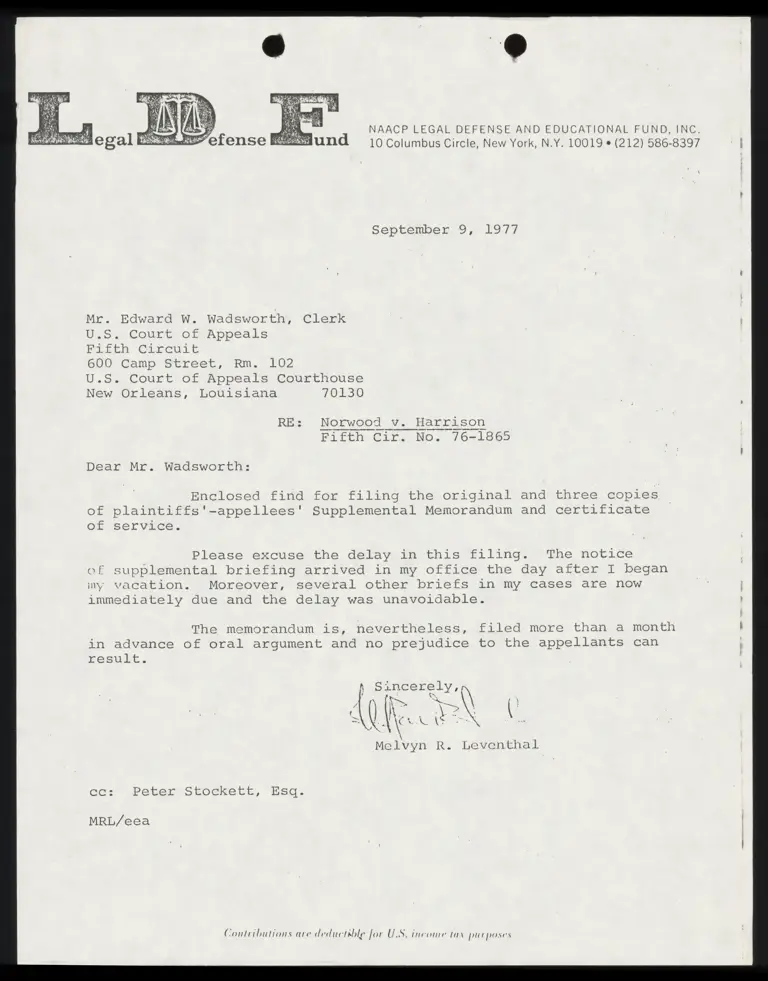
September 9, 1977

Mr. Edward W. Wadsworth, Clerk
U.S. Court of Appeals
Fifth Circuit
600 Camp Street, Rm. 102
U.S. Court of Appeals Courthouse
New Orleans, Loulsiana 70130

RE: Norwood v. Harrison

Fifth Cir. No. 76-1865


Dear Mr. Wadsworth:

Enclosed find for filing the original and three copies
of plaintiffs'-appellees' Supplemental Memorandum and certificate

of service.

Please excuse the delay in this filing. ' The notice
of supplemental briefing arrived in my office the day after I began
ny vacation. Moreover, several other briefs in my cases are now

immediately due and the delay was unavoidable.

The memorandum is, nevertheless, filed more than a month

in advance of oral argument and no prejudice to the appellants can

result.

CE iE Ak a
R. Leventhal

cc: Peter Stockett, "Esg.

MRL/eea

Contributions are deductsble for U.S. income tax purposes


L\ No | IN THE

UNITED STATES COURT OF APPEALS

FOR THE FIFTH CIRCUIT


No. 76-1865


DELORES NORWOOD, et al.,

Plaintiffs-Appellees

VY.

D.L. HARRISON, SR., et al.

Defendants-Appellants.


On Appeal from the United States District Court
for the Northern District of Mississippi


PLAINTIFFS '-APPELLEES'
SUPPLEMENTAL, MEMORANDUM


JACK GREENBERG

MELVYN R. LEVENTHAL

; 10 Columbus Circle
Suite 2030
New York, New York

1001¢

FRED L. BANKS, JR.

538% North Farish St.
Jackson, Mississippi

39202

September, 1977 Attorneys for Plaintiff-
Appellees


IN THE

UNITED STATES COURT OF APPEALS

FOR THE FIFTH CIRCUIT


No. 76-1865


DELORES NORWOOD, et al.,

Plaintiffs-Appellees

Y.

D.L. HARRISON, SR., et al.

Defendants-Appellants.


On Appeal from the United States District Court
for the Northern District of Mississippi


PLAINTIFFS '-APPELLEES'
SUPPLEMENTAL MEMORANDUM


I

The district court identified three poten-

tial obstacles to an award of attorneys' fees: the

Eleventh Amendment, Alyeska, and the "person" require-

ment of §1983. It found attorneys' fee and costs

"ancillary and prospective" and hence not barred by

the Eleventh Amendment; it found Alyeska's require-


ment of an express Congressional authorization for a


fee award fully satisfied by §718; finally, it held that

Congress, in enacting §718, "unmistakably chose to abandon"

the "person" requirement of §1983 for the "specific remedy

[of attorneys' fees] to achieve Fourteenth Amendment com-

pliance in the field of elementary and secondary education.”

410 F. Supp. at 143-44. Judge Keady therefore entered judg-

ment against defendants, who had been sued "as members of the

Mississippi State Textbook Purchasing Board, "(A.l), in their

official capacities. (A.l) hyd

Defendants-appellants challenge these three holdings.

They also argue that the State of Mississippi is an unjoined

indispensable party and that sovereign immunity, aside from

the Eleventh Amendment variety, shields these defendants from

judgment.

The law in this area is fast breaking; indeed, this

appeal may be fully resolved on the basis of developments occur-

ring after Judge Keady's decision and the last brief in this case.


i/ The district court also held that fee awards under §718

do not turn on evidence of bad faith, citing Northcross v.
Board of Education, 412 U.S. 427 (1973).


--


4 4

The Eleventh Amendment


Fitzpatrick v. Bitzer, 427 U.S. 445, 453-56 (1976)


holds that "when Congress has passed specific legislation

pursuant to Section 5 [of the Fourteenth Amendment] to en-

force the rights guaranteed by the Fourteenth Amendment...

monetary relief recoverable directly from the state treasury

will be allowed; i.e., such legislation is insulated from

Eleventh Amendment attack. Jagnandan v. Giles, 538 F.2d


1173, 1184-85 (5th cir. 1976). &/ An action to recover

attorneys' fees under §718, which was enacted pursuant to

Section 5 of the Fourteenth Amendment, 2/ is accordingly not

subledt to Eleventh Amendment challenge.

Subsequent to defendants' first brief in this appeal,

Congress in 1976 enacted legislation, also pursuant to Section

5 of the 14th Amendment, providing for awards of attorneys’


x/ Appellants reliance on Jagnandan is misplaced: that case was
not brought pursuant to a Section 5-14th Amendment statute,
could therefore not benefit from Fitzpatrick and for that
reason led to a holding that plaintiff could not obtain a
money judgment against state defendants. See also, Jordan v.
Trainor, 551 7.28 152, 155 (7h Cir. 1977).


2/ cunningham v, Grayson, 541 F.2d 538, 543 (6th Cir. 1976);
Oliver v. Kalamazoo Board of Education, 73 F.R.D. 30, 36-37


(W.D. Mich. 1976); Arthur V. Nyquist, 426 F. Supp. 194, 196-97
{(Ww.D. N.Y. 1976).


fees in civil rights cases generally. This. court has now held

that:

“The combination of Fitzpatrick and the
Civil Rights Attorney's Fees Awards Act
of 1976 establishes that the Eleventh
Amendment is no longer a bar to the award
of attorney's fees against a state in
actions under the statutes enumerated in
[the 1976] Act.
Rainey v. Jackson State College, 551 F.2d
672, :675..(5th Cir. 1977).2/


Ji:

Alyeska

The district court correctly held that §718 applies

to all cases seeking "Fourteenth Amendment compliance in the

field of elementary and secondary education,” and not merely

to typical school desegregation cases. The enactment of the

Civil Rights Attorney's Fees Award Act of 1976,2/ which clearly

applies to any §1983 action, provides a second express Congress-

ional authorization for a fee award in this case. Rainey, supra;


Stanford Daily v. Zurcher, 550 F.2d (9th Cir. 1977): Finney vV.


Hutto, supra.


2 Other circuits have reached the same result. Martinez
Rodriquez v. Jimenez, 551 F.2d 877 (lst Cir. 1977);
Finno v. Hutto, 548 F.2d 740 (8th Cir. 1977); Cunningham v.
Grayson, supra.


24/ The 1976 statute applies to cases pending on appeal at the
time of its enactment. Rainey, supra,551 F.2d at 675-76.


The Eighth Circuit concurs. Finney v. Hutto, supra, 548
P.24 at 742, n.5.


Iv


The "Person" Requirement

of §1983.


§718, by its very terms, provides for the entry

of judgment against state defendants. The legislative history

of the 1976 attorneys' fees statute clearly states that judg-

ments against state defendants are contemplated.’ This Court,

and others, have entered or upheld judgments for fees against

state defendants in §1983 actions: Rainey v. Jackson State


College, supra, was a §1983, teacher dismissal case against


the State Board of Trustees of Institutions of Higher Learning;

Finney, supra, and Martinez Rodriquez, supra, were both §1983


actions against state officials resulting in fee awards under

the 1976 statute. See also, Gary W. v. State of La., 429 F.


Supp. 711, 713-14 (E.D.La. 1977). The district court is quite

correct in holding that Congress has determined to authorize

judgments for attorneys' fees against state defendants sued

under §1983.


2/ "As with cases brought under 20 U.S.C. §l1617, the Emergency
School Aid Act of 1972, defendants in these cases are often
State or local bodies or State or local officials. In such
cases it is intended that the attorneys' fees like other
items of costs, will be collected either directly from the
official in his offficial capacity, from funds of his agency
or ‘under his control, or from the State or local government
(whether or not the agency or government is a named party)."

Committee on the Judiciary Report, p.5. (Senate)


"The greater resources available to governments provide an
ample base from which fees can be awarded to the prevailing
plaintiff in suits against governmental officials or entities
...0f course, the llth Amendment is not a bar to the awarding
of counsel fees against state governments. Fitzpatrick v.
Bitzer..."


Committee on the Judiciary Report, p.7. (House)


-5- (footnotes continued on next page)


Vv

Defendants' argument that the State of Mississippi

is an indispensable party is frivilous: as we have already

argued, the fee award will derive from the separate fund of

the Textbook Purchasing Board which is by statute, under the

exclusive control of these defendants.

Defendants' argument that the State of Mississippi

is immune from suit under a sovereign immunity principle

distinct from that contemplated by the llth Amendment is answered

by Fitzpatrick:


“The prohibitions of the Fourteenth
Amendment are directed to the States,
and they are to a degree restrictions
of State power. It is these which
Congress is empowered to enforce, and
to enforce against State action, how-
ever put forth, whether that action be
executive, legislative, or judicial.
Such enforcement is no invasion of State
sovereignty.


427 U.S. at 454. (emphasis added). See
also, Mr. Justice Brennan, concurring
in judgment, 427 U.S. at 457-58.


(continued)
"[Wlhile damages are theoretically available under the .
statutes covered...it should be observed that, in some
cases, immunity doctrines and special defenses, avail-
able only to public officials, preclude or severely limit
the damage remedy. Consequently, awarding counsel fees
to prevailing plaintiffs in such litigation is particularly
important and necessary if federal civil and constitutional
rights are to be adequately protected.

Committee on Judiciary Report, p.9 (House).


-


Under defendants' reasoning every civil rights

statute enacted by Congress providing for a judgment against

the State of Mississippi is "unconstitutional" as an invasion

of "state sovereignty."

Respectfully submitted,

  MELVYN R. LEVENTHAL
JACK GREENBERG

10 Columbus Circle

Suite 2030

New York, New York 10019

CERTIFICATE OF SERVICE


This is to certify that the undersigned has on this

day caused to be mailed through the United States Mail postage

prepaid, one copy of Plaintiffs'-Appellees' Supplemental

Memorandum to the following:

Peter M. Stockett, Jr., Esq.
Special Assistant Attorney General
Post Office Box 220
Jackson, Mississippi

  MELVYN R. LEVENTHAL

September 9, 1977

, [||55cc37d3-36d0-430d-8696-bb3dc0b08633||]