Thorpe v. Housing Authority of the City of Durham Petition for Writ of Certiorari
Public Court Documents
October 3, 1966
-
Brief Collection, LDF Court Filings. Thorpe v. Housing Authority of the City of Durham Petition for Writ of Certiorari, 1966. f52d5629-c69a-ee11-be37-00224827e97b. LDF Archives, Thurgood Marshall Institute. https://ldfrecollection.org/archives/archives-search/archives-item/8e079bd7-8742-4f84-b260-1b3119ca0589/thorpe-v-housing-authority-of-the-city-of-durham-petition-for-writ-of-certiorari. Accessed October 12, 2026.
Copied!
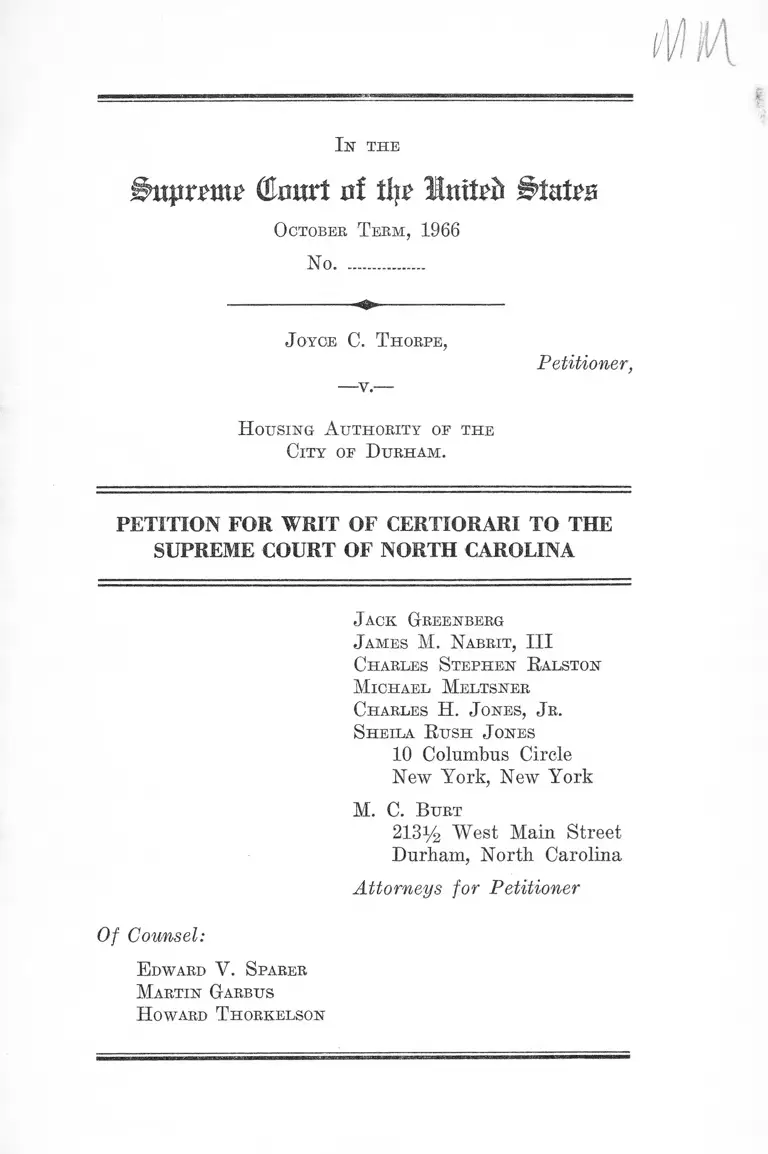
I n t h e
(£mtt ni % Inttpft §>UUb
October T erm, 1966
No.................
J oyce C. T horpe,
— v.—
Petitioner,
H ousing A uthority of the
City of Durham.
PETITION FOR WRIT OF CERTIORARI TO THE
SUPREME COURT OF NORTH CAROLINA
Jack Greenberg
James M. Nabrit, III
Charles Stephen R alston
Michael Meltsner
Charles H. J ones, J r.
Sheila R ush J ones
10 Columbus Circle
New York, New York
M. C. B urt
213% West Main Street
Durham, North Carolina
Attorneys for Petitioner
Of Counsel:
E dward Y. Sparer
Martin Garbus
H oward T horkelson
I N D E X
Opinions B elow ................................................................. 1
Jurisdiction ....................................................................... 1
Question Presented......................................... 2
Constitutional and Statutory Provisions Involved ..... 2
Statement ........................................................................... 3
How the Federal Questions Were Raised and Decided
Below.............................................................................. 6
R easons poe Granting the W rit
The Question of the Right of Tenants of Public
Housing to a Fair Hearing on the Reasons for
Eviction Is of National Importance ........................ 7
Conflict Between the Decisions of This Court and
a Judgment Below as to the Right to a Hearing
Necessitates Resolution of the Issue by This Court 14
Conclusion................................................................................. 20
A ppendix I ......................................................................... la
■M.
A ppendix II ......................................................................... 5 a
A ppendix III ..................................................................... 11a
PAGE
11
Table of Cases
Brand v. Chicago Housing Authority, 120 F. 2d 786
(7th Cir. 1941) .......................................................... 19
Brown v. Board of Education, 347 U. S. 483 .............. 7
Burton v. Wilmington Parking Authority, 365 U. S.
715 .................................................................................. 16
Chicago Housing Authority v. Blackman, 4 111. 2d 319,
122 N. E . 2d 522 (1954) ............................................ 19
Cramp v. Board of Public Instruction, 368 U. S. 278 .... 17
Detroit Housing Commission v. Lewis, 226 F. 2d 180
(6th Cir. 1955) ................................................. 16
Dixon v. Alabama State Board of Education, 294 F. 2d
150 (5th Cir. 1961), cert, denied, 368 U. S. 930 .......15,17
Frost Trucking Co. v. R. R. Com., 271 IT. S. 583 ........... 17
Gideon v. Wainwright, 372 IT. S. 335 ............................. 7
Greene v. McElroy, 360 U. :S. 474 ................................. 14
Griffin v. Illinois, 351 U. S. 12 ......................................... 7
Holt v. Richmond Redevelopment and Housing Au
thority (E. D. Va., C. A. No. 4746, Sept. 7, 1966) .... 19
Housing Authority of Los Angeles v. Cordova, 130
Cal. App. 2d 883, 279 P. 2d 215 (App. Dept., Superior
Ct., 1955) ................................................................. 19
Housing Authority of City of Pittsburgh v. Turner,
201 Pa. Super. 62, 191 A. 2d 869 (Superior Ct. Pa.
1963) .............................................................................. 19
PAGE
Interstate Commerce Commission v. Louisville and
N. R. Co., 227 U. S. 8 8 ................................................ 15
Ill
Joint Anti-Fascist Refugee Committee v. McGrath, 341
U. S. 123.......................................................................14,18
Knight v. State Board of Education, 200 F. Supp.
174 (M. D. Tenn. 1961) ................................................ 15
Kutcher v. Housing Authority of Newark, 20 N. J. 181,
119 A. 2d 1 (1955) ........................................................ 19
Kwong Hai Chew v. Golding, 344 U. S. 590 .................. 16
Lawson v. Housing Authority of City of Milwaukee,
270 Wise. 269, 70 N. W. 2d 605 (1955), cert, denied,
350 H. S. 882 (1955) .................................................... 19
Rudder v. United States, 226 F. 2d 51 (D. C. Cir.
1955) .............................................................................16,19
Schware v. Board of Bar Examiners, 353 TJ. S. 232 .... 15
Shelton v. Tucker, 364 U. S. 479 ..................................... 17
Sherbert v. Yerner, 374 U. S. 398 .................................. 17
Slochower v. Board of Education, 350 U. S. 551 ....... 14
Smith v. Holiday Inns of America, 336 F. 2d 630 (6th
Cir. 1964) ....................................................................... 16
Southern Railroad Co. v. Virginia ex rel. Shirley, 290
U. S. 190 ....................................................................... 15
Torcaso v. Watkins, 367 U. S. 488 .................................. 17
United States ex rel. Knauff v. Shaughnessy, 338 U. S.
537 .................................................................................. 16
PAGE
Walton v. City of Phoenix, 69 Ariz. 26, 208 P. 2d 309
(1949) ............................................................................ 19
Wieman v. Updegraff, 344 U. !S. 183 ................... .......... 17
Williams v. City of Ypsilanti (D. Mich., C. A. No.
28936) .......................................................................... 19
Woods v. Wright, 334 F. 2d 369 (5th Cir. 1964) ....... 15
F ederal Statutes and R egulations
28 U. S. C. §1257(3) ................. 2
42 U. S. C. §1401 ............. ...........................................2,10,12
42 U. S. C. §1402 ............................................................10,13
42 IT. S. C. -§1409 ................................................................ 12
42 U. S. C. §1410 ................................. .......................... 12
42 U. S. C. §1411 ............................................................ 12,18
42 U. S. C. §1411e ............................................................ 18
42 IT. S. C. §1415......................... ..................................... 10
The Criminal Justice Act of 1964, 78 Stat. 552, 18
U. S. C. §3006A ........................................................ . 7
The Economic Opportunity Act of 1964, 78 Stat. 508 .... 7
United States Housing Act of 1937 ............................. 10,12
Public Housing Administration, Consolidated Annual
Contributions Contract, Part I, Sec. 206, Admission
Policies, PHA 3010, p. 8 ............................................ 12
State Statutes and R egulations
Chap. 157, Art. 1, Gen. Stat. of North Carolina ....2, 3,10
§157-2, Gen. Stat. of North Carolina ......................... 10
iv
PAGE
V
§157-4, Gen. iStat. of North Carolina............................. 10
§157-9, Gen. Stat. of North Carolina ......................3,10,12
New York Housing Authority Regulations, 9N1287,
§la(7) ............................................................................ 11
PAGE
Other A uthorities
Bibliography of Selected Readings in Law and Poverty,
in Conference Proceedings, National Conference on
Law and Poverty (1965) ............................................ 8
Conference Proceedings, The Extension of Legal Ser
vices to the Poor (1964) ............................................ 8
Friedman, Public Housing and the Poor: An Over
view, 54 Calif. L. Rev. 642 (1966) ............................. 10
Handler, Controlling Official Behavior m Welfare Ad
ministration, 54 Calif. L. Rev. 479 (1966) .................. 8
Harvith, The Constitutionality of Residence Tests for
General and Categorical Assistance Programs, 54
Calif. L. Rev. 567 (1966) ............................................ 9
O’Neil, Unconstitutional Conditions: Welfare Benefits
with Strings Attached, 54 Calif. L. Rev. 443 (1966) .. 9
Poverty, Civil Liberties, and Civil Rights: A Sympo
sium, 41 New York U. L. Rev. 328 (1966) .............. 8
Property Rights and the Low-Income Tenant: Law
as an Instrument of Social Reconstruction. Institute
for Policy Studies (mimeo) July, 1966 ............... ...... 11
Reich, Individual Rights and Social Welfare: The
Emerging Legal Issues, 74 Yale L. J. 1245 (1965) .... 8
VI
Reich, The New Property, 73 Yale L. J. 733 (1964) .....8,16
Schorr, How the Poor Are Housed, p. 215 “Poverty in
America,” University of Michigan Press .................. 13
Seavey, Dismissal of Students: “Due Process,” 70
Harv. L. Rev. 1406 (1957) ........................................ 16
Symposium: Law of the Poor, 54 Calif. L. Rev. 319
(1966) ............................. .............................................. 8
PAGE
I n t h e
Bupxmx (£mxt iif % Itttfrft States
October Term, 1966
No.................
J oyce C. T horpe,
—v.—
Petitioner,
H ousing A uthority of the
City of Durham.
PETITION FOR WRIT OF CERTIORARI TO THE
SUPREME COURT OF NORTH CAROLINA
Petitioner prays that a writ of certiorari issue to review
the judgment of the Supreme Court of North Carolina en
tered in the above case on May 25, 1966.
Opinions Below
The opinion of the Supreme Court of North Carolina is
reported at 148 S. E. 2d 290 (1966) and is set forth in Ap
pendix A, infra, pp. la-4a. The findings of fact and conclu
sions of law of the Superior Court of Durham County are
unreported and are set forth in Appendix B, infra, pp.
5a-10a.
Jurisdiction
The judgment of the Supreme Court of North Carolina
was entered on May 25, 1966. The time for filing this peti
tion for writ of certiorari was extended by Mr. Justice
2
Brennan to and including October 21, 1966. The jurisdic
tion of this Court is invoked pursuant to 28 U. S. C. §1257
(3), petitioner having asserted below and asserting here
deprivation of rights secured by the Constitution and stat
utes of the United States.
Question Presented
Petitioner, a Negro, and her children have been tenants
in a low-income housing project constructed with Federal
funds and administered by an agency of the State of North
Carolina pursuant to Federal regulations. The day after
petitioner was elected as an official in a tenant’s organiza
tion, the Housing Authority informed her that it was termi
nating her lease.
Was petitioner denied rights guaranteed by the due proc
ess clause of the Fourteenth Amendment and the First and
Fifth Amendments of the Constitution of the United States
by the public housing authority’s refusal to accord her a
hearing on the reasons for the eviction?
Constitutional and Statutory
Provisions Involved
This petition involves the First, Fifth and Fourteenth
Amendments to the Constitution of the United States.
This petition also involves sections of the United States
Housing Act, as amended, 42 U. S. C. §§1401 et seq. and
portions of the North Carolina Housing Authorities Act,
Chapter 157, General Statutes of North Carolina. These
provisions are set forth in Appendix C, infra, pp. lla-30a.
3
Statement
Since November 11,1964, petitioner and her children have
been tenants in MeDougald Terrace, a public low-rent hous
ing project owned and operated by the Housing Authority
of the City of Durham, North Carolina, under authority of
state law and pursuant to a contract with the Federal Gov
ernment (R. 12).1
Under North Carolina law the Housing Authority is a
“ public body and a body corporate and politic, exercising
public powers” (§157-9, Gen. Stat. of North Carolina) and
has “ all the powers necessary or convenient to carry out
and effectuate the purposes and provisions” (Ibid.) of the
North Carolina Housing Authorities Law (Chapter 157,
Article 1, Gen. Stat. of North Carolina). The Authority
also has power “to manage as agent of any city or munici
pality located in whole or in part within its boundaries any
housing project constructed or owned by such city,” and
“ to act as agent for the federal government in connection
with the acquisition, construction, operation and/or man
agement of a housing project” (§157-9, Gen. Stat. of North
Carolina) (R. 12).
Petitioner has occupied the project under a lease agree
ment (E. 18-25), whose initial term was f rom November 11
to November 30, 1964, and which provided that it would
thereafter be automatically renewed for successive terms
of one month each (R. 18). On August 10, 1965, petitioner
was elected president of the Parents’ Club, a group com
posed of tenants of the project (E. 13). The following day,
_ 1 Following the judgment of the trial court below they have con
tinued to remain in the premises under stays of the eviction order
pending appeal.
4
August 11,1965, petitioner was notified that her lease would
be cancelled effective August 31, 1965, at which time she
would have to vacate the premises (R. 25), The Authority
gave no reason for the eviction but merely cited the pro
vision of the lease (R. 19) that permitted the landlord to
cancel upon fifteen days notice (R. 25). Although petitioner
requested a hearing to go into the reasons for her eviction,
the request was denied (R. 5-6).
There was no provision in the lease which specifically
either granted or denied the Authority the right to evict
without cause and hearing. The lease did provide, however,
that either party could terminate by giving written notice
of such termination fifteen days prior to the last day of
the term (R. 19). This provision was construed by the
Authority to permit eviction without cause and without a
hearing. The lease, prepared by the Housing Authority,
further provided that the tenant could be evicted under
certain circumstances, including: non-payment of rent (R.
20); exceeding limits on family size or income (R. 22-23);
misrepresentations of material facts in the tenant’s ap
plication (R. 23); and membership in “an organization
designated by the Attorney General of the United States as
subversive” (R. 24).
On September 18, 1965, the Housing Authority instituted
an action of ejectment against petitioner and her three
children. The Justice of the Peace Court in Durham Town
ship, on September 20, 1965, ordered defendant and her
children evicted from the project upon a showing that the
notice of eviction was duly served (R. 8-11). Petitioner ap
pealed to the Superior Court of Durham County where
additional evidence was taken in the form of stipulated
testimony (R. 11-14).
5
Petitioner alleged that the ground for her removal was
her involvement with the tenants’ organizing group (R. 15).
The Authority denied this was the reason, but admitted
refusing her a hearing prior to the institution of litigation.
The Authority offered no proof concerning the reasons for
the removal of petitioner and her children and did not ex
plain why the notice to evict was sent out the day after
petitioner was elected president of the tenants’ group (R.
13-14). On the basis of the stipulations the Superior Court
found that the reason for the eviction was not petitioner’s
activities with the organizing group. The Court went on
to find that the Housing Authority had not given her
a hearing or a reason for the eviction (R. 5-6),2 and con
cluded as a matter of law that the Authority had no duty
to give petitioner a hearing or to communicate its reason
for terminating the lease; it affirmed the eviction.
Petitioner appealed to the Supreme Court of North Caro
lina, and on May 25, 1966, that Court affirmed the order
to evict. The Supreme Court held that the Authority was
under no obligation to conduct a hearing or advise the ten
ant of its reasons for terminating the lease, since its obliga
tions to its tenants were the same as the obligations of a
private landlord to its tenants. The Court cited as author
ity a 1913 North Carolina decision construing a lease in a
suit brought by a private landlord against his tenant for
loss of rents. A stay of the eviction order was granted by
the Supreme Court of North Carolina pending action by
this Court on a petition for writ of certiorari.
2 The relevant stipulations were that the Housing Authority gave
neither a hearing nor reason for the eviction (R. 12) ; that peti
tioner alleged that the reason for the eviction was her participation
in the organization of the Parents’ Club (R. 13); that the Director
of the Housing Authority would testify that whatever the reason,
if any, for the eviction it was not her activities in the tenants’
group; and that the court could make findings of fact based on
these stipulations and petitioner’s affidavit (R. 13-14).
6
How the Federal Questions Were
Raised and Decided Below
The question of whether the eviction without cause, ex
planation, or hearing, of petitioner and her children, ten
ants in a low-income housing project supported by federal
funds and administered by the Authority pursuant to fed
eral regulations, violated rights guaranteed to petitioner
and her children by the Federal Constitution and statutes,
was raised at the trials in the Justice of the Peace and
Superior Courts by affidavit and motion to quash the evic
tion proceeding (R. 14-18).:za
Following the entry of judgment by the Superior Court,
petitioner made exceptions to the court’s judgment (R. 28-
30), and gave notice of appeal (R. 31). Among the assign
ments of error argued to the North Carolina Supreme
Court was the following:
4. For that the Court erred in finding as a matter
of law that the Housing Authority of the City of Dur
ham did not owe duty to communicate or give the de
fendant any reason for its termination of her lease, nor
was it required or had any duty to hold a hearing on
said subject. As shown by E xception # 4 . (R. 32.)
In its opinion, the Supreme Court held that, “ It is imma
terial what may have been the reason for the lessor’s un
willingness to continue the relationship of landlord and
tenant after the expiration of the term as provided in the
lease.” 148 S. E. 2d 290, at 292 (App., p. 4a). In finding
2a The Motion to Quash stated, in part:
That the tenant in a Public Housing Project has a right to
her apartment and a deprivation of that right without a hear
ing violates due process of law as guaranteed by the 14th
Amendment (R. 17).
7
that the Authority was entitled to bring summary ejection
proceedings against petitioner without granting a hearing
or stating its reasons for eviction, the Supreme Court of
North Carolina necessarily rejected petitioner’s federal
claims.
REASONS FOR GRANTING THE WRIT
Tlie Question of the Right of Tenants of Public Hous
ing to a Fair Hearing on the Reasons for Eviction Is of
National Importance.
Introductory
In recent years there has been a growing awareness of
and concern for the legal rights of the poor and the avail
ability of legal services necessary to preserve them. This
interest has been stimulated by decisions . of this Court,3
and has been furthered by Federal legislation,4 national
conferences,5 and, of course, the underlying economic and
social factors. The initial focus of this interest was on the
rights of criminally accused indigents. More recently, it
3 Brown v. Board of Education, 347 U. S. 483; Griffin v. Illinois,
351 U. S. 12; and Gideon v. Wainwright, 372 U. S. 335.
i E.g., The Economic Opportunity Act of 1964, 78 Stat. 508, and
The Criminal Justice Act of 1964, 78 Stat. 552, 18 U. S. C. §3006A.
5 E.g., National Conference on Law and Poverty, Washington,
D. C., June 23-25, 1965, under the Co-Sponsorship of the Attorney
General and the Director of the Office of Economic Opportunity;
The Extension of Legal Services to the Poor, Washington, D. C.,
November 12, 13, 14, 1964, under the Sponsorship of the IJ. S.
Department of Health, Education and Welfare; National Confer
ence on Bail and Criminal Justice, Washington, D. C., May 27-29,
1964 under the Co-Sponsorship of the U. S. Department of Justice
and the Yera Foundation.
8
has shifted to encompass a variety of areas where legal
institutions—whether by omission or commission—discrimi
nate against the poor: landlord and tenant relationships,
consumer fraud, the relation of the indigent to state ad
ministration of public benefits, especially welfare and pub
lic housing, family problems, and the absence of legal ser
vices for poor clients. See, e.g., Symposium: Law of the
Poor, 54 Calif. L. Rev. 319-1014 (1966); Bibliography of
Selected Readings in Law and Poverty, in Conference Pro
ceedings, National Conference on Law and Poverty (1965)4
Conference Proceedings, The Extension of Legal Services
to the Poor (1964); Reich, Individual Plights and Social
Welfare: The Emerging Legal Issues, 74 Yale L. J. 1245
(1965); Poverty, Civil Liberties, and Civil Bights: A Sym
posium, 41 New York U. L. Rev. 328 (1966). One result of
this concern for the legal rights of the poor has been the
establishment of programs by both public and private or
ganizations to give substance and reality to those rights.6
Among the wide range of legal questions to which atten
tion is being given, one of the most important is that of
the right of indigent persons to public benefits. See Reich,
The New Property, 73 Yale L. J. 733 (1964); Reich, Indi
vidual Rights and Social Welfare: The Emerging Legal-
Issues, 74 Yale L. J. 1245 (1965); Handler, Controlling Offi
cial Behavior in Welfare Administration, 54 Calif. L. Rev.
6 Thus, under the Economic Opportunity Act the Federal Gov
ernment has begun to finance neighborhood legal offices devoted
exclusively to providing free legal advice to the poor. Similar
services are being provided by private organizations, such as
Mobilization for Youth in New York City, and the NAACP Legal
Defense and Educational Fund, Inc. and the Center for Social
Welfare Policy and Law of Columbia University, on a nation-wide
scale. At the same time, organizations of the poor themselves have
arisen in various cities, e.g., the West Side Organization in Chicago,
and Rescuers from Poverty in Baltimore, Maryland.
9
479 (1966); Harvith, The Constitutionality of Residence
Tests for General and Categorical Assistance Programs,
54 Calif. L. Eev. 567 (1966). One of the key issues in the
right to public benefits is the one presented by the present
case, i.e., whether the recipients of such benefits can be
denied or deprived of them arbitrarily, or whether they are
entitled to procedural protections. See, e.g., O’Neill, Un
constitutional Conditions: Welfare Benefits with Strings
Attached, 54 Calif. L. Eev. 443, 474-478 (1966).
Thus, although this petition raises only a narrow question
of what has been called social welfare or poverty law, that
question is of substantial public importance since its reso
lution has ramifications affecting the rights of recipients
to all forms of welfare benefits. Moreover, even viewing
the case solely as affecting the rights of persons in public
housing, the issue is of great importance. According to
information supplied by the United States Department of
Housing and Urban Development, there are approximately
1,400 local housing authorities with low-rent projects
throughout the United States. These authorities have been
advised by the United States Public Housing Authority to
draw up their tenant leases on a month-to-month basis, and
it is the opinion of the Department that the local authori
ties “perhaps without exception, have followed this recom
mendation. This practice does permit evictions to be accom
plished after the giving of a notice to vacate which does not
state the reason therefor.” 7 Thus, the lease involved in
7 This information was supplied in a letter from Mr. Don Hum
mel, Assistant Secretary for Renewal and Housing Assistance,
Department of Housing and Urban Development, in response to an
inquiry from one of the attorneys for petitioner. The partial text
of the letter follows:
Concerning item 2, local authorities consistently have been
advised to draw their tenant leases on a month-to-month basis.
10
this case is substantially identical to that used by the hun
dreds of state and municipal housing authorities adminis
tering federally assisted low-income projects. See also,
Friedman, Public Housing and the Poor: An Overview,
54 Calif. L. Rev. 642, 659-661 (1966).
Thousands of persons reside in these low-income proj
ects, which generally provide the only decent housing avail
able to them because of their poverty.8 To the poor, there
fore, the terms of occupancy in these projects transcend
economic discrimination and involve basic notions of dignity
and responsibility in a free society:
The urban slum is one of the greatest social, political,
economic, and moral problems facing the United States.
It is our opinion that authorities, perhaps without exception,
have followed this recommendation. This practice does permit
evictions to be accomplished after the giving of a notice to
vacate which does not state the reason therefor. Local authori
ties recently, however, have been urged that, in a private con
ference, they should inform any tenants required to vacate of
the reasons for such action.
Formerly there was a federal requirement (called the “ Gwinn
Amendment” ) intended to exclude from tenancy in a low-rent
project any person who- was a member of an organization
designated as subversive by the Attorney General. This legis
lation expired approximately ten years ago. Any local author
ities which might now have a non-communist or similar oath
clause in their leases do so because of their own local policy
or possibly requirements of state law or simply because they
have neglected to delete from their lease forms obsolete pro
visions.
8 The United States Housing Act of 1937 and the North Carolina
Housing Authorities Act (see text and notes, infra), under which
the Housing Authority herein has been established and financed,
both make it clear that the expenditure of funds for publicly owned
housing is required because of the inability of the private sector to
provide decent, safe, and sanitary housing for low-income families.
42 U. S. C. §§1401, 1402; 1415(7) (App. pp. 11a, 12a, 18a-19a);
§§157-2, 157-4, 157-9, Gen. Stat. of North Carolina (App. pp. 20a,
21a-22a, 24a).
11
One major source of the problem is the lack of housing
units for low-income families and the inadequacy of
resources now devoted to building more. Another ag
gravating factor is the increasing separation of the
urban slumdweller from place of work or shopping
facilities which are moving out from the center of the
city. But there are important problems of the slum
that have little to do with the quality or location of
construction. They concern rather the legal and social
organization of slum living. The poor, whether in pub
lic or private housing do not share the same legal re
lations as the rest of the society. While the sanctity
and importance of the home is basic to the American
ideology and tradition, and important safeguards sur
rounding the home are written into the Constitution,
the poor frequently have no rights of decision over
where and under what conditions they live. On such
basic questions as length of tenancy, repairs, privacy,
admission or acceptance, it appears that there is one
law for the middle class and another for the poor. Eco
nomic discrimination is reflected not only in geographi
cal divisions, but in legal ones. Property Rights and
the Low-Income Tenant: Law as an Instrument of
Social Reconstruction. Institute for Policy Studies
(mimeo) July, 1966.
Since no other decent housing is available, an unbridled
power by housing authorities to evict without reason or
hearing is punishment of the severest kind, particularly
since some housing authorities have promulgated regula
tions preventing an individual from being considered as a
tenant after he has once been evicted from a project. (See,
e.g., New York Housing Authority Regulations, 9N1287,
§la(7).)
12
Indeed, the existence and exercise of such a power is in
conflict with the declared policy of the United States Hous
ing Act of 1937 (42 U. S. C. §§1401 et seq.) under which
the Housing Authority of Durham, and others throughout
the country, was financed (R. 12).9 The purpose of fed
erally supported low-income housing is set forth in 42
U. S. C. §1401 (App. p. 11a):
It is declared to be the policy of the United States
to promote the general welfare of the Nation by em
ploying its funds and credit, as provided in this chap
ter, to assist the several States and their political
subdivisions to alleviate present and recurring unem
ployment and to remedy the unsafe and insanitary
housing conditions and the acute shortage of decent,
9 Section 157-9, Gen. Stat. of North Carolina, establishes the
Housing Authority as a “public body and a body corporate and
politic, exercising public powers” necessary to carry out the pur
poses of the North Carolina Housing Authorities Law (Appendix,
pp. 24a, 25a). The Authority has power to manage any housing
project owned by the city and, “ to act as agent for the federal
government in connection with the acquisition, construction, opera
tion and/or management of a housing project or any part thereof.”
(§157-9, Gen. Stat. of North Carolina, App., p. 25a.) Having
received Federal financial support and operating pursuant to its
contract with the Federal Government (R. 12), the Authority must
adopt and promulgate regulations for internal management (such
as lease provisions) that are consistent with and reasonably related
to the purposes of low-income housing (42 U. S. C. §§1401, 1410
(g) (2) (App., pp. 11a, 17a) ; Public Housing Administration, Con
solidated Annual Contributions Contract, Part I, Sec. 206, Admis
sion Policies, PHA 3010, p. 8 (1964)). The Federal Act further
provides that the Federal Public Housing Administration dis
tributing the funds is authorized to lend all municipal Housing Au
thorities an amount not in excess of 90 percent of the final develop
ment cost of the project and also to make annual contributions over
a period of years. Congress then appropriates funds to implement
the contracts made by the federal agency and the tenants of the
project are selected by the municipal authority subject to the loan
or subsidy contract with the government. (42 U. S. C. §§1409, 1410
and 1411.)
13
safe, and sanitary dwellings for families of low in
come, in urban and rural nonfarm areas, that are in
jurious to the health, safety, and morals of the citizens
of the Nation. * * * It is the policy of the United
States to vest in the local public housing agencies the
maximum amount of responsibility in the administra
tion of the low-rent housing program, including re
sponsibility for the establishment of rents and eligi
bility requirements (subject to the approval of the
Authority), with due consideration to accomplishing
the objectives of this chapter while effecting economies.
Certainly, the absolute power conferred on the respon
dent Authority by the court below to evict without a hear
ing, and hence for no reason or at the unbridled whim of
housing officials, runs directly contrary to the purposes of
insuring low-income citizens a decent place to live and of
promoting stability and security in the poor families the
Act is intended to benefit. Cf., 42 U. S. C. §1402, App.,
p. 12a. (See, Schorr, How the Poor Are Housed, p. 215,
“ Poverty in America,” University of Michigan Press.)
For these reasons, the question presented by this case
is no less than whether thousands of persons are able to
live at a minimum level of comfort and decency without
being denied this right by arbitrary and unexplained ac
tions of public agencies. In addition, the broader question
is involved of the right of persons receiving any public
welfare benefits to at least a bare m inim-mu of procedural
protection before the very necessities for life are taken
from them.
14
Conflict Between the Decisions of This Court and the
Judgment Below as to the Right to a Hearing Necessi
tates Resolution of the Issue by This Court.
The decisions of this Court make it clear that the fed
eral and state governments may not act arbitrarily to deny
persons benefits. One obligation imposed upon govern
ment is that before it takes adverse action against persons
it must conform to certain requirements of due process,
the most basic of which is a hearing. In his concurring
opinion in Joint Anti-Fascist Refugee Committee v. Mc
Grath, 341 U. S. 123, at 171, Mr. Justice Frankfurter de
scribed why the due process clause requires a hearing be
fore valuable rights are denied:
Man being what he is cannot safely be trusted with
complete immunity from outward responsibility in de
priving others of their rights . . . That a conclusion
satisfies one’s private conscience does not attest its
reliability . . . Secrecy is not congenial to truth-seeking
and self-righteousness gives too slender an assurance
of rightness.
In cases involving federal employment, even when na
tional security has been involved, this Court has held that
administrative action which denies governmental benefits
would be approved only when an opportunity to influence
the fact-finder and to explain adverse charges is accorded.
Greene v. McElroy, 360 U. S. 474. And, in Slochower v.
Board of Education, 350 U. S. 551, the Court reversed a
state administrative determination on Fourteenth Amend
ment grounds. Although the case is often considered with
respect to the assertion of the privilege against self
incrimination, the Court held that summary dismissal with
15
out any inquiry when the privilege was claimed was a
denial of due process:
This is not to say that Slochower has a constitu
tional right to be an associate professor of German
at Brooklyn College. The State has broad powers in
the selection and discharge of its employees, and it
may be that proper inquiry would show Slochower’s
continued employment to be inconsistent with a real
interest of the State. But there has been no such
inquiry here. We hold that the summary dismissal of
appellant violates due process of law. (350 U. S. at
559.)10
See also, Schware v. Board of Bar Examiners, 353 U. S.
232. In closely analogous cases, involving the expulsion
of students from state colleges or high schools, lower fed
eral courts have applied the above principles and required
notice and a hearing. Dixon v. Alabama State Board of
Education, 294 F. 2d 150 (5th Cir. 1961), cert, denied, 368
IT. S. 930; Woods v. Wright, 334 F. 2d 369 (5th Cir. 1964) ;
Knight v. State Board of Education, 200 F. Supp. 174
10 Cf., Interstate Commerce Commission v. Louisville and N. B.
Co., 227 U. S. 88, 91. This Court, replying to the claim that a
Commission’s order made without substantial supporting evidence
was conclusive, declared:
. . . A finding without evidence is arbitrary and baseless.
And if the government’s contention is correct, it would mean
that the Commission had a power possessed by no other officer,
administrative body, or tribunal under our government. It
would mean that, where rights depended upon facts, the
Commission could disregard all rules of evidence and capri
ciously make findings by administrative fiat. Such authority,
however beneficently exercised in one ease, could be injuri
ously exerted in another, is inconsistent with rational justice,
and eomes under the Constitution’s condemnation of all arbi
trary exercise of power.
See also Southern Railroad Co. v. Virginia ex rel. Shirley, 290
U. S. 190.
16
(M. D. Tenn. 1961). See also eases collected in Reich,
The New Property, 73 Yale L. J. 733, 783-84 (1964), and
Seavey, Dismissal of Students: “Due Process,” 70 Harv.
L. Rev. 1406 (1957).11
The court below apparently based its holding on the con
cept that the Housing Authority of the City of Durham
has the same status as any private landlord. This posi
tion, however, is untenable, since it is clear that govern
ment is not immunized from constitutional requirements
because it occupies the relationship of landlord. See, Bur
ton v. Wilmington Parking Authority, 365 U. S. 715;
Smith v. Holiday Inns of America, 336 F. 2d 630 (6th Cir.
1964). As the Court of Appeals for the District of Co
lumbia has said:
The government as landlord is still the government.
It must not act arbitrarily, for, unlike private land
lords, it is subject to the requirements of due process
of law. Arbitrary action is not due process. Rudder
v. United States, 226 F. 2d 51, 53 (D. C. Cir. 1955).
Thus, for example, a public housing authority could not
discriminate on the basis of race. Detroit Housing Com
mission v. Lewis, 226 F. 2d 180 (6th Cir. 1955). Nor, it
seems, should it be differentiated from government acting
in other capacities. It apparently could not bar occupancy
11 Similarly, although the due process clause does not require
that an alien never admitted to this country be granted a hearing
before being excluded, United States ex ret. Knauff v. Shaughnessy,
338 U. S. 537, 542, once an alien has been admitted to lawful resi
dence in the United States and remains physically present here, it
has been held that “although Congress may prescribe conditions
for his expulsion and deportation, not even Congress may expel
him without allowing him a fair opportunity to be heard.” Kwong
Hai Chew v. Colding, 344 U. S. 590, 597-98.
17
for failure to take an oath, that was unconstitutionally
vague, Cramp v. Board of Public Instruction, 368 U. S.
278, 288, or that barred membership in certain organiza
tions, Wieman v. Updegraff, 344 U. S. 183, 192. Govern
ment has been disabled from imposing a religious oath,
Torcaso v. Watkins, 367 U. S. 488; it has been forbidden
to condition the affording of benefits on performing acts
that violate one’s religious principles, Sherbert v. Verner,
374 U. S. 398; it has been prohibited from requiring a citi
zen to reveal all organizational affiliations, Shelton v.
Tucker, 364 U. S. 479.12 Yet, having been denied a hearing,
petitioner cannot tell whether she was evicted for reasons
that violate the holding of those cases.
The denial of the right to a hearing is even more
abhorrent when, as in this case, it raises questions of sup
pression of the right to speak and associate. Cf. Shelton
v. Tucker, supra. On the face of it, petitioner’s expulsion
following her election as president of a tenants’ associa
tion warranted exploration at a hearing on whether she
was expelled for that reason. Moreover, a provision in
12 Nor can the State successfully maintain the position that al
though the petitioner may have had a right to a hearing, she waived
that right by signing a lease with the provision involved herein
(R. 19). To require that petitioner insist that her lease specifically
contain a provision prohibiting her eviction without hearing or
cause if she wishes to retain her constitutional rights is to nullify
those rights themselves, especially where the State, as landlord,
has all of the bargaining power and the low-income individual, as
tenant, has none. A State may not exact the surrender of federal
constitutional rights as a price for the opportunity of living in a
public housing project or as an exchange for any benefit it has to
offer. See Dixon v. Alabama State Board of Education, 294 F. 2d
150, 156 (5th Cir. 1961), in which the Fifth Circuit held that a
state college could not require that students renounce the right to
due process upon expulsion as a condition to admittance; see also,
Shelton v. Tucker, 364 U. S. 479; Frost Trucking Co. v. B. B. Com.,
271 U. S. 583.
18
the lease barring tenants who belong to “ subversive or
ganizations” is patently unconstitutional.13 See, Joint
Anti-Fascist Refugee Committee v. McGrath, 341 U. S.
123. There is no way of knowing, without a hearing,
whether false evidence was considered against this peti
tioner to the effect that she belonged to such an organiza
tion and that she was evicted for such a reason. She has
no knowledge of why she was evicted and has had no op
portunity to defend against such a false charge, if indeed
it was made. This contention is not entirely speculative
for it is not uncommon to charge subversive conduct to
persons engaged in protest movements of a totally legal
and constitutional nature.
Against the foregoing reasons for requiring an adequate
hearing and notice of reasons before eviction, the State
has proposed no countervailing interest. Certainly, a pub
lic housing authority may make regulations reasonably re
lated to the proper management of the projects under its
control. However, the rationality of such regulations must
be determined in relation to the purposes of the govern
mental activity involved.
An additional reason for review of the judgment of the
court below exists in that a number of state and federal
appellate courts have rendered conflicting decisions on the
question raised herein. Thus, in addition to the Supreme
Court of North Carolina in the present case, the Seventh
Circuit and courts in Arizona and Pennsylvania have held
13 It should be noted that the ostensible federal statutory author
ity for this lease provision, the so-called “ Gwinn Amendment”
(67 Stat. 307, 42 U. S. C. §1411c), expired more than ten years
ago. The continued inclusion of a prohibition against members of
such organizations raises serious questions as to the validity of the
entire lease.
19
that a governmental agency operating a housing project
may act like a private landlord and evict summarily under
the terms of a lease.14 On the other hand, the District of
Columbia Circuit, together with courts in New Jersey,
California, Wisconsin, and Illinois, have held that even
when acting as a landlord the government still must fol
low due process and hence cannot act arbitrarily.15 Be
cause of the seriousness and importance of the question
presented, it is imperative that this Court review the deci
sion below and resolve these conflicting decisions.
14 Brand v. Chicago Housing Authority, 120 F. 2d 786 (7th Cir.
1941) ; Walton v. City of Phoenix, 69 Ariz. 26, 208 P. 2d 309
(1949) ; Housing Authority of City of Pittsburgh v. Turner, 201
Pa. Super. 62, 191 A. 2d 869 (Superior Ct. Pa. 1963).
15 Rudder v. United States, 226 F. 2d 51 (D. C. Cir. 1955);
Kutcher v. Housing Authority of Newark, 20 N. J. 181, 119 A. 2d
1 (1955) ; Housing Authority of Los Angeles v. Cordova, 130 Cal.
App. 2d 883, 279 P. 2d 215 (App. Dept., Superior Ct. 1955) ;
Lawson v. Housing Authority of City of Milwaukee, 270 Wise.
269, 70 N. W. 2d 605 (1955), cert, denied, 350 U. S. 882 (1955) ;
Chicago Housing Authority v. Blackman, 4 111. 2d 319, 122 N. E.
2d 522 (1954). More recently, a district court has enjoined an
eviction on a finding that its reason was the activities of the tenant
in a tenant’s organization. Holt v. Richmond Redevelopment and
Housing Authority (E. D. Ya., C. A. No. 4746, Sept. 7, 1966). Anri
in Williams v. City of Ypsilanti (D. Mich., C. A. No. 28936), a
district court has issued a temporary restraining order barring a
Michigan housing authority from evicting the plaintiff under a
lease provision allowing termination if a woman who is the head
of a household has an additional child.
20
CONCLUSION
For the above reasons, the petition for writ of cer
tiorari should be granted.
Respectfully submitted,
J ack G reenberg
J am es M. N abrit , III
Charles S teph en R alston
M ic h ael M eltsner
C harles H . J ones, J r .
S h e ila R u sh J ones
10 Columbus Circle
New York, New York
M. C. B urt
213% "West Main Street
Durham, North Carolina
Attorneys for Petitioner
Of Counsel:
E dward V . S parer
M artin G arbtjs
H oward T horkelson
A P P E N D I C E S
APPENDIX I
Judgment of the Supreme Court of North Carolina
NORTH CAROLINA SUPREME COURT
S pring T erm 1966
No. 769—Durham
—-------------------------------------------------- .................................................... ............ ..........
H ousing A u th o rity of t h e C it y op D u r h a m ,
— v . —
J oyce C. T horpe .
Appeal by defendant from Bickett, J., October 1965 Civil
Session of Durham.
The plaintiff instituted summary ejectment proceedings
before H. L. Townsend, Justice of the Peace, to remove the
defendant from Apartment No. 38-0 Ridgeway Avenue,
McDougald Terrace, in the city of Durham. From a judg
ment in favor of the plaintiff in the Court of the Justice
of the Peace, the defendant appealed to the superior court
where the matter was heard de novo by the court without
a jury. The court made findings of fact, each of which is
supported by stipulations or by the evidence in the record.
The material facts so found may be summarized as follows:
The plaintiff, a corporation organized and operating
under the laws of the State of North Carolina, is the owner
of the tract of land known as the McDougald Terrace Hous
ing Project in the city of Durham, which includes Apart
ment No. 38-G Ridgeway Avenue. On 11 November 1964
2a
the plaintiff and the defendant entered into a lease con
tract whereby the plaintiff leased to the defendant the said
apartment for a term beginning 11 November 1964 and
terminating at midnight 30 November 1964. The lease pro
vided that it would be automatically renewed for successive
terms of one month each. It further provided that the lease
could be terminated by either party by giving to the other
written notice of such termination 15 days prior to the
last day of the term. There was no provision in the lease
requiring the lessor to give to the lessee any reason for
its decision to terminate the lease or requiring that any
hearing be held by the plaintiff, or by any other person
or agency, with respect to such decision.
The defendant occupied the apartment pursuant to the
lease. On 12 August 1965 the plaintiff gave, and the defen
dant received, a written notice that the lease was cancelled
effective 31 August 1965 and that at such time the plaintiff
would be required to vacate the premises. The plaintiff
gave no reason to the defendant for its decision to termi
nate the lease, advising the defendant that it was not re
quired to do so. The defendant requested a hearing but
the plaintiff did not conduct any hearing at which the de
fendant was present. Whatever may have been the plain
tiff’s reason for terminating the lease, it was neither that
the defendant had engaged in efforts to organize the ten
ants of McDougald Terrace nor that she was elected presi
dent of a group which was organized in McDougald Ter
race on 10 August 1965. The defendant refused to vacate
the premises.
Upon these findings, the court concluded that the plain
tiff terminated the lease as of 31 August 1965; that the
occupancy of the premises by the defendant after such
3a
date was wrongful and in violation of the plaintiff’s right
to possession; that there was no duty upon the plaintiff to
give to the defendant any reason for its termination of the
lease or to hold any hearing upon the matter; and that the
plaintiff was entitled to the possession of the premises and
the defendant was in wrongful possession thereof.
The court, therefore, gave judgment that the defendant
be removed from the premises, that the plaintiff be put in
possession thereof and that the plaintiff have and recover
from the defendant $58.00 plus a reasonable rent for the
premises from and after 1 November 1965 until the same
are vacated, together with the costs of the action. From
this judgment the defendant appeals.
M. 0. Burt, R. Michael F rank, Jack Greenberg, Sheila
R ush, E dward Y. Sparer of Counsel for defendant
appellant.
Daniel K. E dwards fo r plaintiff appellee.
P er Curiam. The plaintiff is the owner of the apartment
in question. The defendant has no right to occupy it except
insofar as such right is conferred upon her by the written
lease which she and the plaintiff signed. This lease was
terminated in accordance with its express provisions at
midnight 31 August 1965. With its termination, all right
of the defendant to occupy the plaintiff’s property ceased.
Since that date the defendant has been and is a trespasser
upon the plaintiff’s land.
The defendant having gone into possession as tenant of
the plaintiff, and having held over without the right to do
so after the termination of her tenancy, the plaintiff was
entitled to bring summary ejectment proceedings against
her to restore the plaintiff to the possession of that which
belongs to it. G.S. 42-26; Murrill v. Palmer, 164 NC 50,
80 SE 55. It is immaterial what may have been the reason
for the lessor’s unwillingness to continue the relationship
of landlord and tenant after the espiration of the term as
provided in the lease.
Having continued to occupy the property of the plaintiff
without right after 31 August 1965, the defendant, by rea
son of her continuing trespass, is liable to the plaintiff for
damages due to her wrongful retention of its property and
for the costs of the action. G.S. 42-32; McGuinn v. McLain,
225 NC 750, 36 SE 2d 377; Lee, North Carolina Law of
Landlord and Tenant, § 18.
No Error.
Moore, J., not sitting.
5a
APPENDIX II
Judgment of the Superior Court of Durham County
This cause, coming on to be heard, and being heard be
fore the undersigned, Honorable William Y. Bickett, Judge
Presiding at the October Civil Term of Durham County
Superior Court, upon plaintiff and defendant having ex
pressly waived trial by jury, and having stipulated and
agreed in open Court that this matter be heard without a
jury by the Judge, and that the Judge find the facts upon
stipulations made and affidavit filed, and render thereon
conclusions of law and judgment in the cause; and the
Court, after hearing argument of counsel and considering
and weighing the stipulations made in this action and the
affidavit filed therein, finds facts as follows:
(1) That the Housing Authority of the City of Durham
is and was during all of the times involved in this action,
and specifically on the 11th of November, 1964, and there
after to the present date, a corporation organized and
operating under and by virtue of the laws of the State of
North Carolina—specifically, the Statute known and desig
nated as the Housing Authorities Law of the State of
North Carolina;
(2) That during said times, C. S. Oldham was the Execu
tive Director of said Housing Authority of the City of
Durham and charged with responsibility for management
of the properties of the Housing Authority of the City of
Durham located in the City of Durham;
6a
(3) That on the 11th day of November, 1964, and there
after, continuously until this date, the Housing Authority
of the City of Durham was and is the owner of real prop
erty known as the McDougald Terrace Housing Project,
located in the City of Durham, and specifically a dwelling
apartment located in said housing project, designated and
known as No. 38-G Ridgeway Avenue;
(4) That on the 11th day of November, 1964, the plain
tiff and the defendant entered into and duly executed a
lease contract, wherein the Housing Authority of the City
of Durham leased to the defendant Apartment No. 38-G
Ridgeway Avenue in said McDougald Terrace Project for
the term beginning November 11, 1964, and terminating at
Midnight November 30, 1964, at a rental of $19.33 for said
term, payable in advance on the first day of said term; that
said lease contract further provided that the rental for
these premises would be based on the current family com
position and family income as were represented to the man
agement of the Housing Authority of the City of Durham,
and would be in conformance with the approved current
rent schedule which had been adopted by the Housing Au
thority of the City of Durham for the operation of the
project; that the lease further provided that the lease
would be automatically renewed for successive terms of one
month each at a rental of $29.00 a month, provided there
was no change in the income or composition of the family
and no violation of the terms of the lease; that the lease
further provided that the rent should be payable in advance
on the first day of each calendar month, and that the lease
could be terminated by the tenant by giving to the Housing
Authority of the City of Durham notice in writing of such
termination fifteen (15) days prior to the last day of the
7a
term, and that management could terminate the lease by-
giving to the tenant notice in writing of such termination
fifteen (15) days prior to the last day of the term; that
there was no provision in said lease whereby it was agreed
that the Housing Authority of the City of Durham would
give the defendant any reason for termination of said lease
or that any reason for the termination of said lease was
required, and there was no provision in said lease that
any hearing should be held by the Housing Authority or
any other agency or person with respect to any decision
by the Housing Authority of the City of Durham to termi
nate said lease and to give the defendant notice in writing
of such termination, as was provided in the language of
the lease;
(5) That the defendant, upon her execution of said lease,
entered into and occupied said Apartment No. 38-Gf Bidge-
way Avenue of the McDougald Terrace Project, owned by
the Plaintiff, Housing Authority of the City of Durham
and does now continue to occupy said dwelling apartment;
(6) That on the 12th day of August, 1965, the plaintiff,
Housing Authority of the City of Durham, gave to the
defendant, Joyce C. Thorpe, notice in writing as follows:
“Your Dwelling Lease provides that the Lease may be
cancelled upon fifteen (15) days’ written notice. This is
to notify you that your Dwelling Lease will be cancelled
effective August 31, 1965, at which time you will be re
quired to vacate the premises you now occupy” ; and that
the defendant duly received said notice to vacate on said
date;
(7) That the defendant failed and refused to vacate said
premises and continues to occupy same;
(8) That the Housing Authority of the City of Durham
duly brought an action in summary ejectment before the
Justice of the Peace Court in Durham County, and after
hearing before said Court judgment was duly entered, re
quiring the defendant Joyce C. Thorpe to vacate said prem
ises and ordering any duly constituted officer of Durham
County to remove the defendant from said premises;
(9) That the defendant gave notice of appeal to the
Superior Court and posted bond, pursuant to the provisions
of G. S. 42,-34;
(10) That the plaintiff Housing Authority of the City
of Durham, acting through C. S. Oldham, its Manager and
Executive Director, gave notice to the defendant to vacate
said premises not because she had engaged in efforts to or
ganize the tenants of McDougald Terrace, nor because she
was elected President of a group organized in McDougald
Terrace on August 10,1965; that these were not the reasons
said notice was given and eviction undertaken;
(11) That the plaintiff Housing Authority of the City
of Durham gave no reason to the defendant for giving her
notice that the lease was being terminated at the end of
the term, nor did the plaintiff or any of its agents or em
ployees conduct a hearing at which the defendant was pres
ent or invited to be present to inquire into reasons for
terminating her lease;
9a
(12) That the defendant did request a hearing on this
matter but had no hearing other than that before the Justice
of the Peace in this eviction action and in this Court;
(13) That the plaintiff, through its agents and employees,
did inform the defendant that the plaintiff was not required
to give or assign reasons to the defendant for the termi
nation of her lease, and has not given to her or communi
cated to her any reason for so doing, other than that they
desired to terminate her lease;
W herefore, the Court concludes, as a matter o f law, as
follows:
(1) That the defendant, during August of 1965, occupied
the premises owned by the plaintiff Housing Authority of
the City of Durham, known and designated as Apartment
No. 38-Gr Ridgeway Avenue, McDougald Terrace, under
and pursuant to the terms and provisions of a lease, where
by she was tenant from month to month;
(2) That by giving the defendant written notice of ter
mination of her lease on the 12th day of August, 1965, the
plaintiff effectively terminated the tenancy of the lease of
the defendant as of the 31st day of August, 1965;
(3) That the continued occupancy of said premises by
the defendant after the 31st day of August, 1965, was with
out right and was wrongful and against the express direc
tion of the owner of said premises to vacate and in violation
of said owner’s right to possession of said premises;
(4) That the Housing Authority of the City of Durham
did not owe a duty to communicate or give to the defendant
any reason for its termination of her lease, nor was it re
quired or had any duty to hold a hearing on said subject;
10a
(5) That the Housing Authority of the City of Durham
acted in conformity with and in accordance with the terms
and provisions of the lease entered into with the defendant,
and the provisions of the laws of the State of North Caro
lina, in terminating her lease;
(6) That the plaintiff is entitled to the possession of the
premises described hereinabove, and that the defendant
is in the wrongful possession thereof;
Now, THEREFORE, IT IS ORDERED, ADJUDGED AHD DECREED that
the defendant be removed from the said premises known
as Apartment No. 38-G Eidgeway Avenue, and the plain
tiff put in possession thereof, and that the plaintiff
have and recover from the defendant the sum of Fifty-
eight and No/100 ($58.00) Dollars, and a further amount,
if any, as reasonable rent for said premises from the 1st
day of November, 1965, until the premises are vacated by
the defendant, and the defendant shall pay the costs to be
taxed by the Clerk.
This 26th day of October, 1965.
W illiam Y. B ickett
Judge Presiding.
11a
APPENDIX III
Federal and State Public Housing Statutes
SELECTED PROVISIONS OF THE
UNITED STATES HOUSING ACT OP 1937
42 U.S.C. § 1401 et seq.
§ 1401. Declaration of policy
It is declared to be the policy of the United States to
promote the general welfare of the Nation by employing
its funds and credit, as provided in this chapter, to assist
the several States and their political subdivisions to alle
viate present and recurring unemployment and to remedy
the unsafe and insanitary housing conditions and the acute
shortage of decent, safe, and sanitary dwellings for families
of low income, in urban and rural nonfarm areas, that are
injurious to the health, safety, and morals of the citizens
of the Nation. In the development of low-rent housing it
shall be the policy of the United States to make adequate
provision for larger families and for families consisting
of elderly persons. It is the policy of the United States
to vest in the local public housing agencies the maximum
amount of responsibility in the administration of the low-
rent housing program, including responsibility for the
establishment of rents and eligibility requirements (subject
to the approval of the Authority), -with due consideration
to accomplishing the objectives of this chapter while effect
ing economies.
12a
§ 1402. Definitions
When used in this chapter—
Low-rent housing; eligibility; continued occupancy
(1) The term “ low-rent housing” means decent, safe, and
sanitary dwellings within the financial reach of families of
low income, and developed and administered to promote ser
viceability, efficiency, economy, and stability, and embraces
all necessary appurtenances thereto. The dwellings in low-
rent housing shall be available solely for families of low
income. Except as otherwise provided in section 1421b of
this title, income limits for occupancy and rents shall be
fixed by the public housing agency and approved by the
Administration after taking into consideration (A) the
family size, composition, age, physical handicaps, and other
factors which might affect the rent-paying ability of the
family, and (B) the economic factors which affect the finan
cial stability and solvency of the project.
(2) The term “ families of Ioav income” means families
(including elderly and displaced families) who are in the
lowest income group and who cannot afford to pay enough
to cause private enterprise in their locality or metropolitan
area to build an adequate supply of decent, safe, and sani
tary dwellings for their use. The term “ families” includes
families consisting of a single person in the case of elderly
families and displaced families, and includes the remaining
member of a tenant family. The term “ elderly families”
means families whose heads (or their spouses), or whose
sole members, have attained the age at which an individual
may elect to receive an old-age benefit under title II of
the Social Security Act, or are under a disability as defined
in section 423 of this Title, or are handicapped within the
13a
meaning of section 1701q of Title 12. The term “displaced
families” means families displaced by urban renewal or
other governmental action, or families whose present or
former dwellings are situated in areas determined by the
Small Business Administration, subsequent to April 1,1965,
to have been affected by a natural disaster, and which have
been extensively damaged or destroyed as the result of
such disaster.
Slum
(3) The term “ slum” means any area where dwellings
predominate which, by reason of dilapidation, overcrowd
ing, faulty arrangement or design, lack of ventilation, light
or sanitation facilities, or any combination of these factors,
are detrimental to safety, health, or morals.
Slum clearance
(4) The term “ slum clearance” means the demolition and
removal of buildings from any slum area.
Development; office space for renewal functions
(5) The term “development” means any or all undertak
ings necessary for planning, land acquisition, demolition,
construction, or equipment, in connection with a low-rent
housing project. The term “development cost” shall com
prise the costs incurred by a public housing agency in such
undertakings and their necessary financing (including the
payment of carrying charges, but not beyond the point of
physical completion), and in otherwise carrying out the
development of such project. Construction activity in con
nection with a low-rent housing project may be confined
to the reconstruction, remodeling, or repair of existing
buildings. In cases where the public housing agency is also
14a
the local public agency for the purposes of sections 1450-
1452, 1453-1455, 1456-1460, and 1462 of this title, or in
cases where the public housing agency and the local public
agency for purposes of such sections operate under a com
bined central administrative office staff, an administration
building included in a low-rent housing project to provide
central administrative office facilities may also include suf
ficient facilities for the administration of the functions of
such local public agency, and in such case, the Adminis
tration shall require that an economic rent shall be charged
for the facilities in such building which are used for the
administration of the functions of such local public agency
and shall be paid from funds derived from sources other
than the low-rent housing projects of such public housing
agency.
Administration
(6) The term “administration” means any or all under
takings necessary for management, operation, maintenance,
or financing, in connection with a low-rent-housing or slum-
clearance project, subsequent to physical completion.
Federal project
(7) The term “ Federal project” means any project owned
or administered by the Administration.
Acquisition cost
(8) The term “acquisition cost” means the amount pru
dently required to be expended by a public housing agency
in acquiring a low-rent-housing or slum-clearance project.
15a
Non-dwelling facilities
(9) The term “ non-dwelling facilities” shall include site
development, improvements and facilities located outside
building walls (including streets, sidewalks, and sanitary,
utility, and other facilities).
Going Federal rate
(10) The term “going Federal rate” means the annual
rate of interest (or, if there shall be two or more such
rates of interest, the highest thereof) specified in the most
recently issued bonds of the Federal Government having
a maturity of ten years or more, determined, in the case
of loans or annual contributions, respectively, at the date
of Presidential approval of the contract pursuant to which
such loans or contributions are made: Provided, That with
respect to any loans or annual contributions made pur
suant to a contract approved by the President after the
first annual rate has been specified as provided in this
proviso, the term “going Federal rate” means the annual
rate of interest which the Secretary of the Treasury shall
specify as applicable to the six-month period (beginning
with the six-month period ending December 31, 1953) dur
ing which the contract is approved by the President, which
applicable rate for each six-month period shall be deter
mined by the Secretary of the Treasury by estimating the
average yield to maturity, on the basis of daily closing
market bid quotations or prices during the month of May
or the month of November, as the case may be, next pre
ceding such six-month period, on all outstanding market
able obligations of the United States having a maturity
date of fifteen or more years from the first day of such
month of May or November, and by adjusting such esti
16a
mated average annual yield to the nearest one-eighth of
one per centum: And provided further, That for the pur
poses of this chapter, the going Federal rate shall be deemed
to be not less than 2y2 per centum.
Public housing agency
(11) The term “public housing agency” means any State,
county, municipality, or other governmental entity or pub
lic body (excluding the Administration), which is author
ized to engage in the development or administration of
low-rent housing or slum clearance. The Administration
shall enter into contracts for financial assistance with a
State or State agency where such State or State agency
makes application for such assistance for an eligible
project which, under the applicable laws of the State, is
to be developed and administered by such State or State
agency.
State
(12) The term “ State” includes the States of the Union,
the District of Columbia, and the Territories, dependencies,
and possessions of the United States.
Public Housing Administration
(13) The term “Administration” means the Public Hous
ing Administration.
Initiated
(14) The term “initiated” when used in reference to the
date on which a project was initiated refers to the date of
the first contract for financial assistance in respect to such
project entered into by the Administration and the public
housing agency.
17a
§ 1410. Annual contributions in assistance of low rent
als—Authorisation
Jf. .v."vv 'A'
Maximum income limits; admission policies
(g) Every contract for annual contributions for any low-
rent bousing project shall provide that—
(1) the maximum income limits fixed by the public
housing agency shall be subject to the prior approval
of the Administration and the Administration may re
quire the agency to review and revise such limits if
the Administration determines that changed conditions
in the locality make such revisions necessary in achiev
ing the purposes of the chapter;
(2) the public housing agency shall adopt and pro
mulgate regulations establishing admission policies
which shall give full consideration to its responsibility
for the rehousing of displaced families, to the appli
cant’s status as a serviceman or veteran or relation
ship to a serviceman or veteran or to a disabled
serviceman or veteran, and to the applicant’s age or
disability, housing conditions, urgency of housing need,
and source of income: Provided, That in establishing
such admission policies the public housing agency shall
accord to families of low income such priority over
single persons as it determines to be necessary to avoid
undue hardship; and
(3) the public housing agency shall determine, and
so certify to the Administration, that each family in
the project was admitted in accordance with duly
adopted regulations and approved income limits; and
18a
the public housing agency shall make periodic reexam
inations of the incomes of families living in the project
and shall require any family whose income has in
creased beyond the approved maximum income limits
for continued occupancy to move from the project un
less the public housing agency determines that, due
to special circumstances, the family is unable to find
decent, safe and sanitary housing within its financial
reach although making every reasonable effort to do
so, in which event such family may be permitted to
remain for the duration of such a situation if it pays
an increased rent consistent with such family’s in
creased income.
* -y. -V. -V- -V;W W W W
§ 1415. Preservation of low rents
# * # # #
Local responsibilities and determinations
(7) In recognition that there should be local determina
tion of the need for low-rent housing to meet needs not
being adequately met by private enterprise—
(a) The Administration shall not make any contract
with a public housing agency for preliminary loans
(all of which shall be repaid out of any moneys which
become available to such agency for the development
of the projects involved) for surveys and planning in
respect to any low-rent housing projects initiated after
March 1, 1949, (i) unless the governing body of the
locality involved has by resolution approved the ap
plication of the public housing agency for such pre
liminary loan; and (ii) unless the public housing
19a
agency has demonstrated to the satisfaction of the Ad
ministration that there is a need for such low-rent
housing which is not being met by private enterprise;
and
(b) The Administration shall not make any contract
for loans (other than preliminary loans) or for annual
contributions pursuant to this chapter with respect to
any low-rent housing project initiated after March 1,
1949, (i) unless the governing body of the locality in
volved has entered into an agreement with the public
housing agency providing for the local cooperation re-
quired by the Administration pursuant to this chapter;
(ii) unless the public housing agency has demonstrated
to the satisfaction of the Administration that a gap
of at least 20 per centum (except in the case of a dis
placed family or an elderly family) has been left be
tween the upper rental limits for admission to the
proposed low-rent housing and the lowest rents at
which private enterprise unaided by public subsidy is
providing (through new construction and available
existing structures) a substantial supply of decent,
safe, and sanitary housing toward meeting the need of
an adequate volume thereof; and (iii) unless the public
housing agency has demonstrated to the satisfaction
of the Administration that there is a feasible method
for the temporary relocation of the individuals and
families displaced from the project site, and that there
are or are being provided, in the project area or in
other areas not generally less desirable in regard to
public utilities and public and commercial facilities and
at rents or prices within the financial means of such
individuals and families, decent, safe, and sanitary
dwellings equal in number to the number of and avail-
20a
able to such, individuals and families and reasonably
accessible to their places of employment.
NORTH CAROLINA HOUSING AUTHORITIES LAW
§ 157-1 et seq., Gen. Stat. of North Carolina
§ 157-2. Finding and declaration of necessity.—It is
hereby declared that unsanitary or unsafe dwelling accom
modations exist in urban and rural areas throughout the
State and that such unsafe or unsanitary conditions arise
from overcrowding and concentration of population, the
obsolete and poor condition of the buildings, improper
planning, excessive land coverage, lack of proper light,
air and space, unsanitary design and arrangement, lack
of proper sanitary facilities, and the existence of condi
tions which endanger life or property by fire and other
causes; that in such urban and rural areas many persons
of low income are forced to reside in unsanitary or unsafe
dwelling accommodations; that in such urban and rural
areas there is a lack of safe or sanitary dwelling accom
modations available to all the inhabitants thereof and that
consequently many persons of low income are forced to
occupy overcrowded and congested dwelling accommoda
tions ; that these conditions cause an increase in and spread
of disease and crime and constitute a menace to the health,
safety, morals and welfare of the citizens of the State and
impair economic values; that these conditions cannot be
remedied by the ordinary operation of private enterprise;
that the clearance, replanning and reconstruction of such
areas and the providing of safe and sanitary dwelling ac
commodations for persons of low income are public uses
and purposes for which public money may be spent and
private property acquired; that it is in the public interest
21a
that work on such projects be instituted as soon as possible;
and that the necessity for the provisions hereinafter en
acted is hereby declared as a matter of legislative deter
mination to be in the public interest.
§ 157-4. Notice, hearing and creation of authority; can
cellation of certificate of incorporation.—Any twenty-five
residents of a city and of the area within ten miles from
the territorial boundaries thereof may file a petition with
the city clerk setting forth that there is a need for an
authority to function in the city and said surrounding area.
Upon the filing of such a petition the city clerk shall give
notice of the time, place and purposes of a public hearing
at which the council will determine the need for an author
ity in the city and said surrounding area. Such notice shall
be given at the city’s expense by publishing a notice, at least
ten days preceding the day on which the hearing is to be
held, in a newspaper having a general circulation in the
city and said surrounding area, or, if there be no such
newspaper, by posting such notice in at least three public
places within the city,' at least ten days preceding the day
on which the hearing is to be held.
Upon the date fixed for said hearing held upon notice
as provided herein, an opportunity to be heard shall be
granted to all residents and taxpayers of the city and said
surrounding area and to all other interested persons. After
such a hearing, the council shall determine:
(1) Whether insanitary or unsafe inhabited dwelling
accommodations exist in the city and said surrounding
area, and/or
(2) Whether there is a lack of safe or sanitary
dwelling accommodations in the city and said surround
ing area available for all the inhabitants thereof.
22a
In determining whether dwelling accommodations are
unsafe or insanitary, the council shall take into considera
tion the following: the physical condition and age of the
buildings; the degree of overcrowding; the percentage of
land coverage; the light and air available to the inhabitants
of such dwelling accommodations; the size and arrange
ment of the rooms; the sanitary facilities; and the extent
to which conditions exist in such buildings which endanger
life or property by fire or other causes.
If it shall determine that either or both of the above
enumerated conditions exist, the council shall adopt a reso
lution so finding (which need not go into any detail other
than the mere finding) and shall cause notice of such deter
mination to be given to the mayor who shall thereupon
appoint, as hereinafter provided, five commissioners to act
as an authority. Said commission shall be a public body and
a body corporate and politic upon the completion of the
taking of the following proceedings:
The commissioners shall present to the Secretary of State
an application signed by them, which shall set forth (with
out any detail other than the mere recital):
(1) That a notice has been given and public hearing
has been held as aforesaid, that the council made the
aforesaid determination after such hearing, and that
the mayor has appointed them as commissioners;
(2) The name and official residence of each of the
commissioners, together with a certified copy of the
appointment evidencing their right to office, the date
and place of induction into and taking oath of office,
and that they desire the housing authority to become
a public body and a body corporate and politic under
this article;
23a
(3) The term of office of each of the commissioners;
(4) The name which is proposed for the corporation;
and
(5) The location of the principal office of the pro
posed corporation.
The application shall be subscribed and sworn to by each
of said commissioners before an officer authorized by the
laws of the State to take and certify oaths, who shall certify
upon the application that he personally knows the com
missioners and knows them to be the officers as asserted in
the application,- and that each subscribed and swore thereto
in the officer’s presence. The Secretary of State shall ex
amine the application and if he finds that the name pro
posed for the corporation is not identical with that of a
person or of any other corporation of this State or so
nearly similar as to lead to confusion and uncertainty he
shall receive and file it and shall record it in an appropriate
book of record in his office.
When the application has been made, filed and recorded,
as herein provided, the authority shall constitute a public
body and a body corporate and politic under the name pro
posed in the application; the Secretary of State shall make
and issue to the said commissioners a certificate of incor
poration pursuant to this article, under the seal of the
State, and shall record the same with the application.
If the council, after a hearing as aforesaid, shall deter
mine that neither of the above enumerated conditions exist,
it shall adopt a resolution denying the petition. After three
months shall have expired from the date of the denial of
any such petitions, subsequent petitions may be filed as
aforesaid and new hearings and determinations made
thereon.
24a
In any suit, action or proceeding involving the validity
or enforcement of or relating to any contract of the author
ity, the authority shall be conclusively deemed to have been
established in accordance with the provisions of this article
upon proof of the issuance of the aforesaid certificate by
the Secretary of State. A copy of such certificate,, duly
certified by the Secretary of State, shall be admissible in
evidence in any such suit, action or proceeding, and shall
be conclusive proof of the filing and contents thereof.
The Secretary of State is authorized and empowered to
revoke or to cancel a certificate of incorporation previously
issued to an authority or housing authority upon filing in
his office a petition and resolution of the council and a peti
tion and resolution of the authority and its members re
questing such revocation or cancellation and when the Sec
retary of State is satisfied that no indebtedness has been
incurred or property acquired by said housing authority.
§ 157-9. Powers of authority.-—An authority shall con
stitute a public body and a body corporate and politic,
exercising public powers, and having all the powers neces
sary or convenient to carry out and effectuate the purposes
and provisions of this article, including the following pow
ers in addition to others herein granted:
To investigate into living, dwelling and housing condi
tions and into the means and methods of improving such
conditions; to determine where unsafe, or insanitary dwell
ing or housing conditions exist; to study and make recom
mendations concerning the plan of any city or municipality
located within its boundaries in relation to the problem of
clearing, replanning and reconstruction of areas in which
unsafe or insanitary dwelling or housing conditions exist,
and the providing of dwelling accommodations for persons
25a
of low income, and to co-operate witli any city municipal or
regional planning agency; to prepare, carry out and oper
ate housing projects; to provide for the construction, recon
struction,. improvement, alteration or repair of any housing
project or any part thereof; to take over by purchase, lease
or otherwise any housing project located within its bound
aries undertaken by any government, or by any city or
municipality located in whole or in part within its bound
aries; to manage as agent of any city or municipality lo
cated in whole or in part within its boundaries any housing
project constructed or owned by such city; to act as agent
for the federal government in connection with the acquisi
tion, construction, operation and/or management of a hous
ing project or any part thereof; to arrange with any city
or municipality located in whole or in part within its
boundaries or with a government for the furnishing, plan
ning, replanning, installing, opening or closing of streets,
roads, roadways, alleys, sidewalks or other places or fa
cilities or for the acquisition by such city, municipality,,
or government of property, options or property rights or
for the furnishing of property or services in connection
with a project; to arrange with the State, its subdivisions
and agencies, and any county, city or municipality of the
State, to the extent that it is within the scope of each of
their respective functions, (i) to cause the services cus
tomarily provided by each of them to be rendered for the
benefit of such housing authority and/or the occupants
of any housing project and (ii) to provide and maintain
parks and sewage, water and other facilities adjacent to
or in connection with housing projects and (iii) to change
the city or municipality map, to plan, replan, zone or rezone
any part of the city or municipality; to lease or rent any
of the dwelling or other accommodations or any of the
26a
lands, buildings, structures or facilities embraced in any
housing project and to establish and revise the rents or
charges therefor; to enter upon any building or property
in order to conduct investigations or to make surveys or
soundings; to purchase,- lease, obtain options upon, acquire
by gift, grant, bequest, devise, or otherwise any property
real or personal or any interest therein from any person,
firm, corporation, city, municipality, or government; to
acquire by eminent domain any real property, including
improvements and fixtures thereon; to sell, exchange, trans
fer, assign, or pledge any property real or personal or
any interest therein to any person, firm, corporation, mu
nicipality, city, or government; to own, hold, clear and
improve property; to insure or provide for the insurance
of the property or operations of the authority against such
risks as the authority may deem advisable; to procure in
surance or guarantees from a federal government of the
payment of any debts or parts thereof secured by mort
gages made or held by the authority on any property in
cluded in any housing project; to borrow money upon its
bonds, notes, debentures or other evidences of indebtedness
and to secure the same by pledges of its revenues, and
(subject to the limitations hereinafter imposed) by mort
gages upon property held or to be held by it, or in any
other manner; in connection with any loan, to agree to
limitations upon its right to dispose of any housing project
or part thereof or to undertake additional housing projects;
in connection with any loan by a government, to agree to
limitations upon the exercise of any powers conferred upon
the authority by this article; to invest any funds held in
reserves or sinking funds, or any funds not required for
immediate disbursement, in property or securities in which
savings banks may legally invest funds subject to their
27a
control; to sue and be sued; to have a seal and to alter
the same at pleasure; to have perpetual succession; to make
and execute contracts and other instruments necessary or
convenient to the exercise of the powers of the authority;
to make and from time to time amend and repeal bylaws,
rules and regulations not inconsistent with this article,
to carry into effect the powers and purposes of the author
ity ; to conduct examinations and investigations and to hear
testimony and take proof under oath at public or private
hearings on any matter material for its information; to
issue subpoenas requiring the attendance of witnesses or
the production of books and papers and to issue commis
sions for the examination of witnesses who are out of the
State or unable to attend before the authority, or excused
from attendance; and to make available to such agencies,
boards or commissions as are charged with the duty of
abating or requiring the correction of nuisances or like
conditions, or of demolishing unsafe or insanitary struc
tures within its territorial limits, its findings and recom
mendations with regard to any building or property where
conditions exist which are dangerous to the public health,
morals, safety or welfare. Any of the investigations or
examinations provided for in this article may be conducted
by the authority or by a committee appointed by it, con
sisting of one or more commissioners, or by counsel, or
by an officer or employee specially authorized by the au
thority to conduct it. Any commissioner, counsel for the
authority, or any person designated by it to conduct an
investigation or examination shall have power to admin
ister oaths, to take affidavits and issue subpoenas or com
missions. An authority may exercise any or all of the
powers herein conferred upon it, either generally or with
respect to any specific housing project or projects, through
28a
or by an agent or agents which it may designate, including
any corporation or corporations which are or shall be
formed under the laws of this State, and for such purposes
an authority may cause one or more corporations to be
formed under the laws of this State or may acquire the
capital stock of any corporation or corporations. Any
corporate agent, all of the stock of which shall be owned
by the authority or its nominee or nominees, may to the
extent permitted by law exercise any of the powers con
ferred upon the authority herein. In addition to all of the
other powers herein conferred upon it, an authority may
do all things necessary and convenient to carry out the
powers expressly given in this article. No provisions with
respect to the acquisition, operation or disposition of prop
erty by other public bodies shall be applicable to an au
thority unless the legislature shall specifically so state.
Notwithstanding anything to the contrary contained in
this article or in any other provision of law an authority
may include in any contract let in connection with a project,
stipulations requiring that the contractor and any sub
contractors comply with requirements as to minimum wages
and maximum hours of labor, and comply with any condi
tions which the federal government may have attached to
its financial aid of the project.
§ 157-29. Rentals and tenant selection.—It is hereby de
clared to be the policy of this State that each housing
authority shall manage and operate its housing projects
in an efficient manner so as to enable it to fix the rentals
for dwelling accommodations at the lowest possible rates
consistent with its providing decent, safe and sanitary
dwelling accommodations, and that no housing authority
shall construct or operate any such project for profit, or
29a
as a source of revenue to the city. To this end an authority
shall fix the rentals for dwellings in its projects at no
higher rates than it shall find to be necessary in order to
produce revenues which (together with all other available
monies, revenues, income and receipts of the authority
from whatever sources derived) will be sufficient
(1) To pay, as the same become due, the principal
and interest on the bonds of the authority;
(2) To meet the cost of, and to provide for, main
taining and operating the projects (including the cost
of any insurance) and the administrative expenses of
the authority; and
(3) To create (during not less than the six years
immediately succeeding its issuance of any bonds) a
reserve sufficient to meet the largest principal and in
terest payment which will be due on such bonds in any
one year thereafter and to maintain such reserve.
In the operation or management of housing projects an
authority shall at all times observe the following duties
with respect to rentals and tenant selection:
(1) It may rent or lease the dwelling accommoda
tions therein only to persons who lack the amount of
income which is necessary (as determined by the hous
ing authority undertaking the housing project) to en
able them, without financial assistance, to live in decent,
safe and sanitary dwellings, without overcrowding;
(2) It may rent or lease the dwelling accommoda
tions only at rentals within the financial reach of such
persons;
30a
(3) It may rent or lease to a tenant dwelling accom
modations consisting of the number of rooms (but no
greater number) which it deems necessary to provide
safe and sanitary accommodations to the proposed
occupants thereof, without overcrowding; and
(4) It shall not accept any person as a tenant in
any housing project if the person or persons who would
occupy the dwelling accommodations have an annual
net income in excess of five times the annual rental of
the quarters to be furnished such person or persons
except that in the case of families with three or more
minor dependents, such ratio shall not exceed six to
one; in computing the rental for this purpose of select
ing tenants, there shall be included in the rental the
average annual cost (as determined by the authority)
to occupants of heat, water, electricity, gas, cooking
range and other necessary services or facilities,
whether or not the charge for such services and facili
ties is in fact included in the rental.
Nothing contained in this section shall be construed as
limiting the power of an authority to vest in an obligee
the right, in the event of a default by the authority, to take
possession of a housing project or cause the appointment
of a receiver thereof, free from all the restrictions imposed
by this section.
*
33