Permission to Protect Rights of Negro and other Minority Workers Asked by NAACP Legal Defense Fund
Press Release
March 31, 1953
-
Press Releases, Loose Pages. Permission to Protect Rights of Negro and other Minority Workers Asked by NAACP Legal Defense Fund, 1953. 2782efbf-bb92-ee11-be37-00224827e97b. LDF Archives, Thurgood Marshall Institute. https://ldfrecollection.org/archives/archives-search/archives-item/8ea91948-49fd-4301-976d-a33afc2d618f/permission-to-protect-rights-of-negro-and-other-minority-workers-asked-by-naacp-legal-defense-fund. Accessed October 05, 2026.
Copied!
    NAACP i DEFENSE AND EDUCATIONAL FUND, INC.
107 Vest 43 Street New York, N. Y.

ne Warshall, Director and Counsei)

FOR RELEASE: April 2, 1953

FER? ISSION TO PROTECT RIGHTS OF NEGRO AND OTHER
MINORITY WORKERS AS¥ED BY NAACP LEGAL DEFENSE FUND

March 31, 1953

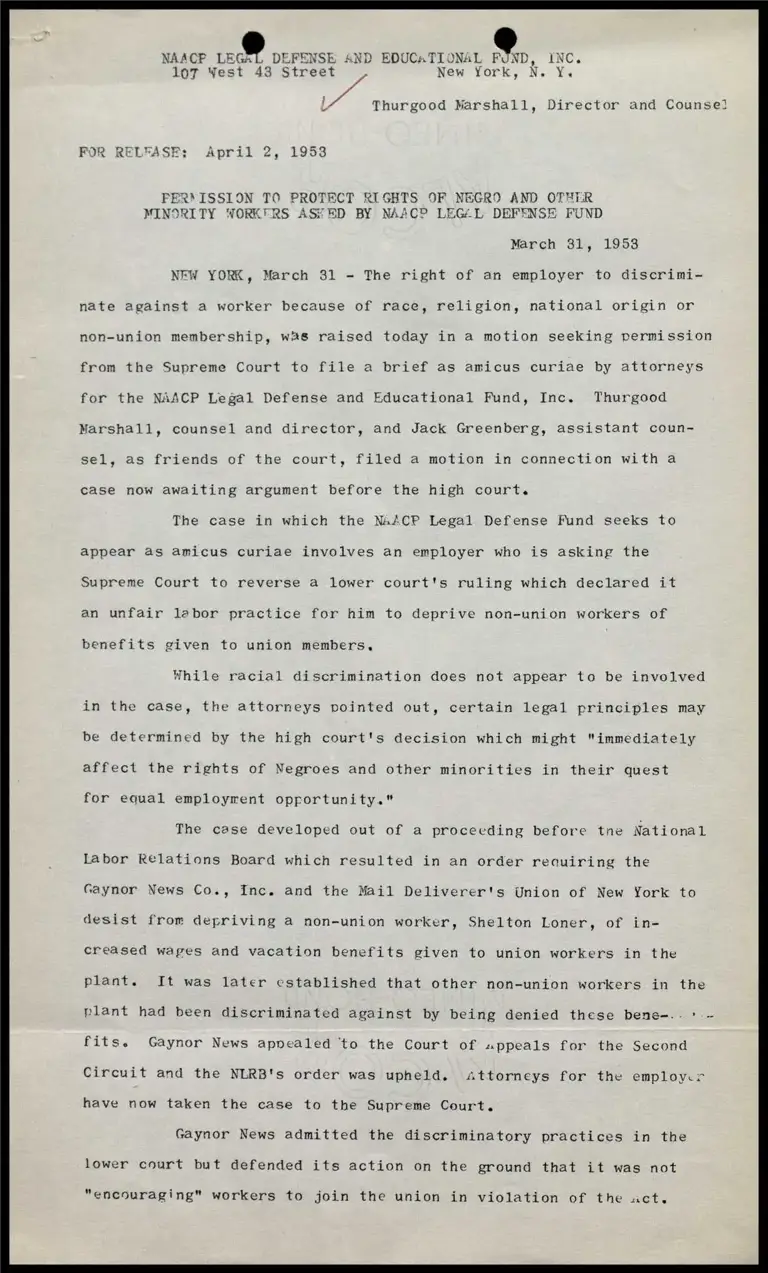
NEW YORK, March 31 - The right of an employer to discrimi-

nate against a worker because of race, religion, national origin or

non-union membership, was raised today in a motion seeking permission

from the Supreme Court to file a brief as amicus curiae by attorneys

for the NAACP Legal Defense and Educational Fund, Inc. Thurgood

Marshall, counsel and director, and Jack Greenberg, assistant coun-

sel, as friends of the court, filed a motion in connection with a

case now awaiting argument before the high court.

The case in which the NAACP Legal Defense Fund seeks to

appear as amicus curiae involves an employer who is asking the

Supreme Court to reverse a lower court's ruling which declared it

an unfair lebor practice for him to deprive non-union workers of

benefits given to union members,

While racial discrimination does not appear to be involved

in the case, the attorneys pointed out, certain legal principles may

be determined by the high court's decision which might "immediately

affect the rights of Negroes and other minorities in their quest

for equal employrent opportunity."

The case developed out of a proceeding before tne National

Labor Relations Board which resulted in an order requiring the

Gaynor News Co., inc. and the Mail Deliverer's Union of New York to

desist from depriving a non-union worker, Shelton Loner, of in-

creased wages and vacation benefits given to union workers in the

plant. It was later established that other non-union workers in the

plant had been discriminated against by being denied these bene-.. *.-

fits. Gaynor News appealed ‘to the Court of «ppeals for the Second

Circuit and the NLRB's order was upheld, Attorneys for the employcr

have now taken the case to the Supreme Court.

Gaynor News admitted the discriminatory practices in the

lower court but defended its action on the ground that it was not

"encouraging" workers to join the union in violation of the act.


The case authority which it relied upon involved a closed shop con-

tract that gave non-union members in another plant the privilege of

electing their own representatives to ask for the same benefits

secured: by the union for its members. The court of appeals, howe

ever, refused to be persuaded by the decision in that case and

stated that a union representing a majority of the workers as ex-

clusive bargaining agent is required to represent all of the workers,

otherwise it would leave "the non-union members with no means of

equalizing the situation."

In its motion, NAACP Legal Defense attorneys claim that

"in many situations in which a labor union is the collective bar-

gaining arent, Negroes and other minority groups are excluded from

membership solely because of race, religion or national origin."

The attorneys argue that if the petitioner's legal theory

is upheld by the Supreme Court, Negroes and other minorities who

are barred from union membership will be deprived of the right to

file unfair labor practice charge with the NLRB and thus will de-

prive them of equal employment opportunity.

In filing the motion, NAACP Legal Defense lawyers assert

that in their belief the briefs to be filed with the Supreme Court

will not adequately present facts "bearing upon the status of Negro

and other minority group workers."

"The decision in this case . . . will vitally affect the

struggle of large segments of our population to secure job equality

and will be of nationel importance," the NAACP Legal Defense Fund

attorneys pointed out.

The filing of the motion was made necessary because

attorneys for the Gaynor News Co. had refused the NAACP Legal De-

fense and Educational Fund permission to file a brief in connection

with the case. If the motion is granted, then Legal Defense will

be able to file a brief amicus curiae.

28008