Letter from Paust to Town RE: Denver Police Bullet and DOJ Report
Correspondence
November 12, 1975
2 pages
-
Case Files, Garner Working Files. Letter from Paust to Town RE: Denver Police Bullet and DOJ Report, 1975. d13ab256-33a8-f011-bbd3-000d3a53d084. LDF Archives, Thurgood Marshall Institute. https://ldfrecollection.org/archives/archives-search/archives-item/8f5f2f1f-41c0-4d95-a893-7fb31a8a8d37/letter-from-paust-to-town-re-denver-police-bullet-and-doj-report. Accessed September 15, 2026.
Copied!
^ Vn
University of Houston
HOUSTON, TEXAS 77004
BaUt Coilaga ol Law
November 12, 1975
Mr. Alan Town
American Civil Liberties Union
of Colorado
1711 Pennsylvania Street
Denver, Colorado 80203
Dear Mr. Town;
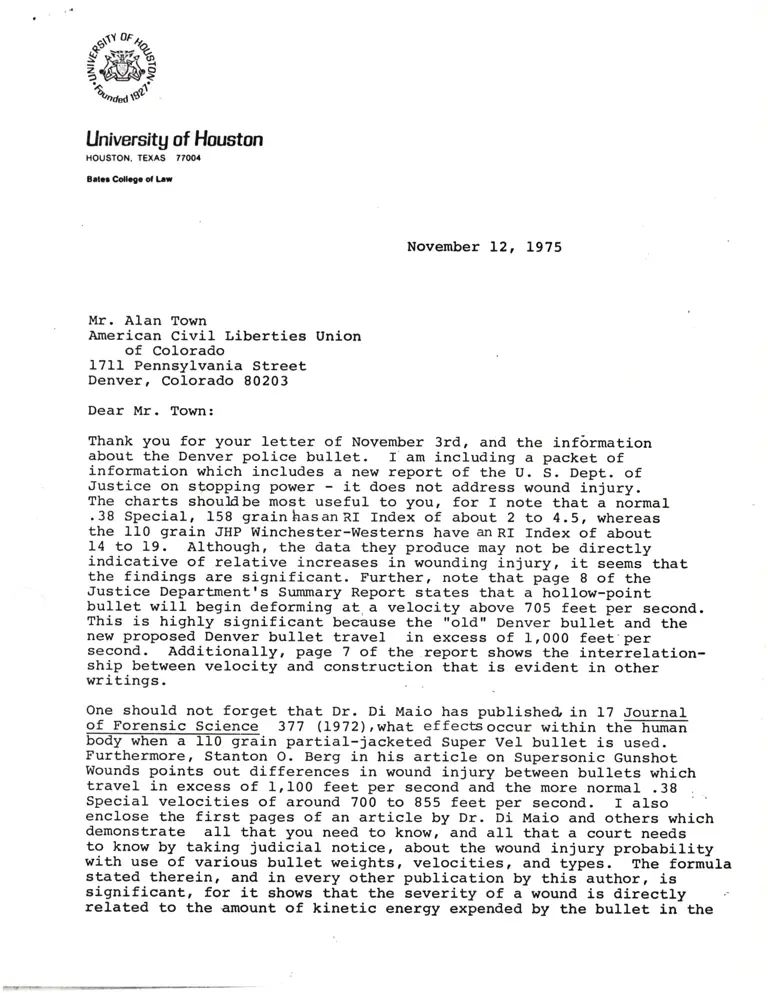
Thank you for your letter of November 3rd, and the information
about the Denver police bullet. I am including a packet of
information which includes a new report of the U. S. Dept, of
Justice on stopping power - it does not address wound injury.
The charts should be most useful to you, for I note that a normal
.38 Special, 158 grain has an RI Index of about 2 to 4.5, whereas
the 110 grain JHP Winchester-Westerns have an Ri index of about
14 to 19. Although, the data they produce may not be directly
indicative of relative increases in wounding injury, it seems that the findings are significant. Further, note that page 8 of the
Justice Department's Summary Report states that a hollow-point
bullet will begin deforming at a velocity above 705 feet per second.
This is highly significant because the "old" Denver bullet and the
new proposed Denver bullet travel in excess of 1,000 feet per
second. Additionally, page 7 of the report shows the interrelation
ship between velocity and construction that is evident in other writings.
One should not forget that Dr. Di Maio has published, in 17 Journal
of Forensic Science 377 (1972),what effects occur within the human
body when a 110 grain partial-jacketed Super Vel bullet is used.
Furthermore, Stanton O. Berg in his article on Supersonic Gunshot
Wounds points out differences in wound injury between bullets which
travel in excess of 1,100 feet per second and the more normal .38
Special velocities of around 700 to 855 feet per second. I also
enclose the first pages of an article by Dr. Di Maio and others which
demonstrate all that you need to know, and all that a court needs
to know by taking judicial notice, about the wound injury probability
with use of various bullet weights, velocities, and types. The formula
stated therein, and in every other publication by this author, is
significant, for it shows that the severity of a wound is directly
related to the amount of kinetic energy expended by the bullet in the
Mr. Alan Town Page - 2 - November 12, 1975
human body. As Dr. Di Maio admits "the greater the loss of
kinetic energy, the greater the damage to the tissues, and,
therefore, the more severe the wound." With regard to the
Denver bullet all that you have to do is compare 290 foot
pounds of kinetic energy transfer to the transfer by a normal
.38 Special which is 74 to 84 foot pounds. Thus, the proposed
Denver bullet would transfer to the human body about 3.6 times more energy than a normal .38 Special, which is the standard
round for most police department across the country despite the
minority trend toward use of illegal and cruel bullets. I also
note that the "old" Denver bullet can expend up to twice or
3.6 times the kinetic energy that a normal round transfers.
I also enclose a copy of the notes that I took from a May 5th,
Pennsylvania hearing on hollow-point bullets. These notes
demonstrated the types of questions that are relevant and the
types of responses one can expect from certain persons.
I assume that you have a copy of the draft law review article
on the dum-dum bullet controversy and the comment about to be
published in the Hastings Constitutional Law Quarterly . We
are about to have hearings on these topics in the U. S. House
Judiciary Committee, Sub-Committee on Crime. Your thoughts
on these developments would be appreciated. Thank you very much.
With kind regards.
Co-Chairman ABA Comm.
Law and the Use of
Force
Law
on Int'l
JJP:mb
Enclosures
cc; A.C.L.U., N.Y.
Bill Olds, C.C.L.U.
P.S. I assume that you are aware of the lawsuits
Massachusets, Tennessee, and Connecticut. filed in