Memphis Police General Order Re: Use of Firearms and Deadly Force; Memo from Price to All Officers
Correspondence
February 24, 1972 - February 5, 1974
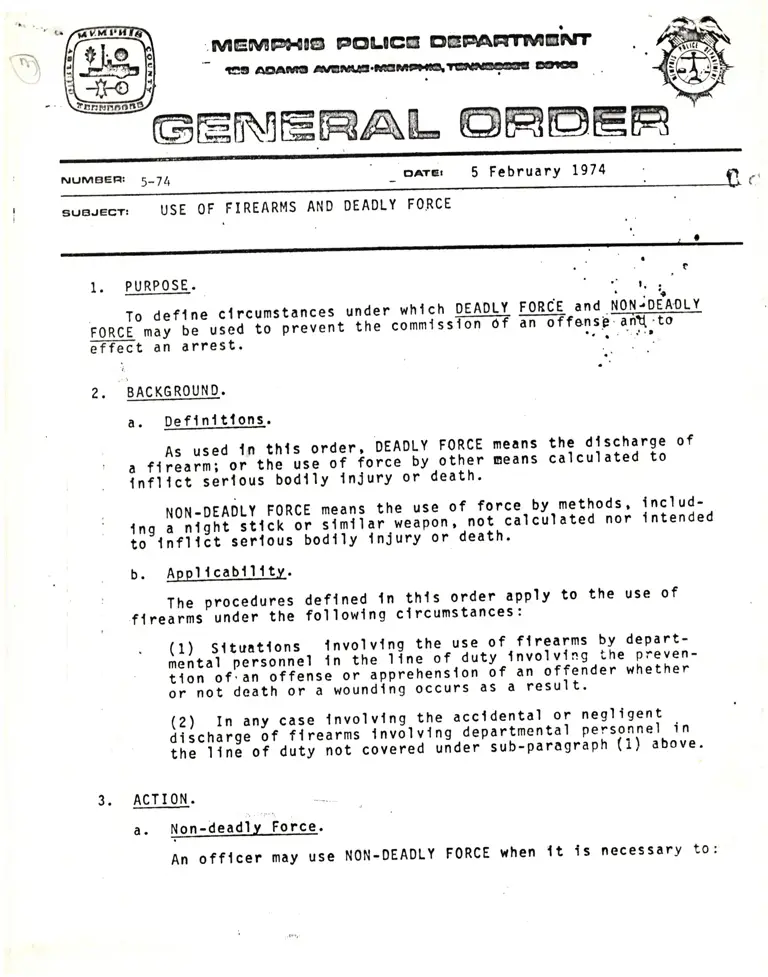
5 pages
-
Case Files, Garner Working Files. Memphis Police General Order Re: Use of Firearms and Deadly Force; Memo from Price to All Officers, 1972. 685d3a96-33a8-f011-bbd3-000d3a53d084. LDF Archives, Thurgood Marshall Institute. https://ldfrecollection.org/archives/archives-search/archives-item/8fce9880-4da8-423c-bcd5-938b5dc38964/memphis-police-general-order-re-use-of-firearms-and-deadly-force-memo-from-price-to-all-officers. Accessed September 25, 2026.
Copied!
W A V 0 ̂ M E B V B P W O Q P O O C H D H P A P S T W a O M T
vus AOAIW9 iBVHWAa3»wr8aMti WO, reMMOcoan eavaa
M U M B E R : 5 _ 7 /(
□ A T C i 5 February 1974
-JX
s u b j e c t : u s e OF FIREARMS AND DEADLY FORCE
1. PURPOSE. •; ».
To define clrcumsUnces under which D E M U »"<
FORCE may be used to prevent the commission df an offense an^_to
effect an arrest.
«
2. b a c k g r o u n d .
a. Definitions.
As used in this order. DEADLY FORCE means the discharge of
a firearm; or the use of force by other means calculated to
Inflict serious bodily Injury or death.
NON-DEADLY force means the use of force by methods,
Ing a night stick or similar weapon, not calculated nor Intended
to Inflict serious bodily Injury or death.
b. Appl1cabi11ty.
The procedures defined In this order apply to the use of
firearms under the following circumstances:
m Situations Involving the use of firearms by depart-
■ lental personnel In the line of d^ty Involving the preven
tion of-an offense or apprehension of an offender whether
or not death or a wounding occurs as a result.
(2) In any case Involving the accidental or negligent
discharge of firearms Involving departmental P®;;sonnel in
the line of duty not covered under sub-paragraph (1) above.
3. ACTION. -.. ^
a. Non-deadlv Force.
An officer may use NON-DEADLY FORCE when It Is necessary to:
- 2 -
(1) Effect an arrest;
(2) Prevent the escape from custody of a person who 1s
reasonably suspect of having committed an offense; or to
(3) Defend one's self or another In cases not Involving
serious bodily Injury or death.
b. Deadly Force.
DEADLY FORCE may be used In the following circumstances only
after all other reasonable means to apprehend or otherwise prevent
the offense have been exhausted:
(1) Self-Defense.
An officer may use DEADLY FORCE when It Is In the
defense of himself or another from serious bodily Injury or
death and the threat of serious bodily Injury or death is
real and Immediate.
(2) Felonies Involving the Use or Threatened Use of Physical
Force.
An officer may use DEADLY FORCE when the offense involves
a felony and the suspect uses or attempts to use or threatens
the use of physical force against any person.
(3) Other Felonies Where Deadly Force Is Authorized.
After all reasonable means of preventing or apprehending
a suspect have been exhausted, DEADLY FORCE Is authorized in
the following crimes:
fal Kidnapping
Murder In the 1st or 2nd degree
Manslaughter
Arson (Including the use of firebombs)
l̂ 3pe
Assault and battery with Intent to carnally know
a child under 12 years of age
Assault and battery with Intent to commit rape
Burglary in the 1st, 2nd, or 3rd degree
Assault to commit murder In the 1st or 2nd degree
Assault to commit voluntary manslaughter
(k) Armed and_s1mple robbery
c. Use of Deadly Force Prohibited.
The use of DEADLY FORCE Is prohibited when:
(1) Arresting a person for any misdemeanor offense; or
3 -
(2) Effecting an arrest of any person for escape from ]
the commission of any misdemeanor offense. i
d . Use of Firearms Prohibited. ^ _i
(1) As warning shots;
(2) From any moving vehicle or to stop any fleeing vehicle,
except in cases of self-defense or cases involving:
(a) Murder in the 1st or 2nd degree
(b) Rape ,
(c) Assault and battery with intent to carnally know
a child under 12 years of age
(d) Armed or simple robbery
(3) In any case where an officer does not have a clear field
of fire and cannot be reasonably certain that only the sus
pect will be hit and that the potential for harm to innocent
persons or their property is minimal.
e. Notification Procedures.
(1) Once the situation is under control, any member who dis
charges a firearm in the line of duty will immediately report the
fact to the Dispatcher who will have the cognizant watch or
squad commander notified. The latter will inform the precinct
or bureau commander of the event ,without delay. As soon as
practicable, the officer who fired a weapon will submit a written
narrative of the circumstances, via the chain of command, to the
Chief of Police, with copies to the Senior Member of the Firearms
Review Board and to the Commanding Officer of the Firing Range.
In addition. Form F2100.149 shall be filled out and forwarded to
the Firing Range.
(2) In any case resulting in death or wounding, the cognizant
watch or squad commander,or his designated representative, wil.
proceed to the scene and will relieve the officer(s) concerned
pending completion of the inquiry that will be conducted by the
Firearms Review Board. In addition, the Dispatcher will notify
the Homicide Squad and the Internal Affairs Bureau as rapidly
as possible. Preservation of the scene will be the responsibility
of the senior commander present.
4. SELF-CANCELLATION.
This order shall remain in effect until its provisions have been
incorporated into the department's Manual of Policies, Procedures
Rules and Regulations.
l U -
'J. W/~4lubbard
Di stri buti o n : A
r ■) t *
j t \
' - J
'w tl ki u O 7 ‘ r O M ! Q
i T z - 0 F F 2 c z
r.̂ E r.1 O A D U
VO: r.!.L cc:::r.D!::3 crfzcEr^
STAr? ;:;j Fiao c?:rj*jic:3
?::c:;3: Ci:2:? OllL ?21ZZ
DATE: DEC£r3£R 13, 1972
CU3JZCT: ;::£fjD:;inT to order G-72-16
SERVICE REVOLVERS
E?7ECYIVE lir-E-OIATELV TJiE R£aiATIC:j SERVICE REVOLVER PCR ALL
L':;j7cr.'̂ fL*:$c:.*:;:L r// ircluoe revolvers havirs a STAiro.ESS
s n a FJWIC:3. ALL 0T;!ER PROVISICR'3 re;̂m r as stated.
\ r 1 ‘7 V A rr O’ ]
i n v e n - o P F s c : :
v: ■ / r.: e r.: o q a n o u a
VO: *' \S' •> •< > -W«vi ^ tO
W u* ># W*
W' b - . • f—
S»r V «* *
r*?n ^
1 r-7:>.iri
:c7; PEns?::-'-t."
. <’,'/ A* < ̂ '̂'' •' ^
/ - V ̂
."“7 c:''’i'";zi C'7 O C g Cz'zr’irrs.Z ics^pcc to so^l. tpcio or
c''-r.:^o clicr":') c7 crj ?:or.:2 crot do co In ccr;)ltcnco with t'*»a lc;i
0? C : i:rvO c? Tcr.r̂ occo cr.:3 ĉ? t.̂ o Fc-oral ĉ vcrr.'ririt.
"3 c'!.tc?j C'."̂ to to t:ocd-'7or po'itw scs’i;1co uoo.
< , c V.c? cri' c*'A'; cvot ta pĉ OPly recorded ct Firlro Ren̂.a prior
•■ 5 C” !j c: q. r~7 r;r.d'-JO to co recorded teay w t to Ciss-o&sd o7 until, ' -- ^
̂r''
;
0 r> w
•■'iOtCen C3rv,ic3 rvevolvor 7cr /'ll in̂ ircrjl rZRSti::::iL is a .33 Spoclal,
U cr CoUt s'CVOwCor, 0 zZzZt C* torrol* blua steal finish, »?cod crips,
iJ.- j C7 cd;*'j3t:*j'E3 slc^.to. Ttio rectenical functions of tho rovolvor shall
cr.Z li cK:;'\:d end or^ rceesccrtco rest ba approved by tha Ronca Of floor
:̂lz7 to Initnllctlcn. (C;*1p Ad"'ptor3 5 Cvcrcizo crips aro acccpUblo after
‘.n.. eet'Jcn end/t? cedlfictticea ty renca fJarccnnol).
.4 • ̂ o« '‘ZZzi’Z c? cfv'Jcers cd:) cro ret rc^Jlred to vrear tho official un1fo;*e
i - ‘■'ntlvea* p̂ oCwt dcCno pnj’tcnnol end off du'ty officers vrcarlng plain
QlC'r.z) try enn̂ y a ccrvico i’̂ volvor ee cistlircd above or 0 .J3 Special S £ U
c? Q'SiZ levelvnr, 5 cr C ctoi, 2* fccr.'ol, after approval by deslcnatod Rar.po
r.:;c:::nd, Ctecdrsdcal fcncticns of tt.o rovolvcr shall not bo altered, cr.d
C ' j cecc3cc;ic2 ur3t ta tppitved by C.o Rnneo Officer prior to Ir.stallatlcn.
r--,f.-.I W to r. . — — .ww.jwjd CT dpty cor'̂ ioe rnvolC’crs will be rede by tha Department
r.t no c:3t to C.3 cffJc:;:j» cr ty C.o î nctnry after 1s?3[fect1cn by ranra per-
c:.:.ol. of prG-ns'J scrvico revolve;'̂ erjet be dene by the fcctovv
f.nd C:3 effienr cn."3t ctvcTb Ode enyenne. (Finishes ether then factory veld
ri.-nrrnnty by C e c:nnft2t! ' ‘ ‘ '' ' ' -- • -
d.'ecveticn of Che r.inciXfflo-*-.
v̂ '.vliwd D tiD scith rentfo.
(wi-'JXr). Sceced f.r3 fp̂ ne will be rofinlshed’ct the
A rovolvo? fciill be fOrnlshed for the period
17 cny cfficn^a pcncceo cnTVice rcvolvefe i-hlcb (do rvSt cc::ply with this Crf.r,
cvntnct C:a Cnn̂ ie Cfflct;* tdn? will b^ndlo cecii ceea cn Its individual merits.
CIZ27 C7'’KtICE