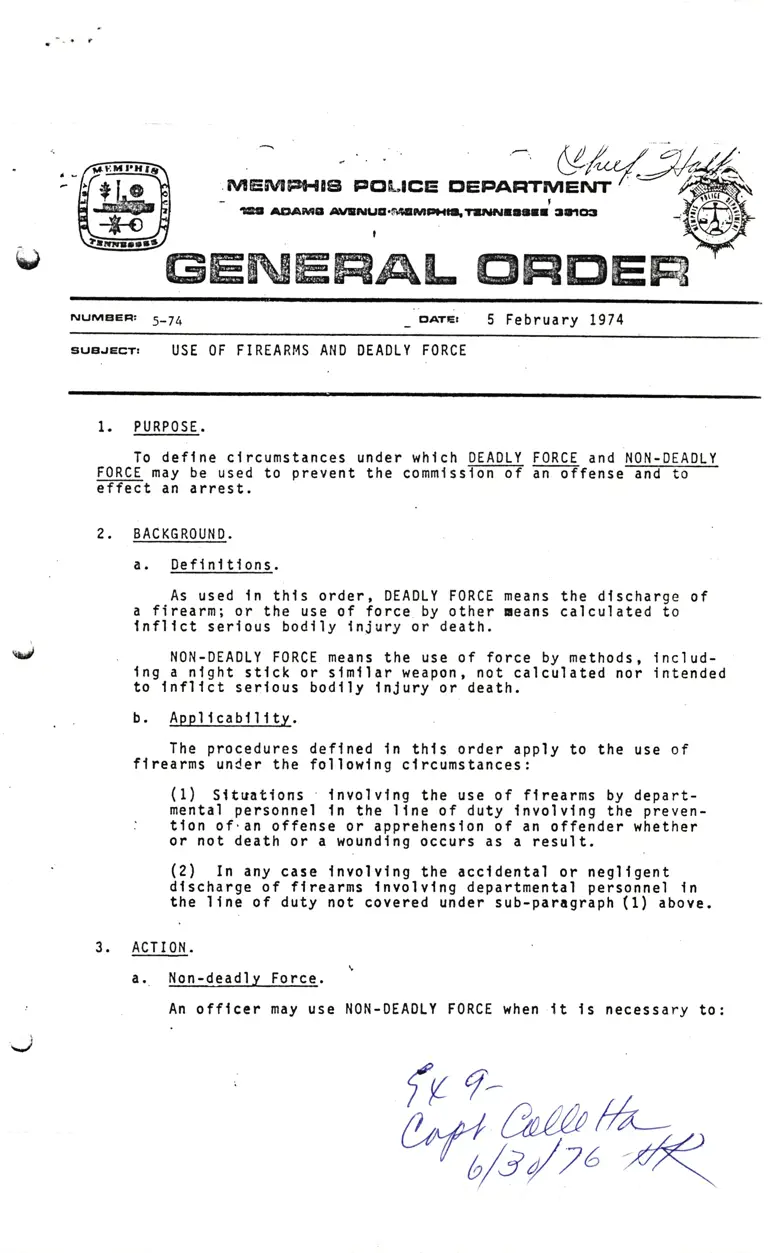
Memphis PD General Order RE: Use of Firearms and Deadly Force
Unannotated Secondary Research
February 5, 1974
3 pages
-
Case Files, Garner Working Files. Memphis PD General Order RE: Use of Firearms and Deadly Force, 1974. b536e5f6-32a8-f011-bbd3-000d3a53d084. LDF Archives, Thurgood Marshall Institute. https://ldfrecollection.org/archives/archives-search/archives-item/9098973c-1e05-4d68-9f0d-ededd6411128/memphis-pd-general-order-re-use-of-firearms-and-deadly-force. Accessed November 13, 2026.
Copied!
M
MESVSPHOe P O L IC E O E P A R T M E rJT
»
‘1 0 0 A O A M O /M/SNUO*?WtaMPHtO,TOMIMKaaaO 3 0 1 0 3
NUMBEP: 5-74 oAT€t 5 February 1974
s u b j e c t : use of firearms AND DEADLY FORCE
1. PURPOSE.
To define circumstances under which DEADLY FORCE and NON-DEADLY
FORCE may be used to prevent the commission of an offense and to
effect an arrest.
W
BACKGROUND.
a. Def1n1tions.
As used In this order, DEADLY FORCE means the discharge of
a firearm; or the use of force by other Beans calculated to
Inflict serious bodily Injury or death.
NON-DEADLY FORCE means the use of force by methods, Includ
ing a night stick or similar weapon, not calculated nor Intended
to Inflict serious bodily Injury or death.
b. Appl1cabi11ty.
The procedures defined In this order apply to the use of
firearms under the following circumstances:
(1) Situations Involving the use of firearms by depart
mental personnel In the line of duty Involving the preven
tion ofan offense or apprehension of an offender whether
or not death or a wounding occurs as a result.
(2) In any case Involving the accidental or negligent
discharge of firearms Involving departmental personnel In
the line of duty not covered under sub-paragraph (1) above.
ACTION.
S.
a. Non-deadly Force.
An officer may use NON-DEADLY FORCE when It Is necessary to;
(1) Effect an arrest; ,
(2) Prevent the escape from custody of a person who is
reasonably suspect of having committed an offense; or to
(3) Defend one's self or another in cases not involving
serious bodily injury or death.
b. Deadly Force.
DEADLY FORCE nay be used in the following circumstances only
after all other reasonable means to apprehend or otherwise prevent
the offense have been exhausted:
(1) Self-Defense.
An officer may use DEADLY FORCE when it is in the
defense of himself or another from serious bodily injury or
death and the threat of serious bodily injury or death is
real and immediate.
(2) Felonies Involving the Use or Threatened Use of Physical
Force.
An officer may use DEADLY FORCE when the offense involves
a felony and the suspect uses or attempts to use or threatens
the use of physical force against any person.
(3) Other Felonies Where Deadly Force is Authorized.
After all reasonable means of preventing or apprehending
a suspect have been exhausted, DEADLY FORCE is authorized in
the following crimes:
Kidnapping
Murder in the 1st or 2nd degree
Mansiaughter
Arson (Including the use of firebombs)
Rape
Assault and battery with intent to carnally know
a child under 12 years of age
Assault and battery with intent to commit rape
Burglary in the 1st, 2nd, or 3rd degree
Assault to commit murder in the 1st or 2nd degree
Assault to commit voluntary manslaughter
Armed and simple robbery
c. Use of Deadly Force Prohibited.
The use of DEADLY FORCE is prohibited when:
(1) Arresting a person for any misdemeanor offense; or
► * >
- 3
(2) Effecting an arrest of any person for escape from
the commission of any mis<lemeanor offense.
Use of Firearms Prohibited.
(1) As warning shots;
(2) From any moving vehicle or to stop any fleeing vehicle,
except in cases of self-defense or cases involving:
Murder in the 1st or 2nd degree
Rape
Assault and battery with Intent to carnally know
a child under 12 years of age
(d) Armed or simple robbery
(3) In any case where an officer does not have a clear field
of fire and cannot be reasonably certain that only the sus
pect will be hit and that the potential for harm to innocent
persons or their property is minimal.
e. Notification Procedures.
(1) Once the situation is under control, any member who dis
charges a firearm in the line of duty will immediately report the
f̂ !ct to the Dispatcher who will have the cognizant watch or
squad commander notified. The latter will inform the precinct
or bureau commander of the event ,without delay. As soon as
practicable, the officer who fired a weapon will submit a written
narrative of the circumstances, via the chain of command, to the
Chief of Police, with copies to the Senior Member of the Firearms
Review Board and to the Commanding Officer of the Firing Range.
In addition. Form F2100.149 shall be filled out and forwarded to
the Firing Range.
(2) In any case resulting in death or wounding, the cognizant
watch or squad commander^or his designated representative, will
proceed to the scene and will relieve the officer(s) concerned
pending completion of the inquiry that will be conducted by the
Firearms Review Board. In addition, the Dispatcher will notify
the Homicide Squad and the Internal Affairs Bureau as rapidly
as possible. Preservation of the scene will be the responsibility
of the senior commander present.
4. SELF-CANCELLATION.
This order shall remain in effect until its provisions have been
incorporated into the department's Manual of Policies, Procedures, and
Rules and Regulations.
J. W. Hubbard
Di stri bution