Simms v OK Petitioners Reply to Brief of Respondents in Opposition to the Petition for Writ of Certiorari
Public Court Documents
January 1, 1998
16 pages
-
Brief Collection, LDF Court Filings. Simms v OK Petitioners Reply to Brief of Respondents in Opposition to the Petition for Writ of Certiorari, 1998. 98a8d272-c49a-ee11-be37-00224827e97b. LDF Archives, Thurgood Marshall Institute. https://ldfrecollection.org/archives/archives-search/archives-item/909f1f7c-ec67-4d5d-af04-06d1a7568789/simms-v-ok-petitioners-reply-to-brief-of-respondents-in-opposition-to-the-petition-for-writ-of-certiorari. Accessed October 05, 2026.
Copied!
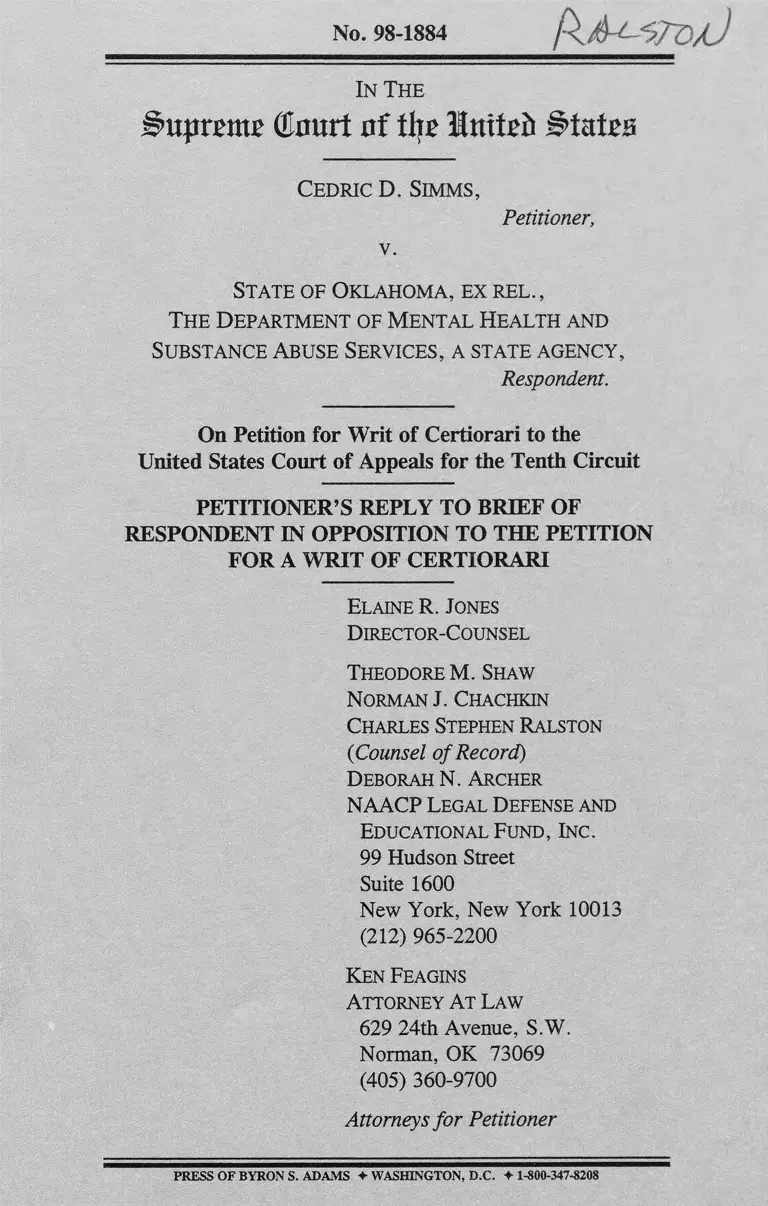
    In  Th e

# > u j i m n £  ( & m v t  $ f  t l j p  l i& m tz b  S t a t e s

Ced ric  D. Sim m s ,
Petitioner,

v.

State o f  Ok la h o m a , ex  r e l .,
T h e  D epartm ent  of M e n ta l  Health  and

Substa n ce  Abuse  Serv ices , a  state  a g en c y ,
Respondent.

On Petition for W rit of Certiorari to the
United States Court of Appeals for the Tenth Circuit

PETITIONER’S REPLY TO BRIEF OF
RESPONDENT IN OPPOSITION TO THE PETITION

FOR A W RIT OF CERTIORARI

Elaine R. Jones
Director-Counsel

Theodore M. Shaw
Norman J. Chachkin
Charles Stephen Ralston
(Counsel o f Record)
Deborah N. Archer
NAACP Legal Defense and

Educational Fund, Inc .
99 Hudson Street
Suite 1600
New York, New York 10013
(212) 965-2200

Ken Feagins
Attorney At Law

629 24th Avenue, S.W.
Norman, OK 73069
(405) 360-9700

Attorneys fo r  Petitioner

PRESS OF BYRON S. ADAMS ♦  WASHINGTON, D.C. ♦  1-800-347-8208


TABLE OF CONTENTS

Table  of  a u t h o r it ie s .................................................  ii

I. Th e  R espond ent  Makes In co rrect
Factual  and  Legal  a ssertions  ................ 1

A. The Statement of the Case  ................ 1

B. The Applicable EEO C Regulation . . .  2

II. R espondent A dvances Argum ents
That  a r e  Irrelev a n t  to th e
Question  Presented  H e r e  and  That
Obscure  the  Split  in  th e  Circuits . . . .  5

Conclusion 10


11

TABLE OF AUTHORITIES

Anderson v. Block, 807 F.2d 145
(8th Cir. 1986) .........................................................5

Ang v. Procter & Gamble Co., 932 F.2d 540
(6th Cir. 1991) ....................................................  7, 8

Conroy v. Boston Edison Co., 758 F. Supp. 54
(D. Mass. 1991) ......................................................... 6

Evans v. Technologies Applications & Serv. Co.,
80 F.3d 954 (4th Cir. 1 9 9 6 ) ..................................... 5

Hopkins v. Digital Equip. Corp., 1998 WL 702339
(S.D.N.Y. 1998) ............................   5

Hornsby v. Conoco Inc., 777 F.2d 243
(5th Cir. 1985) .......................   5

King v. Georgia Power Company, 295 F. Supp. 943
(N.D. Ga. 1 9 6 8 ) ......................................................... 4

Lantz v. Hospital of the Univ. of Penn.,
1996 WL 442795 (E.D.Pa. 1996) ............................ 5

Love v. Pullman, 404 U.S. 522 (1 9 7 2 )....................... 9

M alarkey v. Texaco, Inc., 983 F.2d 1204
(2nd Cir. 1 9 9 3 )....................... ................... .. 7, 8

Pejic v. Hughes Helicopters, Inc., 840 F.2d 667
(9th Cir. 1988) ............................................................5

Sanchez v. Standard Brands, Inc., 431 F.2d 455
(5th Cir. 1970) .................................................... 4, 5


Pages:

Seymore v. Shawver & Sons, Inc., I l l  F.3d 794
(10th Cir. 1997), cert, denied, 118 S.Ct. 342
(1997) ............................................................ 7, 8, 10

Simms v. Oklahoma, 165 F.3d 1321
(10th Cir. 1999) .........................................................5

Steffen v. M eridian Life Insurance Co., 859 F.2d 534
(7th Cir. 1988) ...............    6-8

Washington v. Kroger Co., 671 F.2d 1072
(8th Cir. 1982) ............................................................5

Zanders v. O’Gara-Hess, 952 F.2d 404 (6th Cir. 1992),
1992 U.S.App. Lexis 535 ..........................................5

Zipes v. Trans World Airlines, Inc. Independent
Federation of Flight Attendants,
455 U.S. 385 (1982).................   9

Regulations:

29 C.F.R. 1601.11(b)....................... .............................. 2, 3

29 C.F.R. §1601.1 2 ( b ) ......................................... 2, 3, 7, 10

Other Authorities:

37 Fed. Reg. 9215 (May 6, 1 9 7 2 ) ...............................  2, 4

42 Fed. Reg. 47833 (Sept. 22, 1 9 7 7 ) ....................... 2

EEO C  Compliance M anual §§602.6 (1999 Commerce
Clearing House I n c .) ................................................. 9

I l l


PETITIONER’S REPLY TO BRIEF OF RESPONDENT
IN OPPOSITION TO THE PETITION

FOR A WRIT OF CERTIORARI

In its quest to avoid review of the Tenth Circuit’s
erroneous opinion, the respondent has distorted the factual
proceedings below and obscured the legal issues posed by
this Petition. Petitioner, Cedric Simms, submits this reply
brief to clarify the procedural histoiy and legal questions
squarely presented for review in this case.

I. Th e  Respondent Makes Incorrect Factual
and Legal Assertions

A. The Statement o f the Case

In the body of its brief, respondent states that "[t]he
Court should consider the amendment was not even filed
until after Respondent filed a motion for partial summary
judgment." [R. Br. at 22]. This statement creates the
erroneous impression that Mr. Simms amended his second
EEOC charge after filing an action in federal court based on
that charge. Respondent has obscured the fact that the
charge at issue here, Charge II, was still pending before the
EEOC, without a right-to-sue letter having been issued,
when Mr. Simms filed his amendment to that charge.

On October 31, 1994, Mr. Simms filed a charge with
the EEOC based on the circumstances surrounding the
denial of his promotion to Fire and Safety Officer Supervisor
("Charge II"). On June 5, 1995, while Charge II was still
pending, Mr. Simms filed a third EEOC charge ("Charge
III") alleging retaliation for filing Charge II. On November
29, 1995, the EEOC issued a right-to-sue letter for Charge
III. On January 12, 1996, Mr. Simms filed an action in the
Western District of Oklahoma ('Simms IF ) based on the
allegations in Charge III. When Simms I I  was filed, EEOC
Charge II was still pending before the EEOC, and the
Commission was still investigating the allegations of race
discrimination.


2

On July 15, 1996, while Charge II was still pending,
Mr. Simms filed an amendment to Charge II. The EEOC
accepted the amendment, investigated the amended charge,
attempted conciliation, and ultimately issued a right-to-sue
letter for Charge II. On September 25, 1996, Mr. Simms
filed an action in federal district court ('Simms ///") based
on the amended allegations in Charge II. Charge II and
Simms III  are at issue in this Petition.

B. The Applicable EEOC Regulation

The respondent’s arguments are predicated on an
outdated version of the EEOC regulation at issue in this
case. The respondent erroneously cites and relies on a
version of 29 C.F.R. §1601.12(b), the regulation governing
when amendments relate back to the date of an original
charge, that has not appeared in the Code of Federal
Regulations for 27 years. [R. Br. at 1-2, 10]. The version
quoted by respondent appeared in the C.F.R. between 1967
and 1972, and appeared at §1601.11, not at §1601.12, the
section to which respondent attributes it. This outdated
language has since been amended twice, in 1972 and 1977,
to allow a broader range of amendments to relate back to
the date of an original charge. See 37 Fed. Reg. 9215 (May
6, 1972); and 42 Fed. Reg. 47833 (Sept. 22, 1977).

The outdated 1967 regulation that respondent quotes
is misleading because it specifies only a limited number of
purposes for which an EEOC charge may be amended: "to
cure technical defects or omissions. . . or to clarify or
amplify allegations made therein." 29 C.F.R. §1601.11(b)
(1967).1 The current regulation, by contrast, specifically

'The 1967 regulation states:

A charge may be amended to cure technical defects or
omissions, including failure to swear to the charge, or to
clarify and amplify allegations made therein, and such
amendments related back to the original filing date.


3

adds that "amendments alleging additional acts which
constitute unlawful employment practices related to or
growing out of the subject matter of the original charge will
relate back to the date the charge was first received." 29
C.F.R. $1601.12(b) (1999).* 2 This addition significantly
broadens the range of amendments that can relate back to
the original filing date and makes clear that amendments
relating back to the date of the original charge need not be
limited to "clarifyjmg] or amplifying]" the allegations
originally in the charge.

The version relied on by the respondent was
amended expressly for the purpose of allowing amendments
to EEOC charges like the one at issue in this case to relate
back to the date of the original charge. In the edition of the
Federal Register in which the 1967 regulation quoted by
respondent was first amended, the EEOC included an
explanatoiy preface making clear its intent to avoid limiting
the protections under Title VII available to laypersons based
upon a narrow interpretation of the grievances mentioned in

However, an amendment alleging additional acts constituting
unlawful employment practices not directly related to or
growing out of the subject matter of the original charge will
be permitted only where at the date of the amendment the
allegation could have been timely filed as a separate charge.

29 C.F.R. §1601.11(b)(1967).

2The current regulation states:

A charge may be amended to cure technical defects or
omissions, including failure to verify the charge, or to clarify
and amplify allegations made therein. Such amendments and
amendments alleging additional acts which constitute
unlawful employment practices related to or growing out of
the subject matter of the original charge will relate back to
the date the charge was first received. A charge that has
been so amended shall not be required to be redeferred.

29 C.F.R. 1601.12(b)(1999).


4

their original charges:

. . . the nature of employment discrimination is
complex, pervasive, and institutionalized, and. . .
those filing charges may not fully comprehend the
distinctions among its various forms. The
Commission is under an obligation to safeguard the
Federal rights of persons "* * * untutored in the
technicalities of the law and who may or may not (at
the time of filing the charge) be able to fully
articulate their grievances or be aware of the full
panoply of discriminatory practices against them or
others similarly situated * * *"

37 Fed. Reg. 9215 (May 6, 1972), quoting Sanchez v.
Standard Brands, Inc., 431 F.2d 455, 466 (5th Cir. 1970).
Although this passage referred specifically to other
provisions of the C.F.R. that were amended at the same
time, the language illuminates the EEOC’s reasons for
changing the provision governing when amendments to
EEOC charges can relate back to the date of the original
charge.

In its preface to the amendments, the EEOC went on
expressly to recognize that a charge alleging a particular
violation or legal theory under Title VII could legitimately
grow to encompass other violations or legal theories:

There is a substantial possibility that a charge which
initially alleges only limited violations of title VII
"may encompass any kind of discrimination like or
related to allegations contained in the charge and
growing out of such allegations* * *"

37 Fed. Reg. 9215 (May 6, 1972) quoting King v. Georgia
Power Company, 295 F. Supp. 943, 947 (N.D. Ga. 1968).
Thus, at the time it rejected the outdated version of the
regulation cited by respondent, the EEOC recognized that
a charge only alleging certain violations, could naturally
grow to encompass "any kind of [related] discrimination."


5

The regulatory language which respondent misleadingly
presents, and on which its arguments rely, does not reflect
the recognition by the EEOC, better articulated in the
current regulation, that the complexities of employment
discrimination demand that charges not be restricted to the
kinds or theories of discrimination originally alleged.

II. R espondent Advances Arguments That are
Irrelevant to the Question Presented H ere
and That Obscure the Split in  the Circuits

The respondent devotes a substantial part of its
opposition brief to attempting to explain away the clear split
among the Courts of Appeals on the issue directly raised by
this case: When does an amendment to a pending EEOC
charge relate back to the date of the original charge?
Compare Simms v. Oklahoma, 165 F.3d 1321,1326-28 (10th
Cir. 1999) (prohibiting amendments alleging new legal claims
deriving from same set of operative facts included in the
original charge); Evans v. Technologies Applications & Serv.
Co., 80 F.3d 954, 963 (4th Cir. 1996) (same); Pejic v. Hughes
Helicopters, Inc., 840 F.2d 667, 675 (9th Cir. 1988) (same);
Hopkins v. Digital Equip. Corp., 1998 WL 702339, *2
(S.D.N.Y. 1998) (same); Lantz v. Hospital o f the Univ. o f
Penn., 1996 WL 442795, *4 (E.D.Pa. 1996) (same); with
Zanders v. O ’Gara-Hess, 952 F.2d 404 (6th Cir. 1992), 1992
U.S.App. Lexis 535 (allowing amendments alleging new legal
claims deriving from same operative facts included in the
original charge); Anderson v. Block, 807 F.2d 145, 149 (8th
Cir. 1986) (same); Washington v. Kroger Co., 671 F.2d 1072,
1075-1076 (8th Cir. 1982) (same); Sanchez v. Standard
Brands, Inc., 431 F.2d 455, 464 (5th Cir. 1970) (same). See
also, Hornsby v. Conoco Inc., I l l  F.2d 243, 247 (5th Cir.
1985) (dicta).

Rather than challenge the existence of the circuit
split, the respondent argues that Mr. Simms' reliance on this
line of cases is misplaced. In a manner that can only
confuse the issues, respondent argues that the central


6

question before the Court is whether the retaliatory conduct
complained of occurred prior to or after the EEOC charge
was filed. To support this argument the respondent relies
on factually and legally distinguishable cases that address the
distinct issue of whether a plaintiff may seek judicial relief
in a federal court complaint for discriminatory or retaliatory
incidents that have never been listed in an original or
amended EEOC charge. This issue is irrelevant to the
question before this Court: When may an amendment to a
pending EEOC charge relate back to the date the charge
was originally filed?

The cases relied upon by respondent focus on the
separate question of when, under the "scope of the
investigation" rule or the "reasonably related" rule3 a court
can hear a claim that was never made a part of an EEOC
charge. For example, in Steffen v. Meridian Life Insurance
Co., 859 F.2d 534 (7th Cir. 1988), the Seventh Circuit
addressed the question of whether a plaintiffs claim of
retaliation that was not included in the EEOC charge was
"like or reasonably related to the allegations of the charge"
before the court so as to be cognizable in the federal action.
Steffen, 859 F.2d at 544. The court did not address the issue
of when an amendment to an EEOC charge alleging
retaliation may relate back to the date of the original charge
and distinguished the case before it from cases where "the

3As discussed in Mr. Simms’ Petition the "scope of the
investigation" and the "like or reasonably related" doctrines are
inquiries distinct from the question whether amendments relate back
to the date of the original charge. These two doctrines

revolveQ around the principle that the scope of a civil action
is not determined by the specific language of the charge filed
with the agency, but rather, may encompass acts of
discrimination which the [ ] investigation could reasonably be
expected to uncover.

Conroy v. Boston Edison Co., 758 F. Supp. 54, 58 (D. Mass. 1991).


7

employer was given clear notice from the EEOC that
retaliation was at issue." 859 F.2d at 545, n.2. See also
Seymore v. Shawver & Sons, Inc., I l l  F.3d 794 (10th Cir.
1997), cert, denied, 118 S.Ct. 342 (1997); Malarkey v.
Texaco, Inc., 983 F.2d 1204 (2nd Cir. 1993); Ang v. Procter
& Gamble Co., 932 F.2d 540 (6th Cir. 1991); Steffen v.
Meridian Life Ins. Co., 859 F.2d 534 (7th Cir. 1988), cert,
denied, 491 U.S. 907 (1989).

In contrast, Mr. Simms filed an amendment to his
EEOC charge pursuant to 29 C.F.R. § 1601.12(b) to include
retaliation as a legal claim and to explain why he believed
respondent's decision not to promote him was motivated by
racial discrimination and retaliation for his previous lawsuit.
This amendment was filed while the underlying EEOC charge
was still pending before the administrative agency. The
EEOC accepted Mr. Simms' amendment, investigated the
amended charge, found cause to believe that the amended
charge was true, and attempted conciliation. Accordingly, the
issue before the district court was not whether Mr. Simms
could include in his lawsuit claims not previously subject to an
EEOC charge, because he had amended his EEOC charge to
include the retaliation claims prior to filing his lawsuit.

The distinction between the question presented in
Steffen, Ang, Malarkey, and Seymore and that at issue in the
instant case is important. The policy considerations that
motivated the decisions cited by the respondent are not
relevant here. The respondent's attempt to conflate the two
issues only serves to underscore the dangers of severely
limiting a Title VII complainant's ability to amend a pending
charge to include additional legal claims stemming from the
same core of operative facts as in the original charge. When
the case is viewed from the proper analytic framework, the
respondent's "list of horribles" of what could result
disappears. This is in stark contrast to the very real dangers
of applying the technical rule advocated by the respondent


8

to a process usually initiated by uncounselled complainants.

First, the policy considerations supporting the
opinions in Seymore, Malarkey, Steffen, and Ang  are distinct
from those here. In those cases, the courts were motivated
by the desire to protect the purposes of the EEOC filing
requirement by providing notice to respondents and
providing the EEOC opportunity to investigate and attempt
to conciliate the retaliation claim. See Seymore, 111 F.3d at
800; Malarkey, 983 F.2d at 1209; Ang, 932 F.2d at 546;
Steffen, 859 F.2d at 545, n. 2. Here, all purposes of the
EEOC filing requirement were fulfilled. The respondent
was given notice of Mr. Simms’ retaliation claims and the
EEOC thoroughly investigated the charge as amended and
provided the parties with an opportunity to conciliate all
claims. The purpose of the statutory exhaustion requirement
is not furthered by denying a complainant the opportunity to
pursue such claims in federal court.

Respondent has disingenuously argued that "unless a
plaintiff indicates in the original charge that he engaged in
some protected conduct that led to the defendant’s alleged
retaliatory acts, there arises no reasonable inference that
retaliation has taken place" and respondent is, thereby,
denied notice of the retaliation charge. [R. Br. at 12]. The
respondent further states that:

. . .  a reasonable investigation of Petitioner’s original
charge would have looked to see if he had been
denied a promotion because of his race. Nothing in
the original charge would have alerted a reasonable
investigator to go back in time to determine whether
there had been previous EEOC filings that could
possibly reveal a retaliatory motive for the failure to
promote.

[R. Br. at 21]. This claim makes no sense. Even if the
complainant did not mention the retaliation charge in the
original charge, the standard EEOC investigation of an


9

employee’s discrimination charge would likely reveal
previous charges by the same employee against the same
employer. See EEOC Compliance Manual §§602.6(a)(l) and
(c) (1999 Commerce Clearing House Inc.).

The EEOC’s formal investigation procedures begins
with an inquiry into the history of the employee’s
relationship with the employer:

The charging party/complainant provides all of the
initial information concerning the basis and issue of
the charge/complaint . . . .  Background information
includes, but is not limited to, a brief summary of the
charging party/complainants’s work history with the
respondent . . . and any other information which
charging party/complainant feels is relevant to the
charge/complaint.

EEOC Compliance Manual §602.6(a)(l). A prior EEOC
charge is likely to be a salient feature of any such history
and is, therefore, likely to be among the first pieces of
information gathered by the investigator.

Here, in addition to notification through the EEOC
process, the respondent was undoubtedly aware of Mr.
Simms’ prior EEOC charge and Title VII action and that it
might be at issue because its managers, Kellison and
LaBoon, received a copy of the settlement order in Simms
I  and the instant charge was filed only six months after the
parties reached a settlement in Simms I.

To adopt the per se rule urged by the respondent,
restricting pre-filing retaliation charges but not post-filing
retaliation charges, would result in the type of technical
stringency this Court warned against in Love v. Pullman, 404
U.S. 522 (1972) and Zipes v. Trans World Airlines, Inc.
Independent Federation o f Flight Attendants, 455 U.S. 385
(1982). It neither promotes Title VII nor respects the
realities of the administrative process often initiated by
laypersons.


10

Finally, the respondent has misstated the thrust and
effect of the Tenth Circuit’s opinion in this case.
Respondent argues that the decision rested on its
determination that under Seymore v. Shawver & Sons, Mr.
Simms’ retaliation claims were not "reasonably related" to
the federal complaint. [R. Br. at 26]. The respondent has
lumped together two distinct lines of inquiry performed by
the court of appeals in an attempt to obscure the needlessly
stringent and technical rule employed by the court.

As discussed above, Seymore and similar cases cited
by the respondent examine when a claim not included in any
EEOC charge may still be included in a federal action.
Thus, in applying the reasoning in Seymore to the present
case the Tenth Circuit was determining under the
"reasonably related rule" whether the retaliation claim could
be so included. But what the respondent has ignored is that
the foundation for the Tenth Circuit’s "reasonably related"
analysis is its determination that Mr. Simms’ retaliation
amendment did not relate back to the date of the original
charge under §1601.12(b). To reach that conclusion the
court employed the rule that amendments to an EEOC
charge alleging new legal claims, even those stemming from
the same core of operative facts as in the original charge,
cannot relate back to the date of the original charge. This
is a hyper-technical approach, divorced from the realities of
the EEOC administrative process and the facts of this case.

Further belying the respondent’s claim that Mr.
Simms has imported a circuit split from an unrelated line of
cases and misrepresented the Tenth Circuit’s opinion is that
court’s own acknowledgement of a split in the circuits on the
issue of when an amendment stating new legal claims relates
back to the date of the original charge. (Pet. App. 7a-8a.)

Conclusion

For the foregoing reasons, the petition for a writ of
certiorari should be granted and the decision below reversed.


Respectfully submitted,

Elaine R. Jones
Director-Counsel

Theodore M. Shaw
Norman J, Chachkin
Charles Stephen Ralston
0Counsel o f Record)
Deborah N. Archer
NAACP Legal Defense and

Educational Fund, In c .
99 Hudson Street
Suite 1600
New York, New York 10013
(212) 965-2200

Ken Feagins
Attorney at Law

629 24th Avenue S.W.
Norman, OK 73069
(405) 360-9700

Attorneys fo r  Petitioner