Plaintiffs' Response to Defendants' Amendment to Plan for Further Desegregation of Schools

Public Court Documents
November 20, 1969

Plaintiffs' Response to Defendants' Amendment to Plan for Further Desegregation of Schools preview

8 pages

Includes Correspondence from Chambers to Clerk.

Cite this item

  • Case Files, Swann v. Charlotte-Mecklenburg Hardbacks. Plaintiffs' Response to Defendants' Amendment to Plan for Further Desegregation of Schools, 1969. cc22b779-2e34-f111-88b4-7c1e526962fd. LDF Archives, Thurgood Marshall Institute. https://ldfrecollection.org/archives/archives-search/archives-item/90a1c667-e2ad-484e-b5de-202252e163c7/plaintiffs-response-to-defendants-amendment-to-plan-for-further-desegregation-of-schools. Accessed June 02, 2026.

    Copied!

     [||31028b13-99cb-47f0-bcf8-f6ef404f9b61||] “ | ® oe 
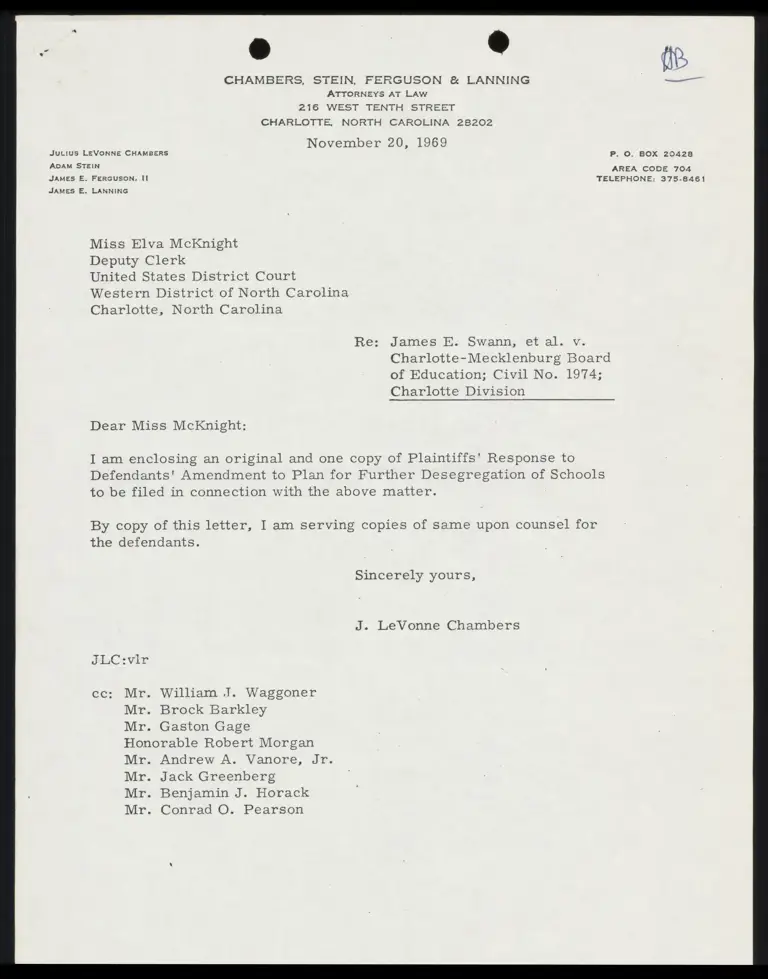
CHAMBERS, STEIN, FERGUSON & LANNING | Se 

ATTORNEYS AT LAW 

216 WEST TENTH STREET 

CHARLOTTE, NORTH CAROLINA 28202 

November 20, 1969 
JuLius LEVONNE CHAMBERS P. O. BOX 20428 


ADAM STEIN AREA CODE 704 

JAMES E. FERGUSON, II TELEPHONE: 375-8461 

JAMES E. LANNING 

Miss Elva McKnight 

Deputy Clerk 

United States District Court 

Western District of North Carolina 

Charlotte, North Carolina 

Re: James E. Swann, et al. v. 

Charlotte-Mecklenburg Board 
of Education; Civil No. 1974; 

Charlotte Division 
  

Dear Miss McKnight: 

I am enclosing an original and one copy of Plaintiffs' Response to 

Defendants' Amendment to Plan for Further Desegregation of Schools 

to be filed in connection with the above matter. 

By copy of this letter, I am serving copies of same upon counsel for 

the defendants. 

Sincerely yours, 

J. LeVonne Chambers 

cc: Mr. William J. Waggoner 

Mr. Brock Barkley 

Mr. Gaston Gage 
Honorable Robert Morgan 

Mr. Andrew A. Vanore, Jr. 

Mr. Jack Greenberg 

Mr. Benjamin J. Horack 

Mr. Conrad O. Pearson 


IN THE 

UNITED STATES DISTRICT COURT 

FOR THE 

WESTERN DISTRICT OF NORTH CAROLINA 

CHARLOTTE DIVISION 


JAMES E. SWANN, et al., 

Plaintiffs, 

No CIVIL ACTION 

THE CHARLOTTE-MECKLENBURG 

BOARD OF EDUCATION, et al., 

NO. 1974 

Defendants. 

N
a
s
 

N
t
?
 
N
t
 

N
t
?
 

i
?
 

wa
t?
 

wa
t;

 
w
t
?
 

at
t 

“w
a?
 

“w
i?
 

u
s
t


PLAINTIFFS' RESPONSE TO DEFENDANTS 

AMENDMENT TO PLAN FOR FURTHER 

DESEGREGATION OF SCHOOLS   On three different occasions this Court has urged, en- 

couraged and requested the defendant School Board to carry out its 

constitutional duty to desegregate the Charlotte-Mecklenburg public 

schools. The Court has literally leaned over backwards to seek 

voluntary compliance by the Board. Even in its last order, in   
| rejecting additional delay to submit a plan, the Court left the 

opportunity open to the Board for additional time to comply by 

merely making some showing now of the Board's intent to implement 

its obligation at some definite time in the future. Despite thesg   
i 

Li       


efforts, however, the Board now unequivocally, defiantly and 

contumaciously advises the Court that it will not now, nor in the 

future, carry out its constitutional responstbititles, 

Irrespective of whether the Court's directives are con- 

stitutionally mandated, and plaintiffs submit that they are and 

further that they are required to be implemented with more haste 

than the Court has heretofore required, the Board is constitutiona 

obligated to implement these directives pending some change, 

modification or vacation by this or some other Court. Walker v.   

City of Birmingham, 388:U.8. 307, 18 L.ed 24 1210; United States     

v. Mine Workers, 330 U.S. 258, 91 L.ed. 884; Howat v. Kansas, 
    

258 U.S. 181, 66 L.ed 550. As the Supreme Court stated in Walker : 

"This Court cannot hold that the petitioners were constitutionally; 

free to ignore all the procedures of the law and [disobey the 

directives of the Court] . . . . [Rlespect for judicial process is 

a small price to pay for the civilizing hand of law, which alone 

can give abiding meaning to constitutional freedom." 388 U.S. at 

321, 18 L.ed 2d at 1220. Here this Court has unequivocally direct 

a plan for complete desegregation of the Charlotte-Mecklenburg 

public schools. Notwithstanding this directive, however, the 

defendants, by the Amendment to Plan for Further Desegregation of 

Schools, in utter contempt of the Court's order, have simply refus 

to comply. Plaintiffs, therefore, respectfully submit that they 

are not only entitled to an order requiring defendants, and each © 

them, to show cause why they should not be held in contempt, Walker Nalrgr, 

v. City of Birmingham, supra, but certainly now to an order appoin   

ing educational consultants to devise a plan for complete and 

  | 

| 
| 
i 

lly 

  | 

| 
| 
i 

i 

| 
{ 

ed 

ed 

£ 

tt —- 


immediate desegregation of the school system. Cf. Dowell v.   

Board of Education of Oklahoma city Public Schools, 244 F. Supp. 
    
971 (W.D. Okla, 1965), aff'd in part 3757.20 158 (10th Cir. 

1967), cert. den., 387 U.S..931, 18 L.ed. 24 993; Alexander v.   

Holmes County Board of Education, u.s. (No. 632). 
  

l. The Board's response to the Court's order of November 

7, 1969 does no more than reiterate the rejected request for more 

time. The Board rejects any affirmative obligation to take 

appropriate steps to disestablish the segregated school system 

it has created. Green v. School Board of New Kent County, 391 
  

U.S. 430, 20 L.ed. 2d 716; NLRB v. Newport News Shipbuilding 
  

and Dry Dock Company, 308 U.S. 241, 84 L.ed. 219; United States     

v. Crescent Amusement Company, 323, U.S. 173, 89 L.ed. 160; 
  

Standard Oil Company v. United States, 221 U.S. 1, 55 L.ed, 619. 
  

The Board questions "tipping", and well it should for the record 

clearly demonstrates that "tipping" has been caused by the Board! ul
 

own action and conduct. See Plaintiffs' Further Response filed 

on November 3, 1969. The Board then inquires what are its duties), 

when this Court, the Fourth Circuit and the Supreme Court have 

clearly instructed the Board with respect to its duties: 

The pattern of separate "white" 

and "Negro" schools in the [Charlotte- 

Mecklenburg] school system established 

under compulsion of state laws is pre- 

cisely the pattern of segregation to 

which Brown I and Brown II were partic- 
ularly addressed, and which Brown I 

declared unconstitutionally denied Negro 

school children equal protection of the 

laws. . . . [S]chool systems were required 


Green, supra; 

by Brown II "to effectuate a transition 

to a racially nondiscriminatory school 

system.” ... + + The School ‘Board con- 

tends that it has fully discharged its 

obligation by adopting a plan by which 

every student, regardless of race, may 

"freely" choose the school he will attend. 

The Board attempts to cast the issue in 

its broadest form by arguing that its 

"freedom-of-choice" plan may be faulted 

only by reading the Fourteenth Amendment 

as universally requiring "compulsory 

integration," a reading it insists the 

wording of the Amendment will not support. 

But that argument ignores the thrust of 

Brown II. In the light of the command of 

that case, what is involved here is the 

question whether the Board has achieved 

the "racially nondiscriminatory school 

system" Brown II held must be affectuated 

in order to remedy the established uncon- 

stitutional deficiencies of its segregated 
system. In the context of the State- 

imposed segregated pattern of long standing, 
the fact that in 1965 the Board opened 

the doors of the former "white" school to 

Negro children and of the "Negro" school 

to white children merely begins, not ends, 

our inquirv « + . +.:Brown 11 was a call for 

the dismantling of well-entrenched dual 

systems tempered by an awareness that complex 

and multifaceted problems would arise which 

would require time and flexibility for a 

successful resolution. School boards such 

as the respondent then operating state - 

compelled dual systems were nevertheless 

clearly charged with the affirmative duty 

to take whatever steps might be necessary 

to convert to a unitary system in which 

racial discrimination would be eliminated 

YOOL and branch . . . .« Green, 391 U.S. 

at 435-438, 18 L.ed. 2d at 722-723. (Emphasis 

added.) 


Further delay has now been clearly enjoined. 

Alexander v. Holmes County Board of Education, 
      U.S. (No. 632) and the Court has been directed to take 


A 
—
—
—
—


immediate steps which will disestablish the segregated school 

system. 

2. Defendants propose to restrict freedom-of-choice, 

allowing limited racial majority to minority situations, but also 

to allow transfers in hardship cases as "determined on the basis   
of uniform rules developed by the administrative staff". Defendants 

past practices and present defiance of the directives of the courte 

clearly entitled plaintiffs to some express constitutional stand- 

ards which can be shown will not futher perpetuate this racially 

dual school system. 

3. Defendants further promise to hire and assign teachers 

and school personnel without regard to race, the same promise 

made in 1965 which the Court found in April, 1969 had not been 

implemented. 

4. Defendants finally promise to withhold construction 

on 21 proposed projects while proceeding with 24 projects. Defen- 

dants contend that the 24 projects will not affect desegregation] 

There has been no showing even as to the 24 projects that they 

will not adversely affect whatever plan may subsequently be 

devised and directed by the Court. Plaintiffs submit that pending 

the approval of a plan by the Court, or at least some showing 

by the defendants, all construction and additions should be 

enjoined. | 

5. The Court has been further directed to devise its 

own plan and to insure its prompt and effective implementation, 

particularly where school officials simply refuse to do so. 

Alexander v. Holmes County Board of Education, supra, and may 


do so without further hearings. While the Court may hear and 

consider objections by the Board to the Court's directed plan, 

'! such is permitted only after the Board has fully complied in 

all respects with the plan directed. Alexander, supra. 
  

Plaintiffs, therefore, respectfull submit and pray that 

the Court reject the defendants' Amendment to Plan for Further 

Desegregation of Schools; that the Court appoint educational 

consultants to devise a plan for complete desegregation to be 

instituted forthwith; that the Court direct that the expenses 

of the educational consultants by borne by the defendants; that 

the Court enjoin any further construction or additions pending 

the complete implementation of the plan directed by the Court: 

that the Court order that the defendants, and each of them, 

immediately show cause why they should not be held in contempt 

i OF the Court's orders; that the Court award plaintiffs' costs   herein, including reasonable counsel fees; that the Court retain] 

i Jurisdiction of this cause and award plaintiffs such other and 

further relief as the Court may deem the plaintiffs entitled. 

Respectfully submitted, 


NRAD O. PEARSON 

203 1/2 East Chapel Hill Street 
Durham, North Carolina   

CHAMBERS, STEIN, FERGUSON & LANNING 

216 West Tenth Street 

Charlotte, North Carolina     | JACK GREENBERG : 

| JAMES M. NABRIT,III 
NORMAN CHACHKIN : 

10 Columbus Circle 

New York, New York 

Attorneys for Plaintiffs 


CERTIFICATE OF SERVICE 
  

The undersigned hereby certifies that copies of the 

foregoing Response were served upon defendants by depositing 

copies of same in the United States mail, postage prepaid, 

addressed to: 

| Mr. Brock Barkley 

Law Building 

Charlotte, North Carolina 

Mr. William J. Waggoner 

Weinstein, Waggoner, Sturgis and Odom 

1100 Barringer Office Tower 

Charlotte, North Carolina 

Mr. Gaston Gage 

Law Building 

Charlotte, North Carolina 

Mr. Benjamin J.' Horack 

Ervin, Horack and McCartha 

806 East Trade Street 

Charlotte, North Carolina 

Honorable Robert Morgan 

Attorney General 

Mr. Andrew A. Vanore, Jr. 

Staff Attorney 

Office of the Attorney General 

State of North Carolina 

Raleigh, North Carolina 

This the Sot any of November, 1969.   


“Yorney for Plaintiffs [||31028b13-99cb-47f0-bcf8-f6ef404f9b61||] 

Copyright notice

© NAACP Legal Defense and Educational Fund, Inc.

This collection and the tools to navigate it (the “Collection”) are available to the public for general educational and research purposes, as well as to preserve and contextualize the history of the content and materials it contains (the “Materials”). Like other archival collections, such as those found in libraries, LDF owns the physical source Materials that have been digitized for the Collection; however, LDF does not own the underlying copyright or other rights in all items and there are limits on how you can use the Materials. By accessing and using the Material, you acknowledge your agreement to the Terms. If you do not agree, please do not use the Materials.


Additional info

To the extent that LDF includes information about the Materials’ origins or ownership or provides summaries or transcripts of original source Materials, LDF does not warrant or guarantee the accuracy of such information, transcripts or summaries, and shall not be responsible for any inaccuracies.