Opinion of the Court
Public Court Documents
April 17, 1972
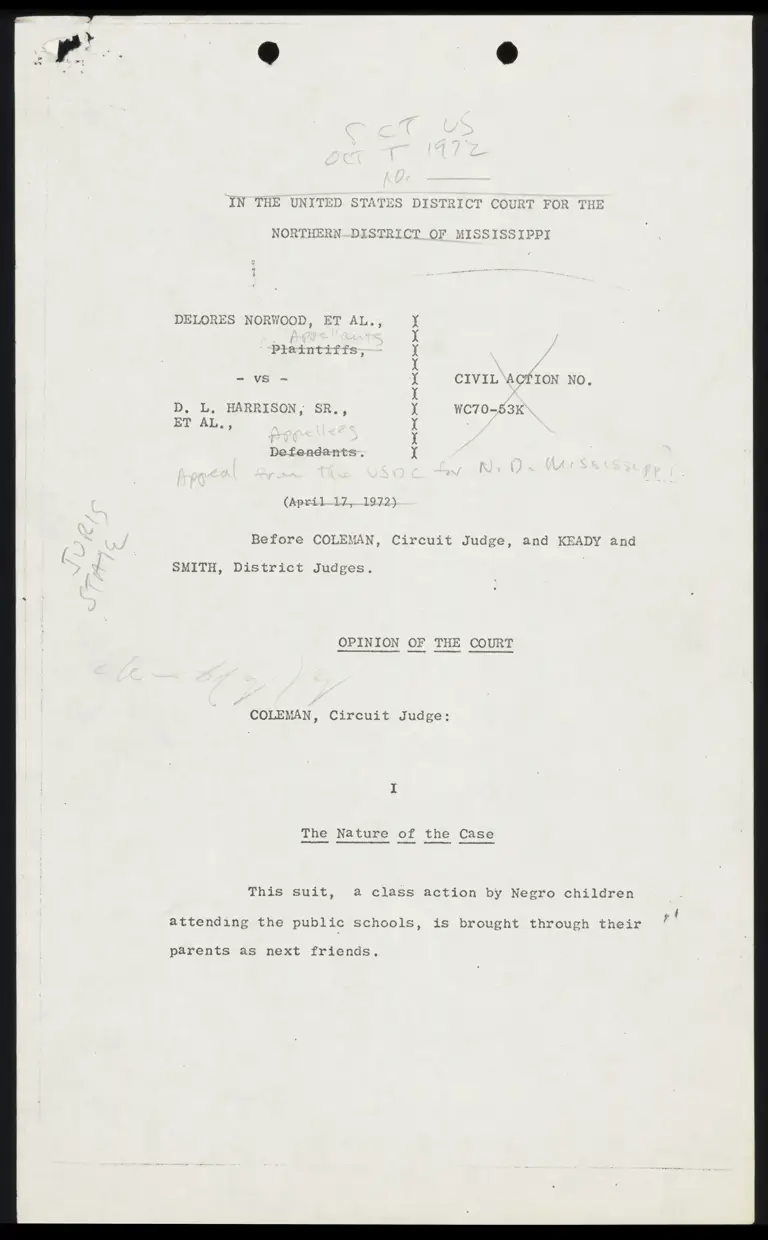
30 pages
-
Case Files, Norwood v. Harrison - Hardbacks. Opinion of the Court, 1972. 102a7468-722e-f111-88b4-7c1e527f53b4. LDF Archives, Thurgood Marshall Institute. https://ldfrecollection.org/archives/archives-search/archives-item/912200e4-ceeb-425a-aff7-c0a9efc28a54/opinion-of-the-court. Accessed October 16, 2026.
Copied!
     [||8f06decf-6b2f-4a39-a79f-e43efe296bdf||] Sf mom FINTYMINTYy CMA MMTO TN QIrpy Dv rm FAMNYITDIN TAD YY i £04 \ a TO | ad Tag 4 | } § A I< ¥ { Yi] d 1 3 ® Ae”
I | dH UNLITLD OTATESD DISTRICH WAVE PUR TD

TOARTITEFRAY NTYTQAMDY AYN AT I TRQTSATDD
N ORTHERN -D Seddedd Aled JD MAO Aw iY]

TY MADRQ  WTNADWANT Elan A
DEI ald NORWOOD g dud Hla.

Plaintifis

CIVIL ACTION NO.

Defendants.

i < 0 1]

Yon
d,

Jd

Jo


Pe
nd


Jar
l

Yeo
n,

en
,

Joa
n,

pen
d,

Ye
l,


{(April-17,—-1972)

Before COLEMAN, Circuit Judge, and XEADY and

SMITH, District Judges.

OPINION OF THE COURT
Ul bAtitibl .  aibki


COLEMAN, Circuit Judge:

The Nature of the Case
I nA rhxAos

+ This suit, a class action by Negro children

attending the public schools, is brought through their

parents as next friends.


"

sippi State Textbook Purchasing Board and the Executive

Secretary of that Board.

The gravamen of the complaint is that:

"Under the laws of the State

of ls defendants select,
purchs distribute, loan and oth-
erwise pir spose of textbooks, in be-
half of the State of Miss issippi,
for the use of children enrolled in
the elementary and secondary schools

in the State of Mississippi (Miss.
Code Anno. Sections 6634 et seq.)
ox kok

"Beginning with the 1964-65
school term * * *% * when the first

i school districts in Mississippi were
required to integrate under freedom
of choice #* * * * and through the
present, numerous private schools
and academies have been either forme
ed or enlarged, which schools have
established as their objective and/

; or have had the effect of a¥fording

. the white children of the State of
Mississippi racially segregated ele-
mentary and Secondary schools as an

alternative to racially integrated
and otherwise non-discriminatory pub-

lic schools.

"The defendants have provided
these racially segregated schools

and academies and the students at-
tending such schools, either through

Sale or loan, textbooks purchased and

owned by the State of Mississippi and
have thereby provided state aid and en-
couragement to racially segregated edu-
cation and have thereby impeded the es-
tablishment of racially integrated pub-~
lic schools in violation of plaintiffs’

rights assured and protected by the

Fourteenth Amendment to the Constitu-
tion of the United States."


Plaintiffs thus assert that defendants’ lend-

ing of state-owned textbooks to children now attending

racially segregated private schools situated within the

State of Mississippi is violative of plaintiffs' Four=-

teenth Amendment rights and constitutes illegal state

aid to racially segregated education. Plaintiffs em-

phasize that they do not challenge the right of stu-

"dents attending private schools, either sectarian or

nonsectarian, to receive state-owned textbooks so long

as the schools they attend were not organized in the

wake of public school desegregation and do not engage

in racially discriminatory admission practices, but as

to students attending schools of the latter category,

their claim is that the state may not validly provide

them with free textbooks,

Y Plaintiffs pray an order requiring an account-

ing by defendants of all textbooks purchased from the

State of Mississippi or on loan from the State of Mis-

sissippi to private schools and students enrolled there-

in; that defendants be directed immediately to recall,

and otherwise assure the return to state depositories,

of all textbooks used by students in attendance at

private schools which have already been adjudged by

other United States Courts as racially segregated and

which have been formed for the purpose of providing

white students with an alternative to racially inte=-

grated, non-discriminatory public schools; that the pi

defendants be enjoined from further sale or distri-


bution of such textbooks to any private schools or stu-

dents enrolled therein without first notifying plain-

tiffs and obtaining court approval; and that defendants

be enjoined from distributing state-owned textbooks to

any private schools or students enrolled therein with-

out first establishing that the school is racially in-

tegrated and has not had the effect of frustrating or

impeding the establishment of racially integrated pub-

lic schools.

Subject matter jurisdiction, not contested, is

predicated upon 42 U,S.C., §1983 and 28 U.S.C., §1343(3)

and (4).

YX

Three-Judge Court Jurisdiction


Subsequent to the original filing of the com-

laint, plaintiffs submitted the following motion: Pp »

"plaintiffs, pursuant to

Jackson v. Choate, 404 F.2d 910

{5th Cir ., 1068), respectfully
move this Court to certify this
cause to the Chief Judge of the

United States Court of Appeals
for the Fifth Circuit to convene
a Three-~Judge District Court pur-~

suant to 28 U.8.C., §52281, 2284.

"We further move that the

Three-Judge District Court there-
after determine whether this ac-

tion should be litigated before

it or a single district court

judge."

In response thereto, the managing District pi

Judge concluded that the complaint called for the con-

vening of a Three-Judge District Court in accordance


with 28 U.8.0C §2284, and requested the Chief Jud Wo We p

of the Circuit to constitute a Court as contemplated

by the statute. Thereafter, the Court was constituted.

The present views of the plaintiffs to the con

trary notwithstanding, the Court is of the opinion that

sitting as a Three-~Judge District Court, it has juris-

diction of this controversy.

Title 28, U.S.C., §2281, provides:

"An interlocutory or perma-

nent injunction restraining the
enforcement, operation or execu-
tion of any State statute by re-
straining the action of any of-
ficer of such State in the en-

forcement or execution of such
statute or of an order made by

an administrative board or com-
mission acting under State stat-

utes, shall not be granted by any
district court or judge thereof

upon the ground of the constitu-
tionality of such statute unless
the application therefor is heard
and determined by a district court
of three judges under §2284."

To authorize the convention of a Three-Judge

Court the controversy must possess the following char-

acteristics: (1) the constitutional question raised

must be substantial; (2) a state statute or admini-

strative order of general state-wide application must

be assailed as unconstitutional; (3) a state officer

must be party defendant; and (4) injunctive relief

must be sought. Idlewild Bon Voyage Liquor Corpora-

tion v. Bpstein, 19062, 370 U.8. 713, 82 8.Ct. 1294,

-

y


8 L.Ed.2d 794; Hall v, Garson, 5 Cir., 1970, 430 F.2d

430, 442-443; Moore's Federal Practice, 1 A., §0.2035;

C. A. Wright, Law of Federal Courts, §50.-at 189 (2nd

Ed. 1970).

This case meets these tests.

An injunction is sought against the enforce=-

ment by state officials of a state statute §§6634
) J

1/
et seq., Mississippi Code, 19427 and Board regula-

2/
tions.” The contention is that although the statute

requires the free lending of textbooks to all educable


children, it should not include those attending private


racially segregated schools. Plaintiffs say that they

do not object to other educable children receiving the

books. Thus it is argued that they are not claiming

the statute to be altogether anconetitut Yona) but they

are only challenging the constitutionality of its ap-

plication. Since, however, the statute specifically

provides that all children shall receive the books and

this Court has no authority to amend that language, we

must consider the complaint as an attack on the statute

as written. Our jurisdiction, of course, extends to a

consideration of whether a facially valid statute has

been unconstitutionally applied by officers in charge

of its enforcement.

As to substantiality, see Ex Parte Poresky,

1933, 290 U.S. 30, 32; 54 S.Ct. 3, 4: 78 L.Ed. 152, ;

153; Local Union No. 300, Amalgamated Meat Cutters & 4

Butchers Workmen of North America, AFL-CIO v. McCulloch,

5 Cir., 1970, 428 F.2d 396, 399-400.


Contrary to the position taken by defendants,

we hold that these plaintiffs, black children who are

attending the public schools, have standing to prose-

cute this complaint, Chance v. Mississippi Textbook

Rating Board, 1941, 190 Miss. 453, 200 So. 706; Asso~

ciation of Data Processing Service Organizations, Inc.

v. Camp, 1970, 397 U.S. 150; Barlow v. Collins, 1970,

397 U.S. 159,

¥I1x

The Merits


Near the close of the Great Depression, Gov-

ernor Paul B, Johnson, Sr. on January 16, 1940, deliv-

ered his Inaugural Address to 2a joint session of the

Mississippi Areata, He said that 75,000 chil-

dren in Mississippi were without textbooks, that all

states surrounding Mississippi gave free textbooks

to each child in those states, that the failure to

provide free textbooks to the children of Mississippi

was "an indictment of our state government', and that

the State should furnish free textbooks to all edu-

cable children in the elementary grades.

The result of this appeal was the enactment

of Chapter 202 of the General Laws of the State of

Mississippi of 1940, approved February 16, 1940, now

&

yl


codified as indicated supra, by which a textbook pur

chasing board was established. The board was cloak-

3 ed with authority to select, purchase, distribute,

and care for free textbooks in all schools in the
enrtmso—

State, through the first eight grades.

In his message to the Legislature on January

| 4/
7, 1942, Governor Johnson recommended that the free

textbook program be extended to high school students.

This resulted in the enactment of Chapter 152 of the

General Laws of Mississippi of 1942, approved March

23, 1942, also codified as above, by which the pro-

gram was extended to include high school students.

The program had not long been in existence,

however, before a state court suit was filed to en-

join the Textbook Purchasing Board from distributing

free textbooks to private and sectarian schools.

‘This was a taxpayers' suit, complaining that text-

books were about to be requisitioned by and loaned to

pupils in thirteen private elementary schools, all of

which were sectarian, and that the issuance of such

books for the free use of students in sectarian schools

would be a violation of §208 of the Mississippi Consti-

tution of 1800.

Section 208 provides that:


igious or other sect

or sects shall ever control any
part of the school or other edu-

cational funds of this state; nor
~~ } hy 5 Ley ~ oe I YY n we 5 ©) 4 ~3 shall any funds be appropriated

~y toward the support of any sectar-

ian school, or to any school ‘that
at the time of receiving such ap-

propriation is not conducted as

a free school."

In a 5-1 decision, the Supreme Court of Mis-

sissippi upheld the legality and the constitutionality

[under §208] of providing free textbooks to students

in private, sectorian institutions.

In an opinion written by the late [and we may

justifiably say, great] Justice Julian P. Alexander,

Sr., the Mississippi Supreme Court spoke the follow-

ing:

"Although the act allows the

g loaning of such books to pupils in

properly qualified private elemen-

tary schools, whether sectarian or

not, the sectarian character of some

of the schools whose pupils would be

loaned school books is vigorously

stressed in complainant's brief and

argument, and some alarm is confessed

by counsel lest this legislation be

viewed otherwise than as a threat to

the mutual independence of church and

state.
y {


"The bases for such anxiety are

founded upon considerations which

bulked large in the minds and hearts

of those who founded our republic,

and who, in order to insure domestic

tranquility and secure the blessings

of liberty, established its Consti-

tution with its restrictions, and the

flag, which it follows, with its free-

dom.

“Freedom of conscience was one of

the blessings of liberty sought to be

secured by constitutional separation

of church and state. These principles

are historical and fundamental. Yet

it is quite true that while liberty is

to be maintained at the price of eternal

vigilance, such vigilance should include

within its scope the common welfare of

those who have the right to view educa-

tional opportunity as one of the 'bless=-

ings of liberty’.

dk dk dk %k k %k xk

"There is no requirement that the

church should be a liability to those

of its citizenship who are at the same

time citizens of the state, and entitled

to privileges and benefits as such. Nor

- 10 =


is there any requirement that the

state should be godless or should

ignore the privileges and benefits

of the church. Indeed, the state

has made historical acknowledgment

and daily legislative admission of

2 mutual dependence one upon the

other.

"It is the control of one over

the other that our Constitution for-

bids. Sections 18, 208. The recog-

nition by each of the isolation and

influence of the other remains as

one of the duties and liberties, re-

spectively, of the individual Citi-

zen. It is not amiss to observe

that by too many of our citizens

the political separation of church

and state is misconstrued as indi-

cating an incompatibility between

their respective manifestations, re-

ligion and politics. The state has

a duty to respect the independent

sovereignty of the church as such;

it has also the duty to exercise

vigilance to discharge its obliga-

tion to those who, although subject

Fahy Ti


TS —— es

to 1ts control, are also objects of

its bounty and care, and who, regard-

less of any other affiliation are pri-

marily wards of the state. The consti-

tutional barrier which protects each

against invasion by the other must not

be so high that the state in discharg-

ing its obligation parens patriae, can-

not surmount distinctions which, view

ing the citizen as a component unit

of the state, become irrelevant.

"The religion to which children

of school age adhere is not subject

to control by the state; but the chil

dren themselves are subject ‘to its

control. If the pupil may fulfil its

duty to the state by attending a pa-

rochial school it is difficult to see

why the state may not fulfil its duty

to the pupil by encouraging it 'by all

suitable means'. The state is under

duty to ignore the child's creed, but

not its need. It cannot control what

one child may think, but it can and

must do all it can to Leach the child

how to think. The state which allows


ARE —— et ne

the pupil to subscribe to any reli-

gious creed should not, because of

his exercise of this right, proscribe

him from benefits common to all.

"If the safety of the republic

is to remain the supreme law, the

safety and welfare of the citizens

who compose it must remain supreme.

In obedience to this duty the state

may and should supply the child with

protection against physical disease

and danger, and under our Constitu-

tion must encourage the promotion

of intellectual and moral improve-

ment. Such benefits once made avail-

able by the state, may be demanded

by the citizen or by any group of

citizens.

kK ok ok k ok Xk Xk XK

"Calm reason must not be stam-

peded by random cries of church or

state or sectarian control, or by

the din from the conflict of cate-

chism and dogmatism. .A wholesome

sanity must keep us immune to the

disabling ptomaine of prejudice.


BT A ARI SAPP th A

If throughout the statute there are

words which arrest the attention of

over-sensitized suspicion and are

seen by a jaundiced eye as symptoms

of secular control, one may regain

composure by viewing the state's

book depository as a great public

library of books available to all,

which sells any books to anybody,

and which, subject to reasonable

regulation, allows the free use

thereof to any child in any school.

Cf. ch. 289, Laws 1938.

kk ok Xk ok Xk

"We are of the opinion that the

appropriation in chapter 18 of the

Laws of 1940 was not a use or diver-

sion of school or other educational

funds as contemplated by section 208,

Mississippi Constitution of 1890, nor

did it become a part thereof. The

appropriation for schools is entire-

ly separate, ch. 17, Acts of 1940.

The use of the textbook fund consti-

tutes no charge against any public

school funds, properly so called, nor

against any trust funds available for

particular schools or educational pur-


poses. Such funds are not appropri-

ated 'toward the support of any sec-

tarian school’, nor does the furnishe

ing of such books to the pupils in

properly qualified private schools

constitute a pledging or loaning of

the credit of the state 'in aid of

any person, association, or corpora-

tion' in contravention of section

258 thereof. The books belong to,

and are controlled by, the state;

they are merely loaned to the indi-

vidual pupil therein designated;

their preservation is fostered by

exaction of suitable compensation

for their loss or damage; the duty

of protection through fumigation

against contagion by use is assumed

by the state.

k % ok Xk Xk 3k Xk XK

"Nor is the loaning of such books

under such circumstances to the indi-

vidual pupils a direct or indirect aid

to the respective schools which they

attend, although school attendance is

compulsory. Such pupil is free to at-

tend a proper public or private school,

sectarian or otherwise."


The judgment of the Chancery Court of Hinds

County, Mississippi, denying the injunction, was af

firmed. Chance v. Mississippi Textbook Rating Board,

1941, 190 Miss. 453, 200 So. 706.

This 1941 decision of the Supreme Court of

Mississippi seems generally to be in accord with one

delivered twenty-seven years later by the Supreme

Court of the United States in Board of Education of

Central School District No. 1 v. Allen, 1968, 392 U.

S. 236, 88 S.Ct. 1923, 20 L.Ed.Z2d 1060.

In that case a New York statute requiring

school districts to purchase and loan textbooks To

students enrolled in parochial as well as in public

and private schools was under constitutional attack.

The Supreme Court held that the New York statute did

not constitute a 'law respecting an establishment of

religion or prohibiting the free exercise thereof" in

conflict with the First and Fourteenth Amendments to

.the Constitution of the United States. We quote from

the opinion in Allen, supra:

"Everson v. Board of Education,

330 y.8. 1,67 5.0t. 504, '91 L.2d,

711 (1947), is the case decided by

this Court that is most nearly in

point for today's problem. ‘New

Jersey reimbursed parents for ex-

penses incurred in busing their chil-

dren to parochial schools. The Court

“15


A,

stated that the Establishment Clause

bars a State from passing ‘laws which

aid one religion, aid all religions,

or prefer one religion over another’,

and bars, too, any 'tax in any amount,

large or small * * * levied to support

any religious activities or institu-

tions, whatever they may be called,

or whatever form they may adopt to

teach or practice religion'. 330 U.S.,

at 15-16, 67 S.Ct., at 411. Neverthe-

less, said the Court, the Establish-

ment Clause does not prevent a State

“from extending the benefits of state

law to all citizens without regard

for their religious affiliation and

does not prohibit 'New Jersey from

spending tax-raised funds to pay the

bus fares of parochial school pupils

as a part of a general program under

which it pays the fares of pupils at-

tending public and other schools’.

The statute was held to be valid even

though one of its results was that

'children are helped £5 church schools’

and 'some of the children might not be

sent to the church schools if the pare

ents were compelled to pay their chil-

oii ll


dren's bus fares out of their own

pockets!, 330.U.8., at 17,:67 8S.

Ct., at 512. As with public pro-

vision of police and fire protec

and sidewalks, payment of bus fares

was of some value to the religious

school, but was nevertheless not

such support of a religious insti-

tution as to be a prohibited es-

tablishment of religion within the

meaning of the First Amendment.

a ok ok sk 3k ok Kk kK

"The express purpose of §701

was stated by the New York Legis~

lature to be furtherance of the edu-

cational opportunities available to

the young. Appellants have shown us

nothing about the necessary effects

of the statute that is contrary to

its stated purpose. The law merely


makes available to all children the


es benefits of a general program to lend


school books free of charge. Books


are furnished at the request of the


pupil and ownership remains, at least

technically, in the State, Thus no r!


- 1D

  —— - . a - ow . wen ET


i

i
b]
1 \
!

:]


funds or books arc furnished toe Phim
Qe Ea Aaa

Fa

rochial schools, and the financial


  benefit is to parents and children,
AAR AAT SI WE MA A VON © $n Es I

not to schools, Perhaps iree books
Be and


make it more likely that some chil

dren choose to attend a sectarian

school, but that was true of the

state-paid bus fares in Everson


and does not alone demonstrate an

unconstitutional degree of support

for a religious institution." [Em-

phasis ours].

To be specific, the racial identity of the

child had nothing to do with the original enactment

of the Mississippi statute nor has it had anything

to do- with the receipt of a free textbook throughout

a period of more than thirty years. Every Mississippi

school pupil, before and since 1954, the date of Brown


v. Board of Education, whether enrolled in public, pri-

iS


vate, or parochial schools, of whatever race, has re-

ceived ‘the free textbooks without question or impedi-

ment.

Plaintiffs say, however, that furnishing the

textbooks free to those students who now choose 10

attend racially segregated private schools, establish=-

ed in Mississippi since 1964 for the purpose of afford=-

ing a child an opportunity of not attending integrated

public schools, is unconstitutional because it conflicts


rp

with the "affirmative duty to take whatever steps

might be necessary to convert to a unitary system in

which racial discrimination would be eliminated root

and branch", Green v. County School Board of New Kent

County, 1958, 391 U.S., at 437.

In line with this position plaintiffs say

(Brief, p. 25) "We challenge this statute to the ex-

tent that it requires or authorizes the distribution

of state-owned textbooks to schools formed for the pur-

pose of having the effect of providing whites with an

alternative to public integrated education."

The evidence establishes that 34,000 students

are presently receiving state-owned textbooks while at-

tending 107-all-white, nonsectarian private schools

which have been formed throughout the ‘state since the

inception of public school sentation This num

ber is to be compared with 534,500 students in more

than 1,000 public schools and 12,100 students in de-

segregated parochial schools who are receiving free

textbooks. It is plain, however, that the books have

not been issued to the schools but to the students.

As in the case of public schools, private and sec=-

tarian school authorities are held responsible for

the books as a matter of orderly administration. The

statute does not authorize the distribution of the

books to schools, only to pupils.

-: 90 iw


We are thus brought to the point of determin-

ing whether the state's furnishing of free textbooks to

students attending racially segregated schools is a

support of such schools, for whose promotion and en-

couragement public funds, of course, may not be consti-

tutionally provided. In terms of the unequivocal pro-

hibition contained in the First Amendment, made appli-

cable to the states by the Fourteenth Amendment, the

| question has been clearly settled. Free textbooks to

| the students is not a financial benefit to the church-

related schools, as held in Allen, and is not a direct

or an indirect aid to such schools, as held in Chance.

In the recent case of Lemon v. Kurtzman, 403 U.S. 603,

29 L.Ed.2d7745, the United States Supreme Court con-

tinued to recognize the distinction between permis-

sible state aid to the student and impermissible state

aid to the church-related school, and invalidated a

Pennsylvania statute which undertook to provide fi-

nancial aid directly to church-related schools.

The essential inquiry, therefore, is whether

we should apply a more stringent standard for deter-

mining what constitutes state aid to a school in the

c
n


S
l

A
n
.


Wn
S
l


context of the Fourteenth Amendment's ban against de-

nial of the equal protection of the law than the Su-

preme Court has applied in First Amendment cases. On

the record made before us we perceive neither the logic

nor the necessity for applying any different test to a Hf

universally free school textbook program.

oY

Ee a aman grt -— i ——————————— “ - ————— I ———————
TEA CRA THN HE TER SIA


Plaintiffs rely primarily upon Coffey v. State

Educational Finance Commission, 296 F. Supp. 1389 (S.D.,

Miss., 1969); Poindexter v, Louisiana Financial Assis-

tance Commission, 275 F. Supp. 833 (E.D., La., 1967);

Griffin v. State Board of Education, 296 F, Supp. 1178

(E.D., Va,, 1969); and Green v. Kennedy, 309 F. Supp.

1127 (D.C., 1970), appeals dismissed for want of juris-

diction, sub nom Cannon Vv. Green, 398 U. S. 956 (1970),

and Coit v. Green, 400 U. S. 986 (1971); continued as

Green v,. Connally, 330 F. Supp. 1150 (D.C., 1971); af-

firmed sub nom Coit v. Green, U.S. _, 92 S.Ct.

564 (1971). These cases, which are clearly distin-

guishable on their facts, are not in point on the pres-

ent issue;

In Coffey it was held that state tuition grants

Jv to students attending private segregated schools, first

begun in 1964, and which in three years time was follow-

ed by an increase in private nonsectarian schools from

three to forty eight in number, were "critical to most

of the schools", 296 F. Supp. at 1392. The Court fur-

ther found "that the tuition grants have fostered the

creation of private segregated schools * * * * encour-

ages, facilitates, and supports the establishment of a

1


Po
B
i


nd

A


wi


1
.


system of private schools operated on a racially segre-

gated basis as an alternative available to white stu-

dents seeking to avoid desegregated schools * ¥ ¥ x

and that grants "tend in a determinative degree to yl

oO


2
4

}
i
i

" AR 86 TIO DORIS A

perpetuate segregation' ", Therefore, the grants, and

the Mississippi statute which authorized them, were

struck down as violative of the equal protection clause

of the Fourteenth Amendment.

The Court further pointed out:

"There is no claim in this case
that the Constitution requires all
children to attend public schools, or
that a private citizen may not select
a private segregated school for his

child because of a desire to keep the

child from being educated with chil-
dren of a different race. What is in-
volved here are legislative enactments
which 'will significantly encourage
and involve the State in private dis-

criminations'. Reitman v. Mulkey, 387

uv. 8. 389, 38), 87. 8.Ct. 1627, 1634,

18 L.Ed.2d 830, 838 (1967)."

Similar tuition grant cases from other states

are collated in Footnote 1 to Coffey, 296 F. Supp., at

1390, and will not be cited here.

Similarly in Poindexter a statute providing


for tuition grants to pupils attending private segre-

gated schools was invalidated. The Court held that

any affirmative and purposeful state aid promoting pri-


vate discrimination violates the equal protection clause,

a state cannot legitimately be just a little bit dis-

criminatory, and that the object or purpose of legis-

lation is to be determined by its natural and reason-

able effect. In speaking for the Court, Judge Wisdom

wrote:

. "% % % any aid to segregated
schools that is the product of the

State's purposeful policy of fos-
tering segregated schools and has

BE ——..... db - — — a——— . rg pp AAA ———


a.

the effect of encouraging discrimi-
nation is significant state involve=
ment in private discrimination. (We
distinguish therefore, state aid
from tax benefits, free school-books,
and other products of the State's

traditional policy of benevolence to-
ward charitable and educational in-
stitutions)." 275 F. Supp. 854.

The United States Supreme Court affirmed, 389

v. S. 571, 88 s.Ct. 693, 19 L.Ed.2d 780 (1968).

The result of this decision was that Louisiana

enacted a revised tuition grant law. This statute, too,

was invalidated by a subsequent Three-Judge Court.

Poindexter v. Louisiana Financial Assistance Commission,

296 FF, Supp. 686. Judge Wisdom again wrote:

"The free lunches and text-
books Louisiana provides all chil-

—dren-in public and private schools
are the fruits of a benevolent ra-
cially neutral policy." :

Again the United States Supreme Court affirmed,

303 U. 8. 17 (1988).

In Griffin, a three-judge district court invali-

dated Virginia's statute allowing tuition grants to chil=-

dren attending segregated schools. Expressly adopting

Judge Wisdom's reasoning in Poindexter, the Court held


the statute impermissibly provided for payments to chile

dren who may expend such funds for a segregated class-

room, thereby 'giving life to an educational forum de-

cried by the Federal Constitution." 296 F. Supp at

1181.

The tuition grant cases, which emphasize the

financial support thereby afforded to educational in-

stitutions, rest upon wholly different considerations

- 04


3
{
i
i

|
i

|

2

from the case sub judice. Here we are concerned only

with the act of furnishing a state-owned textbook to

the student.

Finally the Green case, upon which plaintiffs

place great reliance, involved the grant of federal tax

exempt status and deductibility of contributions to pri-

vate segregated schools in Mississippi. The Green Court


emphasized that, apart from tax exemption to the schools,

the deductions from income taxes by individuals and cor=-

porations who make contributions to racially segregated

private schools amounted to substantial and significant

governmental support for the segregated private school

pattern. Thus the exemptions were held invalid as

against federal public policy without reaching consti-

tutional issues, |

We find no federal decision which has sugges t=

ed the invalidation of the beneficient policy of a state

to furnish textbooks to all of the educable children

within its borders. To the contrary, under settled

case law, the state's legitimate interest in the edu-

cation of its youth, in whatever school the student or

his parents may select, is a proper and adequate basis

. upon which the state may administer its free textbook

program,

It has already been demonstrated that in Mis-

sissippi the free textbook program began without ra- ;

:
4

cial motivation and the books have long been uniform-

ly supplied to all children alike, regardless of race,

OB

  CARRE RWI AT
EE —— En i a oT T———— iat i


in both public and private schools, Only one pre-

requisite must be satisfied for the student who at-

tends a private school, i.e., the school shall main-

tain educational standards equivalent to those estab-

lished by the State Department of Education for public

| schools. In fact, plaintiffs concede that Mississippi

has historically maintained a benevolent and racially

neutral policy in the adninigiration of its state~

owned textbook program.

We find it wholly illogical to require an

alteration. in the state's textbook program simply be-

cause of the advent of more private schools following

the desegregation of the public school system. De-

priving any segment of school children of state-owned

textbooks at this point in time is not necessary for

1 3 the establishment or maintenance of state-wide uni-

| tary schools. Indeed, the public schools which plain-

tiffs acknowledge were fully established as unitary

schools throughout the state no later than 1970-71,

continue to attract 90% of the state's educable chil-

dren. There is no showing that any child enrolled in

private school, if deprived of free textbooks, would

withdraw from private school and subsequently enroll

in the public schools, AoW unitary. We are mindful

of the fact that children are free to attend private

schools of their choice, for whatever reason satis-

factory to them and to their parents, See the con- nr

  a —— pe en rg rn A 0 AT —— — a oom . > =
S a am aie a i i


curring opinion of Mr. Justice Brennan in Abington

School District v., Schempp, 374 U. S., at 242 (1963).

There could be considerable doubt about the

constitutionality, under the equal protection clause,

‘of a program which would provide free books to some

children while denying them to others. Providing

schools to some children and denying others access

to those schools solely for racial reasons was held

invalid in Brown v, Board of Education, Supra,

Plaintiffs say that furnishing the free texte

books to pupils in private schools encourages atten-

dance at such ‘institutions. This, of course, is con-

jectural, as there is no substantial proof on that

score. It occurs to us, however, that if encourage-

ment alone is a sufficient test and if impermissible

encouragement necessarily follows iron the issuance

of the books and subsequent attendance at a particu-

lar school, then the books may not be issued to those

attending private sectarian schools (something which

the Supreme Court has thus far declined to invalidate).

Since the issuance of free textbooks to stu-

dents attending private schools has failed to defeat

the establishment of a state-wide unitary school sys-

tem in Mississippi, and since plaintiffs are them-

selves receiving their free textbooks, there is serious

question as to whether plaintiffs are threatened with

the irreparable injury which is prerequisite to in- pi

“Dou


a - a a —— RN TR AR 0 A a rane


Junctive relief. Fedoral Judicial power is to be ex-

ercised’ to strike down legislation, whether state or

federal, only if a plaintiff is himself immediately

harmed, or immediately threatened with harm, by the

challenged action, Poe v. Ullman, 1961, 367'U. S. 497,

504. i

Lurking beneath all this is the prineivie

that two wrongs do not make a right. Punitive action

against the children now receiving free textbooks in

the private schools will do nothing to cure acts com-

mitted by. others (not children) in the years now dead

and gone. IR .

We hold that the free textbook program and

the Mississippi statutes authorizing it, for the con-

sideration herein recited, are not constitutionally

{i invalid.

This opinion constitutes both our findings of

Vv fact and conclusions of law.

x The complaint is dismissed and judgment will
t

be ‘entered accordingly.


    AS A So


|

|
{

a


T
S
R


PE
RE

 J
R


FE


OE


SE
,

FOOTNOTE NO, 1


Section 6641(1) (a) Mississippi Code of 1942:

"The board shall have the power, and is here-
by authorized: (a) To promulgate rules and regulations
for the purchase, care; use, disposal, distribution,
and accounting for all books to be furnished under the

terms of this Act and to promulgate such other rules
as may be necessary to the proper administration of

this Act." :

Section 6656 Mississippi Code of 1942:

"Plan. This Act is intended to furnish a

plan for the adoption, purchase, distribution, care
and use of free textbooks to be loaned to the pupils
in all elementary and high schools of Mississippi.

..... "The books herein provided by the board shall
be distributed and loaned free of cost to the children

of the free public schools of the state, and all other
schools located in the state, which maintain education-
al standards equivalent to the standards established
by the state department of education for-the state
schools.

FOOTNOTE NO. 2


The regulation for distribution of state-owned
textbooks from 1940 through 1970 provided as follows:

"For the distribution of free textbooks the
local control will be placed in the hands of the Coun=-
ty Superintendent of Education. All requisitions for
books shall be made through him and all shipments of
books shall be invoiced through him. At his discre-

tion he may set up certain regulations governing the
distribution of books within the county, such regula-
tions not to conflict with the regulations adopted by
the State Textbook Board or provisions of the Free Texte
book Act." :

The above regulation was revised on October 14,
1970, to read as follows:

"Public Schools. The administration of the
textbook program in the public schools shall be the ¥
responsibility of the administrative heads of the coun-
ty units, consolidated districts, and municipal separate
districts set up by the Legislature, All textbook trans-
actions between the public schools and the State shall be


    er ———————


5
H

|

H

f

i

1 i
i
i

1


ar
n
A


Ft
 i
n


BA
DE


carried on through them, Xt shall be the duty of these
local custodians to render all reports required by the
State; to place orders for textbooks for the pupils in

thelr schools; . . .

"Private Schools. Private and parochial school
programs shall be the responsibility of the State Text-
book Board. All textbook transactions will be carried

out between the Board and the administrative heads of
these schools. Their duties shall be the same as out-

lined above for public schools."


FOOTNOTE NO, 3


Mississippi House Journal, 1940, page 42.

  ak ae —— RP

FOOTNOTE NO, 4


Mississippi House Journal, 1942, page 52.

FOOTNOTE NO. 5


An additional 8,000 students are enrolled in
41 private, nonsectarian schools which do not partici-
pate in the state textbook program. [||8f06decf-6b2f-4a39-a79f-e43efe296bdf||]