Supreme Court Gives Negroes Access to Public Facilities Made with Federal, State and Local Cash
Press Release
December 16, 1966
-
Press Releases, Volume 4. Supreme Court Gives Negroes Access to Public Facilities Made with Federal, State and Local Cash, 1966. e7168269-b792-ee11-be37-00224827e97b. LDF Archives, Thurgood Marshall Institute. https://ldfrecollection.org/archives/archives-search/archives-item/9139bf3a-9622-4bf3-bf2e-6da3a7b9a1fb/supreme-court-gives-negroes-access-to-public-facilities-made-with-federal-state-and-local-cash. Accessed October 07, 2026.
Copied!
    he

President

Hon. Francis E. Rivers
PRESS RELEASE Director-Couasel

egal efense lund : Sarees
hirector, Public Relations

NAACP LEGAL DEFENSE AND EDUCATIONAL FUND, INC. “Wea DeVore. Ie
10 Columbus Circle, New York, N.Y. 10019 * JUdson 6-8397 NIGHT NUMBER 212-749-8487

FOR RELEASE
FRIDAY
December 16, 1966

SUPREME CCURT GIVES NEGROES ACCESS
TO PUBLIC FACILITIES MADE WITH

FEDERAL, STATE & LOCAL CASH

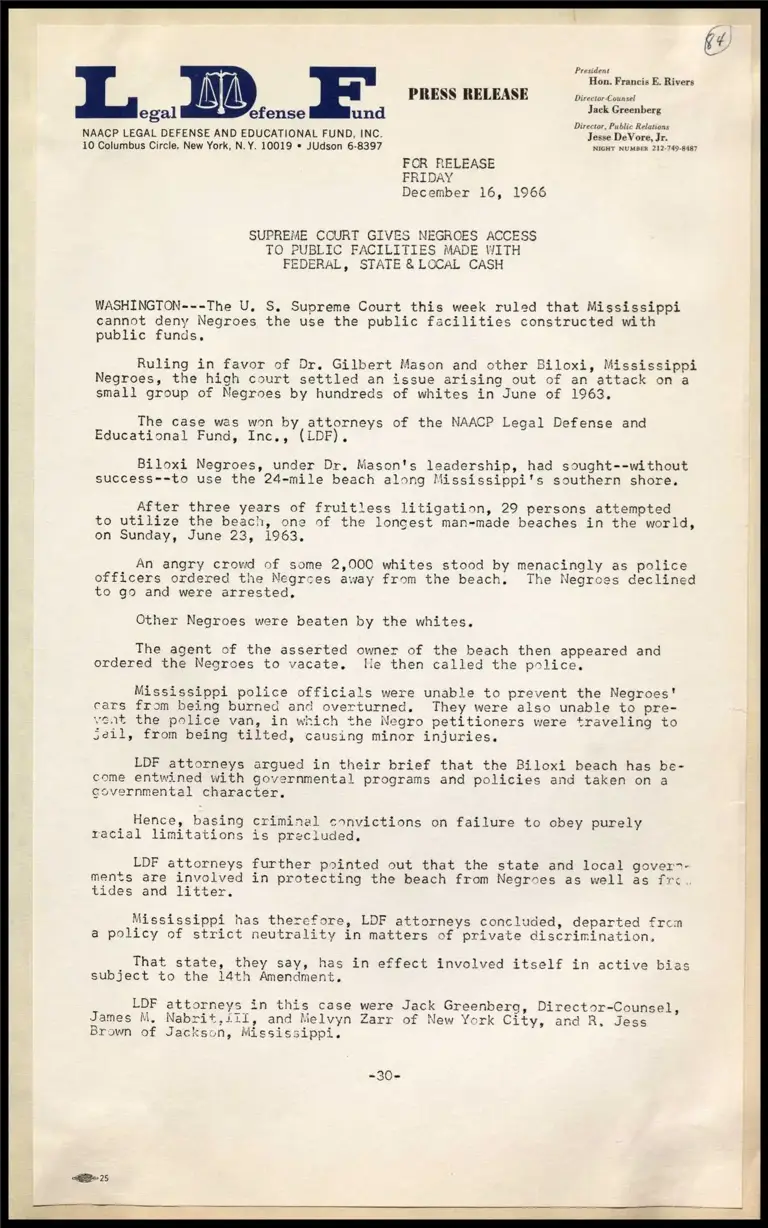
WASHINGTON---The U. S. Supreme Court this week ruled that Mississippi
cannot deny Negroes the use the public facilities constructed with
public funds,

Ruling in favor of Dr. Gilbert Mason and other Biloxi, Mississippi
Negroes, the high court settled an issue arising out of an attack on a
small group of Negroes by hundreds of whites in June of 1963,

The case was won by attorneys of the NAACP Legal Defense and
Educational Fund, Inc., (LDF).

Biloxi Negroes, under Dr. Mason's leadership, had sought--without
success~--to use the 24-mile beach along Mississippi's southern shore.

After three years of fruitless litigation, 29 persons attempted
to utilize the beach, one of the longest man-made beaches in the world,
on Sunday, June 23, 1963,

An angry crowd of some 2,900 whites stood by menacingly as police
officers ordered the Negroes away from the beach, The Negroes declined
to go and were arrested,

Other Negroes were beaten by the whites.

The agent of the asserted owner of the beach then appeared and
ordered the Negroes to vacate. He then called the police.

Mississippi police officials were unable to prevent the Negroes!
cars from being burned and overturned. They were also unable to pre-
veat the police van, in which the Negro petitioners were traveling to
Seil, from being tilted, causing minor injuries.

LDF attorneys argued in their brief that the Biloxi beach has be-
come entwined with governmental programs and policies and taken on a
governmental character.

Hence, basing criminal convictions on failure to obey purely
racial limitations is precluded,

LDF attorneys further pointed out that the state and local govern-
ments are involved in protecting the beach from Negroes as well as fr¢
tides and litter.

Mississippi has therefore, LDF attorneys concluded, departed frem
a policy of strict neutrality in matters of private discrimination,

That state, they say, has in effect involved itself in active bias
subject to the 14th Amendment.

LDF attorneys in this case were Jack Greenberg, Director-Counsel,
James M, Nabri if, and Melvyn Zarr of New York City, and R. Jess
Brown of Jackson, Mississippi.

25