Jackson Municipal Separate School District v. Evers Mimeographed Record Vol. IV
Public Court Documents
August 11, 1964
-
Brief Collection, LDF Court Filings. Jackson Municipal Separate School District v. Evers Mimeographed Record Vol. IV, 1964. 72defad9-b89a-ee11-be36-6045bdeb8873. LDF Archives, Thurgood Marshall Institute. https://ldfrecollection.org/archives/archives-search/archives-item/91db91d5-d531-4586-82ae-f0c954d147eb/jackson-municipal-separate-school-district-v-evers-mimeographed-record-vol-iv. Accessed October 07, 2026.
Copied!
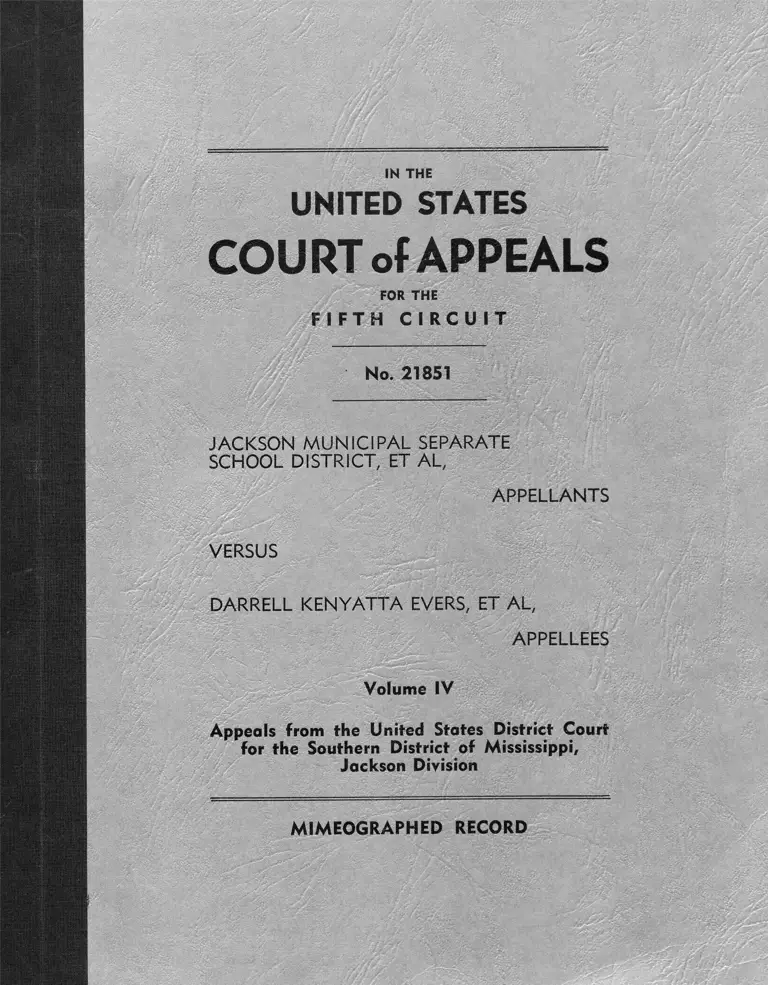
IN THE
UNITED STATES
COURT of APPEALS
FOR THE
F I F T H C I R C U I T
No. 21851
JACKSON MUNICIPAL SEPARATE
SCHOOL DISTRICT, ET AL,
APPELLANTS
VERSUS
DARRELL KENYATTA EVERS, ET AL,
APPELLEES
Volume IV
Appeals from the United States District Court
for the Southern District of Mississippi,
Jackson Division
MIMEOGRAPHED RECORD
VOLUME IV
I N D E X
Page
No
Transcript of
Testimony
Intervenor's
Intervener's
Intervenor's
Intervenor's
Intervenor's
Testimony
HALFORD SNYDER
Exhibit
Exhibit
Exhibit
Exhibit
Exhibit
No
No
No
No
No
Plaintiff's Exhibit No 4
Othnion of the Court
Judgment
Desegregation Plan
Plaintiffs' Object:ons
by Defendant Boards
Notice of Appeal
WHITAKER
24: Sheet
25• Sample Trac
26: Sample
27 A: Article
27 B: Article
Report
: ngs
Tracings
to Desegregation Plans Filed
and Motion for Revised Plans
Appeal Bond
Notice of Appeal
Appeal Bond
Order Tentatively Overruling Objections to Plan
Designation of Contents of Record on Appeal
Motion for Original Exhibits To Be Sent To The
Appellate Court
Designation of Record on Appeal
Order for Original Exhibits To Be Sent To The
Appellate Court
Certificate of Service
574
574
5^4
584
608
613
645
646
650
652
653
655
657
662
66
66
669
(R-693 contd.)
VOLUME IV
574
After Recess
HALFORD SNYDER WHITAKER, called as a witness and having been
duly sworn, testified as follows:
DIRECT EXAMINATION
BY MR. PITTMAN;
Q, Dr. Whitaker, are you a medical doctor?
A. Yes, sir.
Q. Would you state, please, your qualifications as a medical doctor?
And give your full name.
A. Halford Snyder Whitaker. As qualifications, I have a Doctor of
Medicine degree, and trained in pediatrics, certified as a specia
list in pediatrics.
Q. You are a board-qualified pediatrician? (R-594)
A. Yes, sir.
Q. Go ahead.
A. And trained in neurology and EEG, electroencephalogram.
MR. PITTMAN: Your Honor, we tender into the record
the sheet containing the qualifications and training and experience,
and the publications by Dr. Whitaker.
THE COURT: Let them be received in evidence.
(Same received in evidence and marked as Intervenor’s Exhibit No. 24)
(Exhibit is not copied because by order of the Court the original is to
be inspected.)
Q. Dr. Whitaker, what is neurology?
A. Neurology is the study of the brain and its functions, both at the
575
bedside and as a basic discipline of biology.
Q. Since your graduation from medical school and since your intern
ship and since your residency in pediatrics, how many years have
you had in child neurology?
A. Three; two in neurology and one in pediatric neurology.
Q. Where are you now located?
A. I am on the faculty of the Bowman Gray School of Medicine in
North Carolina.
Q. On the faculty?
A. Yes.
Q. How old -- - Before we get into the detailed questions, how old is
the method of study of the brain by electricity, electric study of
the brain? How old is that system?
A. Well, the first signals from an animal brain were picked up about in
1379. It has been used on humans since the late (11-695) 1930's,
and is used every day in hospitals now, since the second world
war.
Q. Doctor, we have been studying the brains of adults, but the ones
involved in this case are children, school children.
And I will ask you if there is any relation between the
brain size of children and the intelligence in children?
A. This has been studied, and actually there is a better correlation
between estimation of this cranial capacity and intelligence in six
year old school children than there is in these adult studies.
Q. Now, when you say "better correlation, " do you mean that the
differences are greater in a six year old school child than they are
576
in adults?
A. These were done on English school children, all white, and they
showed the greater the cranial capacity, the greater the intelli
gence, and it was measured by several tests.
Q. Are you in agreement with those studies?
A. Yes, sir.
Q. Are there any ways to test the working of the brain other than in
telligence and sociological testing that we have shown in the trial
of this case ?
A. Well, a more direct way, it gives a little different information, is
this electroencephalogram, which I would be more interested in,
and this is a way like the electrocardiogram which we are familiar
with.
Q. The electrocardiogram is for the heart? And the (R-696) electro
encephalogram is for the brain?
A. Yes, sir. There's the difference. And in this case, the wires
are applied over the head and electricity given off by the brain, —
the brain functions as an electric organ -- these signals are then
carried into a machine where they are amplified a million times,
and they write out a record, and this record makes a different
pattern, and these can be either analyzed by another machine or
we can just by direct inspection look at them and compare them
with the patterns that have been worked out several years ago by
Gibbs at Harvard and in his 25 or 30 years since. This shows
normal and abnormal patterns.
Q. Now, this is purely for demonstration, and not for evidence in this
577
case, but did you not hand me some samples of tracings made by
the electroencephalograph?
A. Yes, sir.
Q. Would you just take one or two of these and explain for the record
how that machine records these impulses from the brain.
A. These are examples showing the paper which runs through the
machine itself. The recording, of course, is done without the
benefit of anyone between the patient and the machine, and the
machine records this directly.
This shows a child, In a somewhat irregular behavior of
the waves and these big waves that you see here. (R-697)
And this then shows an adult pattern, as you can see,
shows a little more regular and faster and smaller waves running
across the page. And when the eyes are opened, all this stops.
MR, PITTMAN; I believe I will identify the first one for
the record.
THE COURT: Very well.
MR, PITTMAN: We tender it for identification and part
of the record. That is a sample of a child’s brain study.
THE COURT: Let It be received in evidence.
(Same received in evidence and marked as Intervenor’s Exhibit No. 251
(Exhibit is not copied because by order of the Court the original is to
be inspected.)
Q. Now, the next one you have in your hand is a sample of a study of
an adult brain?
A. Yes, sir. This one I just showed you.
578
Q. Are you through illustrating with this to the Court?
A. Yes.
MR. PITTMAN: I. offer this latter study of an adult brain
for identification and for the record.
THE COURT: Let it be received in evidence.
(Same received in evidence and marked as Intervenor's Exhibit No 26)
(Exhibit is not copied because by order of the Court the original is to
be inspected.)
Q. Now, in making those recordings, what enters into it? Is that one
voluntarily or involuntarily, or does the one who is doing the r e
cording have any effect upon what those papers show?
A. The patients, you might say, make their own recordings, and these
are just electrical signals from the different parts of (R-698) the
brain, picked up by the machine, magnified and written down.
Q. Have standards of normal patterns been worked out over the last
few years so that that gives a reliable indication of certain phenom
ena?
A. Standards have been worked out and are published, and there is an
international classification of these that we all use. And these
can be done by interpretation of the record, by only counting the
number of each type of wave and writing them down, and compar
ing it with the standard.
Q. Are there any studies which have compared the white and Negro
brains by the methods that you speak of or by electrophysiology?
A. Not in the U. S. There are some studies on African natives and
African white persons, and these are, one, by the doctors of the
579
French Army, some of whom were electroencephalographers.
Q. Are you familiar with that article, or have you studied it?
A. Yes, sir.
Q. Do you have a copy of that article in French?
A. Yes.
Q. It was published originally in French, was it not?
A. Yes.
Q. Gan you read French?
A. Yes, sir. I have to.
Q. Did you translate that article from French to English?
A. I did for myself; I didn’t make any translation. (A-699)
Q. Do you have a copy of a translation?
A. Yes.
Q. Is that translation correct?
A. It agrees with the original.
Q. Go ahead with your testimony about that study.
A. Well, these findings in this study, which was done with standard
technique and the standard in the international classifications, and
some of them were interpreted with the electronic analyzer --
that is, the doctor didn't interpret them.
On the natives, on the blacks in Africa, shows one-third
of them had none of this normal adult rhythm that we show is the
normal that we usually expect.
Q,. Now, who were these Africans that were being tested that the
article reports on?
A. These were some troops in the French Army. They were natives
530
who had been taken into the Army, screened for the absence of
nervous system disease, of course, and any evidence of severe
head trauma, anything that might have influenced the record.
These hundred soldiers had been in the Army several years and
had been talien to France, and this is where they happened to be
when the study was made, in Marseille, France. They had no
evidence of central nervous system disease, and the study was
made just as a comparison,
Q. Then you state to the Court what were the findings. (R-700)
A. Well, they say one-third of them did not show the normal alpha
ryhthm that we see as expected in the adults.
Q. Will you explain what the alpha rhythm is? And you might point to
one in one of these exhibits so that the Court can better understand
it.
A. This is a normal adult record (indicating) showing this alpha waves
all across the record and disappearing when the eyes are opened
to come back when the eyes are closed.
Q. Explain to the Court what you mean by when the eyes are opened
and when the eyes are closed, the mechanics of it when testing.
A. During this type of recording, we have the patient lying undisturb
ed, with his eyes closed. At times during the recording we have
him open his eyes, and then close them. Very rarely the alpha
wave will persist. They nearly always go away when the eyes are
open. This is supposed to be because the tension of the eyes is
arrested at that time. Otherwise, the alpha waves persist through
the record. This is the adult pattern. As we said, the child does
581
not have this but has a much slower and more irregular record.
Q. Now, the normal white subject, when his eyes are closed, what do
these lines show? Are they rhythmic?
A. This is a rhythm that runs all across the record in the channels
that are connected to the back of the head. (R-701)
Q. All right. When the eyes are opened, then what do those lines
reveal?
A. Well, when the eyes are open, the pattern goes away. The patient
is no longer resting alert with his eyes closed. It has been seen
in a few psychiatric subjects — and this is reported in the Stand
ards book on EEG, in Hill & Parks, it's called — there are some
of these psychiatric subjects whose alpha will go right on when
their eyes are open, and this is supposed to mean a lack of visual
imagery, and it's not the usual abstract capacity that other people
have.
Q. What is the difference between the recordings for those 100 African
troopers and the normal recordings of the normal group of whites?
I believe that appears on page 116 of your translation —- I mean
on page 16.
A. The things that were found, the most striking is that when the eyes
are open, the alpha waves rarely disappear; as I say, this does
happen in white people rarely, that they will persist, but the oppo
site was true in these troops in that the alpha wave nearly always
went right on.
I think the way it was said in the conclusions of the author
was, the author that did this study, it said:
582
"The stoppage reaction Is rarely complete, sometimes
entirely absent.11
As I said, this is exactly the opposite to the white normal.
( R - 702)
Q. Now, what were the conclusions of this study?
A. Well, to quote the author, he says:
", .We find ourselves in the presence of an accumulation of
facts, not very detailed, but very expressive in their raw nature."
He calls attention to the fact that this would be, except for
this business of the alpha persisting, which he says there can be
no explanation for, if it occurred in all the white persons, — ex
cept for this complete difference, he says that the other chcarac-
teristics in these tracings could be explained as immaturity, be
cause this sort of record is seen in very young children. There
is a lot of the slow waves, the regular slowing; he found this in
most of these tracings, and he even found what we call delta waves,
which are never present in the adult white tracings.
Q. Would it be accurate or inaccurate to say that this study reveals
evidence of immaturity or childishness in a third of the subjects
studied?
A. Well, I would modify that to say that two-thirds of them showed
much more alpha than would be seen in the normal adult tracing
that we are used to seeing here in the white race. Otherwise, this
statement would be true. This still does not explain the complete
difference in alpha blocking which he can have no explanation for;
it's Just different in these troops tested than in any of the studies
583
that have (R-703) been done on the white race.
Q, I ask you this: Are the slow delta waves which were found in the
examination of those Africans — not all of them, but a large por
tion of them — are those ever seen in white people except during
childhood?
A. No.
Q. Now, I read you from page 16, and ask you if that finding is a
correct finding in the French text which you translated:
"In tailing account of the norms established for the white
race in important statistical studies to which we shall now return,
we found only 42% of the tracings in accord with the established
c rite ria ."
Is that right? Page 16 of the translation.
A. Well, It is true that he found only 42 percent of the tracings in
accord with the established criteria, but he takes into account that
some of these 42 would be abnormal in the normal adult white,
but they still wouldn't be completely normal tracings.
Q. Now, on page 2l I read to you:
"This system of interpretation of the electrical details of
the brain of subjects of the Negro race would bring biological con
firmation to the work of psychiatric and psychological specialists
on the black continent, who have already known for a long time a
psychological immaturity with a tendency toward paroxysmal
manifestations in the case (R-704) of the forest Negro. "
A. What page is that on?
Q. Page 21. Is that a correct interpretation or, rather, translation,
584
and is that conclusion in accordance with your opinion as a special
ist?
A. Yes.
MR. PITTMAN: We tender, if Your Honor please, for the
record and for admission in evidence both the article in the origi
nal French and the translation. The article is entitled "Introduc
tion to the otudy of the Electrophysiology of the African Negro, "
by P. Gailais and G. Miletto.
THE COURT: Let it be marked, and received in evidence.
MR. BELL: Your Honor, let us enter a special objection
for all these studies of the African Negro. I have great difficulty
seeing the relevancy of these studies on the African to the Ameri
can Negro in Mississippi.
THE COURT: I will adhere to the ruling heretofore made
and overrule the objection.
MR. PITTMAN: If Your Honor please, I would suggest a
number 27-A and 27-B.
THE COURT: Very well.
(Same received in evidence and marked as Intervenor's Exhibits No.
27-A and 27-B, respectively)
(Exhibits are not copied because by order of the Court the original is
to be inspected.)
Q. So is it or not true, Doctor, that this study shows a distinct and
confirmed difference in the physiology of the brain? (R-705)
A. Yes.
Q. Is there anything further you wish to state, anything I have failed
to ask you about In connection with the electrical studies?
A. Parts of this have been tested and confirmed, and I apologize that
there are no studies I know of in the United States.
Q. And that is the only study you know of in the world, of the Negro
brain as compared with the white?
A. Well, that and the second study done in another part of Africa,
and this was reported on by the United Nations in one of their re
ports, this same study. These are the only ones I know of.
Q. And are all of those studies in accord to the effect that the electro
physiology of the Negro brain is different from that of the white
brain?
A. Yes.
MR. PITTMAN: That is all.
THE COURT: Any questions by the defendants?
MR. CANNADA: No, sir.
THE COURT: Any cross examination?
MR. BELL: No cross examination, Your Honor, and the
same motion to strike the testimony.
THE COURT: For the reasons herefofore stated, I will
overrule the motion.
MR. CANNADA: May we say, on behalf of the defendants,
(R-706)
we would adopt for the defendants the testimony of the intervenors.
THE COURT: Yes, sir.
(Witness excused)
THE COURT: Do you rest?
MR. PITTMAN: We rest. The interveners rest.
585
586
THE COURT: I believe all the defendants have now rested.
Is that correct.
MR. CANNADA: Yes, sir.
THE COURT: Any rebuttal?
MR. BELL; Yes, sir. We would, of course, renew our
motion to strike from consideration in the record all the testimony
of the intervenors for the reasons that we gave; and in rebuttal to
the testimony given in the main by defendants -- although I guess
the Court can consider this for whatever relevancy it has through
out the consideration of this case — plaintiffs offer in rebuttal as
an exhibit to their case a part of the evidence admitted in the case
of the United Mates of America vs. Mate of Mississippi, Civil
Action No. 3312, the record in this court, southern District of
Mississippi; that part of the evidence which is a comparison of the
education of Negro and white children, white persons, in Missis
sippi, from 1880 until 1963.
Now, this data was gathered by the United States Govern
ment In response to interrogatories of certain of the (R-707) de
fendants for the State of Mississippi. The data was gathered from
official state reports. It is fairly lengthy, but I would, as a part
of my motion to have it admitted, like to point out some of the
highlights of the information that it contains.
On page 2 of the report, it points out that white public
school teachers in Mississippi "were and are more highly trained
than Negro teachers. "
It points out further that this is during this whole period of
587
the study from 1890 to the present. It points out moreover that
white public school teachers in Mississippi were and are more
highly paid than Negro school teachers.
As just one example of a lot of the figures it gives, in
1949-1950 white school teachers averaged $1,805.69 per year,
and Negro teachers averaged $710. 56 per year.
More white teachers are provided for white child in attend
ance than for Negro child in attendance in the public schools of
Mississippi.
In 1931-32 school year the ratio for whites in white schools
was 23 students for each teacher. During the same period, the
ratio was for Negroes 34 students for each teacher.
In 1961-62 the ratio for whites was still 23 pupils for each
teacher, and for Negroes it had dropped down only to 28.5 pupils
for each teacher.
MR. WATKINS: Pardon me. I want to object to this. It
(R-708)
is clearly inadmissible. We don't know who assembled this data.
We have no opportunity to cross examine, and counsel is merely
reading into the record certain statistics alleged to have been ob
tained by some person from some report, and he will later cite
from the record those statistics as though it were evidence. We
don't think this has any place in this record. He is reading what
are alleged to be findings by some unknown person in some other
lawsuit.
MR. BELL: I think, if counsel was listening, I pointed out
that what I'm reading Is part of the record in a case which was
588
heard in this court, and on that basis alone the court could take
judicial notice of it.
But, moreover, I pointed out that the records were com
piled by the United States Government in answer to interrogatories
posed by officials of the State of Mississippi in all of the material
and all of it set forth here is taken from state reports by state
officials of the State of Mississippi.
Now, we have gone through here since Monday, almost
three full days of testimony, all of which has been adopted by the
defendants, aimed at showing that Negroes are inferior, are less
educable, have lower scholastic achievement, and in all other
manner are greatly inferior to white pupils in Mississippi, and
therefore, a classification based on race, which is the way they
are operating (R-709) their schools, is. justified under the Con
stitution.
I am pointing out in sole rebuttal, and I think I am entitled
to a few minutes after they have taken a few days, one exhibit
which I think throws more light on inequality between Negro and
white pupils than all of the information that they have shown.
THE COURT: Of course, the Court takes judicial know
ledge of its own record and will take judicial knowledge of such
record, as it is required to take. However, unless it was offered
in evidence, as you are doing now, I doubt if testimony taken would
be considered as part of the record of which judicial knowledge
would be taken.
But at any rate, I will let the offer be made and be a part of
589
the record here in this court in another case — to which I assume
these parties in this case were not parties to that suit? What was
the style of that?
MR. BELL: I think that was the United States versus
State of Mississippi. I don't know the exact --- Well, to the ex
tent that the attorney-general's office is representing the school
board in accordance with state statute, then to that extent the
parties would be the same. But I don't think that similar parties
— Similar parties is not one of the prerequisites.
THE COURT: I will permit you to make the offer and
(R-710)
call the attention of the Court to the high spots, and I will reserve
ruling upon the objections of the defendant as to whether or not it
is admissible, because I am not sure whether that can be admitted
in that form or not.
So I reserve ruling upon that objection.
MR. GANNADA: Is he permitted to continue to read his
resume of what the report shows, which we have never seen and
had no opportunity to cross examine on?
THE COURT: Of course, the record, you are offering —
MR. GANNADA: We have never seen it.
THE COURT: Let counsel opposite see that.
MR. BELL: All right. We haven't seen a great deal of
some of the latter testimony and we made no similar objection.
Now, I would like to, if I may, if this is going to be so much prob
lem, continue my resume and then offer this in evidence and let
them see it for whatever purposes they want, and perhaps after the
590
luncheon break they can make any further objection to It that they
may see fit.
MR. WATKINS: Your Honor, may I ask a question? I'm
not too familiar with the record, but, Counsel, isn't it a fact that
the Court in that case from which that was taken refused to con
sider the answers to those interrogatories you are reading as evi
dence, and disregarded it in that lawsuit?
MR. BELL; I'm not certain that that Is so. I am certain
(R-711)
the case is presently pending on appeal before the U. S. Supreme
Court.
MR. WATKINS: Do you know whether or not the Court
that heard that case considered that as evidence in the case?
MR, BELL; Now, I'm not going to answer these questions.
THE COURT; The record will show ---
MR. CANNADA: The other question I would like to ask is,
we are here dealing with the students of the Jackson Municipal
Separate School District,
MR. BELL: I ’m going to get to that if they will give me the
courtesy —
MR. CANNADA: and insofar as I have heard, he is
talking about a report we have never seen.
THE COURT: Let me see what you are offering.
{Same is handed to Court)
THE COURT: I see here "Answers to Interrogatories of
Mate of Mississippi; Mrs. Pauline Easley, Circuit Clerk and
Registrar of Claiborne County; J. W. Smith, Circuit Clerk and
591
Registrar of Coahoma County; T. E. Wiggins, Circuit Clerk and
Registrar of Lowndes County.i!
Now, Coahoma County and Lowndes County are not in this
district.
MR. BELL: I believe that the United States Government
in that voting suit, which is the type of suit it was, had (R-712)
joined all of the counties, if I'm not mistaken, as party defendants,
and these particular party defendants had requested interrogatories
and asked the United States Government to explain allegations in
the complaint to the effect that the educational opportunities pro
vided Negro children in the State of Mississippi were greatly in
ferior to the educational opportunities provided white children in
the State of Mississippi. Now, in response to those interrogator
ies, the Government compiled this document, compiled it com
pletely from official state reports, reports of the superintendents
state
of the/educational system, reports of the state body to the legis
lature biannual reports, a 20-year study and various other studies
made by officials of the State of Mississippi.
THE COURT: This document that you have handed me
which you propose to offer in evidence, is this an exact copy of
the answers to the interrogatories?
MR. BELL: I believe it is, Your Honor, though I imagine
that can be checked. I received it from an agent of the United
States Government. Although I didn't think it would be necessary
to have the seal mark on, I certainly can get that without difficulty,
or it can be checked with the original in the clerk's office.
592
THE COURT: I think the interrogatories ought to be,
because this looks like a lot of argument and stuff here (R-713)
rather than copy.
ME. BELL; No, Your Honor, it is all factual material.
THE COURT: In direct answers?
MR. BELL: That's right. The question was -- There was
a series of interrogatories, and I believe most of this data was in
in answer to one particular interrogatory, which requested the
plaintiff, the United States Government, to explain an allegation in
the complaint to the effect that Negro educational opportunities in
Mississippi were inferior to the educational opportunities provided
for white children. Nov;, all of the materials there is not argu
ment, but the support for the allegation.
THE COURT: And is the language of the answer?
MR. BE LL: And is the language of the — Most of it is
quotes or statistical quotes.
MR. SHAND3: Have you examined that statement to verify
it?
MR. BELL: what statement?
THE COURT: Just a minute, Gentlemen. One at a time.
I think he ought to be able to verify that these are direct
answers. I certainly don't know, and it's not certified to by the
clerk of the Court; but I will let you offer it and, of course, you
can offer it and it will be come a part of the record whether it is
competent or not; but I will exclude it just on statements here be
cause I could not take judicial notice of the records of the Northern
593(R-714)
District of Mississippi because they are not available to me. Now,
the Court will take judicial knowledge of any record in its own
district because they are available to the Court for whatever they
may be worth.
So I think you should just offer them in evidence and —
MR. BELL: Your Honor, I should like to — I would like
to have the courtesy that I extended to counsel for defendants and
counsel for intervenors during the period since about eleven
o'clock on Monday morning when we rested our case, and that is
to at least permit me to make my offer on this proof, and at the
conclusion of it then hear the various objections. I think I am en
titled to that.
THE COURT: Yes, you are entitled to that, and I am
going to let you do that.
I am going to let him epitomize what that —
MR. PITTMAN; If Your Honor please, I'd like to make a
statement in behalf of the intervenors.
MR. BELL: Your Honor, I have been interrupted in the
course of this thing.
THE COURT: Well, they are entitled to be heard, and then
I will hear you.
MR. PITTMAN: We object to the admission of any evidence
or any material derived from any case in which the intervenors
were not parties and with which they were not (R-715) concerned
and in which they had no opportunity to present contrary facts or
evidence of any kind. We insist that under the law we are only
594
bound In cases where the same parties where the evidence was
offered, where we were parties, or where we were represented by
parties. And in the matter he speaks of, we were not represented
directly or indirectly, and had no opportunity to consider or refute
any of the material in it; so we think now it will be incompetent as
far as the interveners are concerned.
THE COURT: Very well. Let the objection be noted, and
I will reserve ruling on it.
Of course, the statement he is reading into the record now,
if there is a variance from anything in the exhibit — if the exhibit
should be received in evidence, the exhibit will control, and the
balance of the statement would be disregarded. He is simply mak
ing this as an offer; rather than reading the testimony he is offer
ing at this time, he is epitomizing the parts he expects or desires
to call attention to.
You may proceed.
MR. BELL: Thank you, Your Honor.
As I was indicating, during this whole period of the statis
tics and other reports that have been compiled, more money was
spent for the instruction of white children in (R-716) the State of
Mississippi than for Negro children. In 1929-1930 the record In
dicates that an average of $40.42 was spent for each white child,
while $7.45 was spent for the education of each Negro child.
By 1956-57 that figure had increased to $128. 50 per white
child, and had Increased for the Negro child to 378.70.
By 1960-61 the figure for the white children was an average
595
of $173.42; for Negroes, $117.10.
Now, with particular reference to the defendants in this
case, the exhibit shows at pages 8 to 10 that during the year 1961-
62 that the defendants boards here spent in the education of each
child above the stale minimum program: The Jackson board, first
of all, for white children, $149.64, and for Negro children,
$106.37; for the Leake County board, that figure was above the
state minimum for the white children, $48.85, and for Negro
children, $17.37. For the Biloxi Separate .school District, the
figure was for the same period, 1961-62, for white children
$128.92, and for Negro children, $86.25.
Now, the figures here give the breakdown for every school
district in Mississippi, and I certainly won't try to read them all,
but other typical ones include Clarksdale (R-717) and Coahoma
County school district, where the Court can take judicial notice
where school desegregation suits have been filed: for the Clarks
dale Separate School District, the figure for 1961-62 was $146.06
for the white children, and $25.07 for Negroes. For Coahoma
County School District, the figure was $139.33 for each white
child, and for each Negro child, $12.74.
Just a few other examples: From Madison County, our
neighboring county here, the figure was $171.24 for the white
children, while for Negroes it was per child $4.35.
For neighboring Rankin County, we have for white children,
$72.71 per child, and for Negro children,$14.78, per child.
And one more, Yazoo County, located about 50 miles away,
596
for each white child above the minimum, it was $245.55, for each
white child, and for Negroes for each child, $2.92.
The report points out at pages 11 to 14 that in 1954-55
every school district in Mississippi spent more money to educate
white children than it did for Negro children. During that period
the Jackson school board, according to the figures given here,
spent $217.00 for the education of each white pupil and $157.00 for
the education of each Negro pupil. The Leake County board spent
$169 for the education of each white pupil, and $104 for the educa
tion of each Negro. The Biloxi school board spent $191 for the
education of each (R-718) white pupil, and $141 for the education
of each Negro.
The county average in county school boards during this
period throughout the state was $161 for each white child, and
$87 for each Negro.
For special or separate school districts In the amount of
money, it was generally a little more. The average was, through
out the state, $181 for each white child, and $106 for each Negro
child.
On page 14, the report taken from official state documents
indicates that white children have generally longer school terms
than Negroes throughout the State of Mississippi. They give the
data bringing up to date to the 1961-62 situation, which showed that
in that period only 2 white school districts had school terms of
eight months, while during the same period 103 Negro school dis
tricts had school terms of eight months. During the same period
597
637 white school districts enfoyed full nine-month school terms.
During that same period only 399 Negro school districts enjoyed
full nine-month school terms.
On page 15 of the report, it shows that in 1910 Mississippi
decided that consolidation of rural schools would improve education
for children, and the report on that indicates the several reasons
the determination to consolidate was made — indicated that if the
teacher was responsible for only one or at the most two (R-719)
grades, it would be easier to secure good teachers with profession
al training. It was an economy toconsolidate the schools. "Pupils
are more interested in school and therefore attend more frequently
and remain in school and go on to high school. The entire curri
culum can be enriched. The school building will be much superior.
Consolidation offers the bases for the solution of more of the rural
school problems than anything that has yet been offered."
Based on these findings, consolidation of the Mississippi
schools began in 1910. However, between 1910 and 1930, while
many white school districts were consolidated, no Negro school
district was consolidated during that period. Therefore, as of
1931, there were 959 consolidated white school districts, and
789 unconsolidated white school districts at that stage. During the
same period there were only 16 consolidated Negro school dis
tricts, and 3,484 unconsolidated Negro school districts. The re
port points out that the consolidation of Negro schools did not
really get underway until after the Brown decision in 1954, forty
years after consolidation of white schools.
598
On pages 16 and 17 of the report, it points out that at all
times in Mississippi "secondary education has been made available
to more white children than Negro children, " even though there
have always been more Negro children than white children of
school age. And the report goes on to give (11-720) the breakdown
in statistics supporting that statement.
On page 18 the report indicates, giving statistics in sup -
port, that at all times "more white high schools than Negro high
schools "have been accredited by either the State of Mississippi or
by regional accrediting association.
On pages 20-23 of the report there are breakdowns indicat
ing the wide variation in college training available to whites and
Negroes in Mississippi.
On page 24 we offer that particularly with reference to the
fact that school teachers who have to have the training generally
get it within the state, then come, return to either Negro or white
school.
On page 24 of the report it points out that officers of the
state government have recognized that the public educational facil
ities provided for Negroes were inferior to those provided for
whites. Now, it gives first of all a number of quotes from various
governors of the State of Mississippi concerning education, and I
certainly won't try to read them all. And I think it does show an
improvement from the early quote by Governor Vardaman back in
1907 when he is reported to have said, "Here is what I promised to
do. I said if you elect me Governor and elect a legislature in
599
sympathy with me that I would submit to the people of Mississippi
an amendment to the State Constitution which would control the
distribution of a public school fund so (R-721) as to stop the use
less expenditure In the black counties." . . .
THE COURT: Let me ask you there about that now.
Is that an answer by these registrars?
MR. BELL: No, Your Honor. I was confused on that
point. The registrars didn't give the answers. The registrars
filed the interrogatories, and the Government, in answer to the
registrars' interrogatories, provided these answers, but they
provided them fro m -----
THE COURT: Well, I'm going to sustain the objection to
the introduction of that, because I was admitting it upon the theory
of a statement against interest. Those are self-serving declara
tions.
MR. BELL: They are not self-serving declarations, Your
Honor, when they are made by officials of the State of Mississippi.
If anything, they are declarations against interest, at least in this
regard.
THE COURT: As I understand, the State of Mississippi
didn't give that information.
MR. BELL: But the information that was given, Your
Honor, is taken from official reports of the state of Mississippi.
THE COURT: I ’d like to see that report where it is stated.
Anyway, that wouldn't be competent. I knew Governor Vardanian
personally. He was campaigning, and that's (R-722) what he was
600
doing in the campaign.
MR. BELL; Well, let me strike the statement of Governor
Vardaman which tends to be a campaign statement and go along to
another statement, Your Honor, which was the only other one I
was going to mention.
THE COURT: I believe I will sustain the objection to that
document in the form it is. I would like to see those records of
which I could take judicial notice, rather than to have a copy that
is prepared by someone other than the official custodian of the
records. Now, if that had been certified to by the clerk of the
court, then, of course, under that doctrine a certificate would
certify to its accuracy.
MR. BELL: Well, Your Honor, let me interrupt, if I may.
I wasn't basing the admissibility of this solely on the fact
that it was admitted in another case. I think that was a certainly
firm basis, and if you prefer it on there, there would certainly be
no difficulty in getting the clerk within a very few minutes, I'm
sure, unless the record has already been sent up on appeal, to have
her certify that this is a true copy of the document that was filed.
Now, it certainly purports to be a true copy from the face of it,
I'm sure you will admit. Moreover, you have the word of counsel
and I have certainly, in all of the years I've been coming (R-723)
down here, and I pride myself on being a member of this court,
and I say to the Court that it is a true and correct document of a
part of a record of a case in this court. Now, we have not, during
all these few days, required any of these books, this information,
601
or at least these graphs which have been shown to the Court, to be
certified in any such fashion. We assumed that because these
attorneys who are members of this bar had indicated that they were
what they were, that that was good enough. Now, I can't see why
we should have to be held to a higher standard, Your Honor.
THE COURT: Because I'm not satisfied, when you start
quoting there from political speeches, that — -
MR. BELL: — It was a statement to the legislature, Your
Honor; not a political speech.
Let me return to the statistics and let me ask you to re
serve the decision until I finish.
THE COURT: All right, you can do that.
MR. WATKINS: Your Honor, before he commences, let
me point out once more that these are statements of some person
with the United States, purported to have been lifted from the pub
lic records of Mississippi. Now, we are not complaining because
we don't think that is what is reflected in the records of that law*
suit, but we complain, as we would have in that lawsuit if there
had been public facts alleged (R-724) to have been produced by
the United States without certification of the facts as produced;
and we think the record is being cluttered by a form of evidence
that is not proper here, would not even have been proper in the
case in which it was offered, and it is my advice from the attorney-
general's office that it was ruled incompetent in that case for the
very reason I am stating. And I don't think we ought to clutter the
record with alleged facts found by the United s ta te s -----
602
THE COURT: Well, I believe he's nearly through, aren't
you?
MR. BELL: I am, Your Honor. May I continue?
Now, every two years the State Superintendent of Public
Education in Mississippi reports to the Mississippi Legislature.
Following are excerpts from some of the reports, many of which
are set out in fairly good detail here. These reports indicate that
the public education for Negroes has been inferior to that provided
for whites.
Now, an early report, at page 25 and 26 of the exhibit, is
quoted, as follows:
"In many counties, particularly in rural areas, Negro
children are forced to attend school in mere shacks or in church
houses... Consolidation has done away with practically all of the
one and two-teacher schools. In fact, this year there are less
than ten percent of the white children CR-725) of the rural dis
tricts attending these old type schools. The other ninety percent
have the advantage of modern high schools, in many of which, not
only the college preparatory course is given but also work in vo
cational agriculture, home economics and business training... "
Now, this was taken from the Biennial Report 1929-31,
page 11 of that report.
Another report indicated that 83 percent of all colored
children enrolled in school were in open country rural schools,
the great majority of which were of the one and two teacher type so
common in Mississippi in both races prior to 1910.
603
That statement was taken from a document titled TWENTY
YEARS OF PROGRESS 1910-1930 AND A BIENNIAL SURVEY
SCHOLASTIC YEARS 1929-30 AND 1930-31 OF PUBLIC EDUCA
TION IN MISSISSIPPI, Issued by W. F, Bond, State Superintendent
of Education.
Now, from the same report by W. F. Bond, he states at
page 90:
"The quality of work done in the school room by the ma
jority of Negro teachers would not rank very high when measured
by any acceptable minimum known to the leaders in educational
thought. There is a growing sentiment among the white people
and the Negroes in Mississippi favorable to improvement in school
plants, in the training of Negro teachers which will guarantee a
better quality of work in (R-726) the schoolrooms for the Negro
ra c e ."
At Page 28 from the Biennial Report to the State Legisla
ture of 1933-35, the report says:
"There is also dire need for school furniture and teaching
materials - comfortable seating facilities, stoves, blackboards,
erasers, crayon, supplementary reading materials, maps, flash
cards, and charts.
"In many of the 3,763 colored schools of the state there is
not a decent specimen of any one of the above-mentioned items.
In hundreds of rural schools there are just four blank, unpainted
wails, a few old rickety benches, an old stove propped up on brick
bats, and two or three boards nailed together and painted black for
604
a blackboard. In many cases, this constitutes the sum total of the
furniture and teaching equipment. “
Now, the next biennial report, for 1935-37, indicates that
"high school advantages for Negroes in Mississippi are very
meager. Ninety-four percent of the educable Negro population of
high school age is not in school. .. .There are twenty-eight
counties in Mississippi which do not have any recognized high
school facilities for Negroes. Fifteen counties make absolutely
no provision whatever for high school training of Negro children.
Of the fifty-four recognized four-year high schools for Negroes,
fifteen are privately owned and supported... Only eighteen Negro
high schools in Mississippi.. . " — (R-727)
THE COURT: I believe, Mr. Bell, that is all I care to
hear from that. You may offer it and let It be marked as an exhi
bit. And I sustain the objection to it and will exclude it from con
sideration in reaching a judgment in this case for more reasons
than one.
I think it is not between the parties that are in this litiga
tion, and they are not bound by it extra judiciary. I would have
to be proven by witnesses because there is a lot of material in
there that is so far back that —
MR. BELL: Well, I was going to bring it up to date, Your
Honor, if you will give me the minimum of the time that the de
fendants have had. I was going to bring that right up to date and
show that there has been an improvement but that there was an
admission by the state legislators up to the present day that there
605
was still a lot of work to be done before the Negro schools in the
State of Mississippi are on a par with the white schools. I was
going to bring it up to date.
Now, we’ve gone clear back to dark Africa to show that
Negroes are inferior.
THE COURT: Yes, but that was by competent evidence,
and I don’t think this is competent. If you had competent evidence
here to establish those facts where it would be subject to cross
examination by the attorneys in this case who are conducting the
trial of this case and were not connected-----that is all the inter
veners; none of them (R-728) were connected with that case, and
none of the other defendants were connected with those cases. So
it is not admissible in evidence.
Now, part of it would be competent testimony if a witness
were here subject to cross examination, but the document in its
present form is not competent, in my judgment, and for that rea
son I will sustain the objection; but, of course, it will go into the
record, and if I am wrong about it, then it would be erroneous and
the courts would probably reverse any judgment that I might ren
der in the case, or they might, considering the record itself,
might conclude that whatever judgment I rule would be correct re
gardless of whether that was competent or not competent.
Now, you have your record complete by offering it in evi
dence, and since I am going to exclude it for the reasons I have
stated, it is not necessary for you to take up any more time read
ing that. So I sustain the objection to it.
606
MR, BELL: Gould I make a further statement, Your
Honor ?
THE COURT: Yes.
MR, BELL: When we returned with this case from the
Fifth Circuit and the motion to intervene was made, and the plain
tiffs objected to such intervention on the basis that it was a mere
attempt to relitigate the issues that had already been settled in the
Brown decision by the United 0 7 2 8 ) Jtates .supreme Court, and
moreover that subsequent similar efforts had been knocked out
by
either/the district courts or by the Fifth Circuit in a number of
cases, the Court pointed out that nevertheless the intervenors
were entitled to make their record.
Now, one of the bases for objection to permitting that rec
ord to be made, notwithstanding the unlikelihood that the position
could be sustained, was that we had to face the fact that Missis
sippi not accidentally was the last of the states to initiate at least
token desegregation, and that we were hopeful that this inevitable
change could be brought about in as peaceful and orderly fashion
as possible. We pointed out to the Court that the introduction of
all of this mass of material, with die importance that the case has
generally and with the tremendous play that it will be given in the
newspapers and news media all over the state, as it has been given,
would rnalee more difficult rather than less difficult the job of
initiating and carrying through compliance with the d upreme
Court's decision of 1954.
Now, it was the opinion of plaintiffs, as we have pointed
607
out several times, one, that all of such data was irrelevant to the
issues in this case, and
THE COURT: I have already ruled on those and-----
MR. BELL: —- This is preparatory to making a further
(R-730)
offer on that, Your Honor, if I may.
THE COURT: Well, you needn’t remind me of everything
— Certainly I don't want to shut you off on anything you want to
say that I don't already know, but we have taken up some time
here, and we have two more cases to go on to pretty soon, so
what is it?
MR. BE LL: Well, what I want to say is that it was my
hope to, since we must be cognizant of the fact, while we are try
ing the case to the Gourt, that the Mate of Mississippi as a whole
is following this case with avid interest, to at least be able to in
dicate part of the reason, in rebuttal, why, if there is any dis
parity between Negro and white achievement, our reason for be
lieving that it is due to the long and rather unhappy history of un
equal educational opportunities that have been provided for Negro
children in the state.
For that reason we wish to offer this, and it is for that
reason that I would permit the Court to permit counsel for plain
tiff under Rule 43-c of the Federal Rules to continue making their
offer in order to make the record. —
THE COURT: Well, you've already made your offer, and
it is there and speaks for itself. And I have sustained the objection
for the reasons I've already stated, so it is not necessary to make
608
any offer of what you expect to prove, because there it Is. Now,
if you have any other evidence you (R-731) want to offer in re
buttal, of course, if it is competent certainly you are entitled to
get it in and I will hear It. I don’t want to shut you off from any
thing I think you’re entitled to and which you want to do; that's not
my purpose. I am simply ruling here upon the admissibility of
evidence, and in my judgment that is not admissible. As I say,
though, it is there and will become a part of the record upon
appeal in the event there is an appeal from whatever decision the
Court makes; so it is there, and it is not necessary for you to say
anything on what is in there.
MR. BELL: All right, Your Honor. We have nothing
further.
THE COURT: Very well. Let it be marked, and the
objection is sustained.
(Same was marked as Plaintiff's Exhibit No. 4.)
THE COURT: It will not be taken into consideration in
reaching a judgment in this case.
Anything further, Mr. Bell?
MR, BELL: Nothing further, Your Honor. The plaintiffs
rest.
THE COURT: I believe everybody has rested. Is that
correct?
MR. LEONARD: The intervenors rest, but I would like to
point out in connection with the statement which has just been made
to the Court by Mr. Bell that we have (R-732) presented here in
609
court the actual witnesses and documents of which we spoke, and
we put them on under the common laws of evidence, and that they
were open both to rebuttal and to cross examination, and that Mr.
Bell's choice not to cross examine has not been a matter of cour
tesy on his part; it has been an unwillingness to meet this proof.
THE COURT: Very well. Everyone has his statement in
the record now.
It is nearly adjourning time, so let me ask about the next
case, the Leake County case.
MR. BELL: Yes, Your Honor. On this case, counsel for
plaintiffs and defendants have been making some efforts to shorten
the proceeding by preparing and agreeing to a group of stipulated
facts which can be submitted to the Court as the factual record of
this case, some of which would be attached, exhibits, and other
documents.
Now, we are in sort of a draft stage at this time, and I
believe with a little longer than ordinary lunch break —-
THE COURT: Very weH. What about three o'clock?
MR. WELLS: I think by three o'clock we will be able to
come into court with a complete stipulation and eliminate any tak
ing of any evidence whatsoever.
THE COURT: Very well. The next case will be the Biloxi
case. What about it?
MR. WATKINS: I don't think the Biloxi case will take
(R-733)
long, Your Honor. We will probably have one witness. We expect
to adopt the evidence offered in the Jackson case, to which I under*
610
stand counsel has no objection.
MR. BELL: We have the regular objection to Its compe
tency, but we have no further objection.
THE COURT: I see. You rely upon the same objections
you have heretofore entered.
All right. Let me ask this now: I don’t believe these cases
have been consolidated, but as I recall it, it was agreed here when
we started that all the evidence that was taken in this Jackson case,
so far as was relevant to the issues in the other cases, would be
considered as apart of the evidence in each one of those cases.
Is that the understanding?
the
MR. BELL: I think that was/under standing.
THE COURT: Is that your understanding?
ME. WATKINS: Yes, sir.
MR. BELL: I did have one witness on the Biloxi case, one
of the plaintiffs who is a medical doctor and one of the few Negro
medical doctors in the community, and I thought there was a
possibility he could get on today, but rather than take his time, I
had asked him to be prepared for nine o’clock tomorrow morning.
Now, I was wondering if we could finish up Leake County this
afternoon and if it would be possible to come back tomorrow morn
ing with the hope of finishing up within a very few hours. (R-734)
MR-. WATKINS: If counsel would reduce to writing what
Dr. Mason — - Is it Dr. Mason?
MR. BELL: Yes.
MR. WATKINS: — what Dr. Mason plans to testify to,
611
we may be able to agree that would be his testimony. I would like
to get through this afternoon on the Biloxi case, if we could.
THE COURT: I imagine you know, in substance, what
Dr. Mason would testify to, don't you, Mr. Bell?
ME. BELL: Yes, Your Honor. I was hoping the Court
would get a chance to see Dr. Mason, in view —
THE COURT; Oh, I know Dr. Mason.
MR, BELL: Oh, you know Dr. Mason? Then — Some
times I begin to wonder myself, after two or three days of this,
and I thought Dr. Mason was a prime example to the contrary.
— But if you know him, perhaps we could get together and make
stipulations similar to those that we are preparing with Mr. Wells.
THE COURT; Very well. We will take a recess until
three o'clock, and see what you can work out in that time.
(Whereupon the court was recessed until 3:00 P . M . )
* Sf- *
612(R-735)
IN THE UNITED STATES DISTRICT COURT FOR THE SOUTHERN
DISTRICT OF MISSISSIPPI, JACKSON DIVISION
DARRELL KENYATTA EVERS and KEENE DENISE EVERS,
minors, by MEDGAR W. EVERS and MRS. MYRL3E
B. EVERS, their parents and next friends, ET AL,
Plaintiffs,
Vs.
JACKSON MUNICIPAL SEPARATE SCHOOL DISTRICT,
KIRBY P. WALKER, Superintendent of Jackson City
Schools; LESTER ALVIS, Chairman; C‘. II. KING,
Vice-Chairman; LAMAR. NOBLE, Secretary; V/. G. MIZE
and J. W, UNDERWOOD, Members,
Defendants,
JIMMY PRIMOS, ET AL,
Intervenors.
(Civil Action No. 3379)
COURT REPORTERS CERTIFICATE
I, D. B. JORDAN, Official Court Reporter for the Southern
District of Mississippi, do hereby certify that the above-entitled cause
came on for hearing before the Honorable S. C. Mize, United States
District Judge for the Southern District of Mississippi, at Jackson,
Mississippi, in the Jackson Division, on the 18th day of May, 1964,
and that the foregoing pages constitute a true and correct transcript
of the testimony and proceedings.
WITNESS my signature, this the 2nd day of July, 1964.
/ s / D. B. Jordan
D. B. JORDAN
* * *
CR-170)
OPINION OF THE COURT
(Title omitted-Filed July 7, 1964)
613
The complaint in this case was filed on behalf of several minors
and their parents. It was alleged that the plaintiffs were all members
of the Negro race and that the action was being brought on their behalf
and on behalf of all other Negro children and their parents in Jackson,
Mississippi.
The defendants are designated as the Jackson Municipal Sepa
rate School District, the individual members of the Board of Trustees
of the Jackson Municipal Separate School District, and Kirby P. "Walk
er, Superintendent of Schools.
The relief sought was that the defendants be enjoined from
operating a compulsory biracial school system in Jackson, Mississippi,
and in the alternative that the Court order the defendants to present a
plan to "desegregate" the schools within the Jackson Municipal Sepa
rate School District.
iifter alleging that the defendants did maintain a compulsory
biracial school system in the Jackson Municipal Separate School Dis
trict, the plaintiffs alleged that they were "injured by the refusal of
the defendants to cease operation of a compulsory biracial school
system in Jackson, Mississippi." It was further (R-171) alleged that
the operation of a compulsory biracial school system violated the
rights of the plaintiffs and the members of the class which they pur
ported to represent which were secured to them by the due process
and equal protection clauses of the Fourteenth Amendment to the Fed
eral Constitution.
614
The defendants filed their answer to the complaint. In this
answer it was admitted that, with respect to all schools under their
supervision and control, there were no schools attended by members
of both the white race and the Negro race. The defendants denied,
however, that they maintained or operated a compulsory biracial
school system and further denied that the fact that no schools were
attended by members of both the white race and the Negro race came
into existence pursuant to the requirements of state law and denied
that such condition was continued, perpetuated or maintained as a mat
ter of state lav;, policy, custom or usage.
Defendants, in their answer, alleged that the schools in said
District were being operated, to the best of their abilities, for the
benefit and best interest of all pupils of the District; that the defen
dants were and are vested with the exercise of judgment and discretion
in connection with the assignment of pupils to schools within the Dis
trict, and that many factors were taken into consideration in connection
with their exercise of such judgment and discretion; that one of the
factors taken into consideration was the differences and disparities
between the ethnic group allegedly represented by plaintiffs and the
Caucasian children in the District; that such racial differences are
factual in nature, and, as such, can and should be taken into considera
tion by the defendants in the operation of the schools of the District.
In short, the defendants planted themselves firmly upon the
proposition that instead of being injured by separate schools for the
members of the Negro and white races that, as a matter of fact, such
schools were advantageous to the pupils of both races, and that in the
615
conduct and exercise of their responsibility and duties (R-172) in
connection with the operation of said schools the defendants were act
ing within their judgment and discretion in taking into consideration the
educational characteristics of the Negro and white races.
Thus, the issues were clearly presented by the pleadings. The
fact that members of both the white and the Negro races do not attend
the same schools was alleged by the plaintiffs and admitted by the de
fendants. Thus, this is not an issue. The controlling issues are:
1. Are the plaintiffs, or the members of the class they pur
port to represent, as a matter of fact, injured by the
operation of separate schools for the races in the Jackson
Municipal Separate School District?
2. Are those charged with the responsibility for the mainte
nance and operation of the schools within the Jackson
Municipal Separate School District authorized to take into
consideration the educational characteristics of the mem
bers of the Negro race and the educational characteristics
of the members of the white race in connection with the
operation of such schools?
A petition to intervene was filed in this cause on behalf of cer
tain minor children and their parents. In this petition it was alleged
that the intervenors were members of the white race. The petition to
intervene was approved by this Court and the intervenors filed an ans
wer to the complaint, oaid answer sets forth in some detail alleged
differences and disparities between members of the Negro race and
members of the white race and alleges affirmatively that should those
616
charged with the responsibility of the operation and maintenance of the
schools of the Jackson Municipal Separate School District ignore or not
consider such differences between members of the two races such
would cause irreparable injury to the intervenors and to the class they
purported to represent, as (R-173) well as to the plaintiffs and to the
class the plaintiffs purported to represent.
Plaintiffs therefore contend that the operation of separate
schools for members of the Negro race and members of the white race
has resulted and is resulting in injury to the members of the Negro
race. The intervenors contend that the operation of schools which
members of both the white race and the Negro race attend would result
in irreparable damage to the members of both races. The defendants,
those charged with the responsibility of the operation and maintenance
of said schools, contend that the educational characteristics of and the
differences between the two races should be taken into consideration
as factual matters and the schools operated in such a manner as to give
good faith consideration to these factors, along with all other proper
factors.
If, as a matter of law, there are no circumstances or conditions
under which the educational characteristics of or the differences be
tween the white race and the Negro race as they now exist within the
bounds of the Jackson Municipal Separate School District can be con
sidered by those charged with the responsibility of administering such
schools, then the preliminary injunction heretofore entered by this
Court should be made final. On the other hand, if those charged with
the responsibility of administering such schools are to be permitted to
617
take into consideration, along with all other proper factors, the educa
tional characteristics of or the differences between the members of
the white and Negro races, then the issues were clearly presented by
the pleadings.
The Court was and is of the opinion that in the exercise of their
discretion and judgment, such exercise being in good faith and in ac
cord with the principles heretofore enunciated by the Supreme Court
of the United States, those responsible for the administration of such
schools may take into consideration, along with all other proper fac
tors, the educational characteristics of or the differences between the
members of any ethnic groups, including the (R-174) Negro race and
the white race. Therefore, the Court permitted the parties to submit
evidence pertaining to the issues as heretofore set forth.
Plaintiffs submitted as witnesses the parents of some of the
minor plaintiffs. The substance of the testimony by such witnesses
was to the effect that they desired that their children attend "mixed
schools, " that is, attend schools that were attended by members of
both the white race and the Negro race. These witnesses testified that
even though it could be shown that separate schools for the members
of the Negro race and members of the white race were actually educa
tionally superior for their children, that, nevertheless, such would
not be satisfactory since they desired that their children attend "mixed
schools. " These witnesses testified, without exception, that their
business contacts, their employers, their customers and their busi
ness associates were all members of the Negro race. Yet, they in
sisted that their children attend "mixed schools. "
618
The plaintiffs also placed on the stand Kirby P. Walker, Super
intendent of Schools of the Jackson Municipal Separate School District.
Mr. Walker testified, in substance, that there were no schools in the
District attended by members of both the white and Negro races, inso
far as he knew, and that in making temporary assignments to the
schools he did take into consideration the educational characteristics
of and the differences between the members of the white and Negro
races. He testified that of the approximately 37,000 pupils enrolled
in the Jackson Municipal oeparate school District, approximately 6093
were members of the white race and approximately 4093 were members
of the Negro race; that because of the numbers in both races it was
economically possible and feasible to have separate schools for the
races, and that this was, in his opinion as an educator, highly advis
able and desirable. He further testified that there were no real differ
ences between the facilities, program of studies or courses available
as between the various (R-175) schools within the District, whether
they be attended by members of the white race or attended by members
of the Negro race.
The plaintiffs then introduced the interrogatories propounded
by plaintiffs to defendants and the answers to these interrogatories by
the defendants.
Thereupon, the plaintiffs rested. There was no showing nor,
in fact, was there any effort to show that the separate schools were
unequal or that such actually caused injury to the plaintiffs or to any
members of the class which the plaintiffs purported to represent. The
plaintiffs obviously rested their case upon the contention and position
619
that any recognition or cognizance of the characteristics of or differ
ences between the members of the various races was not within the
scope of the judgment or discretion to be exercised by those charged
with the responsibility of administering the schools.
There was no evidence or testimony showing or tending to show
injury resulting to plaintiffs or the class purportedly represented by
plaintiffs resulting from separate schools, nor was there any showing
of any advantage or merit in the so-called "mixed schools" insofar as
plaintiffs were concerned.
Defendants first presented evidence pertaining to the scholastic
achievement and mental ability {!. ■>.) of the members of the white and
Negro races, as reflected by the records maintained by the Jackson
Municipal Separate School District, and pertaining to such pupils within
such District. These records disclose that there is a wide discrepancy
between the scholastic achievement and the mental ability, as shown by
recognized tests used nationally.
These records disclosed a noticeable and substantial difference
in the scholastic achievement of the members of the Negro and white
races and a difference in the scores attained on the nationally recog
nized mental ability tests, with the white pupils consistently scoring
above the national average and the Negro pupils consistently scoring
below the national average. The disparity between the members
(R-176)
of the two races as reflected by the mental ability tests became more
pronounced as the age of the pupils increased.
J. D. Barker testified that this same difference or disparity
existed between the members of the two races for as far back as the
620
records of the Jackson Municipal Separate school District were avail
able, which was for a number of years.
This testimony was placed into the record without any objection,
cross-examination or contradiction other than the objection as to ma
teriality or relevancy.
The defendants then presented two witnesses who testified as to
facts concerning public schools that have been changed from all-white
or all-Negro schools to schools serving members of both races. Con
gressman John Bell Williams, as a member of a Congressional Inves
tigating Committee, testified concerning the results found by his Com
mittee investigating the public schools of Washington, D. C. after same
had been "mixed” for a number of years. His testimony was to the
effect that the schools, after the "mixing," were inferior to the schools
which had been operated in such a manner as to have the members of
the two races attend separate schools. Unquestionably, his testimony
was to the effect that the "mixing" of the races in the schools had been
injurious to members of both races.
W. S. Milburn testified as a retired educator. He had served
as principal of a large high school in Louisville, Kentucky. He had
been President of the Southern Association of Colleges and Universi
ties, had served as a member of the Board of Aldermen of Louisville,
Kentucky for a number of years, and had extensive experience as an
educator. He testified that the "mixing" of the races in Male High
School of Louisville, Kentucky had resulted in a deterioration of the
school and injury to members of both races.
Thus, the uncontradicted testimony was to the effect that the
621
"mixing" of the races in the same school was injurious to the members
of both races. (R-177)
The defendants also called as witnesses Kirby P. Walker,
Superintendent of Schools of the Jackson Municipal Separate School
District, and James Gooden, retired Director of the Negro Schools of
the Jackson Municipal Separate School District. Each of these wit
nesses testified, without contradiction, that, in his judgment, as an
educator, the operation of separate schools for the members of the
Negro and white races within the bounds of the Jackson Municipal Sepa
rate School District was for the best interest of the members of both
races.
Mr. Gooden is a member of the Negro race. He holds a mas
te r 's degree in school administration from Northwestern University,
Evanston, Illinois, and has served in the public schools of the Jackson
Municipal Separate ochool District for many years. He testified that,
in his opinion, the schools in the Jackson Municipal separate school
District were excellent and that it was best for the members of both
races that they attend separate schools.
Mr. Walker testified that he had been connected with a study
made by M. V. O'Shea, Professor of Education, University of Wiscon
sin, the results of which were published in 1927, pertaining to the
school systems within the State of Mississippi; that such study had been
impartially and fairly made and that the ultimate recommendation and
conclusion of such study was to the effect that separate schools for
members of the white and Negro races were desirable. He further
testified that this study disclosed a marked and substantial difference
622
in the scholastic achievement and mental ability of the members of the
two races, as reflected by various tests given.
Mr. Walker further testified that as Superintendent of the pub
lic schools of the Jackson Municipal Separate School District he has
been and is conscious of the differences between the members of the
two races, and that In 1954 when the Board of Trustees of the Jackson
Municipal Separate School District placed upon him the responsibility
of temporarily assigning all applying pupils within the District he did
and has taken such knowledge into consideration in making the tempor
ary assignment of such pupils. (R-178)
Mr. Walker's testimony in this regard is that it was his under
standing that after the decision of the United States Supreme Court in
the Brown case, in 1954, the Board of Trustees of the Jackson Munici
pal Separate School District eliminated any and all attendance areas
and placed upon him, as Superintendent of Schools, the responsibility
of making temporary assignments; that he was given no instructions
pertaining to whether he should or should not take into consideration
the race of any prospective pupil, but was charged with the responsi
bility of using his judgment, as an educator, in making the temporary
assignments. That, in the exercise of this responsibility, he realized,
at that time, that members of both races were not attending the same
schools, and he therefore analyzed the situation to see if there should
be any change; that based upon the best information available to him as
it pertained to the pupils In the Jackson Municipal .Separate School
District, and based upon his own knowledge as an educator, he con
cluded that it was best for both races that all temporary assignments
623
be made so as not to temporarily assign pupils of both races to the
same school.
Mr. Walker's testimony was to the effect that it would be educa
tionally unsound and unfair to mix members of both races in the same
school within the bounds of the Jackson Municipal Separate School Dis
trict, which judgment was supported by records maintained in his
office. He further testified that in the event the educational level or
achievement on intelligence tests of the members of the races should
become more nearly equal, then he would certainly take such into con
sideration in making assignments at that time.
Mr. Walker and Mr. Gooden emphasized the difference between
the relationships of teachers and pupils as contrasted with the relation
ships of teachers and students. They testified that the children attend
ing the public schools of the Jackson Municipal Separate School District
are pupils, and, as such, are entitled (R-179) to and do receive from
their teachers much more than formal academic instruction; that the
relationship is one of in loco parentis and the teachers have a very
personal relationship with the pupils, involving personal habits, de -
sires, attitudes and behavior; that an understanding by the teacher of
his pupil is an essential preliminary to successful learning and facili
tates educational progress. They pointed out that not only were discip
linary problems minor where there were separate schools for the
races, but that such schools had a much higher holding power over the
pupils. In confirmation of this statistics were introduced showing a
greater average number of years of education attained by the adults in
the City of Jackson than in comparable cities throughout the nation,
624
and also more than In the large metropolitan areas of the nation where
there have been "mixed schools" even though Mississippi does not have
a compulsory education law.
Mr. Walker supported his claim of educational benefit to be
secured from separate schools for the two races by pointing out that
the Negro pupils of the District were actually over-achieving in many
subject matters. He pointed out that a teacher of the same race as the
pupil is much more likely to develop the substitute parent, or in loco
parentis, relationship with the pupil, to understand the pupil and to
obtain maximum effort from the pupil without antagonizing the child,
creating an educational rejection, or inflicting psychological injury to
the child.
In short, the testimony of Mr. Walker and Mr. Gooden was to
the effect that in their judgment, based upon the facts as they exist in
the Jackson Municipal Separate School District, separate schools for
members of the Negro and white races were highly desirable and were
beneficial to members of both races. Their testimony was to the effect
that to mix the races in the same schools would be highly injurious,
from an educational standpoint, to the members of both races.
All of this evidence stands uncontradicted in the record. (R-180)
Interveners produced seven distinguished scientists, a number
of whom were shown to have been among the leaders of and recipients
of major honors in their professions. Their areas of specialization
included differential and social psychology, biology, genetics and
child neurology. Each of these witnesses testified to the existence of
such differences between the two groups to constitute a rational basis
625
for separate schooling. Plaintiffs challenged neither their qualifica
tions nor the truth of the matters and conclusions which their testimony
and exhibits established or supported.
Accordingly, the Court finds from this uncontradicted evidence
that the Negro and Caucasian races developed in different geographic
areas under differing climatic conditions over periods of time measur
able only in geologic terms.
Physical and mental variations exist between the two groups
which necessarily include differences in traits of temperament, thought
patterns, learning capacities, and other elements directly affecting the
educational potential of the group members. In the case of Caucasians
and Negroes, such differences may be directly confirmed by compara
tive anatomical and encephelographic measurements of the correlative
physical structure of the brain and of the neural and endocrine systems
of the body. The evidence was conclusive to the effect that the cranial
capacity and brain size of the average Negro is approximately ten per
cent less than that of the average white person of similar age and size,
and that brain size is correlated with intelligence.
The differences in some of these varying elements of mentality
are subject to evaluation by observation and testing. While not all
aspects of an individual's learning pattern are susceptible to precise
measurement, a number of factors which have a high correlation with
scholastic success such as mental maturity, learning achievement,
motor control and the like can be objectively scored against nationally
standardized norms. (R-131)
Starting with the Army alpha tests during World War I, and
626
continuing since, several hundred major tests in all parts of this coun
try and abroad have been made to determine the relative aptitudes of
Negro and white children. With no exceptions and regardless of
whether the testing was done in a segregated or integrated community,
between white and Negro groups matched for equivalent socio-economic
circumstances, the results have been substantially identical with those
testified to as resulting from the tests in Jackson from 1927 to the
present. The witnesses specifically referred to results reported from
such testing in the schools of New York, Washington, Charleston,
Birmingham, Mobile, Wilmington, Savannah, Atlanta and Dallas, all
of which had patterns similar to those measured in Jackson, and all of
which showed that the average Negro pupil falls behind the average
white pupil more than one year in every four, so that when the average
white child reaches the 12th grade level, the average Negro child has
not yet reached the Sth grade level.
The differences so measured were not limited to the change of
learning rate and ultimate difference in relative mental age or I.Q.
which the Court has previously noted, but included as well an even
more fundamental distinction in educational patterns, that of subject
interest and problem approach. The witnesses were unanimous that
these differences were not only substantial in themselves but were of
major importance in determining the method of teaching, the selection
and content of courses and fixing the progress norms. This was true
even though an individual of one group would overlap the other in one
or more of the measured factors since these did not show a change in
the over-all pattern. To test this, a large number of Negro and white
627
children were paired in one study for identical scoring on I.Q. tests
and remeasured annually thereafter for a number of years. Instead of
staying the same, the two groups drifted apart at a rate which was a
characteristic of normal group variation and after three years (R-182)
they were the typical one year apart in terms of I .- - . , measured by the
same tests.
It was testified that there has never been any substantial scien
tific argument as to the correctness of such test results, but that a
number of sociologists and psychologists have argued an "environmen
tal" or a "Cultural Hypothesis" to the effect that the Negro result will
approach the white norm to the degree that the socio-economic and
cultural status of the Negroes involved in the testing have been raised
to the comparable white group. To the contrary, it was shown by the
witnesses that these differences in educability are not and cannot be
changed either by a change of the student's environment or the better
ment of his social condition or intimate associations with members of
the white race. They reviewed a number of studies which had been
made on the basis of matching Negro and white children so as to bring
about socio-economic equality in integrated communities. In each
such study the differences between the two groups was slightly less in
the lower socio-economic levels than in the higher, and hence the
"Cultural Hypothesis" was shown to be both unsupported and negated by
the facts. The witnesses emphasized that the widespread economic
and cultural improvement in the status of the Negro population in
America over the past half century had not diminished the differences
shown to exist between Negroes and whites.
628
The differences measured by the Army in 1917 are virtually
identical to those shown by the latest comparative studies. Both in
Wilmington, North Carolina, and Jackson, Mississippi, comparisons
were made over a 40-year period which showed no change, although it
appears that in both Wilmington and Jackson there have been major
improvements made over this period not only in the relative economic
position of the Negro but also great improvements in the Negro schools,
in teaching, plant and in per capita pupil expenditure as between Negro
and white--to the point that there is no substantial difference at the
present time. Mr. Gooden, the former Director (R-183) of Negro
schools, testified that when he came into service in Jackson 35 years
ago there was not a single Negro teacher holding a college degree,
while today there is not one who does not. Yet the tests that measure
learning potential and which have a high national correlation with suc
cess in the public schools, today still show the same variations between
these two groups as existed in 1927.
A special test was also made to determine whether intelligence
tests unduly favored white pupils because of containing cultural ques
tions which might be less familiar to Negro families. The results were
again contrary to the "Cultural Hypothesis" in that the Negro group
scored relatively higher on those questions which had been rated by
educators as being most highly cultural in content.
The Court concludes that white and Negro pupils of public school
age have substantially different educational aptitudes and learning pat
terns which are innate in character and do not arise out of economic or
social circumstance and which cannot therefore be changed or overcome
629
by Intermixed schooling or other change of condition or environment
within the powers of tills Court to decree. The Court finds such differ
ences to be racial traits so directly related to the learning process as
to reasonably require separate forms of instruction in separate schools
if equal educational opportunity is to be made available to the children
of both races.
Apart from any differences in learning aptitude between white
and Negro pupils, the evidence showed without contradiction that effect
ive learning can only occur under conditions in which the individual's
attention can be given to study without unnatural distractions. Such
receptivity occurs only when the learner Is in a group with which he
has an empathic relation, such as with his family, his kind, his neigh
bors of like interests, or other groups with which he identifies himself
as an Individual and in which, because of his similarity of characteris
tic, he is an accepted group member. (R-184)
Negro and white children identify themselves in terms of race,
and other obvious physical characteristics in the early pre-school
years. They assume intuitively that things that do not look alike are
not alike, that things that look alike are alike, and that thhgs are what
they seem. It does not appear that this identification is caused either
by school or society but rather arises primarily from a natural biologi
cal selection mechanism which plays a part in maintaining evolutionary
diversity of type and is described scientifically as ethnocentrism.
While race preferences resulting from gross race differences may be
consciously overriden by mature individuals, they remain as an inher
ent mechanism so that no individual ever becomes completely uncon
630
scious of such a difference.
In the classroom, the Intermingling of two groups, each having
a high degree of self-identity, causes a heightening of consciousness
of group, a result which grows as the number of contacts between them
is increased. Compulsory intermixing there-fore exaggerates rather
than diminishes any divisive forces which exist.
This is particularly the case where one of two different groups
differ in performance in a common effort or endeavor such as learning
in schoolrooms. In such a common environment or class, the slower
of the two groups would be driven to compensate for their comparative
shortcoming either by rationalization in the form of discrediting educa
tional values and dropping out of school, or by substitution of diver
sionary, attention-seeking delinquent behavior.
Apart from the success of separate classes in the Jackson
schools, from the evidence I find that separate classes allow greater
adaptation to the differing educational traits of Negro and white pupils,
and actually result in greater scholastic accomplishments for both.
Results were reported from other areas which prove this to be the case
generally. Jack Greenberg, General Counsel of the NAACP, the organ
ization conducting this litigation for (R-185) plaintiffs, andK. B.
Clark, the principal expert witness relied on by that organization In the
school cases underlying Brown vs. Board of Education. 347 U. 8. 483
(1954), and named in Footnote 11 thereof as an authority, were shown
to have published reports to the effect that a substantially greater per
centage of Negro pupils from segregated southern schools are able to
meet minimal national college entrance standards than those from
631
Northern integrated schools, and that Negro pupils from Southern seg
regated high schools have shown greater academic success in Northern
inter-racial colleges than those who graduate from intermixed schools
in the North.
Finally, it was shown that Negro pupils educated in separate
schools enjoy a much higher degree of mental orientation, personal
assurance and peace of mind than those forced to compete in mixed
schools. It was pointed out in this case that in the cases underlying
Brown vs. Board of Education of Topeka, supra, in order to prove
injury resulting from segregation, the witness, Dr. Kenneth B. Clark,
referred to a test conducted by him on only 16 children in a segregated
school, which was said by him to show that a majority of Negro chil
dren in a segregated school identified themselves with a white rather
than a Negro doll, and that it could be concluded from this that they
had suffered a loss of racial identity which injured their personality.
By comparison, the same test was shown to have been conducted by a
Negro principal of unquestioned integrity on 85 Negro school children
in the segregated schools in Jackson. Ninety-five per cent of those in
Jackson identified themselves with the Negro doll and showed a com
plete absence of the personality injury which Dr. Clark testified that
he found in his test of 16 which formed the sole basis for his testimony
as to personality damage in Brown. In another study by the same Dr.
Kenneth B. Clark, not called to the attention of the Supreme Court in
Brown, involving many scores of Negro children in integrated and seg
regated situations in the North and .South, (R-186) it was reported
that injury from personality conflict, if any, is suffered primarily by
632
Negro children reared and schooled in integrated classes of the North
--not in the segregated schools of the south. From this corroborating
evidence, I am forced to find that the principal evidence of injury re
lied on by the Supreme Court in Brown was unworthy of belief.
The witnesses also were unanimous to the effect that there is
no known scientific study showing the existence of injury resulting to
Negro children through separate education. It was in fact pointed out
that the two principal authors of the Social Science Statement submitted
to the supreme Court as an "Appendix" to the brief of counsel for the
Negro children in Brown, Drs. Clark and Klineberg, have each since
that time stated that nothing presented to the Supreme Court in that
case was intended to mean injury to a Negro child arising from segre-
gation per se. This shows what appears to have been a pattern of eva
sion of fact, if not an actual misleading concealment of fact in that case.
While race or color as such or "alone" has been held not to be
a valid basis for the separation of Negro and white school children,
nevertheless, it is well established, contrary to plaintiffs' position,
that there is no affirmative obligation imposed by the Constitution to
compel Intermixing of school children. Bell v. School City of Gary.
324 F. 2d 209 (7th C ir., 1963), Cert. Den. ____ U. S ._____ ; Be son
v. Bippy, 285 F. 2d 43, 45-6 (5th C ir., I960); Kelley v. Board E d .,
270 F. 2d 209, 229 (6th C ir., 1959), Cert. Den. 361 U. S. 924;
Borders v. Hippy, 24? F. 2d 268, 271 (5th C ir., 1957), 250 F. 2d 690,
692-3 (1957); Avery v. Wichita Falls Indep. School D ist., 241 F. 2d
230, 233 (5th C ir., 1957), Cert. Den. 353 U. S. 938. Separation of
races by law or custom in and of itself is not proof of an unconstitu
633
tional discrimination, unless it appears that there exists no valid
ground for such separation. Arnold v. N, Carolina. _____ U. S .___
32 L. W. 4340 (Apr. 6, 1964); Wright v. Rockefeller, 376 U. 3._____
32 L. W. 4157 (Feb. 17, 1964), Hernandez v. Texas, 347 U. 3.475
(1954). iR-107)
Same things must be treated the same, but as the Supreme
Court pointed out in Perkins v. Lukens Steel Co., 3l0 U. S. 113, 147,
1948 (1940):
"The Constitution does not require things which are
different in fact or opinion to be treated in law as though
they were the sam e."
Public authorities may exercise a wide scope of discretion in
classifying people and things where there is a reasonable basis for so
doing. Lindsley v. Natural Carbonic Gas Co., 220 U. S. 61 (1911);
Morey v. Doud, 354 U. S, 457, 463-64(1957). Discrimination or
classification, to be in conflict with the equal protection clause of the
14th Amendment, must be arbitrary, unreasonable, irrational or in
vidious. As held in Morey v. Doud, supra (463-464):
"The rules for testing a discrimination have
been summarized as follows:
'"1. The equal protection clause of the
Fourteenth Amendment does not take from the State
the power to classify in the adoption of police laws,
but admits of the exercise of a wide scope of
discretion in that regard, and avoids what is done
only when it is without any reasonable basis and
therefore Is purely arbitrary. 2. A classification
having some reasonable basis does not offend against
that clause merely because it is not made with
mathematical nicety or becuase in practice It results
in some inequality. 3. When the classification in
such a law is called in question, if any state of
facts reasonably can be conceived that would sustain
It, the existence of that state of facts at the time
the law was enacted must be assumed. 4. One who
assails the classification in such a law must carry
the burden of showing that it does not rest upon any
reasonable basis, but is essentially arbitrary .' (R-188)
Lindsley v. Natural Carbonic Gas Go., 220 U, 3. 61, 78-79,
31 S. Ct. 337, 340, 55 L. Ed. 309. "
Courts take judicial notice of tine fact that there are such in
trinsic differences between Caucasians and other ethnic groups as to
constitute a rational basis for legislative or administrative classifica'
tion between them. Gong hum vs. Rice, 275 U. .3. 78, 86 (1927),
Farrington vs. Tokushige, et al, 11 F. 2d 710 (C.A. 9,1927); Wolfe
vs. GeorgiaR. &Blec. Co., 2 Ga. App. 499 (1907). Typical is the
statement of former Chief Justice Richard B. Pais sell in the latter
case:
(lCertainly every court Is presumed to know the
habits of the people among which It is held, and
their characteristics, as well as to know leading
634
historical events and the law of the land. . .
635
"We are not compelled to plant our decision
on the ground of inequality or inferiority. We
take judicial notice of an intrinsic difference
between the two races. Gertainly, if a court can
take judicial notice of near a thousand things,
some even of slight importance, which have been
judicially recognized without proof, this court
may be presumed to observe that there is a marked
difference between a Caucasian and an African.
Notice of tills difference does not imply legal
discrimination against either, and for that reason
cannot . . . impugn or oppose the 14th and 15th
Amendments . . . " {Emphasis supplied)
Mr. Justice Frankfurter expressed a great truth when he said
in Beauharnais vs. People, 343 U. 3. 250, 262:
"Only those lacking responsible humility
will have a confident solution for problems as
intractable as the frictions attributable to
differences of race, color or religion." (R-189)
In U. S. vs. Carolene Prod. Co., 304 U. S. 144, 153 {1938),
the court said:
"Where the existence of a rational basis for
legislation whose constitutionality is attacked depends
upon facts beyond the sphere of judicial notice, such
facts may properly be made the subject of judicial inquiry,
. . . and the constitutionality of a statute predicated upon the
636
existence of a particular state of facts may be challenged
by showing to the court that those facts have ceased to
exist. “
In this case the evidence as to racial differences of such signifi
cance as to reasonably require separation of school children for educa
tional purposes is overwhelming, undisputed and unchallenged.
Here plaintiffs have conceded, by their unwillingness or Inabil
ity to contest the issues of which they had been seasonably informed,
first, that the learning traits which are characteristic of Negro chil
dren do differ to an educationally significant degree from those which
are typical of white pupils; second, that separate classes with teachers
of the same race are academically superior and maintain abetter dis
ciplinary status; third, that such classes substantially diminish the
number of delinquents and drop-outs in the schools; fourth, that such
separate classes alone can be adapted to the difference in instruction
which Is necessary to realize for the learning patterns of both groups
the equality of educational opportunity which the Constitution requires;
fifth, that differences between Caucasians and Negroes are genetically
determined and cannot be changed materially by environment; and, six
th, that integration -- not segregation-- injures the Negro school child.
Physical and mental traits are appropriate bases for the reason
able classification of individuals under the equal protection clause;
West Coast Hotel Co. vs. Parrish, 300 U. S. 379 (1937); Muller vs.
Oregon, 208 U. S. 412 (1908); Quong Wing vs. Kirkendall, (R-190)
223 U. S. 59 (1912); Fahr and Ojemann, "The Use of Social and Be
havioral Science Knowledge in Law," 48 Iowa L. R. 59 (1962); Team
637
sters Union vs. Vogt, Inc., 354 U. S. 284 (1957), Approving Note,
(F. Frankfurter), 28 Harv. L. R. 790 (1915), and may be used to
overcome a judicial presumption, United States vs. Provident Trust
Company, 291 U. 3. 272 (1934); Beach vs. Beach, 114 F. 2d 479
(C.A.D.C., 1940).
The supreme Court in Brown specifically limited Its holding to
white and Negro children of "the same age and qualifications'1 who are
treated differently "solely on the basis of race" or “solely because of
their race" (347 U. 3. 483, 493-4). This accords with the ruling in
Hernandez vs. Texas. 347 U. 3. 475 (1854) noted above, decided two
weeks before Brown, that in racial matters, invidious discrimination
exists only when there is ", . . different treatment not based on some
reasonable classification . . . "
In this Circuit the standard of proof In such cases has been
set as "any reasonable classification of students according to their
proficiency or health . . . " Orleans Parish School Board vs. Bush.
242 F. 2d 156 (5th CIr., 1957).
Here the proof called for by the Circuit Court has been given
and, as the record now stands, It is conclusive that the existing assign
ment of children in the schools of Jackson constitutes a reasonable
classification of these children. To change to mixed schools, such as
plaintiffs demand in their complaint, would substantially destroy the
present levels of academic achievement in the school district and deny
to plaintiffs' class the equality of educational opportunity, which they
are entitled to have.
During the trial, plaintiffs requested and were given a continu
638
ing objection to the Introduction ox any evidence which would tend to
show a reasonable classification on the basis of educationally signifi
cant traits or otherwise.
It was the contention of plaintiffs that the decision of the Su
preme Court in Brown vs. Board of Education is "the law of the land, "
(R-191)
binding on all courts and all people in this nation. Since plaintiffs
ground their ease on that proposition, we must discuss it. A decision
of the Supreme Court interpreting a constitutional provision has such
binding effect, but a decision which simply applies a well-recognized
constitutional provision to a state of facts is not binding on persons
not parties or privies to the record In that particular case and is only
persuasive even where the facts In another case are similar. One of
the best discussions of this proposition to be found Is that by Mr. Jus
tice Brandeis in his dissenting opinion in Burnet vs. Coronado Oil &
Gas Co,, 285 U, S. 393, which cites 'with approval an article appear
ing in 14 Harvard Law Review 273, by Arthur W. Machen, Jr. Justice
Brandeis stated:
"Stare decisis is not, like the role of res judicata.
a universal inexorable command. ’The rule of stare
decisis, though one tending to consistency and uniformity
of decision, is not inflexible. . . . 1
"In the cases which now come before us there
is seldom any dispute as to the interpretation of any
provision. The controversy is usually over the
application to existing conditions of some well-
recognized constitutional limitation. This is strikingly
639
true of cases under the due process clause when the
question Is whether a statute Is unreasonable, arbitrary,
or capricious; of cases under the equal protection clause
when the question is whether there Is any reasonable basis
for the classification made by a statute; and of cases
under the commerce clause when the question Is whether
an admitted burden laid by a statute upon Interstate com
merce is so substantial as to be deemed direct. These
issues resemble, fundamentally, that of (R-192) reasonable
care In negligence cases, the determination of which is
ordinarily left to the verdict of the jury. In every such
case the decision, in the first instance, is dependent upon
the determination of what in legal parlance is called a
fact, as distinguished from the declaration of a rule of
law. When the underlying fact has been found the legal
result follows inevitably. The circumstance that the
decision of that fact Is made by a court, instead of by
a jury, should not be allowed to obscure its real character.!I
(pp.410, 411)
Continuing, he said:
11 The doctrine of res judicata demands that a
decision made by the highest court, whether it be a
determination of a fact or a declaration of a rule of law,
shall be accepted as a final disposition of the particular
controversy, even if confessedly wrong. But the decision
of the court, if, in essence, merely the determination of a
640
fact, is not entitled, In later controversies between other
parties, to that sanction which, under the policy of stare
decisis, is accorded to the decision of a proposition
purely of law. For not only may the decision of the fact
have been rendered upon an inadequate presentation of
then existing conditions, but the conditions may have
changed meanwhile. Compare Abie State Bank v.Bryan,
282 U. ,3. 765, 772, 51 S. Ct. 252, 75 L. Ed. 690.
Moreover, the judgment of the court in the earlier
decision may have been influenced by prevailing views
as to economic or social policy which have since been
abandoned. 11 (p. 412) Emphasis supplied) (R-193)
Later cases citing the foregoing with approval are: National
Mutual Insurance Company vs. Tidewater Transfer Co. , 3 3 7
U. S. 582, 616, 617 (Footnote 11); Smith vs. Allwright, 321
U. 3. 649, 664-685 (Footnote 11); Helvering vs. Griffiths,
318 U. 3. 371, 400, 401; and Monroe vs. Pape, 365 U. S. 167,
220, 222.
The difference between the "interpretation" of a. constitutional
provision as distinguished from the "application1' of a constitutional
provision to varying facts, is commented on by Arthur W. Machen,
J r ., in the article mentioned above, cited with approval by Justice
Brandeis:
" . . . The law of the Constitution remains
forever unchanging; the facts to which it must be applied
are infinitely various.
641
“The distinction between law and fact is, however,
often so difficult and illusory that constitutional cases which
really turn on matters of fact sometimes seem to establish
some novel proposition of law. Hasty inferences, therefore,
in regard to such matters should, be avoided. For such
decisions are often thought to prove that the interpretation
of the Constitution may vary--a position which has already
been proved untenable. . . . " (p. 273)
“One result of confusion of law and fact in
constitutional cases is that decisions rendered upon one
state of facts are cited for authority under totally different
circumstances. . . . Indeed, one unfortunate consequence
of the reverence of the common law for judicial precedent
Is the likelihood that decisions on matters of mere fact
will be treated as establishing a rule of law. This is exemp
lified wherever a court is called upon to decide questions
of fact. . . . 11 (p. 275) (R-194)
"The difficulty of determining the precise point
at which the changes in the facts of the case may properly
make a difference in the decision of the court is unques
tionably enormous. It is always extremely difficult to draw
a sharp line between cases which gradually shade into
one another. One cannot say precisely what statutes should
be held arbitrary even on a given state of facts; and the
difficulty Is intensified a hundredfold where the facts are
constantly changing, now slowly, now with almost startling
rapidity. Indeed, the Supreme Court expressly refuses
to lay down any general rule, and contents itself with
determining, as each case is presented, on which side of
the line it falls. This is clearly the proper mode of
procedure." (p. 273}
This case, like the four underlying Brown cases, involves the
application of the equal protection clause of the 14th Amendment to a
factual situation. Interpretation is not involved. In this case, as in
Brown, the decision of the court was "dependent upon the determina
tion of what in legal parlance is called a fact, as distinguished, from
the declaration of a rule of law. " The findings of fact in the four under-
lying Brown cases were based solely upon evidence adduced in behalf
of Negro school children and not rebutted by any evidence adduced by
the defendant school boards. Neither school authorities nor school
children of Jackson were parties or represented by parties in any of
those cases. Therefore, Brown does not bind them either under the
doctrine of res judicata or stare decisis. The due process clause of
the 14th Amendment requires that they have the same opportunity to be
heard as those school boards and children Involved in the four under-
tying Brown cases. Pennoyer vs. Neff, 95 U. 3. 714. (R-195)
During the trial, the plaintiffs requested and were given a con
tinuing objection to the introduction of any evidence Involving educa
tionally significant traits of the Negro and white races which were con
sidered by Superintendent K. P. Walker in making temporary assign
ments of pupils of the District. This Court is of the opinion that such
evidence is admissible and should be considered by the Court. Accord
642
643
ingly, that objection is now overruled.
Although the findings of fact and conclusions of law as set out in
the foregoing opinion would require a dismissal of the complaint, this
Court is mindful of the decisions rendered by the United dtates Court of
Appeals for the Fifth Circuit on June 1 8 , 1964, in Stell vs, .davannahr
Chatham Board of Education, No. 20,557, Armstrong vs. The Board
of Education of the City of Birmingham, No. 20, 595, and Davis vs.
Board of School Commissioners of Mobile County, No. 20,657. It
appears from the opinions of the Fifth Circuit in those cases that evi
dence similar to that presented in this case was considered by the
Fifth Circuit. There appear to be, however, some basic differences
in the evidence submitted in this case and that considered by the Fifth
Circuit. As an illustration, in the 3tell case the Fifth Circuit stated
as follows:
"The real fallacy, Constitution-wise, of the
classification theory is that many of the Negro pupils
overlap many of the white pupils in achievement and
aptitude but are nevertheless to be segregated on the
basis of race. They are to be separated, regardless of
how great their ability as individuals, into schools with
members of their own race because of the difference in
test averages as between the races. Therein is the
discrimination. The individual Negro student is not to
be treated as an individual and allowed to proceed along
with other individuals on the basis of ability alone without
regard to race.
(R -196) 644
The facts in this case are to the effect that even though there is
an "overlap" of certain Negro pupils with white pupils in achievement
and aptitude, nevertheless such pupils do not progress at the same rate
and therefore even though a Negro pupil and a white pupil may be simi
lar in achievement and aptitude at the beginning of the school term,
such would not hold true throughout the school year and the difference
or disparity would become even more marked with each subsequent
year.
Nevertheless, this Court feels that it is bound by what appears
to be the obvious holding of the United States Court of Appeals for the
Fifth Circuit that if disparities and differences such as that reflected
in this record are to constitute a proper basis for the maintenance of
separate schools for the white and Negro races it is the function of the
United States Supreme Court to make such a decision and no inferior
federal court can do so. Although it is contrary to the facts and the
law applicable thereto, this Court feels that it is required to enter an
order making permanent the temporary injunction heretofore entered
herein and denying the injunction prayed for by the intervenors in this
case.
In the opinion of this Court, the facts in this case point up a
most serious situation, and, indeed, "cry out" for a reappraisal and
complete reconsideration of the findings and conclusions of the United
States Supreme Court in the Brown decision, as interpreted by the
United States Court of Appeals for the Fifth Circuit. Accordingly,
this Court respectfully urges a complete reconsideration of the decis
ion in the Brown case.
645
Due to the equitable nature of this case and the facts as pre
sented herein, the Court does not feel that costs should be awarded
to any party as against any other party.
RENDERED, this the 6th day of July, 1964.
/ s / S. C. Mize _____________
UNITED STATES DISTRICT JUDGE
* * *
(R-197)
J U D G M E N T
(Title omitted-Filed July 7,1964)
Pursuant to and in accordance with the opinion this day entered
in this cause, it is ordered, adjudged and decreed as follows:
1. The temporary injunction heretofore entered herein is here
by made permanent.
2. The injunction prayed for by the intervenors is denied.
3. No costs are awarded to any party as against the other.
4. The Court reserves jurisdiction in this cause for the pur
pose of approving, disapproving, altering, amending or changing any
plan submitted to this Court pursuant to and in accordance with the
temporary injunction heretofore issued and hereby made permanent,
such jurisdiction being reserved as long as this injunction remains in
effect.
ORDERED, ADJUDGED AND DECREED, this the 6th_ day of
July, 1964.
/s / S. C. Mize
UNTIED STATES DISTRICT JUDGE ~
O.B., 1964, Page 422
* * *
(R -1 9 8
DLi JE GEE G ATI ON P lF d J
(Title omitted-Filed July 15, 1834/
646
NOW COME the defendants in the above styled and numbered
action, by their attorneys, and submit the following plan under which
said defendants propose to make an immediate start in the desegrega
tion of the schools of said 'School District in accordance with that cer
tain preliminary injunction order entered by this Court under date of
March 4, 1964, and subsequently made permanent by order of this
Court, as follows, to-wit:
1 . That the maintenance of separate schools for the
Negro and white children of said School District shall be
completely ended with respect to the first grade during the
school year commencing September, 1964, and with re
spect to at least one additional grade each school year
thereafter.
2. That for the school year beginning in liepternber,
1964, all pupils entering the first grade shall be admitted
to the various elementary schools without (E-199) regard
to race, giving primary consideration to the choice of the
pupil or his parent or legal guardian.
3. That among those pupils in a desegregated
grade applying for admission to a particular school, where
adequate facilities are not available for all applying pupils,
priority of admission shall be based on the proximity of the
residence of the pupil to the school, provided that for
justifiable administrative reasons other factors not related
647
to race may be applied.
4. That where a pupil in a desegregated grade, or
his parent or legal guardian, has indicated his choice of
schools, as herein provided, and has been notified of his
admission to such school, transfer to another school will
be permitted only in a hardship case or for valid reasons
unrelated to race.
5. That not later than August 10, 1964, the de
fendant Board will publish this plan in a newspaper having
a general circulation throughout the School District so as
to give all pupils and their parents or legal guardian,
notice of the rights that are to be accorded them.
Attached hereto marked Exhibit "A" is a certified copy
of a Resolution of the Board of Trustees of said School District autho
rizing the adoption of said plan.
JOE T. PATTERSON, ATTORNEY GENERAL
Jackson, Mississippi
DUGAS SHANDS, ASSISTANT ATTORNEY
GENERAL
Jackson, Mississippi
E. W. STENNETT, SPECIAL COUNSEL
Jackson, Mississippi
THOMAS H. WATKINS, SPECIAL COUNSEL
Jackson, Miss iss ipp i
ROBERT G. CANNADA, SPECIAL COUNSEL
Jackson, Miss iss ipp I
BY /s / Thos. H. Watkins________ _______
ATTORNEYS FOR DEFENDANTS
(R--200 Certificate of Service, which is not copied here.)
(R -201) 648
EXHIBIT "A"
RESOLUTION OF BOARD OF TRUSTEES OF
JACKSON MUNICIPAL SEPARATE SCHOOL DISTRICT
ADOPTED JULY 14, 1964
WHEREAS, in the United States District Court for the Southern
District of Mississippi, Jackson Division, in the case of Darrell Ken-
yatta Evers, et al v. Jackson Municipal separate school District, et al,
Civil Action No. 3379, the Court, under date of March 4, 1964, en
tered its preliminary injunction order requiring the Board of Trustees
of the Jackson Municipal Separate School District to submit to said
Court, not later than July 15, 1964, apian under which said Trustees
would make an immediate start in the desegregation of the schools of
said School District; and
WHEREAS, said preliminary injunction order of said District
Court also required said plan to include a statement that the mainte
nance of separate schools for the Negro and white children of said
School District shall be completely ended with respect to at least one
grade during the school year commencing in September, 1964, and
with respect to at least one additional grade each school year there
after; and
WHEREAS, said preliminary injunction order has now been
made permanent by said U. o. District Court,
NOW, THEREFORE, BE IT RESOLVED that the following plan
be filed with said U. S. District Court as compliance with its said In
junction order:
"1 . That the maintenance of separate schools for the
649
Negro and white children of said School District shall be com-
pletely ended with respect to the first grade during the school
year commencing September, 1964, and with respect to at
least one additional grade each school year thereafter.
112 . That for the school year beginning in September,
1964, all pupils entering the first grade shall be admitted to
the various elementary schools without regard to race giving
primary consideration to the choice of the pupil or his parent
or legal guardian. (R-202)
"3. That among those pupils in a desegregated grade
applying for admission to a particular school, where adequate
facilities are not available for all applying pupils, priority of
admission shall be based on the proximity of the residence of
the pupil to the school, provided that for justifiable administra
tive reasons other factors not related to race may be applied.
"4. That where a pupil in a desegregated grade, or his
parent or legal guardian, has indicated his choice of schools,
as herein provided, and has been notified of his admission to
such school, transfer to another school will be permitted only
in a hardship case or for valid reasons unrelated to race.
"5. That not later than August 10, 1964, the defendant
Board will publish this plan in a newspaper having a general
circulation throughout the School District so as to give all
pupils and their parents or legal guardian, notice of the rights
that are to be accorded them ."
BE IT FURTHER RESOLVED that a certified copy of this
Resolution be furnished to the attorneys for transmission to the U. 3.
District Court for the Southern District of Mississippi in accordance
with its direction.
I, the undersigned Atssistanfc Secretary of the Board of Trustees of The
Jackson Municipal Separate School District, do hereby certify that the
above and foregoing is a true and correct copy of the resolution of the
Board of Trustees of said District adopted on the 14th day of July, 1964,
as the same appears on record in Minute Book of said Board.
Given under my hand this the 14th day of July, 1964.
(SEAL}
M .__ L arnar Noble__________________
Secretary, Board of Trustees
EXHIBIT !lA;i
* * *
(R-203)
PLAINTIFFS’ OBJECTIONS TO DEGEGLEGATION PLANS
FILED BY DEFENDANT BOARDS AND MOTION FOR
REVISED PLANS
(Title omitted-Filed July 15,1964)
Plaintiffs in the above cases having reviewed the defendant
Boards plans of desegregation filed on July 15, 1964, as required by
the orders of this Court, have concluded that such plans fail to meet
the minimum standards for initial desegregation plans as set by the
United States Supreme Court and the United States Court of Appeals for
the Fifth Circuit, and therefore move the Court to require defendant
Boards to prepare and file revised plans correcting the failures set
f°rth below: (R-204)
1. The plans filed by defendant Boards have failed to show why
651
no more than one grade can be entirely desegregated in September,
1964, nor do the plans clearly indicate that more than one grade will
be desegregated in subsequent years.
2 . The plans filed by defendant Boards fail to specifically and
clearly provide for the elimination of all dual school districts based on
race through the assignment of all children within the grade(s) to be
desegregated according to a single set of zone lines, which failure
places the burden of seeking desegregated assignments on Negro par
ents and children.
3. The plans filed by defendant Boards are too vague in pro
viding that desegregated assignments may be denied "where adequate
facilities are not available for all applying pupils," and "for justifiable
administrative reasons (and) other factors not related to race . . . "
4. The plans filed by defendant Boards fail to Include provision
for all students entering the systems for the first time to be assigned
on a non-racial basis, and further fails to provide a procedure by
which students presently attending the school systems, but not eligible
for attendance at a grade being entirely desegregated, may apply for
desegregated transfers and have such transfers applications reviewed
and determined according to standards not based on race and no differ
ent than are applied to children admitted to the schools where transfers
are sought.
Plaintiffs' omission of other aspects of the relief requested in
their complaints, including desegregation of faculties Is not intended
by Plaintiffs' to constitute a waiver of such relief.
Plaintiffs pray that a hearing can be promptly had on their
652
objections and motions so that defendants can prepare, file and place
in operation a revised plan that accords with the provisions set forth
above.
R. JESS BROWN
125 1/2 North Farish Street
Jackson, Mississippi 39201
(R-205)
JACK H. YOUNG
115 1/2 North Farish Street
Jackson, Mississippi 39201
JACK GREENBERG
CONSTANCE BAKER MOTLEY
DERRICK A. BELL, JR.
10 Columbus Circle
New York, New York 10019
Attorneys for Plaintiffs
By / s / Derrick A Bell Jr._____
(R-205 Notice of Motion and Certificate of Service, which are not
copied here.)
* * *
(R-736 Civil Subpoena, which is not copied here.)
(R-737)
NOTICE OF APPEAL
(Title omitted-Filed Aug. 3,1964)
Notice is hereby given that Jackson Municipal Separate School
District, Lester Alvis, C. H. King, Lamar Noble, W. G. Mize, and
E W. Underwood, as Trustees and as comprising the Board of Trust-
ees of the Jackson Municipal Separate School District, and Kirby P.
Walker, Superintendent of Schools, Jackson Municipal Separate School
District, the defendants In the above styled and numbered action, here'
by appeal to the United States Court of Appeals for the Fifth Circuit
from the final judgment entered in tills action on the 6th day of July,
'1964, which made permanent the temporary injunction order entered
653
in this action on the 4th day of March, 1964.
JOE T. PATTERSON
Attorney General
Jackson, Mississippi
DUGAS SHANDS
Assistant Attorney General
Jackson, Mississippi
E. W. STENNETT, Special Counsel
C ity Hall
Jackson, Mississippi
THOMAS H. WATKINS, Special Counsel
800 Plaza Building
Jackson, Mississippi
ROBERT C. CANNADA, Special Counsel
700 Petroleum Building
Jackson, Mississippi
BY / s / Thos. H. Watkins_______
ATTORNEYS FOR DEFENDANTS
* * *
(R-738)
APPEAL BOND
(Title omitted-Filed August 3,1964)
KNOW ALL MEN BY THESE PRESENTS, that we, Jackson
Municipal Separate School District, Lester Alvis, C. H. King, Lamar
Noble, W. G. Mize, and J. W. Underwood, as Trustees and as com
prising the Board of Trustees of the Jackson Municipal Separate School
District, and Kirby P. Walker, Superintendent of Schools, Jackson
Municipal Separate School District, as Principals, and United States
Fidelity & Guaranty Company, as Surety, are held and firmly bound
unto the plaintiffs in the above styled and numbered action in the penal
sum of TWO HUNDRED AND FIFTY ($250.00) DOLLARS for the pay
ment of which we well and truly bind ourselves, our successors, and
assigns;
654
HOWEVER, THIS OBLIGATION IS UPON THE FOLLOWING
CONDITION:
WHEREAS, on the 6th day of July, 1964, the District Court of
the United States for the Southern District of Mississippi, Jackson
Division, entered a Judgment making permanent a temporary injunction
order theretofore entered in this action, and said defendants, feeling
aggrieved at said judgment, have perfected an appeal to the United
States Court of Appeals for the Fifth Circuit from said Judgment of
July 6, 1964.
NOW, THEREFORE, if said Principals shall prosecute said
appeal with effect and shall make payment of costs if said appeal is
dismissed or the judgment affirmed, or make payment of such costs
as the Appellate Court may award if the judgment is modified, then
this obligation shall be null and void and of no force and effect; other-
wise, to remain in full force and effect.
WITNESS OUR SIGNATURES, this 3rd day of August, 1964.
JACKSON MUNICIPAL SEPARATE SCHOOL
DISTRICT, LESTER ALVIS, C. H. KING,
LAMAR NOBLE, W. G. MIZE, J. W. UNDER
WOOD, KIRBY P. WALKER, PRINCIPALS
BY: ROBERT C. CANNADA
THOMAS H. WATKINS
BY / s / Thos. H. Watkins_________
ATTORNEYS FOR PRINCIPALS
UNITED STATES FIDELITY & GUARANTY
COMPANY, SURETY
(SEAL)
BY / s / Dan Bottrell
ATTORNEY-IN-FACT, DAN BOTTRELL
* * *
NOTICE OF APPEAL
(Title omitted-Filed August 4,1964)
Notice is hereby given that Jimmy Primes, Claudia Primos
and Gale Primos, minors, by Aleck Primos, their father and next
friend, and Aleck Primos, individually, and Billy Claude Pierce P ri-
mos, individually; and Doyle Goodman and Gale Goodman, minors, by
James Goodman, their father and next friend, and James Goodman,
individually; Alex Little, J r . , minor, by Wilton Little, his father and
next friend, and Wilton Little, individually, and Mrs. Wilton Little,
individually; and John Harold spears, minor, by lit s . Joy spears,
his mother and next friend, and Mrs. Joy spears, individually; and
William Christopher Keyes, minor, by Mrs. W. C. Keyes, his mother
and next friend, and Mrs. W. C. Keyes, individually; and Jan Carol
Hills and Parker Hills, minors, by Charles Hills, their father and
next friend and Charles Hills, individually, and Mrs. Charles Hills,
individually; and Linda Herren Errington and Howard Errington,
minors, by Mrs. James Errington, their mother (R-740) and next
friend and Mrs. James Errington, individually; Tom Gates, W. T.
Gates, Jr. and Beverly Gates, minors, by W. T. Gates, their father
and next friend and W. T. Gates, individually; Danny Gates, minor,
byW. J. Gates, his father and next friend, and W. J. Gates, individ-
uaHy, and Mrs. W. J. Gates, individually; Johnny Walker, Cathy
walker and Jim Walker, minors, by Hiram Walker, their father and
next friend, and Hiram Walker, individually, and Mrs. Hiram Walker,
individually; Howard Coon and Susan Coon, minors, by Edward Goon,
their father and next friend, and Edward Coon, individually, and Mrs.
(R -739) 655
Edward Coon, Individually; Lynn Hutchens and Alyce Hutchens,
minors, by Mrs. Marjorie Hutchens, mother and next friend, and
Mrs. Marjorie Hutchens, individually; Sammy Garrett and Betty Gar
ret, minors, by Howard Garrett, their father and next friend, and
Howard Garrett, individually, and Mrs. Howard Garrett, individually;
Lynda Payne, minor, by Hoyt Payne, her father and next friend, and
Hoyt Payne, Individually, and Mrs. Hoyt Payne, individually; and
Margaret Ann Whitt and Ruth Jimelle Whitt, minors, by J. A. Whitt,
their father and next friend, and J. A. Whitt, individually, and Mrs.
J. A. Whitt, individually; Tommy Case and Frank Case, minors, by
Frank Case, their father and next friend, and Frank Case, Individually,
Mrs. Frank Case, individually; and Jerry Lea Reynolds, minor, by
Seab Reynolds, father and next friend, and Seab Reynolds, individually,
and Mrs. Seab Reynolds, individually, the intervenors in the above
styled and numbered cause, do hereby appeal to the United States
Court of Appeals for the Fifth Circuit from a part of the final Judg
ment, that part being making the temporary injunction heretofore en
tered herein permanent and denying the injunction prayed for by the
intervenors, which Judgment was entered and (R-741) became effect
ive on the 6th day of July, A. D ., 1964, as to the plaintiff, Darrell
Kenyatta Evers, Et Al.
/ s / Dan H. shell
DAN II. SHELL
340 First National Bank Building
Jackson, Mississippi
R. CARTER PITTMAN
108 1/2 South Hamilton Street
Dalton, Georgia
656
GEORGE S. LEONARD
1730 K Street, N. W.
Washington, D. C.
ATTORNEYS FOR THE APPELLANTS-
INTERVENORS
(This instrument carries proper Certificate of .Service, which is not
copied here.)
* * *
(R-742)
APPEAL BOND
(Title ornitted-Filed August 4,1964)
KNOW ALL LIEN BY THESE PRESENTS, That we, Jimmy
Primos, Claudia Primos, Gale Primes, minors, by Aleck Prirnos,
their father and next friend, and Aleck Primos, individually, and Billy
Claude Pierce Primos, individually; and Doyle Goodman and Gale
Goodman, minors, by James Goodman, their father and next friend,
and James Goodman, individually; Alex Little, J r . , minor, by Wilton
Little, his father and next friend, and Wilton Little, individually, and
Mrs. Wilton Little, individually; and John Harold Spears, minor, by
Mrs. Joy Spears, his mother and next friend, and Mrs. Joy Spears,
individually; and William Christopher Keyes, minor, by Mrs. W. C.
Keyes, his mother and next friend, and Mrs. W. C. Keyes, individ
ually; and Jan Carol Hills and Parker Hills, minors, by Charles Hills,
their father and next friend and Charles Hills, individually, and Mrs.
Charles Hills, individually; and Linda Herren Errington and Howard
Errington, minors, by Mrs. James Errington, their mother and next
friend and Mrs. James Errington, individually; and Tom Gates, W. T.
Cates, Jr. and Beverly Gates, minors, by W. T. Gates, (R-743)
their father and next friend and W. T. Gates, individually; and Danny
657
658
Gates, minor, by W. J. Gates, his father and next friend, and W. J.
Gates, individually, and Mrs. W. J. Gates, individually; and Johnny
Walker, Cathy Walker and Jim Walker, minors, by Hiram Walker,
their father and next friend, and Hiram Walker, individually, and Mrs.
Hiram Walker, individually; and Howard Coon and Susan Coon, min
ors, by Edward Coon, their father and next friend, and Edward Coon,
individually, and Mrs. Edward Coon, individually; and Lynn Hutchens
and Alyce Hutchens, minors, by Mrs. Marjorie Hutchens, mother and
next friend, and Mrs. Marjorie Hutchens, individually; and Sammy
Garrett and Betty Garrett, minors, by Howard Garrett, their father
and next friend, and Howard Garrett, individually, and Mrs. Howard
Garrett, individually; and Lynda Payne, minor, by Hoyt Payne, her
father and next friend, and Hoyt Payne, individually, and Mrs. Hoyt
Payne, individually; and Margaret Ann Whitt and Ruth Jimelle Whitt,
minors, by J. A. Whitt, their father and next friend, and J. A. Whitt,
individually, and Mrs. J. A. Whitt, individually; and Tommy Case and
Frank Case, minors, by Frank Case, their father and next friend,
and Frank Case, individually, Mrs. Frank Case, individually; and
Jerry Lea Reynolds, minor, by Seab Reynolds, father and next friend,
and Seab Reynolds, individually, and Mrs. Seab Reynolds, individually,
Principals, and Fidelity & Deposit Company of Maryland a surety
company duly authorized and empowered to execute judicial bonds with-
^ fee state of Mississippi, as surety, are held and firmly bound unto
the Plaintiff, in the principal sum of Two Hundred and Fifty and No/100
Dollars ($250.00), for the payment of which well and truly to be made
659
we bind ourselves, our successors, executors and admin- (R-744)
istrators firmly by these presents.
The condition of this obligation is such that the above bound
principals have placed on file Notice of Appeal from the Final Judg
ment rendered in this cause, and are taking all steps necessary to
perfect such an appeal.
NOW, THEREFORE, if the above bound principals shall pay
all costs if the appeal is dismissed or the judgment affirmed, or such
costs as adjudged against them if the judgment is modified on decision
which may be rendered by the United States Court of Appeals for the
Fifth Circuit, this obligation is to be void; otherwise, It is to remain
in full force and effect.
WITNESS OUR SIGNATURES, this the 3rd day of August,
A. D., 1964.
JIMMY PRIMOS, CLAUDIA PRIMOS AND
GALE PRIMOS, MINORS, BY ALECK PRIMOS,
THEIR FATHER AND NEXT FRIEND;
ALECK PRIMOS, INDIVIDUALLY;
BILLY CLAUDE PIERCE PRIMOS, INDIVIDUALLY;
DOYLE GOODMAN AND GALE GOODMAN, MINORS,
BY JAMES GOODMAN, THEIR FATHER AND NEXT
FRIEND;
JAMES GOODMAN, INDIVIDUALLY;
ALEX LITTLE, JR ., MINOR, BY WILTON LITTLE,
HIS FATHER AND NEXT FRIEND;
WILTON LITTLE, INDIVIDUALLY;
MRS. WILTON LITTLE, INDIVIDUALLY;
660
JOHN HAROLD OPE ARB, MINOR, BY MRS. JOY
SPEARS, HIS MOTHER AND NEXT FRIEND;
MRS. JOY SPEARS INDIVIDUALLY;
WILLIAM CHRISTOPHER KEYES, MINOR, BY
MRS. W. C. KEYES, HIS MOTHER AND NEXT
FRIEND;
MRS. V/. C. KEYES, INDIVIDUALLY;
JAN CAROL HILLS AND PARKER HILLS, MINORS,
BY CHARLES HILLS, THEIR FATHER AND NEXT
FRIEND;
CHARLES HILLS, INDIVIDUALLY;
MRS. CHARLES HILLS, INDIVIDUALLY;
(R-745)
LINDA HERREN ERRINGTON AND HOWARD ERRING -
TON, MINORS, BY MRS. JAMES ERRINGTON,
THEIR MOTHER AND NEXT FRIEND AND
MRS. JAMES ERRINGTON, INDIVIDUALLY;
TOM GATES, W. T. GATES, JR AND BEVERLY
GATES, MINORS, BY W. T. GATES, THEIR FATHER
AND NEXT FRIEND AND
V/. T. GATES, INDIVIDUALLY;
DANNY GATES, MINOR, BY W. J. GATES, HIS
FATHER AND NEXT FRIEND;
W. J. GATES, INDIVIDUALLY AND
MRS. W. J. GATES, INDIVIDUALLY;
JOHNNY WALKER, CATHY WALKER AND
JIM WALKER, MINORS BY HIRAM WALKER,
THEIR FATHER AND NEXT FRIEND;
HIRAM WALKER, INDIVIDUALLY; AND
MRS. HIRAM WALKER, INDIVIDUALLY;
HOWARD COON AND SUSAN COON, BY EDWARD
COON, THEIR FATHER AND NEXT FRIEND;
EDWARD COON, INDIVIDUALLY AND
661
MRS. EDWARD GOON, INDIVIDUALLY;
LYNN HUTCHENS AND ALYCE HUTCHENS, MINORS,
BY MRS. MARJORIE HUTCHENS, MOTHER AND
NEXT FRIEND;
MRS. MARJORIE HUTCHENS, INDIVIDUALLY;
SAMMY GARRETT AND BETTY GARRETT, MINORS,
BY HOWARD GARRETT, THEIR FATHER AND NEXT
FRIEND;
HOWARD GARRETT, INDIVIDUALLY;
MRS. HOWARD GARRETT, INDIVIDUALLY;
LYNDA PAYNE, MINOR, BY HOYT PAYNE, HER
FATHER AND NEXT FRIEND;
HOYT PAYNE, INDIVIDUALLY;
MRS. HOYT PAYNE, INDIVIDUALLY;
MARGARET ANN WHITT AND RUTH JIMELLE WHITT,
MINORS, BY J. A. WHITT, THEIR FATHER AND
NEXT FRIEND;
J. A. WHITT, INDIVIDUALLY;
HRS. J . A. WHITT, INDIVIDUALLY;
TOMMY CASE AND FRANK CASE, MINORS, BY
FRANK CASE, THEIR FATHER AND NEXT FRIEND;
(R-746) FRANK CASE, INDIVIDUALLY;
MRS. FRANK CASE, INDIVIDUALLY;
JERRY LEA REYNOLDS, MINOR, BY SEAB .
REYNOLDS, FATHER AND NEXT FRIEND;
SEAB REYNOLDS, INDIVIDUALLY; AND
MRS. SEAB REYNOLDS, INDIVIDUALLY.
PER:
SATTERFIELD, SHELL, WILLIAMS & BUFORD
By / s / Dan H, Shell ...... .
DAN H. SHELL
Agent and Attorney
662
FIDEUTY & DEPOSIT COMPANY OF MARYLAND
SURETY
Bv / s / W. M. Buie
Attorney in Fact (SEAL)
Countersigned in Mississippi by:
W. M. BUIE INSURANCE AGENCY
/s / W. M. Buie _______ ____
Jackson, Mississippi
* * *
(R-747)
ORDER TENTATIVELY OVERRULING
OBJECTIONS TO PLAN
(Title omitted-Filed August 5, 1964)
THIS ACTION came on for hearing on the plaintiffs' objections
to the desegregation Plan filed by the defendant Board and on plaintiffs*
motion for a revised Plan, and the Court having heard evidence, both
oral and documentary, and having considered same, is of the opinion
that said objections and motion should be tentatively overruled and
denied and said Plan should be tentatively approved, with this hearing
recessed for further hearing on a day during the month of February,
1965 for such action as this Court may then deem appropriate.
IT IS, THEREFORE, ORDERED, ADJUDGED AND DECREED
that plaintiffs' objections to the desegregation Plan filed herein by the
defendant Board and the plaintiffs' motion for a revised Plan be and
the same are hereby tentatively overruled and denied, and that the
desegregation Plan filed herein by the defendant Board be and the same
is hereby tentatively approved subject to the further orders of this
Court.
663
IT IS FURTHER ORDERED, ADJUDGED, AND DECREED that
this Court retains jurisdiction over this action, and that this (R-748)
hearing be and the same is hereby recessed to a day to be subsequent
ly fixed by order of this Court during the month of February, 1965,
for approval of said Plan or for consideration of any revisions of, or
amendments or additions to, or deletions from said Plan which this
Court may then deem appropriate in the light of developments.
ORDERED, ADJUDGED, AND DECREED this 29th day of
My, 1964.
/ s / S. C. Mize___________________
UNITED STATES DISTRICT JUDGE
0 B, 1964, Pages 491 and 492
* * *
(R-749)
DESIGNATION OF CONTENTS OF
RECORD ON APPEAL
(Title omitted-Filed August 8, 1964 )
NOW COME Jackson Municipal Separate School District,
Lester Alvis, C. H. King, Lamar Noble, W. G. Mize, and J. W.
Underwood, as Trustees and as comprising the Board of Trustees of
the Jackson Municipal Separate School District, and Kirby P. Walker,
Superintendent of Schools, Jackson Municipal Separate School District,
Defendants and Appellants, by their attorneys, and hereby designate
for inclusion in the record on appeal the complete record and all the
proceedings and evidence in the action, pursuant to Rule 75(a) of the
Federal Rules of Civil Procedure.
JOE T. PATTERSON, Attorney General
Jackson, Mississippi
664
DUGAS SHANDS, Assistant Attorney General
Jackson, Mississippi
E. W. STENNETT, Special Counsel
City Hail
Jackson, Mississippi
ROBERT G. CAJNNADA, Special Counsel
700 Petroleum Building
Jackson, Mississippi
THOMAS H. WATKINS, special Counsel
800 Plaza Building
Jackson, Mississippi
BY / s / Tiios. H. Watkins _______________ _
ATTORNEYS FOR DEFENDANTS AND
aPPE LM -..NT S
(R-750 Certificate of service, which is not copied here.)
* * *
(R-751)
MOTION FOR ORIGINAL EXHIBITS TO
BE SENT TO THE APPELLATE COURT
(Title omitted- Filed August 10, 1964 )
NOW COME the Defendants and Appellants in the above styled
and numbered action, by their attorneys, and respectfully move the
Court to enter an order requiring all of the original Exhibits in this
action to be sent to the United States Court of Appeals for the Fifth
Circuit, as part of the record on appeal in this case, and in support
thereof would show unto the Court that said Exhibits should be inspect
ed by the Appellate Court and that it would be difficult, if not impos
sible, to obtain or prepare copies of said Exhibits.
Respectfully submitted,
JOE T. PATTERCON, Attorney General
Jackson, Mississippi
665
DUGAS SHANDS, Assistant Attorney General
Jackson, Mississippi
E. W. STENNETT, Special Counsel
City Hall
Jackson, Mississippi
ROBERT C. CANNADA, Special Counsel
700 Petroleum Building
Jackson, Mississippi
THOMAS H. WATKINS, Special Counsel
800 Plaza Building
Jackson, Mississippi
BY / s / Thos. H. W a t k i n s ____________
ATTORNEYS FOR DEFENDANTS AND
APPELLANTS
(R-752 Certificate of Service, which is not copied here.)
* * *
(R-753)
DESIGNATION OF RECORD ON APPEAL
(Title omitted-Filed August 11, 1964}
The appellants, being the intervenors, Jimmy Primos, Claudia
Primos and Gale Primos, minors, by Aleck Primos, their father and
next friend, and Aleck Primos, Individually, and Billy Claude Pierce
Primos, individually; and Doyle Goodman and Gale Goodman, minors,
by James Goodman, their father and next friend, and James Goodman,
individually; Alex Little, J r . , minor, by Wilton Little, his father and
next friend, and 'Wilton Little, individually, and Mrs. Wilton Little,
individually; and John Harold Spears, minor, by Mrs. Joy Spears, his
mother and next friend, and Mrs. Joy spears, individually; and Will
iam Christopher Keyes, minor, by Mrs. W. C. Keyes, his mother
mid next friend, and Mrs. W. C. Keyes, individually; and Jan Carol
Hills and Parker Hills, minors, by Charles Hills, their father and
666
next friend and Charles Hills, individually, and Mrs. Charles Hills,
individually; and Linda Herren Errington and Howard Errington, min
ors, (R-754) by Mrs. James Errington, their mother and next friend
and Mrs. James Errington, individually; Tom Gates, W. T. Gates,
Jr. and Beverly Gates, minors, by V/. T. Gates, their father and next
friend and W. T. Gates, individually; Danny Gates, minor, by W. J.
Gates, his father and next friend, and W. J. Gates, individually, and
Mrs. W. J. Gates, individually; Johnny Walter, Cathy Walker and
Jim Walker, minors, by Hiram Walter, their father and next friend,
and Hiram Walter, individually, and Mrs. Hiram walker, individually;
Howard Coon and jusan Coon, minors, by Edward Coon, their father
and next friend, and Edward Goon, individually, and Mrs. Edward
Coon, individually; Lynn Hutchens and Alyce Hutchens, minors by
Mrs. Marjorie Hutchens, mother and next friend, and Mrs. Marjorie
Hutchens, individually; Sammy Garrett and Betty Garrett, minors,
by Howard Garrett, their father and next friend, and Howard Garrett,
individually, and Mrs. Howard Garrett, individually; Lynda Payne,
minor, by Hoyt Payne, her father and next friend, and Hoyt Payne,
individually, and Mrs. Hoyt Payne, individually; and Margaret Ann
Whitt and Ruth Jimelle Whitt, minors, by J. A. Whitt, their father and
next friend, and J. A. Whitt, individually, and Mrs. J. A. Whitt, in
dividually; and Tommy Case and Frank Case, minors, by Frank Case,
their father and next friend, and Frank Case, individually, Mrs. Frank
Case, individually; and Jerry Lea Reynolds, minor, by oeab Reynolds,
father and next friend, and 3eab Reynolds, individually, and Firs. Seab
Reynolds, individually, designate, pursuant to Rule 75(a) of the Rules
667
of Civil Procedure, the complete record and all the proceedings, ex
hibits and evidence, to be included in and incorporated as the record
on appeal to the United States Court of Appeals for the Fifth Circuit.
(R-755) Due to the fact that the defendants and appellants, Jackson
Municipal Separate School District, Lester Alvis, C. H. King, Lamar
Noble, W. G. Mize and J. W. Underwood, as Trustees and as com
prising the Board of Trustees of the Jackson Municipal Separate School
District, and Kirby P. Walker, Superintendent of Schools, Jackson
Municipal Separate School District, have heretofore filed with their
Designation of Contents of Record on Appeal a copy of the reporter's
transcript of the evidence in the above cause, the intervenors and
appellants, herein, pursuant to Rule 75(b) of the Rules of Civil Proce
dure, do not include herewith any additional copies of said reporter's
transcript of the evidence.
This the 11th day of August, A. D., 1964.
/ s / Dan H. Shell___________________
DANE. SHELL
340 First National Bank Building
Jackson, Mississippi
R. CARTER PITTMAN
108 1/2 South Hamilton Street
Dalton, Georgia
GEORGE S. LEONARD
1730 K Street, N. W.
Washington, D. C.
ATTORNEYS FOR THE APPELLANTS-
INTERVENORS
^his instrument carries proper Certificate of Service, which is not
c°pied here.
6 6 8
(R-756 Continuation of Certificate of service, which is not copied here.)
(R-757 & R-758 Amendment to Certificate of Service on Notice of
Appeal, which is not copied here.}
(R-759 Certificate of Service, which is not copied here.)
S({ Jj! Jfc
(R-760)
ORDER FOR ORIGINAL EXHIBITS
TO BE SENT TO THE APPELLATE
_______ COURT__ ____ _________ _
( Title omitted-Filed August 13, 1964 )
THIS ACTION carne on for hearing on the motion of the Defend
ants and Appellants that the original Exhibits in this action be sent to
the United States Court of Appeals for the Fifth Circuit as a part of the
record on appeal in this case, and the Court having considered same
is of the opinion that said motion should be and the same is hereby
granted.
IT IS, THEREFORE, ORDERED that all of the original Exhibits
in tills action be sent to the Appellate Court as a part of the record on
appeal of this action.
ORDERED, this 11th day of August, 1964.
/ s / 3. C. Mize___________________
UNITED STATES DISTRICT JUDGE
OB, 1964, Page 475
* * *
669
CERTIFICATE OF SERVICE
I, Theresa Herbert, hereby certify that, having made up the
appeal record In the case of JACKSON MUNICIPAL SEPARATE
SCHOOL DISTRICT, ET AL, Appellants versus DARRELL KENYATTA
EVERS, ET AL, Appellees, No. 21851 on the docket of the United
States Gourt of Appeals for the Fifth Circuit, I have, acting for
Honorable Thomas H. Watkins, of counsel for Appellants, served
upon Honorable Derrick A, Bell, Honorable R. Jess Brown and
Honorable Jack Young, of counsel for Appellees, one copy each of the
record, in accordance with the Rules of the United States Court of
Appeals for the Fifth Circuit, by sending same to them via REA
Express, addressed to their respective addresses as shown by the
court file.
THERESA HERBERT