Lupper v. Arkansas Transcript of Record
Public Court Documents
January 1, 1964
-
Brief Collection, LDF Court Filings. Lupper v. Arkansas Transcript of Record, 1964. 8acada10-bc9a-ee11-be36-6045bdeb8873. LDF Archives, Thurgood Marshall Institute. https://ldfrecollection.org/archives/archives-search/archives-item/92a64344-31ef-4400-8f28-a63792c40204/lupper-v-arkansas-transcript-of-record. Accessed October 07, 2026.
Copied!
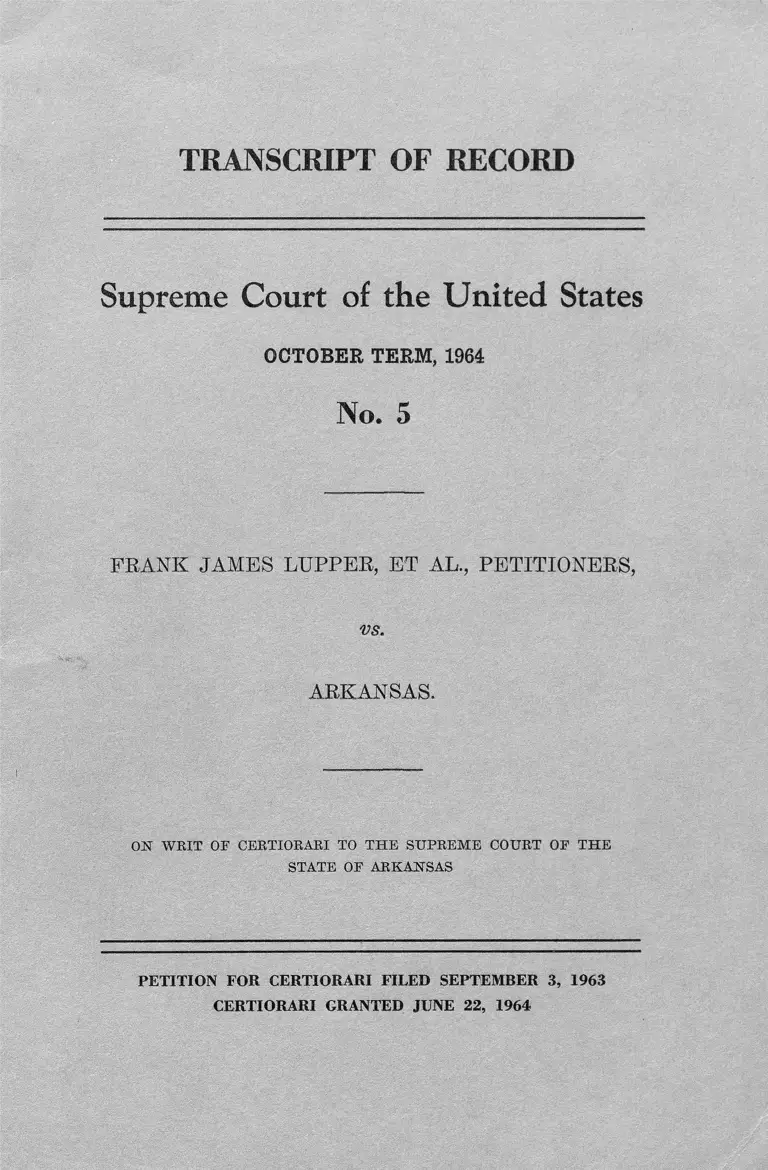
TRANSCRIPT OF RECORD
Supreme Court of the United States
OCTOBER TERM, 1964
No. 5
FRANK JAMES LUPPER, ET AL., PETITIONERS,
vs.
ARKANSAS.
ON WRIT OF CERTIORARI TO THE SUPREME COURT OF THE
STATE OF ARKANSAS
PETITION FOR CERTIORARI FILED SEPTEMBER 3, 1963
CERTIORARI GRANTED JUNE 22, 1964
SUPREME COURT OF THE UNITED STATES
OCTOBER TERM, 1964
'No. 5
FRANK JAMES LITPPER, ET AL., PETITIONERS,
vs.
ARKANSAS.
ON WRIT OF CERTIORARI TO THE SUPREME COURT OF THE
STATE OF ARKANSAS
I N D E X
Record from the Circuit Court of Pulaski County,
Arkansas, First Division, in Nos. 59130 and 59131
Appeal transcript re Frank James Lupper in the
Municipal Court of Little Rock, Arkansas,
Criminal Division, in Nos. 2488 and 2506 ____
Appeal transcript re Thomas B. Robinson in the
Municipal Court of Little Rock, Arkansas,
Criminal Division, in Nos. 2487 and 2505 ____
Order of continuance, May 9, 1960 ____________
Order of continuance, May 31, 1960 __________
Motions to dismiss ____________________________
Motion to quash or dismiss information________
Order overruling motions to dismiss __________
Verdict and judgment _______________________
Motion for new trial _________________________
Order overruling motion for new trial ________
Bail bond re Frank James Lupper____________
Bail bond re Thomas B. Robinson ____________
Bill of exceptions, June 17, 1960 _______________
Appearances ____________________________
Original Print
B 1
1 1
3 3
5 5
6 6
7 7
11 9
16 13
16 13
18 14
20 16
21 17
23 19
25 21
25 21
R ecord P ress, P rinters , N e w Y ork , N. Y., J u l y 15, 1964
11 INDEX
Original Print
Record from the Circuit Court of Pulaski County,
Arkansas, First Division, in Nos. 59130 and 59131
— Continued
Bill of exceptions, June 17,1960— Continued
Colloquy between Court and counsel re motions
to dismiss, and motion to quash, and ruling
thereon __________________________________ 25 21
Testimony of Paul Terrell—
direct_____________________ 34 26
cross _____________________ 38 28
redirect___________________ 41 30
recross____________________ 42 31
H. J. Talbert—
direct_____________________ 43 32
cross _____________________ 46 33
redirect___________________ 49 35
A. F. Baer—
direct_____________________ 49 36
cross _____________________ 55 39
Joseph Trianfonte—
direct_____________________ 57 41
Henry L. Holt—
direct_____________________ 63 45
cross _____________________ 68 48
redirect___________________ 71 50
recross____________________ 71 50
redirect___________________ 73 51
recross____________________ 73 51
Motion for a directed verdict and ruling there
on ________________________________________ 75 52
Testimony of Frank James Lupper—
direct_____________________ 77 53
cross _____________________ 81 56
Thomas B. Robinson—
direct_____________________ 88 60
cross -------------------------------- 92 63
Court’s instructions to ju r y _________________ 101 69
Jury’s verdict ______________________________ 111 74
Judge’s certificate _________________________ 114 75
Clerk’s certificate (omitted in printing) ______ 116 75
INDEX
Original Print
Proceedings in the Supreme Court of Arkansas in
No. 4997 _____________________________________ 117 76
Opinion, Johnson, J., in Nos. 4992, 4994, and 4997 117 76
Judgment----------------------------------------------------------- 132 87
Petition for rehearing _________________________ 133 88
Supplemental opinion denying rehearing, John
son, J. ----------------------------------------------------------- 134 89
Motion to stay mandate_________________________ 136 91
Clerk’s certificate (omitted in printing) _________ 137 91
Order allowing certiorari __________________ _____ 138 91
iii
1
[fol. A ] [File endorsement omitted]
[fol. B]
IN THE
CIRCUIT COURT OF PULASKI COUNTY, ARKANSAS
FIRST DIVISION
State of A rkansas, Plaintiff,
vs.
Frank J ames L upper, Defendant. No. 59130
T homas B. R obinson, Defendant. No. 59131
[fol. 1]
A ppeal Transcript
In the Municipal Court of L ittle Rock
Criminal D ivision
60-2488 and 2506
State of A rkansas,
vs.
Frank James L upper.
.......................................... )
) ss.
- ................................................................................................................... )
On the 21 day of April 1960, before Hon. Quinn Glover,
Judge of the Municipal Court of Little Rock, Arkansas,
came the defendant Frank James Lupper charged with the
offense of Acts 226 and 14 of 1959. Said defendant be
ing then before the court, in custody of the officer, and
after hearing the charge entered a plea of not guilty and
announced ready for trial, the witnesses were sworn and
the court proceeded with the trial. After hearing all the
evidence for and against the said defendant, the court
found the said defendant guilty as charged and assessed
against him fines of $250.00 and $150.00 Dollars, and cost
2
of $18.00 and 90 days confinement (60 days in #2488 and
30 days in #2506).
Now, on this 21 day of April 1960, within apt time
comes the defendant, by his attorney Harold B. Anderson
and prays an appeal to the Circuit Court, which is by the
Court granted, and the appeal bond fixed at (same as for
appearance in municipal court) Dollars, and a copy of the
testimony given at said trial ordered attached hereto,
which is so attached.
[fol. 2] The defendant having given the required bond
with ........................... .......... and ....... ........ .................... . as
sureties thereon, the defendant was ordered released from
custody to wait his case on appeal.
I, James L. Verhoeff, Clerk of the Municipal Court of
Little Bock, Arkansas, do hereby certify that the forego
ing is a true transcript of the record of this Court in the
above ease.
James L. Verhoeff, Clerk, Criminal Division, Munic
ipal Court.
Endorsed on Bach
No. 59130
State oe A rkansas,
vs.
F rank James Ltjpper (CM).
Offense
Acts 226 and 14 of 1959
Attorney
Harold B. Anderson
Filed
April 22,1960
Boger McNair, Circuit Clerk
By P. B. Frederick, D.C.
Fine ....................... $400.00
Act 138 ................. 1.00
State P olice........... 2.00
Ord. 10,737 ...........
Court Costs........... 15.00
Total ..... $418.00
Period of Imprisonment
90 Days
Witnesses
Same as in Cases #2487
and 2505
3
[fol. 3]
A ppeal T ranscript
In the Municipal Court op L ittle R ock
Criminal D ivision
60-2487 and 2505
State op A rkansas,
vs.
T homas B. R obinson.
.......................................... )
) ss.
.......................................... )
On this 21 day of April 1960, before Hon. Quinn Glover,
Judge of the Municipal Court of Little Rock, Arkansas,
came the Defendant Thomas B. Robinson charged with
the offense of Act 226 of 1959, and Act 14 of 1959. Said
defendant being then before the court, in custody of the
officer, and after hearing the charge entered a plea of not
guilty and announced ready for trial, the witnesses were
sworn and the court proceeded with the trial. After hear
ing all the evidence for and against the said defendant,
the court found the said defendant guilty as charged and
assess against him fines of $250.00 and $150.00 Dollars,
and cost of $18.00 and 90 days confinement (60 days in
#2487, and 30 days in #2505).
Now, on this 21 day of April 1960, within apt time comes
the defendant, by his attorney Harold B. Anderson and
prays an appeal to the Circuit Court, which by the Court
is granted, and the appeal bond fixed at (same as for ap
pearance in municipal court) Dollars, and a copy of the
testimony given at said trial ordered attached hereto, which
is so attached.
[fol. 4] The defendant having given the required bond
with .......................... ......... and .................... ...... ........... as
4
sureties thereon, the defendant was ordered released from
custody to await his case on appeal.
I, James L. Verhoeff, Clerk of the Municipal Court of
Little Rock, Arkansas, do hereby certify that the fore
going is a true transcript of the record of this Court in
the above ease.
James L. Verhoeff, Clerk, Criminal Division, Munic-
ipal Court.
Endorsed on Bach
No. 59131 Fine ....................... $400.00
State oe A rkansas, Act 138................... 1.00
vs. State Police........... 2.00
T homas B. R obinson (CM). Ord. 10,737 ...........
Offense Court Costs........... 15.00
Acts 226 and 14 of 1959 T ota l....... $418.00
Attorney Period of Imprisonment
Harold B. Anderson 90 days
Filed Witnesses
April 22, I960 Capt. Terral, Lt. Talbert,
Roger McNair, Circuit Clerk Sgt. Shemwell, Thomas and
By P. B. Frederick, D.C. Owens and Powers LRPD
5
[fol. 5]
In the Circuit Court oe P ulaski County, A rkansas
F irst D ivision
March Term, 1960
59130
State op A rkansas,
vs.
F rank J. L upper (CM ).
59131
State op A rkansas,
vs.
T homas B. R obinson (CM).
Order op Continuance—May 9,1960
This day comes the State of Arkansas by Frank Holt,
Prosecuting Attorney, and comes the defendants in proper
persons and by their attorney, Harold B. Anderson, and
defendants are called to the bar of the Court and informed
of the nature of the charge filed herein (violation of Acts
226 & 14 of 1959), and each defendant enters his plea of
not guilty thereto, and on motion of the defendants the
cases are passed to May 31, 1960 for court trials.
6
[fol. 6]
In the Circuit Court of P ulaski County, A rkansas
F irst Division
March Term, 1960
(Acts 226 and 14 of 1959)
59130
State of A rkansas,
vs.
F rank J. L upper (CM).
59131
State of A rkansas,
vs.
T homas B. R obinson (CM ).
Order of Continuance—May 31,1960
This day comes the State of Arkansas by Frank Holt,
Prosecuting Attorney, and come the defendants in proper
persons and by their attorneys, Harold Anderson and Wiley
Branton, and on motion of the defendants herein the Court
doth pass each case to June 17, 1960 for a jury trial.
7
F irst Division
No. 59130
No. 59131
[Titles omitted]
Motion to Dismiss—Filed June 17, 1960
Come the defendants, and move the Court to dismiss
the charge filed herein and for cause state:
1. That they deny that they are guilty of a violation of
Act 226.
2. That there is a violation of the equal protection and
the due process clauses of the Fourteenth Amendment to
the United States Constitution in that an instrumentality
of the State—by judicial enforcement of Act 226 in this
action—is being utilized against these defendants to pre
vent them and all other Negroes from securing equality of
treatment by peaceful persuasion.
3. That there is a violation of the due process of law
in that an instrumentality of the State seeks to compel the
adherence to an arbitrary standard applied to Negro in
vitees by private establishments by the enforcement of
Act 226 in this action, all in violation of the Fourteenth
Amendment to the Constitution of the United States.
4. That there is a violation of the equal protection clause
of the Fourteenth Amendment to the Constitution of the
United States in that the State has made available to pri-
[fol. 8] vate establishments—by the enforcement of Act
226 in this action—the full coercive power of government
to aid in the discrimination of Negro invitees because of
their race and color.
5. That there is a violation of the Constitution of the
United States in that the State is using its criminal statutes
to maintain racial segregation and discrimination.
[fol. 7]
I n t h e C ir c u it C ourt oe P u l a s k i C o u n t y , A r k a n sa s
8
Wiley A. Branton, 119 E. Barraque, Pine Bluff,
Arkansas;
Harold B. Anderson, 205 Century Building, Little
Bock, Arkansas,
Attorneys for defendants, By Harold B. Anderson.
[File endorsement omitted]
'[fol. 9]
In the Circuit Court of P ulaski County, A rkansas
F irst Division
No. 59130
No. 59131
[Titles omitted]
Motion to D ismiss— Filed June 17, 1960
Come the defendants, and move the Court to dismiss
the charge filed herein and for cause state:
1. That they deny that they are guilty of a violation of
Act 14.
2. That there is a violation of the equal protection and
the due process clauses of the Fourteenth Amendment to
the United States Constitution in that an instrumentality
of the State—by the judicial enforcement of Act 14—is
being utilized against these defendants to prevent them
and all other Negroes from securing equality of treatment
by peaceful persuasion.
3. That there is a violation of due process of law in
that an instrumentality of the State seeks to compel the
adherence to an arbitrary standard applied to Negro in
vitees by private establishments by the enforcement of
Act 14, all in violation of the Fourteenth Amendment to
the Constitution of the United States.
4. That there is a violation of the equal protection
clause of the Fourteenth Amendment to the Constitution
of the United States in that the State has made available
9
to private establishments—by the enforcement of Act 14—
'[fol. 10] the full coercive power of government to aid in
the discrimination of Negro invitees because of their race
and color.
5. That there is a violation of the Constitution of the
United States in that the State is using its criminal stat
utes to maintain racial segregation and discrimination.
Wiley A. Branton, 119 E. Barraque, Pine Bluff,
Arkansas;
Harold B. Anderson, 205 Century Building, Little
Rock, Arkansas,
Attorneys for defendants.
By Harold B. Anderson
[File endorsement omitted]
[fol. 11]
In the Circuit Court of P ulaski County, A rkansas
F irst Division
Nos. 59130 & 59131
[Title omitted]
Motion to Quash or Dismiss Information— Filed
June 17, 1960
Come the defendants and move the Court to Quash the
Informations filed herein or to otherwise dismiss the
charges contained therein and for cause, state:
(1) That Act 226 of the Acts of 1959 of the sixty-second
General Assembly of the State of Arkansas, under which
these defendants have been charged with creating a dis
turbance or breach of the peace, and Act 14 of the Acts
of 1959, under which these defendants have been charged
with failure to leave the business premises of a store after
request of the manager, are each unconstitutional as ap
plied to these defendants for the reason that this prosecu
tion or this attempt of prosecution of these defendants
under either of said Acts and under the Informations filed
10
herein is a denial to these defendants of the equal pro
tection of the laws as guaranteed to him under the Consti
tution of the United States of America and the Constitu
tion of Arkansas, in that these defendants were singled out
because of their race and color from all other parties at
tempting to receive services at the time and on the occa
sion of the alleged offenses.
(2) The State of Arkansas, acting through the Prose
cuting Attorney of the Sixth Judicial District and the
Police Department of the City of Little Rock, Arkansas,
[fol. 12] has denied to these defendants the equal protec
tion of the laws of the State of Arkansas and of the
United States of America, in that these defendants have
been arbitrarily and knowingly discriminated against by
the State of Arkansas because of their race and color and
by the arbitrary action on the part of the said prosecuting
attorney and the Police Department of the City of Little
Rock in arresting these defendants while these defendants
were in the process of enjoying or attempting to enjoy
equal rights with other citizens of Pulaski County, Ar
kansas. That the action on the part of the State of Ar
kansas, acting by and through the said prosecuting attorney
and the Police Department of the City of Little Rock,
Arkansas, is a denial to these defendants of the equal
protection of the laws of the State of Arkansas as guar
anteed to them by Article 11, Section 3 of the Constitution
of Arkansas, and is a denial to them of the privileges and
immunities guaranteed by Article 11, Section 18 of the
Constitution of Arkansas, and is a denial to them of their
rights under the Due Process and Equal Protection Clauses
of the Fourteenth Amendment to the Constitution of the
United States of America.
(3) That the State of Arkansas, acting through the
Prosecuting Attorney of the Sixth Judicial District and
the Police Department of the City of Little Rock, Arkan
sas in prosecuting and attempting to prosecute these de
fendants under the Informations filed herein, is fostering
the private prejudices of Blass Department Store in ar
resting and prosecuting these defendants solely because they
[fol. 13] are members of the Negro race and are of African
descent and the same is a denial by the State of Arkansas,
11
acting through the said prosecuting attorney and the Police
Department of the City of Little Rock, Arkansas, of the
rights guaranteed to these defendants under Article 11,
Section 3 and Section 18 of the Constitution of Arkansas
and the Due Process and Equal Protection Clauses of the
Fourteenth Amendment of the Constitution of the United
States of America.
(4) That the Informations filed herein against these
defendants and this prosecution should be dismissed for
the same is a denial to these defendants of the equal
protection of the laws of the State of Arkansas as guar
anteed to them under Article 11, Section 3 and Section 18
of the Constitution of Arkansas, and the same deprives
them of their liberty without due process of law and with
out the equal protection of the laws secured to them by
the Fourteenth Amendment to the Constitution of the
United States of America solely because of their race and
color in that these defendants are members of the Negro
race and of African descent and that the Information filed
against them and these prosecutions against them are
being made solely because of their race and color and these
defendants would not now be prosecuted and these Infor
mations would not now be pending against these defendants
except for the fact that they are members of the Negro
race and are of African descent.
(5) That Act 14 of the Acts of 1959, the statute under
which these defendants are charged with failing to leave
the premises of another or remaining on the premises of
[fol. 14] another after they had been ordered to leave said
premises is unconstitutional as applied to these defendants
in that it makes it a crime to be on property opened to the
public after being asked to leave, because of their race or
color, is a violation of the defendants’ rights under the
Due Process and the Equal Protection Clauses of the Four
teenth Amendment to the Constitution of the United States
of America and the equality before the law provisions
guaranteed by Article 11, Section 3 of the Constitution of
Arkansas and the Privileges and Immunities Clause pro
vided for in Article 11, Section 18 of the Constitution of
Arkansas.
12
(6) That Act 14 and Act 226 of the Acts of 1959 are each
violative of Article 11, Section 4 of the Constitution of
Arkansas in that they deny the right of these defendants
to peaceably assemble for the common good or to petition
by remonstrance for a lawful purpose.
(7) That Act 14 and Act 226 of the Acts of 1959 are
unconstitutional in that they violate Amendment 13 to the
Constitution of the United States of America in that the
State of Arkansas, acting through the Prosecuting Attor
ney of the Sixth Judicial District and the Police Depart
ment of Little Bock, Arkansas and also the officials of
Blass Department Store, are attempting by the use of said
Acts, to force the defendants, solely because of their color,
into a position of involuntary servitude by denying to the
defendants and all other members of the African or Negro
race the right to be served at lunch counters or restau
rants on the same basis that other members of the general
public are served.
[fol. 15] (8) That Act 14 of the Acts of 1959 is uncon
stitutional in that it is so vague that it does not prescribe
any standard of conduct or circumstances under which the
owner or manager of a business shall have the right to
request that a person leave the premises of said business
and does not apprise the person going upon the said prem
ises of the conduct expected of him to keep from violating
the said law or act.
(9) That Act 226 of the Acts of 1959 is written in such
a manner that it is impossible for one to determine, and
particularly it was impossible for these defendants to de
termine when, if at any time, they had violated said Act
and because of the vagueness, indefiniteness and uncer
tainty of said Act as applied to these defendants, the
arrest and prosecution of these defendants under said
vague and uncertain Act is a violation of these defendants’
rights under the Due Process Laws of the Fourteenth
Amendment to the Constitution of the United States of
America.
13
Wherefore, the defendants pray that the Informations
filed herein be quashed and that the charges now pending
against them be dismissed.
Wiley A. Branton, 119 E. Barraque, Pine Bluff,
Arkansas;
Harold B. Anderson, 205 Century Building, Little
Rock, Arkansas,
Attorneys for Defendants.
By Wiley A. Branton
[File endorsement omitted]
[fol. 16]
In the Circuit Court of P ulaski County, A rkansas
F irst Division
March Term, 1960
59130
59131
[Titles omitted]
Order Overruling Motions to Dismiss—June 17, 1960
V erdict and Judgment—June 17, 1960
This day comes the State of Arkansas by Frank Holt,
Prosecuting Attorney, and comes the defendants in proper
persons and by their attorneys, Harold Anderson and
Wiley Branton, and motions to dismiss and quash are filed
by the defendants and hearing held and the Court doth
overrule said motions, and parties announce ready for
trial; thereupon comes twelve qualified electors of Pulaski
County, viz: Mrs. Ouida McKissack, N. E. Harpole, Mrs.
Herbert Besser, S. N. Arick, Mrs. Joe R. Roberts, Joe Her
rick, Mrs. A. C. Salley, W. A. Treadway III, Mrs. Eura J.
Smith, Mrs. R. E. Freeman, Mrs. Roy Beard and A. L.
Pierce, who are duly selected, empaneled and sworn as a
trial Jury in these cases, and after hearing the testimony
14
of the witnesses, the instructions of the Court and the argu
ment of counsel the Jury doth retire to arrive at a verdict,
and after deliberation thereon doth return into open court
with the following verdicts: “ We, the Jury, find the defen
dant Frank J. Lupper guilty of violation of Act 226 of 1959,
as charged, and fix his punishment at both a fine of 500.00
Dollars and 6 months imprisonment. Joe Herrick, Fore
man.”
[fol. 17] “We, the Jury, find the defendant Frank J. Lup
per guilty of violation of Act 14 of 1959, as charged, and
fix his punishment at both a fine of 500.00 Dollars and 30
days imprisonment. Joe Herrick, Foreman.”
“ We, the Jury, find the defendant Thomas B. Bobinson
guilty of violation of Act 226 of 1959, as charged, and fix
his punishment at both a fine of 500.00 Dollars and 6 months
imprisonment. Joe Herrick, Foreman.”
“We, the Jury, find the defendant Thomas B. Robinson
guilty of violation of Act 14 of 1959, as charged, and fix
his punishment at both a fine of 500.00 Dollars and 30 days
imprisonment. Joe Herrick, Foreman.”
Whereupon the Court doth discharge the Jury from these
cases and the defendants are given thirty days in which to
file a Motion for a New Trial and bond is set at Two Thou
sand Dollars for each defendant pending filing of motion.
[fol. 18]
l x the Circuit Court oe P ulaski County, A rkansas
F irst Division
59130
59131
[Titles omitted]
Motion for New Trial—Filed July 14, 1960
Come the defendants, Frank James Lupper and Thomas
B. Robinson, by their attorneys, Harold B. Anderson and
Wiley A. Branton, and hereby move the Court to grant a
new trial in this case and for cause therefor state:
15
1. Because the Court erred in overruling the defendants’
Motion to Dismiss which was filed prior to the hearing of
the evidence over the exceptions of the defendants.
2. The Court erred in overruling defendants’ oral mo
tion to declare Act 226 unconstitutional for vagueness.
3. Because the Court erred in overruling defendants’
Motion for a directed verdict after the State had rested.
4. Because the Court erred in overruling defendants’
Motion for a directed verdict after the State and the defen
dants had rested.
5. Because the Court erred in giving to the Jury the
State’s requested Instructions No. 1 and No. 1-A over the
objections and exceptions of the defendants.
6. Because the Court erred in giving to the Jury the
State’s requested Instruction No. 2, over the objections and
exceptions of the Defendants.
[fol. 19] 7. Because the Court erred in giving to the Jury
the State’s requested Instruction No. 3, over the objections
and exceptions of the defendants.
8. Because the Court erred in giving to the Jury the
State’s requested Instruction No. 4, over the objections and
exceptions of the defendants.
9. Because the Court erred in refusing to give to the
Jury the defendants’ requested Instruction No. 3, over the
objections and exceptions of the defendants.
10. Because the Court erred in refusing to give to the
Jury the defendants’ requested Instruction No. 5, over the
objections and exceptions of the defendants.
11. Because the verdict was contrary to law.
12. Because the verdict was contrary to the evidence.
13. Because the verdict was contrary to both the law and
the evidence.
14. Because the judgment is excessive.
16
Wherefore, defendants pray that the judgment hereto
fore entered in this case be vacated and that each of said
defendants be granted a new trial.
Respectfully submitted,
Wiley A. Branton, 119 E. Barraque, Pine Bluff,
Arkansas.
Harold B. Anderson, 205 Century Building, Little
Rock, Arkansas.
By Harold B. Anderson.
[File endorsement omitted]
[fol. 20]
In the Circuit Court oe P ulaski County, A rkansas
F irst D ivision
March Term, 1960
59130
59131
[Titles omitted]
(Act 226 and Act 14 of 1959)
Order Overruling Motion for New Trial—
July 14, 1960
This day comes the State of Arkansas by Frank Holt,
Prosecuting Attorney, and come the defendants by their
attorneys, Harold Anderson and Wiley Branton, and Mo
tion for a New Trial is overruled by the Court and defen
dants exceptions are saved and appeals are prayed and
granted and defendants are given thirty days to file Bill of
Exceptions.
17
F irst Division
Bail B ond—Filed June 18, 1960
State of Arkansas,
County of Pulaski, ss.
.......................................... )
) ss.
.....-.................................... )
Frank James Lupper B.M, being in custody, charged
with the offense of Violation of Ark. Statutes Act 11 &
Act 226 and being permitted to give bail in the sum of
Two Thousand Dollars.
Now we, G. Q. Anderson hereby undertake that the above
named Frank James Lupper shall appear in the Arkansas
Supreme Court, from day to day of its Regular Term,
1960, or any term thereafter, to answer to said charge, and
shall at all times, render himself amendable to the order
and process of said Court, in the prosecution of said charge
and that he will not depart therefrom without leave of the
Court, and if convicted shall render himself in execution
thereof, or if he fails to perform either of these conditions
that we will pay to the State of Arkansas the sum of
Two Thousand Dollars.
Approved
L. C. Young, Sheriff, Pulaski County, Ark., By A. I.
Baker, D.C.
Frank James Lupper, L.S., Anderson Bonding Co.,
By George West, L.S.
G. Q. Anderson and ...................................... upon their
oath say that they are citizens of the State of Arkansas, and
worth the sum set opposite their respective names in prop
erty situated in said State over and above their just
debts, liabilities and exemptions and subject to execution
to-wit:
[fol. 21]
1st t h e C ir c u it C o u rt of P u l a s k i C o u n t y , A r k an sa s
18
[fol. 22]
Property Real
Name Personal Estate Total
East 77 Ft. of Lot 7 Block 227 4000.00 4000.00
City of Little Rock.
(Located 800 West 8th Street L.R.)
Aggregate...... ...................... 4000.00
Subscribed and sworn to before me ...................................
this 17th day of June 1960.
Approved
L. C. Young, Sheriff, Pulaski County, Ark., By A. I.
Baker, D.C.
Endorsed on the. Back
No. 59130
Bail Bond
State of A rkansas,
vs.
F rank James L tjpper.
Gf. Q. Anderson
Sureties
[File endorsement omitted]
19
F irst D ivision
Bail B ond— Filed June 18, 1960
State of Arkansas,
County of Pulaski, ss.
....... - ..... - ...... - ...... )
) ss.
.......................................... )
Thomas B. Eobinson B. M. being in custody, charged
with the offense of Violation of Act 14 & Act 226 and
being permitted to give bail in the sum of Two Thousand
Dollars.
Now we, G. Q. Anderson hereby undertake that the above
named Thomas B. Eobinson shall appear in the Arkansas
Supreme Court, from day to day of its Eegular Term,
1960, or any term thereafter, to answer said charge, and
shall at all times, render himself amendable to the order
and process of said Court, in the prosecution of said charge
and that he will not depart therefrom without leave of
the Court, and if convicted shall render himself in execution
thereof, or if he fails to perform either of these conditions
that we will pay to the State of Arkansas the sum of Two
Thousand Dollars.
approved
L. C. Young, Sheriff, Pulaski County, Ark., By A. I.
Baker, D.C.
Thomas B. Eobinson, L.S., Anderson Bonding Co.,
By George West, L.S.
G. Q. Anderson and ------------------------- ------ upon their
oath say that they are citizens of the State of Arkansas,
and worth the sum set opposite their respective names in
property situated in said State over and above their just
debts, liabilities and exemptions and subject to execution,
to-wit:
[fol. 23]
I n t h e C ir c u it C ourt of P u l a s k i C o u n t y , A r k a n sa s
20
[fol. 24]
Personal Real
Name Property Estate Total
East 77 Ft. of Lot 7 Block 227 4000.00 4000.00
City of Little Bock
Aggregate ............................ 4000.00
Subscribed and sworn to before me ..................................
this 17 day of June 1960.
Approved
L. C. Young, Sheriff, Pulaski County, Ark., By A. I.
Baker, D.C.
Endorsed on the Back
No. 59131
Bail Bond
S t a t e oe A r k a n s a s ,
vs.
T h o m a s B . B o b in s o n .
G. Q. Anderson
Sureties
[File endorsement omitted]
21
F irst D ivision
[fol. 25]
Iw t h e C ir c u it C ourt of P u l a s k i C o u n t y , A r k a n sa s
No. 59130
State of Arkansas,
vs.
F rank James Lupper.
No. 59131
State of A rkansas,
vs.
T homas B. R obinson.
B ill of E xceptions—June 17,1960
Be It Remembered that on this 17th day of June, 1960,
the same being a day of the regular March, i960, term of the
Pulaski Circuit Court, First Division, Before the Honorable
William J. Kirby, Judge of said Court, and a Jury, this
cause came on to be heard, the State of Arkansas being
represented by the Hon. Frank Holt, and the defendants be
ing represented by Hon. Wiley Branton and Hon. Harold
Anderson, and both parties announcing ready, thereupon,
the following proceedings were had and done, objections
made, exceptions saved, etc., to-wit:
Colloquy B etween Court and Counsel R e Motions to
D ismiss, and Motion to Quash, and R uling T hereon
Mr. Anderson: Your Honor, we would like—we have
some motions we would like to enter.
The Court: Sir?
[fol. 26] Mr. Anderson: We have some motions we would
like to enter.
The Court: The Court will dispose of them. Do you
want to argue the motions?
22
_ Mr. Branton: Well, if there’s going to be some discus
sion, it ought to be in chambers.
The Court: Excuse me, ladies and gentlemen, we have
some motions we want to decide. We will retire to cham
bers.
(Thereupon, the Court and Counsel, retired to chambers
and thereafter occurred the following proceedings.)
The Court: Have you got your motions, Counselor?
Mi*. Anderson: Yes, sir, just a moment.
The Court: Did you furnish the State a copy ?
Mr. Anderson: Yes, sir.
The Court: Have they been filed yet 1
Mr. Anderson: No, sir, they haven’t been.
The Court: Have the Clerk mark them filed.
Mr. Branton: These have not been filed with the Clerk,
Your Honor.
The Court: All right. Mark them filed, Mr. Clerk. Now,
let’s see. I have got two motion to dismiss and a motion to
quash.
Mr. Branton: Now, Judge, these two motions right
[fol. 27] here, in order to save time and in fairness to the
Court and Counsel, these motions are identical to the two
motions or rather to one of the motions which was filed
in the case which was tried about two weeks ago, the only
difference between them is that one of them refers to Act
14 specifically and the other one refers specifically to
Act 226.
The Court: Act 226, yes.
Mr. Branton: But the sense of the motions is pretty
much word for word like the motions which we previously
submitted to the Court.
The Court: All right.
Mr. Branton: I say that because the Court has seen
them. He is familiar with them and I don’t think we raise
anything new in these particular motions.
The Court: All right. Let the motion to dismiss in Case
No. 59130 and 59131, Lupper and Robinson, and the motion
to dismiss in the same cases as to Act 226 and as to Act
14, both be overruled. Save his exceptions. Now, you want
to argue this motion to quash?
23
Mr. Branton: Now, the other motion to quash or dismiss
has not previously been submitted to the Court in any
[fob 28] form that I am aware of.
The Court: All right. Let me read it.
Mr. Branton: It is rather lengthy. It has nine separate
paragraphs, each one being a separate motion.
The Court: You want to argue the motion!
Mr. Branton: If Your Honor please.
The Court: You may remain seated.
Mr. Branton: All right, sir. We feel that Act 226 is
clearly unconstitutional as applied not only to the Arkan
sas Law but to the Federal Constitution. The Statute sets
out a certain line of conduct that leaves any person doubt
ful as to exactly what standard of conduct he can or cannot
conform to and still not be guilty of a violation of this law.
Now, Act 226 is the disturbing the peace act.
Mr. Anderson: Yes.
Mr. Branton: We think that in the way it is worded that
it is just unconstitutional on its face, that it is impossible
to set a standard of conduct that one could conform to and
that as such it is unconstitutional on its face for vagueness
[fob 29] and indefiniteness and in addition to that we
charge that the Act is being used to accomplish an unlaw
ful purpose, that it is being used in a discriminatory man
ner, that the defendants in this case are negroes or persons
of African descent and that the Act is being used to deny
to these defendants and any other negroes similarly situa
tion the right of equality of opportunity, equality before
the law. It denies to them the right to petition and other
guarantees which are set out, not only in our State Con
stitution but in the Federal Constitution and on those
grounds as to Act 226 we say that that act is unconstitu
tional. As to Act 14, the failure to leave after being re
quested to do so, we say that that Act is entirely too vague
and is unconstitutional on its face. It does not set up any
standard of reason which might be advanced for allowing
a manager to refuse service to any one. In other words,
obviously a person could come into a store under this
Statute and decide that they wanted to make a purchase,
pay some money over to the manager or to the clerk, the
clerk would refuse to give them any goods for any money
[fob 30] and the person could say, “ If you are not going
24
to give me the goods,” the manager could say, “You get
out of here,” and under the Act that person, if they refuse
to leave, even though they had paid money, it leaves it open
there for the manager of that store to have that person
arrested under this and exempts the store from liability
for arrest for doing so. It sets up no reasonable require
ments for leaving the store. It just says any person who
refuses to leave. It doesn’t say within any certain length
of time. It sets no standards for departure or anything
else and this being a criminal statute, it ought to be a little
more specific than that.
In addition to that argument about the unconstitution
ality on its face, we raise the same argument that we do
as to Act 226 and again Act 14 is being used in a normal
manner to discriminate against the defendants solely be
cause of their color.
Mr. Holt: If the Court please, the State takes the same
position it has in other cases where similar motions have
[fol. 31] been filed and briefly it is that the Acts are not
discriminatory in the wording nor in its application and it
is the Acts are a valid exercise of the police power of the
State.
The Court: I am going to overrule the motions. Save
the exceptions.
Mr. Branton: All right, sir.
(Thereupon, the Court and Counsel returned to the
Court Boom, and thereupon the Jury Panel was called and
sworn and thereafter occurred the following proceedings.)
The Court: Is the State ready?
Mr. Holt: Yes, sir.
The Court: Is the defense ready?
Mr. Anderson: Tes, sir.
The Court: Ladies and gentlemen, we have Frank Lup-
per and Thomas Robinson here as defendants. Will you
gentlemen stand up please and let the Jury see you. You
may sit down. Mr. Wiley Branton here on their immediate
right and Mr. Harold Anderson are going to defend. Of
course, you all know Attorney General Holt and his assist
ant, Mr. Horton. These parties are charged with violating
two Acts. I am not too familiar with them. I will read
25
[fol. 32] them to you all and let you understand the charge,
that is, I will read the pertinent portions of them to you.
I don’t know whether I want to read the whole Act or not,
hut they are charged with violation of Act 14 of 1959,
which has this title: “ An Act to Render it Unlawful for
any person to refuse to leave the business premises of any
person when so requested by the order or manager thereof;
to render it unlawful for any person, firm, association, cor
poration or other organization to aid, encourage, counsel
or assist any person or persons to do any act in violation
of the provisions of this Act; to authorize the removal of
any person refusing to leave the premises at the request
of the owner or manager of such premises; to provide pen
alties for violations of this Act; and for other purposes.”
The Section of the Act I assume is Section 1, I imagine
they are charged under. Let me see. It just says Act 14.
Anyway, after the preamble where the reporter whereases
a couple of times, Section 1 reads as follows:
“Any person who after having entered the business
premises of any other person, firm, or corporation, other
[fol. 33] than a common carrier and who shall refuse to
depart therefrom upon request of the owner or manager of
such business establishment, shall be deemed guilty of a
misdemeanor and upon conviction shall be fined not less
than fifty ($50.00) Dollars, nor more than five hundred
($500.) Dollars, or by imprisonment not to exceed thirty
(30) days, or both such fine and imprisonment.”
As I understand it now, that is the section under— Sec
tion 1 of Act 14, under which these parties are charged is
that right?
Mr. Holt: Yes, sir.
The Court: All right. Now, let me get Section 226. Now,
of course, that is not all of Act 14. It has six or seven other
sections, but I think that is the pertinent section and I just
want to read to you the pertinent sections so you will know
something about this when I ask you if you know any rea
son why you can’t sit on this case. That is the only pur
pose.
“An Act to prohibit any person from creating a disturb
ance for breach of the peace in any public place of business
and to prescribe the penalty therefor.”
26
[fol. 34] And it reads, Section 1, as follows:
“ Any person who shall enter any public place of busi
ness of any kind whatsoever, or upon the premises of such
public place of business, or any public place whatsoever
in the State of Arkansas and while therein or thereon shall
create a disturbance, or a breach of the peace, in any way
whatsoever, including, but not restricted to, loud and offen
sive talk, the making of threats or attempting to intimidate
or any other conduct which causes a disturbance or breach
of the peace of threatened breach of the peace shall be
guilty of a misdemeanor, and upon conviction thereof shall
be fined not more than five hundred ($500) dollars, or im
prisoned in jail not more than six months, or both such
fine and imprisonment.”
(Thereupon, a drawn and struck jury was selected and
opening statements were made by Counsel and thereafter
occurred the following proceedings.)
The Court: Call your first witness, Mr. Holt.
Thereupon, Paul Terrell, called as a witness on behalf
of the State, after being first duly sworn by the Clerk, in
answer to questions propounded, testified as follows,
to-wit:
[fol. 35] Direct Examination.
By Mr. H olt:
Q. State your name, please ?
A. Captain Paul Terrell, Little Rock Police Department.
Q. How long have you been an officer there!
A. Nineteen years.
Q. Captain, on April 13, 1960, did you have occasion to
make an investigation of an alleged offense at Blasses De
partment Store in Little Rock, Arkansas ?
A. I did.
Q. Do you recall what you—caused you to be there and
what you observed?
A. We, Lieutenant Talbert and myself, Officer Baer, and
Officer Thomas, we were at 4th and Main Streets in front
of the Worthen Bank. We were at the corner of 4th and
27
Main, over in front of the Worthen Bank Building. It’s
about twelve noon. Mr. Holt and Mr. Trianfonte, I believe
is the way he pronounces his name, Trianfonte or some
thing like that, but anyway they come over and identified
themselves as being the manager and assistant manager
of Blass’ Department Store, said they had some colored
boys.
Mr. Branton: I object to what was said.
[fol. 36] The Court: Just tell what you did, Mr. Terrell,
after you had this conversation with them.
The Witness: They asked us if we would assist them.
We went over to Blass’ Department Store and when we
got inside the store, just about 20 feet from the elevator
we observed two negro boys that they pointed out to us
and said they were the ones that had sat—
Mr. Branton: I object unless this was done in the pres
ence and hearing of the defendants, Your Honor.
The Court: Was it in the presence and hearing of the
defendants, Mr. Terrell?
The Witness: It was.
The Court: All right, proceed.
The Witness : They pointed out these two boys, said they
were the ones that— Thomas B. Robinson and Frank James
Lupper.
By Mr. Holt:
Q. Are they present in the Court Boom today?
A. They are.
Q. All right. Go ahead.
A. They said they were the ones that had—I asked them,
or they said they were the ones that had been in their lunch
counter and sat down. 1 asked Bobinson in the presence
[fol. 37] of all of us, Lieutenant Talbert and myself, Mr.
Trianfonte and Holt, if they were the ones that was at the
lunch counter. Robinson spoke up and said he was. Also
Lupper said he was also present and we arrested them,
brought them both to headquarters. Actually their state
ment was made in the presence of Lieutenant Talbert and
myself, Mr. Holt.
Q. Where is the lunch counter there, do you know?
A. It is up on the mezzanine floor, the second floor.
Q. And this conversation in their presence and with the
—was where in the store ?
A. Directly underneath the lunch counter.
Q. Did they state to you that they had sat at the lunch
counter ?
A. They did.
Q. Did they state to you that they had been asked to
leave ?
A. They did.
Q. Did they state to you that they had refused to leave?
A. Yes, sir.
Q. Would you be able to tell this Court and Jury the de
meanor of the patrons in the store at the time you were
talking to them or do you know?
A. As far as the lunch counter, I couldn’t say, but there
were several white people that followed them and ganged
up around us while we were talking to them. There was
quite a few people there. I would say 25 or 30 people.
[fol. 38] Q. Did you find it necessary to restrain any one
or not while they were—you were talking to them?
A. There was several people walked up there and asked
what we were going to do, wanted to know what was
going on, you know, and so forth. They asked several ques
tions.
Mr. Holt: Your witness.
Cross examination.
By Mr. Anderson:
Q. Officer Terrell, you were in Municipal Court when
this case was tried is that correct?
A. Yes, sir.
Q. And in that case you didn’t testify to any of that that
you said here, did you?
A. I am sure I did.
Q. Did you say that they had ganged up, that anybody
had to be restrained?
A. I don’t remember just what I did testify there.
Q. Then who was with you, Lieutenant Terrell?
29
A. Lieutenant Talbert.
Q. Now, as far as yon observed, these boys weren’t doing
anything, were they, when you were talking to them? They
were orderly?
A. They were coming out of the store. I mean—
[fol.39] Q. But they were orderly?
A. As far as—yes.
Q. Except for what the manager had said to you, you
had no reason to arrest them, is that correct?
A. Except from the complaint of the manager.
Q. And did he request you to arrest them?
A. He did. He had requested our assistance to get them
out from the lunch counter when he come over to get us.
Q. But they weren’t at the lunch counter, were they?
A. He told us that he had two boys that had refused to
leave the lunch counter and asked that we assist them.
Q. But you don’t know that they did any of these things,
did you?
A. I do not except their word. They said they had been
up there and they had been asked to leave and refused to
leave.
Q. Was Officer Talbert standing near you, very near?
A. I am sure he was.
Q. He was close enough to have heard it?
A. I think—yes, he was.
Q. Then he could have heard what you heard, is that
correct?
A. I would think so.
Q. Well, there is no reason why he couldn’t have heard,
is that correct?
A. Well, I couldn’t say whether he could hear exactly
[fob 40] what I did. I wTas talking to them. Maybe he was
talking to some of them. I couldn’t say just exactly what
he heard and what he didn’t.
Q. Now, you talked to both boys ?
A. Yes, I asked both of them had they been at the lunch
counter and they said they had.
Q. You asked each one individually?
A. That is right.
Q. Now, are you positive that you asked them if they re
fused to leave?
30
A. I asked them were they the ones at the lunch counter
and had Mr. Holt asked them to leave. They said yes, that
they wanted to be served.
Q. But I am saying are you positive that they told you
that they refused to leave?
A. They said they had been asked to leave.
Q. And that is all ?
A. (No response.)
Mr. Branton: Get his answer in the record. The nod of
his head doesn’t help the record any.
The Witness: Do what?
By Mr. Anderson:
Q. Instead of answering you nodded your head to the
question.
A. Nod your head?
[fol. 41] Q. Is that right?
A. Now, ask the question again.
Mr. Anderson: Read the question, Mr. Reporter.
(Question read.)
The Witness: I answered the question, I believe, by say
ing that they had been asked to leave.
Mr. Anderson: There was another question, I believe,
there, wasn’t there ?
The Court: Well, ask him the question again and let him
answer it.
By Mr. Anderson:
Q. The thing that they told you was that they had been
asked to leave?
A. They did.
Redirect examination.
By Mr. Holt:
Q. What time of day was this, Captain?
A. It was twelve, twelve noon.
Q. Was there a large or small crowd in the store?
31
A. There was a large crowd. I believe there was some
thing, I forget what it was, but anyway there was a large
crowd downtown that day.
Mr. H olt: No further questions.
The Court: Both of you gentlemen through with this
[fob 42] witness?
Mr. Holt: Yes, sir.
Recross examination.
By Mr. Anderson:
Q. Did the defendants seem to be leaving the store when
you met them, is that correct?
A. No, I didn’t say they were leaving the store. I might
have said, but they were leaving towards the elevator.
They were about halfway from here to you or maybe a lit
tle further from the elevator, but the elevator is in the cen
ter of the store.
Q. In which direction were they going?
A. They were—there was a large crowd in there. They
were coming from the elevator which would have been
going south from the elevator.
Q. Going toward the south entrance?
A. I couldn’t say. There is an aisleway there. They
could—I couldn’t say that they were going out of the store.
Q. But they were going out of the door there or some
other department in the store?
A. There were several aisles there. They could have
been going any direction.
Mr. Anderson: That is all.
[fol. 43] The Court: Either one of your gentlemen want
the Captain any further ?
Mr. Anderson: No, I don’t think so. No, sir.
The Court: You may be excused.
(Witness excused.)
The Court: Call your next witness.
32
Thereupon, H. J. Talbert, called as a witness on behalf
of the State, after being first duly sworn by the Clerk, in
answer to questions propounded, testified as follows,
to-wit:
Direct examination.
By Mr. Holt:
Q. State your name, please.
A. H. J. Talbert.
Q. And where do you work?
A. Little Rock Police Department.
Q. How long have you been a police officer?
A. Eighteen years.
Q. You assist in the investigation at Blass’ Department
Store in Little Rock on April 13th?
A. Yes, sir, I did.
Q. How, what attracted your attention?
A. Two men come running across the street on the corner
[fol. 44] in front of the Forthen Bank.
Q. Do you know who those men were ?
A. They told us they were managers of the department
store.
Q- All right. And don’t tell what they told you, but based
on your information, what did you do?
A. Went in the store.
Q. And who went with you, Officer ?
A. Captain Terrell.
Q. And what did you observe when you got in there ?
A. I observed two negroes coming down the aisle in the
store, was pointed out to me.
Q. Were the two men who complained with you at that
time?
A. They was.
Q. Do you see those two in the court room today who
were pointed out to you, the two defendants ?
A. These two boys on my right.
Q. Do you recall their names?
A. No, sir, I don’t. We had had 12 or 15 that day.
Q. Now, on what floor of the store was it that you—
A. The ground floor.
33
Q. And did you or Captain Terrell or anyone talk to the
boys at that time ?
A. We both talked to them.
[fob 45] Q. Was anything asked by them about why they
were there?
A. I asked the big boy there if he had been sitting at
the lunch counter and he said he did.
Q. Did you ask him if he was asked to leave ?
A. I did.
Q. What did he say?
A. He said that he was.
Q. What did he say, he left ?
A. He said he refused.
Q. Did you question the other one as to whether he had
refused to leave or not?
A. I did not.
Q. Did you know about what time of day it was ?
A. It was between 11:45 and 12:00 o’clock.
Q. Was there a small or large number of people in the
store?
A. There was, I would say, over a normal crowTd, a large
crowd of people.
Q. Officer, could you say from your experience as an offi
cer what the demeanor of the patrons of the store were and
was it noticeable?
A. I didn’t notice it in that store at that time.
Mr. H olt: Your witness.
[fol. 46] Cross examination.
By Mr. Anderson:
Q. Now, Officer Talbert, you were present in the Muni
cipal Court, is that correct?
A. I was.
Q. Now, I will ask you if you didn’t testify to this in
Municipal Court:
“Answer: Captain Terrell talked to the boys and asked
them if they were at the lunch counter. They said they
34
were. He asked them if they refused to leave and one of
them said he did.”
That was your answer in the Municipal Court.
“ Question: Did the other one deny it,” was the question
asked of you.
“Answer: The other one denied it to me.” That was
your answer in Municipal Court,
_ “ Question: Do you know which one it was,” is the ques
tion following and you answered:
“Answer: This one here said he refused to leave.
“ Question: Is that Lupper or Robinson?
“Answer: I believe this is the one, this is Robinson.
“ Question: Go ahead.
“ Answer: This big boy, Lupper, he reared up and
pointed his finger at Mr. Holt and said he didn’t refuse
[fol. 47] to leave. We put them under arrest and took
them out of the store.”
Now, that was your testimony in Municipal Court,
wasn’t it?
A. I think so. I don’t remember.
Q. Well, then why did you change it here this morning?
A. Because I testified to what I done.
Q. You testified now that both of these boys told you
that, didn’t you?
A. No, sir, I did not.
Q. That is not your testimony this morning?
A. No.
Q. Then you are saying—
A. That one of them.
Q. That Robinson said he refused?
A. That one of them is the one I talked to.
Q. That is right, You were standing next to—
A. We was altogether.
Q. You were next to Captain Terrell?
A. We was all, the two men, the two negroes and Cap
tain Terrell was all standing in one bunch.
Q, That is right. And you could hear what was going on
and what was said ?
A. That is right. That is right.
35
[fol. 48] Q. And this boy said in this group he did not
refuse to leave? He denied it?
A. This big boy is the one that said he refused to leave.
Q. But he did say that in the presence of Captain Terrell?
A. Yes, we was all standing there together, the two store
managers.
Q. Now, I believe it was also your testimony there in the
Court that as far as you knew and from what you observed
these boys had done nothing for you to arrest them, is that
correct?
A. Only on what the men said.
Q. Just what the manager said?
A. That is right. That is right.
Q. In other words, their conduct was all right? It was
orderly and well behaved ?
A. They was coming down the aisle when we stopped
them.
Q. Yes, weren’t bothering anybody or weren’t molesting
anybody?
A. That is right.
Q. Weren’t loud and boisterous?
A. No.
Q. In other words, their conduct wasn’t threatening to
disturb the peace in any manner, was it?
A. Not when we stopped them, no.
Mr. Anderson: That is all.
[fol. 49] Redirect examination.
By Mr. Holt:
Q. Which one, Officer, told you if you can identify him
that he sat at the lunch counter and refused to leave?
A. The big fat man on this end.
Mr. Holt: All right. No further questions.
The Court: You may be excused, Lieutenant.
(Witness excused.)
36
Thereupon, A. F. Baer, called as a witness on behalf of
the State, after having been first duly sworn by the State,
in answer to questions propounded, testified as follows, to-
wit:
Direct examination.
By Mr. Holt:
Q. State your name, please!
A. A. F. Baer.
Q. Where do you live f
A. 711 Maple, North Little Rock.
Q. Where do you work!
A. Little Rock Police Department.
Q. What is your rank!
A. Sir!
Q. Your rank!
[fol. 50] A. Patrolman.
Q. How long have you worked there ?
A. Four and a half years.
Q. Officer, did you have occasion on April 13, 1960, with
other officers to make an investigation of an alleged offense
at Blass’ Department Store in Little Rock!
A. Yes, sir.
Q. Who all, Officer, did you work with!
A. I was with Lieutenant Talbert and Captain Terrell.
Q. Where were you when you received information to go
there!
A. I was working that beat at the particular time.
Q. What did you observe on that date!
A. I observed that there was a group of negroes that
proceeded in the store that—some went in the front door
and some went in the Fourth Street side and I knew that
they were these sit-downers they have been called because
most of them had their badges on and I followed them in
and observed them sitting down upstairs.
Mr. Branton: If Your Honor please, I object to this
testimony unless it can be shown that these defendants
were a part of any group that the witness saw go in.
The Court: Objection sustained.
37
[fol. 51] By Mr. H olt:
Q. Can you?
A. Eobinson was in the group of negroes. I had seen
him once or twice before.
The Court: You knew him, did you, enough to recognize
him?
The Witness: I had come to recognize him, yes, sir.
The Court: All right. Proceed.
The Witness : On account of his glasses and his build.
The Court: Which one is Eobinson?
The Witness : He is the heavy set one on the right.
The Court: I see. All right.
The Witness: I proceeded down and called headquarters
and advised them.
Mr. Branton: I object to what he advised headquarters.
The Court: Don’t tell us what you told somebody. Just
tell us what you did.
The Witness: Well, I called headquarters.
The Court: All right. Now, then what happened? Don’t
give conversation.
The Witness: And they said—
The Court: That is what we are trying to get at.
The Witness: They sent the Lieutenant and the Captain
down there, talked to Mr. Trianfonte of the Blass store,
[fol. 52] He advised us of the situation there.
The Court: Don’t tell what he advised you. Just what
did you do after you got the information?
The Witness: We went into the store, walked up to
Lupper and Eobinson. They admitted to us that they had
been upstairs and sat down and that they were the two
that had refused to leave.
By Mr. H olt:
Q. So where did you—where were you when you ob
served these two defendants in the store? In what part
of the store did you first see them?
A. I was upstairs.
Q. Did you see—
A. In the eating place, the lunch counter, whatever it is
called.
Q. How many were sitting there or sat down there ?
A. I would say between 12, 15, maybe more. I am not
sure.
Q. Were you present when any person working for the
store approached and conversed with them?
A. No, sir, I wasn’t.
Q. Did you observe any of them leave or not?
A. When I came back outside from using the phone and
the wagon had driven up and several police cars, they were
beginning to come out.
Q. Did you talk to any of them while they were sitting at
[fol. 53] the lunch counter yourself?
A. No, sir.
Q. Did you hear anyone talk to them?
A. I talked to the store employee. I don’t know his name
and he advised he was waiting for the manager at the time.
Q. Well, don’t say what he said. Did you have a conver
sation with Lupper or Robinson either during your investi
gation? Did you talk to the defendants?
A. No, sir, other than advised them they were under
arrest after the Lieutenant and Captain was talking. We
were all three together there at the same time.
Q. Did they refuse to leave at your request or anybody
else’s from your own personal knowledge?
A. Trianfonte.
Q. No, not what he told you, in other words.
The Court: Were you there when anybody requested
them to leave is what he is trying to get at.
Mr. Holt: Yes, sir.
The Witness: No, sir, not when they requested them to
leave. They advised us.
The Court: Well, that is what he wants.
The Witness: We asked them and they advised us that
they were to—
Mr. Branton: I object to that.
[fol. 54] By Mr. H olt:
Q. No, only your conversation with the defendants or in
their presence.
A. They didn’t, no, sir.
Q. You didn’t have a conversation with them?
A. Personally.
Q. All right.
39
The Court: Were you present when the Lieutenant and
the Captain had any conversation with them?
The Witness: Yes, sir.
The Court: Now, if you want to ask what they said, ask
him what they said.
By Mr. H olt:
Q. Were you present when the other officers questioned
them?
A. Yes, sir.
Q. Did they admit or deny either or both of them that
they were at the lunch counter?
A. They both admitted that they were, had been up to
the lunch counter and they were asked then if they had
refused to leave and they both said that they had.
Mr. Holt: Your witness.
[fol. 55] Cross examination.
By Mr. Branton:
Q. Officer Baer, have you ever testified previously in
this case in Municipal Court?
A. No, sir.
Q. Now, where were you when Captain Terrell and is it
Lieutenant Talbert?
A. Yes, sir.
Q. Lieutenant Talbert first made contact with the defen
dants ?
A. I was standing—we were all five right to—well, there
was six of us counting the employees standing there, plus
there’s quite a crowd of people there. We were altogether.
Q. And where was this in the store ?
A. Oh, Judge, maybe 25 foot from the elevator, maybe
a little farther than that. It was kind of in the middle of
the main floor.
Q. Was this on the first floor?
A. Yes, sir.
Q. Did it appear that the defendants were in the act of
leaving the store when they were stopped by your group?
40
A. As near as I can recall, I believe they were just stand
ing there when we walked up to them. They were still just
—they were just standing at the—there was some going
and coming. These two happened to be just standing there,
[fol. 56] I believe.
Q. Now, are you sure about that?
A. As near as I can recall I believe they were. I am not
positive though.
Q. You are not postive about that?
A. They could have been moving toward the door. I am
not sure.
Q. Now, are you positive that both of these defendants
admitted that they had refused to leave?
A. Yes, sir, they asked each one as near as I recall.
Q. Now, were you there in the presence of Captain Ter
rell and Officer Talbert ?
A. Yes.
Q. Did you hear everything that was said to the defen
dants ?
A. Yes, I was standing right there at their elbow.
Q. Now, if I tell you that one of the witnesses who just
preceded you has stated that one of these defendants
denied that he refused to leave, can you explain the in
consistency of his statement and yours ?
A. No, sir.
Q. Are you positive about your testimony?
A. Yes.
Q. And you say that both defendants admitted that they
[fol. 57] refused to leave?
A. Yes, sir.
Mr. Branton: That is all.
Mr. H olt: No further questions.
The Court: Do either one of you gentlemen want the
officer any further? You are free to leave.
(Witness excused.)
41
Thereupon, J o s e p h T r ia n f o n t e , called as a witness on
behalf of the State, after being first duly sworn by the
Clerk, in answer to questions propounded, testified as fol
lows, to-wit:
Direct examination.
By Mr. H olt:
Q. State your name, please!
A. Joseph Trianfonte.
Q. How do you spell that name, please?
A. T-R-I-A-N-F-O-N-T-E.
Q. And where do you work, Mr. Trianfonte?
A. Assistant Store Superintendent at the Blass Com
pany.
Q. And how long have you been there?
A. I have been there approximately about four and a
half years.
Q. You were in a supervisory capacity?
A. Yes, sir.
[fol. 58] Q. And did you have anything to do with the
lunch counter?
A. More or less, it’s under the supervision of the store
superintendent or his assistant when the store superinten
dent is not there.
The Court: Can you ladies and gentlemen hear the wit
ness? Talk just a little louder so all the jury can hear you
over there.
The Witness: All right.
The Court: They have got to hear you too.
By Mr. Holt:
Q. You do have some supervisory power over the lunch
counter yourself?
A. Yes, sir.
Q. And what other person has?
A. The store superintendent and we have a luncheon
manager.
Q. Yes, sir. Does Mr. Holt have any authority there?
A. Yes, sir, complete.
Q. Complete. Now, on April 13, 1960, were you in the
store?
42
A. Yes, sir.
Q. Did anything occur there to attract your attention!
A. Well, I was sitting in my office and I received a call
that we had guests up in the dining room.
Q. And what floor is your office on?
[fol. 59] A. My office is in the basement.
Q. And where is your dining—your lunch counter?
A. It is on the mezzanine, the main part of the store.
Q. And what floor is that?
A. That is on the mezzanine, the floor above the first
floor.
Q. All right. And based on your information, did you
go up there?
A. Yes, sir, I did.
Q. And what did you observe?
A. I observed a group of these boys, students sitting at
the lunch counter, also at scattered tables in the forepart
of the lunch room.
Q. Were they wearing any sort of sign on themselves?
A. No, sir, they were very neatly dressed.
Q. Did they—about how many were sitting at the lunch
counter, would you say?
A. Oh, I would say approximately six or seven. I didn’t
count them.
Q. And how many were sitting at tables?
A. Well, I would say about three.
Q. And what did you do?
A. Well, I went up to one boy. It isn’t any of these boys
here. Well, I suggested that we are not prepared to serve
you at this time and will you kindly excuse yourself and
[fol. 60] he did not leave. He insisted that every Blass
customer must be satisfied.
Q. Is that your slogan?
A. That is our slogan and we try to live up to it.
Q. So what did you do?
Mr. Branton: If Your Honor please, I am not clear on
one point. Is he saying that one of the defendants—
Mr. Holt: No, he said that it wasn’t one of them, that
there was a group.
Mr. Branton: Will you ask the witness to confine his
remarks to what he did with these defendants, please?
43
Mr. Holt: We think it is proper.
Mr. Branton: If Tour Honor please, these statements
which the witness said to somebody else, unless it is shown
that it was in the presence of these defendants, is not
admissible and we object to it on that ground.
Mr. Holt: I will withdraw the question. He is correct.
By Mr. H olt:
Q. Was this conversation with this other boy in the
presence of the two defendants, or do you know!
A. I couldn’t say. This boy came in late, the big boy
here (indicating).
[fol. 61] Q. All right. So you observed these numbers
there and where they were sitting? Now, did you have a
conversation? What did you observe about the two defen
dants ?
A. I don’t know this boy’s name here, the smaller of the
two. I don’t recall him, but the other fellow here, I re
call when he came in.
Q. Well, describe what you recall.
A. I did not speak to either of these two boys.
Q. You did not?
A. No, sir.
Q. Did you see either or both of these two defendants in
the store?
A. No.
Q. Which one did you see?
A. Well, this fellow here on the outside.
Q. The smaller or larger one?
A. The larger boy.
Q. All right. What did you see him do?
A. Well, he just came up to the counter and sat down
and went into conversation with the other group of boys.
Q. Did you discuss anything with him yourself?
A. No, sir.
Q. Did anyone else come in and assist you?
[fol. 62] A. No, Mr. Holt was speaking to one group of
boys.
Q. And what was your actions whenever—after your
conversation with him?
44
A. Well, I spoke to—I got up from one counter to the
table and requested the boys to leave.
Q. Let’s confine it to these two defendants. The one you
recognized, can you say that you requested this defendant
whom you recognize to leave ?
A. No, sir.
Q. You did not request him?
A. No.
Q. You didn’t talk to him?
A. No, sir.
Q. Do you know why he came in late?
A. No, sir.
Q. Then after you—what did you do?
A. Well, I—after speaking to the boys individually and
again I requested them to leave, they refused, so we just
turned around and went out and spoke to Mr. Holt.
Q. Well, don’t say what you talked to him about.
A. No, I didn’t say anything.
Q. Just say what you did.
A. What I did. I went out and just went on the corner
and I went over there and notified the police that I had
[fol. 63] guests that would not leave.
Q. Did the police come with you ?
A. They preceded me, yes, sir.
Q. Did you observe anything else after you got back in
the store with the police?
A. No, sir, I went in one door. I went in at the main
street door. The police went in the Fourth Street door and
I noticed that they stopped some boys and I don’t know
who they were.
Q. I see. That is all?
A. That is all.
Mr. Holt: Your witness.
Mr. Anderson: No questions, Your Honor.
The Court: You are excused.
(Witness excused.)
45
Thereupon, H enry L. H olt, called as a witness on behalf
of the State, after being first duly sworn by the Clerk, in
answer to questions propounded, testified as follows, to-wit:
Direct examination.
By Mr. H olt:
Q. State your name, please?
A. Henry L. Holt.
[fol. 64] Q. And where do you live?
A. 6115 West Markham.
Q. And where do you work?
A. At the Blass store.
Q. And how long have you worked there ?
A. I worked there since last November.
Q. And where are you from?
A. Chicago.
Q. I was trying to see whether we were related or not.
A. If so, I didn’t know.
The Court: If you have got a poll tax receipt, he will
claim kin to you.
By Mr. H olt:
Q. Mr. Holt, what is your position with the store?
A. I am store manager.
Q. And were you such on April 13,1960?
A. I was.
Q. Were you in the store at that time?
A. I was.
Q. Is the Blass Department Store owned through private
capital or who—does the Government have any interest in
it?
A. It is my understanding it is a private corporation.
Q. All right. I will ask you if anything happened to at
tract your attention and you went and asked for assistance
[fol. 65] from the police?
A. Yes.
Q. Will you, in your own words, describe, if you recall,
what happened there and, first of all, I want to ask you if
you have supervisory and manager’s powers of the store?
46
A. That is right.
Q. Does that include the lunch counter?
A. That is right.
Q. And so would you then tell the Court and Jury what
you actually observed and not what someone told you now?
A. I went to the balcony lunch room during the lunch
hour and observed there were five negro boys sitting in the
lunch room, three of them at the counter and two of them at
tables. I told each one of them in turn that I didn’t want
any disturbance, but I did ask them to leave. They didn’t
want to leave, refused to leave and wanted to argue with
me about whether they should leave and X refused to argue
with them and just told them.
Mr. Anderson: Your Honor, we are going to object to
that. Are you testifying as to these defendants ? Is he tes
tifying as to these defendants?
By Mr. Holt:
Q. Let me ask you now of the five you observed, do you
[fol. 66] see any of them in the court room today?
A. Yes.
Q. Are these—do you recognize these two defendants?
A. Ido.
The Court: Proceed.
By Mr. H olt:
Q. Well, go ahead.
A. Then after asking them to leave and their refusing to
leave, I left the store to look for assistance and having them
removed.
Q. Where did you go to find the—
A. I went across the street, diagonally across the street
in front of the Worthen Bank and found a police officer
and told him that I had asked these people to leave and
they had refused to do so and he came back with me and
found them still there.
Q. Did you observe these two defendants anywhere in
the store when you came back?
47
A. Yes, they were in the store when I came back.
Q. Did you observe Captain Terrell and Lieutenant Tal
bert talking to them!
A. Yes, he accompanied me back, as a matter of fact.
Q. All right. Did you identify them then!
A. Yes, I did.
[fol. 67] Q. And you did ask these two defendants whom
you recognized as being two of five to leave and they re
fused to do it !
A. I did. That is correct.
Q. About how long would you say you were gone from
when you left to go get the officers until you came back,
how many minutes would you say approximately?
A. Oh, two or three minutes, I guess, perhaps five. No
more than that.
Q. What time of day was this, Mr. Holt? About what
time?
A. It was in the lunch period. I would say somewhere
between 11:30 and 12:00 roughly. I am not sure of the
exact time it was.
Q. What is your busiest hour or time of day in that store,
would you say?
A. From eleven to two.
Q. Was your crowd, could you tell what the demeanor
of the crowd was while this was going on? Was it—did it
attract it generally?
A. Well, there were a number of people in the tea room
when I arrived there who were all of them apparently very
interested perhaps, concerned with wffiat was going on and
what would happen.
Q. Did it cause any disruption in the trade or sales up
there?
A. Well, during the time that I was there talking to them
[fol. 68] and asked them to leave no one came in the tea
room. Normally I would have expected a good many people.
Q. And that is your busiest time?
A. Yes, it is, sir.
Mr. Holt: Your witness.
48
Cross examination.
By Mr. Anderson:
Q. Mr. Holt, were these boys orderly?
A. They were quiet.
Q. They weren’t boisterous ?
A. No, they were not boisterous at all.
Q. And not disrespectful?
A. No.
Q. Now, are you sure that you talked to these two defen
dants here?
A. Yes, I did.
Q. A moment ago, Mr. Trianfonte I believe is his name,
stated that one of these boys wasn’t in the lunch room when
you were there. How do you reconcile that statement?
Mr. Holt: Your Honor, I don’t believe that is a proper
question. I don’t believe he said that.
Mr. Anderson: I think he did, Your Honor.
The Court: The record should show that. You may read
the record and see.
[fol. 69] (The record was read.)
The Court: Now, ask the question.
By Mr. Anderson:
Q. Mr. Trianfonte called you, is that correct?
A. I beg your pardon?
Q. Mr. Trianfonte called you?
A. It might have been Mr. Trianfonte. I got the phone
call. I don’t recall who it was that phoned.
Q. And then did Mr. Trianfonte state to you that these
boys were sitting in the—
A. The phone call informed me that the boys were
sitting in the restaurant, that is right.
Q. And when you were there, how many did you see?
How many did you say were sitting there?
A. Five.
Q. And they were sitting there when you came into the
room?
A. That is right.
49
Q. Did you see another one enter the room?
A. No, I didn’t see another one enter the room.
Q. Were you in a position where you could have observed
it?
A. No, they were on my right when I went down the row
taking each one in turn and asked him to leave and after I
had finished the conversation with each of the boys that
[fob 70] were at the counter I turned and there were sev
eral boys at the tables and I talked to them. Now, I can’t
say what was going on behind my back.
Q. So you can’t say whether or not Robinson came in
afterward?
A. I don’t know the boys by name.
Q. Well, that is the large fellow.
A. I can’t say whether I saw him come in the tea room,
no, but I did see him in the store.
Q. I think—-
A. I saw him in the store when I came back with the
police officers.
Q. And where was he? Where were the two defendants
in the store when you came back ?
A. They were on the main floor.
Q. Approximately where on the main floor?
A. Oh, a few feet from the stairs, at the bottom of the
tea room.
Q. That is the stairs at the bottom of the tea room and
not at the elevator ?
A. Yes, just about the same place, just a few feet. The
elevator is just about eight feet from the bottom of the
stairs.
Q. And in which direction were these boys headed when
you saw them?
[fob 71] A. They were facing out and facing toward the
street.
Q. Apparently on their way out of the store?
A. Possibly.
Mr. Anderson: That is alb
50
Redirect examination.
By Mr. Holt:
Q. Mr. Holt, you don’t know what Mr. Trianfonte’s con
versation, if he had one, was with any of them, do you!
A. No, I was going about my business and he was talk
ing to others while I was talking to some and I made the
circuit of everyone there myself and I believe he had been
talking to some if not all of them.
Q. And you did say that you did ask each of them to
leave, including these two defendants?
A. That is correct.
The Court: Either one of you gentlemen want the wit
ness any further ?
Mr. Holt: No, sir.
Mr. Anderson: Just this question, Your Honor.
Recross examination.
By Mr. Anderson:
Q. Are you sure that you talked to everyone in the
store, everyone of the defendants! I mean every one of
the colored boys in the store!
A. That is right.
[fol. 72] The Court: Well, are you sure you talked to
these two!
The Witness: I talked to these two in the store.
The Court: All right. That is what we are concerned
with.
By Mr. Anderson:
Q. What reply, if any, did they give you!
A. They said they refused to leave.
Q. The two you questioned!
A. Yes.
Q. They said specifically, “We refuse to leave! I refuse
to leave,” or what!
A. I asked them to leave and they said, “ We don’t feel
we ought to. Why should w e!” The questions varied and
51
the answers varied from one to another, something like
that.
Q. Did yon identify yourself as the manager of the
store?
A. I certainly did, in each case.
Q. Now, again, how many colored men wrere there?
A. Five.
Q. And there couldn’t have been 12 or 15 in there at all?
A. Five are all I talked to and all I saw when I came in
and I talked to each of them.
Q. Well, I mean you were in a position to observe whether
[fob 73] there were 12 or 15 people in there, negroes?
A. I don’t recall that there were 12 or 15 in the tea room
because I talked to each one that was in the tea room.
Mr. Anderson: That is all.
Redirect examination.
By Mr. Holt:
Q. There could have been some others in the other part
of the store?
A. Oh, of course, I was concerned only with those in the
tea room because those are the ones I talked to.
The Court: Well, these two were there?
The Witness: Yes, sir.
The Court: And you talked to them?
The Witness: (No response.)
Mr. H olt: No further questions.
Mr. Anderson: No questions. Oh, yes, sir, there is one
more question.
Recross examination.
By Mr. Anderson:
Q. You say it took three minutes to go down and get
the officers, is that correct?
A. Something like that.
The Court: You may be excused.
(Witness excused.)
52
[fol. 74] Mr. Holt: That is the State’s case, Your Honor.
The Court: Ladies and gentlemen, we have reached the
noon hour. It is the Court’s duty as you all know to
admonish you not to discuss this case among yourselves
nor allow anybody to discuss it with you until it is finally
submitted to you. If anybody attempts to do so, why notify
the Court. As I have told you lots of times, if I forget
that, that applies to all recesses. We are now going to
recess for lunch until 1:30. Court will be in recess until
1:30.
Thereupon, the hearing was recessed until 1 :30 o’clock
p.m., Thursday, June 27,1960.
[fol. 75] A fternoon Session
(1 :30 o ’clock, p.m., Thursday, June 27,1960.)
(The following proceedings occurred in Chambers out of
the presence of the Jury.)
Motion for a Directed V erdict and R uling T hereon
Mr. Branton: Come the defendants, and after the State’s
having announced that the State rests, the defendants move
for a directed verdict of not guilty as to each defendant
as to the alleged violation of Act 14 and the defendants
also move to a directed verdict of not guilty as to the
alleged violation of Act 226.
Now, in that connection, Judge, and in all seriousness
as to that disturbing the peace statute violation, I thought
the case the other day was pretty weak on the part of the
State, but this one today, there is absolutely no testimony
in the record whatsoever about any peace having been
disturbed or threatened breach of the peace. In fact, the
only thing in there was where one of the witnesses stated
that people didn’t come into the tea room during the time
that he was there, nothing about any crowd or anything
else.
The Court: Well, I believe one of the officers testified
that two or three people gathered around and wanted to
know what they were going to do and grumbled a little bit.
53
[fol. 76] I guess that is a sufficient case for the Jury.
Mr. Branton: Judge, seriously, there just isn’t enough
evidence to go to the Jury legally on that.
The Court: I will concede there is not as much as I would
like to have.
Mr. Branton: Really, there isn’t. That is as weak a case
on something like that as—
The Court: About as weak as one I could let go to the
Jury.
Mr. Branton: One that doesn’t even make a factual case
legally.
(Discussion off the record.)
The Court: Overruled. Save his exceptions.
(Thereupon, The Court and Counsel returned to the
Court Room and thereafter occurred the following pro
ceedings.)
The Court: It looks like the Jury is all present, gentle
men. I believe this is the same Jury. Yes, will it be stipu
lated that it is?
Mr. Branton: Yes, sir.
The Court: Good. Now, I think the State has rested.
Is the Defense ready to proceed? Call your first witness.
Mr. Anderson: Yes, sir.
[fol. 77] Thereupon, F eaxtk James Lupper (col) one of
the defendants herein, called as a witness in his own behalf,
after being first duly sworn by the Clerk, in answer to ques
tions propounded, testified as follows, to-wit:
Direct examination.
By Mr. Anderson:
Q. State your name?
A. Frank James Lupper.
Q. Where do you live, Frank ?
A. 1817 Bishop.
Q. Is Little Rock your home town?
A. Yes, it is.
54
Q. How long have you lived here ?
A. Nineteen years.
Q. And you are—how old are you!
A. Nineteen.
Q. Thank you. Do you recall the date of April 13, 1960?
A. Yes, sir, I do.
Q. Were you in the Gus Blass store on that date?
A. Yes.
Q. Are you a customer of Gus Blass?
A. Yes, I am.
Q. How long have you been a customer of Gus Blass?
[fol. 78] A. For some time. My mother has an account
there and we—and been having an account there for about
19 or 20 years.
Q. In other words, your people have been customers of
Gus Blass practically before you were born?
A. That is right.
Q. Will you state to the Court what occurred on the
morning of April 13,1960?
A. Yes, sir, on the morning of April 13, 1960, I entered
Blass’ Department Store about 11:35 and on my way up
to the lunch room, I sat down at the table to be served and
while I was there waiting a man came to me, I believe it
was the manager for he said so. He asked me did I see
the sign up on the wall and I told him no and he pointed
to the wall and showed me a sign that I couldn’t read at the
distance I was at the time. I couldn’t make out what it was
and he said, he told me what was on the sign. He said
that they had the right to choose who they would like to
serve and he said do I understand. I told him—
Q. Did you tell him that you were a customer of Gus
Blass?
A. Yes, I did.
Q. And then what did he say?
A. He said he couldn’t help that. He said do I under
stand what he had just said.
Q. Then what did you do ?
[fol. 79] A. I sat there and he went to the next person.
Q. Did he ask you to leave?
A. No, he did not.
Q. Did you refuse to— the request of anyone to leave?
55
A. No, I did not.
Q. Then what happened?
A. Well, after I sat there for sometime and I didn’t
get waited on, I decided to leave on my own and I walked
down the stairs and when on out, turned to my right and
as I was going outside I stopped at a counter to look at
a pair of sunshades and just then a couple of officers
walked in and asked the manager, “ Is this the one?” And
then he said, “ I don’t know,” and he said, “ Well, all you
have to say is yes or no,” and he said, “Yes,” and then he
said, “You are under arrest,” and I said, “ What charge,”
and he said, “ Open charge,” and then he took us down.
Q. Did the officer ask you had you refused to leave the
store?
A. No.
Q. Or the alleged tea room?
A. No, he didn’t ask me that.
Q. No officer asked you that at any time?
A. No.
Q. Nor did the manager of the store ask you?
[fol. 80] A. No.
Q. Nor did any person who was a representative of the
Blass store ask you to leave?
A. No, sir, they didn’t.
Q. While you were there, did you see, as you were com
ing out of the store, did you see Thomas Robinson?
A. Yes.
Q. Where was he?
A. He was at the top of the stairs when I saw him.
Q. Coming towards you ?
A. Yes, and as I was leaving out, then everybody else
was leaving out and then he turned around and followed
me on out.
Q. While you were there, did you make any noises of any
sort ?
A. No, I did not.
Q. Were you loud?
A. No.
Q. Were you boisterous ?
A. No.
Q. Did you threaten anybody there at any time?
56
A. No, I did not.
Q. Did you molest anybody?
A. No.
Q. Did anyone threaten you?
A. No.
Q. Were you molested by anyone?
[fol. 81] A. No.
Mr. Anderson: Your witness.
Cross examination.
By Mr. H olt:
Q. Did you sit down at the lunch counter?
A. No, I sat at the table.
Q. You sat at a table?
A. Yes, I did.
Q. Who sat with you?
A. Well, I don’t know the fellow’s name that sat with me,
but there was another person.
Q. Well, was it one—-was someone with you?
A. No, it wasn’t someone with me. It was someone from
the store.
Q. How many boys at the table?
A. Just one. There was two at the table, the other fellow
and me.
Q. Had you ever seen him before ?
A. Yes, I have.
Q. Well, you don’t know who he was?
A. No, I don’t know his name.
Q. Where had you seen him before ?
A. Around the school, Philander Smith College.
Q. He went to school at Philander Smith?
[fol. 82] A. Yes.
Q. And was he sitting there when you sat down?
A. Yes.
Q. How long had he been there?
A. I don’t know.
Q. Do you belong to any—
A. I sat down there first and then he sat down there.
Q. Do you belong to the NAACP?
57
A. No, I do not.
Q. Do your parents belong to them?
A. I don’t know. I don’t know. I don’t believe so.
Q. Did somebody tell you to do this?
A. No.
Q. How many went down there with you?
A. I went down alone.
Q. By yourself?
A. By myself.
Q. You didn’t know that that was what you were going
to do when you got down there?
A. Yes, I knew that.
Q. Well, how did you know that you were going to do
that when you went down there ?
A. I went down there to do that.
Q. To sit down at the table?
A. To be served, yes.
[fol. 83] Q. Had you done that before?
A. No.
Q. Had you done it at any other store?
A. No.
Q. Why did you do it this day?
A. Because I am a customer of Blass Department Store.
Q. Why did you go there that day to be served at the
lunch counter that day?
A. That day. Well, it could have been any other day. It
just happened that is the day I decided to go down.
Q. And why did you pick April 13?
A. I didn’t pick April 13.
Q. And you didn’t know anybody else was going to sit
down and ask for service?
A. No, I did not.
Q. Had you been instructed what to do if they asked you
to leave?
A. No, I did not.
Q. Had anybody encouraged you to do this?
A. No.
Q. How many others? How many was in your crowd
there ?
A. In my crowd?
Q. Uh-huh.
58
A. What do you mean, in the store ?
[fol. 84] Q. Yes.
A. I don’t know. There was quite a few. There was
about six.
Q. Now, you say you did have a crowd?
A. I didn’t say I didn’t have a crowd.
Q. And you said there was five or six?
A. You mean in the store while I was there, but not with
me. I came in by myself.
Q. And then you had a crowd that you knew was going
to sit down there?
A. No, I didn’t know.
Q. What did you do when they asked you to leave?
A. He didn’t ask me to leave.
Q. Well, now, you have been—you heard all these wit
nesses testify, is that right?
A. I heard them, yes, sir.
Q. And did not Captain Paul Terrell and Lieutenant
Talbert talk with you?
A. Yes, they talked with me.
Q. Did they ask you if you sat down and refused to leave?
A. They asked me did I sit down.
Q. What did you tell them?
A. I said yes.
Q. Did they ask you if you refused to leave?
A. No, they did not.
[fol. 85] Q. Did Mr. Holt ask you to leave?
A. No.
Q. Did you see your—the defendant Eobinson there?
A. Yes, I saw him.
Q. Was he sitting with you?
A. No, he wasn’t.
Q. Where was he sitting?
A. I didn’t see him sitting. I saw him at the top of the
stairs.
Q. When?
A. As I was going out.
Q. Well, did you leave by yourself?
A. No, he followed me.
Q. Who followed you?
59
A. Robinson.
Q. And how long have you known him?
A. About five years, I imagine.
Q. And you didn’t know that he was going to be there
that day?
A. No, I did not.
Q. And he didn’t know you were going to be there that
day?
A. No, he didn’t.
Q. What is the name of some of the other boys there?
A. Well, I don’t know them.
Q. You don’t know them?
A. I mean I just seen them around the school. I don’t
make it my business to find out their names.
[fol. 86] Q. Where do you go to school?
A. Philander College. Some of them just come around
the school.
Q. And you had no meeting about going in there, several
of you and sitting down?
A. No.
Q. Had you ever seen them do this before?
A. Yes, I have.
Q. Where?
A. I believe it was at Woolworths.
Q. How long before that?
A. Well, before that.
Q. How many days before that?
A. Not any time before that.
Q. Well—
A. I mean, you know, the states, I haven’t seen it, but I
have heard about them.
Q. You have been reading about them in the paper?
A. Yes.
Q. What prompted you to do that?
A. Well, I decided since I am a Blass customer and I buy
a lot of things, I decided to go in and see if we could get
served.
Q. Of what stores are you a customer?
[fol. 87] A. Well, Pfeifer’s and Cohn’s.
Q. And where?
60
A. Cohn’s, M. M. Cohn Company and Blass, a few others
and I just go in every once in a while, not all of the time.
Q. If another sit-down demonstration happened at Pfei
fer’s that day, did you know anything about it?
A. Well, after I had heard about it, I saw it happened.
Q. And you didn’t know anything about that?
A. No, I didn’t know it was going to happen.
Q. How did you get to town?
A. I drove in my car.
Q. Where did you park it?
A. I believe it is Columbus Street.
Q. How far did you have to walk?
A. Well, I say a block away, I imagine.
Q. What time did you get there?
A. Eleven thirty-five.
Q. Now, how do you remember eleven thirty-five?
A. Well, that is the time I got there. I remember it
because I saw it on the clock as I walked in the place.
Mr. Holt: Your witness.
Mr. Anderson: That is all.
The Court: Call your next witness.
(Witness excused.)
[fol. 88] Thereupon, T homas B. R obinson (Col) one of
the defendants herein, called as a witness in his own behalf,
after being first duly sworn by the Clerk, in answer to ques
tions propounded, testified as follows, to-wit:
Direct examination.
By Mr. Anderson:
Q. State your name.
A. Thomas B. Robinson.
Q. And where do you live, Mr. Robinson?
A. 1216 West 9th.
Q. And where is your home city?
A. Little Rock, Arkansas.
Q. You are a native of Little Rock?
61
A. I am.
Q. I call your attention to April 13, 1960. Were you pres
ent? Were you in the Gus Blass store on that date?
A. I was.
Q. About what time were you there?
A. I guess it was between eleven forty-five and twelve
o ’clock. I am not sure.
Q. Approximately that time?
A. It was approximately.
Q. Well, state to the Court just what occurred.
[fol. 89] A. Well, I entered Gus Blass store and I—as I
was going upstairs to the mezzanine to get served I noticed
—I saw several people leave out of the store and I didn’t
know what reason they was leaving and so as I walked in
I left—I left when 1 saw the other people leave and as I
was about to leave out of the store this officer stopped me
and he asked me was I upstairs and I said yes and he ar
rested us and we asked him what was the charge and he
said, “ Open charge.”
Q. Did he ask you if you refused to leave?
A. No, he didn’t.
Q. Did you make any statement with reference to your
leaving?
A. No, only thing he asked us was I upstairs.
Q. Did you have an occasion to talk to Mr. Holt of Gus
Blass Company?
A. No, the only time I saw Mr. Holt was when I was leav
ing the store, leaving with the officers that arrested us.
Q. Then Mr. Holt did not come to you sitting down at the
table in the tea room of Gus Blass?
A. I did not sit down at the table at Gus Blass, so he
couldn’t have talked.
Q. Did you have any conversation of any kind?
A. No, i didn’t.
Q. Then he said nothing to you at all?
[fol. 90] A. Nothing.
Q. Do you go—do you attend school?
A. Yes.
Q. Where do you attend school?
A. Philander Smith College.
Q. How long have you attended Philander Smith?
62
A. This will be my third year.
Q. How did you—when did you first—did you arrive at
the store alone ?
A. I did.
Q. Did you expect to meet anyone there?
A. Well, the store have a lot of people. I wasn’t going
to meet no one personally.
Q. I mean any special person ?
A. No, sir, I wasn’t expecting to meet no one.
Q. Then you only got in the store at the top of the stairs,
is that correct, and you turned and came out?
A. I did.
Q. And you were stopped by the officers?
A. As I was leaving out of the store.
Q. And then you were placed under arrest?
A. Uh-huh.
Q. Did you talk to anybody while you were there?
A. No, no one.
[fob 91] Q. Were vou loud?
A. No.
Q. Were you boisterous?
A. No.
Q. Molest anybody?
A. No.
Q. Did you have any occasion to say anything to any
body?
A. No, I didn’t.
Q. Then you had no conversation with any of the person
nel in Glus Blass store?
A. I did not.
Q. And are you a customer or have you ever been a cus
tomer of Gus Blass?
A. I have bought clothes at Gus Blass. I am a customer.
Q. How long a period has that been ?
A. Ever since I—I will say about ten years or more. I
have been going there ever since I can remember.
Q. Since you were a child?
A. Since I was a child.
Q. And you have always been served there?
A. I have.
Mr. Anderson: Your witness.
63
[fol. 92] Cross examination.
By Mr. H olt:
Q. How old are you?
A. Twenty.
Q. How long have you lived in Little Bock?
A. Twenty years.
Q, What year school were you in?
A. Junior year.
Q. What kind of grades do you make?
A. I would rather not say.
Q. Do you belong to the NAACP?
A. Well, I used to belong to the Junior Council when I
was in high school.
Q. You don’t now?
A. I don’t think they have a Junior Council now. If they
do, I mean I might have.
Q. Are you a member of any group out at the school who
has met and worked up a scheme to go in the stores and
sit down ?
A. No.
Q. You did go in Blass’ store?
A. Yes.
Q. On April 13?
A. Yes, I did.
Q. You went there by yourself ?
[fol. 93] A. Yes, I did.
Q. How did you get there?
A. In my car.
Q. Where did you park it?
A. I think I parked it down on Scott, about 3rd and
Scott.
Q. What time did you get there?
A. It was close to twelve o’clock.
Q. Close to twelve?
A. Yes, about lunch time.
Q. No one was with you?
A. No one.
Q. Were you late?
64
A. Late? Late for lunch, no, I don’t—I seen food and I
don’t think I was late. I seen people eating.
Q. Why did you go there ?
A. Why did I go to Blass’ store?
Q. Uh-huh.
A. I was looking for a suit.
Q. And you didn’t sit down at the table or the lunch
counter?
A. No, I didn’t get a chance to.
Q. Why did they arrest you, if you didn’t?
A. I don’t know.
Q. Were you with the defendant, Lupper, there when
they arrested him?
[fob 94] A. Well, we were together when we got arrested.
Q. How did you happen to be with him then ?
A. Well, as he was coming out, I guess we was coming
out of the store at the same time.
Q. Well, why were you leaving the store?
A. Because I was ready to go.
Q. I thought you went there to buy a suit?
A. After I—after I had got upstairs and seen that it was
impossible for me to get served, I decided to leave out.
Q. Impossible to get served what?
A. Food.
Q. Oh, you did go there to be served food?
A. Not solely. I got hungry as I was there and I went
upstairs to get served.
Q. Well, did you ask to buy a suit while you were there?
A. No, I didn’t.
Q. Where do they sell suits in the store?
A. They sell them on different—they sell them on the
main floor.
Q. Well, where is the lunch counter?
A. It is on the mezzanine.
Q. And what, do they sell suits up there?
A. No.
Q. Why did you go up to the lunch counter?
[fol. 95] A. To eat.
Q. Where was Lupper when you got up there ?
A. I don’t know.
Q. Well, where did you get with Lupper?
65
A. Me and Lupper got arrested. We accidentally—I
guess it was accidentally as we was coming out of the store.
We was leaving the same entrance.
Q. Did you come down the stairs with him?
A. No.
Q. How did you come down, on the elevator?
A. No, I walked down the stairs.
Q. Walked down the steps. Did you walk down with you ?
A. No, he didn’t walk with me. He walked by himself.
Q. And did you go ahead of him or behind him?
A. I think I was behind him.
Q. Well, are you sure?
A. I am almost positive.
Q. Well, you remember being with him now or you re
member where you were ?
A. I remember seeing him as we were going out of the
store.
Q. Anri were you together when the officers stopped you?
A. Yes, we were.
Q. Did you catch up with him or did he catch up with you ?
A. No, lie was looking at some shades.
[fol. 96] Q. And why, did you stop and talk to him?
A. Why did I stop to talk to him? I didn’t stop to talk to
him.
Q. Well, how did you happen to be right there with him
then?
A. We was going out the same entrance and the police
stopped us together.
Q. So you went there to buy a suit, but you got hungry
while you were there?
A. That is right.
Q. And you did go up on the mezzanine?
A. I didn’t understand you.
Q. You did go up where they served food?
A. I was going up towards there. I got as far as the
entrance, the head of the steps.
Q. Were there any other boys up there sitting around
at the tables when you got up there?
A. Boys?
Q. Yes.
A. There was a lot of people sitting around.
66
Q. Was there any colored boys up there?
A. Yes, there was.
Q. Were they sitting around?
A. They were sitting down at the tables and some at the
counter.
Q. And you saw them sitting there?
A. After when I came up there, they were leaving.
[fol. 97] Q. And did you see them sit—
A. There were some of them leaving and some of them
sitting down and then all of them leaving as I was coming
in.
Q. Why did they leave?
A. I don’t know.
Q. Did you see Lupper up there?
A. No, I didn’t see Lupper. I don’t remember seeing
Lupper until I was on the main floor.
Q. How close did you get to the lunch counter?
A. To the top of the stairs.
Q. And you didn’t get any closer?
A. That is as close as I got.
Q. And why did you turn around and leave?
A. Because I saw a lot of other people leave.
Q. Why was they leaving?
A. Well, it was obvious that I couldn’t get served.
Q. Why did you think you couldn’t be served?
A. Because I saw the other people leave out.
Q. And why were they leaving?
A. I don’t know why. I presumed they left because they
couldn’t be served.
Q. Why couldn’t they be served?
A. I really don’t know. I guess because they are colored.
Q. Well, do you know why that these officers would tell a
[fol. 98] story on you?
A. No, I don’t.
Q. Did you see any other colored people sitting around
there or in the store about your size and wearing glasses?
A. No, I can’t say that I—
Q. Do you know why Mr. Holt would—have you ever had
any trouble with him or anybody in the store there?
A. I never have seen him before we got arrested.
67
Q. And do you know why he would sit there and say that
he asked— saw you sitting there and asked you to leave?
A. He might have made a mistake.
Q. Well, do you know of any other person there your
size?
A. There’s a lot of people in the store, that might have
been.
Q. And your age?
A. There might have been.
Q. And you didn’t tell the officers that you sat down and
you refused to leave?
A. He asked me was I upstairs and I said yes.
Q. And you didn’t tell him that you refused to leave?
A. No, he didn’t ask me.
Q. And you didn’t tell Mr. Holt when he walked up and
asked you to leave that you wanted to be served and he
said—■
A. Mr. Holt didn’t ask me.
Q. I say you didn’t?
A. No, I didn’t.
[fol. 99] Q. And he didn’t tell you that he wasn’t pre
pared to serve you at that time.
A. No, he didn’t.
Q. And you didn’t ask any questions why he wasn’t?
A. I didn’t.
Q. So how many—you say you had not discussed this
with anybody about being there on that day?
A. No, I didn’t.
Q. Nor at the time you would get there?
A. No.
Q. Or what you would do when you got there?
A. No.
Mr. Holt: Your witness.
Mr. Anderson: That is all.
(Witness excused.)
Mr. Anderson: The defendants rest, Your Honor.
The Court: The State have any rebuttal?
Mr. Holt: No, sir, Your Honor.
The Court: Ladies and gentlemen, if you will, be at ease
a few minutes. Remember the Court’s admonition about
discussion the case during recesses. We will go in and
settle the instructions and be right back out.
[fol. 100] (Thereupon, the Court and Counsel retired to
Chambers. Whereupon, the requested instructions of the
State and the Defendants were read, all of which were
given with the exception of two requested instructions by
the Defendants as hereinafter appears.)
Defendant’s Instruction No. 3:
You are instructed that if you find from the evidence
that the conduct of other persons in the Blass Department
store at the time complained of in this lawsuit was such as
to tend to create a disturbance of the peace, or threaten a
breach of the peace, but further find that the defendants
did nothing more to create or bring about this conduct on
the part of other persons other than by their presence at
the lunch counter or in the restaurant and their request for
service therein, then you should find the Defendants not
guilty as to Act 226.
Mr. Branton: Note the objections of the Defendants.
The Court: Save his exceptions.
Defendants’ Instruction No. 5:
You are instructed as a matter of law that the Defen
dants had a legal right to enter the Blass Department
Store at the time of the incident complained of in the in
formation and that they had a right to enter the restaurant
or go to the lunch counter in said store and to request
service at said store and that the actions of the Defendants,
[fol. 101] or either of them, in seeking service at the said
lunch counter or restaurant is not in of itself a violation
of any law.
Mr. Branton: Note the objections of the Defendants.
The Court: Save his exceptions.
Mr. Branton: Note a general objection to the State’s re
quested instructions.
The Court: Save his exceptions.
(Thereupon, the Court and Counsel returned to the Court
Boom and thereafter occurred the following proceedings.)
69
Court’s I nstructions to J ury
The Court: Ladies and gentlemen, the Court is now going
to give you the law in this case. I don’t want you to single
out any one of these instructions and attempt to decide
the case on that. They all constitute the law and you are
supposed to harmonize them and apply them to the evidence
to the best of your ability. Just don’t decide the case on
any one particular instruction.
Both these defendants here are charged with the viola
tion in the first count, or one count rather of violation of
Section 1 of Act 226 of 1959. Section 1 of that Act reads
as follows:
[fol. 102] “ Any person who shall enter any public place of
business of any kind whatsoever, or upon the premises of
such public place of business, or any other public place
whatsoever in the State of Arkansas, and while therein or
thereon shall create a disturbance, or a breach of the peace
in any way whatsoever, including, but not restricted to,
loud and offensive talk, the making of threats or attempt
ing to intimidate or any other conduct which causes a dis
turbance or breach of the peace or threatened breach of
the peace, shall be guilty of a misdemeanor and upon con
viction thereof shall be fined not more than $500 or im
prisoned in jail not more than six months, or both such fine
and imprisonment.”
Each of the defendants is also charged with violation of
Section 1 of Act 14 of 1959, which reads as follows:
“Any person who after having entered the business prem
ises of any other person, firm or corporation, other than a
common carrier, and who shall refuse to depart therefrom
upon request of the owner or manager of such business
establishment, shall be deemed guilty of a misdemeanor and
[fol. 103] upon conviction shall be fined not less than Fifty
Dollars, nor more than $500, or by imprisonment not to
exceed 30 days, or both such fine and imprisonment.”
The defendants start out in the trial with the presump
tion of innocence in their favor and that follows them
throughout the trial and until the evidence convinces you
70
of their guilt beyond a reasonable donbt, and that the offense
occurred in this County and State within one year nest
before the filing of the information. The effect of this pre
sumption is cast upon the State the burden of proving all
the essential elements upon the defense beyond a reason
able doubt.
You have been told that you should give the defendants
the benefit of a reasonable doubt. Eeasonable doubt is not
an impossible or an imaginary doubt because everything
that depends upon human testimony is susceptible to some
possible or imaginary doubt. To be convinced beyond the
reasonable doubt is that state of the case which after the
careful consideration and comparison of all the testimony
leaves the minds of the jurors in that condition that they
[fol. 104] feel an abiding conviction to a moral certainty of
the truth of the charge. A moral certainty of the truth of
the charge is such a certainty as you would be willing to
act upon in the important affairs of your own life.
You are the sole judges of the credibility of the witnesses
and the weight that should be given to their testimony. With
that the Court has nothing to do. It is the province of the
Court to declare to you the law applicable to any phase of
the testimony, and it is your duty to apply that law to the
testimony and to return a verdict in accordance with both
the law and the testimony. You are to exercise your judg
ment and common sense, neither of which you are to leave
behind you when you go into the jury room. You may
judge the credibility of a witness by the manner in which
he gives his testimony, the demeanor upon the stand, the
reasonableness or unreasonableness of his testimony, his
means of knowledge as to any fact about which he testifies,
his interest in the case, the feeling he may have for or
against the defendants, or any circumstances tending to
shed light upon the truth or falsity of such a statement and
[fol. 105] it is for you last to say what weight you will give
to the testimony of any and all witnesses.
You are instructed that if you find from the evidence
that the defendants, or either of them, while in the Blass
Department Store, did not use loud and offensive talk and
made no threats to anyone, and did not attempt to intimi
date anyone or do anything else which caused a disturbance
71
or breach, of the peace or threatened breach of the peace,
then you should find the defendants not guilty as to Act 226.
You are instructed that the defendants had a lawful right
to enter the Blass Department Store, and to seek service at
the lunch counter or in the restaurant of said store and
unless you find that the defendants, or either of them, did
some overt Act, other than to merely seek service from the
store, which caused a disturbance or breach of the peace
or threatened breach of the peace, then you should find the
defendant, or defendants, not guilty as to Act 226.
I f you find from the evidence that the defendants were
requested to leave the lunch counter or restaurant of Blass
[fob 106] Department Store by a proper person in author
ity and that said defendants left the restaurant or lunch
counter within a reasonable time after the request had been
made to them, then you are instructed that you should find
the defendants, or either of them, as the case may be, not
guilty of violation of .Act 14.
If you believe that, the defendant, Thomas B. Robinson
is guilty of violation of Act 226, you will say, “ We, the
Jury, find the Defendant, Thomas B. Robinson, guilty of
violation of Act 226 of 1959 as charged,” and fix his punish
ment at a fine of $__________ ___ or ...... ...... .......... ..........
imprisonment, that is, anywhere up to $500 on the fine or
up to six months imprisonment or both a fine of $........ ..........
and imprisonment. In other words, under this section you
may fine him or you may give him time on the county farm
or you may both fine him and give him time on the county
farm as the jury sees fit. Upon the other hand, if you feel
like he is not guilty of violation of Act 226 or you have a
reasonable doubt of it, you will say, “We, the Jury, find
the defendant, Thomas B. Robinson, not guilty of violation
of Act 226 of 1959.” If you feel like the defendant, Thomas
[fol. 107] Robinson, is guilty of violation of Act 14, you will
say, “We, the Jury, find the defendant, Thomas B. Robin
son, guilty of violation of Act 14 of 1959, as charged,” and
fix his punishment at a fine of $....... ..... ..... o r ............... ........
imprisonment, that is, fifty to to $500 and up to 30 days
imprisonment or both a fine of $--------------- and imprison
ment. In other words, you have the same option in that
case. You may either fine him, you may give him the time
72
or you may both fine him and give him the time at your
option. On the other hand, if you feel like he is not guilty
of violation of Act 14 of 1959, you will say, “We, the Jury,
find the defendant, Thomas B. Robinson, not guilty of vio
lation of Act 14 of 1959.”
Now, if you feel like Frank Lupper is guilty of violation
of Act 226 of 1959, you will say, “We, the Jury, find the
defendant, Frank Lupper, guilty of violation of Act 226
of 1959 as charged,” and fix his punishment at $..................
and ___ ________ imprisonment or both $..... ............. and
.........—......... . imprisonment, that is, anything up to $500 or
up to six months under Act 226, or you may either fine him
or imprison him and you may both fine him and imprison
him, of course, within the limits of the statute. On the other
[fol. 108] hand, if you feel like he is not guilty of violation
of Act 226 and if you have a reasonable doubt of his guilt,
you say, “We, the Jury, find the defendant, Frank Lupper,
not guilty of violation of Section 14 of 1959.” If you find
him guilty of Act 14 of 1959, you will say, “ We, the jury,
find the defendant, Frank Lupper, guilty of violation of Act
14 of 1959, as charged,” and fix his punishment at a fine of
$—....... - .... - or imprisonment or both a fine and imprison
ment, that is from fifty to $500 under Act 14 or not more
than 30 days under Act 14. On the other hand, if you feel
like he is not guilty of violation of Act 14, or you have a
reasonable doubt of his guilt on the whole case, you say,
say, “We, the Jury, find the defendant, Frank J. Lupper,
not guilty of violation of Act 14 of 1959.”
How long do you gentlemen want to argue the case?
Mr. Branton: About 20 minutes.
The Court: Twenty minutes to a side, Mr. Holt. It is
about five minutes after three.
(Discussion off the record.)
[fol. 109] The Court: You may proceed, Mr. Holt.
(Thereupon, the matter was argued to the Jury by
Counsel for the respective parties and thereafter occurred
the following proceedings.)
The Court: Ladies and gentlemen, I will now give you
the forms of verdict again. If you believe the defendant,
73
Robinson, is guilty of violation of Act 226, you will say,
“We, the Jury, find the defendant, Thomas B. Robinson,
guilty of violation of Act 226 of 1959, as charged, and fix
his punishment at a fine of $............ o r ....... ....... imprison
ment or both a fine of $............. and ........ ...... imprison
ment.” In other words, you may fine him or you may im
prison him or you may fine him and imprison him both at
your option under the limits to which you may decide
under Act 226. You may fine him up to $500 or you may
imprison him up to six months; on the other hand if you
feel like he is not guilty of violation of Act 226 or there is a
reasonable doubt in your mind on the whole case, you say,
“We, the Jury, find the defendant, Thomas B. Robinson,
not guilty of Act 226 of 1959.” On the other charge as to
Robinson, if you feel like he is guilty of violation of Act 14
[fol. 110] of 1959, you will say, “We, the Jury, find the de
fendant, Thomas B. Robinson, guilty of violation of Act 14
of 1959 as charged and fix his punishment at a fine of
$—............ or imprisonment or both a fine of $....... ....... and
............ . imprisonment.” The range that you have to choose
from there is fifty to $500 and up to 30 days. On the other
hand, if you feel like he is not guilty of violation of Act 14
or have a reasonable doubt of his guilt, you will say, “We,
the Jury, find the defendant, Thomas B. Robinson, not
guilty of Act 14 of 1959.”
As to Frank Lupper, if you feel like he is guilty of
violation of Act 226 of 1959, you will say, “ We, the Jury,
find the defendant, Frank Lupper, guilty of violation of
Act 226 of 1959, as charged, and fix his punishment at a
fine of $............... o r ............... imprisonment or both a fine
of $.... .......... and ..... ......... imprisonment.” Your range
there is up to $500 and up to six months. If you feel like
he is not guilty of violation of Act 226, you will say, “We,
the Jury, find the defendant, Frank J. Lupper, not guilty
of violation of Act 226 of 1959.”
[fol. I l l ] If you feel like that Lupper is guilty of violation
of Act 14 of 1959, you will say, “We, the Jury, find the
defendant, Frank J. Lupper, guilty of violation of Act 14
of 1959, as charged, and fix his punishment at a fine of
$....... ....... or ________ imprisonment or both a fine of
$________ and ______ _ imprisonment and your range
74
there is fifty to $500 on the fine and not more 30 days on
the imprisonment. On the other hand, if you feel like he is
not guilty of violation of Act 14 or yon have a reasonable
doubt of his guilt, you will say, “We, the Jury, find the
defendant, Frank J. Lupper, not guilty of Act 14 of 1959.”
These verdicts must be signed by one of you ladies or
gentlemen as foreman and they must be unanimous. You
may retire and consider your verdict.
(Thereupon, the jury retired at 3:45 p.m., Thursday,
June 17, 1960, to consider its verdict and returned to the
Court Room at 4:00 o’clock, p.m., of the same day and
thereafter occurred the following proceedings.)
Jury’s V erdict
The Court: All right. Ladies and gentlemen, have you
reached a verdict?
[fol. 112] The Jurors: We have, sir.
The Court: Mr. Foreman, will you hand your verdict to
the Clerk? Will the defendants please rise? Mr. Clerk,
will you read the verdict to the defendants?
The Clerk: We, the Jury, find the defendant, Frank J.
Lupper, guilty of violation of Act 226 of 1959, as charged
and fix his punishment at both a fine of $500 and six
months imprisonment. Signed Joe Herrick, Foreman.
We, the Jury, find the defendant, Frank J. Lupper,
guilty of violation of Act 14 of 1959, as charged, and fix
his punishment at both a, fine of $500 and 30 days imprison
ment. Signed Joe Herrick, Foreman.
We, the Jury, find the defendant, Thomas B. Robinson,
guilty of violation of Act 226 of 1959, as charged, and fix
his punishment at a fine of $500 and six months imprison
ment, Signed Joe Herrick, Foreman.
We, the Jury, find the defendant, Thomas B. Robinson,
guilty of violation of Act 14 of 1959, as charged, and fix
his punishment at a fine of $500 and 30 days imprison
ment. Signed Joe Herrick, Foreman.
[fol. 113] The Court: Is that the verdict of each and every
one of you ladies and gentlemen?
The Jurors: It is, sir.
The Court: Does the defense wish the jury polled?
75
Mr. Branton: No, sir.
The Court: Well, ladies and gentlemen, you will be
discharged. Please report back Monday morning at 9:30.
Thank you very much.
Thereupon, the hearing was closed.
[fol. 114]
In the Circuit Court of P ulaski County, A rkansas
F irst Division
Judge’s Certificate—July 26, 1960
And now on the 26th day of July, 1960, and well within
the thirty days heretofore by the Court granted herein
to tile their Bill of Exceptions, come the defendants herein
and present to Honorable William J. Kirby, the regular
Judge of the Pulaski Circuit Court, First Division, who was
present and presiding at all times upon the trial of this
cause, this, their Bill of Exceptions herein, which is by
said Judge examined, found to be a complete and correct
record thereof, and same he now approves as such and
orders that same be filed as a part of the record in this
cause.
Witness my hand as such Judge of the Pulaski Circuit
Court, First Division, on this 26th day of July, 1960.
Wm. J. Kirby, Circuit Judge.
Approved:
Dennis W. Horton, Deputy Prosecuting Attorney.
Harold B. Anderson, Attorney for Defendants.
[fol. 115] Reporter’s Certificate to foregoing transcript
(omitted in printing).
[fol. 116] Clerk’s Certificate to foregoing transcript
(omitted in printing).
76
[fol. 117]
In the Supreme Court of A rkansas
No. 4992, 4994, 4997
Appeal From Pulaski Circuit Court; Hon. William ,J.
Kirby, Judge.
Reversed and Dismissed in Part. Affirmed in Part.
Chester B riggs, et al., Appellants,
v.
T he State oe A rkansas, Appellee,
Consolidated with
E ugene D. Smith, et al., Appellants,
v.
T he State oe A rkansas, Appellee,
Consolidated with
J ames F rank Lupper, et al., Appellants,
v.
T he State op A rkansas, Appellee.
Opinion Delivered—May 13, 1963
J im J ohnson, Associate Justice:
These are the so-called “ sit-in” cases. They were sub
mitted to this court on January 16, 1961. At that time
there were cases claimed to be similar pending in other
states.1 By common consent our decision was delayed
1 H enderson v. Trailways Bus Co. (Va.), 194 P. Supp. 423;
Randolph v. Commonwealth (Va.), 119 S.E. 2d 817; State v. W il
liams (N.C.), 117 S.E. 2d 824; Samuels v. State (Ga.), 118 S.E.
2d 231; Briscoe v. State (Tex.), 341 S.W. 2d 432; W alker v. State
(Ga.), 118 S.E. 2d 284; State v. F o x (N.C.), 118 S.E. 2d 58;
Rucker v. State (Tex.), 342 S.W. 2d 325; Burton v. W ilmington
(B el.) Parking A uthority, 365 U.S. 715; Williams v. H ot Shoppes,
Inc., C.A.D.C., April 20, 1961, No. 15610; Qoher v. City o f B ir
mingham (Ala.), 133 So. 2d 697.
77
awaiting the outcomes of cases then pending in which
petitions for certiorari to the United States Supreme Court
had been filed. Since then additional petitions have been
filed and there are now pending before the United States
Supreme Court at least three cases of this nature in which
certiorari has been granted. See Avent v. North Carolina,
cert. 370 U.S. 934; Peterson v. City of Greenville, cert. 370
U.S. 935; Lombard v. Louisiana, cert. gr. 370 IT. S. 935.
We were particularly interested in the outcome of the
[fol. 118] “ Garner cases”, Garner v. Louisiana, 368 U.S. 157,
82 Sup. Ct. 248, 7 L.Ed. 2d 207, which appeared to be in
point with the cases at bar. From the opinion of the
United States Supreme Court in these cases, which were
decided December 11, 1961, it developed that the cases did
not involve a situation similar to ours and therefore af
forded no persuasive authority.
While we originally intended to delay our decision until
the United States Supreme Court had decided a case in
point with ours, it is against our policy to delay for too
long our decision in any pending case. We ascribe to the
theory that justice delayed is justice denied. For many
years when this court goes into summer adjournment all
cases ready for submission have been decided except some
rare case like these which is carried over for a definite
reason. These cases have now been pending for over two
years. We do not feel that we can properly delay them
longer to await a decision of the United States Supreme
Court. In order to avoid carrying these cases over another
summer we now proceed to a decision.
Our cases here were consolidated.2 They consisted of
three criminal prosecutions against 13 defendants. The
prosecutions arise out of the activities of the defendants
in seeking to be served at eating facilities maintained for
whites, the defendants being Negroes. The three cases
involve separate incidents at separate retail establish
ments. There are factual and legal differences necessitating
a different disposition of the cases of one group of appel-
[fol. 119] lants as compared to the other two groups.
2 The eases were consolidated for briefing upon motion of appel
lants.
78
Case No. 4992, styled Briggs et al. v. State, is a prosecu
tion under Act 226 of the Acts of 1959. It involves a
“ sit-in” at F. W. Woolworth Company in Little Bock on
March 10,1960.
Case No. 4994, styled Smith et al. v. State, is also a
prosecution under Act 226 of the Acts of 1959. It involves
a “ sit-in” at Pfeifers Department Store in Little Bock on
April 13,1960.
Case No. 4997, styled Lupper et al. v. State, is a prosecu
tion under Act 226 and also under Act 14. It involves a
“ sit-in” at the Gus Blass Store in Little Bock on April 13,
1960.
In the Briggs case, the evidence shows that the Negro
defendants seated themselves at a lunch counter in Wool-
worth’s and refused to leave when ordered to do so by
police officers. The evidence is undisputed that these defen
dants were not requested to leave by the management or
by anyone with authority to act for the management.
In the Smith case, the record shows that all defendants
but one left the premises promptly upon the request of the
manager.
The Lupper case was tried to a jury and there is adequate
evidence on behalf of the State to support a finding that
these two defendants, James Frank Lupper and Thomas
B. Bobinson, refused to leave the Gus Blass Store at the
request of the manager.
Act 226 Cases
We see no distinction in fact or law between the three
[fol. 120] prosecutions under Act 226 of 1959. Therefore,
we will discuss the three cases together insofar as Act 226
is concerned. Of course, it will be necessary to discuss
the prosecution under Act 14 separately.
For reversal of the Act 226 cases, it is insisted that:
(1) The Act is unconstitutional because it denied de
fendants due process and equal protection of the law.
(2) The Act has been applied in an unconstitutional man
ner.
79
(3) The evidence was insufficient to support a convic
tion ; and,
(4) The judgment was excessive and harsh.
Since we are of the opinion that Point 3 is well taken,3
we will not pass upon the constitutionality of Act 226 of
1959. This is in accordance with the established rule of
this court that constitutional questions will not be decided
where the case may be disposed of on other grounds.
Bailey v. State, 229 Ark. 74, 313 S.W.2d 388; Bowling v.
State, 229 Ark. 876, 318 S.W. 2d 808.
Section 1 of Act 226 of 1959 [§41-1432 Ark. Stats.] reads
as follows:
“Any person who shall enter any public place of
business of any kind whatsoever, or upon the premises
of such public place of business, or any other public
place whatsoever, in the State of Arkansas, and while
therein or thereon shall create a disturbance, or a
[fol. 121] breach of the peace, in any way whatsoever,
including, but not restricted to, loud and offensive talk,
the making of threats or attempting to intimidate or
any other conduct 'which causes a disturbance or breach
of the peace or threatened breach of the peace, shall be
guilty of a misdemeanor, and upon conviction thereof
shall be fined not more than five hundred dollars
($500.00) or imprisoned in jail not more than six (6)
months, or both such fine and imprisonment.”
Under this Act the prohibited offenses are creating dis
turbances or breaches of the peace. The Act sets forth
loud and offensive talk, the making of threats and attempts
to intimidate as examples of prohibited conduct. While
there was some evidence on the part of the State to the
effect that feeling and tension were high, the State offered
no substantial evidence that these defendants entered the
store to carry out a conspiracy to cause a breach of the
3 It is noted that these appellants were charged and convicted of
a violation of Act 226 of 1959 exclusively and not for a violation
of the prohibitions contained in Ark. Stats. §41-1401 or §41-1403,
the general disturbance of the peace statutes.
80
peace, nor was there evidence that these defendants or
any of them uttered any loud offensive talk, made any
threats or attempted to intimidate anyone. The defendants
had a right to peacefully seek service at the lunch counters.
By the same rule, management had a right to refuse to
serve them. Since the peaceful efforts of the defendants
to get service at the lunch counters were lawful, and in
the absence of a substantial showing that such efforts were
organized and calculated to disturb or breach the peace,
it cannot be said here that the mere making of these
efforts amounted to “ creating a disturbance or breach of
the peace.” It is obvious that the Act contemplates a
doing of that which the actor has no legal right to do.
The defendants in the Briggs case refused to leave at the
command of the police officers but in the absence of a
[fol. 122] request by management of the officers to order
appellants to leave the premises, the officers had no right
or authority to give such orders. There is no contention
in this case that the officers had received such a request
from management. Hence, the refusal of the defendants
to leave was not unlawful and could not have been unlawful
until they refused to leave at the request of the manage
ment or the officers in compliance with a request from man
agement. In the Smith case all defendants but one left
promptly at the request of the management. Certainly
those leaving were guilty of no offense. The case of the
one individual (in the Smith case) who did not leave
promptly gives us more concern. However, we are con
strained to believe that any unrest, tension or disturbance
existent in the Pfeifer store at that time had already been
created by the unlawful efforts of all the defendants to
obtain service. There is no showing that this act of the
defendant created a disturbance or breach of the peace.
A different question would be presented had this defendant
been prosecuted under Act 14 of 1959 but no such charge
was placed against him.
The point which we wish to make completely clear is
that the mere fact that the exercise of a lawful right may
result in a disturbance or breach of the peace does not
make the exercise of that right a violation of the law so
81
long as the right is exercised in a peaceful manner and
without force or violence or threats of same. Therefore,
we conclude that all defendants in all prosecutions under
[fol. 123] Act 226 of 1959 should have been acquitted.
In the Lupper case, which involves violations of Act
14 of 1959, as well as violations of Act 226, the appellants
make the same contentions as to Act 14 as are made as to
Act 226 and an additional point is raised as to alleged
error in refusing to give certain instructions.
Due Process & Equal Protection of Laws
Section 1 of Act 14 of 1959 [§41-1433 Ark. Stats.] reads
as follows:
“ Any person who after having entered the business
premises of any other person, firm or corporation,
other than a common carrier, and who shall refuse to
depart therefrom upon request of the owner or man
ager of such business establishment shall be deemed
guilty of a misdemeanor and upon conviction shall be
fined not less than fifty dollars ($50.00) nor more than
five hundred dollars ($500.00) or by imprisonment not
to exceed thirty (30) days, or both such fine and im
prisonment.”
Appellants assert that Act 14 is unconstitutional in that
it denies them equal protection of the laws and due process
as guaranteed by the Fourteenth Amendment to the Con
stitution of the United States and Section 8 of Article II
of the Constitution of Arkansas, and cite United States v.
WIiller, 17 F. Supp. 65; and Lametta v. New Jersey, 306
U.S. 451, Sup. Ct. , 83 L. Ed. 888. It is contended
that the Act is so vague as to make it impossible to deter
mine what conduct might transgress the statute. It is said
that the Act provides no ascertainable standard of crim
inality. With these contentions we cannot agree. The
Act clearly, specifically and definitely makes the failure to
leave the business premises of another upon request of the
[fol. 124] owner or manager a misdemeanor.
82
It is suggested that the Act could be construed so as to
allow an owner or manager to invoke the same because
a customer was demanding a refund of money paid for mer
chandise or because a customer was demanding a delivery
of merchandise which he had purchased. Assuming this to
be true, we see no reason why the Act amounts to a denial
of due process or equal protection of the laws. To remain
upon the premises of another after having been requested
to leave amounts to a trespass. State v. Clyburn, 247 N.C.
455, 101 S.E. 2d 295. This does not mean that under the
hypothesis suggested by appellants that the aggrieved
customer would have no remedy because if management
had failed to return his money or deliver merchandise pur
chased, an action would lie in the courts of this State and
the customer could be fully compensated for the failure to
return the money or deliver the merchandise. A bill col
lector has a right to attempt to collect what is due him
but he has no right to commit a trespass in the process.
By its terms and on its face, the statute applies to all
who refuse to leave and it is not restricted to negroes.
There is nothing uncertain, indefinite or vague about Act
14. It prohibits trespass.
While the Legislature and not this court determines
public policy by statutory enactments, we feel that it is a
wise policy to prevent possible violence and bloodshed by
providing criminal sanctions against trespass. We have
[fol. 125] held that a citizen of this State may use force
and violence short of killing to protect his property against
trespass even though the trespasser makes no effort to
commit a felony. Carpenter v. State, 62 Ark. 286, 36 S.W.
900. The statute here in question simply provides a means
whereby the owner of property may be protected in his
use and possession of such property without having to
resort to force and violence. We are impressed with the
proposition that without this salutary statute, violence in
repelling trespassers could become commonplace. Cer
tainly, it is in the interest of the public and a valid exer
cise of the police power to protect the public peace by
criminal sanction against trespass. Article 2, §22 of the
Constitution of Arkansas in part is as follows:
“ The right of property is before and higher than
any constitutional sanction.. . . ”
The right to hold and enjoy property free from interfer
ence by others is one of the most precious rights enjoyed
by the citizens of this State. They are entitled to be pro
tected in this right against all trespassers without regard
to whether they are colored or white.
The appellants complain that the Act, does not require
any mens rea or criminal intent on the part of the offender.
We again disagree; the intent to remain after being re
quested to leave is a criminal intent.
Unconstitutional Application of Act 14
The appellants contend that Act 14 has been unlawfully
and unconstitutionally administered because it is said that
[fol. 126] the Act would not be invoked or enforced against
a white man under the same or similar circumstances,
thereby denying appellants equal protection of the laws.
There is absolutely no evidence in the record to justify such
an assertion. On its face the Act is applicable to all per
sons without regard to race. Appellants made no effort
to adduce evidence to prove that white persons had vio
lated the Act; that these violations were known to the
officers and prosecuting authorities and that no arrests
and prosecutions had followed such violations. Such proof
would have been necessary in order to justify the present
contention. See: Taylor v. City of Pine Bluff, 226 Ark.
309, 289 S.W.2d 679, Certiorari denied, 352 TJ.S. 894, 77
Sup. Ct. 125, 1 L. Ed. 2d 85; also see: Yick Wo v. Hopkins,
118 U. S. 356, 6 Sup. Ct. 1064, 30 L. Ed. 220; Snowden v.
Hughes, 321 TJ.S. 1, 64 Sup. Ct. 397, 88 L. Ed. 497; Hickin-
botham v. State, 227 Ark. 1032, 303 S.W.2d 565.
The appellants have not shown, nor have we been able
to find from the record, a single discriminatory act on the
part of the State in the enforcement of this statute. It is
not unusual for persons charged with crime to assert
“discrimination” , however, unsupported assertions cannot
be held to take the place of evidence.
84
State Action
Appellants further assert that the Act has been uncon
stitutionally applied in that the enforcement of such Act
amounts to “ state action” in violation of the 14tli Amend
ment to the Federal Constitution. They cite, inter alia,
[fol. 127] Shelley v. Kraemer, 334 U.S. 1, 68 Sup. Ct. 836, 92
L. Ed. 1161; Hurd v. Hodge, 334 U.S. 24, 68 Sup. Ct. 847, 92
L. Ed. 1187; Barrows v. Jackson, 346 U.S. 249, 73 Sup. Ct.
1031, 97 L. Ed. 1586; and Valle v. Stengel, 176 F. 2d 697.
This argument is completely untenable because it presup
poses a right in the Negro defendants to be served by the
lunch counter operators. In all of the cited cases from the
Supreme Court of the United States it is either assumed or
specifically stated that the Negroes involved had a right
to own and occupy the property in question. In the Valle
case, the State of New Jersey had enacted a statute giving
all persons, irrespective of color, the right to admission of
places of public accomodation such as the swimming pool
there in question.
There is no right in these defendants under either
State or Federal law to compel the owners of lunch counters
to serve them. Many states have enacted so-called “public
accomodation” statutes but Arkansas is not among them.
The Fourteenth Amendment does not guarantee any such
right to the appellants.
Appellants place great reliance on the language in Valle
v. Stengel, supra, with reference to the right to contract.
However, a reading of the Valle case shows that the court
merely held that the Fourteenth Amendment and the Fed
eral Civil Eights Statutes only guaranteed to Negroes “ a
civil status equivalent to that enjoyed by white persons.”
As previously mentioned, New Jersey had a “ public ac-
[fol. 128] comodation” statute guaranteeing to all persons,
regardless of color, the right to admission to the swimming
pool in question. This is considerably different from the
situation in the case at bar. Arkansas has no “public ac
comodation” statute. Management can arbitrarily order
white persons to leave lunch counters for any reason
whatever. While appellants expound forcefully of the
equal privileges and immunities provisions of the Four-
85
teentli Amendment, we cannot escape the conclusion that
they are urging this court to grant them an unequal privi
lege, that is the right to be served in a restaurant because
they are colored, even though a corresponding right does
not exist in white persons. Appellants’ argument must
fail because they, regardless of color, had no right or
privilege to be served. To hold otherwise would be to
employ judicial fiat to coerce unwilling lunch counter oper
ators to afford service to patrons they do not want and
did not seek. It can add nothing to the argument to say
that they did not want appellants because of their color
because appellants had no basic right to be served and
the State’s action in enforcing the criminal laws against
trespass cannot be held to be “ state action” abridging the
privileges or immunities of citizens of the United States.
There is no privilege or immunity to trespass on private
property. It should be remembered that the operators of
the lunch counter in question have a right not to be de
prived of their property without due process of law.
This right is guaranteed to them under the same provisions
[fol. 129] of the Constitution now sought to be invoked
by appellants. To hold that anyone may trespass at will
simply because his color is different from that of the
property owner and that the law is powerless to protect
the injured party would be inviting property owners to
provide their own means of evicting trespassers. This
would not be consonant with the principles of a nation
which regards good order as one of the fundamental ob
jectives of society. The Supreme Court of the United
States has approved a municipal ordinance designed to
prevent trespass by providing that it should be unlawful
for magazine subscription solicitors to go upon private
property for the purpose of soliciting orders without hav
ing been requested or invited to do so. Breard v. Alex
andria, 341 U.S. 622, 71 Sup. Ct. 920, 95 L.Ed. 1233. In
the Breard case the court rejected arguments of the ap
pellant solicitor that the ordinance violated: (a) The
due process clause of the Fourteenth Amendment; (b) The
Federal Commerce Clause; (c) The guarantees of the First
Amendment of freedom of speech and the press (made ap
plicable to the states by the Fourteenth Amendment).
86
In the Breard case the court said:
“ Since it is not private individuals but the local and
federal governments that are prohibited by the First
and Fourteenth Amendments from abridging free
speech or press, Hall v. Virginia does not rule a con
viction for trespass after notice by ordinance. How
ever, if as we have shown above, p. 1247, a City Council
may speak for the citizens on matters subject to the
police power, we would have in the present prosecu
tion the time-honored offense of trespass upon private
grounds after notice. Thus, the Marsh and Tucker
cases are not applicable here.”
[fol. 130] We think the quoted language makes it abun
dantly clear that the act of discrimination in refusing
service is that of the individual and thus not subject to the
interdiction of the Fourteenth Amendment. The same lan
guage also makes it clear that in prosecuting for trespass
the State is making a valid exercise of police power. In
other words, it makes no difference as to why the individual
lunch counter operator did not want the appellants on the
premises, because if they remained after a request to leave
they became trespassers and the State prosecuted for tres
pass and not to enforce discrimination.
Sufficiency of Evidence in Lupper Case
As previously mentioned, there was sufficient evidence
to support the verdict of the jury in finding that the defen
dants Lupper and Robinson refused to leave the premises
after having been requested to do so by the manager. It
is not our province to pass upon the weight of the evidence.
It requires no citation of cases as to the familiar rule that
we may not go behind the verdict of a jury which is sup
ported by substantial evidence.
Refusal of Requested Instructions
The appellants complain of the action of the trial court
in refusing to give two instructions requested by them.
However, a comparison of the instructions which were re
87
fused with those which were given by the court makes it
crystal clear that the subject matter of the rejected in
structions was adequately covered by the instructions
given. Harrison v. State, 222 Ark. 773, 262 S.W. 2d
[fol. 131] 907.
Excessiveness and Harshness of Judgment
The appellants contend that the fines and punishment
meted out to them were excessive and harsh even though
they did not exceed the penalties provided by Act 14. This
contention has been rejected many times by this court.
See: Johnson v. State, 214 Ark. 902, 218 S.W. 2d 687.
Conclusion
For the error indicated, the convictions under Act 226
of 1959 are reversed and the cases having been fully de
veloped are dismissed.
The convictions of Lupper and Robinson under Act 14
of 1959 are affirmed.
Robinson, J., dissents in part; Holt, J., disqualified.
[fol. 132]
I n the Supreme Court of A rkansas
October Term 1962
Chester Briggs et al., Appellants,
vs.
T he State of A rkansas, Appellee.
Appeal from Pulaski Circuit Court, First Division
J udgment—May 13, 1963
This cause came on to be heard upon the transcript of
the record of the circuit court of Pulaski County, First
Division, and was argued by counsel; on consideration
whereof it is the opinion of the Court that so much of the
proceedings and judgment of said circuit court involving
the convictions of appellants Lupper and Robinson under
Act 14 of 1959 should be affirmed.
It is, therefore, considered by the Court that so much of
the judgment of said circuit court in this cause rendered
be, and the same is hereby, affirmed.
But it is further the opinion of the Court that there is
error in so much of the proceedings and judgment of said
circuit court in this cause which upheld the convictions of
all the appellants under Act 226 of 1959.
It is, therefore, considered by the Court that so much of
the proceedings and judgment of said circuit court be, and
the same is hereby, reversed, annulled and set aside; and
that this cause be dismissed.
It is further considered that said appellants recover of
said appellee all their costs in this Court, in this cause
expended. Robinson, J., dissents in part; Holt, J., dis
qualified.
May 13, 1963
[fol. 133] [File endorsement omitted]
I n the Supreme Court of A rkansas
No. 4997
James F rank Lupper et al., Appellants,
vs.
State of A rkansas.
P etition for R ehearing— Filed May 24, 1963
Comes the Appellants James Frank Lupper et al. by
their Attorneys Wiley A. Branton and Harold B. Anderson
and petitions this Honorable Court for a rehearing of the
above styled case for the following reasons:
1. That the U. S. Supreme Court on May 20, 1963 has
subsequent to this opinion delivered May 13, 1963,
rendered opinions in Peterson v. Greenville #71 ;
89
Gober v. Birmingham # 6 6 ; Avent v. N. C. # 11 ; Lom
bard v. La. # 5 8 ; etc. Which appellant believe would
cause this court to rule differently.
2. That this case considered in the light of these opin
ions declare this law unconstitutional in its application
if not on its face.
Wherefore, Appellants pray that this petition be granted
and for all further and proper relief.
Harold B. Anderson, Wiley A. Branton, Attorneys
for Appellants.
Certificate of Service (omitted in printing).
[fol. 134]
In the Supreme Court oe A rkansas
October Term 1962
No. 4997
On Rehearing
Rehearing Denied.
James F rank Lupper et ah, Appellants,
vs.
The State of A rkansas, Appellee.
Supplemental Opinion Denying R ehearing—
Delivered June 3, 1963
J im Johnson, Associate Justice
Subsequent to the opinion delivered by this court in
Lupper v. State on May 13,1963, the United States Supreme
Court on May 20, 1963, rendered opinions in four “ sit-in”
cases the pendency of which was specifically referred to in
our opinion as cases in the nature of and similar to the
90
cases at bar. The four cases are Avent v. North Carolina,
# 1 1 ; Peterson v. City of Greenville, # 7 1 ; Lombard v.
Louisiana, # 5 8 ; and Gober v. Birmingham, #66.
Within the time prescribed by the rules of this court,
appellants have petitioned for a rehearing urging recon
sideration of our opinion in the light of these recent pro
nouncements of the United States Supreme Court.
A careful examination of copies of the official opinions
in these cases furnished us by the Government Printing
Office discloses that the court [in Lombard v. Louisiana,
#58 ] summarized its own holdings as follows:
[fol. 135] “ We have . . . held . . . that where an ordi
nance makes it unlawful for owners or managers of
restaurants to seat whites and Negroes together, a
conviction under the State’s criminal processes em
ployed in a way which enforces the discrimination
mandated by that ordinance cannot stand. Equally the
State cannot achieve the same result by an official com
mand which has at least as much coercive effect as an
ordinance.”
In compliance with petitioners’ request for review, we
have reexamined our opinion in the light of the cited cases
and find that appellants did not claim nor was there any
showing made relative to the existence of a state law or
municipal ordinance in the City of Little Rock which made
it unlawful for owners or managers of restaurants or lunch
counters to seat whites and Negroes together. Further,
appellants did not claim nor was there any showing made
that any official command was issued which could remotely
have the coercive effect of a law requiring segregation of
the races in restaurants or lunch counters. In fact, from
our assiduous review of the entire record before us, we
have been unable to find any claim, evidence or showing
indicating in the slightest respect that the decision of the
manager in the case at bar to exclude these petitioners from
the lunch room was anything except the exercise of free
dom of choice. Having thus reviewed our opinion in the
light requested, rehearing is denied.
91
[fol. 136]
I n the Supreme Court oe A rkansas
James F rank Lupper, et al., Appellants,
vs.
State oe A rkansas, Appellee.
Motion to Stay Mandate
Comes the Appellant by the Attorneys Harold B. Ander
son and Wiley A. Branton, petitions the court to Stay the
Mandate in the above style case while petitioners perfects
a petition for a writ certiorari.
Bespectfully submitted,
Harold B. Anderson, Wiley A. Branton.
[fol. 137] Clerk’s Certificate to foregoing transcript
(omitted in printing).
[fol. 138]
Supreme Court oe the United States
No. 432, October Term, 1963
F rank James Lupper, et al., Petitioners,
vs.
A rkansas.
O r d e r A l l o w in g C e r t io r a r i— June 22, 1964
The petition herein for a writ of certiorari to the Su
preme Court of the State of Arkansas is granted.
And it is further ordered that the duly certified copy of
the transcript of the proceedings below which accompanied
the petition shall be treated as though filed in response to
such writ.
IM
S.