Correspondence from Sherman to Winter Re: Police Foundation Research
Correspondence
March 28, 1984
1 page
-
Case Files, Garner Working Files. Correspondence from Sherman to Winter Re: Police Foundation Research, 1984. d8f2be71-35a8-f011-bbd3-000d3a53d084. LDF Archives, Thurgood Marshall Institute. https://ldfrecollection.org/archives/archives-search/archives-item/93f2ad8e-36cd-4209-a6a2-686f0df29acb/correspondence-from-sherman-to-winter-re-police-foundation-research. Accessed September 23, 2026.
Copied!
    '------N[> s , [cuLT D T ] DIRJ

1909 K Street NW
Suite 400
Washington DC 20006
Phone (202) 833-1460

Lawrence W. Sherman
Director of Research

March 28, 1984

Mr. Steven Winter
99 Hudson Street
New York, New York 10013

Dear Mr. Winter:

Re: Memphis Police Department
V. Garner, et a1 831070

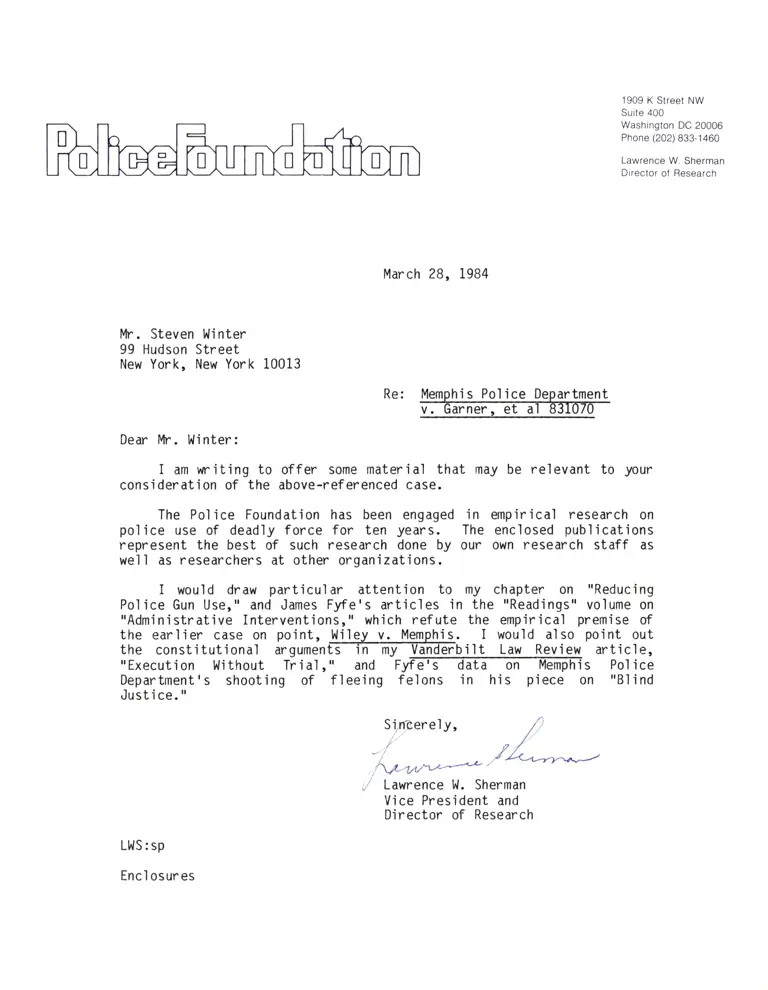
I am writing to offer some material that may be relevant to your
consideration of the above-referenced case.

The Police Foundation has been engaged in empirical research on
police use of deadly force for ten years. The enclosed publications
represent the best of such research done by our own research staff as
well as researchers at other organizations.

I would draw particular attention to my chapter on "Reducing
Police Gun Use," and James Fyfe's articles in the "Readings" volume on
"Administrative Interventions," which refute the empirical premise of
the earlier case on point, Wiley v. Memphis. I would also point out
the constitutional arguments in my Vanderbilt Law Review article,

Pol ice"Execution Without Trial
Department' s
Justice."

shooting of
" and
fleeing

Fyfe's
felons

data on
in his

Memphis
piece on "Blind

Sincerely,

t/ Lawrence W. Sherman
Vice President and
Director of Research

LWS.'sp

Enelosures