Memorandum of Law in Opposition to the Motion of Defendant Califano to Dismiss, or in the Alternative, for Summary Judgment
Public Court Documents
May 7, 1977
110 pages
-
Case Files, Hatcher v. Methodist Hospital - Hardbacks. Memorandum of Law in Opposition to the Motion of Defendant Califano to Dismiss, or in the Alternative, for Summary Judgment, 1977. 6044dcce-5384-f111-ab0f-7c1e527d528a. LDF Archives, Thurgood Marshall Institute. https://ldfrecollection.org/archives/archives-search/archives-item/94f9c597-9022-46b0-8189-2ad3a81de567/memorandum-of-law-in-opposition-to-the-motion-of-defendant-califano-to-dismiss-or-in-the-alternative-for-summary-judgment. Accessed October 10, 2026.
Copied!
     [||e6671b44-20e7-4c04-ae85-31ffa39e123e||] May. 7, 1977

Hon. Phil M. McNagny, Jr.
United States District Judge
United States District Court
Northern District of Indiana
Federal Building, 502 State Street
Hammond, Indiana 46325

Re: Wesson et al. v. Methodist Hospital
of Gav, Inc., et al,, Cause No. H 76-373


Dear Judge McNagny:

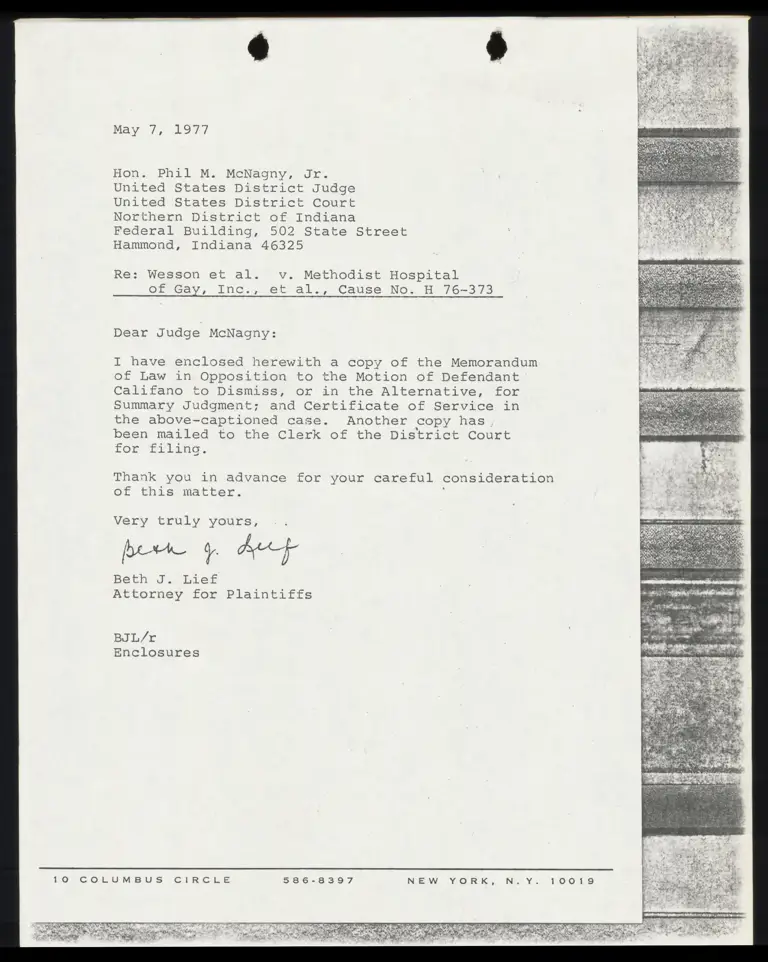
I have enclosed herewith a copy of the Memorandum
of Law in Opposition to the Motion of Defendant
Califano to Dismiss, or in the Alternative, for
Summary Judgment; and Certificate of Service in
the above-captioned case. Another copy has .
been mailed to the Clerk of the District Court
for filing.

Thank you in advance for your careful consideration
of this matter. :

Very truly yours,

Beth J. Lief
Attorney for Plaintiffs

BJL/r

Enclosures


10 COLUMBUS CIRCLE 586-8397 NEW YORK, N.Y. 10019


May 7, 1977
Hon. Francis T. Groudys, Clerk
United States District Court

Northern District of Indiana

Federal Building, 502 State Street
Hammond, Indiana 46325

Re: Wesson et al. v. Methodist Hospital
of gary, Inc,, et al,, Cause No. B 76-373
Ga :

Dear Mr. GrQudys:


I have enclosed herewith, for filing, Memorandum
of Law in Opposition to the Motion of Defendant
Califano to Dismiss, or in the Alternative, for
Summary Judgment; and Certificate of Service
in the above-captioned case.

Thank you for your handling of this matter.

“

Very truly yours,

[x pA ( Af

Beth J. Lief
Attorney for Plaintiffs

BJL/r
Enclosures


10 COLUMBUS CilRCILE 586-8397 NEWYORK, N.Y. 10019


IN THE UNITED STATES DISTRICT COURT

FOR THE NORTHERN DISTRICT OF INDIANA

HAMMOND DIVISION


BARBARA LEEX WESSON, :

BERNICE TERRY,

EDDIE GRAY and

ROSA KEETON,

Plaintiffs,

Vv.

METHODIST HOSPITAL OF GARY, INC., Cause No. H 76-373

An Indiana Not-For-Profit

Corporation, and JOSEPH CALIFANO,

United States Secretary of Health, :
Education and Welfare,

0


Defendants.


MEMORANDUM OF IAW IN OPPOSITION TO THE MOTION

OF DEFENDANT CALIFANO TO DISMISS, OR IN

THE ALTERNATIVE, FOR SUMMARY JUDGMENT


JACK GEEENBERG

te
BETH J. LIEF

PUNT S\mmIS 10 Columbus Circle
} Jew 1

CWALLLS wa cam yi York, Ney Yorn 10019

JULIAN ALLEN

200S Broadway

Gary, Indiana 46407

MARILYN G. ROSE

1751 NN Street, N. WN.

Washington, D. C. 20036

Attorneys for Plaintiffs


IN THE UNITED STATES DISTRICT COURT

FOR THE NORTHERN DISTRICT OF INDIANA

HAMMOND DIVISION


BARBARA LEEK WESSON,
BERNICE TERRY,
EDDIE GRAY and

ROSA KEETON,

Plaintiffs,

Ve
: Cause No. H 76-373

METHODIST HOSPITAL OF GARY, INC.,

An Indiana Not-For-Profit

Corporation, and JOSEPH CALIFANO,

United States Secretary of Health,

Education and welfare,

Defendants.


MEMORANDUM OF LAW IN OPPOSITION TO THE MOTION

OF DEFENDANT CALIFANO TO DISMISS, OR IN

THE ALTERNATIVE, FOR SUMMARY JUDGMENT

I.

INTRODUCTION


This case was commenced by four black citizens of the

City of Gary, Indiana on December 29, 1976 against the

Methodist Hospital of Gary, Inc., (hereinafter Methodist

Hospital) and the United States Secretary of Health, Education

and Welfare (hereinafter HEW). Plaintiffs charge defendants

with violating their obligations and plaintiffs' rights under


Title VI of the Civil Rights Act of 1964, 42 U.S.C. § 20004

(hereinafter Title VI), and their right to equal protection guar-

anteed by the Fifth and Fourteenth Amendments to the Constitution

of the United States. Defendant HEW did not file an appearance

in this action until April 1, 1977 when it moved to dismiss the

complaint or, in the alternative, for summary judgment on the

grounds that (1) plaintiffs have failed to exhaust administrative

remedies and (2) the complaint fails to allege facts upon which

relief can be granted. Plaintiffs submit this memorandum in op-

position to that motion.

The complaint arises out of the creation and perpetuation of

a discriminatory and segregated health care system that is financed

in substantial part by federal funds and grants which HEW approved.

Plaintiffs charge HEW with violating their civil rights by subsi-

dizing and enabling this discrimination by Methodist Hospital. At

the outset of its memorandum, however, defendant attempts to distort

these allegations and the plaintiffs’ attempt to enforce their

rights by insinuating shat the filing of the lawsuit arises not

out of concern for nondiscriminatory and quality health care, but,

rather, is the result of a political dispute.

It is worth note that the defendant does not challenge the

standing of plaintiffs to bring this case. If defendant sincerely

believed that plaintiffs and the class they wish to represent

wD


were not seeking to redress the injury suffered by segregated

and discriminatory health care, that route was plainly avail-

able and, indeed, in our system of jurisprudence, was the

proper route. Instead, by innuendo and accusation, defendants

attempt to obfuscate the issues raised. Plaintiffs strenuously

object to this treatment of so critical a case which they

brought only as a good faith attempt to secure equal treatment

under the law.


i 8

PLAINTIFFS HAVE EXHAUSTED THEIR ADMINISTRA-

TIVE REMEDIES, ANY FURTHER ATTEMPT TO SECURE

RELIEF THROUGH THE ADMINISTRATIVE PROCESS WOULD

BE FUTILE, AND THE DOCTRINE OF EXHAUSTION OF

ADMINISTRATIVE REMEDIES IS INAPPLICABLE TO THE

CAUSES OF ACTION AGAINST THE DEFENDANT HEW.


Defendant HEW concedes that the rights conferred by Title

VI apply to both the Hill-Burton direct grant program and loan

guarantee program, the programs pursuant to which Methodist

Hospital has received and is continuing to receive federal fund-

ing to subsidize the construction and, now expansion, of its

suburban hospital, Broadway Methodist. See, 42 C.F.R. § 53.112(¢c);

1/
45 Cc. F.R. §85 80.2,:80.134F). Defendant argues, however, that

this Court lacks subject matter jurisdiction over the complaint

because plaintiffs failed to exhaust the administrative procedure

set forth in 45 C.F.R. § 80.7(b). The sequence of events which

HEW itself outlines in its memorandum of law proves otherwise.

A.

On or about October 1, 1976, numerous individuals, including

plaintiff Wesson, sent letters and mailgrams to the Regicnal

Office of HEW to protest the grant of federal funds to Methodist

Hospital. At that time, prior to the filing of this lawsuit,

HEW properly treated those protests as complaints pursuant to

45 C.F.R. § 80.7 (b) and responded to those complaints by letter


l/ Contrast the position of HEW with that taken by defendant
Methodist Hospital concerning the applicability of Title VI. See

Memorandum of Methodist Hospital In Support of Motion To Dismiss,

8-10.
-—dl

=


and report dated October 21, 1976. See Exhibit 12 attached to

Memorandum in Support of Motion to Dismiss or In the Alternative

for Summary Judgment by Defendant Secretary of Health, Education,

and Welfare (hereinafter Exhibit 12). The eleven page summary

which was sent to the complainants, including plaintiff Wesson,


concluded that "the Office of Civil Rights found the applicant

[Methodist Hospital] to be in compliance with Title VI and

recommended clearance to the Public Health Services. We have

been informed that the applications were approved and that funds

were granted," Exhibit 12 at p. 11. That summary constituted

final resolution of the complaints pursuant to 45 C.F.R. § 80.7

(d) (2) which provides:

"If an investigation does not warrant

action pursuant to subparagraph (1) of

this paragraph the responsible Department

official or his designee will so inform

the recipient and the complainant, if any,

in writing.”

Having exhausted their administrative remedies, plaintiffs are now

entitled to pursue their complaint in federal court.

HEW received a complaint filed by Steven Tallackson on behalf

of the Gary Human Relations Commission on September 29, 1976,

approximately the same time that the other complaints were received.

See Exhibit 13. HEW at that time treated this complaint along with

those of plaintiff Wesson and other persons, and sent the October

21, 1976 response to all these individuals, including not only Mr.

Tallackson, but, as noted above, plaintiff Wesson. See Exhibit 12.

-5=


After the complaint in this case was filed on December 29,

1976, HEW sought an extension of time in which to enter an

appearance and began to conduct a further investigation of the

serious allegations raised in the complaint. On March 29, 1977,

a mere three days before HEW moved to dismiss or for summary

2/
judgment, HEW issued a second report. However, in contrast to

its initial, and, at the time, final report and conclusions, HEW

3/
only sent this second report to Mr. Tallackson, despite its

earlier treatment of the complaints filed by plaintiff Wesson and

others. HEW now makes the incredible argument that only Mr.

4/
Tallackson filed a complaint , and that the "letters and mailgrams®

which the Office of Civil Rights received "from interested persons

3/
in Gary," including plaintiff Wesson, were not complaints. On

the basis of this retrospective self-serving recharacterization,


2/ The motion of HEW was filed April 1, 1977.

2/ See Exhibit 17.

4/ See Memorandum of HEW at p. 1ll.

5/ See Memorandum of HEW at p. 10.


HEW argues that plaintiffs have not filed any complaints and have

consequently failed to exhaust administrative remedies. The

facts, as outlined above, plainly demonstrate that this is simply

not so.

Thus, in contrast to the cases cited by defendant, the ex-

hibits filed by HEW to support its motion conclusively establish

that plaintiffs did not "bypass" the administrative process.

Green Street Assoc, v. Daley, 373 7.24 1, © {7th Cir. 1970);


Dupreg v. City Of chattanooga, 'Temm., 362 2. Supp. 1136, 1141


(E.D. Tenn. 1973). (It was undisputed plaintiffs failed to exhaust

their administrative remedies,) See McGee v. United States, 402


U.S. 479, 488 (1971) (Plaintiffs' "bypass was deliberate and with-

out excuse.") HEW cannot be allowed at this eleventh hour to

ignore its own treatment of the administrative complaints prior

to the filing of this action in federal court in order to escape

5/
liability for its violation of plaintiffs' rights and the law.

On October 21, 1976, when HEW responded to complaints that

Methodist Hospital was guilty of discrimination, Alfred Sanchez,

Chief, Health and Social Services Branch, Office For Civil Rights,

Region V, informed the complainants that HEW's Office of Civil

Rights found no violation of Title VI, Bxhibit 12; affidavit of


86/ In considering a motion to dismiss, the allegations in the
complaint are accepted as true. E.g.,Radovitch v. National
Football L.eague, 352 U.S. 445 (1957).


Bey 20


Alfred Sanchez, Exhibits 4, 99 5, 6. This determination was

the final action taken on the complaints (except that of Mr.

Tallackson), after which plaintiffs were free to pursue judicial

remedies. The cases cited by defendant, Green v. Cauthen, 379


F. Supp. 361 (D.S.C. 1974) and Feliciano v. Romney, 363 F. Supp.


656, 669 (S.D. N.Y. 1973) are thus inapposite since, in contrast

to this case, in those cases there had either been no final agency

action taken or the administrative investigation was "still in progress."

The Sit ennt by HEW to reopen the adninistvative process after

the filing of this complaint in federal court by undertaking a

new investigation (Exhibit 17) cannot serve to preclude access to

this Court by plaintiffs. To begin with, as HEW never reopened

the complaint of plaintiff Wesson, her administrative channels are

closed. More importantly, to allow HEW to frustrate judicial re-

view by continually reopening investigations would result in a

total denial of a mechanism by which beneficiaries of institutions

subject to Title VI could obtain final administrative determination.

In such circumstances, the Supreme Court has held, "neither the

principle of 'exhaustion of state remedies' nor the doctrine of

‘primary jurisdiction' has any application to the situation.”

Rosado v. Wyman 397 U.S. 397, 406 (1970). In Rosado, the petitioners,


who were welfare recipients, did not seek review of an adminis-

trative order prior to proceeding to Federal court, nor could they

pe, Yon


as HEW had no procedures whereby they "could trigger and partic-

ipate in HEW's review of state welfare programs," and obtain a

Final decision,” Id. The procedures provided for HEW to follow

when it decides to terminate federal funding to state welfare plans

are similar to the procedures for terminating funds to recipients

of federal funds who violate Title VI, except that beneficiaries of

Title VI programs may file complaints and obtain decisions by HEW

concerning their grievances. Compare, 42 U.S.C. §§ 604 (a), 1316

with 45 C.F.R. Part B80. If HEW's attempt to reopen final agency

determinations and to continue review indefinitely were to succeed,

the result here and under other ritle VI situations would be iden-

tical to that faced by the petitioners in Rosado v. Wvman: plaintiffs


could obtain no final agency decision. According to the decision of

the Supreme Court, in the absence of a mechanism to obtain such a

final determination, the exhaustion requirement is inapplicable. Id.:;

Liovéd v, Regional Transportation Authority, 548. 7.24 1277, 1287 (7th


Cir... 1977),

The administrative process may be "bypassed" if the issue

raised by plaintiffs "cannot be raised upon judicial review of an]

+ =» « Order of the agency.” Borden, Inc. v. PIC., 495 7.28 785,


786-7 (7th Cir. 1974). In addition, the exhaustion reguirement is

inapplicable where review of the agency determination would provide

"an inadequate remedy." Jewel Companies, Inc. v. FTC., 432 F.2d


1155, 1158; compare Skinner & Eddy Corp. v. United States, 249


U.S. 557 (1919) with Myers v. Bethleham Shipbuilding Corp., 303


U.S. 41 (1938). In this case, were HEW's argument to prevail, the

review of the administrative decision would not be inadequate; it

would be nonexistent.

As the Supreme Court stated in McKart v. United States, 395


U.S. 185, 193 (1969), "[alpplication of the [exhaustion of admin-

istrative remedies] doctrine to specific cases requires an under-

standing of its purposes and of the particular scheme involved."


(Emphasis added.) Accord, Weinberger v. Salfi, 422 U.S. 749, 764-


768 (1975). In cases brought under Title VII of the Civil Rights

Act of 1964, alleging racial discrimination in employment, the

statutory provisions specifically state that while a plaintiff must

file a charge of discrimination with the Equal Employment Opportunity

Commission prior to filing in federal court, the Commission must make

a final determination or issue a "right to sue" letter within 180

days entitling the plaintiff to proceed to federal court, 42 U.S.C.

§§ 5(a) and 2000e-5(e). The Supreme Court had held that "[Tlhe Act

does not restrict a complainant's right to sue to those charges as

to which the Commission has made findings of reasonable cause, and

we will not engraft on the statute a requirement which may inhibit

the review of claims of federal employment discrimination in the

federal courts." McDhonnell Douglas Corp. v. Green, 411 U.S. 792,


798-799 (1973).

wlOw


Similarly, judicial review of alleged violations of Title

VI are not limited solely to those cases in which HEW has made

a determination of a violation. Adams v. Richardson, 480 F.2d


1159 (p.C.C. 1973). Moreover, the lack of any specific statutory

or regulatory time limitation in which HEW must act cannot act

to preclude indefinitely the right of plaintiffs to seek judicial

relief. See id. Indeed, in Adams v. Richardson, the district


court by supplemental order filed March 14, 1975 enjoined HEW to

make a determination as to whether there is a Title VI violation

in school districts receiving federal aid "{w]ithin 90 days of

receipt by HEW of a complaint or other information of racial dis-

crimination." Paragraph F(a) of Supplemental Order, (a copy

of which is attached to this Memorandum of Law as Exhibit A).

It has been more than seven months since HEW received complaints

alleging violations of Title VI by defendant Methodist Hospital.

Plaintiffs suggest that there is no reason why a specific time

limitation for reviewing complaints should not be imposed on

HEW's investigation of hospital complaints, just as they are sub-

ject to in school cases. In any event, HEW cannot be allowed to

frustrate judicial review indefinitely by continual reopening of

investigations or similar dilatory tactics.

“lle


5.

Even assuming arguendo that plaintiffs did not exhaust their


administrative remedies, the doctrine of exhaustion is inapplic-

2hte to the instant case because it is clear that further resort

to such procedures would be futile; and plaintiffs cannot obtain

the complete relief they seek through administrative channels.

In the report and findings of October 21, 1976, HEW responded

2
to the plaintiff Wesson's charge of racial discrimination with

8/
the comment that racial segregation "too is a reality," and stated

that assessment of the reduction of quality of care for the minor-

ity citizens of Gary "is a complex issue which this Office is not

4
qualified to assess."

In addition, HEW conceded that in 1971 it was predicted that

there would be "maldistriction of resources among geographic areas

and population groups" but nevertheless excused Methodist Hospital

10/
on the legally irrelevant ground that "it is not solely to blame."


1/ Exhibit 12 at'p.. 4.

8/ 16. at p.wl0,

3/38. arp. 8,

10/ 14. at pp. 6.

rl Doe


Finally, in response to the allegation that the construction

and expansion of Broadway Methodist Hospital has accelerated

"white flight" and consequent segregation, HEW stated, " . . .

while it may Ye argued that the Hospital is gulliy of racism by

trying to join that exodus, it cannot be argued that it initiated

11/
‘white flight'.™"

12/
The further report of HEW issued on March 29, 1977 con-

cedes that the equipment at Broadway Methodist Hospital is newer

than that at Gary Methodist Hospital and that one hospital (Gary)

13/
is 80% black and the other (Broadway) is 90% white. HEW

further recognized that all foreign nurses, who have difficulty

14

communicating with patients, are employed at Gary, and not Broadway.


1l/ Id. at p. 9. The day has long since passed when institutions
can escape liability from racial discrimination and segregation be-

cause others are also guilty or because of disagreement with the

constitutional and statutory principal of equality. Cooper v. Aaron,

358 U.5. 1 (1958); Brown v. Board of Zducation, 349 U.S. 294, 299-300

{1955).


12/ Exhibit 17 to Memorandum in Support of HEW's Motion to Dismiss

or, In The Alternative, for Summary Judgment.

13/ E=zshibit 17 at pp. 3-11, .22.

4/ Id. at p. 14.

“13


Despite the clear acknowledgement that the facilities are not

equal, HEW refused to find a Title VI violation because de-

fendant Methodist Hospital had shown "a pattern of investment

. « « to modernize the Gary facility" and because the hospital

met the mimimum standards of the Joint Commission on Accreditation

17

of Hospitals and the Indiana State Board of Health.”

In view of HEW's refusal to correct the racism, discrimination,

inequality of the facilities, and perpetuation of segregation by

Methodist Hospital, or, to deem such discrimination violative of

Title VI, it is clear that further resort to HEW would be an exer-

cise in futility. The doctrine of exhaustion of administrative

remedies has no application where it is clear that the relevant

administrative agency will not grant the relief in question.

Clover v., St. Louls-San Francisco R, Co., 393 U.5. 324, 330-331


{19569).

Finally, plaintiffs are not required to exhaust administrative

remedies insofar as they challenge HEW's procedures in failing to

enforce Title VI or in granting Hill-Burton financial assistance

to Methodist Hospital. The Court of Appeals held, in a similar


15/ 38. at p. 25. The Joint Commission on Accreditation of
Hospitals certifies only that a hospital meets required minimum

guidelines, not that it is provided comparatively good, or equal

health care. See CCH Medicare & Medicaid 9g 12,330, 12,660, 16,957,

20,801.

Fo


Title VI case that where plaintiffs charged inadequacies in

the procedures by which administrative officials exercise their

administrative responsibilities under Title VI, that there are no

administrative procedures to exhaust:

", . «. the procedural afforded under the

Civil Rights Act of 1964 are designed to

provide redress against specific discrim-

inatory acts and do not pertain to the

adequacy of HUD procedures.”

Shaymon Vv. fb, 436 F.2d 809, 820 (3rd Cir. 1970). See also Et


[()]


(


County School District No. 4 vv. Gardner, 263 7. Supp. 26, 3%

D.8.C. 1967).

The complaint in this case charges HEW with violating the

rights of plaintiffs guaranteed by Title VI. That violation

necessarily includes not only the decision to continue funds to

a hospital which discriminates and segregates persons on the basis

of race, but also the failure of HEW's procedures to review

recipients of federal funds adequately, and to prevent inequality

la/

of health services to minority residents. As the Court stated

in NAACP v. Brennen, 360 F. Supp. 1006, 1012 (@.D.C. 1973):


16/ HEW's investigation adopted in large part the position and

statements of Methodist Hospital and failed to conduct an adequate

investigation pursuant to proper standards. For example, the

report of March 29, 1977 accepted without question the truth of

the statement by Methodist Hospital that the emergency room was

"totally renovated” and failed entirely to consider, more importantly,

whether it was adequate to serve the needs of minority patients.

Exhibit 17.af p. 24.
«1l5~


« « « both Title VI and the Fifth Amend-

ment impose upon Federal officials not

only the duty to refrain from partici-

pating in discriminatory practices, but

the affirmative duty to police the op-

erations of and prevent discrimination

by state or local agencies funded by them."

Where, as here, plaintiffs charge HEW with failing to adopt pro-

cedures and standards necessary to accomplish its "affirmative

enforcement duty," administrative procedures need not be ex-

hausted., Adams v. Richardson, 4380 F.28 1159, 1162 (.C.

16/

1973.

Cir.


16/ Defendant incorrectly states that plaintiffs must demonstrate
that HEW "colluded" in the discriminatory processes of Methedist

Hospital. See Memorandum of HEW at p. 14. In Gautreaux v. Romney,

448 F.247°731, 737=740 {7th Cir, 1971), aff'd sub nom., Sills vv.

Gautreaux, 425 U.S. 284 (1976), the Court of Appeals did not re-

quire that plaintiffs echaust remedies and held on the merits that

HUD violated Title VI by dispersing funds in a manner which per-

petuated a racially discriminatory housing system. Good faith

attempts by HUD to accommcdate different factions did not relieve

it Of liability in its "own right" for it was "an active partici-

pant [in the discrimination] since it could have halted the dis-

crimination at any step in the program. Hicks v. Weaver, 302 F.

Supp. 81%, 623 (DD. La. 1969). HIw's action in approving funds

to Methodist make it no less an active participant as HUD in

Gautreaux and no less liable for violations of Title VI.


Wo


hk

THE COMPLAINT, WHICH ALLEGES DISCRIMINATION BY

HEW IN ITS FAILURE OR REFUSAL TO ENFORCE THE PRO-

HIBITION AGAINST DISCRIMINATION BY A RECEIPIENT

OF FEDERAL FINANCIAL ASSISTANCE, STATES A CAUSE OF

ACTION UNDER TITLE VI; AND SUMMARY JUDGEMENT IS

INAPPROPRIATE BECAUSE OF THE EXISTENCE OF GENUINE

ISSUES OF MATERIAL FACT.


Rule 12 (b) of the Federal Rules of Civil Procedure

provides in pertinent part:

"If, on a motion asserting the defense numbered

(6) to dismiss for failure of the pleading to

state a claim upon which relief can be granted,

matters outside the pleading are presented to

and not excluded by the court, the motion shall

be treated as one for summary judgement and

disposed of as provided in Rule 56..."

As defendant HEW has submitted seventeen exhibits to support

its motion to dismiss, the motion is properly considered as one

for summary judgement.

In ruling on a motion for summary judgement, a court is

charged by Rule 56 of the Federal Rules of Civil Procedure with

determining whether or not the "pleadings, ... together with the

affidavits, if any, show that there is no genuine issue as to any

naterial fact and that the moving party is entitled to a judgement

as a matter of law." The Court of Appeals for the Seventh Circuit

held in Rose v Bridgeport Brass Company, 487 F.2d 804, 808 (7th Cir.


1973):

" Qurs cases have uniformly placed upon the movant

for summary judgement the burden of establishing

hii the absence of a genuine issue of material fact.

Carter v {iltliznms, 36) 7.26 189, 193 (7th Cir, 19686):


-17-


‘MotouXx v Gulling Auto Electric, Inc.,

295 »,.2d4 573, 576 {7th Cir. 1981. The

burden is not lightly discharged."


The Court in Rridgeport Brass added:


"On a motion for a summary judgement the

burden of establishing the nonexistence of

any genuine issue of fact is upon the

moving party, all doubts are resolved

against him, and his supporting affidavits

and depositions, if any, are carefully

scrutinized by the court. Albert Dickenson

CO, v Maellos Deanut Oo., 179 F.24 265, 268

(7th Cir, 15950), 139 7.24 318,: 322 {8th Cir.

1943) ." Id. (Emphasis in orginal).


The very exhibits submitted by defendant to support its motion

demonstrate the existence of a plethora of disputed material

issues that relate directly to the issue of iARLevet HEW has

violated its affirmative obligation and the plaintiffs' rights

under Title VI. Since HEW has thus failed to discharge its

heavy burden under Rule 56, the motion must be denied.

As stated above, Title VI and the Fifth Amendment impose

upon HEW "not only the duty to refrain from participating in dis-

criminatory practices, but the affirmative duty to police the

operations of and prevent discrimination by state and local

agencies funded by them." NAACP v Brennen, supra 360 F. Supp. at


1012; accord, e.g., Adams v Richardson, supra, 480 F.2d at 1162;

Gautreaux v Romney, supra, 448 F.2d at 737-740; Hicks v Weaver,


supra, 302 F. Supp. at 623. As defendant admits, Section 602

of Title VI, 42 § 20000-1, directs each Federal agency adminis-

-18=~-


trating a program of Federal financial assistance to take

action pursuant to regulation to effectuate the obligations and

purposes of Title VI. Those regulations, promulgated by -

defendant HEW, appear at 45 C.F.R. Part 80. Amcng the specific

discriminatory actions prohibited is the provision by a recipient

of federal financial assistance, including defendant Methodist

Hospital of

"...service, financial aid, or other benefit

to an individual which is different, or is

provided in a different manner from that
provided to others under the program." 45

C.P.R. $80.30) 41) (ii).

The regulations also prohibit:

"subject[ing] an individual to segregation

or separate treatment in any manner related

to his receipt of any service..." 45C.F.R.
§ 80.3 (b) (I) (ii) (Emphasis added).

and

"Restrict[ing] an individual in any way in

the enjoyment of any advantage or privilege

enjoyed by others receiving any service,...

or other benefit under the program." 45 C.F.R.

S$ 80.30) (AY (iv)

The data before this court raises serious and genuine issues of

fact as to whether HEW is assuring, as it is obligated to do, that

Methodist Hospital has not violated these provisions.

w l72/
The reports conducted by HEW itself establish that

defendant is aware that the two facilities of Methodist Hospital,

Gary Methodist and Broadway Methodist, have segregated patient


l7/ Zxhibits 12 and 17.

-19-


populations in violation of 45 C.F.R. § 80.3) (ii). — Almost

fifteen vears ago, the Court of Appleals in Simkins v Moses Cone


Hospital, 323 F.2d 959, cert. denied, 3786 u.s. 938 (1964) held that


the provision of services on a "separate but equal" basis by

hospitals receiving Hill-Burton funds violated the Constitution

of the United States, vet HEW has by its own admission done

nothing to correct this violation. Plaintiffs contend that the

failure of HEW to take steps to have the recipient remedy this

segregation is on its face a violation of plaintiffs' rights

and defendants obligation, and the Court of Appeals for the

Seventh Circuit has so held in an analagous case. Gatreaux v Romney,


supra, 448 F.2d at 739-740; accord, Shannon v HUD, supra, Hicks v


Weaver, supra. The mere fact that HEW conducted an investigation


which uncovered this violation cannot, of course, satisfy its

obligation; on the contrary, the conscious channeling of funds to

segregated institutions flies in the face of the "expressed purpose

of Congress." Adams v Richardson, supra, 480 F.2d at 1162.


The plaintiffs charge HEW with violating Title VI not only

because of the segregated operation of facilities by Methodist

Hospital, but also because the provision of services is unegual..

As HEW-admits, the issue of quality of care is "complex". 19/ The

Supreme Court has stated that "summary proceedings, however

salutory where issues are clear-cut and simple, present a treacherous

record for deciding issues [that involve complex and important


18/ Gary Methodist is 80% black; Broadway Methodist is 90% white.

3.9/ Exhibit 12. at 'p. 8.
-20-


constitutional questions]”. Xennedv v Silas Mason Co., 334 U.S.


249, 256-7 (1948). In accordance with this pronouncement and with

particular sensitivity accorded issues involving personal

20/
liberties, the court stated in Sisters of Providence of St.


Marv of the Woods v City of Evanston, 335 F. Supp. 396,399


{D.C., X11. 1971), "It is especially in clvil rights disputes

that we ought to be chary of disposing of the case on pre-trial

motions..." Although the Supreme Court sanctions the grant of

summary judgement where "solid bases of fact" are derived from

21/
"a comprehensive statement of agreed facts," © plaintiffs do not

in any way agree with the bases upon which HEW concluded that

minority recipients of hospital services by Methodist are not

discriminatory, or the conclusion reached.

To begin with, as noted above, HEW accepted withcut

question the fact that the emergency room at Gary Methodist

Hospital, which serves the black residents of Gary, was "totally

renovated" and is adequate to meet the needs of the plaintiff class.

Critical facts remain to be discovered concerning whether these

statements are in fact true. Summary judgement should not be

granted without affording plaintiff extensive discovery,

particularly since most of the facts are exclusively within the

defendant's knowledge. Schoenbaum v First Brook, 405 F.2d 215


{28 Cir. 1968), cert. denied, 395 U.S. 906 (1969). More im-


20/ United States v Caroline Products, 304 U.S. 144,152 n.4 (1938)


217. Kennedy v Silas Mason Co., supra, 334 U.S. at 257


-21-


portantly, on a motion for summary judgement, it is HEW and

not plaintiffs who has the burden of establishing the truth of

these statements. g.g., Rose v Bridgeport Brass Co., supra,


487 F.2d at 808. That burden cannot be met and has not been met

without facts as to the number of patients seeking treatment at

the emergency room.

In addition, HEW acknowledges that a linear accelerator,

which provides radiation treatment, is available at Broadway

Methodist but not at Gary Methodist and that minority residents

of Gary can only receive such treatment by private transportation

to Broadway, which is fifteen miles outside Gary. 22/ HEW

summarily dismisses this discrepancy in an important service with

the statement, "The physicians interviewed were not aware of any

patient having difficulty as far as accessibility of treatment is

23/
concerned,” . — Self-serving statements which are not in affi-

davit form may not be considered as to whether a genuine issue

of material fact exists. Tunnell v Wiley, 514 F.2d 971 (3rd


Cir. 1975); Smith v Mack Trucks, Inc., 505 F.24. 1248 {oth Cir, 1974).


Plaintiffs are in the process of collecting affidavits from black

citizens of Gary which establish that they are in fact having

serious difficulty in obtaining transportation to Broadway

particularly since there is no public transportation to Broadway


22/ Exhibit 17 at p. 22

33 Id.
he 0


Methodist from the City of Gary. ~° Even if

this were not so, however, the placement of the linear accelerator

at the facility which serves a smaller, white population violates

the mandate of 45 C.F.R. § 80.3 (b) (X¥) (iv) that minority recipients

not be restricted "in any way in the enjoyment of any advantage

or privilege enjoyed by others receiving any service."

The assurances which HEW had Methodist sign prior to

the grant of Hill Burton funds to construct Broadway Methodist

Hospital did not mandate equally of care or intergration of patient

populations, but only required that Gary Methodist be maintained

as a viable hospital. 2 It is clear that both the statutory

and regulatory language of Title VI, as well as case law, require

much more: Title VI prohibits any discrimination. any denial of

benefits and any segregation of black patients of defendant

Methodist Hospital. Those assurances thus cannot discharge the

obligation of HEW. In addition, HEW itself has seriously questioned

whether Gary Methodist Hospital will be able to continue to

operate as a viable institution. See Exhibit 3 where Mr. Sanchez

felt "a dim picture is being painted for medical care [in the

inner city] in the future." Serious issues of material facts exist

as to the role that the construction and expansion of Broadway

Methodist has played in the loss of doctors who had served the


24/ See assurances attached to complaint.

-23-


inner tity. According to HEW, of the 165 physicians on the medical

staff of Methodist Hospital, nearly half now practice primarily at

Broadway, dispite the fact that Broadway has approximately

one-third the number of beds as does Gary Methodist Hospital,
25/

and Broadway has only half the number of patient days as does

26 / :
Gary. ~— According to Title VI regulations:

"In determining the site or location of
a facilities, an applicant or recipient

may not make selections with the effect of

excluding individuals from, deneying them

the benefits of, or subjecting them to

discrimination...on the ground of race,

color-of national origin. 45 Cc. P.R. §'80.3

(B) (3).

The location of a brand new facility in an all white suburb has

resulted .in the loss by minority residents of Gary of virtually

half of the previously available doctors. Serious issues of

fact exist as to the effect of the expansion of Broadway

on the further drain of resources.

In order to determine whether HEW has violated Title VI,

it is obviously essential to determine whether Methodist Hospital

is segregating and discriminating against minority residents of

Gary in the provision of health services. If, as plaintiffs

contend, this discrimination is occurring, than HEW is as a

matter of law violating Title VI by continuing to channel funds


25/ Txnibit 17 at'ps 17 and Complaint.

26/ See letter and report dated January 19, 1977 R.B. Glesne,
Administrator of Methodist Hospital to Alfred Sanchez,

Attached as Exhibit B to this memorandum.

«Dl


to Methodist Hospital and by failing to cite Methodist Hospital

for its violation. See Adams v_ Richardson, supra; Gautreaux v


Romney, supra; Shannon v HUD, supra. The issues raised by this


allegation are complex and varied and include the need not only

for a complete record as to staffing, patient populations and

services, but also as to the motive of Lithadtst Hospital for its

consistent determination to channel the vast majority of Federal

funds to the new, suburban facility as opposed to the older one

which serves the black population. As the Supreme Court has

stated, "where motive and intent play leading roles," it is unwise

to grant summary judgement." Poller v Columbia Broadcasting Svstem,


Inc., 368 U.S, 464, 473 (1952); gccord, Adickes v. S. HB. Kress (O.,


398 U.S. 144 (1970). HEW has not submitted a single affidavit

to support the statements contained in its exhibits. Without

clear proof to rebut the allegations in plaintiffs’ complaint,

summary judgement cannot be granted.

CONCLUSION


For the reasons stated above, the motion of HEW must

be denied.

Respectfully submitted,

t

heat, QO Aud
JACK GREENBERG VY
BETH J. LIER

10 Columbus Circle

New York, New York 10019


-25-


JULIAN ALLEN

2009 Broadway

Gary, Indiana 46407

MARILYN G. ROSE

CHRISTINE B. HICKMAN

1751 N Street, N.W.

Washington, D.C. 20036

Attorneys for Plaintiffs


CERTIFICATE OF SERVICE


I hereby certify that a copy of the foregoing MEMORANDUM

OF LAW IN OPPOSITION TO THE MOTION OF DEFENDANT CALIFANO TO

DISMISS, OR IN THE ALTERNATIVE, FOR SUMMARY JUDGEMENT, was

served by United States Mail, postage prepared, on the 7th day

of May, 1977, on counsel for defendants as follows:

HODGES, DAVIS, GRUENBERG, COMPTON

& SAYERS, BRUCE E. SAYERS, ESQ.

5525 Broadway

Gary, Indiana 46401

MARVIN E. GARVIN & EDWARD L. KOVEN

REGIONAL ATTORNEY & GENERAL ATTORNEY

Department of Health, Education and

Welfare

300 south Wacker Drive, 18th Floor

Chicago, Illinois

RICHARD L. KIESER

UNITED STATES ATTORNEY FOR

THE NORTHERN DISTRICT OF INDIANA

HAMMOND, INDIANA

Fred W. Grady

Assistant United States Attorney

hei. Aol


BETH J. LIEF
Attorney for Plaintiffs


| | $7

| i
| Lo

UNITED STATES DISTRICT COURT , i
| FOR THE DISTRICT OF COLUMBIA j=}
H : t ! {

| if
: | pick
: ; 0

® 1
; KENNETH ADAMS et al., Yo :
4 : or ) i

: Plaintiffs,  )
Ra x )

: Pye WAY ) Civil Action No. 3095-70
; phen % to, ; ) i

og CASPAR W. WEINBERGER, individually )
; and as Secretary of the Department )
! of Health, Education and Welfare, ) : |

; et al., ) IV ED)
: ) El I : |

! Defendants. ; MAR 141975 i
JAMES FE. DAVEY, Clerk   SUPPLEMENTAL ORDER


This cause came before this Court upon plaintiffs.’ Motion for

ia
d

cr
—
—
—
—
—
—
—
—
—
—
 +


4 1
0


Further Relief and the Opposition of the defendants thereto. After a

review of the entire record, the Court inclines to the belief that sub-

-

stantial progress has been made in this difficult and complex area. On

the other hand, without deprecating the value of voluntary settlement of

these problems, thers appears to be an over-reliance by HEW on the use of

voluntary negotiations over protracted time periods and a "reluctance in

recent years to use the administrative sanction process where school


districts are known to be in non-compliance ***" Report of United States

Commission on Civil Rights, January 22, 1975, page 131, n. 1. Having


|
1 -

considered the motion and opposition and the record before it, this Court
|

enters the following findings and remedial provisions.

| : A. 125 Substantial Racial Disprovortion

Th "Districts. :

| rT 1/
As this Court found in its February 16, 1973 Order, the Supreme


Court in Swann v. Charlotte-Mecklenburg Board of Education, 402 U.S. 1


4 3 (1971) enunciated "a presumption against schools that are substantially

disproportionate in their racial composition.” In Appendix B of that

    1/° Adams v. Richardson, 356 F. Supp. 92 (1973).


Te i

February 16, 1973 Order, the Court listed 85 southern school districts

having one or more schools substantially disproportionate in their composi-

tion (because at least a.207 disproportion existed between the percentage

hg of local minority pupils in the schools and the percentage in the entire

school district). HEW not having required any of these 85 school districts

to explain or rebut the substantial racial disproportions in the schools,

this Court enjoined NEW to communicate with cach of the districts within

—


es

i
r
i
s
.


su
e
R
d
s


60 days, putting them on notice to rebut or explain the disproportions in

one or more of their schools. HEW took appropriate acticn pursuant to

{
this Order and substantial compliance progress resulted therefrom. However,   the record now reveals an additional 125 southern "HEW school districts”

jy th one or more schools substantially disproportionate in their racial a
|

composition (see Attachment A), where HEW has not sought an explanation or

rebuttal from the school district. ; i

: WHEREFORE, in supplementation of ¥ III B (1) of this Court's

i Order of February 16, 1973, defendants, their successors, agents and

employees are required and enjoined within 80 days of the date of this

Order to communicate with ach of the 125 districts listed in Attachment A,

putting them on notice to rebut or explain the substantial racial dis-

* proportion in one or more of the districts' schools.

B. "293 Districts With Allegations of Miscellaneous

"Violations.


=e "  Plaintiffs' Motion for Further Relief alleges that there are

293 additional districts where HEW has found presumptive Title VI violaticms.

The daposition and affidavit of Dr. Lloyd R. Henderson, indicate however

2
that the statistical data on which this allegation is based demonstrate

ta
d?


set

 d
ud

id
u

di
me

rs
 sn

wu
wa

re
n   possible Title VI problems and not presumptive violations. We accept for

, the present HEW's assertion that one of the purposes of the Enforcement . :

Analysis Tables compiled on a nationwide basis was to provide an indicatien


2/ The data were extracted from Office of Civil Rights

1972-1973 Enforcement Analysis Tables.


F005 Forme enti pms sivas Cs vie opm


a
S
e
t
e


l
e


he
le
n

W
e
a
l


ar
in


Se
to
n

car


dn


“le

of those districts which might be likely candidates for Title VI compliance

activity and to aid in the determination of priorities.

, WHEREFORE, plaintiffs’ request for further relief in this area

is denied at this time.

C. 6 ESAA Districts.


With respect to 116 alanentary and secondary school districts,

where HEW had found probable violations of Title VI, this Court's

Febriary 16, 1973 Order held that the time permitted by Title VI for

seething voluntary compliance before commencing enforcement proceedings

had org since passed (TY II A (5); III (A) (7)). HEW had found the

districts In violation or presumptive violation of Title VI and had failed

during substantial periods of time to achieve voluntary compliance.

Accordingly, the Court ordered HEW within 60 days to commence enforcement
. - |

proceedings by administrative notice of hearing or any other means authorized

by law against each of the districts in order to effect compliance with

Title VI. In the spring of 1973, HEW declared 17 HEW districts in the |

south ineligible for funding ender the Emergency School Aid Act of 1972

because of substantial civil rights violations. Nine districts were the

subject of HEW en Zorienent activity pursuant to specific directives of

this Hourt's February 16, 1973 Order. Since the filing of the present

Motion for Further Relief, Orangeburz, South Carolina has been found

eligible for ESAA funding and Charles County, Maryland, has submitted a

student assignment plan acceptable to HEW. In the remaining 6 districts,

however, HEW has made no efforts to effectuate compliance with Title VI

after indication of substantial civil rights violations.

WHEREFORE, in supplementation of YY II B (1) and III B (2) of

this Court's Order of February 16, 1973, defendants, their successors,

agents and employees, are required and enjoined within 60 days of the date

of the Supplemental Order* to commence enforcement proceedings by administra-

tive notice of hearing or any other means authorized by law against each

tek rd NC p————— 1 ———_ = .

i
|
|

it


Piss rhastats pa FES LD


ti i
|

i

of the school districts identified in Attachment B, in order to effect
I

complidnce with Title VI.

D. 39 Unresolved Swi. Districts.


In its February 16, 1973 Order, this Court found 85 school

districts presimprively in vizl2vdnn of Swann and Title VI because they

nel ode or wore sdhacle Substantial Th diepedvortionsts in their racial

composition. This Court ordered defendants to communicate with each of

these districts promptly, putting them on notice to rebut or explain the

stbssidetal racial disproportions (Y III B (1)). HEW has done so.

Thirty-one of these districts have since been found in compliance by HEW,

and 15 others are in litigation or under court order. rl iaratr of

the diierioe remain unresolved more than 25 months after the issuance of

this Court's Order, but HEW has not initiated enforcement seocaedings

against any of them. The time for securing compliance by merely voluntary

means in these districts has passed.

WHEREFORE, defendants, their successors, agents and employees,

are’ diiutred gud grivined within 60 days from the date of this Order to

commence enforcement Stacdedings by administrative notice of hearing or

any other means authdrized by law, in order to effect compliance witt

Title VI by each of the school districts identified in Ateichment C.

: J

E. Hundreds of School Districts Subject to

“"Court Desegregation Orders.


This Court's Order of February 16, 1973 (4 V B (2)) required HEW

to Situs its findings of court order violations to the attention of the

court concerned. Since that Order issued, HEW has identified numerous

southern districts subject to judicial desegregation orders which, in

violating or apparently violating Title VI, are in violation of sald

court orders.

  -

3/ Defendants have admitted that 21 of these 39 districts
remain unresolved, claiming that 18 districts of the
39 are now in compliance. Since we are not advised
either of the names of said districts or the reasons:

why they should not be still included, they are covered

by this Order.


“Sw

In cases where the United States is a party, HEW has referred

some of this information of violations or presumptive violations of

court orders to the Justice Department, but none of the information has

been brought to the attention of the courts concerned. In cases of

orders resulting from private litigation, such information has not been

conveyed either to the courts or to the private attorneys of record.

WHEREFORE, in supplementaticn of ¥ V B (1) and (2) of this

Court's Order of February 16, 1973, defendants, thelr successors, agents

and employees, through the Justice Department or other means, are required

and enjoined within 120’ days of the date of this Supplemental Order to

call to the attention of the courts concerned each of the violations or

presumptive violations of court orders, unless defendants have made a

administrative determination of compliance by the school district within

5;

the 120-day period. «

F. Future HEW Compliance with Title VI.


This Court has ruled in this case that HEW has a duty to

commence prompt enforcement activity upon all complaints or other

information of racial discrimination in violation of Title VI, aad that

where it appears that a school district is in violation or presumptive

violation of Title VI the agency has a duty under Title VI to commence

enforcement proceedings by administrative notice of hearing or any other

means authorized by law where efforts to obtain voluntary compliance do

not succeed within a reasonable period.

HEW has often’ delayed too long in ascertaining whether a complaint

or other information of racial discrimination constitutes a violation of

Title VI. HEW has also frequently failed to commence enforcement proceed-

ings by administrative notice of hearing or any other means authorized by law


|

|

rire BLA al R | Bi

}

1

] although the efforts to obtain voluntary compliance have not succeeded :

during a substantial period of time. As shown in Section D above, in

39 "unresolved" Swann districts, HEW, having failed during a substantial |
period of time to achieve voluntary compliance, has not commenced enforce-

ment proceedings by administrative notice of hearing or any other means

| authorized by law. Apart from the school districts expressly covered

by this Court's February 16, 1973 Order, HEW has not initiated a single

administrative enforcement proceeding against a southern school district

since the issuance of this Court's Order 25 months ago.

are required and enjoined hereafter to carry out their Title VI enforcement

activities affecting public school districts in the 17 southern -and border
I
|

i
|

[
)

|
| WHEREFORE, defendants, their successors, agents and employees

:

| states according to the following schedule: :
=

(a) Within 90 days of receipt by HEW of a complaint or other

Information of racial discrimination, determine for

t
e
n


a
J

dra

ma


en


At
t
n


. administrative purposes whether the district is in or

cut of compliance with Title VI:
(5) Wherever there is not a determination of compliance by -

the 90th day, attempt to secure compliance through

voluntary means for an additional period not to exceed -

90 days;

i {¢) Where such compliance is not sacured within 180 days

of the receipt of the complaint or other information

of racial discrimination, commence within 30 days

thereafter an enforcement proceeding through adminis-

EE : trative notice of hearing or any other means . i   ' i authorized Hy law. : : |

G. Supnlemental Reporting Provision. ‘ HH

Supplementing the reporting provisions in this Court's Order of

February 16, 1973, defendants, their successors, agents and employees, are


La


,
5

P
R
M
P
P
U
E
D
S
 |
S
P
R


NOR.


Po
art


fi | ! i
i 5.4 \ |

| } aie
1h | ; I
3 i

% | | :

: | required and enjoined to provide in verified form to counsel for plaintiffs ;

i

5 ii within 150 days of the date of this Supplemental Order, and at the time

i | |
fi of all subsequent reports required by this Court's February 16, 1973 :

“a J ‘ i :

# 1 Order, a Summary of all steps tuken to comply with the injunctive provisions

! : | : ; |

} i set forth in the preceding paragraphs. 2

5 ] 2 E
: pi EE

.

' ry > 0% PRR 1 i

1 | eo 1, ;

| | Ey : wierd |

: |!
: of q

3 } # \

: phn oo Nal 3
vo] bo / John H. Pratt |

Toa 4 Unided States District Judge | i

|
i |

{

March 14, 1975 hea i
i I ; jis % :

% | ; i

i ; :
He |

: |
: : !

| if
4 i

|
| |
i |
1] i .

|
! eo.

|
|
i

| .; 3

t

i

: |
I

|

|
:

|
|
| .

| .

.

i | .
; |

|
t

+ !

3 i -

: i
4] | i
i | [
4 j i |

i
1

| l :
1 |

:

!

i

| | y
i

| [| |

2 | :

i


|

Attachment A

(Page 1 of 3 pages)

  |
|
|
i

|
i SUBSTANTIAL RACIAL DISPROPORTION DISTRICTS


ARKANSAS

Jonesboro School District #1

DELAWARE, .. ,

Caesar Rodney . :
De La Warr School Disiiict

Newark

FLORIDA

Levy County
Monroe County

* GEORGIA

Madison County

Thomasville City :

"KENTUCKY

Covington City :
Elizabethtown Independent
Warren County

LOUISIANA

Allen Parish
Vernon Parish

MARYLAND

Baltimore County

Caroline County

Cecil County Public Schools

Frederick County :
Howard County

Montgomery County Pub. Sch.

. Talbot County
Washington County

M1SsSISssirrl

Lee County

MISSOURI

Cape Girardeau Public #63
Joplin R-8
Poplar Bluff R-1

Special Sch. Dist. of St. Louis
Springfield R-12


}

NORTH CAROLINA


Burke County
Caswell County

Chatham County

Hoke County

Jackson County

Madison-Mayodan City

Onslow County

Pender County
Polk County Bd. of Educ.

Randolph County

Roancke Rapids Graded School
Rowan County Schools :
Shelby City Schools
Stanly County
Swain County Schools
Union County
Vance County
Wayne County

Wilkes County

OKLAHOMA.

Altus

Bristow

Claremore City
Dutant Public Schools
Enid Public Schools

Moore :
Moton '
Norman
Sapulpa City Schools
Shawnee

SOUTH CAROLINA

’


Aiken County

Bamberg County 01
Charleston County School Dist.

* Edgefield County
Greenwood County S50

Marion County 01

Orangeburg County 02

Pickens County

Richland County 01

Richland County School Dist. #2
Spartanburg County 02

Spartanburg County 06

Spartanburg County 07

TENNESSEE

Athens City Schools
Dyer County

Hamilton County

Hardeman County Bd. of Educ.

Lincoln County

Morristown City
Williamson County

Attachment A

(Page 2 of 3 pages)


¥i
ih
is


.
L

SL
RS

R
V
R

W
E
D
:


OC
s

TS
p
u


PR
s


TEXAS

Alamo Heights ISD

Alice Ind. School Dist.
Amarillo ISD

Arlington ISD

Bay City ISD

i Brazosport Independent School
Cleburne ISD

Cotulla Ind. School Dist.

Dumas ISD

East Central ISD

Edinburg CCN Ind. Sch. Distr.

El Campo Independent School Dist.

El Paso Independent School Dist.
Gainesville Ind. School Dist.
Gregory-Portland ISD

Harlandale ISD

Harlingen CISC

i Hereford Indept. School Dist.

Irving Independent

Xerrville ISD

La Porte Indep. Sch. Dist.
Livingston Independent School

Marfa Ind. School Dist.
McAllen Ind. School District

Morton Ind. School Dist.
‘New Boston ISD
New Braunfels I SD

North Forest ISD

Palestine Ind. School District
Pampa Indep. Sch. Dist.
Pasadena Ind. School Dist.

Pecos-Barstow Consolidated ISD
Pleasanton ISD
Round Rock I S D

Sherman Ind. School District
South San Antonio ISD
Southwest ISC

Tuloso-Midway Ind. School Dist.

United Independent School Dist.
Vernon Consolidated Independent
Wharton Ind. Sch. Dist.

Ysleta Independent Sch. Dist,

© VIRGINIA

Fairfax County

Prince William County
’

WEST VIRGINIA


Fayette Co. Bd.. of Educ.
Marion County Bd. of Educ.

"Mineral County
Mingo County

* Ohio County

Attachment A
ee coea—


  B
E


A
r
n
b


Ths
S
r


B
i
m
a
n


Rb
A


a
d
h
e


Al
a
t


ini
Ben

ah
L
e


barn
Sain.

a
r
e
,

A
f
r


sin
le. h

r
e
s


e
e
r


modem
h.

(AAA
a
m


Bet
A
A


B
a
t
a
t
a


a
n
h


$30
he

A


M
R


A


A
A
A
S


a
r


7%
4

BAL
28

Th
ea

w
e


m ES)

Cc Q

i [=]
~


h
i


Ld

n


=
A


.

| 0


[]
[<4]

| (
7
5
)


LJ

p
=


°

| Q


-C
i”

~


—


< VE |
Q


(®)
ja bl
oO

:

.
7]

.
at

.

>
[a]

C2
wv

~~

Zz
EON

0
LN

[-4
Q

ts]
oe

©


[72]

bp
.

Q
oy

=


Q
«


«


©


od

wn
[3]

A
7

HM
a

Pa
>)

-


ag
J

~~

a
wd

»


0
.
0


Ly)

Cc
A


Q


8
o


D
o


o


0}
[<1

o
[21]

oh
©

q

nl
©

a
l


wl
A

4s
€
¥


'
«f

M
M


=


[0]
LE

5


oJ
|S]

| od
~


.
}


o
ef

~
[0]

v
9


Lo)

1


|
EE

Bl
5

PIER.
wl

WN
mM

a


3
BR

S
a
)


7
B+

o
<

15)
8

"Ed
<

x
=

73
=

i J
.

1 3 § 1

o
u


E
E


Cp
a

gy
Tega

r
e


——
sie
m
r
e


iprar y
Srgperinciin

A


i

A]

8


Attachment C
(Page 1 of 2 pages)

UNRESOLVED SWANN DISTRICTS


ARKANSAS £

Hot Springs §6
South Miss

FLORIDA

Martin Co.


GEORGIA

Hall Co.
Normandy Co.

MARYLAND
St. Mary's Co. :

Worcester Co. i 1

‘Baltimore . i

Greene Co.’

|

|
|

| ‘MISSISSIPPI
!

:
.

|

| .
| " "MISSOURI

[

¥ Webster Grove

; : i Columbia
St. Louis
Kansas City

nk] : University City

‘0 Kirkwood
Maplewood-Richmond

Ritenour Consol. S. D. :

P
P
I
 a


ME
 V
E


‘NORTH CAROLINA


Kings Mountain City

Cherokee Co,

SOUTH CAROLINA         i

= Union Co.
i Horry Co.

Florence

Lancaster Co. :

Anderson {5


re
a
n


A
Br
h
n
 he oe

Wn
a

a


A


eA
t
d


rnd
4

Le AD Me
mt,

Toh
Mn

bbe
te

An
ore

A
A
A


tn
H
i
t


nts
a

af
A

—
—
—
—
—
—


a
—
—
—
—
—
—

ot

S
E


1 Sem


P
p


(Page 2 of 2 pages)
Attachment C

LJ


~ [e) lal
a ¥]

[+]
|

0
FY)

"
a

1%]
a

a
o


Ye
uJ

Q

€wi
O

pr]
L
e


.

Q
vr

a
—

5
Q

H
e


I
o


I
TR

I
a

+
3]

|
O
W


>»
0

EB
fc

y
o
r
t
o


P
M


po]

o
d


U
E


QD
W
d


O
r
d


E
d


[
o

6


6
n
e


9
M


>


3
p
u
n
o
O
g


(4)
SL

M
E


J
=

M
M
e


S
0
n
o
O
0


[4
be

0


A
d

W
W


W
d


x
0
D


E
D


HH
o

n
p


M
w


E
R

E
X
W
b
o
d


U
d


>


=]

i
l
.

H
E
S


8
o

N
S
A

h
a
u


oJ

5
T
A
R

E
A
E


R
M
R
E
A
N
M
N
O
N
™
R
O


i
4

3


£3)

4
=


d 1 \
a
m
n
a
e
—
—
—
.


I


f
d


pre
deghom

g
e
n
d
e
r


-
—


h
d


p
o
e


p
y
r

r
a


©
a


=

—

—
—


\


.

’

c
m


r
n

e
r


T
E
T

—

—
—
—
—


erm
—


Te
—
—
—
—
—


—


=
e
e


T
T
T

T
E
T


T
L


E
n

m
T


T
I
T


.
’

r
e


—
—
—


p
r


en
ap

py
-

|
—

-
-

-
—


r
—
—


-
-

B
l


I
n
d


t
a


She
og

!

-


ra

THE METHODIST BOSPITAL OF GARY, INC.
BROADWAY METHODIST HOSPITAL

Reply to: [J
Reply te [7]

METHODIST HOSPITAL OF GARY : : BROADWAY METHODIST HOSPITA t 600 GRANT STREET
8701 BROADWAY : GARY, INDIANA 46402
MERRILLVILLE, INDIANA 44410 219 886-4000
219 738.5500

January 19, 1977

| RECEIVE
JAN on 3 Aa Alfred J. Sanchez Alt 20 1877

Chief, Health and Social Services Branch
Office for Civil Rights, Region V
Department of Health Education and Welfare OFFICE FOR CIViL RIGHTS
300 So. Wacker Drive

Chicago, Illinois 60606

Dear Mr. Sanchez:

In response to your letter of 12/22/76, The Methodist Hospital of Gary, Inc., wishes to provide the following information specifically relating
to each of the allegations made against the hospital. In addition, you should be aware of the following facts, in reference to the Civil
Rights Assurances signed by The Methodist Hospital of Gary, dnc., in
1873:

1. There has been no reduction of services at the Gary hospital
since the assurances were signed.

2. A continuous capital equipment and renovation program has
been in effect at the Gary hospital for at least twenty
years.

The programs and equipment found in the Gary hospital are
among the most modern to be found in any urban hospital of
comparable size and age.

3. Every effort has been made by the Board and Administration
of the two hospitals to operate the hospitals in a fiscally
prudent and efficient manner. Basic services have been
duplicated in the Gary and Broadway facilities, solely in the
interest of effective care and service to the patient, whose
interests must be given priority.

The hospital has consciously kept your office advised of all it's plans
for expansion and development of services at both hospital sites, and
will continue to do so in the future should additional programs be
contemplated at either site.

Exhibit B
0)

. ’


Satan imate re’ Eton ins Een Ahi vain 2 SA ran, ei TE non Vt WALI ATCT PIE TR Sooners ot va Firms «mires PR : .

i a » ki \ / ‘
-

-

t
.


Alfred J. Sanchez January 19, 1977
Office for Civil Rights : Page 2
Department of Health Education and Welfare :
Chicago, l1linois

& : The commitment of The Methodist Hospital of Gary, Inc., to its entire
: service area of eastern Lake County has been a deep and abiding one for

54 years. Within the limits of its.resources, the hospital organization
will continue to provide the best possible facilities and programs of
care to the patients throughout the area it serves regardless of their . race, creed, or national origin.

We have answered the allegations within the time frame you proposed.
} We have been forthright and direct in responding to these allegations,

despite the fact that many of the allegations assumed facts which vere
x not true. We have tried to provide you with the best information we

could within the time allotted.

Si rel

7 R. B. Glesne

Administrator

RBG/bas

Attachments


The Methodist Hospital of Gary, Inc.


Xerography Machine


In regard to Xerography being available at Broadway Methodist
Hospital but not at the Gary Hospital, it should be noted that
xeromammography (available at Broadway) and xeroradiography
(available at Gary) are both of equal value, accuracy and
benefit. A recent article in the American College of Radiology
by Dr. Lester who was Chief of Radiology at Duke University,
stated that ''the two modalities are of equal value and benefit,
but the determining factor is the expertise of the examiner'.

The Xeromammography machine was not purchased at Broadway, but
was rented in May 1976 on a temporary basis for testing and
evaluation to evaluate if this service would be as reliable as
the Xeroradiography machine at the Gary Hospital and also meet
the needs of the medical staff.

In the last several months the number of mammograms have de-
clined markedly because of recent publicity in regard to adverse
effects from radiation exposure. In 1975, there were nearly 600
mammograms performed at the Gary Hospital whereas in 1976 there
were less than 300 examinations. On reviewing our statistics
it was noted that in August, September, October, and November
of 1376 there was an average of less than 12 mammograms a month
in contrast to 45 mammograms a month in 1975. It was for this
reason that it was not advisable to duplicate both mammogram
services at either hospital. :

Urology Room


One small cystology room is available at the Broadway Hospital
adjacent to the surgical area. This room can function only as
a diagnostic room; thus patients in need of surgery need to be
transferred to the surgical area or scheduled for future surgery
at a later date since this room is not suitable for surgery.

A cystoscopy table at Gary is available in one of the larger
surgical suites. The cystoscopy table at Gary can also function
as a surgical table; thus immediate surgery can be performed
following a diagnostic procedure. The ability to perform
surgery following a diagnostic procedure is sometimes advanta-
geous to the patient and attending physician.

The administrative office has not been made aware that patients
have to wait up to a week to have surgery scheduled at the Gary
Hospital. There is usually open time available every day of
the week and with proper scheduling there should be no waiting
period. Since most of the medical staff urologists are also


ve hc ; , iy = £ : or : ; : r n .


staff members of at least 3-4 area hospitals, any scheduling wait
is most likely created due to the weekly schedule of the operating
physician. The hospital also has a very active medical staff,
Utilization Review Committee, and daily surveillance is made on
all hospitalized patients; thus authorization to have the patient
wait in the hospital for a week for surgery would not be permitted.

3. X-Ray Equipment in Surgery


One control stand and one generator is available in surgery at
the Broadway Methodist Hospital. This equipment can serve two

ily. rooms. A similar machine is available at Gary Methodist Hospital
in cone room. However, other surgical suite rooms have 240 volt
shockproof outlets; therefore, a 200 KV portable machine can be
used in any surgical room at Gary Methodist Hospital.

x’ Gary Methodist Hospital has one operating room equipped with a
well wired rapid changer machine able to perform angiography---

< this service is not available at Broadway Methodist Hospital.

In the summer of 1976 bids were obtained to completely renovate
one .of the fluorscopic and diagnostic X-ray units at the Gary
Methodist Hospital. Work was begun in the fall of 1976 and
completed the first week of January, 1977. There was a complete
renovation of an entire room with the most modern expensive
equipment available. This room is essentially the same as the
facility at the new hospital in Merrillville. It should also be
noted that bids are now also being obtained to renovate a second

» room at the Gary Methodist Hospital and this work should be
completed in 1977.

Currently, there is discussion involving plans for enlarging the
special procedures room in the Radiology Department at Gary
Methodist Hospital. Hopefully, this expanded service will be-
come operational by early 1978.

[Te should be noted without anyone really having to point it out
that when one builds a new hospital the most modern technological

| equipment that budgetary allowances permit would be purchased.
|

The Gary Hospital has been in existence since 1923 and consequently
\ the equipment is older and cannot be equated to. that going into a
\new hospital. However, major pieces of equipment have besn pur-
chased annually at the Gary Hospital in order to insure that
quality services are available. These additions have always been
undertaken at the hospital's initiative: witness our completely
renovating and replacing one entire diagnostic unit, including
image intensification and television control at the Gary Hospital.

It should also be noted that at the Gary Methodist Hospital we
have six rooms of diagnostic radiology equipment whereas at the
Merrillville Hospital there are only four rooms of diagnostic

}=19=-77


oy

equipment.

Gary Methodist Hospital has 7 stationery x-ray machines with
separate controls and generators.

Broadway Methodist Hospital has 5 stationery machines with _
separate controls and generators.

The same diagnostic procedures are performed at Gary Methodist
Hospital as at Broadway Methodist Hospital namely: myelography,
hysterosalpingography, arteriography, arthrography, lymphangio-
graphy, tomography, mammography; in other words, all of these
diagnostic procedures are performed at both hospitals.

Film storage is a constant problem and it should be noted that
Gary Methodist Hospital has 4 times the storage than is available
at Broadway Methodist.

Image Intensifiers


There are 5 Image Intensifiers at Gary Methodist Hospital. Two of
these are portable and can be used in any of the operating rooms,
Intensive Care Units, or a patient room at the Gary Hospital.

Broadway Methodist Hospital has a total of 2 Image Intensifiers
which are permanently located and can only be used in the main
Radiology Department.

It should also be noted that Gary Methodist Hospital has 6
portable x-ray machines, one of which is 3 panoramic machine.
Broadway Methodist has only 2 portable machines.

Portable Monitors in Recovery Room


The recovery room at Broadway has portable monitors. There is one
portable monitor and defribrillator available for use in the re-
covery room at the Gary Hospital.

There are current plans to add portable monitors for individual
E.K.G. scope monitoring of patients at the Gary Hospital recovery
room and these should be available in 1977.

It should be noted that the essential modality of treatment is
physical observation by the personnel.

Automatic Patient Cart Washer


There is an automatic cart washer at Broadway as this piece of modern
technology was not available until the time the Broadway Hospital was
built.


® - ® =

Carts at the Gary Hospital are hand washed with ''Beaucoup'' and
within 3-4 minutes are germicidally clean and available for use
when needed. All carts returned to Central Service are washed
properly at both hospitals prior to returning to any of the
hospital nursing stations.

Combination Gas-Steam Autoclave Sterilizer with an Aeration Chamber


Broadway Methodist Hospital has a gas sterilizer with a separate
aeration chamber located in the central processing area. This
equipment is used to sterilize catheters, trays, rubber and
plastic supplies as well as surgical instruments.

Methodist Hospital in Gary also has a smaller gas sterilizer located
in the operating area but is seldom used because it is more convenient
to send supplies to the Broadway Hospital for processing; thus avoid-
ing duplication of effort and expensive equipment.

A well scheduled transportation system operates between the two
hospitals and provides for this type of service. For example,
'""eut down'' needles are processed at the Broadway Hospital, using
the Gas Sterilizer, and returned to Gary on a routine scheduled
basis.

It should be pointed out that other methods of sterilization can
be used effectively and safely beside gas sterilization. Both
institutions have steam autoclave sterilization, cold sterilization
methods, as well as the gas sterilization technique. All methods
are monitored by quality control methods; thus assuring the hospital
that safe and effective sterile technique is being maintained.

Ultra-Sonic Instrument Washer


This is correct---there is an ultra-sonic instrument washer at the
Broadway Hospital and nore at the Gary Hospital. Instruments are
hand-washed at Gary, rinsed, wrapped, and autoclaved for sterile
purposes.

Ultra-sonic instrument washing is a modern cleaning technique and
was installed in the Broadway Hospital at the time it was built.
Instruments coming out of the ultra-sonic machine must also be
checked for cleanliness by an employee before wrapping and sterili-
zing. Both techniques are safe and acceptable standards of operation.

Private Rooms


All rooms at the Broadway Hospital are private. Again, this was
the latest concept in patient care units at the time the hospital
was designed and built. It was also pointed out in the literature


10.

11)

to be the most reasonable in cost, because patient transfers would not be necessary and rooms could be utilized more effectively,

Gary Methodist Hospital was built in 1523 when this concept was not recommended. In fact ''8 bed wards'' were considered to be the most modern concept in the delivery of patient care. Continuous re- modeling over the last 50 years has taken place at the Gary Hospital and at the present time there are no 8 bed wards or 4 bed wards. Our beds are all state conforming. It is our understanding that there are approximately 185 beds in the community that are not con- forming.

Nurses

Gary Methodist Hospital employees 156 nurses.

*22 of whom are Filipino nurses

Patient Average Census - 260

Broadway Methodist Hospital employees 109 nurses.

“None are Filipino

Patient Average Census - 140

*The Filipino nurses were employed at the Gary Hospital prior to the existence of Broadway Methodist Hospital. Like mans inter-city hospitals it is difficult to recruit an adequate number of nurses;

on the 3rd floor of the Administration Center and since these nurses do not have transportation, they choose to stay and work at the Gary Hospital. They are welcome to work at both institutions.

Physicians


It is both prestigious and advantageous to the Gary Methodist Hospital to have a higher percentage of externs, medical students, and physi- cian residents at the Gary Hospital. These young men and women are from teaching institutions, which are the most respected medical schools and hospitals in the country, It is also a stimulus to the medical staff and the entire hospital personnel to have these medical professional workers in the Gary Hospital.

I't should also be noted that the Gary Methodist Hospital has recently completed a very extensive Family Practice Residency Program curriculum

- 5 =


application and has been site surveyed by the American Medical Asso-
ciation Academy of Family Practice. The residency is to be a three-
year program and will be located at the Gary Hospital and serve the
Gary community. The focus of this three-year program is on the

, - delivery of quality medical care to families in need of health care
: on a 24 hour basis. The residents in this program are licensed

physicians and will spend a total of 3 years associated with family
medicine under supervision and direction of a full time Medical
Director and medical staff physicians willing to donate their time

: teaching in this residency program at Gary Methodist Hospital.

The Board of Directors of Methodist Hospital has also allocated
$250,000 annually for operational support of this program. The
3 million dollar building project at the Gary Hospital will include
a floor devoted to this residency program. A total of 12 licensed
physicians will compliment the residency program and serve the

3 community and their medical needs.

. 12. Rooms for Physicians on Call


At the Broadway Hospital the only on call rooms are centrally
available in one area of the hospital. Any physician needing to
stay at the hospital must go to the 2nd floor of the hospital for
sleeping accommodations. These physicians are then called to
various areas of the hospital when their services are needed.

At the Gary Hospital there are several on call rooms available for
physicians located in numerous patient care areas. For example,
the emergency room at Gary has an on call room for the physician
in the immediate area, thus the physician is always immediately
available. Likewise, in the 0.B. department at Gary, there are on
call rooms available for physicians and anesthetist---this is not
true at Broadway Hospital. The administrative building at Gary
also has several rooms on the second floor that are available for
physicians, technicians, or any hospital employee needing to stay
on the hospital premises overnight. There is no administrative
building at the Broadway Hospital that can offer these types of
accommodations.

13. Linear Accelerator
  —

The use of the linear accelerator is the latest modality of radiation
treatment of cancer patients and this equipment has only been made
available in the last few years.

It should also be noted that the linear accelerator was placed at the
hospital in Merrillville for several reasons: 1) It was recognized
that St. Catherine's and St. Margaret's hospitals both had high
energy sources of radiation and it was considered in the best interest

“tw


4.

SACRE IR IN @® Ce te EN A SE » . a

geographically, to install the new linear accelerator in the

southern part of the County where high energy radiation sources

were lacking or unavailable. In all probability planning would
not allow a linear accelerator in Gary due to population needs,

and close proxsimity to St. Catherine's and St. Margaret's,
2) The room requires extensive architectural planning and

would have been impossible to build in The Gary Methodist

Hospital because of space considerations and architectural re-
quirements.

Cesium is available at both hospitals for implantation.

Modernization of Gary Methodist Hospital


a. Inadequate power plant---in 1972 a new boiler was added to

the Gary plant at the cost of $160,000. The present power
plant is adequate to carry the present hospital power needs.

One of the building projects approved by H.E.W. is a new
laundry facility.


With a new modern laundry facility that will serve both insti-
tutiors this will relieve the present power plant at the Gary

Hospital and will allow for future expansion and remodeling

projects. The hospital Board of Directors approved this project

several years ago and we expect to start the building on this

project along with the two other building projects when the

present issues are resolved. :

'b. Radiology (X-Ray) Department---please refer to question #3 and #4.


c. Emergency Room---the present emergency department at Gary Methodist
was totally renovated and replaced the former emergency room in
August, 1973.


The remodeled area consists of 6 treatment bays, 2 treatment carts
in a self-contained ''trauma room'', a ''triage' room which can
double as a minor treatment room, a pediatric treatment room,
and a orthopedic cast room which is located off the emergency
department/out-patient lobby. The Gary facility can routinely
care for 9 patients on carts, simultaneously, with a total capa-
city for 12 occupied carts.

The Broadway Emergency Department has 4 treatment bays with carts
and a combination Cast/Trauma Room which has 2 carts for a total
capacity of 6 patients on carts. The fourth treatment bay doubles
8s an examining area for the Pre-admission Center, while Gary
Methodist has a separate and much larger Pre-admission Center.
Both hospital emergency room facilities are equally equipped, in-
cluding one crash cart and one portahle EKG Monitor-defibrillator
which is used during patient transport situations.


Staffing Patterns:


The Gary Emergency Department:


1 - Head Nurse (R.N.)
6 - R.N.'s (full-time)
]

7
L.P.N. (full-time)

EMT-11 Paramedics

2 - full-time

5 - part-time

EMT- |

2 - full-time

3 - part-time

1 - Physician Assistant

full-time, evening shift

wv
 ]

He The Broadway Emergency Department:


X 1 - Head Nurse (R.N.)
: L - R.N.'s (full-time)

1 = EMT-1 (full-time nights)
plus Crown Rescue EMT |/EMT Il Paramedics who function
as E.R. personnel while waiting for emergency runs.

The EMT's are frequently called away from the department on emergency
runs at the Broadway Hospital. This does not occur at the Gary
Hospital since the EMT's are not scheduled on emergency runs while

i working at the hospital. Both Emergency Departments share a common
medical department director and a common E.M.S. physician group.
Both departments have one physician on duty at all times.


a tam A A Caaeen mpm ~ Siena - a “te tes Su vm i - - ps T — .

® : 5 ;


Health Education

Health education offers a wide variety of programs as well as individual
counseling at the Gary Hospital, including diabetic classes which meet
every day during the week for both inpatients and outpatients. There are

; pre-natal classes twice weekly as well as groups of evening classes four
: times per year for the community.

Health education has post-partum classes three times a week and infant
care programs twice weekly. In addition to those, there are classes
on tubal ligation and other preoperative preparation classes.

Hypertension counseling and coronary classes are provided. There is
much individual counseling for families with incidencies of ulcers,

, Wh asthma, etc. Also, there is individual counseling for families regarding
tube feedings, colostomy care, self-catheterization, mastectomy, etc.

There are scoliosis classes held two times per month In correlation with
the scoliosis clinic.

At the Broadway facility there are classes in coronary and hypertension
along with individual counseling. There are no pre-natal classes there,
however, there are post-partum and infant care programs. There are
classes on radiation therapy at Broadway that include a variety of in-
formation relevant to those who are receiving treatments. There are
diabetic classes held at Broadway, also.

3

In the community, the health education department is involved with the
radio program WLTH, relating to a wide variety of health programs. The
staff of the department also direct special presentations to area P.T.A.
groups. They additionally give classes on C.P.R., diabetes, hypertension
and coronary problems relevant to the families! needs.

bJ


Patient Days


Gary Hospital . Broadway Hospital

id Medicare Patient Days 20,000 13,900

; Medicaid Patient Days | 17,500 1,350
| Total Patient Days 97,526 45,321

Admissions Policy


X There is no separate admissions policy at either hospital regarding Medicare and Medicaid patients.
\

Improvements and Additions of Service
at Gary Hospital

1976

No reduction of services at Gary Methodist Hospital.

1. Epilepsy Clinic added to existing Clinic Services

2. Combined Employee and Medical Staff Library

3. Regional Coordinating Center for EMT/Paramedic
Training for 7 Counties:

Lake

LaPorte
Jasper

Pulaski
sh Newton
wit. Porter

Stark

4. Expanded and Extended Patient and Community Education Services/Programs

5. Presently Enlarging Electro-Diagnostic Department and Services

6, Presently Enlarging Nuclear Medicine - 'Wet Lab Services for Assay Testing

7. Presently Enlarging Cast Clinic and Waiting area for Emergency Room and and Orthopedic Patients.

JO


8. Presently Expanding Laboratory Department---for Mini-Stat Lab Services

'9, Remodeled Radiology Room 2 - Furnished with most modern up-to-date

radiology equipment.

10. Up-dated Library Texts and Reference Materials.

11. Pilot Project with St. Vincent Hospital, Indianapolis - Family Practice
Residents (physicians) working with 0.8. clinic under supervision and
direction of Medical Director.

12, Affiliating with Purdue University (Added to numerous other Educational
Hospital Affiliations) A.D. Nursing students to Gary/Broadway - 12 stu-

dents at Gary and 12 students at Broadway

13. Security Department---added additional workforce

Xo 14, Total Number Manhours for Employee Staff Development and Continuing

Education at Gary - 42,912

15. Total number Manhours for Employee Staff Development and Continuing
Education at Broadway - 40,882.

16. Auxiliary Contributions:

Scholarship Assistance


Auxiliary-A.D. Nursing-ind. University $1,500.00
Medical Staff H fl n J 1,500.00

3 Auxiliary (1/2 Tuition for Hospital 4,029.00
personnel - 1976)

Auxiliary (Youth Volunteer Scholarship) 1,000.00
Cytology Lab. Scholarship (Special Award) 500.00

- Yi -


IN THE UNITED STATES DISTRICT COURT

FOR THE NORTHERN DISTRICT OF INDIANA

HAMMOND DIVISION


BARBARA LEEK WESSON,

W BERNICE TERRY,

EDDIE GRAY and

" ROSA REETON,

(1
]


Plaintiffs, :

V. :

METHODIST HOSPITAL OF GARY, INC., Cause No. H 76-373

An Indiana Not-For-Profit .

Corporation, and JOSEPH CALIFANO,

United States Secretary of Health, :

Education and welfare,

Defendants.

MEMORANDUM OF IAW IN OPPOSITION TO THE MOTION

OF DEFENDANT CALIFANO TO DISMISS, OR IN

THE ALTERNATIVE, FOR SUMMARY JUDGMENT

3 JACK GEEENBERG
BETH J. LIEF

~ 10 Columbus Circle

New York, New York 10019

JULIAN ALLEN

2009 Broadway

Gary, Indiana 46407

MARILYN G. ROSE

CHRISTINE B. HICKMAN

1751 ¥ Street, N. W.

Washington, D. C. 20036

Attorneys for Plaintiffs


IN THE UNITED STATES DISTRICT COURT

FOR THE NORTHERN DISTRICT OF INDIANA

HAMMOND DIVISION


BARBARA LEEK WESSON,
BERNICE TERRY,
EDDIE GRAY and
ROSA KEETON,

Plaintiffs,

Ve

Cause No. H 76-373

METHODIST HOSPITAL OF GARY, INC.,

An Indiana Not-For-Profit

Corporation, and JOSEPH CALIFANO,

United States Secretary of Health,

Education and welfare,

Defendants.


MEMORANDUM OF LAW IN OPPOSITION TO THE MOTION

OF DEFENDANT CALIFANO TO DISMISS, OR IN

THE ALTERNATIVE, FOR SUMMARY JUDGMENT

] I.

INTRODUCTION


This case was commenced by four black citizens of the

City of Gary, Indiana on December 29, 1976 against the

Methodist Hospital of Gary, Inc., (hereinafter Methodist

Hospital) and the United States Secretary of Health, Education

and welfare (hereinafter HEW). Plaintiffs charge defendants

with violating their obligations and plaintiffs' rights under


Title VI of the Civil Rights Act of 1964, 42 U.8.C. § 20004

(hereinafter Title VI), and their right to equal protection guar-

anteed by the Fifth and Fourteenth Amendments to the Constitution

of the United States. Defendant HEW did not file an appearance

in this action until April 1, 1977 when it moved to dismiss the

complaint or, in the alternative, for summary judgment on the

grounds that (1) plaintiffs have failed to exhaust administrative

remedies and (2) the complaint fails to allege facts upon which

relief can be granted. Plaintiffs submit this memorandum in op-

position to that motion.

The complaint arises out of the creation and perpetuation of

a discriminatory and segregated health care system that is financed

’ in substantial part by federal funds and grants which HEW approved.

Plaintiffs charge HEW with violating their civil rights by subsi-

dizing and enabling this discrimination by Methodist Hospital. At

the outset of its memorandum, however, defendant attempts to distort

these allegations and the plaintiffs’ attempt to enforce their

re rights by insinuating shat the filing of the lawsuit arises not

out of concern for nondiscriminatory and quality health care, but,

rather, is the result of a political dispute.

It is worth note that the defendant does not challenge the

standing of plaintiffs to bring this case. If defendant sincerely

believed that plaintiffs and the class they wish to represent

we Di


were not seeking to redress the injury suffered by segregated

and discriminatory health care, that route was plainly avail-

able and, indeed, in our system of jurisprudence, was the

proper route. Instead, by innuendo and accusation, defendants

attempt to obfuscate the issues raised. Plaintiffs strenuously

object to this treatment of so critical a case which they

brought only as a good faith attempt to secure equal treatment

under the law.


tt 4

PLAINTIFFS HAVE EXHAUSTED THEIR ADMINISTRA-

TIVE REMEDIES, ANY FURTHER ATTEMPT TO SECURE

RELIEF THROUGH THE ADMINISTRATIVE PROCESS WOULD

BE FUTILE, AND THE DOCTRINE OF EXHAUSTION OF

ADMINISTRATIVE REMEDIES IS INAPPLICABLE TO THE

CAUSES OF ACTION AGAINST THE DEFENDANT HEW.


Defendant HEW concedes that the rights conferred by Title

VI apply to both the Hill-Burton direct grant program and loan

guarantee program, the programs pursuant to which Methodist

Hospital has received and is continuing to receive federal fund-

ing to subsidize the construction and, now expansion, of its

suburban hospital, Broadway Methodist. See, 42 C.F.R. § 53.112(c);

L/
45 Cc. F.R. §§ 80.2, 80.13(%). Defendant argues, however, that

this Court lacks subject matter jurisdiction over the complaint

because plaintiffs failed to exhaust the administrative procedure

set forth in 45 C.F.R. § 80.7 (b). The sequence of events which

HEW itself outlines in its memorandum of law proves otherwise.

A.

On or about October 1, 1976, numerous individuals, including

" plaintiff Wesson, sent letters and mailgrams to the Regional

Office of HEW to protest the grant of federal funds to Methodist

Hospital. At that time, prior to the filing of this lawsuit,

HEW properly treated those protests as complaints pursuant to

45 C.F.R. § 80.7 (b) and responded to those complaints by letter


1l/ Contrast the position of HEW with that taken by defendant
Methodist Hospital concerning the applicability of Title VI. See

Memorandum of Methodist Hospital In Support of Motion To Dismiss,

8-10 °

AT


and report dated October 21, 1976. See Exhibit 12 attached to

Memorandum in Support of Motion to Dismiss or In the Alternative

for Summary Judgment by Defendant Secretary of Health, Education,

and Welfare (hereinafter Exhibit 12). The eleven page summary

which was sent to the complainants, including plaintiff Wesson,


concluded that "the Office of Civil Rights found the applicant

[Methodist Hospital] to be in compliance with Title VI and

recommended clearance to the Public Health Services. We have

been informed that the applications were approved and that funds

were granted," Exhibit 12 at p. ll. That summary constituted

final resolution of the complaints pursuant to 45 C.F.R. § 80.7

(d) (2) which provides:

"If an investigation does not warrant

action pursuant to subparagraph (1) of

this paragraph the responsible Department

official or his designee will so inform

the recipient and the complainant, if any,

in writing.”

Having exhausted their administrative remedies, plaintiffs are now

entitled to pursue their complaint in federal court.

HEW received a complaint filed by Steven Tallackson on behalf

of the Gary Human Relations Commission on September 29, 1976,

approximately the same time that the other complaints were received.

See Exhibit 13. HEW at that time treated this complaint along with

those of plaintiff Wesson and other persons, and sent the October

21, 1976 response to all these individuals, including not only Mr.

Tallackson, but, as noted above, plaintiff Wesson. See Exhibit 12.

-5


After the complaint in this case was filed on December 29,

1976, HEW sought an extension of time in which to enter an

appearance and began to conduct a further investigation of the

serious allegations raised in the complaint. On March 29, 1977,

a mere three days before HEW moved to dismiss or for summary

2/
judgment, HEW issued a second report. However, in contrast to

its initial, and, at the time, final report and conclusions, HEW

3/
only sent this second report to Mr. Tallackson, despite its

earlier treatment of the complaints filed by plaintiff Wesson and

others. HEW now makes the incredible argument that only Mr.

4/
Tallackson filed a complaint , and that the "letters and mailgrams"

which the Office of Civil Rights received "from interested persons

3/
in Gary," including plaintiff Wesson, were not complaints. On

the basis of this retrospective self-serving recharacterization,


2/ The motion of HEW was filed April 1, 1977.

3/ See Exhibit 17,

4/ See Memorandum of HEW at p. 1ll.

5/ See Memorandum of HEW at p. 10.


HEW argues that plaintiffs have not filed any complaints and have

consequently failed to exhaust administrative remedies. The

facts, as outlined above, plainly demonstrate that this is simply

not so.

Thus, in contrast to the cases cited by defendant, the ex-

hibits filed by HEW to support its motion conclusively establish

. that plaintiffs did not "bypass" the administrative process.

Green Street Assoc. v. Daley, 373 F.2d 1, 9 (7th Cir. 1970);


Dupree v. City of Chattanooga, Tenn., 362 F. Supp. 1136, 1141


{€.D. Tarm. 1973). (It was undisputed plaintiffs failed to exhaust

their administrative remedies,) See McGee v. United States, 402


U.S. 479, 488 (1971) (Plaintiffs' "bypass was deliberate and with-

out excuse.") HEW cannot be allowed at this eleventh hour to

ignore its own treatment of the administrative complaints prior

to the filing of this action in federal court in order to escape

8/
liability for its violation of plaintiffs' rights and the law.

y On October 21, 1976, when HEW responded to complaints that

Methodist Hospital was guilty of discrimination, Alfred Sanchez,

Chief, Health and Social Services Branch, Office For Civil Rights,

Region V, informed the complainants that HEW's Office of Civil

Rights found no violation of Title VI, Exhibit 12; affidavit of


6/ In considering a motion to dismiss, the allegations in the
complaint are accepted as true. E.g.,Radovitch v. National

Football Leaque, 352 U.S. 445 (1957).


7 vo


Alfred Sanchez, Exhibits 4, 991 5, 6. This determination was

the final action taken on the complaints (except that of Mr.

Tallackson), after which plaintiffs were free to pursue judicial

remedies. The cases cited by defendant, Green v. Cauthen, 379


F. Supp. 361 (D.S.C. 1974) and Feliciano v. Romney, 363 F. Supp.


656, 669 (S.D. N.Y. 1973) are thus inapposite since, in contrast

.. to this case, in those cases there had either been no final agency

action taken or the administrative investigation was "still in progress."

The attempt by HEW to reopen the administrative process after

the filing of this complaint in federal court by undertaking a

new investigation (Exhibit 17) cannot serve to preclude access to

: this Court by plaintiffs. To begin with, as HEW never reopened

the complaint of plaintiff Wesson, her administrative channels are

closed. More importantly, to allow HEW to frustrate judicial re-

view by continually reopening investigations would result in a

total denial of a mechanism by which beneficiaries of institutions

P subject to Title VI could obtain final administrative determination.

In such circumstances, the Supreme Court has held, "neither the

principle of 'exhaustion of state remedies' nor the doctrine of

'primary jurisdiction' has any application to the situation."

Rosado v. Wyman 397 U.S. 397, 406 (1970). In Rosado, the petitioners,


who were welfare recipients, did not seek review of an adminis-

trative order prior to proceeding to Federal court, nor could they

-3


as HEW had no procedures whereby they "could trigger and partic-

ipate in HEW's review of state welfare programs," and obtain a

final decision,” Id. The procedures provided for HEW to follow

when it decides to terminate federal funding to state welfare plans

are similar to the procedures for terminating funds to recipients

of federal funds who violate Title VI, except that beneficiaries of

Title VI programs may file complaints and obtain decisions by HEW

concerning their grievances. Compare, 42 U.S.C. §§ 604 (a), 1316

with 45 C.,F.R. Part 80. If HEW's attempt to reopen final agency

determinations and to continue review indefinitely were to succeed,

the result here and under other Title VI situations would be iden=

tical to that faced by the petitioners in Rosado v. Wyman: plaintiffs


could obtain no final agency decision. According to the decision of

the Supreme Court, in the absence of a mechanism to obtain such a

final determination, the exhaustion requirement is inapplicable. Id.:;

Lloyd v. Regional Transportation Authority, 548 F.2d 1277, 1287 (7th


Cir. 1977).

The administrative process may be "bypassed" if the issue

raised by plaintiffs "cannot be raised upon judicial review of a[n]

o ee 0r8er Of the agency.” Borden, Inc. v. rTC., 495 r.24 785,


786-7 (7th Cir. 1974). In addition, the exhaustion requirement is

inapplicable where review of the agency determination would provide

"an inadequate remedy." Jewel Companies, Inc. v. FTC., 432 F.2d


1155, 1158; compare Skinner & Eddy Corp. v. United States, 249


U.S. 557 (1919) with Myers v. Bethleham Shipbuilding Corp., 303


U.S. 41 (1938). In this case, were HEW's argument to prevail, the

review of the administrative decision would not be inadeguate; it

would be nonexistent.

As the Supreme Court stated in McKart v. United States, 395


U.S. 185, 193 (1969), "[alpplication of the [exhaustion of admin-

istrative remedies] doctrine to specific cases requires an under-

standing of its purposes and of the particular scheme involved."


(Emphasis added.) Accord, Weinberger v. Salfi, 422 U.S. 749, 764-


768 (1975). In cases brought under Title VII of the Civil Rights

Act of 1964, alleging racial discrimination in employment, the

statutory provisions specifically state that while a plaintiff must

file a charge of discrimination with the Equal Employment Opportunity

Commission prior to filing in federal court, the Commission must make

a final determination or issue a "right to sue" letter within 180

days entitling the plaintiff to proceed to federal court, 42 U.S.C.

§§ 5(a) and 2000e-5(e). The Supreme Court had held that " [T]he Act

does not restrict a complainant's right to sue to those charges as

to which the Commission has made findings of reasonable cause, and

we will not engraft on the statute a requirement which may inhibit

the review of claims of federal employment discrimination in the

federal courts." McDonnell Douglas Corp. v. Green, 411 U.S. 792,


798-799 {1873}.

lle


Similarly, judicial review of alleged violations of Title

VI are not limited solely to those cases in which HEW has made

a determination of a violation. Adams v. Richardson, 480 F.2d


1159 (D.C.C. 1973). Moreover, the lack of any specific statutory

or regulatory time limitation in which HEW must act cannot act

to preclude indefinitely the right of plaintiffs to seek judicial

relief. See id. Indeed, in Adams v. Richardson, the district


court by supplemental order filed March 14, 1975 enjoined HEW to

make a determination as to whether there is a Title VI violation

in school districts receiving federal aid "[w]ithin 90 days of

receipt by HEW of a complaint or other information of racial dis-

crimination." Paragraph F(a) of Supplemental Order, (a copy

of which is attached to this Memorandum of Law as Exhibit A).

It has been more than seven months since HEW received complaints

alleging violations of Title VI by defendant Methodist Hospital.

Plaintiffs suggest that there is no reason why a specific time

limitation for reviewing complaints should not be imposed on

HEW's investigation of hospital complaints, just as they are sub-

ject to in school cases. In any event, HEW cannot be allowed to

frustrate judicial review indefinitely by continual reopening of

investigations or similar dilatory tactics.

—ile


B.

Even assuming arquendo that plaintiffs did not exhaust their


administrative remedies, the doctrine of exhaustion is inapplic-

able to the instant case because it is clear that further resort

to such procedures would be futile; and plaintiffs cannot obtain

the complete relief they seek through administrative channels.

In the report and findings of October 21, 1976, HEW responded

2
to the plaintiff Wesson's charge of racial discrimination with

8/
the comment that racial segregation "too is a reality," and stated

that assessment of the reduction of quality of care for the minor-

ity citizens of Gary "is a complex issue which this Office is not

4
qualified to assess."

In addition, HEW conceded that in 1971 it was predicted that

there would be "maldistriction of resources among geographic areas

and population groups" but nevertheless excused Methodist Hospital

10/
on the legally irrelevant ground that "it is not solely to blame."


1/ Exhibit 12 at p. 4.

8s/ Id. at pp." 10.

9/ Id. at p. 8.

o/ 1d. at pr. 5,

-] Dw


Finally, in response to the allegation that the construction

and expansion of Broadway Methodist Hospital has accelerated

"white flight" and consequent segregation, HEW stated, " . . .

while it may be argued that the Hospital is guilty of racism by

trying to join that exodus, it cannot be argued that it initiated

11/
‘white £light’."

12/
The further report of HEW issued on March 29, 1977 con-

cedes that the equipment at Broadway Methodist Hospital is newer

than that at Gary Methodist Hospital and that one hospital (Gary)

13/
is 80% black and the other (Broadway) is 90% white. HEW

further recognized that all foreign nurses, who have difficulty

14

communicating with patients, are employed at Gary, and not Broadway.


1ll/ Id. at p. 9. The day has long since passed when institutions

can escape liability from racial discrimination and segregation be-

cause others are also guilty or because of disagreement with the

constitutional and statutory principal of equality. Cooper v. Aaron,

358 U.S. 1 (1958); Brown v. Board of Education, 349 U.S. 294, 299-300

{1955),


12/ Exhibit 17 to Memorandum in Support of HEW's Motion to Dismiss

or, In The Alternative, for Summary Judgment.

13 E=hibit 17 at pp. 3-1), 22.

14/ Id. at. Pp. 14.

“l=


Despite the clear acknowledgement that the facilities are not

equal, HEW refused to find a Title VI violation because de-

fendant Methodist Hospital had shown "a pattern of investment

. « « to modernize the Gary facility" and because the hospital

met the mimimum standards of the Joint Commission on Accreditation

| 15/
of Hospitals and the Indiana State Board of Health."

In view of HEW's refusal to correct the racism, discrimination,

inequality of the facilities, and perpetuation of segregation by

Methodist Hospital, or, to deem such discrimination violative of

Title VI, it is clear that further resort to HEW would be an exer-

cise in futility. The doctrine of exhaustion of administrative

remedies has no application where it is clear that the relevant

administrative agency will not grant the relief in question.

Clover v, St. Louis~-San Francisco R., Co., 393 U.S. 324, 330-331


(1969).

Finally, plaintiffs are not required to exhaust administrative

remedies insofar as they challenge HEW's procedures in failing to

enforce Title VI or in granting Hill-Burton financial assistance

to Methodist Hospital. The Court of Appeals held, in a similar


15/ Id. at p. 25. The Joint Commission on Accreditation of
Hospitals certifies only that a hospital meets required minimum

guidelines, not that it is provided comparatively good, or equal

health care. See CCH Medicare & Medicaid gg 12,330, 12,660, 16,957,

20,801.

~ld-


Title VI case that where plaintiffs charged inadequacies in

the procedures by which administrative officials exercise their

administrative responsibilities under Title VI, that there are no

administrative procedures to exhaust:

"., . « the procedural afforded under the

| Civil Rights Act of 1964 are designed to
3 provide redress against specific discrim-

inatory acts and do not pertain to the

adequacy of HUD procedures."

Shannon v. HUD, 436 F.2d 809, 820 (3rd Cir. 1970). See also Lee


County School Digtrict No. 4. v., gardner, 263 ¥. Supp. 26, 31


(D.8.C. 1967).

The complaint in this case charges HEW with violating the

rights of plaintiffs guaranteed by Title VI. That violation

necessarily includes not only the decision to continue funds to

a hospital which discriminates and segregates persons on the basis

of race, but also the failure of HEW's procedures to review

recipients of federal funds adequately, and to prevent inequality

1le6/

of health services to minority residents. As the Court stated

in NAACP v. Brennen, 360 F. Supp. 1006, 1012 (D.D.C. 1973):


1l6/ HEW's investigation adopted in large part the position and
statements of Methodist Hospital and failed to conduct an adequate

investigation pursuant to proper standards. For example, the

report of March 29, 1977 accepted without question the truth of

the statement by Methodist Hospital that the emergency room was

"totally renovated" and failed entirely to consider, more importantly,

whether it was adequate to serve the needs of minority patients.

Exhibit 17 at po. 24.
«15.


", «. +. both Title VI and the Fifth Amend-
ment impose upon Federal officials not

only the duty to refrain from partici-

pating in discriminatory practices, but

the affirmative duty to police the op-

erations of and prevent discrimination

by state or local agencies funded by them."

Where, as here, plaintiffs charge HEW with failing to adopt pro-

cedures and standards necessary to accomplish its "affirmative

enforcement duty," administrative procedures need not be ex-

hausted. ‘Adams v. Richardson, 480 P.28 1159, 1162 (.C. Cir.

16/

1973.


16/ Defendant incorrectly states that plaintiffs must demonstrate

that HEW "colluded" in the discriminatory processes of Methodist

Hospital. See Memorandum of HEW at p. 14. In Gautreaux v. Romney,

448 F.24. 731, 737-740 (7th Cir. 1971), aff'd sub nom., Hills v
Gautreaux, 425 U.S. 284 (1976), the Court of Appeals did not re-

x quire that plaintiffs echaust remedies and held on the merits that

HUD violated Title VI by dispersing funds in a manner which per-

petuated a racially discriminatory housing system. Good faith

attempts by HUD to accommodate different factions did not relieve

it of liability in its "own right" for it was "an active partici-

pant [in the discrimination] since it could have halted the dis-

crimination at any step in the program. Hicks v. Weaver, 302 F.

Supp. 619, 623 (D. La. 1969)." HEW's action in approving funds
to Methodist make it no less an active participant as HUD in

Gautreaux and no less liable for violations of Title VI.


«16


III

THE COMPLAINT, WHICH ALLEGES DISCRIMINATION BY

HEW IN ITS FAILURE OR REFUSAL TO ENFORCE THE PRO-

HIBITION AGAINST DISCRIMINATION BY A RECEIPIENT

OF FEDERAL FINANCIAL ASSISTANCE, STATES A CAUSE OF

ACTION UNDER TITLE VI; AND SUMMARY JUDGEMENT IS

INAPPROPRIATE BECAUSE OF THE EXISTENCE OF. GENUINE

ISSUES OF MATERIAL FACT.


Rule 12 (b) of the Federal Rules of Civil Procedure

provides in pertinent part:

"If, on a motion asserting the defense numbered

(6) to dismiss for failure of the pleading to

state a claim upon which relief can be granted,

matters outside the pleading are presented to

and not excluded by the court, the motion shall

be treated as one for summary judgement and

disposed of as provided in Rule 56..."

As defendant HEW has submitted seventeen exhibits to support

its motion to dismiss, the motion is properly considered as one

for summary judgement.

In ruling on a motion for summary judgement, a court is

charged by Rule 56 of the Federal Rules of Civil Procedure with

determining whether or not the "pleadings,... together with the

affidavits, if any, show that there is no genuine issue as to any

naterial fact and that the moving party is entitled to a judgement

as a matter of law." The Court of Appeals for the Seventh Circuit

held in Rose v Bridgeport Brass Company, 487 F.2d 804, 808 (7th Cir.


1973):

" Qurs cases have uniformly placed upon the movant

for summary judgement the burden of establishing

li the absence of a genuine issue of material fact.

carter v Williams, 361 P.24 189, 193 (7th Cir. 1966);


Motoux v Gulling Auto Electric, Inc.,

295 F.28.573, 576 (7th Cir. 1961. The

burden is not lightly discharged."


The Court in Bridgeport Brass added:


"On a motion for a summary judgement the

burden of establishing the nonexistence of

any genuine issue of fact is upon the

moving party, all doubts are resolved

against him, and his supporting affidavits

and depositions, if any, are carefully

scrutinized by the court. Albert Dickenson

Co. vv Mellos Peanut Co., 179 F.24 265, 268

{7th Cir. 1950), 1397.24 318, 322 {8th Cir.

1943) ." Id. (Emphasis in orginal).


The very exhibits submitted by defendant to support its motion

demonstrate the existence of a plethora of disputed material

issues that relate directly to the issue of whatever HEW has

violated its affirmative obligation and the plaintiffs' rights

under Title VI. Since HEW has thus failed to discharge its

heavy burden under Rule 56, the motion must be denied.

As stated above, Title VI and the Fifth Amendment impose

upon HEW "not only the duty to refrain from participating in dis-

criminatory practices, but the affirmative duty to police the

operations of and prevent discrimination by state and local

agencies funded by them." NAACP v Brennen, supra 360 F. Supp. at


1012; accord, e.g., Adams v Richardson, supra, 480 F.2d at 1162;


Gautreaux v Romney, supra, 448 F.2d at 737-740; Hicks v Weaver,


supra, 302 F. Supp. at 623. As defendant admits, Section 602

of Title VI, 42 § 20000-1, directs each Federal agency adminis-


trating a program of Federal financial assistance to take

action pursuant to regulation to effectuate the obligations and

purposes of Title VI. Those regulations, promulgated by -

defendant HEW, appear at 45 C.F.R. Part 80. Among the specific

discriminatory actions prohibited is the provision by a recipient

of federal financial assistance, including defendant Methodist

Hospital of

"...S8ervice, financial aid, or other benefit

to an individual which is different, or is

provided in a different manner from that

provided to others under the program." 45

CR. RR. §80.3¢b) (1) (ii).

The regulations also prohibit:

"subject[ing] an individual to segregation

or separate treatment in any manner related

to his receipt of any service..." 45C.F.R.
§ 80.3 (b) (I) (ii) (Emphasis added).

and

"Restrict[ing] an individual in any way in

the enjoyment of any advantage or privilege

enjoyed by others receiving any service,...

or other benefit under the program." 45 C.F.R.

§ 80.3(b) (1) (iv)

The data before this court raises serious and genuine issues of

fact as to whether HEW is assuring, as it is obligated to do, that

Methodist Hospital has not violated these provisions.

17/
The reports conducted by HEW itself ™ establish that

defendant is aware that the two facilities of. Methodist Hospital,

Gary Methodist and Broadway Methodist, have segregated patient


17/ Exhibits 12 and 17.

-19-


18/
populations in violation of 45 C.F.R. § 80.3 (b) (ii). = Almost

fifteen years ago, the Court of Appleals in Simkins v Moses Cone iy


Hospital, 323 PF.24 959, cert. denied, 376 U.S. 938 (1964) held that


the provision of services on a "separate but equal" basis by

hospitals receiving Hill-Burton funds violated the Constitution

of the United States, vet HEW has by its own admission done

nothing to correct this violation. Plaintiffs contend that the

failure of HEW to take steps to have the recipient remedy this

segregation is on its face a violation of plaintiffs' rights

and defendants obligation, and the Court of Appeals for the

Seventh Circuit has so held in an analagous case. Gatreaux v Romney,

supra, 448 F.2d at 739-740; accord, Shannon v HUD, supra, Hicks v


Weaver, supra. The mere fact that HEW conducted an investigation


which uncovered this violation cannot, of course, satisfy its

obligation; on the contrary, the conscious channeling of funds to

segregated institutions flies in the face of the "expressed purpose

of Congress." Adams v Richardson, supra, 480 F.2d at 1162.


The plaintiffs charge HEW with violating Title VI not only

because of the segregated operation of facilities by Methodist

Hospital, but also because the provision of services is uneqgual..

As HEW-admits, the issue of quality of care is "complex". 19/ The

Supreme Court has stated that "summary proceedings, however

salutory where issues are clear-cut and simple, present a treacherous

record for deciding issues [that involve complex and important


18/ Gary Methodist is 80% black; Broadway Methodist is 90% white.

19/ Exhibit 12 at p. 8B.
-20-


constitutional questions]”. Xennedy v Silas Mason Co., 334 U.S.


249, 256-7 (1948). In accordance with this pronouncement and with

particular sensitivity accorded issues involving personal

20/
liberties, the court stated in Sisters of Providence of St.


Mary of the Woods v City of Evanston, 335 F. Supp. 396,399


(D.C. Ill. 1971), "it is especially in civil rights disputes

that we ought to be chary of disposing of the case on pre-trial

motions..." Although the Supreme Court sanctions the grant of

summary judgement where "solid bases of fact" are derived from

2A
"a comprehensive statement of agreed facts," = plaintiffs do not

in any way agree with the bases upon which HEW concluded that

minority recipients of hospital services by Methodist are not

discriminatory, or the conclusion reached.

To begin with, as noted above, HEW accepted without

question the fact that the emergency room at Gary Methodist

Hospital, which serves the black residents of Gary, was "totally

renovated" and is adequate to meet the needs of the plaintiff class.

Critical facts remain to be discovered concerning whether these

statements are in fact true. Summary judgement should not be

granted without affording plaintiff extensive discovery,

particularly since most of the facts are exclusively within the

defendant's knowledge. Schoenbaum v First Brook, 405 r.2d 215


(2d Cir. 1968), cert. denied, 395 U.S. 9206 (1969). More im-


20/ United States v Caroline Products, 304 U.S. 144,152 n.4 (1938)


217 Kennedy v Silas Mason Co., supra, 334 U.S. at 257


-2)~


portantly, on a motion for summary judgement, it is HEW and

not plaintiffs who has the burden of establishing the truth of

these statements. E.g., Rose v Bridgeport Brass Co., supra,


487 F.2d at 808. That burden cannot be met and has not been met

without facts as to the number of patients seeking treatment at

the emergency room.

In addition, HEW acknowledges that a linear accelerator,

which provides radiation treatment, is available at Broadway

Methodist but not at Gary Methodist and that minority residents

of Gary can only receive such treatment by private transportation

to Broadway, which is fifteen miles outside Gary. ed HEW

summarily dismisses this discrepancy in an important service with

the statement, "The physicians interviewed were not aware of any

patient having difficulty as far as accessibility of treatment is

23/ w——r
concerned." Self-serving statements which are not in affi-

davit form may not be considered as to whether a genuine issue

of material fact exists. Tunnell v Wiley,. 514 F.24 971 (3rd


ok Cir. 1975); Smith 'v Mack Trucks, Inc., 5305 P.2d4.1248 {9th Cir. 13974).


Plaintiffs are in the process of collecting affidavits from black

citizens of Gary which establish that they are in fact having

serious difficulty in obtaining transportation to Broadway

particularly since there is no public transportation to Broadway


22/f EBxnibit 17 .at pn. 22

23/ Id.
DD


Methodist from the City of Gary. ~~ Even if

this were not so, however, the placement of the linear accelerator

at the facility which serves a smaller, white population violates

the mandate of 45 C.F.R. § 80.3 (b) (¥) (iv) that minority recipients

not be restricted "in any way in the enjoyment of any advantage

or privilege enjoyed by others receiving any service."

The assurances which HEW had Methodist sign prior to

the grant of Hill Burton funds to construct Broadway Methodist

Hospital did not mandate equally of care or intergration of patient

populations, but only required that Gary Methodist be maintained

as a viable hospital. 2 It is clear that both the statutory

and regulatory language of Title VI, as well as case law, require

much more: Title VI prohibits any discrimination, any denial of

benefits and any segregation of black patients of defendant

Methodist Hospital. Those assurances thus cannot discharge the

obligation of HEW. In addition, HEW itself has seriously questioned

whether Gary Methodist Hospital will be able to continue to

operate as a viable institution. See Exhibit 3 where Mr. Sanchez

felt "a dim picture is being painted for medical care [in the

inner city] in the future." Serious issues of material facts exist

as to the role that the construction and expansion of Broadway

Methodist has played in the loss of doctors who had served the


24/ See assurances attached to complaint.

-23-


inner vity. According to HEW, of the 165 physicians on the medical

staff of Methodist Hospital, nearly half now practice primarily at

Broadway, dispite the fact that Broadway has approximately

one-third the number of beds as does Gary Methodist Hospital,

25/
and Broadway has only half the number of patient days as does

26 / :
Gary. ~— According to Title VI regulations:

"In determining the site or location of

a facilities, an applicant or recipient

may not make selections with the effect of

excluding individuals from, deneying them

the benefits of, or subjecting them to

discrimination...on the ground of race,

color of national origin.” 45 Cc. P.R.. "SS 80.3

(b) (3).

The location of a brand new facility in an all white suburb has

resulted in the loss by minority residents of Gary of virtually

half of the previously available doctors. Serious issues of

fact exist as to the effect of the expansion of Broadway

on the further drain of resources.

In order to determine whether HEW has violated Title VI,

it is obviously essential to determine whether Methodist Hospital

is segregating and discriminating against minority residents of

Gary in the provision of health services. If, as plaintiffs

contend, this discrimination is occurring, than HEW is as a

matter of law violating Title VI by continuing to channel funds


2 Exnibit 17 at p. 17 and Complaint.

26/ See letter and report dated January 19, 1977 R.B. Glesne,

Administrator of Methodist Hospital to Alfred Sanchez,

Attached as Exhibit B to this memorandum.

D4.


to Methodist Hospital and by failing to cite Methodist Hospital

for its violation. See Adams v Richardson, supra; Gautreaux v

Romney, supra; Shannon v HUD, supra. The issues raised by this


allegation are complex and varied and include the need not only

for a complete record as to staffing, patient populations and

services, but also as to the motive of Methodist Hospital for its

consistent determination to channel the vast majority of Federal

funds to the new, suburban facility as opposed to the older one

which serves the black population. As the Supreme Court has

stated, "where motive and intent play leading roles," it is unwise

to grant summary judgement." Poller v Columbia Broadcasting System,

Inc., 368 U.S. 464, 473 (1962); accord, Adickes v S.HE, Kress CO..


398 U.S. 144 (1970). HEW has not submitted a single affidavit

to support the statements contained in its exhibits. Without

clear proof to rebut the allegations in plaintiffs’ complaint,

summary judgement cannot be granted.

CONCLUSION

For the reasons stated above, the motion of HEW must

be denied.

Respectfully submitted,


Ho wt QO. deed
JACK GREENBERG V
BETH J. LIEF

10 Columbus Circle

New York, New York 10019

-25-


JULIAN ALLEN

2009 Broadway

Gary, Indiana 46407

MARILYN G. ROSE

CHRISTINE B. HICKMAN

1751 N Street, N.W.

Washington, D.C. 20036

Attorneys for Plaintiffs


CERTIFICATE OF SERVICE


I hereby certify that a copy of the foregoing MEMORANDUM

OF LAW IN OPPOSITION TO THE MOTION OF DEFENDANT CALIFANO TO

DISMISS, OR IN THE ALTERNATIVE, FOR SUMMARY JUDGEMENT, was

served by United States Mail, postage prepared, on the 7th day

of May, 1977, on counsel for defendants as follows:

HODGES, DAVIS, GRUENBERG, COMPTON

& SAYERS, BRUCE E. SAYERS, ESQ.

5525 Broadway

Gary, Indiana 46401

MARVIN E. GARVIN & EDWARD L. KOVEN

REGIONAL ATTORNEY & GENERAL ATTORNEY

Department of Health, Education and

Welfare

300 South Wacker Drive, 18th Floor

Chicago, Illinois

RICHARD L. KIESER

UNITED STATES ATTORNEY FOR

THE NORTHERN DISTRICT OF INDIANA

HAMMOND, INDIANA

Fred W. Grady

Assistant United States Attorney

fei § frp

BETH J. LIEF
Attorney for Plaintiffs


P
C
I


FOR
O


: UNITED STATES DISTRICT COURT
FOR THE DISTRICT OF COLUMBIA

KENNETH ADAMS et al.,

Plaintiffs,

A
,


¥
»


We Civil Action No. 3095-70

CASPAR W. WEINBERGER, individually
and as Secretary of the Department
of Health, Education and Welfare,

EILED

MAR 141975

JAMES E. DAVEY,
Cler¥

Na
’

So
f

N
F


N
F

N
N


N
N


SN


Na


NS

N
S


Defendants.

SUPPLEMENTAL ORDER


This cause came before this Court upon plaintiffs.’ Motion for

Further Relief and the Opposition of the defendants thereto. After a

review of the entire record, the Court inclines to the belief that sub-

stantial progress has been made in this difficult and complex area. On

the other hand, without deprecating the value of voluntary settlement of

these problems, there appears to be an over-reliance by HEW on the use of

voluntary negotiations over protracted time periods and a "reluctance in

recent years to use the administrative sanction process where school

districts are known to be in non-compliance ***'" Report of United States


Commission on Civil Rights, January 22, 1975, page 131, n. 1. Having


considered the motion and opposition and the record before it, this Court

enters the following findings and remedial provisions.

A. 125 Substantial Racial Disproportion

“Districts.


1/
As this Court found in its February 16, 1973 Order, the Supreme

Court in Swann v. Charlotte-Mecklenburg Board of Education, 402 U.S. 1


(1971) enunciated "a presumption against schools that are substantially

disproportionate in their racial composition.” In Appendix B of that


1/° Adams v. Richardson, 356 F. Supp. 92 (1973).


Exhibit A


.
—
—


—-

—
-
—
—
—


=
we

:
=


F
I
C
I
E
N
T


AT
I

1
ST
D
T
I
C


T
I


r
IP


D
E
R
I


TI
TY


—

a


E
I

R
E


L
I
E


ba
ki
da


dib
len

nda
n.

wa
3

iran


ow,

February 16, 1973 Order, the Court listed 85 southern school districts

having ane or more schools substantially Siorapaerionats in their conposi=

tion (because at least a.207 disproportion existed between the percentage

of toca} minority pupils in the schools and the percentage in the entire

school district). HEW not having required any of these 85 school districts

to explain or rebut the substantial racial disproportions in the schools,

this Court enjoined HEW to communicate with cach of the districts within

60 days, putting them on notice to rebut or explain the disproportions in

one or more of their séhools.
‘ {

this Order and substantial compliance progress resulted therefrom. However,

HEW took appropriate action pursuant to

the record now reveals an additional 125 southern "HEW school districts"

with one or more schools substantially disproportionate in their racial
1

composition (see Attachment A), where HEW has not sought an explanation or

rebuttal from the school district.

| WHEREFORE, in supplementation of Y III B (1) of this Court's

Order of February 16, 1973, defendants, their successors, agents and

employees are required and enjoined within 60 days of the date of this

Order to communicate with each of the 125 districts listed in Attachment A,

putting them on notice to rebut or explain the substantial racial dis-

proportion in one or more of the districts' schools.

B. "293 Districts With Allegations of Miscellaneous

"Violations.


Plaintiffs' Motion for Further Relief alleges that there are

293 additional districts where HEW has found presumptive Title VI violations.

The deposition and affidavit of Dr. Lloyd R. Henderson, indicate however

2/
that the statistical data on which this allegation is based demonstrate

possible Title VI problems and not presumptive violations. We accept for

the present HEW's assertion that one of the purposes of the Enforcement

Analysis Tables compiled on a nationwide basis was to provide an indication


2/ The data were extracted from Office of Civil Rights

1972-1973 Enforcement Analysis Tables.


i
l
h
o


Smo

——
—
T
T
T


“3

of those districts which might be likely candidates for Title VI compliance

|

activity and to aid in the determination of priorities.

WHEREFORE, plaintiffs' request for further relief in this area

is denied at this time.

C. 6 ESAA Districts.


With respect to 116 elementary and secondary school districts,

where HEW had found probable violations of Title VI, this Court's

Febriary 16, 1973 Order held that the time permitted by Title VI for

Sesuiing voluntary compliance before commencing enforcement proceedings

had long since passed (YY IX A (5); III (A) (7)). HEW had found the

districts In violation or presumptive violation of Title VI and had failed

during substantial periods of time to achieve voluntary compliance.

Accordingly, the Court ordered HEW within 60 days to commence enforcement
|

proceedings by administrative notice of hearing or any other means .authorized
4

)

by law against each of the districts in order to effect compliance with
i - }

south ineligible for funding under the Emergency School Aid Act of 1972

Title VI. In the spring of 1973, HEW declared 17 HEW districts in the

because of substantial civil rights violations. Nine districts were the

subject of HEW TI OR WERE, activity pursuant to specific directives of

this Bourets February 16, 1973 Order. Since the filing of the prosent

Motion for Further Relief, Orangeburg, South Carolina has been found

eligible for ESAA funding and Charles County, Maryland, has submitted a

student assignment plan acceptable to HEW. In the remaining 6 districts,

however, HEW has made no efforts to effectuate compliance with Title VI

after indication of substantial civil rights violations.

WHEREFORE, in supplementation of YY II B (1) and III B (2) of

this Court's Order of February 16, 1973, defendants, their successors,

agents and employees, are required and enjoined within 60 days of the date

of the Supplemental Order to commence enforcement proceedings by administra-

tive notice of hearing or any other means authorized by law against each


| «-
i

of the school districts identified in Attachment B, in order to effect

compliance with Title VI.

D. 39 Unresolved Swu.a. Districts.


In its February 16, 1973 Order, this Court found 85 school

districts presimptively in vi2l2%inn of Swann and Title VI because they

nad ofl or ore echonls Subatanth din» disproportionate in their racial

composition. This Court ordered defendants to communicate with each of

these disuelots promptly, putting them on notice to rebut or explain the

substbiseal racial disproportionms (Y III B (1)). HEW has done so.

Thirty-one of these districts have since been found in compliance by HEW,

and 15 others are in litigation or under court order. Totter ads of

the diiertoes remain unresolved more than 25 months after the issuance of

this Court's Order, but HEW has not initiated enforcement procesdings

against any of them. The time for securing compliance by merely voluntary

means in these districts has passed.

WHEREFORE, defendants, their successors, agents and employees,

ate fhmitzel and antolied within 60 days from the date of this Order to

commerice enforcement btosasdings by administrative notice of hearing or

any other means authorized by law, in order to effect compliance with

Title VI by each of the school districts identified in Atescnmens Ce.

(

E. Hundreds of School Districts Subject to
"Court Desegregation Orders.


This Court's Order of February 16, 1973 (Y V B (2)) required HEW

to piling its findings of court order violations to the attention of the

court concerned. Since that Order issued, HEW has identified numerous

southern districts subject to judicial desegregation orders which, in

violating or apparently violating Title VI, are in violation of said

court orders.


 3/ Defendants have admitted that 21 of these 39 districts
remain unresolved, claiming that 18 districts of the

39 are now in compliance. Since we are not advised
either of the names of said districts or the reasons

why they should not be still included, they are covered
by this Order.


i
3

3

d


i

Yai
3
i
{
i


rr pA = ve 0g een wg

. In cases where the United States is a party, HEW has referred

some of this information of violations or presumptive violations of

court orders to the Justice Department, but none of the information has

been brought to the attention of the courts concerned. In cases of

orders resulting from private litigation, such information has not been

conveyed either to the courts or to the private attorneys of record.

WHEREFORE, in supplementation of % V B (1) and (2) of this

Court's Order of February 16, 1973, defendants, their successors, agents

and employees, through the Justice Department or other means, are required

and enjoined within 120' days of the date of this Supplemental Order to

call to the attention of the courts concerned each of the violations or

presumptive violations of court orders, unless defendants have made -

administrative determination of compliance by the school district within

% I *
the 120-day period. be

F. Future HEW Compliance with Title VI.


This Court has ruled in this case that HEW has a duty to

commence prompt enforcement activity upon all complaints or other

tntoridtion of racial discrimination in violation of Title VI, and that

where it appears that a school district is in violation or presumptive .

violation of Title VI the agency has a duty under Title VI to commence

enforcement proceedings by administrative notice of hearing or any other

means authorized by law where efforts to obtain voluntary compliance do

not succeed within a reasonable period.

HEW has often delayed too long in ascertaining whether a complaint

or other information of racial discrimination constitutes a violation of
i

Title VI. HEW has also frequently failed to commence enforcement proceed-

ings by administrative notice of hearing or any other means authorized by law


et Mt Stn i al tna ama dati innS


lw

although the efforts to obtain voluntary compliance have not succeeded

diving a substantial period of time. As shown in Section D above, in

39 weiiesolved” Swann districts, HEW, having failed during a substantial

period of time to achieve voluntary compliance, has not commenced enforce-

ment proceedings by administrative notice of hearing or any other means

authorized by law. Apart from the school districts expressly covered

by this Court's February 16, 1973 Order, HEW has not initiated a single

sdnirigieteve enforcement proceeding against a southern school district

since the issuance of this Court's Order 25 months ago.

WHEREFORE, defendants, their successors, agents and employees

are required and enjoined hereafter to carry out their Title VI enforcement

activities affecting public school districts in the 17 southern and border

states according to the following schedule:

i Within 90 days of receipt by HEW of a complaint or other

untoraarion of racial discrimination, determine for

administrative purposes whether the district is in or

out of compliance with Title VI;

5) Wherever there is not a determination of compliance by -

the 90th day, attempt to secure compliance through

voluntary means for an additional period not to exceed -

90 days;

{¢) Where such compliance is not secured within 180 days

of the receipt of the complaint or other information

of racial discrimination, commence within 30 days

thereafter an enforcement proceeding through adminis-

trative Botice of hearing or any other means

authorized Hy law.


G. Supplemental Reporting Provision. :

Supplementing the reporting provisions in this Court's Order of

February 16, 1973, defendants, their successors, agents and employees, are


-7-
|

required and enjoined to provide in verified form to counsel for plaintiffs

within 150 days of the date of this Supplemental Order, and at the time

of all subsequent reports required by this Court's February 16, 1973

Order, a summary of all steps taken to comply with the injunctive provisions

set forth in the preceding paragraphs.


- ov

a io I art,

“= - i

PP ———————

Jove w, G—
| A

y John H. Pratt

United States District Judge

March 14, 1975

|

4


Attachment A

(Page 1 of 3 pages)


SUBSTANTIAL RACIAL DISPROPORTION DISTRICTS


ARKANSAS

Jonesboro School District #1

Caesar Rodney o :

De La Warr School Disirict

Newark

FLORIDA

Levy County

Monroe County

© GEORGIA

Madison County

Thomasville City

‘KENTUCKY

Covington City

Elizabethtown Independent
Warren County

LOUISIANA

Allen Parish

Vernon Parish

MARYLAND

Baltimore County

Caroline County .
Cecil County Public Schools
Frederick County
Howard County

Montgomery County Pub. Sch.
. Talbot County

Washington County

MISSISSIPP1

Lee County

MISSOURI

Cape Girardeau Public #63
Joplin R-8
Poplar Bluff R-1

Special Sch. Dist. of St. Louis
Springfield R-12


hr
—
—
—
—
—
—
—
—
—


1
1


e
+


he

di
t

  i Attachment A ! !

2 ark gd (Page 2 of 3 pages) . !

NORTH CAROLINA


!

. : Burke County ii
Caswell County . p i

: Chatham County . SEN

Hoke County
Jackson County :

Madison-Mayodan City

Onslow County :

Pender County |
| Polk County Bd. of Educ.

} Randolph County

: = Roantke Rapids Graded School
Nr Rowan County Schools : : i

: rT Shelby City Schools :
i A "Stanly County

Swain County Schools
oh i Union County

Vance County

. Wayne County
Wilkes County


        OKLAHOMA.

Altus

Bristow |

Claremore City .
Durant Public Schools
Enid Public Schools

Moore
Moton

sgl! Norman
Ler ‘ Sapulpa City Schools

pr } Shawnee

SOUTH CAROLINA


Aiken County

Bamberg County 01
‘ Charleston County School Dist.

] © Edgefield County
: Greenwood County 50

Marion County 01
b.? Orangeburg County 02
i Pickens County

. Richland County 01
id . Richland County School Dist. #2

Spartanburg County 02

‘cl ; Spartanburg County 06

1 : Spartanburg County 07   TENNESSEE

Athens City Schools

! Dyer County
| Hamilton County

Hardeman County Bd. of Educ.

Lincoln County

Morristown City
Williamson County


TEXAS

Alamo Heights ISD

Alice Ind. School Dist.
Amarillo ISD

Arlingten ISD

Bay City ISD

i Brazosport Independent School
Cleburne ISD

Cotulla Ind. School Dist.

Dumas ISD

East Central ISD

Edinburg CCN Ind. Sch. Distr.

El Campo Independent School Dist.
El Paso Independent School Dist.
Gainesville Ind. School Dist,

Gregory-Portland ISD
Harlandale ISD

Harlingen CISC

f Hereford Indept. School Dist.

Irving Independent

Kerrville ISD

La Porte Indep. Sch. Dist.

Livingston Independent School

Marfa Ind. School Dist.

McAllen Ind. School District

Morton Ind. School Dist.

‘New Boston ISD
New Braunfels I SD
North Forest ISD

Palestine Ind. School District
Pampa Indep. Sch. Dist.
Pasadena Ind. School Dist.

Pecos-Barstow Consolidated ISD
Pleasanton ISD

Round Rock I S D

Sherman Ind. School District

South San Antonio ISD
Southwest ISC

Tuloso-Midway Ind. School Dist.

United Independent School Dist.

Vernon Consolidated Independent

Wharton Ind. Sch. Dist.

Ysleta Independent Sch. Dist.

© VIRGINIA

Fairfax County

Prince William County
i

WEST VIRGINIA


Fayette Co. Bd. of Educ.

Marion County Bd. of Educ.
"Mineral County’
Mingo County

' Ohio County

Attachment A

(Page 3 of 3 pages)


E
R


—


C
E
H
 SHE

 C
P

QO
U

Yo
LD


SR

N
D
A


EMERGENCY SCHOOL AID ACT DISTRICTS


ARKANSAS

Bearden PS

MARYLAND
Caroline Co.

NORTH CAROLINA


Chatham : i

. SOUTH CAROLINA


Lexington Co. #2 SD
Spartanburg Co. #7

Harlandale PS

Attachment B


Y
r


Fe

—
—
—


Y
E


YT


e
r


| — = heres
] .

: :
Attachment C

i
i |

| UNRESOLVED SWANN DISTRICTS

! | .

|
$ ARKANSAS

Hot Springs §6
: : South Miss

FLORIDA :

j . .
i Martin Co.

|

i GEORGIA
Hall Co.


e
e


e
a
—


fe


+ S
e

Sm

C
E
E


S
e


S
T

S
S


(Page 1 of 2 pages)


Normandy Co.

MARYLAND :

St. Mary's Co.
Worcester Co. |

‘Baltimore

MISSISSIPPI

Greene Co.

‘MISSOURI

Webster Grove

Columbia

St. Louis
Kansas City

University City

Kirkwood
Maplewood-Richmond

Ritenour Consol. S. D.

‘NORTH CAROLINA


Kings Mountain City
Cherokee Co,

SOUTH CAROLINA


Union Co.

Horry Co.

Florence

Lancaster Co.

Anderson {#5


        CRA ig


- = >

4 an

4 >

:

|

|

i 3 :
Attachment C

| | 5
(Page 2 of 2 pages) :

,
: i

:

p : |

|

i

|

|
ies

] i TEXAS
i 1] Si i

3 \ Harding-Jefferson

4 1 i San Antonio
|

: ! Northside
1d

: ; McKinney :
|

hy | Monahans-Wickett-Pyoxe
|

“3 ! Foft Bend
; |

4 i Lamar .
5

; ES Texdrkana . |

i Plainview
|

ed ; | Brownwood

: Sag 7
Kingsville

es ; “i | Galveston
:

iv
| ] Jacksonville

| |

Sweetwater
| |

|

WEST VIRGINIA
|

i
i

| |

i | %

|

| Kanawha Co.

: |
|

j i

|

}

|

!

| |
| |

{ |
|

.

|

| |
i

|

y | : :
|

i

|

-

|

|

i :

|

|
{

|

i .

|

:
j |

|

i

|

| |

:
Ll]

—
—
—
—


pa
?

A
T
E


a


a

p
—
—


e
r
n

m
a
n


.
a


tt
t

la

Na
t

A
s


Fa
d

¢


Eo) : Co

THE METHODIST HOSPITAL OF GARY, INC.
BROADWAY METHODIST HOSPITAL

Reply to: [J : Reply to [J
METHODIST HOSPITAL OF GARY ; : BROADWAY METHODIST HOSPITA i 600 GRANT STREET

8701 BROADWAY
: GARY, INDIANA 46402

MERRILLVILLE, INDIANA 46410
219 886-4000

219 738.5500

January 19, 1977


Alfred J. Sanchez JAN 20 1877
Chief, Health and Social Services Branch
Office for Civil Rights, Region V
Department of Health Education and Welfare OFFICE FOR CIVIL RIGHTS 300 So. Wacker Drive

Chicago, Illinois 60606

Dear Mr. Sanchez:

In response to your letter of 12/22/76, The Methodist Hospital of Gary,
Inc., wishes to provide the following information specifically relating
to each of the allegations made against the hospital. In addition, you
should be aware of the following facts, in reference to the Civil
Rights Assurances signed by The Methodist Hospital of Gary, Inc., in
1873:

1. There has been no reduction of services at the Gary hospital
since the assurances were signed.

2. A continuous capital equipment and renovation program has
been in effect at the Gary hospital for at least twenty
years.

The programs and equipment found in the Gary hospital are
among the most modern to be found in any urban hospital of
comparable size and age.

3. Every effort has been made by the Board and Administration
of the two hospitals to operate the hospitals in a fiscally
prudent and efficient manner. Basic services have been
duplicated in the Gary and Broadway facilities, solely in the
interest of effective care and service to the patient, whose
interests must be given priority.

The hospital has consciously kept your office advised of all it's plans
for expansion and development of services at both hospital sites, and
will continue to do so in the future should additional programs be
contemplated at either site.

Exhibit B sis

4 y . ’ TE


Alfred J. Sanchez January 19, 1977
Office for Civil Rights : Page 2
Department of Health Education and Welfare :
Chicago, Illinois

The commitment of The Methodist Hospital of Gary, Inc., to its entire
service area of eastern Lake County has been a deep and abiding one for
54 years. Within the limits of its.resources, the hospital organization
will continue to provide the best possible facilities and programs of
care to the patients throughout the area it serves regardless of their
race, creed, or national origin.

We have answered the allegations within the time frame you proposed.
We have been forthright and direct in responding to these allegations,
despite the fact that many of the allegations assumed facts which were
not true. We have tried to provide you with the best information we
could within the time allotted.

Sipeprel

/ R. B. Glesne
Administrator

RBG/bas

Attachments


The Methodist Hospital of Gary, Inc.

Xerography Machine


In regard to Xerography being available at Broadway Methodist
Hospital but not at the Gary Hospital, it should be noted that
xeromammography (available at Broadiiay) and xeroradiography
(available at Gary) are both of equal value, accuracy and
benefit. A recent article in the American College of Radiology
by Dr. Lester who was Chief of Radiology at Duke University,
stated that ''the two modalities are of equal value and benefit,
but the determining factor is the expertise of the examiner'.

The Xeromammography machine was not purchased at Broadway, but
was rented in May 1976 on a temporary basis for testing and
evaluation to evaluate if this service would be as reliable as
the Xeroradiography machine at the Gary Hospital and also meet
the needs of the medical staff.

In the last several months the number of mammograms have de-
clined markedly because of recent publicity in regard to adverse
effects from radiation exposure. In 1975, there were nearly 600
mammograms performed at the Gary Hospital whereas in 1976 there
were less than 300 examinations. On reviewing our statistics
it was noted that in August, September, October, and November
of 1976 there was an average of less than 12 mammograms a month
in contrast to 45 mammograms a month in 1975. It was for this
reason that it was not advisable to duplicate both Bog ran
services at either hospital.

Urology Room


One small cystology room is available at the Broadway Hospital
adjacent to the surgical area. This room can function only as
a diagnostic room; thus patients in need of surgery need to be
transferred to the surgical area or scheduled for future surgery
at a later date since this room is not suitable for surgery.

A cystoscopy table at Gary is available in one of the larger
surgical suites. The cystoscopy table at Gary can also function
as a surgical table; thus immediate surgery can be performed
following a diagnostic procedure. The ability to perform
surgery following a diagnostic procedure is sometimes advanta-
geous to the patient and attending physician.

The administrative office has not been made aware that patients
have to wait up to a week to have surgery scheduled at the Gary
Hospital. There is usually open time available every day of
the week and with proper scheduling there should be no waiting
period. Since most of the medical staff urologists are alsa


staff members of at least 3-4 area hospitals, any scheduling wait
is most likely created due to the weekly schedule of the operating
physician. The hospital also has a very active medical staff,
Utilization Review Committee, and daily surveillance is made on
all hospitalized patients; thus authorization to have the patient
wait in the hospital for a week for surgery would not be permitted.

X-Ray Equipment in Surgery


One control stand and one generator is available in surgery at
the Broadway Methodist Hospital. This equipment can serve two
rooms. A similar machine is available at Gary Methodist Hospital
in one room. However, other surgical suite rooms have 240 volt
shockproof outlets; therefore, a 200 KV portable machine can be
used in any surgical room at Gary Methodist Hospital.

Gary Methodist Hospital has one operating room equipped with a
well wired rapid changer machine able to perform angiography---
this service is not available at Broadway Methodist Hospital.

In the summer of 1976 bids were obtained to completely renovate
one .of the fluorscopic and diagnostic X-ray units at the Gary
Methodist Hospital. Work was begun in the fall of 1976 and
completed the first week of January, 1977. There was a complete
renovation of an entire room with the most modern expensive
equipment available. This room is essentially the same as the
facility at the new hospital in Merrillville. It should also be
noted that bids are now also being obtained to renovate a second
room at the Gary Methodist Hospital and this work should be
completed in 1977.

Currently, there is discussion involving plans for enlarging the
special procedures room in the Radiology Department at Gary
Methodist Hospital. Hopefully, this expanded service will be-
come operational by early 1978.
TN

[It should be noted without anyone really having to point it out
|
i
i

|

that when one builds a new hospital the most modern technological
equipment that budgetary allowances permit would be purchased.

The Gary Hospital has been in existence since 1923 and consequently
\ the equipment is older and cannot be equated to that going into a
\new hospital. However, major pieces of equipment have been pur-
chased annually at the Gary Hospital in order to insure that
quality services are available. These additions have always been
undertaken at the hospital's initiative: witness our completely
renovating and replacing one entire diagnostic unit, including
image intensification and television control at the Gary Hospital.

It should also be noted that at the Gary Methodist Hospital we
have six rooms of diagnostic radiology equipment whereas at the
Merrillville Hospital there are only four rooms of diagnostic


equipment.

Gary Methodist Hospital has 7 stationery x-ray machines with
separate controls and generators.

Broadway Methodist Hospital has 5 stationery machines with _
separate controls and generators.

The same diagnostic procedures are performed at Gary Methodist
Hospital as at Broadway Methodist Hospital namely: myelography,
hysterosalpingography, arteriography, arthrography, lymphangio-
graphy, tomography, mammography; in other words, all of these
diagnostic procedures are performed at both hospitals.

Film storage is a constant problem and it should be noted that
Gary Methodist Hospital has 4 times the storage than is available
at Broadway Methodist.

Image Intensifiers


There are 5 Image Intensifiers at Gary Methodist Hospital. Two of
these are portable and can be used in any of the operating rooms,
Intensive Care Units, or a patient room at the Gary Hospital.

Broadway Methodist Hospital has a total of 2 Image Intensifiers
which are permanently located and can only be used in the main
Radiology Department.

It should also be noted that Gary Methodist Hospital has 6
portable x-ray machines, one of which is a panoramic machine.
Broadway Methodist has only 2 portable machines.

Portable Monitors in Recovery Room


The recovery room at Broadway has portable monitors. There is one
portable monitor and defribrillator available for use in the re-
covery room at the Gary Hospital.

There are current plans to add portable monitors for individual
E.K.G. scope monitoring of patients at the Gary Hospital recovery
room and these should be available in 1977.

It should be noted that the essential modality of treatment is
physical observation by the personnel.

Automatic Patient Cart Washer


There is an automatic cart washer at Broadway as this piece of modern
technology was not available until the time the Broadway Hospital was
built.


Carts at the Gary Hospital are hand washed with '"Beaucoup' and
within 3-4 minutes are germicidally clean and available for use
when needed. All carts returned to Central Service are washed
properly at both hospitals prior to returning to any of the
hospital nursing stations.

Combination Gas-Steam Autoclave Sterilizer with an Aeration Chamber


Broadway Methodist Hospital has a gas sterilizer with a separate
aeration chamber located in the central processing area. This
equipment is used to sterilize catheters, trays, rubber and
plastic supplies as well as surgical instruments.

Methodist Hospital in Gary also has a smaller gas sterilizer located
in the operating area but is seldom used because it is more convenient
to send supplies to the Broadway Hospital for processing; thus avoid-
ing duplication of effort and ‘expensive equipment.

A well scheduled transportation system operates between the two
hospitals and provides for this type of service. For example,
'""eut down'' needles are processed at the Broadway Hospital, using
the Gas Sterilizer, and returned to Gary on a routine scheduled
basis.

It should be pointed out that other methods of sterilization can
be used effectively and safely beside gas sterilization. Both
institutions have steam autoclave sterilization, cold sterilization
methods, as well as the gas sterilization technique. All methods
are monitored by quality control methods; thus assuring the hospital
that safe and effective sterile technique is being maintained.

Ultra=-Sonic Instrument Washer


This is correct---there is an ultra-sonic instrument washer at the
Broadway Hospital and nore at the Gary Hospital. Instruments are
hand-washed at Gary, rinsed, wrapped, and autoclaved for sterile
purposes.

Ultra-sonic instrument washing is a modern cleaning technique and
was installed in the Broadway Hospital at the time it was built.
Instruments coming out of the ultra-sonic machine must also be
checked for cleanliness by an employee before wrapping and sterili-
zing. Both techniques are safe and acceptable standards of operation.

Private Rooms


All rooms at the Broadway Hospital are private. Again, this was
the latest concept in patient care units at the time the hospital
was designed and built. It was also pointed out in the literature


10.

1)

to be the most reasonable in cost, because patient transfers would not be necessary and rooms could be utilized more effectively,

Gary Methodist Hospital was built in 1923 when this concept was not recommended. In fact "8 bed wards" were considered to be the most modern concept in the delivery of patient care. Continuous re- modeling over the last 50 years has taken place at the Gary Hospital and at the present time there are no 8 bed wards or 4 bed wards. Our beds are all state conforming. It is our understanding that there are approximately 185 beds in the community that are not con- forming.

Nurses

Gary Methodist Hospital employees 156 nurses.

*22 of whom are Filipino nurses

Patient Average Census - 260

Broadway Methodist Hospital employees 109 nurses.

*None are Filipino

Patient Average Census - 160

*The Filipino nurses were employed at the Gary Hospital prior to the existence of Broadway Methodist Hospital. Like many inter-city hospitals it is difficult to recruit an adequate number of nurses; thus the Nursing Service Administration actively recruited these nurses. The Gary Methodist Hospital had living quarters available on the 3rd floor of the Administration Center and since these nurses do not have transportation, they choose to stay and work at the Gary Hospital. They are welcome to work at both institutions.

Physicians


It is both prestigious and advantageous to the Gary Methodist Hospital to have a higher percentage of externs, medical students, and physi- cian residents at the Gary Hospital. These young men and women are from teaching institutions, which are the most respected medical schools and hospitals in the country. It is also a stimulus to the medical staff and the entire hospital personnel to have these medical professional workers in the Gary Hospital.

I't should also be noted that the Gary Methodist Hospital has recently completed a very extensive Family Practice Residency Program curriculum

-5 -

1-19-77


12.

13.

application and has been site surveyed by the American Medical Asso-
ciation Academy of Family Practice. The residency is to be a three-
year program and will be located at the Gary Hospital and serve the
Gary community. The focus of this three-year program is on the
delivery of quality medical care to families in need of health care
on a 24 hour basis. The residents in this program are licensed
physicians and will spend a total of 3 years associated with family
medicine under supervision and direction of a full time Medical
Director and medical staff physicians willing to donate their time
teaching in this residency program at Gary Methodist Hospital.

The Board of Directors of Methodist Hospital has also allocated
$250,000 annually for operational support of this program. The
3 million dollar building project at the Gary Hospital will include
a floor devoted to this residency program. A total of 12 licensed
physicians will compliment the residency program and serve the
community and their medical needs.

Rooms for Physicians on Call


At the Broadway Hospital the only on call rooms are centrally
available in one area of the hospital. Any physician needing to
stay at the hospital must go to the 2nd floor of the hospital for
sleeping accommodations. These physicians are then called to
various areas of the hospital when their services are needed.

At the Gary Hospital there are several on call rooms available for
physicians located in numerous patient care areas. For example,
the emergency room at Gary has an on call room for the physician
in the immediate area, thus the physician is always immediately
available. Likewise, in the 0.B. department at Gary, there are on
call rooms available for physicians and anesthetist---this is not
true at Broadway Hospital. The administrative building at Gary
also has several rooms on the second floor that are available for
physicians, technicians, or any hospital employee needing to stay
on the hospital premises overnight. There is no administrative
building at the Broadway Hospital that can offer these types of
accommodations.

Linear Accelerator
  T—

The use of the linear accelerator is the latest modality of radiation
treatment of cancer patients and this equipment has only been made
available in the last few years.

It should also be noted that the linear accelerator was placed at the
hospital in Merrillville for several reasons: 1) It was recognized
that St. Catherine's and St. Margaret's hospitals both had high
energy sources of radiation and it was considered in the best interest

Ca am


geographically, to install the new linear accelerator in the
southern part of the County where high energy radiation sources
were lacking or unavailable. In all probability planning would
not allow a linear accelerator in Gary due to population needs,
and close proxsimity to St. Catherine's and St. Margaret's, ~ : 2)

The room requires extensive architectural planning and
; would have been impossible to build in The Gary Methodist
a : Hospital because of space considerations and architectural re-

quirements.

Cesium is available at both hospitals for implantation.

% 8 14. Modernization of Gary Methodist Hospital


a.


Inadequate power plant---in 1972 a new boiler was added to


the Gary plant at the cost of $160,000. The present power
plant is adequate to carry the present hospital power needs.
One of the building projects approved by H.E.W. is a new
laundry facility.

With a new modern laundry facility that will serve both insti-
tutions this will relieve the present power plant at the Gary
Hospital and will allow for future expansion and remodel ing
projects. The hospital Board of Directors approved this project
several years ago and we expect to start the building on this
project along with the two other building projects when the
present issues are resolved. :

Radiology (X-Ray) Department---please refer to question #3 and #4.


Emergency Room---the present emergency department at Gary Methodist
was totally renovated and replaced the former emergency room in
August, 1973.


The remodeled area consists of 6 treatment bays, 2 treatment carts
in a self-contained "trauma room", a "triage" room which can
double as a minor treatment room, a pediatric treatment room,
and a orthopedic cast room which is located off the emergency
department/out-patient lobby. The Gary facility can routinely
care for 9 patients on carts, simul taneously, with a total capa-
city for 12 occupied carts.

The Broadway Emergency Department has 4 treatment bays with carts
and a combination Cast/Trauma Room which has 2 carts for a total
capacity of 6 patients on carts. The fourth treatment bay doubles
as an examining area for the Pre-admission Center, while Gary
Methodist has a separate and much larger Pre-admission Center.
Both hospital emergency room facilities are equally equipped, in-
cluding one crash cart and one portahle EKG Monitor-defibrillator
which is used during patient transport situations.


Staffing Patterns:


The Gary Emergency Department:


- Head Nurse (R.N.)
- R.N.'s (full-time)

L.P.N. (full-time)

EMT-11 Paramedics

2 - full-time

5 - part-time

5 - EMT-I

2 - full-time

3 - part-time

} - Physician Assistant
full-time, evening shift

“
f
w


CN


The Broadway Emergency Department:


1 - Head Nurse (R.N.)

4 - R.N.'s (full-time)
1 = EMT-1 (full-time nights)

plus Crown Rescue EMT I/EMT || Paramedics who function
as E.R. personnel while waiting for emergency runs.

The EMT's are frequently called away from the department on emergency
runs at the Broadway Hospital. This does not occur at the Gary
Hospital since the EMT's are not scheduled on emergency runs while
working at the hospital. Both Emergency Departments share a common
medical department director and a common E.M.S. physician group.
Both departments have one physician on duty at all times.

¥=~19=77


Health Education


Health education offers a wide variety of programs as well as individual
counseling at the Gary Hospital, including diabetic classes which meet
every day during the week for both inpatients and outpatients. There are
pre-natal classes twice weekly as well as groups of evening classes four
times per year for the community.

Health education has post-partum classes three times a week and infant
care programs twice weekly. In addition to those, there are classes
on tubal ligation and other preoperative preparation classes.

Hypertension counseling and coronary classes are provided. There is
much individual counseling for families with incidencies of ulcers,
asthma, etc. Also, there is individual counseling for families regarding
tube feedings, colostomy care, self-catheterization, mastectomy, etc.

There are scoliosis classes held two times per month in correlation with
the scoliosis clinic.

At the Broadway facility there are classes in coronary and hypertension
along with individual counseling. There are no pre-natal classes there,
however, there are post-partum and infant care programs. There are
classes on radiation therapy at Broadway that include a variety of in-
formation relevant to those who are receiving treatments. There are
diabetic classes held at Broadway, also.

:

In the community, the health education department is involved with the
radio program WLTH, relating to a wide variety of health programs. . The
staff of the department also direct special presentations to area P.T.A.
groups. They additionally give classes on C.P.R., diabetes, hypertension,
and coronary problems relevant to the families' needs.


Patient Days


Gary Hospital . Broadway Hospital

Medicare Patient Days 20,000 13,900

Medicaid Patient Days | 17,500 1,350

Total Patient Days 97,526 45,321

Admissions Policy


There is no separate admissions policy at either hospital regarding Medicare and Medicaid patients.

Improvements and Additions of Service
at Gary Hospital

1976


No reduction of services at Gary Methodist Hospital.

1. Epilepsy Clinic added to existing Clinic Services

2. Combined Employee and Medical Staff Library

3. Regional Coordinating Center for EMT/Paramedic
Training for 7 Counties:

Lake
LaPorte
Jasper

Pulaski
Newton

Porter

Stark

4. Expanded and Extended Patient and Community Education Services/Programs

5. Presently Enlarging Electro-Diagnostic Department and Services

6, Presently Enlarging Nuclear Medicine - "Wet Lab Services for Assay Testing"

7. Presently Enlarging Cast Clinic and Waiting area for Emergency Room and and Orthopedic Patients.

“ JO


8. Presently Expanding Laboratory Department---for Mini-Stat Lab Services

'9, Remodeled Radiology Room 2 - Furnished with most modern up-to-date
radiology equipment.

10. Up-dated Library Texts and Reference Materials.

11. Pilot Project with St. Vincent Hospital, Indianapolis - Family Practice
Residents (physicians) working with 0.B. clinic under supervision and
direction of Medical Director.

i 12. Affiliating with Purdue University (Added to numerous other Educational
- Hospital Affiliations) A.D. Nursing students to Gary/Broadway - 12 stu-

: dents at Gary and 12 students at Broadway


1

"y 13. Security Department---added additional workforce

: 14, Total Number Manhours for Employee Staff Development and Continuing
: Education at Gary - 42,912

\

15. Total number Manhours for Employee Staff Development and Continuing
Education at Broadway - 40,882.

16. Auxiliary Contributions:

Scholarship Assistance

Auxiliary-A.D. Nursing-ind. University $1,500.00
Medical Staff " " " 1,500.00

: Auxiliary (1/2 Tuition for Hospital 4,029.00
personnel - 1976)

Auxiliary (Youth Volunteer Scholarship) 1,000.00
Cytology Lab. Scholarship (Special Award) 500.00

- 11 - [||e6671b44-20e7-4c04-ae85-31ffa39e123e||]