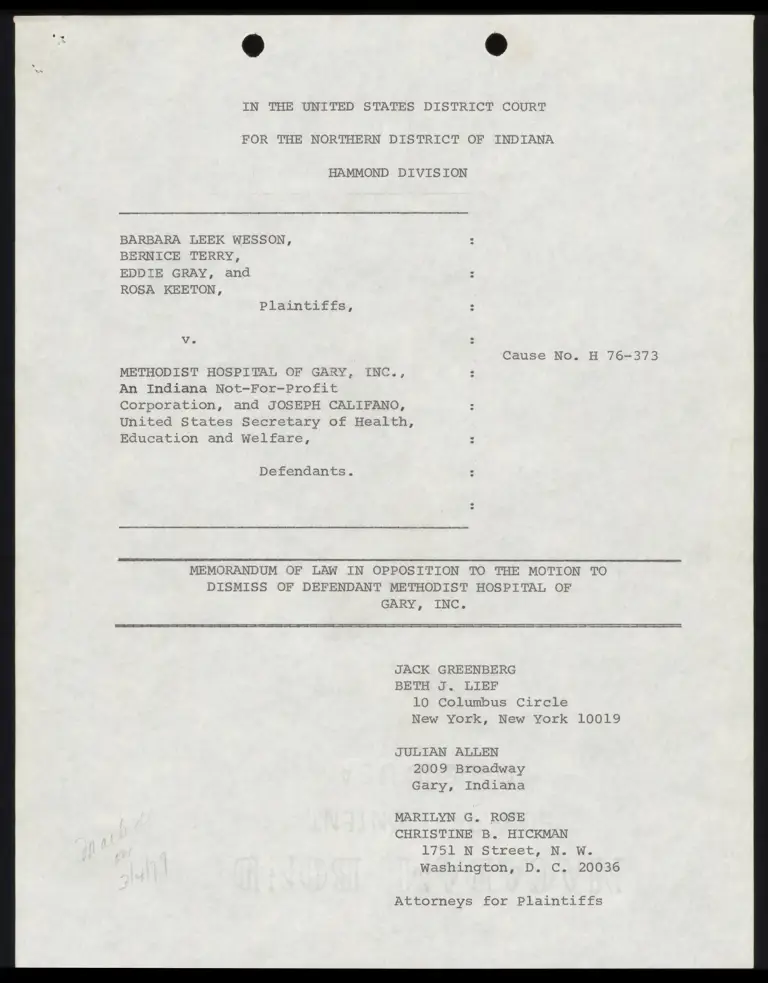
Memorandum of Law in Opposition to the Motion to Dismiss
Public Court Documents
March 5, 1977
52 pages
-
Case Files, Hatcher v. Methodist Hospital - Hardbacks. Memorandum of Law in Opposition to the Motion to Dismiss, 1977. 801491cf-5384-f111-ab0f-7ced8d2181dd. LDF Archives, Thurgood Marshall Institute. https://ldfrecollection.org/archives/archives-search/archives-item/9573da73-f764-4307-9ad3-1c34d7a2b5d2/memorandum-of-law-in-opposition-to-the-motion-to-dismiss. Accessed October 10, 2026.
Copied!
     [||11ea9f8d-1212-4d16-a85d-0b64bee70fe0||] IN THE UNITED STATES DISTRICT COURT

FOR THE NORTHERN DISTRICT OF INDIANA

HAMMOND DIVISION


BARBARA LEEK WESSON,

BERNICE TERRY,

EDDIE GRAY, and

ROSA KEETON,

(1
)

Plaintiffs, es


Ve ae


Cause No. H 76-373

METHODIST HOSPITAL OF GARY, INC.,

An Indiana Not-For-Profit

Corporation, and JOSEPH CALIFANO,

United States Secretary of Health,

Education and Welfare,

4


(1
)

Defendants. .
“a
e


MEMORANDUM OF LAW IN OPPOSITION TO THE MOTION TO

DISMISS OF DEFENDANT METHODIST HOSPITAL OF

GARY, INC.


LB i a rE E> — cern emerge Ea ————.. RE CISTI ESTES T= Te —

JACK GREENBERG

BETH J. LIEF

10 Columbus Circle

New York, New York 10019

JULIAN ALLEN

2009 Broadway

Gary, Indiana

MARILYN G. ROSE

CHRISTINE B. HICKMAN

1751 N Street, N. W.

Washington, D. C. 20036

Attorneys for Plaintiffs


II.

IIT.

IV.

vill.

INDEX

TABLE OF CONTENTS

Page

STATEMENT OF THE CA Duns senses dines evevesesnsveved

THE COMPLAINT STATES A CAUSE OF ACTION UNDER TITLE
VI OF THE CIVIL RIGHTS ACT OF 1964 AND JUDICIAL RE-
VIEW IS NOT PRECLUDED BY THE ADMINISTRATIVE PROCE-
DURE ACT OR THE HILL-BURTON ACT. ssvcsssssvvsonsnses

A, The Complaint, Which Alleges Racial Discrimi-
nation By A Recipient Of Federal Financial
Assistance, States A Cause Of Action Under

Title Ml sss ss shsosnssvsesrsesvsessersesetovenesd

B. Neither The Administrative Procedure Act Nor

The Hill-Burton Act Preclude Jurisdiction Over

The Subject Matter Of The Complainteeceececcceeesll

METHODIST HOSPITAL OF GARY, INC, IS SUBJECT TO THE

PROHIBITIONS OF THE FOURTEENTH AMENDMENT. .ccccseeslD

PLAINTIFFS HAVE EXHAUSTED THEIR ADMINISTRATIVE
REMEDIES, ANY FURTHER EFFORTS AT OBTAINING RELIEF
THROUGH THE ADMINISTRATIVE PROCESS WOULD BE FU-
TILE, AND THE DOCTRINE OF EXHAUSTION OF ADMIN-
ISTRATIVE REMEDIES IS INAPPLICABLE TO THE CAUSES
OF ACTION AGAINST THE SECRETARY OF HEWeeeoooeoosese0

PLAINTIFFS HAVE STANDING TO BRING THIS ACTIONeeeo23

THIS CASE IS RIPE FOR JUDICIAL REVIEW. .ccocecoonses’b

THE DOCTRINE OF SOVEREIGN IMMUNITY IS INAPPLICABLE
IN THIS CASE AND IS NO BAR TO THIS COURT'S JURIS~
DICTION OVER THE SECRETARY OF HEALTH, EDUCATION

AND WE AR visu vn sons oorusos assesses iossnsnsonesds

CONCUSSION , ss. so somos nes vos rsostnseahnessesessssesn edd


TABLE OF AUTHORITIES


CASES PAGE

Adams v. Richardson,

480 F.2d 1159 {D.C.C. T7973) sesaisiosssssovesensiviee eddy 14,

22,30


Albemarle Paper Co. v. Moody,

922 U.S. 405 (1075) ev vss Bosesnesvevsinebonssnesssestl


Arlington Heights v. Metropolitan Housing Corpe.,
45 U.S. LN, 4073 (January 11, 1977) cv esnseesvesoesass 24


Ascherman v., Presbyterian Hospital,
507 F.24 1103 (9th Cir. JOT) ssi nsva ven enssssves suid


Baker v. Carr,
369 U.S. 186 (1062) cnn nse sniinsessbonensesevsines vod

Bob Jones University v. Johnson,
396 FF. Supp. 597 (D.S.C. 1974), aff'd, 529 F.24
514 (4th Cir, O76) Luss nnnsssnsnnsseevitiesveneeseensy 9


Citizens to Preserve Overton Park v. Volpe,

401 k 2 402 0107 1 eve canesimeisvnns sone nenseseronestds 14


Conley v. Gibson,
355 U.S. 41 (1057) 0 nsnevisnesevovessseveossoreeveey 15

Data Processing Service v, Camp,
397 U.S, 150 (1070) caves ene ds sviseesnsvnsesnssnossinesy 25


Doe v, Bellin,

479 Fe 2d 756 (7th Cir, 197 ec sv sce cencsvesenssnssls, 19


Dugan v. Rank,

372 U.S, 609 £1063) cannes oneioissssseseveines ss oe see sna

Ex Parte Young,

209 F.Se 123 {1008 ) cues svnsosssssvsnesnesesvenens sd


Foman v. Davis,
LR ———

371 U.S. 178 (L062) cde san tons sess esis vee ven's eesesld, 15

Fuhrer v. Fuhrer,
292 F.2d 140 (7th Cir, 1061) J vias Venn ss nnneveeveved

Gautreaux v. Hills,

425 U.S. 284 {A075 vv sion ons ssniosnvsdessevesmive esa, 30


wf]


CASES (cont'd) PAGE

Glover v. St. Louis-San Francisco R. Co.,

393 P.O. 324 01069) binvioasvsensesesosossesesnvesenal


Griggs v. Duke Power Co.,

401 U.S 424 C1071) von nvosvrosnvesvenveivevveeveeell


Hicks v. Weaver,
302 Fe. Supp. 619 {(£.D. La, JOEO) svn nensensvsesseid,

Jackson v., Metropolitan Edison Co.,

419 U.S. 345 (1OT7A) un vanne nsiovnesindiveseiaeesensseeeld,


Land v. Dollar,

330 U.S. 731 (1047) sien snnossensenetnesssasvenersedds

Larson v. Domestic and Foreign Commerce Corp.,

337 U.S. 682 (LOZ EY sian iv sins esosienineesvssssissvveenaSs


Lau v. Nichols,
414 U.S, 563 (1074) an tenvoivsssvnesinssvessensnsns vets

Lee County School District No, 1 v. Gardner,

263 Fe. Supp. 26 {D.S.C. 1067) cc dsnos sors snvilonws dod


Malone v. Boudin,

369 U.S. 642 (1002) 0s vnnosnesssseoeenne sees sensossves

Moose Lodge No. 107 v. Irvis,

407 U.S. 163 £1972 aia's thofnios sisinin sins dae nesvsnnsseesesld


NAACP v. Brennan,

360 F. Supp. 1006 DCA. V373) seme dos aseinsesnecsesl

NAACP v. The Wilmington Medical Center,
Civ. Action No, 76-298 "{D, Del, 1976) cc evesssneeseds


Radovich v, National Football League,

352 U.S. 445 (1057) snevvsnvsnssorensesetsowtnsvensd


Schafly wv. Volpe,

495 Fe 2d 273 (7th Cir. 1072) scene vances isesnniseveedd

Shannon v, HUD,
— iin,

£36 FP, 20 809 (318 Cir. 1070). costes snnnevnviacese2, 30

Sierra Club v. Morton,
405 UeSs 727 (T0722) svn vveness sosunenssncetenns vases


Simkins v. Moses Cone Memorial Hospital,
323 F. 2d 959, cert. denied, 376 U.S. 938 (1964)..8, 17


Simon v. Eastern Kentucky Welfare Rights Organization

426 UsSe 26 0 Yh I ER IO RR ie ER he T


-iii-


CASES (cont'd) PAGE

Spark v. Catholic University of America,
510 F. 2d 1277 {(b.C.C. 1975) seuss swin esas ess sessed


State of Washington v. Udall,

417 Pa 2d 1310 (9th Cir, 1969). « wheiote so s 00 'ninin's ss nvinnva0


United States v. SCRAP,

412 US e 669 (1973) a a vne nines stn esteswinee oie vied ve side vas


Warth v, Seldin,

422 U.S. 490 L1O76) sno novos onnesvvisimeiee se seesennsieres


STATUTES


Fifth Amendment To The Constitution of the United States.2, 8

Fourteenth Amendment To The Constitution of the United

SALES seventeen ssinvncossssnsewronsesverssbesenssves eed 3, B.,

15, 16,
17, 26

5 UeS.Cu §701. ® © © © © © OO ® ® OOO OOPS OES OOO EE SOOO OO e000 OO 0 0 eee 00 i i 12, 13

5 U.,S.Ce §702a ova veo nwieivitioie sve oe e oe ss esse viveeee seine swe ss 31

28 UeSCoe S134 3nnsvesionsesevevesnsssssrecsrvess eens seveveld

42 U.S.C §291 et. SCC a vic 0s nbesetesssesessesasseseses suse PasSsSim


42 UL E80 21083 eves ess vsvoverssensevieesisesssssesssesseeeinsdd

42 UeS Co §2000d et. SECs wvsssvnssssssssssssnesnssssesesnsPOSSim

42 C.T.R. 853 ell dis vnnnvesvvierevmsisieesnnevsesssenieresviselOy 12

42 C.EB.R. 8530127 cnvaninens oneness vesensineassseeeeessessseelO

42 CCFLRL BS 31128 0s eie tosses ne sensors eesssveseeinvessnessll

45 CF.R, Part BO ses oneseaivevniseevsieeeveeve ve siomeses10, 32, 13,

16, 20

Government Documents


110 Congressional Record 7054-7058, 7060-7063, 14433-

14440 (1OGA Ys ss snes votsnevssesssnsosevsersressssvees

110 Congressional Record 13928, 14331 (1964)eccccccccccce?

-—]


Government Documents (cont'd) Page


House Document No. 124, 88th Congress, First
Session, at 120 bois vin ne evs snsensevictsens sews vives ened

House Report No. 94-1656, September 22, 1976 Congres-
sional and Administrative News 6553ccccceccccecessll

Senate Report No. 752, 79th Congress

First Session, 26 L104) sc ensniv snes nsneosnnesnsssele


CERTIFICATE OF SERVICE


I hereby certify that a copy of the foregoing MEMORANDUM

OF LAW IN OPPOSITION TO THE MOTION TO DISMISS OF DEFENDANT

METHODIST HOSPITAL OF GARY, INC., was served by United States

Mail, postage prepaid, on the 5th day of March, 1977, on

counsel for defendants as follows:

HODGES, DAVIS, GRUENBERG, COMPTON

& SAYERS, BRUCE E. SAYERS, ESQ.

5525 Broadway

Gary, Indiana 46401

ATTORNEYS FOR DEFENDANT METHODIST

HOSPITAL OF GARY, INC.


BETH J." L1IEF

Attorney For Plaintiffs


IN THE UNITED STATES DISTRICT COURT

FOR THE NORTHERN DISTRICT OF INDIANA

HAMMOND DIVISION


BARBARA LEEK WESSON, :

BERNICE TERRY,

EDDIE GRAY, and

ROSA KEETON,

{1
}

Plaintiffs,

Yea Cause No. H 76-373

[1
]

METHODIST HOSPITAL OF GARY, INC.,

An Indiana Not-For-Profit

Corporation, and JOSEPH CALIFANO,

United States Secretary of Health,

Education and welfare,
se


(1


Defendants.


MEMORANDUM OF LAW IN OPPOSITION TO THE

MOTION TO DISMISS OF DEFENDANT METHODIST

HOSPITAL OF GARY, INC.

I.

STATEMENT OF THE CASE


This case was commenced by four black citizens who

are residents of the City of Gary, Indiana against the

Methodist Hospital of Gary, Inc., and the United States

Secretary of Health, Education and Welfare (hereinafter

"HEW") . Plaintiffs charge the defendants with violating

their obligations and plaintiffs' rights under Title VI

of the Civil Rights Act of 1964, 42 U.S.C. § 20004, and


their rights to equal protection guaranteed by the Fifth

and Fourteenth Amendments to the Constitution of the United

States.

Methodist Hospital of Gary, Inc., has operated a

hospital facility, Gary Methodist Hospital, in the City of

Gary for over fifty years. In 1975, Methodist Hospital of

Gary, Inc., completed construction of another hospital,

Broadway Methodist Hospital, which is located in Merrillville,

Indiana, a suburb of Gary. The precipitating cause of this

action was the approval by HEW of a $8,143,370 proposal by

Methodist Hospital of Gary, Inc., and the grant of federal

financial assistance under Title VI of the Public Health

Services Act, 42 U.S.C. § 291 et seq. (hereinafter "Hill-Burton"

Act). The majority of funds in this proposal are intended to

be used to expand the facilities at Broadway Methodist Hospital.

Plaintiffs contend that the construction and expansion

of Broadway Methodist by Methodist Hospital of Gary, Inc.,

discriminates against the black citizens of Gary in the pro-

vision of health services. To remedy this discrimination,

plaintiffs seek an order enjoining HEW from continuing the

federal financial assistance which HEW is giving and has

given to Methodist Hospital of Gary, Inc., for the construction

of Broadway Methodist Hospital and an order directing HEW to


withhold Hill-Burton financial assistance on the $8,143,370

proposal of Methodist Hospital of Gary, Inc.

Defendant HEW has not filed an appearance in this

action. Defendant Methodist Hospital of Gary, Inc., has

filed a motion to dismiss on the grounds that (1) the Court

lacks jurisdiction over the complaint under Title VI of the

Civil Rights Act of 1964, the Administrative Procedure Act,

the Hill-Burton Act, and the Fourteenth Amendment; (2) plain-

tiffs have failed to exhaust administrative remedies:

(3) plaintiffs lack standing to prosecute the action; (4) the

cause is not ripe for judicial determination; and (5) the

Court lacks jurisdiction over the Secretary of HEW. This

memorandum of law is submitted in opposition to all grounds

raised in the motion to dismiss.

IX.

THE COMPLAINT STATES A CAUSE OF ACTION UNDER

TITLE VI OF THE CIVIL RIGHTS ACT OF 1964 AND

JUDICIAL REVIEW IS NOT PRECLUDED BY THE AD-

MINISTRATIVE PROCEDURE ACT OR THE HILL-BURTON

ACT


A. The Complaint,Which Alleges Racial

Discrimination By A Recipient Of

Federal Financial Assistance, States

A Cause Of Action Under Title VI.

Section 601 of Title VI of the Civil Rights Act of 1964

provides:


"No person in the United States shall

on the ground of race, color or na-

tional origin, be excluded from par-

ticipating in, be denied the benefits

of, or be subjected to discrimination

under any program or activity receiving

federal financial assistance." 42 U.S.C.

§ 2000d.

The allegations of the complaint, which on a motion to dismiss

1/
are accepted as true, charge that Methodist Hospital of Gary,

Inc., which is a recipient of federal financial assistance,

discriminates against the black citizens of Gary, Indiana in

the provision of health care (Complaint, paragraphs 4, 8, 11).

This allegation falls squarely within the prohibitions of

and states a cause of action under Title VI.

Although defendant professes some uncertainty as to whether

the complaint actually alleges racial discrimination, it is

clear from the totality of the pleading, that racial dis-

crimination forms the gravaman of the action. The allega-

tion that Methodist Hospital of Gary, Inc., does not refuse

black patients outright at Broadway Methodist in no way

minimizes the allegation that black citizens are being dis-

criminated against at Gary Methodist by receiving inferior

health care, or by the construction of the more modern facility,

Broadway Methodist, in a location not accessible to them. Any

ambiguity in this regard must be resolved in favor of plain-

tiffs, for in considering a motion to dismiss, the facts alleged


l/ E.g., Radovich v. National Football League, 352 U.S. 445
(1957).


ue


must be viewed in the light most favorable to the plaintiffs.

Conley v. Gibson, 355 U.S. 41, 45-46 (1957); Fuhrer v. Fuhrer,


292. 9.24140, 143 (7th Cir. 1961).

It is equally clear, and defendant admits that Methodist

Hospital of Gary, Inc., has received substantial amounts of

federal financial assistance. The affidavit of Larry Mangold,

Chief Financial Officer of the Methodist Hospital of Gary, Inc.,

2/
submitted in Opposition to the Motion for a Preliminary Injunction,

states:

"2. +. «. . That The Methodist Hospital of Gary

entered into an agreement with the Department

of Health, Education and Welfare of the United

States government dated September 5, 1973, pro-

viding for a 3% interest subsidy on a real
estate mortgage in the sum of $ 14,315,207.00

. « « « [and] that the aggregate 3% interest

subsidy over the next 24 months commencing

February 1, 1977 is in the sum of $837,394.05.

4. That the defendant, Methodist Hospital,

has obtained approval of the Health Services

Agency for Northern Indiana for three building

projects being a health services building in

Gary, a health services building in Merrillville
and a laundry in Merrillville. This approval

was granted September 28, 1976. In addition,

defendant, Methodist Hospital, has obtained a

loan guarantee agreement for said projects under

Project Numbers 212 and 213 both of which are

dated September 28, 1976. . . Said loan guaran-

tee agreement provides for a loan guarantee and


2/ The motion has since been withdrawn.


3% interest subsidy provided the project is

placed under contract within 12 months from

the date of execution of these agreements by

the Secretary (of HEW) unless a longer time

is approved by the Secretary but in no case

to exceed 18 months. Said loan guarantee

for Project 212 is in the sum of $2,511,604.00

and for Project 213 is $3,522,895.00 and the

value of the interest subsidy thereon is in

the sum of approximately $2,660,

5. That in addition, the defendant,

Methodist Hospital, has obtained approval for

a grant of $491,573.00 in Hill-Burton Funds

for the construction of said buildings, which

it may lose in the event of a preliminary in-

junction."

Despite these admissions, Methodist Hospital contends that

it is not subject to the obligations and prohibitions of Title

VI by virtue of § 605 of the Title, which provides:

"Nothing in this subchapter shall add to or

detract from any existing authority with

respect to any program or activity under

which Federal financial assistance is ex-

tended by way of a contract of insurance

or guaranty." 42 U.S.C. § 2000d4-4.

The legislative history of Title VI, case law, administrative

determinations, and commonsense demonstrate that the defend-

ant's attempt to evade the requirements of Title VI is merit-

less.

Title VI,and the other provisions of the Civil Rights

Act of 1964, were passed in response to Congress' heightening

determination to obliterate the evils of segregation and


Pursuant to § 2000d-1, HEW promulgated regulations which set

forth with specificity the obligations of Title VI.

45 C.F.R. Part 80. Appendix A to those regulations is titled

"Federal Financial Assistance to Which These Regulations Apply."

Included within that list at Part 2, number 22, is the Hill-

Burton program: "grants, loans, and loan guarantees with

interest subsidies for hospital and medical facilities (Title

VI, Public Health Service Act, 42 U.S.C. 291 et seq.)." More-

over, the regulations promulgated by HEW under the Hill-Burton

Act also recognize the applicability of Title VI to the program.

42 G.F.R. § 53.112.

It is well-recognized that the interpretation of a statute

by the agency charged with its enforcement is entitled to

great deference. E.g., Albemarle Paper Co. v. Moody, 422 U.S.


405, 431 (1975), Griggs v. Duke Power Co., 401 U.S. 424, 433-


434 (1971). Indeed, both HEW and Methodist Hospital of Gary,

Inc., thought Title VI applied so that Methodist was subject

to Title VI by virtue of the Hill-Burton financial assistance,

since HEW had Methodist sign the "Civil Rights Assurance" which

is attached as Exhibit "A" to the Complaint. Finally, the de-

fendant admits that it is receiving not merely a loan guarantee,

but a grant and interest subsidy which total substantial

amounts of money. See, supra, pp. 5-6.

Wo


discrimination which had continued to plague the United States

since the end of the Civil War. In the message accompanying

the proposed Civil Rights Act of 1964, President Kennedy re-

quested that Congress "pass a single, comprehensive provision

making it: clear that the federal government is not required

under any statute, to furnish any kind of financial assistance

. « » to any program or activity in which racial discrimination

occurs." House Document No. 124, 88th Cong., lst Sess., at 12.

Section 605 was added to Title VI by a Senate floor amend-

ment, and is therefore not analyzed in the committee reports

on the Act. Debate on the floor of Congress establishes, how-

ever, that the amendment was intended to exempt from coverage

loans handled by banks which were members of the Federal

Deposit Insurance Corporation, and handled Veterans Administration

and Small Business Administration loans. 110 Cong. Rec. 13928,

14331 (1964). The concern which prompted the amendment was

that the conventional loan market not be affected. Id.

In contrast to those types of conventional loans, Congress

clearly intended to have Title VI cover financial assistance

under the Hill-Burton grant and loan program. In the twenty-

year period predating Title VI, a number of federal laws had

been promulgated which provided federal tax dollars on an

alleged "separate-but-equal" basis. Prominent among these laws


3/
was the Hill-Burton program, the program pursuant to which


Methodist Hospital has received, is receiving and will

receive funds. In December, 1963, the Court of Appeals for

the Fourth Circuit declared the "separate-but-equal" clause

in the Hill-Burton Act unconstitutional, and held that other-

wise "private" hospitals, built with Hill-Burton monies,

violate the Fifth and Fourteenth Amendments of the Constitution

when they discriminate on the basis of race. Simkins v. Moses


Cone Memorial Hospital, 323 F.2d 959, cert. denied, 376 U.S.


938 (1964). The need to rid the Hill-Burton program of such

discrimination was very much on the minds of the sponsors of

Title VI. 110 Cong. Rec. 7054-7058, 7060-6063, 14433-14440

(1964) .

Moreover, courts have recognized that the coverage of

Title VI, a remedial civil rights statute, should be given a

broad interpretation. As the District Court in Bob Jones


University v. Johnson stated:


"Beyond giving the literal language of Section

601 its ordinary meaning . . . it is also im-

portant to consider whether . . . a construction

comports with the Congressional purpose under-

lying Title VI. . . . In the absence of statutory

language or legislative history which would clearly


3/ Pub. L. 725, Title VI of the Public Health Services Act,

42 U.S.C. § 291 et seq.


seem to exclude Title VI coverage . . .

the broad language of Title VI should be

interpreted in the remedial context in

which the Title was presented to Congress

by the Kennedy Administration. Under such

circumstances narrow readings of Title VI

coverage are inappropriate. See Miller wv.

Amusement Enterprises, Inc., 394 F.2d 342

(5th Cir. 1968). Nothing in the congress-

ional debate on what became the Civil Rights

Act of 1964 compels exclusion of these

statutes from Title VI coverage. The sweep-

ing language of Section 601 suggests other-

wise." 396 F. Supp. 597, 604 (p.S.C. 1974),

aff'd, 529 v.24 514 {4th Cir. 1978).


The Court in Bob Jones University held that VA payments to


veterans are covered by Title VI; the reasoning of the Court

there applies with equal, if not greater force to interest

subsidy assistance under the Hill-Burton, in light of legisla-

tive history. See supra.

Defendant’s position is also contrary to that of HEW,

which has responsibility for administering the Hill-Burton

program. Section 602 of Title VI provides in pertinent part:

"Each Federal department and agency which

is empowered to extend Federal financial

assistance to any program or activity, by

way of grant, loan, or contract of insur-

ance or guaranty, is authorized and di-

rected to effectuate the provisions of

Section 20004 of this Title with respect to

such program or activity by issuing rules,

regulations, or orders of general applica-

bility which shall be consistent with

achievement of the objectives of the statute

authorizing the financial assistance in con-

nection with which the action is taken."

42 U.S.C. '§ 20004-1.

Oe


Neither The Administrative Procedure

Act Nor The Hill-Burton Act Preclude

Jurisdiction Over The Subject Matter

Of The Complaint.

The Administrative Procedure Act (hereinafter APA) pro-

vides:

"Right of Review

A person suffering legal wrong because of

agency action, or adversely affected or

aggrieved by action within the meaning of

a relevant statute, is entitled to judicial

review thereof." 5 U.S.C. § 702.

Section 702 confers jurisdiction over plaintiffs' complaint

that HEW, by its actions, has failed to enforce the reguire-

ments of Title VI.

Defendant ' contends, however, that judicial review under

the APA is foreclosed by the provisions of 5 U.S.C. § 701 that:

"(a) This chapter applies . . . except to

the extent that —

(1) statutes preclude judicial review; or

(2) agency action is committed to agency

discretion by law."

To support its contention that a statute precludes judicial re-

view, Methodist Hospital relies on certain provisions of the

Hill-Burton Act. This position misconceives the nature of

the complaint. This action is not an action arising under

the Hill-Burton Act. Plaintiffs do not allege that the Hill-


Burton Act per se has been violated,but rather that the

defendants have violated the provisions of Title VI, which

apply to recipients of Hill-Burton funds. ‘See 42 C.F.R. § 53.112;

4/
45 C.F.R,. Part 80. : Judicial relief

concerning allegations under Title VI is not foreclosed by

statute. §See., e€.9., Lau v. Nichols, 414 U.S. 563 (1974).


Defendant 1s equally incorrect in its assertion

that the actions of HEW in enforcing or failing to enforce

its Title VI obligations with respect to recipients of Hill-

Burton funds is committed to agency discretion by law. Again,

plaintiffs are not challenging the failure of HEW to fulfill

its responsibilities pursuant to the Hill-Burton Act, 42 U.S.C.

§ 291) et seq., but are challenging the failure to enforce

Title VI and its implementing regulations, 45 C.F.R. Part 80.

The Supreme Court, in reviewing the agency discretion

exception to the APA, has stated that the exception is an ex-

tremely narrow one, "applicable in those rare instances where

'statutes are drawn in such broad terms that in a given case

there is no law to apply.' S. Rep. No. 752, 79th Cong., lst

Sess., 26 (1945)." Citizens to Preserve Overton Park v. Volpe,


401 U.S. 402, 410 (1971). The notion that the exception applies


4/ To the extent that defendants' confusion is caused by the

wording of the complaint, the proper course is not to dismiss

the complaint but to allow leave to amend. Foman v. Davis,

371 'U.8.»178 (192).


Wo,


to challenges under Title VI was laid to rest in Adams

v. Richardson, 480 F.2d 1159, 1161 (D.C.C. 1973, where the

Court of Appeals stated:

"Appellants insist that the enforcement of

Title VI is committed to agency discretion,

and that review of such action is there-

fore not within the jurisdiction of the

courts. But the agency discretion exception

to the general rule that agency action is reveiw-
able the Administrative Procedure Act, 5 U.S.C.

§§ 701-2, is a narrow one . . . . The terms

of Title VI are not so broad ('That in a given

case there is no law to apply' so] as to pre-
clude judicial review. A substantial and

authoritative body of case law provides the

criteria by which noncompliance can be de-

termined, and the statute indicates with

precision the measures available to enforce

the Act . . . Title VI not only requires

the agency to enforce the Act, but also sets

forth specific enforcement procedures . . . "

As noted above, HEW has promulgated a detailed set of

regulations, 45 C.F.R. Part 80, under Title VI which applies

to recipients, like Methodist Hospital of Gary, Inc., of Hill-

Burton financial assistance. In addition, Section 602 of

Title VI, 42 U.S.C. § 2000d4-1, which directs the department

or agency which extended financial assistance to enforce

the prohibition against discrimination by terminating aid to

programs which violate Title VI, sets forth specific measures

of enforcement. When Section 602 is viewed in conjunction

with the regulations, which set forth the criteria to apply

in determining whether a recipient has violated Title VI, it

213-


is clear that the actions of HEW under the Title lie out-

side the parameters of the narrow agency discretion rule

enunciated in Citizens to Preserve Overton Park.v. Volpe,


supra. The cases cited by defendant: are all inapposite

because they involve different statutes whose standards are.

not remotely as detailed as those of Title VI.

In Adams, as here, the Court was asked to interpret Title

VI and to determine whether HEW has correctly construed its

enforcement responsibilities. The Adams court observed, supra,

480 F.2d at 1163-1164;

" [The purpose of the suit] is . . . to assure

that the agency properly construes its

statutory obligations, and that the policies

it adopts and implements are consistent with

those duties and not a negation of them . . .

This action is consistent with the nature

of judicial review exercised in other situa-

tions. See Burlington Truck Lines v. United

States, 371 U.S. 156, 165-169 (1962); Board

of Public Instruction of Taylor City wv. Finch,

414 F.2d 1068, 1073-1075 (5th Cir. 1969); Elgin

Joliet & Eastern R. R. Co. v. Benj. Harris & Co.,

245 FP. Supp. 467, 472 (N.D. Ill. 1965)."


This view directly applies in the instant case.

~14=


Ix:

METHODIST HOSPITAL OF GARY, INC. IS

SUBJECT TO THE PROHIBITIONS OF THE

FOURTEENTH AMENDMENT


The denial by Methodist Hospital of Gary, Inc., that

it has discriminated against the black citizens of Gary is

irrelevant in considering a motion to dismiss since, as

noted above, on a motion to dismiss the facts pleaded in the

3/
complaint are accepted as true.

Moreover, defendant is incorrect in its assertion that

its actions are not "state action" for purposes of the

Fourteenth Amendment. To determine whether a defendant's

action is "state action," ". . . The inquiry must be whether

there is a sufficiently close nexus between the State and the

challenged action of the regulated entity." Moose Lodge No.

107 v. Irvis, 407 U. S. 163, 176 (1972), cited with approval


in Jackson v. Metropolitan Edison Co., 419 U.S. 345, 351 (1974).


The nexus in this case meets the Moose Lodge standard.


In order to participate in the Hill-Burton program, a state is

required to submit for approval by HEW a state plan which,

among other things, designates a State Agency to administer the


5/ It is true that the jurisdictional precedent for a cause of

action which arises under the Fourteenth Amendment is 42 U.S.C.

§ 1983 and 28 U.S.C. § 1343. However, to dismiss for

omission of these statutes is improper; plaintiffs should be

given an opportunity to amend. Conley v. Gibson, supra; Faman

v. Davis, supra.


-15<


plan, provides minimum standards for the maintenance and

operation of facilities providing inpatient care, and

provides methods of administration of the State plan, 42

U.S.C. § 291d. Both the state plans, 42 U.S.C. § 291d and

the project applications, 42 U.S.C. §291le, 42 C.F.R. §§ 53.127,

53.128, are subject to the requirements of Title VI, 42 C.F.R.

§ 80.4 (a) (b), Appendix A. The State Agency is responsible

for approving, recommending and forwarding applications for

Hill-Burton financial assistance to the Secretary of HEW, 42

C.F.R. § 53.127. Every application by a State Agency

to carry out its Hill-Burton program must contain a statement

that the program is conducted in compliance with Title VI

and must provide or be accompanied by provision for "such

methods of administration for the program as &e found . . .

to give reasonable assurance that the applicant and all re-

cipients of Federal financial assistance under such program"

will comply with Title VI regulations, 45 C.F.R. § 80.4 (b).

The Indiana State Board of Health is the State Agency

in Indiana which is responsible for implementing the Hill-

Burton program. According to Attachment #2-A to Defendant's

Memorandum in Opposition to the Motion for a Preliminary

Injunction, the Indiana State Board of Health approved


Federal assistance in the form of Hill-Burton funds for

Methodist Hospital of Gary, Inc.'s construction project.

In addition, the affidavit of Larry Mangold, submitted in

support of the Memorandum in Opposition to the Motion For a

Preliminary Injunction, states that the defendant obtained

approval of the project from the local agency designated by

the State to review such projects, the Northern Indiana Health

Services Agency (94 of Affidavit).

Here we have not merely the massive use of public funds

and state and federal involvement in the program. We have, in

the approval by the State of a construction program which dis-

criminates against plaintiffs and the black citizens of Gary,

an imprimatur placed by the State on the very action challenged.

Such an imprimature is sufficient to justify characterization of

the actions of the hospitals as "state action." See Jackson v.


Metropolitan Edison Co., supra, 419 U.S. at 354-355.


The Court of Appeals in Simkins v. Moses Cone Hospital,


supra, was faced with the identical question of whether the

actions of a "private" hospital which receives Hill-Burton

funds and which discriminates on the basis of race is

"state action" for purposes of the Fourteenth Amendment and

unequivocally answered yes. Supra, 323 F.2d at 967-968.

There is no case involving a claim of racial discrimination

by a hospital receiving Hill-Burton funds which has held

-17


otherwise. Cf. Spark v.Catholic University of America,


510: F.24 1277,:1281-1282. {(DCC..1975);.

The cases cited by defendant are readily distinguish-

able. The claim in Ascherman v. Presbyterian Hospital, 507


F.2d 1103 (9th Cir. 1974), involved a contention by a

physician that he had been arbitrarily terminated from em-

ployment by a private hospital receiving Hill-Burton funds.

The Court of Appeals specifically stated in affirming a

finding of lack of state action:

"The appellant cites us to no regulation,

and our independent research reveals none

that authorizes the State of California

or federal government to participate in

the appointment of medical doctors to the

staff of Presbyterian Hospital." Id. at

1105.

In contrast, as noted above, there are pervasive regulations

which authorize and mandate that the recipient of federal

funds, State Agency and HEW enforce the provisions of Title

VI and affirmatively enforce the right of persons receiving

benefits of Hill-Burton recipents not to be discriminated

against on the basis of race. Indeed, in the opinion in

Doe v. Bellin, cited by defendants and written by Justice,


then Judge, Stevens, the Court stated:

"No doubt the defendant hospital agreed

to abide by a variety of regulatory terms

related both to its operations and to the

lB


use of the Hill-Burton funds in connection
with its acceptance of benefits under that

Act. There is no evidence, however, that

any condition related to the performance

or non-performance of abortions was imposed

upon the hospital. Unlike the fact situa-

tion in Simkins v. Moses H. Cone Memorial

Hospital, 323 FP.28.959 (4th Cir, 1963), on

which plaintiffs place heavy reliance, this

record does not reflect any governmental

involvement in the very activity which is

being challenged. We find no basis for con-

cluding that by accepting Hill-Burton funds

the hospital unwittingly surrendered the

right it otherwise possessed to determine

whether it would accept abortion patients."

479 P.24 756, 761 {7th Cix. 1973).


While hospitals receiving Hill-Burton funds may not have

surrendered the right to determine whether to accept

abortion patients, they certainly abandon any possible

right to be racially discriminatory in the provision of

health services. The receipt of Methodist Hospital of

Hill-Burton funds, the approval of such funding by local

and state agencies and HEW, and the provisions of the Hill-

Burton Act, Title VI and their implementing regulations

establish that, according to standards set forth by the Supreme

Court, the defendant's actions are "state action" and there

is no lack of subject matter jurisdiction over the plaintiffs’

constitutional claims.

~1.G-


IV

PLAINTIFFS HAVE EXHAUSTED THEIR

ADMINISTRATIVE REMEDIES, ANY FURTHER

EFFORTS AT OBTAINING RELIEF THROUGH

THE ADMINISTRATIVE PROCESS WOULD BE

FUTILE, AND THE DOCTRINE OF EXHAUS-

TION OF ADMINISTRATIVE REMEDIES IS

INAPPLICABLE TO THE CAUSES. OF ACTION

AGAINST THE SECRETARY OF HEW.


Methodist Hospital of Gary, Inc., is correct that the

Title VI regulations provide:

"Conduct of Investigations.


(b) Complaints. Any person who believes

himself or any specific class of individ-

uals to be subjected to discrimination pro-

hibited by this part may by himself or by

a representative file with the responsible

department official or his designee a written

complaint.” 45'C.F.R.:§80.7(().


The simple answer to defendant's assertion that plaintiffs

must exhaust this administrative procedure is that admin-

istrative procedures have been exhausted. Attached as

Exhibit C to the complaint are a letter and telegrams sent

to HEW to oppose the approval of defendant's application

for federal financial assistance. (See § 10 of Complaint.)

Other persons, including Mayor Hatcher of Gary and Barbara

Wesson, one of the named plaintiffs, sent detailed complaints.

HEW sent a reply to the objectors which, among other things,

acknowledged the existence of racial discrimination and


stated that HEW could not assess the quality of care at

Gary Methodist Hospital. (See affidavit of Beth J. Lief

and attachment submitted as Exhibit I in opposition to

Motion to Dismiss of defendant Methodist Hospital of Gary,

Inc.) Despite these admissions, HEW informed the com-

plainants that it granted the 1976 application of Methodist

Hospital of Gary, Inc., for further Hill-Burton financial

assistance. Thus, the administrative procedure provided

under Title VI has been utilized.

In view of HEW's determination, its knowledge of racial

discrimination, and its refusal to assess the quality of

care at the hospitals operated by Methodist Hospital of

Gary, Inc., it is clear that further resort to HEW would be

an exercise in futility. The doctrine of exhaustion of ad-

ministrative remedies has no application where it is clear

that the relevant administrative agency will not grant the

relief in question. Glover v. St. Louis-San Francisco


R. Co., 393 Uu.8. 3244 330-331. 41909).

Plaintiffs allege that HEW, as well as Methodist Hospital,

has violated Title VI. Cf. NAACP v. Brennen, 360 F. Supp.


1006, 1012 (D.C. 1973). Plaintiffs are not required to ex-

haust administrative remedies insofar as they challenge

3)


HEW's procedures in granting the Hill-Burton financial

assistance. In a similar case, where plaintiffs allege

violation of administrative responsibilities by government

officials, the Court in Shannon v. HUD held:

" . . « the procedures afforded under the

Civil Rights Act of 1964 are designed

to provide redress against specific dis-

criminatory acts, and do not pertain to

the adequacy of HUD procedures." 436

F.24:809,:820 {3rd Cir. 1970).

See also, Adams v. Richardson, supra; Lee County School


District No. 1 v. Cardner, 263 PF, Supp. 26, 31 (D.S.C." 1967).

The doctrine of exhaustion of administrative remedies

is thus no bar to judicial review of this case since admin-

istrative remedies have been exhausted, any further resort

to administrative procedures would be futile, and, in any

event, plaintiffs need not exhaust administrative remedies

with regard to their charge that the Secretary of HEW has

violated their rights.

oD De


V

PLAINTIFFS HAVE STANDING TO BRING THIS ACTION

The essence of the question of whether a plaintiff has

standing "is whether the plaintiff has 'alleged such a

personal stake in the outcome of the controversy' as to

warrant his invocation of federal-court jurisdiction and

to justify exercise of the courts' remedial powers on his


behalf." Warth v. Seldin, 422 U.S. 490, 498-499, (1976) quoting

Baker v. Carr, 369 U.S. 186, 204 (1962). In order to demon-

strate that personal stake, plaintiffs must show that they

are injured by the challenged actions of defendants. That

injury may be indirect, see United States v. SCRAP, 412 U.S.

669, 688 (1973) and need not be an economic injury. Arlington

Heights v. Metropolitan Housing Corp., 45 U.S.L.W. 4073, 4076

(January 11, 1977); Sierra Club v. Morton, 405 U.S. 727, 734


(1970).

As black citizens of Gary who have used, use or will use

the facilities at Gary Methodist Hospital, plaintiffs suffer

from the discrimination by defendant in the provision of

health services. The fact that plaintiffs may not currently

be in need of hospital care does not deprive them of standing 0}


3


since they are potential users of Gary Methodist Hospital.

In the recent case of Arlington Heights v. Metropolitan


Housing Corp., supra, the Supreme Court stated that a

black who would "probably" move into housing that was

allegedly not built on the grounds of racial discrimination

had standing to challenge official action which prevented

the construction of the housing. Similarly, in Gautreaux

v. Hills, supra; Hicks v. Weaver, 302 F. Supp. 619 ( E.D.


La. 1969), the courts held that potential residents of

federally assisted housing projects had standing to challenge

federal agency decisions as to the location of those pro-

jects. So, too, the stature of plaintiffs as black citizens

who are potential users of the hospital facilities of

Methodist Hospital of Gary, Inc. and suffer from discrimina-

tory treatment at those facilities is sufficient to confer

standing.

Plaintiffs have also alleged an injury that is "likely


Kentucky Welfare Rights Organization, 426 U.S. 26, 38 (1976).


A decision that enjoins HEW and Methodist Hospital of Gary,

Inc. to enforce the provisions of Title VI will ensure that

federal funds are not spent on providers who violate the

civil rights of black persons and will help to ensure

that plaintiffs will not receive discriminatory or inferior

ir ZA


health care.

Finally, plaintiffs are within the "zone of interests"

which Title VI seeks to protect, that is, black benefi-

ciaries of the services of a recipient of federal financial

assistance. Plaintiffs therefore satisfy the second

aspect of the standing test. Data Processing Service Vv.

Camp, supra.


VI

THIS CASE IS RIPE FOR JUDICIAL REVIEW


Plaintiffs allege that Methodist Hospital of Gary, Inc.,

and the Secretary of HEW have violated their obligations

under Title VI. This issue 1s clearly ripe for judicial

review. Methodist Hospital does not dispute the fact that

it is currently and continually receiving the interest sub-

sidy on the Hill-Burton financial assistance which was

granted in 1973. Furthermore, the affidavit of Larry Mangold,

q 4, submitted in opposition to Plaintiffs' Motion For A

Preliminary Injunction, states that Methodist Hospital has

also received approval on its 1976 application. The report

of HEW in reply to the objections to the 1976 application

(attached to Exhibit 1 of this memorandum) also states that

HEW has approved the application. Indeed, Methodist Hospital

has submitted no affidavits or other proof to establish that

the 1976 application has not yet been approved.

In short, Methodist Hospital has received, is receiving,

and will receive federal financial assistance under the Hill-

Burton program. Plaintiffs allege that the receipt of those

funds in the face of continuing discrimination by Methodist

Hospital violates their rights under Title VI and the

Fourteenth Amendment. The statement of defendant that "the

controversy alleged herein is too speculative" (Memorandum

= Dh


in Support of Motion to Dismiss, p.

absurd.


VII

THE DOCTRINE OF SOVEREIGN IMMUNITY IS

INAPPLICABLE IN THIS CASE AND IS NO

BAR TO THIS COURT'S JURISDICTION OVER

THE SECRETARY OF HEALTH, EDUCATION. AND

WELFARE.


Defendant Methodist Hospital of Gary, Inc., asserts

that the doctrine of sovereign immunity bars suit against

Sy
the Secretary of Health, Education and Welfare. Methodist

Hospital admits, however, that the doctrine is inapplicable

where the Complaint alleges that the Secretary has acted out-

side the scope of his duty or where there is statutory

authority for the suit. Both situations are present in

this case, rendering the principle of sovereign immunity no

bar to jurisdiction over the Secretary of HEW.

A long recognized exception to the doctrine of sovereign

immunity allows suit against an officer of the United States

who has acted or is acting beyond the scope of his duties.

Dugan v. Rank, 372 U.S. 609, 621-622 (1963); Malone v. Boudin,


369 U.S. 642, 647 (1962); Larson v. Domestic and Foreign


iV; It is curious that defendant Methodist Hospital of Gary,

Inc., raises an objection to jurisdiction over the Secretary

of Health, Education and Welfare when the Secretary has not

yet made an appearance in this case and did not make such an

objection in another suit which alleges that he has violated

his obligations under Title with respect to the grant of

federal financial assistance to a hospital facility. NAACP

v. The Wilmington Medical Center, et al., Civ. Action No.

76-298 OD. Del.).


Wy |: I


commerce Corp., 337 U.S. 682 (1948); see Ex Parte Young,


209 U.S. 123 (1908); Schalfy v. Volpe, 495 F.2d 273 (7th


Cir. 1974). Title VI and its implementing regulations

require the Secretary to terminate federal financial

assistance to recipients who discriminate on the basis

of race. Plaintiffs allege that Methodist Hospital of Gary,

Inc., a recipient of federal financial assistance, discrim-

inates against the black citizens of Gary. By continuing

federal financial assistance in the Hill-Burton grant and

loan given in 1973, and by approving additional financial

assistance to Methodist Hospital of Gary, Inc., in 1976,

the Secretary has failed to enforce his obligations not to

continue financial assistance to a recipient who discrim-

inates on the basis of race and has therefore acted beyond

the scope of his duties (fq 10 and 11 of Complaint). More-

over, this is not a case where the doctrine of sovereign

immunity should apply because "the judgment sought would

expend itself on the public treasury or domain," Land v.

Dollar, 330 U.S. 731, 738 (1947). The relief sought is

solely the cessation of the grant of federal funds.


Nor is the statement in footnote 11 of the Larson

opinion a bar to suit. In that footnote the Supreme Court

stated:

WL


"Of course, a suit may fail, as one against

the sovereign, even if it is claimed that

the officer being sued has acted . . . be-

yond his statutory powers, if the relief

. « » will require affirmative action by

the sovereign . . .". Supra 337 at 691,

nS 11.

As the Court of Appeals for this circuit held in Schalfy v.

Volpe, supra, 495 F.2d at 280, footnote 11 exception "may


bar a suit [only] in exceptional cases (i.e., where to do

otherwise would impose 'an intolerable burden on governmental

functions, outweighing any consideration of private harm')."

(emphasis in original) Accord, State of Washington v. Udall,


417 F.2d 1310 (9th Cir. 1969). In this case there is no

such intolerable burden in governmental functions, and the

narrow rule of that footnote does not apply. Plaintiffs

seek an order requiring the Secretary to enforce his obli-

gations under Title VI. Courts faced with the same request

have not hesitated to grant the relief. See, e.g9., Hills

v. Gautreaux, 425 U.S. 284 (1976); Adams v. Richardson,


supra; Shannon v. HUD, supra; Hicks v. Weaver, supra. To bar suit


against the Secretary here would fly in the face of long-

standing precedent.

Finally, an amendment to the Administrative Procedure

Act, 5 U.S.C. § 702, effective October 2, 1976, specifically

provides the right of judicial review in

-30-


“An action in a court of the United States

seeking relief other than money damages

and stating a claim that an agency or an

officer or employee thereof acted or failed

to act in an official capacity or under

color of legal authority shall not be dis-

missed nor relief therein denied on the

ground that it is against the United States

or that the United States is an indispensi-

ble party." P. Law 94-574, October 21, 1976.

The House Report accompanying the bill establishes that the

purpose of the amendment was "to remove the defense of sovereign

immunity as a bar to judicial review of Federal administra-

tive action otherwise subject to judicial review." House

Report No. 94-1656, Sept. 22, 1976 Cong. & Adm. News 6553.

Although the applicability of the law is limited to cases

where injunctive and declaratory relief, as distinct from

damages, is sought, this is, as noted above, such a case.

And this is a case "otherwise subject to judicial review."

The allegation in the Complaint that the Secretary of HEW

acted in concert with Methodist Hospital of Gary, Inc., to

discriminate against the black citizens of Gary (fll of

Complaint) charges that plaintiffs suffered a legal

wrong and were adversely affected by the failure of the

Secretary of HEW to enforce his obligations under the

requirements of Title VI. These allegations render plain-

tiffs "aggrieved" within the meaning of 5 U.S.C. § 702.

“3 =


VIII

CONCLUSION


For the reasons set forth above, the motion to dismiss

of defendant Methodist Hospital of Gary, Inc., should be

denied.

Respectfully submitted,


« JACK GREENBERG

BETH J. LIEF

10 Columbus Circle

New York, New York 10019

JULIAN ALLEN

2009 Broadway

Gary, Indiana

MARILYN G. ROSE

CHRISTINE B. HICKMAN

1751 N Street, N. W.

Washington, D. C. 20036

Attorneys for Plaintiffs

3 Du


Rh ®

IN THE UNITED STATES DISTRICT COURT

FOR THE NORTHERN DISTRICT OF INDIANA

HAMMOND DIVISION

BARBARA LEEK WESSON,

BERNICE TERRY, EDDIE GRAY, and

ROSA KEETON, :

Plaintiffs,

AFFIDAVIT


METHODIST HOSPITAL OF GARY, INC.,

An Indiana Not-For-Profit

Corporation, and JOSEPH CALIFANO,

United States Secretary of Health,

Education and Welfare,

Defendants.

BETH J. LIEF, being duly sworn, deposes and says:

l. I am one of the attorneys for plaintiffs in the above-

captioned case and I make this Affidavit in opposition to the

Motion To Dismiss Of defendant Methodist Hospital of Gary, Inc.

with particular reference to the allegation of defendant that

administrative remedies have not been exhausted.

2. I visited the regional office of the Department of

Health, Education and Welfare on February 9 , 1977 in order to

review the office's files on Methodist Hospital of Gary, Inc.

3. Included in those files were !letters from Richard

Hatcher, Daisy Stone, Vernon Smith, Clarence Wood, Barbara

Wesson and Stephen Inllackson protesting the grant of federal

financial assistance to Methodist Hospital of Gary, Inc. on the

grounds, inter alia that Methodist Hospital of Gary, Inc. was


discriminating against the minority residents of Gary.

4. Included in those files also was the reply by HEW to

those objectors in the form of comments and a written report.

A copy of that report is attached to this Affidavit.

Respectfully submitted,


BETH J. LIEF

Sworn to and subscribed

before me this “of March, 1977.


NOTARY PUBLIC


Commission a

Exhibit #1


T
R


INTRODUCTION


HILL-BURTON APFLICATIONS

OF THE METHODIST HOSPITAL

OF GARY INC.

po 5 SE Bry

HE i

gE TH

OCT 22:18:86


MEDICAL CENtun wo: ive 7 =

AM 59

The Department of Health, Education, and Welfare, particularly the

Office for Civil Rights, has received objections from several sources

to the approval of Hill-Burton funds for the Methodist Hospital of

The applications are Methodist Hospital of Gary, Irc.
(Project No. =~ Indiana 212) and Broadway Methodist Hospital (Project No. -

Indiana 213). Objections have been reccived from the following persons:

Gary, Inc.

Sent

9/28/76

9/24/76

9/24/76

9/29

9/29/76

9/28/76

9/7/76

9/29/76

Received

10/1/76

9/27/76

10/1/75

10/1/76

10/1/76

10/7/76

9/15/76

9/29/76

Richard Gordon Hatcl.er

Daisy R. Stone

Vernon Smith

Clarence N. Wood

Barbara L. Wesson

Stephen R. Tallackson

I. Nature of Objections


The specific objections are listed.

of the author has been quoted.

where

Mayor, Gary, Indiana

President, Gary Branch

of the NAACP

President, Gary Common

Council

Regional Director,

Central Regional Office,

Nacional Uxrbaa League, lnc.

President, Medical Center

of: Gary, Inc,

Exccutive wirector,

Gacy Human Relation:

Commission

possible, the actual laaguage


®

1. Ylgrhodist Hospital has already made a huge investment in
contrary to present and projected health
County, Indiana. . . . This unneeded and

anteld expansion has duplicated services which are
wvallable in Gary, Indiana and which will only

ase the cost of health care throughout Lake
is odd and conspicuous that no study had ever

ead for more primary care facilities in South
. Is. Wesson statement to HSA Executive
Litee, August 25, 1976.)

rnathodist Hospital has already invested heavily in
Ezuth County area and the current proposal if closely.

examinsl, will indicate that the ‘reasons' for expansion
are rot Justified and will only serve to increase the
alreacy nigh cost of medical care in Lake County, Indiana."
(Mr. cod, Letter to ir. "loyd Russaw, September 238, 1976.)

3. See Ms. Stone statement below (C-2).

Increase in Cost of Health Care

l. See Ms. Wesson statement above (A-1).

Sce Mr. Wood statement above (A-2).

"To allow Methodist Hospital to continue its expansion in
the suburbs. . . will only serve to further reduce the
quality of health care to the citizens of Gary, Indiana
and to increase the cost of health care for everyone in
Lake County." (Mayor Hatcher, Letter of September 28, 1976.)

Lack of Commitment to Gary

l. "Methodist Hospital's reluctance to totally modernize its
Gary facility (evidenced by (i) its failure to replace its
inadequate power plant, x-ray and OMATJENnCY rcol. -... “and
(ii) Methodist deleting three of the original five inprove-
ments for G.M.H. that were in the Present pending grant and
loan application) will probably be furthered by thas
increasing identification of G.M.H. as the 'black hospital.”
(Mr. Tallackson, Letter of September 29, 1976.)


2. Mietoodist Hospital will noi share with the citizens of
Gary their ~ong range plans foi. the community. They also
will not jein with the community (the Medical Center of

nN
ve
i lary's Medical Center of Gary, and the

o) om


P
s


0 ts


) acllity and program planning to combine, share, or
te aQuplications, in order to achieve the maximum

iiization of health care dollars and, thereby, maintain
Gil service health facilities of the highest quality in

Gary". (Ms. Stone, Letter to Secretary Matthews,
Sestomsyr 24, 1076.)

3. "We enczcurage you to demand Methodist Hospital to develop a
long range plan, which will meet the needs of the citizens
of Gary ind the needs of the citizens of the County".

cher, Letter of September 22, 1976.)

HSA Lack cI Responsibility

"It is our opinicn that the Northern Indiana lcalth Systems Agency
is abdicating its role and responsibility in the case of their
position in regard to the application by Methodist Hospital «iui
(Mr. Wood, Letter to Mr. Floyd Russaw, September 28, 1976.)

Negative Impact on Gary

1. Reduction of Quality of Care in Gary

a) ". . . relegated to the institution within the city which
would be unable to offer medical care on par with the

"institution to the South". (Mr. Wood)

b) See Mayor Hatcher statement above {(B--3;.

c¢) "This proposal is another step in abandoning health services
to the citizens of Gary, Indiana". "The poor and minorities
will receive the leftover care when the health resources arc
shifted to South County". {Ms. Wesson)

2. Acceleration of "vihite Flight"

a) "The serious question as to whether or not the original
construction of B.M.H. has greatly accelerated the existing
flight of white patients and physicians to the suburbs and
suburban hospitals should be dealt with prior to . . . any
rurther development/expansion at the Broadway sito".
(iiz. Tallackson, Letter of Scptember 29, 197G.)


. b) More &sotors will leave Gary and the health care in the

rospital «will deteriorate". (Ms. Wesson)


. wood statement bolow (E-5-b).


raclal segregation of patient populations at the two
Zs that already exist would be greatly accelerated".
lackson)

5 —-

~r rey
Te -


       Zt 1s avident that the drive for this shift in resources
on tne economic gain of a few and is fueled by

ear and hatred". (Ms. Vesson)


=~

A

££
FN


ine 1a Bed Occupancy at Gary Methodist


"It has hzen brought to the attention of the Gary Human
Relaticns Commission chat G.M.I{. normally has 120 to 160
empty sods. . . If that exvansion occurs, then another
sharp Crop in the number of occupied beds av G.u.Il. may occur” !
(Mr. Tallackson)

5. Broadway Methodist Threatens Existence of Gary Methodist

a) "We are opposing this application because of the negative
impact this action will have on Gary, Indiana". (Mavoa:
Hatcher)

Pb) ". '. . the ultimate results of such an action. Namely, the
weaving away from the City of Gary, the good physicians and
the 'apying' patients". (Mr. Vood)


c) « ow MethodlstJlospital's application's. + will . i
adversely affect its Gary facility". (Mr. "allackson)


"HEW should also consider withdrawing the $14 million
; dollar Hill-Burton Loan Subsidy which was given to

Mcthodist Hospital in 1973 to build their Broadway
Suburban Hospital, which is a direct cause for the present
deteriorating hospital situation in Gary'. (Ms. Stone)


    II Comnaents


A. Duplication of Services


The possibility of duplication of services and the threat this would
pose to Gary rethodist Hospital was foreseen by the Office For Civil
Rights. To avert this problem HEW required the Methodist Hospital of
Gary, Inc. Zo sign Assurances in 1973 that:


Any and all pians to duplicat®. at Broadway Methodist Hospital
services row present at Gary iethodist Hospital or the
implementation of new programi,. in accordance with Public Law
92-603, at either hospital must be submitted to and approved
by the Regional Civil Kiyhts Director of the Department of
Health, Education, and Welfare in a manner consistent with
Title VI of the Civil Rights Act of 1964 and the regulations
pursuant thereto.

The Hospital has lived up to this assurance on two occasions:
(a) upon the closure of the 0B department at St. Mary Mercy
Medical Center in Gary and (b) by submitting its proposals for
the current Hill-Burton funds to the Office for Civil Rights as
early as July 19, 1974.

The Northern Indiana Health Systems Agency has the responsibilicy
for assessing the merits of certain applications for federal funcs.
my This Office has relied on the HSA and its predecessor (tho Cp) for
information regarding duplication of services. In a letter to our
Office, dated August 23, 1976, the ISA informed us that each
component of the Hospital's plan met real needs and did not rosuit
in "unneeded or unwarranted" expansion with the possible excention
of the laundry, which the HSA felt should be a joint venture with
other hospitals.

There does exist a duplication of services in Lake Cormbty, Indiana,
namely a surplus of beds. This is not, however, solely the result
of the building of the Broadway Methodist Hospital. It should be
remembered that four new hospitals were builc at the same time:
Broadway, Hobart Mercy, St. Anthony in Crown Point, and the
Munster Hospital. The latter two were built without CHP or State
approval. What is necded to stop the proliferation of hospital
beds is legislation requiring certificate of rced. This is a
State responsibility. Neither HEW nor this Office can reauire the
State to enact such legislation. A study of health care in Lake
County by the Northwest Indiana Comprehensive Planning Council and
Arthur D. Little, Inc. warned against the very situation which now
exists (Hospital Study, June 1971). That study and an earlier one
in 1960 by the Hamilton Associates did see a need for health
facilities in South Lake County, while warning against actions
which would undermine Gary health facilities.


the Northwest Indiana CHP in its 1971 Hogpital

involved,

Gary, Inc. Without such planning,

CoLsgguences were likely:

wealth Care


~ facilities, bed facilities which arc kept filled

the financial need of the institution rather than

needs of the patient. Estimated annual operational
hospitals were set at $30,000 per bed. -

-cCrrrzTition for scarce manpower resources

expansive and unnecessary duplication of facilities and equinmeat

-pobariial maldigstribution of

and p:nulation groups (PP 25 and 29-20).

rosourcoes anong goeogrammic

Gary Methodist Hospital is not the sole player in the game. Thus,
it is not solely to blame. On the other hand, a case could be made
that the blame worthy institutions are St. Anthony Hospital and the
Munster iledical Center, which were not approved by the CHP. Iaeally,
there should be a consolidated medical Program For the eastern half
of the county. This issue, however, is not within the domain of the
Office for Civil Rights. Title VI of the Civil Rights Act of 19564
does not guarantee cost effective health programs. It guarantees
that citizens will not be denied health care or treated differently
on the basis of their race, color, or national origin whatever the
quality of the health care offered by the recipient of federal
funds.

With respect to the specific actions to be taken by the Hospital, a
CEP Analysis in July 1974 took the position that the steps would
effectively result in cost savings.

Lack of Commitment to Gavy


1 The statements of the Board of Directors of the Methodist Hospital
of Gary, Inc. affirming its commitment tc Gary are a matter of
public record. A resolution was passed on April 13, 1972. The
1973 Assurances between HEW and the Hospital were Yoported in the
press. As recently as July 19, 1975, the Administrator reaffirmed
this commitnent in alettor Lo Dr. Holliday of tha Medical Cunror
of Gary, irc. So, apparently, the concern is nob whal the stated
intent of tho Hospital is. Rather, tho concery is that coviain
actions. ox lack of action reflect lack of comaitrent. Spaciiically
mentioned zre the failure to modernize, the failure to share long-
range plars, and the reluctance to plan jointly witli commualty
health res: .r-es.


Rights came a.r0$s no reports that Gary
x-ray, ape. cmergency room fecilities'

were "inaGecuats” “his charce i= apparently based on the
Projec:aé use £3 iiich funds fron the 1966 Cary Joint Hospital
Fund wCcull be use. The Fuad Drive letter of November 17, 1966
does = sneak In terms of inadequacy as much as it does of
"expansion


Report to the Board of Directors, the Administrator
reports : 2 partial remodelling of the E.R. is mentioned in the
1972 Lonz-Fanye Program Recommendations made to the Board of Directors.
The power tlzn is mentioned only in terms of expansion to meet the
needs of <i: X:alth Services Building. X-Ray. facilities are not
mentions z= all.

In the 9273 snrual

a

The Gffice Zor Civil Rights also has a deep concern about the
Hospital's Tirmicment to Gary. It bolioves thav actions nob WOLGS

care proof cnls commitment. In chat light, considerable weight
must be glil-zn to the following fects:

1) The Imergency Room at Gary was remodelled in 1973. Yo
2) The ICU--CCU at Gary were remodelled.
3) The Hospital proposes to expend $3,281,370 for a Bealth

Services Building in Gary.
4) $1,262,200 of $4,862,000 earmarked for construction ac

Merrillville is for a laundry which will also benefit
the Gary Facility. ;
Methodist Hospital assumed the responsibility for providing
obstetrical care after St. Mary Mercy closed its obstetrical
department.

Whether these steps go far enough can be debated. lowever, i: is
the judgment of this Office that thev do manifest commitment.

1 A |

Secondly, there is question of the Hospital's reluctance to share NEVE |

|

long-range plans with the people of Cary. Tac Bospital dous have “lon, 0)
long-range plans, developed in 1972. The Office for Civil Rights ulin
has no authority to compel the Hogpital to disclose these plans.
It 1s surprising that a community hospital, such. as Gary Methodist,
has not done so.

|
{


Finally, thore is thc guestion of the Hospital's reluctance to
nls Shanomenon —~ of which all hospitals in Lake

nas been noted in the aforementioned studies.

: correct, ‘joint plaming is a ust. 'thig

OLfice cinnot consi Yecipiwi.os of federal funds to plan jointly. or

even drniividuas ly, What it can fo is insure that whatever plans

rare cevelon .0 not discriminate on the basis of race, color, oz:

nationa ied


~&358 of the HSA in carrying cut its responsibilitics

can.only Iz aiuated by the Public Health Services Administration

of Hew.

Negative _-—rct on Gary


1, ReducCh.. on of ual Ly Caro in Gary

This c:a.ity of health care is a conmplex lussue which this Dffica

is not cualified to assess. Ve relied very much on ESA covalua-

tions. Each single component of the two Hill-Rurton applications
was found by the HSA to be nece ssary, cost cffective, and

beneficial. The HSA, however, made no attempt to compare the

quality of care at both institutions. It ig the exporionce of

this Office that there is no wyency with an adoqueote instrument
to compare the quality of carc at different institutions. ‘ihe

best that can be done is to assess that auality of care within
an institution. The Office for Civil Rights intends to concinu

exploring this issue with the resources available to it.

Quality of care is complex because it involves such diverse

factors as the number and skill of medical personnel, the cuality

of facilities and equipment, and the timeliness and ATTOTSA RE

ness of treatment. The question of medical personnel will be

treated later. Regarding facilities and equipment, the Q<fice

for Civil Rights has no evidence, to date, that the Hospital las

taken steps to reduce the lovel of quality in violation of

Title VI. Likewise, we have nu evidence that the level of treat-

nent has been reduced in violation of Title VI. However, acs

mentioned previously, this is a difficult arca to measure.

2. Acceleration of "White"Fliuht


This iz an ugly reality and a persistent problem. Howecver, wo

do not IZind that we can prove the Hospital guilty of comnlicity.


show that "Whitc flight” Began as far

1950, tho Hhite ponulation of nary hes

ince 1960, the total populaticn of Gery

wnile thc Black population increased by

1950

Favalation 133,911 178,320

i 39,326 69,340

94,585 108,980

1971 Hospital Study noted that physiclans were

ané were relocating to the South.

noted a similar trend in Chicago. Thus,

TAY be argued that the Hospital is gullty of racism by

*oia the oxodus, it cannol ba argued that it initiated
Ne

WVhito

ata Z.20i5000 to OCR hy Lhe lienpital sicw Lua holon 1470 - 4.

1972, =hirty-four physicians on staff moved Hv Yerrillville
from Gzr. This was prior to construction of the Broadway

satel

Docs the logpital's actions aid and abet "White EFligat"?

This is one of those "Which came first? Tho chigknnior: the

egy?" type questions. Ue have data that shows a declince in

the number of white physicians on staff fron 1973 to 1976.

Total - White . Black Hispanic Oriental

1972 4 1: 27 i

1976 28 1 27

Thirty-six white physicians who were on the active staff in

1372-1973 ar¢ nd longer on the active: staff. Bight are on the

Courtesy staff and five are on the Honorary staff. We do not

know what became of the remainder. If Broadway Methbtlist was

intended as a "haven" or if the Hospital's actions accelerated

Wnite flight, the Hospital has still lost over 30% of the White

staff i: had in 1972-73. It should he remembered thal there are

three other hospitals in South Lake County coawnelting with

Broadway Methodist and the two Gary hosnitals for medical staff.

A final comment concerns the limits off HEW's authoritv over

physic-ans. At the time the Assurance: were originally drafted,

a provizion was included waich obliged the liospital to compe)

physicians to praclice at Gary Methodist as a condition for


LEY Regic di Attorney ¥ tanat there
; the government to dictate to pnysiciarn:s

rad practice. ne 197) CUD study recomrernde:l
5 eastern Lake County merge staffs to insure
tion of plweiaians. Obviously, this recomaen-
6 by all pariicg and no agcecacy has tho

1 op

Ena ysis, the availability of physicians is the
in Gary. In that vein, the Hospital's

ish a Family Practice Residency must be
to attract physicians to Gary. liowovoer,

been atlempting this since 1972 withoui
Hospital's position is thal the space wnich

afier construction of the Health Services
ce a major step towards realization of the

proctra~. The issue of phvsician availebility and the
Hospital ls ole init is one that must be closely tracked.

~5 a reality. It cen be attribuies directly Lo the
physicians. Thus, this Office cannot charge the ilospital with
the creation of a dual svsten in violation of Title VI. This i §

Office polled one-third of the Black physicians on the Hospite staff. Their comments support Mr. Tallackson's statement. All staled: that thov are rFerfectly free to practices at Broaavey
Hethodist and that some of their Black col HEH Ecwevoer,
in gencra Ll, they prefer to practice at Gary Methodist and Vhite physicians prefer Broadway Methodist. Again, we come back to the free choice of physicians.

Mr. Wesson's statement also bears truth. Develcuments in the
health field in Lake County do seem to have been dictated nore by economics than health necds. The shift of resouices is
undoubtedly prompted to some degree by racial fear and hatred.
The question is whether the administration of the Hospital is ‘the primary and/or sole cause or whether the greed, Fear, and
hatred of other hospitals, the physicians, and the Deople have
created these forces. Our evaluation of tho gliwation, abt this
time, is that the Hospital has acted in the he:st interests of Gary in the face of Jorces hayonG its control.

Decline In Bed Occupancy at Gary Methodist

In our judgment, the OCCupancy rate at Gary Mcthodist would have
declined whethor or not Broadway Methodist opened given the
construziion of St. Inthony, Liobart Mercy, and the Munster
llospitals. It was the position of the Cli, the Z:ite Board of
Health, oni IBW that the best hopes for Gary Methodist Jay in
the zruction of the Broadway facility which would he park
Of a mins... corporation with Gary Methodist. ‘This provided
some insurance for the financial solvency of Gary tobthodist.

S


5. Broadway Methcdist Threatens: Fuislence of Gary Methodist

The objectiens in this category have been treated specifically

elsewhere. Tne primary concern cxpresseld 1s the negative

impact the lospital's actions will have on Gary.

CONCLUSION


Based cn a review of the Hospital's application and the issues, the Office

for Civil Rights founcé the applicant to be in compliance with Title Vi and

recommended clearance to the Public Mealth Services. We have been informed

that the applications were approved and that funds were granced. Tne

granting of the funds does not preclude later action by the Office fox Civil

Rights to seeX termination of the grant in the event that a Title VI

violation is proven.

Cffice for Civil Rights presently has no evidence that the Hospital's

tions constitute a violation of Title VI. In an issue as complox as’ chis;

here is always the possibility that previously unknown past developimcincs ox

ew developments will come to light which will negate our findings or rcouire

new ones. The granting of the funds does not preclude later action Ly the

ffice for Civil Rights to seek termination of the grant in the event that a

Title VI violation is proven.

Il [||11ea9f8d-1212-4d16-a85d-0b64bee70fe0||]