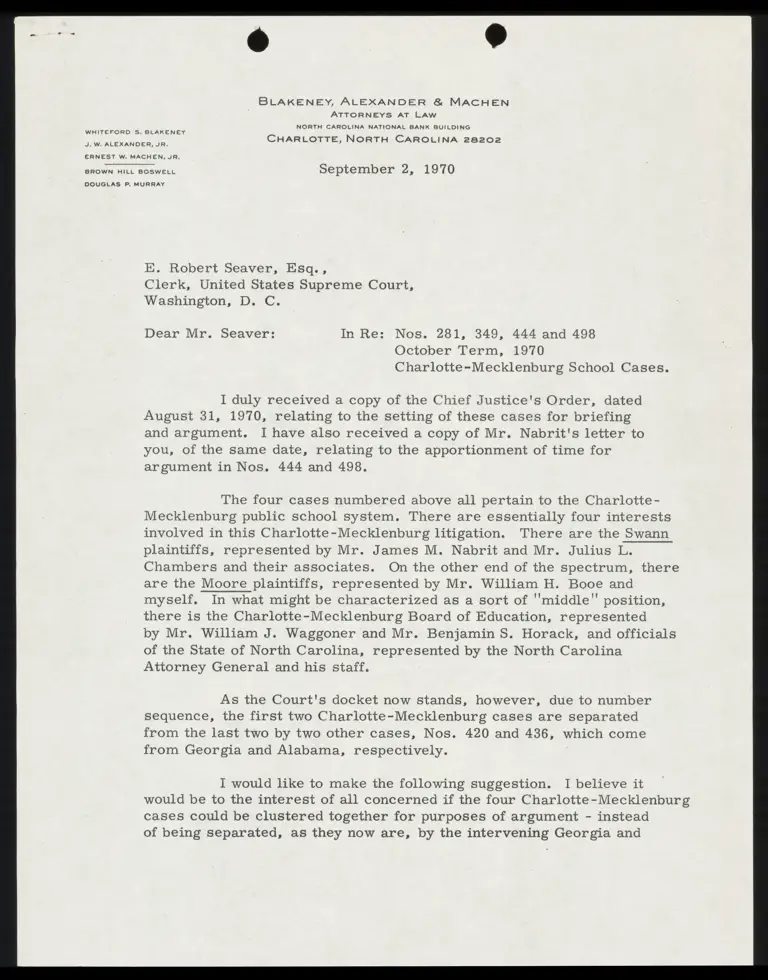
Letter from Blakeney to Court Re: Grouping Cases for Argument

Public Court Documents
September 2, 1970

Letter from Blakeney to Court Re: Grouping Cases for Argument preview

2 pages

Cite this item

  • Case Files, Swann v. Charlotte-Mecklenburg Hardbacks. Letter from Blakeney to Court Re: Grouping Cases for Argument, 1970. c5f8db76-2e34-f111-88b4-7c1e527f53b4. LDF Archives, Thurgood Marshall Institute. https://ldfrecollection.org/archives/archives-search/archives-item/95fb9f3a-9fd4-41a4-83f0-f7177c72b1d6/letter-from-blakeney-to-court-re-grouping-cases-for-argument. Accessed June 02, 2026.

    Copied!

     [||944285f7-ffd9-42c8-a4b7-32469d06087e||] é ® 


BLAKENEY, ALEXANDER & MACHEN 
: ATTORNEYS AT LAw 

NORTH CAROLINA NATIONAL BANK BUILDING 
WHITEFORD S. BLAKENEY 

CHARLOTTE, NORTH CAROLINA 28202 
J. W. ALEXANDER, JR. 

ERNEST W. MACHEN, JR. 

BROWN HILL BOSWELL September 2 1970 

DOUGLAS P. MURRAY 

E. Robert Seaver, Esq., 

Clerk, United States Supreme Court, 
Washington, D. C. 

Dear Mr. Seaver: In Re: Nos. 281, 349, 444 and 498 

October Term, 1970 

Charlotte-Mecklenburg School Cases. 

I duly received a copy of the Chief Justice's Order, dated 

August 31, 1970, relating to the setting of these cases for briefing 

and argument. I have also received a copy of Mr. Nabrit's letter to 

you, of the same date, relating to the apportionment of time for 

argument in Nos. 444 and 498. 

The four cases numbered above all pertain to the Charlotte- 

Mecklenburg public school system. There are essentially four interests 

involved in this Charlotte-Mecklenburg litigation. There are the Swann 

plaintiffs, represented by Mr. James M. Nabrit and Mr. Julius L. 

Chambers and their associates. On the other end of the spectrum, there 

are the Moore plaintiffs, represented by Mr. William H. Booe and 

myself. In what might be characterized as a sort of ''middle' position, 
there is the Charlotte-Mecklenburg Board of Education, represented 

by Mr. William J. Waggoner and Mr. Benjamin S. Horack, and officials 

of the State of North Carolina, represented by the North Carolina 

Attorney General and his staff. 

As the Court's docket now stands, however, due to number 

sequence, the first two Charlotte-Mecklenburg cases are separated 

from the last two by two other cases, Nos. 420 and 436, which come 

from Georgia and Alabama, respectively. 

I would like to make the following suggestion. I believe it 

would be to the interest of all concerned if the four Charlotte-Mecklenburg 
cases could be clustered together for purposes of argument - instead 

of being separated, as they now are, by the intervening Georgia and 


4 %9 

Alabama cases. It seems to me that as the Court gains familiarity 

with the Charlotte-Mecklenburg situation in Nos. 281 and 349, it would 

prefer to hear argument at the same time in the other Charlotte- 
Mecklenburg cases, that is, Nos. 444 and 498 - rather than shifting 

in the meantime to the Georgia and Alabama cases and then later 

having to revive its recollection of the Charlotte-Mecklenburg situation 

by separate hearing of Nos. 444 and 498. 

I have today made inquiry of the attorneys for the Charlotte- 
Mecklenburg Board of Education and also of the State Attorney General's 

staff, and they inform me that they are agreeable to the arrangement 

here suggested and believe that it would be desirable both from the 

standpoint of the parties and the Court. I am, of course, forwarding 

copies of this letter to Mr. Nabrit and Mr. Chambers. I believe that 

their view of this will be substantially the same. 

With respect to the periods of time allotted for argument, it 
is my understanding that under the ordinary application of the Court's 

present rules, there would be a total of four hours of argument in these 

four numbered cases. The opportunity of requesting additional time is, 

of course, also open to any party under the rules, and I am hopeful that 

the Court will consider these cases of sufficient importance to justify 

favorable consideration of any such request. 

For the reasons outlined above, I believe it would be best 

to bring these four Charlotte-Mecklenburg cases into a group for purpose 

of argument, and then leave questions of time and time allotments to 

be later determined on the basis of agreements between the parties 
or requests to the Court seasonably made. 

Very truly yours, 

) LD. | 
_A , P_— x [4 ’ ) { hr. ava PN ” x 5 y nS AS ae WP NE > I” 

To 

he ALEXANDER & MACHEN 

WSB:ig 

CC: James M. Nabrit, 111, Esq. 

CC: Julius L. Chambers, Esq. 

CC: William J. Waggoner, Esq. 

CC: Benjamin S. Horack, Esq. 

CC: Ralph Moody, Esq. 

CC: Andrew A. Vanore, Jr., Esq. [||944285f7-ffd9-42c8-a4b7-32469d06087e||] 

Copyright notice

© NAACP Legal Defense and Educational Fund, Inc.

This collection and the tools to navigate it (the “Collection”) are available to the public for general educational and research purposes, as well as to preserve and contextualize the history of the content and materials it contains (the “Materials”). Like other archival collections, such as those found in libraries, LDF owns the physical source Materials that have been digitized for the Collection; however, LDF does not own the underlying copyright or other rights in all items and there are limits on how you can use the Materials. By accessing and using the Material, you acknowledge your agreement to the Terms. If you do not agree, please do not use the Materials.


Additional info

To the extent that LDF includes information about the Materials’ origins or ownership or provides summaries or transcripts of original source Materials, LDF does not warrant or guarantee the accuracy of such information, transcripts or summaries, and shall not be responsible for any inaccuracies.