Michigan Road Builders v. Millikan Court Opinion
Public Court Documents
November 25, 1987
-
Brief Collection, LDF Court Filings. Michigan Road Builders v. Millikan Court Opinion, 1987. e0ea19a0-bd9a-ee11-be36-6045bdeb8873. LDF Archives, Thurgood Marshall Institute. https://ldfrecollection.org/archives/archives-search/archives-item/96455f00-5f36-4015-bfbd-80ff7c2a8f4d/michigan-road-builders-v-millikan-court-opinion. Accessed October 08, 2026.
Copied!
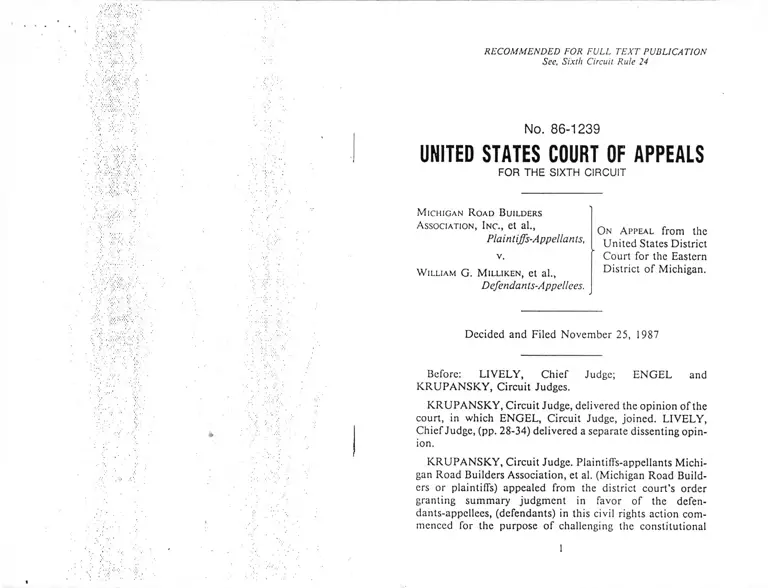
RECOMMENDED FOR FULL TEXT PUBLICATION
See, Sixth Circuit Rule 24
No. 86-1239
UNITED STATES COURT OF APPEALS
FOR THE SIXTH CIRCUIT
M ichigan Road Builders
Association, Inc., et al.,
Plaintiffs-Appellants,
v.
W illiam G. M illiken, ct al.,
Defendants-Appellees.
O n A ppeal from the
United States District
Court for the Eastern
District of Michigan.
Decided and Filed November 25, 1987
Before: LIVELY, Chief Judge; ENGEL and
KRUPANSKY, Circuit Judges.
KRUPANSKY, Circuit Judge, delivered the opinion of the
court, in which ENGEL, Circuit Judge, joined. LIVELY,
Chief Judge, (pp. 28-34) delivered a separate dissenting opin
ion.
KRUPANSKY, Circuit Judge. Plaintiffs-appellants Michi
gan Road Builders Association, et al. (Michigan Road Build
ers or plaintiffs) appealed from the district court’s order
granting summary judgment in favor of the defen-
dants-appellees, (defendants) in this civil rights action com
menced for the purpose of challenging the constitutional
1
validity of 1980 Mich. Pub. Acts 428 (Public Act 428), Mich.
Comp. Laws §450.771, el sec/.1 In particular, the Michigan
Road Builders charge that Public Act 428 which “set aside”
a portion of state contracts for minority owned businesses
(MBEs) and woman owned businesses (WBEs) impinges
upon the Equal Protection Clause of the Fourteenth Amend
ment to the Constitution. Section 2 of Public Act 428, Mich.
Comp. Laws §450.772 provides that after the 1984-85 fiscal
year, each state department must award not less than 7% of
its expenditures for construction, goods, and services to
MBEs and not less than 5% to WBEs.2 Under Public Act 428,
2 Michigan Road Builders v. Milliken. el al. No. 86-1239
lPlaintifTs-appellants “are (1) several non-profit associations whose
members arc, in general, construction firms, contractors and suppliers,
who have done, or are doing business with the Slate of Michigan, and
(2) various profit corporations who have had, or seek, contracts with
the State of Michigan.” Michigan Road Builders Ass'n v. Milliken, 571
F. Supp. 173, 174 (E.D. Mich. 1983). Dcfcndants-appcllccs arc William
G. Milliken, the former Governor of Michigan, the Michigan Depart
ment of Management and Budget, Gerald H. Miller, the former Direc
tor of the Michigan Department of Management and Budget, the Mich
igan Department ofTransportalion, and John P. Woodford, the former
Director of the Michigan Department ofTransportalion.
2Mich. Comp. Laws § 450.772 provides:
Sec. 2. (1) The construction, goods, and services procurement
policy for each department shall provide for the following per
centage of expenditures to be awarded to minority owned and
women owned businesses by each department except as pro
vided in subsection (6):
(a) For minority owned business, the goal for 1980-8 1 shall
be 150% of the actual expenditures for 1979-80, the goal for
1981-82 shall be 200% of the actual expenditures for 1980-81,
the goal for 1982-83 shall be 200% of the actual expenditures
for 1981-82, the goal for 1983-84 shall be 1 16% of the actual
expenditures for 1982-83, and this level of efiort at not less
than 7% of expenditures shall be maintained thereafter.
(b) For woman owned business, the goal for 1980-81 shall
be 150% of the actual expenditures for 1979-80, the goal for
No. 86-1239 Michigan Road Builders v. Milliken, et al. 3
a “minority” is a “person who is black, hispanic, oriental,
cskimo, or an American Indian,” Mich. Comp. Laws
§ 450.771 (c), and a “minority owned business” is “a business
enterprise of which more than 50% of the voting shares or
interest in the business is owned, controlled, and operated
by individuals who are members of a minority and with
respect to which more than 50% of the net profit or loss attrib
utable to the business accrues to shareholders who are mem
bers of a minority.” Mich. Comp. Laws §450.771(0- A
“woman owned business” is “a business of which more than
1981-82 shall be 200% of the actual expenditures for 1980-81,
the goal for 1982-83 shall be 200% of the actual expenditures
for 1981-82, the goal for 1983-84 shall be 200% of the actual
expenditures for 1982-83, the goal for 1984-85 shall be 140%
of the expenditures for 1983-84, and this level of effort at not
less than 5% of expenditures shall be maintained thereafter.
(2) If the first year goals arc not achieved, the governor shall
recommend to the legislature changes in programs to assist
minority and woman owned businesses.
(3) Each department, to assist in meeting the construction,
goods, and services procurement expenditures percentages set
forth in subsection (1), shall include provisions for the acco
modation of subcontracts and joint ventures. The provisions
shall be established by the governor and shall require a bidder
to indicate the extent of minority owned or women owned
business participation.
(4) Only the portion of a prime contract that reflects minority
owned or women owned business participation shall be con
sidered in meeting the requirements of subsection (1).
(5) Minority owned or woman owned businesses shall com
ply with the same requirements expected of other bidders
including, but not limited to, being adequately bonded.
(6) If the bidders for any contract do not include a qualified
minority owned and operated or woman owned and operated
business, the contract shall be awarded to the lowest bidder
otherwise qualified to perform the contract.
50% of the voting shares or interest in the business is owned,
controlled, and operated by women and with respect to which
more than 50% of the net profit or loss attributable to the
business accrues to the women shareholders.” Mich. Comp.
Laws §450.7710).
The Michigan Road Builders commenced the present
action on July 8, 1981 in the United States District Court
for the Eastern District of Michigan seeking declaratory and
injunctive relief against the enforcement of the set-aside pro
visions of Public Act 428. In particular, the plaintiffs charged
that the set-aside provisions of Public Act 428 violated the
Ecjual Protection Clause of the Fourteenth Amendment, as
well as 42 U.S.C. §§§1981, 1983 and 2000d,3 by according
4 Michigan Road Builders v. Milliken, el at. No. 86-1239
342 U.S.C. § 1981 provides:
All persons within the jurisdiction of the United States shall have
the same right in every State and Territory to make and enforce con
tracts, to sue, be parties, give evidence, and to the full and equal benefit
of all laws and proceedings for the security of persons and properly
as is enjoyed by white citizens, and shall be subject to like punishment,
pains, penalties, taxes, licenses, and exactions of every kind, and to
no other.
42 U.S.C. § 1983 provides:
Every person who, under color of any statute, ordinance,
regulation, custom, or usage, of any Stale or Territory or the
District of Columbia, subjects, or causes to be subjected, any
citizen of the United States or other person within the jurisdic
tion thereof to the deprivation of any rights, privileges, or
immunities secured by the Constitution and laws, shall be lia
ble to the party injured in an action at law, suit in equity, or
other proper proceeding for redress. For the purposes of this
section, any Act of Congress applicable exclusively to the Dis
trict of Columbia shall be considered to be a statute of the
District of Columbia.
42 U.S.C. § 2000d provides:
No person in the United Slates shall, on the ground of race,
color, or national origin, be excluded from participation in,
racial and ethnic minorities and women a preference in com
peting for state expenditures. After discovery had been com
pleted, the parties filed cross motions for summary judgment,
and on August 12, 1983, the district court determined that
Public Act 428 did not violate the Equal Protection Clause
of the Fourteenth Amendment and granted defendants’
motion for summary judgment. Michigan Road Builders
Ass'n v. Milliken, 571 F.Supp. 173 (E.D. Mich. 1983). Michi
gan Road Builders appealed, and this court dismissed the
appeal because the district court had not decided all of the
claims against the Michigan Department of Transportation.
Michigan Road Builders Ass’n v. Milliken, 742 F.2d 1456 (6th
Cir. 1984). Thereafter, the district court entered an order dis
posing of the remaining charges against the Department of
Transportation, Michigan Road Builders Ass’n v. Milliken,
654 F.Supp. 3 (E.D. Mich. 1986), and the Michigan Road
Builders commenced this timely appeal. On appeal, the plain
tiffs argued that the district court applied the incorrect legal
standard to determine the constitutional validity of Public
Act 428.
No. 86-1239 Michigan Road Builders v. Milliken, el al. 5
be denied the benefits of, or be subjected to discrimination
under any program or activity receiving Federal financial
assistance.
Because the protections afforded by these sections are coextensive with
the protections afforded by the Equal Protection Clause of the Four
teenth Amendment, Regents ofUniv. o f Calif, v. Dakke, 438 U.S. 265,
287, 333, 98 S.Ct. 2733, 2746, 2770, 57 L.Ed.2d 750 (1978)(§ 1983
and 2000d); Detroit Police Officers' Ass'n v. Young, 608 F.2d 671,
691-92 (6th Cir. 1979) (§ 1981), cert, denied, 452 U.S. 938, 101 S.Ct.
3079, 69 L.Ed.2d 951 (1981), this court need only analyze Public Act
428 under Fourteenth Amendment equal protection standards. See
Associated Gen. Contractors o f Cal. v. Citv & County o f San Francisco,
813 F.2d 922, 928 n. 11 (9th Cir. 1987). Plaintiffs also alleged in their
complaint that Public Act 428 violated Title VII of the Civil Rights
Act of 1964, 42 U.S.C. § 2000c et seq. See Johnson v. Transportation
Agency, 107 S.Ct. 1442, 1446 n.2, 94 L.Ed.2d 615 (1987)(suggcsting
that Title VII analysis differs from constitutional equal protection anal
ysis). They have abandoned this argument on appeal.
6 Michigan Road Builders v. Milliken, ct at. No. 86-1239
In addressing equal protection claims, the Supreme Court
has employed differing levels of judicial review depending
upon the type of imposed classification under constitutional
attack.4 “Racial and ethnic distinctions of any sort arc inher
ently suspect and thus call for the most exacting judicial
examination.” Regents o f Univ. of Cal. v. Bakke. 438 U.S.
265, 291,98 S.Ct. 2733, 2748, 57 L.Ed.2d 750 (1978)(plural-
ity opinion)(concluding that state medical school’s admission
program which reserved a specified number of student posi
tions for racial and ethnic minority applicants violated the
Equal Protection Clause). This “most exacting judicial
examination” has been labeled by the Supreme Court as
“strict scrutiny.” Id. at 287, 98 S.Ct. at 2747 (plurality opin
ion).
When a classification denies an individual opportu
nities or benefits enjoyed by others solely because
of his race or ethnic background, it must be regarded
as suspect.
4In considering equal protection claims, courts must first determine
whether the governmental body imposing the classification at issue had
authority to act to accomplish its purpose. Fullilove v. Klutznik, 448
U.S. 448, 473, 100 S.Ct. 2758, 2772, 65 L.Ed.2d 902 (1980) (plurality
opinion); Associated Gen. Contractors o f Cal., 813 F.2d at 928. In the
case at bar, the state asserted, and the plaintifTs did not dispute, that
Public Act 428 was designed to ameliorate the effects of past discrimi
nation against minorities and women competing for contracts to supply
the state with goods and services. It is beyond contention that a stale
legislature has the prerogative and even the “constitutional duly to take
affirmative steps to eliminate the continuing effects of past unconstitu
tional discrimination.” Wyganl v. Jackson Bd. ofEduc.. 476 U.S. 267,
106 S.Ct. 1842, 1856, 90 L.Ed.2d 260 (1986) (O’Connor, J„ concur-
ring)(cmphasis in original); Ohio Contractors Ass'n v. Keip, 713 F.2d
167, 172-73 (6th Cir. 1983); Associated Gen. Contractors o f Cal., 813
F.2d at 929. Accordingly, it is not disputed that the Michigan legisla
ture had jurisdiction to act for the purpose of ameliorating the effects
of past discrimination.
No. 86-1239 Michigan Road Builders v. Milliken, ct al. 7
* * *
We have held that in “order to justify the use of
a suspect classification, a Stale must show that its
purpose or interest is both constitutionally permissi
ble and substantial, and that its use of the classifica
tion is ‘necessary . . . to the accomplishment’ of its
purpose or the safeguarding of its interest.”
* * *
Preferring members of any one group for no reason
other than race or ethnic origin is discrimination for
its own sake. This the Constitution forbids.
Id. at 305-07, 98 S.Ct. at 2756-57 (plurality opinion)(citations
omitted).
In Fullilove v. Khtlznick, 448 U.S. 448, 100 S.Ct. 2758, 65
L.Ed.2d 902 (1980), the Supreme Court probed a congres-
sionally enacted affirmative action plan embodied in the Pub
lic Works Employment Act of 1977, 42 U.S.C. § 6701 el seq.
The constitutional attack in that case was lodged against the
“Minority Business Enterprise” set aside provision of the act,
§ 103(0(2), 42 U.S.C. § 6705(0(2), which required local gov
ernmental units receiving funds under public works programs
to use 10% of the funds to procure services or supplies from
MBEs. The court determined that “Congress had abundant
evidence from which it could conclude that minority busi
nesses have been denied effective participation in public con
tracting opportunities by procurement practices that perpetu
ated the effects of prior discrimination,” id. at 477-78, 100
S.Ct. at 2774, and that the set aside provision therein at issue
was “narrowly tailored to the achievement of [the] goal” of
ameliorating the effects of that past discrimination. Id. at 480,
100 S.Ct. at 2776. Justice Powell, author of the Bakke
opinion, concurred in the Court’s opinion and filed an opin
ion in which he stated:
8 Michigan Road Builders v. Milliken, el al. No. 86-1239
Section 103(0(2) [of the Public Works Employment
Act of 1977] employs a racial classification that is
constitutionally prohibited unless it is a necessary
means of advancing a compelling governmental
interest.
★ ★ ★
The Equal Protection Clause, and the equal pro
tection component of the Due Process Clause of the
Fifth Amendment, demand that any governmental
distinction among groups must be justifiable. Differ
ent standards of review applied to different sorts of
classifications simply illustrate the principle that
some classifications are less likely to be legitimate
than others. Racial classifications must be assessed
under the most stringent level of review because
immutable characteristics, which bear no relation
to individual merit or need, are irrelevant to almost
every governmental decision.
448 U.S. at 496, 100 S.Ct. at 2783-84 (Powell, J. concurring).
Subsequent to the Bakke and Fullilove decisions, this cir
cuit considered constitutional attacks on state and local gov
ernment mandated affirmative action plans. In assessing the
constitutional validity of the affirmative action plans at issue
in the post-Bakke and Fullilove cases, this circuit redefined
the term “strict scrutiny” as it applied in affirmative action
cases:
[T]he first stage in our approach to affirmative action
programs entails an analysis of the need for such
remedial measures — i.e., with the presence of a
governmental interest in their implementation. It is
uncontested that the government has a significant
interest in ameliorating the disabling effects of iden
tified discrimination.
No. 86-1239 Michigan Road Builders v. Milliken, cl al. 9
* * *
Once the governmental interest in some remedial
action is thus established, we must proceed to deter
mine whether the remedial measures employed arc
reasonable.
Bratton v. City o f Detroit, 704 F.2d 878, 886-87 (6th Cir.
1983) (footnote omitted), cert, denied, 464 U.S. 1040, 104
S.Ct. 703, 79 L.Ed.2d 168 (1984). See also Detroit Police Offi
cers' Ass'n v. Young, 608 F.2d 671 (6th Cir. 1979) (determin
ing that no “direct showing of past intentional
discrimination” by the governmental unit imposing the affir
mative action plan was necessary and that the plan need only
be a “reasonable” means of serving the governmental interest
of eradicating the effects of past discrimination), cert, denied,
452 U.S. 938, 101 S.Ct. 3079, 69 L.Ed.2d 951 (1981); Ohio
Contractors Ass’n v. Keip, 713F.2d 167 (6th Cir. 1983) (where
compelling interest of state in ameliorating the past effects
of its prior discrimination was clear, the affirmative action
plan adopted need only be “reasonably calculated” to serve
that interest). In these decisions, this court essentially relaxed
the strict scrutiny standard enunciated by the Supreme Court
in Bakke and Fullilove. Thus, this circuit essentially required
that affirmative action plans be a “reasonable” means of fur
thering a “significant” governmental interest rather than a
“narrowly tailored” or “necessary” means of furthering a
“compelling” governmental interest.5
5WhiIc the distinction between the terms “significant” and
“compelling” may be negligible, see Wygant v. Jackson Bd. o f Educ..
476 U.S. 267, 106 S.Ct. 1842, 1853, 90 L.Ed.2d 260 (1986) (O’Connor,
J., concurring)(discussing distinction between terms “compelling” and
“important”), as discussed below, it is clear that the district court in
the case at bar considered the terms as having different meanings when
it expressly refused to require defendants to demonstrate a
“compelling” interest, but instead required them to demonstrate a
“significant interest.” 571 F.Supp. at 176-77.
10 Michigan Road Builders v. Millikan, el al. No. 86-1239
In Wygant v. Jackson Bd. ofEduc., 746 F.2d 1 1 52 (6th Cir.
1984), this circuit again applied its relaxed standard of review
to uphold an affirmative action layoff plan embodied in a col
lective bargaining agreement between a public board of edu
cation and a teachers’ union. In reversing the decision, the
Supreme Court rejected the relaxed level of judicial scrutiny'
imposed by this circuit in Wygant:
This Court has “consistently repudiated ‘[distinc
tions between citizens solely because of their ances
try’ as being ‘odious to a free people whose institu
tions are founded upon the doctrine of equality.’ ”
. . . . “Racial and ethnic distinctions of any sort arc
inherently suspect and thus call for the most exact
ing judicial examination.”
The Court has recognized that the level of scrutiny
does not change merely because the challenged clas
sification operates against a group that historically
has not been subject to governmental discrimina
tion. In this case, [the collective bargaining agree
ment] operates against whites and in favor of certain
minorities, and therefore constitutes a classification
based on race. “Any preference based on racial or
ethnic criteria must necessarily receive' a most
searching examination to make sure that it docs not
conflict with constitutional guarantees.” There are
two prongs to this examination. First, any racial
classification “must be justified by a compelling gov
ernmental interest.” Second, the means chosen by
the State to effectuate its purpose must be “narrowly
: tailored to the achievement of that goal.” We must
decide whether the layoff provision is supported by
a compelling state purpose and whether the means
chosen to accomplish that purpose arc narrowly tai
lored.
Wygant v. Jackson Bd. ofEduc., 476 U.S. 267, 106 S.Ct. 1 842,
1846-47, 90 L.Ed.2d 260 (1986) (plurality opinion) (citations
omitted). Subsequent to rejecting the “compelling” nature of
the governmental interests advanced by the board of educa
tion in support of the constitutional validity of the layoff
plan, which interests had been found to be “sufficiently
important” by this circuit, 106 S.Ct. at 1847-49, the Court
continued:
The Court of Appeals examined the means chosen
to accomplish the Board’s race-conscious purposes
under a test of “reasonableness.” That standard has
no support in the decisions of this Court. As demon
strated . . . above, our decisions always have
employed a more stringent standard — however
articulated — to test the validity of the means cho
sen by a state to accomplish its race-conscious
purposes.6 Under strict scrutiny the means chosen
to accomplish the State’s asserted purpose must be
specifically and narrowly framed to accomplish that
purpose. “Racial classifications are simply too perni
cious to permit any but the most exact connection
between justification and classification.”
The term “narrowly tailored,” so frequently
used in our cases, has acquired a secondary mean
ing. More specifically, . . . the term may be used
to require consideration whether lawful alterna
tive and less restrictive means could have been
used. Or . . . the classification at issue must “fit”
with greater precision than any alternative
means. “[Courts] should give particularly intense
scrutiny to whether a nonracial approach or a
more narrowly tailored racial classification could
promote the substantial interest about as well and
at tolerable administrative expense.”
106 S.Ct. at 1849-50 (citations and footnote omitted). The
Supreme Court left no doubt that the standard of judicial
review previously employed by this circuit in racial and eth
nic affirmative action cases was inappropriate.
No. 86-1239 Michigan Road Builders v. Milliken, el al. 11
In the case at bar, the district court, having issued its opin
ion nearly three years before the Supreme Court reversed this
circuit in Wygant, erroneously decided the constitutional
validity of Public Act 428 under this circuit’s relaxed level
of scrutiny:
“A different analysis must be made when the
claimants are not members of a class historically
subjected to discrimination.”
* * *
Having determined that the law of this Circuit
requires that the State must demonstrate a signifi
cant interest in ameliorating the past effects of pres
ent discrimination rather than the “compelling
interest" standard . . ., this Court must examine the
record to assess the nature of the interest of the State
in enacting [Public Act] 428.
* * *
Having determined that the State has established
its interest in ameliorating the present effects of past
discrimination, this Court must now determine
whether [Public Act] 428 is a reasonable means of
achieving that end.
571 F.Supp. at 176-77, 187 (quoting Bratton, 608 F.2d at
697). The district court’s analysis represented an erroneous
application of strict scrutiny as that term has been defined
and employed by the Supreme Court. In Wygant, the
Supreme Court expressly disapproved of the reasoning
employed by the district court in this case. Although the dis
trict court had properly analyzed the constitutional validity
of Public Act 428 under the law of this circuit as enunciated
in Bratton, Detroit Police Officers' Ass'n, and Ohio Contrac
tors Ass'n when it issued its opinion in this case on August
12, 1983, “an appellate court must apply the law in effect
12 Michigan Road Builders v. Milliken, ct al. No. 86-1239
at the time it renders its decision.” Thorpe v. Housing Auth.
o f City o f Durham, 393 U.S. 268, 281, 89 S.Ct. 518, 526, 21
L.Ed.2d 474 (1969) (footnote omitted). See also Gulf Offshore
Co. v. Mobil Oil Corp., 453 U.S. 473, 486 n. 16, 101 S.Ct.
2870, 2879 n. 16, 69 L.Ed.2d 784 (1981). Accordingly, in
light of the Supreme Court’s mandate in Wygant, this court
must abrogate the legal conclusions of the district court in
the case at bar.
As indicated by the Supreme Court precedent already dis
cussed, a more appropriate constit utional review of racial or
ethnic classifications adopted by governmental bodies should
be subjected to a two stage evaluation. First, a court must
determine whether a “compelling” state interest supports the
use of the racial or ethnic classification. If the court concludes
that a compelling interest exists, it must then determine
whether the challenged state action employing a racial or eth
nic classification is “ narrowly tailored” or “necessary” to fur
ther that interest.
A state “unquestionably has a compelling interest in reme
dying past and present discrimination by a state actor.”
United States v. Paradise, 107 S.Ct. 1053, 1065, 94 L.Ed.2d
203 (1987) (citations omitted) (plurality opinion). Before a
state may permissibly employ a racial or ethnic classification,
however, it must make a finding based upon material factual
evidence, that it has in the past discriminated against those
classes it now favors. If the state had not engaged in discrimi
nation against racial and ethnic minorities in awarding con
tracts to supply the state with goods and services in the past,
then it cannot assert in praesenli that it has a compelling
interest in preferring MBEs in the award of such contracts.
[The Supreme Court] never has held that societal
discrimination alone is sufficient to justify a racial
classification. Rather, the Court has insisted upon
some showing of prior discrimination by the govern
mental unit involved before allowing limited use of
No. 86-1239 Michigan Road Builders v. Milliken, el al. 13
14 Michigan Road Builders v. MiUiken, el al. No. 86-1239
racial classifications in order to remedy such dis
crimination.* * * [P]rior discrimination [is] the justi
fication for, and the limitation on, a State’s adoption
of race-based remedies.
★ ★ *
Societal discrimination, without more, is too
amorphous a basis for imposing a racially classified
remedy. * * * No one doubts that there has been
serious racial discrimination in this country. But as
the legal basis for imposing discriminatory legal
remedies that work against innocent people, societal
discrimination is insufficient and over expansive. In
the absence of particularized findings, a court could
uphold remedies that are ageless in their reach into
the past, and timeless in their ability to affect the
future.
* * *
[A State] must act in accordance with a “core pur
pose of the Fourteenth Amendment” which is to “do
away with all governmcntally imposed distinctions
based on race.” * * * In particular, [a state] must
ensure that, before it embarks on an affirmative
action program, it has convincing evidence that
remedial action is warranted. That is, it must have
sufficient evidence to justify the conclusion that
there has been prior discrimination.
Wygant, 106 S.Ct. at 1847-48 (citations omittcd)(some
emphasis added). See also Bakke, 438 U.S. at 307, 98 S.Ct.
at 2757 (“We have never approved a classification that aids
persons perceived as members of relatively victimized groups
at the expense of other innocent individuals in the absence
of judicial, legislative, or administrative findings of constitu
tional or statutory violations. After such findings have been
made, the governmental interest in preferring members of
No. 86-1239 Michigan Road Builders v. MiUiken, el al. 15
the injured groups at the expense of others is substantial,
since the legal rights of the victims must be vindicated.”) (ci
tations omitted) (emphasis added); J. Edinger & Son, Inc. v.
City of Louisville, 802 F.2d 213, 216 (6th Cir. 1986) (“[T]he
city should be required to present evidence of invidious
discrimination.”); South Fla. Chapter o f Associated Gen. Con
tractors o f Am. v. Metropolitan Dade County, 723 F.2d 846,
851-52 (11th Cir.) (“[Ajdcquate findings [must] have been
made to ensure that the governmental body is remedying the
present effects of past discrimination rather than advancing
one racial or ethnic group’s interests over another___”) (em
phasis in original), cert, denied, 469 U.S. 871, 105 S.Ct. 220,
83 L.Ed.2d 150 (1984); Associated Gen. Contractors o f Cat.,
8 13 F.2d at 930 (“[S]tate and local governments [can] act only
to correct their own past wrongdoing.. . , ”). More recently,
the Fourth Circuit has slated:
[B]efore an asserted governmental interest in a racial
preference can be accepted as “compelling,” there
must be findings of prior discrimination. Findings
of societal discrimination will not suffice; the find
ings must concern “prior discrimination by the gov
ernment unit involved."
* * *
For a locality to show that it enacted a racial prefer
ence as a remedial measure, it must have had a firm
basis for believing that such action was required
based on prior discrimination by the locality itself.
* * *
Wygant... limit[s] racial preferences to what is nec
essary to redress a practice of past wrongdoing.
J.A. Croson Co. v. City o f Richmond, 822 F.2d 1355, 1358,
1360, 1362 (4th Cir. 1987)(citations omitted) (emphasis in
original). Accordingly, in the instant case, this court must
determine whether the Stale of Michigan possessed a compel
ling interest in purging the present effects of alleged past dis
crimination by virtue of its past inequitable treatment ol
MBEs. To accomplish this result, this court must decide
whether the Michigan legislature, based upon the evidentiary
factual record before it, “had a firm basis for believing that
such action was required based on prior discrimination” by
the state itself. J.A. Croson Co., 822 F.2d at 1360.6
An examination of the evidence asserlcdly relied upon by
the defendants in this action as support for their contention
that the Michigan legislature had a firm basis for concluding
that the state had engaged in discrimination in awarding con
tracts for goods and services clearly indicates that Michigan
had not developed material evidence to support a conclusion
that it had a compelling interest in adopting the racial and
ethnic distinctions at issue in the case at bar. The defendants
have relied upon certain conclusory historical resumes of
unrelated legislative enactments and proposed enactments,
executive reports, and a state funded private study conducted
in 1974. This documentation is not reflective of discrimina
tory action by the State of Michigan.7
16 Michigan Road Builders v. Millikcn, el al. No. 86-1239
6Bccause the factual record in this case is complete and this court’s
only function is to determine whether the evidence presented to the
district court satisfied a legal standard, remand is unnecessary. Bose
Carp. v. Consumers Union o f U.S., Inc., 466 U.S. 485, 501, 104 S.Ct.
1949, 1960, 80 L.Ed.2d 502 (1984).
7The defendants in this action have, as a defense, “admitted” that
the State of Michigan had engaged in impermissible discrimination
in the award of state contracts. See generally Appellee's Brief, pp. 29-32.
This “admission” is of little relevance and docs not relieve this court
of its duty to determine whether remedial legislation in the form of
racial and ethnic classifications is, in fact, supported by a compelling
interest in alleviating the present effects of past slate discrimination.
Wyganl. 106 S.Ct. at 1849 n. 5 (“Nor can the [state] unilaterally insu
late itself from this key constitutional question by conceding that it
has discriminated in the past, now that it is in its interest to make
such a concession.”)
The defendants have directed this court’s attention to
“executive memoranda”8 concerning proposed legislation
considered by the Michigan legislature during 1971 and sub
sequent years. The first of these memoranda concern House
Bill (H.B.) 4394 (1971) which would have relaxed bonding
requirements for state construction contracts. The memo
randa conjectured a belief that the state’s stringent bonding
requirements prohibited most small businesses from effec
tively competing for such contracts. The proposed statute
would have assertedly served the dual purpose of fostering
the growth of small businesses in general and benefiting the
state by increasing competition for state construction con
tracts. Fostering the growth of MBEs in particular was not
a concern or purpose expressed in the legislative history of
H.B. 4394.
Senate Bill (S.B.) 885 (1975) would have set aside a per
centage of state goods and services procurement contracts
for small businesses. The asserted purpose of this proposed
legislation was to foster the growth of small businesses in light
of Michigan’s “sluggish economy.” Again, fostering the
growth of MBEs was not a consideration for this proposed
legislation.
S.B. 1461 (1976) and S.B. 10 (1977)9 would have also set
aside an allotment of state contracts for small businesses. The
executive memoranda commenting upon these enactments
suggested that increasing the number of contracts awarded
to small businesses would also increase the number of MBEs,
which were predominantly small businesses, doing business
with the state. In addition, S.B. 1461 included a provision
No. 86-1239 Michigan Road Builders v. Milliken, el al. 17
The executive memoranda which analyzed pending legislation
were prepared for the Governor by each of the state’s various executive
departments.
9S.B. 1461 and S.B. 10 were essentially identical and were introduced
in successive sessions of the Michigan legislature. Neither proposal was
enacted into law.
18 Michigan Road Builders v. Milliken, cl al. No. 86-1239
which would have set aside contracts for “socially or econom
ically disadvantaged persons.” In testimony given before the
Michigan Senate State Affairs Committee in support of S.B.
1461, Norton L. Berman, Director of the OfTicc of Economic
Expansion within the Department of Commerce, indicated
that underrepresentation of MBEs in slate contracting
resulted from factors other than discrimination by the State
of Michigan:
Small and minority businesses traditionally have
experienced problems in management, financing,
and market development. These problems often
times result from the inability of small businessmen
to generate sufficient capital to meet their opera
tional needs.
* * *
Through a series of public hearings and question
naires sent to small and minority businesses, busi
ness persons expressed their concerns in several
areas, some of which were: complexity of procure
ment procedures, information distributed of stale
agencies was inadequate, contracts were too large,
there was no requirement on the part of large con
tractors to solicit bids from small and minority sub
contractors, excessive delay in paying vendors,
excessive pre-award costs and bonding requirements
which small and minority businessmen could not
meet.
* * *
[P]ast business patterns have resulted in under rep
resentation of minorities in the business commu
nity. Therefore, I feel the state is remiss if we do
not do what we can to assure that minority business
obtain an equitable share of state purchasing.
I am aware there arc those who view this legisla
tion as preferential treatment and the distortion of
the competitive spirit of purchasing. I agree that this
might be considered so, but unorthodox methods
are needed to create opportunities for a major seg
ment of our society that can contribute more to eco
nomic stability. With regards to competition, what
we have now in many industries is competition
among the small operators and domination by a few
large firms. Large businesses often can sell at a con
siderable lower price because of high volume of
sales, more efficient distribution systems and more
advertising and promotion. Small business cannot
equitably compete because of these disadvantages
of size.
As reflected in Berman’s testimony, the relative lack o
MBEs doing business with the state was coupled with th<
objective reality that most MBEs were small businesses
Small businesses, as a result o f their size, were unable to effec
tively compete for state contracts. Consequently, most MBEs
as a result o f their size, were unable to effectively compeb
for state contracts.
The legislative history of Public Act 428 itself offered m
support for the contention that the State of Michigan inten
tionally discriminated against MBEs. A House Legislativi
Analysis of the bill attributed the scarcity of MBE contract
with the state to the lack of minorities within the busines
community as a result o f societal discrimination:
Statistical descriptions of the extent of participation
in state programs by businesses controlled by
women and minorities are varied and sometimes
contradictory depending on the definitions used and
the samples of state spending examined. These
descriptions, however, all reveal that such busi
nesses receive a disproportionately small share of
No. 86-1239 Michigan Road Builders v. Milliken, el al. 19
state spending for construction and goods and ser
vices in relation to their proportion of the slate's
population. That minorities and women have been
systematically denied equal opportunity in this
country is sad historical fact now generally accepted
and widely recognized in legislation of the past two
decades. In the interests of justice as well as the
social and economic health of the slate, the legisla
ture should do all that it can to ensure that busi
nesses owned by minorities and women obtain their
fair share of the state’s business.
★ * ★
The federal government and other stale govern
ments are already proceeding in this direction as a
remedy to the underrepresentation of minority and
other segments of business in the business commu
nity. The legal issues are difficult and outcomes of
various litigations impossible to predict. In the
meantime Michigan should continue to be a partici
pant in the enactment of progressive legislation,
which would in any case enhance the growth of these
underrepresented sectors of the business commu
nity, at least until the question of constitutionality
is resolved.
Evidence of societal discrimination, however, is an insuffi
cient basis for the employment of racial and ethnic distinc
tions by state or local governments. Wygant, 106 S.Ct. at
1848; J. Edinger & Son, Inc., 802 F.2d at 216-17.
The evidence consisting of executive action designed to
increase small business and MBE participation was also
insufficient to support a conclusion that the state had discrim
inated against MBEs. In 1975, the Governor issued Executive
Directive 1975-4 creating a task force to study small business
oarticipation in state purchasing. After conducting two public
20 Michigan Road Builders v. Milliken. cl al. No. 86-1239
hearings wherein witnesses testified that small and minority
businesses’ size and lack of expertise prohibited them from
effectively competing for state purchasing contracts, the task
force issued its report recommending the adoption of policies
and procedures to aid small and minority businesses in the
state procurement process.
In response to the task force's report, the Governor issued
Executive Directive 1976-4 wherein he established the Small
and Minority Business Procurement Council (Council) to
oversee the declared “policy of tye [sic] executive branch
agencies of the State of Michigan . . . to aid, counsel, assist
and protect the interests of small and minority business con
cerns in order to preserve free competitive enterprise and to
insure that a fair portion of the procurement of state agencies
and agencies of the state be placed with small and minority
business enterprises.” In 1977, the Council issued its first
annual report in which it noted that the objectives establish
ing small and minority business participation in state pur
chasing had been achieved.
In 1975, the Governor also issued Executive Directive
1975-6 wherein he commanded the Michigan Department
of Civil Rights (MDCR) to assist the other state departments
in developing and implementing standards and procedures
to assure nondiscrimination in awarding state contracts. In
1978, the MDCR issued a report in which it expressed con
cern over limited compliance with Executive Directive 1975-
6 because of the lack of adequate staff in some agencies and
the inexperience of personnel in dealing with civil rights mat
ters. The MDCR did not suggest that limited compliance with
Executive Directive 1975-6 was the result of intentional dis
crimination.
The evidence most heavily relied upon by the defendants
in this action was the report of a 1974 state-commissioned
study by Urban Markets Unlimited, Inc. (Urban Markets).
The report, entitled “A Public Procurement Inventory on
No. 86-1239 Michigan Road Builders v. Milliken, el al. 21
22 Michigan Road Builders v. Milliken, el a/. No. 86-1239
Minority Vendors,” was prefaced with the rather dubious
statement: “Minority-owned business enterprises arc often
described as being synonymous with small business.”10 The
report noted that there were 8,112 minority businesses in
Michigan, but that in a small sampling of purchase contracts,
only four did business with the state.11 The contracts sam
pled, however, represented only approximately $21 million
of state’s annual expenditures of over $437 million. The sam
pling was necessarily small and of little value because, as the
report noted, the state did not maintain data on minority
procurement by state agencies.12
Because the statistical evidence was not probative of dis
crimination, Urban Markets also circulated questionnaires
to and conducted interviews of state officials responsible for
purchasing goods and services for various state agencies and
departments. Responses to Urban Markets’ inquiries dis
closed that most state agencies did not actively seek new
10The report ofTcrs no evidence for this proposition. While it may
well be true that most MBEs arc small businesses, the notion that the
terms are synonymous is not persuasive. There arc, no doubt, a sub
stantial number of non-minority small businesses, which, because of
their size, also experience problems in effectively competing for stale
contracts. This questionable proposition, upon which much of the
report’s analysis is based, seriously undermines the validity of the con
clusions reached by Urban Markets.
u As an indication that most MBEs were small businesses, Urban
Markets reported that only 2,577 of Michigan’s 8,112 MBEs had paid
employees, and all 8,112 businesses employed a total of only 10,958
persons.
12Only 4 of 26 state agencies maintained data on purchases from
MBEs. Indeed, one of the report’s recommendations was that the state
“establish a means of collecting data on the quantity, types, and dollar
amounts of purchases which the State expends with minority vendors.”
The fact that the state admittedly kept no data on MBE participation
in state contracts seriously undermined the defendants’ attempt to rely
on the “statistical evidence" incorporated into the Urban Markets
report as an indication of past state discrimination.
No. 86-1239 Michigan Road Builders v. Milliken, el al. 23
sources of supplies, but instead relied primarily upon
“already established purchasing contracts” when filling new
orders for goods and services. In particular, the study indi
cated that only three state agencies were using minority busi
ness directories to “actively seek-out” minority suppliers, and
that some purchasing officials expressed unfavorable impres
sions of the qualiP' and reliability of performance afforded
by small and minority businesses. Significantly, Urban Mar
kets did not conclude that state purchasing policies were dis
criminatory, but rather “[m]ost agencies indicated that
awards [were] based upon the lowest satisfactory bid.”
Most damaging to the defendants’ contention that the
Michigan legislature was motivated by a compelling interest
to eradicate the effects of past state discrimination when it
enacted Public Act 428 were defendants’ responses to plain
tiffs’ interrogatories in this action. Plaintiffs requested the
defendants to identify the findings of past discrimination
against each of the minority groups favored in Public Act
428, and defendants responded to each interrogatory as fol
lows:
(1) Upon information and belief, the Michigan Leg
islature found that
(a) there had been a history of significant politi
cal, economic, and cultural discrimination based
upon race, ethnic origin, and sex in the United
States, including Michigan; and
(b) among the racial and ethnic minorities who
have been the victims of such discrimination are
Eskimos, Hispanics, Orientals, Indians (Native
Americans), Blacks; and
(c) Females have been the victims of discrimina
tion based upon sex; and
(d) as a result of the discrimination described in
1(a) above, racial and ethnic minorities and females
have been subjected to economic disadvantages; and
24 Michigan Road Builders v. Mi/liken, el at. No. 86-1239
(e) amonglhe consequences of the discrimination
described in 1 (a) and (d) above, has been an inability
to compete on an equal competitive level for access
to contracting opportunities with government,
including but not limited to such opportunities with
the State of Michigan; and
(f) as a result of competitive limitations imposed
on racial and ethnic minorities and females because
of the discrimination aforesaid, other persons not
in those categories enjoy an artificial and unfair
advantage in the competitive process; and
(g) the advantages resulting to persons not subject
to discrimination based upon racial or ethnic con
siderations or those of gender reduce competition
for state contracts and thereby result in greater costs
to the taxpayers for goods and services needed by
the State of Michigan; and
(h) establishment of goals and timetables effect
ing state procurement policies was the most effective
feasible means available to remedy the present
effects of the discriminatory history and conditions
described in 1(a), (d), and (e) above; and
(i) increases in the number of businesses qualified
to compete for state contracts will result in a cost
benefit to the taxpayers.
In addition, the plaintiffs directed the defendants to identify
documents supporting the legislature’s conclusion that the
state had discriminated against minorities and women in the
award of state contracts. In their answer, the defendants,
other than referring to the evidence discussed above, again
relied upon societal discrimination, referring generally to
“the history of the western world for the past 2000 years.”
Furthermore, the state again acknowledged that it did not
maintain records concerning the number of MBEs which bid
on slate contracts and the number which were awarded state
contracts.
After reviewing the record in its entirety as developed
before the district court, this court concludes that the Michi
gan legislature had little, if any, probative evidence before
it that would warrant a finding that the State of Michigan
had discriminated against MBEs in awarding state contracts
for the purchase of goods and services. At best, the evidence
suggested that societal discrimination had afforded the obsta
cle to the development of MBEs in their business relationship
with the State of Michigan. Consequently, relatively few
MBEs exist,13 and those that do are generally small in size
and have difficulty in competing for state contracts as a result
o f their size. The evidence does not prove that the State of
Michigan invidiously discriminated against racial and ethnic
minorities in awarding state contracts. Accordingly, this
court concludes that the state has not supported its conclu
sion that it had a compelling interest in establishing the racial
and ethnic classifications contained in Public Act 428, and
those classifications are, therefore, constitutionally invalid.14
With regard to the preference accorded WBEs by Public
No. 86-1239 Michigan Road Builders v. Milliken, cl al. 25
13Bcrman testified in support of S.B. 1461 that minorities comprise
13.73% of the general population of Michigan, but MBEs comprised
only 5.85% of the businesses within the state.
14Thcrc is no proof to support preference for the groups listed in
Public Act 428, i.c., persons who arc “black, hispanic, oriental, cskimo,
or an American Indian.” Mich. Comp. Law § 450.771(c). In the
answers to plaintiffs’ interrogatories, defendants admitted that they
were “unaware” of how many MBEs in each of the above minority
groups bid for and were awarded state contracts. A finding of “prior,
purposeful discrimination against members of each of these [favored]
minority groups” is required before state and local governments are
permitted to remedy alleged discrimination by the enactment of laws
embodying racial and ethnic distinctions. Wygant, 106 S.Ct. at 1852
n. 13. See also J.A. Croson Co., 822 F.2d at 1361; Associated Gen. Con
tractors o f Cal., 813 F.2d at 934.
26 Michigan Road Builders v. Millikan, cl al. No. 86-1239
Act 428, the Supreme Court has employed a less stringent
standard of review or level of scrutiny for gender based classi
fications:
Our decisions also establish that the party seeking
to uphold a statute that classifies individuals on the
basis of their gender must carry the burden of show
ing an “exceedingly persuasive justification” for the
classification. Kirchbcrg v. Feenstra, 450 U.S. 455,
461, 101 S.Cl. 1 195, 1199, 67 L.Ed.2d 428 (1981);
Personnel Administrator o f Mass v. Feenev, 442 U.S.
256, 273, 99 S.Ct. 2282, 2293, 60 L.Ed.2d 870
(1979). The burden is met only by showing at least
that the classification serves “important governmen
tal objectives and that the discriminatory means
employed” are “substantially related to the achieve
ment of those objectives.” Wengler v. Druggists
Mutual Ins. Co., 446 U.S. 142, 150, 100 S.Ct. 1540,
1545, 64 L.Ed.2d 107 (1980).
Mississippi Univ. for Women v. Ilogan 458 U.S. 718, 724,
102 S.Ct. 3331,3336, 73 L.Ed.2d 1090 (1982)(footnotc omit
ted). Although the Supreme Court has never expressly
defined these terms, “substantially related to serve an impor
tant governmental interest” is regarded as a less stringent
judicial standard of review than “narrowly tailored to serve
a compelling governmental interest.” Associated Gen. Con
tractors of Cal., 813 F.2d at 939 (describing level of scrutiny
for gender based classifications as “mid-level review”).
Even under this less stringent standard of review, the WBE
preferences in Public Act 428 cannot withstand constitu
tional attack since evidence of record that the state discrimi
nated against women is nonexistent. Defendants’ reliance
upon general assertions of societal discrimination are insuffi
cient to satisfy their burden absent some indication that the
“members of the gender benefited by the classification actu
ally suffered] a disadvantage related to the classification.”
Mississippi Univ. for Women, 458 U.S. at 728, 102 S.Ct. a
3338. Defendants presented no evidence that WBEs sufferei
a disadvantage in compel' ng for state contracts. Accordingly
Public Act 428’s gender-based classifications are als<
invalid.15
For the foregoing reasons, this court concludes that Publi
Act 428, Mich. Comp. Laws § 450.771 et seq., is unconstitu
tional. Consequently, the judgment of the district court i
REVERSED and the case is REMANDED for entry of judg
ment in favor of the plaintiffs in accordance with this opir
ion.
No. 86-1239 Michigan Raad Builders v. Milliken, cl al. 2'
15Becausc this court concludes that Michigan lacked a “compellinj
interest to support the racial and ethnic distinctions, and r
“important” interest to support the gender based distinction
embodied in Public Act 428, this court does not address the sccor
prong of the constitutional elimination, i.e., whether the means we
“narrowly tailored” and “substantially related” to the achievement i
its goal of eradicating the present effects of prior discrimination.
LIVELY, Chief Judge, dissenting. Because I disagree with
both major premises of the majority opinion, I must respect
fully dissent.
28 Michigan Road Builders v. Milliken, cl al. No. 86-1239
I.
The majority reads Wygant v. Jackson Board of Education,
476 U.S. 267 (1986), as if it changed all the previously
accepted standards for judging the validity of affirmative
action programs of governments and governmental units.
That is not a fair appraisal of the purport or effect of Wygant.
In Wygant itself the Court noted that it is necessary in some
cases to take race into account, and emphasized the differ
ence in consequences flowing from a program such as the one
involved in this case and one that requires layoffs, as the plan
in Wygant did. This emphasis was made by contrasting the
minority set-aside program that the Court had approved in
Fullilove v. Klutznick, 448 U.S. 448 (1980), with the plan
under consideration in Wygant, which did require layoffs:
We have recognized, however, that in order to
remedy the effects of prior discrimination, it may
be necessary to take race into account. As part of
this Nation’s dedication to eradicating racial dis
crimination, innocent persons may be called upon
to bear some of the burden of the remedy. “When
effectuating a limited and properly tailored remedy
to cure the effects of prior discrimination, such a
‘sharing of the burden’ by innocent parties is not
impermissible.” Id. [Fullilove, 448 U.S.] at 484, 100
S. Ct. at 2778, quoting Franks v. Bowman Transpor
tation Co., 424 U.S. 747, 96 S. Ct. 1251,47 L.Ed.2d
444 (1976). In Fullilove, the challenged statute
required at least 10 percent of federal public works
funds to be used in contracts with minority-owned
business enterprises. This requirement was found to
be within the remedial powers of Congress in part
because the “actual burden shouldered by nonmi
nority firms is relatively light.” 448 U.S. at 484, 100
S. Ct. at 2778.
Significantly, none of the cases discussed above
involved layoffs. Here, by contrast, the means cho
sen to achieve the Board’s asserted purposes is that
of laying off nonminority teachers with greater
seniority in order to retain minority teachers with
less seniority. We have previously expressed con
cern over the burden that a preferential layoffs
scheme imposes on inn,.cent parties. See Firefighters
v. Stotts, 467 U.S. 561, 574-576, 578-579, 104 S. Ct.
2576,____ ______ , 81 L.Ed.2d 483 (1984); see also
Weber, n. 9, supra this page, 443 U.S. at 208, 99
S. Ct. at 2730 (“The p;an does not require the dis
charge of white worker:; and their replacement with
new black hirees”). In cases involving valid hiring
goals, the burden to be borne by innocent individu
als is diffused to a considerable extent among society
generally. Though hiring goals may burden some
innocent individuals, they simply do not impose the
same kind of injury that layoffs impose. Denial of
a future employment opportunity is not as intrusive
as loss of an existing job.
106 S. Ct. at 1850-51 (foo.notes omitted).
The Michigan program is similar to the federal MBE pro
gram in Fullilove. At most, nonminority owned businesses
will be required to share the state’s contracts with minority
owned businesses; no white owned business will be removed
from a previously awarded contract. I believe this case is con
trolled by Fullilove and Ohio Contractors Ass’n v. Keip, 713
F.2d 167 (6th Cir. 1983), rather than by Wygant.
The Supreme Court has been unable to agree on the precise
level of scrutiny required when considering race conscious
programs to assist minorities. While there is a consensus that
No. 86-1239 Michigan Road Builders v. Milliken, el al. 29
race conscious programs demand an elevated level of scru
tiny, the Court has not defined that level. This is clear from
an examination of the plurality opinions from Regents of the
University of California v. Bakke, 438 U.S. 265 (1978), to
United States v. Paradise, _ U.S. 107 S. Ct. 1053 (1987).
In fact a plurality of the Court in Paradise, a ease subsequent
to Wygant, noted it has “yet to reach consensus on the appro
priate constitutional analysis.” Id. at 1064.
Despite this uncertainty, at least two prerequisites for a
constitutionally acceptable race conscious program arc
clearly established. The program must be in response to a
compelling state goal and it must be narrowly tailored to
achieve that goal. The majority concedes, as it must, that the
State of Michigan has a compelling interest in eliminating
race and gender discrimination from its procedures for
awarding public contracts. I believe the Michigan program
also satisfies the second requirement in that it is narrowly
tailored. Given the subject matter involved—public contract
ing — it is hard to conceive of a difTcrcnt approach that would
achieve the state’s legitimate goals in a less intrusive way.
In my opinion the plan chosen by Michigan to correct a sys
tem that virtually excluded minority contractors in the past
“fits” the situation better than any alternative means. See
Wygant, 106 S. Ct. at 1850 n. 6, where the Court discusses
the meaning of “narrowly tailored,” and quotes Professor
Ely’s definition: “the classification at issue must ‘fit’ with
greater precision than any alternative means.”
II.
I also disagree with the majority’s conclusion that the State
of Michigan did not develop material evidence that estab
lished the existence of past discrimination or the need for
a program to increase minority participation. An examina
tion of the record totally refutes this conclusion. The district
court found that the Michigan legislature considered the fol
lowing evidence before finally adopting P.A. 428 in 1981:
30 Michigan Road Builders v. Milliken, cl a/. No. 86-1239
No. 86-1239 Michigan Roc;:! Builders v. Milliken, el at. 31
1. An Executive Memorandum concerning House
Bill No. 4394 (1971). The bill was to help small busi
nesses receive government contracts; MBEs consid
ered to fall within the classification of a small busi
ness. Bill and Memorandum indicate early concern
for plight of minorities. 571 F. Supp. 178-79.
2. A study commissioned by the state in 1974 to
explore the state’s procurement policies and its
effects upon minorities (the Urban Markets Unlim
ited Study). Report issued in 1974 examined the
procurement opportunities that were available to
minority businesses, concluding that opportunities
were not great, and that purchasing agents expressed
negative attitudes toward minority vendors. Id. at
179-81.
3. Three Senate bills introduced in 1975-77 (Sen
ate Bills 885 (1975), 1461 (1976), and 10 (1977)).
These bills addressed set-asides for small businesses,
but were also designed to address the problems fac
ing minority businesses. Id. at 181.
4. Testimony of Nonon L. Berman, Director of
Office of Economic Expansion, Michigan Depart
ment of Commerce, concerning Senate Bill 1461
and encouraging legislature to enact set-asides. Id.
at 181-82.
5. The Governor’s Executive Directive 1975-4
(1975), creating a Task Force on Small Business Par
ticipation in State Purchasing. Directive empha
sized minority businesses and the difficulty they
have had getting into the mainstream of business.
Id. at 182.
6. Two public hearings of the Task Force, where
views were expressed concerning the difficulties of
minority businesses. Id. at 183.
32 Michigan Road Builders v. Midi ken, el al. No. 86-1239
7. The Task Force’s Final Report (March 1976),
recommending, inter alia, that goals be established
for the participation of MBEs in state procurement.
Id. at 183.
8. The Governor’s Executive Directive 1976-4'
(1976), stating that it is the executive branch’s policy
to ensure that MBEs get a fair portion of business
with the state and creating the Small and Minority
Business Procurement Council. Id. at 183.
9. The First Annual Report of the Council (1977),
noting that the commitment for MBEs was reached
in the first year. Id. at 183-84.
10. The Governor’s Executive Directive 1975-6
(1975), directing the Michigan Department of Civil
Rights to, inter alia, establish standards to assure
non-discrimination in state contracting. Id. at 184.
11. The May 15, 1978 Report of the Department
of Civil Rights, expressing concern over limited
progress that had been made under Directive
1975-6. Id. at 184.
12. Proposed House Bill 4335, initiated March
15, 1979, which provided for MBE set-asides, and
later, WBE set-asides. Id. at 184-85.
House Bill 4335 was adopted by the legislature two years
after it was introduced, and became P.A. 428, the Act at issue
in this case. The district court concluded that this evidence
was sufficient for “the Legislature to make a finding of past
intentional discrimination.” Id. at 187. This is a finding of
fact that is fully supported by the record and is not clearly
erroneous.
The majority’s conclusion that the evidence in this case
at best suggested “that societal discrimination had afforded
the obstacle to the development of MBEs in their business
No. 86-1239 Michigan Road Builders v. Milliken, el al. 33
relationship with the State of Michigan” has no support in
the record. The Supreme Court has determined that societal
discrimination in and of itself is not sufficient justification
for enactment of an affirmative action plan. Wygant, 106 S.
Ct. at 1847. As the Coun noted in Bakke, it has never
“approved a classification that aids persons perceived as
members of relatively victimized groups at the expense of
other innocent individuals in the absence of judicial, legisla
tive, or administrative findings of constitutional or statutory
violations.” 438 U.S. at 307. Societal discrimination is best
exemplified in Wygant. The school board extended preferen
tial protection against layoffs to minority employees in'ordcr
to provide minority students with minority role models. In
holding this was an insufficient justification, the Court noted
there must be some showing of prior discrimination by the
governmental unit and that the plan must have a remedial
purpose.
The legislative record in this case clearly shows that the
plan enacted by the State of Michigan was not designed solely
to aid persons perceived as members of “relatively victimized
groups” or to create “role models” for minorities. As noted,
the Michigan Legislature began in 1971 to review the prob
lem of limited participation of minority and woman owned
businesses in the state’s procurement of goods and services.
The plan that was adopted approximately nine years later
was the culmination of numerous studies, hearings and pro
posals to rectify the situation. Any acceptable understanding
of the concept of federalism; requires us to accord the same
degree of deference to the findings of a state legislature follow
ing years of study and investigation that we give to findings
of Congress. The majority’s rejection of the legislative show
ing of prior discrimination is improper, not only because it
fails to give the deference that a federal court should give
to a state legislature’s findings, but because the level of find
ings which the majority would exact from the legislature has
not heretofore been required.
The Supreme Court noted in FuUilovc that “Congress, of
course, may legislate without compiling the kind o f ‘record’
appropriate with respect to judicial or administrative
proceedings. 448 U.S. at 478. The Court determined that
Congress had abundant evidence from which it could .con
clude that minority businesses have been denied effective
participation in public contracting opportunities by procure
ment practices that perpetuated the effects of prior
discrimination.” Id. at 477-78, There is sufficient evidence
in the legislative record or Michigan Public Act 428 to sup
port a determination that the state’s procurement practices
did perpetuate the effects of prior discrimination, resulting
in an extremely small percentage of contracts being awarded
to minority and woman owned businesses.
As we stated in Ohio Contractors Ass'n v. Keip, 713 F.2d
at 173:
The state has chosen to remedy the effects of its
own past discriminatory practices by means of a pro
gram which imposes relatively light burdens on the
majority group which was in position to benefit from
those practices.
(Emphasis in original). Michigan did the same thing for the
same reasons.
Finally, in my opinion the majority places entirely too
much emphasis on semantics. The district court’s use of
‘ significant” as opposed to “compelling” in describing the
state’s interest is immaterial, given that the state clearly did
have a compelling interest in eliminating discriminatory
practices from its contracting and procurement procedures.
Although the district court referred to a “reasonableness” test
in reviewing the means chosen by Michigan to deal with the
state s interest, in actually testing the MBE program the dis
trict judge expressly analyzed all of the factors that the plural
ity of the Supreme Court analyzed in applying the “narrowly
tailored” standard in Fullilove. 571 F. Supp. at 188.
34 Michigan Road Builders v. Mi/liken, cl al. No. 86-1239 No. 86-1239 Michigan Road Builders v. Milliken, el al. 3
1 would affirm the judgment of the district court.