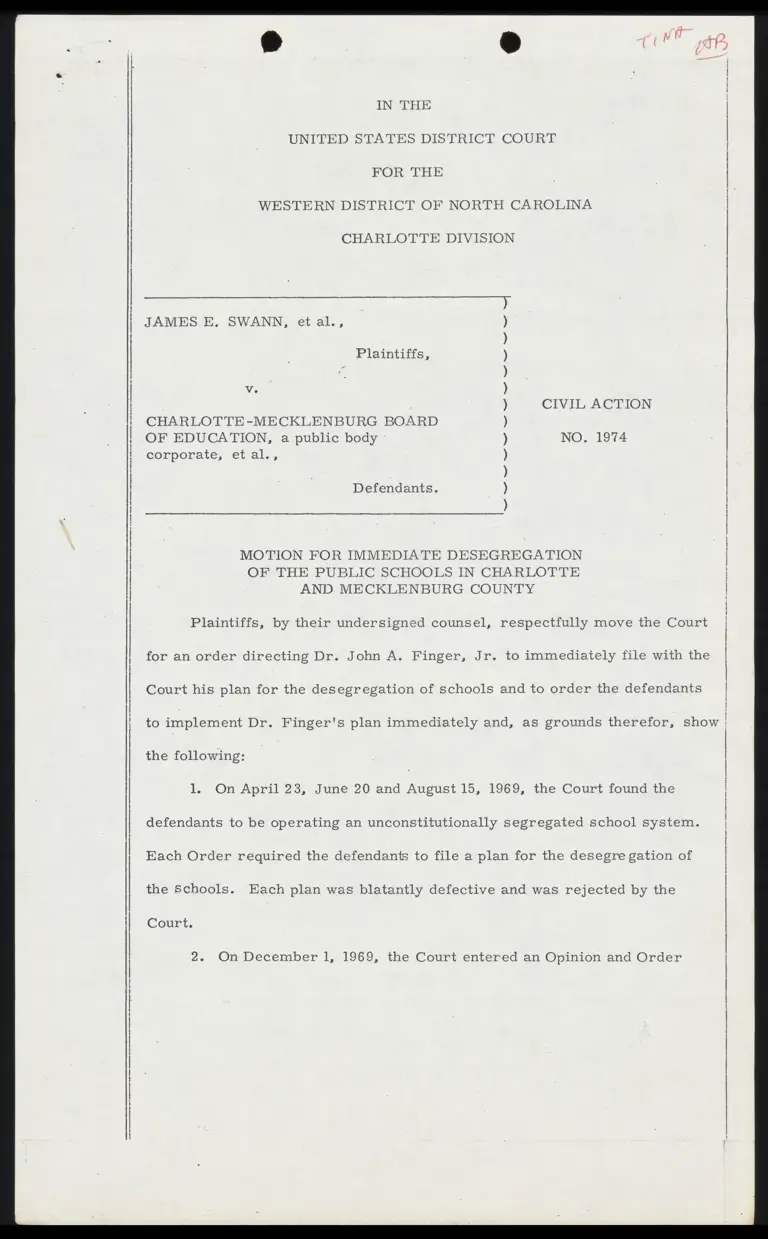
Motion for Immediate Desegregation of the Public Schools in Charlotte and Mecklenburg County
Public Court Documents
January 19, 1970
7 pages
-
Case Files, Swann v. Charlotte-Mecklenburg Hardbacks. Motion for Immediate Desegregation of the Public Schools in Charlotte and Mecklenburg County, 1970. ad1d1c4d-2e34-f111-88b4-0022482cdbbc. LDF Archives, Thurgood Marshall Institute. https://ldfrecollection.org/archives/archives-search/archives-item/97baec6d-cc37-42c3-b37c-c72aed1f28c0/motion-for-immediate-desegregation-of-the-public-schools-in-charlotte-and-mecklenburg-county. Accessed October 15, 2026.
Copied!
     [||9593e918-2315-4f50-8f24-bfd7ff627531||] 4
rf N fv AL)
gd 10S

IN THE

UNITED STATES DISTRICT COURT

FOR THE

WESTERN DISTRICT OF NORTH CAROLINA

CHARLOTTE DIVISION


JAMES E. SWANN, et al.,

Plaintiffs,

v.
: CIVIL ACTION

CHARLOTTE-MECKLENBURG BOARD
OF EDUCATION, a public body -

corporate, et:al,,

NO. 1974

Defendants.
N
w
”


a
t
”


u
m
”


“
w
s
?


w
p
?


S
w
”


“
w
t


w
w


“
w
s
?


“w
w?


“
w
t


“
w
t
?


“
o
u
s


MOTION FOR IMMEDIATE DESEGREGATION

OF THE PUBLIC SCHOOLS IN CHARLOTTE

AND MECKLENBURG COUNTY |


Plaintiffs, by their undersigned counsel, respectfully move the Court

for an order directing Dr. John A. Finger, Jr. to immediately file with the       Court his plan for the desegregation of schools and to order the defendants |

to implement Dr. Finger's plan immediately and, as grounds therefor, show |

the following:

1. On April 23, June 20 and August 15, 1969, the Court found the

defendants to be operating an unconstitutionally segregated school system.

Each Order required the defendants to file a plan for the desegre gation of

the schools. Each plan was blatantly defective and was rejected by the

Court.

2. On December 1, 1969, the Court entered an Opinion and Order


rejecting the plan filed by the Board on November 17, 1969 and determined

that a consultant would be appointed by the Court to prepare immediate

plans and recommendations to the Court for the desegregation of the schools.

The following day, December 2, the Court entered an Order appointing Dr.

John A. Finger, Jr. of Providence, Rhode Island to act as a consultant to

the Court in preparing a plan for the desegregation of the schools.

3. Plaintiffs are informed that Dr. Finger has completed the essen-

tial elements of his plans and is in the process of refining and perfecting

his proposal.

4. On October 29, 1969, the Supreme Court unanimously reversed

the United States Court of Appeals for the Fifth Circuit which had granted

delays for the desegregation of schools in Mississippi.

"Under explicit holdingsSof this Court, the obliga-
tion of.every school district is to terminate dual

school systems at once and to operate now and

hereafter only unitary schools. Griffin v. School

Board, 377 U.S. 218, 234 (1964); Green v. School

Board of New Kent County, 391 U.S. 430, 438,

439, 442 (1968). "


Alexander v. Holmes County Board of Education, 396 U.S. 19 (1969).


9. The day following this Court's Opinion and Order disapproving of

the defendants' November 17 plan, the United States Court of Appeals for the

Fourth Circuit entered an Order in five cases, three from North Carolina.

"We consolidate these appeals for hearing and disposi-
tion in light of Alexander v. Holmes County Board

of Education, 396 U.S. 19 (October 29, 1969).

That recent decision of the Supreme Court teaches
'[ulnder explicit holdings of this Court the obliga-

tion of every school district is to eliminate dual

school systems at once and to operate now and

hereafter only unitary schools.' The clear mandate

of the Court is immediacy. Further delays will

not be tolerated in this circuit. No school district

may continue to operate a dual system based on race.

Each must function as a unitary system within which

no person is to be excluded from any school on the

basis of race."


Nesbit v. Statesville City Board of Education, No. 13,229 ZF. 2d (Dec. 2,
    1969). The three school districts from North Carolina were given until the

5


end of the Christmas vacation within which to implement plans for complete

desegregation of the schools. The two districts from Virginia were given

until the end of the first semester. Each district was required to integrate

faculties as well.

"All plans must include provisions for integration
of the faculty so that the ratio of Negro and white

faculty members of each school shall be approxi-

mately the same as the ratio throughout the
system."

6. Following the Supreme Court decision in Alexander v. Holmes


County, the United States Court of Appeals for the Fifth Circuit heard and

decided a large number of cases from various states within the Circuit.

The Court en banc unanimously decided that complete integration would not

be required until the Fall of 1970. In several of the cases where the plain~

tiffs were represented by private counsel, petitions for certiorari were

filed with the United States Supreme Court. The petitioners requested that

the Supreme Court order the school districts to prepare for complete de-

segregation by February 1, 1970 pending a decision by the Court on the

merits. The petitioners were granted the sreliminary relief which they

sought. Cartier v. West Feliciano Parish School Board, U.S. (Dec. 13,


1969); Davis v. Board of School Commissions of Mobile County, a. U, Se :


and Bennett v. Evans County Board of Education, U.S. (Opinions of


Justice Black in Chambers, December 13, 1969). On January 14, 1970, the
and oral

Court in a per curiam /decided without/argument that the Court of Appeals

had misread Alexander v. Holmes County Board of Education.


"Insofar as the Court of Appeals authorized
deferral of student desegregation beyond

February 1, 1970, that Court misconstrued

our holding in Alexander v. Holmes County Board

of Education, U.S. . Accordingly, the peti-

tions for writs of certiorari are granted, the

judgments of the Court of Appeals are reversed

and the cases remanded to that Court for further

proceedings consistent with this opinion. The

judgments in these cases are to issue forthwith."


Carter v. West Feliciano Parish School Board, U.S. (jan. i4, 1970).

De


The decision of the Court, representing the views of four members, was con-


curred by Mr. Justice Harlan and Mr. Justice White. They discussed

what they thought were the practical requirements of Alexander and found
a


a ""maximum' timetable from/Court finding of non-compliance with the

requirements of Green to the time of the actual operative effect of the relief


to be eight weeks. Justices Black, Douglas, Brennan and Marshall found

this view to be a retreat’ from the holding in Alexander v. Holmes County


Board of Education. Justices Berger and Stewart dissented, being of the


view that the cases should not be decided without oral argument.

7. Findings of non-compliance with the requirements of the Green


case were made by the Court on April 23, June 20, August 15 and December

1, 1969. Eight weeks, the "maximum' timetable which Justices Harlan and

White viewed as permissible from the date of a finding of non-compliance,

a determination which four others viewed as a ''retreat' from Alexander,


has long since passed since the decisions of April, June and August. Eight

weeks from December 1, 1969 would be January 26, 1970. That would

clearly be the outside date for the implementation of a comprehensive

plan for the desegregation of schools in this case.

8. Dr. Finger has not yet filed his plan with the Court. Howeyer,

even if his plan remains somewhat rough, that plan should be implemented

now and any suggested modifications, by the Board, by the plaintiffs or

possibly by Dr. Fingey can be made later.

"It would suffice that such measures will
tend to accomplish the goals set forth in

. Green, and, if they are less than education-

ally perfect, proposals for amendments may

thereafter be made. Such proposals for

amendments are in no way to suspend the

relief granted in accordance with the re-
quirements of Alexander."


Carter v. West Feliciano Parish School Board, TU. S. (1969) (concurring


opinion of Justice Harlan).

"The intent of Alexander, as I see it, was


4


: s »

that the burden in actions of this type

should be shifted from plaintiffs seeking
redress for a denial of constitutional

rights, to defendant school boards.

What this means is that upon a prima facie
showing of noncompliance with this

court's holding in Green v. New Kent

County School Board, 291 U.S. 430 (1968),

plaintiffs may apply for immediate relief

that will at once extirpate any lingering

vestiges of a constitutionally prohibited

dual school system."


(Concurring opinion of Justice Harlan.)

9. In this Court's Opinion and Order of December 1, 1969, the Court

held:

"12. Fixed ratios of pupils in particular
schools will not be set. If the board in

one of its three tries had presented a plan
for desegregation, the court would have

~ sought ways to approve variations in pupil

ratios. In default of any such plan from

the school board, the court will start with

the thought, originally advanced in the

order of April 23, that efforts should be

made to reach a 71-29 ratio in the various

schools so that there will be no basis for

contending that one school is racially
different from the others, but to under-

stand that variations from that norm may

be unavoidable.

15. On the facts in this record and with
this background of de jure segregation

extending full fifteen years since Brown I,

this court is of the opinion that all the

black and predominantly black schools in

the system are illegally segregated, Green

v. New Kent County; Henry v. Clarksdale;
United States v. Hinds County."


In its Order, the Court invited the Board to submit a plan conforming to the

requirements established by the Court.

"If the members of the school board wish
to develop plans of their own for desegre-

gation of the schools without delaying or

interfering with the work of the consultant,

they may proceed to do so, and if they wish,

any guidance from the court they will find

their guidance in the previous cpinions

and orders of this court and in the court
decisions and principles. set out in this

opinion and order."

eR,


* ® | |
The School Board decided not to appeal from the decision of December 1, 199

as it had decided not to appeal from the previous orders of the Court. Nor

has it submitted a plan as it was invited to do. Instead, members of the

Board have continued to criticize the law of the land and to pretend that they !

do not know what the Court means when it says that all-black schools in

this system are constitutionally RIE The Court and the plain-

tiffs have waited patiently and in vain for an indication that the Board would

finally accept its burden to devise a constitutional plan for the desegregation |

of the schools. Since the Board has refused to assume its responsibility,

the Court must act to vindicate the constitutional rights of children within

the School System.

WHEREFORE, plaintiffs respectfully pray that the Court direct Dr.

Finger to file his plan forthwith and upon receipt of his plan, order the

defendants:

1. To completely implement the plan filed by Dr.
Finger on or before January 26, 1970; and

2. To reassign faculty within the School System
so that the ratio of black and white faculty
members of each school shall be approximately

the same as the ratio throughout the System
and that such reassignments be implemented on
or before January 26, 1970.

Respectfully submitted,


CONRAD O. PEARSON

203 1/2 East Chapel Hill Street

Durham, North Carolina

CHAMBERS, STEIN, FERGUSON &

LANNING

216 West Tenth Street

Charlotte, North Carolina

JACK GREENBERG

JAMES M. NABRIT, III

NORMAN CHACHKIN

10 Columbus Circle

New York, New York

-5-
T
e


CERTIFICATE OF SERVICE


The undersigned hereby certifies that copies of the foregoing Motion

were served upon counsel for defendants by depositing copies of same in

the United States Mail, postage prepaid, addressed to:

William J. Waggoner, Esq.

Weinstein, Waggoner, Sturges and Odom

1100 Barringer Office Tower

Charlotte, North Carolina;

Brock Barkley, Esq.

Law Building

Charlotte, North Carolina;

Gaston Gage, Esq.
Law Building
Charlotte, North Carolina;

Honorable Robert Morgan, Attorney General
Andrew Vanore, Jr., Esq., Staff Attorney

Office of the Attorney General

State of North Carolina

Raleigh, North Carolina; and

Benjamin S. Horack, Esq.
Ervin, Horack and McCartha

806 East Trade Street

Charlotte, North Carolina.

This I ny of January, 1970,

£1: Yi

; '

Ik ~~ oN St
I] s

Attorney for Plaintiffs [||9593e918-2315-4f50-8f24-bfd7ff627531||]