Albemarle Paper Co. v. Moody Court Opinion
Unannotated Secondary Research
1975
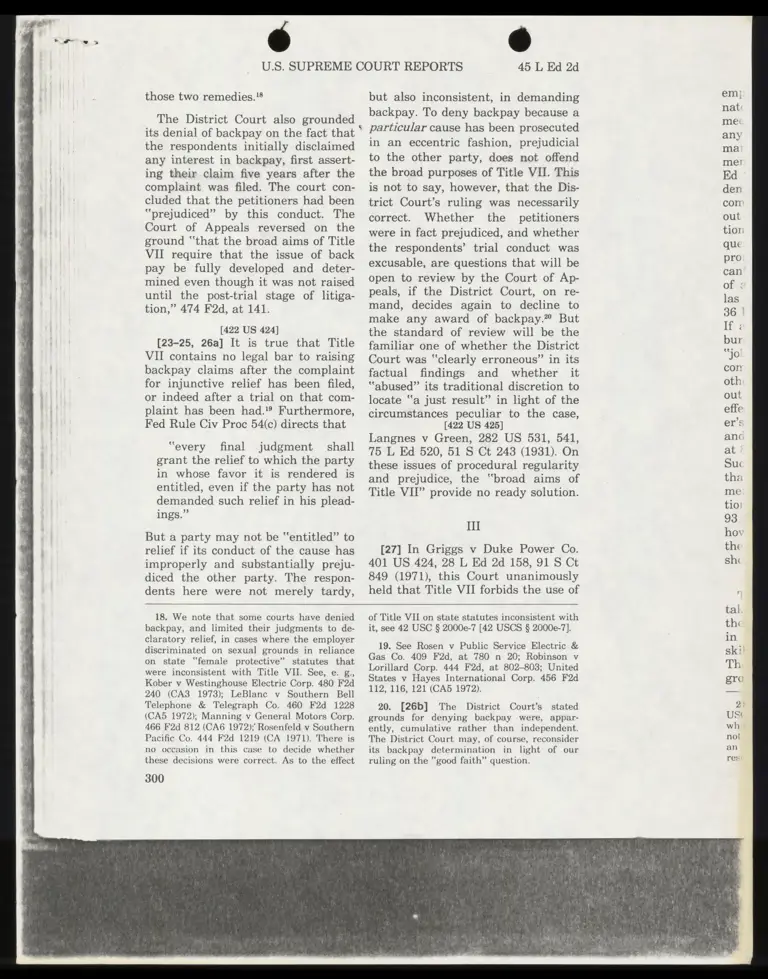
2 pages
-
Case Files, Henry v. Clarksdale Hardbacks. Albemarle Paper Co. v. Moody Court Opinion, 1975. 61f20665-8418-f111-8341-7c1e527f53b4. LDF Archives, Thurgood Marshall Institute. https://ldfrecollection.org/archives/archives-search/archives-item/9a39feaa-ccc6-481a-ae3f-bdd3acabc79c/albemarle-paper-co-v-moody-court-opinion. Accessed September 29, 2026.
Copied!
     [||5e8d465d-7916-4fc5-944a-947c3dbd00f8||] A


a


i
.

S
i
v
a
s
 1

50
d

BS
T
R
L


LAO.
1

*
U.S. SUPREME COURT REPORTS 45 L Ed 2d

those two remedies.!8

The District Court also grounded .
its denial of backpay on the fact that
the respondents initially disclaimed

any interest in backpay, first assert-
ing their claim five years after the
complaint was filed. The court con-

cluded that the petitioners had been
“prejudiced” by this conduct. The
Court of Appeals reversed on the

ground “that the broad aims of Title
VII require that the issue of back

pay be fully developed and deter-
mined even though it was not raised

until the post-trial stage of litiga-
tion,” 474 F2d, at 141.

[422 US 424]

[23-25, 26a] It is true that Title

VII contains no legal bar to raising

backpay claims after the complaint

for injunctive relief has been filed,
or indeed after a trial on that com-

plaint has been had." Furthermore,
Fed Rule Civ Proc 54(c) directs that

“every final judgment shall
grant the relief to which the party

in whose favor it is rendered is
entitled, even if the party has not

demanded such relief in his plead-
ings.”

But a party may not be “entitled” to

relief if its conduct of the cause has
improperly and substantially preju-
diced the other party. The respon-
dents here were not merely tardy,

but also inconsistent, in demanding

backpay. To deny backpay because a

particular cause has been prosecuted

in an eccentric fashion, prejudicial

to the other party, does not offend

the broad purposes of Title VII. This

is not to say, however, that the Dis-

trict Court’s ruling was necessarily

correct. Whether the petitioners

were in fact prejudiced, and whether

the respondents’ trial conduct was

excusable, are questions that will be

open to review by the Court of Ap-
peals, if the District Court, on re-

mand, decides again to decline to
make any award of backpay.?® But

the standard of review will be the
familiar one of whether the District
Court was “clearly erroneous” in its

factual findings and whether it
“abused” its traditional discretion to

locate “a just result” in light of the
circumstances peculiar to the case,

[422 US 425]

Langnes v Green, 282 US 531, 541,
75 L Ed 520, 51 S Ct 243 (1931). On
these issues of procedural regularity

and prejudice, the “broad aims of
Title VII” provide no ready solution.

III

[27] In Griggs v Duke Power Co.
401 US 424, 28 L Ed 2d 158, 91 S Ct

849 (1971), this Court unanimously
held that Title VII forbids the use of

18. We note that some courts have denied

backpay, and limited their judgments to de-
claratory relief, in cases where the employer

discriminated on sexual grounds in reliance

on state “female protective” statutes that

were inconsistent with Title VII. See, e. g.,

Kober v Westinghouse Electric Corp. 480 F2d

240 (CA3 1973); LeBlanc v Southern Bell

Telephone & Telegraph Co. 460 F2d 1228

(CA5 1972); Manning v General Motors Corp.

466 F2d 812 (CA6 1972); Rosenfeld v Southern

Pacific Co. 444 F2d 1219 (CA 1971). There is
no occasion in this case to decide whether

these decisions were correct. As to the effect

300

of Title VII on state statutes inconsistent with

it, see 42 USC § 2000e-7 [42 USCS § 2000e-7].

19. See Rosen v Public Service Electric &
Gas Co. 409 F2d, at 780 n 20; Robinson v

Lorillard Corp. 444 F2d, at 802-803; United

States v Hayes International Corp. 456 F2d

112, 116, 121 (CA5 1972).

20. [26b] The District Court’s stated
grounds for denying backpay were, appar-

ently, cumulative rather than independent.
The District Court may, of course, reconsider

its backpay determination in light of our

ruling on the “good faith” question.

bur

con

oth

out

effe

er’s
anc

at |

Suc

tha

tio

93

hov
the

sh

tak


d 2d

ding

Ise a

uted

licial

fend

This

+ Dis-

arily

ners

sther

was

111 be

I Ap-

1 re-
ie to

' But

2 the
strict

in its
iS 1

on to

f the

case,

, 541,

). On
larity

ns of

ution.

r Co.

1 S Ct
ously
ise of

it with

10e-T].

ctric &

nson Vv

United

56 F2d

stated

© appar-

endent.

-onsider

of our

A
ALBEMARLE PAPER CO. v MOODY

422 US 405, 45 L Ed 2d 280, 95 S Ct 2362

employment tests that are discrimi-

natory in effect unless the employer

meets “the burden of showing that

any given requirement [has] . . . a

manifest relationship to the employ-

ment in question.” Id., at 432, 28 L

Ed 2d 158, 91 S Ct 849.2! This bur-

den arises, of course, only after the

complaining party or class has made

out a prima facie case of discrimina-
tion, i.e., has shown that the tests in

question select applicants for hire or

promotion in a racial pattern signifi-

cantly different from that of the pool

of applicants. See McDonnell Doug-

las Corp. v Green, 411 US 792, 802,

36 L Ed 2d 668, 93 S Ct 1817 (1973).

If an employer does then meet the

burden of proving that its tests are

“job related,” it remains open to the

complaining party to show that

other tests or selection devices, with-

out a similarly undesirable racial

effect, would also serve the employ-

er’s legitimate interest in “efficient

and trustworthy workmanship.” Id.,

at 801, 36 L Ed 2d 668, 93 S Ct 1817.

Such a showing would be evidence

that the employer was using its tests

merely as a “pretext” for discrimina-

tion. Id., at 804-805, 36 L Ed 2d 668,

93 S Ct 1817. In the present case,

however, we are concerned only with

the question whether Albemarle has

shown its tests to be job related.

[422 US 426]

The concept of job relatedness
takes on meaning from the facts of

the Griggs case. A power company

in North Carolina had reserved its

skilled jobs for whites prior to 1965.
Thereafter, the company allowed Ne-

gro workers to transfer to skilled

jobs, but all transferees—white and

Negro—were required to attain na-

tional median scores on two tests:

“[Tlhe Wonderlic Personnel Test,
which purports to measure gen-
eral intelligence, and the Bennett
Mechanical Comprehension Test.
Neither was directed or intended

to measure the ability to learn to
perform a particular job or cate-

gory of jobs. . . .

“. . . Both were adopted, as the
Court of Appeals noted, without
meaningful study of their relation-
ship to job-performance ability.

Rather, a vice president of the
Company testified, the require-
ments were instituted on the Com-
pany’s judgment that they gener-

ally would improve the overall

quality of the work force.” Griggs
v Duke Power Co., supra, at 428-

431, 28 LL Ed 2d 158, 91 S Ct 849.

The Court took note of “the inade-

quacy of broad and general testing
devices as well as the infirmity of
using diplomas or degrees as fixed

measures of capability,” id., at 433,

and concluded:

“Nothing in the Act precludes
the use of testing or measuring

procedures; obviously they are use-
ful. What Congress has forbidden
is giving these devices and mecha-
nisms controlling force unless they
are demonstrably a reasonable
measure of job performance . . .
What Congress has commanded is

that any tests used must measure
the person for the job and not the
person in the abstract.” Id. at

21. In Griggs, the Court was construing 42

USC §2000e-2(h) [42 USCS § 2000e-2(h)],
which provides in pertinent part that it shall
not “be an unlawful employment practice for

an employer to give and to act upon the

results of any professionally developed ability

test provided that such test, its administra-
tion or action upon the results is not de-

signed, intended or used to discriminate be-
cause of race, color, religion, sex or national

origin.”

301

S
F [||5e8d465d-7916-4fc5-944a-947c3dbd00f8||]