Folder
Trial Transcripts Volumes 1-6
Public Court Documents
August 2, 1976 - August 5, 1976
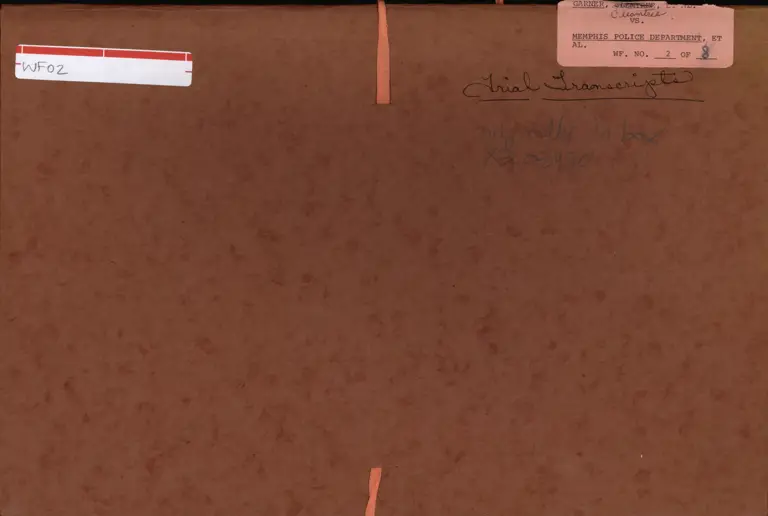
482 pages
-
Case Files, Garner Working Files. Trial Transcripts Volumes 1-6, 1976. ecf4525f-27a8-f011-bbd3-000d3a53d084. LDF Archives, Thurgood Marshall Institute. https://ldfrecollection.org/archives/archives-search/archives-item/9ab61a09-04cd-4f99-8dfc-555ae80b878f/trial-transcripts-volumes-1-6. Accessed September 25, 2026.
Copied!
. j^ '- y . - J j^
■■' . ■ .’ -::* -s.’'' ,;̂’ Vj' i
' , ?: •-s'’' * -,' ' ■'' • » ''.r>'̂.7 .
1% ' ;J. .■ ■“■ V’'- ■-<
■ t • .S"*.'-Mr.;
.'-y ■• ̂.
.V' S" , 1• ’V¥ **- " 1
• • ‘ -T'' •/::'■■■ ■■■■V̂
i., ..
% , .
& . j , -■'■:nu--A
X t s . .
garner , ..©fegjff j
CV>U-<v>vĉ 6̂i--̂VS.
•• ';.
MEMPHIS POLICE DEPARTMENT. ET
AL.
WF. NO. 2
">A.'\ . ■
'*’:n'■''I* c 4 a1 J L
:̂- if“-
yf-. i::ii
■■■. j - . \ ‘ ^-..
.• >f]
.... ..^:#iS
t'
̂ -• - a' . • * Wĥ:-/-
. - • "
Wr-d
fop
f%-lrd
' >%...
\
4
-i
*V' /' , ■ 2̂ ■'■‘1 1 IN THE UNITED STATES DISTRICT COURT
; 2 FOR THE WESTERN DISTRICT OF TENNESSEE
3 3 WESTERN DIVISION
{s 4
CLEAMTEE GARNER, Father and )J Next of Kin, EDWARD EUGENE )
6 GARNER, Deceased, A Minor, )
)
7 Plaintiffs, )
)
8 VS ) No. C-75-1^5
)
9 MEMPHIS POLICE DEPARTMENT, )
CITY OF MEMPHIS, WYETH )
10 CHANDLER, Mayor of Memphis, )J. W. HUBBARD, Director of )
11 Police of Memphis, E. R. )HYMON, Police Officer of the )
12 City of Memphis, )
)
13 Defendants. )
14
15 Be it remembered that the above-styled case came
.5 16 on to be heard on this date. Monday, August 2nd, et seq..
17 1 9 7 6 , at Memphis, Tennessee, before the Honorable Harry
18 W. Wellford, Judge, presiding, when and where evidence
Jt 19 was introduced and proceedings had as follows:
20
' 21 - - -
22
» 23 rnrnimgBm
24
C A R Y E L IZ A B E T H M IL L E R
S U IT E 4 1 0
F IR S T A M E R IC A N B A N K B L D G .
M E M P H IS . T E N N E S S E E 3 8 1 0 3
2
3
4
5
6
7
8
9
10
11
12
13
14
15
16
17
18
19
20
21
22
23
24
1
-2-
For the PIaintiff
APPEARANCES:
For the Defendant
MR. DREW S. DAYS, III, ESQ.
Attorney at Law
10 Columbus Circle
New York, N. Y. 10019
MR. WALTER BAILEY, ESQ.
Attorney at Law
l6l Jefferson
Suite 901
Memphis, Tennessee
MR. HENRY KLEIN, ESQ.
Attorney at Law
Rickey, Shankman, Blanchard,
Agee & Harpster
100 North Main Bldg.
Memphis, Tennessee
liji
1
0 WITNESS
I N D E X
DIRECT CROSS B/D R/C
3 Cleamtee Garner 8 27
Talton Douglas Enoch 46 55 63 66
4 David Michael Cordero 71 8o
Ann Stepp 86 91
5 Leedell Anderson 93 100 113
6
7
8 E X H I B I T S
9 NUMBER MARKED
10 #1 47
#2 48
11 #3 48
#4 49
12 #5 49
#6 55
13 #7 65
#8 65
14 #9 67
#10 90
15 #11 116
#12 117
16 #13 A Il8
#13. B 119
17 #14 120
#15 121
18
19
20
21
22
23
24 V. 1 G 8
-4-
3
4
5
6
7
8
9
10
11
12
13
14
15
16
17
18
19
20
21
22
23
24
1
2
MORNING SESSION
AUGUST 2. 1976
THE COURT; Gentlemen, are we
ready to proceed in the matter of Cleamtee
Garner versus Memphis Police Department
and Hymon and others?
MR. KLEIN: Yes, sir.
MR. BAILEY: Yes, Your Honor.
THE COURT: Gentlemen, I have
read the memorandum that each of you have
filed together with the Interrogatories
that have been filed and the statements
that have been filed, your statement of
issues, and it's very helpful to the
Court that these memoranda and full
positions, setting forth your respective
views of the Issues in the case and the
matters that the Court will be called
upon to decide.
We are ready to hear from you,
and in light of the fact that the Court is
familiar with your points and authorities
and statement, you may either proceed to
an opening statement on each side if you
-5-
3
4
5
6
7
8
9
10
11
12
13
14
15
16
17
18
19
20
21
22
23
24
1
2
wish, or you may proceed with the
presentation of prooi and evidence as
you desire.
MR. BAILEY: Your Honor, two
things — one, I wish to apologize for
our briei delay. Lt. Lee's funeral sort
of Interrupted --
THE COURT: (Interposing) All
right. Lee's funeral hasn't already taken
place?
MR. BAILEY: No, sir. No, sir.
I nave been ministering to his daughter.
THE COURT: I see. I see.
MR. BAILEY: Secondly, I wish
to introduce co-counsel, Mr. Drew Days,
who is a member of the New York Bar and I
know it's Sixth Circuit and I think the
Supreme Court and some other Circuits.
THE COURT: We're happy to have
Mr. Days appear in this matter.
I was shocked to read about
that matter this morning, Mr. Bailey, and
in the press. There hasn't been very many
like him in our part. I don't know whether
̂ 17U
-6-
1
2
3
4
5
6
7
8
9
10
11
12
13
14
15
16
17
18
19
20
21
22
23
24
there will ever be another one like Lt. Lee
Are we ready to proceed as far
as you're concerned, Mr. Klein?
MR. KLEIN: Yes, sir. Mr.
Charles Holmes, who I'm sure Your Honor
knows, is going to work with me in this
case.
THE COURT: All right. We are
glad to have you, Mr. Holmes.
All right, as I say, on either
side, I'm prepared to hear from you by
openin. statement if you like, but again,
as I say, I ajn familiar thoroughly with
what you have already submitted and the
Court appreciates the full position that
each of you have set out in your memoranda.
Mr. Bailey, you may either
proceed with opening statement or proceed
with your proof, whichever you desire.
MR. BAILEY: Your Honor, we
waive opening statement and are ready to
proceed with our first witness, Mr. Garner.
THE COURT: All right, sir.
Mr. Klein, is it agreeable with you that
1i i J.
-7-
3
4
5
6
7
8
9
10
11
12
13
14
15
16
17
18
19
20
21
22
23
24
1
2
the opening statement be waived and we go
ahead with the proof?
MR. KLEIN: Yes, Your Honor. I
am going to asK Mr. Hymon, who is one of
the Defendants, to sit behind me at the
counsel table.
THE COURT; All right, sir.
MR. KLEIN; He will remain in
the Courtroom.
THE COURT: All right, sir. He
is entitled to be present.
You may call your witness, and
gentlemen, in this non-jury type of pro
ceeding, for the benefit of each of you,
I don't plan to have the marshal in the
Courtroom. He will be attending the jury
that is out, so if either of you have
matters that you wish to present to a
witness, you are free to approach the
witness and present that to him. Mr.
Clerk, will you call the first witness
if he is --
MR. DAYS: (Interpos ing)
Your Honor, we would like to call as our
± i
-b-
1
2
3
4
5
6
7
8
9
10
n
12
13
14
15
16
17
18
19
20
21
22
23
24
first witness the Plaintiff in this case,
Mr. Cleamtee Garner.
THE COURT: All right.
Whereupon,
CL^.AMTEE GARNER.
after first being duly sworn, was examined and testified as
follows;
DIRECT EXAMINATION
BY MR. DAYS:
Q. Mr. Garner, would you state your full name and
address for the record, please?
A. Stand or sit?
THE COURT: No, you may sit,
Mr. Garner.
A. (By the witness) My name is Cleamtee Garner. You
want my address?
Q.
A.
Q.
A.
Q.
A.
Q.
A.
That is right.
I live at 928 Tully, Memphis.
And how long have you lived at that address?
About 11 years.
Are you the Plaintiff in this case, Mr. Garner?
Sir?
Are you the Plaintiff in this case?
Plaintiff, Plaintiff, yes, sir.
̂ 173
1
2
3
4
5
6
7
8
9
10
11
12
13
14
15
16
17
18
19
20
21
22
23
24
-9-
Q. Mr. Garner, could you Indicate what your educa
tional background is?
A. About six grade level.
Q. And where are you originally from?
A. Mississippi, Til^atoba, Mississippi.
Q. How long have you resided in Memphis?
A. Since 19^5.
Q. Since 19^5?
A. Since 19^5.
Q. ■ Are you employed?
A. I am employed at the Memphis Defense Depot.
Q. Artd how long have you been employed there?
A. Abdut, since 1952, about 24 years.
Q. And what is your Job category at the depot?
A. W6 material packer.
Q. And have you been in that Job since you started?
A. I haven't been in that Job since I started. I have
been in that Job about 12 years.
Q. I see. At what level did you start in that
employment?
A. I started out in laborers, W2 laborers.
Q. Is it correct to say that you moved up from that
original level to your present position?
A- Correct.
̂ 174
2
3
4
5
6
7
8
9
10
11
12
13
14
15
16
17
18
19
20
21
22
23
24
1
-10-
Mr. Garner?
A. I stayed four years and four months in the Armed
Forces, the Array.
Q. And your present address, how long have you been at
that address?
A, About 11 years.
Q. Do you reside in a private home or do you reside in
some type of apartment complex?
A. I guess what you would call aji apartment complex.
I would suppose Just like a residential house.
Q- Do you have any history of service in the military,
Q.
A.
Q.
A.
Q.
A.
Q.
A.
Q.
A.
Q.
A.
Q.
A residential house?
Yeah.
And do you rent or are you buying a house?
I'm buying.
Are you married, Mr. Garner?
I'm married.
And how long have you been married?
I have been married since 19^6.
And is your wife still alive?
She is still alive.
Do you have any children?
I have five children.
And could you name those children and their
17 u
-11-
1
2
3
4
5
6
7
8
9
10
11
12
13
14
15
16
17
18
19
20
21
22
23
24
relative ages?
A. Curtis Garner, twenty-two, Charles Garner, twenty,
and Larry, nineteen, and Edward would have been, if he had
been living he would have been seventeen, Linda, sixteen, and
Diane, thirteen, I believe she'll be fourteen her birthday.
Q* Now, could you indicate something about the educa
tional background of your children? Are any of your children,
who are presently living, high school graduates?
A. Yes, I have two high school graduates, Charles
Garner and Larry Garner.
Q- And are Linda and Diane in school?
A. They are still in school.
Q. Do you know whether they intend to complete their
course of study?
A. They intend to finish. They like school very much.
I think they will finish. At least, I hope they will.
Q- Is it fair to say that you expect that they will
complete their course of study and graduate?
A. I believe they will complete.
Q. Are any of your children presently employed?
A. Yes. Charles, he runs a body shop, and Larry, he
runs a grocery.
Q. And what about Curtis, the oldest son?
A. Well, he helps out with the grocery and the body
1 7 o
1
2
3
4
5
6
7
8
9
10
11
12
13
14
15
16
17
18
19
20
21
22
23
24
-12-
Shop .
Q- Does he engage in any other kind of employment?
A. Well, he did work in the grocery. He was working
in the grocery a while, but his back — he had trouble with
his back and he stopped work because he got operated on for
his back.
Q. So the reason why he stopped working was because of
an illness?
A. He was still having back trouble, you know, from
the operation.
Q. Now, in terms of the children that you have Just
mentioned, the children who are presently living, do you
recall having any problems with these children in terms of
their educational situation, that is, any school problems that
they might have had while they were growing up?
A. Well, speaking from Curtis, I didn’t have any
trouble with him too much. Charles and Larry, well, I think
Charles failed one year and I think Larry failed one year.
Other than that, I didn't have no problem with them in school.
Q. But Charles and Larry did ultimately graduate from
high school?
A. They did finish. Yeah, they graduated.
Q. I see. And did you have any problems with the
girls in terms —
J 4 H
-13-
1 A. (Interposing) I don't have no trouble with the
2 girls. They seem to like school.
3 Q. Have these other children had any problems with
4 the police authorities, to your knowledge?
5 A. Not to my knowledge.
6 Q. So that the children that you have just mentioned
7 earlier have not, to your knowledge, had any difficulty with
8 the police authority?
9 A. Not to my knowledge.
10 Q. Have you had any problems ever with the police
11 department in terms of your personal life?
12 A. Well, I was picked up a couple times for being
13 drunk. You see, I was drunk a couple times, about the only
14 problem that I had.
15 Q. And was that a recent occurrence?
16 A. One time, when I first got out of the service,
17 would be about 30 something years ago and I think about maybe
18 two years later than that. That was about the last time I had
trouble with them.
20 Q. So at least for 30 years you haven't had any per-
21 sonal involvment with the police department?
22 A. I haven't had any trouble with them.
23 Q. Has your wife had any problems with the police
24 department?
”14-
3
4
5
6
7
8
9
10
11
12
13
14
15
16
17
18
19
20
21
22
23
24
2
A. She hasn't had any problem with the police.
Q. I want to turn to your son, Edward Eugene Garner.
Is it correct that he is deceased?
A. That is correct.
Q. Now, could you describe in terms of physical
appearance, your son, Edward Eugene Garner, at the time of his
death?
A.
Q.
A.
Yes, he was kind of a small type person, slender.
How tall would you say he was?
I would say he was about five feet two inches or
three inches.
Q. And do you have any recollection of his weight?
A. I believe he would weigh between a hundred and
maybe eighty-five or ninety. He didn't weigh over a hundred,
I don't believe.
Q. But you don' t recall?
A. I don't recall the exact weight.
Q. — the exact weight. And how old was he at the
time of his death, if you recall?
A. Fifteen.
Q, Was he enrolled in school at the time of his death?
A. He was .
Q. Now, in considering Edward Eugene in comparison to
your other children, would you say that he had more or less
̂ 17J
-15-
2
3
4
5
6
7
8
9
10
11
12
13
14
15
16
17
18
19
20
21
22
23
24
1 trouble in terms of school situations?
A. Well, I would say he had more trouble in school
situations. Well, he had a little more problem in school it
seemed.
Q. Could you give some indication of what, if any,
problems he had?
A. Well, I believe he failed twice and then he had
some trouble, you know, I think he skipped some classes or
something like that.
Q. Were you informed of this fact by school
authorities?
A. That is right, I was.
Q. Did you take any action in response to this infor
mation from school authorities about Edward Eugene's diffi
culties?
A. I talked with the principal and I teilked with some
of his teachers.
Q. Why did you take that action, Mr. Garner, if you
can Indicate?
A. Because I was concerned about him doing well in
school. I thought he should be corrected and what I could do
to correct him, I would try to do it, because I was working
with the teachers, the principal.
Q. Again, comparing your son, Edward, with your other
I b U
3
4
5
6
7
8
9
10
11
12
13
14
15
16
17
18
19
20
21
22
23
24
1
2
-16-
cnildren, did he have more or less problem with police
authorities than the other children?
A. Well, he mijjht have had more perhaps. I'm quite
sure he did, yes.
Q- Could you indicate what, if anything, you recall
about his having problems with the police authorities prior to
his death?
^ ' THE COURT: Excuse me Just a
minute, Mr. Days, if I may. Excuse me,
Mr. Garner.
(Discussion off the record.)
THE COURT: Excuse me, sir.
MR. DAYS: That is quite all
right. Your Honor.
THE COURT: You may proceed.
MR. DAYS: I'm not intimately
familiar with the Judicial calendar in
Memphis, but I have some idea what that
matter related to.
Q. (By Mr. Days) Mr. Garner, at the time the Court
had to turn to another matter, I was asking you whether Edward
Eugene had any problems with the police authorities as com
pared to experiences you had had with your other children, and
you were about to describe to the best of your recollection th^
̂ I S j.
3
4
5
6
7
8
9
10
11
12
13
14
15
16
17
18
19
20
21
22
23
24
1
2
-17-
nature of problems that he had had. Could you continue your
answer in that resspect?
A. He did have some problems. I guess you would call
them problems. I don’t know if you would call them problems.
He was picked up, and you know, taken to Juvenile on a couple
of occasions, you know.
Q. Could you be more specific, if you're able to?
What, to the best of your recollection, was the nature of
Eugene's first problem with the police authorities?
A. I believe it was third degree burglary. I believe
he was charged with third degree burglary.
Q. And could you describe, to the best of your know
ledge, what circumstances produced that charge of third degree
burglary?
A. Well, he was placed on probation for a year and
after that he was taken off the probation.
Q. But what was he alleged to have done that produced
those charges?
A. They said he had entered a building, you know, and
I wanted to know what happened.
He said really they picked him up at school because
I don't know what happened — so they taken him to Juvenile
from school, so I wanted to know what happened. When I got a
report — that was a report that I got that they had him on
̂ 182
-18-
1
2
3
4
5
6
7
8
9
10
11
12
13
14
15
16
17
18
19
20
21
22
23
24
third degree burglary, you know.
That is when I went in and talked with one of the
counselors , l believe, and they put him on probation for a
year.
Q. You talked to a councilman or to a counselor?
A. A counselor. I believe it was Mr. Rogers, if I’m
not mistaken. I'm not sure.
Q. And you say as a result of these charges, your son
was put on one year's probation?
A. Probation, that is correct.
Q. As a result of these charges having been brought
against your son and his being put on probation, did you take
any action with respect to Eugene's behavior, Edward Eugene's
behavior after that time?
A. That is right. I counseled with him and I chas
tised him and gave him certain hours to be home, you know,
during the day and at nighttime, and different things.
Q. What were the conditions of his probation, if jrou
recall?
A. What was the —
Q. (Interposing) Conditions of his probation. Were
there any requirements that he had to meet to satisfy —
A. (Interposing) Restrictions. He had certain times
of night he would have to be at home. Somebody would have to
18o
2
3
4
5
6
7
8
9
10
n
12
13
14
15
16
17
18
19
20
21
22
23
24
1
-19-
know where he was at all times.
Q. And who in your family, if anyone, assumed the
responsibility of overseeing that he complied with those
requirements?
A. I would, when I would be at home, and my wife was
supposed to when I would be away from home. Of course, his
other brothers and his older brother, he was concerned about
him and they would keep check on him as near as they could.
Q. I believe you indicated that you were away from
home?
A. Yes, I worked the second shift, evening shift, and
I ’m supposed to be at work from four o'clock to 12:30 o'clock.
Q. And is that the regular shift you had?
A. That is the regular shift I had.
Q. And you continue to work that shift?
A. I still work that shift.
Q. So does that mean that you were away from your
home from four o'clock in the afternoon until twelve o'clock
midnight?
A- I get off at twelve o'clock but I usually get home
about one o'clock if I don't stop no place. Sometimes I stop
at the store, at Fred Montesi's. But if I don't stop, I get
home about one o 'clock.
Q. Can you recall what, if any, problems Edward Eugene
184
-20-
2
3
4
5
6
7
8
9
10
11
12
13
14
15
16
17
18
19
20
21
22
23
24
1
had with the police authorities after this third degree bur
glary charge?
A. Well, after this third degree burglary, well, then
he was picked up once — I believe on a curfew charge, I
believe, and he was taken to Juvenile Court, being out after
hours.
Q. Did you have any knowledge of the circumstances
surrounding this alleged curfew violation?
A. No. He was working at a little sundry at the time
on the corner. I don't know. He said he saw some people
being arrested or something and he watching or looking on.
Him and some more children or something was looking
on and he was ordered by the police or a policemtn to go back
inside the place, and I think he refused to go and he was
taken to Juvenile Court.
Q. You say that Edward was working in a store at that
time?
A. He was working in a little sundry when he would be
off duty, Einyway be out of school on a holiday and his off
days.
Q. Do you have any idea what he did in the store?
A. I think he was to clean up and empty trash and
stuff like that.
Q. And he would do that after school?
18o
-21-
2
3
4
5
6
7
8
9
10
11
12
13
14
15
16
17
18
19
20
21
22
23
24
1
Q.
A,
A. After school hours and on holidays.
Would he do It on weekends?
Yes, sir, weekends, yes.
Q. Do you know how long he had that particular job?
A. He didn’t really — sometimes there was a lady.
She would send for him to come in and,, you know, he didn't
really work too steady at it. Whenever she needed somebody,
she would call for him to come in to work.
Q. I see. Did Edward have any other types of employ
ment?
A. He used to throw a paper called the Consumer Times,
I believe. He used to throw that once a week.
Q. And do you recall how long he had that particular
job?
A. I believe, if I can remember good, I think he threw
it for about two years maybe, more or less.
MR. KLEIN: I'm sorry. I
didn't understand what he said.
THE COURT: The Court under
stood him to say that he threw papers for
a time, approximately two years.
THE WITNESS: Consximer Times
was the paper, name of the paper.
THE COURT: Consumer Times.
. 18b
2
3
4
5
6
7
8
9
10
11
12
13
14
15
16
17
18
19
20
21
22
23
24
1
-22-
quent to the curfew violation that you just described?
A. After, you mean?
Q. That is right.
A. He did have trouble because really -- one particu
lar time, particular occasion, you know, I give him a two
dollar bill, or my wife, one, gave him two dollars and he had
to have two dollars for something. I didn't know what reason,
but I gave it to him.
And then later on, well, he turned up with a lot
of pennies, you know. I don't know where he got the pennies
from. My son, one of my sons, was telling me where he had,
you know, a lot of pennies.
So I talked with him about it, and he said he got
those two dollars cheinged into pennies. And so I begin to
believe it. Then my son said he had more than two dollars
worth of pennies.
Q. Your son told you that he had more than two dollars
worth of pennies? Are you referring to Edward or are you
referring to the other son?
A- My other son was the one who told me that Gene had
more than two dollars worth of pennies.
Q. So these were other sons of yours who informed you
Q. (By Mr. Days) Did Edward have any problems subse
that Eugene —
18
1
2
3
4
5
6
7
8
9
10
11
12
13
14
15
16
17
18
19
20
21
22
23
24
A. (Interposing) Gene had more pennies. Yeah, that
is right.
Q. I see.
A. But I questioned him further where did he come up
with the pennies, and then I was questioning him about where
did he get them from, and later on he told me where he got
them from.
It was Just about time for me to go to work at the
time. You know, it was at evening time. So I told him to
show — I told him take them back to where he got them and
also my oldest son was at home, and I told my oldest son to go
with him and see where he got them and take them back, you
know, to the place.
And so, he taken them back. And the lady — I
forget her name — she didn't want to call the police, you
know. Well, see, I think my oldest son insisted on calling
and she said since somebody had been into her place and since
a person the size of Edward couldn't have done it by himself,
it would take more than -- it would have to be a larger
person to move the stuff around that had been moved around.
Q. Now, why did you make Edward Eugene Garner take the
pennies back?
A. Because I thought that would teach him not to
bother things that didn't concern him and, you know, I felt
-23-
. 188
-24“
2
3
4
5
6
7
8
9
10
11
12
13
14
15
16
17
18
19
20
21
22
23
24
1 that it would correct him some and that he would be ashamed
to do something like that again. I thought that would help
him some by making him take them back, and facing up to it,
you know, and tell the lady what he had did. I thought that
would help him.
And I believe you indicated that you were
informed of this penny situation by your other boys?
A. Yes, Charles.
Q. Was that unusual for them to bring to your atten
tion something that Edward might have done?
A. No. Any time when one of those children — the
oldest children sees one doing something they don’t think is
right, and he won't listen to them, then he brings it to my
attention or either their mother's attention.
Q* And this was something that happened from time to
time, rarely, frequently? How would you describe it?
A. You mean, what? Bringing things — any time that
he thought that Edward or someone was doing something he
shouldn't do, they would tell me about it or tell my wife
about it, bring it to our attention.
Q- In September of 1974 was Edward Eugene enrolled in
school?
A.
Q.
He was.
And when did he die, if you recall?
18d
2
3
4
5
6
7
8
9
10
n
12
13
14
15
16
17
18
19
20
21
22
23
24
1
-25-
A. I believe October — I believe on the 3rd or 4th
of October, 1974.
And so at the time that he died, he was enrolled in
school?
A.
Q.
A.
That is correct. West Side.
What school was that?
West Side Junbr High, I believe it was, out in
Frayser. I believe it was jxinior high or high school.
Q* Mr. Garner, if you had to sum up in a few words
what your son Edward Eugene Garner was like, what would you
say?
A- Well, he was a very easy person to get along with.
He wasn’t a violent type person. I mean, most anybody could
talk with him. He could make friends quick, and he was a nice
person, I mean, as far as I'm concerned.
Q* How would you describe him in terms of his intelli
gence? Was he a slow person or was he quick-witted? How
would you describe him?
A. He was quick to catch on. He wasn’t very slow.
He was quick to catch on, very easy to catch on.
Q* Mr. Garner, if your son had not died in October of
1975, do you have a' y thoughts about what would have happened
to him?
MR. KLEIN: Your Honor, I'm going
. 19 u
-26-
1
2
3
4
5
6
7
8
9
10
11
12
13
14
15
16
17
18
19
20
21
22
23
24
to Object to that.
THE COURT; Well, in these
types of things, Mr. Klein, I think
some latitude is appropriate. This
may involve speculation and it may
involve opinion, but I'm going to
permit it under these circumstances.
You may proceed.
Q. (By Mr. Days) Do you recall the question, Mr.
Garner? If he had not died in 197^> do you have any
thoughts about what would have become of your son?
A. I believe he could have been corrected. I believe
he would have changed and been a different person.
Q. Well, what is your basis for thinking that, Mr.
Garner?
A. Well, because I was planning on retiring, you
know, shortly before that happened, and I was going to have a
chance to be with him more where I could correct him direct
myself more, and I think that would have helped a whole lot.
Q. So you would have no longer been on that four to
twelve shift?
A. That's right. I was planning on retiring the next
year, that following year after, but see, after this happened
that made me have to work on longer.
191
-27-
1
2
3
4
5
6
7
8
9
10
11
12
13
14
15
16
17
18
19
20
21
22
23
24
Q.
A.
Q.
A.
Q.
MR. DAYS: Just one moment.
Your Honor.
. THE COURT: Yes, sir.
MR. DAYS: We have no further
questions. Your Honor.
THE COURT: You may cross-
examine .
CROSS EXAMINATION
BY MR. KLEIN:
Mr. Garner, you said you had how many sons?
How many sons I have?
Just the number of them, not the names.
I have three sons.
Three sons. All right, and was Larry Eugene Garner,
is he a son of yours?
A. Who?
Q.
A.
Q.
Larry Eugene Garner.
That is right.
All right. Now, I think Mr. Days, your attorney.
asked you a minute ago if any of your other sons had been in
any trouble and I think you said, no, that they had not?
A. To my knowledge, that is right.
Q. Well, now, wasn't your son, Larry Eugene Garner,
didn't he have some trouble with the Juvenile authorities back
̂ 192
-28-
1
3
4
5
6
7
8
9
10
11
12
13
14
15
16
17
18
19
20
21
22
23
24
2
in 1970 and 1971?
A- Not to my knowledge. I don't remember it.
Q* Well, wasn't he picked up on an assault and
battery charge back in 1970 and turned over to the Juvenile
authorities?
A. Not to ray knowledge.
Q* You don't know anything about that? Is that what
you're saying?
A* I said I don't know anything about that.
Q* What about truancy? Do you know what truancy is?
A- I said, to my knowledge, I said I didn't know any
thing about it.
Q- Well, now, what about another charge of truancy?
Was he having any problems about going to school or were you
having any trouble keeping him in school back then?
A. Keepirxg Larry in school?
Q. Yes.
A- Larry stayed in school until he finished school.
Q. Well, do you know whether or not he was ever
picked up by the Juvenile authorities and charged with
truancy?
A. Not to my knowledge.
Q* You don't remember that either?
A. No.
19^
1
2
3
4
5
6
7
8
9
10
11
12
13
14
15
16
17
18
19
20
21
22
23
24
-29-
Q* Now, as far as Edward Eugene Garner, your son who
died in October 197^> I think you have mentioned two instances
where he was held by the Juvenile authorities for burglary?
Is that correct?
A. That is correct.
Q* All right, and you described to us what each one
was involved, I believe. In one instance he had stolen a jar
of pennies or stolen something out of a house, is that correctj?
A. I don't know whether those pennies was in a jar or
what it was in. I mean, I know when I saw them, they was in a
bag.
Q. You saw them in a bag?
A. I believe they was in a plastic bag, I believe.
Q- All right. Now, how did you find out about that?
A. One of my sons was telling me about it. Charles
was telling me about it.
Q. Charles was telling you about that?
A. That's right.
Q. And what did you do?
A. Well, I questioned him about those pennies. He sai
it was — I think it was two dollars worth. Either I gave him
two dollars or his mother gave him two dollars. He said he
got it changed into pennies.
And after Charles was telling me that it was more
194
2
3
4
5
6
7
8
9
10
11
12
13
14
15
16
17
18
19
20
21
22
23
24
1
-30-
than two dollars worth of pennies that he had, then I checked
into it further, and he come up with the pennies and then I
asked him where did he get them from, and then finally he told
me where he got them.
Q. Where did he tell you he got them?
A. Some lady’s house down the street.
Q. Did you know the lady?
A. No, I don't know the lady, no.
Q. Did you go down and talk to the lady about it?
A. I sent my oldest son down because it was time for
me to go to work. When I found out, it was about work time.
Q. So you sent the oldest boy. How old is your
oldest boy, or how old was he back then?
A. Well, Curtis was about twenty years old back then.
Q. That would be back in 197^ when this happened, is
that right?
A. He would be about twenty years cGd,
Q. All right. And then he was handled by the Juvenile
authorities and then placed on what? Probation?
A. Probation.
Q. For a year?
A. At least, he wasn't — the officer didn’t arrest
him. If he had arrested him, they would have made a notation
of it. He had to go to Juvenile Court to see a Judge and they
1
2
3
4
5
6
7
8
9
10
11
12
13
14
15
16
17
18
19
20
21
22
23
24
put him on probation for a year.
Q. In tiru time before^ .aiich would have been back in
1971, I believe, he was charteu with burfclary again, and do
you Know what happened on that occasion or where the place
was that was supposedly burglarized?
A, I think it was over on i^anassas near Chelsea some
place. I think they told me — I think I did have a report
from the Juvenile Court. I haa s letter, a copy oi it. It
was some place on ilanassas near Chelsea.
Q. All rijit. And what happened to him on that
charge?
Kc was placed on a year’s probation.
Was he still on probation when he was charged in
A.
Q.
1974?
A. Not for that, but he was on probation for his
penny deal.
Q. Ec v̂ as on probation lor the penny deal?
A. Yean, when he c.ot killed.
Q. And then you mentioned another violation, the
curfew. Is that correct?
A. I’hat was before the penny deal.
Q. All right, ana on October 3rd of 1974, chat
evening, were yow working that ua>?
A. I was workiAt^ that nl̂ ĥt.
19 o
1
2
3
4
5
6
7
8
9
10
11
12
13
14
15
16
17
18
19
20
21
22
23
24
-32-
Q. You worked that night, and what was your shift at
that time?
A. The same, from four o'clock to 12:30.
Q. Four o'clock to 12:30. So in other words, it would
be four o'clock in the afternoon —
A. (Interposing) Until 12:30.
Q. Until 12:30 at night?
A. That is right.
Q. — or early in the morning. All right, now, did
your son go to school that day?
A. He didn't go to school that day. In other words,
he was being bussed and his bus didn't run or he missed the
bus for some reason.
Q. So he didn't go at all that day?
A. No, he didn't go.
Q. Well, now, who would be at home? If you were
working the evenin' shift, who was at home with the children?
A. My wife.
Q. Was she there all the time?
A. She was supposed to be there all the time.
Q. All right, and he was on probation at that time,
was he not?
A. At that time.
Q. All right, was there any condition of his probation
19.
-33-
2
3
4
5
6
7
8
9
10
11
12
13
14
15
16
17
18
19
20
21
22
23
24
1 about the hours that he would keep or was supposed to keep?
A. I think they kind of left it up to his parents
because, you know, they could be knowing what he did all the
time, while his probation officer would be here to check on
him. He should have a certain time to getting back home, to
be at home.
Q. Well, what hours did ya’ll establish for your son?
A. Well, ray hours was supposed to be back home around
9:30 or no later than ten.
Q. 9:30 or no later than ten. Was he working at that
time, back in October of 197^?
A. He used to clean up for this here lady what run
that sundry sometimes.
Q. He would do what now?
A. He would clean up for her, clean up in the svindry.
Q. Well, how long would that take him?
A. It wouldn’t take him — I don't know how long it
would take him because I think he would go down sometimes and
clean up and I don't know how long he would stay down there.
It was mostly holidays and weekends. That is when he worked
mostly.
Q. Holidays and weekends. Now, October 3rd of 197^i
that was during the week, was it not?
A. That was during the week.
. li)6
■o
18
-34-
Q. Do you remember what day of the week that was?
A. I don't remember whether it was a Thursday or
Wednesday. I believe it was a Thursday.
Q. All right. But in any event, it was during — he
was supposed to be in. Based on the requirements that you had
of him, he was supposed to be in by 9 : 3 0 or no later than
ten o'clock, is that correct?
A. About ten o'clock.
Q. All right, ajid you said he didn't go to school
that day. Was your wife home with him that day or do you
know?
A.
Q.
A.
See, I was home until I went to work that day.
Until four o'clock?
Until about 3:15* I would leave about three
o'clock or 3 :1 5 *
Q. All right. What did he do that day while you were
there?
A- Well, I had him cleaning the back, raking the
leaves in the back yard and he was — I left going to work,
he was laying down in the bed.
Q. Well, now, you say he missed his bus and that is
the reason he didn't go to school.
A. That' s r ight.
Q. How far is the school from where you live?
19ii
o 1
2
3
4
5
6
7
8
9
10
11
12
13
14
15
16
17
18
19
20
21
22
23
24
-35-
A. He be bussed though. They would bus him to West
Side In Frayser. See, they had to bus him.
Q* I see. Did you have a car at that time?
A. I did.
Q* Did you give any thought to taking him to school
that day?
A* When I found out he didn’t go to school, it was
already after school. It was late when he came back.
Q* You mean he missed his bus and didn’t come back
for a long time?
A. I guess he stayed around waiting for the bus.
Sometimes when children be bussed to school and sometimes
those buses be late. They don't run on time all the time.
Q* What time does the bus usually come by to pick him
up?
A. I don’t remember exactly the time. I don't really
have a — I don’t remember what time because it had different
times. I had —
Q* (Interposing) Well, it would be reasonably early
in the morning, wouldn't it?
A. Now, some of those buses go seven something and
some go later because they pick up two different groups of
children.
Q. All right. So when he finally came home, you say
1
2
3
4
5
6
7
8
9
10
11
12
13
14
15
16
17
18
19
20
21
22
23
24
-36-
it was too late for you to take him to school?
A. It was too late. It was after school. School
had been taken in because — I'm quite sure it had been taken
in at that time.
Q. So you left before four o'clock to go to your
job, and who was at home with him when you left?
A. My wife.
Q. Anybody else?
A. Some more of the children was home.
Q. All right. And then you came home at what time?
A. I guess about 1:30 perhaps.
Q. 1:30. That would be October 4th then?
A. Correct.
Q. All right, and he> of course, wasn't at home at
that —
A. (Interposing) Later on.
Q. All right. Did you inquire as to his whereabouts?
A. That is what I usually do. When I was home I woulci
check to see if all the children was home, and he wasn't home
And they told me he had left home about ten o'clock to go get
a drink. I believe that is what my wife said, and he hadn't
gotten back home.
Q. Left at ten o'clock at night to go get a drink?
A. To go get a drink.
. 201
. . .
M
r - - . - i . r - y
-37-
Q. All riiiht. Now, when did you first find out, Mr.
Garner, that anything or that something had happened to your
son?
A. I don't believe — it was about two o'clock or
maybe a little bit later. I don't know the hour. I had
somebody called and wanted to speak to Edward.
And I told him he wasn't home and then he wanted
to know what kind of clothes does he have on and, you know,
I don't remember what kind of clothes he had on because I
wasn't there when he left, but anyway somebody told me they
would be out there later on to talk with me and finally two
gentlemen cajne out.
Q.
A.
Q.
A.
Q.
All right, came out that morning.
That morning.
Now, we're still talking about October 4th?
Correct.
All right. Do you know who the two gentlemen
were that came out to see you?
A.
Q.
I don't remember their names.
Were they police officers?
MR. DAYS: Objection, Your Honor.
We have heard part of this line of inquiry
and it's our position that this goes beyond
the scope of direct examination.
. 20^
-38-
2
3
4
5
6
7
8
9
10
11
12
13
14
15
16
17
18
19
20
21
22
23
24
1 THE COURT: Mr. Klein,
normally my ruling in that respect is
that if you go beyond the scope, to the
extent that you do you make the witness
your witness in that respect.
If you understand that ruling,
if you go beyond the scope of the direct
examination and cross examination, to
that extent the witness is your witness,
and in that event, Mr. Days, you would be
entitled to examine the witness further
in respect of that area.
MR. KLEIN: Your Honor, I don't
have any —
THE COURT: (Interposing) What
is the relation, Mr. Klein, in respect to
anything that this witness may have stated
in any conversation with any representatives
of the Defendant?
MR. KLEIN: Well, I'm getting to
that. Your Honor.
THE COURT: Well, I'm asking —
I'm assuming that it must relate to some
conversation or discussion.
. 2 o;3
-39-
2
3
4
5
6
7
8
9
10
n
12
13
14
15
16
17
18
19
20
21
22
23
24
1 What is the relevancy or
materiality of any conversation or
discussion on the part of the Plaintiff
with the police officers following the
episode that is in question?
MR. KLEIN: Well, it was a
characterization by this gentleman to
the police officer of what he was
expecting to happen to his son.
Now, I can tell you exactly
what I'm going to ask before I ask it,
if you want me to.
THE COURT: All right. Will
you wish to be heard further in that
respect?
MR. DAYS: No, Your Honor.
We don't want to be heard.
THE COURT: A H right. You may
proceed.
MR. KLEIN: Your Honor, again,
as I say, I have no quarrel with making
him my witness in that this wasn't gone
into on direct examination, but this gets,
I think, to the heart of inquiry and this
204
o
2
3
4
5
6
7
8
9
10
11
12
13
14
15
16
17
18
19
20
21
22
23
24
1
-4o-
is the reason I'm proceeding.
I'm trying to follow a chain
of events that occurred and this is just,
to my way of thinking, this is a part of
that chain of events.
THE COURT: Well, you may
proceed.
MR. KLEIN; All right.
MR. DAYS: Your Honor, we would
have no objection. We have some sense of
what Mr. Klein is after and if he would
Just ask the questions directly and get
the correct answer, we have no objection.
THE COURT: All right, sir.
Q* (By Mr. Klein) All right. Did you talk to two
gentlemen or two police officers who came out to your home
at 928 Tully, is that correct?
A. That is correct.
Q. All right. Did these* men ask you if you would go
down to identify a person that they had at the morgue to see
if it was or was not your son?
A. They did ask me that.
Q- All right, and what was your response to that
request?
205
o
1
2
3
4
5
6
7
8
9
10
11
12
13
14
15
16
17
18
19
20
21
22
23
24
-41-
A, At the time I was really heavy and I didn't say
anything for a few moments, euid finally I let my oldest son
go with them to check to see was it my son.
Q. All right, you don't remember the names of the two
officers?
A. We did have a card. I don't remember the names.
Q. Would one of them be named Wheeler and one of them
be named Chambers?
A. They could have been. I don't remember.
Q. All right. And you told them that you didn't feel
like going down. You were going to send your son to go down,
is that correct?
A. That is correct.
Q. Did you make a comment to them at the time that
even though you weren't for sure, that you felt that the body
at the morgue was your son and that you had tieen expecting
something like this for some time?
A. No, I think I told -- I asked what type of person
was it. I asked was it a kid with a cleah.face? He said he
did have a small face.
Q. But you didn't make the comment that I just asked
you about?
A. I don't remember making no comment.
Q. You don't remember making it?
. 20G
No. I don’t,
You're not saying for certain that you did not malc(!
A. I don't remember making such a comment.
Q- Now, you were talking about jobs that your son
held. You mentioned the sundry store Job, and then I think
you said something about throwing papers.
A- He used to throw a little old paper, a sale paper.
Consumer Times. I think they come out once a week. People
would sell them. They have advertisements and stuff for
different sales.
It wasn't like the Commercial Appeal or nothing
like that. It was Just mostly for advertising.
Q- All right. Well, now, you remember my asking you
on your deposition, which I took on November 1 9 th in my
office — you know what a deposition is? Do you remember when
you came to my office with your lawyer, Mr. Bailey, and we
asked you some questions before e. court reporter and you gave
me some answers under oath? Do you recall that?
A. I remember.
Q- Now, I think I asked you at that time if he had
had any other Jobs other than the one at the sundry store and
your answer to me was, no, that he had had no other Jobs. Do
you know of any other Jobs that he has had other than the Job
2i)y
at the sundry store? Now, you have mentioned the one about
the —
A. (Interposing) I remember he had this little job
throwing the paper. Really, I wouldn't consider that really
as a job but it was something to keep some of his time
occupied, and you know, those paper jobs, you know how
children keep them. They keep them a while and they let them
go. It's not a job that you would be employed at, that you
would have to go to every day.
Q- And you were characterizing your son a moment ago
by saying that you believe that if he had lived he might have
been a different person, and that you were due to retire soon
and you were going to spend more time with him. Is that what
you are saying?
A. What I meant by spending more tlme^ I would have a
chaince to be at home more at night thani would just be at home
in the daytime.
Q- You're still working, are you not?
A. I'm still working, correct.
Q* When are you scheduled to retire?
A. I was thinking about it pretty strong, you know,
during the time that that happened, before it happened. I
don't know when I'll retire. Maybe sometime in the near
future.
-43>
. 208
,'k̂-' ■■..-44“ f̂,- ;>
!‘
1
2
3
4
5
6
7
8
9
10
11
12
13
14
15
16
17
18
19
20
21
22
23
24
Q. : All right., You''.-also mentioned the fact that, I
think you were again characterizing your son, you said he was
quick to catch on and not very slow. Was that what you said?
A. Well, Just like he — what I meant by quick to
catch on, if you were trying to explain something to him, he
would catch it real quick. You know, he wasn't a slow type,
hard to learn.
Q. Well, he did have trouble though, as I think you
mentioned earlier, in school he failed at least two times,
did he not?
A.
Q.
school?
Right.
And he was having difficulty with something in
A. He was having some problem in school, yes.
Q. Do you know what the problems were that he was
having in school? '' "
• AA. I don't really know. I talked with some of the
teachers, and one teacher told me that he was,„seemed to be
something more like an entertainer, you know^ because when she
vjould go out of the school room, lots of times the children,
when she came back in the room, the children would be listen
ing to him, you know. He would be the center of attention.
Q . Did he ever have any special tutoring or anything
to help him catch up for having failed two grades?
V 203
nA*?
1
2
3
4
5
6
7
8
9
10
11
12
13
14
15
16
17
18
19
20
21
22
23
A. No, he never did go to summer school or nothing
like that.
-45-
24
Q- All right. What grade was he in at the time of
his death?
A.. Eighth grade.
Q* He was in the eighth grade, and what school again
was that?
A.
Q.
A.
Q.
A.
West Side High.
That is the one in Frayser?
Frayser, I believe.
Well, he was in the eighth grade at that time?
That is right.
MR. KLEIN: All right. Your
Honor, excuse me just one minute. ■
THE COURT; Yes, sir. •
MR. KLEIN: That is all I
have. Your Honor.
THE COURT: Any further
examiniion of Mr. Garner?
MR. DAYS: Just a moment.
Your Honor.
No, we have no further questions
of this witness.
THE COURT: All right, so you may
21U
1
2
3
4
5
6
7
8
9
10
11
12
13
14
15
16
17
18
19
20
21
22
23
I 24
s p l *
-46-
step down, Mr. Garner.
You may call your next witness.
MR. BAILEY; Your Honor, at this
time we wish to call — may I peep in the
jury room to see who is in there?
THE COURT: Yes, sir.
Whereupon,
TALTON DOUGLAS ENOCH.
having been duly sworn, was examined and testified as follows
DIRECT EXAMINATION
BY MR. BAILEY;
Q, State your full name to the Court, please.
A. Talton Douglas Enoch.
Q. And Mr. Enoch, your occupation?
A. Architect.
Q. With what firm?
A. Gassner, Nathan and partners.
Q. And did I not engage you to go out to 739 Vollen-
tine in order to view an alleged scene involved in the law
suit in question?
A. Yes, sir, you did.
Q. All right. While out there, did you happen to
view the scene?
A. Yes, sir, I did.
2ij.
'f
I hand you four photo^sraphs and ask you —
-47-
MR. KLEIN: Let me see those,
Walter.
(By Mr. Bailey) I hand you a photograph and ask
■:
* :
‘ ■•' I
' ' ' ' ’ ■ ■■jA.
you can you identify it?
Yes, sir.
And what does that photograph depict?
Well, it shows the back of the house.
Of 739?
Of 739.
MR. BAILEY: Your Honor, we
would like to have that marked as
Exhibit A.
THE COURT: All right, sir.
That can be introduced as — have you
pre-marked it, Mr. Clerk?
THE CLERK: No, sir.
THE COURT: All right. Let it
be introduced as Exhibit 1.
(Whereupon, the said document
was marked as Exhibit 1.)
MR. KLEIN: Your Honor, may I
212
• V , '■ j1̂ . iV' ■■. y<Ŝ ■
J
*̂v; *'̂-
or
%
1
3
4
5
6
7
8
9
10
11
12
13
14
15
16
7\: 17
18
19
20
21
22
23
24
2
-48-
inqulre as to whether he made those photo
graphs or someone else made them?
THE COURT: You may inquire.
MR. BAILEY: I made them.
THE COURT: You may proceed.
Q. (By Mr. Bailey) All right. I hand you another
photograph and ask you can you identify it?
A.
Q.
Q.
A.
Q.
Q.
A.
Yes, sir. It's the back of the same residence.
All right. Can we have that marked as Exhibit B?
THE COURT: Yes, sir.
Let it be introduced as Exhibit No. 2.
MR. BAILEY: 2.
(Whereupon, the said document
was marked as Exhibit 2.)
(By Mr. Bailey) A third photograph.
Right. The same residence.
Could we have that marked as Exhibit 3?
THE COURT: Yes, sir.
Exhibit No. 3.
(Whereupon, the document was
marked as Exhibit 3.)
(By Mr. Bailey) Fourth photograph.
Same residence. Just farther back from the rear.
MR. BAILEY: All right.
V 2 U
-49-
1
3
4
5
6
7
8
9
10
11
12
13
14
15
16
17
18
19
20
21
22
23
24
2
Exhibit 4, Your Honor.
THE COURT: Let it be
introduced as Exhibit No. 4.
(Whereupon, said document
was marked as Exhibit 4.)
Q. (By Mr. Bailey) And a final photograph.
A. Yes, sir. The same, again, the same residence.
Q. Could we have that as Exhibit 5’
THE COURT: Yes, sir.
Exhibit No. 5.
(Whereupon, the said document
was maxked as Exhibit 5.)
MR. BAILEY: Your Honor,
at this time we wish to tender these
photographs for the Court's view.
THE COURT: All right, sir.-
(Whereupon, the said documents
were passed to the Court.)
Q. (By Mr. Bailey) Mr. Enoch, did you also, pursuant
to my Instructions, make measurements of the back of the
residence, 739 Vollentine and do an illustration, a diagram?
A. Yes, sir.
Q. A scale model?
A. In the form of a scale model, yes, sir.
214
m
1
2
3
4
5
6
7
8
9
10
11
12
13
14
15
16
17
18
19
20
21
22
23
24
-50-
Q* All right. I hand you this scale model and ask you
cein you Identify that?
A. Yes, sir. This is the same residence on Vollentine
Q* And is that the scale model you did?
A. Yes, sir. This is at a quarter inch scale with
some of the measurements showing the back yard area there.
Q- I see. And did you make your own measurements?
A. Yes, sir, I did.
MR. BAILEY: All right. I
ask you. Your Honor, for the benefit of
all of us can we —
THE COURT: (Interposing)
Yes, sir. Mr. Clerk, would you —
MR. BAILEY: (Interposing)
Mr. Enoch —
THE COURT: (Interposing)
All right, sir. You may approach if you
wish, Mr. Klein.
MR. KLEIN: Thank you. Your
Honor.
Q. (By Mr. Bailey) I hand you a pointer and ask you
to show the various models on your scale model.
A. Okay. This is the main part of the residence,
right here, where the family lives. This appears to be some
21o
3
4
5
6
7
8
9
10
11
12
13
14
15
16
17
18
19
20
21
22
23
24
1
2
-51-
sort of small apartment or just a small storage room. As I
recall, it's about ten by nine or something like that, and
then this is just the back door and then a bathroom window,
I believe, and a bedroom window, and then there is just a
concrete stoop at the back door.
The only other thing that we show here — this is
like a — this is a chain link fence with aluminum supports
and then the top of it is rather sharp and has pointed edges,
and I believe that is six feet high, and there is a small
chicken wire fence or something like that at this end that
probably just contains some sort of small animal or something,
but it's not very sturdy. And this is five feet high here,
this fence, and then there is a wooden fence along this side
of the property with a wooden stop at this side and then it
was open through here, just a — but it's less than two feet
behind this building and the fence.
And then there was another smaller fence back
behind this fence and then another fence back behind that.
Q- You mentioned the — is that chain link five feet
or six feet?
A. Five feet. I guess it's five — it's five and a
half feet.
Q.
A.
Five and a half feet.
Five and a half, right,
21G
Q. All right. The chicken wire fence you mentioned
there, would you again point to it?
A. Okay. It's right here.
-52-
. Q. And how high is that chicken wire fence? How tall
“- Is that?
A . Three feet, as I recall. Yes, it's three feet.
Q, All right, and is there any, between the storage
house and the residence, was there any enclosure or obstacle
in there?
10
11
12
13
14
15
16
17
18
19
20
21
22
23
24
A. There was no enclosure here.
Q. All right. Now, I do believe you went completely
around the storage?
A. Right, but there was a lot of, you know, debris,
sort of like, in here, in that area.
Q. And is that area fully enclosed or is-it not?
A. Well, it's enclosed at this end, so you couldn't
get out through there, but I mean unless you could Jump over
it but it's very tight. I think that is Just l8 inches right
there. That is only l8 inches on this side and like I said,
two feet on this side. So it's very tight.
Q, I see. So now, one other thing. Is there a
driveway on —
A. (Interposing) There is a driveway here, right.
Q, Now, I notice on your model there are items behind
2 1
■ f ip ^ > j^.
'~4.
-53-
the main chain link, fence, and would you explain those?
A, Okay. These are the dimensions of this area, and
it's shown in five feet increments, so where you see a "five"
indicates five feet and then ten, 13» 20 and then this entire
distance from this small buLLding here to this chicken wire
fence is 32 feet and nine inches.
And then the same device was used from here. This
is 1 5 feet and three inches from the back of the house to this
chain link fence.
Q. All right, and going behind on the other side
of that chain link fence, what are those items shown?
A. What, in here?
Q. Yes.
A. This is a low fence again, almost a chicken wire
fence. It was not as tall as the chain link fence, but then
this was another chain link fence in here, and this looked
like it was used as a garden area.
At the time I was there, which was in the winter,
it was, you know, sort of grown up though. But that is what
it looked like it was used for. There were no buildings or
anything in here, but you could see, you know, through back
there.
Q. I also notice you have a fence running down the
side there.
218
2
3
4
5
6
7
8
9
10
n
12
13
14
15
16
17
18
19
20
21
22
23
24
1
then runs along the — it looks to be a property line fence
all along here.
Q. I see. And did you make the measurements relative
to the other fences?
A. Yes, sir.
Q. And what are those measurements?
A. Let's see. I didn't put these on here. 19 feet
from this fence to — from this chain link fence to this
chicken wire fence, and then l8 feet to this other chain link
fence.
Q. I see. All right, and Just for the record, I take
it the shrubbery looking item is a tree?
A. Are trees, two trees.
Q. Two trees, all right.
A. That is really all the vegetation you coxlLd say —
I mean, that was back there. In other words, it wasn't
covered in trees or anything. There were only two trees back
there.
Q. And that chicken wire fence you mentioned, you saw
in the photograph, do the photographs show exactly what you
saw when you were out there?
A. Yes, sir. That is the same. It was not what you
would say in good repair. It was, you know, falling down in
A. Right. It connects at this point right here and
-55-
1
2
3
4
5
6
7
8
9
10
n
12
13
14
15
16
17
18
19
20
21
22
23
24
some parts of it.
Q.
A.
Q.
But that is the same chicken wire fence?
It's the same chicken wire fence, right.
MR. BAILEY: You may resume
the stand.
Your Honor, at this time we
wish to introduce the scale model as,
I believe, it's Exhibit 6.
THE COURT: Let it be intro
duced .
(Whereupon, the said document
was marked as Exhibit 6.)
MR, BAILEY: We have no further
questions.
examine.
THE COURT: You may cross-
Q.
Enoch?
CROSS EXAMINATION
BY MR. KLEIN:
May I see those photographs, please, sir?
THE COURT: Yes, sir.
(Whereupon, the said documents
were passed to Mr. Klein.)
(By Mr. Klein) What was your first name, Mr,
220
-i:"
■ ■ • ■ -i
ii.*
(.'■̂ ■ M-V 't-is ■ i
1
2
3
4
5
6
7
8
9
10
11
12
13
14
15
16
17
18
19
20
21
22
23
24
-56-
A.
Q-
A.
Q.
sir?
Doug.
Douglas?
Right.
All right. How long have you been an architect.
A. Let' s see . Three years .
Q. Three years?
A. Ritjht.
Q. Are you licensed as such?
A. Yes, sir, for three years.
Q. When did you go out to take the — or view the
site in order to make your model?
A. V/ell, like I said, I believe it was in the winter,
I just recall that it was cold and rainy.
Do you remember what month it was and what year?
A. Well, it was either late last year or early this
year. That is all I —
Q. (Interposing) So it would be either 1975, late
1975 or early 1976? - ;
A. 1975 or 1976, yes, sir.
Q. Now, when you went out, were you given these
pictures to take with you? Had you seen these pictures when
you went out to make your view?
A. No, sir. I don't believe I had the pictures then.
V 221
,1
2
3
4
5
6
7
8
9
10
11
12
13
14
15
16
17
18
19
20
21
22
23
24
-57-
Q. All right. Now, when you got out to the scene,
did you ascertain who lived at the property?
A. No.
Q. I assume you had permission of whomever lived
there?
A. Yes. Mr. Bailey went up to the door and told them
what we were there for.
Q. Mr. Bailey took you out there?
A. Right.
Q. Okay. Did you ascertain where the property lines
were?
A- Not officially, no, sir.
Q. Well, for example, you have shown here the back
fence, which you have referred to as a chain link fence,
which you initially said was five feet and then you corrected
yourself to say it was five auid a half feet tall. Do you
know whether that was the back property line of this residency
on Vollentine?
A. When I say, "Officially", I don't — I mean by,
you know, through a legal, in a legal way, we did not check
that out. I did not check that out.
There is a house — I meein that appears to be the
back yards of other houses that front on another street,
Q. What appears to be the back yard?
22 i
1
2
3
4
5
6
7
8
9
10
11
12
13
14
15
16
17
18
19
20
21
22
23
24
Q. In other words, the two fenced areas behind this
five and a half feet chain link fence appears to be the back
yards of other houses? Is that vihat you're saying?
A. Right. I mean it just appears to be the property
line.
Q. And you said that it appeared to you also that
they possibly used this back area for gardening. For garden
ing, and there was growth or vegetation?
A. Some, you know. Just overgrown weeds like you have
in the winter.
Q. All right. Well, let me show you Exhibit 4 and
ask you if that —
A. (Interposing) Right. That is taJcen from that
area looking back at the back of the house.
Q. All right. Now, do you know whether there are
any exit ways in this back area? Do you know what I'm talk
ing about, "the back area"? I'm talking about the area
behind 739 Vollentine.
Do you know whether there are any gates, any exit
ways or whatever?
A. In these other instances, I do not know. I mean,
there is no — there are no gates anywhere that I saw, I mean,
as far as, you know, a gate.
c
.1
2
3
4
5
6
7
8
9
10
11
12
13
14
15
16
17
18
19
20
21
22
23
24
-59-
Q. All right. Now, which way does this house face?
A. I really don't know. I would think it's north.
I don't know. Do you know? Is it — I don't know.
Q. You don't know which direction is which?
A. I do not know.
Q. All right. Well, I'm pointing here down to the
bottom of your exhibit. Do you know whether there was a
driveway on that side of the house?
A. I don't recall that there was. I know there was a
driveway on the other side that serviced that particular
residence, but on the other side it seems to me there was a
house very close and there was no driveway on that side.
Q. Now which side are you talking about?
A. Well, let's see. If that's the north, that would
be on the west side.
If the houses faces north, then this would be on
this side right here. There was no driveway. There was a
driveway on that side.
Q. All right. In other words, you're saying there
was a driveway that goes to this little garage-like house?
A. I don't think it was ever a garage. It's not
large enough for a garage.
Q. All right. And your scale is wha t now?
A. One-quarter inch.
224
1
2
3
4
5
6
7
8
9
10
11
12
13
14
15
16
17
18
19
20
21
22
23
24
-6o-
Q. One-quarter inch represents what?
A. One foot.
Q. One-quarter inch represents one foot.
A. Right.
Q. All right. Do you know how far it would be from--
let's call this the southwest corner of the house -- over to
this far corner, which would be the southeast corner of that
little outhouse?
A. I don't know. I could measure it.
Q. Measure it and tell me.
MR. BAILEY: Your Honor,
for the record, Mr. Klein, can we
agree on the directions?
THE COURT: That would be
helpful to the Court if you gentlemen
would orient me as to which direction
is north on that scale model.
Q. (By Mr. Klein) Would you put arrows on there
showing the directions?
A. It's 37 feet approximately, 37 feet.
MR. BAILEY: You had better
put it up where the Court can see it.
MR. KLEIN: Mark, if you would
for me, please, sir, this direction and
-6l-
1
2
3
4
5
6
7
8
9
10
n
12
13
14
15
16
17
18
19
20
21
22
23
24
that direction.
THE WITNESS: Okay. You want
me to just —
MR. DAYS: In fact, mark in
all four directions. That would be helpful.
A. (By the witness) This would be the east side.
This would be the west, and this would be the south.
Q. All right. Now, that measurement that you gave me
just a moment ago where 1 asked you from this point —
A. (Interposing) From this corner is where I made
the measurement.
Q. All right, I want you to go just outside of this
corner on the other side of this fence and then make the
measurement all the way over to this corner of the garage or
the outhouse.
A. It would be just about — would that be approxi
mately the point you want it --
Q. (Interposing) Just on the other side of this
chicken wire fence just mark a point there and a point there,
if you would for me, please.
A. You Just want a point here?
Q. Yes.
A. And then a point right here?
Q. Right, just on this side of the outside, and then
^ ̂ V J
w
i-
■J!tr
__,
j6̂- ■ -V ,,
■ w ' in-i ■ ‘-"•■■•■ >31-
“4^ ■ ■'“■■■ ■ ■■■‘■'ii'iiJ iS- ■.;:
1|5̂'-
7
8
9
10
11
12
13
14
15
16
17
18
19
20
21
22
23
24
A,
Q
tell me what the distance —
A. r (Interposing) That is 37 i'eet six inches.
Q. 37'feet six inches.
Right. ...
When you were out there, Mr. Enoch — and I'll
refer to it as a chicken wire fence running along the west
side of the house — was it up or down when you were there?
A. Partially up and down. The area nearest the
house was up and then the part nearest the chain link fence
was down.
Q. Ail right. Do you know — of course, you
wouldn't know what the condition of it was back in October
197^?
A. I wouldn't have any idea.
Q, You wouldn't have any idea. And that chicken ’
wire fence was how tall, did you say?
A. Three feet.
MR. KLEIN: Three feet.
That is all I have. Your Honor.
THE COURT: Anything further
of Mr. Enoch?
MR. BAILEY: Just one other
question. Your Honor
2 ‘2 7
1̂"*
-63-
3
4
5
6
7
8
9
10
11
12
13
14
15
16
17
18
19
20
21
22
23
24
1
2
RE-DIRECT EXAMINATION
BY MR. BAILEY:
Q- Does Exhibit 2 show pretty much the condition of
the fence when you were out there, the chicken wire fence?
A. Yes, sir. That is what I would -- it was up, you
know, it was erect on the side nearest the residence and
then falling down or sagging near the chain link fence.
MR. BAILEY: All right.
That is all. Your Honor.
THE COURT: All right, sir.
You may step down, sir. Thank you.
Gentlemen, why don’t we take
a brief recess now before you call your
next witness and we'll be ready to
proceed. About ten minutes.
(Recess.)
THE COURT: Are you ready with
your next witness?
MR. BAILEY: Yes, sir. Mr.
Enoch, would you resume the stand again,
please?
There were three photographs.
Your Honor, I neglected to get testimony
on.
228
1
3
4
5
6
7
8
9
10
11
12
13
14
15
16
17
18
19
20
21
22
23
24
2
-64-
THE COURT: All rifeht, sir.
Q. (By Mr. Bailey) Can you identify this photograph?
A. Yes. This is the area directly in back, of the
small shed, looking toward east, now that we have the direc
tions established.
Q. And what is this —
A. (Interposing) That is the beginning of that fence
that goes along the side of the entire shed.
Q. On which side of the shed?
A. On the east side of the shed. It does not connect
at the corner. This photograph is a little bit misleading.
It doesn't connect at the corner of that fence. It starts
at the corner of the chain link fence and then continues past
that really.
THE COURT: Mr. Bailey, would
you put your finger at the point that-I
think he discussed?
MR. BAILEY: Here?
THE COURT: Yes, sir. Thahk you.
THE WITNESS: Right.
MR. BAILEY: Could we have this
marked as Exhibit 7?
THE COURT: Yes, sir. Let it be
marked as the next exhibit number.
-65-
1
3
4
5
6
7
8
9
10
11
12
13
14
15
16
17
18
19
20
21
22
23
24
2
THE CLERK: No . 7 .
(Whereupon, the said document
was marked as Exhibit 7*)
Q. (By Mr. Bailey) I hand you another photograph
and ask you what does it show?
A. Okay. This is the enclosure at the end of the
shed. Well, at the north end of the — at the northeast
corner of that small shed. This wooden fence continues past
the shed on down that assumed property line several feet, and
then this is the enclosure from that corner over to that
fence.
Q. Would you use your pointer and indicate?
THE COURT; Thank you.
A. (By the witness) It's at this point right here.
The photograph is actually made from back here looking
through that area to that little fence right there. > ,
MR. BAILEY; And finally. Your
Honor, may we have this marked as 8?
THE COURT: Yes, sir. Let‘It
be marked Exhibit No. 8 .
(Whereupon, the said document
was marked as Exhibit 8 .)
THE COURT: I'm going to suggest
when we complete, if you will, Mr. Bailey,
2 Ik)
-66-
2
3
4
5
6
7
8
9
10
11
12
13
14
15
16
17
18
19
20
21
22
23
24
1 if you'll mark on the chart there where
Exhibit 7 and No. 8 , for the record, will
show on your scale model. Tie in these
exhibits to the scale model for the
purpose of the record.
You have pointed it out and
I can see it clearly, but I think the
record should also make that clear.
MR. BAILEY: Very well. Your
Honor.
Q. (By Mr. Bailey) I hand you another photograph and
ask you can you Identify that?
A. Yes, sir. This is made in that back lot behind th^
main house and it's made looking east down this, almost on
top of this small chicken wire fence along in here, and you
can see in the picture where there was a garden on this side.
You can still see some tomato stakes or something
in that area.
Q. And does that reasonably depict the conditions
when you were out there?
A. Yes, sir. It shows those two trees, too, that we
have shown here.
Q. Caji we have that marked as 9?
THE COURT: Yes, sir.
231
3
4
5
6
7
8
9
10
11
12
13
14
15
16
17
18
19
20
21
22
23
24
1
2
-57-
(Whereupon, the said document
was aariced as Exhibit
Q- (By Mr. Bailey) Mr. Enoch, would you mark on the
model, correlate the photographs?
A. The photographs.
THE COURT: Let him have
these photographs.
THE WITNESS: Just these three?
THE COURT: Yes, sir.
THE WITNESS: You want me to
just mark them where they were made from
and what direction they are looking —
THE COURT: (Interposing)
Yes, sir. That would be fine. Thank you.
Q. (By Mr. Bailey) Would yoii also mark an X on the'
chicken wire fence on the photograph and I guess you had
better mark — would you make a mark on the photograph -show
ing the chicken wire fence and the chain link fence that you
have testified to?
A. I probably need another pen. Just with an arrow,
just denote the two different —
MR. BAILEY: (Interposing)
If you will put an X on the chicken wire
and maybe a Y on the chain link showj.nt the —
232
1
2
3
4
5
6
7
8
9
10
11
12
13
14
15
16
17
18
19
20
21
22
23
24
Q.
I take it?
-66-
all right. Thank you. I have no —
MR. KLEIN: (Interposing)
Your Honor, may I see those, please?
THE COURT: Yes, sir.
Just a minute, Mr. Enoch. We'll see if
there are any further questions.
RE-CROSS EXAMINATION
BY MR. KLEIN:
Mr. Enoch, you again didn't make these photographs
A. No, sir. I did not.
Q* I'm talking about now Exhibits 7, 8, and 9?
A. No, sir. I made none of the photographs.
Q- All right. Then did you have them with you when
you went out to visit the scene?
A. No, sir.
Q- You had not seen them at that time either?
A. I had not seen them, no, sir.
Q. All right. So it's subsequent to that that you
have seen these photographs?
A. Right.
Q. I take it Mr. Bailey showed them to you, is that
correct?
A. Right.
233
1
3
4
5
6
7
8
9
10
11
12
13
14
15
16
17
18
19
20
21
22
23
24
2
-69"
Q. And again, what is depicted on your model is, of
course, as you saw it in the latter part of 1 9 7 5 or early
part of 1 9 7 6 . You don't have any idea what it was like back
in October of 197^?
A. No.
Q. Of course, I guess it goes without saying that
whether or not this three foot chicken wire fence had
extended all the way across, you wouldn't —
A. (Interposing) Well, I mean, you can see from the
photograph that it was all the way across at one time, that
it was sagging in one portion.
MR. BAILEY: We'll stipulate
to that, Mr. Klein. I think we're pretty
much in agreement.
Your Honor, we'll stipulate
that that chicken wire fence went all
the way across.
THE COURT: All right. As is
reflected on the scale model, as a matter
of fact?
MR. BAILEY: Yes, sir.
THE WITNESS: Right.
THE COURT: All right, anything
further of this witness?
234
-70-
2
3
4
5
6
7
8
9
10
11
12
13
14
15
16
17
18
19
20
21
22
23
24
1 MR . BAILEY: No.
THE COURT; Thank you, sir.
You may call your next witness.
MR. BAILEY; Mr. Cordero.
Your Honor, Mr. Cordero is being taken
out of turn. He is suffering with an
illness and I assured him we would get
him in and get him out so he could make
his doctors visit.
THE COURT: All right.
MR. KLEIN: Your Honor,
excuse me, I don't know what the
gentleman is going to testify to. I do
notice he was sitting in the Courtroom
while the other witness was testifying.
THE COURT: Well, the Court
noted that he was there just in the last
series of questions, and unless there is
some unusual problem, there is no problem
as far as the Court is concerned under
that circumstance.
MR. BAILEY: He is the ambulance
attendant.
THE COURT: Proceed, Mr. Bailey.
23o
-71-
] MR. BAILEY: Thank you.
2 Whereupon,
3 DAVID MICHAEL CORDERO.
4 after first being duly sworn, was examined and testified as
5 follows:
6 DIRECT EXAMINATION
7 BY MR. BAILEY:
8 Q* State your full name for the benefit of the Court,
9 please.
10 A. David Michael Cordero.
11 Q. And your residence, please?
12 A. 1 2 6 5 Vinton Avenue.
13 Q. Here in the ity of Memphis?
14 A. Right.
15 Q. And your age?
16 A. Twenty-seven.
17 Q. Occupation?
18 A. Paiaraedic with the Fire Department.
19 Q. And married?
20 A. Right.
21 Q. All right. Calling your attention to the date in
22 question which was October 3rd of 197^, did you and a Mr.
23 Williams ride as companions?
24 A. Yes, sir.
. 23G
-72=t
2
3
4
5
6
7
8
9
10
11
12
13
14
15
16
17
18
19
20
21
22
23
24
1
A.
Q.
A.
Q.
Yes, sir.
And where were you stationed?
Engine house 15. It was on — I don't know. It
Providing ambulance services?
was either on Breedlove or Faxon. They have moved the new
engine house. I don't know whether that day — I can't recall
if we had moved into the new engine house by that time. It
was emergency unit 1 1 .
Q- I see. And what sort of call did you get?
A. Referring to —
Q- (Interposing) The gun matter, the call you made.
A. Okay. These calls like this usually come in,
"A shooting, meet the police at such and such address^' or
something like that.
Q. I see.
A. I think the police — this particular call cajne- ■
through the police dispatcher.
Q- All right. I see. And how long did it take you
to get to the scene? - t
i
A. I don't know. That could be — just a short time,
you know. Less than five minutes.
Q. I see.
A. Less than five minutes. I would think less than
five minutes and that probably could be checked with the alarm
237
-73-
3
4
5
6
7
8
9
10
11
12
13
14
15
16
17
18
19
20
21
22
23
24
1
2
office out there. They keep a record, time out of quarters
and arriving on the scene and all of this.
Q. But to your best recollection, it was less than
five minutes?
A. Right.
Q- And upon arriving on the scene. Just exactly —
would you describe in detail exactly what you saw and what
you heard?
A. Well, we didn't hear much of anything except this
boy, the young boy that was shot was shot in the head, and he
was hollering, you know, from the pain.
Q. Do you recall his utterances?
A. Nothing that you could understand. You know. Just
hollering. He wasn't saying anything that I can recall, you
know, anything — I don't believe he was saying anything.
The officer was really upset on the scene.
Q- Did you overhear any remarks on the part of the
officer?
MR. KLEIN: What officer are
we talking about?
A. (By the witness) The officer that was at the
scene when we arrived.
Q.
A.
Was he black or white?
This was a black officer,
23S
>74-
] Q* And I ask you to look at the gentleman sitting
2 behind counsel and do you recall whether or not that is the—
3 A. (Interposing) I don’t recall.
4 Q- How many black officers were on the scene?
5 A. I believe, two. I believe, two. You know, I
6 didn't really pay that dose attention to this. I do know that
7 it was a black officer and he seemed to really be upset, you
8 know, that the fellow that got shot was such a young fellow,
9 and that is pretty much it. You know, he just really seemed
10 to be real upset about what had happened.
11 Q. And what did he say? Did he say anything, this
12 officer?
13 A. I think we probably asked him what, you know, what
14 had happened here or what, you know, what did happen and I
15 think the officer — I think it was stated that the felloW was
16 running away from a house or trying to go over a fence and
17 they hollered for the man to stop, and he didn't and so, you
18 know, they shot.
19 Q. Did he say, indicate what steps he had taken to
20 try to apprehend him?
21 A. I can't recall. You know, like he was describing
22 a chase to me or something like this?
23 Q. Yes, sir.
24 A. I don't recall. I mean, I'm sure he probably did
M:-.
-75-
chase the fellow, you know, and holler at him to stop, and I
have seen this happen before and, I mean, I didn't see it
happen in this case, but I mean, that's usually
Q. (Interposing) You have seen officers chase?
and before they usually shoot, I mean, they
have always hollered and telling the people to stop, "Fut up
your hands. You're under arrest" or Stop. This is the
police. ’’
Q. And chase them?
A. Right.
Q, Did you hear any remarks about a boy, about the
victim being described as a boy?
MR. KLEIN; I'm going to have
to object to this unless it comes from
the Defendant. I don't know who he is
asking about or who is supposed to have
said, "Boy," but I'll object to it unless
it's further identified, as being hearsay.
Q. (By Mr. Bailey) All right. Now, the officer you
saw upset, did he indicate he was the officer who had shot th2
boy?
A. I don't know. I don't recall if he was the one,
you know.
Q. Was any other officers as upset as this one you
24U
2
3
4
5
6
7
8
9
10
11
12
13
14
15
16
17
18
19
20
21
22
23
24
1
-76-
descrlbed?
A. No, no. You know, I guess I would assume that he,
you know, would have been the officer that fired the shot, but
he might have said that — about, you know, this fellow being
so young,
I think that was what, you know, he was really
upset about, you know, because the fellow that did get shot
was such a youni; — you know, he was young. I don't recall
exactly — I don’t think he was but about fourteen or fifteen
years old, or something like this. He was a big boy, yu know,
big for his age, but he was yount.,. I think he was — I can
remember about five feet six, five feet seven.
Q. All ri.,ht.
A. — maybe in height.
Q. All right. Now, one other question. What was the
position of the body of the victim when you saw him?
A. Well, he was laying down and he was rolling, kind
of rolling a little bit, but it was close to, I think, a
wooden fence, as best I cein remember.
Q. Do you recall whether or not he tried to get up or
move other than rolling?
A. No. He was just, you know, really hollering. The
child was in a state of shock I’m sure from all that
happening.
241
3
4
5
6
7
8
9
10
11
12
13
14
15
16
17
18
19
20
21
22
23
24
1
2
-77-
To the best I can remember, I think he was holding
his head and just thrashing about on the ground and rolling
around.
Q.
A.
Q.
A.
don't know.
Anybody try to restrain him?
My partner and I.
I mean before ya'll took charge?
I don't — I don't know. I don't think so.
Q. What about the black officer? You say there were
two black officers on the scene?
A. I think. I don't really recall. I do remember
there was one black officer there that was terribly upset.
And I don't recall If it was — I don't remember.
I'm not one for faces anyway, and I don't
remember if it was this officer or not. You know, I don't
know. I do know that there was a black officer there and he
was upset, you know.
Q. Do you know whether he tried to administer treat
ment or anything of this sort?
A. Well, I couldn't tell. I mean, I'm sure, you
know, he would have tried to do something for the fellow, but
there was really nothing, you know, he couldn't have done too
much for him, I don't think, other than just try to calm him
down and keep him from hurting himself any further, you know.
2^1 )
1
2
3
4
5
6
7
8
9
10
n
12
13
14
15
16
17
18
19
20
21
22
23
24
-ru
by moving around on the ground,
Q* But you didn't see him doing that?
A* No, not when we got up. He — I think that is wher,
I remember, you know, he was upset and that is when we — we
weren't on the scene very long at all, I don't believe.
We just stayed — all this happened just, say, in
a matter of a couple of minutes, two and a half, maybe three
minutes at the most ol us getting to the scene, you know,
trying to find out what, you know, a short instance of what
had happened and getting the fellow on the stretcher and on
the way to the hospital.
Q- I ask you, to the best of your recollection, would
you use the pointer and try to point out where you saw the
body of the victim when you arrived on the scene?
A. Well, I think it was, you know, right close to the
fenced area here. I don't know how close the fence was in
relation to the house or anything, but it was this close to
the fence.
Back fence?
A. Right, well, what are you talking about? Like
this one? Which way was the street running?
Q. Okay. This is 7:59 facing north. This is the back
of the house, and this is the fence directly behind the house.
A. Well, I believe that is the fence where he was.
-79-
2
3
4
5
6
7
8
9
10
11
12
13
14
15
16
17
18
19
20
21
22
23
24
1
roughly?
A* Just a couple of feet, just two or three feet at
the most.
Q- Which side of the fence was his body?
A. On the side that the house was on.
All right. Now, in transporting young Garner to
the hospital, do you remember him constantly yelling and
hollering?
A- He hollered pretty much all the way to the hospital,
Like I said, I believe I was driving,. I wasn't in the back
with the young fellow. I believe ^villiams was riding in the
back with him and I was driving that nig,ht.
I think, you know, he probably hollered some, I'm
sure, and he was still hollering, he holxered some when he
got to the hospital, I think.
Q. He did?
A. When we notified — we were carrying him to John
Gaston and we notiiied them to stand by to be ready for us, to
have the resuscitation room ready, you know. We radioed
ahead, so they would be prepared for us.
Q* Would you again mark on the scale where the body
was, to the best of your recollection, when you got on the
scene or where young Garner, I should say, was lying and
All right. Do you know how far from the fence
244
1
2
3
4
5
6
7
8
9
10
11
12
13
14
15
16
17
18
19
20
21
22
23
24
-80-
rolllng? I believe you're going to need a pen.
A. I think roughly, you know, maybe here like that
He wasn't really far from the fence.
Q.
A.
I see.
I don't know
MR. DAYS: (Interposing)
Your Honor, would it help the record
if the witness just initialed that spot
on the exhibit?
THE COURT: Yes, it would be
helpful if the witness initialed. Thank
you,
MR. BAILEY: Your Honor, we
pass the witness.
THE COURT: Ail right. You
may cross-examine.
CROSS EXAMINATION
BY MR. KLEIN:
Q. i4r. Cordero, while you're down, if you'll just look
at the point where you initialed. You say that is the best of
your recollection as to where the body was. Do you know
whether the body had been moved or not?
A. Well, there was really no way for us to tell,
because he was, like I said, he was rolling around. I didn't
2 4 5
-81-
1
2
3
4
5
6
7
8
9
10
11
12
13
14
15
16
17
18
19
20
21
22
23
24
notice any —
THE COURT: (Interposing,)
Can the reporter hear ail rig,ht?
Q, ^By 5̂.r. Klein) li you'll just face the reporter
while you talk.
Okay. I didn't notice, you know, dian't notice it
he had been moved any distance, you know, other than just
maybe a two or three foot area, just around where he was.
£)id you see any blood on the ground?
Just, you know, rig>ht where he was.
Q. Right where he was .
At the time. Right, it was dark. I think it was
pretty late at night, il;3Q or twelve o'clock.
Q. vias there much light in the back yard area, that
you recall?
A. No, sir.
Q. Was there not?
A. No, sir.
Q. Now, ataln, ttiis Is to the best oi your recollec
tion, It could have been a little bit one way or the other,
as far as you know?
Xt could have teen on this lence here, as far as I
know. I just remember a fence. You know, we just — we realxy
didn't pay that close attention to the details to it. He was
. 24G
3
4
5
6
7
8
9
10
11
12
13
14
15
16
17
18
19
20
21
22
23
24
1
2
-82-
very close to a fence, and it was a wooden fence. I believe
it was a wooden fence.
Q- Could it have been a chain link fence?
A. I think it was wood at the time. I b^eve it was
wood.
Q* Be that as it may, that is not your Job to go out
and investigate the scene, is it? You're more interested in
administering first aid to whomever is hurt?
A. Right. First aid.
Q* All right, sir. When you got there, this was
pursuant to a call that you received at your station, at your
fire station, is that correct?
A. Yes, sir.
Q- All right, and you are a part of the Memphis Fire
Department, is that correct?
A. Yes, sir.
Q* You may sit down. And you had a partner with you,
is that correct, too?
A. Right, a fellow T. L. Williams.
Q- All right, and how far were you from this scene,
in other words, your station?
A. Well, at that time I think the station had moved —
I don't know for sure, but I think we had moved into the new
engine house on Breedlove. That was at 688 Breedlove and what
2 4 7
2
3
4
5
6
7
8
9
10
11
12
13
14
15
16
17
18
19
20
21
22
23
24
1
-83-
was the address?
Q. Vollentine.
A. Vollentine. Okay. That is just — that is the
first big intersection heading north from the engine house,
so we weren't — like I said, it was inside of five minutes.
It could have possibly been less thaii that.
Q. All right. You don't know who made the call or how
the call came out, do you?
A. That could be checked with the fire alarm office.
I don't know. I would think, just assuming, because I have
made calls similar to this before, you know, a shooting where
the police were involved or whatever. Usually the police or
the officers there on the scene would call for an ajnbulance.
That is usually the practice, and that's probably — I think
that might have been the way this one came in. All this
stuff is on tape out at the alarm office.
Q. I understand.
A. And these calls come in like, "Meet the police at
such and such address on Vollentine, a shooting call." I
don't know for a fact but, I mean, it could be checked.
Q. Do you make a report or a record of each call that
you —
A. (Interposing) Just a little ticket for the city's
records, you know, for the billing records. It's just a name
. 24S
1
2
3
4
5
6
7
8
9
10
11
12
13
14
15
16
17
18
19
20
21
22
23
24
-84-
and an address like this.
Q* All right. And so when you got to the scene, I
think Mr. Bailey asked you how many officers were present.
Do you remember how many, or he asked you if one
was black or you indicated you thought there might be two
black officerG. Do you remember how many officers were there
at the scene when you arrived?
A- No. I remember some arriving. As we were leaving,
some more were coming up as we were leaving.
Q. I see.
A- But all I can recall — really I think there were
just two.
Q* Just two when you got there? Were there any other
people around?
A. No one in back. I think there were some people out
front. Just some neighbors or whatever, people on the street
who stopped — any time an ambulance or a police car drive up,
you have got a crowd.
Q- All right. How long were you actually there on the
scene before you took the subject —
A. (Interposing) Again, we didn't spend much time on
the scene, probably three minutes or just — I wouldn't say
four minutes. Two and a half, three minutes, something like
that, probably not any longer.
-65-
1
2
3
4
5
6
7
8
9
10
11
12
13
14
15
16
17
18
19
20
21
22
23
24
Q- So you were mostly concerned with administering to
the wounded subject?
A. Right. He was breathing on his own when we got
there.
Q. All ri^ht.
THE COURT: Anything further?
MR. KLEIN: That is all I have.
Your Honor.
MR. BAILEY: That is all. Your
Honor.
THE COURT: Mr. Cordero, if you
were not in your new station on Breedlove
and you were at your former station on
Faxon, is that the station that is —
THE WITNESS: (Interposing)
On the corner of Faxon and Decatur.
THE COURT: Three or four
blocks from the old water works?
THE WITNESS: Yes, sir. It's
right behind the Pic Pac Store at Jackson
and Decatur.
THE COURT: All right. Anything
further?
MR. KLEIN: No, sir.
2 .)iJ
-66-
1
2
3
4
5
6
7
8
9
10
11
12
13
14
15
16
17
18
19
20
21
22
23
24
THE COURT: Thank you.
THE WITNESS: Yes, sir.
MR. JbAILEY: Your Honor, again,
we are gointi to take a couple of other
witnesses out of turn.
THE COURT: All right, sir.
MR. BAILEY: Would you ask Mr.
Anderson?
THE COURT: Any reason why Mr.
Cordero can’t be excused?
MR. BAILEY: No, sir.
THE COURT: Thank you.
MR. BAILEY: Your Honor, I really
wanted the Anderson from the hospital. This
is another Anderson.
THE COURT: All right. We'll
call you later, Mr. Anderson.
Whereupon,
ANN STEPP.
after first being duly sworn, was examined and testified as
follows:
Q.
DIRECT EXAMINATION
BY MR. BAILEY:
State your name, please.
2 5 i
-87-
1 A. Ann Stepp.
2 Q. S-t-e-p?
3 A. Two p's.
4 Q. Miss Stepp, your employment?
5 A. I work for the City of Memphis Hospital.
6 Q. In what capacity?
7 A. Assistant director of the medical record department.
8 Q. And are you familiar with the books and records of
9 the medical record department?
10 A. Yes, I am.
11 Q. And are they kept in the normal course of business?
12 A. Yes, sir.
13 Q. In recording medical records?
14 A. Yes, sir.
15 Q. And do you have the medical records on Robert
16 Eugene Garner?
17 A. Yes, I do. On Edward Garner?
18 Q. Edward Garner, I'm sorry.
19 A. Yes, sir.
20 Q. And were those records also kept within the normal
21 coarse of business?
22 A. Yes, they were.
23 Q. Did you bring those records with you?
24 A. Yes, I did.
V Ut \J
2
3
4
5
6
7
8
9
10
11
12
13
14
15
16
17
18
19
20
21
22
23
24
1
-88-
Q. And would you read those records in reference to
his admission of October 3 and his discharge?
A. Okay. You want his diagnoses? I have several
things here,
Q. Yes, the doctors — the observation, his diagnoses,
his history, his —
A. (Interposing) You want me to read the discharge
summary, that includes a final, diagnosis?
Q. All right. Read the discharge summary.
A. Okay. "This young black male was brought to John
Gaston Hospital emergency room the evening of 10-3”7^> with
a history that he had been shot in head by the police in
circumstances which were unknown to me.
"When I first saw this young man, he was lying in
the emergency room with a gunshot wound on the back of the
head. There was a lot of blood on the sheet. He was moaning
some, lying on the bed.
"He was bilaterally decerebrate. The pupils were
mid position and fixed. Head movements appear to be intact bi
laterally. His respirations were approximately ten per minute
and quite shallow. His pulse was about 6o and regular.
"The X-ray showed a gunshot wound on the back of
the head that appeared to be transcerebral. I thought on the
pre-operative X-ray examination there might be a superior
253
3
4
5
6
7
8
9
10
11
12
13
14
15
16
17
18
19
20
21
22
23
24
1
2
-89-
saggital sinus injury in addition. The patient was taken to
surgery in a very critical condition.
”We attempted to do a craniotomy and repair the
gunshot wound to the head. However, he expired on the table
soon after we got surgery started. At surgery, we did find an
extensive skull injury on the back of the head, and in addi
tion, a transected superior saggital sinus.
"Admission diagnosis was gunshot wound to the head.
Discharge diagnosis, same with extensive cortical injury and
superior sag tal sinus transection. Operative and special
procedures, attempted repair of gunshot wound to head through
craniotomy."
Q. Okay. Will you identify that document you have
just read from?
A.
Q.
A.
Q.
A.
Q.
A.
Q.
us?
This is the discharge summary.
By whom?
By Dr. Howard Morgan.
Was he the attending physician?
He was the resident at the case.
Does it have a form number?
It’s form number 40A.
Do you have an extra copy that you could provide
Well, not with me. This is —
- 254
-90"
1
3
4
5
6
7
8
9
10
11
12
13
14
15
16
17
18
19
20
21
22
23
24
2
THE COURT; (Interposing)
Well, the Cleric can make a photostatic
copy so that Miss Stepp may retain her
permanent record, but the Clerk may make
a photostatic copy and the copy may oe
marked as an exhibit in this cause,
MR. BAILEY: Very well. Would
Your Honor have the copy marked as the
next exhibit?
THE COURT: Yes, sir.
THE CLERK: It's Mo. 10.
(Whereupon, the said document
was marked as Exhibit 10.)
MR. KLEIN: Your Honor, I
realize these are ousiness records. I
would make an objection on the theory
that it was a doctor who was giving this
report, and oi course, 1 don't have an
opportunity to cross-examine that doctor,
as SUCH.
So granted it is part oi her
business records, but for the reason that
I can't cross-exaiHine the doctor's statement
or his diagnosis, then I would object to the
25u
1
2
3
4
5
6
7
8
9
10
11
12
13
14
15
16
17
18
19
20
21
22
23
24
-91-
admission.
THE COURT: Objection will be
overruled and the exhibit will be introduced.
MR. BAILEY: We have no further
questions of this lady.
THE COURT: You may cross-examine,
Mr. Klein.
CROSS EXAMINATION
BY MR. KLEIN:
Q. Miss Stepp, you were reading from the discharge
summary, is that correct?
A. Yes.
Q. Now, this was prepared and signed by Dr. Howard
Morgan, is that correct?
A. Right.
Q. You, of course, had nothing to do with that and
were not present and know nothing about it, is that correct?
A. No, I did not.
Q. Are you familiar with any of the terms that are
used in this report?
A. As to their meaning, not really.
Q. Okay. Again, I was referring to the discharge
diagnosis where it says it's the same as the admission
diagnosis, which is gunshot wound to the head and then it goes
2 5 1:
3
4
5
6
7
8
9
10
11
12
13
14
15
16
17
18
19
20
21
22
23
24
1
2
-92-
on to say that there was extensive cortical injury and superior
saggital sinus transection. Do you know what that means?
A. No, I really don't.
MR. KLEIN: I have no further
questions.
MR. BAILEY: Your Honor, I
might observe that we plan to call Dr.
Francisco, who can define that termino
logy.
THE COURT: In any event, this
record is admitted aind Miss Stepp, after
the next witness is called, the Clerk
will have an opportunity to go with you
to the Clerk's office and make a copy
so that you can retain your record and
the photostat will be introduced as the
next exhibit number.
You may call your next witness.
MR. BAILEY: Mr. Anderson.
Whereupon,
Lg<lDELL ANDERSON.
after first being duly sworn, was examined and testified as
follows:
25/
-93-
3
4
5
6
7
8
9
10
11
12
13
14
15
16
17
18
19
20
21
22
23
24
1
2
DIRECT EXAMINATION
BY MR. BAILEY:
Q- State your name to the Courts please.
A. Leedell Anderson.
Q- Mr. Anderson, where do you reside? Where do you
live?
A. 739 Vollentine.
Q. And your age?
A. Fifty-four.
Q- Married?
A. Yes.
Q* All right. Is 739 Vollentine where you reside the
site or the place where young Garner was shot by the police?
A. Yes. Yes, sir.
Q. All right, and were you present at the — you
weren't present at the actual shooting, were you?
A. No, sir.
Q. You got home a little later after the shooting?
A. Right.
Q. All right, and after you got there, did you get a
chance to see the young boy who was shot?
A. They was fixing to put him in the ambulance when I
rolled up.
Q. I see. And your house had been burglarized, had it
2-o 8
1
2
3
4
5
6
7
8
9
10
11
12
13
14
15
16
17
18
19
20
21
22
23
24
-94-
not?
Q* As a matter of fact;, was there evidence that some
body had gained forceful entry into the home?
A. Right.
Q. What kind of eviaence was there?
A. Well, the window was broken out and the door
hadn't been broken in, so somebody had to go through the
window to open the door.
Q. You say the door had been broken in?
A. The door hadn’t been broken in.
Q. Had not been broken in.
A. The latch was still on it, but when I went in
there it was open, so I assumed somebody opened the door from
the inside.
Q. Was there no siê n of any instruments used on the
door?
A. Rit,ht.
A. No.
Q. ' And the door was completely intact?
A. Right.
Q. What about your window that you — which window are
we talking about?
A. The back window aext to the bedroom was broken out
Q- All right. I ask you to step aown just a second, i
1
2
3
4
5
6
7
8
9
10
11
12
13
14
15
16
17
18
19
20
21
22
23
24
-95-
you would. Would you stand over here where the Court can see?
Wait a minute. I guess you do have to stand on
that side so we can see the window and all.
Now, assuming that this represents your house, that
this is 739 Vollentine where you live —
A. (Interposing) Right.
Q. (Continuing) — what would this object be, this
building?
A. That would be facing Vollentine and the back would
be back that away.
Q. All right. I understand that. Now, what is this
building, I suppose, is really what I'm asking you, that small
building on your premises?
A. Right. That woxild be —
Q. (Interposing) What do you use it for?
A. The outer house.
Q.
A.
Q.
Okay.
Right.
And on the night of October 3rd of 197^, did you
have a wire mesh chicken wire fence across there?
A. Right. Three foot high.
Q. Three foot high, and would you point to it?
A. That would be — the fence would be here
(indicating).
2(i0
-96-
2
3
4
5
6
7
8
9
10
11
12
13
14
15
16
17
18
19
20
21
22
23
24
1 Q. All right.
mark that?
MR. KLEIN: Can we get him to
MR. BAILEY: Your Honor^ for
the benefit of the record, we’re referring
to the model Exhibit 8 — 1 mean. Exhibit 6 ,
I'm sorry.
THE COURT; Exhibit 6 scale model.
Q* (By Mr. Bailey) Would you put your initial right
by that chicken wire fence that you mentioned?
All right. That is good enough. Okay.
MR. BAILEY: Would Your Honor
have the record show he has put his
initials by —
THE COURT: (Interposing) Yes, sir.
Q- (By Mr. Bailey) Now, did you have a light on your
back porch that night?
A. It wasn't on.
Q- Do you know anything about the lighting conditions?
A. The light would be on the kitchen, on the back door.
Q. You leave any other lights on in the house?
A. No. It was day when I left. We was supposed to go
right back but my car quit on me.
Q- I see. And of course, there is a driveway down
•201
3
4
5
6
7
8
9
10
11
12
13
14
15
16
17
18
19
20
21
22
23
24
1
2
-97-
here?
A. There Is a driveway and that Is the outer house.
Q. All right. What is this?
A. That is a wooden fence.
Q. All right.
A, It's about that high.
Q* All right. And what is this?
A. That is —
Q- (Interposing) Is that the chicken wire fence that
runs the length of the back of the house?
A. That is an ordinary big fence. I think it was
about eight feet, I think.
Q. You never measured it?
A. No, I never measured it. It comes through by the
other property back of the house. It was about eight foot.
Q. That is Miss Sarah's —
A. (Interposing) Miss Sarah, right.
Q. (Continuing) — property?
A. Right.
MR. KLEIN: It's whose property?
MR. BAILEY: Sarah Jackson.
THE WITNESS: Miss Jackson.
Q. (By Mr. Bailey) And that is her — the front of
her home faces Woodlawn, does it not?
- 2(i2
2
3
4
5
6
7
8
9
10
n
12
13
14
15
16
17
18
19
20
21
22
23
24
1
Q.
A.
Q.
A.
-98-
And Woodlawn intersects with VoRentine?
Right.
All right. And she owns all of that property all
Right.
the way --
A- (Interposing) All the way back to —
Q* (Interposing) Woodlawn?
A- To the house on the other side of mine.
Q. And does that fence run all the way back down to
Woodlawn?
A.
Q.
A.
Q.
Ail the way back.
I see.
— from Woodlawn on back down to —
(Interposing) Do you recall whether there was any
small grass or large grass, and what the condition of the
area was right behind the fence? Behind your back yard? Well
that is — is there a garden back there?
A. There is a garden back there and pecan trees and
apple trees, and a pear tree back there growing in her garden.
She has a garden.
Q. Is it kind of clear back there or is it brushy?
A. It’s kind of brushy.
Q. How much brush is it?
A. Well, the trees, you know. It’s mostly shady back
-99-
3
4
5
6
7
8
9
10
11
12
13
14
15
16
17
18
19
20
21
22
23
24
1
2
there.
Q, Small brush or large brush or what?
A. Just small trees.
Q. How about the brush? Small brush?
MR. KLEIN: I'm going to
object to the leading questions. Your
Honor.
A. (By the witness) I don't recall no brush.
Q. You don't recall about the brush?
A, I don't recall no brush. Trees are back there.
Q. All right, now, does that model pretty much —
does that accurately show the condition of your premises at
the time of the shooting on October 3rd?
A. Right.
Q. It shows all of the fences?
A. Right.
Q. Even shows that little area running down the side
of the storage house?
A. Right.
Q. And it even shows the little area on the side over
in here, I'm asking?
A. Right. That is right. This is another house
sitting back over on that side '̂f the fence.
Q, And I ask you, direct your attention to the front
2 G 4
-lOO-
3
4
5
6
7
8
9
10
11
12
13
14
15
16
17
18
19
20
21
22
23
24
1
2
Of this storage house on the model where we have got a little
small fence here.
A. Right here. Right in between here. Yes, right.
Q. So is there any way out or any gates or anything
all the way in this enclosure at all?
A. No, not unless you go over that fence.
Q. That is the only way out?
I asked you to bring the chicken wire fence. Is
it weak or strong wire?
A. It's little old chicken wire. It's weak. It's
weak wire.
MR. BAILEY; I trust Your
Honor can take Judicial notice of
chicken wire and I don't have to
bring it? Very well. I have no
further questions.
THE COURT; You may examine.
Mr. Anderson, if you will resume the
stand up there, please, sir. All right,
Mr. Klein.
CROSS EXAMINATION
BY MR. KLEIN:
Q. Mr. Anderson, what is your first name again.
please, sir?
2G5
-101-
2
3
4
5
6
7
8
9
10
11
12
13
14
15
16
17
18
19
20
21
22
23
24
1 A.
Q.
A.
Q.
A.
Q.
Leedell Anderson.
How do you spell that first name?
L-e-e-d-e-l-i.
Okay, and what is your wife's name, please?
Louvinia Anderson.
Louvinia. And ya'll were both living there back
in October of 197^, is that correct?
A. Yes, sir.
Q. Ail right, and that is 739 Vollentine?
A. Yes, sir.
Q. All right, and do you know a Daisybell Statts?
A. Daisybell?
Q. Yes.
A. Daisy stays next to me.
Q. Right. That is a neighbor of yours?
A. Yes, sir.
Q. Do you know a lady by the name of Haywood, I
think, Ruth Ann Haywood?
A. Yes. She stays right across in front of me,
across the street.
Q. All right. Is she still there, or do you know?
A. No. She has been away from there.
Q. Does Mrs. Statts still live in the neighborhood?
A. Yes.
2 G G
4
-1 0 2 -
1 Q. She still lives there. All right, now which one —
2 one of them lives right nextdoor to you?
3 A. That is Daisy.
4 Q. Miss Statts lives right nextdoor to you. And Mrs.
5 Haywood lived across the street. Would that be —
6 A. (Interposing) Right.
7 Q. Now, you said you had been away from the house
8 that day. is that correct?
9 A. Yes, sir.
10 Q. You and your wife?
11 A. Yes, sir.
12 Q. What time did you leave the house that day, do you
13 recall?
14 A. About three o'clock, something like that •
15 Q. In the afternoon?
16 A. Right.
17 Q. Ail right. Does anyone else live there besides you
18 and your wife?
19 A. No, sir.
20 Q. All right, and so ya'll left and you got back
21 about what time? Do you remember?
22 A. Well, it was turned dark. I imagine it was around
23 seven something, because it was —
24 Q. (Interposing) Well, now, I think you said a minute
2G7
-103-
1 ago that when you got there they were taking —
2 A. (Interposing) They was putting him in the
3 amDulance •
4 Q. Putting Mr. Garner in the ambulance, is that
5 correct?
6 A. Right.
7 Q. All right. Do you remember whether there were any
8 policemen around there when you got home?
9 A. Yes.
10 Q. Do you remember how maiiy policemen were there?
11 A. It was about three in the house and it was one
12 standing back there by the outer house, and it was one in
13 front, front of the house to keep anybody from going in there.
14 Q. All right. Did you go through your house Just as
15 soon as you got home?
16 A. No, sir. It was about — it was near about an
17 hour before they let me in.
18 Q. Well, there were police out there investigating
19 your house?
20 A. They let my wife in.
21 Q. They let her in?
22 A. Let her in when we got there, directly after we got
23 there.
24 Q. Well, now, when you got in, was the —
2 G 6
1
2
3
4
5
6
7
8
9
10
11
12
13
14
15
16
17
18
19
20
21
22
23
24
-i04-
A. (Interposing) They didn’t let her in when we first
got to —
Q- (Interposing) They let your wife in when she
first —
A. (Interposing) No, sir. They didn't let her in
when we first got there.
Q. All right. But she went in before you did, is
that right?
A. She was in about 40 minutes before I —
Q. (Interposing) All right. Was it you just didn't
want to go in or they wouldn't let you in?
A. They wouldn't let me.
Q. I see. But how long was it before they let your
wife in the house?
A. I imagine about 20 minutes, somewhere like that,
before she —
Q. (Interposing) All right. What did you notice
aoout the house when you went inside?
A. All the stuff was out on the floors, ail the
drawers was pulled out, and stuff was scattered all over.
That is all I remember.
Q. All right. Well, it was obvious somebody had been
in there and ransacked the house, would that be what happened?
A. What happened.
1
2
3
4
5
6
7
8
9
10
11
12
13
14
15
16
17
18
19
20
21
22
23
24
- 105-
Q. All right. How many rooms were upset, so to speak,
or where there had been drawers out or something had been done
to the house?
A. One that I paid any attention to, and that was my
wife's room.
Q. All right. No other room was disturbed as far as
you remember?
A. No, sir. The first I had some old coins in there
and when they did let me in, I went to them. They were still
there.
Q. The old coins were still there. Was there anything
missing that you know of in the house?
A. Well, my wife's rings was missing and she said she
had a little old purse in there, a pocketbook or something or
other. She had two five dollar bills in it.
Q.
A.
•a.
A.
Q.
All fight. Was that missing?
Yes, sir.
Anything else that you know of that is missing?
Not that I know of.
Did you later recover the ring or the purse with
the two five dollar bills in it, or did your wife?
A. They never did recover the ring. So they give her
the ten dollars up here somewhere.
Q, I see. What about the purse that was — did she
27U
1
2
3
4
5
6
7
8
9
10
11
12
13
14
15
16
17
18
19
20
21
22
23
24
-10 6-
ever get the purse back?
A. I don't know. She just told me about, she said she
got her ten dollars back.
Q. All right. Now, how long have you lived at that
•i
house on Vollentine, Mr. Anderson?
A. About seven years.
Q. Seven years. Has this back fence — and I'll call
it a chain link fence that I'm pointing to — was that there
when you bought the house?
A. Yes, sir.
Q. All right, now, how tall would you say that fence
is?
A.
Q.
A.
Q.
I think it's about eight foot.
How tall are you?
About six feet.
Well, now, can you stand up to the fence? Is it
taller than you are?
A. Yes, sir.
Q. How much taller is it than you?
A. I imagine it's about two feet.
Q. Are you sure about that?
A. Right at it. I didn't pay too much attention to
it, how tall, but I imagine it was eight feet wide, it looked
1 ike to me.
̂ 271
107-
1
2
3
4
5
6
7
8
9
10
11
12
13
14
15
16
17
18
19
20
21
22
23
24
Q. You didn't pay much attention to it. All right.
Now, this property behind, you said that belonged to — what
is the lady's name?
A. Miss Sarah Jackson.
Q. Miss Sarah Jackson. And her house faces what
street?
A. It faces Woodlawn.
Q. All right, now, which direction is Woodlawn? Would
that be down here west of here or would it be —
A. (Interposing) It would be east — I mean, west of
my house.
Q. Be west of your house?
A. Right.
Q. All right, and so you say this is her. Now does
she raise a garden back there? Is that what she does in the
summer?
A. Yes, sir.
Q. All right. Now, which part of the back yard does
she raise the garden in? Would it be this section, which is
the section right next to the chain link fence which separates
your house from —
A. (Interposing) That's right.
Q. All right. What about the second section? Do you
know what she raises back there, or if she raises anything?
272
1
2
3
4
5
6
7
8
9
10
11
12
13
14
15
16
17
18
19
20
21
22
23
24
"10 8-
A. It's some pear trees right in the next section from
the garden, pear trees eind apple trees.
Q. Was anything left from the garden when this shoot
ing took, place? In other words, were there any growth back
there from the garden in October of 1974?
A. No, sir. I never heard her saying anything about
it.
Q- When I say like, you know, how corn stalks will
stay in the garden or how you might have some beans or peas
or something. Even after you have already picked them, there
would still be some brush or — was some of that still back
there in the back in October?
A. Yes, sir. It was collands and things back there.
Q. All right. Do you ever have any occasion to go
back in her back yard?
A.
Q.
A.
Q.
thing?
A.
Q.
No, sir.
Are you friendly with her?
Yes, sir.
But you don't have any reason to go back for any-
No, sir.
Okay.
MR. KLEIN; Your Honor, excuse me.
I think that is all, but let me check.
̂ 27.5
-109-
1
2
3
4
5
6
7
8
9
10
11
12
13
14
15
16
17
18
19
20
21
22
23
24
Q. (By Mr. Klein) Mr. Anderson, you were talking
about one of the windows being broken and I think you said
the back door — was it the back door that was open or un
locked?
A.
Q.
door?
Yes, it was --
(interposing) Was it damaged in any way, the back
A. No, sir.
Q. You can open it from the inside, I guess, without
a key, is that correct?
A. It looked somebody had took a little job and broke
that glass on the inside, and I say that because glass was on
the outside.
Q. I see. So then whoever did whatever they did, they
used some object to do it with? In other words, it's not a
matter of just turning a knob or a latch and unlocking —
MR. BAILEY: (Interposing)
Your Honor, now I'm going to object to
that. This calls for speculation on the
part of the witness.
THE COURT: I'm going to
overrule the objection. You may examine
him as to the basis of his conclusion, if
any,
274
2
3
4
5
6
7
8
9
10
n
12
13
14
15
16
17
18
19
20
21
22
23
24
1
-110-
The witness stated that he
observed the glass on the outside, and
he drew a deduction from that, and you
may cross-examine him in that regard.
(By Mr. Klein) All right, and your deduction was
that somebody had taken something and broken the glass or
pried the back door? Is that what you're saying?
A. No, sir. Couldn't nobody get their hands through
the door, but the glass was — it looked like it was
shattered from the inside and laying over into the other glass
from the inside and on the outside.
Q.
A.
Q.
opened?
A.
inside.
Had the door been pried open?
No, sir.
How was it opened? Could you tell how it was
It was opened by the latch from the latch on the
Q. I see. I see. Now, the windows, were any of the
windows — I'm not talking about the door now. I'm talking
about any of the other windows in the house. Were auiy of the
other windows broken, and if so, where were they?
A. The one in my bedroom.
Q. If you would, please, sir, step down here and just
show us where your bedroom is and where that window would be.
k! (x)
1
2
3
4
5
6
7
8
9
10
11
12
13
14
15
16
17
18
19
20
21
22
23
24
A.
Q.
A.
Right there.
All right. The back, part of the house over on the-
(Interposing) This window up here was the one that
-111-
was broke out.
Q.
the --
A.
Q.
A.
Q.
A.
Q.
A.
Q.
out?
A.
Q.
All right, that would be over on the west side of
(Interposing) Next to the top window.
Ail right. Is that a bedroom back —
(Interposing) There's four parts to that window.
Four parts to that window?
Yes.
All right. That is your bedroom, is that right?
Yes, sir.
Ail right. And what part of the window was broken
That one right there, and the one next to the top.
Do you have a top half and a bottom half of the
window? Is that —
A- (Interposing) Yes. It's the top part and the
bottom part slide up. It's got two short pieces and --
Q. (Interposing) 1 see. Do you have any sort of
grill ,or anything on the outside of that window?
A. Yes, sir. It Just covers half of it.
Q. Just covers the bottom half, is that right?
27 B
2
3
4
5
6
7
8
9
10
11
12
13
14
15
16
17
18
19
20
21
22
23
24
1
-112-
Q. So if somebody broke in, he would have to come
through the top, is that right? Was that window unlatched or
couid you tell whether the window had been moved out or pulled
down in any way?
A. No, sir. It hadn't been pulled down.
Q. All right. Was it big enough for somebody to get
through where it was broken?
A. They would have to be mighty small to get through
there.
Q. All right. Were any other windows broken in the
house?
A. Yes.
A.
Q.
A.
No, sir.
Just the one by your —
(Interposing) Just the one in my bedroom ard the
one at the door.
Q. The one at the door. Okay. How many rooms have
you got in that house?
A. Four rooms.
Q.
house?
Four rooms. Okay. Where is the kitchen in the
A. Right there.
Q. Ail right. Are you pointing to the back of the
house now, over on the east?
2 T i
-113-
2
3
4
5
6
7
8
9
10
11
12
13
14
15
16
17
18
19
20
21
22
23
24
1 A.
Q.
The kitchen is on the back.
On the back over toward the east side.
MR. idjEIN: Okay. That is all
1 have.
Q.
THE COURT: Any further
questions?
MB. BAILEY: Yes, sir. Your Honor.
THE COURT: Would you please
resume tne staj:id, Mr. Anderson? Thanic you.
RE-DIRECT ex a m;'NATION
BY MR. BAILEY:
Mr. Anderson, I show you Exhibit i: and ask you.
is this the chicken wire fence that was tnere?
A. That is it.
Q. Is that the exact — I mean, that is &he same wire,
same fence?
A.
Q.
A.
That’s the same.
But it came all the way across?
It come on across there.
Q. Okay. Was it weak wire or strong wire or what?
A. It was a bad part of it rie,ht there. That is the
reason I taken it down, because dogs was jumpine, over this.
Q. Dogs were, jumping over the --
i
A. (Interposing) Over this here part right here, next
273
-114-
1
2
3
4
5
6
7
8
9
10
11
12
13
14
15
16
17
18
19
20
21
22
23
24
to the fence.
Q.
A.
ft.
A.
ft.
there?
Was it sagged like that on the —
(Interposing) It was sagging in there.
Was it sagged like that on October 3rd?
Right.
It came all the way across but it was sagging right
A. It was sagging in there.
Q. And was thip pretty much the exact condition it was
on October 3rd that is shown in Exhibit 2?
A. R ight.
Q. Did you ever go back and forth over this fence
yourself?
A. No, sir.
Q. You never did? I'm talking about the chicken wire
fence.
A. No, I never did go.
Q, Your wife?
A. Not as I know of.
Q. Your neig,hbors?
A. Neighbors might be coming over there. They used to
hanfc, out clothes over there sometimes, used to.
Q. I believe you subsequently have taken this whole
fence down, haven't you?
279
-115-
2
3
4
5
6
7
8
9
10
11
12
13
14
15
16
17
18
19
20
21
22
23
24
1
Q.
A.
A.
And put another one up, a wood fence?
Right. It's about five feet high.
MR. BAILEY: I have no further
Correct.
questions.
THE COURT: Anything further?
MR. KLEIN: Your Honor, this
is something that really wouldn't be
re-direot. It's something I omitted, if
Your Honor would let me ask him about it?
THE COURT; All right, sir.
Q. (By Mr. Klein) Mr. Anderson, I'm going to show you
some photographs which depict the inside of your house and ask
you if you can identify these as being the inside of your
house, and the first one I'm going to show you is a picture
with a window and it shows — may I approach him. Your Honor?
THE COURT: Yes, sir.
Q. (By Mr. Klein and continuing) — window broken and
I ' 1 1 ask you if you can identify that?
A.
Q.
A.
Q-
A.
Yes, sir.
Is that your house?
Yes, sir.
Is that the way the window was?
Right.
280
-ll6-
2
3
4
5
6
7
8
9
10
11
12
13
14
15
16
17
18
19
20
21
22
23
24
1
A.
Q.
Q. All right. What room is that, Mr. Anderson?
That is nay room. That is the back room.
Is that the back room that is over on the rear.
toward the west side of the house?
A.
Q.
Right.
MR. KLEIN: Your Honor, I'm
going to ask that that be made an exhibit
to his testimony.
THE,COURT; All right. Let it
be marked the next exhibit number.
THE CLERK: It's No. 11.
(Whereupon, said document was
marked as Exhibit No. 11.)
(By Mr. Klein) I'm going to hand you ajiother one
and ask you if you can identify that, please, sir?
A.
Q.
A.
Q.
bedroom on?
A.
room.
Yes, sir.
What is that?
That is my wife's bedroom.
Does she have a separate bedroom from yours?
All right. What side of the house is your wife's
That is in the front room, west, next to the front
Now, would that be up in the front of the house?
2 8 i
2
3
4
5
6
7
8
9
10
11
12
13
14
15
16
17
18
19
20
21
22
23
24
1
-117-
That would be the --
A. (Interposing) Yes, that is right.
Q. Or would it be toward the east side or toward the
west Bide?
A.
Q.
A.
Q.
It would be in the west side.
On the same side of the house as your back bedroom?
Right.
All right. Is that the way her bedroom looked
when you came home?
A. Yes.
MR. KLEIN: Your Honor, I'll
ask that that be marked an exhibit.
THE COURT; All right. Let it
be introduced as Exhibit No. 12, I believe,
Mr. Clerk.
(Whereupon, said document was
marked as Exhibit No. 12.)
Q. (By Mr. Klein) I hand you another one and ask you
if you can Icfentify that, Mr. Anderson?
A. This is the same room.
Q. Is that the same room?
A. Yes.
Q-
night?
Is that the way it looked when you came in that
282
-iia-
2
3
4
5
6
7
8
9
10
11
12
13
14
15
16
17
18
19
20
21
22
23
24
1
MR. KLEIN; All right. I'll
ask. that be marked an exhibit. Your Honor.
THE COURT: That will be
introduced as Exhibit No. 13.
(Whereupon, the said document
was marked as Exhibit No. 13.)
Q. (By Mr. Klein) And I'll hand you another one and
ask you if you can Identify that, please, sir?
A. That is the same room.
Q. You keep saying, *'the same room*'. You're talking
about your wife's bedroom, is that right?
A. Yes.
Q. Is that the way it appeared when you came home on
the evening of October 3> 197^?
I'll ask that that be made an exhibit, too.
THE COURT; This is the same
room as in the previous exhibits but
different?
MR. KLEIN; It's the same room.
It just shows a little different —
THE COURT: (Interposing) All
right. Let it be marked, the prior one,
13A and this one, 13B, Mr. Clerk, please.
A. Right.
28..i
-119-
3
4
5
6
7
8
9
10
11
12
13
14
15
16
17
18
19
20
21
22
23
24
1
2
(Whereupon, the said documents
were marked respectively as Exhibits 13A
and Exhibit 13B.)
Q. (By Mr. Klein) I ask you if you can identify this
one, Mr. Anderson?
A. This is the kitchen.
Q. Is that the kitchen?
A. Yes, sir.
Q. Now, is that the inside or the outside of the
kitchen?
A.
Q.
A.
Q.
This is the inside.
That is the inside?
No, this is the outside. This is the outside.
But that is the door that — is that in the back
of the house?
A. Right.
Q. And if you open that door, you walk into the
kitchen, is that correct?
A. Right.
Q. All right.
A. If I open it, it opens back yonder.
Q. All right. In other words, open it, of course,
goes into the inside of the house, as you open it, is that
correct?
2H‘i
-120-
2
3
4
5
6
7
8
9
10
11
12
13
14
15
16
17
18
19
20
21
22
23
24
1
Q. Is that the way it would have appeared on
October 1974?
A. Right.
Q.
Q.
Yes.
All right. I ask that that be made an exhibit.
THE COURT: Let it be
introduced.
THE CLERK: It's No. l4.
THE COURT: Yes, sir.
(Whereupon, the said document
was marked Exhibit No. l4.)
(By Mr. Klein) I'm going to hsind you one more, Mr,
Anderson, and ask you if you can identify it?
A.
Q-
A.
Q.
A.
Q.
This is my bedroom.
That is the window to your bedroom?
Yes, sir.
Is that the inside or outside of the house?
It would be the outside.
All right, and there is a screen that has been
taken off.
A. The screen was taken off.
Q. That screen was taken off, is that correct, sir?
A. Yes.
Q. All right. So that is the way it would have
285
1
2
3
4
5
6
7
8
9
10
11
12
13
14
15
16
17
18
19
20
21
22
23
24
-121-
appeared on October 3> 197^? Is that correct, sir?
A. Well, the cans and the garbage cans were over here
somewhere when the picture was taken.
Q. But there is a garbage can that sits underneath
that window?
A. Yes, right over there somewhere.
(̂. Ail right, sir. I'll ask that that be made the
next exhibit.
THE COURT: Let it be toarked
as Exhibit No. 15*
(Whereupon, the said document
was marked as Exhibit No. 15•)
MR. KLEIN: Your Honor, that
is all I have. I would ask they be passed
for the Court's viewing.
THE COURT: Is there further
examination in light of this last line of
inquiry, Mr. Bailey?
MR. BAIUtiY: Your Honor, one
omitted question.
THE COURT: All right.
Q. (By Mr. Bailey) I show you Exhibit 9, Mr. Anderson
and ask you does that in any sort of way resemble the condi
tions of the yard back behind your house on October 3rd of
2 8 b
-122-
3
4
5
6
7
8
9
10
11
12
13
14
15
16
17
18
19
20
21
22
23
24
1
2
Q. Is that pretty much the way it looked back there
on October 3rd?
You're shaking your head. You have to --
A. (Interposine,) Yes, sir. That is right.
MR. BAILEY: I have no further
questions.
THE COURT: All right. Any
thing further? Thank you, Mr. Anderson.
You may step down, sir.
Excuse me. Mr. Anderson, let
me ask you one question. How far is
Tully from your house on Vollentine?
,THE WITNESS: Tully?
THE COURT: Tully Street.
THE WITNESS: One block and
a half.
THE COURT: Thank you. You
may step down.
MR. BAILEY: Your Honor, may
I look in the Jury Room and see —
THE COURT: (Interposing) Yes,
sir. Mr. Bailey, we have planned to go for
197̂ ?
A. That is rifeht.
28.'
- 123-
2
3
4
5
6
7
8
9
10
11
12
13
14
15
16
17
18
19
20
21
22
23
24
1 about ten or fifteen minutes, so you can
plan on that with regard to whether you
can complete your examination of the next
witness or not. I'll interrupt if we don't.
MR. BAILEY: Very well.
Your Honor, it seems as if we
have run out of witnesses.
THE COURT: All right, sir.
We'll take a break at this time ratner
than later.
Gentlemen, I note that -- and
we’ll excuse you all. We have the lawyers
here on this other matter and ask please
that you return so that we can resume at
1:30.
We'll stand recessed in this
matter until 1:30, and I don't know any
reason why you can't feel that your things
on the table will be safe without having to
remove them.
MR. BAILEY: Very well.
(Whereupon, at 12:10 o'clock
p.m., the Court was recessed for lunch.)
288
if ) .
■ .
>_> __v . •.-’ * .
■■■ /•. •A * » ̂ ■ * , _ *•
v''' .. ■•/i’ ■
r * • i •*
t'--'
m
1
2
3
4
5
6
7
8
9
10
11
12
13
14
15
16
17
• 18
19
20
21
22
23
24
IN THE UNITED STATES DISTRICT COURT
FOR THE WESTERN DISTRICT OF TENNESSEE
WESTERN DIVISION
J.V I
i
̂-i
r\
CLEAMTEE GARNER, Father and
Next of Kin, EDWARD EUGENE
GARNER, Deceased, A Minor, )
)Plaintiffs, )
VS. )
) No. C-75-1^5
MEMPHIS POLICE DEPARTMENT,
CITY OF MEMPHIS, V/YETH
CHANDLER, Mayor of Memphis,
J. W. HUBBARD, Director of
Police of Memphis, E. R.
HYMCMi, Police Officer of the
City of Memphis,
Defendants.
AFTERNOON SESSION
AUGUST 2, 1 9 7 6
(Appearances as heretofore noted.)
VOLUME II
C A R Y E L IZ A B E T H M IL L E R
S U IT E 4 1 0
F IR S T A M E R IC A N B A N K B L D G .
M E M P H IS , T E N N E S S E E 3 6 1 0 3
-125-
2
3
4
i N D E
D M rn T . CROSS B/D B/C
Dan L. Jones
John A. Coletta
ciOO
240
219 230 >32
7
8
9
10
11
12
13
14
15
16
17
18
19
20
21
22
23
24
-126-
2
3
4
5
6
7
8
9
10
n
12
13
14
15
16
17
18
19
20
21
22
23
24
1 AFTERNOON SESSION
THE COURT; Are we ready to
proceed, Mr. Bailey and Mr. Days?
MR. BAILEY: Your Honor, we
have one minor problem that has arisen.
We filed our subpoenas on Tuesday and the
marshal apparently has had some difficulty
getting all of our folks served, and I have
special concern about the failure of Captain
Coletta, who has apparently not been served,
and we planned to go forward with the
deposition at this time, but we had planned
to put him on immediately afterward, and
had ordered him, at least requested of him,
to bring certain photographic equipment and
slide equipment, and I have looked out there
and I haven't seen him, and I don't know
what the state of affairs is relative to his
appearance.
THE COURT: Does the Defendant
have any information?
MR. KLEIN: Your Honor, I do know
this. I have got him under subpoena also.
He is out at the training center, at Armour
28 J
-127-
2
3
4
5
6
7
8
9
10
11
12
13
14
15
16
17
18
19
20
21
22
23
24
1 Academy.
I know that he was out of town
for, I think, one or possibly two weeks,
and I had issued a subpoena for him and I
called and talked to his secretary to have
her to be sure and tell him that I wanted
him here. I had subpoenaed him for tomorrow.
Now, I did not know Mr. Bailey had
subpoenaed him. I'll certainly cooperate in
any way I can to get him here because whoever
puts him on, I tnink the Court is going to
have the benefit of his testimony, and that
is the way we want it, and I don't see any
problem.
As I say, I had him lined up for
tomorrow. I haven't talked to him since he
came back. I understand he would be back
today and whether he got Mr. Bailey's
subpoena or not, I do not know.
THE COURT; All right. Well,
if Mr. Holmes would be in a position, while
we proceed, to see if Mr. Coletta can be
present, then perhaps you could proceed
with another witness or witnesses and then
2iU)
-128-
3
4
5
6
7
8
9
10
11
12
13
14
15
16
17
18
19
20
21
22
23
24
1
2
put him on if he can be alerted to be
present this afternoon.
MR. KLEIN; Your Honor, I think
Mr. Bailey wants him to bring with him some,
I think certain film.
MR. BAILEY: Film and slides.
MR. KLEIN: Do you have a copy
of your subpoena? I'll give it to Mr.
Holmes so he can be sure and have it, and
I teLke it, you want him here this afternoon?
Your Honor, I don't know whether
he made any plans. I don't have any idea.
I know he should have scheduled tomorrow,
but I will do everything we can to get him.
THE COURT: All right, sir.
MR. DAYS: Your Honor, at this
point in our case we would like to read
into the record portions of the deposition
of the Defendant in this case, Mr. E. R.
Hymon.
THE COURT: All right, sir.
MR. DAYS; Would the Court like
for me to take the stand and read from there?
THE COURT: You may do so from the
29.1
2
3
4
5
6
7
8
9
10
11
12
13
14
15
16
17
18
19
20
21
22
23
24
1
-129-
MR. DAYS; Fine. I am reading
into the record portions of — my co-counsel
has suggested that I take the witness stand.
THE COURT: All right, sir.
MR. BAILEY: Your Honor, while
Mr. Days is reading, may I indulge or request
the Court's indulgence to check on some other
witnesses?
THE COURT: Yes, sir.
MR. DAYS: I am reading into the
record from the deposition of Elton Richard
Hymon, a Defendant in this cause, taken on
the 26th day of April, 19 7 u I begin
reading from the deposition at page four,
lines six to nine:
Q. (Mr. Days reading) Would you give your full name
once again for the record, and your address?
A. Elton Richard Hymon; at the time, 90I Woodland,
Memphis, Tennessee.
(Mr. Days then reading from lines 15 to 24 on page 4:)
Q. Can you indicate to me your educational background,
Mr. Hymon?
A. Yes. VJhere would you like me to start?
counsel table if that is more convenient.
̂ 2 9
-130-
2
3
4
5
6
7
8
9
10
11
12
13
14
15
16
17
18
19
20
21
22
23
24
1
of Memphis, and where you attended primary and secondary
schools, and whether you had any post secondary education.
A. Yes. I am a native Memphian. I attended primary
and secondary school at Jeter High School, Horn Laice
Road, Memphis. I graduated in 1 9 6 6 ,
(Turning to page 5 of the deposition;)
A. And in September of I966 I enrolled in the Tennessee
State University, Nashville, Tennessee; I graduated in 1970,
in June of 1970, with a B.S. Degree in English.
(Moving to lines 11 to 24 on page 5 0
Q. Were you involved in any extra curricular
activities while you were at Tennessee State? Were you
Involved in any clubs or any groups or anything like that?
A. Yes. Basically, I guess; I don't recal.1 the names
of the clubs. But something like the literary guild and
sports.
What kind of sports did you play?
Basketball, softball.
But not euiy varsity level athletics, is that right?
Do you mean for the school?
For the school, that's right.
Yes.
Did you play any athletics when you were in high
. 2^3o
Q. Well, you can start with whether you are a native
Q.
A.
Q.
A.
Q.
A.
Q.
-131-
2
3
4
5
6
7
8
9
10
11
12
13
14
15
16
17
18
19
20
21
22
23
24
1 school?
A.
Q.
A.
(Turning to page 6 of the deposition;)
Yes.
What sports were you involved in?
Basketball eind softball.
Q. Did you receive any letters for your participation
in those sports?
A. In basketball.
Q. How many years did you receive it?
A. One year.
Q. How tall are you, Mr. Hymon?
A. Six-four.
(Turning to page 23 of the deposition, starting at
line one:)
Q. Did you have any instruction in physical combat
when you were out there at the Academy?
A. Yes. We had some instructions in physical combat.
Q. Can you describe, to the best of your recollection,
what that instruction entailed?
A. Well, I might start by saying it entailed an
excessive amount of running. You know, we had to rxm some two
or three miles a day while we were in training. We also had a
little training in the use of the night stick, and also, some
training in the use of, I guess you would call it Judo.
2
3
4
5
6
7
8
9
10
11
12
13
14
15
16
17
18
19
20
21
22
23
24
1
-132-
Judo?
A. I only had a minimal amount. It wasn't that much,
you know. Just a few grappling techniques with the hands, and
how to get a defendant down so that you could cuff him.
Q. How meiny hours would you say was involved in
instruction in Judo?
A. Daring the entire time?
Q. Yes.
A. Well, I can't really narrow it down to Just Judo,
but I would say that we went to the — we went to the gym and
received this type of training on a daily basis.
Q. For how many hours a day?
(Turning to page 24, line one;)
A. It was something like an hour a day.
Q. And this was over a three week period?
A. No. It was over a two month period, I believe.
Q. Eight weeks?
A. Yes.
Q. In the running that you had to do, was there any
sprinting? Did you have to do wind sprints?
A. We had to do some of everything.
Q. Were you graded on things like how far you could
run and how fast you could run?
Q. Well, how much training did you have in the use of
-133-
2
3
4
5
6
7
8
9
10
11
12
13
14
15
16
17
18
19
20
21
22
23
24
1
Q.
A.
A.
How fast?
Yes. In a given amount of time, yes.
How fast, yes.
And what distance did you have to run, and if you
recall, what minimum did people who wanted to be police
officers have to make?
A. 1 think the distance was roughly two miles or two
and a half miles; I'm not sure. In something like 15
minutes, I believe.
(i. So, it was really endurance as opposed to speed,
is that right?
A. It was a combination of both. It wasn't a situa
tion where you could run a few minutes, and walk, and make it
in that length of time.
(Turning to pa^e 30 of the deposition, beginning
at line 2 2 :)
VJere you given any instruction with respect to
dealing with persons who are fleeing from what may have been
the commission of a felony, who are unarmed, in terms of
resort to lethal force?
(Turning to page 31:)
A. Would you run that by me again?
Q. I will restructure the question.
Were you ever, during training, presented with a
2BG
-134-
2
3
4
5
6
7
8
9
10
11
12
13
14
15
16
17
18
19
20
21
22
23
24
1 hypothetical situation where a person is fleeing from what
appears to be the commission of a felony, but is unarmed,
and the officer is aware of the fact that that person fleeing
is unarmed, was such a hypothetical ever presented to you
during training?
A. I don't think so, but we were given some instances
where we would — I think most of the instances where we use
lethal force, it was up to our discretion period. They never
said, "in this situation, you will use legal force." It was
a discretionary situation. But some minor felonies, I guess,
like larceny, you know, if it was Just a minor larceny or
something of this nature, then we were instructed that it
wouldn't be a wise decision to use legal force.
(Turning to page 33 of the deposition, starting at
line 1 9 :)
MR. DAYS: Will you mark this
for identification?
(Whereupon, said document
"Agility test" was marked Exhibit 2 for
identification to the deposition of the
witness.)
Q. (By Mr. Days) Mr. Hymon, directing your attention
to Exhibit 2 for identification, it's a three-page document.
I want to ask you whether you can identify the nature of that
2 9
2
3
4
5
6
7
8
9
10
11
12
13
14
15
16
17
18
19
20
21
22
23
24
1
-135-
A. Yes. It seems to be the ability test that I had
to take prior to my coming on the force. It seems to be the
score for that test.
Q. Can you describe the nature of the agility test
that you had to take?
A. Yes. It was a combination of various agile move
ments, basically; you know, situps, chinups, jumps, run.
Q. And can you indicate, if you recall, what a perfect
score would be on the agility test?
A. I don't recall what it was.
Q. On page two of Exhibit 2, in one column there is
indicated, is there not, a list of the events that form part
of the agility test?
A. Yes.
Q. And in the column next to that, on the right hand
side, there is a score indicated, is that correct?
A. Yes.
Q. Now, for example, in number one, under "Agility
Jump" being the event, a score of six is indicated. Can you
indicate what that six represents, what scale it was marked
on? Six out of ten? Six out of twenty?
(T urning to page 3 5 :)
A. Six out of ten.
document?
̂ 2 8 8
-136-
2
3
4
5
6
7
8
9
10
11
12
13
14
15
16
17
18
19
20
21
22
23
24
1
A.
Six out of ten?
Yes.
Q. So that the higher score was ten?
A. I assiuae, yes. I don't know if that was coherent
all the way down the line.
Q. Well, let's go down the list. Number two is
"Back stretch" and you have a score of nine. Is that nine out
of ten?
A. Right, I think so.
Q. And "Broad Jump", number three, you have a score of
eight. Is that eight out of ten?
A. I think so.
Q. And "Dips" — what are dips? Don't do it, but if
you can, describe it.
A. I was Just trying to recall exactly what they were.
Q. Well, it's not critical.. The point is that you did
very well, did you not, on it? You got a ten?
A.
Q.
A.
Q-
were.
A.
Right.
Is that ten out of ten?
I assume that it is.
You did so well in it, you've forgotten what they
(Turning to page 3 6 :)
On some of them.
̂ 23'J
3
4
5
6
7
8
9
10
11
12
13
14
15
16
17
18
19
20
21
22
23
24
2
-137-
Q* On the balance beam you got a score of three. Now,
is that a good score or a bad score, if you know?
A. It was three out of ten, I would assume that it’s
a bad score.
Q* Now, six is Hand walk, parallel bars" and there
is, if I read it correctly, a zero under the score,
A. Now, I don't know ii that's a zero, or a circle
and a line through, indicating that I didn't do them at all.
Q* All right. Well, without going down the rest of
the list, do you have any reason to doubt that the highest
score in each of these categories was ten?
A. No, I don't have any reason to.
Q* And there are ten categories, are there not?
A. Right.
Q- And, so, a perfect score, if the assumption I am
making is correct, would be 1 0 0?
A. If your assumption is correct, yes.
Q* And the total score that you made was 75?
A. Right.
(Turning to page 47 of the deposition, starting at
line 2 1 :)
Q. All right. I would like to direct your attention,
Mr. Hymon, to the date of October 3, 1974, and ask you whether
you were on duty at that time?
. 3 0 0
2
3
4
5
6
7
8
9
10
11
12
13
14
15
16
17
18
19
20
21
22
23
24
1
A.
Q.
day?
A.
to 12:00.
for just a minute? It looks like we are
getting into a new area.
(Turning to page 48:)
MR. DAYS: Certainly.
RECESS
MR. DAYS: (Addressing Court
Reporter) Please read the last question
asked.
(Whereupon, the Court Reporter
complies with the request of counsel.)
Yes.
Can you indicate what shift you were working that
Yes. I was working l600 to 2400 hour shift, 4:00
-138-
M R . KLEIN: May I take a break
Q. And can you indicate whether you were on a walking
patrol or a motor patrol?
A. Motor patrol.
Q. In what area were you assigned during that time,
if you were assigned an area?
A. I was assigned to Ward 128.
Q. And can you indicate what the geographic boundaries
are of that Ward?
̂ 30i
3
4
5
6
7
8
9
10
11
12
13
14
15
16
17
18
19
20
21
22
23
24
2
-139-
A. Yes. I believe it was Evergreen on the east,
Bellevue on the west, and I think, it was Jackson on the south,
and Chelsea — I think it was Chelsea on the north. I'm not
sure.
(Movin:s over to page 49:)
Q. Were you in the police car alone, or were you with
another officer?
I was with another officer.
And what is the name of that officer?
His name is Leslie Wright.
Was Mr. Wright the person with whom you generally
A.
Q.
A.
Q.
rode?
A. Yes, I believe so.
Q. How long would you say you and he had been riding
together in the patrol car?
A. I really don’t know.
Q. You can't describe it in terms of the number of
months you have been on duty together?
A. No, not really, because some times I would be put
with a different partner. I don't recall him being a regular
partner of mine.
Q. Well, who was your regular partner at that time?
A. I really don't recall having one because, you know,
sometimes we'd change. This day we might have somebody, he
30,
3
4
5
6
7
8
9
10
11
12
13
14
15
16
17
18
19
20
21
22
23
24
1
2
-140-
may be sick, and they'll put somebody else with you. I really
don't recall exactly who it was.
Q. Well, iî you had to rank officers with whom you
worked during 19?4 in terms of the length of time you worked
with each, which officer would be number one; that is, the
officer with whom you spent most time during 1974, on patrol?
(Turning to page 50:)
A. I really couldn't say because I don't remember all
the various officers that I rode with.
Q. I see. Did you have occasion, on October 3̂ 1974,
to go to an address on Vollentine Street?
A. Yes.
Q. And can you indicate how you happened to be called
to that scene?
A. I couldn't tell you definitely. I could tell you
what was related to me, because I was in the fire house at
the time we received the call. Officer Wright was listening
to the radio and came in and informed me that we had received
a burglary in progress call through the dispatcher.
Q. Now, when you talk about a burglary in progress
call, the dispatcher says, "Car such and so, burglary in
progress at — " Is that the nature of the communications?
A. Usually, if it's in progress, he will say whatever
the nature is, burglary in progress at whatever the location
303
3
4
5
6
7
8
9
10
n
12
13
14
15
16
17
18
19
20
21
22
23
24
1
2
-141-
iS .
Q. Does the dispatcher ever give details of the nature
of the burglary?
(Turning to page 51:)
A. No. He Just — in some cases he gives the Com
plainant's name but no details, unless the Complainant is
relaying details to him over the phone or something.
Q. I see. So, you were not present when a call
allegedly came over the radio that there was a burglary in
progress?
A. No.
Q. But you were told that by your partner at the
time — Mr. Wright?
A. Right.
Q. Now, can you indicate why you were in the fire
house at the time this call arrived?
A. Yes, I can. I was in the fire house using the
restroom.
Q. And the call with respect to a burglary in progress
was received by your car at approximately what time?
A» (No response.)
Q. I'm not asking for the specific minute. If you can
tell me generally the time of night, whether it was early in
the evening, early in the afternoon?
30-1
-142-
1 A. Okay. I think it was somewhere in the neighborhood
2 of 10:40 or 10:50, somewhere in that neighborhood.
3 Q. And you were on duty at that time until midnight.
4 is that right?
5 (Turning to page 52:)
6 A. Yes.
7 Q. Now, do you recall being called to the area of 737
8 Vollentine?
9 A. Yes.
10 Q. And is 737 Vollentine in Ward 128?
n A. No, it's not.
12 Q. Well, V'fhy was it that your car received a call to
13 report to that particular address?
14 A. The cars in that area — I'm assuming the cars in
15 that area were out of service. I had no way of knowing that.
16 Q- Is it normal, to the best of your knowledge, for a
17 car from Ward 128 to be asked to go into another Ward?
18 A. Sure.
19 Q. What Ward is 737 Vollentine?
20 A. I believe at the time it was in 129.
21 Q- 129?
22 A. Yes.
23 Q. In terms of the nature of the calls that come over
24 the car radio is there a difference between a report that a
̂ 30J
-143-
3
4
5
6
7
8
9
10
11
12
13
14
15
16
17
18
19
20
21
22
23
24
1
2
prowler is inside a building and a report that there's a
burglary in progress?
A. Yes, I think there is a difference.
Q. Well, what is the difference?
(Answer on page 53;)
A. There's a minor difference. I think we assume
basically that when one says that there's a prowler inside,
then we assume that he's inside for the purpose of burglarte-
ing. Now that you brought that out, I believe the call was
prowler inside ratho* than burglary in progress.
Q. Well, do you proceed in any different fashion when
you receive a prowler inside notice as opposed to the way you
would proceed if you received a burglary in progress call?
A. No.
Q.
A.
Q.
The same situation?
Right. It's the same for me.
Well, is there any distinction in the way the
Police Department operates between those two types of direc
tions?
A. I would say it is the same basically for everyone.
But you know, say where I might use a light and siren, some
body else may Just use the light, or somebody may use the
spotlight. But it's usually a call that we try and proceed
rapidly to.
30u
2
3
4
5
6
7
8
9
10
11
12
13
14
15
16
17
18
19
20
21
22
23
24
1
-144-
Q. When you were told by your partner that you had beep
asked to go to 737 Vollentlne, was there any Indication of how
the dispatcher received the report that there was a prowler
Inside?
(Turning to page 5^:)
A. The dispatcher relayed it, I believe, as a prowler
inside. I think that’s the way — well, I'm assuming that's
the way he received it since that's the way he lelajed it.
Q. Can you indicate how far the fire house is from
737 Vollentlne? That is, the fire house where you were
located?
A. You mean in miles, I assume?
Q. In miles, if you can, and also in terms of the time
that it would take you, driving rapidly from the fire house to
737 Vollentlne.
A. Okay. Roughly, I would say that the fire house is
possibly, I would say over a mile. If you are going in a
direct route, I would say a mile and a half, probably.
Q. Let's be specific. How long do you recall it took
your car to move from the fire house to 737 Vollentlne?
A. Okay. I believe we received the call at about
2250 or -53, something like that. And we arrived on the scene
at 2303, I believe, or somewhere around there. So, we are
talking about eight minutes or more, something like that.
3 0 /
-145-
1
2
3
4
5
6
7
8
9
10
11
12
13
14
15
16
17
18
19
20
21
22
23
24
Q.
A.
Q.
Where is the fire house located?
It's located at Stonewall and Chelsea.
And upon arriving at 737 Vollentine would you
describe what you observed and what you did?
(Page 55:)
Yes. When we arrived, the — a lady was standing
in the door at 737 Vollentine, and she was pointing towards
739 Vollentine, and she was, you know. Just making a gesture
with her finger, pointing in that direction. And I asked her
what she was saying, and she made another gesture, make some
type of gesture with her mouth, and I couldn't understand her,
so I went up to the porch and asked her what she was saying.
Roughly I recall her saying, "They are breaking in inside.
And at this time I went back to the car and got my flashlight
and informed ray partner of what she said, and told him to go
around to the other side.
You used the term "They are breaking in." Did jfou
understand her to be saying that there were several people
inside the house?
A. I don't really think she knew. I think that she
I think she might have mentioned that she had heard some
glass breaking or something, and she knew that somebody was
breaking in. I don't think the plural form had any indicatior.
of her knowing.
. 303
2
3
4
5
6
7
8
9
10
11
12
13
14
15
16
17
18
19
20
21
22
23
24
1
A.
Q.
Q. But you recall her saying something about "They"?
"They are breaking in Inside."
And after you notified your partner what you under
-146-
stood the wonmn on the porch to have said, did you or your
partner make any effort to radio that Information to the
dispatcher, to other units in the area?
(Roving over to page 5 6 ;)
A. I didn’t make any indication. I don't know what
he did from the time that he moved the squad car over until
the time he got aroxind to the side of the house.
Q. Well, can you indicate what proper police
procedure is, to the best of your knowledge, under such
circumstances? Is it appropriate for you, once you've
received information with respect to a crime being in progress
to radio that information to the dispatcher?
A. Well, the first appropriate thing is to investigate
to see that that's actually what's happening. Once we see tha
that is actually what's happening, we informed the dispatcher
of our findings.
Q. I see. So, it's not incumbent upon you to communi
cate the Information that you receive upon arriving on the
scene to the dispatcher?
A. No. He had already received that information.
Q. When you were talking to the woman on the porch,
. 30J
3
4
5
6
7
8
9
10
11
12
13
14
15
16
17
18
19
20
21
22
23
24
1
2
-147-
were you in any position to see anything with respect to the
house at 739 Vollentine?
A. Yes. I saw the house and I saw the lights on in th^
house.
Q. Where were the lights on, if you recall?
A. I think it was the kitchen and —
(Going over to page 57:)
Q. Well, you didn't know it was the kitchen at that
time, did you?
A. No, no. Later on.
Q. Okay. Can you describe where you saw the lights
in terms of —
A. (Interposing) I believe there was a light in the
first room in the northwest corner of the house.
Q. All right. For purposes of further discussion
and questions, can you indicate the directions of the house
in terms of which direction the front of the house faced and
which direction the back of the house faced, and the sides?
A. The front of the house faced the north, back to
south, and the sides are east and west.
Q. So, 737 Vollentine is located on what side of 739
Vollentine?
A.
Q.
It was located on the west side.
All right. So, you saw lights where? In the front
. 310
2
3
4
5
6
7
8
9
10
11
12
13
14
15
16
17
18
19
20
21
22
23
24
1
-148-
A. In the front of the house on the north side, yes.
Q. And where else did you see lights?
A. I believe on the east side, the southeast side of
the house.
Q. Well, how could you see lights on the southeast
side if you were standing on the west side at 737 Vollentine?
(Going over to page 5 8 :)
A. Well, if I recall correctly, the room on the west
side had a reflection of a light, but I think the light was
coming from the room adjacent to that.
Q. I see. So, you assumed that there was some
reflected light on the east side, coming through on the west
side?
A. I'm reasonable sure that's what it was.
Q. Do you remember if there were any windows along the
west side of the house at 739’
A. I believe there are tvio windows.
Q. Two windows. And in terms of their location, could
you say where they were located, whether they were toward the
north, that is, the front, or toward the south, which is the
back of the house?
A. I stand corrected, but I believe one is on the
of th- house, on the north side, or where exactly?
north, towards the front. I don't recall the exact position I
3ii
-149-
3
4
5
6
7
8
9
10
11
12
13
14
15
16
17
18
19
20
21
22
23
24
1
2
was standing.
Q, And you say there was another window somewhere else
on the west side?
A. I'm not sure. I'm assuming that it was.
Q. How would you describe the size of the window that
you recall on that west side? Was it a large window? A small
window?
A, I don't really recall. I don't think it was small
to the sense of being minute, but to the best of my recollec
tion, average size.
Q. Well, what would be average size in your terms?
A. Well, I would think large enough for me to get
through would be termed average, without any problem.
Well, do you recall whether it had a top and bottom
pane?
A. I believe it had both.
Q. And when you say large enough for you to get
through do you mean if both panes were removed, or do you mear
if the bottom half were raised or the top half lowered you
could climb through?
A. If the bottom half were raised or the top half was
lowered.
Q. Do you recall how nigh the window was from the
ground?
̂ 314;
2
3
4
5
6
7
8
9
10
11
12
13
14
15
16
17
18
19
20
21
22
23
24
1
•150-
Q* You don't recall whether it was in a position uriiere
you could pull yourself into the house?
A. No, I do not.
Well, it was low enough for me to get in.
All right, sir. But you are six-four, is that
A.
Q.
right?
A. Right.
(Turning to page 60:)
Q. Do you recall whether it would have been h arder
for somebody under six feet to climb into such a window?
A. I don't think it wouldj the houses weren't tall.
Q. ’ I see. How high would you say the house was from
the ground to the roof?
A. That's a good question. I really couldn't say.
Q. Do you recall what kind of night it was in terms
of the weather, Mr. Hymon?
A.
Q.
A.
Q.
A.
Q.
A.
Q.
To the best of my ability, the weather was fair.
Fair?
Yes.
Do you recall whether there was a moon?
No, I do not.
Do you recall what the temperature was, roughly?
No, I do not.
But you don't recall it being cloudy?
. 3 1 ^
-151-
2
3
4
5
6
7
8
9
10
11
12
13
14
15
16
17
18
19
20
21
22
23
24
1 A. No.
Q. You don't recall it being rainy?
A. No.
Q. All right. After you went back and spoke to your
partner and communicated to him what you gathered from speak
ing to the woman on the porch, what did you do?
A. I got my flashlight out of the car and proceeded to
the rear of the house.
(Turning to page 6l;)
Q. And how did you move from the front of the house to
the back of the house? Was there some way of passing between
7 3 7 and 7 3 9 to get from the front to the back?
A. Yes. I recall going between two houses, to the
rear.
Q. And what side of the house were you on at that
time?
A. I should have been on the west side of 739 and the
east side of 7 3 7 -
Q. Now, between 739 and 737, can you describe what, if
anything, separated the two houses?
A. No, I cannot.
Q. Was there a driveway that went the length of 739,
from the front of the house to the back of the house?
I don't have any idea.
3 1 4
-152-
2
3
4
5
6
7
8
9
10
11
12
13
14
15
16
17
18
19
20
21
22
23
24
1
A. No.
Q. Do you recall whether there were any automobiles
parked between 7 3 7 and 7 3 9?
A. Not to my recollection.
Q. What type of flashlight do you use, Mr. Hymon, or
were you using at the time of this incident occurring?
A. I really don't know. I assume that I was using
Kel-light. I had had another flashlight prior to that time;
I don't remember whether it was that kind or not.
(Turning to page 62;)
Q. Do you recall euiything about a driveway in 737?
Q. And what is that, exactly?
A. Kel-light?
Q. Yes.
A. That's an unbreakable flashlight.
Q. And is that something that's issued by the
department?
A. No. Flashlights are not department issue.
Q. So, you purchased that yourself?
A. Yes.
Q. Do you recall how much you paid for it?
A. I think it was about $17.00.
Q. $1 7 .00?
A. Roughly.
3 1 3
“153-
2
3
4
5
6
7
8
9
10
11
12
13
14
15
16
17
18
19
20
21
22
23
24
1
A. At whatever place we were getting our uniforms at
that time. I don't know if that was Southern or Shapiro or
what.
Q. Southern or —
A. (Interposing) Shapiro. I think it's S-a-p-
something.
Q. Do you remember where you purchased it?
Q.
A.
Q.
A.
Q.
A.
Q-
How many batteries does that flashlight carry?
Five.
Five batteries?
Yes.
(On to page 63:)
And what types of batteries are they? C? TR
I believe they are C 's.
At the time that you were moving aJLongside the
residence at --
A. (Interposing) I think it was D cell.
Q. D cell?
A. Whichever is larger.
Q. I would have to ask my co-counsel.
MR. BAILEY: D.
Q. (By Mr. Days) As you were moving along the west
side, between 7 3 7 and 7 3 9, did you see your partner do
anything?
̂ 31G
2
3
4
5
6
7
8
9
10
11
12
13
14
15
16
17
18
19
20
21
22
23
24
1
-154-
Q- Well, at any time after you spoke to him about what
you had learned from the woman on the porch, did he take any
action?
A- Yes. I asked him to go around to the other side
of the house, and he proceeded around to the other side.
Q- Did he proceed in the car, or did he proceed on
foot?
A. I really don * t know.
Q* Well, where was your car parked in relationship to
737 and 739 Vollentine?
A. I think it was right at the end of 737, right at
the east end of 737* It wasn’t — tt couldn't possibly have
been, you know, even with the east corner.
(Going on to page 64;)
Q* How was it parked, if you recall?
A. I think it was just normally pulled up to the curb.
Q. Aloiigthe curb?
A. Yes.
A. As I was moving along the side?
Q.
A.
Parallel to the curb?
Yes.
Q* Does your patrol car, or patrol car you were in on
October 3rd have a floodlight or a spotlight?
A. I don't recall whether it did or not.
3'1 . i
2
3
4
5
6
7
8
9
10
11
12
13
14
15
16
17
18
19
20
21
22
23
24
1
-1551
lights?
A. Most of them have them, but sometimes the spot
light has ina 1-functioned and we may have turned it in to get
it fixed, and we may be out of a spotlight at that particular
time.
Q* Well, assuming that a patrol car has a working spot
light, and an officer is investigating a burglary, that is,
some type of breaking and entering, I assume it's in the
nighttime. Is there a police procedure that one is required
to follow in using the spotlight for any purpose?
A. Well, it's not a police procedure, but it would be
common sense not to use the spotlight and shine it in the
house if you suspect that there is a felon inside.
Q« I believe you said it would be common sense not to
shine the spotlight in?
A. Right.
Q- Did you mean to say it would be common sense to
shine the spotlight in?
A. No. No. It wouldn't be using common sense to
shine the spotlight inside the home.
Q. Why would not it be?
A. Because if the felon is inside, then he would see
the light and possibly get out before you could get around to
Q* Well, are there patrol cars that don't have spot
316
3
4
5
6
7
8
9
10
11
12
13
14
15
16
17
18
19
20
21
22
23
24
1
2
-156-
hlm to apprehend him.
Q- Well, do you think it would be common sense to
shine the spotlight in the direction of the possible line of
escape of a person who was inside a house at night?
A. It would be common sense then, if you were in the
car, and if you knew the house and the means of escape of the
house.
Q. Well, did you at any point indicate to your partner
that he should be ready to shine his spotlight from the car in
the direction of the back of the house in case the person
inside tried to escape?
A. No. It would have been logical for him to stay in
the car in front of the house and shine the spotlight when
the -- he was supposed to come around the other side, you know
come to the rear of the house?
(Going over to page 6 6 ;)
Q. Is there any police technique recommended with
respect to using cars as shields when you are in the process
of investigating a situation where a suspect may be armed?
A. Well, yes, I — you mean, you said "procedure"?
Q. Yes.
A. Okay. We were told if there are no other forms of
cover in an armed situation, you know, where a party is armed,
then, you know, that the car would be a feasible form; not
3iJ
3
4
5
6
7
8
9
10
11
12
13
14
15
16
17
18
19
20
21
22
23
24
1
2
“157“
Q. Did you place your patrol car in a position where
it mijiht be resorted to for cover in case the person inside
were armed?
necessarlly the best, but it would be one form of cover.
A.
Q.
A.
Q.
A.
No, we did not.
Did you consider doing tnat at all?
No, we did not.
Why didn't you?
Well, because we had no indication that the person
was armed. And for one thing, when I got to the rear of the
house and I saw the subject running from the rear door, and I
still had no indication that he was armed, and if I had then
it wouldn't have been a position where we could get the car in
and use it as a form of cover.
(Page 67:)
Q. Getting back to the woman on the porch, did that
person indicate anything about the nature of the person in the
house? Male? Female?
A. No, she didn't.
Q. Did she indicate whether she had seen the person In-f
side the house?
A.
A.
No, she didn't.
Was there only one person on the porch at that time?
Yes. That's all I ever did see.
3ciU
-158t
2
3
4
5
6
7
8
9
10
11
12
13
14
15
16
17
18
19
20
21
22
23
24
1
A.
Q.
Q.
Right.
And there were no other people around, to your
Only one woman?
knowledge?
A. Not to my knowledge after we arrived.
Q. All right. So, your patrol car was parked
parallel to the curb, approximately in front of 737 Vollentine
is that right?
A. As best as I can recall, when we pulled up on the
scene.
Q.
A.
Q.
And it was pointed in what direction?
It was pointed in an eastwardly direction.
All right. And I believe you indicated that you
told your partner to go around the east side of 739 VollentineV
Is that right?
A. .Right.
Q. And what did you do?
A. I went to the west corner.
Q. When you got to the —
A. (Interposing) Southwest corner.
Q. (Continuing) — southwest corner, what, if anything,
did you observe?
A. Okay. I observed, when I got to the southwest
corner, just as I was getting to the corner of the house,
. 3 2 i
3
4
5
6
7
8
9
10
n
12
13
14
15
16
17
18
19
20
21
22
23
24
1
2
-159-
peeked around the corner of the house and saw what appeared to
be a male — well^ a figure, rather, rvinning from the door.
And I heard the door slam and I saw a movement across a streak
of light, and then I heard noise on the fence, and I shined
the flashlight and saw what appeared to be a male black on the
fence.
Q. Now, you Just mentioned that you saw a streak of
light. Can you explain that?
A. Yes. As I got to the corner, the southwest corner
of the house, possibly a little before I got there, the lady
at 737 turned her rear porch light on.
Q. And how would you describe that porch light in
terms of wattage?
A. I really didn't look at the light itself. I just
recall seeing the light flick on.
(Going on to page 6 9 :)
Q. Well, at the time that the light flicked on, could
you describe the extent to which it illuminated the area
beyond which you were able to see with your flashlight? Were
there things that you did not see with your flashlight that
became visible when the light went on at 737 Vollentine?
A. Well, that particular light didn't illuminate the
back portion of -- didn't seem to, well, it didn't cast any
light, not too much light, really, on the rear portion of 739*
o
“160“
3
4
5
6
7
8
9
10
11
12
13
14
15
16
17
18
19
20
21
22
23
24
1
2
It was Still dark, you know, where you had to use a flash
light to identiiy someone. It did seem to cast a better —
well, a sj.ight ray of light across the rear of 739.
Q- Did you have any reason to think that the woman
from 737 Vollentine v.̂as on the back porch at that time?
A. No.
Q.
area.̂
You uidn't sec. .inyboay or hear anybody in that
A. VJell, I didn't really look.
Q- And you say you saw u blacic male heading towards
the fence?
A. v/ell, I didn't realuy know where he was heading
after I heard the door slam and after I saw him come from the
door area and heard the door slam, because I saw — like I
say, I just saw the streak and then I had to find him to see
exactly where he went after I heard a noise on the fence.
Q. And could you describe what you recall of the back
yard of 739 Vollentine at the time you shined your flashlight
around?
A. Well, I think I crosseu a building, what seemed to
be either a garage or ,an; outer ..ouse, you know, trying to find
the subject. He was back on te.e xence In the rear of the
house.
Q. Now, was it possiole, from where you were standing
. 3 2 3
3
4
5
6
7
8
9
10
n
12
13
14
15
16
17
18
19
20
21
22
23
24
1
2
-l6l-
at the southwest corner, to see from one side of the yard to
the southeast corner?
A. Not the furthermost corner because the building was
blocking that area between the outer house and the fence;
there was an area back in there that I couldn't see around in.
Q. Wait a minute. If you were standing at the south
west corner and you looked in a direct line across to the soutlji
east corner, could you see past the house, past the southeast
corner?
A. Yes.
Q. And could you indicate what, if anything, you saw
beyond the southeast corner of the house?
A. Beyond the southeast corner, at the time that I was
standing there?
Q. Yes.
A- Okay. At the time that I was standing there I
couldn't indicate what I saw because my attention was focused
on where the individual went that left the door area, the rear
door area.
Q. But was your flashlight of sufficient power for you
to be able to see what was beyond the southeast corner of the
house?
A. Yes.
Q. Could you see was there a fence, or was there
324
3
4
5
6
7
8
9
10
11
12
13
14
15
16
17
18
19
20
21
22
23
24
1
2
-162-
brush, or was there anything beyond the house that separated
739 from the next house?
A. The next house golnt east?
Q. That’s right.
A. It seems to me I receQ-l a driveway being over
there. I don’t know about anything beyond that. I know that
there was a space for my partner to come down, because I
recall going down that space.
Q. You recall going down that space at sometime
subsequent?
A. Right.
Q. Now, at the time you were at the southwest corner,
where was your partner? As you arrived at the southwest cornej:
of the house did you have any knowledge where your partner was
at that time?
A. No. I don’t know if he was moving the car aroxind
to the other side, or if he had gotten out and walked around,
but I know he was in the process of coming around to the other
side.
Q. Well, I don’t understand your reference to "moving
the car around". Was it your understanding that after you told
him to go around the east side of the house that he was to mov3
the car before he did that?
A. Well, it would have been up to him. I don't recall
o •) ~r O
]
3
4
5
6
7
8
9
10
11
12
13
14
15
16
17
18
19
20
21
22
23
24
2
-163-
exactly whether he actually moved the car from its original
position when we arrived on the scene. Vaguely, seemingly, he
did.
Q* What would be the purpose of moving the patrol car
under those circumstances?
A. It would depend upon where the car was located.
Q- Well, is there any police procedure that dictates
that upon arrivin:. upon a Scene where there is a burglary in
progress that once the officers have learned where this is
going on, they should, rather than leaving their car, move
their car to some other position before going to investigate
further?
A. There is no procedure dictated on it, but it may
have been a situation where he might have been t^etting into
position to use the spotlight in case, if we had had a spot
light, to use the spotlight in case the guy tried to come
around, or in case the guy ran, or in smother area he might
have been able to drive the squad car and try to keep up with
him.
Q. Did he say to you, to your recollection, "I'm going
to move the car before I back you up"?
A. No, he didn't.
Q. Did you expect to have the full cooperation of your
partner in investigating this burglary?
. 32G
1
2
3
4
5
6
7
8
9
10
11
12
13
14
15
16
17
18
19
20
21
22
23
24
-164H
A. Yes.
Q. Was it your expectation that your partner would
move the car aifter you asked him to go around the other side
of the house?
A. I really had no thoughts about it, and I really
don't know whether he moved it or not.
Q. Have you ever investigated any other burglaries in
progress with Mr. Wright?
A. In the course of time we have ridden together,
however long it had been, it's a possibility.
Q. Do you recall any situations where you've gone
around one side of the house eind he's gone around the other?
A. Sure. That's normal procedure.
Q. Do you recall any situations in which, prior to
his going aroxind the other side, he moved the automobile?
A. Well, if he didn't, I might have done it if I had
been driving, just depending upon who was driving, because I
might have dropped him off at one corner and cruised around to
the other side.
Q. Well, assuming that you followed such a procedure
on other occasions, do you recall why, after your partner
went around one side of the house, you decided to move the
car before going to the other side of the house?
A. Certainly. It might have been a situation where
3
4
5
6
7
8
9
10
n
12
13
14
15
16
17
18
19
20
21
22
23
24
1
2
-165-
the building was large and it would have been faster to drive
around rather than to walk around.
Q. So, is it fair to say that on this particular
evening, when you asked your partner to go around to the other
side, you do not know whether your partner went to the other
side immediately, or in fact, took some time to move the car?
I think that would be fair.
Q. Well, later in the evening did you have any
occasion to re-enter Car 128?
A.
Q.
A.
Q.
A.
Q.
After?
Later in the evening?
Later in the evening when?
At any point.
Are you talking about after this call?
Yes.
A. Yes.
Q. Do you recall whether the patrol car was in the
same position it was when you left it to go around the west
side of the house, or whether it was in some other position?
A. I don't recall.
Q. What else were you able to see when you were stand
ing at the southwest corner of the house, looking toward the
east?
A. Okay. Starting off, I guess, after I finally
. 32S
2
3
4
5
6
7
8
9
10
11
12
13
14
15
16
17
18
19
20
21
22
23
24
1
-l66-
plcked up the subject on the fence, I was able to see the
broken window on the southwest corner, I believe it is, the
garbage can under the window, the door — well, not the entire
door, but you know, the facing where the door was going
across,
Q. And you were standing at the southwest corner,
looking east, and you were able to see a door that was built
into the back of the house and could see what condition it was
in?
A. No. I said I was able to see the facing where the
door was, which would Indicate that this was a door. I knew
that it was a door, because I had seen the screen door slam.
That's why I knew the door was there.
Q. Well, is it your testimony that you could see a
window in the back of the house when you were standing at the
southwest corner, looking in eua eastwardly direction?
A. I was looking at an angle, not directly east. My
peripheral vision, you know, would cover a reasonable portion
of the area.
Q. Well, is it fair to say that you were not standing
directly at the southwest corner of the house, that, in fact,
you were farther south from the corner?
A. Not too much farther south. Far enough to see, you
know, to see what would be coming from the east and to see wha
32j
1
2
3
4
5
6
7
8
9
10
11
12
13
14
15
16
17
18
19
20
21
22
23
24
-167-
was in that area.
Were you in a position whereby you could look from
an angle, back to the south portion of the house, that is,
the rear of the house?
A. Yes.
Q- So, you weren't standing in a position where your
vision would be pareillel to the back of the house? That is,
if you were standing parallel to the back of the house on the
south side, it would be very hard, would it not, to see what
was in the face of the back of the house, a door or a window?
A. Right.
Q- Isn't that correct?
A. Right.
Q* So, is it fair to say that you were farther south
than at the very corner?
A. Right.
Q- Okay. Did you notice any buildings in the back of
the house?
A. Yes. I noticed some type of buildings. I stated
before, I don't know if it was a garage or outer house or what
it was.
Q* Now, was there any space between the back of the
house on the east side, and this building that you identified?
A. Yes.
3:iu
1
2
3
4
5
6
7
8
9
10
11
12
13
14
15
16
17
18
19
20
21
22
23
24
-168-
Q* And how much space will you say, what was the
distance that that building ran in terms of its length, going
north to south? I assume its length would be north-south.
A. I really couldn't say.
Q* All right. Can you just describe the length of the
building, that portion of it you saw, in terms of its distance
from north to south?
A. Not really, because all I itnow it was a building;
my attention was not focused on it at all.
Q. Were you able to see whether the building extended
to the very back of the yard behind the house?
A. To the best of my knowledge, it did not extend to
the very back.
Q. To the best of your knowledge, what do you recall
to be the placement of this building in the back of the house?
A. Seemingly it was over to the — what I would say,
somewhere parallel to the east side; just looking south you
could see the building, as if a garage would be, and it was
off the fence, I would say a couple feet from the rear fence.
Q* Now, at the very rear of the yard what, if anything
did you see?
A. At the very rear of the yard was a chain link
fence, I would say approximately five and a half or six feet
tail. Beyond that was a bunch of weeds.
3 3 i
1
2
3
4
5
6
7
8
9
10
11
12
13
14
15
16
17
18
19
20
21
22
23
24
-169-
Q* Now, can you recall whet the approximate distance
was from the back of the house to that chain link fence?
A. No, I can't.
Q* Did the chain link fence run beyond the point where
you were stajidinji? That is, you were standing at some point
south of the west corner of the house, but not exactly in the
corner, is that right?
A. South of the west corner, but not exactly at the
corner, yes, I would say that's right.
Q* Okay. Now, did the fence run as far west as where
you were standing?
A. To the best of my knowledge — I take that back. I
really don't know. I really don't remember just how long the
fence was.
Q- Well, did you see any break in the fence between
the point where you were standing and where the building was
located? That is, the building in the back of the house.
A. From where I was standing, going east?
Q. Yes.
A. No, I didn't.
Q. Was it your recollection that it was a continuous
fence?
A. From where I was standing, roughly eastward.
Q. And you don't have any recollection of the
3
4
5
6
7
8
9
10
11
12
13
14
15
16
17
18
19
20
21
22
23
24
1
2
-170-
approximate distance between the back of the house to the
chain link fence?
A. No, I don't.
Q* Do you recall whether the fence was new or old?
A. It really didn't look brand new, but it didn't look
you know, rusty.
Q- Would you say the fence was in good condition?
A. Roughly, I would.
Q- Did the fence run down to the ground, or was there
any space underneath the fence?
A. As far as I can remember, it ran ail the way to the
ground.
Q. Now, you indicated that you saw some weeds beyond
that fence, is that right?
A. Yes.
0,. Can you describe those weeds?
A. As far as I can remember, I believe it was Johnson
grass or regular grass, just tall grass.
Q. How tall would you say the grass was?
A. Well, I would think that it came up just roughly --
I think that it came up to almost the height of the fence.
Q. It was aloaost six feet high?
A. It was rather high. I am not sure that the fence
was six foot, but I'd say almost, or maybe half the height of
33J
1
2
3
4
5
6
7
8
9
10
11
12
13
14
15
16
17
18
19
20
21
22
23
24
-171-
the fence, but it was tall.
Q. Could you see beyond the weeds?
A. No, because it was a dark. area.
Q* Well, could you see how deep the grass was with
your flashlight?
A. I wasn't really paying any attention to it, as much
as I was the subject.
Q. Well, is it fair to say that based upon what you
were able to see, the grass could have been tall one foot
beyond the fence and not tall after that?
A. It could have been tall one foot beyond the fence?
Q. Yes.
A. No, I wouldn't think so. From watching him in the
grass, and I watched him in the area around, I just don't
recall exactly how it was, but to the best of my ability, I
was recalling that he was over the fence, then he was gone
because the grass was — to me it was that tall.
Q. What, if anything else, did you observe about the
back of the house? You described the fence, the grass, the
building. Were there any clotheslines in the back yard, to
your knowledge?
A. I guess roughly it was. I think I remember seeing
a clothesline.
Q. You also described seeing a garbage can. Can you
1
2
3
4
5
6
7
8
9
10
11
12
13
14
15
16
17
18
19
20
21
22
23
24
“172H
indicate more specifically what that was about?
garbage can was under the window, the window at
the corner of the south — on the south side of the house, and
the glass was broken out, the window glass was broken out.
Now, at the time you were in the back of the house,
were the lights still on in the building?
A* Inside the house, yes.
Was there a light on, would you say, toward the
back of the house?
Right. I think we later found out that there was a
kitchen light on.
And was there a light on in what you later deter~
mined was the kitchen?
A. Yes.
Q- Was there any light reflected out from the kitchen
into the back yard?
A’ If so, it was only at the door, you know, where the
light from the kitchen goes through the glass in the door, and
I don't really think that was the case, because I believe
there might have been some curtains.
What about the window that was broken open?
A- That was not in the kitchen.
Q- That was not in the kitchen?
A* No. That was in the bedroom.
33 o
1
2
3
4
5
6
7
8
9
10
11
12
13
14
15
16
17
18
19
20
21
22
23
24
“173-
Q. I see. All right. After you arrived —
A. (Interposing) I take that oack. Which window are
you talking about that was broken?
Q. Well, you described the door in the back and you
also described the window that I believe was over above the
garbage can?
A. Right.
Q. Is that right?
A. Right.
Q. Where was that window?
A. That window was not in the kitchen. It was in the
bedroom.
Q. Was there another window in the back of the house
that was broken?
A. We later on discovered the window.
Q. And where was that located? Was that located on the
east side of the back, that is, that southeast side?
A. Yes, the southeast side.
Q. On the other side of the door?
A. No. It was the door. The window was in the door.
Q. I see. And there was no other window beyond the
door in the back of the house?
A.
Q.
I don't think so.
So, you are in the back of the house, the light
33u
2
3
4
5
6
7
8
9
10
11
12
13
14
15
16
17
18
19
20
21
22
23
24
1
-174-
comes on at 737 Vollentine, you see a figure rush toward the
fence. Is that right?
A. Right. From the door.
Q. At the time that you saw this figure, could you
identify anything about the character of that figure?
A. Other than it seemed to be a male black.
Q.
A.
Q.
A.
A male black?
Right.
How did you know that?
Well, from the reflection, you know, of the little
light I mentioned that was coming across the door, coming from
somewhere, I don't know where.
Q. Now, did the figure move from the door prior to
your shining your flashlight in that area?
A. Yes. Yes.
Q. Well, where were you shining your flashlight when
this figure rushed from the back of the house, if you recall?
A. Well, as I recall, I vjasn't shining it at all,
because as I got to the corner, this is when the figure came
from the door.
Q. You didn't even have your flashlight on?
A. I may have had it on, but I don't recall shining
it, unless I was shining it directly at the fence, in the area
in front of it, which is probably where I was shining it. But
V 33/
3
4
5
6
7
8
9
10
11
12
13
14
15
16
17
18
19
20
21
22
23
24
1
2
-175-
this is what attracted my attention, the noise coming from
the door,
Q- You had no expectation that somebody might try to
come out the back door?
A. None whatsoever.
Q- So, you shined your light at the fence rather than
at the back of the house?
A. No. I didn't say I definitely did. I said this is
probably where I shined it.
Q. All ritî ht. So, this figure rushed out of the door.
You didn't have your flashlight directed in that area. And
then what happened?
A. After I heard the door slam, and someone streaked
across, that's when I started trying to find whoever it was,
from the point of where I heard the door slam to the fenced
area where I finally located him.
Q. Now, at the time that you were shining your flash
light either at the fence, or certainly not at the door, did
you have your revolver drawn?
A. Yes, I believe I did.
Q. When did you draw your revolver from your holster?
A. I'm assuming that it was right before I got within
view from the south side of the house.
Q. All right. So, by the time you arrived at the
3
4
5
6
7
8
9
10
11
12
13
14
15
16
17
18
19
20
21
22
23
24
1
2
-176-
southwest cornerj is it fair to say that you had your revolver
drawn?
A.
Q.
A.
I think that's a fair assumption.
You are left handed, is that right?
Right.
Q* So, you had your revolver in your left hand and
your flashlight in your right hand?
A. Right.
Q. And after this figure streaked, as you say, from
the back, you heard the door slam, what did you do?
A. Shined my flashlight and found whoever -- well,
found the fellow on the fence.
Q. Now, at the time you were able to locate this
person with your flashlight, the person was on the fence, is
that right?
A. Right.
Q. And what did you do then?
A. I advised him to halt and identified myself.
Q. Did you use those words, "l advise you to halt"?
What did you say?
A. Well, I said, "Halt. Police officer. Halt."
Something like that. "Policej halt.' Somethinb like that.
0. Could you see the person you were telling to halt
at the time that you issued that direction?
̂ 3 3 d
1
2
3
4
5
6
7
8
9
10
11
12
13
14
15
16
17
18
19
20
21
22
23
24
-177-
A. I saw — I couldn't plainly see him, but I saw, you
know, I knew it was an individual; and again, I knew it was a
black male.
Q. Was this person's face turned toward you at any
point?
A. I believe he looked in my direction, yes.
Q. Do you recall the position of his feet at the time
that you shined the light?
A. No, I do not.
Q. Do you recall the position of his hands at the time
you shined your light?
A. Yes. I believe his hands were grasping the fence,
and I believe he was in a stooped position.
Q. And after you cried "halt" did you keep your flash
light on this individual?
A. Yes, I did.
Q. And what happened after that?
A. My partner, sometime before that, had made it to
the edge of — to the corner of the house, the southeast
corner of the house, and the individual stopped and I told him
my partner, that he was around behind the building, you know,
on the fence. And told him to come around and get him.
Q. All right. Now, your partner had arrived at the
southeast corner of the house, is that right?
3'lu
-178-
2
3
4
5
6
7
8
9
10
11
12
13
14
15
16
17
18
19
20
21
22
23
24
1 A. Right.
And Qould you, s^e him?
A. Right.
Q. Well, how could you see him at that point?
A. "Him" who?
Q. Your partner?
A. He was across in front of me. He was at the
corner and I was at the west corner.
Q. Did you shine your flashlight in his direction?
A. No.
Q. There was sufficient light for you to®e your
partner at the southeast corner?
A. Yes.
Q. Did he have his flashlight?
A. I don't recall.
Q. And what did you say to your partner?
A. I said that "He's on tne fence, on the side of the
house, on the side of the outer house," or something to that
effect, or the garage.
Q. And what did you tell your partner to do?
A. To come around and get him.
Q. By "get him" what dî you mean?
A. Apprehend him.
Q. Using h:i.s hands or u&int, his billy cxub? What did
34i.
1
2
3
4
5
6
7
8
9
10
11
12
13
14
15
16
17
18
19
20
21
22
23
24
-179-
you intend by telling your partner that, if you recall?
A. Weil, my intentions were not based on his, but my
intentions were for him to apprehend him with whatever was
necessary. I mean, if it took the club, the club. If it
didn't, just use the cuffs.
Q- Was he closer to this individual than you were?
A. Yes.
Q- How far would you say he was from the individual?
A. Well, I wouldn't -- I couldn't estimate in terms
of feet, but he was at the southeast corner and the individual
was around behind the house, on the fence.
Q- Now, when you say "around behind the house, on the
fence", do you mean that In relationship to you, he was behind
that outhouse or building, away from the wall of the building
that was closest to you?
A. No. He wasn't behind —
Q. (Interposing) In other words, you weren't saying
by your testimony you didn't mean to indicate that he was at
the south of that building?
A. No, I didn't.
Q. Where was he located in terms of that building?
A. To the best of my knowledge he was right at the
corner of the — excuse me — the southwest corner of that
outside building.
3 4 ^
-180-
1
2
3
4
5
6
7
8
9
10
11
12
13
14
15
16
17
18
19
20
21
22
23
24
Q.
A.
He was out the southwest corner?
On the west side.
Q. Now, in terms of that building, was your partner
at the — let's say northeast corner of that building? That
is, toward the front, but the far side of that out building?
Or was your partner at the northwest corner of that building?
A. I think he was closer to the northeast corner.
Q. So, he was on the other side, if you will, the
other corner of the building from where this individual was?
A. I wouldn't say definitely, but I'm saying somewhere,
perhaps the middle of the building.
Q. Okay. But somewhere in this relationship, your
partner was at the northeast corner, and this individual was
at the southwest corner. Is that fair?
A. No. I would say that my partner was directly at
the northeast corner.
Q. You would say that he was closer to --
A. (Interposing) I would say that he was at the
corner of the house, not in respect to the building, but
rather closer to the corner of the house.
Q. All right. Can you describe for me the relation
ship between the west wall of this out building 6ind the south
east corner of the house? Or maybe this would be easier;
Was the east wall of that out building parallel to the east
3 4 3
1
3
4
5
6
7
8
9
10
11
12
13
14
15
16
17
18
19
20
21
22
23
24
2
-l8l-
wall of the house, to your Itnowledge?
A. No. I think the building is setting more or less
like in the driveway, on the side of the house. You know, as
if you would turn on the east side of the house and go dovn
to the building, I would think that the building was like that
But my partner wasn't situated in relationship to the building
and house where he could look directly across and see the
Defendant, or see the victim.
Q* Did you say anything else to your partner at that
time?
A. I think I had to tell him that twice, well, I had
to tell him where he was twice, because he didn't know where
I was talking about.
Q- Did you have your light shining on the individual
all this time, while you were giving your partner instructions
twice?
A.
Q.
A.
Yes, I did.
And what was this individual doing at that time?
The first time, he was doing as I had ordered; he
had stopped. But when my partner asked me the second time, he
said "Where?" and I told him, at that time, this is when the
individual started over the fence.
Q. By starting over the fence do you mean that this
upindividual was at the top of the fence, or was midway the
3 4 i
1
2
3
4
5
6
7
8
9
10
11
12
13
14
15
16
17
18
19
20
21
22
23
24
-182-
fence, or just about to climb onto the fence?
A. No, He was on the fence and about to go over the
fence, so he was well — well up at the top of the fence,
Q- So, while you were giving your partner instructions
you, in fact, watched this individual climb up the fence
toward the top?
A. Well, it wasn't a climb, it was a jump. You know,
just as if he were trying to spring over, spring over the
fence.
Q. Did you make any attempt to move toward this
Individual at the time you were telling your partner to appre-
hend this invidivual?
A. I might have taken a couple of steps forward, but
I couldn't get — I couldn't get directly to the individual,
Q- Why not?
A. Well, there was a fence separating me from him.
In other words, there was a fence on the southwest corner,
running north and south.
Q. It was running north and south?
A. Right.
Q. And could you describe the nature of this fence?
A. As far as I can recall, the fence was a —
seemingly — I think it appeared to me to be a chicken wire
fence. You know, about three and a half to four feet tal.1.
3 4 5
-183-
2
3
4
5
6
7
8
9
10
11
12
13
14
15
16
17
18
19
20
21
22
23
24
1 Q.
A.
Q.
A chicken wire fence?
Right.
How was it supported, if you recall?
A. I don’t really recall. I think roughly, though, it
was probably two by fours, or something of this nature.
Q. Two by fours?
A. Yes.
Q.
A.
Q.
that time?
And was it an upright fence?
Straight up? Yes.
What will you say the condition of the fence was at
A. I would say that it was in good condition.
Q. And it's your recollection that that fence went
from the southwest corner of the house to the chain link fence?
A.
Q.
A.
Right.
There was no break in it that you could see?
Well, I wouldn’t swear to it because my mind wasn't
focused on the fence at the time. Later on I think we found
out, but I don't remember what we found out.
Q. You weren't considering at that time how you coiild
get to the person who was trying to climb over the fence?
A. Right. And in that consideration I would say that
I considered that he was to the fence, or saw that he was to
the fence. I just don't remember exactly what I saw at the
. 34G
1
2
3
4
5
6
7
8
9
10
11
12
13
14
15
16
17
18
19
20
21
22
23
24
-184-
tlme, or exactly what I determined at the time.
Q- Did you consider, at that time, trying to hop over
that fence?
A. No, I didn't.
Q. Whj not?
A. Well, i'rom the tiuie that I had told my partner,
since my partner was there, frorr the time that I had told him
and from the time that the subject nade the attempt to go over
the fence, if I had hopped over the fence, I still couldn't
have caught him because I'm not quite that fast.
Q* Do you have any reservations about your ability at
that time to jump over the fence?
A. No. No. I'm sure I —
Q- (Interposing) To vault over the fence?
A. No. I'm sure I could have jumped over it. I could
have stepped over the fence.
Q- You could have stepped over the fence?
A. Right.
Q. But you didn't feel that stepping over the fence
would have given you enough ti le to catch this individual?
A. n'ell, I'm sure it wouldn't have.
Q- Why are you sure that it wouldn't have?
A. v.'ell, w.s I stated, well, I didn't state it, but
when the individual jumped, he was already at the top of the
34
2
3
4
5
6
7
8
9
10
11
12
13
14
15
16
17
18
19
20
21
22
23
24
1
-185-
fence; and before I could have made a step to get over the
fence, he would have been already over the fence. I mean, it
was just that quick.
Q- Did you at any point instruct your partner to try
to circle around the other side of the fence, if possible, to
head him off?
A.
Q.
A.
It happened too fast.
You didn't think about that?
Well, I would have thought about it, you know, had
it been a slow process. But like I said, when I told my
partner and he started in that direction, then the individual
was already up at the top of the fence. And as far as I can
recall, there was no way that he could have gone around 6urxd
circled.
Q. Did you indicate anything to your partner about
whether this individual was armed?
A. I don't recaJ-1 us discussing that. I'm sure that
the — excuse me. I'm reasonably sure that the individual was
not armed, because had he been armed, I assume that he would
have attempted to show that by firing a weapon, or I assume
that he would have thrown it down, or I assume that I would
have seen it.
Q. Well, if you had had any questions about whether
this person was armed, would it have been your responsibility
̂ 348
-186-
1
2
3
4
5
6
7
8
9
10
11
12
13
14
15
16
17
18
19
20
21
22
23
24
to notify your partner of that fact?
A. Definitely.
Q. And what would have been the normal way you would
have gone about notifying your partner of that fact?
A. Well, I would have — the thing I would have said,
I guess, is that "He has a weapon" or "He has a gun" and I
would have taken more cover than what I had.
Q, Did you have a riot gun in your car that evening?
A. Yes, I sure did.
Q. During the course of this deposition I have been
using the term "individual" and so have you. Is this indivi
dual we've been discussing Edward Eugene Garner?
A. Yes.
Q. You later determined that this person was Edward
Eugene Garner?
A. Right.
Q. Did you tell your partner to shoot Edward Garner
at the time you told him where he was located, that is, where
Garner was located?
A. No.
Q. Tell me again what you recall saying to your
partner.
A. I recall telling him that he was on the fence, on
the side of the house, or in back of the house.
34j
1
2
3
4
5
6
7
8
9
10
11
12
13
14
15
16
17
18
19
20
21
22
23
24
-187-
Q. Did your partner have a flashlight?
A. I don't recall.
Q- And then what happened, after you notified your
partner several times of the location of Garner?
A. He started — to the best of my ability, he
started, perhaps a little hesitantly, around where I was talk
ing about, and Garner started over the fence.
Q* And what did you do then?
A. As he got to the top of the fence I lired one shot
from my service revolver, after — you know — well, we've
already went through the halt situation and identification
situation.
Q- I don't know what that means, but we'll hold off
on that.
When you fired at Garner, what was your intention?
A. Well, I will state that in a roundabout way, but
we are instructed that when we fire our weapons that we are to
shoot for the largest portion of the body.
Q- And the largest portion of the body is what?
The thorax?
A. The chest area.
Q- The chest area. Well, his chest wasn't toward you
at this time, was it?
A. No. I guess his back would have been toward me at
3 j 0
2
3
4
5
6
7
8
9
10
11
12
13
14
15
16
17
18
19
20
21
22
23
24
1
-188-
that time. It wasn’t exactly toward me; his whole body was at
an angle.
Q- His whole body was at an angle, meaning exactly
what? Could you see part of his face at the time that he was
climbing over?
A. Just the side.
Q* You could see the side of his face?
A. Yes.
Q* Could you see part of his chest?
A. No. His chest would have been in front.
Q« Could you see his hands at all times?
A. I'm reasonably sure I could.
Q- Did you aim your at that point?
A. No. It was a point shoulder position. It was not
aimed -- I knew that I had the revolver on him, but it wasn't
aimed at any certain portion other than the widest portion of
the body.
Q. Under those circumstances were you following the
correct procedure in firing your gun? Let me clarify it a
little bit more.
Was the way in which you fired the gun according to
proper police procedure, the stance that you took, the way you
pointed your gun, and the way you fired it?
A. I couldn't elaborate on the stance because I don't
3 5 ±
2
3
4
5
6
7
8
9
10
11
12
13
14
15
16
17
18
19
20
21
22
23
24
1
-189-
remember exactly how my feet were at the time. But the way
that I pointed it, or the way that I fired it and the position
that I was to hold the revolver in, I would say that it was
correct —
Q.
A.
Q.
A.
(Interposing) Did you fire with one hand?
Yes.
You didrtt steady your hand with the other hand?
No.
Q- Is there any police procedure that suggests that
you steady your shooting hand with the other hand?
A. No, not when you have a flashlight in the other
hand.
Q. I see. They don’t require you to drop the flash
light under those circumstances?
A. No.
Q. Can you indicate what service revolver you were
using that evening?
A. Yes. I was using a 38 caliber revolver. Model 10,
Smith and Wesson, four inch barrel.
Q.
A.
Q.
A.
Q.
What kind of ammunition did you have in your gun?
38 special.
Was your gun fully loaded at that time?
Yes, it was.
Did you fire more than one shot?
. 35^
1
2
3
4
5
6
7
8
9
10
11
12
13
14
15
16
17
18
19
20
21
22
23
24
-190-
A. No.
Q- After you fired, what took place?
A- After I fired, my partner came around where the
individual was goint across the fence, and said that he was
bleeding badly from what seemed like the beaa,I think he said.
He was slumped over the fence.
Q* Your partner yelled this infortra tion to you, or
stated this infornstion to you?
A. He stated it to me.
Q. And then what did you do?
A. I proceeded over to Garner. We got him off the
fence, and I advised my partner to call for the lieutenant
6uad ambulance and Crime Scene --
Q* (Interposing) How did you proceed over to the
fence?
A. By stepping across the — what appeared to be the
chicken wlr e fence .
Q- So, you stuped over the fence, that is, the chicken
wire fence?
A. Yes.
Q. And went to the chain link fence where Garner's
body was draped?
A. Right.
Q. And did you remove his body from the fence?
3 5 3
-1914
1
2
3.
4
5
6
7
8
9
10
11
12
13
14
15
16
17
18
19
20
21
22
23
24
A. Yes.
Q. Did you do that by yourself?
A. I don't recall. Seemingly, we both removed it
from the fence.
Q. Let me backtrack just briefly for a moment.
At the time you saw Garner at the fence, can you
indicate what the relationship of his body was to the fence,
how much fence was above his head at the point he was standing
at the fence? "'as there any fence remaining above his head?
A. I would think that in the stooped position, he was
probably about halfway the height of the fence.
Q. So, he was somewhat stooped at the time?
A. Rights in a jumping position.
Q. I see.
You are speaking of before the shot was fired?
A. That's right.
(Turning to page 107 of the deposition;)
Q. At the time that this incident occurred on
October 3rd, who was in charge? Were you in charge, or was
your partner in charge? By "in charge"' I mean who had the
superior rank?
A. I did.
Q.
A.
So, you were in charge, is that right?
Right.
3 5 4
3
4
5
6
7
8
9
10
11
12
13
14
15
16
17
18
19
20
21
22
23
24
1
2
-1^2-
.;iien you first perceived a figure moving from tHe
back of the house to the fence, ,;hat was your impression of
the size of that person?
A. In relation to what? Height? Weight?
Q- Height and weight.
A- Well, I really didn't have an opportunity to get
a vivid Impression. He looked — looked like an adult, I mean*
by — you know, by face, by the look, well, I couldn't tell
really from the door to the fence, but once I shined the
light on the fence, as far as I could see, considering the
lighting factor, he looked to be about seventeen or eighteen
years old.
Q* Well, what sense did you get of his size when he
was at the fence and you could see his face?
A. He v/asn't short, you know, which would indicate
that he wasn't necessarily that young, and he wasn't real
tall, I would say he was in the neighborhood of five-five or
five-seven, and I would say maybe a little larger weight, a
hundred and maybe thirty pounds, just roughly,
Q. Do you recall whether Garner was wearing a coat
that evening?
A. I don't think he was, I'm not sure.
Q- Would it be fair to say that what you saw, his
physical appearance, would not have been distorted by any
3 5 5
2
3
4
5
6
7
8
9
10
11
12
13
14
15
16
17
18
19
20
21
22
23
24
1
-193*
A. That’ii not necessarily so. 1 don’t remejnoer what
he had on,
Q. I see. You testified, did you not, that when
Garner reached the fence he paused for a moment before going
up on the :ence?
A. Bight.
Q. Could you give any quantliication to that period
during which he paused? How many seconds? How many minutes
did he pause?
A. iVcll, roughly, us ini: fay Judgment, I would say that
as I appeared and shined the li .ht on him and said "police;
halt" there was a ;noment of, you know, stopping and looking,
maybe to sec that I was who I said I was, since I had some
light from the house nextdoor. And then, at the ssune time,
after I flnlahed saying that, I had noticed that he stopped a
few minutes, and I was tellin,. ;ny partner to go around and get
him because he had stopped, you know, that's when, after the
second time —
Q. (Interposing) You said you saw him pause there for
a few minutes. Do you mean to say that he was in a paused
position for a period of time that could be measured in
minutes?
A. Weil, I would say, I guess I could say that, yes.
additional clothing or unnecessary clothing?
3 5 b
3
4
5
6
7
8
9
10
11
12
13
14
15
16
17
18
19
20
21
22
23
24
1
2
because It seemed as thoutJi he mlĵ ht have hit the fence in a
position, you know, where he was getting ready to g. over.
Q. Do you think that Garner could see you at the time
that you told him to halt and that you were the police?
A.
Q.
A.
door,
Q.
A.
Well, I'm sure that he could see me.
Why are you so sure of that?
Because I was well illuminated from the li^ht next-
Well, were you shlntn;. the flashlight In his face?
I was shining it In his direction. I wouldn't say
that I was shining it directly in his face.
Q. Do you think it reasonable to assume that the light
from your flashll;.fit might have made it difficult for him to
see you?
A. If he had been lookln,. directly at the light, but
certainly not my body.
Q. Did Garner stop after he had turned and looked at
you, looked in your direction?
A. Well, that's when he — that's when he stopped
Initially. It hit the fence, you know, when I identified
myself he, you know,
Q. Well, I want to get this clear. He stopped and
then looked at you? Or did he look at you and then stop?
A. stopped and then looked at me,
.. 3 5 7
1
2
3
4
5
6
7
8
9
10
11
12
13
14
15
16
17
18
19
20
21
22
23
24
-195-
Q. Did you at any point, during the time tiiEt Garner
was at the fence, before you fired at him, turn away from his
direction, loolc in another direction?
A. No, I did not.
Q. You did not?
A. No.
Q. You didn’t look, at your partner at any point?
A. No. I could see him, you know, moving out ol the,
you might say side of my peripheral vision, but I didn't
focus on him.
Q. You never took your eyes off Garner?
A. No.
Q. You saw him every moment?
A. Right.
Q. Between the time that he got to the fence and the
time that you shot him?
A. From the time he got to the fence to the time he
was shot, yes.
Q. And during that time, while you were looking at him
every moment, you didn't move toward him?
A. If I did it wasn't — it wasn't, you know, far
enough to make a difference. It mloht have been, you know,
might have stepped up a couple of feet or something, moved
closer to the fence as I was waiting for him.
3 5 8
2
3
4
5
6
7
8
9
10
11
12
13
14
15
16
17
18
19
20
21
22
23
24
1
-196H
was on the fence?
A. I guess from the corner of the house to that area
was 30 — probably 30 or 40 feet, something like that.
Q. 30 to 40 feet?
A. At an an,ile. That's just roughly guessing.
Q. Could you have climbed over the fence and kept your
eye on Garner while he was climbing the fence?
A. I wouldn't say that.
Q. You don't think that you could have stepped over
the fence, v;hlch you testified earlier you felt you were able
to do, and yet keep your eye on Garner?
A. Well, because I didn't know what I was stepping on
would have been the thing. I would have had to look down to
see what was directly on the other side of the fence, you know
step and watch him at the same time, which would have been
almost impossible.
Q. You decided that that would have been impossible?
A. Right. To risk stepping overj that's what I had my
partner for.
Q. Do you recall the condition of the chain link fence
that Garner was climbing over in terms of what it looked like
at the top? Was it rounded on the top? Was It pointed on the
top? Do you have any recollection?
̂ 3'5d
Q* What distance were you roughly from Garner when he
-197-
1
2
3
4
5
6
7
8
9
10
11
12
13
14
15
16
17
18
19
20
21
22
23
24
A. To the best of my knowledgre, i would say it was
like any other storm fence that had the little wires sticking
up at the top.
Q. So, is it fair to say that if someone grabbed the
top of the fence with a certain amount of force, it might
damage the Imnd?
A. With a certain amount of force, I would say so,
Just roughly trying to remember.
Q. Now, at the time that you shot Garner, could you
describe the position of his body on the fence?
A. It was draped over, I believe it was draped over
from the waist portion, hanging over the fence.
Q. So, his legs were hanging on the north side of the
fence?
A.
Q.
side?
Correct.
And his toro essentially was hanging on the south
A. Correct. And arms.
Q. And arms. Did you encounter any difficulty in
removing his body from the fence?
A. It seems to me as though his clothes might have
gotten hung in the wire and ml,,ht have been sticking up. I
don’t remember exactly,
Q. Can you describe how Garner went about getting over
3 GO
- 19b“
3
4
5
6
7
8
9
10
11
12
13
14
15
16
17
18
19
20
21
22
23
24
2
the fence? viias he climbing? ,;as he leaping? How would you
describe what he was doing?
I r.’ouxd describe it as leaping from a stooped
position; spring, where you ^rab and pull and spring at the
same time and you plunge over the fence,
Well, did you observe him at the fence, not
climbing u., the fence, but spring up and grab the top of the
fence? Is that v.liat you saw him do?
veil, now, that particular movement happened
rather fast, and I wouldn't want to swear to say that he
sprung up and grabbed the top; but I didn't observe him climb
him, to the ^est of my knowledge, it was a leaping.
Q- Did Garner say anything to you?
A, NothlUî ..
(Turning to page 114;)
MR. DAYb; Please mark this
the next exhibit for identification.
(Whereupon, said PHOTOGRAPH
was marked EXHIBIT p for identiiication
to the deposition of the witness.)
Mr. Hymon, I want to hand you what has been marked
Exhibit 5 for identification and see if you can identify it.
(Passed to witness.)
A* Yes, that seems to be a picture of me, roughly from
3Gi
-199-
1
2
3
4
5
6
7
8
9
10
11
12
13
14
15
16
17
18
19
20
21
22
23
24
behind. I woiildn’t swear to It.
(Turning to page 115:)
Q- Do you have any knowledge of when that photograph
was taken?
A. Judging from the picture I would say that it was
me, and I assume that it was taken when Crime Scene arrived.
Q* To the best of your recollection, was that photo
graph taken on the evening of October 3rd, 1974?
A. Yes.
MR, DAYS: That is the end
of the portion of the deposition that
we wish to read.
THE COURT: All right, sir.
We will take a recess before you call
your next witness.
(Recess.)
THE COURT; You may call your
next witness.
Whereupon,
DAN L. JONES.
the witness, having been first duly sworn, was examined and
testified as follows:
3G2
-200-
3
4
5
6
7
8
9
10
11
12
13
14
15
16
17
18
19
20
21
22
23
24
1
2
Q.
A.
DIRECT EXAMINATION
BY MR. BAILEY:
State your full name for the record, please
Dan L. Jones.
Q. And are you not Chief of Detectives with the
Shelby County Sheriff's Department?
A. I am, sir.
Q. How long have you been with the Shelby County
Sheriff’s Department, Chief Jones?
A. 21 years.
Q. And I suppose in your 21 year period you probably
.have run the gamut in terms of departments of which you have
served, is that a fair statement?
A. Right.
Q. Have you had the opportunity over your history with
the Sheriff's Department to be involved in police field work?
A. I have.
Q. You were a patrolman for many years, I take it?
A. I was.
Q. And while serving as patrolman, I take it, that you
had the responsibility of apprehending suspects? Is that not
correct?
A. That is correct.
Q. Even fleeing felonious suspects?
̂ 3G3
1
2
3
4
5
6
7
8
9
10
11
12
13
14
15
16
17
18
19
20
21
22
23
24
A.
Q.
A.
Q.
I beg your pardon?
Fleeing felony suspects even?
Yes, sir.
And how long have you been Chief of Detectives with
-201-
the Sheriff’s Department?
A. Since January 1, 1976.
Q. And how many are under your control?
A. 38.
Q. How many men are employed by the Shelby County
Sheriff's Department?
A. 475.
Q. I see. And prior to becoming Chief of Detectives,
what was your primary responsibility?
A. Supervising the Detective Bureau, Fugitive Squad,
all the detective functions.
Q. I see. And for the record, what do the detective
functions entail?
A. Mostly investigative work.
Q. I see. And does that range all the way from
assault and battery to murder?
A. It does, sir.
Q. All right. Did you have the occasion to be a field
supervisor of patrolmen?
A. I did, sir.
3B4
-202-
1
2
3
4
5
6
7
8
9
10
11
12
13
14
15
16
17
18
19
20
21
22
23
24
Q. And how lon^ did you serve as a field supervisor
of patrolmen?
A. About four years, if mi" memory is correct.
Q. And how long ago was that?
A. 196:5 through '6 7 .
Q. And Chief Jones, in your many years of law enforce
ment have you had the occasion to go off to many seminars and
workshops and conventions and that sort of thing?
A. Yes, sir. I have.
Q. All right. Now, and I take it you have had the
occasion to lecture to recruits on police apprehension of
suspects?
A. Many occasions.
Q. And have you partaken in co-authorin^, manuals and
other guidelines and sending out memoranda regarding the
apprehension of suspects?
A. I hadn't sent out any memo’̂anda, but I am familiar
with all the — I think I am familiar with all aspects of
the metnod of arrest.
Q. I see. And are you familiar pretty much with the
standard, general standard of apprehending suspects in this
community?
A. I believe s .
Q. Now, incidentally, have you lectured and taught
3B3
1
3
4
5
6
7
8
9
10
11
12
13
14
15
16
17
18
19
20
21
22
23
24
2
-203-
recruits regarding the use of firearms?
A. I hEve.
Q. And when it's proper to use firearms and when it's
not proper to use iirearms?
A. That is correct.
Q. And have you not also lectured and taught recruits
as to various alternatives to the use of firearms in trying to
apprehend suspects?
A. I have, sir.
Q. Now, incidentally, regarding the standard of appre
hension, is the stauidard in this community such that one
exhausts all methods prior to using firearms in apprehension
of a fleeing suspect, felonious suspect?
MR. KLEIN: I am going to
object to that question. Now, we're
getting into a field, and I think I
know where we're headed, but I can't
object overall.
I would have objected to
this man's testimony in the beginning,
because I think I know what he is going
to testify to, but I know Your Honor
would be in no position to rule on it
until we have heard what he had to say.
. 3Gb
-204-
2
3
4
5
6
7
8
9
10
11
12
13
14
15
16
17
18
19
20
21
22
23
24
1 But what the standard in this
community is I think has nothing to do
with it, I think there is a statute
which controls the situation which we
have here and I think each case has to
fall on its own, and I believe there
isn’t any standard which prevails in the
community which would be controlling or
have any effect or should have any
influence on the Court in its decision
in this case.
So for that reason, I'm going
to object to what he labels as the standard
or custom in the community about when and
when you don't use iirearms or how you go
about apprehendin^i, I assume a fleeing
felon, if that is what your question is
directed to.
THE COURT: Mr. Bailey.
MR. BAILEY: Your Honor, our
position is that there is a standard in
this section of the country. Just like in
all sections of the country, regarding
poor police work as opposed to good police
3B7
-205-
2
3
4
5
6
7
8
9
10
11
12
13
14
15
16
17
18
19
20
21
22
23
24
1 work, with the statute, of course, being in
mind, and operating, and of course, good
police and poor police work being determi
native in reference to how either of the
other is done in accordance with the law,
and that is the thrust of our questions;
is he not familiar with such a standard in
this section of the community.
THE COURT: I'm going to permit
the question to be asked. I am not ruling
on the Defendant's objection as to whether
or not the witness's response, if he does
so respond that there is such a standard.
I am not ruling at this time that the
Defendant's objection is or is not well
taken or whether it's material or whether
it's relevant to the issues that may apply
here on the question as to whether there is
a legal standard that is or is not to apply
here, and whether or not, of course, the
actions in this individual case comply
with the legal standard remains for us to
hear all the proof in evidence.
MR. BAILEY; Very well.
1
2
3
4
5
6
7
8
9
10
11
12
13
14
15
16
17
18
19
20
21
22
23
24
Q.
-206-
THE COURT: But I will permit
you to ask the question of the witness, if
he undersoands and has a response, to rmke
his response subject to the objection made
by the Defendajit.
(By Mr. Bailey) Chief Jones, is there not a
standard of conduct expected out of officers in this
community based on your experience and exposure regarding
proper methods ol apprehension of suspects?
A. I don't understand what you're getting at.
MR. BAILEY: All right. May I
rephrase the question?
THE COURT: Yes, sir.
Q- (By Mr. Bailey) Is there not a standard of conduct
that oliicers are expected to follow regarding the apprehen
sion of fleeino felons, or any suspect for that matter?
A. My only response is that an officer is trained
during his interim period as an officer and receives training
throughout his career in this rê ârd and all other aspects of
law enforcement.
Q* And is it not arilled within him proper methods
of apprehension of suspects?
A. ’well, again, the officers are trainee in the appre
hension of fleeing felons and the apprehension of suspects.
3(iJ
1
2
3
4
5
6
7
8
9
10
11
12
13
14
15
16
17
18
19
20
21
22
23
24
-^07-
Q- I see. Now, what is the training, the standard of
training around in this area regarding the apprehension of
fleeing felonious suspects, or felony suspects?
A. Well, here again, they are trained to protect
themselves and that a fleeing felon is a fleeing felon and to
make the arrest.
Q. I see. Now, at what point are they taught when to
shoot ajid not shoot?
A. This is included in the training and primarily they
are taught to protect themselves.
Q. I see.
A. And to apprehend the suspect.
Q. I see. Now, in reference to the apprehension of
suspects, are they taught when it's better to — at least, when
it's proper or at what point it's better to use a weapon as
opposed to not using a weapon?
MR. KLEIN: I think my objection
is a continuing one.
THE COURT: All right, sir. It
may be treated as a continuing objection and
you may proceed.
MR. BAILEY: Very well, thank you.
A. (By the witness) Would you ask the question again?
Q. Are officers taught what conditions they ought to
370
3
4
5
6
7
8
9
10
11
12
13
14
15
16
17
18
19
20
21
22
23
24
1
2
-208-
use their firearm in trying to apprehend a fleeing felony
suspect?
A. Yes, they are.
Q. I see. And is that sort of the standard? That
teaching and training, is that based on a general understand
ing of what a standard is?
A. I think so .
Q. All right. And of course, you are familiar with
that standard in the Memphis area, are you not?
A. I think I am.
Q. I take it you consort with police officers as well
as — and work hand in glove with police officers and under
stand their basic training, and I take it the standards are
pretty much the same, is that not correct?
A. I think that is correct.
Q. Very well. Now, assuming. Chief Jones, that —
MR. BAILEY: Your Honor, may I
approach the diagram?
THE COURT: Yes, sir.
Q. (By Mr. Bailey) Assuming that this home is the
subject of a burglary, facing northwardly, and that there is a
wooden fence some six feet or five and a half feet running
along the east side of this home^ assuming further that there
is a rear chain link fence some five and a half feet in
. 37i
2
3
4
5
6
7
8
9
10
11
12
13
14
15
16
17
18
19
20
21
22
23
24
1
-209-
height ajicl a small chicken wire fence some three feet in
height, and that this area from the chicken wire fence all the
way around is fully enclosed, assuming those facts; assuming
further — incidentally, at my request I believe you went out
and looked at this?
A.
Q.
A.
Q.
A.
Q.
I did, sir.
All right. At 739 Vollentine?
That is correct.
And you recall seeing the chicken wire fence?
Very well.
The wooden fence on the side?
A. I do, sir.
Q. And was this not a fully enclosed area?
A. It is, sir.
Q. All right. Now, assuming those facts, and assuming
further that we have an officer who is six foot four, the size
of the Defendant, Mr. Hymon —
MR. BAILEY: (Interposing)
Your Honor, could we have Mr. Hymon stand?
THE COURT: All right. Mr.
Hymon will stand.
(Whereupon, Mr. Hymon complied
with the request of the Court.)
Q. (By Mx . Bailey) The size of Mr. Hymon.
0 7 >
V \J i
1
2
3
4
5
6
7
8
9
10
11
12
13
14
15
16
17
18
19
20
21
22
23
24
-210-
THE COURT: You may be seated.
Q. (Bi Mr. Bailey) Assumint^ further that such an
officer would receive a call that a burglary, or at least a
strong notion that a burglary is in process and that he
appeared with his partner and left the vehicle in front of the
home, and that he approached the home from the rear and
stopped at the — regained — I mean, made his position at the
southwest corner, right here where the chicken wire fence
connects with the home; and assuming further that some 30 to
40 feet away that he observed a burglary suspect flee from
the home and he had every reason to believe that a burglary
was in progress, that a burglary had, in fact, been commited,
and that the perpetrator of the burglary is a teenager,
seventeen or eighteen years of age, weighing anywhere between
five and — I mean, I'm sorry — weighing somewhere around
130 pounds, and that the burglary suspect is from a height of
five feet five to five feet seven, and that is unarmed,
obviously unarmed and in a stooped position after being told
to halt after running from the home that was burglarized; and
assuming further that the officer had had his flashlight, that
he is left handed and had his flashlight in his right hand,
and his 38 service revolver in his left hand; and assuming
further that he assumed that his partner, or at least saw his
partner, or thought he saw his partner approach the rear of
373
2
3
4
5
6
7
8
9
10
11
12
13
14
15
16
17
18
19
20
21
22
23
24
1
-211-
the house from the east side of the victimized home, or the
site of the alleged burglary; and assuming further that the —
and stop me at any point you feel desirous of stopping me and
repeating -*• and assuming further that the teenager, seventeen
or eitjhteen year old by appearance to the officer, turned and
loofced at the oificer and the officer had his spotlight on
him, after telling him to halt, that he did halt and remained
there for some several minutes, would the — and again, that
the officer is fully aware that -- he has no reason to believe
that the suspect is armed and had seen his hands, has no
reason to believe that there is anymore than one suspect,
would the officer have acted properly when the suspect stopped
in the rear of the home in not proceeding to advance toward
the suspect in making the apprehension?
MR. KELIN: Your Honor, I object.
THE COURT: All right. What is
the basis of your objection?
MR. KLEIN: Your Honor, number
one, he is assuming a lot of facts that
aren't in the record and that aren't
correct. I know we have read into the
record the depositioi. ol Mr. Hymon. We
haven't read all of it in and I would
at my proper time I can read
assume chat
374
-212-
1
2
3
4
5
6
7
8
9
10
11
12
13
14
15
16
17
18
19
20
21
22
23
24
other parts of it into the record.
Furthermore, he is askirifei him
to pass on a hypothetical question, and I
presume, give an expert opinion which
really is what this lawsuit is all about,
and what I think is left for Your Honor to
decide.
And I don't think that it's
proper to let him — again, I don't say
this in a disparaging way, but as a so-
called expert testify what the man
should or shouldn't have done under
those circumstances, because again, as
I say, that is the issue in this lawsuit.
And I don't think it can be treated with
an expert witness.
THE COURT: Well, under the
new Federal rules, is it not so that where
the former objection obtained that it was
invading the province of the Jury or
invading the province of the prior fact
that that is no longer a basis for sustain
ing an objection to an expert's opinion or
conclusion relating to matters that may be
. 373
-213-
2
3
4
5
6
7
8
9
10
n
12
13
14
15
16
17
18
19
20
21
22
23
24
1 forthcoming and further, in respect to
just about every product liability case
that comes up before the Court, the
Plaintiff, before I get through with
the Plaintiff's proof, has asked an
expert or experts, assuming such and
such and such and such, would it or not
have been a proper course of conduct for
the Defendeuit manufacturer to have put
this guard on here or to have done this
or done that, which is the ultimate fact
that the tryer of fact has got to deter
mine, whether or not they produced an
unreasonably defective piece of machinery,
whether it was unreasonably dangerous, an
expert is called upon to render his opinion
on that subject.
Merely because it bears upon
the ultimate issue, is that a basis ror
your objection as to an expert's opinion?
MR. KLEIN: That is part of it.
Your Honor, and the other part is as I say,
he is assuming facts that are not correct
and only time and the rest of the proof will
3 7 b
-214-
2
3
4
5
6
7
8
9
10
11
12
13
14
15
16
17
18
19
20
21
22
23
24
1 show what the facts are, or there may be
some facts that are in dispute and as I
say, the facts that he has posed to this
eientleman at this point are not really
what I submit to the Court the facts are
going to ultimately be.
THE COURT: Well, I'm going to,
at this point at least, to overrule your
objection to the witness's response to the
question as put. Whether or not it includes
all the actual facts that are involved,
whether or not there may be other factors
and other elements that ought to be taken
into account with regard to that matter,
remains for further proof, but I will
overrule it as being addressed to the
ultimate issue in this proceeding.
MR. KLEIN; All right. Your
Honor, one other point, are we considering —
as I say I ajn not belittling the qualifica
tions of this man at all — we are consider
ing him as an expert at this time, because
that is the only way I know that he would be
entitled to give such an opinion?
. 37 <
1
2
3
4
5
6
7
8
9
10
11
12
13
14
15
16
17
18
19
20
21
22
23
24
-215-1
THE COURT: Mr. Bailey?
MR. BAILEY: Your Honor, of
course, we tender aira to the Court as an
expert in the iield of apprehension of
suspects amd there is no question Chief
Jones is second to none in terms of
qualifications and credentials and
experience ana training,, and has himself
lectured and tauî ht recruits rej^arding
the methods or apprehension of suspects
oX all sorts, incluctoei fleeing felon
suspects and the proper use of firearms
under such circumstances.
THE COURT: Well, I'm goino
to overrule the objection on the basis
that has been stated ttiat he may testify
ii he understeuads the question that nas
been asked.
Q. (By Mr. Bailey) Chief Jones, assuming all of
these facts that I have Just told you are true, would the
officer who vxould have been standin.' some 30 feet away right
on the corner, at the southwest corner of this chicken wire
fence, who incidentally, could have stepped over the chicken
wire fence, was tall enough and vijho felt he could have stepped
378
2
3
4
5
6
7
8
9
10
11
12
13
14
15
16
17
18
19
20
21
22
23
24
1 over It, would he have acted properly and accordlne, to a
proper standard Ox conduct in not steppint, over the I'ence and
going toward the suspect where the suspect had stopped and
looked at hins for some several iuinutes or seconds?
A- This is very, very hard to answer because I was not
on the scene and was not familiar with what happened and know
nothing about it except what I have been told. l did .̂o out
arid look at the property and spent some time walking around
the house ana looking at it oiyself in the daytime, and I’m
assuming that by use of his flashlight this occurred at night?
Q* Yes, sir.
A. And I want to ae sure that 1 understood you right
when you asked me, told me ratner, that the officer had a
flashlight in his hand and well knew that the Defendant was
not armed?
0̂ Yes, sir, saw his hand grasping the fence.
A. Anu in response to that (Question, I can only say
that I woulu not have shot the suspect myself.
MR. KLEIN: I object. Your Honor.
Nothing has been said about shooting the
suspect.
THE COURT: I'll sustain the
objection to the response under the circum
stances .
37 J
-217-
1
2
3
4
5
6
7
8
9
10
11
12
13
14
15
16
17
18
19
20
21
22
23
24
Q- (By Mr. Bailey) My question is really, would the
officer have acted properly in not moving toward the suspect
but remaining there on the other slue oi the fence and making
no advancement?
A- I think the officer should have moved over the
fence and apprehended him.
Q. Now, assuming further that the officer felt that
his partner was on the other siae, whether he was or not,
would you still maintain the same opinion that he should have
advanced toward the suspect and tried to apprehend him?
A. I wo ale,
Q. And would you say the failure to do so was not in
accordance with proper standards as you understand them?
MR. KLEIN: Your Honor, my
objection is a continuing one.
THE COURT; Yes, sir.
A. (By the witness) Let me cay again, Mr. Bailey,
that I was not there --
Q. (Interposing) I understand that.
A. And I'm not familiar with any aspect of the case
at all, and I know as you know and the Court knows that every
case is different and stands on its own merit. So I can only
say, or answer you the way I it, the way I think I would
have done.
. 380
-218+
1
2
3
4
5
6
7
8
9
10
11
12
13
14
15
16
17
18
19
20
21
22
23
24
Q» But in your opinion, based on your training and
experience and understandinii of the standards of apprehension
of fleeing felon suspects, you would have advanced toward the
suspect?
A. I certainly would have.
Q. Even i. your partner was on the other side of the
house?
A. I would have.
Q. ASBuminu you could have stepped over the fence?
A. Yes, I would have.
Q. Would you have hesitated at any — would hasteness
and nujvement toward the suspect been important in that kind of
situation, or is it Important?
A. Yes, it is.
Q. And although the officer is telling his partner,
"There he is over there by the fence. Go over and get him,"
with his flashlight beamed on him, did he still have the
responsibility of stepping over the fence and moving very
quickly himself?
A. I would think so.
Q. Instead of relyin,^ on his officer?
A. I think that is correct, yes, sir.
MR. BAILEY: Your witness.
THE COURT: You may cross-examine
3 8 1
-219-
3
4
5
6
7
8
9
10
11
12
13
14
15
16
17
18
19
20
21
22
23
24
1
2
without waiving the objection that has
previously been taade.
CROSS EXAMINATION
BY MR. iiLEIN;
Q. Do you Know Captain Coietta of the Memphis Police
Depart men tv
A. Very well.
Q. Have you ever attended any of the seminars that
they give out there at the Training Academy?
A. YeSj sir.
Q, Have you t̂ one through their Training Academy?
A. No, sir.
Q. Do you Know what they teach out there at the
Training Academy?
A. I primarily Know what they teach, yes, sir.
Q. Do you all have a separate Training Academy your
self, members of the Sheriff's Patrol?
A.
Q.
A.
Q.
A.
Q-
We do.
Have you ever instructed at that Academy?
Yes, sir.
What did you instruct at that training session?
Laws of arrests primarily.
Laws. All right. Are you familiar with the
Tennessee Statute on the apprehension and arrest of a fleeing
3 8 c;
-220-
2
3
4
5
6
7
8
9
10
11
12
13
14
15
16
17
18
19
20
21
22
23
24
1
A.
Q.
A.
ft.
felons.
felon?
I tninls 8 0.
And what does that statute say, Just in summary?
The Tennessee Statute on arrests?
Yes, sir. I'm talKln^ about apprehending fleeing
A. Well, I have been involved with it for 21 years.
I can't cite it to you, but —
(J. (Interposing) I'm not asking you verbatim because
I probably couldn't do it myself, but Just what in essence
does it say?
A. That an officer is to apprehend a fleeing felon.
Q. All right. Does it say by what force or by what
means he can apprehend a fleeing felon?
A. Yes, it says, but I don't recall the exact wording
of it.
Q. Weil, can an officer use legal force to apprehend
a fleeing felon?
A.
ft.
A.
ft.
A.
ft.
Yes, sir.
Whether he is armed or unarmed?
That's right.
It doesn't make any difference, does it?
That is correct.
All right. And it's really up to the officer to
. 383
15
16
17
18
19
20
21
22
23
24
-221-
act, and usually when an officer Is confronted he has got to
act in a split eccona or on a second's notice, is that correct!
A. That is correct,
Q- And he has to think .̂.icî ly and do what he thinks
is right in that spilt secona's tiaae? Is that correct?
A. That's correct,
Q. All right. Now, you said you went out to this
scene where tiits shooting occurred?
9 A. I die, sir.
10 Q. WTien did you go out to tue scene?
11 A. Probably three weeks ago.
12 Q. All right. At Mr. bailey's request?
13 A. Yes, sir.
14 Q. All right. And for the purpose of what?
Familiarizing yourself with the scene so you could come up
here and testify, is that correct?
A. Yes, sir.
Q. Are you under subpoena?
A. Yes, sir.
Q. All rl^ht. Now, as you pointed out, you don't know
what the circuastances were the nî î t that this shooting took
place, is that right?
A. I know nothing aoout it at all.
Q. All rl^nt. Now, 1. lAr. iialley pointed out to you
- 3 8 'i
2
3
4
5
6
7
8
9
10
11
12
13
14
15
16
17
18
19
20
21
22
23
24
1
-222«'
that you were to asBunie certain things and that the officer
in question was coiaing around the west side of the house, and
he comes to this small fence, which you say is still out
there and intact, is that riyit?
A. That is correct.
Q. How hi^h is that fence?
A. It's four feet high. I didn't measure it, and I'm
assumihts, it's four feet hiĵ h.
Q- All right. And you're familiar with this baclt
fence that runs along the back, line of the property line?
A. Chain link.
Q.
A.
feet.
Q.
A.
Q.
How tall is that fence?
1 didn't measure it, but 1 would guess it's six
You would guess it s six feet?
That is what I assumed when I saw it.
All right. Now, again, assuming that the suspect
was shot over in this far corner, which is the far corner of
the fence where it comes close to this little outhouse, you
know what I'm talking about there?
A- Right, yes, sir.
Q. Do you have any idea how fax distance-wise it would
be from the, say, southwest corner of this house or Just beyoh(fl
the southwest corner of this house, over to the corner of the
38o
2
3
4
5
6
7
8
9
10
11
12
13
14
15
16
17
18
19
20
21
22
23
24
1
-223“
A. I dlun't know until today where the incident
occurred as iar as the fence was concerned, but to answer your
question, I would guess 60 feet.
Q. 1 see. I see. All right. Now, you said that when
you were basing your opinion upon — you said in your opinion
the officer should have moved toward the felon to apprehend
him?
A. Yes, sir.
Q. Were you assuming that the felon or the suspect was
still on the b̂ 'ound, or were you assuming he was attempting to
climb the fence?
A. 1 was assuming the suspect was still on the ground.
Q. Still on the ground. So if he remained on the
ground — in other words, the officer comes up, he has got a
flashlight in his right heuid, he has got his service revolver
in his left hand, and he shines his flashlight over to that
far corner, and he sees the suspect over in that far corner
by that chain linK. fence and let's say he is in a squatting
position —
A. (Interposing) All ritjht.
Q. And at that point that is when you say he should
have moved toward the suspect to apprehend him regardless of
what his partner may have been doing, assuming his partner was
outhouse?
38u
-224-
2
3
4
5
6
7
8
9
10
11
12
13
14
15
16
17
18
19
20
21
22
23
24
1
A. Yes, sir. That Is the way I see it, yes, sir.
Q. Anci tnat is what you're i>redicatin4i, your testimony
on, is that ri^ht? The fact that that suspect was still
squatting down by that lence and that the officer had his
riashlibht on him?
A. As I said, X didn't know where the suspect was
bei'orc you ^ot up, but if thats what you're saying, you're
askin^, me if I feel the officer should have pursued him at
this point squatting down?
Q. Yes, sir,
A. I think he should have.
Q. Ail right. You said you didn't know where the
suspect was prior to my interrogating you?
coming around the east side of the house?
A. As far as the lence —
MB. BAILjc/Y: Your Honor, X
wish Mr. Klein woulu not argue with the
witness, and t̂ ive him an opportunity to
respond thoroughly to his questions.
TEE COURT: Well, if the
witness has not liad a full opportunity
to respond, he certainly will have a
full opportunity to respond before
counsel proceeds to the next question.
3 8 ^
2
3
4
5
6
7
8
9
10
11
12
13
14
15
16
17
18
19
20
21
22
23
24
1
-225-
off in any way and I don't Intenc — I don't mean to be
arguing with you.
A. Fine, I know that.
Q. I thin.v you understana that. But my question to
you is that when you ,̂ ave your opinion in response to Mr,
Bailey's question, you said that that was based upon the
suspect bcln̂ p over in the i'ar corner of the yard, but tliat
you didn't knov; anythint> aoout him being on the fence until
I started Interrogating you, is that what you're saying?
A. That is ;ny understanuin:^, the way 1 took it.
Q. All right, all ri^ht. bo as far as you're concerned
in giving, your opinion, the saspect was doing nothing but
remaining In a squattin^ positLcn?
MR. DAlLrY: Your Honor, I
don't believe Mr. :u.ci.n is correctly
rcstacin,^ my assumption oi facts. I
also Indicated that tne suspect had
graspea tnc fence witn his hands.
THE COUl'vT; Well, he may
cross-c:\amine ana ix counsel is incorrectly
statirr^ any of these matters, you may pursue
it.
MR. BAIiuJY: Very well.
Q. (By Mr. Klein) Mr. Jones, don't let me cut you
38o
3
4
5
6
7
8
9
10
11
12
13
14
15
16
17
18
19
20
21
22
23
24
1
2
-226-
correct me. As I say, I want to be sure I understand what
your opinion is based upon. That is really what I'm driving
at, Mr. Jones.
A. I was under the opinion that the suspect was stand
ing at or near the fence.
Q. All right.
A. But I have no knowleuge oi the Defendant or the
deceased sitting on the ground or as you called it, leaning
over.
Q. All right. All rioht. Was your opinion based upon
the suspect having his hands on the fence or touching the
fence in any way?
A. I don't believe that would have changed my opinion.
Q. Ail right. What ii. the suspect was climbing over
the fence?
Q. (By Mr. Klein) If I say something wrong, you
A.
Q.
A.
I think it would have.
You think that woulu change your opinion?
I do.
Q. All right. What would your opinion be if the
suspect was climbing over the xence?
A. And 1 had told him to 'halt, police ?
Q. Yes, sir.
A. On one occasion or more?
3 8 3
-227-
2
3
4
5
6
7
8
9
10
11
12
13
14
15
16
17
18
19
20
21
22
23
24
1
A. Well, I think the iirst tninĵ I would have consi
dered was the size oi the suspect, and probably tried to
consider the oi the suspect in this short period of time
that you call a split decision which is a hurried decision,
and I just don't know what 1 woula have done.
Q. All rii:.ht, sir.
A. X never have shot anyone and I hope I never have
to shoot anyone.
Q. Well, it oOes without saying, 1 don't think any
good responsible law officer cherishes the thought of having
to shoot anyone. That is true, isn't it?
A. That is right.
Q. All ribht. But you're frankly saying you don't
know what you would have done, is that correct?
A. Tnat is right, if the suspect was climbing the six
loot chain link fence.
Q. All rie,ht. And let's assume that the officer is
not in a position to really tell what is on the other side of
that six foot chain link lence except that he believes that
there is crush or undergrowth or such as that on the other
side, which would make it difficult for him to maneuver or to
find tne so-called fleeing suspect. Is that another factor
that would enter into the officer's judgment?
Q. Yea, air.
-228-
2
3
4
5
6
7
8
9
10
11
12
13
14
15
16
17
18
19
20
21
22
23
24
1
the officer probably didn't know what was behind the fence at
that time, as we know today It was a ditch behind the fence,
Q. There was a ditch behind the fence?
A. There was.
Q. Where is the ditch behind the fence?
A. Just to the other sloe.
Q. Now, v.e're tailklni. about this crsln link fence?
A. That is right, the chain link fence.
Q. How deep a ditch is behind that?
A. I couldn't get that close to see the size of it,
but there is a ditch, a draina^.e ditch there.
Q. All rifc,ht. And you actually saw that when you
were out there?
A. That is what I took it to be, yes, a ditch.
Q. Was it something that you could negotiate, the
ditch? In other words, was it a real deep ditch or are we
talkint., about a shallow —
A. (Interposing) This yard has dogs in it and I
aidn’t get that close to it, out I saw that there was a ditch
there.
Q. I see. Well, quite likely at nlt,ht the officer
wouldn't be aole to see that ditch, would he?
A. I viouldn't think so.
A. Well, here again, I would only have to assume that
31U
-229-
2
3
4
5
6
7
8
9
10
11
12
13
14
15
16
17
18
19
20
21
22
23
24
1
assume that the oi'flcer in this brief moment when he looked
back there — of course, only with the aid of his flashlight,
and let's assume also that there was a porch light that had
been turned on nextdoor, at the house to the west of this
house, but that it didn't really illuminate all of the back
yard, it wasn't particularly illuminating as far as this back
fence is concerned, but in the officer's mind, or at least he
thought he saw brush and undergrowth and it was sort of some
what of a thicket back there, that would be another factor
that would enter into his —
A. (Interposing) I think so, yes.
Q. That might be a factor that he would consider in
whether or not he exercised the use of lethal force or used
his firearm, would it not?
A. We're still going on the assumption that the
Defendant was climbing the fence?
Q. Yes, sir,
A. I would think that is riî ht, yes, sir.
Q. It could well be that in the officer's mind that
once the suspect î ot over the fence, that he would quite
possibly be unable to apprehend him, not knowing altogether
what is back in that area on the other side of the fence?
Q. All right. So again, assuming. I'm asking you to
A. That is quite possible.
3 9 2
2
3
4
5
6
7
8
9
10
11
12
13
14
15
16
17
18
19
20
21
22
23
24
1
-230-
Q. And that if he didn’t resort to the use of lethal
force, then the suspect may .̂ et away?
A. That is correct.
Q. And if the suspect may ,̂et away or there is a chanc^
or an officer may think In his own mind that the suspect may
get away and the officer is convinced that he is a fleeing
felon, then under State law he would be Justified in using his
firearm, would he not?
A. Under the law, he would,
MR. KLEIN: That is all I have.
THE COURT; Excuse me before
you start, Mr. Bailey.
Gentlemen, I asked counsel to
come in on the case. We have a communica
tion from the Jury and we're awaitino Mr,
Harwell and I would like to advise with
you as soon as Mr. Harwell appears. All
right, ^ou may proceed.
RE-DIRECT LX.^MINATION
BY MR. BAILEY:
Q. Chief Jones, for purposes of clarity, assuming
again that the officer is at tne southwest corner at the
chicken wire fence, suspect belnc, some 30 feet awayj assuming
further that the suspect has stopped in heed of the officer’s
2
3
4
5
6
7
8
9
10
11
12
13
14
15
16
17
18
19
20
21
22
23
24
1
- 231-
command to halt and has turned toward him aind looked at him
lor some lapse oi time, would your testimony be changed any
that the officer should have — if he could have stepped over
the fence by his own admission, assuming that he would have
been Justified in remaining tnere and not advancing toward
the suspect?
A. I'lo. I think he should have gone to the suspect.
Q. Now, assuming further that the suspect was in the
process of scalint, the fence and had completely stopped in
obedience to the Oj.flcer's deiiaand to halt, and he stopped on
the fence, would the officer have been proper or should he
have under those circumstances, since the suspect had stopped,
moved toward the suspect in order to secure his prisoner?
A. I believe that I would have continued to move towar
the suspect, especially î. I knew and had seen that he was not
armed.
0. And it wouldn't have made any difference what
portion of the fence he was on as long as he had stopped in
obedience to th«. officer's demanu to halt?
A. Here again, I Just want to say that I was not on
the scene and it would probably be different had I been, but
I would have pursued the suspect.
Q. Anu I do believe you said hasteness was of the
essence in a situation like that*
-232-
2
3
4
5
6
7
8
9
10
11
12
13
14
15
16
17
18
19
20
21
22
23
24
1
that is made instantly, which most of them are.
Q. When a suspect halts, isn't hasteness and quickness
of the essence in moving immediately toward the suspect to
secure him, knowinê , that he isn't armed?
A. That would be the procedure I would have followed.
MR. BAILEY: Very well.
Thank you.
THE COURT: Anythinfe further?
MR. BAILEY: One.iurther
question. Excuse me. Your Honor.
Q. (By Mr. Bailey) I believe I mentioned or used the
concept "Community standard" and what I have reference to is
what is reasonable under the circumstances. I believe we both
understood that to be the meaning, of community standards, is
that not correct?
A. Correct.
MR. BAILEY: Mr. Klein.
RE-CROSS EXAMINATION
BY MR. KLEIN:
Q. Mr. Jones, again, now we're talking about assuming
certain thine,e, but again let's assume that when that officer
gets around to the corner of the house, the officer who has
got the flashlight and the firearm in his hand, and that he
A. Well, it's like Mr. Klein said, here is a decision
3G5
2
3
4
5
6
7
8
9
10
11
12
13
14
15
16
17
18
19
20
21
22
23
24
1 calls out, he sees the man running out the back door and head
ing for the back fence, and he calls out for that man to halt,
and that man does pause momentarily — we’re talking about
seconds now. We're not talking about minutes. Let's assume
we're talking about seconds,
A- Right.
Q- — because you and I both know that these things
don't happen in a matter of minutes.
MR. BMLVff: Your Honor, is this
a commentary or is he askinji him a question?
THE COURT: I'll sustain your
objection to the coiariient.
Q* (By Mr. Klein) And then assume further that after
he halts before attempting to scale the fence euid before the
officer has had a chance to cross over the little fence, the
three to four foot fence, then the suspect starts to leap over
the fence, is halfway over the fence.
Now, are you still saying that you would move
toward him or would you do whatever is necessary to apprehend
the JQeeing lelon even if that means using firearms?
A. I would have moved toward the suspect.
Q. Even after he has already started to go over the
fence?
A. Even after he has started over the fence.
39 G
2
3
4
5
6
7
8
9
10
11
12
13
14
15
16
17
18
19
20
21
22
23
24
1
A.
Q.
Q. Now, you Baid in your estimate it was 60 feet.
Well, tliat is my estimate.
Do you think you could have caujilxt him? You could
-234-
have apprehended —
MR. BAILĵ y: (Interposinii)
Your Honor, this is arsument.
THE COURT: I'll sustain the
objection.
MR. lOLEIN: Well, now. Your
Honor, he is saying what he would have
done under the circumstances and we're
talking about a 60 foot difference and
I want to know if in his opinion whether
he thinks that he, the officer, could
have apprehended him 60 leet away where
the man is already —
THE COURT: (Interposinii)
I'm not prohibiting yov’ from asking
whether he thinks under the assumed
circumstances he could or could not
have apprehended him.
MR. KLEIN; All right. That
is my question.
0. (By Mr. Klein) Do you think that the officer could
3 9 7
2
3
4
5
6
7
8
9
10
n
12
13
14
15
16
17
18
19
20
21
22
23
24
1
-235-
have apprehended him some, as to say, 60 feet away where the
officer le still on the other side of the chicken wire fence
and the suspect is in the process of leaping over, vaulting
over the wire fence?
A. I don't know whether he could have apprehended him
or not, but I'll put it this way, he could have been a lot
closer to the suspect. 60 feet is no great distance in the
first place, and the fence would have been very easy to get
over, the three or four feet hogwire fence, is what it is,
for that officer or me either, because we're both tall, but
all I can say is that he would have been closer to the suspect
In getting closer to the suspect, the suspect, I believe
you're saying that he is climbing the fence at this time.
Q. Right. Assume he is climbing the fence before the
officer has even stepped over the chicken wire fence.
A. I think he could have been much closer to the
suspect because it takes the suspect time to climb the chain
link fence and, of course, it takes the officer time to climb
over the hogwire fence.
Q. Right.
A. What I'm trying to say is that I think the officer
could have been closer to him than at the fence where he was
at the corner of the house.
Q- '.Veil, but isn't it likely, Mr. Jones, that by the
- 2 5 6 -
2
3
4
5
6
7
8
9
10
11
12
13
14
15
16
17
18
19
20
21
22
23
24
1 time that the officer gets over the chicken wire fence, the
suspect is already over the six root chain link ience?
MR. BAILEY: Your Honor, I'm
going to object to that. We're getting
into an area that is hly,hly speculative.
He said — Mr. Jones indicated that the
officer would have been closer, and it
seems to me to go beyond that, to try to
speculate what the suspect would have done,
whetaer he would have kept moving forward
or tryin^ to escape apprehension or whether
he would have stopped because of the offi
cer's being closer, is a matter of great
speculation and I rhink improper.
THE COURT: I'm ê oing to
overrule the objection, Mr, Bailey. I
agree with you in what you say, but this
v;hoie area is highly difficult, as the
witness has testified here. The witness
is being called upon as an expert to
testify at 11 o'clock at night what he
A’oula have done in the darkness after he
goes out sometime later to examine on the
scene as to what a police officer should
3 9 8
-^37-
3
4
5
6
7
8
9
10
11
12
13
14
15
16
17
18
19
20
21
22
23
24
1
2
or should not do, and I permitted him to
testify and give his opinion over objection.
Counsel can cross-examine him as
to all the other possibilities or probabili
ties that may have existed at the time,
whether the standard admittedly — was the
officer acting reasonably under the
circumstances. You may ask.
Q. (By Mr. Klein) All ri^ht. What I'm saying is —
do you recall my question?
A. Ask it again, please.
Q. All right. What I'm saying is that if the suspect
has begun to climb over the fence, and let's say he is halfway
over the fence — that is, that his mid section is doubled
over the fence and he is in the process of climbin^ over —
before the officer has even begun to step over the chicken
wire fence, and now we're talking about probabilities, isn't
it likely that by the time the oifico' could step over that
chicken wire fence the suspect has already scaled the six
foot fence and ir fleeing through the brush in the adjacent
yard?
A. I can only assume that that is possible.
Q. All right. Then what are the prospects of appre
hending that fleeing felon?
3
4
5
6
7
8
9
10
11
12
13
14
15
16
17
18
19
20
21
22
23
24
2
-233-
A* I can only answer as to what I would have done.
0- Well, what are the prospects of apprehending that
fleeing felon at that parttculeir point?
A. The law says you should apprehend him.
Q- The law also says you can use firearms to apprehend
him, too, doesn't it?
A.
Q.
A.
That is correct.
So you don't know what the prospects —
(Interposing) I don’t know.
MR, KLEIN: All right. That
is all.
THE COURT; Any further questions?
Gentlemen, if it's going to be
any more extended back and forth now, I'm
sorry, I thought we would complete this
witness. I have called these others In.
Do you have any further questions you want
to go into with this witness?
MR. BAILEY: Your Honor, I think
we have no further questions. I think his
testimony is quite clear.
THE COURT; All rl^t. You may
step down.
Gentlemen, if you'll vacate the
40U
-239-
3
4
5
6
7
8
9
10
n
12
13
14
15
16
17
18
19
20
21
22
23
24
1
2
table tor a motnent so I can discuss a
matter with the other attorneys. I’ll
appreciate It, Thank you.
(Becess.)
4 0 1
2
3
4
5
6
7
8
9
10
n
12
13
14
15
16
17
18
19
20
21
22
23
24
25
1
IN THE UNITED STATES DISTRICT COURT
FOR THE WESTERN DISTRICT OF TENNESSEE
WESTERN DIVISION
CLEAMTEE GARNER, Father and
Next of Kin, EDWARD EUGENE
GARNER, Deceased, a Minor,
Plaintiffs,
vs.
MEMPHIS POLICE DEPARTMENT,
CITY OP MEMPHIS, WYETH CHANDLER,
Mayor of Memphis, J. W. HUBBARD,
Director of Police of Memphis,
E. R. HYMON, Police Officer of
the City of Memphis,
Defendants.
V O L U M E I I I
AUGUST 3. 1976
)
)
)
)
)
)
)
)
)
)
)
)
)
)
)
NO. C-751^5
260
2
3
4
5
6
7
8
9
10
11
12
13
14
15
16
17
18
19
20
21
22
23
24
25
1 I N D E X
WITNESS , . DIRECT CROSS -RZP- R/C
EUOENE L. BARKSDALE 303 318 329 330
JOHN A. COLETTA
(Resumed)
332
261.
2
3
4
5
6
7
8
9
10
11
12
13
14
15
16
17
18
19
20
21
22
23
24
25
1 E X H I B I T S
NUMBER IDENTIFICATION EVIDENCE
16 271 271
17 35^ 354
262
2
3
4
5
6
7
8
9
10
11
12
13
14
15
16
17
18
19
20
21
22
23
24
25
1 MORNING SESSION
AUGUST 3« 1976
THE COURT: Are we ready to proceed,
gentlemen, with the testimony of Captain
Coletta?
MR. DAYS: Your Honor, we were
trying to determine whether another one
of our witnesses was present. We thought
we might take him before continuing with
Captain Coletta, but he's not present.
THE COURT: All right. You may
proceed.
303
1
2
3
4
5
6
7
8
9
10
11
12
13
14
15
16
17
18
19
20
21
22
23
24
25
EUGENE L. BARKSDALE,
having first been duly sworn, was examined and
testified as follows:
DIRECT EXAMINATION
BY MR. DAYS:_______
Q» Would you state your full name for the
record, please.
Eugene L. Barksdale.
Q* And do you reside In Memphis?
A. Yes, sir, I do.
Q. Are you presently employed?
A. I am on a leave of absence from the
Memphis Police Department.
Q* And prior to your taking leave of absence,
what capacity did you have at the Memphis Police
Department?
A. I'm an Inspector. At the time that I
took my leave of absence I was Inspector of the
personal crimes bureau.
Q* Can you give some indication of the nature
of your responsibilities as a commander of that
division?
A. Right, I had the administrative duty and
responsibility and command responsibility of all
detectives assigned to homicide, assault, sex crimes.
4G.
30i|.
1
2
3
4
5
6
7
8
9
10
11
12
13
14
15
16
17
18
19
20
21
22
23
24
25
robbery and the crime scene bureau.
Q* How long have you been on the Memphis
Police Department force?
A. 26 years.
Q* Have you been employed by anyone other
than the Memphis Police Department?
A. No, sir, I have not.
So It Is fair to say that your entire
life as a police officer has been spent on the
Memphis Police Force?
A. Yes, sir. It Is.
Q* What Is your educational background, Mr.
Barksdale?
High School graduate, I have approximately
three years of college. I'm a graduate of the FBI
academy, graduate of the Air War College and several
police administrative schools and seminars and
so forth.
You mentioned the FBI academy, can you
describe the nature of the training that you received
there?
A. Twelve years training program conducted
by the FBI which Includes all facets of police work,
federal law, court decisions and things of that nature.
Now, In your capacity as Inspector, which
4 G
2
3
4
5
6
7
8
9
10
11
12
13
14
15
16
17
18
19
20
21
22
23
24
25
1 Other officials In the department were superior to
you?
Anything above the rank of Inspector,
chief Inspector, deputy chief and chief and director
of police.
So there are four categories above you.
Is that right?
A, Yes, sir.
Q. And how many levels below?
A. Captain, lieutenant, sergeant and patrolman.
Q. So four below?
might add detective and there Is a rank
of detective.
Q. Is the position of commander of a division
an administrative capacity?
It Is commander and administrative, you
have the command responsibility of supervision.
Q. So that Involves direct supervision of
line officers In dealing with the problems In the
area that you mentioned?
A. I deal primarily with the captains In
charge of the various bureaus, but It Is my total
responsibilities to see that the duties are
carried out effectively and efficiently.
Q. I see. In your performance and experience.
305 .
4 G 4
306 .
3
4
5
6
7
8
9
10
n
12
13
14
15
16
17
18
19
20
21
22
23
24
25
1
2
as a police officer here In Memphis, have you arrived
at any opinions of what standards control good
police work In the apprehension of fleeing felons?
A. I have always been of the opinion and
still of the opinion that you should never use a
firearm to apprehend a felon or suspect unless it
Is absolutely necessary for the apprehension of
that suspect.
Q* Now, In the articulation of that standard,
do you believe that there Is any variation In the
standard where we have a situation where a fleeing
felon Is armed as opposed to a situation where
a fleeing felon Is unarmed?
A. Of course. It is difficult, I know, at
times to determine If a suspect Is armed or
unarmed. I think that there Is a differentiation
there, if you are positively certain beyond a
reasonable doubt that the defendant is not armed,
I think you have a different situation than you
would If you knew that the defendant was armed.
Q* Can you describe In more detail the nature
of the distinction that you see in your capacity
as an official?
A. Well, If a person Is unarmed, and you know
4G,
307 .
2
3
4
5
6
7
8
9
10
11
12
13
14
15
16
17
18
19
20
21
22
23
24
25
1 that he is unarmed, you are not In fear of your
life in an attempt to apprehend and your harming
an Innocent bystander as opposed to If he Is armed.
If you know that the suspect Is armed, you approach
him more cautiously and use a little discretion as
to how you are going to apprehend.
MR. DAYS: Your Honor, I would
like to apologize to the Court for
getting In to these details to
qualify Inspector Barksdale as an
expert In the area of police
procedure.
THE COURT: You may proceed.
If there Is any objection to
proceeding on that basis?
MR. KLEIN: I want to know
specifically what he’s going to
get Into. Of course, I can ask
questions on cross examination
about what his qualifications are
In that particular area. I think
I know where he Is leading but
I'm going to wait until he gets
there.
THE COURT: I take It that there
4 B o
1
2
3
4
5
6
7
8
9
10
11
12
13
14
T5
16
17
18
19
20
21
22
23
24
25
is no objection to you proceeding.
MR. KLEIN: Pine, that la
Perhaps the basis —
MR. KLEIN: I ’m not objecting
yet because what he has asked him,
I think he can probably ask. I
can't object until I know what the
other questions are.
THE COURT: You are not waiving
any objections, Mr. Klein, I ’m
simply stating, and It Is apparent
that there Is no objection to proceeding
along this line of Inquiry. You may
proceed,
Q, (By Mr. Days) Mr. Barksdale, I was asking
you whether you felt that there was a distinction
between the standards of good police work and
apprehending a fleeing felon between a situation
where a fleeing felon.was known to be armed and a
situation where a fleeing felon was known to be
unarmed, and I believe you said that you felt that
there was a distinction. Would you Indicate to the
Court what you feel that distinction Is?
A. Well, I thought I said that If a
person. If you know that a person Is unarmed, that
308 .
4 G /
2
3
4
5
6
7
8
9
10
11
12
13
14
15
16
17
18
19
20
21
22
23
24
25
1 you can approach him without baing as cautious
you can be a little more open about you approaching
that Individual. As far as openness, running, or
whatever the case may be, without a fear of being
shot as opposed to the person who had a gun or
weapon, you would approach more cautiously, you
wouldn’t run quite as fast or take cover or something
like that to keep from being fired upon.
Q. All right. Mr. Barksdale, I would
like to direct your attention to Exhibit 6 In the
record and ask you your opinion as an expert with
respect to whether resorting to lethal force under
the circumstances that I'm going to describe was
reasonable based on your knowledge and experience.
^xhlblt 6 Is a --
MR. KLEIN: May I move closer.
Your Honor.
THE COURT: Yes, sir.
Q. (By Mr. Days) This Is a scale model
of Vollentlne here In the City of Memphis and
Its surrounding area. On the southwest back of
the house there Is a fence. Can you see that?
A. Yes, sir.
Q. Running In a southward direction, and
that fence Is determined to be approximately three
309 .
4 G S
' feet high. It runs In, without Interruption, to
2 another fence. You see that fence?
3 A. Yes, sir.
4 Q. Which has been Identified as being
5 between five and a half and six feet high. As you
6 can see that ladder fence runs completely across
7 the back of this yard without Interruption terminating
8 at the east boundary of that property, which Is also
9 fenced In, Is that correct?
10 A. Yes, sir.
n And there Is also an outbuilding at the
12 southeast back of this property at 6 38 Vollentlne.
13 The situation Is set at approximately 11:00 In the
14 evening and police have been notified that a prowler
15 Inside Is at 739 Vollentlne. Two officers reached
16 the scene of the accident, one officer moves along
17 the west side of the house moving In a southwardly
18 direction, one officer moves on the east side,
19 also In a southwardly direction. As the officer
20 reaches a portion of the house close to the southvkest
21 corner of the house, but west of this three foot
22 fence, the officer with his flashlight picks up an
23 Individual, after that Individual has run from the
24 back of the house to this six foot or five and a
25 half to six foot cyclone fence, a chain link fence.
310.
4 G j
2
3
4
5
6
7
8
9
10
11
12
13
14
15
16
17
18
19
20
21
22
23
24
25
1 It has been established that this fence Is one of
a pointed variety at the top, it Is not rounded,
but pointed. The officer using a cell light flashllghi;
shines his light on the individual at the base of the
fence and that individual is in a crouching or
stooping position with the hands on the fence. The
officer can see that the person is unarmed and can
make certain things out about the size of the
individual, so it is Just that the individual was
certainly shorter than six feet and approximately
a hundred and thirty pounds. The officer on the
west side of the house yells to the individual to
halt, police, or something to that effect. The
person at the fence stops and looks at the officer.
The officer on the south side of, southwest corner
then yells to the partner on the southeast corner,
he’s on the fence, go get him, and repeats that
instruction. The officer to the east does not
move immediately toward the area where the suspect
is located. At the point of giving the second
command to his partner, that is indicating where
the individual was located, the officer on the
west side sees this individual begin to climb
the fence or spring over the fence and has reached
at least the point where his waist level is at the.
311.
47 u
2
3
4
5
6
7
8
9
10
11
12
13
14
15
16
17
18
19
20
21
22
23
24
25
1 is at the top of this cyclone fence, and at that
point the officer fires his weapon, hitting the
individual in the head. The body then drops across
the fence partially with the torso area and the arms
and the head hanging on the south side of the cyclone
fence, with the legs and feet hanging on the north
side of that fence.
Given those set of circumstances and
the fact that prior to shooting his weapon the
officer, who was six-four and stated that he could
step over this three foot fence, but did not do so
before firing, assume that that is also part of the
record, based upon your experience and your training
as a police officer, would you say thatthls police
officer who fired the shot acted as a reasonable
officer under the circumstances in resorting to
lethal force?
MR. KLEIN: Objection, Your
Honor.
THE WITNESS: Sir, may I ask
a question.
MR. KLEIN: Your Honor, the
objection is the same that I made
prior to Mr. Jones responding to a
similar type question or question that
312.
4 7 i
311
2
3
4
5
6
7
8
9
10
11
12
13
14
15
16
17
18
19
20
21
22
23
24
25
1
I think was propounded to Mr. Jones,
had a few different facts In It,
but again It Is for the same reason.
I think that he ’s called upon to
ask what your Honor Is ultimately
asked to decide. I object on that
basis and also object on the basis
that he’s asked to assume certain
facts, but not all of the facts
which pertain In this particular
situation. Therefore, I don’t
think that he can accurately give
an answer.
THE COURT: I will make the
same ruling as I did previously.
He may ask and the response may be
given In making this ruling. I ’m
not ruling ultimately as to whether
or not the question and the response
Is or Is not material and relevant
under all of the facts and circumstances
here. He may ask and the witness may
respond to that extent and for the
purpose of permitting the record to
show that It Is overruled at that time.
472
312.
1
2
3
4
5
6
7
8
9
10
n
12
13
14
15
16
17
18
19
20
21
22
23
24
25
Q. (By Mr. Days) Do you recall my question.
Mr. Barksdale?
A.
Honor.
Yes, sir. May I ask a question. Your
THE COURT: Yes, sir, you may.
THE WITNESS: Why didn't he
get a response from his partner when
he told him that there Is the man,
go get him?
MR. KLEIN: I'm sorry, what was
your question?
THE WITNESS: Why did his partner
not respond when the officer told him
that there he Is, go get him. That
Is good police procedure, I mean, you
hold a suspect at bay, so to speak,
and then your partner approaches him
and frisks him, puts the cuffs on
him and takes him into custody.
Q, (By Mr. Days) There Is nothing In the
record to explain that particular situation, Mr.
Barksdale, so could you answer the question without
that particular fact having been clarified?
A, May I ask another question.
Q. Certainly.
4 7 .
1
2
3
4
5
6
7
8
9
10
11
12
13
14
15
16
17
18
19
20
21
22
23
24
25
A. How did he know that the prisoner was not
armed, that the defendant was not armed?
Q. His testimony was that, well, we are really
dealing with an assumption and the assumption based
upon the hypothetical that I gave you was that the
officer knew that the person was not armed. And
for your purpose In responding to the question you
can rely upon that.
A. O.K. First of all, I would like to make
a statement that for good police procedure, and
we are, that Is what we are talking about, good
sound principles Is that we, the number one
policeman who had the gun on the suspect told his
partner to go get him. His partner should have
d°ne It, and had he reacted to that order or command
or request, this situation would not have happened.
All right. Being as he did not respond,
I think the officer who shot the suspect had a
decision to make In his own mind, and he elected
to shoot the Individual. Possibly he should have
stepped over the fence and made an attempt to
apprehend the suspect because of that short distance
and his height and agility. In all probability he
could have apprehended the subject without having
to shoot him, but there again that Is a matte r of
313.
4 7 4
2
3
4
5
6
7
8
9
10
11
12
13
14
15
16
17
18
19
20
21
22
23
24
25
1 a decision that he made at that particular time, but
I think probably good practice would have dictated
that he made an effort to step over the fence.
Q. Would you have gone over the fence and made
an attempt?
A. I probably would.
Q. Assuming that the officer felt that he
could not reach the suspect before the suspect
climbed over the fence, would it have been proper
police procedure for the police officer to get as
close to the fence as possible before firing his
weapon?
A. I think there again—
MR. KLe i n : Your Honor, excuse
me. I'm making a continuing objection,
I want that understood for the record.
' THE COURT: All right, it will
be a continuing objection.
A. Again, I think that is a personal decision
for that police officer to make. At that particular
time he did not want the defendant to get away,
so he took whatever action that he deemed necessary
at that particular time.
Q. Would you have made an effort to get as
close to the fence --
31^ .
. 47.)
1
3
4
5
6
7
8
9
10
11
12
13
14
15
16
17
18
19
20
21
22
23
24
25
2
A. If I were going to shoot him I would have
shot him from where I stood.
MR. KLEIN; I*m sorry, I didn't
understand.
A. (Continuing) If I was going to shoot the
man I would have shot him from right there.
Q. But your testimony Is that you would have
J”ade an attempt to run over the fence?
A. I probably would have under the circumstances
Now, there again, that Is an Individual decision to
make.
Q. Well, based upon your knowledge of proper
police procedures, would an officer have been expected
to run over to that fence?
A. I think he should have tried to apprehend
him.
Q. Mr. Barksdale, suppose the situation were
such that the officer on the west side did not.
In fact, see his partner at the southeast corner at
the time that the Individual at the fence had halted
at the command of this officer on the west side, under
those circumstances, that Is where the officer on
the west side did not see his partner and did not
know his whereabouts, would It have been appropriate
under those circumstances for the officer to make an
315.
4 7
316
1
2
3
4
5
6
7
8
9
10
11
12
13
14
15
16
17
18
19
20
21
22
23
24
25
attempt to run after the individual?
I think he would have been a little more
cautious and I think he would have been less apt
to run after him if his partner was not — I would
like to ask another question, if I may.
Q. All right,
A, Did he see his partner there or did his
partner respond by voice communication or in any
way so that he would know that his partner was there?
Q. Let's assume two situations. One is a
situation where he saw his partner and the other is
a situation where he did not see his partner and did
not hear his partner, do those different circumstances
change your approach?
A. Yes, sir, I think so. If you know that
your partner is there and you know all good police
procedure works on a partner relationship to take
care of each other. And if he knew that his partner
was there and that for some reason his partner did
not respond, that is one thing, but if he didn't
see his partner and was not sure that he was there,
so then that would present another situation. If his
P®^rtner was there he would probably be less apt
to shoot the individual than if his partner was not
there. I think he would be more prone to shoot him
4 7 /
317 .
2
3
4
5
6
7
8
9
10
11
12
13
14
15
16
17
18
19
20
21
22
23
24
25
1 If his partner was not there, I think, if I*m making
myself clear, because you work on a partnership
concept.
Q. Mr. Barksdale, how certain do you think
an officer should be that he could not apprehend
a fleeing unarmed felon using non-lethal means before
he resorts to lethal means?
A, There again, you know, that is a matter
of a personal opinion as to what he is thinking at
that particular time because he is under a lot of
stress and that adrenalin is running and you are
straining to do everything possible to apprehend
an individual without resorting to violence, but
it is an individual decision to make that particular
time based on the training and the Job knowledge
that you possess, and that is where the individual
thought comes in.
Q. WeU, should an officer be fairly certain
that he can capture the fleeing felon or reasonably
certain or merely absolutely certain, what standard?
A, If he is sure that he couldn't apprehend
that subject, and it is a fleeing felon, then under
the state law then that is his Job. Now, if he
is sure that he could apprehend and knows beyond
a reasonable doubt that the individual is not armed.
4 7 3
2
3
4
5
6
7
8
9
10
n
12
13
14
15
16
17
18
19
20
21
22
23
24
25
1 then I think he should use whatever means at his
disposal to apprehend without the shooting,
Q. What about something in between where the
officer knows the felon is unarmed and is not certain
that he can catch him but thinks that the likelihood
is that he cannot catch him?
A. I think he should make the effort to
apprehend him without firing a shot.
MR. DAYS: We have no further
questions.
THE COURT: O.K. You may examine.
MR. KLEIN: I would like to examine
with the same understanding that I
examined Mr. Jones.
THE COURT: You are examining
without waiving your objection.
CROSS EXAMINATION
BY MR. KLEIN:
Q. Sir, you said you were on a leave of
absence?
A. Yes, sir.
Q. I think it is because you are involved
in a political campaign at this time?
A. Yes, sir, I am, yes, sir.
Q. I don't mean to be prying. I assume that
318 .
4 7 J
2
3
4
5
6
7
8
9
10
11
12
13
14
15
16
17
18
19
20
21
22
23
24
25
1 If you sir® unsuccessful fch&t you Intend to go
back to the police force?
A, September 1st, yes, sir.
Q. Are you familiar with the Academy, the
training academy?
A. Yes, sir, I am.
Q, You are familiar with who heads that up?
A. Captain Coletta, yes, sir.
Q* Have you been through that academy
yourself?
A. - Yes, sir.
Q. Are you familiar with the training program
out there In regard to the lethal force and so forth?
A. I haven't been to the academy, approximately
we go through the annual, probably due to go through
my retraining section probably In the next three
months.
Q. They do give Instructions on the use of
lethal force?
A. Yes, sir.
Q. As well as tactical and legal Instructions,
Is that correct?
A. Yes, sir.
Q. That school Is, or Is It In your opinion
a school?
4 8 VI
319
1
2
3
4
5
6
7
8
9
10
11
12
13
14
15
16
17
18
19
20
21
22
23
24
25
A.
Q.
Q.
The finest in the country.
The finest In the country?
MR. DAYS: I object to this line
of Inquiry, It goes beyond the extent
of direct examination.
THE COURT; Here again, I rule If
he wants to examine beyond the area
he makes the witness his witness and
he may proceed on that basis.
(By Mr. Klein) You say It Is the finest
320.
In the country?
A
Q.
say It?
A.
Q.
Yes, sir.
You firmly believe that, sir, or you wouldn'^
Yes, sir.
Also you mentioned that you have been to
the FBI academy?
A. Yes, sir.
Q. And do the principles that they teach
here at the Academy coincide with the principles that
are taught at the FBI Academy?
A. Yes, sir.
Q. And I think Captain Coletta Is In charge
of It?
A. Yes, sir.
4 8 i
321.
1
2
3
4
5
6
7
8
9
10
n
12
13
14
15
16
17
18
19
20
21
22
23
24
25
Q. He Is an able man, isn’t he, sir?
A. Without a doubt. In fact, he, too. Just
returned from the FBI Academy where he graduated.
Q. I will call you Inspector, If that Is all
right, I guess that would be a proper title to use?
A. Yes, sir.
Inspector, you were asked to assume a lot
of facts which existed at a particular time, and
then asked to give your opinion, what you thought
good police practice would be under those particular
set of facts, is that correct, sir?
A. Yes, sir.
Q. Now, inspector, did you know how far in
distance the police officer was from the suspect at
the time of the shooting?
A, No, sir, not really, but I Just could tell
from the direction.
Q, Would that make any difference to you if
you didn't know how far he was, the distance?
A. It would determine whether or not you
could possibly make — resort to using the firearm,
the distance involved and the subject unarmed.
Q. What about the area behind the fence that
the suspect was climbing over at the time, and by
that I mean whether the area was dense with brush
4 8 . :
322 .
2
3
4
5
6
7
8
9
10
11
12
13
14
15
16
17
18
19
20
21
22
23
24
25
1 or at least It had certain cover and whether or not
there was a means of escape once the suspect gets
over the fence? By that I mean, means of escape,
an avenue by which he could get away?
A.
Q.
It not?
A.
Q.
That would make a difference.
That Is a fact to be considered, too. Is
Yes, sir.
It Is true, also. If an officer was placed
In a situation at a time such as this, the given
hypothetical question, that he’s got to make split
second Judgment?
A. Yes, sir.
Q , We are talking about fractions of second?
A. Yes, sir.
Q. What he does based on his training and
everything at hand?
A. That’s what I said, the Individual officer
at that particular time and circumstance, that
dictates his actions.
Q. All right. And what one officer may do
In a particular situation, and obvious, too, say,
another officer may not do that?
A. Yes, sir.
Q. Well, who Is to say what Is right and what
4 8
1
2
3
4
5
6
7
8
9
10
n
12
13
14
15
16
17
18
19
20
21
22
23
24
25
Is wrong In a situation such as that?
A. Standard training and practices and things
that he has been schooled in In the academy dictates
his conduct, but at the same time It is an Individual
decision to make at that particular time and he may
be on the department ten years or may never be faced
with a situation like that, so you can’t say, you
can’t drill or instill In a person to make an Instant
decision based on a particular situation at a
particular time, but you do the best you can when
they are In the academy to bring hypothetical questions
or points that a person may face from time to time
and instill in them the actions that they should take
at that particular time.
Q* All right, sir. The lighting has something
to do with the situation such as the hypothetical that
was proposed to you by Mr. Days?
Yes, sir.
Q. And again, assuming the lighting Is not
particularly good, that Is, most of the light which
is available at the time Is coming from the flashlight
used by the officer, although there may have been
a porch light turned on next door which gave some
lighting toward the back door area of the property,
but not much lighting on the fence area, and assume
323.
4 8 i
2
3
4
5
6
7
8
9
10
11
12
13
14
15
16
17
18
19
20
21
22
23
24
25
1 further there was virtually no lighting in the
area behind the fence, that would make a difference,
too, wouldn't It?
A. Yes, sir.
Q. It would be fair to say, would it not, that
if the officer is sure or reasonably sure in his
mind that a felony had been committed and the man
is fleeing and he is concerned or he thinks that
this Individual Is about to get away, that he would
be Justified under state law and Memphis Police
procedures to use his firearm, would he not?
Yes, in his own mind he knew he couldn't
apprehend without firing his.
Q. And he would be Justified in doing that?
324 .
A. In his own mind.
That is what you have to —
A. That's right, at that particular time.
You get a lot — wouldn't say you get a
lot, but it may be a situation where he's a clearcut
case, he might be a few feet away and no place for
the individual to go and may make a move to the
right or left and the officer may fire his gun and
may be a situation totally unjustified, but taking
this hypothetical situation, wouldn't you agree,
sir, that this is one of those situations where there
48iJ
1 is no clearcut answer to It?
2 A. If in his own mind he did not think that
3 he could apprehend him without firing a shot.
4 Q. All right, sir. Assume further. Inspector,
5 the officer, and if I may point to this model which
6 has been marked exhibit 6, has come around the west
7 side of the house and he is not right at the fence,
8 but he is back from the fence, and then he sees
9 the subject on the fence, and I might say, let's
10 assume that he is, I think Mr. Days was pointing
11 approximately in this area, but let's assume that
12 he was a little further east, more toward the
13 corner where this little outhouse is located, and
14 then the officer yells and tells him to halt, and
15 he halts momentarily, say he's in a stooping position
16 with his hands on the fence, and then the officer
17 says something to his partner, who he assumes is
18 coming around the other side of the house to get
19 him, and then the officer takes a couple of steps
20 ^°i^ard the fence, the fence which is represented
21 here which is about a three foot chicken wire
22 fence, and then the suspect begins to spring and
23 is halfway over the fence. After the officer has
24 taken a couple of steps toward the chicken wire
25 fence, but has not had a chance to Jump over or
325.
48''
2
3
4
5
6
7
8
9
10
11
12
13
14
15
16
17
18
19
20
21
22
23
24
25
1 step over or whatever Is necessary, again would he
have been Justified in using his firearm under those
circumstances?
A. At that particular time I would say that
he was of the opinion that he could not Jump that
fence and go that distance and apprehend that
individual before he got over the fence and made
his escape.
But I would like to ask a question again,
as a commander I want to know where that number two
man was, why didn’t he respond and help his partner,
you know, because I think — if that one individual
had the opportunity to come around this side of
the fence and get to the fence, it looks to me like
his partner could have gone that short distance
to where the individual was or at least to the
corner of the house where he could have seen him.
Q* Now, let’s assume, I can’t answer your
question completely, I ’m not trying to evade you,
but I can only ask you to assume a couple of
situations.
A. Yes, sir.
Q. Let’s assume that the partner was coming
down this side of the house but had not quite reached
it, reached the end — the corner of the house. And
326.
487
2
3
4
5
6
7
8
9
10
11
12
13
14
15
16
17
18
19
20
21
22
23
24
25
1 that the partner over here, who has the firearm
and who ultimately uses it, does call to his partner,
but the partner — say this police officer on the
west side, assume he Is coming around, knows his
partner is In the vicinity, calls to him and knows
ultimately he will be on the scene and there Is no
response, and he takes his couple of steps toward
the fence and at this point the suspect Is beginning
to leap or Jump over the fence to the point where
his midsection Is straddling the top of the fence.
Is the police officer Justified to prevent, if in
his opinion that he didn’t feel that he had the
time to Jump the three foot fence, run the distance
Involved between the three foot fence and the six
foot fence, to prevent the Individual from getting
away by apprehending him without shooting him, if
In his opinion he was Justified? Inother words,
what --
A. That Is police practice.
Q. That Is police practice. In other words,
what you are saying — I think you have been consisten
throughout. What you are saying. If I am correct,
it Is up to the officer Involved and In his opinion
whether he thinks he has time to apprehend him before
he gets away?
327 .
‘1 8 3
328.
1
2
3
4
5
6
7
8
9
10
11
12
13
14
15
16
17
18
19
20
21
22
23
24
25
A. Yes, sir.
Q, Would It be a factor, sir. If the officer
Involved felt like once he got over the fence that
he was. If I may use the phrase, long-gone?
A . I would say so .
Q* You would say that he would be Justified
In using his firearm?
A. If In his opinion — as a commander I would
still like to know where that number two man was, that
Is Incidental, but still If that partner may have
responded a little faster, this whole thing possible
could have been prevented.
Q, It goes without saying. If the suspect had
stopped when told to halt and not move. It could
have been prevented, also?
A. Yes, sir.
MR. DAYS: Just a couple of
redirect
MR. KLEIN: Excuse me, I may
have --
MR. DAYS: I ’m sorry.
MR. KLEIN: I have nothing further.
THECOURT: You may proceed, Mr.
Days .
4 8.1
329 .
2
3
4
5
6
7
8
9
10
11
12
13
14
15
16
17
18
19
20
21
22
23
24
25
1 REDIRECT EXAMINATION
BY MR. DAYS;_________
Q. Mr. Barksdale, In trying to arrive at
your view as to what would be reasonable under the
circumstances of the hypothetical that you were
given, would It affect your Judgment to know that
the fleeing felon was trying to climb a cyclone
metal fence as opposed to some other type of
fence, would that make a difference In terms of
whether you would think the action was reasonable
or unreasonable?
What was the physical — the defendant,
height and so forth, I know that doesn’t have a lot
to do with It.
Q. Well, let’s assume that the defendant
was between, not the defendant but the fleeing
felon was 5-3 and 55, and the fence Is a cyclone
fence with the pointed on the top variety, would that
make a difference In your evaluating the reasonableness
of using lethal force?
A. Possibly what chance he stood of getting
over the fence, how agile the officer, whether he
could get over that fence, the distance between
that fence and the defendant.
Q. I ’m directing your attention to the
•1 ‘) 11
2
3
4
5
6
7
8
9
10
11
12
13
14
15
16
17
18
19
20
21
22
23
24
25
1 chEracteristics of the fence, a cyclone with a
pointed top?
A. It would be difficult to get over.
Q. How would the fact that it is a cyclone
fence and pointed affect your judgment as to whether
shooting was reasonable, can you indicate that?
A. Well, of course, it is at night and
it Isdark, apparently he has his flashlight, if
I ’m correct, on the defendant. It would possibly
be hard in his mind, the officer’s mind to
determine whether or not that was that type fence.
Q. Whether it was pointed at the top or
not?
A. That’s right.
Q. But would the height of the fence make
a difference?
A. If It is a six foot fence and he is
five foot two it would be difficult for him to scale
the fence especially if you had the metal wire
points sticking up.
MR. DAYS: I have no further
330.
questions.
THE COURT: Anything further?
RECROSS EXAMINATION
BY MR. KLEIN:
Q. Again, of course, you are asking the
4 9 i
331.
3
4
5
6
7
8
9
10
11
12
13
14
15
16
17
18
19
20
21
22
23
24
25
1
2
officer to determine a lot of things in a split
second, aren’t you?
A.
Q.
A.
Yes, sir, I realize that.
And that is a factor, too, is it not?
Yeâ sir.
MR. KLEIN: That’s all.
THE COURT: You may step down.
THE WITNESS: Am I through. Your
Honor?
THE COURT: Any reason why Inspector
Barksdale may not be excused?
MR. DAYS: No.
(Witness excused.)
THE COURT: If you will recall
Captain Coletta.
1
2
3
4
5
6
7
8
9
10
11
12
13
14
15
16
17
18
19
20
21
22
23
24
25
IN THE UNITED STATES DISTRICT COURT
FOR THE WESTERN DISTRICT OF TENNESSEE
WESTERN DIVISION
cgp̂
CLEAMTEE GARNER, Father and
Next of Kin, EDWARD EUGENE
GARNER, Deceased, a Minor,
Plaintiffs,
vs.
MEMPHIS POLICE DEPARTMENT,
CITY OF MEMPHIS, WYETH CHANDLER,
Mayor of Memphis, J. W. HUBBARD,
Director of Police of Memphis,
E. R. HYMON, Police Officer of
the City of Memphis,
Defendants.
)
)
)
)
)
)
)
)
)
)
)
)
)
)
)
)
NO. C-75-1^5
V O L U M E I V
AUGUST 1976
395
2
3
4
5
6
7
8
9
10
11
12
13
14
15
16
17
18
19
20
21
22
23
24
25
1 I N D E X
WITNESS DIRECT CROSS R/D R/C
JOHN A. COLETTA 403 434 4 7 9
DR. J. T. FRANCISCO 496 5 1 6 5 3 6 537
3 9 6 .
2
3
4
5
6
7
8
9
10
11
12
13
14
15
16
17
18
19
20
21
22
23
24
25
1
NUMBER
E X H I B I T S
IDENTIFICATION EVIDENCE
18-A - 18-I 399 399
19 H20 421
20 i»50 450
21 i*78
22 527 527
23 532
V 5ijtJ
3 9 7
2
3
4
5
6
7
8
9
10
11
12
13
14
15
16
17
18
19
20
21
22
23
24
25
1 MORNING SESSION
AUGUST 1976
THE COURT: Gentlemen, I think I
can promise you a less Interrupted day
today. I ’m sorry you all were delayed
on yesterday and we are ready to
proceed, if you are.
MR. DAYS: Yes, we are.
THE COURT: I take It that It
Is satisfactory, Mr. Days, in
accordance with what Mr. Bailey
advised us yesterday that you will
be proceeding in his absence.
MR. DAYS: That’s correct.
Your Honor, before I proceed
with the examination of Mr. Coletta
I would like to make clear on the
record the fact that the slides that
were shown yesterday are to be
Introduced Into evidence I believe,
as collective exhibit 18.
THE COURT: Let one be marked,
I believe you referred to a slide
number, let each one of those be
398
2
3
4
5
6
7
8
9
10
11
12
13
14
15
16
17
18
19
20
21
22
23
24
25
1 marked with a letter slide number,
1̂1 would be collective exhibit 18-A
or whatever.
MR. DAYS; I can suggest that
now, I would suggest that slide
number 1^ be marked as Exhibit 18-A,
slide 15 as Exhibit 18-B, slide 16
as Exhibit 18-C, slide 2 as Exhibit
18-D, slide 3 as Exhibit 18-E, slide
as Exhibit 18-P, slide 5 as exhibit
l8-0, slide 6 as Exhibit 18-H and
slide 7 as Exhibit l8-I.
THE COURT: All right, sir.
Let them be so introduced subject to
and noting the objection of the
defendant with regard to the
introduction of these items for the
reasons stated by the defendant and
the Court at that time on yesterday
indicated that the defendant’s
objection would be overruled for the
reasons that the plaintiff asserted
a part of its theory with
respect to the action of the defendant’s
officer and with regard to the defendant
Dr) /
3 9 9
1
2
3
4
5
6
7
8
9
10
11
12
13
14
15
16
17
18
19
20
21
22
23
24
25
with regard to policy.
(Whereupon, the said slides
referred to above were accordingly
marked Trial Exhibit 18-A through
I respectively and received in
evidence.)
MR. KLEIN: Your Honor,
excuse me, may I make one other
reference.
THE COURT: Yes, sir.
MR. KLEIN: With regard to
the movie Itself I think it was made
an exhibit to the testimony and
Captain Coletta asked me whether or
not that had to remain here or
whether he could take it back with
him. I don't think Mr. Days has
any objection to Captain Coletta
taking it back with him with the
understanding that it has been made
an exhibit and will be in his
custody.
THE COURT: Is that agreeable
provided that it will be available
for whatever purpose as a part of
Oi)o
400
1
2
3
4
5
6
7
8
9
10
11
12
13
14
15
16
17
18
19
20
21
22
23
24
25
the record as and when needed?
MR. DAYS: Your Honor, we have
no objection to Captain Coletta
taking the film. It Is our
understanding that he wishes to
continue Its use In a training
program, and, of course, we have no
objection to that.
THE COURT: All right, sir.
My suggestion would be that
counsel on either side, with Captain
Coletta having possession of it,
note, I've forgotten the commercial
procedures of that, but perhaps
the cover Indicate that In the event
that despite any reasonable best
efforts that something were to happen
that a replacement. If necessary,
could be obtained or a copy could
obtained.
MR. DAYS: Yes, sir, that
certainly would be a wise Idea.
THE COURT: I'm now becoming
a little more conversant about films
and copies of films after hearing
5 5 j
i»01
2
3
4
5
6
7
8
9
10
11
12
13
14
15
16
17
18
19
20
21
22
23
24
25
1 about nine weeks about film and
copies of film and bootlegs and so
on and so on. I make that suggestion
for purposes of the record. I don't
believe that we will have any problem
about bootlegs of this particular
film.
MR. DAYS: Your Honor, I'm not
a lawyer practicing generally In
Memphis, but I can say to the Court
that I'm well aware of how the Court
came to an understanding perhaps of
a question of films and a copy
thereof.
THE COURT; It Is a rather sore
subject right now, Mr. Days.
MR. DAYS: I won't belabor It.
THE COURT: Mr. Klein being
similarly Involved with another
matter will understand the context
of the Court' sstatement because I
believe he represents another
defendant In another matter In which
recent developments have raised some
concern to the court and prosecution.
5 h U
H02
1
3
4
5
6
7
8
9
10
11
12
13
14
15
16
17
18
19
20
21
22
23
24
25
2
You may proceed.
MR. DAYS: Pine, Your Honor.
2
3
4
5
6
7
8
9
10
11
12
13
14
15
16
17
18
19
20
21
22
23
24
25
1 THE COURT: Anything further
on the part of the plaintiffs?
MR. BAILEY: Your Honor, two other
matters. One, the motion to view, I
don't know what Your Honor's Inclinations
are at this state of the lawsuit. Your
Honor may feel that you have enough of
a grasp of the scene Itselfto not go
out and view. Of course, we still move
Your Honor to go out and view.
The other being, we wish to reserve
for this afternoon the right to Insert
the, read from the mortality table of
the state code about the life expectancy.
THE COURT: Other than those two
matters. Is there any further proof to
be offered?
MR. Ba i l e y : n o , sir, that would
close our plaintiff's case.
THE COURT; Do the defendants
wish to be heard with respect to the
motion to view?
MR. KLEIN; your Honor, I had an
opportunity to do some research on that,
and quite frankly what I have come up
5̂ 1.
5 ^ 2
2
3
4
5
6
7
8
9
10
11
12
13
14
15
16
17
18
19
20
21
22
23
24
25
1 with Is strictly a matter that is
within the discretion of this Court,
whether this Court feels like it needs
to. There are numerous eases both
ways. I would say that I think the
Court has ample before it in the way
of diagrams and photographs and
that I think the Court can get a good
picture, so to speak, of what the
scene is like and what the situation
is at the scene, but again with
regard to law, I think it is strictly
a matter of discretion with Your Honor,
and I, of course, Just leave it to
your honor. I don't pose any objection
to it. I would comment that I think
the Court has enough before it now
without having to go to the scene.
THE COURT: Well, the court's
conclusion is that it is a matter that
is within the discretion of the court
under the circumstances, and the
Court does not view adversely a motion
to view in the situation where circum
stances and physical objects and other
5̂ 3.
2
3
4
5
6
7
8
9
10
11
12
13
14
15
16
17
18
19
20
21
22
23
24
25
1 matters and locations are of serious
Import In the case. The plaintiff
has gone to a great deal of trouble
In presenting to the court an d through
witnesses a scale model and photographs
and other matters which give some
clear Indication as to what the
circumstances may be. It would be
the court*8 view that If a view were
to take place that the court would
expect to do that, not In the daytime
area, which would leave us this evening
at a time In which to do that. And I
will leave open, I would not wish to
do that, of course, without the presence
of counsel on each side, and you gentlemen
have had a pretty good Investment of
time In the court In the proceedings,
but I will simply leave It at this
point that the court does not have an
adverse view towards the motion, but
the court feels that In order to be
or practical assistance to the court.
In addition to the matters that have
already been presented by the plaintiff
2
3
4
5
6
7
8
9
10
11
12
13
14
15
16
17
18
19
20
21
22
23
24
25
1 as a matter of proof and evidence,
that If the court were going to make
any view that It should do so In non-
dayllght hours and could or might be
available during the course of this
evening to do that. And I don’t
know how that comports with counsel’s
situation, and the court would not
expect to do It except In the presence
of adversary counsel or with certainly
a reasonable opportunity for counsel
on each side to be present. So I
will leave It at that point with the
tender and the proffer, as It were,
by the plaintiffs of that motion and
the Court’s response as to Its attitude
at this stage.
All right. Are you ready to proceed
as far as the defendant Is concerned?
MR. KLEIN: Yes, sir, I have some
motions that I would like to make at
this time.
THe COURT: All right, sir, you may
proceed.
MR. KLEIN: If Your Honor please.
2
3
4
5
6
7
8
9
10
11
12
13
14
15
16
17
18
19
20
21
22
23
24
25
1 I would move for a directed verdict
in the case on behalf of all of the
defendants and I will go down the
list and briefly give my reasons why.
First, with regard to Mayor
Chandler, there has not been one word
mentioned with regard to Mayor Chandler
throughout any of these proceedings.
Frankly, It hasn't even been established
that during this time that he was the
mayor. Now, I won't question that the
Court can take Judicial knowledge of
what the political situation of what
the office, who's In office at various
times, but, nonetheless, there Is nothing
In the record to Implicate the mayor
In any shape, form or fashion. There Is
certainly nothing to indicate that he
was personally Involved In any way,that
he was out on the scene, which I say, of
course, would be absurd, but I guess
there could be some circumstance where
a Mayor might be around, but this Is
certainly not the case here, and all
Of the allegatlonst, which are contained
5^5.
5 4 6 .
2
3
4
5
6
7
8
9
10
11
12
13
14
15
16
17
18
19
20
21
22
23
24
25
1 In th« complaint, and I’m looking on
page 4 of the complaint. If Your Honor
p2.dase, under what la headed the fifth
claim for relief, and they talk about
the Mayor’s support or policy of shooting
to prevent escape and his support of
hiring practices, and there has been
no testimony whatsoever In that regard.
The question of whether or not
the use of the dum-dum type bullets,
and I must contend that we are not
actually talking about dum-dum bullets,
and there Is reference throughout the
complaint about dum-dum bullets. I
think that Is Inaccurate. We are
talking about hollow point bullets,
or approval of that type of bullet.
There has been no testimony with regard
to him In that regard. In summary,
there has been no testimony with
regard to the mayor at all, so for that
reason. Your Honor, I move that he
be dismissed from this lawsuit.
The same would apply to General
Hubbard, J. W. Hubbard, the Director
5̂ 7
2
3
4
5
6
7
8
9
10
11
12
13
14
15
16
17
18
19
20
21
22
23
24
25
1 of police. Not one time has his name
been referred to throughout this
hearing. And the allegations in the
complaint with regard to Director
Hubbard I think are set out in the
third claim for relief, which is on
page, starts on page 10 and it has
to do with his hiring practices or
that he knew or should have known
that the defendant Hymon was unsuitable
to perform the duties of a law enforce
ment officer. There has been no
testimony with regard to Mr. Hubbard,
no testimony with regard to the fact
that the defendant Hymon was unsulted
to perform the duties of a law
enforcement officer. The hiring
practices, there has been no
testimony about the hiring practices
of the city of Memphis or particularly
as it would relate to Director Hubbard,
that he would know or knew of anything
that would indicate that officer Hymon
was unsulted to perform his duties as
a police officer, and that the
5*J8
2
3
4
5
6
7
8
9
10
11
12
13
14
15
16
17
18
19
20
21
22
23
24
25
1 policies that were implemented with
regard to the use of lethal force,
there's frankly, I submit to Your
Honor, that there is no proof whatso
ever that any of the policy of the
Memphis Police Department with regard
to their use of lethal and non-lethal
force, have In any way suggested that
It Is Improper, That Is what the
training procedures are. As a matter
of fact. Captain Colette testified
today that the training procedures
used by the Memphis Police Department
was not Inconsistent with that used
by the PPI and the FBI academy. We
can set them up as any example, but
certainly they are a recognized
Investigative agency, but they do get
Into law enforcement to some extent.
No hint or any proof of anything with
regard to the policies of the Memphis
Police Department In that regard.
And furthermore, with regard
to the use of the dum-dum type bullet.
In this, of course, was the basis of
5̂ 9
2
3
4
5
6
7
8
9
10
11
12
13
14
15
16
17
18
19
20
21
22
23
24
25
1 my objection, whether or not it la a
violation of anyone’a conatltutlonal
rlghta. Again, I ’m really referring
to the hollow point bullet. I don’t
think from the proof that la in the
record at this point that Your Honor
can conclude that the uae of the
hollow point bullet in any way ia,
or the uae by the Memphia Police
Department in any way vlolatea anyone’a
constitutional rlghta. And furthermore,
I refer to the FBI, it has been eatabllahed
that they uae hollow points.
The Memphis Police Department made
studies with regard to this type of
ammunition, studied it carefully and
they made a conclusion, a Judgment
decision that this ia the type of
ammunition that we would use and this
is what was Implemented and this is
what was used, and we can get into a
lengthy discussion about the effects of
the hollow point bullet and whether it
produced more injury or less injury,
and we can get into a discussion of
550.
2
3
4
5
6
7
8
9
10
11
12
13
14
15
16
17
18
19
20
21
22
23
24
25
1 Whether or not it le effective, whether
or not It protects the police officers
In danger, passers by or Innocent
people. I suggest to Your Honor that
there Is nothing that has been
Introduced at this point that would
permit or allow this court to make any
connection with regard to the use of
that type of ammunition.
Furthermore, I know of no
authority, I'm not saying that Your
Honor can’t do It, I don’t mean to
Indicate that, I know of no authority
where It has been done or where the
Cout has got Into that question.
If Your Honor please, with regard
to the City of Memphis and the Memphis
Police Department, I submit there Is
nothing In the record to Indicate that
there has been any wrongdoing on the
part of the Memphis Police Department
or on the part of the City of Memphis,
and again we are talking about hiring
practices, screening of applicants,
training procedures and the formulation
2
3
4
5
6
7
8
9
10
11
12
13
14
15
16
17
18
19
20
21
22
23
24
25
1 of policies with regard to lethal and
non-lethal force, and again decisions
to go to or use the hollow point type
bullet.
Now, this, of course. Is within
the department, that Is these matters
do concern themselves with the Memphis
Police Department and presumably with
the city of Memphis, since the Memphis
Police Department Is an arm of the city
of Memphis, but there Is nothing In
the record to suggest that there has
been anything to substantiate the
allegations In this complaint. Now,
with regard to Officer Hymon and the
shooting Incident, I submit to Your
Honor that the scene, the model, the
testimony that Your Honor has heard
with regard to the location, the circum
stances, how this shooting took place,
and again from the reading of the
officer Hymon'8 deposition with regard
to what he did at the time, I respectfully
submit that It was a situation where the
officer had to act In a split second.
551.
552
2
3
4
5
6
7
8
9
10
11
12
13
14
15
16
17
18
19
20
21
22
23
24
25
1 It was a matter of judgment which he
had to exercise at that time, and again
I will borrow from what one of the
experts said yesterday, and I think
it was Inspector Barksdale about whether
or not the man did everything that was
reasonable under the circumstances to
apprehend a fleeing felon and whether
or not he was justified In using lethal
force at that particular time.
And the state statute, Tennessee
Code Annotated ^0~8o8, does authorize
the means of any means necessary to
apprehend a fleeing felon, that
Inspector Barksdale Indicated. This
Is their own witness, and this is their
own expert that If In the officer’s
own mind and evaluates everything In
the spilt second, that the only way
that he can apprehend that fleeing
felon is by the use of force, then he ’s
justified by In doing so.
Now, we can talk about a lot of
other alternates, that attempt to
catch him on foot, and we can go back
5 5 3 .
2
3
4
5
6
7
8
9
10
11
12
13
14
15
16
17
18
19
20
21
22
23
24
25
1 and we can second guess and we can
review the situation, but I think It
really gets down to whether or not
the officer exercised that Judgment
at that time under those circumstances
that In the exercise of his Judgment
he was doing what he thought was
necessary to apprehend the fleeing
felon. So, If Your Honor please,
on their own proof I don’t think there
Is anything to Indicate that the officer
did not at the time that he fired his
weapon, did nothing to Indicate that
he thought that he could apprehend
this Individual In any other means
than by the means of use of lethal force
As a matter of fact. If you go back
over Officer Hymon’s deposition, and
he does so Indicate at one point that
he was at the little fence and that he
had commanded the suspect to halt and
that the suspect did halt momentarily
and that he was taking a couple of
steps towards the fence, and at that
point la when the suspect began to
2
3
4
5
6
7
8
9
10
11
12
13
14
15
16
17
18
19
20
21
22
23
24
25
1 attempt to vault over the fence, and
that Is when, after yelling to his
partner coming down the other side
of the house, that Is when he fired
his weapon and he further goes on
to state that he was convinced, I’m
paraphrasing now, that he was satisfied
that he was convinced that he could not
have apprehended or that he could not
have caught the man. If, In fact,he
had gotten over that fence, which he
was about to do. And It was apparent
that he was about to do. That once he
got over that fence that he was gone.
He, even made a comment In response
to the question by Mr. Days In the
discovery deposition, do you think
that you could have caught him on
foot, the comment —
THE COURT: Now, that Isn’t before
me now, Mr. Klein, In the motion that
you are addressing at this point Is
^he motion based on the proof and
evidence that Is before me now.
Obviously In any case the defendant
5 5 ^ .
2
3
4
5
6
7
8
9
10
n
12
13
14
15
16
17
18
19
20
21
22
23
24
25
1 has the opportunity to present proof
and evidence to controvert what may
be asserted by the plaintiff, but all
that I have before me at this time,
and you are asking for a Judgment,
and I have got to do this, as I
understand It In the ftice of your
motion, I have got to consider all
of the proof and evidence that has
been presented by the plaintiff and
every possibly appropriate Inference
that may be drawn giving It favorable
Import and then make a ruling as to
whether or not a cause of action has
been stated. That you, now you are going
Into things that may or may not be
presented by the defendants.
MR. KLEIN: Your Honor, what I’m
referring to Is the discovery.
THE COURT: I made note of that
Portion of the discovery deposition
that was relied upon by the plaintiff
and I don’t recall anything In that
portion of It that goes Into the
area that you are mentioning.
555 .
2
3
4
5
6
7
8
9
10
n
.. 12 r
' 13
14
15
16
17
18
19
20
21
22
23
24
25
1
556.
MR. KLEIN: If Your Honor please,
again I want you to understand why
I»Bi relying on, I ’m relying on. It Is
a part of their proof because they
read from the deposition.
THE COURT: Well, you are free
to call to the court’s attention
anything that they read from, but
not anything that they didn’t rely
upon as a matter of their proof.
MR. KLEIN: All right. I ’m
reading from page 9^, If Your Honor
please, the very top of the page, and
line one, and this is Mr. Days:
"Question. Did you consider
at that time trying to hop over the
fence?
"Answer. No, I didn’t.
"Question. Why not?
"Answer. Well, from the time
that I had told my partner, since
my partner was there, from the time
that I had told him and from the
time that the subject made the attempt
to go over the fence. If I had hopped
557
3
4
5
6
7
8
9
10
11
12
13
14
15
16
17
18
19
20
21
22
23
24
25
1
2
over the fence I still couldn’t
have caught him because I’m not
quite that fast.”
Now, I point that out. Your
Honor, because this Is the state
of mind of this police officer at
that particular time, and this,
of course, his state of mind If
very material and pertinent to
whether or not In his own mind
he was Justified In using, using
lethal force, and then I go on
down to the same page, line 21;
"But you didn’t feel that
stepping over the fence would have
given you any time to catch this
Individual?
"Answer. Well, I’m sure It
wouldn’t have, would not have.
"Question. Why are you so
sure that It wouldn’t have?
"Answer. Well, as I stated,
well, I didn’t state, but when the
Individual Jumped, he was already at
the top of the fence. Before I could
5 5 8
2
3
4
5
6
7
8
9
10
11
12
13
14
15
16
17
18
19
20
21
22
23
24
25
1 have made a step to get over the
fence he would have been already
over the fence, I mean. It was
Just that quick."
So, If Your Honor please, what
I'm saying Is that based on their
own proof this officer did not
feel under the circumstances that
he could have used the other means
that has been suggested by plaintiffs'
counsel, and that Is go over the
fence and try to apprehend him before
he gets away. In other words, take
him without using lethal force. In
the officer's own mind he concluded
that this was the only way that he
'̂'as going to be able to apprehend
that fleeing felon.
I submit to Your Honor based on
the proof at this point that there Is
no question that a felony had been
committed. I think that Is clear —
THE COURT: Well, you don't
need to argue that part of It. I
thinkfbr purposes of the record at this
2
3
4
5
6
7
8
9
10
n
12
13
14
15
16
17
18
19
20
21
22
23
24
25
1 point there Is no question but that In
the light of the plaintiff's own proof
that the officer had every reasonable
basis to believe that the deceased was,
in fact, a felon and that he was a fleeing
felon seeking toescape. You don't need
to argue that point.
MR. KLEIN: All right, sir. But
again that Is one of the criteria that
Is clear, as I say, plus the testimony
of Officer Hymon that he didn't feel,
once he saw him vaulting over the
fence, that he could apprehend him
on foot. That Is when he reverted to
the lethal force.
I'm going to go back to Mr.
Barksdale again, I reiterate, true I
objected to that testimony, but that
Is In the record at least up to this
point unless Your Honor rules otherwise
or Your Honor may have changed your
ruling and may ultimately rule
differently according to Mr. Barksdale,
and as I understand It his testimony,
please forgive me If I'm misquoting.
5 5 9 .
2
3
4
5
6
7
8
9
10
11
12
13
14
15
16
17
18
19
20
21
22
23
24
25
1 this l8 the way that I understood the
testimony to be, that if In the officer's
own mind he felt that the man was about
to get away and that he had no chance
of apprehending him, then under state
law, under police policies, under
police procedures he was justified In
resorting to the use of his weapon.
And I remember Inspector Barksdale saying,
of course, the officer should explore
the possibility ofgalng over the fence
In the circumstances and trying to get
him on foot, but that he went back
to the same statement. If In his mind
he felt like that was the only thing that
he could do, then In his opinion he
was justified In shooting him.
Then, If Your Honor please, on their
own proof and based on their record, I
don't think they have carried the
burden that Is necessary, and that Is
giving them the benefit, all reasonable
Inferences that flow from the proof,
they have got In weighing the case In
their favor. Based upon the proof that
560.
561.
2
3
4
5
6
7
8
9
10
11
12
13
14
15
16
17
18
19
20
21
22
23
24
25
1 they have, and again I strongly
submit that Inspector Barksdale’s
part of their proof, that they haven’t
made ou^ a case and that we are
entitled to a directed verdict,
THE COURT: You wish to respond?
MR. DAYS: Your Honor, Just
two brief comments in response.
With respect to Mr. Klein’s contention
that there is some variance between the
proof and the pleadings, we will stand
on the record that we have made in
the case up to this point.
Secondly, on the question of
whether the officer’s conduct is
reasonable, we submit contrary to
what Mr. Klein has Just said, that
question has to be resolved largely
according to some objective standard,
not based merely upon what an officer
may have subjectively felt about
the situation.
THE COURT: I’m more Interested
in your response, if I may direct it,
I’m more Interested in your response
5 6 2
1
2
3
4
5
6
7
8
9
10
11
12
13
14
15
16
17
18
19
20
21
22
23
24
25
to the motion as It relates to
the mayor and the former director
and others beyond the defendant
Hymon, who Is, unfortunately, he Is
where the buck begins,
MR. DAYS: Your Honor, we really
take no position whatsoever on the
position of Mr. Chandler and Mr.
Hubbard. Again, I will say that
the record will speak for Itself
In terms of the police department and
the City of Memphis. We think there
Is adequate basis for retaining
them as defendants.
THE COURT: Well, I’m troubled
®bout what the record does reflect.
You have got — the Court has wrestled
with this matter of the City of Memphis
and the Memphis Police Department being
defendants In a type of action that
relates to 1981 and the relationship
of 1981 and 1983 and 1331, and we
have lots of problems about that
area. But assuming they are here,
you have got the city of Memphis and
2
3
4
5
6
7
8
9
10
11
12
13
14
15
16
17
18
19
20
21
22
23
24
25
1 the Memphis Police Department. The
court does not recall any proof or
evidence presented as a part of the
plaintiff’s case In chief directed
principally to the Individuals, the
mayor or the police director. There
has been reference made to a number
of other persons In the hierarchy.
If you will, of the Memphis Police
Department who had the policy making
decisions, I’m asking specifically
In the light of the defendants or
the police department what It Is that
the defendants say In opposition to
the defendant’s motion with regard
to the Mayor or director.
MR, DAYS: We have no objection
to the dismissal of Mayor Chandler
and Hubbard.
THE COURT: Well, the Court Is
in this Instance, and particularly
In light of the statement of counsel
that the case should be dismissed as
to the Mayor and as to Hubbard, and that
further, the case should be dismissed
5 6 3 .
56̂1.
2
3
4
5
6
7
8
9
10
11
12
13
14
15
16
17
18
19
20
21
22
23
24
25
1 as to the city and the police
department In the area of the
assertion made In the complaint
with regard to Improper hiring,
screening of applicants on the
outside, there Is nothing whatever
In the record to Indicate other
than the plaintiff Is the type of
police officer that ought to be
sought by the defendants, the type
of police officer that ought to be
sought by the defendants, being
educated, physically with the properties
and the capacities that a police officer
should have, I’m going to sustain the
motion Insofar as the complaint
asserts that the defendant, the City
of Memphis or the police department Is
guilty of some Improper hiring practices
or procedures that would have resulted
In the hiring of the defendant Hymon.
As I say, quite to the contrary
it Is clear to the court that he
Is the type of persont hat should be
encouraged to be a police officer, so
2
3
4
5
6
7
8
9
10
11
12
13
14
15
16
17
18
19
20
21
22
23
24
25
1 to that extent and to the extent that
the defendant Chandler and Hubbard
are specified, I will grant the
motion of the defendant.
As to the other defendants, the
city of Memphis and the Police Department
and the defendant Hymon, It Is the
Court’s feeling that the motion should
be taken under advisement with the
opportunity of the defendant. If the
defendants wish to stand on that
motion, and the court make Its ruling
on the basis of the proof and evidence
that Is before us, or If the defendants
wish, without waiving the basis asserted
under the motion, to present proof or
evidence with the court having a
further opportunity to consider all
of the ramifications that are here.
So, Mr. Klein, we will stand
adjourned until 2:00, and I understand
your situation Mr. Bailey. We will
stand adjourned until 2:00 and you
can advise us at that time whether
^^e defendant wishes to stand on the
5 6 5 .
2
3
4
5
6
7
8
9
10
11
12
13
14
15
16
17
18
19
20
21
22
23
24
25
1 m o t i o n o r w h e t h e r t h e d e f e n d a n t s w i s h
t o p r e s e n t p r o o f o r e v i d e n c e . A n d
t h e d e f e n d a n t ’s m o t i o n I s g r a n t e d o n l y
I n t h e p a r t i c u l a r a n d t o t h e e x t e n t
t h a t h a s b e e n I n d i c a t e d a t t h i s t i m e .
W e w i l l s t a n d a d j o u r n e d , M r ,
C l e r k , u n t i l 2 : 0 0 , a n d I w i l l e x p e c t
t h e d e f e n d a n t s t o a d v i s e u s f u r t h e r
o f t h e d e f e n d a n t ' s p o s i t i o n I n l i g h t
o f t h e C o u r t ' s s t a t e m e n t a b o u t t h e
m o t i o n t o v i e w a s t o t h e d e f e n d a n t ' s
a t t i t u d e a n d w h a t t h e , a f t e r a n
o p p o r t u n i t y t o c o n s u l t w i t h p l a i n t i f f ' s
c o u n s e l a b o u t w h e t h e r t h a t s u g g e s t i o n
I s f e a s i b l e a n d p r a c t i c a b l e a n d w h e t h e r
I t I s n o t .
( W h e r e u p o n , C o u r t a d j o u r n e d
u n t i l 2 : 0 0 o ’c l o c k p . m . , A u g u s t ,
1976.)
566.
2
3
4
5
6
7
8
9
10
n
12
13
14
15
16
17
18
19
20
21
22
23
24
25
1
IN THE UNITED STATES DISTRICT COURT
FOR THE WESTERN DISTRICT OP TENNESSEE
WESTERN DIVISION
CLEAMTEE GARNER, Father and
Next of Kin, EDWARD EUGENE
GARNER, Deceased, a Minor,
Plaintiffs,
vs
MEMPHIS POLICE DEPARTMENT,
CITY OP MEMPHIS, WYETH CHANDLER,
Mayor of Memphis, J. W. HUBBARD,
Director of Police of Memphis,
E. R. HYMON, Police Officer of
the City of Memphis,
Defendants.
)
)
)
)
)
)
)
)
)
)
)
)
)
)
)
)
NO. C-75-145
V O L U M E
AUGUST 4. 1976
5 ^ .
3
4
5
6
7
8
9
10
11
12
13
14
15
16
17
18
19
20
21
22
23
24
25
1
2
I N D E X
WITNESS DIRECT CROSS R/D R/C
JAY W. HUBBARD 577
ELTON RICHARD HYMON 60̂ 1 636 652 652
VELTON J. ROGERS 655 66H 670
LESLIE BURTON ROGERS 672
5 6 9
2
3
4
5
6
7
8
9
10
11
12
13
14
15
16
17
18
19
20
21
22
23
24
25
1 E X H I B I T S
NUMBER IDENTIFICATION EVIDENCE
2i» - 25 586 586
26 652 652
570
2
3
4
5
6
7
8
9
10
n
12
13
14
15
16
17
18
19
20
21
22
23
24
25
1 AFTERNOON SESSION
AUGUST 4. 1976
THE COURT: Is the defendant ready
to advise us with respect to going
forward, and are you gentlemen ready
to advise me with regard to the motion
to view?
MR. KLEIN: Yes, sir.
MR. DAYS: I would like to make
one preliminary comment before we turn
to that Issue. Mr. Bailey, my co-counsel,
asked the court's indulgence with
respect to the taking of Judicial
notice with Inspecting the scene.
Under Tennessee law, I would like
to do that at this point, I'm quoting
from page 515 of the 1975 accumulative
supplement of the Tennessee Code
Annotated Volume 1. And on page 515
Is contained the mortality table
showing the expectation of life at
various ages. And under the age 15,
which I think has been established
as the age of the deceased, the life
expectancy is 5^.95 years.
70-i
1
2
3
4
5
6
7
8
9
10
11
12
13
14
15
16
17
18
19
20
21
22
23
24
25
THE COURT: Without having been
made a part of the record, as part of
the plaintiff's case, can you advise
>flth regard to the defendant at
this time, Mr. Klein?
MR. KLEIN: Your Honor, as I
understood the court's ruling before
the recess. Your Honor granted the
motion as to the defendant Hubbard and
granted the motion as to the defendant
Chandler, granted the motion partially
as to the city of Memphis and the Memphis
Police Department with regard to the
hiring practices, but with regard to
the other allegations relative to the
city of Memphis and the Memphis Police
Department and all of the allegations
with respect to the defendant Hymon,
the Court Is reserving Its ruling on
that?
THE COURT: Correct, with the
right of the defendant to stand on
your motion or to proceed without
waiving It.
MR. KLEIN: In that case. Your
5 7 1 .
7 0 ^
572
2
3
4
5
6
7
8
9
10
11
12
13
14
15
16
17
18
19
20
21
22
23
24
25
1 Honor, we will go ahead and put on
proof. Of course, again standing
naturally standing on our motion
for directed verdict that we have
already made.
THE COURT: All right, sir.
You may proceed.
What about the motion to view?
MR. KLEIN: Your Honor made a
comment whlqh I think is a good point
with regard to, if the Court decides
to view, it should view in the night
time and I don't know how closely
we can simulate the circumstances
or the lighting, but hopefully it
could be done with the idea of doing
it as closely to the situation as
the facts have established that
existed at that time.
I, frankly. Your Honor, as I
say, I have researched the law. It
is clearly within your Honor's
discretion. I think the court has
enough before it now to rule on
the case without going out there.
70.
573
2
3
4
5
6
7
8
9
10
11
12
13
14
15
16
17
18
19
20
21
22
23
24
25
1 and really, that Is all that I have to
say, Your Honor. I don't vigorously
oppose It, I can't say that I'm
for It. I repeat, I think that the
Court has enough before It now to
pass.
MR. DAYS: I have a feeling that
I should rely on Mr. Klein's conversa
tion with my co-counsel In the midst
of discussing other things I overlooked
getting his definite position on It.
I think our position. In light of what
the Court has said and Mr. Klein's
position, we would not press our
motion for view In light of all of
the evidence In the record at this
time .
THE COURT: All right. I will
treat It and the court will make no
plans to do that. If we do plan, I
do not plan to be out there at the
same time, In order for It to be a
meaningful practical thing It should
be after dark and I don't suggest
that there should be any effort to
7 0 4
2
3
4
5
6
7
8
9
10
11
12
13
14
15
16
17
18
19
20
21
22
23
24
25
1 attempt to simulate anything but as
conditions allegedly or purportedly
were, but we simply have that
opportunity with counsel present at
the place after dark, but since neither
side is pressing us on that point, we
will make no present plans to do so
until or unless we hear further from
°°unsel to do that. All right. You
may proceed.
MR. KLEIN: Your Honor, in view of
the Court's ruling and as the Court has
Indicated, not ruling at this time on
the training procedures, the policies
of the police department with regard
to the use of lethal and non-lethal
force^ and the policy of the police
department wherein they decided to use
the hollow point bullet, I would like to
call one witness out of turn. Ordinarily
I would call Officer Hymon first, but
I have General Hubbard here.
THE COURT: All right. I want
to make one other thlngclear. The Court,
you are correct that the court is not
57^ .
/{)o
2
3
4
5
6
7
8
9
10
11
12
13
14
15
16
17
18
19
20
21
22
23
24
25
1 ruling on the contentions with respect
to training and with respect to the
use of certain types of ammunition
to the extent, and If the plaintiff’s
Contention Is that the defendants,
or any of them, are In contravention
of the plaintiff’s rights, with regard
to the following, the policies of the
Tennessee Code Annotated ^0-808, to
the extent or If the plaintiffs are
asserting a violation of the plaintiff’s
rights because of the defendant’s
enforcement of Tennessee Code Annotated
40-808, but only to that extent that
the Court would grant the defendant’s
motion as to that portion of the
alleged cause of action that bears
Upon that, but as we understand It, the
plaintiffs are not asserting to the
Court that the defendants carry
Instructions per se. The defendants
Instruction that It provide the
conditions of Tennessee Code Annotated
J^0-808 are followed the use of lethal
force Is lawful.
575 .
70 u
1
2
3
4
5
6
7
8
9
10
11
12
13
14
15
16
17
18
19
20
21
22
23
24
25
MR. DAYS: That’s correct. Your
Honor, we are not charging the
constitutionality of the Tennessee
statute Insofar as lethal force may
be used under certain circumstances.
THE COURT: I wanted to make
that other clarification that I
understand that the plaintiffs were
not raising that as a further
contention because. If so, the
court feels bound under the Ellington
matter to follow the effect of that
case but we will proceed.
MR. KLEIN: All right. General
Hubbard. Your Honor, I ’m calling
him —
THE COURT: The Court Is ruling
you may call him out of turn provided
that any of the defendants who are
present would be asked to step out
when you call someone else out of
order.
MR. KLEIN: That is what I
wanted to find out. I will ask Officer
Hymon to step out.
576
7 0 /
577
1
2
3
4
5
6
7
8
9
10
n
12
13
14
15
16
17
18
19
20
21
22
23
24
25
JAY W. HUBBARD,
having first been duly sworn, was examined and
testified as follows:
DIRECT EXAMINATION
BY MR. KLEIN;______
Q. State your name, please, sir?
A. Jay W. Hubbard.
Q. How do you spell your first name?
A. J-a-y.
Q. And you reside where, sir?
A. Currently In San Juan Capistrano, California
0. What is your occupation?
A. Western regional manager for Guardsmark,
Incorporated.
Q, All right, sir. Were you formerly the
director of police for the city of Memphis, Tennessee?
A. I was.
MR. DAYS; Excuse me, may I ask
that the witness speak up, I have
difficulty hearing.
THE COURT: If you will, please.
THE WITNESS: Yes.
Q, . (By Mr. Klein) And how long did you hold
the position as director?
A. Almost exactly two and a half years.
0( UCJ
5 7 8 .
2
3
4
5
6
7
8
9
10
11
12
13
14
15
16
17
18
19
20
21
22
23
24
25
1 Q. And when did you first take that position
and when did you terminate that position?
A. The first of December ’72, and I terminated
31 May ’75.
Q. And prior to that time, what was your
occupation?
A. I retired on the 30th of November of ’72
from 32 and a half years of active duty in the Marines
What was the rank that you had attained
at that time?
A. Brigadier general.
Q. At the time that you took over as director
of police, what was your understanding as to your
J®b duties or what was or what were you supposed to
do in that capacity as you understood it at that time?
A. My understanding was that the, everything
to do with the administration of the department, its
funding, its organization. Its ability to perform.
Its mission was my responsibility.
All right, sir. And as such as director
did you have any supervision authority or did you
oversee the training program of the Memphis Police
Department of the new recruits as well as those
who were on the force for a period of time?
Yes, the, maintaining the authorized
70 J
2
3
4
5
6
7
8
9
10
11
12
13
14
15
16
17
18
19
20
21
22
23
24
25
1 compliment, assisting the city personnel department
in securing, screening and finding the people that
met our standards for initial entry into the
academy, our curriculum there, the product of that
curriculum, the future on a probationary status
^̂ efore they were fully certified, all of these
things I felt were my responsibility.
Q. All right, sir. And were you familiar with
the operation of the police training academy?
A. Certainly was.
^o you recall at that time when you
first came in who was in charge of the academy?
A. Yes, at that time Inspector Barksdale.
All right. And who succeeded Inspector
Barksdale?
579.
A.
Q.
Then it was—
Do you recall?
A. Captain Craven.
Q. All right. And then after Captain Craven
was anyone after Captain Graven while you were
director?
I would have to refer to my notes on that.
Q. What about Captain Coletta, do you know
whether he had any connection with the —
A. Captain Coletta had been in the, was the
7 i U
580.
2
3
4
5
6
7
8
9
10
11
12
13
14
15
16
17
18
19
20
21
22
23
24
25
1 r a n g e t r a i n i n g o f f i c e r a n d t h r o u g h o u t a l l t h e p e r i o d
t h a t I w a s i n t h e d i r e c t o r ’s p o s i t i o n .
T h e r e w a s a n o f f i c e r f o r a s h o r t p e r i o d
w h o c o m m a n d e d t h e a c a d e m y a n d I ’m s t r u g g l i n g f o r h i s
•^ame, I c a n ’t r e c a l l i t .
Q. D i d y o u k e e p i n c l o s e c o n t a c t o f w h a t w a s
g o i n g o n o u t a t t h e t r a i n i n g a c a d e m y ?
A. Y e s , w e r e v i e w e d t h e c u r r i c u l u m b e f o r e e a c h
c l a s s . T h e r e w e r e c h a n g e s , w e f e l t t h e r e w a s - -
T H E C O U R T : E x c u s e m e , c o u n s e l .
M R . D A Y S : Y o u r H o n o r , I w o u l d
l i k e t o o b j e c t t o t h e f o r m o f t h e
q u e s t i o n , f o r c o u n s e l t o l e a d t h e
w i t n e s s i n t e r m s o f c h o i c e o r n o t ,
I t h i n k s u g g e s t s t h e a n s w e r t o t h e
q u e s t i o n s , s o I w o u l d o b j e c t t o t h i s
f o r m o f q u e s t i o n i n g .
T H E C O U R T : W e l l , I w i l l o v e r r u l e
t h e o b j e c t i o n t o t h a t p a r t i c u l a r
q u e s t i o n . I w i l l a s k t h a t t h e c o u n s e l
r e f r a i n f r o m s u g g e s t i n g a n a n s w e r i n
t h e f o r m o f t h e q u e s t i o n a s a g e n e r a l
p r o c e d u r e .
( B y M r . K l e i n ) O o a h e a d , s i r .
M y o v e r v i e w c o n s i s t e d o f l o o k i n g a t t h e
Q.
A
71J
2
3
4
5
6
7
8
9
10
11
12
13
14
15
16
17
18
19
20
21
22
23
24
25
1 curriculum, making Inputs before we would start
the next class. We would have a, I would be Involved
In at least one conference and then we would have
several others hoping that we would continue to
update and Improve Our curriculum. I caused some
weight to be shifted and emphasis here and there.
We tried to put more of the humanities Into It.
We had some conflict In that we only had
so much time that we could keep a cadet in the
academy. In that process 1 was In and out and then
I would also speak on one or two occasions to the
students. That was basically my relationship to the
academy.
Q. All right, sir. Now, In relation to the
policies of the department relative to the use of
deadly and non-deadly force, when you came Into the
department did you review the policies that were
In effect, and. If so, were changes made.
A. I read the existing order which was publlshe|i
In January of ’72 I believe, signed by chief Price,
and I did It with the department counsel, Mr.
Krelsteln, and I needed to educate myself to see
what the ground rules were in the department, and
what the state required, what the city ordinances
required. If anything. And I was satisfied that we
5 8 1 .
7 1
5 8 2 .
2
3
4
5
6
7
8
9
10
11
12
13
14
15
16
17
18
19
20
21
22
23
24
25
1 had a legal directive. I also felt that It could
be improved upon Just editorially, so I caused another,
we went to work on a revision and found that we
really didn’t vary that much from it as we originally
had thought that wo would because the first one was
quite comprehensive, so I ’m sure if anyone compares
the order that we came out with in February of ’7^
that he would find a great deal of similarity with
the one that it replaced.
Q. So another order did come out, is that
correct, sir?
Yes.
And let me hand you this and ask you to
Identify it. Can you identify that, sir?
Yes, this is the order.
All right, sir. Is that over your
signature?
A. Yes, it is.
And it is dated when?
A. It is dated 5 February 197^.
Q. Working on that order was any consideration
giving to the existing Tennessee law?
A. Yes, of course, the reasonableness feature
of Tennessee Code Annotated 40-808 was our real
guidance, and that was where we derived our authority
- 7 l o
2
3
4
5
6
7
8
9
10
11
12
13
14
15
16
17
18
19
20
21
22
23
24
25
1 to prescribe the use of deadly force under certain
conditions.
Q. So that was really your predicate, so to
speak, and you worked from that. Is that correct?
A. Yes, that's correct.
Q. All right. Now, was there any thought
to create a firearms review board?
A. The department didn't have one. They are
called various things. Again my process of
education led me to look at other departments,
particularly those who were In the forefront of
Innovation and upgrading the quality of their work,
their professionalism. And my own experience In
the military suggested to me that we needed to have
a departmental system of critlquelng our performance
whenever we used deadly force, whether It resulted
In a loss, loss of life, or wounding was not
Important. The fact that It was used and should it
have been In our professional Judgment, so that was
one of our two standing boards that I created. The
review board was and the tactical review board was
the other.
Q, You made reference to looking to other
police departments to get Ideas. Do you remember
whether you -- do you rememberwhere you went, the
5 8 3 .
71.i
1 o t h e r d e p a r t m e n t s t h a t y o u l o o k e d a t a s f a r a s - -
2 A. Y e s , I v i s i t e d , I t h i n k I w a s m o s t
3 I m p r e s s e d b y a f u l l d a y w i t h C h i e f J e r r y W i l s o n i n
4 W a s h i n g t o n , D . C . , n o t o n l y h i s p e r s o n n e l , h i s a p p r o a c h
5 t o t h e f u n c t i o n o f l a w e n f o r c e m e n t o f f i c i a l s , b u t
6 w h a t h i s d e p a r t m e n t h a d a c c o m p l i s h e d . A n d i t is
7 a v e r y d i s c i p l i n e d e n v i r o n m e n t , g r e a t s e n s e o f
8 r e s p o n s i b i l i t y f o r e v e r y t h i n g t h e y d o . H e g a v e m e
9 a w h o l e s e t o f t h e i r o r d e r s o n e v e r y t h i n g , a n d I
10 w e n t t h r o u g h t h e m i n g r e a t d e t a i l . A n d t h e i r f i r e a r m s
11 w e a p o n s d i s c h a r g e r e v i e w , I t h i n k t h e y c a l l i t , w a s —
12 I w a s i m p r e s s e d b y t h a t a s w e l l a s o t h e r t h i n g s .
13 L o s A n g e l e s w a s t h e o t h e r s o u r c e o f s o m e r e f e r e n c e .
14 Q. D i d t h e s e o t h e r t w o c i t i e s h a v e t h e f i r e a r m s
15 r e v i e w b o a r d s o r s o m e t h i n g s i m i l a r t o t h a t ?
16 A. Y e s , t h e y h a v e a r e v i e w p r o c e s s , a n d i n
17 s o m e c a s e s t h e y s u s p e n d t h e o f f i c e r t e m p o r a r i l y
18 u n t i l , i n a c a s e s t a t u s , u n t i l t h e m a t t e r h a s b e e n
19 i n v e s t i g a t e d .
20 Q. D o y o u k n o w w h e t h e r t h e y h a d a n y t h i n g
21 s i m i l a r t o y o u r g e n e r a l o r d e r w i t h r e g a r d t o l e t h a l
22 a n d n o n - l e t h a l f o r c e ?
23 A. Y e s , s i r , t h e i r g u i d a n c e i s e s s e n t i a l l y
24 t h e f l e e i n g f e l o n c o n c e p t , a n d , o f c o u r s e , i n a d d i t i o n
2 5 t o t h e n o r m a l s e l f d e f e n s e t o p r o t e c t t h e l i f e o f
58^1.
. 7 io
2
3
4
5
6
7
8
9
10
11
12
13
14
15
16
17
18
19
20
21
22
23
24
25
1 another.
Is the order that you promulgated or put
Into effect similar to what the others were using,
if you recall?
Adoptually, yes, I wouldn’t go any further
than that in comparing them.
With regard to the firearms review board,
do you recall when you Implemented that?
A, The summer of '73 — no, I'm sorry, the
board was activated In February of '73 — February
of '7^, I'm sorry.
Q, Let me ask you If you can Identify this?
A. Yes.
Q, All right.. Is that a copy of the order?
A . Yes, it Is.
Q. And what was the first purpose of the
firearms review board?
It was to critique professionally. It had
no punitive power. It had no opportunity to
render anything except as a professional evaulatlon
In police terms as to whether or not a situation
had been handled properly Involving the discharge
of a firearm. That was the purpose to render an
objective finding with the membership of the cross
section of qualified, presumably qualified membership
585.
’71 o
2
3
4
5
6
7
8
9
10
11
12
13
14
15
16
17
18
19
20
21
22
23
24
25
1 Their opinion of whether in any individual instance
the officer or officers had conducted themselves
tactically and legally within our professional
intention.
MR. KLEIN: If Your Honor please,
I would move the introduction of both
of these general orders as exhibits
to this witness's testimony.
THE COURT: Let them be Introduced.
THE CLERK: 2M and 25.
MR. DAYS: No objection.
(whereupon, the said items
referred to above were accordingly
marked Trial Exhibits 2M and 25 and
received in evidence.
Q. (By Mr. Klein) All right, sir. With
regard to the firearms review board, it does call
for the appointment, as you mentioned, certain
Individuals within the police department, is that
correct?
A. The membership.
5 8 6 .
Q.
A.
Yes .
Yes .
Q, All right. Who was responsible for
appointing those people who sat on the firearms
7 1
1
2
3
4
5
6
7
8
9
10
n
12
13
14
15
16
17
18
19
20
21
22
23
24
25
r e v i e w b o a r d ?
A, I a p p o i n t e d t h e h e a d o f t h e f i r e a r m s
p a v l e w b o a r d a n d t h e n w e s p e c i f i e d m e m b e r s h i p w h i c h
I n c l u d e d - - I t w a s b y a g r e e m e n t e i t h e r f r o m t h e
C I B o r t h e u n i f o r m p a t r o l d i v i s i o n , t h e r e w e r e o n l y
t h r e e p e o p l e w h o w e r e s p e c i f l e d b y J o b t i t l e , a n d ,
t h e r e f o r e , a l m o s t b y n a m e , o n e , w h o I s t h € l e g a l
a d v i s o r , w h o I s t o b e o f c o u n s e l t o t h e p r o c e e d i n g ,
t h e o t h e r I s t h e o f f i c e r I n c h a r g e o f t h e f i r e a r m s
t r a i n i n g , w h i c h w a s C a p t a i n C o l e t t a , a n d t h e
d e p u t y c h i e f f o r a d m i n i s t r a t i v e s e r v i c e s .
Q. A l l r i g h t , s i r . N o w , w h e n t h e f i r e a r m s
r e v i e w b o a r d m e t , w o u l d t h e i r c o n c l u s i o n s b e
p a s s e d o n t o y o u f o r y o u r r e v i e w ?
A, Y e s , t h e y c a m e t o m e t h r o u g h t h e c h i e f .
Q. A n d w o u l d y o u a c t u p o n I t I n a n y w a y ?
A. Y e s , I w o u l d . I t w a s a s i m p l e f o r m a t .
A g a i n I t w a s a n I n h o u s e b o a r d t h a t w e e r e c t e d
o u r s e l v e s t o c r i t i q u e o u r o w n p e r f o r m a n c e , s o I t
w a s a n I n f o r m a l r e p o r t , w h i c h o n c a l l c o u l d b e
s u p p l e m e n t e d w i t h m o r e d a t a , b u t b a s i c a l l y I t
w a s a p r i n t e d f o r m b r i e f i n g t h e e l e m e n t s o f t h e
f i n d i n g s o f t h e I n c i d e n t , d e v e l o p i n g t h e f i n d i n g s
w i t h t h e s i g n a t u r e s o f t h e m e m b e r s a n d t h e n t h e r e
w a s a p l a c e w h e r e t h e c h i e f a n d I b y o u r o w n s i g n a t u r e
5 8 7 .
1
2
3
4
5
6
7
8
9
10
11
12
13
14
15
16
17
18
19
20
21
22
23
24
25
would Indicate approval If we did approve.
y^re you authorized to take any action
In any case that Involved the use of firearms?
I ’m talking about disciplinary action.
Yes, that authority Is Inherent In the
director of police and Is totally exclusive of any
boards or anything like that.
Q. All right, sir. What about referring
matters to the state attorney general for possible
criminal action.
A. We -- I wrote to the attorney general
asking that he — we cooperatively Insure that
In every case where a Memphis Police officer fires
a weapon and strikes a subject that the attorney
general assign an Investigation Immediately, our
homicide squad would take It up In the normal
sequence, but we asked the attorney general to
formally structure our relationship. It was being
done that way. However, we wanted to get It posltlvelr
as a commitment so there would be no lack of
understanding by the public, the press or the
peak men of our department that this was required,
and further that It always be presented to the
Shelby County Grand Jury.
Q. Always be presented?
5 8 8 .
. 7 l J
1 A. Always, that was the request that I
2 presented to the attorney general and he responded
3 with a couple of questions. I replied to that and
4 the system really was In effect.
5 MR. DAYS: Your Honor, I move to
6 strike his reference to anything that
7 the attorney general may have said as
8 being heresay.
9 THE COURT: I will sustain that
10 objection to that part of his testimony
1 1 which related to what actions that he
12 took and the request that he made will
13 stand.
14 Q. (By Mr. Klein) All right, sir. When did
15 that go Into effect, general?
16 A. It was actually In effect before I ever
17 raised the Issue to formalize It.
18 I have a piece of paper In my pocket with
19 some key dates on It for memory purposes. I don't
20 know If I'm permitted to do that.
21 MR. KLEIN: I would ask that
22 he do that.
23 THE COURT: Any objection?
24 ' MR. DAYS: No objection.
25 THE COURT: You may proceed.
5 8 9 .
7 ^ U
590 .
1
2
3
4
5
6
7
8
9
10
11
12
13
14
15
16
17
18
19
20
21
22
23
24
25
A. The letter to the attorney general was
dated 11 February ’75. His reply was 5 March and
then I responded to that on 17 March, but It -- this
was merely to confirm an existing procedure In
writing.
MR. DAYS; Your Honor, I would
move to strike his testimony In
Its entirety with respect to formalizing
this procedure, since any of these
discussions occurred subsequent to
any of the events that have happened
In the case.
MR. KLEIN: May I respond?
The Incident In the case was In
February of ’7^. Now, It could well be
If we are talking about this specific
Instance, could have been referred to
the Federal Grand Jury sometime In
’75 after the Implementation. Also
what he’s saying Is he was continuing
to carry out a policy or procedure
that was already In effect.
MR. DAYS; Your Honor, If I
understood his testimony, there was
an arrangement made that formalized
i (U.
2
3
4
5
6
7
8
9
10
11
12
13
14
15
16
17
18
19
20
21
22
23
24
25
1 the involvement of the attorney general’s
office from the time the Incident occurred
until perhaps some presentation to the
grand Jury. I assume that If the
letter requesting this formalized
arrangement was sent to the attorney
general on February 11, 1975, there
could not have been a formal arrangement
for an attorney general’s staff person
to be Involved in the outset of the
investigation of this matter, unless
we assume from the outset of this
matter that it would be several months
after it occurred.
MR. KLEIN: Your Honor, I will
ask him one other question I think that
may clarify the matter.
THE COURT: You may, sir, subject
to the continuing motion to strike.
Q. (By Mr. Klein) Do you know whether a
member of the attorney general’s office was called
in prior to the time that you Implemented this
program to investigate matters where there was a
shooting taking place?
A. In every Instance to my knowledge.
591.
'*'0 > 4
2
3
4
5
6
7
8
9
10
11
12
13
14
15
16
17
18
19
20
21
22
23
24
25
1 Wr . KLEIN: Your Honor, again
I make the same response to his
objection, that Is he was Just
carrying out a program that was
already in effect.
THE COURT: Well, I ’m going to
sustain the objection with regard
to the testimony as to what may
have transpired in February of *75
or thereafter. You may ask him
as to other procedures that apply
at or about October the 3rd, 197^.
MR. KLEIN: I will ask that
question^ Your Honor.
Q. (By Mr. Klein) Directing your attention
to October 3, 197^, what procedures were in effect
with regard to referring matters to the attorney
state attorney general’s office?
A. The homicide squad would be notified.
They in turn would notify their point of contact in
the investigative staff of the attorney general’s
office. They in turn would dispatch an investigator
to the scene Just as fast as they could.
Q, And were matters at that time routinely
presented to the Shelby County Grand Jury?
592.
i
5 9 3 .
1
2
3
4
5
6
7
8
9
10
11
12
13
14
15
16
17
18
19
20
21
22
23
24
25
A. Yes, they were.
Q. All right. Are you familiar with a
particular incident involving officer Hymon?
A , I am.
Q Do you know of your own knowledge whether
that matter was presented to the Shelby County
Grand Jury?
A. Yes.
Do you know the results of the Shelby
County Grand Jury’s deliberations in that case?
MR. DAYS: Objection, Your
Honor, until the counsel is able to
elicit from the witness the basis
of his personal knowledge.
THE COURT: I ’m going to overrule
the objection. As I understand the
question he asked him to his personal
knowledge and the witness responded,
yes.
(By Mr. Klein) What was the outcome of
the grand jury investigation?
A. No true bill.
MR. KLEIN: Your Honor, I know
we have been into this before and it
may be objectionable. I will tell the
7 9 .
59^
1
2
3
4
5
6
7
8
9
10
11
12
13
14
15
16
17
18
19
20
21
22
23
24
25
Court what I'm going to ask first.
I would like to ask him what the
results of the firearms review
board findings were In connection
with Officer Hymon, that will be my
next question, so I say It preliminarily
so —
MR. DAYS: Your Honor, at this
time I would like to make an objection
to the Inclusion of the results of
the Grand Jury to the extent again
there Is no Indication of what charges
were presented to the grand Jury with
regard to this matter, who appeared
before the grand Jury or anything of
that nature. There would be a question
certainly of Its relevancy to the
evidence that wasput before the Court
already and that would be submitted
to this court.
t h e COURT: I'm going to overrule
the objection. Again, I think that
relates to the weight, faith and credit,
there may be different standards,
different witnesses, all sorts of
/
1 variations, but I think that pertains
2 to vrhat extent that is weighed.
3 I think I will overrule the objection
4 on the basis of relevancy.
5 MR. DAYS: Very good.
6 THE COURT: You may proceed in
7 the other area and if counsel has
8 objection to any of that line of
9 inquiry, I'm sure that I will hear
10 from him.
11 Q. (By Mr. Klein) All right. Did you review
12 the matter, the firearms review board findings in
13 connection with officer Hymon?
14 A. I did-
15 Q. And what were the conclusions by the board?
16 A. The conclusion was that the use of
17 deadly force was Justified.
18 Q. All right, sir. Do you know whether any
19 action was taken against Officer Hymon as a result of
20 the use of deadly force?
21 There was no punitive action. The customary
22 relief from duties pending outcome of the
23 investigation. Our officers sometimes think that is
24 punitive, but it has no such purpose, there was no
25 action taken.
595 .
'*» <) ’
5 9 6
1 Q. Is the officer relieved of duty
2 automatically. Is that what you are saying?
3 A. Yes, it happens Immediately, the senior
4 officer arriving on the scene is instructed to
5 preserve the scene, and the right agencies in to
6 commence the investigation, get the officers
7 started on their statement and to relieve them
8 from normal duties pending the outcome.
9 Q. All right, sir. Was he then later restored
10 to duty?
11 A. Yes, he was.
12 Q. Did you take any action, disciplinary
13 action against Officer Hymon as a result of this
14 incident •>
15 A. No^ I did not.
16 Q. Did you feel that it was necessary to
17 take any disciplinary action against Officer
18 Hymon?
19 A. I hope I don't sound facetious, I never
20 hesitated to take action when I thought it was
21 warranted and I think my record probably reflects
22 that I did not feel that it was Justified in the
23 case.
24 Q. You didn’t feel what was justified?
25 A. Any disciplinary action against the
-to
i ^ i
5 9 7
2
3
4
5
6
7
8
9
10
11
12
13
14
15
16
17
18
19
20
21
22
23
24
25
1
Q. Now, General, with regard to the ammunition
that was used, or was used, I will confine my
questions to October of 197^ or thereabouts,
are you, areyou familiar with the type of ammunition
that was being used by the officers of the Memphis
Police Department?
o f f i c e r .
A.
Q.
A.
Q.
A.
Q.
I am.
'̂ ^̂ t type of ammunition was being used?
The . 3 8 Special Jacketed hollow point.
All right, sir.
1 2 5 grain.
All right, sir. Were you in your position
of director when change was made to use that
particular type of ammunition?
A. I was.
Q. Tell us briefly, sir, if you would, what
was behind the change and what affected your
decision to the extent that you participated in
the decision to make the change?
One of the early tragedies during my
tenure in the department was what they call the
Kansas Street Shootout.
I wish I could give the date, it was
in the spring of '73. At that time, one of our
> * 10 ~
2
3
4
5
6
7
8
9
10
11
12
13
14
15
16
17
18
19
20
21
22
23
24
25
1 police officers was confronted with a homicidal
maniac who killed several people and ultimately
killed the officer, David Clark. Officer Clark
had struck the assailant several times and again
I can't recollect how many, but It was sufficient
to raise concern In the department about the
adequacy of our sldearm. We by then, had a tactics
and equipment board, and I discussed the problem
with them. At that time the union was raising a
lot of — raising the Issue very strongly, they
suggested we should go to a .357 Magnum or nine
millimeter, and I, as the administrator of the
department, told them we wouldn't make any change
until we evaluated the thing technically and
tactically and that Is what our T&E board was for.
The problem was referred to them and they In turn
went to the best source In our department, our
firearms training center where tests were conducted,
recorded, the outcome, analysis were made and
presented to the T&E board. The T&E board concluded
that a change In the weapon was not Justified. It
would entail a great deal of expense, among other
things, that the .38 police Special was basically
still accepted by most departments In the country
that we should continue but use Improved ammunition
5 9 8 .
72 J
2
3
4
5
6
7
8
9
10
11
12
13
14
15
16
17
18
19
20
21
22
23
24
25
1 for stopping power. Reference was made to the FBI
agents and other agents using this hollow point
round.
I did not Issue an order directing that
we change over to It, It was just a natural
transition In equipment that we commenced, that
we felt was a solution to a problem, and we began
procurement of the Improved ammunition which has
some safety features to It that were most appealing.
It replaced the 158 grain roundnose round.
Did you rely at all on Captain Coletta
In making your decision to change?
A. I relied on my own reaction to some
reading that I did and his test and the Judgment
the T&E board. It was sort of a composite that
led me to conclude that this should be done, and
therefore, I approved the transition.
Q. This T&E board. Is this one of the two
new boards that you mentioned earlier?
A. Right, correct.
Q, That you put Into effect when you came
In?
A, That's correct, to standing boards, that
Is correct. I'm sorry, there were standing boards,
the merit review board, also.
599 .
i oU
6 0 0 .
1
3
4
5
6
7
8
9
10
11
12
13
14
15
16
17
18
19
20
21
22
23
24
25
2
Q. What was the powers of that?
A. To hear appeals for departmental, to
Illustrate what would be equivalent to non-Judlclal
punishment In the military usage and for correction
of records, any kind of appeal to have something
set straight or decide whether or not to commend
someone. It was not binding, but It was helpful.
Q. On the other end of the spectrum, did you
have any policy of disciplining any members of the
police department In any respect whatsoever, did you
have any policy or anything that you did with regard
to taking the necessary action against police
officers where It was needed?
A. I probably created more than anyone else
created the union because of my policies, which
were very vigorous and almost Immediately upon my
arrival I put them In because I felt that they were
needed, and the reaction was another try at unionizing
which succeeded at that time.
Q. Why would you, would you explain Just
briefly why that caused the union to come Into being
as with regard to your policy that you say you
Implemented?
A. When I became director I was faced with
two dilemmas; One was the finding of a selected
r’)/ Jj.
6 0 1 .
2
3
4
5
6
7
8
9
10
n
12
13
14
15
16
17
18
19
20
21
22
23
24
25
1 board, three local attorneys who had Investigated
some documentation called the lazy files and there
were approximately 186 cases of misconduct alleged
on the part of Memphis police officers ranging
from misconduct to criminal misconduct, that was
one of the things that was handed to me Immediately.
And the other, of course, was a little budget
submission. We got to work on both of those very
fast, and I relied heavily on Mr. Krelsteln, for
example, to assist me In laying out a work schedule
to get at the lazy files so that we could assure
the public that they were not going to be Ignored,
they were going to be Investigated to the extent
that you can do much about things that are two,
three, four, five years old, but at least we could
determine a pattern. It would be Instructive for
future dealings. This led to some statements by
me regarding conduct, ethical conduct and public
service and those kind of things, and I made some
very strong statements about those who were not
meeting the standards. I called some people In
whom I knew to have been Involved In dishonest
practices under the cloak of their voice who I
could not do anything else about except tell that I
knew and that I Intended to do something about It,
4 OCs
2
3
4
5
6
7
8
9
10
11
12
13
14
15
16
17
18
19
20
21
22
23
24
25
1 that I could and that they were on notice, those
kinds of things plus my public statements led the
officers, many of them, absolutely with nothing to
hide In their own performance, but they probably
felt they needed some protection from someone who
^as making so much noise about discipline, that Is
what I think led to the success of the Union on
that round.
Q. This Is all an effort on your part to
run an efficient organization?
To open the department up to the public,
which we Invited on every occasion.
Q. Were you concerned about public opinion
as far as the conduct of the police department
was concerned?
A. I was concerned about the public’s
acceptance of our policies, yes, I think that Is
the descriptive term that they understand why we
had to do certain things, and the unpleasant things.
Q. Did you make any concerted effort to get
to the people or different groups within the
community to explain your position?
I went to places In times that I was
advised not to do to meet with people, hostile people.
I had been shouted at and threatened and called all
6 0 2 .
3J
6 0 3 .
2
3
4
5
6
7
8
9
10
11
12
13
14
15
16
17
18
19
20
21
22
23
24
25
1 kinds of things, but we Just sort of took one day at
a time and we began to hear some grudging admissions
that we were beginning to open the police up. They
weren’t urging compliments on anyone, they would
say we think you are trying.
MR. KLEIN: That's all.
MR. DAYS: We have no cross
examination. Your Honor.
THE COURT: You may step down,
sir.
(Witness excused.)
THE COURT: You may call your
next witness.
MR. KLEIN: Officer Hymon.
/ O i
DUH .
1 ELTON RICHARD HYMON,
2 having first been duly sworn, was examined and
3 testified as follows:
4 DIRECT
BY MR.
EXAMINATION
KLEIN:
5
6 Q. State your name, please.
7 A. Elton Richard Hymon.
8 Q. Mr. Hymon, you are going to have to speak
9 out, please, sir.
10 How do you spell your last name?
11 A. H-y-m-o-n.
12 Q. How old are you, please?
13 A. 27.
14 Q. 27?
15 A. Yes .
16 Q. And where do you reside?
17 A. 467 Shoffner.
18 Q. Is that In Memphis?
19 A. Memphis, Tennessee.
20 Q. And how long have you resided In Memphis?
21 A. I have been In Memphis all my life.
22 Q. All your life.
23 A. Yes .
24 Q. Do you have family here?
25 A. Yes.
o ■
6 0 5
2
3
4
5
6
7
8
9
10
11
12
13
14
15
16
17
18
19
20
21
22
23
24
25
1 Q.
A.
Q.
A.
And have they lived In Memphis --
Yes .
For an extended period of time?
Yes.
Q* All right, sir. Where did you attend school^
Officer Hymon?
A. I went to Jeter High School in Memphis,
Tennessee.
Q.
A.
All right. And then did you go to college?
Yes , I did.
Q. And where did you go to college?
A. I went to Tennessee State University in
Nashville, Tennessee.
Q* All right. And did you graduate from
Tennessee State?
Yes, I did.
Q. And what did you major in or what did you
get your degree in?
A. I majored in English and graduated with a
BS degree.
Q. A BS degree?
A. Yes.
Q. All right, sir. Upon leaving — let me
ask you this, did you serve in the military?
A. No, I did not.
o ' i O U
6o6,
1
2
3
4
5
6
7
8
9
10
n
12
13
14
15
16
17
18
19
20
21
22
23
24
25
Q. Upon leaving college, what Jobs did you
have leading up to your employment with the Memphis
Police Department?
A. After leaving Tennessee State I was employed
I believe In October of that same year of 1970 with
the Ft. Pillow State Farm In Ft. Pillow, Tennessee.
Q. All right, sir. What type of work did you
do there?
I started off as a treatment service
counselor for the residents at Ft. Pillow and later
«levated to Institutional parole officer.
Q. What did you do as Institutional parole
officer, what was your Job?
A. As Institutional parole officer I was
charged with preparing summaries of the Individual
residents that were to meet the parole board. I was
to work, to prepare those summaries for the board
on their behalf and If these Individuals were
recommended for parole, then It was my Job to follow
up with their recommendations by helping the resident
to secure employment on the outside by trying to
bring In people of the various types of businesses to
orient them to the opportunity that they had once
^hey were released.
Q. All right, sir. Did you hold any other
3 ,
1
2
3
4
5
6
7
8
9
10
11
12
13
14
15
16
17
18
19
20
21
22
23
24
25
position at Ft. Pillow?
A. Treatment service counselor and I was
a member of the disciplinary board a while there.
Q. All right, sir. How long did you stay
at Ft. Pillow?
A. I stayed at Ft. Pillow two years and eight
months.
Q* All right. And that would have you leaving
there, when, sometime In 1972 or thereabouts?
A. I left there In '73, I believe.
Q. All right. What did you do when you left
Ft. Pillow?
A. I left Ft. Pillow and came to the Memphis
Police Department.
Q. Was there any particular reason why you
left Ft. Pillow?
A. Yes, It was, first of all it was the
distance that I had to travel to Ft. Pillow being
65 miles from the city limits, an exhausting and
financial strain on me to have to go that far, so
I sought another closer location to work, and I
chose the Memphis Police Department.
Q. Any particular reason why you chose the
Memphis Police Department? Did you have any feelings
about being a policeman one way or the other, or what
6 0 7 .
O
t o o
6 0 8 .
2
3
4
5
6
7
8
9
10
n
12
13
14
15
16
17
18
19
20
21
22
23
24
25
1 made you decide to become an officer?
A. Well, I had — I always really loved
law enforcement, and I guess being at Fort Pillow
somewhat affected my decision, also, because
^®^llng with people who are law violators, as such,
and that Is always something that I wanted to do
In life, and I had the opportunity and I was
talked to by one of the members of the personnel
department for the city of Memphis. And he was
sort of explaining the Job to me and sort of
encouraged me to come.
Q. Well, did It have anything to do with
salary, would you make any more money as a police
officer Initially?
A. When I first started off I had weighed
that possibility to leave Port Pillow and come to the
Memphis Police Department, I would have taken a
cut In salary. However, the salary raises or
Increments In the salary were such that If I were
In Memphis, say, for a six month’s period of time,
then I would be making more than I would have been
when I left Port Pillow, so certainly the salary
had a lot to do with It.
Q. All right, sir. Do you remember approximate
when you applied for a Job with the Memphis Police
3y
■ } Ir o J
1
2
3
4
5
6
7
8
9
10
11
12
13
14
15
16
17
18
19
20
21
22
23
24
25
Department?
A. I think I applied at sometime about
November or December of ’72 I believe, and I was
accepted for the January class, I think It was the
January class of '73, and I let my parents talk
me out of going to that and decided to stay on at
Fort Pillow for about six more months, and I came to
the Memphis Police Department In July of '73.
Q. Was there a class starting In July of '73?
A. Yes, sir, there was.
Q, Do you remember what session that was?
A. The 36th session.
Q. And how long did that training session
last, dp you recall?
A. It lasted eight weeks, I believe.
Q. All right. And did you go through the
whole training session, all the courses and
receive all of the Instructions that was given?
A. Yes, I did.
All right. Did you receive Instructions
6 0 9 .
Q.
Captain Coletta?
A. Yes, I did.
Q. And what particular phase of the police
work did you receive the Instructions from him?
A. I received Instructions from Captain
/ 'lU
6 1 0 .
3
4
5
6
7
8
9
10
11
12
13
14
15
16
17
18
19
20
21
22
23
24
25
1
2
Colctta and the use of firearms, safety, the function
of the firearm Itself, and more specifically how
to effectively —
Q. Was there any Instruction as to when you
could or should or when you should not use the
firearm or lethal force?
A. We received that instruction, it wasn't
directly from Captain Coletta, we received some
minor refreshment types through him, but that was
basically through the legal advisor.
Q, Do you know who that was at that time?
A. That was Ronald Krelsteln.
Q. All right. And In the course of your
training I guess you were given certain proficiency
tests with regard to the use of firearms. Is that
correct?
A. Yes, sir, we were.
Q. And did you have to meet certain standards
before you could graduate?
Yes, we did.
Q. All right. Were you given written tests
as well as performing physical type tests?
A. In the use of the firearm?
Q. Yes.
A. Yes, I believe we were.
. ' M i
2
3
4
5
6
7
8
9
10
11
12
13
14
15
16
17
18
19
20
21
22
23
24
25
1
completed your training successfully?
A. Yes, I did.
Q* All right. And after that what was your
first Job assignment?
A. After completion I believe my first
Job assignment was — I was assigned to the North
Precinct, what is now the west precinct, 2̂ 17
Washington.
Q. And what was your duties, what type of work
were you doing?
A. I was In the squad car basically cruising
the area.
Q* All right. Now, let me direct your
attention to October 3, 197^, what were your duties
at that particular time?
A. I was assigned to the squad car on the
3rd of October '7̂ and was running car 128.
Q. All right. Were you assigned to a particular
section of Memphis?
A. Right.
What was that, what general area are we
talking about?
A. Generally we would call It, I guess. North
east Memphis.
74.:
6 1 1 .
Q. All right. Then, I take It that you
2
3
4
5
6
7
8
9
10
11
12
13
14
15
16
17
18
19
20
21
22
23
24
25
1
739 Vollentlne, was that in your area at that particular
time?
A. No, it was not.
Q. Was it close to your area?
A. It was relatively close. It really wasn't
that close.
Q. I see. Let me ask you, up to that point,
I'm talking about up to October 3, 197^, had you ever
had an occasion to use your firearm, other than
I'm talking about, for practice purposes?
A. No, I had not.
Did you have to go back to the firing
range periodically so they could check your proficiency
in the use of the firearms?
A. Yes, we did.
Q. How often did you go back?
A. They had a schedule to go by. We were, more
or less, demanded to go back once a year. However,
we could select any time between that and go back on
our own.
And what type of weapon did you have at
that particular time, October 3 of '7^?
A. A Smith & Wesson .38 Special revolver six
shot.
6 1 2 .
Q, All right. Now, Vollentlne, and specifically
'M
613.
1
2
3
4
5
6
7
8
9
10
11
12
13
14
15
16
17
18
19
20
21
22
23
24
25
Q. Did you own the revolver or was that
Issued by the police department?
A. That was police Issue.
Q. The ammunition that you were Issued, was
that also police Issued?
That was police Issue.
Who was your partner on October 3, 197^?
A. Patrolman L.B. Wright.
Q. All right. And what was your duty hours
on October 3, *7^?
A. We were working from il;00 to 12:00.
Q. Was that 4:00 In the afternoon to 12:00
midnight?
A. Yes, It is.
Q. And I take It that you came on duty at
4:00 that day?
A. Yes, sir.
Q. And your particular duties were what at
that time?
A. My particular duties were to run ward 128.
Q. All right. Would you do that In a squad
car?
A. Yes, we were Just generally patrolling
the area, routine patrol.
Q. Do you recall getting a call with regard to
6 l 4 .
3
4
5
6
7
8
9
10
11
12
13
14
15
16
17
18
19
20
21
22
23
24
25
1
2
an incident at 730 or 737 I believe, Vollentlne
that particular evening?
A. Yea, i do.
Q, Tell me how you firstfbund out about It?
A. I was, first of all I was In the firehouse,
I believe at Chelsea and Stonewall, and my partner
came In and told me that we had received a call of
e prowler inside 737 Vollentlne, and we proceeded
from there to that location.
Q. All right. What did that Indicate, you
say prowler, did the report Indicate that there was
a prowler Inside a house. Is that the report that
you got?
A. We really didn’t know whether It was a
residence or business, but it did Indicate prowler
Inside.
And the given address?
A* 737 Vollentlne. I didn’t receive the
call. My partner may have been told that It was
a residence.
Did he come and get you?
Right.
And what did you do next?
A. We left that area and proceeded In the
direction of the call.
A.
Q.
-e -
i
2
3
4
5
6
7
8
9
10
11
12
13
14
15
16
17
18
19
20
21
22
23
24
25
1
how long it took you to get from where you were at
the fire station to the residence?
A. Well, it took us a little longer than
usual. I think it was, may have been about eight
or nine minutes because we got lost on the way
going to the call.
I see. Was that because you weren't
familiar with the area?
A. Right, you know, we thought the street
was one place and the street ended and we thought
that it was the, we thought it was a bad number,
so to speak, and we later discovered that it
extended on the north side of Chelsea.
Who was driving?
My partner, Leslie Wright.
Q. All right. And then tell me what happened,
when you arrived at the, I take it that you went
to 737 Vollentlne?
A. Yes, we did.
All right. Tell me what happened then?
When we arrived on the scene, if I recall
correctly, we were going east down Vollentlneto
approach 737 and we arrived on the scene and there
was a lady standing out on the porch and pointing in
615.
Q, All right. Do you know approximately
M o
6 1 6 .
2
3
4
5
6
7
8
9
10
11
12
13
14
15
16
17
18
19
20
21
22
23
24
25
1 an eastwardly direction to the house next door* and
she was mumbling something, but we could not hear
what she was saying, so we were still In the car,
both of us sitting In the car, so he asked her
out loud, ”What did you say?" She Just mumbled
and made a motion toward the house next door.
Q, What would the house next door be?
X, 739. And since I couldn't understand
her, then I got out of the squad car and went up to
the porch where she was and she pointed again and
said, "Their breaking In next door."
Q. Now, what did she say?
A. She said, "They are breaking In next
door."
Q, That Is her words as best you recall?
A. Yes, It Is.
Q. All right. And then what did you do?
What did your partner — was he still In the police
car?
A. Yes, he was still In the police car.
Q. All right. What did you do then?
A. I went back to the squad car, told him
what she had told me, that they were breaking In
next door, they were breaking In, however she put
It, I got my flashlight out of the car and proceeded
74*
2
3
4
5
6
7
8
9
10
11
12
13
14
15
16
17
18
19
20
21
22
23
24
25
1 to the southwest corner of the house.
All right. Did you give any Instructions
to your partner at that time?
A. I think I roughly recall telling him to
go around to the other side.
All right. Let me ask you this about
Instructions. Is either one of you or were either
one of you, soto speak. In charge at that time?
In other words, were you superior to Officer Wright
or is he superior to you? What I'm getting at,
were either one of you In command of the situation
at that time?
Generally the senior man was In command
and I was the senior man at that time.
So you told Officer Wright to go around
to the other side of the house?
A. Right.
Q. All right. Then tell me exactly what
you did step by step?
A. After I told him that I proceeded toward
the southwest corner. I had my flashlight In
my hand. And sometime between the time that I
sot there it was a rapid procedure, so I assume I
Immediately started drawing my service revolver
and I got to the southwest corner of the house, and
617
7 4 8
6 1 8
2
3
4
5
6
7
8
9
10
n
12
13
14
15
16
17
18
19
20
21
22
23
24
25
1 when I got to the corner and looked around, then I
heard the door, screen door open and slam and I
saw a figure run across a streak of light that was
there toward the south of that location. After I
had seen that I shined, I started my flashlight
shining where I had seen him from the beginning In
a circular motion to try and find him, and I picked
up a young male on the fence or what appeared to be
a young male on the fence.
Q, All right. When you say a streak of light,
what was the lighting situation out there at that
time?
A. The lighting was very poor. I recall the
lady who gave us the directions from the beginning
telling us that they were breaking in next door,
somehow or another flicking on the porch light.
I absorbed most of that, the light, because most of
That light was to the side of me. It was Just a ray
of light going across the rear door. However, the
back portion fenced in area on back was dark, I
couldn't see anything.
Q. When you say fenced area, therehas been
some reference to a chain link fence that ran across
the back property line.
A. Right, the chain link fence.
4 d
3
4
5
6
7
8
9
10
11
12
13
14
15
16
17
18
19
20
21
22
23
24
25
1
2 chain link fence?
A. No, I could not.
Q, Did you have any Idea at that time what was
beyond the chain link fence?
A. No, I did not.
Q. All right. You say that you finally
picked up this male on the. In the back by the fence.
Is that what you —
A. Yes.
Q. All right. What part of the yard was he
in when you first picked him up?
A. He was In the southeast corner of the yard
over there an outer house.
Q. All right. If I may, let me refer to this
exhibit that 1s marked Exhibit 6.
THE COURT: Counsel may approach.
MR. DAYS: Thank you. Your Honor.
Q. (By Mr. Klein) If you would take this
pointer. Officer Hymon, let me ask you this, does this
simulate the location at 739 Vollentlne?
A. I would think that Is a reasonable
facsimile.
Q, Now, show us now which side of the house
that you came around when you left your car, when
619
Q. All right. Could you see beyond the
I
2
3
4
5
6
7
8
9
10
11
12
13
14
15
16
17
18
19
20
21
22
23
24
25
1 you say that you proceeded around the aide of the
house?
A. O.K. I came around at an angle to about
here.
All right. Now, that is the, what corner
of the house?
A. The southwest corner.
Q. All right. Was there a fence in front of
you, immediately in front of you?
A. Right, there was a fence about in the
area here that ran from the corner of the house to
the chain link fence in the rear.
Q. All right. And how high would you say
that fence was?
A. I would say it was from three and a half
to four feet high.
Q. All right. Now, show me where you said
the someone ran out of the back of the house?
I think you said that you heard a screen door slam
first — where were you approximately, if you remember,
when you heard the screen door slam?
A. I was about in the area Just adjacent to
this where I could see, you know, in a straight line
almost in a straight line down in that direction.
Q* You are pointing Just about to the corner
6 2 0 .
/ ij -i-
6 2 1 .
1
2
3
4
5
6
7
8
9
10
11
12
13
14
15
16
17
18
19
20
21
22
23
24
25
Of the house?
A. Right.
Q. All right. Now, show me where you said
that the person running out of the back door went to
the chain link fence and was by the fence when you
put your spotlight or flashlight on him. Is that what
you said?
A. Right.
Q. Where at the fence was he when you put
your flashlight on him?
A. I v,as about In the area because he ran
at an angle here, and he got In the area somewhat
close to the outer house and close to the corner
of the outer house near the fence.
Q, You would be talking about the southwest
corner?
A. Right.
Q. Of the outer house?
A. Right.
Q. All right. What did you do — well, let
me ask you this, did you say anything at any point?
A. Yes, after I had picked him up with my
flashlight I immediately yelled, "police, halt."
And after I had yelled,"Police, halt," I went to call
to my partner, you know, a matter of seconds, I went
i
2
3
4
5
6
7
8
9
10
11
12
13
14
15
16
17
18
19
20
21
22
23
24
25
1 to holler to my partner, ”He's on the fence.” And
my partner said, ’’What, he’s on the fence?” And
by that time when I told him that I made a couple of
steps this way In the direction and Just as I did
^hat he started over the fence.
Q. When you say you made a couple of steps,
now, which direction are you show me where you
were when you started to make It?
I was here and I made a couple of steps
In the direction toward the fence.
Q. Why were you making steps toward the
fence?
̂ '̂ 8̂ under. Initially under the Impression
that once I Identified and he stopped momentarily
and looked at me, that he was going to stay there.
I didn’t want to necessarily gamble on my partner
getting along, I made a couple of steps In his direction
hoping In the future to go over the fence and we were
both going to apprehend him.
6 2 2 .
Q. And then you say, well, toll me then what
did he start to do as you made your couple of
steps toward the, I will call It the chicken wire
fence?
A. About the time that I made one foot In front
of the other, made the step up toward the fence and
i O O
3
4
5
6
7
8
9
10
11
12
13
14
15
16
17
18
19
20
21
22
23
24
25
1
2
got even with the fence he started over the fence
In a leaping, I guess, real leaping motion.
Q. All right. Then what did you do next?
A. That Is when I fired one shot and he
fell and draped across the fence.
All right. Let me ask you this question.
Why did you fire a shot at that time?
A. Well, first of all It was apparent to me
from the little bit that I knew about the area at
the time that he was going to get away because,
number 1, I couldn't get to him. My partner then
couldn't find where he was because, you know, he
was late coming around. He didn't know where I was
talking about. I couldn't get to him because of
the fence here, I couldn't have Jumped this fence
and come up, consequently Jumped this fence and
caught him before he got away because he was already
up on the fence. Just one leap and he was already over
the fence, and so there Is no way that I could have
°^^ght him.
Q. Now, was this all happening rather quickly.
A. It was happening very quickly.
Q. All right. Now, after you fired your shot,
what did you do?
After I fired the shot I recall my partner
6 2 3 .
I 0 1
3
4
5
6
7
8
9
10
11
12
13
14
15
16
17
18
19
20
21
22
23
24
25
1
2
going to the fence area and saying that he was
hit very bad, and I was stepping over the fence
and coming In that direction.
Q, You say ’’stepping over the fence” you are
talking about the chicken wire fence?
A. Right, the chicken wire fence.
Q, Did you have any difficulty getting over
the chicken wire fence?
A. No, I didn’t have^ any difficulty. The
fence was the size that I, you know, could step over
it.
Q, Well did you know at or Immediately before
you shot what was Immediately on the other side of
the chicken wire fence, and did you know what was
In the yard or anything about the terrain In the
yard between you and where he was on the fence?
A. I didn’t know what was Immediately what
was on the other side of the fence. I do recall
seeing some other articles in the yard that would
have been close to me, clothesline, clothes and
tub and what have you, which would have closed me
down to perhaps assure me of having not got, caught
him, having to push these articles out of the way,
and I surely wouldn't have found him In the dark.
Q. Let me ask you this question, was there any
62^*.
t u o
2
3
4
5
6
7
8
9
10
n
12
13
14
15
16
17
18
19
20
21
22
23
24
25
1 question In your mind that you could not apprehend
him on foot?
Definitely so. Perhaps if the area behind
him had been light and I would have known the
general area I would have, you know, I would have if
I could have seen where he went at a later time, what
I'm saying from where I was I couldn't have gotten
to him and have got him without him getting away.
If there had been a big floodlight where I could
see --
9* The fact that you didn't know what was on
the other side of the chalnllnk fence, did that
Influence you in any way at all about your decision?
A. Definitely so.
Q. All right. Did you have any concern about
being able to get over the chalnllnk fence?
A. Definitely so, because I could have easily
stepped over the chicken wire fence, but, you know,
I had my flashlight in one hand and my pistol in
the other hand and then we got the handcuffs and
what have you on, which is not exactly light, and
I would have had to somehow run and hold onto my
flashlight and hold onto my pistol and somehow spring
up and get on across the six and/or six and a half
foot. No doubt I would have fallen with all of that
6 2 5 .
r '0 U
6 2 6 .
2
3
4
5
6
7
8
9
10
11
12
13
14
15
16
17
18
19
20
21
22
23
24
25
1 in my hand, and then after that I would have to
try and find out where I was.
Q, How tall are you?
^ • I * m 6-M.
Q. Did you think that you would have any
difficulty, aside from the fact that you had a
flashlight in your hand and a pistol in your hand,
did you anticipate any difficulty in getting over the
chainlink fence. Just climbing it without any
handicap, such as a flashlight or pistol?
A. I think it would have been some kind of
problem. It is not exactly easy for a 6-4 man to go
over a six foot fence that way. It would have
taken some effort.
Q* What kind of footwear did you have no?
A. We had on what they call Jumper boots, they
are somewhat heavy boots.
Q, Would there be any way that you can put
your foot anyplace in a chain link fence where you
can put your foot to help you get over the fence?
A. No, it would have had to have been strength,
flipped myself over the fence and then got up and
tried to go from there. There is no way to put
anything, you know, as far as a stirrup to put your
^oot in.
1
2
3
4
5
6
7
8
9
10
11
12
13
14
15
16
17
18
19
20
21
22
23
24
25
Q. Did you have any concern about the subject
being able to outrun you?
Yes, I did, because I have always got that
concern, as a matter of fact, well, because of the
fact he was young and no doubt the fact that he has
a little more energy, and with me having to run with
all of the equipment that I had I don't think I
could have caught him.
Q. Let me ask you this, did you know what was
In the house at that time?
A. No, I had no idea. The only thing that
I observed, I saw the garbage can under the window
and the window broken, which indicated to me after
the subject came out the door that he had been Inside,
that something was wrong Inside, whether there were
people In the hours or what exactly had gone on Inside.
Q. Do you know whether or not he had an
accomplice?
I had no idea because I assume that he
6 2 7 •
A.
did because the lady said when she told us the directions
that it was, "They were breaking inside," which indicated
there might have been more than one.
Q. Did that present a problem for you as far
as going over the chicken wire fence and going
Across the back yard in the same path where he had
7 5 5
6 2 8 .
2
3
4
5
6
7
8
9
10
n
12
13
14
15
16
17
18
19
20
21
22
23
24
25
1 exited from the back door?
Well, It certainly did because, first of
all my partner didn't exactly -w I think he had
gotten to the corner of the house somewhat at the
last minute or so, but he didn’t exactly know what
was going on and I would have had to have watched
the subject that was on the fence, see Ifmy partner
was there and then watch the side at the same time
to see If there was somebody else In the house who
might have had a weapon or whatever. Basically
somebody In the house who might come out later on,
so I think I had my hands full really.
In other words, what you say, you would
have left your backside exposed to somebody coming
out of the house?
A. Right.
Or somebody In the house who might have
had a weapon to shoot out --
MR. DAYS; I move to strike the
recharacterization of the witness's
answer.
THE COURT: I sustain the objection
to the recharacterization of a witness's
response. Mr. Klein, as you know we can
only take the proof and evidence from the
;’5 d
2
3
4
5
6
7
8
9
10
11
12
13
14
15
16
17
18
19
20
21
22
23
24
25
1 witness, and counsel's recharacterizing
it is Improper.
Q. (By Mr. Klein) All right. After you got
to the subject, I think your partner got to the subject
first, is that correct?
A. Right.
Q, All right. What did you observe about the
subj ect?
A. Well, first of all where he was on the
fence. He was hanging across the fence about, right
about in this general area hanging across the fence
with his arms and chest area hanging across the
fence and his feet hanging back on this side of the
fence.
Q, All right. Let me go back onw to the time
where you first saw him. Did you know positively
whether or not he was armed?
A. I really had no idea as to whether he
was armed or not. I could only see one of his hands,
and I wasn't really — I wasn't really concentrating
on it as such. I assumed he wasn't — I figured,
well, if he is armed I'm standing out in the light and
all of the light is on me, the I assume he would
have made some kind of attempt to defend himself,
but I had no idea what was in the hand or what he
6 2 9 .
VinJ
1
2
3
4
5
6
7
8
9
10
n
12
13
14
15
16
17
18
19
20
21
22
23
24
25
might have had on his person.
Q. Then after he was taken — who took him
off the fence?
A. My partner and I.
Q. And then what did you all do next?
A. We laid him down In the area and we saw —
we had seen where the wound was. We laid him down
and I think we took a handkerchief and tried to
stop the blood. He had blood s?)ewlng from his
head and we tried to exert direct pressure on
the wound to stop the blood from running and then
we called the ambulance, for an ambulance.
Q. How long did It take the ambulance to
arrive on the scene?
A. It took the ambulance something like
three minutes. If that long, they were very rapid.
Q. And what happened after that as far as
the subject was concerned?
A. He was —
Q. Was he taken away?
A. He was taken to one of the hospitals.
I believe It was John Qaston Hospital.
Did you remain on the scene?
A. Yes, I did.
Q. All right. And what happened after that as
630 .
/ */ bJ.
2
3
4
5
6
7
8
9
10
11
12
13
14
15
16
17
18
19
20
21
22
23
24
25
1 far as you were concerned?
Well, after we, we had noticed really
before then, they took him, but during the time that
we took him down and laid him down and waiting on
^he ambulance we noticed there was a woman's billfold
there. After the ambulance took him off we left
that laying there. Before the ambulance took him
off we reconstructed the whole thing looking at
where the blood area was, looking at all of the
Johnson grass was blood, we made note to leave the
purse where It was, check the rear door of the
house and saw the footprints and glass broken out.
Q. You saw footprints, did you say?
We saw a footprint on the door Just about
the area of the knob where It seems as If somebody
had attempted to kick the door In. The glass was
broken out of the door, the screen was off on this
side of the house.
Q. When you say "this side", which side of
the house, oast side or southeast side?
The screen was off and somebody attempted
to raise the window but with no success.
Q. All right. Did you go Inside the house?
A. I don't remember If we went Inside then
or waited for crime scene. I think we might have
631.
' waited for crime sceen to come before we went Inside
2 the house.
3 Q. Did you go In after the crime scene?
4 a . We did.
5 Q. What Is the crime scene, what Is their
6 function?
7 A. The crime scene Is a, usually one or two
8 police officers that come out and take pictures of
9 the scene, take fingerprints, whatever necessary.
10 In other words, they process the scene area, the
1 1 entire area, make measurements as to who was doing
1 2 what, where each Individual was standing at the
13 time as close as possible.
14 Q. And did they Interrogate you?
15 A. I believe they did, yes.
16 ' All right. Did anybody else come out,
1 7 any other Investigative group cone out?
18 A. Yes, the homicide bureau came. We called
19 for the crime scene. We called for an ambulance,
20 we called for a crime scene, homicide and a
2 1 lieutenant. And they all made the scene, homicide
22 made the scene, crime scene and the lieutenant.
23 Q. All right. And you gave, cooperated,
24 I take It, with them and gave statements?
25 A. Yes, sir, I did.
6 3 2 .
̂bo
1
2
3
4
5
6
7
8
9
10
11
12
13
14
15
16
17
18
19
20
21
22
23
24
25
Q. Was any action taken against you as a
result of this shooting?
Yes, I was relieved of duty with pay,
as Is customary, you know. In any type of action such t
this, they relieve you of duty with pay pending the
Investigation. I think that was, to the best of
my knowledge, that was about Friday. I was relieved
of duty that Friday morning and I think I was back
to work that Monday.
Q. All right. Was any disciplinary action
taken against you as a result of this shooting?
A. No, It wasn't. I had to go before the
Firearm Review Board. We have a Firearms Review
Board that reviews whenever an officer has to fire
his weapon. I had to go before the Firearms Review
Board and tell them basically the same thing that
had happened out on the scene, and no action was
taken. They found that I was Justified according
to policy.
Q. You know whether the matter was presented
to the Shelby County Grand Jury?
A. Yes, It was presented to the Grand Jury
on a charge of murder and no true bill was returned.
Q. All right. Do you know who testified
before the Shelby County Grand Jury?
6 3 3 .
63^t
1
2
3
4
5
6
7
8
9
10
11
12
13
14
15
16
17
18
19
20
21
22
23
24
25
A.
Q.
A.
Well, I testified for one.
You did?
As far as I can remember. Let me see —
yes, I testified and I believe one of the officers
In the homicide squad presented the case to them.
Q. Now, since that time have you had an
occasion to use your firearm In the line of duty?
MR. DAYS: Objection, Your Honor,
as Irrelevant and Immaterial.
THE COURT: What Is the
relevance and materiality, Mr. Klein,
In matters that occurred subsequent?
MR. KLEIN: Well, Your Honor,
to the extent that there may be any
contention that ho Is prone to use
his weapon too quickly In any situation.
I Just wanted that, that Is the reason
that I ’m asking the question.
THE COURT: I ’m going to sustain
the question, there being no such
contention apparent to the court at
this time.
(By Mr. Klein) Officer, do you know whatQ.
kind of clothing that the subject had on?
I don’t exactly recall. I know he was
7Go
635.
2
3
4
5
6
7
8
9
10
11
12
13
14
15
16
17
18
19
20
21
22
23
24
25
1 fully clothed and I know he had on — I believe he
had on a Jacket other than his pants and shoes
and sweater, I believe he had on a Jacket.
MR. KLEIN: That’s all.
THE COURT: We will take a recess
before the cross examination.
MR. KLEIN: Your Honor, how long
do you propose to go this afternoon?
THE COURT: Approximately 5:00,
depending on what the circumstances
may be. How many more witnesses do
you contemplate?
MR. KLEIN: I have got about
four. Your Honor. Well, I would hate
to Interrupt one, I would like to
get on and off this afternoon and I will,
I guess I will Just have to wait and
see.
THE COURT: We will try to
accommodate you If we can do that.
(Recess.)
THE COURT: All right, sir, Mr.
Days.
/ h i.)
636
2
3
4
5
6
7
8
9
10
11
12
13
14
15
16
17
18
19
20
21
22
23
24
25
1 CROSS EXAMINATION
BY MR. DAYS;
Q. Mr. Hymon, could you point again to
exhibit 6 and Indicate where you stopped when you
first got to the back of the house at the southwest
corner of 739 Vollentlne?
THE COURT: For the record, the
witness has been testifying In
respect to his direct examination to
the same Exhibit 6 that counsel has
Just referred to. All right.
MR. DAYS: Would there be any
objection from counsel or the court
having him mark that particular point?
Would you mark that with this
pen and put your Initial next to It.
THE COURT No objection.
Q. (By Mr. Days) All right. Did you put,
Just put your mark over there and that will be
A next to It.
A. Yes.
Q. So that point Is the same point that
you Initialed, Is that right?
A. Basically.
Q. Basically the same position. All right.
7G /
2
3
4
5
6
7
8
9
10
11
12
13
14
15
16
17
18
19
20
21
22
23
24
25
1 Now, when you reached that particular point were you
able to see anything about the back of the yard or
to determine any thing about the back of the house?
A. In what respect.
The condition of the yard, the condition
of the back of the house?
I could see the yard, the yard area, you
know. It was directly In front of me, you know,
the area right In my Immediate surrounding. I couldn't
tell you what color the door was or anything of that
nature.
Q. Is that the point where you were when you
heard the screen door slam?
A. Basically. Basically.
Q. All right. Now, what. If anything, could
you see about the back portion of the house, that Is
the condition of the back portion of the house?
A. Well, I could see the broken window that
was right there by me and the garbage can under the
window. As I said, I could see the screen door.
Standing from the position that you marked,
you could see a window that Is approximately
directly but east from where you were standing 1s
that right? It Is the first window between you and
the east side of the house. Is that correct?
637 .
7Go
6 3 8 .
1
2
3
4
5
6
7
8
9
10
n
12
13
14
15
16
17
18
19
20
21
22
23
24
25
A. Not exactly, now, I wasn’t standing along
the edge of the house. I was standing slightly
south.
Q. You were, so you were standing then in
a position different from the one that you Just
marked on the exhibit?
A. It was basically In the area here.
Q. Would you mark that, please, and perhaps
make an X Instead of a dot.
What I'm trying to determine, it this
dot or some otherpolnt other than —
A. I'm Just saying It was close to the dot.
It wasn't in a direct line here. It was in an angle
here where I could see, but I could not tell you
maybe Whep^ the face of the door was.
Q. Would you be in a position to be able
to put an X on this exhibit that it is perhaps
different from the point that is, from the dot that
is already there and initialed?
Now, was there any light on in the house
when you got to that point, Mr. Hymon?
A. When I got to what point?
Q. The point that you Just markedon the
exhibit.
A. I don't recall looking for a light. Roughly
7Gj
2
3
4
5
6
7
8
9
10
11
12
13
14
15
16
17
18
19
20
21
22
23
24
25
1 I don’t recall looking for a light but roughly I
remember seeing some lights on. I remember there was
a light on when I stopped outside. I remember seeing
that. I don't know If it was the same light, you
know, that was reflecting that, the particular room.
If that Is what you mean.
Q. You did notice there was some light
coming from within the house, is that right?
A. I noticed that before I got to that point.
Q* When you were standing at this point somewhat
south of the southwest corner, were you able to see
any light coming from the back of the house?
A. I really don't remember seeing any. As
I understand there were some lights on, I assume
there may have been a ray or so of light coming, but
I don't recall seeing any.
Q. Do I recall you correctly in that you
testified that there was a portion broken out In the
door, some glass missing from the door In theback
the house?
^Ight.
So that there were light on inside, would
It be fair to assume that It would reflect through
that broken window?
A. No, It wouldn’t be because when we determined
' / ( U
639.
1
2
3
4
5
6
7
8
9
10
n
12
13
14
15
16
17
18
19
20
21
22
23
24
25
that the glass was broken we also determined that
there was a curtain at the door•
I see. But you do recall some light
reflecting from that particular area?
A, I recall that after the Incident Is
o''̂ «r, yes.
Q. Now, I bellve you testified on direct
that you really couldn’t see what was behind or
beyond this chain link fence that was on Exhibit 6,
Is that correct?
A. Right.
Q. You couldn’t see what was back here
behind this cyclone fence?
A. At what point?
At the point where you were standing
south of the southwest corner of the house?
A. Before the shot?
Q* That’s right.
A. No, I did not, I was not concentrating
©n that.
Q. o,K. Well, If you didn’t know what was
behind that particular fence, how was It that you
determined that If this Individual got over the
fence he would most definitely escape your capture,
your apprehension?
6 4 0 .
i / X
1
2
3
4
5
6
7
8
9
10
n
12
13
14
15
16
17
18
19
20
21
22
23
24
25
A. Well, for one thing it was dark.
Q. Well, isn't it possible that there could
have been a ditch right on the other side of that
fence into which the person would have fallen and
you would have captured that person?
A. I would assume that that is possible.
Q. That is possible, isn't it?
Now, I believe you indicated that you
gave statements to various entitles of Memphis
Police Department with respect to the incident which
you were Involved, is that right?
641.
A.
Q.
A.
Q.
Yes.
Is that correct?
Yes.
Did you on any occasion give a report which
was signed by you after you gave the statement?
A. I think I did.
Q. Well, let me show you a document and
ask you —
MR. KLEIN: Let me see it.
Q. (By Mr. Days) Let me show you this
document and ask you whether you can identify it?
A. This seems to be a statement — it seems
to be a statement that I might have — it was typed
and I initialed it.
7'7i ( ̂
1
2
3
4
5
6
7
8
9
10
11
12
13
14
15
16
17
18
19
20
21
22
23
24
25
Q, Let me direct your attention to the last
page and let me ask you if the document Is signed?
A. Yes.
Q. Is that your signature?
A, It seems to be.
Do you have any doubt that that Is your
signature?
A. Not particularly.
Q. All right. Now, I believe you testified
on direct that In addition to the chicken wire fence
^hat was in the back of the yard, that there were
other obstacles between you and the Individual,
is that right?
A. Right.
Q. And you mentioned something about a
clothesline being there?
A. Right.
Q. Now, this statement that was given to the
Memphis Police Department, was it not, was given
at what time In relationship to the time of the
shooting, do you recall?
A. I don’t have any Idea, I don’t know whether
It was given that night.
Q. It was given shortly thereafter, wasn’t it?
A. I assume so.
>•1 '*1 'T-
V i i o
61»2.
6H3
2
3
4
5
6
7
8
9
10
11
12
13
14
15
16
17
18
19
20
21
22
23
24
25
1 Do you have any doubts. If you want to
l3ok at this document —
A. I was looking at, I don’t recall exactly
when It was given.
Q. But It was shortly thereafter?
A. I would think so.
Q. Would you say that It was at a time when
circumstances of the shooting was fresh In your
memory?
A. I would probably say they were fresh
and fuzzy due to the excitement.
Q, All right. Probably a fair comment.
Let me direct your attention to page 2
Of this document a nd ask you whether there Is
anything In your statement that reflects the fact
that there was a clothesline In the back of the
yard?
A. No, it la not.
Q, There Is no reference to It, Is there?
A. No, there Is not.
Q. All right. Now, after the Individual,
I assume we are talking about Edward Eugene Garner,
are we not?
A.
Q.
Yes.
Was shot by you, I believe you Indicated
i ( i
2
3
4
5
6
7
8
9
10
11
12
13
14
15
16
17
18
19
20
21
22
23
24
25
1 that you stepped over the fence, that is the chicken
wire fence and you went over to where the body was
located. Is that right?
A. Right.
Q. Do you have any estimation of howlong
it took you to move from where you were on the west
side of the chicken fence over to the east side and
to the cyclone fence?
A. No, I don't. I imagine it was rather
rapid because after the shot I really wasn't expecting
necessarily to hit him. Because of it, after my
partner told me he had been hit and bleeding badly
from the head, I might have got stunned and stood
there for Just a minute, I don't know if I rushed
immedlatley over there.
Q* Once you started moving from the west
side of the house over to the east and to the
cyclone fence, how long do you think it took you?
A. Well, it didn't take me that long. I
almost got my neck hung on the clothesline wire. It
didn't take me very long. Just a matter of ducking
and moving around.
Q. All right. And I believe you testified
that at the time that you got to the back of the
house you didn't have any knowledge of whether there
t (iJ
2
3
4
5
6
7
8
9
10
11
12
13
14
15
16
17
18
19
20
21
22
23
24
25
1 was one person or several persons In the house, is
that right?
A. Well, from the indication, what the lady
gave, I assumed that it was more than one because
she said, ’’they”, and ’’they" means plural.
Q. Well, what are you taught, Mr. Hymon,in
terms ofproper police procedure if you think there
is more than one person running from a house where
a burglary has been committed and one person runs
out to a houseand you, as an officer, are exposed
to the back of the house and don’t know whether anothe|r
person is going to rush out of the house, or is it,
is the procedure one of shooting at the first person
who is trying to go out of the yard or not shooting
at the first person or waiting until the second
person exits before taking any action? What generally
is the proper procedure, if you know?
A. Well, the procedure for me would be if I
thought there was more than one, to approach the
One who I did see in a way where I could also, so
if possible, see the openings of the house. In
other words, I approach him cautiously.
Q. In other words, you would, if I understand
you correctly, make certain that you would not be in
a position where you might be shot by someone running
SH5.
»*i >*>
I i u
6 4 6 .
1
3
4
5
6
7
8
9
10
11
12
13
14
15
16
17
18
19
20
21
22
23
24
25
2
out of the house who happened to be armed?
A.
Q.
fence?
A
Or for him that, or him for that matter.
Or the person that was climbing over the
Right.
Q. Well, did you do that, did you feel that
under the circumstances that you were In a position
whereby you wouldn’t open yourself up to this type
of possible Insury by a second person, coming out of
the house?
''̂ ®ll. Ideally I say that Is what I would
do, but when you get In that moment of situation, I
recall perhaps not, you know. Jumping and running
over to him as I knew he wasn't armed because I
really didn't know. I recall being a little
cautious, I don't know If I Just lingered and stood a-
round waiting for somebody else to come out of the
house. I dorit recall doing that at all.
Q. I believe on direct you also testified
you really didn't know whether Garner was armed. Isn't
that right? Isn't that what you testified?
A . True.
Q* Let me direct your attention again to a
document that I showed you earlier and ask you whether
In the course of this examination you were asked anything
t ( t
2
3
4
5
6
7
8
9
10
11
12
13
14
15
16
17
18
19
20
21
22
23
24
25
1 about whether you saw anything In Garner's hand, and.
If so, does It Indicate what you answered?
A. Yes, It mentions that.
Does It Indicate whether you at that time
stated that you saw something In his hands or did not
see something In his hands?
A. Well, the statement asks did I observe
anything In his hand. And I say, no, I did not. No
I did not observe anything In his hand.
All right. Do you recall being examined undo
oath by me earlier this year, do you not?
^oughly, yes.
All right. Do you recall being asked the
following question s and being asked the following _
giving the following answers, starting at page 97.
"Question. The chest area. Well, his
chest wasn't toward you at this time, was It?
"Answer. No. I guess his back would have
been toward me at that time. It wasn't exactly
toward me; his whole body was at an angle."
Do you remember that?
Yes.
Q* And the question, "His whole body was at
an angle" meaning exactly what? Could you see part
of his fact at the time that he was climbing over?
6̂ 17.
. - f / / 1)
1 "Answer, Just the side."
2 Is that correct?
3 A. Yes.
4 Q. "Question. You could see the side of his
5 face?
6 "Answer, ^es."
7 Is that correct?
8 A. Yes.
9 Q. "Question. Could you see part of his
10 chest?
11 "Answer. No. His chest would have
12 been In front.” Do you recall giving that answer?
13 A. Yes.
14 Q. "Question. Could you see his hands at
15 all times?
16 "Answer. I'm reasonably sure I could."
17 "Do you remember giving that answer?
18 A. When I gave that statement I don't know
19 if I said hand or hands. I remember something
20 about hand but I don't know If It was plural at
21 the time that I gave the statement.
22 Q. I did ask you something about whetherjou
23 ®®uld see his hand or hands?
24 A. Right.
25 Q. And your answer was, "I'm reasonably sure
>*i -1 .«. i ( J
6 4 9 .
1
2
3
4
5
6
7
8
9
10
11
12
13
14
15
16
17
18
19
20
21
22
23
24
25
I could.”
A.
Q.
Right.
You don't really have any doubt, do you,
Mr. Hymon, that you could see Mr. Garner was unarmed
at the time that you fired that weapon?
A. I ’m sorry, was that a question?
Q. Do you have any doubt at this time?
I don't have any doubt at this time because
I have been through that, and I know, you know,
once that we got over to him that we didn't see
anything, but the fact is that is that when I was
standing at that particular angle only one of his
hands, as far as I can remember, was In view by him
standing at an angle. It Is not likely that I
could see both of his hands on the same stand, that
Is why I, I say I don't know if I said hand or hands
at the time. I merely responded because I could
see one of his hands and I stated that as far as
I could see he didn't have anything In that hand.
Q, So that your testimony Is that you could
certainly see one hand but perhaps not see the
other. Is that right?
A. Right.
MR. DAYS: Just one second.
THE COURT: Yes, sir.
'•1 : i
2
3
4
5
6
7
8
9
10
11
12
13
14
15
16
17
18
19
20
21
22
23
24
25
1 Q, Dlrectlngyour attention to page 95 of
the deposition, do you recall being asked this question
and giving this answer, Mr. Hymon.
"Did you indicate anything to your
Partner about whether this individual was armed?”
And giving this answer;
”1 don’t recall us discussing that. I ’m
sure that the — excuse me. I ’m reasonably sure
that the individual was not armed, because had he been
armed, I assume that he would have attempted to
show that by firing a weapon, or I assume that he
would have thrown it down, or I assume that I would
have seen it.”
Do you remember giving that answer?
A . I do .
Do you remember being asked this question:
"Well, if you had had any questions about
whether this person was armed, would it have been
your responsibility to notify your partner of that
fact?”
And do you recall this answer?
"Definitely."
A. I do.
Q. And do you recall this question on page
96.
6 5 0 .
7 8 1
2
3
4
5
6
7
8
9
10
11
12
13
14
15
16
17
18
19
20
21
22
23
24
25
1 "And what would have been the normal way
you would have gone about notifying your partner of
the fact?
Do you remember that question?
A. I do.
Q. And do you remember giving this answer?
"Well, I would have — the thing I would
have said, I guess, is that, "He has a weapon"
or "He has a gun" and I would have taken more cover
than what I had."
651.
A.
Do you remember giving that answer?
I do.
Q. Now, after Garner was shot I believe you
indicated that you and your partner went over and
removed the body from the fence, is that correct?
A. Yes.
And do you recall having any difficulty
in removing the body from the fence?
'*̂e had minor difficulty because the wire
sticking up on the top of the fence and I think
generally probably some of his clothes got hung in
the wire.
MR. DAYS; I have no further
questions.
THE COURT: Anything further of
78
6 5 2
3
4
5
6
7
8
9
10
11
12
13
14
15
16
17
18
19
20
21
22
23
24
25
1
2
this witness?
r e d i r e c t e x a m i n a t i o n
BY MR. KLEIN:_____
Q.
A.
Q.
A.
Can you identify this, please, sir?
It seems to be a picture of the back yard.
Is that the backyard?
The backyard at the time of the shooting.
739 Vollentine I believe.
Q. Is that the way that it existed as you
recall it at that time?
A. As I recall it.
MR. KLEIN: All right. I'm going
to ask that be made an exhibit to his
testimony.
THE COURT: Without objection let
it be Introduced.
THE CLERK: Number 26.
MR. DAYS: No objection. Your Honor.
(Whereupon, the said photograph
referred to above was accordingly marked
Trial Exhibit 26 and received in evidence)
Q. (By Mr. Klein) What does that depict.
Officer Hymon?
A. It depicts a garbage can in the rear of
^he house under the window, washing machine, tub
-'to / O O
653
3
4
5
6
7
8
9
10
11
12
13
14
15
16
17
18
19
20
21
22
23
24
25
1
2
on some board and stones, a ladder, a clothesline,
some clothes on the line, a house on the rear, the
side.
Were all of those Items or most of those
Items that you mentioned between you and where Mr.
*^arner was and his position by the fence?
A. Yes, sir, they were.
MR. KLEIN; That'sail.
THE COURT: Anything further?
MR. DAYS: Let me take a look at
the picture. If I may. Your Honor.
THE COURT: All right. You may.
RECROSS EXAMINATION
BY MR. DAYS;_______
Q. Directing your attention, Mr. Hymon, to
exhibit 26, there Is a metal pole that seems to be
sticking up here next to the clothesline. Do you
know what that Is?
A. It seems like It might be a rake.
Q. All right. Now, In relationship to the
point where Garner was shot, can you Indicate whether
there appears to be clothesline — clothes obscuring
the area where Garner was on the fence If you were
standing where you stated that you were standing?
A. No, there would not be any clothes obscuring
7 8 4
6 5 ^ .
1
2
3
4
5
6
7
8
9
10
11
12
13
14
15
16
17
18
19
20
21
22
23
24
25
It .
Q. All right. Can you tell from this
photograph whether the clothesline was as high
as the cyclone fence, higher or lower than the
cyclone fence? It Is hard to tell. Isn't It?
A. It Is because of the darkness In the area
MR. DAYS: I have no further
questions.
THE COURT. You may step down,
sir.
(Witness excused.)
THE COURT: You may call your
next witness.
W -I( o O
655 .
1
2
3
4
5
6
7
8
9
10
11
12
13
14
15
16
17
18
19
20
21
22
23
24
25
VELTON J. ROGERS,
having first been duly sworn, was examined and
testified as follows;
DIRECT EXAMINATION
BY MR. KLEIN;
State your name, please.
^elton J. Rogers.
Where do you live, Mr. Rogers?
Felton Road.
Is that in Memphis?
Memphis.
What is your occupation, please, sir?
Probation officer.
With whom are you associated as a probation
Q.
A.
Q.
A.
Q.
A.
Q.
A.
Q.
officer?
A. Memphis and Shelby County Juvenile Court.
Q. Are you here today in answer to a
subpoena of which I asked you to bring certain
records with you?
A. Yes, sir.
Q. All right, and do you have those records
'*̂ lth you, please, sir?
A. Yes, sir.
Q. All right. And who do those records pertain
to, Mr. Rogers.
78o
656
1
3
4
5
6
7
8
9
10
11
12
13
14
15
16
17
18
19
20
21
22
23
24
25
2
A.
Q.
records?
A.
Edward Eugene Garner.
Anybody else mentioned In any of your
Well, there 1s, It Is a social family file.
Q* All right. When you say social family,
does It pertain to one family?
A. Yes, sir.
Which family would that be?
A. The Garner family.
Q* All right. In addition to Edward Eugene
Garner, does the file cover any matters concerning
any other members of that family, and. If so, who
are they?
A* Yes, sir. It has Larry Garner In the file
and Curtis.
Q. What address Is shown for all of the Garner
children?
A. 928 Tully.
Q* All right. With regard to — well, let me
ask you this. Are you personally familiar with the
Garner family?
A V• ^es, sir, Eugene — Edward I am, but not
the other boys.
Q* All right. Had you handled any matters
Involving Edward Eugene Garner?
7 8 ^
1 A. Yes, sir.
2 Q. All right. What matter did you handle
3 personally Involving Edward Eugene Garner?
4 A, I handled a matter concerning burglary
5 back In really November of ’71, and violation of
6 °urfew that occurred In October ’73 and a burglary
7 ^hat occurred July ’7^.
8 Q. July of ’7^?
9 Yes, sir.
10 Q. All right. Tell us about the first
1 1 burglary, what brought, what are the facts surrounding
12 that or how did It come to your attention?
13 A. He was arrested as a result of he and
14 several other younger boys, he was twelve at the
1 5 time, going Into the Porter Leath Home at 850 North
16 Manassas. They placed a charge of burglary In the
1 7 third degree against him. Seems like they went througjh
18 ® window and went Into the place. It wasn’t an
1 9 actual break-ln as such, but Itvas an Illegal entry.
20 Q. I see. Did you handle that matter?
2 1 Yes, sir.
22 Who did you deal with In the family, do
23 you remember?
24 A. Edward and his father, I’m pretty sure.
2 5 Q. Go ahead. If you need to refer to something.
657.
7 8 3
0 5 0 .
A. He and his father.1
2 Q. All right. What was the outcome or
3 disposition of that matter?
A. He was placed on probation.
5 Q. All right. Was he placed In the custody
6 of his parents?
7 A. Yes, sir.
8 Q. Any Instructions given with regard to or
9 ®ny terms of probation?
10 A. Well, I was — there should be. I can’t
11 verify that because we have an auxiliary probation
12 service and we refer this — this ends my dealing
13 with them once he’s placed on probation. I make
14 referral to the auxiliary service and they set the
15 Instructions. We have the rules or form.
16 Q. What did the rule generally cover, times
17 when curfews or limited activities anyway?
18 A. Yea, sir, they say a child shouldn’t be,
19 we leave blank the time and the supervising probation
20 officer from the auxiliary services Is the one who
21 sets the time and says that he shouldn't be out past
22 whatever time they put In the blank without being
23 with the parent or guardian or some responsible
24 person whom the parent approves.
25 Q* All right. What was the next, I think you
(b J
659 .
3
4
5
6
7
8
9
10
11
12
13
14
15
16
17
18
19
20
21
22
23
24
25
1
2
mentioned curfew violation, is that correct?
A. Yes, sir.
Q* What did that Involve?
A. Being out past midnight. It was a matter
for my understanding in talking to him where he had
permission to work at a close-by like sundry store
•̂̂ d while some incident occurred there on the street
and he went out to look at it and while the officers
were there they saw that he was quite young and
talked to him, and being out past midnight they
Issued him — well, I guess they arrested him.
Q. All right. What was the disposition of that?
A. That was adjusted, non-Judlclal after
warning and counseling.
Q. All right. Was he again placed in the
custody of his parents?
A. Yes, sir, he was not at the time under
Supervision and we didn’t, because he had served
the first period of probation and we didn't reactivate
his probation.
Q. And what is the next event that you have
recorded?
Burglary, second degree.
Q. Burglary second degree?
A. Yes, sir.
i bv.
6 6 0 .
1
2
3
4
5
6
7
8
9
10
11
12
13
14
15
16
17
18
19
20
21
22
23
24
25
Q.
A.
Q.
What is the date of that?
Of June 30, 197^.
June 30, 197^. All right. What does that
involve?
"̂ hat had to do with an Incident — well,
the parent brought this to the attention of the
police officers. Seemingly he had gone Into a
close neighbors home and obtained some money In a
Jar, I think It was In a Jar, and the family found
Out about It and called the police to rectify the
matter. They didn’t arrest him. At that time they
issued him a Juvenile summons and he was later
1summoned into the court.
Q. All right. And what was the disposition
of that?
A. He was given a suspended sentence,
commitment as we call it, and placed on probation.
Q, Well, what was the commitment. In other
words, how does the sentence read?
A* When read the petition sustained committed
to the Tennessee Department of Corrections,
commitment suspended and placed on probation.
Q. All right. And what does that probation
mean.
Q. It means that he's to stay out of trouble
'9i
661.
2
3
4
5
6
7
8
9
10
11
12
13
14
15
16
17
18
19
20
21
22
23
24
25
1 and that he’s to obey his parents, that he’s to,
whatever time the probation officer that supervises
him in the home gives for him to be home, that he
Is to abide by that. Well, Just —
Q. Do you know what time was given pursuant
to this probation as to what —
A. I sure wouldn’t. I sure don’t.
Q. When you say the probation officer In the
home, now, what do you mean by that?
A. Well, see, we have auxiliary or volunteer
service and they are the ones who provide this
service. It Is provisions In the home.
Q. They will provide or specify a time for
him to be In, Is that correct?
A. Yes, sir.
Q. All right. Is there any comment on there
with regard to anything said by the father?
A. Well, yes, sir, I noted a comment wherein
the complaint before we went to court, the last
complaint, we did talk about supervision, and at that
time I think the father was quite concerned that the
boy would get into this trouble and I guess with
a stern type feeling and attitude he felt that
maybe commitment might have benefited the boy at
that time. However, the court — I recommended
6 6 2 .
2
3
4
5
6
7
8
9
10
11
12
13
14
15
16
17
18
19
20
21
22
23
24
25
1 probation, and, of course, the court thought —
saw fit to give — may I see that?
A. Yes, sir.
MR. KLEIN: Excuse me Just one
minute. Your Honor.
THE COURT: Yes, sir.
MR, KLEIN: If I may approach
the witness.
THE COURT: Yes, sir.
Q. (By Mr. Klein) Is this what you are
talking about, sir, and If It Is I will ask you to
read the recommendation.
A. Yes, sir.
Read that. If you will.
A. ’’Recommendation: Probation supervision
Is recommended. However, the father leaves the
Impression that the boy needs to be committed.”
That Is Just what I was talklngabout.
Q. That Is your comment. Is that correct?
A. Yes.
All right. With regard to the other, you
mentioned, I think, Larry Eugene Garner and Curtis
Garner, what did you handle them for?
A. I didn’t handle those now.
Q. All right. What does the record show?
2
3
4
5
6
7
8
9
10
11
12
13
14
15
16
17
18
19
20
21
22
23
24
25
1 A. Oh, assault and battery against Larry
and truancy and reckless driving against Curtis.
Q. Does this mean that these are all matters
that are handled by the Juvenile court?
A, Yes, sir, they were all handled, well,
administratively non-Judlclally.
Q. All right. In those instances Is there
any contact made with the parent?
A. Yes, sir.
Q. And which parent was that contact made
with?
A. The record shows that the two contacts
were with Larry released to mother after counseling.
I ’m not sure — it doesn’t exactly say In the case
of Curtis.
Q. All right. Is there any comment In
connection with any of those matters where the
father made some comment with regard to the concern
about leaving them under the supervision of the
mother?
A. Yes, I — at one time in explaining In
my visiting and contact the reason for supervision
for Edward at that time. The father explained that
hewas working at a 4:00 to 12:00 p.m. shift and at
that time they weren’t getting as good supervision
6 6 3 .
794
2
3
4
5
6
7
8
9
10
11
12
13
14
15
16
17
18
19
20
21
22
23
24
25
1 as they -could have been had he been home and that
the mother was not able to provide the supervision
that they needed at the time,
MR. KLEIN: That’s all I have.
THE COURT: You may examine,
MR. DAYS: All right. Your
Honor.
CROSS EXAMINATION
BY MR. DAYS:
Q. Mr. Rogers, I believe you Indicated that
at the time that Edward Eugene Garner was brought
to the attention of the Juvenile authorities for
a curfew violation that he received a certain type
of counseling. Is that right?
A. Yes, sir.
Q. Would you Indicate briefly what the
nature of that counseling was?
A. Basically It Is a warning, this was a little
^^fferent from the normal violation of curfew.
Informal circumstances you Just find a kid out, but
with the, after talking to him and with the parents
and finding that there was Justification for him
being there and that they had this set up where the
owner of this place would deliver him hom^ and
seemingly he was under supervision, so we Just
6SH.
665.
2
3
4
5
6
7
8
9
10
n
12
13
14
15
16
17
18
19
20
21
22
23
24
25
1 talked about it and made sure that It wouldn't happen
any more. And we left, you know, we didn’t feel that
punishment or any type of supervision probably was
necessary at that time.
Q. Did you have occasion to discuss with
Ed^^ard the circumstances of the first charge?
The burglary at North Manassas?
A. Yes, sir.
Q. And do you recall what he Indicated or
^ased upon your discussion with Edward did you come
to any* conclusion about the circumstances surrounding
this particular incident?
A. sir. Now, Inreferrlng back to the note
I made that Everett stated that he, Michael Eason
and Jeffery Beckton did break Into the Porter Leath
Home. They were playing in the yard and decided to
go through a window. They ran when the police came.
They had been Into the building prior to on a prior
^ate, this was basically what they told me.
Q. And do you know what the age of the other
boys' were at the time, were they older or younger?
A. They were fairly close the same age. One
of them seemed to be younger because I can remember
making an adjustment In the case due to his age
or something, about ten years old or something.
. 79 o
1
2
3
4
5
6
7
8
9
10
11
12
13
14
15
16
17
18
19
20
21
22
23
24
25
Q. The burglary charge In June of 197^,
you Indicated that you talked to Mr. Garner and
to Edward, and I believe you Indlcatd that Mr.
Garner urged you to have his son committed to an
Institution, Is that right?
A. It wasn't necessarily urging. I think
It was Just a statement that of feeling, I think —
Q. But you. In fact, did not recommend that
he be committed. Is that right?
A. That's right, yes, sir.
Q. And can you state why you didn't make that
recommendation?
A. Well, probation officers, we generally, I
guess, stretch the rule, I guess. In favor of the child.
And we seemingly make recommendations sometimes even
for probation when the Judge doesn't agree with us,
so we try to keep the child In the home If any way
possible.
Q. Do you think that In your own mind that
the decision that you reached was an appropriate one?
A, I thought so at that time. Well, I felt
this way, that If It didn't work, well, you know,
we would Just have to do It later.
Q. I see. Well, did you get any Impression
of Edward's home life and the role the parent played
̂ 7B7
6 6 6 .
2
3
4
5
6
7
8
9
10
11
12
13
14
15
16
17
18
19
20
21
22
23
24
25
1 in the home from your discussions with him and his
father? What would you say that the home life was
like? I know that you Indicated that there was
some question about the mother providing adequate
supervision. Is that right, but what else do you know
about the family or conclude about the family?
Well, I felt that the circumstances, the
father worked and being out of the home probably
at a necessary hour, because of the hour. The day
time hour the children are In school and when they
are home they would need that strong supervision
that the father could provide, and as Indicated,
knowing that from the prior discussion that the mother
seemed that she didn’t have that control that the kid
needed.
Q. Did you know anything about whether Mrs,
Garner was a sickly person or not?
A. Yes, sir, that was — I didn’t get any
deep details from It, but I got that Impression.
And can you Indicate, If you recall, how
You got that Impression?
A. Well, first I think I got —
MR. KLEIN; If It Is being based
on something somebody said. If It Is
something based on his knowledge I think
667.
793
6 6 8 .
1
2
3
4
5
6
7
8
9
10
11
12
13
14
15
16
17
18
19
20
21
22
23
24
25
that is all right.
THE COURT: I will ask at this
time at least that the witness respond
on personal knowledge. You may inquire
into the other if appropriate.
A. I didn't have any personal knowledge, no
sir.
Q. Did you ever have an occasion to talk
to Mrs. Garner?
A. Yes, sir, I talked to her. She was present
at the last court hearing when we went to court.
Q, So she came to court with her son and
with her husband?
A. No, sir, her husband didn't come at this
one. He came to the conference and she came to the
court hearing.
Q. I see. When was this hearing held?
A. August 26th.
Q. And do you know what time it was held?
A. It was the morning — well, here — it
would have been at 10:00, 10:00 a.m.
MR. DAYS; Just one second. Your
Honor, I would like to look at the
document that the witness has.
THE COURT: Yes, sir.
7 9 3
669.
1
2
3
4
5
6
7
8
9
10
11
12
13
14
15
16
17
18
19
20
21
22
23
24
25
MR. DAYS: The document with
respect to the other members of the
family.
Mr. Days) Mr. Rogers, with respect
to the complaint against Larry Garner, does the
Record Indicate anything about whether a determination
of culpability was made or any determination whether
Larry was guilty of the charges?
A. No, sir. It wouldn't. It doesn't Indicate
that. In the first complaint It was a Juvenile
summons which was Issued by the police officers. He
''as not arrested, and I would assume that the officer
that handled the case, based on some admission on
the boy's part, adjusted non-Judlclally feeling that
It was not necessary for It to be presented to the
court.
Does the record reflect whether the parents
Of Larry Garner were Involved In any meetings with
Juvenile authorities about those Incidents?
A. Meetings?
That's right.
A, Yes, sir. It reflects that the parents
were present with the child at the time of the
conference.
MR. DAYS: All right. Thank you
8 0 0
6 7 0 .
1
2
3
4
5
6
7
8
9
10
11
12
13
14
15
16
17
18
19
20
21
22
23
24
25
very much. No further questions.
THE COURT; Anything further?
MR. KLEIN; Just let me see your
report again real quickly, please, sir.
REDIRECT EXAMINATION
BY MR. KLEIN;
Q. Sir, in thelast matter that you handled,
which was, I think you said August the 26th of 197^,
as far as Edward Eugene Garner is concerned, he
was placed on probation?
Yes, sir.
^ow long does that probation last?
That would have been a year of supervised
probation.
Q. Does that mean on October 3, 197^?
A. On probation.
MR. KLEIN; Thank you, sir.
MR. DAYS; No further questions.
EXAMINATION BY
THE COURT;
Q. Mr. Rogers, what, if anything, do you
recall about what is the, what is your impression
about the physical size and appearance of Edward
Eugene Garner now on the last occasion of the court
hearing in August of *7^?
80i.
6 7 1 .
2
3
4
5
6
7
8
9
10
11
12
13
14
15
16
17
18
19
20
21
22
23
24
25
1 A. Well, I would think that he was of normal
size for fifteen years old, not small and then not
overly large for his age. I thought he was probably
normal size, yeah.
THE COURT: O.K. Anything
further?
MR. KLEIN: Nothing further.
MR. DAYS: NO, Your Honor.
THE COURT: Thank you.
(Witness excused.)
THE COURT: You may or may not
able to conclude the testimony
of the next witness.
MR. KLEIN: I will go ahead and
Your Honor, and go as long as
Your Honor wants me to.
ft « « « »
80.:i
672 .
1 LESLIE BURTON WRIOHT,
2 having first been duly sworn, was examined and
3 testified as follows;
4 DIRECT EXAMINATION
5
BY MR. KLEIN:
6 Q. State your name, please, sir.
7 A. Leslie B. Wright.
8 Q. How do you spell your last name?
9 A. W-r-l-g-h-t,
10 Q. Where do you live, sir.
11 A. 1221 Abernathy.
12 Q. Is that In Memphis?
13 A. Yes, sir.
14 Q. What Is your occupation?
15 A. A policeman with the Memphis Police
16 Department.
17 Q. How long have you been with the Memphis
18 Police Department?
19 A. Two years and ten months.
20 Q. All right, sir. Did you go through the
21 academy , the training academy for new officers?
22 A. Yes, sir.
23 Q. Do you remember what session you went through
24 A. The 37th.
25 Q. The 37th session?
' 803
673.
1 A. Yes, sir.
2 Q. Were you with the police department on
3 October 3, 197^?
4 A. Yes, sir.
5 Q. All right. And were you on duty that
6 day?
7 A. Yes, sir.
8 Q. And, If so, what hours were you on duty
9 that day?
10 A
• I was working the l»:00 p.m. to 12:00
11 midnight.
12 Q. All right, sir. And did you have a partner?
13 A. Yes, sir.
14 Q. And who was your partner?
15 A. E. R, Hymon.
16 Q. Is that the gentleman seated right here
17 (Indicating)?
18 A. Yes, sir.
19 Q. All right, sir. Were you all assigned to
20 a certain precinct at that time?
21 A. Yes, sir, we were.
22 Q. All right. What was that?
23 A. That was the, then called the north
24 precinct,
25 Q. And what about wards, are you designated
> 8 0 i
6 7 ^ .
1
2
3
4
5
6
7
8
9
10
11
12
13
14
15
16
17
18
19
20
21
22
23
24
25
Yes, sir.
Now, what ward were you In on that
certain wards?
A. We were assigned to a particular ward that
night.
Q* All right. What Is a ward, Is that a
geographical —
A. Yeah, Just an Imaginary area with Imaginary
boundaries which you stay Inside and answer calls
In that ward.
Q* And were you all In a patrol car at that
time?
A.
Q.
evening?
A.
128 .
Q. 128, all right. Do you recall getting a
call with regard to a breakln at 737 Vollentlne
that evening?
A. Yes, sir, It was a prowler Inside call.
And who received the call?
I did.
Is that the way that It came over to you?
Yes, sir. It was put out by the dispatcher
as a prowler Inside.
Q. What did that Indicate to you?
We were assigned to the ward designated
Q.
A.
Q.
A.
8(3u
2
3
4
5
6
7
8
9
10
11
12
13
14
15
16
17
18
19
20
21
22
23
24
25
1 A. It indicated there was somebody who had
broken into a house at that location.
Q. Do they always designate the prowler or
do they ever say burglary or does It vary how It
comes out over the wire?
Sometimes It Is burglary In process, that
Is the only other designation that I have heard
of that,
Q. Did you make any distinction, is there
any distinction as far as you are concerned as a
prowler inside or burglary in progress?
A. No, sir, to me a prowler Inside means
they have broken Into a place where they are not
supposed to be and that Is a burglary offense.
Q. Approximately what time did you receive
this call?
I can’t be sure of exactly the time. It
was about ten minutes before the hour of 11:00 at
night.
Q. All right, sir. Not too long before you
were due to get off, go off duty?
A. Yes, sir. It would have been about an hour
before we got off.
Q. Where were you when you received the
call?
675.
SOG
1
2
3
4
5
6
7
8
9
10
11
12
13
14
15
16
17
18
19
20
21
22
23
24
25
A. We were at the fire station. I ’m not
sure which number it is. On Chelsea Just east of
North Watkins.
Q. All right. And were you in the car or
was your partner in the car when you received it?
A. No, sir, he was in the firestation.
Q. All right. And did you tell him that you
^ad received such a call?
A. Yes, sir. I did.
Q. All right. What did you all do then?
A. I was driving. We proceeded west on
Chelsea. And since this call was out of our area
and we weren’t familiar with the location, Vollentine
runs east and west south of Chelsea, so we went
left, south on Watkins and hit Vollentine and ran
Vollentine all the way to a dead end and it dead
ended in the hundred block that was different from
the 737 where we were going, so we had to go all the
way to North Thomas and then go North on Thomas to
the other side, the North side of Chelsea to catch
Vollentine again where it ran east and west north
of Chelsea. So we came in from the, from North
Thomas, went east on in that particular, in the
six and seven hundred blocks of Vollentine there off
Thomas, so we came eastbound on Vollentine.
6 7 6 .
8 0 .
677 .
1
2
3
4
5
6
7
8
9
10
11
12
13
14
15
16
17
18
19
20
21
22
23
24
25
Q All fight. Now, Is it accepted practice
for you to go outside of your ward?
A. ^ellt that is a pretty busy area of town
and when a car is out of service in an area they
usually send the next closest available car to
answer calls in another ward, particularly if it
is a more serious type call,and prowler inside is
a fairly serious type call.
Q, Does the call come out to anyone on the
network or comes directly to a particular car?
A^ At that time on the radio system we were
using, all of the cars running in the north precinct
area would have heard the call, but we were the only
ones who would have acknowledged it, and our call
letters were 128, so it comes specifically for us
to respond.
Q. Did you all acknowledge?
A. Yes.
Q, All right. Then you proceeded on, you
finally made it to Vollentlne?
A. Yes, sir.
Q. And where did you go then?
A. We stopped right in front of 737,
in front of the street and there was a female black
standing in front of that house, either on the
8 0
6 7 8 .
2
3
4
5
6
7
8
9
10
11
12
13
14
15
16
17
18
19
20
21
22
23
24
25
1 porih or on the ground. She was In her night —
housecoat or nightgown. It wasn’t normal street
wear, I remember, and she was pointing to the house
’̂ ext door which we found later was 739 Vollentlne,
and she was moving her mouth but both of us were
Inside the car, and, of course, the engine was
running and couldn’t hear anything. So my partner
opened the door and got out and went over to her
and she was still pointing and she wasn’t saying
anything. Finally, I was leaning over In the street
like this trying to hear what she was saying through
the open door. She said, "Somebody Is breaking In
there right now." And she Is still pointing to
739. So my partner comes back to the car and gets
his flashlight and says, "Show us on the scene."
̂ hadn’t advised the dispatcher on the radio that
we had arrived on the scene, which Is the proper
procedure that you are supposed to do, let him
know that you have gotten to the scene. So he
gets his flashlight, he says, "Show us on the scene"
and gets out of the car, actually Just leaned In
®>̂ d picked It up and went down toward the south
°f 739 along the west side of that house, and I
got on the mike and turned. Just turned the car Into
the curb to where It was almost, or almost in front
8 0 3
2
3
4
5
6
7
8
9
10
11
12
13
14
15
16
17
18
19
20
21
22
23
24
25
1 of 739 and advised the dispatcher once that we
were on the scene and another transmission from
some other car, so we didn't acknowledge It, so I
advised him again, "128 at the scene." And he
acknowledged It, so I Just opened the door and
my flashlight and I went around the northeast,
to the northeast corner of the house, 739 —
yeah. It Is northeast, and I was shining my flashlight
and looking along the. It was the fence along the
left side of It, it was a driveway, as I remember
It was all concrete and I was looking along the
fence to see if there were any breaks and down to
an outbuilding there that was at the end of the
fence, I thought it was a garage at first, but I
later found out it was too small to be a garage.
And I heard the screen door slam, sounded like a
screen, wooden screen door from the back of the
house and I heard my partner yell, "Halt" and then
there was a short pause, a couple of seconds,
and I heard one shot. And at that time I ran to
the back corner and there hadn't been any verbal
communication after the shot, I didn't know whether
someone had fired at my partner or he had fired
at someone else. So I came around the corner of
the house slowly shining my flashlight.
8 U )
6 7 9 .
1 Q. Which corner of the house are you talking
2 about?
3 Now, that is the southeast, that is the
4 back corner.
5 Q, All right. Let’s look at this, if you
6 would, please, sir, and this has been marked Exhibit
7 6. It has already been introduced into evidence.
8 And ask you if you will Just assume that this is
9 the house at 739 with the back yard, and what I ’m
10 pointing to now has been referred to as a chain link
11 fence five and a half to six feet tall with the
12 direction, the front of the house faces north, the
13 back of the house faces south, and if you would
14 point out which side of the house that you went
15 and where you were when you heard the shot?
16 A. Let’s see. I pulled the car in here and
17 I got out of the door and I ran around, there is a
18 picket fence that is r\ot shown. I ran around it,
19 come down to right here, when the, when I heard the
20 screen door slam and my partner yelled,’’Halt ”, and
21 as soon as I heard that and my partner yelled, ”Halt",
22 I stopped momentarily and then I heard the shot and
23 then I ran around, there is a window air conditioning
24 unit that stuck out here, and I ran around it, come
25 down to this corner right here and came around this
6 8 0 .
8 1
3
4
5
6
7
8
9
10
11
12
13
14
15
16
17
18
19
20
21
22
23
24
25
1
2
corner slowly shining my flashlight In this direction.
Q. You say "this direction", you are talking
about which —
A. That Is going to be west, yeah, west over
In this direction to try and pick up my partner.
My partner had his flashlight out, too, and his
pistol drawn, and I had my pistol drawn, and he
pointed out with his flashlight and said that
"He’s on the fence," And I swung my light along the
fence here until I come to the subject who was draped
over this chain link fence right here, right Just
the edge of this small outbuilding. He was draped
over, torso, arms and head draped over on the
south side of this chain link fence and legs draped
over the north side right In the bend of the body
Just where the hips Join the abdomen, and there was
a large volume of blood coming from the head of the
subject In a steady stream about three quarters of
inch In diameter. Really the most I had ever
seen. And I was standing about here, and I took
a couple of steps closer and I said, I said, I better
go get an ambulance. And I believe my partner said,
"Yeah, It looks like he’s hurt pretty bad." He was
moving toward the subject, so I ran back around the
front of the house to the front of the car. ¥e weren’t
6 8 1 .
81.:
2
3
4
5
6
7
8
9
10
11
12
13
14
15
16
17
18
19
20
21
22
23
24
25
1 carrying walkie-talkies at the time, and got to the
radio and advised them that the subject had been
shot and that we needed an ambulance and the other
cars that were needed on the scene. There Is a
crime scene and homicide and a lieutenant be sent
there. My partner was, my partner was taking the
subject down from the fence at that time, and I
started, and I started back from the car, and my
partner met me right In here and asked me If I
would call for all the cars, the cars again, and
he had blood on his uniform. And I had forgotten
crime scene. I hadn't asked for them, and he
run down the list of cars that had I called, and I
said no, I hadn't called the crime scene. So I
went back to the car and he went back toward the
back of the house, and I called for the crime scene
and I got out and went back there and he had the
subject roughly In here, as I can best remember,
lying on the ground face-up. And there was still
a large amount — he was still bleeding, but he
never moved or said anything or gave out with any
kind of cry or any Indication. At the time I
assumed that he was, that he had been killed by the
wound.
Q. All right, sir —
6 8 2 .
81 o
6 8 3 .
1
2
3
4
5
6
7
8
9
10
11
12
13
14
15
16
17
18
19
20
21
22
23
24
25
MR. DAYS: I would move to
strike the assumption on the part of
the witness.
THE COURT: I ’m going to overrule
the objection. You may proceed.
Q. (By Mr. Klein) All right, sir. Do you
know, or were you, have you ever ascertained whether
there was any blood over on the other side on the
south side?
A. Yes, sir, after crime scene and homicide
^ad arrived they asked me to go with another officer
around, there Is a corner house here, this house
where we got the initial call was here.
Q. That Is what number?’
737 Is where we had the original call to.
I went all the way around and come through their lot
here. It Is a long thin lot and we came back here.
We were looking to see If anything was dropped on
that side of the fence, but there was a large —
It Is a — there were weeds and wild grass and there
was a large amount of blood over there on that side
where he, where It had Just fallen straight down from
the subject’s wound there on that side of the fence
and there was blood, of course, over here where he
was bleeding profusely when he was taken off and on
81 i
6 8 i | .
2
3
4
5
6
7
8
9
10
11
12
13
14
15
16
17
18
19
20
21
22
23
24
25
1 the ground where he had been laid. So there was
a large amount, a large quantltly of blood on the
south side of the cyclone fence.
Q. All right. Then who all arrived onthe
scene. If you recall?
A. The fire department ambulance got there
first, as best I can recall, and then In the order,
I'm not sure of, crime scene, homicide, another
squad car, that's all I can be certain of.
Q. All right. Did you remain on the scene
for any length of time?
A. Yes, sir, we stayed around, I was there
&nd both of us were there until the subject was
transported and the crime scene was taking pictures
all of the area and homicide, I had run back
around to this house here where I believe her name
was Daisy Statts, she lived at 737, she had been the
lady that had pointed to the house when we first
arrived. I ran back around there and found her and
a^sked her to remain available for homicide detectives
and the lady — there was another lady, I can't
^emember her name, but she had witnessed something
and she had told Mrs. Statts to call the police
and she lived across the street. I'm not sure what
her name was. Anyway, I told her to stand by to —
8 i :
685 .
2
3
4
5
6
7
8
9
10
11
12
13
14
15
16
17
18
19
20
21
22
23
24
25
1 I didn’t want themto get off without getting their
names or at least telling them to stay there In the
house. And my partner was taken Inside and shown
the Interior of the house, although I never went
Inside, but we were there for a good length of time.
Q, All right. Did you see any broken glass
or any indication that the house was broken Into?
A, Yes, sir, the back door was open. One
Of the panes of glass on the back door underneath
the window guard was broken. There was a screen
on the east side of this house where I had come
was taken down, but there were window guards, there
were window guards, as I remember, on all of the
windows, and there was a garbage can right underneath
this south bedroom window here.
Q. South toward which side?
A. South toward the west side. And that
window had been broken up, and I think that was the
window that the entry had actually been gained Into
the house. That Is about all that I can recall.
Q. All right,
THE COURT; I ’m going to Interrupt
you at this point, Mr. Klein. I ’m
sorry. Officer Wright, but we will
ask you to return to complete your
81 u
6 8 6
2
3
4
5
6
7
8
9
10
11
12
13
14
15
16
17
18
19
20
21
22
23
24
25
1 testimony at 9:30 and we will stand
adjourned until 9:30 tomorrow morning.
(Whereupon, court adjourned until
9:30 a.m., August 5th, 1976.)
8 1 7
2
3
4
5
6
7
8
9
10
11
12
13
14
15
16
17
18
19
20
21
22
23
24
25
1
IN THE UNITED STATES DISTRICT COURT
FOR THE WESTERN DISTRICT OP TENNESSEE
WESTERN DIVISION
CLEAMTEE GARNER, Father and
Next of Kin, EDWARD EUGENE
GARNER, Deceased, a Minor,
Plalntll^f,
vs
MEMPHIS POLICE DEPARTMENT,
CITY OP MEMPHIS, WYETH CHANDLER,
Mayor of Memphis, J. W. HUBBARD
Director of Police of Memphis,
E. R. HYMON, Police Officer of
the City of Memphis.
Defendants.
NO. C-75"1^5
V O L U M E V I
AUGUST 5. 1976
6 8 8
1
2
3
4
5
6
7
8
9
10
11
12
13
14
15
16
17
18
19
20
21
22
23
24
25
I N D E X
WITNESS DIRECT CROSS R/D R/C
LESLIE BURTON WRIGHT
(resumed) 691 673 702
SGT. C. A. RUSSELL 70̂ 1 720
689
3
4
5
6
7
8
9
10
11
12
13
14
15
16
17
18
19
20
21
22
23
24
25
1
2
e x h i b i t s
NUMBER IDENTIFICATION EVIDENCE
27-A - 27-R 708 708
27-S - 27-U 719 719
28 726 726
6 9 0 .
2
3
4
5
6
7
8
9
10
n
12
13
14
15
16
17
18
19
20
21
22
23
24
25
1 Mo r n i n g s e s s i o n
AUGUST 5. 1976
THE COURT: Gentlemen, are we ready
to proceed with the testimony of the
witness. Officer Wright who was on the
stand?
2
3
4
5
6
7
8
9
10
n
12
13
14
15
16
17
18
19
20
21
22
23
24
25
1 LESLIE BURTON WRIOHT,
resumed the stand and testified further as follows:
DIRECT EXAMINATION
BY MR, KLEIN:______
Q. Officer Wright, I think on yesterday you
were, among other things, describing the scene out
at 739 Vollentlne. Were you there when the
crime scene squad arrived?
A. Yes, sir,
Q. All right. Do you know whether or not
they took any photographs?
A. Yes, sir, they were taking a lot of
pictures.
Q. You did, of course, view the backyard of
the house. Is that right?
A. Yes, sir.
Q. I ’m going to hand you what has been
marked Exhibit 26 and ask If that depicts the
backyard as you saw It that evening?
A. Yes, sir, that Is taken from the west side
looking east across the backyard.
Q. And Just briefly what does that picture
show, any objects or —
A. Yes, sir. It shows a garbage can up
Against the house and what appears to be a metal
691.
8 1 3
1 washtub, an old model washing machine, clothesline
2 with support poles, rugs and other items hanging from
3 the clothesline, small ladder up against the small
4 out building.
5 Q. Were there a lot of things in the backyard
6 there?
7 A. Yes, sir, it was extremely cluttered.
8 MR. BAILEY: We object to Mr.
9 Klein leading the witness by saying
10 were there a lot of things out in
11 the backyard.
12 MR. KLEIN: I withdraw the
13 question.
14 THE COURT: All right, sir.
15 Q. (By Mr. Klein) Officer, what was the
16 lighting situation out there that evening?
17 A • Do you mean in the backyard?
18 Q. Yes, sir.
19 A. Backyard was extremely dark, very poor
20 lighting •
21 Q. Do you know if there was any lighting
22 behind the fence, the chain link fence?
23 A. To the south?
24 Q. Right. Which would be to the south.
25 correct, to the south?
' 8Ij
693.
2
3
4
5
6
7
8
9
10
11
12
13
14
15
16
17
18
19
20
21
22
23
24
25
1 A.
you went.
I don't remember any,
Was darker back the further south that
MR, KLEIN: All right, sir, that's
all I have. Your Honor.
THE COURT: All right, sir, you
may cross examine.
CROSS EXAMINATION
BY MR. DAYS:
Q. Mr. Wright, you have In your hand a
photograph that has been Identified as 26 I believe,
and you described what It reflects and you say you
were there when the crime scene squad arrived?
A. Yes.
crime scene squad taking
pictures?
A. Yes, sir.
Q* Do you know what. If any, assistance the
crime scene squad had in terms of additional
lighting to take these pictures?
A. As near as I can remember, they had
flash attachments on their cameras. I don't remember
•̂̂ y kind of floodlights or anything.
Q. But there were flashlights?
A. Attachments, yes, sir.
8,:;U
6 9 ^ .
1
2
3
4
5
6
7
8
9
10
11
12
13
14
15
16
17
18
19
20
21
22
23
24
25
Q. For the cameras taking the pictures. Would
you Indicate again for the record and mark on
exhibit 6 where you were when you heard the shot?
A. Yes.
Would you take this pen and mark It on
exhibit 6 and put your Initials next to It?
A. Right here.
All right. So you were at the northeast
corner of the house?
A. Yes, sir.
And was It your testimony on direct thatt
you heard your partner shout "Halt" at that point?
A. The first thing that I remember hearing
was the screen door slam and then my partner yelled
"Halt".
Q. And you were at that same position when
you heard your partner yell "Halt"?
A. Yes, sir.
I believe you Indicated In your direct
testimony that there was no verbal communication
between you and your partner until after the shot.
Is that correct?
Yes, sir, on my part.
Q. And I believe you testified that your
partner at some point Indicated that he ’s on the
82i
1
2
3
4
5
6
7
8
9
10
11
12
13
14
15
16
17
18
19
20
21
22
23
24
25
A.
Q.
A.
Q.
Yes, sir.
Did that occur before or after the shot?
After the shot.
Now, when you got to the back of the
695 .
house after the shot, were you able to see your
partner?
A. Ye^ sir, after shining the flashlight.
Q. Did you see your partner after you got
back there move from his position to where the
'̂ Ody was located?
A. I didn't see him move. He was standing
still as I remember when I came back to the yard
and he said he's on the fence and indicated with his
flashlight the direction, and as I was scanning
toward the fence and caught sight of the body and
moved toward the subject, my partner must have been
moving as I was doing that because I didn't actually
see him move, no.
you estimate how long It took your
partner to get from where he was to the location of
the body? Just try to give your best estimate?
A. Three or four seconds.
Q. All right. Did you have any Involvement
of taking the body off the fence?
A. No, sir.
82
6 9 6
2
3
4
5
6
7
8
9
10
11
12
13
14
15
16
17
18
19
20
21
22
23
24
25
1 MR. DAYS: No further questions.
Your Honor.
t h e COURT: Anything further of
this vfltness?
MR. KLEIN: No, sir, I have
nothing further.
THE COURT: You may step down,
sir.
(Witness excused.)
THE COURT: You may call your
next witness.
MR. KLEIN: Sgt. Wheeler.
82,
697 .
1
2
3
4
5
6
7
8
9
10
11
12
13
14
15
16
17
18
19
20
21
22
23
24
25
P. J. WHEELER,
having first been duly sworn, was examined and
testified as follows:
DIRECT EXAMINATION
BY MR. KLEIN:______
Q. State your name, please^ sir.
A. P. J. Wheeler.
Q. And you are employed by whom, sir?
A. Memphis Police Department.
Q* And what is your rank, please?
A* It is sergeant.
Q. And how long have you been with the Memphis
Police Department?
A. Be 14 years this coming October.
Q. o.K. Are you assigned to any particular
department or division?
A, To the homicide division.
Q. And how long have you been assigned to
the homicide division?
A, A little over three years now.
Q. All right. Back on October 3, 1974, were
you assigned to the homicide division?
A. Yes, sir, I was.
Q. All right, sir. Are you familiar with
the incident that Involved a shooting out at 739
8 2 i
6 9 8
2
3
4
5
6
7
8
9
10
11
12
13
14
15
16
17
18
19
20
21
22
23
24
25
1 Vollentlne on that day?
sir, I am.
Q. What role did you play in that, please sir?
A. More or less as the coordinator of the case
The case had been assigned to me to be written up
for disposition on it.
Q. Is it customary that a situation like
this be assigned to the homicide squad?
A. Yes,sir, it is.
Q. Why, because the homicide actually
occurred?
A. Yes, sir.
this a routine, when I say "routine”
is it standard that you do this in every homicide
case?
A. Yes, sir, it is.
Q. Does it make any difference whether it
involves the police officer?
A. No, sir, it is all handled Just —
Q. Did you actually go to the scene that
evening?
A. Yes,sir, I did.
Q. All right. And did you have an occasion
to talk to the father of the deceased, Mr. Clinton
T. Garner?
82.J
699.
1
2
3
4
5
6
7
8
9
10
11
12
13
14
15
16
17
18
19
20
21
22
23
24
25
A. I did, sir.
Q, When did you talk to him?
A. It was later the following morning, I don't
remember the exact time. It would be possibly around
1:00 a.m., 1:30, somewhere In that area.
What was the purpose of your going to
see him?
A* To make positive of the Identification of
the victim.
Where did you see him, sergeant?
A. At his home at 928 Tully.
Q. All right, sir. And you say you did have
a conversation with him?
A. Yes, sir, I had a brief conversation.
Q. What was that conversation?
A. We were attempting to make positive
Identification of the victim. We had received a
scrap of paper from the victim's clothing with the
name of Edward Garner on It, and we had checked our
files and also the juvenile court files and had come
up with the name, I believe of Eugene Edward Garner
or Edward Eugene Garner at that address, and we had
gone to that location to have someone accompany us
to the morgue and act as a corpus witness for positive
Identification.
82u
700.
1 Q. Did you ask Mr. Garner to go with you?
2 A. I did, sir.
3 Q. And what was his response?
4 A. Mr. Garner refused to accompany us to the
5 morgue, stating that he would prefer thaf.hls other
6 son Curtis accompany us, Indicating to us that he
7 felt that there was no doubt that the person was
8 his son •
9 MR. BAILEY. Excuse me. Is
10 he saying what the witness said
11 or Is he trying to interpret the
12 witness’s reaction?
13 THE COURT: I would suggest to
14 counsel that he ask the witness. In
15 view of the question, for clarification
16 as to whether the witness Is purporting
17 to recite what may have been stated
18 by Mr. Garner or whether he Is purporting
19 to give an Impression.
20 Q. (By Mr. Klein) Do you remember what he
21 said to you, sir?
22 A. No, sir, not exactly what ha said. He
23 Just --
24 Q. Well, then to an effect do you know what
25 he said —
̂ 827
̂ MR. BAILEY: What does to an
2 effect — I object, the witness said
3 he doesn’t know what Mr. Garner said
4 and Mr. Klein I suppose Is asking
5 him for paraphrasing his version of
6 what the witness said by saying to
7 the effect, and I object to It.
8 THE COURT: We will treat the
9 objection this way, as to what the
10 witness’s Impression may have been,
11 the objection may be well taken. If
12 the witness Is recalling or trying
13 to recall to the best of his recollection
14 what was said, though It may or may not
15 be verbatim, he may be asked but If
16 that he has Is a general Impression,
17 I think the objection may be well taken
18 In that regard.
19 Q. All right. Do you have a recollection
20 of what In substance was said?
21 A, Only one thing. He did state that he
22 did not want to go — he did want his son to go and
23 that he had been expecting something of this nature
24 to happen. As far as his exact words I can’t
25 remember, but It was to the effect that we have been
7 0 1 .
‘ 825
1
2
3
4
5
6
7
8
9
10
11
12
13
14
15
16
17
18
19
20
21
22
23
24
25
expecting something like this to have happened,
MR. KLEIN: That*8 all I have.
THE COURT: You may cross examine.
CROSS EXAMINATION
BY MR. BAILEY;
Q. Sgt. Wheeler, you investigated many homicides
since this one, have you not?
A. Yes, sir.
Q. And I take it that your recollection actually
is a bit fuzzy as to what Mr. Garner said, isn't it?
A. He was upset, Mr. Bailey, but, no, sir, I
know to the effect that they had been expecting
something like this to happen.
Q. Well, he was in a state of shock when you
told him —
7 0 2 .
upset.
Q.
A.
Well, I don't say shock, but he was visibly
And he was crying?
Yes, sir, he was.
MR. BAILEY: I have no further
questions.
THE COURT; Anything further?
MR. KLEIN; No, sir.
THE COURT; You may step down,
(Witness excused.)
1 SGT. C. A. RUSSELL,
2 having first been duly sworn, was examined and
3 testified as follows:
4 DIRECT EXAMINATION
BY MR. KLEIN:5
6 Q. State your name, please, sir?
7 A. Sgt. C. A. Russell.
8 Q. And where do you live, sir?
9 A. In Shelby County, Memphis, Shelby County.
10 Q. All right. Your address?
11 A. 4261 Zalo, Z-a-l-o.
12 Q. And you are employed by whom?
13 A. Memphis Police Department.
14 Q. And your rank Is?
15 A. Sergeant.
16 Q. All rlgj^^ ̂ long have you been with the
17 Memphis Police Department?
18 A. ^7 years.
19 Q. 17 years?
20 A. Yes, sir.
21 Q. All right, sir. What Is your present
22 duty assignment?
23 A. Crime scene squad.
24 Q. All right. And how long have you been with
25 the crime scene squad?
8 o u
70i|
2
3
4
5
6
7
8
9
10
11
12
13
14
15
16
17
18
19
20
21
22
23
24
25
1 A. Eight years,
Q. Eight years. So you were with the crime
scene squad In October of 197^, Is that right?
A, Yes, sir, I was.
Q. You have an occasion to go to Vollentlne
Street on October the 4th of, October the 3rd of
1974?
A. Yes, sir, I did.
Q. All right. And where did you go to
specifically on Vollentlne?
739 Vollentlne.
Q. All right. And how Is It that you happened
to go out there?
A. We received a call,
Q. All right. Is this customary or the
procedure In a situation such as this that you, that
^he crime scene does go to the scene?
A. Yes, sir, we make all shootings.
Q. Would It necessarily be homicide or all
shootings or what dictates whether you go or not
to the scene?
If a shot Is fired and It doesn't strike
anybody, we still have to maek the scene.
Q. REgardless, but any shooting you do go
to the scene. Is that correct.
83i
1
2
3
4
5
6
7
8
9
10
11
12
13
14
15
16
17
18
19
20
21
22
23
24
25
A. Right.
Q. All right. What function do you serve
or what duties do you perform when you get to the
scene?
A. We take photographs, fingerprints, draw
rough sketches and take measurements and pick up
any evidence and mark it for later use.
And did you do this in this case?
A. Yes, sir, we did.
Tell us, if you would, step by step what
you did at the scene?
A. We got to the scene and we were advised
that there had been a shooting. Patrolman Hymon
had shot a burglar and that he had expired at the
John Gaston Hospital.
Qi All right. Then what is the next thing
that you do?
A. We start taking photographs.
All right. Now, what do you focus on any
particular part of the scene?
^es, sir.
What do you do as far as taking the
photographs?
A. We take photographs of everything Just as
it is then.
705 .
2
3
4
5
6
7
8
9
10
11
12
13
14
15
16
17
18
19
20
21
22
23
24
25
1 Q. All right, sir. Did you take photographs
of the back yard?
A. Yes, sir, we did.
Q. Did you take photographs of the Inside of
the house?
A. Yes, sir, we did.
Q. Did you take photographs of the fence?
A. Yes, sir, we did.
When I say "fence” now was there a fence
In the back of the house?
Yes, sir, there was?
Q. All right, sir. I ’m going to hand you
a group of photographs and ask you If you can Identify
them.
MR. BAILEY: Your Honor, we have no
objection. We would stipulate to the
admission of these photographs with the
understanding, of course, that they —
that Sgt. Russell Is not making an
effort to testify to the arrangement
of the various objects on the photographs
prior to his getting on the scene and
he Just, I suppose, took photographs
of what he saw?
MR. KLEIN; Your Honor, again I
706.
83,
7 0 7
2
3
4
5
6
7
8
9
10
11
12
13
14
15
16
17
18
19
20
21
22
23
24
25
1 assume he's going to testify this Is
the way that It waswhen he arrived on
the scene and this Is what the picture
depicts the scene as he saw It.
THE COURT: If counsel for the
plaintiffs wish to ask any questions
or voir dire the witness prior to the
Introduction of any of the photographs
you may do so.
MR. BAILEY: May I voir dire with
a couple of questions. Your Honor?
THE COURT: Yes, sir.
VOIR DIRE EXAMINATION
BY MR. BAILEY:
Q. Sgt. Russell, you didn't place any of
these objects that are shown In the photographs,
did you?
No, sir, I didn't.
MR. BAILEY : We have no objection
to the admission of them.
THE COURT: All right, sir. Let
the Items be proceeded with.
Q. (By Mr. Klein) Sgt. I'm going to hand
you these and ask you If you can Identify them.
You don't have to tell me what Is In each one of
83
2
3
4
5
6
7
8
9
10
11
12
13
14
15
16
17
18
19
20
21
22
23
24
25
1 them, just look and tell me If you can identify
all of those.
MR, BAILEY: We agreed to It —
Yes, sir, those are the photographs
that I took,
Q. You took those photographs?
A. Yes, sir, I did.
MR, KLEIN: Your Honor, I'm going
to move the Introduction of these
photographs.
THE COURT; Let them be Introduced
as a collective exhibit.
THE CLERK; Number 27.
(Whereupon, the said photographs
referred to above were accordingly
marked Trial Exhibits 27-A through
27-R| and received In evidence.)
Q. (By Mr. Klein) Sergeant, I'm going to
hand you one of these particular photographs and ask
you If you can tell me what that depicts, sir?
MR. DAYS: Your Honor, If It
please the court, have those been
submarked, also?
THE COURT: I think that Is appropriate
that they be marked 27-A, B, C, D and
708.
8:io
2
3
4
5
6
7
8
9
10
11
12
13
14
15
16
17
18
19
20
21
22
23
24
25
1
Q.
A.
Q.
A.
Q.
so forth so that a particular photograph,
the record will reflect It and for
purposes of examination or cross examlnatlor
will reflect which particular scene or
photograph Is Involved.
(By Mr. Klein) Is that already marked?
Yes, sir, It Is.
Let’s Identify that by It's number.
Exhibit 27-A.
Tell me what that Is, please, sir.
This Is the coin purse dropped by the
709.
A.
burglar —
MR. BAILEY: Your Honor, I ’m
going to object to that.
THE COURT: I will sustain the
obj ectlon.
(By Mr. Klein) All right. Again, you
'^®ren’t there at the time of the shooting?
A, I was not,
Q. So all you know Is what you saw when you
got there?
A. It was a coin purse.
Q. O.K. I would ask you not to speculate
or make any conjecture about how It got there. Just
tell me what It depicts. If you would, sir?
83u
1
2
3
4
5
6
7
8
9
10
11
12
13
14
15
16
17
18
19
20
21
22
23
24
25
A.
Q.
A coin purse, sir.
Now, where was that picture taken, was
It the front, back, side or what part of the house?
A. It was at the back of a fence where he
was shot.
Now, let me ask you to do this, I'm going
^o ask you to refer to what has been marked Exhibit
6, this Is a previous exhibit. It has been Introduced
Into evidence In this case, and this Is a scale
model of the house at 739 Vollentlne.
A. Yes, sir.
Q. And Just for your orientation this would
be the front of the house?
A. Right.
Q. And this direction would be north, the
t>ack of the house south and this side, of course,
east and thlg side west? And this Is what has been
referred to as a chain link fence of approximately
and a half to six feet. This Is what has
been referred to as a chicken wire fence of approxlmat
three, three and a half feet.
A. Yes, sir.
Q. And this building has been referred to as
an out building.
Q. Yes.
710.
< ly
8 3 :
3
4
5
6
7
8
9
10
11
12
13
14
15
16
17
18
19
20
21
22
23
24
25
1
2
A, It Is a concrete block with a two by six
on top of It.
Q. A concrete block. Where does It sit or
where would you position it on the scale model?
712.
A.
Q.
say?
A.
Q.
A.
Q.
A.
sleeve.
Right about there.
How far from the chain link fence would you
About, not over a foot.
Not over a foot from the chain link fence?
Yes, sir.
Now, what is 27-B, sir?
That is some blood shown on Patrolman Hymon's
MR. BAILEY; We object to this
witness drawing a conclusion about how
the blood got on his sleeve unless he
observed it, and if he observed it
he should state I saw how he got the
blood on the sleeve.
THE COURT: Again, the objection
is appropriate that the witness will
testify as to what he saw and observed
and located and photographed unless
he personally had some personal knowledge,
not based on surmise.
83 o
711.
1
2
3
4
5
6
7
8
9
10
11
12
13
14
15
16
17
18
19
20
21
22
23
24
25
Q. All right. Now, If you could take your
pointer and show me where that picture was taken?
A, It was approximately right In that area
right there,
Q, All right. Now, can you describe on the
scale model and give the directions?
A. Where the coin purse was?
Q, Yes. How far from the back of the chain
link fence was It?
A, It was approximately four foot.
Q, All right. And how far would It have been
from the southwest corner of the outbuilding?
A. About two foot,
Q, All right. And you say that was a
coin purse?
A. Yes, sir. It was.
Q, Did you examine the purse?
A. Yes, sir, we did.
Q. Was there anything Inside of the purse?
A. Yes, sir. It had Identification from that
house that was broken Into.
Q. Did It have any money or anything?
A. No, slj.̂
Q. All right. Let me ask you what else
Is depicted In that picture right next to the fence?
8:ij
2
3
4
5
6
7
8
9
10
11
12
13
14
15
16
17
18
19
20
21
22
23
24
25
1 Q, (By Mr, Klein) You understand that, don’t
you. Just what does that depict?
A. Blood on patrolman Hymon's sleeve.
All right. Let's look at 27-C and what
does that show?
A. That shows a squad car where It was parked
when we got there, both doors were open.
Q, Do you know whose squad car that was?
713.
A.
Q.
A.
128.
Now, what does 27-D depict?
It Just shows a view of the squad car where
It was parked when we got there in front of the
house.
Q. All right. And 27-E.
A. It shows a picket fence and the front of
the house at 739 Vollentlne.
Q. 27-P.
A. This shows the east side of the house with
the outbuilding down through there.
•3. All right. 27-Q?
A. This again shows a coin purse and the
concrete block with a two by six on top of It and
the clothesline.
Q, All right. Is that the same concrete
block and the 2 x 6 that you referred to In a previous
84 J
714.
1 exhibit?
2 A. 7es, it is.
3 Q. In any of these did you see any blood on
4 the ground or on any of the objects?
5 A. 7es, sir, that 2 x 6 had spots of blood
6 on it and they were more on the ground close by.
7 Q. All right, sir. Did you check the other
8 side of the fence, the south side of the fence?
9 A. No, sir, I did not.
10 0. All right. 27-H, what does that depict?
11 A. This shows the house as we found it when
12 we got there, ramsacked.
13 Q. Do you remember which room thatwas?
14 A. No, sir, I do not.
IS Q. All right. That was taken inside the
16 house?
17 A. Yes, sir, it was.
18 Q. All right. 27-1, what does that depict?
19 A. This shows a bedroom, but I do not remember
20 which bedroom, and it shows the shape the house was
21 in when we got there.
22 Q. 27-J.
23 A. This shows the window that was broken out
24 and the curtains that were hanging, they were down.
25 Q. Do you remember which window that was?
̂ 84i
715.
2
3
4
5
6
7
8
9
10
11
12
13
14
15
16
17
18
19
20
21
22
23
24
25
1 A. Yes, sir. It was on the southwest, I
mean on the west side of the house along about here
Q. All right, sir. 27-K.
A, That shows a footprint in the middle of
the bed where whoever broke the window out climbed
In.
You don't know that?
A. No.
Q.
A.
Q.
All It shows —
Is the footprint.
27-L.
A. This shows the bedroom where the matress
was turned back and the condition of the house when
we got there.
All right. That Is obviously a bedroom?
Yes, that Is a bedroom.
27-M.
A.
Q.
A* This shows a chest of drawers that had
^een pulled out and dumped in the floor.
Q. All right. What room would that have
been?
A. I'm not sure. I believe it was a bedroom
but I'm not sure.
Q. All right. 27-N.
A. This was where Iwas told the shooting took
84,
2
3
4
5
6
7
8
9
10
11
12
13
14
15
16
17
18
19
20
21
22
23
24
25
1 place.
Q. All right. Who was depicted In the picture?
A. Patrolman Hymon,
Q. In other words, was he positioned at
that place and you took a picture of him at that
spot?
Yes, sir.
Q. All right. 27-0.
A. This shows the coin purse and the concrete
block and the 2 x 6 with blood on It.
All right, sir. There Is something else
that runs, looks like It Is white that Is running
diagonally across the photographs, do you know what
that was?
No, sir, I do not.
And again that photograph In 27-0 Is,
where would that be on the —
716.
A.
Q.
A.
It would be right about right there.
27-P.
This shows the blood or what appeared to
to® blood on the ground.
Q. All right, sip. Is there someone holding
an object?
A. Yes, someone holding a light on It.
Q. All right. 27-Q.
8 4 o
1 A. This shows the coin purse and what appears
2 to be blood stains back to the right of It about three
3 foot and also the concrete block and the 2 x 6 with
4 blood on It.
5 Q. According to that picture, the 2 x 6 which
6 Is sitting on the concrete block, where Is It In
7 ^®^atlon to the outbuilding?
8 A. It Is behind It.
9 All right. Point that out.
10 It would be right back up behind It with
1 1 ^^e end of It sticking out on this concrete block.
12 Q* And again, how close would you say It
13 was to this chain link fence?
14 It was approximately maybe a foot. A foot
1 5 and a half, maybe two foot.
16 Q. And 27-R?
1 7 A, This shows the concrete block with the
18 2 X 6 on top of It and blood spots on top of It.
19 MR, KLEIN: Would the court like
20 to see —
2 1 THE COURT: Yes, sir.
22 You may proceed.
23 Wr. Klein) All right, sir. I’m going
24 to hand you what has been previously marked exhibit
25 26 and ask you If you can Identify that, please, sir?
717.
8 4 i
718.
2
3
4
5
6
7
8
9
10
11
12
13
14
15
16
17
18
19
20
21
22
23
24
25
1 A. Yes, sir this Is the back porch of
739 Vollentlne.
MR. DAYS: Excuse me, what number
is that?
MR. KLEIN; 26, that which has
been previously introduced.
A. (Continuing) And also a garbage can and a
broken window, sitting under a broken window.
Q. That Is the backyard as you saw It when
you arrived?
A. Yes, sir. It Is.
Q. I'm going to hand you three more that have
not been marked yet and ask you If you can Identify
those. Please, sir.
A. This Is the back door of 739 Vollentlne,
this Is a screen.
MR. KLEIN; Excuse me. Your Honor,
I'm sorry that I did this piecemeal,
and I will Just make them part of the
collective Exhibit 27.
THE COURT; All right. Do counsel
wish to be heard with respect to the
Introduction of those items?
MR. DAYS; We would like to take a
look at them.
84,
719.
2
3
4
5
6
7
8
9
10
11
12
13
14
15
16
17
18
19
20
21
22
23
24
25
1 MR. KLEIN; I just handed them,
you can take a look at them again if
you would like to.
MR. DAYS: We have no objection.
Your H o n o r ,
THE COURT; All right, sir. Let
them be marked 27-S, T and —
THE CLERK : And U.
THE COURT; All right, sir.
(Whereupon, the said photographs
referred to above were accordingly
marked Trial Exhibit 27-S, 27-T and
27-U and received in evidence.)
Q. (By Mr. Klein) I'm going to hand you what
has been marked 27-S and ask you to tell me what
is, please?
A. That is the rear door to 739 Vollentine.
Q* All right. Is there anything out of the
ordinary or unusual about it?
A. It had the glass broken out, but nobody
could have reached in it.
Q, All right. I hand you 27-T and ask you if
you can identify that, please, sir?
A. Yes, sir, this is a screen that was off
of the west side — east side of the house over here
S4.u
720.
1 on this side of the house.
2 Q. Is that the way It was when you arrived?
3 A. Yes, sir. It Is.
4 Q. And 27-U, I will ask you what that Is,
5 please, sir?
6 A. That Is a garbage can under a window with
7 window guards on It and the next window up was
8 broken out and a hoe laying there by It.
9 MR. KLEIN: All right, sir.
10 Your Honor —
11 THE COURT: Yes, sir-
12 MR. KLEIN; That’s all I have.
13 Your Honor.
14 THE COURT; You may cross
15 examine.
16 Cr o s s e x a m i n a t i o n
BY MR. DAYS:
17
18 Q. Mr. Russell, could you Indicate what type
19 of photographic equipment you used for the purpose of
20 taking the exhibits that have been Introduced Into
21 evidence?
22 A. 35 millimeter.
23 Q. And did you have any Illumination
24 equipment?
25 A. Yes, sir, flash power pack.
84 V
2
3
4
5
6
7
8
9
10
11
12
13
14
15
16
17
18
19
20
21
22
23
24
25
1 Q. Could you describe essentially what a
power pack Is?
Is what makes the camera flash and you
turn it on and off on the side,
Q. Does it sit on top of the camera?
A. No, sir, it does not. It hangs on your
shoulder.
And how much power does the power pack
contain in terms of voltage or energy or things along
those lines?
̂ don’t know, sir.
Q. Mr. Russell, directing your attention to
Exhibit 27-S, what again does that show?
^hat is the, that shows the rear door of
729 Vollentine and it is cracked open.
It is cracked open?
Yes, the door is open with a crack in it
and it has got the glass broke out of it.
Q. And now, was that door cracked open when
you arrived?
A. Yes, sir, it was.
Q. And did you take that picture before you
went into the house?
A. Yes, sir, I did.
Q. Were you the first person to go into the hous
721.
A
< ?
8 4 3
722.
1 A. That I know of, yes.
2 Q. And you didn't position the door In any
3 way?
4 A. No, sir, I did not.
5 Q. Well, how far would you say that the
6 crack was In the door?
7 A. It Is approximately two or three Inches.
8 Q. Two or three Inches?
9 A. Yes, sir.
10 Q. So the door was open two or three Inches
n when youtook that picture?
12 A. Yes, sir.
13 Q. Do you have any knowledge of whether anyone
14 else on the scene touched that door?
15 A
e No, sir, I do not.
16 Q. 27-B —
17 MR. DAYS: Just one moment.
18 Your Honor.
19 THE COURT: Yes, sir.
20 Q. (By Mr, Days) Let me direct your attention
21 to Exhibit 27-B and ask you whether you can Identify
22 that?
23 A. Yes, sir^ j took the picture.
24 Q. And what Is It a picture of again?
25 A. It Is a picture with patrolman Hymon with
84vJ
2
3
4
5
6
7
8
9
10
n
12
13
14
15
16
17
18
19
20
21
22
23
24
25
1 some blood on his sleeve.
And can you Indicate why that picture
was taken?
«*Cept that I was told to take
it.
Q. Who told you to take it?
A. I don’t remember, but the highest ranking
officer is always in charge.
Q. Do you remember ray examining you under
oath earlier this year?
Yes, sir.
Do you remember being asked the following
questions and giving the following answers?
Page IM.
"Question. All right. Let me show you
Exhibit 8 and ask you what it is designed to show.
"Answer. Blood on a shirt where he pulled
him back and got blood on it.
You remember being asked that question and
giving the answer that you Just read?
A. Yes, sir, I do.
Was the purpose of showing that on the
officer, and that is Just in case he didn’t die and
accused him of beating him or something, do you
remember giving me that answer?
723.
8 o U
7 2 i » .
1
2
3
4
5
6
7
8
9
10
11
12
13
14
15
16
17
18
19
20
21
22
23
24
25
A. Yes, sir, I do.
Q. Do you remember being asked on page 15
of the deposition:
”Que8tlon, Well, what would the blood
on Hymon’s shirt demonstrate and why would It rebut
a claim of brutality Involved or some type of
claim occurred?
•’Answer. I don't know, sir."
"Do you remember giving that answer?
A. Yes, sir, I do.
Q, "Question. Who told you to take that
picture. If you recall?
"Answer. It seems like it was Captain
Smith."
Do you remember giving that answer?
A. Yes, sir.
MR. DAYS: No further question.
THE COURT: Anything further?
MR. KLEIN: No, sir, that Is
all I have.
EXAMINATION BY THE COURT:
Q. Sgt. Russell, do you recall being at the
scene that night yourself Independently?
A. Yes, sir, I do.
Q. What was the visibility in the backyard
8 5 1
725.
2
3
4
5
6
7
8
9
10
n
12
13
14
15
16
17
18
19
20
21
22
23
24
25
1 without the use of photographic equipment or
otherwise?
A. It was extremely dark.
Q. Did you examine or not examine the area
to the south of the chain link fence Inthe back?
A. No, sir, I did not.
THE COURT: All right, sir. Any
other questions?
MR. DAYS: Could I have Just a
minute. Your Honor?
THE COURT: Yes, sir.
MR, DAYS: No further questions.
THE COURT: All right. You may
step down, sir.
(Witness excused.)
MR. KLEIN; Your Honor, at this
time I would like to read Into the
record the burglary statute of the
state of Tennessee, The purpose for
doing this Is that there are three
different burglary statutes that
distinguish between burglary In the
first degree, second degree and third
degree, and I would like to read It or
at least make reference to the code
2
3
4
5
6
7
8
9
10
n
12
13
14
15
16
17
18
19
20
21
22
23
24
25
1 section, I don’t necessarily have
to read the whole section in.
THE COURT: All right, sir. Unless
there is objection you may proceed.
MR. BAILEY: He may proceed.
MR. KLEIN: I have photocopies
of it and if there is no objection I
will ask that it be Introduced.
MR. BAILEY: No objection.
THE COURT; Let it be introduced.
THE CLERK: Exhibit number 28.
(Whereupon, the said item referred
to above was accordingly marked Trial
Exhibit 28, and received in evidence.)
MR. KLEIN: Your Honor, that concludes
our proof. I would like to make this
®tatement for the record that I had
under subpoena Daisy Bell Statts and
Louvennia Anderson, she is the lady who
lived in the house that was burglarized
and Statts is the lady referred to
previously. I did excuse both of them,
advised counsel for the plaintiff that
I was doing so in the event that they
were calling them as their witnesses.
726 .
8 5 o
727
2
3
4
5
6
7
8
9
10
11
12
13
14
15
16
17
18
19
20
21
22
23
24
25
1 They were under subpoena and were not
used because I thought It would be
superfluous. I also had under subpoena
Sgt. Powell and Captain Smith. I'm
not going to call them, I don't deem
it necessary.
I would like for the record to
note that their discovery depositions
were taken by the plaintiff in this
cause.
THE COURT: Is there any further
proof or evidence to be adduced?
MR. BAILEY: Your Honor, we have
a funeral bill in the amount of $913.95
and a cemetery bill in the amount of
$165.
MR. KLEIN: Your Honor, I have
to object to that coming in at this
particular time. I don't think that
is rebuttal, I think that is proof in
chief and furthermore I think there
has to be established the reasonableness
of these bills, so for the record I
do have to make the objection.
THE COURT: Well, let the items
85 .
728 .
2
3
4
5
6
7
8
9
10
11
12
13
14
15
16
17
18
19
20
21
22
23
24
25
1 be marked with the next exhibit number
as a composite exhibit, noting the objection
of the defendant.
THE CLERK : 29-A and B, air.
(Whereupon, the said bills referred
to above were accordingly marked Trial
Exhibit 29-A and 29-B and received in
evidence.)
THE COURT: Any further proof to
be adduced by either party?
MR. DAYS: None for the plaintiffs.
Your Honor.
MR. KLEIN: None for the defendant.
THE COURT: Gentlemen, do you wish
to be heard at this time in argument?
MR. DAYS: We do not. Your Honor.
MR. KLEIN: Your Honor, may I
inquire of the court if the court is at
liberty, does it Intend to rule at this
time or ask us to submit anything further,
if it is proper?
THE COURT: Normally, Mr. Klein,
the court would expect to ask the parties
to submit a proposed statement of fact
and conclusions to be submitted. Normally,
8 b O
2
3
4
5
6
7
8
9
10
11
12
13
14
15
16
17
18
19
20
21
22
23
24
25
1 also, I try to point out the particular
area or areas that the court has some
particular concern with In a non-jury
case. I wouldn't say In a case of this
type, because I don't know that there
Is any case of this type, but the court
Is expecting to ask that each of you
submit a proposition of fact and
conclusion to be drawn with respect
the proposition of fact. You have
both submitted pretrial memoranda of
points and authorities setting forth
your position with regard to statement
of facts and statements of the law.
Again, the matters that have been
submitted, I would afford you a twenty
day period of time. If you wish, to
augment or resubmit what has been set
forth, either In the form of taking the
position that It Is supported by the
proof and evidence.
Now, In Indicating twenty days,
gentlemen, that may or may not preclude
access to a transcript here. That Is
my normal procedure. The court has
729 .
85G
2
3
4
5
6
7
8
9
10
11
12
13
14
15
16
17
18
19
20
21
22
23
24
25
1 tried to take fairly detailed notes
of the evidence as It has been adduced.
I am primarily concerned In this
particular case with the facet of
the case which Is unusual to the court,
and that Is the weaponry, the ammunition
aspect of the case. I think the facts
have been fully developed by proof and
evidence and counsel on either side,
but there may be particular matters
or particular Information In respect
of discovery proof and evidence that
would augment or be supplementary to
the proof and evidence that was adduced
In the case. And by that, I ’m also
referring to Interrogatory proof and
evidence that was adduced. So I would
expect you to submit within the 20 day
period propositions of fact and
conclusions with your being advised
that the court has a particular concern
In the area with the regard to the
matters pertaining to the use of
ammunition Involved. How that pertains,
for example, to the defendants that are
730.
85»
2
3
4
5
6
7
8
9
10
n
12
13
14
15
16
17
18
19
20
21
22
23
24
25
1 before the court. How that pertains to
the city of Memphis, how that pertains
to the defendant Memphis Police Department,
how that pertains to the defendant E. R.
Hymon In that particular aspect of the
Case.
As I stated earlier In the course
of this proceeding, the court was not
aware of any particular case authority
that deals with that area of the law.
And I would expect that you would submit
If you feel that there Is any additional
authority In addition to what has been
submitted on statements of law and
propositions by the parties on each
side, so I ’m not asking either side to
start from scratch In presenting what
you wish to present unless you wish to
do that, because what has been
submitted Is of help to the court. I
do feel that the background and the
work that has been done In presenting
the memoranda up to this time or the
essential work and effortthat Is
Involved except as may be augmented by
731.
858
732 .
2
3
4
5
6
7
8
9
10
n
12
13
14
15
16
17
18
19
20
21
22
23
24
25
1 what counsel believe are the important
aspects from your viewpoints of
advocacy with regard to the particular
development of facts here and conclusions
that should be drawn from these facts
on the evidence in this case.
MR. DAYS: Your Honor, would It
be possible to get an exact date for
submission?
THE COURT: Yes, sir. It certainly
will. I would ask that you transmit,
let us say, by the 26th, that will give
you three weeks.
MR. KLEIN: Again this would be
for facts and proposition of facts
and evidence?
THE COURT: Based on all the
proof and evidence.
MR. KLEIN: And Your Honor Indicated
that you had some concemabout the
ammunition question. That, of course,
would be Included In our proportion.
THE COURT: Yes, sir. I'm making
that statement because I feel that
each of you have certainly adequately
2
3
4
5
6
7
8
9
10
11
12
13
14
15
16
17
18
19
20
21
22
23
24
25
1 presented the matters pertaining to
the law on the factual aspect, which
is unfortunately a more common aspect
that this court and other courts have
had to deal with, but this particular
area is an area that I ’m inviting
your attention to for assistance to
the court.
MR. KLEIN; Your Honor, there
is one other item that I would like
to refer to and I would ask that it
be Included in the part of my motion
for a directed verdict. There Is an
allegation in the complaint, and it is
set out on page 7 of the complaint that
refers, well. It says that the wounding
and killing of the deceased Garner by
defendant Hymon occurred because the
deceased was black.
That Is to say that lethal force
Would not have been resorted to under
the circumstances had the deceased been
white. In that regard the ceased was
deprived of equal protection of the
laws irrespective of the race as guaranteed
733 .
8(;u
2
3
4
5
6
7
8
9
10
n
12
13
14
15
16
17
18
19
20
21
22
23
24
25
1 by the fourth amendment of the United
States Constitution and 1^ United
States Code 1981. And I respectfully
submit there Is absolutely nothing
In this record to Indicate anything
of race or racial overtones, anything
related to that.
THE COURT: Do the plaintiffs wish
to be heard?
MR. DAYS: We have no objection
to the court taking action, and I
suggested It to counsel for the
defendant.
THE COURT: The court will
consider the issue as presented in
number 22 is not before the court on
the record.
Is there any other matters,
gentlemen, that you wish to discuss
before I hear from you then by the
2 6th?
MR. DAYS: No, Your Honor.
MR. KLEIN: Of course, we still
stand on the motion that we made.
THE COURT: I understand that
73̂ *
8 G i
2
3
4
5
6
7
8
9
10
11
12
13
14
15
16
17
18
19
20
21
22
23
24
25
1 your motion has been made and it Is
continuing and will be continuing to
be considered during this period of
time with theopportunity — now,
gentlemen, on the exhibits, of course,
the Court will be referring to those
exhibits and before any final decision
In the matter Is reached, but I would
ask that the clerk have them available
for your use presently or during that
time so that they may be withdrawn for
an opportunity to make reference, if
you wish, to any of the exhibits or
to make copies of these exhibits so
you will notice what specific references
if you include a reference In a proposal
of fact or a conclusion, that they
will be available to you or to take
to your offices, If necessary, but I
would hope that that would not be
necessary.
MR. DAYS: Thank you Your Honor.
The COURT: All right. We will
stand In recess, and, Mr. Clerk,
If you can get the attorneys and the
735 .
SG.
736
2
3
4
5
6
7
8
9
10
11
12
13
14
15
16
17
18
19
20
21
22
23
24
25
1 parties In the other matter to be
available in the next 20 or 25 minutes
the court will be ready to proceed In
that case whenever they can be ready.
« • « » »
2
3
4
5
6
7
8
9
10
11
12
13
14
15
16
17
18
19
20
21
22
23
24
25
1 C E R T I ^ P I ^ C ^ ^ T E
I, LYNN DUDLEY, do hereby certify that
the foregoing 736 pages are, to the best of my
knowledge, skill and ability, a true and accurate
transcript from my stenotype notes of the trial
In the matter of;
CLEAMTEE GARNER, Father and Next
of Kin, EDWARD EUGENE GARNER,
Deceased, a Minor,
Vs.
7 3 7
MEMPHIS POLICE DEPARTMENT, CITY
OP MEMPHIS, WYETH CHANDLER, Mayor
of Memphis, J. W. Hubbard, Director
of Police of Memphis, E. R, HYMON,
Police officer of The City of
Memphis.
NO. C-75-1^5
D a t e d t h i s day of December, 1976,
United States District Court
Western District of Tennessee