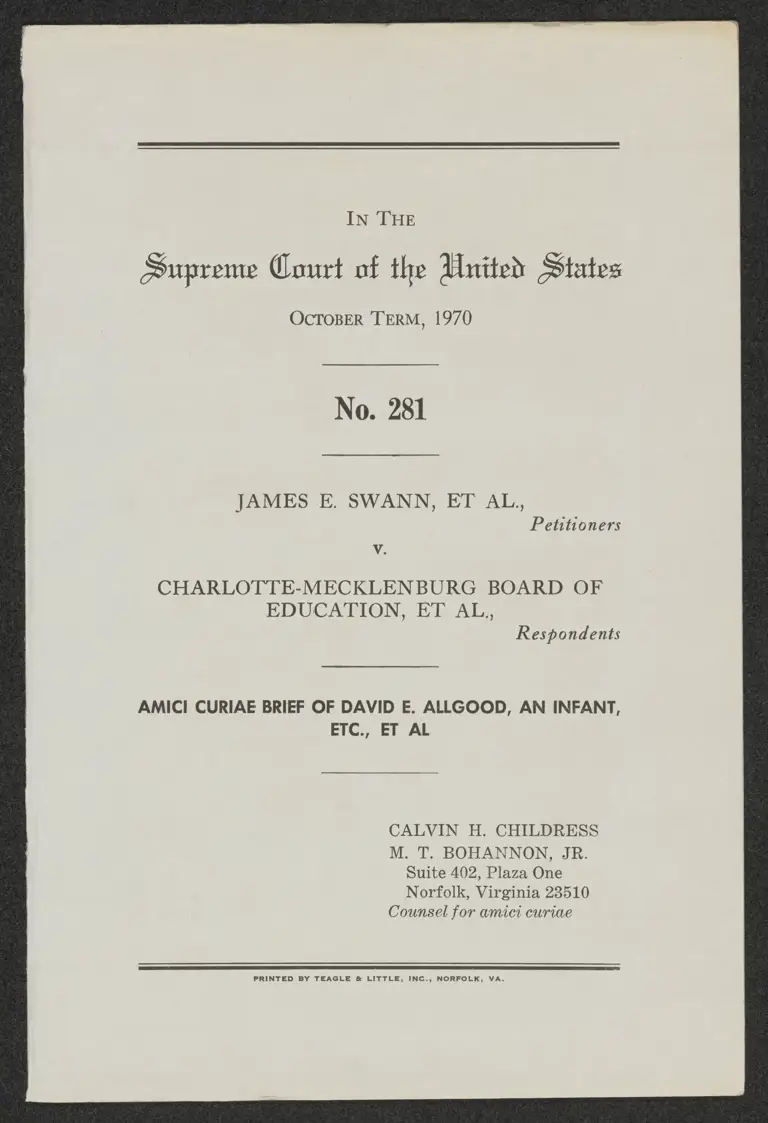
Amici Curiae Brief of David E. Allgood, An Infant, Etc., et al.
Public Court Documents
1970
15 pages
-
Case Files, Swann v. Charlotte-Mecklenburg Hardbacks. Amici Curiae Brief of David E. Allgood, An Infant, Etc., et al., 1970. 2db6a525-2e34-f111-88b4-7c1e527f53b4. LDF Archives, Thurgood Marshall Institute. https://ldfrecollection.org/archives/archives-search/archives-item/9ae2e24b-4374-4f40-a152-3e781a0040eb/amici-curiae-brief-of-david-e-allgood-an-infant-etc-et-al. Accessed October 18, 2026.
Copied!
     [||67dd0cb8-9a5f-460f-af72-124965ccc57c||] IN THE

Supreme Gout of the United States

OCTOBER TERM, 1970


No. 281


JAMES E. SWANN, ET AL,
Petitioners

V.

CHARLOTTE-MECKLENBURG BOARD OF
EDUCATION, ET AL,

Respondents


AMICI CURIAE BRIEF OF DAVID E. ALLGOOD, AN INFANT,

ETC., ET AL


CALVIN H. CHILDRESS

M. T. BOHANNON, JR.

Suite 402, Plaza One

Norfolk, Virginia 23510

Counsel for amici curiae


PRINTED BY TEAGLE & LITTLE, INC., NORFOLK, VA.


SUBJECT INDEX

INTEREST OF THE AMICI CURIAE

QUESTIONS ADDRESSED

ARGUMENT

I. The Factual Situation and the Courts’ Response... 2

II. The Constitutional and Practical Objections to
Racial Balancing and Bussing

A. A Denial Of Equal Protection Of The Laws.. 4

B. There Is No Constitutional Mandate To
Racially Balance Or Bus

C. Racial Balancing and Bussing Are Not
Reasonable

III. Neighborhood Schools

IV. White Flight...

V. The Civil Rights Act of 1964


CONCLUSION

TABLE OF AUTHORITIES

CASES:

Brewer et al. v. The School Board of the City of Norfolk,
et al. F.2d (C.A. 4th Cir. June 22, 1970)

Brewer et al. v. The School Board of the City of Norfolk,
et al. 308 Fed. Supp. 1274, 1303
(D.C., E.D. Va., 1969)

Brown v. Board of Education
347 U.S. 483, 99 L. Ed. 1089 (1954)

Green v. County School Board of New Kent County
391 U.S. 430 (1968)


STATUTES:

Civil Rights Act of 1964


IN THE

Supreme Court of the United States
OcTroBER TERM, 1970


No. 281


JAMES E. SWANN, ET AL,
Petitioners

V.

CHARLOTTE-MECKLENBURG BOARD OF
EDUCATION, ET AL,

Respondents


AMICI CURIAE BRIEF OF DAVID E. ALLGOOD, AN INFANT,

ETC., ET AL


QUESTIONS ADDRESSED

1. Is Racial Balancing and Bussing Required or Permitted

by the Constitution?

2. Can Race Be the Prime Consideration in School Assign-
ments?

THE INTEREST OF THE AMICI CURIAE

This brief is filed on behalf of David E. Allgood,
an infant, his father, Lloyd C. Allgood, and others, here-
inafter referred to as Concerned Citizens of Norfolk,

who are defendant-intervenors in the Norfolk, Virginia,
school desegregation case Beckett, et al. v. The School

1


Board of the City of Norfolk, Virginia, et al., now on
appeal to the Court of Appeals for the Fourth Circuit.

These defendant-intervenors are a class consisting of

Norfolk school children and their parents. Most of the

children were born after the 1954 Brown decision; many

of the children are entering for the first time a school

system in a state that formerly had legally segregated

schools. The Concerned Citizens of Norfolk are both

black and white.

The order of the district court in the Norfolk school

case, according to the findings of fact contained therein,

arbitrarily busses Norfolk children, many living within

walking distance of a school which can accommodate

them, to a distant school against their will merely to

place them with children of another race.

In the present case, the children of Charlotte and

Mecklenburg County, North Carolina, are under court

order which affects them in the same way as the chil-

dren of Norfolk are affected. The decision in this case

will determine the outcome of the Norfolk case. This

brief is filed with the consent of the parties to assist

the court in reaching a decision that will not deny

equal protection of the law to the Charlotte and Meck-

lenburg County children or the Norfolk children and

one that will not require these children to attend a school

under a plan not required by the Constitution.

ARGUMENT

I—THE FACTUAL SITUATION AND THE COURTS’ RESPONSE

To describe the racial composition of Charlotte

and Mecklenburg County is to describe the racial com-

position of Norfolk, Virginia; Atlanta, Georgia; Wash-

ington, D. C.; and every other large city or metropoli-

tan area in the country with significant numbers of

2


both blacks and whites. Each has black sections, white
sections, and transitional sections. Because the white

sections initially are relatively large in area they are
apt to be a considerable distance from the black areas.
Historically, but particularly in the past ten to fifteen
years, the black sections have grown, the transitional sec-
tions have turned black and the white sections have

become transitional then black.

Even though these facts have been present in all of
the city school cases, each District Court and each Court
of Appeals has come up with a different set of rules for

desegregating the schools. This has been justified by
holdings that each case rests on its own facts. A look

at what has happened within the past six months shows

this is not accurate. In the present case the District
Court set racial balancing as the goal and ordered into

effect the plan that came closest to achieving this. The

District Court in the Norfolk School case has ordered
racial balancing to the extent permitted by available
transportation. The District Court in Richmond, Vir-
ginia, has ordered racial balancing for the 1971/72
school year. The District Court in Roanoke, Virginia,
has rejected all plans that use bussing solely to achieve
racial mixing.

These widely different decisions have not been the
result of different factual situations in these cities. They
have been the result of different interpretations of the
rulings of this court.

We have not had the lower courts experimenting
with different desegregation tools and different factual

situations in an effort to eliminate dual school systems.
We have had the lower courts experimenting with the
meaning of desegregation and the meaning of “unitary
school system.” The need for definitions, for objective

3


standards, is critical. Disruption and litigation will con-
tinue and grow until such standards are established.

- Most lower courts have taken the view that re-
gardless of any other factors a school system is not de-
segregated if some of its schools contain all or almost all

black pupils or some of its schools contain all or almost
all white pupils. These courts have ordered bussing to
eliminate schools of all black pupils and schools of all

white pupils.

If this court should decree that each school district
must take all feasible steps to racially balance its pupils
then we would have a fairly objective standard by which
school systems could be judged. We believe, however,

that such a solution or standard necessarily involves in-

surmountable constitutional and practical objections.

iI—THE CONSTITUTIONAL AND PRACTICAL OBJECTIONS

TO RACIAL BALANCING AND BUSSING

[A] A DENIAL OF EQUAL PROTECTION OF THE LAWS.

The Court has ruled that in order for children to

have equal protection of the laws, no government must

effectively exclude any child from any school because
of his race or color. Racial balancing, however, the
goal set by the lower courts, does just this. Under any

city racial balancing plan, many black and white chil-

dren who live within walking distance of a school which

can accommodate them will be required to ride buses to

distant schools solely because of their race. They will

not be allowed to attend the school closest to their home

solely because of their race. This effectively excludes

many from their neighborhood schools solely because

of their race. It is discrimination and, as such, a denial

of equal protection of the laws. It is the very thing out-

lawed in Brown v. Board of Education, 347 U.S. 483, 99

L.Ed. 1039, (1954).


The avowed purpose in the racial-balancing-bussing
schemes is equal educational opportunity. It cannot be
concluded that this will be the result unless as a matter
of law (since there is no evidence on the subject) ‘it is
concluded that schools with all black pupils will be

inferior to other schools regardless of any other factors

which may be present.

Scores on learning, progress, or intelligence tests of
black pupils attending all black schools are significantly

lower than the national average. It is claimed that this
proves the inferiority of schools with all black pupils

and their lack of equal educational opportunity. This
would not be true, however, unless each child taking

these tests entered a school system with the same moti-
vations and the same level of learning as all other chil-
dren. This is not the case. Much can and should be
done to raise the general educational level of the cul-
turally-deprived but this is not a Constitutional man-
date. Schools can and should have faculties chosen with-

out regard to their color. If appropriate, such faculties

may be trained to meet the special needs of pupils such
as culturally-deprived children. Interscholastic activities,
athletic, academic, and social, should be conducted in a

nondiscriminatory manner. School zone lines should be
drawn in a nondiscriminatory manner. These steps ef-
fectively desegregate schools regardless of the color of
pupils, without depriving any of their constitutional

rights. They will provide the equal educational oppor-

tunity required.

Exactly what an equal educational opportunity en-

tails should be given serious consideration by this court’
for this is involved in all questions now presented in the

school cases. It does mean that each child must be given
the same opportunity to learn. Attempts to do more
than this (such as giving culturally-deprived children

5


the opportunity to acquire such motivation, learning,
and other factors as will place them on the same foot-
ing as others except for basic intelligence) through racial
balancing and bussing, do not equalize educational op-
portunity, but impinge upon rights of others. The ends
sought do not justify or require these means.

[B] THERE IS NO CONSTITUTIONAL MANDATE TO
RACIALLY BALANCING OR BUS.

This court has held that the Constitution requires a

unitary school system, one in which no child is effectively

excluded from any school because of his color. This
court has held that all vestiges of the dual school systems

must be eliminated so that there are no longer black

schools or white schools, but just schools. This court
has approved desegregation plans ordered into effect by
District Courts when such courts have found discrimina-

tion to exist. These previous holdings of this court do
not constitute a mandate to racially balance schools or
even to make reasonable attempts to do so. These hold-
ings do not require bussing solely to mix pupils. They
have been so interpreted, however, which makes it im-

perative that these questions now be answered.

The Constitution is and must be color-blind. It
is the only way that every person can receive the equal
protection of the laws. Justice Marshall, then repre-

senting the NAACP, in his brief and in oral argument
before this court in Brown v. Board of Education, supra,
so stated. This is the premise upon which the Brown

decision rests.

[C] RACIAL BALANCING AND BUSSING ARE NOT

REASONABLE.

Even though the term reasonable is one familiar

to the law, its meaning varies so from person to person,

lawyer to lawyer and court to court, it has no real sig-

6


nificance. In spite of this a few lower courts (notably

those in the fourth circuit—at the direction of the fourth
circuit) and certain sections of the U. S." Government
have adopted a desegregation policy of reasonableness.’
In practice this means that a school district must do
everything reasonable to racially balance its schools in-
cluding rezoning, bussing, pairing, grouping and relo-

cating schools. It is submitted that all bussing for racial
reasons, is unreasonable, that all rezoning for racial rea-
sons Is unreasonable and that all other “tools” when

employed solely for racial reasons are unreasonable.

It has been pointed out quite correctly that all
these “tools” have been used in the past for valid educa-
tional reasons and also for maintaining segregated

schools. This is said to justify their use to mix colors.
Certainly use of such tools for valid educational pur-
poses 1s reasonable and it may result in mixing of pupils.

Unless such use, however, is tied to valid educational
purposes (other than mixing, if this be one) those

affected will consider the use unreasonable and respond

accordingly, as they have in the past. Reasonableness

cannot be determined in a vacuum. It must be determined

with regard to those affected and their response. It has

been clearly shown by the Coleman Report and all other

studies that the use of these tools solely to mix the races
is not generally accepted and, where employed, the mid-

dle class (white) child does not long attend the school

assigned. Unless this sad fact (of white or middle class
flight) is ignored, reasonableness must rule out the use
of such tools solely for mixing different colored pupils.

lIl—NEIGHBORHOOD SCHOOLS

In a concurring opinion in the Norfolk school case,
Brewer, et al. v. The School Board of the City of Nor-

folk, Virginia CA. 4th Cir. (June 22 1970), Judge
Bryan stated:


“ .. TI express the belief that the expertise of the
Board and the seasoned judgment of the District

Court can formulate a design — not impinging
Brown—consisting of ungerrymandered neighbor-
hood schools supplemented by freedom of choice
and other pertinent factors. . ..

“Accordingly, on account of the peculiar lay-
out of residential Norfolk, I think the neighbor-

hood school plan there would be altogether valid

if supplemented by the freedom of choice priv-

ilege and provision for transportation at the ex-

pense of school authorities, wherever transporta-

tion is needed to make the schools accessible to

the neighborhood pupils or to those exercising

their freedom of choice of other schools . ..”

This is the prayer of the Concerned Citizens of

Norfolk and of concerned citizens everywhere, As we

previously pointed out, the residential pattern in Nor-

folk (with regard to race) is basically the same as in

every other city or metropolitan area with significant

numbers of both races. A neighborhood plan such as

this effectively excludes no one from any school be-

cause of his race. It eliminates black schools and white

schools. As late as 1963 in the Norfolk school case, the

NAACP was asking the court for just such a school

plan. It appears that throughout the fifties and the early

sixties this was the prayer of the NAACP in all school

cases. If such a plan was constitutional during those

years, it is constitutional now.

Opposition to neighborhood school plans is based

upon the fact that such plans do not eliminate schools

with only black pupils and schools with only white

pupils. It is contended that the placement of schools,

discriminatory housing and zoning laws, and other gov-

8


ernmental acts caused racially segregated housing pat-
terns which perpetuate school segregation under neigh-

borhood plans. It is further contended that when white
children are not in an obvious majority status in a school
(which will occur in any neighborhood plan) they will
gradually desert the school.

We do not believe such objections are constitution-
ally sound. Certainly there will be schools with only
black pupils and schools with only white pupils. Any

constitutional objection to these can be easily eliminated,
however, by the nonracial assignment of teachers and
administrative personnel and by nondiscriminatory inter-

scholastic activities.

If governmental action has caused racially segre-
gated housing patterns, ungerrymandered school zones

do perpetuate dual school systems. In the present case
the district court has found as a fact that segregated
housing patterns were the result of governmental action.

The similarity between the housing patterns in Charlotte,
Mecklenburg County and those in northern cities was
declared to be more apparent than real. Such a finding
must be challenged for it ignores one of the cardinal pre-
cepts of the law, that of proximate cause. Experience

throughout the entire country establishes without any

doubt that most neighborhoods will be racially homo-
geneous regardless of governmental action. This fact

effectively eliminates governmental action as the cause.
In the Norfolk school case, Brewer v. The School Board
of the City of Norfolk 308 Fed. Supp. 1274 1303,
(1969) this was recognized by the district court which

found as a fact in similar circumstances that govern-

mental action did not play a significant part in the

segregation of neighborhoods.


During the past few years all discrimination in
laws relating to housing has been struck down. Laws

and regulations have been put into effect which actually

severely discourage private discrimination in the sale
and rental of housing. The location of all new schools

has been under the control of the courts for the past
few years. As a result, any family wishing to move

knows that it will not be limited by race in choosing a

new location. Further, no one can point to any particu-

lar school and say that it would not be in its present loca-

tion if the school district were all one color. Neverthe-

less, objections such as this to the neighborhood plan

are met by a fairly administered majority to minority

freedom of choice provision. Freedom of choice has

been struck down by this Court only when there has

been a finding that it was administered unfairly (Green

v. County School Board of New Kent County, 391 U.S.

430, [1968]). This suggests, and it is certainly true,

that the success of any freedom of choice plan depends

on it being administered fairly without discrimination,

not upon it mixing any particular number of different

colored bodies. There well may be only a few transfers

in any freedom of choice plan. Not surprisingly, most

people wish their children to go to school with those

who are from backgrounds similar to theirs. If they

have a constitutional right to go to school with those

of another color, must they be forced to exercise it?

IV—WHITE FLIGHT

Most important to any decision regarding the

method of desegregation (or its meaning) is the fact

that “de jure integration” brought about by racial bal-

ancing and bussing, does not work. The refusal of white

and middle-class families to send their children to schools

where their race and class does not predominate is well

documented. The most dramatic example is found in

10


the District of Columbia. In 1954 white pupil enroll-
ment was 39 per cent of the total (about 40,000 white
pupils). Since then an ambitious program of integra-
tion (as opposed to desegregation) has been undertaken.
Pupil achievement in the District, which was close to

the United States norm in 1954, dropped to a point far
below the United States norm in 1969. Although total
student enrollment rose, the number of white pupils fell

to 5.6 per cent of the total in 1969 or less than 8,500
pupils out of a total of about 149,000. A study of indi-
vidual schools in the District shows that when black

pupil enrollment approached 30 per cent in a school, the

percentage rose to 75 per cent in about four years and

quickly thereafter the school had all black pupils. Over

99 per cent of the District's black pupils attend schools

where they are in the great majority.

Atlanta, Georgia, did not start its school desegrega-
tion until 1960. Its experience has been the same 2s

Washington’s. In 1960, about 60 per cent of total pupils
enrolled were white. In 1970 this fell to 35 per cent.
At the present rate of change, Atlanta schools will have

about 90 per cent black pupils in seven to ten years. New

York City has had a similar experience following its
school board’s requirement of racial balance.

Other cities faced with the same school situation are

experiencing the same change. If the present “de jure
integration” policies continue, our large cities soon will

become all black.

The net result of all this will be inevitably the
destruction of confidence in public education and the

erosion of the tax base upon which all school systems

depend. We have already seen the beginning of this
in thousands of private schools that have sprung up

and are flourishing. It is now the rule rather than the

11


exception for school bond issues to be defeated in refer-
enda throughout the country. This will be the end of
meaningful education for most of this country’s blacks.

V—THE CIVIL RIGHTS ACT OF 1964

It was within the power of Congress, specifically

granted by the 14th Amendment, to enforce the Constitu-
tional mandate to desegregate the schools. It would be
most unreasonable if this power did not include the
right to define terms and to set out procedures to be
followed and to be avoided. This was done in the Civil
Rights Act of 1964. Desegregation does not mean racial
balancing and the Act so states. Bussing is neither rea-
sonable, required nor constitutional and the Act so states.
This Act can and should be given effect as an exercise of

Congress's power to enforce the 14th Amendment.

12


CONCLUSION

The Constitutional mandate to desegregate schools,
to abolish dual school systems and all vestiges of it is met

when school districts are contiguous to the schools; when
zone lines are drawn in a nondiscriminatory manner
without regard to race; when faculties are assigned to

schools without regard to race; when interscholastic
activities, academic, athletic, and social, are conducted
without regard to race; when, in those school districts
that have Government-imposed segregated housing pat-

terns, there is a majority to minority transfer provision;

and where deviations from the above are for valid educa-

tional reasons only. This plan will not mix enough dif-
ferent colored pupils to suit many but it is the only plan

that meets the Constitutional test of equal educational

opportunity and will not completely destroy the public

educational system in this country. It is the only plan
that will assure to all the equal protection of the law.

Respectfully submitted,

CALVIN H. CHILDRESS

M. T. BOHANNON, JR.

Suite 402, Plaza One

Norfolk, Virginia 23510

Counsel for amici curiae

13 [||67dd0cb8-9a5f-460f-af72-124965ccc57c||]