Brief of Defendants-Appellants in Opposition to Motion for Summary Affirmance
Public Court Documents
October 4, 1976
19 pages
-
Case Files, Norwood v. Harrison - Hardbacks. Brief of Defendants-Appellants in Opposition to Motion for Summary Affirmance, 1976. 7a2ba088-722e-f111-88b4-0022482cdbbc. LDF Archives, Thurgood Marshall Institute. https://ldfrecollection.org/archives/archives-search/archives-item/9b4d55af-b1bf-4333-8040-0b47248cdbb2/brief-of-defendants-appellants-in-opposition-to-motion-for-summary-affirmance. Accessed October 16, 2026.
Copied!
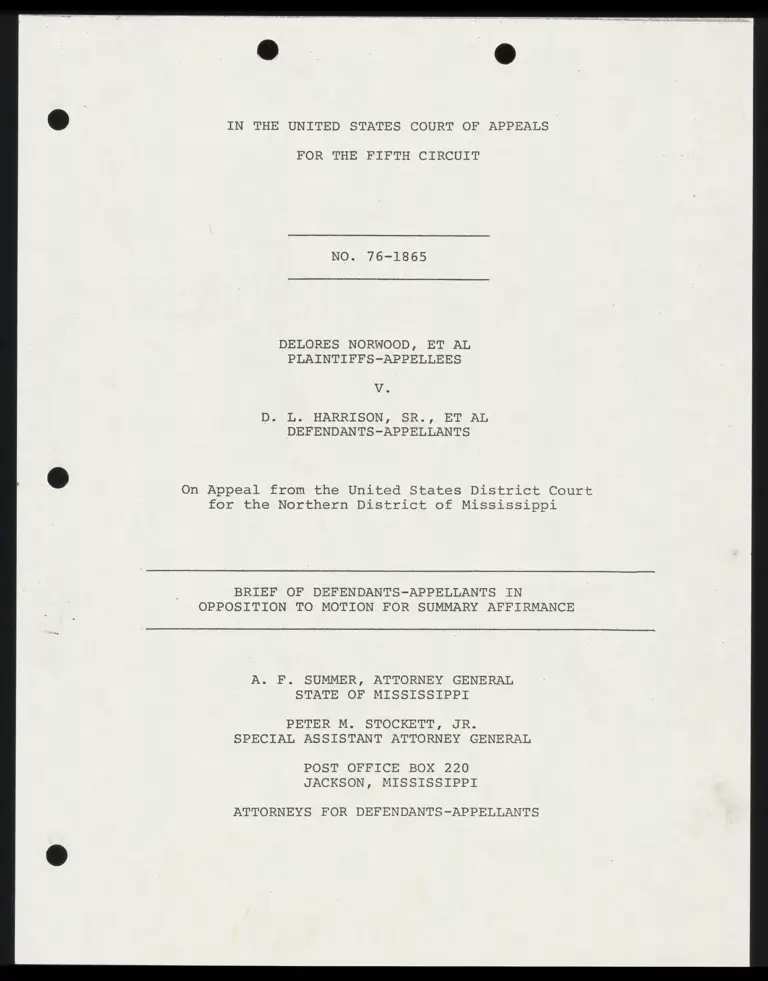
     [||d3ad053b-a1f2-4c6e-88cc-22ee0cfab9f2||] IN THE UNITED STATES COURT OF APPEALS

FOR THE FIFTH CIRCUIT


NO. 76-1865


DELORES NORWOOD, ET AL
PLAINTIFFS-APPELLEES

Vv.

D. L. HARRISON, SR., ET AL
DEFENDANTS-APPELLANTS

On Appeal from the United States District Court
for the Northern District of Mississippi


BRIEF OF DEFENDANTS-APPELLANTS IN
OPPOSITION TO MOTION FOR SUMMARY AFFIRMANCE


A. F. SUMMER, ATTORNEY GENERAL
STATE OF MISSISSIPPI

PETER M. STOCKETT, JR.
SPECIAL ASSISTANT ATTORNEY GENERAL

POST OFFICE BOX 220
JACKSON, MISSISSIPPI

ATTORNEYS FOR DEFENDANTS-APPELLANTS


INDEX


STATEMENT OF THE CASE
AND PROCEDURAL HISTORY

ARGUMENT I 4 wien inn

ARGUMENT II Jie ie oe

ARGUMENT TIX . seis

CONCLUSION. , wl vs +

CERTIFICATE "vis ov 'v.'»

PAGE


TABLE OF CASES


loan v. Jordan, 415 U.S. 651, 94 8. Ct,
¥347239 1. . BR.2A 662. i. aang nu

Fitzpatrick v. Bitzer, U.S. y 96 8. Ct.
2666, 49 L. Ed.2d (1976) ov viv au.

ttt v. City of Jacksonville, 5 Cir. 1951
IBS Pid d23 i, ih nian nie a ah ya

dagnandan vv. 0ilea, 178-3867  . . . . J.P

on v. California Adult Authority, (9 Cir.
YO7005423 PP. 128 1326: . a ih aris aa ea

OTHER AUTHORITIES:


§718 of the Emergency School Aid Act (20 U.S.C.
B17) ee ode ohh ir ee ey EL,

21.

PAGE

10, 11


IN THE UNITED STATES COURT OF APPEALS

FOR THE FIFTH CIRCUIT


NO. 76=1865


DELORES NORWOOD, ET AL
PLAINTIFFS—-APPELLEES

V.

D. L. HARRISON, SR., ET AL
DEFENDANTS-APPELLANTS

On Appeal from the United States District Court
for the Northern District of Mississippi


BRIEF OF DEFENDANTS-APPELLANTS IN
OPPOSITION TO MOTION FOR SUMMARY AFFIRMANCE


Defendants oppose the motion of plaintiff-appellees

for summary affirmance, pursuant to Rule 21 of the rules of

this Court, and also oppose the alternative motion, pursuant

to Rule 18, to assign this appeal to the summary calendar.


In the event that this Court should decide to dispose

of this case in any summary manner or fashion, defendants

move the Court to grant summary reversal of the judgment

of the District Court from which this appeal is taken.

Defendants submit that the legal and constitutional

issues involved in this appeal are such that this Court

should not decide them without full briefing and oral argu-

ment.


RO NRE

STATEMENT OF THE CASE
AND PROCEDURAL HISTORY


The statement of the case and the procedural history

is set forth in the brief for defendant-appellants previously

filed in this Court on pages 3-7, inclusive thereof, and

is incorporated herein by reference.

ARGUMENT TI


The principal point made by plaintiff-appellees in

their brief accompanying their motion for summary affirmance

is that the decision of the Supreme Court of the United States

in the case of Fitzpatrick v. Bitzer, 44 L.W. 5120 (June 28,

1976) is dispositive of this appeal and mandates affirmance.

For the reasons to be hereinafter stated, defendants

strongly disagree with plaintiffs. We believe that the

decision in Fitzpatrick mandates the reversal of the judgment

of the District Court awarding attorneys' fees and costs

to be paid with funds of the State of Mississippi.

The Supreme Court held in Fitzpatrick that Congress

has the constitutional authority, pursuant to the power vested

in it by §5 of the Fourteenth Amendment to enforce the provisions

of the amendment by appropriate legislation, to provide that

persons might bring suit in the Federal Courts against States

or State agencies, and receive awards for back pay and attorneys’


FETS NBR RR RT ET ORT

         The statute under consideration


fees in appropriate cases.

in Fitzpatrick was Title VII of the Civil Rights Act of 1964

(42 U.S.C. §§2000e, et seg.) As amended by Congress in

1972, this statute provides in clear, explicit and unambiguous

language that the United States District Courts shall have

Jurisdiction of suits brought against states alleging a

violation of rights granted and secured by said Title VII.

As the Supreme Court noted in Footnote 2 of its opinion in

Fitzpatrick:

"As relevant here, the definition of
'person' in §701(a) of the 1964 Act, 78 Stat.
253, 42 U.S.C. §2000e(a), was amended by §2

(1) of the Equal Employment Opportunity Act
A of 1972 (hereinafter the 1972 Amendments),

86 Stat. 103, 42 U.8.C. §2000=e(a) (1970 ed.,
Supp. IV), to include "governments, govern-
mental agencies, [and] political subdivision."

'The express exclusion of "a State or
political subdivision thereof'" provided in
§701(b) of the former was stricken by §2(2)

; of ithe latter, 86 Stat. 103, 42 U.S5.C.§2000e
lb) 541970 ed. , Supp. IV. Section 2 (5): 0f the
1972 Amendments, 86 Stat. 103, 42 U.S.C.
§2000e(f) (1970 ed., Supp. IV), amended §701
(£) (1970 ed., Supp. IV), amended §701 of the
1964 Act, 42 U.S.C. §2000e (f), to include
within the definition of 'employee' those
individuals 'subject to the civil service laws
of a State government, governmental agency or

political subdivision.’

The 1972 Amendments retained the right of
an individual aggrieved by an employer's unlaw-
ful employment practice to sue on his or her

1 own behalf, upon satisfaction of the statutory

] procedural prerequisits, and made clear that    Ee

i
hE

. be

24

*

i

ar)
5g

bl

°F

i$
i

g


that right was being extended to persons
aggrieved by public employers. See 1972
Amendments, §4 (a), 86 Stat. 104, 42 U.S.C.
§52000e~-5 (a)~{(g). (1970 ed., Supp. 1V.

Thus, it is clear that Title VII of the Civil

Rights Act of 1964, as amended, is a jurisdictional statute

which provides that States and State agencies may be sued

for damages in Federal Courts on account of discrimination

in employment, and the Federal Courts are thereby vested

with jursidiction to award such money judgment for damages

and attorneys' fees. See 42 U.S.C. §§2000e-5 (g) and

§§2000e-5 (k).

The statute involved in the case sub juduce is of

a completely different character, §718 of the Emergency School

Aid Act (20U.S.C.1617) is not a jurisdictional statute which

explicitly authorizes a suit against a State or against a

State agency or government. This statute provides:

"Upon entry of a final order by a court
of the United States against a local educa-
tional agency, a State (or any agency thereof)
or the United States (or any agency thereof),
for failure to comply with any provision of
this chapter of for discrimination on the basis
of race, color, or national origin in violation
Of Title VI of the Civil Rights Act of 1964,
or the Fourteenth Amendment to the Constitution
of the United States as they pertain to elemen-
tary and secondary education, the court, in its
discretion, upon a finding that the proceedings
were necessary to bring about compliance, may
allow the prevailing party, other than the
United States a reasonable attorneys' fee as
part of the costs.”

TS Cg ORR


I RE RT TT ST TG I I RS A ES Ls I —_ . TT —_——_—— BA RB EE i A TF WR Te) es a Js a = EE CRA REC AR Sn he 5

Section 718 is not a jursidictional statute. It

simply provides that the Federal Court may, in its discretion

grant an award of attorneys' fees in cases in which the

Federal Court has obtained jurisdiction of a state or

any agency thereof. It does not vest jurisdiction in the

Federal , to entertain a suit against a state or any

agency thereof. Section 718 is a remedial statute, which

authorizes the awarding of attorneys' fees against a

state where jurisdiction exists to do so; but it does not

confer such jurisdiction. Some states have modified their

laws on soveriegn immunity to provide that persons may,

in certain circumstances, bring suit against a state or

a state agency. In such cases, §718 would apply, and

would provide for the awarding of attorneys' fees. The State

of Mississippi has not amended its statutes pertaining to

sovereign immunity in such a manner.

Defendants have discussed in their brief previously

filed (pages 23-25) the legislative history and background

of the adoption of §718. The Mondale proposal provided

that Congress should appropriate the sum of Fifteen Million

Dollars ($15,000.000) to pay for these attorneys' fees.

This proposal was rejected by a vote of the Senate, and

Senator Cook revised this proposal to provide that the party should


pay the fees. The committee reports and the Senate debates

shed very little light on the intent of Congress in enacting

this legislation. Counsel for defendants can find nothing

in the legislative history indicating an intent to waive

or abrogate the state's immunity to suit or judgment.

Plaintitt-agpelless correctly state in their brief

(Page 4) that Fitzpatrick held that waiver of the state's

immunity is predicated upon a congressional intent to "abrogate

the immunity conferred by the Eleventh Amendment". The

Supreme Court found such congressional intent manifest in

the Civil Rights Ack Of 1964. It is totally lacking in §718

of the Emergency School Aid Act.

This court has recently addressed the issue of the

State of Mississippi's immunity to suit in the context of

an effort to recover from the state excess tuition payments

which had been held to have been unconsitutionally extracted

from plaintiffs. See Jagnandan v. Giles, $#74-3467, decided

De ianbon 20, 1976. In Jagnandan, supra, this Court carefully

 nidered the controlling case San in this area, including

Edelman v. Jordan, 415 U.S. 651,94 S.Ct. 1497, 39:1... E4.24

662 and Fitzpatrick v. Bitzer, supra. This Court held in

Jagnandan that, since there was no Federal statute explicitly

authorizing the State of Mississippi, or Mississippi State

University, to be sued, that Edelman, not Fitzpatrick, was


controlling. In explicating the purpose of the Eleventh

Amendment in Jagnandan, this Court said:

"The Eleventh Amendment was fashioned
to protect against federal judgments requiring
payment of money that would interfere with
the states fiscal autonomy and thus its poli-
tical sovereighty. Retroactive monetary relief
for the constitutional violations here would
have just that effect.23"

25 see generally Note, Attorneys' Fees
and the Eleventh Amendment, 88 Harv.L.Rev.
1875, 1877-1882 (1975).

In reconciling the holdings of the Supreme Court

in Edelman and Fitzpatrick and applying them to circumstances

in Jagnandan, this Court made the following pronouncement:

bs "Tn its most recent decision on the Eleventh

Amendment, the Supreme Court in Fitzpatrick v.
Bitzer, U.S. 986 S.Ct, 2666, 49 L.ED.24


(1976) left unquestioned its holding in Edelman
v. Jordan. Although Fitzpatrick permitted recovery
of retroactive retirement benefits wrongfully with
held from plaintiffs on the basis of sex discrimi-
nation, that case is not controlling. Different
from the case at bar was the presence in Fitz-
patrick of Federal legislation authorizing federal
courts, under Title VII, to award money damages
in favor of private individuals and against a:
state found to have discriminated in employment
on the basis of race, religion, color, sex or

national origin, U.8. at °°, 96 8. Ct. 2666,
See 42 U.S.C.A. §2000e-2(a). This legislation
had been passed pursuant to §5 of the Fourteenth
Amendment. Similarly in Edelman there was no
express congressional legislation. Thus Fitzpatrick
found a situation wholly unpresent in Edelman.
The Court in Fitzpatrick indicated that without
this particular legislation the case would be

governed by Edelman. . |


H
iE

it vy

i

fs

For reasons which have been stated, ante, defendants contend

that '§718, unlike Title VII of the Civil Rights Act of 1954,

does not grant the Federal Courts jursidiction to entertain

a suit against the state or one of its agencies. For that

reason, Edelman not Fitzpatrick, should control the case

sub juduce,. just as in Jagnandan.


IT.

The brief for plaintiff-appellees maintains that

the contention of defendants of §718 of the Emergency School

Aid Act (20 U.S.C. 1617) should not apply unless defendants

have engaged in "purposeful action with actual or constructive

knowledge of its discriminatory impact" is without sound

basis or merit. Defendants set out their position on this

part of the argument on their brief previously filed in this

Court at pages 26-29. For the sake of avoiding repetitious

argument, we request the Court to read and Consider this

portion of the brief for defendants previously filed. In

summary, we submit that an examination of the pertinent

legislative history, particularly the remarks of Senator

Mondale cited in our original brief, demonstrates that a

finding of purposeful action with actual or constructive

knowledge of its discriminatory impact is a necessary element

in awarding of attorneys' fees pursuant to §718. Such

finding is totally absent in the case sub juduce. The

record in this case is clear that the only thing done by

the defendant is to administer in a neutral and nondiscriminatory

manner a Mississippi statute enacted in 1940 for the pro-

vision, without cost, of textbooks to students attending


public or private schools within the State of Mississippi.

In our brief (page 28) defendants specifically

disavowed the contention that their good faith is a

defense to the awarding of attorneys' fees under §718;

however, plaintiffs, in their brief (page 3) stated that

defendants "argue that §718 [20 U.S.C. §1617] of the

Emergency School Aid Act of 1972, does not apply to cases

wherein defendants acted in 'good faith' and merely

foraea a state statutes defining their duties".

In support of their contention that defendants

were in fact, active participants in the transfer of

textbooks to private academies, plaintiffs cite a proported

memorandum alleged to have been circulated to all Super-

intendants of Education on December 4, 1969. See plaintiffs-

appellees' brief, pages 6-7.

This proported memorandum was supposed to have

been attached as Exhibit 1 to a dacosi tion given by on Snowden.

Neither the Snowden deposition nor the alleged memorandum

are part of the record on this appeal. Pursuant to the rules

of this Court, plaintiffs and defendants designated portions

of the record on appeal in this cause, which have now

been printed as the Appendix. We submit that it would not be

appropriate to consider matters not properly before the

wi itl -


to

* Court. We request the, court. to disregard citations of this

PSroporien i aaiun at 0 Aid unless i is properly pre-

sented to the court, = 43 10 Bi |

Defendants have been able to locate a copy ‘of a dems

“+position given by Marshal Alan Snowden on December 21, 1970,

%but have Tot been able to find a deposition given by Mr.

A nawder on June 28, 1971, which proportedly contained the

a quoted ‘by Dlointifls as an exhibit. Mr. W. A.

Matthews, Executive Secretary of ik Mississippi State Text-

book Purchasing Board, one of the defendants in this i ly

“has LL a search of the office of the Forth Board

~and has not been able to find a copy of the proported memoran-

“dum of December 4, 1969. Under the circumstances now weight

should. be ‘given this proported memorandum.


II

Defendants-appellants argued in their orgininal

brief (pages 34-37) that the State of Mississippi is an

absent indispensable party to this litigation. Again, for

the sake of ARPT T RR in i argument, we request the

Court to consider that portion of our original brief in

‘deciding the Satioh of whether to grant summary affirmance

or:place this appeal on the summary calendar.

The issue of absent indispensable parties res

to the jurisdiction of the Court and may be considered at

any time, including on appeal, and Courts will consider the

issue sua sponte, just as they will any other jurisdictional

issue, such as the Eleventh Amendment.

Plaintiff—-appellees say that our position is unsound

because any award made by the District Court will be from

monies, even though appropriated by the State of Mississippi

which; "will derive from this defendant controlled fund".

Plaintiffs-appellees also contend that all of the

cases cited by defendants are inapposite because neither the

relevant states nor any of their agencies were named as parties


defendant in those cases.

This argument overlooks the fact that the Mississippi

State Textbook Purchasing Board is not, and has never been,


a defendant in this action. Among the defendants are the

members of the Textbook Board and its Executive Secretary.

The Textbook Board could never have been a defendant even

if plaintiffs had desired it so, because the complaint in

this action is based upon a violation of 42 U.5.C. §1983

(A-1) and under §1983, the Textbook Board is not a suable

Pe itiny. See Olson v. California Adult Authority (9 Cir.

1970) 423 PF. 24.1326; Hewitt v.: 0ity of Jacksonville

(5 Cir. 1951) 138 F..24 423.

Defendants submit that the cases cited in its

brief previously filed in support of their contention that

% the State of Mississippi is an absent indispensable party

to this litigation are fully controlling.

- 14 -


CONCLUSION


For the foregoing reasons, this Court should not

summarily affirm the judgment of the District Court, nor

should it assign this appeal to the summary calendar, but

in the event this case is assigned to the summary calendar,

the judgment of the District Court should be reversed.

Respectfully submitted,

A. F. SUMMER, ATTORNEY GENERAL
STATE OF MISSISSIPPI

PETER M. STOCKETT, JR.
® SPECIAL ASSISTANT ATTORNEY GENERAL

sv: {Ph nm lol

Peter M. Stockett, Jr. |


3.

Br
fod E
BS
wy

5
=
0
oF

CERTIFICATE


This is to certify that the undersigned has on

this day caused to be mailed through the United States Mail

postage prepaid, one copy of my Brief for defendants-appellants

in opposition to motion for summary affirmance to the

following:

Jack Greenberg
Melvyn R. Leventhal
10 Columbus Circle
Suite 2030
New York, New York 10019

Fred L. Banks, Jr.
538 1/2 North Farish Street
Jackson, Mississippi 39202

This the H4~tp day of October, 1976.

Cp hl yy


PETER M. STOCKETT, JR)
~ [||d3ad053b-a1f2-4c6e-88cc-22ee0cfab9f2||]