Taylor v. Collins Court Opinion
Unannotated Secondary Research
November 21, 1983
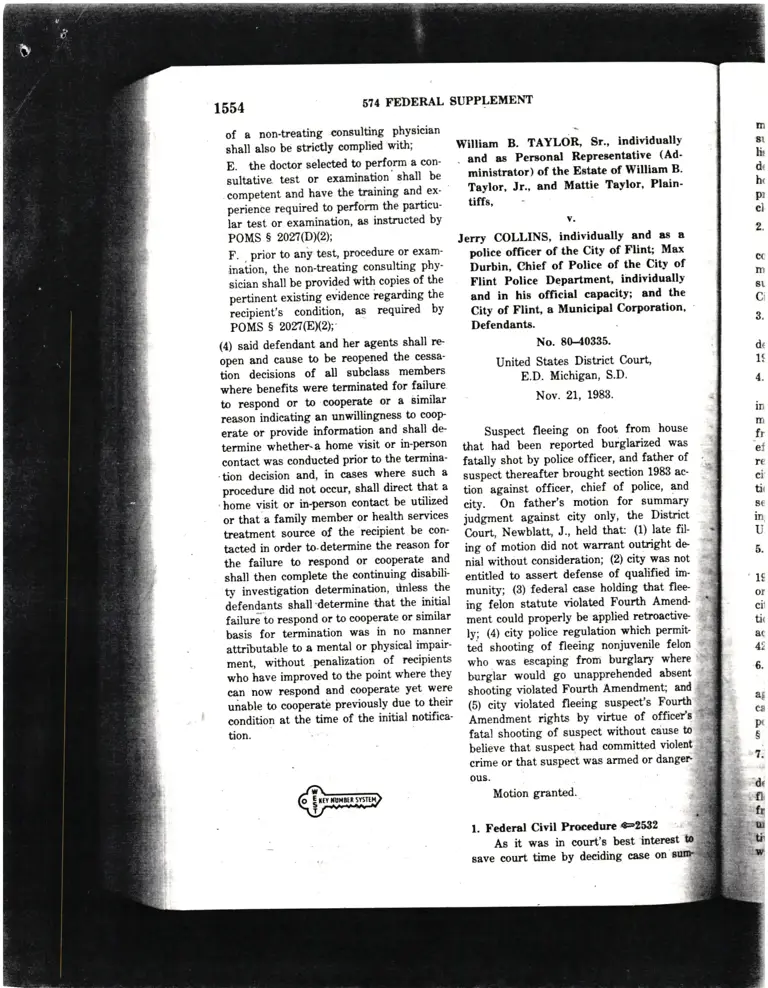
10 pages
-
Case Files, Garner Working Files. Taylor v. Collins Court Opinion, 1983. eb880878-35a8-f011-bbd3-000d3a53d084. LDF Archives, Thurgood Marshall Institute. https://ldfrecollection.org/archives/archives-search/archives-item/9b9fad21-ad28-4b65-976c-5a650368e350/taylor-v-collins-court-opinion. Accessed September 27, 2026.
Copied!
1554 574 FEDERAL SUPPLEMENT
of a non-treating consulting physician
shall also be strictly complied with;
E. the doctor selected to perform a con
sultative test or examination shall be
competent and have the training and ex
perience required to perform the particu
lar test or examination, as instructed by
POMS § 2027(D)(2);
F. prior to any test, procedure or exam
ination, the non-treating consulting phy
sician shall be provided with copies of the
pertinent existing evidence regarding the
recipient’s condition, as required by
POMS § 2027(EK2);
(4) said defendant and her agents shall re
open and cause to be reopened the cessa
tion decisions o f all subclass members
where benefits were terminated for failure
to respond or to cooperate or a similar
reason indicating an unvnllingness to coop
erate or provide information and shall de
termine whether'a home visit or in-person
contact was conducted prior to the termina
tion decision and, in cases where such a
procedure did not occur, shall direct that a
home visit or in-person contact be utilized
or that a family member or health services
treatment source of the recipient be con
tacted in order to-determine the reason for
the failure to respond or cooperate and
shall then complete the continuing disabili
ty investigation determination, dnless the
defendants shall determine that the initial
failur^to respond or to cooperate or similar
basis for termination was in no manner
attributable to a mental or physical impair
ment, without penalization of recipients
who have improved to the point where they
can now respond and cooperate yet were
unable to cooperate previously due to their
condition at the time of the initial notifica
tion.
William B. TAYLOR, Sr., individually
and as Personal Representative (Ad
ministrator) of the Estate of William B.
Taylor, Jr., and Mattie Taylor, Plain
tiffs,
V.
Jerry COLLINS, individually and as a
police officer of the City of Flint; Max
Durbin, Chief of Police of the City of
Flint Police Department, individually
and in his official capacity; and the
City of Flint, a Municipal Corporation,
Defendants.
No. 80-40335.
United States District Court,
E.D. Michigan, S.D.
Nov. 21, 1983.
Suspect fleeing on foot from house
that had been reported burglarized was
fatally shot by police officer, and father of
suspect thereafter brought section 1983 ac
tion against officer, chief of police, and
city. On father’s motion for summary
judgment against city only, the District
Court, Newblatt, J., held that: (1) late fil
ing of motion did not warrant outright de
nial without consideration; (2) city was not
entitled to assert defense of qualified im
munity; (3) federal case holding that flee
ing felon statute violated Fourth Amend
ment could properly be applied retroactive
ly; (4) city police regulation which permit
ted shooting o f fleeing nonjuvenile felon
who was escaping from burglary where
burglar would go unapprehended absent
shooting violated Fourth Amendment; and
(5) city violated fleeing suspect’s Fourth
Amendment rights by virtue o f officer’s
fatal shooting of suspect without cause to
believe that suspect had committed violent
crime or that suspect was armed or dange^
ous.
Motion granted.
1. Federal Civil Procedure «=2532
As it was in court’s best interest to
save court time by deciding case on sum- -4
2.
3.
4.
5.
6.
iT-
TAYLOR V. COLLINS
cite u S74 F^upp. 1554 (1983)
1555
LOR, Sr., individually
lal Representative (Ad-
the Estate of William B.
d Mattie Taylor, Plain-
, individually and as a
if the City of Flint; Max
of Police of the City of
department, individually
ficial capacity: and the
3 Municipal Corporation,
). 80-40335.
ates District Court,
Michigan, S.D.
)v. 21. 1983.
sing on foot from house
reported burglarized was
lolice officer, and father of
er brought section 1983 ac-
ficer, chief o f police, and
er*s motion for summary
ist city only, the District
t, J., held that: (1) late fil-
id not warrant outright de-
isideration; (2) city was not
srt defense o f qualified im-
leral case holding that flee-
ite violated Fourth Amend-
perly be applied retroactive-
ice regulation which permit-
if fleeing nonjuvenile felon
ping from burglary where
go unapprehended absent
ed Fourth Amendment; and
3d fleeing suspect’s Fourth
ights by virtue o f officer’s
of suspect without cause to
ispect had committed violent
;uspect was armed or danger-
■anted.
Procedure «=*2532
1 court’s best interest to
by deciding case on sum
mary judgment motion if possible, filing of
such motion after motion deadline estab
lished by court did not warrant outright
denial of motion without consideration;
however, party which filed late motion was
properly required to pay fine of $250 to
clerk.
2. Federal Civil Procedure «=2537
Affidavit of attorney which did not
comply with personal knowledge require
ment could not be considered in deciding
summary judgment motion. Fed.Rules
Civ.Proc.Rule 56(e), 28-U.S.C.A.
3. Civil Rights «=13.8(3)
Municipality is not entitled to assert
defense of qualified immunity in section
1983 action. 42 U.S.C.A. § 1983.
4. Courts ®=100(1)
Where federal case holding that flee
ing felon statute violated Fourth Amend
ment was not unforeshadowed departure
from prior law, case would have prodigious
effect on police departments regardless of
retroactivity, and no substantial inequity to
city would result from retroactive applica
tion, case could be applied retroactively in
section 1983 action based upon fatal shoot
ing of fleeing suspect. 42 U.S.C.A. § 1983;
U.S.C.A. Const.Amend. 4.
5. Civil Rights ®=13.7
City cannot be held liable under section
1983 unless city policy, custom, regulation,
or usage caused constitutional tort; where
city policy authorizes constitutionally tor
tious act and that act is committed by state
actor, such causation condition is satisfied.
42 U.S.C.A. § 1983.
6. Civil Rights «=13.7
For purposes o f section 1983 action
against city, police department’s policies
can be said to be policies of city in which
police department is located. 42 U.S.C.A.
§ 1983.
7. Arrest «=68(2)
Fleeing felon regulation of city police
department which permitted shooting of
fleeing nonjuvenile felon who was escaping
from burglary where burglar would go
unapprehended absent shooting was viola
tive o f Fourth Amendment, where there
was no requirement that fleeing felon had
committed violent crime or that he was
armed or dangerous. U.S.C.A. Const.
Amend. 4.
8. Arrest «=68(2)
City violated fleeing suspect’s Fourth
Amendment rights by virtue of police offi
cer’s fatal shooting of suspect pursuant to
police regulation, where officer did not
have probable cause to believe that fleeing
suspect had committed violent crime in re
lation to reported burglary, there was no
indicatioh that suspect was armed or dan
gerous to others, and all evidence pointed
to fact that officer shot suspect merely to
prevent him from escaping. 42 U.S.C.A.
§ 1983; U.S.C.A. Const.Amend. 4.
Thomas Stanley, Pontiac, Mich., for
plaintiffs.
Linda Olivieri, Frederick Schmoll, Flint,
Mich., for defendants.
MEMORANDUM OPINION
AND ORDER
NEWBLATT, District Judge.
I FACTS
This is a 42 U.S.C. § 1983 action brought
by William B. Taylor, Sr., the father and
personal representative of the estate of
William B. Taylor, Jr. and by Mattie Tay
lor, the mother o f William B. Taylor, Jr.
On July 8, 1980, Flint police officers Ger
ald Collins and Thomas Peek were notified,
by police dispatch radio, o f a reported
breaking and entering on Basil Lane, in the
City of Flint. The two officers arrived at
the scene o f the alleged breaking and en
tering and officer Collins sighted a person
fleeing on foot from the home that had
been reported burglarized. For reasons to
be developed hereafter, Collins shot the
fleeing suspect fatally.
The dead suspect, who had indeed partici
pated in a burglary o f the house on Basil
Street, was Billy Taylor, the fifteen-year-
old son o f the two persons bringing this
action. Plaintiffs sued the following re
maining defendants: Officer Collins; Chief
1556 574 FEDERAL SUPPLEMENT
of Police Max Durbin; and the City of
Flint.
On August 26, 1983, plaintiffs filed a
motion for summary judgment. In an opin
ion read into the record on September 19,
1983, the Court denied this motion on the
ground that the motion was not supported
by evidence as required by Rule 56 of the
Federal Rules of Civil Procedure. On Oc
tober 20, 1983, plaintiffs filed a motion for
summary judgment against the City of
Flint only. This motion is supported by
evidence in accordance with Rule 56. The
City has responded with two opposition
briefs. (Docket entries # # 167 and 168.)
Plaintiffs’ motion is based solely on a
Fourth Amendment theory as that amend
ment was recently interpreted and applied
by the Court of-Appeals for the Sixth Cir
cuit in Gcltuct v, Mcvtphis Police Dept.,
710 F.2d 240 (CA 6, 1983) decided on June
16 o f this year. It should be recalled that
this Court briefly commented on Gamer at
the August 16, 1983 hearing in the context
o f a motion for a continuance filed by all
the defendants. As was then pointed out.
Gamer would not seem to be decisive vnth
respect to the racial discrimination equal
protection clause claim asserted by plain
tiffs. Furthermore, in light of the quali
fied immunity enjoyed by the individual
defendants. Gamer-cannot even be said, as
to these defendants, to be of decisive sig
nificance as to the Fourth Amendment
claims asserted by plaintiffs. In light of
this, the Court refused to grant a continu
ance based on Gamer.
The October 20, 1983 motion, however, is
directed to the City only. And because the
City does not enjoy a qualified section 1983
immunity. Gamer takes on considerable
importance. See Owen v. City o f Inde
pendence, 445 U.S. 622, 100 S.Ct. 1398, 63
L.Ed.2d 673 (1980). The Court has careful
ly studied Gamer and the rest of the rele-
• vant law. The Court has also studied plain
tiffs’ brief (at docket entry # 166) ?ind the
City’s response briefs (at docket entries
# # 167, 168.) In this respect, the Court
noted that plaintiffs have supported their
motion by excerpts from the December 8,
1982 deposition o f officer Collins. After
reading the excerpts, the Court felt that it
was necessary to study the entire Collins
deposition. Notice of the taking of this
deposition is filed at docket entry # 108.
Since Eastern District Local Rule 16(g)
eliminated the necessity of filing all deposi
tions, this notice put the deposition into the
record and thus was subject to being con
sidered by the Court on this motion for
summary judgment. Indeed, even if the
deposition had not yet been put into the
record, it would have been permissible un
der Rule 56 for the Court to order the
already taken deposition into the record for
purposes o f deciding the motion. See
Wright & Miller, Federal Practice & Pro
cedure § 2721. In any event, the Court
has carefully considered the Collins deposi
tion in its entirety.
A final pretrial conference was held in
this case on November 3, 1983. The Court
indicated that an opinion would be entered
shortly deciding the pending motion for
summary judgment. Subsequent to the fi
nal pretrial conference, on November 7,
1983, the City filed its supplemental brief
along with an affidavit of officer Collins.
The Court has considered the November 7,
1983 Collins affidavit along with the Collins
deposition.
Having carefully studied the briefs, the
evidence and the law, plaintiffs’ motion for
summary judgment against the City will
herein be decided.
II LEGAL ANALYSIS
[1] In analyzing this motion, two
threshold procedural issues raised by de
fendant must be addressed. First, defend
ant argues that the motion should be de
nied outright because it was filed later
than the September 5,1983 motion deadline
set in the Court’s Order of August 18,
1983.
It is true that this motion is beyond the
September 5, 1983 deadlihe date without
explanation. Deadlines must be respected;
without such respect, courts are unable to
regulate their dockets. Nevertheless, it
would be unwise policy and^counterproduc-
tive to deny the motion as a sanction. If
p laint i f f s have Succeeded in removing all
■y to study the entire (Dollins
Siotice o f the taking o f this
filed at docket entry # 108.
n District Local Rule 16(g)
: necessity o f filing all deposi-
ice put the deposition into the
lus was subject to being con-
le Court on this motion for
gment. Indeed, even if the
d not yet been put into the
lid have been permissible un-
for the Court to order the
deposition into the record for
deciding the motion. See
ler, Federal Practice & Pro-
1. In any event, the Court
considered the Collins deposi-
irety.
trial conference was held in
ovember 3, 1983. The (k)urt
an opinion would be entered
ng the pending motion for
Tnent. Subsequent to the fi-
onference, on November 7,
filed its supplemental brief
affidavit o f officer (k)llins.
considered the November 7,
fidavit along with the Collins
fully studied the briefs, the
he law, plaintiffs’ motion for
Tnent against the City will
led.
^ALYSIS
ilyzing this motion, two
edural issues raised by de-
>e addressed. First, defend-
it the motion should be de-
because it was filed later
nber 5, 1983 motion deadline
art’s Order o f August 18,
it this motion is beyond the
1983 deadline date without
•eadlines must be respected;
jspect, courts are unable to
dockets. Nevertheless, it
;e policy and^counterproduc-
e motion as a sanction. If
succeeded in removing all
genuine issues of fact as to the liability of
defendant City, it is hi the Court’s best
interest to decide and grant the motion and
thereby save court time. ’This possibility is
enough to justify the Court proceeding to
decide the motion. Also, the Ckiurt notes
that defendant City has had and has taken
advantage of the opportunity to file two
briefs in opposition to plaintiffs’ motion.
(See briefs at docket entries # # 167, 168.)
But the Court cannot allow plaintiffs to
go unpunished. Consequently, as a sanc
tion for the tardy motion, the Court hereby
ORDERS plaintiffs to pay a fine o f $250 to
the Clerk of the Court as a sanction. The
fine must be paid within five (5) days from
the date o f this Order.
TAYLOR V. COLLINS
cite u S74 F.Supp. 1554 (1983) 1557
[2] A second threshold procedural issue
involves the affidavit of attorney
Waterman (filed at docket entry # 166).
As defendants point out, this affidavit does
not comply with the Rule 56(e) personal
knowledge requirement. 'Therefore, the af
fidavit will not be considered by the Court
in deciding this motion.
[3] Having considered the threshold
procedural issues, two threshold substan
tive issues must be addressed. The first of
these is the issue of qualified immunity.
And the rule of law is clear. A municipali
ty is not entitled to assert the defense of
qualified immunity in section 1983 actions.
See Owen v. City o f Independence, 445
U.S. 622, 100 S.Ct. 1398, 63 L.Ed.2d 673
(1980). "The City, o f course, has not assert
ed this defense, but the Court feels that it
is necessary to briefly mention Owen in
order to explain why the City cannot assert
the qualified immunity defense even
though the defense is available to the indi
vidual defendants in this case.
14] The other threshold substantive is
sue is that of retroactivity. Defendant con
tends that the recent Sixth Circuit Gamer
decision should not be applied to this case
which arose out of events that occurred
over three years before Gamer.
At the outset, note must be taken o f the
anomalous nature o f defendant’s request.
In Gamer, the Sixth Circuit held that the
Tennessee fleeing-felon statute was uncon
stitutional as applied to a case arising in
1974. Clearly, the Sixth Circuit Gamer
court applied its ruling retroactively.
Thus, this trial court is now being asked to
render a non-retroactive Gamer ruling
where the appellate court applied Gamer
retroactively.
Nevertheless, it must be acknowledged
that the Gamer opinion said nothing about
the retroactivity issue, and the possibility
must readily be acknowledged tJiat the
retroactivity issue simply may not have
been considered. Therefore, a retroactivity
analysis must be undertaken.
In Chevron Oil v. Huson, 404 U.S. 97, 92
S.Ct. 349, 30 L.Ed.2d 296 (1971), the Su
preme Court set out a three-pronged test to
be applied in deciding whether a newly-
enunciated rule should be applied retroac
tively. The first prong o f this test is
whether the new rule overrules clear prece-
dent or decides an issue o f first impression
the resolution o f which was not clearly
foreshadowed.
The City vigorously argues that Gamer
indeed resolved an issue o f first impression
that was not clearly foreshadowed. 'This
argument turns on the fact that Gamer
was the first Sixth Circuit decision to
squarely hold that a fleeing-felon statute
violated the Fourth Amendment While su
perficially persuasive, this argument can
not survive close scretiny.
Billy Taylor was killed on July 8, 1980
On June 18, 1979, the Sixth Circuit decided
the first appeal in the Gamer case. See
Gamer v. Memphis Police Dept, 600 F.2d
52 (CA 6, 1979), hereafter referred to as
Gamer I. 'The precise ground for reversal
in Gamer I was that the district judge
^ ^ prc Monell * ruling—erroneously
held that the City o f Memphis was not a
“person” under 42 U.S.C. § 1983. Never
theless, this Court notes that the 1979 Gar
ner opinion contains nearly a whole page
discussing the issues to be decided on re
mand by the trial judge. These issues are
enumerated at 600 F.2d 54, 55. One o f the
enumerated issues was whether a munici-
* Monell V. Dept, o f Social Services. 436 VS. 658, 98 S.Ct. 2018, 56 L.Ed.2d 611 (1978).
574 FEDERAL SUPPLEMENT
1558
nality’8 use of a state fleeing-felon statute
to justify a fleeing-felon regulation
constitutional under the Fourth Amend
ment See 600 F.2d 55. A footnoto-foot^
note 2^ to this issue lists seven
^^^l^iTreview pieces. See 600 F.2d 55 n.
2 (1979).
Two of the cases in footnote 2 are Mattis
. S n a r r , F.2d 1007 (CA 8 1 « ^
Jones V. Marshall, 528 F.2d 132 (CA 2
1975). These cases contain scholarly and
conceptual discussions justifying rulings
that strike down fleeing-felon statutes on
bases other than the Fourth Amendment.
Nevertheless, both Mattis and Jones are
cited and quoted extensively m Gamer IL
See Gamer v. Memphis Police Dept 710
F 2d at 244-45. Clearly, the concepts dis
cussed in Mattis and Jones were very mflu-
ential in Gamer II-
Furthermore, footnote 2 of the 1979 Gar
ner opinion cites the following law review
comments: Comment, Deadly Force te
Arrest Triggering Constitutional Ke-
U Hareard Civil Rights and Cml
Liberties Review 361, 364^5 ^
Comment, cited at page 244
Gamer decision, was extremely important
'in the analysis of the Gamer II opmion.
The Comment contains an mcKive and nch
ly detailed discussion of the historical back
ground of the English common law rule
allowing the shooting of fleemg felons.
The Comment foretold the line of analysis
at pages 244-45 of the Gamer II opmiom
In ^ e r words, a careful
the Comment reveals that the. histon^
of American State g^ in g ie lon
is a foundation built on loose sai^.
" "in sumr^ST^ ^ ^ G Fourth
' ment ruling-set out on pages
was no shock. City attorneys m Miclugan
Tennessee, Ohio.
have read the cases cited at 600 F.2d 5A w
fn 2 If they had done so, withm a few
months of June 18, 1979, fleemg-felon
lice department policies would tove been
altered to forbid shooting at fleemg un-
Lm ed burglars. But BUly Taylor
killed twelve months ^ f i f^ G a ^ r l a ^
at the time of the boy s death--the Hint
police department had a regulatoon which
Slowed police officers to shoot fleemg un
armed and non-dangerous burglars where
the escape would result in the crime gomg
unpunished. In light of Gamer I ^ e
Court rejects the City’s theory that the
Gamer II Fourth Amendment ruling was
not clearly foreshadowed.
The second Chevron inquiry is whether
retrospective operation o f Gamer would
further or retard the new rule’s operation.
The Court believes that this prong o f the
test has a neutral effect in this c^e^
Whether or not the Gamer rule is applied
retroactively, tee Gamer decision_^early
will have a prodigious eff^ t on police ̂prac-
tices.
i ^ l l y , the Court weighs the issue of
whether retroactive application will p i^
duce a substantially inequitable result In
arguing this issue, the City tells the Court
that . . . XL
“ It would indeed do an injustice to tee
taxpayers of the City of Flint to require
teose taxpayers to pay for plamfiffs
damages and suffer the conconutant de
crease in City services simply because
the City could not anticipate that state
law might, in tee future, be co n s id e ^
unconstitutional.” (See brief at docket
entry # 169, P 8.)
This statement is far too sweeping.
to the second part of the statement, the
Court already has established why it w ^
unreasonable for tee City not to ^
for Gamer / / . It could, and it should have
anticipated Gamer II. It had a responsi
bility to its citizens and to the ^
have anticipated a ruling so clearly forth
coming. Furthermore, the Court imtes
that the City is not liable for punitive dam
ages under 42 U.S.C. § 1983. S e e N ^ ^
V Fact Concerts, 453 U.S. 247, 101 S.
^ 4 8 69 L.Ed.2d 616 (1981). Thus, there is
no reason to conclude that a judgment m
this case would cause a staggermg de
crease in city services. This is simply ^
inflammatory statement not supported m
anv way. Moreover, in weighmg the equi
ties it is noted teat—unlike the Chevron
nlahitiff—the instant plaintiffs did not
sleep on their _ rights. Instead, they
promptly filed suit under the Civil Rights
■dangerous burglars where
id result in the crime going
1 light o f Gamer I, the
he City’s theory that the
■th Amendment ruling was
shadowed.
'hevron inquiry is whether
aeration of Gamer would
■d the new rule’s operation,
ives that this prong o f the
utral effect in this case,
the Gamer rule is applied
le Gamer decision clearly
ig^ous effect on police prac-
Court weighs the issue of
ctive application will pro-
ially inequitable result. In
lue, the City tells the Court
leed do an injustice to the
the City o f Flint to require
ers to pay for plaintiffs’
suffer the concomitant de-
y services simply because
Id not anticipate that state
1 the future, be considered
aal.” (See brief at docket
p 8 . )
nt is far too sweeping. As
part o f the statement, the
has established why it was
ar the City not to be ready
It could, and it should have
mer II. It had a responsi-
izens and'to the Taylors to
d a ruling so clearly forth-
hermore, the Court notes
not liable for punitive dam-
J.S.C. § 1983. See Newport
'ts, 453 U.S. 247, 101 S.Ct
d 616 (1981). Thus, there is
onclude that a judgment in
Id cause a staggering de-
jervices. ’This is simply an
statement not supported in
eover, in weighing the equi-
1 that—unlike the Chevron
instant plaintiffs did not
ir_ rights. Instead, they
suit under the Civfl Rights
TAYLOR V. COLLINS
ate u 574 F.Supp. 1554 (1983)
1559
Act. Plaintiffs claim to have suffered a
dreadful emotional loss and it simply is not
inequitable for the taxpayers to pay out
compensatory damages if such claim is le
gally established.
The Ck)urt thus concludes that retroac
tive application of Gamer is appropriate.
The Court will now move on to consider the
core substantive issues raised by the mo
tion for summary judgment.
[5] The City cannot be held liable under
section 1983 unless a city policy, custom,
-regulation or usage caused the constitu
tional tort. Monell v. Dept o f Social Serv
ices, 436 U.S. 658, 98 S.Ct. 2018, 56 L.Ed.2d
611 (1978). Where a City policy authorizes
a constitutionally tortious act and where
that act is committed by a state actor, (an
agent or employee of the state or its subdi
visions and acting as such) the Monell cau
sation condition is satisfied. See Hays v.
Jefferson County, 668 F.2d 869, 875 (CA 6,
1982); Van Ooteghem v. Gray, 628 F.2d
488 (CA 5, 1980).
[6] Thus, if the police department had
an unconstitutional regulation, and if (her
ald Collins shot Billy Taylor in a context
authorized by the unconstitutional regula
tion, the City caused the boy’s death under
42 U.S.C. § 1983. This, o f course, assumes
the entirely settled rule that a police de
partment’s policies can be said to be the
policies of the City in which the police
department is located. See the cases just
cited. In other words, the Memphis police
regulations are— for section 19S3 p u r
poses—the regulations o f the City of Mem
phis. And the Flint Police Department reg-
ulations are— for section 1983 purposes—
the regulations of the City of Flint.
[7] 'The Court now considers whether
the fleeing-felon regulation of the Flint Po
lice Department was violative o f the Fourth
Amendment. This regulation is Exhibit B
to the summary judgment motion at docket
entry # 166. The regulation provides in
pertinent part;
“ Deadly force may be used to effect an
arrest only in extreme situations in order
to protect officers or innocent citizens
from bodily harm, or in order to prevent
the escape of the perpetrator o f a serious
felony such as murder, rape, robbery,
burglary, arson and then only if it is
likely that the escape would result in the
crime going unpunished. With the ex
ception of offenses involving the daqger
of great bodily harm or death, under no
circumstances shall deadly force be used
to effect the arrest of a fleeing offender
known to the officer to be a juvenile.”
It ^ u s can be seen—and the Court hereby
recognizes—that the Flint Police Depart
ment regulation permits the shooting o f a
fleeing non-juvenile felon who is escaping
from a burglary where the burglar would
go unapprehended absent the shooting.
’The Court now considers whether this
squares with the Gamer holding.
The Gamer holding is stated at page
246:
“The officers may be justified in using
deadly force if the suspect has commit
ted a violent crime or if they have proba
ble cause to believe that he is armed or
that he will endanger the physical safety
of others if he is not captured.”
But the Flint regulation permits the shoot
ing of a nonjuvenile who merely is fleeing
from a burglary and who cannot otherwise
be apprehended. Such a fleeing burglar is
not the committer of a violent crime. Fur
thermore, under the regulation, the police
need not establish probable cause to believe
that the fleeing burglar is armed or that he •
will endanger the safety of others. There
fore, the Flint regulation is overbroad and
in the situation discussed above, is violative
of the Fourth Amendment. If the Billy
Taylor shooting falls within this situation,
the City caused the constitutionally tor
tious death of the boy. And if there is no
genuine issue of fact as to whether the
Billy Taylor shooting falls therein, this
Court is obligated under Rule 56 to grant
plaintiffs’ summary judgment motion
against the City.
[8] Let us move on to consider-whether
there is a genuine issue o f fact as to wheth
er Billy Taylor committed a violent crime
or whether officer Collins had probable
cause to believe Billy Taylor was armed or
a danger to the physical safety of others.
I
574 FEDERAL SUPPLEMENT
1560
If a genuine issue of fact exists as to any
of these disjunctives, the summary judg
ment motion will be denied.
In this inquiry, the Court first considers
tht issue of whether Collins had probable
cause to believe Taylor had committed a
violent crime. The record contains a num
ber of items o f evidence that strongly ar
gue that no such probable cause existed.
In this respect H is first noted ^ a t in a
proposed final pretrial statement, f i l^ and
sign ^ by the City’s attorney at docket
entry # 152, it is stipulated that
“ William Taylor, Jr. had participated m a
breaking and entering of an unoccupied
dwelling at 1929 Basil Lane just before
he was shot.” See ̂C of list of uncM-
tested facts at page 5 of docket entry
# 157.
Furthermore, in his deposition, officer
Collins said utterly nothing about belie^ng
that a violent crime had occurred Collins
testified that upon leaving his police crais-
er he went into the back yard of the bur-
glkrized house. There, he noticed drawere
laying on the ground, a slightly opened
back door, a bathroom
open and a waving curtain,
d ^ s itio n at page 27.) Seconds later M -
linTsaw the fleeing silhouette of Billy Tay
lor.
Finally, in response to the question of
why it was necessary to shoot Taylor, Co -
lins testified as follows;
“ I fired at the silhouette because there
was no way I was going to ever be able
to identify that person. There was no
way I was ever going to be able to cateh
' that person. And he was flat out gomg
to get away.”
Belatedly, however, on the eve of ^
opinion, and having been informed that it
was coming, and that Gam er was impor
tant if not controlling, the City has f i l^ an
affidavit of officer Collins stating that
“ he was extremely concerned that a per
sonal injury crime in addition to the
breaking and entering was being perpe
trated.” . .
A rvnic might believe that tois affidavit is
hnt a shabby last mmute aixempt m t ^
?piTns’ testimony such that the shootog
spena time ---------
(cs of the City, the Court will confine its
examination to the merits of the question
of whether the November 7, 1983 affidavit
raises a genuine issue of fact as to ^^etoer
Collins had probable cause to believe Billy
Taylor had committed a violent crime.
The Collins affidavit lists three facts in
support of Collins’ belief that a personal
injury crime may well have oreurred^
First, Collins was aware from the dispatch
that four males had been observed -
ing and entering. Collins believed, on the
basis of his experience that this was un
usual. Second, it was clear to Collins, on
the basis of “ observations” that people
were living in the burglarized house.
Third, when Collins reentered the front
yard of 1927 Basil Lane in pursuit of Tay
lor he became “ immediately concerned
ab^ut the safety o f his partner, officer
Peek. The concern stemmed from the fact
that Collins did not see Peek in the front
yard.
The fact that four people committed the
breaking and entering does not really re
late to the issue of violence. The four
burglars could all have acted together m
order to obtain as many items as possible
from the burglarized house in the shortest
possible time. Thus, the report that four
persons had committed the burglary does
little or nothing to establish that Collins
had probable cause to believe a violent
crime had or was being committed.
Siimlarly, Collins’ observation that people
were living in the house is o f little value m
establishing probable cause to believe that
a violent crime had been committed. At
the risk of being flippant in a very serious
discussion, this Court must remmd the City
that burglars—like the rest o f us—do not
labor for no reward. ’The Taylor b u rg lar-
like the Gamer burglar—entered the bur
glarized house for the purpose o f stealing
property. If people did not live m the
burglarized house, what could have b^ n
the source of the goods that the b u r g ^
sought to steal? Clearly, the mere fact
ppear lawful even un-
t would be a waste to
; the motives and eth-
Court will confine its
nerits o f the question
mber 7, 1983 affidavit
e o f fact as to whether
cause to believe Billy
d a violent crime,
irit lists three facts in
relief that a personal
well have occurred,
'are from the dispatch
been observed break-
ollins believed, on the
Qce that this was un-
as clear to Ck)llins, on
rvations” that people
j burglarized house.
reentered the front
ane in pursuit of Tay-
mediately concerned”
F his partner, officer
stemmed from the fact
see Peek in the front
people committed the
ig does not really re-
f violence. The four
ave acted together in
lany items as possible
1 house in the shortest
, the report that four
ted toe burglary does
establish that Collins
to believe a violent
ing committed.
)bservation that people
use is o f little value in
i cause to believe that
been committed. At
>pant in a very serious
t must remind the City
the rest o f us—do not
The Taylor burglar—
glar— entered the bur-
he purpose o f stealing
e did not live in the
what could have been
x>ds that the burglars
clearly, the mere fact
that people lived in the house does nothing
to show that a violent crime occurred in the
house.
And finally, the Court considers Collins’
“ concern” about the safety o f his partner,
officer Peek. At page 29 of his deposition,
Collins testified that when he ran into the
back yard o f the burglarized house, he did
not notice where officer Peek was. Collins
was then asked (at page 29 of his deposi
tion) the following question about officer
Peek:
“ Weren’t you wondering where he was?”
Collins answered as follows:
“ No, sir. My whole idea was to get to
the backyard to cover the back.”
Collins now apparently alleges that in
the moments between the time he was in
the backyard and the time he ran to the
front yard of the burglarized house, he
became immediately concerned about
Peek’s safety. Taking this as true, the
Court cannot understand why Collins testi
fied at his deposition that he believed he
was not in a life threatening situation when
he shot at Billy Taylor. (See pages 83 and
84 o f his deposition.)
Nevertheless, assuming Collins really
was concerned about Peek (as it must be
assumed for purposes of this motion), the
Court does not believe he had even a mod
est basis to believe Peek had been the
victim o f a violent crime. In the recent
case of U.S. y. McManus, 719 F.2d 1395
(CA 6, 1983), the Sixth Court clearly indi
cated that probable cause is more than a
mere possibility. ’The McManus court de
clared that
“ Probable cause exists where the facts
and circumstances within the, officer’s
knowledge o f which he had reasonably
trustworthy information are sufficient in
themselves to warrant a man of reasona
ble caution in the belief that an offense
has been committed.”
The Court holds that the Collins affidavit
does nothing more than show that there
was a bare possibility that a violent crime
had been committed and that Collins had a
concern. But this affidavit comes nowhere
near.establishing probable cause. Indeed,
the Court must conclude that the affidavit
TAYLOR V. COLLINS
cite M 574 FSupp. 1554 (1983)
1561
does not raise a genuine issue o f fact as to
the existence o f probable cause to think
that a violent crime had been committed at
the scene of the burglary. In other words,
Collins’ deposition itself removes all genu
ine issues of fact as to whether such proba
ble cause existed and the Collins’ affidavit
does not succeed in reviving such factual
issues. Thus, the City cannot defeat this
motion on the basis of the theory that
factual issues remain as to whether Collins
had probable cause to believe a violent
crime had occurred at the burglarized
house; alertness and concern for what is
possible is simply not “ probable cause.”
The Court next considers the issue o f
whether Collins had probable cause to be
lieve Taylor was armed. Again, the Court
considers the Collins deposition. At page
67, Collins is asked whether the silhouette
o f the fleeing Billy Taylor threatened Col
lins. Collins answered the question in the
affirmative. ’The next question on page 67
is:
“ Did it (the silhouette) appiear to have a
weapon?” Collins’ answer was:
“ I couldn’t say.”
At the bottom o f page 67 of the Collins
deposition, in response to a question o f why
Collins felt threatened by the silhouette,
Collins testified as follows:
“ I didn’t know an3d;hing about i t ”
Finally, at page 67 of the deposition, as
earlier noted, the following is recorded:
Q: “ Can you tell me why you felt it was
necessary to fire your gun at the fleeing
silhouette or suspect?”
A: “ I fired at the silhouette because
there was no way I was ever going to be
able to identify that person. There was
no way I was ever going to be able to
catch that person. And he was flat out
going to get away.”
’The issue in focus is whether there is a
genuine issue of fact as to whether Collins
had probable cause to believe that Billy
Taylor was armed. By probable cause, the
Court means reasonable trustworthy infor
mation from which Collins could infer that
Taylor was armed. But the Collins’ deposi-
1562
ti^n indicAtes that Collins himself didn t
even believe for certain that Taylor was
prmrf ̂ nn*̂ l-now pt nn tacis trom which it
would be aTflrm^vely inferred that Ta^or
574 FEDERAL SUPPLEMENT
w o u ia o e a i i i r m a u v c i j ^
w a s h ed. Indee<i, the Court hearkens to
its analysis o f whether a genuine issue of
fact exists aS to Collins’ probable cause for
believing a violent crime had occurred.
The issue of whether Billy Taylor, as one
of the four burglars, was armed is even
narrower and thus the probable cause
showing would have to be stronger.
But the Court comes away from a read
ing of Collins’ sworn testimony with a firm
conviction that Collins shot Taylor merely
to prevent him from escaping and that
there was no foundation whatsoever, in
fact, for the belief that Taylor was armed.
And the Collins’ affidavit does nothing to
alter this conclusion. 'Thus, the Court finds
that there is no genuine issue of fact but
that Collins did not have probable cause to
believe Taylor was armed. And so the
Court now considers the third Gamer II
safe harbor; the issue of whether Collins
had probable cause to believe that Taylor
was a danger to the physical safety of
others if not captured.
Again, the Court hearkens to pages 67-
69 of the Collins’ deposition where he testi
fied that he shot Taylor to prevent escape.
This is far from an assertion that Taylor
had to be halted because he was a physical
danger to others. In light o f the Gamer II
result, this Court must read the “ physical
danger to others’’ requirement as meaning
that the officer must have probable cause
to believe that the fleeing person is a
threat to actually harm the per^n of oth
ers. ’The deposition clearly indicates that
Collins had no basis to believe this. The
Court already has concluded that the Col
lins’ affidavit does not raise a genuine is
sue of fact as to a violent crime being
committed at the house. The Court also
concludes that the affidavit does not raise a
genuine issue o f 'fact as to whether Taylor
was a physical danger to others. Indeed,
the affidavit simply does not cite to particu
larized evidence that the burglar was dan
gerous to the physical safety of others.
Thus, the Ckiurt piust conclude that there is
no genuine issue of fact as to the physical
danger to others issue. In other words,
the conclusion that is compelled is that
plaintiffs have shown, beyond a genuine
issue of fact, that Collins did not have
probable cause to believe that Taylor was a
physical danger to others.
The Court has now explored and resolved
the following substantive issues: (1) the
June 16, 1983 Gamer decision is retroac
tive; (2) the City enjoys no qualified immu
nity as a defense against its section 1983
constitutional torts; (3) the police depart
ment’s regulations are, in the context of
section 1983, the City regulations; (4) the
Police Department regulations authorize a
police officer to shoot at a fleeing non-juve
nile felon if the shooting is necessary to
apprehend the fleeing felon even where the
police officer has no probable cause to be
lieve (a) the suspect is armed or dangerous
to the physical safety of others or (b) has
committed a violent crime; (5) there is no
genuine issue o f fact as to the conclusion
that Collins did not have probable cause to
believe that Taylor committed a violent
crime; (6) there is no genuine issue of fact
as to the conclusion that officer Collins ̂ lid
not have probable cause to believe Taylor
was armed; (7) there is no genuine issue of
fact as to the conclusion that officer Collins
did not have probable cause to believe that
Taylor was a physical danger to others.
Under the Gamer case, therefore, the
Court must conclude that there is no genu
ine issue of fact remaining as to the conclu
sion that the City violated Billy Taylor’s
Fourth Amendment rights through the
July 8, 1980 shooting of Taylor by officer
Collins. ’Therefore, the Court is obligated
to grant plaintiffs’ motion for summary
judgment against the City.
And there now is a partial federal court
r^olution of the constitutionality of the
Billy Taylor slaying. ’This ruling is the
ineluctable result o f a chain of legal rea
soning with Gamer II defeating the City
at every point The law was clear—and
the Court is obligated to faithfully apply
the law.
The only possible way out for the City,
was the retroactivity theory, and this theo-
jthers issue. In other words,
ion that is compelled is that
ive shown, beyond a genuine
ct, that Collins did not have
ise to believe that Taylor was a
iger to others.
has now explored and resolved
ig substantive issues; (1) the
83 Gamer decision is retroac-
City enjoys no qualified immu-
ifense against its section 1983
il torts; (3) the police depart-
lations are, in the context of
, the City regulations; (4) the
rtment regulations authorize a
r to shoot at a fleeing non-juve-
the shooting is necessary to
le fleeing felon even where the
r has no probable cause to be-
suspect is armed or dangerous
cal safety o f others or (b) has
violent crime; (5) there is no
e o f fact as to the conclusion
did not have probable cause to
Taylor committed a violent
ere is no genuine issue o f fact
iclusion that officer Collins .did
tbable cause to believe Taylor
(7) there is no genuine issue of
! conclusion that officer Collins
probable cause to believe that
a physical danger to others.
Gamer case, therefore, the
onclude that there is no genu-
act remaining as to the conclu-
J City violated Billy Taylor’s
•ndment rights through the
shooting o f Taylor by officer
refore, the Court is obligated
intiffs’ motion for summary
linst the City.
now is a partial federal court
the constitutionality o f the
slaying. This ruling is the
isult o f a chain o f legal rea-
Gamer II defeating the City
it. The law was clear—and
obligated to faithfully apply
ossible way out for the City
activity theory, and th^ theo-
_ , «**«»574F J
ry was doomed by the presence o f Gamer
^ r t S t t Gil-
Gamer II. Gamer / was the golden
..^jiS^PuT'the end o f
t fe e in ^ o n l^ t^ 'n the SnaTTilSSTir-
But the City failed to hear Judge MprrifT
^ Whirlwind.
C iJron JudgmeTir against the
RICCI V. VENTURE MAGAZINE. INC
CIUMS74F.S«ipp. IS«3 (1983) 1563
III CONCLUSION AND ORDER
For the reasons stated in the foregoing
pinion, the Court hereby GRANTS plain^
2 ? n s t motionagainst the City. Therefore, the Citv Ls
table to plaiMiffs. The Court will „Sify
counsel as to the date o f a settlemenrm,
c ^ t e X “ trrtl ̂ “ T “ ■
IT IS SO ORDERED.
Joseph RICCI. Plaintiff.
V.
VENTURE MAGAZINE, INC,
Defendant
Civ. A. No. 81-2182-K.
United States District Court,
D. Massachusetts.
Nov. 22, 1983.
P l-ccu .
1. Libel and Slander *=>42(1)
■ Under Massachneette’ privilege for re-
E e l s ’l d t 'Cflbiren.ent ofaimess and accuracy extends only to mat
ter relevant to claimed defamatory “ stiTg -’
munication is reasonably susceptible o f in
terpretation in derogatory sense.
2. Libel and Slander *=42(1)
Under Massachusetts’ privileee for
tart of judicial prooeedtegsturSto^^^
report testimony offered in court that in
lures another without determining whether'
testimony is, m fact, true if journalist’s
report o f testimony was fair anHccurate.
3. Libel and Slander «=42(1) .
law under Massachusetts
aw, fair and accurate” report o f judicial
p r^ ed in gs need be neither exhaustiveTn
detail, nor perfectly precise in languaire if
« » f a u a b n d g o u , e „ t o f . t o u r r t „ f X '„ ^
4. Libel and Slander «=42(1)
o f judicial proceedings to be
^^bonable, not only must defamatory
stmg arise from unfair and inaccurate
report, but also lack o f fairness a n d ^ ^
y ^ to some fault o f reporter.
5. Libel and Slander «=42(i)
Report in magazine article that crimi
SaTrt t® Publishfair and accurate report of occurrence at cnmma ri-ioi ii.- , >ureQce ai
.. ■ j ------**'*«-i. ui a cnminal prosecu- „ j — n^vuege to publish
tion filed a defamation action arising out o f ^ ? accurate report o f occurrence at
S T an incfdent in S t d T ’ "lagazine article
threatened a T T " a«e^tion was contra
witness m court On a motion for sumriia- defendant’s attorney._ . j a motion for sumriia-
^ ju d ^ e n t the District Court, Keeton J
T T T ® a criminal prose-
cubon threatened a witness in court S
P «"
though It did not disclose that the allega-
®* I'IJ’cl and Slander «=»42(1)
^ t cnniinal defendant threatened a wit-
m court was privileged as report o f an
^ eren ce expressed by a participant in judi-
iT “ opinion, which was protected as such, or tf