Whitus v. Balkcom Opinion
Public Court Documents
June 18, 1964
-
Brief Collection, LDF Court Filings. Whitus v. Balkcom Opinion, 1964. 9c8d0e11-c99a-ee11-be36-6045bdeb8873. LDF Archives, Thurgood Marshall Institute. https://ldfrecollection.org/archives/archives-search/archives-item/9c7097eb-ab6f-44d2-9cc1-08077c4043bd/whitus-v-balkcom-opinion. Accessed September 22, 2026.
Copied!
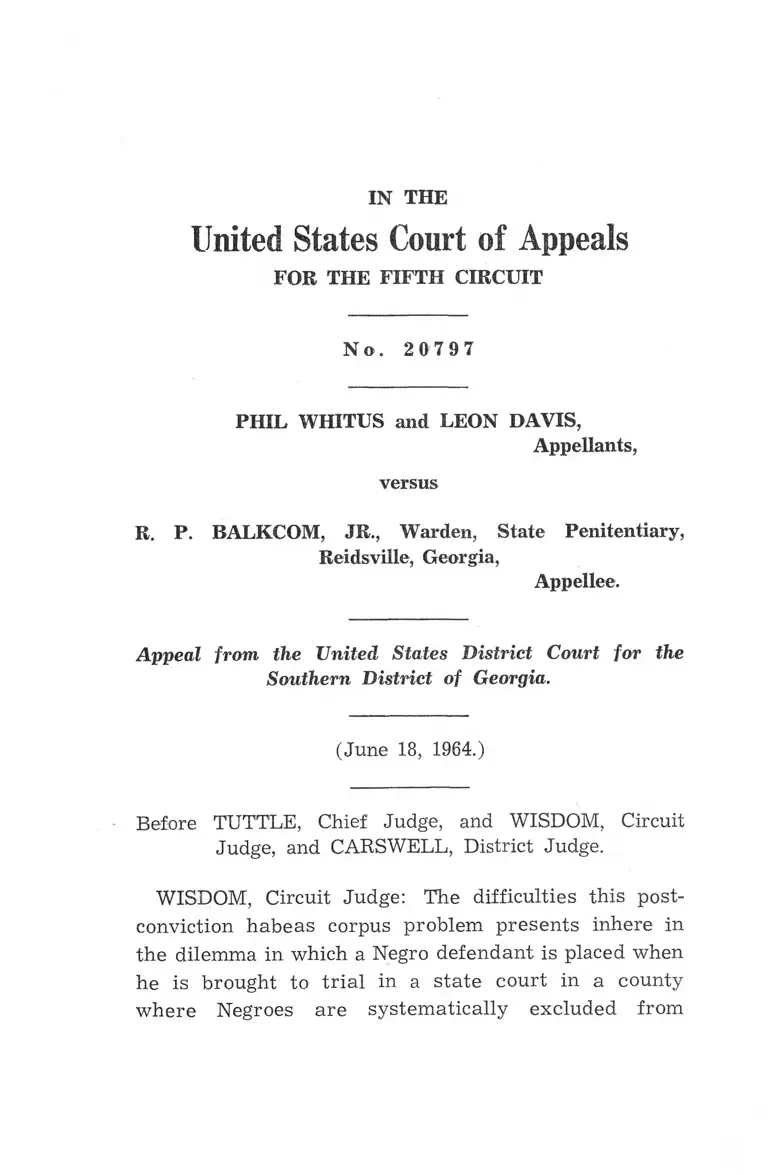
IN THE
United States Court of Appeals
FOR THE FIFTH CIRCUIT
N o . 2 0 7 9 7
PHIL WHITUS and LEON DAVIS,
Appellants,
R. P.
versus
BALKCOM, JR., Warden, State Penitentiary,
Reidsville, Georgia,
Appellee.
Appeal from the United States District Court for the
Southern District of Georgia.
(June 18, 1964.)
Before TUTTLE, Chief Judge, and WISDOM, Circuit
Judge, and CARSWELL, District Judge.
WISDOM, Circuit Judge: The difficulties this post
conviction habeas corpus problem presents inhere in
the dilemma in which a Negro defendant is placed when
he is brought to trial in a state court in a county
where Negroes are systematically excluded from
2 Whitus, et al. v. Balkcom, Jr.
juries.1 The matrix within which this problem de
veloped is the social structure of the deep South.
The two Negro petitioners were tried in the Superior
Court of Mitchell County, Georgia, for the murder of
a white farmer. They were convicted and sentenced
to die. Mitchell County is a small county in rural
Georgia.2 No Negro has ever served on a grand jury
or on a petit jury in Mitchell County. The attorneys
for the petitioners were fully aware of this fact. They
were also fully aware of the hostility that an attack
on the all-white jury system would generate in a
community already stirred up over the killing. Without
consulting the defendants, the attorneys decided not
to object, ili the trial or on appeal, to the systematic
exclusion of Negroes from either jury. Later, in this
habeas corpus proceeding, the federal district court
held that the attorneys’ non-assertion in the state
court of a timely objection to the composition of the
juries was an effectual waiver of that objection.
1 See Sofaer, Federal Habeas Corpus for State Prisoners:
The Isolation Principle, 39 N.Y.U.L.Rev. 78 (1964); Reitz, Federal
Habeas Corpus: Impact of an Abortive State proceeding, 74
Harv. L. Rev. 1315, 1324-32 (1961); Hart, Foreword: The Time
Chart of the Justices, 73 Harv. L, Rev. 84, 103-108 (1959);
Brennan, Federal Habeas Corpus and State Prisoners: An Exer
cise in Federalism, 7 Utah L. Rev. 423 (1961); Bator, Finality
in Criminal Law and Federal Habeas Corpus for State Prisoners,
76 Harv. L. Rev. 441 (1963); Schaeffer, Federalism and State
Criminal Procedure, 70 Harv. L. Rev. (1956); See especially
Comment, Negro Defendants and Southern Lawyers: Review in
Federal Habeas Corpus of Systematic Exclusion of Negroes
from Juries, 72 Yale L. Jour. 559 (1963); Note, Lightfoot, Waiver
of Right to be Tried Before Jury from which Members of One’s
Race have not been Systematically Excluded, 16 Ala. L, Rev.
117 (1963). See also Note, Racial Discrimination, Systematic
Exclusion in Jury Selection, 24 La. L. Rev. 393 (1964).
2 The population of Mitchell County, according to the 1960
census is about 20,000, 9,000 Negroes and 11,000 white persons.
Whitus, et al. v. Balkcom, Jr. 3
Many constitutional rights may be waived. And, in
the interests of legal economy and the integrity of
orderly procedure in state courts, a defendant’s non
assertion of certain constitutional rights before a trial
or in the early stages of a trial has been treated as a
“waiver” of those rights. This handy rule applies, for
example, to the right to be tried by a jury or the right
to counsel. It does not fit this case.3
The core of this case is the lack of remedy in the
state courts. The petitioners and their attorneys had
no desire to give up their right to be tried by a jury
chosen without regard to the race of the jurors. It
was not to their interest to do so—except as a choice
of evils. A choice of evils was indeed the only state
remedy open to them. The petitioners could choose
to be prejudiced by the hostility an attack on the all-
white jury system would stir up. Or they could choose
to be prejudiced by being deprived of a trial by a jury
of their peers selected impartially from a cross-section
of the community. This is the “grisly” ,4 hard, Hobson’s
8 “ The rights which a defendant may waive are those which
establish procedures designed to insure fairness, but which a
particular defendant may deem it advantageous to forego. The
clearest example, perhaps, is the right to jury trial, which
many defendants waive in the expectation that trial by a judge
alone will be beneficial to their cause. . . . If Johnson v. Zerbst
permits a defendant to forego some of the constitutional safe
guards if he deems it to his advantage to do so. The law re
spects his choice in the first instance and holds him to it if he
should later change his mind. These considerations are not rele
vant when the defendant ‘waives’ an opportunity to protest un
constitutional action, in the sense that a violation of a state rule
of procedure forecloses some part of the review otherwise avail
able in the state judicial system. If a forfeiture of constitutional
rights is to be made the outcome of this kind of lapse, it must
be explained on some basis other than an interest in allowing a
defendant to follow what seems to him his most advantageous
course of action.” Reitz, Federal Habeas Corpus: Impact of an
4 Whitus, et al. v. Balkcom, Jr.
choice the State puts to Negro defendants when it
systematically excludes Negroes from juries; white
defendants are not subjected to this burden.
The constitutional vice is not just the exclusion of
Negroes from juries.* 4 5 It is also the State’s requiring
Negro defendants to choose between an unfairly con
stituted jury and a prejudiced jury. We hold that this
discrimination violates both the equal protection and
the due process clauses of the Fourteenth Amendment.6
I.
Oversimplifying the facts, the homicide occurred
November 15, 1959, when Leon Davis, one of the peti
tioners, killed a respected white farmer after an
altercation between the two precipitated by each caus
ing his automobile to bump into the other’s automobile.
Phil Whitus and two other Negroes were in Davis’s
automobile and were at the scene of the killing. All
Abortive State Proceeding, 74 Harv. L. Rev. 1266, 1333, 1336
(1961).
4 This is the term Mr. Justice Brennan used in Fay v. Noia,
372 U. S. 391, 440, to describe Noia’s predicament.
5 The exclusion of Negroes from petit juries trying Negro
defendants has been repeatedly held to violate the equal pro
tection clause as well as the due process clause of the Fourteenth
Amendment. Reece v. State of Georgia, 1955, 350 U. S. 85,
76 S. Ct. 167, 100 L. Ed. 17; Patton v. State of Mississippi, 1947,
332 U. S. 463, 68 S. Ct. 184, 92 L. Ed. 76: Norris v. State of
Alabama, 1935, 294 U. S. 587, 55 S. Ct. 579, 79 L. Ed, 1074;
Carter v. State of Texas, 1900, 177 U.S. 442, 20 S.Ct. 687, 44 L.
Ed. 839; United States ex rel. Goldsby v. Ha.rpole, 5 Cir. 1959,
263 F. 2d 71, cert, den’d 1959, 361 U.S. 838, 80 S. Ct. 58, 4 L. Ed.
2d 78.
0 We have based our decision on Fay v. Noia, 372 U. S. 391.
At the same time, we have considered, as Mr. Justice Harlan
would require the Court to consider, “ the adequacy, or fairness,
of the state ground” .
Whitus, et al. v. Balkcom, Jr. 5
four were indicted for murder. The attorneys for the
defendants decided against requesting a change of
venue.7 January 13, 1960, the jury found Davis and
Whitus guilty as charged.8 Under Georgia law, since
the jury withheld a recommendation of mercy, the
verdict carried the sentence of death by electrocution.
The petitioners filed unsuccessful motions for new
trials, appeals to the Supreme Court of Georgia, and
petitions for certiorari to the United States Supreme
Court.9 Davis contended that the trial court erred in
admitting in evidence an allegedly coerced confession
and in making an erroneous charge to the jury on
insanity. Whitus contended that he did not participate
in the killing in any way; that there was no conspiracy
to commit any crime; and that whatever assistance he
gave to Davis he gave unwillingly at the point of
Davis’s gun. In the state court proceedings petitioners
did not refer to the composition of the juries, except
for a vague allusion in the petition for certiorari to
the United States Supreme Court.
The attorneys first presented the issue now before
this Court in a petition for habeas corpus in the United
States District Court. That court denied the petition
7 Mr. Walter Jones, attorney for Whitus, testified that he “had
a conference with the other attorneys in the case and we agreed
that [if a request for a change were made and acted on favor
ably] the trial judge might change it to Baker County and we
were better off in Mitchell.”
8 The two other defendants pleaded guilty and were sentenced
to life imprisonment. One was sixteen years of age. The other
testified for the State.
9 Whitus v. State, 1960, 216 Ga. 284, 116 S.E,2d 205; cert,
den’d 1961, 365 U. S. 831, 81 S. Ct. 718, 5 L. Ed. 2d 708; Davis
v. State, 1960, 216 Ga. 110, 114 S.E.2d 877.
6 Whitus, et al. v. Balkcom, Jr.
on the ground, among others, that a state remedy
through habeas corpus was still available. We affirmed.
Whitus v. Balkcom, 5 Cir. 1962, 299 F.2d 844. The
Supreme Court, per curiam, vacated the judgment and
remanded the case. Whitus v. Balkcom, 1962, 370 U. S.
728, 82 S. Ct. 1575, 8 L. Ed. 2d 803. Again the district
court dismissed the petition.10 The petitioners are
before us on their appeal from that order of dismissal.
The factual question of the existence of the custom
of systematic exclusion of Negroes from the Mitchell
County juries is not at issue. The appellee relies
solely on the doctrine of waiver. The appellee’s brief
states: “Rather than argue the substantive issue of
systematic exclusion of Negroes from the juries of
Mitchell County and thereby attempt to overcome this
Court’s decision in United States ex rel. Seals v. Wiman,
5 Cir. 1962, 304 F.2d 53, cert, den’d, 1963, 372 U. S. 924,
83 S. Ct. 741, 9 L. Ed. 2d 729, appellee will admit for
the purposes of this Appeal that the present case is
adversely covered by such decision.”11
10 The district court held: (1) the evidence was sufficient
to support the conviction; (2) there was no evidence to support
the contention that there was discrimination in the selection of
the jury; (3) there was no violation of the petitioner’s right to
equal protection or due process.
11 The district court found that there was a complete revision
of the jury list two months before the commission of the crime,
and the names of thirty Negroes were in the jury box at the
time of the trial. The testimony, however, showed that no
Negro had ever served on either the grand jury or the petit
jury. The jury lists were based on the names on the County
tax returns. These returns were on yellow sheets for the Negroes
and white sheets for the whites. See Avery v. Georgia, 1953,
345 U. S. 559, 73 S.Ct. 891, 97 L.Ed. 1244. See also Collins v.
Walker, 5 Cir. 1964, 329 F.2d 100.
Whitus, et al. v. Balk.com, Jr. 7
II.
The classic, Johnson v. Zerbst definition of waiver
is “an intentional relinquishment or abandonment of
a known right or privilege” .12 The general principles
governing “waiver” of constitutional rights, as that
doctrine is applied in federal habeas corpus post-con
viction proceedings, are succinctly stated in Mr. Justice
Frankfurter’s separate opinion in Brown v. Allen, 1953,
344 U. S. 443, 503, 73 S. Ct. 397, 97 L. Ed. 469:
“Of course, nothing we have said suggests
that the federal habeas corpus jurisdiction can
displace a State’s procedural rule requiring that
certain errors be raised on appeal. Normally
rights under the Federal Constitution may be
waived at the trial, and may likewise be
waived by failure to assert such errors on
appeal. When a State insists that a defendant
be held to his choice of trial strategy and not
be allowed to try a different tack on State
habeas corpus, he may be deemed to have
waived his claim and thus have no right to
assert on federal habeas corpus. Such con
siderations of orderly appellate procedure give
rise to the conventional statement that habeas
corpus should not do service for an appeal.
However, this does not touch one of those
extraordinary cases in which a substantial
claim goes to the very foundation of a proceed
ing.” (Citations omitted. Emphasis added.)
12 Johnson v. Zerbst, 1938, 304 U. S. 458, 464, 58 S. Ct. 1019,
82 L. Ed. 1461.
8 Whitus, et al. v. Balkcom, Jr.
The Supreme Court has recently expressed itself on
the subject of waiver in Fay v. Noia, 1963, 372 U. S. 391,
83 S. Ct. 822, 9 L. Ed. 2d 837, a case pertinent here
on the facts. The Court said:
“If a habeas applicant, after consultation with
competent counsel or otherwise, understand-
ingly and knowingly forewent the privilege of
seeking to vindicate his federal claims in the
state courts, whether for strategic, tactical, or
any other reasons that can fairly be described
as the deliberate by-passing of state pro
cedures, then it is open to the federal court
on habeas to deny him all relief. . . . At
all events we wish it clearly understood that
the standard here put forth depends on the
considered choice of the petitioner. Cj. Carnley
v. Cochran, 369 U. S. 506, 513-517; Moore v.
Michigan, 355 U. S. 155, 162-165. A choice made
by counsel not participated in by the petitioner
does not automatically bar relief. Nor does a
state court’s finding of waiver bar independent
determination of the question by the federal
courts on habeas, for waiver affecting federal
rights is a federal question. E.g., Rice v.
Olson, 324 U.S. 786.” (Emphasis added.)
In addition to its holding on waiver,18 Fay v. Noia
makes it clear that to invoke the Great Writ a peti- 13 *
13 See Daniels v. Allen, 1953, 344 U. S. 482, 73 S.Ct. 420, 97
L.Ed. 502. “ Clarity of anaylsis requires that each device be
treated as an isolated doctrine, though such treatment is es
sentially artificial. If exhaustion is interpreted to include
presently unavailable remedies, it would appear that the waiver
and adequate-state-ground rules are merely semantic variants of
Whitus, et al. v. Balkcom, Jr. 9
tioner need exhaust only the state remedies available
to him at the time he files his petition. As to the
applicability of the doctrine of “an adequate and in
dependent state ground” , the Court said:
“ [T]he doctrine under which state procedural
defaults are held to constitute an adequate
and independent state law ground barring
direct Supreme Court review is not to be ex
tended to limit the power granted the federal
courts under the federal habeas statute,” 372
U.S. at 399.
Two recent decisions of this Court deal with waiver
in systematic exclusion cases: United States ex rel.
Goldsby v. Harpole, 5 Cir. 1959, 263 F.2d 71, cert, den’d
1959, 361 U.S. 838, 80 S. Ct. 58, 4 L, Ed. 2d 78 and United
States ex rel. Seals v. Wiman, 5 Cir. 1962, 304 F.2d 53,
cert, den’d 1963, 372 U. S. 924, 83 S.Ct. 741, 9 L,Ed.2d
729. Judge Rives was the author of both opinions;
the author of this opinion was on both panels. In
each case the attorneys for the Negro defendant did
the exhaustion requirement. Application of these principles to a
given set of facts produces identical results. Thus, . . . a
habeas court could hold that by failing to exhaust a remedy
no longer available, petitioner has waived his procedural rights
and has created an adequate and independent state ground for
his continued detention. No matter which theory is used, peti
tioner is denied habeas corpus relief for failure to employ a
presently unavailable remedy. Once it is decided, however,_ that
the exhaustion requirement applies only to presently available
remedies, an applicant would not be penalized under that theory
for failing to appeal if he could no longer do so. But such an
interpretation of the exhaustion requirement would be rendered
nugatory if failure to appeal were to result in a forfeiture under
the theories of waiver or adequate state ground. The danger
in regarding the doctrines separately is this possibility of anti
thetical application.” Sofaer, supra, Note 1, 39 N.Y.U.L.Rev.
78, 82.
10 Whitus, et al. v. Balkcom, Jr.
not make a timely objection to the composition of the
jury. In spite of this non-compliance with the state
rule requiring such an objection to be made in the
early stages of a trial,14 this Court held that there
was no waiver. In Goldsby “we held that the conduct
of Goldsby’s counsel without consultation with his
client did not bind Goldsby to a waiver of his consti
tutional right to object to the systematic exclusion of
members of his race from the trial jury.”15 With
regard to the grand jury, Judge Rives observed that
systematic exclusion of Negroes from a grand jury in
volves consequences less serious than the consequences
of their exclusion from a trial jury. The Court held
that the petitioner had waived any objection to the
grand jury. In discussing this case in Seals, however,
Judge Rives pointed out: “ [In Goldsby] the evidence
to support objections to the composition of the jury
was entirely unknown to the defendant Seals, who
was at no time even consulted by his attorney on this
subject. Further, that evidence was not known to the
attorney who defended Seals. Finally, that evidence
was not ‘easily ascertainable’ ” . 304 F.2d at 69. In
Seals, therefore, the Court held that there was no
waiver of the constitutional objection to the composi
tion of either the petit jury or the grand jury.
We approve of the holdings in Goldsby and Seals.
The important fact in each case was that the attorney
for the Negro defendant did not consult his client with
„ , See Seals v. State, 1961, 271 Ala. 622, 126 So.2d 474, cert,
dend, 366 U. S. 954; Cobb v. State, 1962, 218 Ga. 10, 126 S E 2d
231, cert, den’d 1963, 371 U. S. 948, 83 S. Ct. 499, 9 L.Ed 2d 497
15 United States ex rel. Seals v. Wiman, 5 Cir. 1962, 304 F2d
53, 69.
Whitus, et al. v. Balkcom, Jr. 11
regard to his decision to refrain from making an attack
on the jury system; and in Seals the evidence relating
to systematic exclusion of Negroes from the juries was
unknown to the defendant’s attorney, Goldsby has
been construed as holding that in a capital case
“before a defendant will be deemed to have waived
his objection to trial by a petit jury infected by an
unconstitutional exclusion for race, the record must
show that the defendant, not just his counsel, took
the action deliberately and after advice” .16 Adams v.
United States, 5 Cir. 1962, 302 F.2d 307, 314 (dissenting
opinion). Goldsby, however, does not go that far.
The opinion makes this significant reservation:
“In ordinary procedural matters, the defendant
in a criminal case is bound by the acts or non
action of his counsel. . . . It might extend to
such a waiver even in capital cases, where the
record affirmatively shows that the particular
jury was desired by defendant’s counsel after
conscientious consideration of that course of
action which would be best for the client’s
cause.” 263 F.2d 71 at 83.
The unusual example—for an exclusion case—which
Judge Rives gives is the only type of exclusion situa
tion where there is a possibility of a true waiver * 50
16 Cf. “Before any waiver can become effective, the consent of
government counsel and the sanction of the court must be had,
in addition to the express and intelligent consent of the de
fendant.” Patton v. United States, 1930, 281 U. S. 276, 312,
50 S.Ct. 253, 74 L.Ed. 854. “ [Clourts indulge every reasonable
presumption against waiver of fundamental constitutional rights” ,
and “ do not presume acquiescence in the loss of fundamental
rights” . Johnson v. Zerbst, 1938, 304 U. S. 458, 464.
12 Whitus, et al. v. Balkcom, Jr.
based on a free option.17 When a defendant’s attorney
prefers a particular jury, there is “a voluntary choice
between two meaningful alternatives” .18 Absent this
preference, there is no voluntary choice to relinquish
the right to a fairly constituted jury when the right
must be relinquished in order not to imperil the
defense.19 Even in a situation where a defendant’s
attorney has a considered preference for a particular
jury, under the decisions the attorney must consult
with his client and the defendant must “understand-
ingly and knowingly” forego his federal claims before
a waiver would be established. But if the defendant
lacks the capacity “understandingly and knowingly”
to waive his right, it is an empty gesture to require
consultation and it is meaningless to speak of waiver.
17 For example, in Carruthers v. Reed, 8 Cir. 1939, 102 F.2d
933, cert, den’d 1939, 307 U.S. 643, the trial attorney knew certain
jurors and believed that the defendant would receive a fair trial.
18 Comment, supra, note 1, 72 Yale L. Jour, at 567.
19 Professor Reitz brings out clearly the “great difficulties”
that “arise in this attempted transition from ‘an intentional
relinquishment or abandonment of a known right of privilege’ ”
[Johnson v. Zerbst] to a case involving an abortive state pro
ceeding. ( “An abortive state proceeding has occurred when a
state criminal defendant, at some time in the past, had an op
portunity to present to his own state’s courts any question rele
vant to the power of the state to hold him in custody but lost
that opportunity can no longer seek any relief there.” ) “The
most that was waived was the right to review in the state Su
preme Court. It takes some additional extrapolation to make
that equivalent to waiver of the underlying federal right.” Reitz
supra, note 1, 74 Harv. L. Rev. 1335. See also Moyers v. Yar
brough, Bis Vexari: New Trials and Successive Prosecutions, 71
Harv. L. Rev. 1, 6 (1960). In discussing “waiver” of the
guarantee against double jeopardy, the authors wrote, “Yet it is
obvious that a waiver rationale here, as elsewhere, serves only
to state the conclusion without explaining the reason for it
See also Sofaer, supra, Note 1, 39 N.Y.U.L.Rev. 78, 83-91; Com
ment, Waiver of the Privilege Against Self Incrimination. Note,
Waiver of the Privilege Against Self Incrimination, 14 Stan L
Rev. 811 (1962).
Whitus, et al. v. Balkcom, Jr. 13
To return to the case before us, here the attorneys
for the petitioners are able, conscientious, experienced,
court-appointed white lawyers.20 The petitioners are
ignorant Negroes whose frame of reference could not
have included any comprehension of the traditional
constitutional rights incident to a fair trial. Davis is
illiterate and Whitus semi-illiterate. The Attorney
General for the State, in his brief, makes a point of
this in order to further his contention that the defend
ants are bound by the fictitious waiver of their at
torneys:
“It is evident from the record that defendants
were men of lesser intelligence at least in their
understanding of the law and were completely
dependent upon their attorneys for a proper
defense. . . . The testimony of the appellant,
Leon Davis, at the first hearing before the
District Court for the Southern District of
Georgia lucidly points out that he does not
comprehend the nature or meaning of the
Constitution or the rights provided thereunder
and is, in fact, entirely dependent on counsel
for his defense.”
In these circumstances, it is unrealistic for the Court
to attach significance to the presence or absence of
consultation of the attorneys with the defendants and
20 The brief of the Attorney General states:
“ The court will remember that Honorable P. Walter
Jones has represented Phil Whitus from the outset of this
case. A fleeting glance at the history of this case proves
conclusively that Mr. Jones has exerted every effort in be
half of the appellant and is to be commended for his un
selfish and tireless defense of this individual.”
14 Whitus, et al. v. Balkcom, Jr.
the presence or absence of express consent by the
defendants to the so-called waiver. For the petitioners
in this case, these protections are simply not adequate
safeguards against forfeiture of constitutional rights.
The defendants would have been no better off after
consultation than before; had they been consulted and
had they given instructions contrary to the attorneys’
advice, they would have been worse off. As the
Supreme Court of Georgia said in Cobb v. State, 1962,
218 Ga. 10, 126 S.E.2d 231, cert, den’d 1963, 371 U. S.
948, 83 S. Ct. 499, 9 L.Ed.2d 497:
“Where, as here, the defendant knows nothing
of his rights or whether it would be stra
tegically wise to waive them in certain situa
tions, it would be to require a vain and useless
thing1 that he personally consent to such waiver.
If appointed counsel had been compelled to
consult and be controlled by the directions
given him by his client, who was only fifteen
years old, and according to his own insistence,
knew nothing of law, courts or legal procedure,
his usefulness would have been destroyed and
the defendant would not have been represented
by counsel within the meaning of Art. I, Sec.
I, Par. V of the Georgia Constitution (Code
Ann. §2-105).” (Emphasis added.)
Cobb involved facts very similar to the facts in the
instant case. The futility of requiring an express
waiver from the fifteen year old Negro defendant led
the Georgia Supreme Court to conclude that “the
Whitus, et al. v. Balkcom, Jr. 15
waiver may be made on his behalf by counsel ap
pointed by the court to defend him.”
Here, as in Cobb, the evidence showed no consulta
tion between the attorneys and the petitioners on
waiver and here too the petitioners lacked the com
prehension to make an intelligent waiver. If, notwith
standing, the State may treat the attorneys’ inaction
as implied “waiver” , it is because the State, for its
purposes, may establish a ground rule that orderly
procedures compel a client to be bound by his lawyer’s
action and inaction21 and require also that objections
to juries be urged in the early stages of a trial; other
wise, state procedures would be circumvented.
Such a state rule, so reasonable on its face, is an
“ independent and adequate state ground”,22 which
21 Popeko v. United States, 5 Cir. 1961, 294 F.2d 168; Kennedy
v. United States, 5 Cir. 1958, 259 F.2d 883.
22 In Fay v. Noia, 372 U. S. 391, 429-32, the Court commented:
“ The fatal weakness of this contention is its failure to recognize
that the adequate state-ground rule is a function of the limita
tions of appellate review. . . . And so we have held that the
adequate state-ground rule is a consequence of the Court’s obliga
tion to refrain from rendering advisory opinions or passing upon
moot questions. U But while our appellate function is concerned
only with the judgments or decrees of state courts, the habeas
corpus jurisdiction of the lower federal courts is not too con
fined. The jurisdictional prerequisite is not the judgment of a
state court but detention simpliciter. The entire" course of de
cisions in this Court elaborating the rule of exhaustion of state
remedies is wholly incompatible with the proposition that a state
court judgment is required to confer federal habeas jurisdiction.
And the broad power of the federal courts under 28 U.S.C. §2243
summarily to hear the application and to ‘determine the facts,
and dispose of the matter as law and justice require,’ is hardly
characteristic of an appellate jurisdiction. Habeas lies to en
force the right of personal liberty; when that right is denied and
a person confined, the federal court has the power to release
him. Indeed, it has no other power; it cannot revise the state
court judgment; it can act only on the body of the petitioner.
. In Noia’s case the only relevant substantive law is
16 Whitus, et al. v. Balkcom, Jr.
Federal courts generally should respect. But, as
stated in Fay v. Noia, “Federal courts have power
under the federal habeas corpus statute to grant relief
despite the applicant’s failure to have pursued a state
remedy not available to him at the time he applies.”
372 U. S. at 398.
The overriding duty of a federal court to protect the
federally guaranteed rights of the individual citizen
impels the court to inquire into the reasonableness,
the constitutionality, of the state rule. “Reasonable
consequences attached by the states to a failure to
comply with reasonable rules must accordingly be
respected. . . . But this assuredly does not mean
federal—the Fourteenth Amendment. State law appears only in
the procedural framework for adjudicating the substantive federal
question. The paramount interest is federal. Cf. Dice v. Akron,
C. & Y.R.Co., 342 U. S. 359. That is not to say that the States
have not a substantial interest in exacting compliance with their
procedural rules from criminal defendants asserting federal de
fenses. Of course orderly criminal procedure is a desideratum,
and of course there must be sanctions for the flouting of such
procedure. But that state interest ‘competes . . . against an
ideal . . . [the] ideal of fair procedure.’ Schaeffer, Federalism
and State Criminal Procedure, 70 Harv. L. Rev. 1, 5 (1956). And
the only concrete impact the assumption of federal habeas juris
diction in the face of a procedural default has on the state
interest we have described, is that it prevents the State from
closing off the convicted defendant’s last opportunity to vindi
cate his constitutional rights, thereby punishing him for his de
faults in the future.” Ct. Williams v. Georgia, 1955, 349 U. S.
375, 393-405, 75 S.Ct. 814, 99 L.Ed. 1161. In McKenna v. Ellis,
5 Cir. 1960, 280 F.2d 592, 603 rehearing denied and opinion
modified, 289 F.2d 928, cert, den’d 1961, 368 U.S. 877, this Court
granted habeas corpus although the prisoner had not complied
with Texas procedure. We held: “Article 543 of the Texas Code
of Criminal Procedure sets forth very clearly the requirements
for a continuance. We do not question the propriety, the reason
ableness, the constitutionality of Article 543. ‘Such detailed
and technical requirements of a motion for continuance, no doubt,
serve a salutary purpose in a proper case, but they cannot
justify putting a defendant to trial when he has been given no
fair opportunity to secure the attendance of his witness.’ ”
Whitus, et al. v. Balkcom, Jr. 17
that every last technicality of state law must be
sacrosanct.” Hart, Foreword: Time Chart for the
Justices, 73 Harv. L. Rev. 84, 118 (1959). Professor
Hart’s comments on a state rule that the escape of a
prisoner nullifies his motion for a new trial23 are apt
here:
“The reasonableness of the state rule and,
even more, the reasonableness of its application
in the particular circumstances of the case
cried aloud for questioning. Life was at stake.
The constitutional rights which the prisoner
asserted went to the very jugular of a system
of ordered liberty—the right to be judged in
an orderly trial before an unprejudiced tri
bunal rather than by the whipped-up emotions
of the community. States may punish an
escape as a crime. But surely not all rights
to a fair trial can become forfeit because of it.
Especially are doubts stirred when the escape
' in question can be viewed as a form of self
protection from the very community hostility
against which the prisoner had previously pro
tested in vain by lawful means. These con
siderations called for close scrutiny of the
opposing considerations advanced by the state
to show that the forfeiture it had decreed was
necessary for the due enforcement of law.”
73 Harv. L. Rev. at 116.
23 See Irvin v. Dowd, 1959, 359 U. S. 394, 79 S.Ct. 825, 3 L.Ed.2d
900
18 Whitus, et al. v. Balkcom, Jr.
III.
This ■ case is “one of those extraordinary cases” Mr.
Justice Frankfurter may have had in mind in the
caveat to his discussion of waiver in Brown v. Allen:
the federal “claim goes to the very foundation of [the]
proceeding” . When Negroes are systematically ex
cluded from juries, the fictitious waiver rule puts
Negro defendants, and only Negro defendants, to a
choice of evils that deprives them of an effective
remedy.
A. We know what happens when the attorney’s
inaction is treated as a waiver of the exclusion issue:
the Negro defendant loses the benefits of a trial by
his peers. We quote two sentences on the subject
from a Supreme Court opinion in 1879:
“The very idea of a jury is a body of men com
posed of the peers or equals of the person
whose rights it is selected or summoned to
determine; that is, of his neighbors, fellows,
associates, persons having the same legal
status in society as that which he holds. . . .
[C]ompelling a colored man to submit to a
trial for his life by a jury drawn from a panel
from which the State has expressly excluded
every man of his race, because of color alone,
however well qualified in other respects, is
. . . a denial to him of equal protection
of the law.” Strauder v. West Virginia, 1879,
100 U. S. 303, 309, 25 L. Ed. 664.
Whitus, et al. v. Balkcom, Jr. 19
B. We believe that we know what happens when a
white attorney for a Negro defendant raises the ex
clusion issue in a county dominated by segregation
patterns and practices: both the defendant and his
attorney will suffer from community hostility.
The burden of making hard decisions is one that
attorneys are used to carrying. But the burden is
exceptionally heavy when the life and liberty of an
accused depend on the weight to be given something
as imponderable as the extent of the additional anti-
Negro reaction that would be engendered by attacking
the all-white jury system. As if this were not suf
ficiently difficult, there is the intolerable complication
that the reaction against an attorney who raises the
exclusion issue may stretch from persiflage to ostra
cism. The intensity of the reaction will depend on
how bad racial relations are in the particular county,
the standing of the defendant’s attorney at the bar
and in his community, the happening of unpredictable
local events, and coincidental accidents of history. The
reprisals may be real or chimerical; if chimerical, 'they
may seem real to any particular attorney. All of this
adds up to pressures which may, consciously or sub
consciously, affect an attorney’s measured evaluation
of which evil is the lesser evil in this Hobson’s choice
of evils.24 Later, should there be a post-conviction
24 “In response to a questionnaire prepared by the Journal
and sent to 100 southern lawyers whose names were picked at
random, 20 stated that they felt the Fifth Circuit was correct in
taking judicial notice that lawyers in the South rarely raise the
issue of jury exclusion. Fourteen felt the Fifth Circuit was in
correct either because there is no jury exclusion (9) or because
the issue is raised when the facts so warrant (5).
“ In answer to the question whether you would ‘raise at trial
level the issue of systematic exclusion of Negroes from the
20 Whitus, et al. v. Balkcom, Jr.
habeas corpus proceeding, the attorney’s knowledge
that his integrity may be questioned and his pro
fessional skill second-guessed in an antagonistic atmos
phere may cause him to slant his explanation for
making the wrong guess. The exposure of a Negro
on trial for his life to these factors destructive of
justice and federally protected rights and harmful to
the public policy of encouraging adequate legal repre
sentation of indigents is a monstrous price to pay for
the convenience to the state of the procedural rule
euphemistically termed “waiver” .25 * 26
jury, if you thought there was reasonable evidence of such
exclusion,’ 21 answered yes and 13 responded no.
“ Reasons given for the failure to raise the objection included
a desire not to prejudice the lawyer’s position in the community
(2), a desire not to prejudice the client’s interests by stirring
up community feeling against him, thereby hoping to achieve
the best result for the Negro client (11), and a feeling that it
would make no difference to the outcome of the case whether
or not there is jury exclusion (15).
“ In response to the questionnaire prepared by the Journal,
one Alabama lawyer wrote:
“ If I accepted a Negro for jury duty and put him on with
11 white men I would prejudice the white men against me
and my client.
A lawyer in Florida wrote:
“ It has been my observation and it is my present thinking
that the interests of a Negro client in the South would be
better protected by the white man than colored.”
Comment, Negro Defendants and Southern Lawyers: Review in
Federal Habeas Corpus of Systematic Exclusion of Negroes from
Juries, 72 Yale L. Journ. 559, 565 (1963).
26 “It is relevant to ask, for purposes of a corollary to the
federal exhaustion rule, whether the price of utilizing the state
remedies was too great . . . This is particularly significant in
the case of the Negro defendant who had to give up the chance
of an unprejudiced trial in order to raise the constitutional ob
jections at the time prescribed by state procedural law. In some
circumstances, the situation might be such that the defendant
could not be said to have had an effective state remedy available
to him, even though formally a method for challenging the
juries existed. But even in less extreme cases, there ought to be
serious doubt that a defendant should be put to this Hobson’s
choice with respect to a constitutionally guaranteed right, jf Not
everyone will agree that the federal courts should go to the
Whitus, et al. v. Balkcom, Jr. 21
C. We turn now to the bases in the decision-making
process for judicial consideration of these matters.
(1) We start with a fair inference. If the segrega
tion policy in a county is so strong that Negroes are
systematically excluded from the jury system, com
munity hostility would be generated against any
“trouble-maker” who would attempt to upset the all-
white make-up of the jury system. Such hostility would
directly affect the Negro defendant. It would carry
over and affect the defendant’s attorney. Whether
horrendous or merely embarrassing, the prospect of
social extra-legal pressures distorting an attorney’s
judgment is a burden only Negro defendants bear.
(2) In Goldsby we took judicial notice of the fact
that in some areas in the deep South lawyers almost
never raised the exclusion issue.* 26 We said:
“Moreover, the very prejudice which causes
the dominant race to exclude members of what
it may assume to be an inferior race from jury
service operates with multiplied intensity
against one who resists such exclusion. . . .
Such courageous and unselfish lawyers as find
it essential for their clients’ protection to fight
against the systematic exclusion of Negroes
merits of these applications. It seems to me, however, that
entertaining them would not pose a serious threat to the general
requirement of exhaustion of state remedies, since the factors
which governed the actions of the defendants were unrelated to
the exhaustion rule.” Reitz, supra, Note 1, 74 Harv. L. Rev. at
1372.
26 McNaughton, Judicial Notice-Exerpts Relating to the Morgan-
Wigmore Controversy, 14 Vand. L. Rev. 778, 789 (1961); Mc
Cormick, Judicial Notice, 5 Vand. L. Rev. 296, 315 (1952).
22 Whitus, et al. v. Balkcom, Jr.
from juries sometimes do so at the risk of
personal sacrifice which may extend to loss
of practice and social ostracism. As Judges
of a Circuit comprising six states of the deep
South, we think that it is our duty to take
judicial notice that lawyers residing in many
southern jurisdictions rarely, almost to the
point of never, raise the issue of systematic
exclusion of Negroes from juries.” (Emphasis
added.) 263 F.2d at 82.
The effect will, of course, be accentuated if the case
is one involving the murder of a white man by a Negro
or the rape of a white woman by a Negro or if the
timing of a trial should happen to coincide with
fevers running high because of bad racial relations.
(3) The fact, standing alone, that no Negro has
ever served on a jury in the particular county where
his case is tried strongly indicates, if it does not
create a presumption, that there was a tacit agree
ment by the bar of that county not to raise the consti
tutional issue. In such case the Negro would have no
adequate remedy, either because of the powerful
environmental factors infecting the jury system or
because of ineffective representation by counsel. At
the very least, that fact alone establishes a prima
facie case putting the burden of going forward on the
State to show that there was a true waiver; that the
non-assertion of the defendant’s constitutional right
was not caused by environmental pressures or inef
fective representation by the defendant’s attorney.
Whitus, et al. v. Balkcom, Jr. 23
(4) This case is a doubly strong one for the de
fendant because, unlike Goldsby,27 we have the benefit
of specific testimony from Whitus’s trial attorney on
the motivation for his non-action. As we noted in
Goldsby, “Conscientious southern lawyers often reason
that the prejudicial effects on their client of raising the
issue far outweigh any practical protection in the
individual case.” 263 F.2d at 82. Here, Mr. Walter
Jones, attorney for Whitus, testified that he had hopes
for an acquittal of his client on the charge of murder,
whatever other offense he might have committed. In
the habeas corpus hearing Mr. Jones testified:
“Q. Did you confer with Phil Whitus and
receive his express permission to waive his
objection to the trial jury unconstitutionally
selected and discriminatorily selected?
“A. No, I did not.
“Q. Why did you not raise this question
on the trial of Phil Whitus in Mitchell County,
Georgia?
“A. Well, I had talked to Phil Whitus and
I conferred with the attorneys who repre
27 In Goldsby, the defendant’s first lawyer, a Negro, was willing
to raise the exclusion issue. His white lawyer refused to join
with the Negro lawyer in representing the defendant and did not
raise the exclusion issue after the Negro lawyer left the case.
The attorney’s failure to raise the issue and the lack of any
explanation could give rise to the inference that the trial counsel
was not acting in the best interests of his client. In Goldsby,
however, we said, as we do here, that sometimes raising the
issue may cause more prejudice than it is worth. The necessity
for the attorney making this choice, not just the composition of
the jury, is the constitutional vice. See Comment, Negro De
fendants and Southern Lawyers: Review in Habeas Corpus of
Systematic Exclusion of Negroes from Juries, 72 Yale L Jour.
559, 564 (1963).
24 Whitus, et al. v. Balkcom, Jr.
sented the other defendants and I knew ap
proximately what they would testify and I
had hopes that I could obtain an acquittal
under the facts as l knew• them, and I realized
that the case had created quite a bit of noto
riety and to have brought up such a question
at the lower court would have filled the air
with such hostility that an acquittal would
have been almost impossible.
“Q. The Solicitor General asked you just
now if you requested a change of venue. Did
you have a conference with the judge con
cerning the possibility of that?
“A. No, sir. I had a conference with the
other attorneys in the case and we agreed
that he might change it to Baker County and
we were better off in Mitchell.
“Q. Would there have been the same dis
crimination in Baker County?
“A. Yes, sir.
“Q. As I understand, you said that the
reason for not raising the question of dis
crimination was because you thought it would
create a hostile feeling and would hurt your
client?
“A. Yes, sir.” (Emphasis added.)
The measure of the merits of Whitus’s defense and
the measure of his dilemma is that the Chief Justice
and two other members of the Supreme Court of
Whitus, et al. v. Balkcom, Jr. 25
Georgia agreed with Mr. Jones’s theory of the case
and wrote a strong dissent.28
D. In Fay v. Noia the defendant was also con
fronted with a “grisly” choice. In that ease a de
fendant was convicted of murder. Years later, long
after his time for appeal had expired, he applied for
habeas corpus on the ground that he had been con
victed on the basis of a coerced confession. The Su
preme Court held that the petitioner’s failure to appeal
in the state court was not a waiver of his rights and
did not bar habeas corpus relief. The Court first
28 In his dissenting opinion, Chief Justice Duckworth said:
“In full recognition of the established rule of law that holds
those parties to a criminal conspiracy or enterprise, who commit
no overt act, equally guilty with those who commit the overt
acts, I am, nevertheless, simply unable to find any basis either in
law or common reason for holding this defendant guilty of murder
where all the evidence excludes any possibility of conspiracy
among the four, who included this defendant and the person who
did the killing. They had planned no robbery, theft or other
crime, and indeed had no reason to expect to see the deceased
before he went to them. Thereafter, this defendant had no
dealings, words or feelings with or toward the deceased. Why
should he want to harm the deceased? There is positively a
complete absence of even a suspicion of any motive. The slayer
committed every criminal act that caused the death. He needed
no help from this accused other than pushing the car and racing
the motor, both of which were done at his command while he
held the gun with which he later shot the deceased, who had
already been knocked unconscious by the killer. To say that this
was not enough to cause a reasonable person to fear that a
refusal to obey would endanger his life, is to ignore realities and
human nature. No act of his harmed a hair of the deceased.
Even if he was cowardly and foolish in obeying the murderer
who held a gun, this would not show his guilt of criminal desire
or intent. Human life should not be taken by the State with
such total lack of evidence of either act or intent as this record
shows. Unless he is saved by the clemency of the Pardon and
Parole Board, his life will be forfeited for a crime he never com
mitted and had no cause for wanting it committed. If this de
cision fixes the law, then every person stands in danger of being
electrocuted if a murder is committed by someone of his as
sociates even though he had no knowledge that it was going to
be done.” Whitus v. State, 116 S.E.2d at 207.
26 Whitus, et al. v. Balkcom, Jr.
eliminated the possibliity of any express waiver: “A
choice made by counsel not participated in by the
petitioner does not automatically bar relief.” Mr.
Justice Brennan, for the majority, then explained
why Noia’s choice not to appeal was not a matter of
trial strategy or a deliberate attempt to by-pass state
procedures:
“Under no reasonable view can the State’s ver
sion of Noia’s reason for not appealing support
an inference of deliberate by-passing of the
state court system. For Noia to have appealed
in 1942 would have been to run a substantial
risk of electrocution. His was the grisly choice
whether to sit content with life imprisonment
or to travel the uncertain avenue of appeal
which, if successful, might well have led to a
retrial and death sentence. See, e.g., Palko v.
Connecticut, 302 U. S. 319. He declined to play
Russian roulette in this fashion. This was a
choice by Noia not to appeal, but under the
circumstances it cannot realistically be deemed
a merely tactical or strategic litigation step, or
in any way a deliberate circumvention of state
procedures.”
Recently a commentator has observed the analogy
between the defendant’s situation in the Noia case and
the defendant’s position in the instant case “in that
here he must choose whether to assert his consti
tutional right with a possibility of forfeiting his chances
for an unprejudiced trial, or remain silent and gamble
Whitus, et al. v. Balkcom, Jr. 27
on the outcome of the trial with the possibility of
raising the question later if the outcome proves un
satisfactory” . Note, 16 Ala. L. Rev. 117 (1963).29 The
instant case, however, is a stronger case than Fay v.
Noia for habeas corpus relief. Noia could have exer
cised his right to appeal without suffering any consti
tutional deprivation. But here, in order for the pe
titioners to exercise their right to a jury from which
Negroes were not excluded, the petitioners had to com
promise their right to a fair trial on the merits of
their defense.
IV.
We summarize. Taking waiver as the “intentional
relinquishment or abandonment of a known right or
privilege” , the facts show that the petitioners made no
“deliberate” , meaningful waiver of their objection to * So.
29 The note is on Ex parte Aaron, Ala. S.Ct. 1963, 155 So. 2d
334. On the authority of Seals v. State, 1961, 271 Ala. 622, 126
So. 2d 474, cert, den’d 1961, 366 U. S. 954, 81 S.Ct. 1909, 6
L.Ed.2d 1246, the Court held that the defendant, a Negro indicted
for the rape of a white woman, had waived the systematic
exclusion issue. At arraignment, in answer to a question from the
trial judge, the defendant’s attorney stated that they did not
intend to attack either the grand jury or the petit jury venire
because of “ the racial make-up of such grand jury or petit jury
venire” . The note concludes, “Thus, the Alabama court has yet
to recognize the principle advanced in the Noia case—that even
a knowing failure to assert this particular constitutional right
does not constitute a waiver, or, more concisely, that there can
be no waiver at the present time of this constitutional right. . . .
Would it not be better to align [Alabama’s] concept of waiver
with that set out in the Noia case, thereby enabling defendants,
by coram nobis in state courts, to assert the right for the first
time, rather than forcing an unsuccessful defendant into the
federal courts on habeas corpus when the obvious result will be
a federal decision overturning a decision of our highest state
court, with the chafing effect it will undoubtedly have on federal-
state relations?” Note, 16 Ala. L. Jour. 117, 123 (1963).
28 Whitus, et al. v. Balkcom, Jr.
systematic exclusion of Negroes from the juries in
Mitchell County. Taking “waiver” as a formula stand
ing for the rule that non-assertion of an objection to
state procedures vitiates the objection, we hold: under
Fay v. Noia, in a federal habeas corpus proceeding the
court cannot permit a state ground rule to frustrate the
federally guaranteed right to a fair trial before a
fairly constituted jury. We do not say that “no waiver
can be effective if some adverse consequences might
reasonably be expected to follow the exercise of that
right.”80 We say that the doctrine of fictitious waiver
is unacceptable when the state compels an accused
person to choose between an unfairly constituted jury
and a prejudiced jury. In short, while giving full ef
fect to the holding of the majority in Fay v. Noia the
Court has attempted to answer the basic question Mr.
Justice Harlan asked in his dissenting opinion:
“Whether the choice made by the defendant is one
that the State could constitutionally require.”30 31 We
hold that the State could not constitutionally require
the petitioners to make a guess and a gamble between
two evils. This burden, which only Negro defendants
bear, violates the requirements of due process and
equal protection of the laws guaranteed by the Four
teenth Amendment.
* * *
As in Goldsby and Seals, the Court expresses its
present opinion that a period of eight months from and
after the entry of this judgment or its final test by
certiorari, or otherwise, will be sufficient to afford the
30 Pay v. Noia, 1963, 372 U. S. 391, 472 (dissenting opinion).
31 Ibid.
Whitus, et al. v. Balkcom, Jr. 29
State an opportunity to take the necessary steps to
reindict and retry the petitioners. Any such reindict
ment must of course be by a grand jury from which
Negroes have not been systematically excluded, and
any such retrial must be before a jury from which
Negroes have not been systematically excluded, or be
fore some court or tribunal so constituted as not to
violate the petitioners’ constitutional rights. For the
guidance of the parties, the Court expresses the present
opinion that if petitioners are reindicted and retried
and if any question should arise as to the legality or
constitutionality of such indictment or trial, that should
be decided not upon the present petition but in the
regular course by the Courts of the State of Georgia,
subject to possible review by the Supreme Court of the
United States.
The judgment of the district court is reversed, judg
ment here rendered in accordance with the holdings of
this opinion, and the cause remanded for any further
proceedings which may be found necessary or proper.
REVERSED, RENDERED, and REMANDED.
CARSWELL, District Judge, concurring specially:
Sharing fully the Courts’ view that there was no
meaningful waiver by these appellants of their basic
Constitutional right to face trial by jurors selected
without systematic racial exclusion, I, therefore, con
cur in the basic holding of the Courts’ opinion.
Adm. Office, U. S. Courts—E. S. Upton Printing Co., N. O,, La.