Mattis v. Schnarr Opinion with cover letter
Public Court Documents
November 23, 1973
-
Case Files, Garner Working Files. Mattis v. Schnarr Opinion with cover letter, 1973. 684d7063-33a8-f011-bbd3-000d3a53d084. LDF Archives, Thurgood Marshall Institute. https://ldfrecollection.org/archives/archives-search/archives-item/9d44e906-54bc-4812-b95b-51b4c61e6382/mattis-v-schnarr-opinion-with-cover-letter. Accessed September 27, 2026.
Copied!
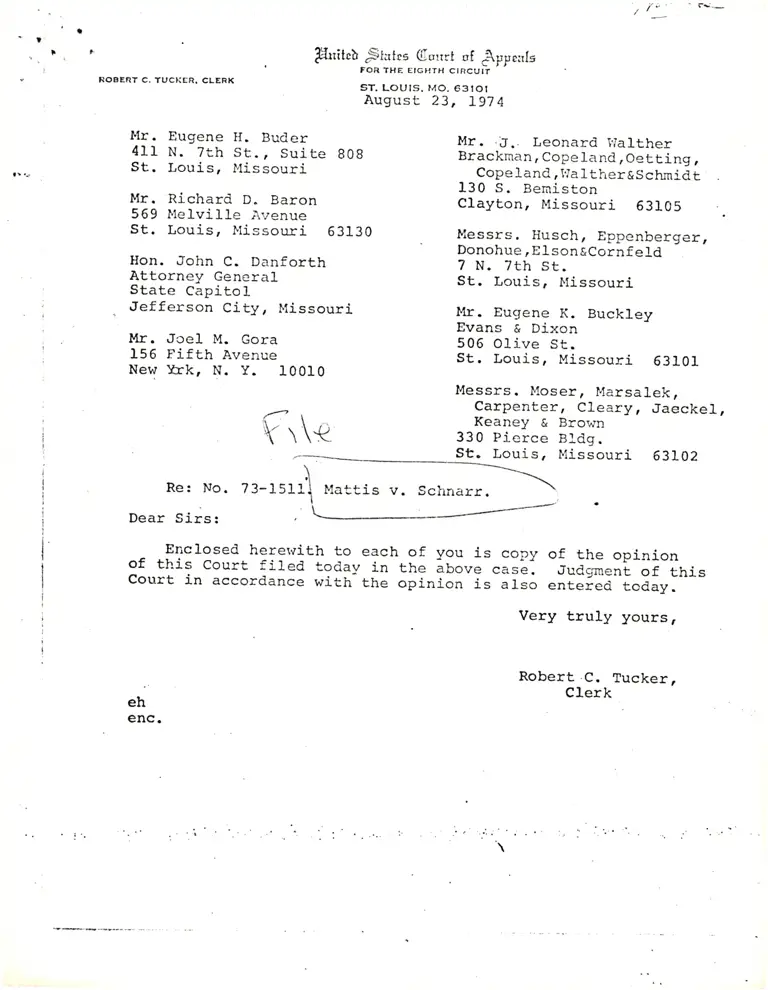
ROBERT C. TU C KE R. CLERK
îiitcb ̂ fatcs (Coirt of J\ppc:ils
FOR TH E EIGHTH C IR C U IT
ST. L O U IS . MO. 63101August 23, 1974
Mr. Eugene H. Buder
411 N. 7th St., Suite 808
St. Louis, Missouri
Mr. Richard D. Baron
569 Melville Avenue
St. Louis, Missouri 63130
Hon. John C. Danforth
Attorney General State Capitol
Jefferson City, Missouri
Mr. Joel M. Gora
156 Fifth Avenue
New ^k, N. Y. 10010
Mr. j.. Leonard V/alther
Brackman,Copeland,Getting,
Copeland, VZalther&Schmidt130 S. Beiniston
Clayton, Missouri 63105
Messrs. Husch, Eppenberger,
Donohue,Elson&Cornfeld 7 N. 7th St.
St. Louis, Missouri
Mr. Eugene K. Buckley
Evans & Dixon
506 Olive St.
St. Louis, Missouri 63101
Messrs. Moser, Marsalek,
Carpenter, Cleary, Jaeckel, Keaney & Brown
330 Pierce Bldg.
St. Louis, Missouri 63102
Re: No. 73-1511^ Mattis v. Schnarr.
Dear Sirs:
Enclosed herewith to each of you is copy of the opinion
of this Court filed today in the above case. Judgment of this
Court in accordance with the opinion is also entered today.
Very truly yours.
eh
enc.
Robert C. Tucker,
Clerk
United States Court of Appeals
FOR THE EIGHTH CIRCUIT
No. 73-1511
Robert Dean Mattis, M.D.,
Appellant,
V.
Patrolman Richard R. Schnarr,
Police Officer, City of Creve
Coeur, Missouri; and Sgt.
Robert Marek, Police Officer,
City of Olivette, Missouri,
Appellees.
*
* •
*
*
ic
*
★
*
*
★
*
*
*
Appeal from the United States
District Court for the
Eastern District of Missouri,
Submitted: November 16, 1973
Filed: August 23, 1974
Before GIBSON, LAY and HEANEY, Circuit Judges,
HEANEY, Circuit Judge.
Plaintiff appeals an order entered in this civil rights
action by the United States District Court for the Eastern
District of Missouri denying his prayer for damages^ and
declaratory judgment.
The case was tried below upon stipulated facts. The
plaintiff's minor son, Michael, age eighteen, was shot and
killed by defendant Marek, a police officer, while
No appeal is taken from that' part of the trial court' s
order denying plaintiff's damages. This action was
originally commenced by Dr. Mattis and his wife, Christine
Mattis, who died while the action was pending.
attempting to escape arrest. Michael and another youth,
Thomas Rolf, age seventeen, had entered the office of a golf
driving range at night for the purpose of taking money by
opening an unlocked windov;. Marek and another officer
attempted to arrest the two youths who ran in different
directions. Marek ran into Mattis, Mattis broke away and
Marek pursued. Marek was losing the race and shouted, "Stop
or 1*11 shoot." Mattis failed to stop and Marek fired one
shot (he believed he fired well above Mattis) which struck
Mattis in the head. Marek and the other officer would;
* * * testify that their use of their guns
in the manner described was reasonably
necessary under the circumstances and was
authorized by the statutes of the State of
Missouri and that such statutes were valid
and lawful.
Matti-s V. Kisslingj et at.. Civil No. 72-Civ. (3)(E.D. Mo.,
filed January 16, 1973).
The trial court initially held that the plaintiff had
standing to bring this action under Title 42 U.S.C. §1983.
It reasoned that the section did not create a new cause of
action in favor of a person for the wrongful death of
another, but that §1988 of the same title authorizes resort
to state law to determine whether a cause of action survives
for the wrongful death of another. Pritchard v. Smith,
289 F.2d 153 (8th Cir. 1961). It further reasoned that
since Missouri law (V.A.M.S. §537.080) permits a father
to bring a wrongful death action for the death of an
unmarried minor son, the father had standing to bring this
V.A.M.S. §537.080.
death— who may sue
Action for wrongful
- 2-
action.
Whenever the death of a person shall be
caused by a wrongful act * * * and the act
* * * is such as would, if death had not
ensued, have entitled the party injured to
maintain an action and recover damages in
respect thereof, then, and in every such
case, the person who or the corporation
which would have been liable if death had
not ensued shall be liable to an action for
damages, notwithstanding the death of the
person injured, which damages may be sued
for and recovered.
(1) By the spouse or minor children,
natural or adopted, of the deceased, either
jointly or severally; * * *
(2) * * * [I]f the deceased be a minor
and unmarried, then by the father and mother,
natural or adoptive, v;ho may join in the
suit, and each shall have an equal interest
in the judgment; or if either of them be
dead, then by the survivor; or if the surviv
ing parents are unable ot decline or refuse
to join in the suit, then either parent may
bring and maintain the action in his or her
name alone, for rhe use and benefit of both
such parents; * * *
Accord, Brazie
cert, denied, 368 U.
Hospital of Joliet,
(N.D. 111. 1972); Pe
1326-1327 (D. Conn,
provide right of act
222-223 (D. Colo. 19
930 (S.D. Cal. 1966)
Civil Practice 117,
1153, 1158, §4 (a) (19
404, the Court said:
r V. Cherry,
S. 921 (1961)
Illinois, 340
rkins V. Sala
1972)(looked
ion); Salazar
6 6); Ga Undo
; C. Antieau,
591 (1971).
63). In Braz
293 F.2d 401 (5th Cir.),
; Holmes v. Silver Cross
F.Supp. 125, 128-129
fia, 338 F.Supp. 1325,
to state law which did not
V. Dowd, 256 F.Supp. 220,
V. Brownell, 255 F.Supp.
Federal Civil Rights Act--
See, Annot., 88 A.L.R.2d
ier V. Cherry, supra at
* * * [I]t defies history to conclude that
Congress purposely meant to assure to the
living freedom from such unconstitutional
deprivations, but that, with like precision,
it meant to withdraw the protection of civil
rights statutes against the peril of death.
- 3-
The court went on to hold, however, that the defense of
good faith was available to the defendants as they had acted4in reliance on Missouri statutes which permit a law enforce
ment official to use deadly force in apprehending a person
who has committed a felony. The court reasoned that the
defense of good faith was available even if the statute was
unconstitutional as the defendants had acted on the reasonable
belief that it was constitutional. It concluded that no
justiciable issue was present which permitted declaratory
relief.
The plaintiff then moved for a nev/ trial and entry of a
new judgment. The trial court modified its position with
respect to the plaintiff's standing in its order denying
that motion. It stated:
Plaintiffs * * * claim for the wrongful
death of Michael C. Mattis is derivative.
None of their own civil rights are alleged
^V.A.M.S. §559.040. Justifiable Homicide
Homicide shall be deemed justifiable
when committed by any person in either of
the following cases:
(3) When necessarily committed in
attempting by lawful ways and means to
apprehend any person for any felony
committed, or in lawfully suppressing any
riot or insurrection, or in lawfully keep
ing or preserving the peace.
V.A.M.S. §544.190,
Making Arrests
Rights of Officer in
If, after notice of the intention to
arrest the defendant, he either flee or
forcibly resist, the officer may use all
necessary means to effect the arrest.
- 4-
to have been violated.. "While a party may
vindicate his own constitutional rights, he
may not seek vindication for rights of
others."
The trial court also advanced an alternative reason for
denying relief:
* * * Plaintiffs seek declaratory relief and
not injunctive relief. Only a three-judge
court could enjoin the enforcement of a state
law. 28 U.S.C. §2281. It seems to this
court particularly inappropriate to be asked
to make a declaration that a statute is
unconstitutional, v;ithout the power to enforce
that holding and without that holding having
any binding effect upon any other court.
Plaintiffs presumably could have asked for
injunctive relief and sought a three-judge
court for that purpose, but they did not
elect to do so. "In light of this fundamental
conception of the Framers as to the proper
place of the federal courts in the govern
mental process of passing and enforcing laws,
it can seldom be appropriate for these courts
to exercise any such power of prior approval
or veto over the legislative process." Younger
V. Harris, [401 U.S. 37] at 53 [1970],
We agree with the trial court's initial conclusions that
the plaintiff had standing, and that the defenses of good
faith and probable cause were available to the officers
insofar as the action for damages was concerned. We cannot
agree, however, that good faith is a defense to the action
insofar as declaratory relief is concerned. Nor can we
agree with declaratory relief is otherwise inappropriate.
^We express no opinion as to the constitutionality of
these statutes but note only that the claim' is not frivolous.
Many question the use of deadly force when neither actual or
threatened deadly force has been used in the commission of
the crime nor serious bodily harm has been threatened or
resulted. PROSSER, LAW OF TORTS §26 (4th ed. 1971).
- 5-
The plaintiff's right to declaratory relief is not
dependent upon a showing that he is entitled to injunctive
or monetary relief.
* * * Where there is * * * a concrete case
admitting of an immediate and definite
determination of the legal rights of the
parties in an adversary proceeding upon the
facts alleged, the judicial function mav be
appropriately exercised although the
adjudication of the rights of the litigants
may not require the av;ard of process or the
payment of damages. * * * And as it is not
essential to the exercise of the judicial
power that an injunction be sought, alle
gations that irreparable injury is threatened
are not required. [Citations omitted.]
Aetna Life Ins. Co. v. Haworth^ 300 U.S. 227, 241 (1937).
Declaratory and injunctive relief, while similar in
some respects, are distinct remedies. One testing the
constitutionality of a state statute in federal court may
ask for declaratory relief only. He need not ask for
injunctive relief; and if he does not do so, a single judge
can hear the case and give declaratory relief is appro
priate.
In Powell V. McCormick, 395 U.S. 486, 517-518 (1969), the
Supreme Court stated:
We need express no opinion about the
appropriateness of coercive relief
[mandamus or injunction] in this case, for
petitioners sought a declaratory judgment,
a form of relief the District Court could
have issued. The Declaratory Judgment Act,
28 U.S.C. §2201, provides that a district
court may "declare the rights . . . of any
interested party . . . whether or not
further relief is or could be sought."
The availability of declaratory relief
- 6-
depends on whether there is a live dispute
between the parties * * * and a request for
declaratory relief may be considered
independently of whether other forms of relief
are appropriate. * * * [Citations omitted.]
See also. Super Tire Engineering Co. v. McCorkle, 42 U.S.L.W.
4507 (U.S. April 16, 1974); Mitchell v. Donovan, 398 U.S.
427 (1970); Kennedy v. Mendoza-Martinez, 372 U.S. 144 (1963);
United Fublic Workers v. Mitchell, 330 U.S. 75 (1947).
Moreover, the defense of good faith is only what its
name implies. It is a defense which shields a public
official from being required to respond in damages.^ It is
intended to avoid penalizing an official who acts in the
good faith belief that he is acting in accordance with a
valid law. The defense cannot be permitted to serve as a
reason for denying equitable or declaratory relief in
appropriate situations.
The defense of good faith should be read against the
background of tort liability. Clearly the defense is
intended to apply only to the damage action. See, Pierson
V. Ray, 386 U.S. 547 (1967); Monroe v. Pape, 365 U.S. 167
(1961); Wilhelm v. Turner, 431 F.2d 177 (8th Cir. 1970),
cert, denied, 401 U.S. 947 (1971).
In Strickland v. Inlow, 485 F.2d 186, 189 (8th Cir.
1973), cert, denied, 42 U.S.L.W. 3584 (U.S. April 15, 1974)
(No. 73-1285), we said; "Good faith is a defense in damage
action, but not in actions for equitable relief."
In Eslinger v. Thomas, 476 F.2d 225 (4th
the plaintiff brought an action for damages a
relief (declaratory relief and an injunction)
against the Lieutenant Governor of South Caro
President Pro Tempore and all state senators
of plaintiff's civil rights. The plaintiff a
a senate resolution permitting females to be
clerical assistants and committee attendants,
pages, was unconstitutional. The Court held
Cir. 1973),
nd equitable
under §1983
lina, the
for a violation
lleged that
employed as
but not as
that the
- 7-
We also find unpersuasive the trial court's other
alternative ground for dismissing the case. A declaratory
judgment would not, as the trial court suggests, be totally
ineffectual. Such a judgment has " * * * the force and
effect of a final judgment or decree and is [reviewable
as such] * * 28 U.S.C. §2201. The judgment is res
judicata and the doctrine of collaterial estoppel is
applicable. WRIGHT & MILLER, FEDERAL PRACTICE AND PROCEDURE
CIVIL §2771. The judgment is precedential as to the matters
declared by it. Annot., 10 A.L.R.2d 782, 785 (1950). Most
importantly, if the statute is declared unconstitutional,
a defense based on a good faith belief of the statute's
validity would no longer be available.
Moreover, no considerations of comity, federalism or
abstention justifying the court in refusing to proceed are
present here. Compare^ Samuels v. Macketl, 401 U.S. 66
(1971).
The critical issue then is whether the plaintiff had
standing. We believe the trial court's initial views on
this matter were the correct ones. There are two aspects
to this question: (1) the party seeking relief must show
that he is sufficiently affected by the action he is
defendants were immune from liability but remanded the case
for the purpose of granting declaratory and injunctive
relief.
^In Bvisaoe v. Kusper, 435 F.2d 1046 (7th Cir. 1971) ,
the plaintiff brought an action under the Civil Rights Act
(§1983) for violation of plaintiff's constitutional rights.
The Court held that the plaintiff was entitled to declaratory
relief but that'the defendants had acted out of good faith
and upon reasonable grounds; consequently, citing Pierson
V. Rayj supra^ the defendants were not liable for damages.
- 8-
challenging to justify consideration by the court of the
validity of the' action; and (2) the action violates the
rights of the particular party who is attacking it and not
of some third party. SEDLER, Standing to Assert Consti
tutional Jus Tertii in the Supreme Courts 71 Yale L. J. 599,
599-600 (1962).
We believe the plaintiff showed that he would be
sufficiently affected by the killing of his son to justify
the courts considering the matter. The Missouri Wrongful
Death Act (V.A.M.S. §537.080) creates a vested right in the
plaintiff to bring suit for the death of his minor son.
Spencer v. Bradley^ 351 S.W.2d 202, 207 (Mo. 1961) . The
right of action is not derivative. The Missouri Supreme
Court has said;
It is now well settled that the causes
of action provided by these statutes are
not either derivative, transmissible, or
survival causes of action, but are new
causes of action spri.nging into being and
accruing on and by reason of the death of
the party injured in favor of the persons
named in the statute.
Jordan v. St. Joseph Ry. Light, Heat & Power Co., 73 S.W.2d
205, 211 (Mo. 1934).
Further, the Missouri Supreme Court has declared;
* * * [T]he true ground of recovery by a
parent in such cases arises from the
reciprocal duty of the child to render to
its parent such services or earnings as
the latter may reasonably expect of it.
★ ★ ★
- 9-
We hold that the right of a parent to
a minor's services is in the nature of a
personal right arising out of the family-
relationship, and is not a property right
arising out of a psuedo contractual
relationship.
Mennemeyer v. Harty 221 S.W.2d 960, 962 (Mo. 1949).
Thus, it is clear that Dr. Mattis is an injured party under
§1983, that he is suing in his own right for injuries person
ally sustained, and that he is sufficiently affected by
action challenged to fulfill the first aspect of standing.
We turn to the more difficult question of whether the
killing of the plaintiff's son invaded the plaintiff's
constitutionally protected rights under the due process
clause of the Fourteenth Amendment to the Constitution of
the United States.
To determine whether a right is
protected by the due process clause, a
court
must look to the "traditions and (collec
tive) conscience of our people" to determine
whether a principle is "so rooted (there)
. . . as to be ranked as fundamental."
Snyder v. Com. of Massachusetts, 291 U.S. 97,
105 (54 S.Ct. 330, 332, 78 L.Ed. 674). The
inquiry is whether a right involved "is of
such a character that it cannot be denied
without violating those 'fundamental
principles of liberty and justice which lie
at the base of all our civil and political
institutions' . . .." Powell v. State of
Alabcima, 287 U.S. 45, 67 (53 S.Ct. 55, 63,
77 L.Ed. 158)
Griswold v. State of Connecticut, supra,
381 U.S. at 493, 85 S.Ct. at 1686 (concur
ring opinion, Goldberg, J.) .' •
- 10-
United States v. State of Texas, 252 F.Supp. 234, 250
(D.C. Tex.), affd, 384 U.S. 155 (1966).
The Supreme Court has on numerous occasions observed
that the framers of che Constitution intended to protect
rights other than those specified.
This Court, in a series of decisions,
has held that the Fourteenth Amendment
absorbs and applies to the States those
specifics of the first eight amendments
which express fundamental personal rights.
The language and history of the Ninth
Amendment reveal that the Framers of the
Constitution believed that there were addi
tional fundamental rights, protected from
governmental infringement, which exist
alongside those fundamental rights
specifically mentioned in the first eight
constitutional amendments.
Griswold V. Connecticut, 381 U.S. 479, 488 (1965) (Goldberg,
concurring).
In Meyer v. Nebraska, 262 U.S. 390, 399 (1923), the Court
stated;
VJhile this court has not attempted to
define v/ith exactness the liberty thus
guaranteed [Fourteenth Amendment guarantee
against deprivation of life, liberty, or
property without due process of law], the
term has received much consideration, and
some of the included things have been
definitely stated. Without doubt, it
denotes not merely freedom from bodily
restraint, but also the right of the
individual to contract, to engage in any
of the common occupations of life, to acquire
a home and bring up children, to worship God
according to the dictates of his own
conscience, and, generally, to enjoy those
privileges long recognized at common law as
\
- 11-
essential to the orderly pursuit of
happiness by free men. * * * The established
doctrine is that this liberty may not be
interfered with, under the guise of
protecting the public interest, by legis
lative action which is arbitrary or without
reasonable relation to some purpose within
the competency of the state to effect.
Determination by the legislature of what
constitutes proper exercise of police power
is not final or conclusive, but is subject
to supervision by the courts. * * * (Cita
tions omitted and emphasis added.)
The familial relationship between parent and child is
fundamental to our civilization. The family is the
foundation of society and hence the state. The traditions
and common heritage of our people have alv;ays stressed the
importance of the family bonds.
Lo children are an heritage of
the Lord: and the fruit of the womb is
his reward.
As arrows are in the hand of a
mighty man; so are the children of the
youth.
Happy is the man that has his
quiver full of them; they shall not be
ashamed, but they shall speak with the
enemies in the gate.
Psalm 27:3-5. We do not believe that the Constitution
excludes this fundamental relationship from its protection
The entire fabric of the Constitution
and the purposes that clearly underlie its
specific guarantees demonstrate that the
rights to marital privacy and to marry and
rdiss Q are of similar order and
magnitude as the fundamental rights
specifically protected. v v :
- 12-
* * * The fact that no particular provi
sion of the Constitution explicitly forbids
the State from disrupting the traditional
relation of the family— a relation as old
and as fundamental as our entire civili-
zation--surely does not show that the
Government v/as meant to have the power to
do so. Rather, as the Ninth Amendment
expressly recognizes, there are fundamental
personal rights such as this one, which are
protected from abridgment by the Government
though not specifically mentioned in the
Constitution. (Emphasis supplied.)
Griswold v. Connecticut, supra at 495-496.
The practical effect of Officer Marel<.'s act was to deny
the plaintiff the fundamental right to raise his son. The
plaintiff has a right to have the validity of the act
dstermined. It is insufficient to say that since you
cannot recover damages, you cannot challenge the statutes
which occasioned the loss. Such a result would leave the
plaintiff without a remedy. Chief Justice Marshall in
Marbury v. Madison, 5 U.S. (1 Cranch) 37, 10^-103 (xuC3/,
noted that such a result was untenable.
* * * If he has a right, and that right has
been violated, do the laws of this country
afford him a remedy?
The very essence of civil liberty
certainly consists in the right of every
individual to claim the protection of the
laws, whenever he receives an injury. * * *
" * * * [E]very right, when withheld, must
have a remedy, and every injury its proper
redress."
The government of the United States has
been emphatically termed a government of laws.
- 13-
and not of men. It will certainly cease to
deserve this high appelation, if the laws
furnish no remedy for the violation of a
vested legal right.
We believe that "parenthood is a substantial interest of
surpassing value and protected from deprivation without due9process of law" — a fundamental legal right. The plaintiff
alleges that this fundamental right has been invaded. The
only way to determine this issue is to examine the
constitutionality of the statutes and a declaratory judgment
action is an appropriate method to do this.
Finally, we turn to two questions raised by the dissent:
whether the defendants have a sufficient stake in the outcome
of the declaratory judgment action to meet the case or
controversy requirement of Article III, and whether it is
unfair, in a practical sense, to burden them with the
defense of this action.
VThile it is clear that the judicial power extends only
to "actual controversies arising between adverse litigants,"
Muskrat v. United States, 219 U.S. 346, 361 (1911), we do
not agree that defendants lack sufficient adverse interest.
The defendants have a stake in the outcome because the
declaratory relief sought would define their rights and
powers as police officers. They have an interest in assuring
that the law governing their official conduct is clear so
that they may perform their duties in a manner consistent
with the Constitution. This interest is not a financial one,
but it is an adverse one, nevertheless. The defendants
^White V. Minter, 330 F.Supp. 1195, 1197
see, Armstrong v. Manzo, 380 U.S. 545 (1965)•
(D. Mass. 1971);
- 14-
relied on state statutes in their use of deadly force against
plaintiff's son; clearly, they perceive that those statutes
govern their conduct and confer upon them a special power not
held by ordinary citizens. The result of a declaratory
judgment in favor of the plaintiff v;ould be a curtailment of
the power which defendants assert, and a removal of the
defense of good faith in future damage actions.
For these reasons, the defendants do have a "greater
legal interest in the question presented by plaintiff than
* * * other citizens of Missouri.", This is not to say that
police officers can be required to litigate every declaratory
judgment suit challenging a state criminal statute. Rather,
they may be required on occasion to bear the much narrower
. burden of litigating the constitutionality of state criminal
statutes which set forth their special rights and powers as
governmental officers, which they assert shield them from
damage actions, and upon which they rely in carrying out their
official duties. This suit is no different, from the stand
point of adverseness, than an action for declaratory relief
against one or more county voting registrars who excJude
certain voters from the ballot in reliance on an allegedly
unconstitutional state statute providing for a poll tax,
literacy test, or residency requirement. S.ee, Evans v.
Cornman^ 398 U.S. 419 (1970); Harman v. Forssenius^ 380
U.S. 528 (1965); Lane v. Wilson^ 307 U.S. 268 (1939). Cf.,
Cine-Com Theatres Eastern States^ Inc. v. Lordi, 351 F.
Supp. 42 (D. N.J. 1972) (state anti-obscenity law declared
unconstitutional in action against county prosecutor).
Those who would use a statute as a chield must be prepared
to defend the constitutional validity of that shield.
■ ■ Once it- is seen that defendants Marek and Schnarr are
proper parties, and that a case or controversy does indeed
- 15-
exist, the practical question of whether or not it is unfair
to naine them as defendants becomes irrelevant. That issue
has long since been resolved by Ex Parte Young, 209 U.S. 123
(1908) , which held that a state official who attempts to
assert powers conveyed by an unconstitutional enactment "is
stripped of his official or representative character and is
subjected in his person to the consequences of his individual
conduct." Id. at 159-160. In numerous cases since that
decision, the federal courts have permitted both equitable
and legal actions against government officials without
pausing to inquire whether or not it is fair that the named
defendant bear the burden of the defense. See, e.g.. Doe v.
McMillan, 412 U.S. 306 (1973)(superintendent of documents and
public printer); Powell v. McCormick, 395 U.S. 486 (1969)
(congressional employees); Lane v. Wilson, supra. We add,
hov;ever, that public agencies have the right to assist in
the defense of this type of action should they choose to do
so.
Since the state has power to intervene under Rule 24, it
can, if it so desires, move both to assure that its voice
is heard and to assist defendant police officers. A copy
of the complaint was mailed to the state Attorney General at
the outset of this proceeding and, on remand, it will, of
course, be appropriate to give the state an opportunity to
be heard on the issue of declaratory relief.
Reversed and remanded with directions to the trial court
to determine whether the plaintiff is entitled to have the
statutes in question declared unconstitutional. On such
remand, it will, of course, be appropriate to give the state
an opportunity to be heard on the issue.
- 16-
GIBSON, Circuit Judge, dissenting.
I respectfully dissent. The majority's decision trans
gresses a fundamental Constitutional limitation on judicial
power. In short, there exists no "case or controversy"
regarding plaintiff's request for declaratory judgment that
would permit invocation of the judicial process. My dis
agreement with the majority lies not v;ith the standing of
the plaintiff, but with the majority's failure to discern
that the required adversariness of legal interests to render
a claim justiciable is absent in this case. This case is not
cast in an adversary mold. The defendants have no legal
interest in upholding the constitutionality of the statutes
under attack nor should they have an obligation to do so.
I agree with the majority that a father should have
standing to seek redress for the alleged unconstitutional
deprivation of the life of his son. And even though I
personally feel that the use of the declaratory judgment
statute to challenge the constitutionality of a state
statute is a "back-door" approach to circumventing the
requirement of a three-judge district court set out in
28 U.S.C. §2281, the decided cases support the majority's
holding that a three-judge court is not required in this
case. However, I cannot agree that the combination of a
plaintiff with standing and a properly constituted court
suffices to establish a "case or controversy" in the
Constitutional or statutory^ sense. If a plaintiff does
^28 U.S.C. §2201 provides:
In a case of actual controversy within its
jurisdiction, except with respect to Federal
taxes, any court of the United States, upon the
- 17-
not sue a proper party, no amount of standing and no number
of judges can create a justiciable controversy.
The plaintiff asks that we determine that the existence
of an actual controversy between him and defendants over
their liability for damages under 42 U.S.C. §1983 may some
how be imputed to his claim for declaratory relief under
28 U.S.C. §2201. This we cannot, or more accurately since
the majority has done so, should not do. The issuance of
a declaratory judgment, the same as a resolution of a claim
for damages, requires an actual controversy between parties
having adverse legal interests. Maryland Casualty Co. v.
Coal & Oil Co., 312 U.S. 270 (1941); Paper Carriers
Union No. 450 v. Pulitizer Publishing Co., 309 F.2d 716
(8th Cir. 1962); Johnson v. Fidelity & Casualty Co.,
238 F.2d 322 (8th Cir. 1956). As stated by the Supreme
Court in Maryland Casualty Co., supra at 273:
The difference between an abstract question
and a "controversy" contemplated by the Declara
tory Judgment Act is necessarily one of degree,
and it would be difficult if it would be possible,
to fashion a precise test for determining in every
case whether there is such a controversy. Basically,
the question in each case is whether the facts
alleged, under all the circumstances, show that
there is a substantial controversy between parties
having adverse legal interests, of sufficient
immediacy and reality to warrant the issuance of a declaratory judgment.
1 continued
filing of an appropriate pleading, may declare
the rights and other legal relations of any
interested party seeking such declaration,
whether or not further relief is or could be
sought. Any such declaration shall have the
force and effect of a final judgment or decree
and shall be reviewable as such.
- 18-
See also Joint'Anti-Fascist Refugee Committee v. McGrath,
341 U.S. 123, 149-57 (1951) (Mr. Justice Frankfurter con
curring); 6A Moore's Federal Practice 1157.11-57,15 (2d ed.
1974) .
The adverse legal interest required must relate to the
claim for declaratory judgment. An adverse legal interest
relative to a damage issue will not suffice, without more,
to establish the adverse legal interest required to determine
a constitutional question. The circumstances of this case
reveal that the defendant police officers have no legal
interests adverse to that of the plaintiff concerning the2constitutionality of the challenged statutes. The real
concern of the defendants in this lawsuit is their possible
liability for damages. The damage issue was resolved in
the District Court and no appeal was taken on that issue.
Here a decision as to the constitutionality of these
statutes does not affect the decision in defendants' favor
^This is succinctly indicated in defendants' brief;
This basic complaint of Dr. Mattis in this
appeal is directed not at the [liability of
defendants], but at the District Court's refusal
to decide the constitutional question. This
contention creates a problem' for appellees be
cause their real concern is the fact that money
damages had been sought against them and their
status in that regard. Marek and Schnarr, as
citizens and police officers, * * * are naturally
interested in the broader question raised by
appellants, but such interest is necessarily
limited by the economic facts of life existing
in an attorney-client•relationship where funds
of a public interest group are not available.
- 19-
on the damage question as the defendants in good faith
relied on the validity and lawfulness of the statutes.
Once absolved of liability for damages, the defendants
have no greater legal interest in the question presented
by plaintiff than any other citizens of Missouri nor
should they be burdened with the task and expense of
litigating the constitutionality of state statutes.
The State of Missouri or a proper official thereof
can be the only proper party defendant on this claim for
declaratory relief. It is inappropriate to note the
State should be given an opportunity to be heard on the
issue v;hen in actuality the State should be the defendant.
Of course, in making the State a defendant, the statutory
requirements of 28 U.S.C. §§2281 and 2284 would have to
be respected, and a three-judge district court convened
to pass on the constitutional issue. The plaintiff
apparently does not v;ant to bring in the State as a party,
in blatant disregard of the spirit, purpose, and intent of
§2281 to submit the constitutionality of state statutes to
a three-judge court, rather than a single judge, as a matter
of public policy. The courts, however, have acquiesced in
this deception, utilizing questionable rationale to dis-
It cannot seriously be contended that defendants'
status as police officers places them in a position where
they can be required to litigate declaratory suits challeng
ing state criminal statutes.
It is interesting to note that the plaintiff is repre
sented by the American Civil Liberties Union in his endeavor
to have the state statutes declared unconstitutional, while
the defendant police officers are on their own except for
whatever insurance might be available to them to cover their
personal liability. This is not meant as a reflection on
the American Civil Liberties Union as it has a right to
pursue issues in a judicial forum, but this in turn requires
an adversary defendant capable of and interested in contest
ing the issue.
- 20-
tinguish b .‘tween an injunction based on a declaration of
unconstitUT-ionality of a state statute and a declaratory
judgment declaring the same state statute unconstitutional.
This distinction is based on procedure and not substance.
The effect on the statute is identical and the crucial
issue of constitutionality resolved in either case.
It is interesting to note that the majority, to support
its conclusion of sufficient adversariness of interest to
sustain jurisdiction, cites Evans v. Cornman, 398 U.S. 419
(1970); Harman v. Forssenius, 380 U.S. 528 (1965); and
Cine-Corn Theatres Eastern States, Inc, v. Lordi, 341 F.Supp.
42 (D.N.J. 1972). All these cases were brought before three-
judge district courts convened pursuant to §2281, precisely
the procedure which I have suggested as proper in this
dissent. Lane v. Wilson, 307 U.S. 268 (1939), the fourth
case cited by the majority was an action for damages, not
declaratory relief, and serves as no precedent for the
majority's position. The majority states, "Those who would
use a statute as a shield must be prepared to defend the
constitutional validity of that shield." Ante, p. 15.
This may be true, but such a finely turned phrase cannot
obscure the fact that the logic contained therein is
inapplicable to the facts of this case. Here, defendants
did not rely upon the constitutionality of the statutes in
question to shield them from damages; instead, in accord
with Pierson v. Ray, 386 U.S. 547 (1967), it was their good
faith belief in the statutes' constitutionality that served
as their shield.
In the context of the instant case the issue is further
exacerbated by utilizing a non-litigious procedural method
which amounts virtually to an ex parte proceeding. The ex
parte aspects of this case could not occur under a §2281
- 21-
proceeding as a state official must of necessity be made a
party defendant and notice of the hearing given to the
governor and attorney general of the state under §2284(2).
In making its suggestion, the majority implicitly recognizes
that the case for constitutionality will likely receive an
inadequate presentation on behalf of the present defendants.
Nor could a court realistically expect more from an unwilling
party with no adverse legal interest to be affected by the
decision in this case. It is the general public which has a
legal interest in upholding the constitutionality of the
statute, and it is that public interest which is assured
'Protection in a §2281 proceeding. Here that interest will
receive no protection, not perhaps because of philosophical
disinterest but financial disinterest, a compelling considera
tion to privately financed litigants.
I would affirm the judgment of dismissal, without
prejudice to the institution of a proper action challenging
the Missouri statutes in question.
A true copy,
Attest:
CLERK, U.S. COURT OF APPEALS, EIGHTH CIRCUIT.
- 22-