Patterson v. McLean Credit Union Brief Amicus Curiae in Support of the Respondent on Reargument
Public Court Documents
August 13, 1988
-
Brief Collection, LDF Court Filings. Patterson v. McLean Credit Union Brief Amicus Curiae in Support of the Respondent on Reargument, 1988. 3dfcb4ca-c09a-ee11-be36-6045bdeb8873. LDF Archives, Thurgood Marshall Institute. https://ldfrecollection.org/archives/archives-search/archives-item/9e75c3b2-e40d-4612-912a-4dc922a08d49/patterson-v-mclean-credit-union-brief-amicus-curiae-in-support-of-the-respondent-on-reargument. Accessed October 06, 2026.
Copied!
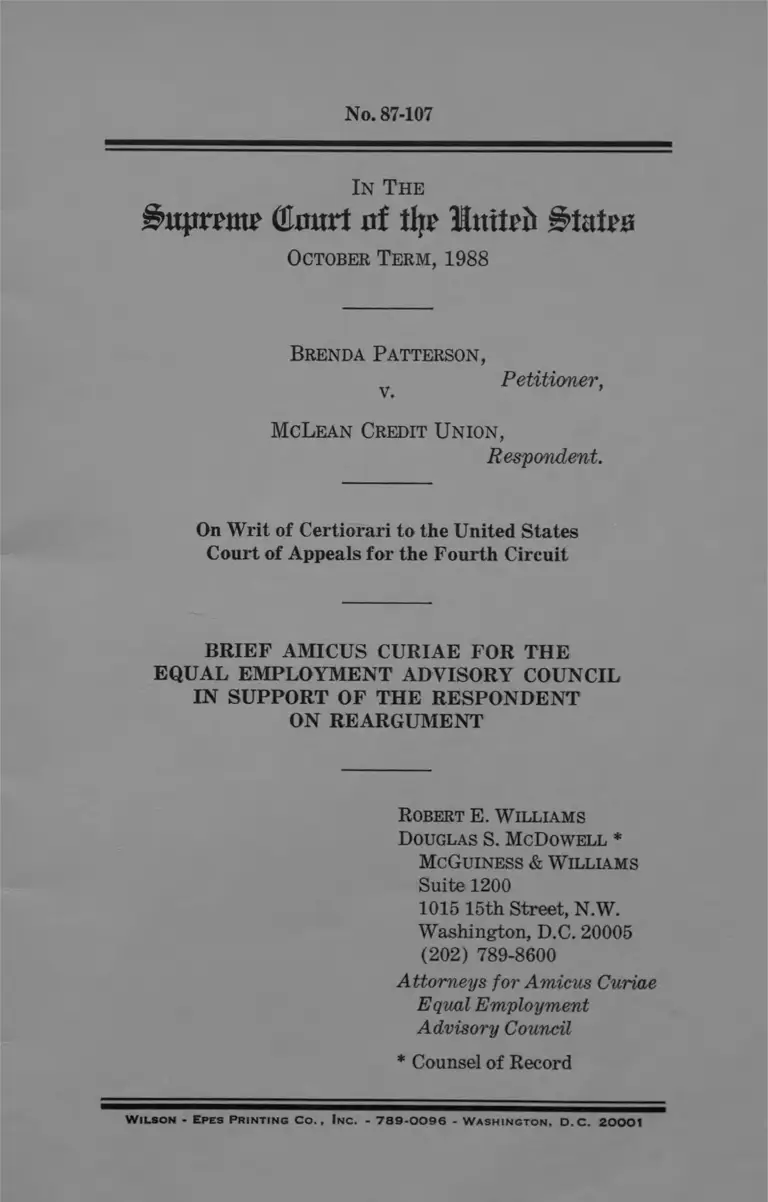
No. 87-107
In T he
Gkwrt of tip ItttJpii &tnt?B
October Term, 1988
Brenda Patterson,
v Petitioner,
McLean Credit Union,
Respondent.
On Writ of Certiorari to the United States
Court of Appeals for the Fourth Circuit
BRIEF AMICUS CURIAE FOR THE
EQUAL EMPLOYMENT ADVISORY COUNCIL
IN SUPPORT OF THE RESPONDENT
ON REARGUMENT
R obert E. W illiam s
Douglas S. McDowell *
McGuiness & W illiams
Suite 1200
1015 15th Street, NW.
Washington, D.C. 20005
(202) 789-8600
Attorneys for Amicus Curiae
Equal Employment
Advisory Council
* Counsel of Record
W il s o n - Epes P r in t in g Co . , In c . - 7 8 9 -0 0 9 6 - W a s h in g t o n , D .C . 200 01
TABLE OF CONTENTS
Page
TABLE OF CONTENTS.............. i
TABLE OF AUTHORITIES............................................ iii
INTEREST OF THE AMICUS CURIAE ....................... 1
STATEMENT OF THE CASE.......... .............................. 6
SUMMARY OF ARGUMENT.......... .......... 7
ARGUMENT ................. 8
I. THIS COURT SHOULD RECONSIDER
RUNYON v. McCRARY IN ORDER TO
ADDRESS THE FUNDAMENTAL, UNRE
SOLVED CONFLICT BETWEEN THE
LAWSUIT-ORIENTED APPROACH OF SEC
TION 1981 (WITH JURY TRIALS AND
PUNITIVE AND COMPENSATORY DAM
AGES), AND THE ADMINISTRATIVE CON
CILIATION REQUIREMENTS OF TITLE VII
—A CONFLICT THAT INTERFERES WITH
CONGRESS’ INTENTION THAT TITLE VII
BE THE PRIMARY MECHANISM TO RE
SOLVE CLAIMS OF RACE-BASED EMPLOY
MENT DISCRIMINATION ......... 8
A. Section 1981 Was Not Generally Recognized
As An Available Remedy For Employment
Discrimination When Congress Enacted And
Amended Title V I I ................ 8
B. The Remedial Schemes Established By Sec
tion 1981 And Title VII Have Fundamental
Inconsistencies ....... 10
1. Section 1981 Relies On Immediate Resort
To Litigation And Provides Remedies
That Are Fundamentally Punitive and
Undefined ........................................ 10
2. Title VII Discourages Initial Resort To
The Federal Courts And Establishes Vol
untary Compliance And Conciliation As
The Nation’s Primary Policy For Elimi
nating Employment Discrimination....... 13
C. The Conflict Between The Two Remedial
Schemes Was Not Meaningfully Addressed
In The Title VII Debates In 1964 And 1972.. 16
1. The 1964 Tower Amendment.................... 17
2. The 1972 Hruska Amendment..... ............. 18
D. Early Lower Court Decisions Recognized
The Fundamental Problems Caused By The
Coexistence Of Section 1981 And Title VII. .. 18
E. This Court’s Decisions Construing Other
Reconstruction-Era Civil Rights Statutes
Further Recognized That Court-Oriented
Private Lawsuits Imperil The Purposes Of
Title V I I .................... .................................... 21
1. Brown v. GSA ....................................... 21
2. The Novotny Decision................................ 23
F. Title VII Is Being Interpreted And Enforced
In A Manner That Protects The Rights Of
Charging Parties Consistent With Federal
Antidiscrimination Policy.......................... 24
CONCLUSION............... 28
ii
TABLE OF CONTENTS— Continued
Page
I ll
TABLE OF AUTHORITIES
Cases Page
Albemarle Paver Company v. Moody, 422 U.S. 405
(1975) ......................... 28
Alexander v. Gardner-Denver Company, 415 U.S.
36 (1974)............................... 5,16
Brady v. Bristol-Meyers, Inc., 459 F.2d 621 (8th
Cir. 1972) ....................................................... 19
Brown v. Gaston County Dyeing Machine Co., 457
F.2d 1377 (4th Cir.), cert, denied, 409 U.S. 982
(1972) ........... 19
Brown v. General Services Administration, 425
U.S. 820 (1976) ...... ..............................................7, 21, 22
Caldwell v. National Brewing Co., 443 F.2d 1044
(5th Cir. 1971), cert, denied, 405 U.S. 916
(1972) ................................................................ 19,20
Chance v. Board of Examiners, 534 F.2d 993 (2d
Cir. 1976), mod. on other grounds, 534 F.2d
1007 (2d Cir. 1976), cert, denied, 431 U.S. 965
(1977) ................ 24
Dean v. American Security Insurance Company,
559 F.2d 1036 (5th Cir. 1977), cert, denied, 434
U.S. 1066 (1978)...................................................... 22
EEOC v. Associated Dry Goods Corp., 449 U.S. 590
(1981).. ................................................................... 12,26
EEOC v. Commercial Office Products Company, 56
U.S.L.W. 4424 (U.S., May 17, 1988)................. 6, 25
EEOC v. Shell Oil Company, 466 U.S. 54 (1984).... 26
Ford Motor Co. v. EEOC, 458 U.S. 219 (1982)....... 16
General Building Contractors Ass’n, Inc. v. Penn
sylvania, 458 U.S. 375 (1982) .............................. 5,25
General Telephone Company of the Northwest, Inc.
v. EEOC, 446 U.S. 318 (1980).............................. 7, 27
General Telephone Co. of the Southwest v. Falcon,
457 U.S. 147 (1982)................................................ 27
Goodman v. LuJcens Steel Company, 107 S.Ct. 2617
(1987)......................................................................5,11,25
Great American Federal Savings & Loan Associa
tion v. Novotny, 442 U.S. 366 (1979)..................5, 7, 23
International Union of Electrical Workers v. Rob
bins & Myers, Inc., 429 U.S. 229 (1976)................ 5
IV
Johnson v. Railway Express Agency, 421 U.S. 454
(1975) ................................................................. passim
Johnson v. The Goodyear Tire & Rubber Company,
491 F.2d 1364 (5th Cir. 1974).... ........................9,10, 20
Jones v. Alfred H. Mayer Co., 392 U.S. 409 (1968).. 9,18
Lingle v. Norge Division of Magic Chef, Inc., 108
S.Ct. 1877 (1988) .......... ........................................ 5,6
Long v. Ford Motor Co., 496 F.2d 500 (6th Cir.
1974) ........ 19
Macklin v. Spector Freight Systems, Inc., 478 F.2d
979 (D.C. Cir. 1973) ... -.......................................... 19, 20
McDonald v. City of West Branch, Michigan, 466
U.S. 284 (1984) ...................... 5
Mohasco Corp. v. Silver, 447 U.S. 807 (1980)....... 15
Monell v. Dept, of Social Services of City of N.Y.,
436 U.S. 658 (1978)................................................. 4
Naton v. Bank of California, 649 F.2d 691 (9th
Cir. 1981) .............. 22
New York Gaslight Chib, Inc. v. Carey, 447 U.S.
54 (1980) ............... ................................................... 15,25
Occidental Life Ins. Co. of California v. EEOC, 432
U.S. 355 (1977)............ 14,24
Oscar Mayer & Co. v. Evans, 441 U.S. 750 (1979).. 15
Patterson v. McLean Credit Union, 108 S.Ct. 1419
(1988)... .................................................................. 4,6
Richerson v. Jones, 551 F.2d 918 (3d Cir. 1977).— 15
Rogers v. Exxon Research & Engineering Co., 550
F.2d 834 (3d Cir. 1977), cert, denied, 434 U.S.
1022 (1978).............................................................. 22
Runyon v. McCrary, 427 U.S. 160 (1976)............. 2, 5, 6, 8
Sanders v. Dobbs Houses, Inc., 431 F.2d 1097 (5th
Cir. 1970) ........................ ................................- ...... 18, 20
Sant v. Mack Trucks, Inc., 424 F. Supp. 621 (N.D.
Calif. 1976).................... 22
Slatin v. Stanford Research Institute, 590 F.2d
1292 (4th Cir. 1979)................ 22
Smith v. North American Rockwell-Tulsa Div., 50
F.R.D. 515 (N.D. Okla. 1970)
TABLE OF AUTHORITIES— Continued
Page
2 1
V
TABLE OF AUTHORITIES— Continued
Page
St. Francis College v. Al-Khazraji, 107 S.Ct. 2022
(1987) ....................................................................... 5
Taylor v. Safeway Stores, Inc., 833 F. Supp. 83
(D.Colo. 1971), modified, 524 F.2d 263 (10th
Cir. 1975) ........... ..................................................... 21
United States v. East Texas Motor Freight System,
564 F.2d 179 (5th Cir. 1977)......... ....................... 25
United States v. Trucking Management, Inc., 662
F.2d 36 (D.C. Cir. 1981)..... .................................. 24
Washington v. Davis, 426 U.S. 229 (1976).............. 25
Waters v. Wisconsin Steel Works of International
Harvester Co., 502 F.2d 1309 (7th Cir. 1974)
cert, denied, 425 U.S. 997 (1976)....... ................ 24
Waters v. Wisconsin Steel Works of International
Harvester Co., 427 F.2d 476 (7th Cir.), cert,
denied sub nom. International Harvester Co. v.
Waters, 400 U.S. 911 (1970)........... .................... 19,20
Young v. International Telephone & Telegraph Co.,
438 F.2d 757 (3d Cir. 1971)........................... ...18,19, 20
Zipes v. Trans World Airlines, Inc., 45 U.S. 385
(1985) ..................................... ................................. 25
Statutes
Age Discrimination in Employment Act of 1967,
29 U.S.C. §§ 621 et seq............................................ 22
Civil Rights Act of 1866, Section 1981, 42 U.S.C.
§ 1981..................................................................... passim
Civil Rights Act of 1964,
Title VI, 42 U.S.C. § 2000d et seq............ .......... 4
Title VII, 42 U.S.C. § 2000eetseq.....................passim
Section 706 (b ), 42 U.S.C. § 2000e-5 ......... 15, 27
Section 717, 42 U.S.C. § 2000eA6.............. 17, 22
42 U.S.C. § 1985(3)...................................................... 5,23
42 U.S.C. § 1988.......... 13
Equal Employment Opportunity Act of 1972, 42
U.S.C. § 2000e ....................................................... 14,16
National Labor Relations Act, Section 301, 29
U.S.C. § 185(a)........................................................ 5
VI
Rules and Regulations Page
Fed. R. Civ. P. 12......................................................... 7, 27
29 C.F.R. § 1601.16(b) (1) and (2) .......................... 27
29 C.F.R. § 1601.19 ....................................................... 26
29 C.F.R. § 1601.22.,............. ...................................... 12
Executive Order 11246, 30 Fed. Reg. 12319 (1965),
as amended by, 32 Ref. Reg. 14303 (1967) and
Fed. Reg. 46501 (1978) ....... .... ............................ 4
EEOC: Investigative Compliance Policy, 8 Fair
Empl. Prac. (BNA) 401:2625-2626 .................... 27
Policy Statement on Remedies and Relief for Indi
vidual Victims of Discrimination, 8 Fair Empl.
Prac. (BNA) 401: 2615-2618 .................... ........ 26
Congressional History
110 Cong. Rec. 13650-652 (1964)............................... 17
118 Cong. Rec. 3961-62 (1972)................................... 18
Debates on Hruska Amendment to Title VII of the
Civil Rights Act of 1964, reprinted in Legisla
tive History of the Equal Employment Act of
1972, 1382-1403 (1972)......................................... 18
Miscellaneous
Brief for Respondents Brotherhood of Railway
Clerks Tri-State Local and Brotherhood of Rail
way Clerks Lily of the Valley Local, Johnson v.
Railway Express Agency, 421 U.S. 454 (1975).... 11
Brief for the United States as Amicus Curiae,
Johnson v. Railway Express Agency, 421 U.S.
454 (1975) .............................................................. 4
Brooks, Use of the Civil Rights Acts of 1866 and
1871 to Redress Employment Discrimination, 62
Cornell L.Rev. 258 ................................................... 11
Note, Developments in the Law—Employment Dis
crimination and Title VII of the Civil Rights Act
of 196U, 84 Harv. L.Rev. 1109 (1971) ................. 24
Developments in the Law—Section 1981, 15 Harv.
C.R.-C.L.L. Rev. 29 (1980) ................................. 19
TABLE OF AUTHORITIES— Continued
Exhaustion of Remedies under Title VII (Equal
Employment Opportunity) of Civil Rights Act of
196) ()2 USCS §§ 2000e, et seq.) as Prerequisite
vii
TABLE OF AUTHORITIES— Continued
Page
to Maintenance of Action Under )2 USCS § 1981
for Employment Discrimination, 23 ALR Fed.
895 ............................................................................ 19
Reiss, Requiem for an “Independent Remedy” : The
Civil Rights Acts of 1866 and 1871 as Remedies
for Employment Discrimination, 50 S.Cal.L.Rev.
961 (1977) ................................................... .......... 11, 12
Richey, Manual on Employment Discrimination
and Civil Rights Actions in the Federal Courts,
Kluwer 1987............................................................ 8
Sape & Hart, Title VII Reconsidered: The Equal
Employment Opportunity Act of 1972, 40 Geo.
Wash. L.Rev. 824 (1972)... 24
Shapiro, Section 1983 Claims to Redress Discrimi
nation in Public Employment: Are They Pre
empted by Title VII? 35 Am. U.L.Rev. 93
(1985) ....................................................................... 23
In T h e
$uprm? (Exmrt nf tlp> §>tdtn\
October T e r m , 1988
No. 87-107
B ren da P a tte r so n ,
Petitioner,v.
M cL ean Credit U n io n ,
Respondent.
On Writ of Certiorari to the United States
Court of Appeals for the Fourth Circuit
BRIEF AMICUS CURIAE FOR THE
EQUAL EMPLOYMENT ADVISORY COUNCIL
IN SUPPORT OF THE RESPONDENT
ON REARGUMENT
The Equal Employment Advisory Council, with the
written consent of the parties, respectfully submits this
brief as Amicus Curiae in support of the Respondent.
The letters of consent have been filed with the Clerk of
the Court.
INTEREST OF THE AMICUS CURIAE
The Equal Employment Advisory Council is a volun
tary, nonprofit association organized to promote sound
government policies pertaining to nondiscrimination in
employment. Its membership comprises a broad segment
of the employer community in the United States, includ
ing both individual employers and trade associations.
Its governing body is a board of directors composed of
experts in equal employment opportunity and affirma
tive action. Their combined experience gives the Coun
2
cil a unique depth of understanding of the practical, as
well as the legal, aspects of equal employment policies
and requirements. All of the Council’s members are
firmly committed to the principles of nondiscrimination
and equal employment opportunity.
EEAC’s members will be directly affected by a deci
sion in this case on the issue of whether the Court should
reconsider its decision in Runyon v. McCrary, 427 U.S.
160 (1976), which held that 42 U.S.C. § 1981 prohibits
racial discrimination in the making and enforcement of
private contracts. See cdso, Johnson v. Railway Express
Agency, Inc., 421 U.S. 454 (1975) (Section 1981 affords
a federal remedy against discrimination in private em
ployment on the basis of race.) Section 1981 plaintiffs
may have their claims heard before a jury and, if suc
cessful, can receive extensive relief— including punitive
damages and compensatory damages, such as for pain
and suffering.
In resolving the issue of the reach of § 1981 and its
impact on potential plaintiffs, the Court is likely to delve
in some depth into the legislative history of § 1981 and
the intent of the sponsors when the statute was enacted
well over a century ago. That history will be covered
extensively by the parties and other amici. EEAC’s brief
does not take a position on the meaning of this history
or on whether Runyon v. McCrary should be overruled.
EEAC submits, rather, that however the Court decides
the case on the merits, reconsideration of Runyon is war
ranted because it will afford an opportunity for the Court
to address and explicate, if not resolve, the practical ef
fects of § 1981’s coexistence with other, fundamentally
inconsistent statutory schemes for remedying private em
ployment discrimination.
EEAC’s brief thus concentrates on the fact that
§ 1981 exists alongside of— and often in conflict with—
numerous other federal, state, and local employment dis
crimination statutes, executive orders, wrongful discharge
3
causes of action and collective bargaining agreements,
all of which may provide an avenue of relief for an in
dividual for the same alleged racial discrimination.
More specifically, while this Court has noted that
§ 1981 and Title VII of the 1964 Civil Rights Act, 42
U.S.C. §§ 2000e, et seq. provide “ independent] . . .
avenues of relief” (Johnson, 421 U.S. at 460), experi
ence over the past decade has shown that those avenues
not only are independent, but often are fundamentally
conflicting and antithetical. Thus, § 1981 relies exclu
sively on private individual court suits, spurred by un
defined damages designed to punish the employer and
provide damages for pain and suffering. Title VII es
chews immediate resort to the courts, requires adminis
trative investigation and conciliation, and imposes dam
ages which are primarily of a “ make whole” nature.
The fundamental policy and enforcement problems
caused by this legislative dichotomy never were addressed
in a meaningful manner, either when Title VII was en
acted in 1964, when it was amended in 1972, or in prior
decisions of this Court. What this Court says in this
case about the existing civil rights structure in terms of
its effects on enforcement, conciliation, efficiencies, in
consistencies and impact on the judiciary, will be ex
tremely important not only for the enforcement of those
statutes, but also in any future Congressional debates
related to this Court’s decision.1
The briefs in Johnson v. Railway Express did not ad
dress in any detail the negative effect on public anti-
discrimination policy of conflicting side-by-side statutory
schemes. Rather, the issue in that case was limited to
“whether the timely filing of a [Title VII] charge of
employment discrimination . . . tolls the running of the
period of limitation applicable to an action based on the
1 See Brief of 66 Members of the United States Senate and 118
Members of the United States House of Representatives as Amici
Curiae in Support of Petitioner.
same facts, instituted under 42 U.S.C. § 1981.” 421 U.S.
at 455.
Moreover, although a number of lower courts had
ruled that § 1981 prohibits private employment discrim
ination on the basis of race (see Johnson, 421 U.S. at
460-61 n.6), the Respondents in Johnson “ [did] not chal
lenge those decisions [t]here, and therefore the question
of the scope of Section 1981 [was] not before the Court.”
Brief for the United States as Amicus Curiae in John
son v. Railway Express, at 12 n.6. Thus, the Court’s
statements in Johnson that § 1981 applies to private em
ployment discrimination were not addressing the precise
issue upon which review had been granted and, conse
quently, many of the arguments advanced in this brief
were not briefed to the Court. In short, there has not
been a “ full airing of all the relevant considerations”
(Monell v. Dept, of Social Services of City of N.Y., 436
U.S. 658, 709 n.6 (1978) (Powell, J., concurring)) that
bear on the relationship between Title VII and § 1981.
In addition, in deciding this case, the Court should
keep in mind that aside from Section 1981, numerous
other avenues of relief are available for race-based em
ployment discrimination. See Patterson v. McLean Credit
Union, 108 S.Ct. 1419, 1422 (1988) (dissenting opinions
of Justices Blackmun and Stevens). For example, an
individual employed by a federal contractor with at least
15 employees has numerous independent avenues of re
lief wholly apart from § 1981, each of which may be
pursued simultaneously. These include:
— Title VII;
-—Executive Order 11246;
— Title VI of the Civil Rights Act of 1964, 42 U.S.C.
§ 2000d, et seq. (if the employer receives federal
financial assistance);
— anti-discrimination statutes in virtually every
State, and numerous local statutes and ordinances;
4
5
— state and local executive orders prohibiting dis
crimination and requiring affirmative action;
— state court suits (where available) for wrongful
discharge based upon contract, tort or other theo
ries (often with jury trials and punitive and com
pensatory damages) ; 12 and
— grievance proceedings, arbitration and federal
suits under § 301 of the National Labor Relations
Act for breach of collective bargaining obligations
where a union contract exists.8
Thus, at least with respect to employment discrimina
tion, even if Runyon v. McCrary is reversed, employers
still will have substantial incentives to avoid employ
ment discrimination.
EEAC is well-qualified to brief the Court on the im
plications of its decision in this case on federal civil
rights enforcement, having participated as amicus curiae
in the initial briefing of this case, as well as in numer
ous other cases involving § 1981 and Title VII issues.2 * 4
2 See Lingle v. Norge Division of Magic Chef, Inc., 108 S.Ct. 1877
(1988), which increases the ability of plaintiffs to sue under various
state wrongful discharge theories even if a collective bargaining
agreement also applies to the same situation.
8 See Alexander v. Gardner-Denver Company, 415 U.S. 36 (1974)
(right to sue under Title VII not encumbered by prior submission
of claim to arbitration) ; International Union of Electrical Workers
v. Robbins & Myers, Inc., 429 U.S. 229 (1976) (filing a grievance
under a collective bargaining agreement does not toll Title VII’s
charge filing requirements) ; and McDonald v. City of West Branch,
Michigan, 466 U.S. 284 (1984) (no preclusive effect need be given to
labor arbitration awards).
4 See, e.g., Goodman v. Lukens Steel Company, 107 S.Ct. 2617
(1987) (Section 1981 statute of limitations) ; St. Francis College
v. Al-Khazraji, 107 S.Ct. 2022 (1987) (Section 1981 and national
origin discrimination) ; General Building Contractors Ass’n, Inc. v.
Pennsylvania, 458 U.S. 375 (1982) (Section 1981 standard of
proof) ; Great American Savings & Loan Assn. v. Novotny, 422
U.S. 366 (1979) (42 U.S.C. § 1985(3) does not apply to a conspiracy
to violate Title VII) ; IUE, Local 790 v. Robbins & Meyers, 429
6
STATEMENT OF THE CASE
This case arose out of a race-based discrimination suit
filed by Brenda Patterson under 42 U.S.C. § 1981. She
alleged that she had been a victim of race discrimination
by her employer. In particular, she alleged that she was
subjected to racially-motivated harassment and that she
was denied a promotion because of her race. Her claim
of promotion discrimination was submitted to a jury,
which returned a verdict for the employer. The correct
ness of the district court’s jury instruction on the pro
motion issue was considered in the first hearing before
this Court, and EEAC’s initial brief argued that the in
struction was correct.
Also at issue was whether the Fourth Circuit was cor
rect in ruling that a claim for racial harassment is not
cognizable under § 1981. These issues were not addressed
by EEAC nor resolved by the Court, which instead or
dered reargument on the following question:
Whether or not the interpretation of 42 U.S.C. § 1981
adopted by this Court in Runyon v. McCrary, 427
U.S. 160 . . . should be reconsidered.
In dissenting from this order, Justice Blackmun stated
that it is “probably true that most racial discrimination
in the employment context will continue to be redress-
able under other statutes. . . .” Patterson v. McLean
Credit Union, 108 S.Ct. 1419, 1422 (1988). Similarly,
Justice Stevens’ dissenting opinion pointed out that . .
the present case involves a claim of discrimination in
the workplace, an area of the law where there is sub
stantial overlap between 42 U.S.C. § 1981 and Title VII
. . . 42 U.S.C. § 2000e, et seq.” Id. It is the interrela
U.S. 229 (1976); EEOC v. Commercial Office Products Company, 56
U.S.L.W. 4424 (U.S., May 17, 1988) (analysis of Title VII’s re
quirement of deferral to state agencies as an alternative to court
suit) ; and Lingle v. Norge Division of Magic Chef, Inc., 107 S.Ct.
1877 (1988) (effect of federal law on state wrongful discharge
suits).
7
tionship between these two statutory schemes that is the
primary focus of this amicus curiae brief.
SUMMARY OF ARGUMENT
In discussing the applicability of § 1981 to employment
discrimination, this Court has stated that § 1981 and
Title VII provide “ independ [ent] avenues of relief”
(.Johnson v. Railway Express Agency, Inc., 421 U.S. 454,
460 (1975)). The Court, however, also has recognized
that the filing of a § 1981 suit can deter Title VII con
ciliation and that such a lawsuit is “privately oriented
and narrow, rather than broad, in application, as suc
cessful [Title VII] conciliation tends to be.” Id., 421
U.S. at 461.
Thus, this and other courts often have expressed con
cerns that because of Title VII’s administrative require
ments, § 1981 will, “by perverse operation of a type of
Gresham’s law” drive the use of Title VII “ out of cur
rency.” Brown v. General Services Administration, 425
U.S. 820, 833 (1976). See also Great American Federal
Savings & Loan Association v. Novotny, 442 U.S. 366,
376 (1979) (“ Perhaps most importantly, the complaint
could completely bypass the administrative process which
plays such a crucial role in the scheme established by
Congress in Title VII.” ). Because § 1981 was not widely
used in the employment context until after the 1972 Title
VII debates, Congress has never addressed meaningfully
the fundamental inconsistencies between the two statutes.
Moreover, this Court’s Title VII decisions provide
many benefits for charging parties. Liberal construction
of time filing requirements, and the EEOC’s investiga
tory and enforcement authority, have assured that the
EEOC— unlike private litigants— can pursue enforcement
actions that “are not limited to the claims presented by
the charging parties” and are unencumbered by the lim
ited class representative requirements of Rule 23, Fed.
R.Civ. Pro. General Telephone Company of the North
west, Inc. v. EEOC, 446 U.S. 318, 331 (1980).
8
Private plaintiffs alleging employment discrimination
have multiple avenues of relief besides § 1981, including
Title VII, state and local laws and executive orders,
wrongful discharge suits and collectively bargained
dispute-resolution mechanisms. But as this brief shows,
Title VII and § 1981 often work at cross purposes. As a
result, the use of § 1981 to cover employment discrim
ination may be impeding Congressional intent that Title
VII be the primary means of dealing with employment
discrimination on the federal level.
ARGUMENT
I. THIS COURT SHOULD RECONSIDER RUNYON v,
McCRARY IN ORDER TO ADDRESS THE FUNDA
MENTAL, UNRESOLVED CONFLICT BETWEEN
THE LAWSUIT-ORIENTED APPROACH OF SEC
TION 1981 (WITH JURY TRIALS AND PUNITIVE
AND COMPENSATORY DAMAGES), AND THE
ADMINISTRATIVE CONCILIATION REQUIRE
MENTS OF TITLE VII—A CONFLICT THAT IN
TERFERES W ITH CONGRESS’ INTENTION THAT
TITLE VII BE THE PRIMARY MECHANISM TO
RESOLVE CLAIMS OF RACE-BASED EMPLOY
MENT DISCRIMINATION
A. Section 1981 Was Not Generally Recognized As An
Available Remedy For Employment Discrimination
When Congress Enacted And Amended Title VII
Despite the extensive arguments over the legislative
history of the 1866 Civil Rights Act set out in the briefs
of Petitioner and supporting amici, there is no real ques
tion that § 1981 “ lay essentially dormant” for more than
a century before it was used in any meaningful manner
in the employment discrimination context.® Indeed, it was
8 Richey, Manual on Employment Discrimination and Civil Rights
Actions in the Federal Courts, at D-l (1987). Unlike Title VII,
Section 1981 does not mention employment discrimination and has
no administrative enforcement mechanism. Rather, immediate re
sort to the federal courts is required under § 1981, which provides:
[Continued]
9
not until the 1968 decision in Jones v. Alfred H. Mayer
Co., 392 U.S. 409 (1968), that the Court held that § 1981
provided a right to an individual to sue for racial dis
crimination in private, as well as public, sale or rental
of property. Until that decision, there had been no con
clusive ruling by the Court that § 1981 was not limited
to contract-related discrimination by public entities.
Moreover, it was not for another seven years, until
1975, that the Court stated that § 1981 affords a federal
remedy against discrimination in private employment on
the basis of race. Johnson v. Railway Express Agency,
Inc., 421 U.S. 454, 460 (1975). Thus, this Court’s ruling
on this crucial issue was not handed down until after
the Congressional Title VII debates in 1964 and 1972—
the only two times when Congress has taken a compre
hensive look at race-based employment discrimination.
Any meaningful discussion of the use of § 1981 to
remedy employment discrimination must recognize that
until the mid-1960’s, there was— as a practical matter—
no useful federal remedy for employment discrimination.
Indeed, although the Fifth Circuit preceded this Court in
finding a § 1981 cause of action for employment claims,
it also limited back pay under § 1981 to the effective date
of Title VII. See Johnson v. The Goodyear Tire & Rub
ber Company, 491 F.2d 1364, 1378 (5th Cir. 1974). The
Fifth Circuit stated:
We think that a balancing of equities presented by
the whole area of employment discrimination de
mands that back pay claims under § 1981 be limited
to July 2, 1965, the effective date of Title VII. It
was not until that date that the employers clearly 5
5 [Continued]
All persons within the jurisdiction of the United States shall
have the same right in every State and Territory to make and
enforce contracts, to sue, be parties, give evidence, and to the
full and equal benefit of all laws and proceedings for the secu
rity of persons and property as is enjoyed by white citizens,
and shall be subject to like punishment, pains, penalties, taxes,
licenses, and exactions of every kind, and to no other.
became aware that they would be held accountable
for employment discrimination. Our revitalization
of § 1981 did not occur until 1970. In our opinion,
it would be unjust to impose liability before the ef
fective date of Title VII even though we are aware
that the two provisions have been interpreted to be
procedurally independent in our Circuit.
491 F.2d at 1378-79 (emphasis added). Thus, in the
1970’s, there was no experience as to how effectively
§ 1981 would work in carrying out a long-dormant Con
gressional mandate to eliminate private employment dis
crimination. This Court may consider on rehearing
whether there was, in fact, any such mandate from the
Congress that passed the Reconstruction-Era Civil Rights
statutes in the mid-1860’s. But, regardless of how the
Court ultimately rules, its reconsideration of that issue
should not be undertaken in a historical vacuum. The
Court is now in a position to assess the practical impli
cations of § 1981’s coexistence with other, more recently
enacted remedies for employment discrimination, and
this case presents a rare vehicle in which to do so.
B. The Remedial Schemes Established By Section 1981
And Title VII Have Fundamental Inconsistencies
1. Section 1981 Relies On Immediate Resort To
Litigation And Provides Remedies That Are
Fundamentally Punitive And Undefined
Section 1981 relies for its enforcement on direct resort
to civil litigation. Its remedies are essentially punitive
and undefined. It provides several important procedural
inducements to plaintiffs that are not available to Title
VII charging parties. These inducements include:
—punitive damages;
— compensatory damages (including damages for
pain and suffering;
—jury trials;
— longer statutes of limitations;
— no need to wait for the EEOC to investigate the
charge and issue a right-to-sue letter; and
10
11
—no limitation on back pay to two years prior to
the filing of a charge.6
In practice, these procedures are often used to extract
from defendants settlements that bear little relationship
to the degree of damages suffered by the plaintiff.
As one commentator has pointed out, the “ fiscal con
sequences” of proceeding under 1981 can be enormous.
Brooks, Use of the Civil Rights Acts of 1866 and 1871
to Redress Employment Discrimination, 62 Cornell L.
Rev. 258, 285 (1977). “ Compensatory and punitive dam
ages—both available under the Reconstruction Acts—
can easily amount to millions of dollars.” Id., at 285.
Thus, the possibility of recovering such damages “ encour
ages plaintiffs to seek redress in the many cases where
actual injury is too small to warrant a suit for com
pensatory damages alone.” Id., at 287.
Indeed, because of the large potential damages awards,
there is a great deal of truth to the now-standard irony
shared by employment discrimination litigators that it
is virtually malpractice for a plaintiff’s attorney to file
a Title VII charge with the Equal Employment Oppor
tunity Commission (EEOC) in a race-discrimination
case, instead of filing a federal or state court suit under
§1981 and some theory of wrongful discharge where
available.7
Moreover, even when a Title VII charge is filed, a
§ 1981 complaint also may be filed as the same time, or
at some later time before the longer § 1981 limitations
8 See Brief for Petitioner on the merits, at pp. 58-61; Johnson
v. Railway Express, 421 U.S. at 460 (jury; damages; back pay);
and Goodman v. Lukens Steel Co., 107 S.Ct. 2617 (1987) (limitations
period). See also, Reiss, Requiem for an “Independent Remedy” :
The Civil Rights Acts of 1866 and 1871 as Remedies for Employ
ment Discrimination, 50 S.Cal.L.Rev. 961, 965-970 (1977).
7 See Brooks, 62 Cornell L.Rev. at 260, which argued that “ it is
prudent for an attorney to file suit under more than one statutory
provision, so as to assure survival of the action beyond the pretrial
stage and maximize the chances for success at trial.
12
period runs out. As was pointed out to the Court in
Johnson v. Railway Express:
the fact is that Section 1981 is commonly thrown
into complaints based on Title VII principally for
the purpose of avoiding defects in the complaint
arising out of failure to comply with one or more
of the requirements of Title VII.8
The Title VII charge may be broader in scope than
the § 1981 complaint, as, for example, when a charge
alleging race and sex discrimination under Title VII is
filed concurrently with a § 1981 race claim. This may
lead to procedural complications if the cases are con
solidated for trial. For example, the Court may deter
mine that the race discrimination issues are appropriate
for jury consideration but the sex discrimination claims
are not.
Another common plaintiff’s tactic is to file a Title VII
charge, thereby triggering an EEOC investigation which
is conducted at agency expense and which costs nothing to
the chargeing party or his attorney. Often this investiga
tion is lengthy and complex and a great deal of informa
tion is developed. The information in the EEOC’s investi
gative files must be turned over to the charging party or
his attorney once his Title VII suit is “ instituted.” See 29
C.F.R. 1601.22 (1979) ; and EEOC v. Associated Dry
Goods Corp., 449 U.S. 590 (1981).
The information developed by EEOC thus can be used
as the basis for the plaintiff’s private lawsuit. Typically,
the plaintiff’s complaint will be based on § 1981, as well
as Title VII. Since the limitations period for filing a
8 Brief for Respondents Brotherhood of Railway Clerks Tri-State
Local and Brotherhood of Railway Clerks Lily of the Valley Local,
p. 16, Johnson v. Railway Express Agency, 421 U.S. 454 (1975). See
also Reiss, 50 S.Cal.Rev. at 1025:
The primary present use of the Civil Rights Acts of 1866 and
1871, therefore, is simply as a safeguard against the procedural
pitfalls of Title VII, in areas covered by that statute. No plain
tiff should fail to allege claims under one or more of these
statutes and Title VII, whenever applicable. (Emphasis in
original)
§ 1981 suit often will not run out until after the EEOC
investigation is complete, the case can proceed through
the EEOC investigation and conciliation periods before
the employer is even aware that a § 1981 suit is con
templated.
A plaintiff thus can obtain the relevant information
for a private suit without incurring substantial attor
ney’s fees for this investigation that would not be award-
able unless he prevailed at trial. See 42 U.S.C. § 1988,
which provides attorney’s fees only to a “ prevailing
party.” This tactic essentially subverts Title VII’s em
phasis on conciliation and administrative resolution of
charges.
As this discussion demonstrates, § 1981 provides sig
nificant inducements to plaintiffs and their counsel, who,
not surprisingly, regularly resort to § 1981 even when
proceeding simultaneously under Title VII. But, as now
shown, encouraging such dual proceedings tends to thwart
the public interest and the goals established by Congress
in enacting Title VII.
2. Title VII Discourages Initial Resort To The Fed
eral Courts And Establishes Voluntary Compli
ance And Conciliation As The Nation’s Primary
Policy For Eliminating Employment Discrimi
nation
Even though this Court has stated that Title VII and
§ 1981 provide independent avenues of relief, it also has
recognized the inherent conflict between these statutes.
Thus, the Court stated in Johnson v. Railway Express,
421 U.S. at 461:
We recognize, too, that the filing of a lawsuit [under
§ 1981] might tend to deter efforts at conciliation,
that lack of success in the legal action could weaken
the Commission’s efforts to induce voluntary com
pliance, and that a suit is privately oriented and
narrow, rather than broad, in application, as suc
cessful conciliation tends to be.
14
A review of Title VIPs administrative scheme demon
strates the fundamental differences from § 1981.
The primary focus of Title VII is on administrative
enforcement and voluntary compliance, not on federal
court litigation. Thus:
In the Equal Employment Opportunity Act of 1972
Congress established an integrated, multistep en
forcement procedure culminating in the EEOC’s
authority to bring a civil action in a federal court.
That procedure begins when a charge is filed with
the EEOC alleging that an employer has engaged in
an unlawful employment practice. A charge must
be filed within 180 days after the occurrence of the
allegedly unlawful practice, and the EEOC is di
rected to serve notice of the charge on the employer
within 10 days of filing. The EEOC is then required
to investigate the charge and determine whether
there is reasonable cause to believe that it is true.
This determination is to be made “ as promptly as
possible and, so far as practicable, not later than one
hundred and twenty days from the filing of the
charge.” If the EEOC finds that there is reasonable
cause it “ shall endeavor to eliminate any such alleged
unlawful employment practice by informal methods
of conference, conciliation, and persuasion.” When
“ the Commission [is] unable to secure . . . a concilia
tion agreement acceptable to the Commission, the
Commission may bring a civil action against any
respondent. . . .”
Occidental Life Ins. Co. of California v. EEOC, 432 U.S.
355,359-60 (1977) (footnotes omitted).
Indeed, Title VII not only provides for prior review
by the EEOC; it also contains the requirement that state
agencies be given:
an opportunity to redress the evil at which the fed
eral legislation was aimed, and to avoid federal in
tervention unless its need was demonstrated. . . .
Congress chose to prohibit the filing of any federal
charge until after state proceedings had been com
pleted, or until 60 days had passed, whichever came
sooner.
15
Mohasco Corp. v. Silver, 447 U.S. 807, 821 (1980) (em
phasis added). Accord, Oscar Mayer & Co. v. Evans, 441
U.S. 750, 755 (1979) (deferral provisions give state
agencies an opportunity “ to resolve problems of employ
ment discrimination and thereby to make unnecessary,
resort to federal relief by victims of discrimination” ).
Thus, Section 706(b) of Title VII was “ clearly in
tended to increase the role of States and localities in re
solving charges of employment discrimination.” 447 U.S.
at 820.
Congress viewed proceedings before the EEOC and
in federal court as supplements to available state
remedies for employment discrimination. Initial re
sort to state and local remedies is mandated, and
recourse to the federal forums is appropriate only
when the State does not provide prompt or complete
relief.
New York Gaslight Club, Inc., v. Carey, 447 U.S. 54, 65
(1980) (awarding Title VII attorney’s fees to the charg
ing party for legal work performed before the state
deferral agency) (emphasis added).
In addition to this preference for administrative en
forcement, Title VII does not provide for a jury trial,
and its “make whole” remedial provisions do not pro
vide for punitive or compensatory damages (such as
damages for pain and suffering.) See Richerson v. Jones,
551 F.2d 918, 926-28 (3d Cir. 1977), and cases cited.
Instead, Title VII’s thrust is to encourage conciliation
and resolution without resort to federal court litigation.
Congress enacted Title VII of the Civil Rights Act of
1964, 42 U.S.C. § 2000e et seq., to assure equality of
employment opportunities by eliminating those prac
tices and devices that discriminate on the basis of
race, color, religion, sex, or national origin. . . Co
operation and voluntary compliance were selected as
the preferred means for achieving this goal. To this
end, Congress created the Equal Employment Oppor
tunity Commission and established a procedure
whereby existing state and local equal employment
16
opportunity agencies, as well as the Commission,
would have an opportunity to settle disputes through
conference, conciliation, and persuasion before the
aggrieved party was permitted to file a lawsuit. In
the Equal Employment Opportunity Act of 1972,
Pub. L. 92-261, 86 Stat. 103, Congress amended
Title VII to provide the Commission with further
authority to investigate individual charges of dis
crimination, to promote voluntary compliance with
the_ requirements of Title VII, and to institute civil
actions against employers or unions named in a dis
crimination charge.
Alexander v. Gardner-Denver Co,, 415 U.S. 36, 44 (1974)
(emphasis added). Accord, Ford Motor Co., v. EEOC,
458 U.S. 219, 228 (1982), (voluntary compliance can end
“ discrimination far more quickly than could litigation
proceeding at its often ponderous pace” ) .
As we will show more fully below, these fundamental
differences between Title VII and § 1981 were never fully
considered by Congress or by this Court in Johnson, but
they have bedeviled the courts ever since § 1981 came to
be recognized as providing a remedy for race-based em
ployment discrimination.
C. The Conflict Between The Two Remedial Schemes
Was Not Meaningfully Addressed In The Title VII
Debates in 1964 and 1972
Because § 1981 has only recently been applied to pri
vate contracts, there was very little judicial analysis of
its impact on employment discrimination in existence
when Congress enacted and amended Title VII. Thus, it
is not surprising that the Congressional Title VII de
bates provided little insight into whether § 1981 and
Title VII were compatible. To read the briefs of Peti
tioner and supporting amici, one would gain the impres
sion that Congress had made a reasoned policy decision
after taking the Reconstruction Era legislation into ac
count. That, however, simply was not the case.
The two most pertinent pieces of legislative history
were the rejection of two amendments— the Tower
17
Amendment in 1964 and the Hruska Amendment in
1972. In neither instance did Congress show any aware
ness of the problems it was creating by the juxtaposition
of two quite different statutory schemes.
1. The 1964 Tower Amendment
The Petitioner argues that when Congress in 1964 re
jected Senator Tower’s Amendment which would have
made Title VII the exclusive remedy for employment dis
crimination, it was “ clear that members of the Senate,
including Senator Ervin, believed that § 1981 already
prohibited such private discrimination,” and that the
Senate’s rejection of the Tower Amendment, “ma[de]
clear its intent to retain other statutory remedies.” Peti
tioner’s Brief on Reargument at 76.
The Tower Amendment, however, was not directed at
limiting private suits brought under § 1981— indeed,
§ 1981 was not even mentioned in the debates. 110 Cong.
Rec. 13650-13652 (1964). Rather, the Tower Amend
ment was intended to “preclude the harassment of busi
nessmen, companies, or unions by more than one Fed
eral agency.” 110 Cong. Rec. at 13650. The Amendment
stated:
Exclusive Remedy
Sec. 717. Beginning on the effective date of Section
703, 704, 706, and 707 of this title, as provided in
section 716, the provisions of this title shall con
stitute the exclusive means whereby any department,
agency, or instrument in the executive branch of the
Government or any independent agency of the
United States, may grant or seek relief from, or pur
sue any remedy with respect to, any employment
practice of any employer, employment agency, labor
organization, or joint labor-management committee
covered by this title, if such employment practice
may be the subject of a charge or complaint filed
under this title.
Id. Thus, the amendment had nothing to do with pri
vately-filed court suits: it was directed only at prevent
ing simultaneous investigations by “ EEOC and the vari
18
ous departments charged with enforcing the provisions
of the President’s Equal Employment Commission’s rules
for Federal contractors.” Id.
2. The 1972 Hruska Amendment
In the 1972 Title VII debates, the Senate rejected an
amendment proposed by Senator Hruska to the effect that
a charge filed under Title VII “ shall be the exclusive
remedy of any person claiming to be aggrieved by an
unlawful employment practice of an employer, employ
ment agency or labor organization.” Debates on Hruska
Amendment to Title VII of the Civil Rights Act of 1964,
reprinted in Legislative History of the Equal Employ
ment Act of 1972, 1382 (1972). At several points, § 1981
was mentioned as an alternative avenue of relief that
was not to be eliminated. Id. at 1402, 1403 (citing Jones
v. A. M ayer). Also the House Report cited to two cases
which had applied § 1981 to private employment discrim
ination. See Sanders v. Dobbs Houses, Inc., 431 F.2d
1097 (5th Cir. 1970) ; and Young v. International Tele
phone & Telegraph Co., 438 F.2d 757 (3d Cir. 1971).
But the debates on this point were fairly perfunctory,
and— except for the differences in statutes of limitations
(118 Cong. Rec. 3961-62 (1972))— did not delve into the
divergent paths taken by these two statutes, nor into
the problems which this divergence could cause. More
over, the brief reference to the decided cases mentioned
above failed to point out that the federal courts had im
mediately recognized the potential problems that Con
gress had created and then overlooked.
D. Early Lower Court Decisions Recognized The Fun
damental Problems Caused By The Coexistence Of
§ 1981 and Title VII
Around the time that Congress amended Title VII in
1972 and expanded EEOC’s investigatory and enforce
ment authority, a number of lower courts found that
§ 1981 could be used as a parallel means to pursue em
19
ployment discrimination.9 Unlike Congress, however,
these courts immediately were bothered by the incon
sistencies in the statutes and tried to find a way to ac
commodate the two in order to preserve Title VIFs pur
poses of voluntary compliance and conciliation.
Thus, several circuits held that “ while Title VII can
impose no absolute procedural prerequisites on section
1981 litigation, allowing premature diversion of employ
ment discrimination claims into court, would weaken Ti
tle VII conciliation efforts.” Developments in the Law—
Section 1981, 15 Harv. C.R.-C.L.L. Rev. 29, 240-241
(1980).10 * 12
The most thoughtful discussion was found in Waters
v. Wisconsin Steel Works of International Harvester Co.,
427 F.2d 476, 486-88 (7th Cir. 1970), cert, denied sub
nom. International Harvester Co. v. Waters, 400 U.S.
911 (1970). Although recognizing that Congress had
allowed Title VII charging parties to by-pass the EEOC
and go directly to court under Title VII, the Waters
decision also stated that:
Despite these indications we are convinced that had
Congress been aware of the existence of a cause of
action under section 1981, the absolute right to sue
9 A number of these cases were cited in Johnson v. Railway
Express, 421 U.S. at 460-61 n.6. See Young v. International Tel.
& Tel. Co., 438 F.2d 757 (3d Cir. 1971); Brown v. Gaston County
Dyeing Machine Co., 457 F.2d 1377 (4th Cir. 1971), cert, denied,
409 U.S. 982 (1972) ; Caldwell v. National Brewing Co., 443 F.2d
1044 (5th Cir. 1971), cert, denied 405 U.S. 916 (1972); Long v. Ford
Motor Co., 496 F.2d 500 (6th Cir. 1974); Waters v. Wisconsin Steel
Works, 427 F.2d 476 (7th Cir.), cert, denied sub nom. International
Harvester Co. v. Waters, 400 U.S. 911 (1970) ; Brady v. Bristol-
Meyers, Inc., 459 F.2d 621 (8th Cir. 1972); Macklin v. Spector
Freight Systems, Inc., 478 F.2d 979 (D.C. Cir. 1973).
10 See also, Exhaustion of Remedies under Title VII (Equal Em
ployment Opportunity) of Civil Rights Act of 1961 (12 USCS
§§ 2000e, et seq.) as Prerequisite to Maintenance of Action Under
12 USCS §1981 for Employment Discrimination, 23 ALR Fed
895, 903-916.
20
under that section would have been modified.
Throughout the legislative history of Title VII, Con
gress expressed strong preference for resolution of
disputes by conciliation rather than court action.
Conciliation was favored for many reasons. By es
tablishing the EEOC Congress provided an inexpen
sive and uncomplicated remedy for aggrieved parties,
most of whom were poor and unsophisticated. Con
ciliation also was designed to allow a respondent to
rectify or explain his action without the public con
demnation resulting from a more formal proceeding.
Furthermore, the absence of direct government coer
cion was thought to lessen the antagonism between
parties and to encourage reasonable settlement. The
need for voluntary compliance was stressed since
more coercive remedies were likely to inflame re
spondents and encourage them to employ subtle
forms of discrimination.
427 F.2d at 486-87 (emphasis added).
Because Congress placed such strong emphasis on con
ciliation, the Waters decision concluded: “we do not
think that aggrieved persons should be allowed inten
tionally to by-pass the Commission without good cause.”
Id. Thus, the court held that “ an aggrieved person may
sue directly under section 1981 if he pleads a reasonable
excuse for his failure to exhaust EEOC remedies.” Id.
The other courts of appeals did not go so far as to
require the § 1981 plaintiff to prove that he had a reason
able excuse for not exhausting Title VII remedies. How
ever, in order to encourage the use of EEOC concilia
tion facilities, they either ordered or suggested that the
district courts stay the proceedings in the § 1981 suit
until conciliation procedures under Title VII were car
ried out.11 Some of the district courts discussed the
11 See Young v. International Telephone & Telegraph Co., 438
F.2d at 764; Caldwell v. The National Brewing Company, 443 F.2d
at 1046; Sanders v. Dobbs Houses, Inc., 431 F.2d at 1101; Macklin
v. Spector Freight Systems, Inc., 478 F.2d at 997. See also Johnson
v. Goodyear Tire & Rubber Co., 491 F.2d at 1379 (Back pay under
§ 1981 cannot begin prior to the effective date of Title V II).
21
problem in harsher terms, recognizing that to entertain
claims simultaneously under Title VII and § 1981 “would
make Title VII . . . a redundancy and in large part an
absurdity.” Smith v. North American Rockwell— Tulsa
Div., 50 F.R.D. 515, 518 (N.D. Okla. 1970), quoted on
this point in Taylor v. Safeway Stores, Inc., 333 F. Supp.
83, 87 (D. Colo. 1971).12
E. This Court’s Decisions Construing Other Recon
struction-Era Civil Rights Statutes Further Recog
nized That Court-Oriented Private Lawsuits Imperil
The Purposes Of Title VII
As noted above, this Court’s decision in Johnson v.
Railway Express pointed out the negative impact that
§ 1981 employment discrimination litigation would have
on the proper enforcement of Title VII. But the Court
concluded that because Congress had made the choice to
permit two avenues of relief, the Court was “disin
clined. . . to infer any positive preference for one over
the other. . . 421 U.S. at 461. But when construing
other Reconstruction-Era statutes, the Court has been
quite inclined to preserve the Title VII administrative
enforcement system to the exclusion of private litigation.
1. Brown v. GSA
Thus, in Brown v. General Services Administration,
425 U.S. 820 (1976), the Court held that Title VII is the
exclusive remedy for claims of employment discrimina
tion in federal employment and that the plaintiff could
not also sue under § 1981. The Court concluded that the
administrative and judicial remedies of Title VII were
intended to provide exclusive relief and rejected asser
tions that this system could coexist with other judicial
action. The Court stated:
12 The court of appeals subsequently remanded Taylor on this
point, 524 F.2d 263, 274-75 (10th Cir. 1975), following the issuance
of this Court’s decision in Johnson, but did not provide any further
analysis of or solutions to the practical problems discussed in the
district court’s opinion.
22
Under the petitioner’s theory, by perverse opera
tion of a type of Gresham’s law, § 717 [of Title
VII], with its rigorous administrative exhaustion
requirements and time limitations, would be driven
out of currency were immediate access to the courts
under other, less demanding statutes permissible.
425 U.S. at 833.13 The Brown decision also expressed
concern that the administrative role that Congress gave
the enforcement agencies “would be eliminated ‘by the
simple expedient of putting a different label on [the]
pleadings.’ ” Id., at 833. The Court in Brown concluded
that “ [i]t would require the suspension of disbelief to
ascribe to Congress the design to allow its careful and
thorough remedial scheme to be circumvented by artful
pleading.” Id.
Johnson v. Railway Express was distinguished in
Broivn— not on policy grounds— but on the fact that the
legislative history of Title VII had recognized the exist
ence of the right of private sector employees to sue under
§ 1981 but had seen no corresponding pre-existing right
for federal employees. Id., at 83. But this distinction in
13 Courts construing- the Age Discrimination in Employment Act
of 1967, 29 U.S.C. § 621, et seq., also have recognized that permitting
claims for compensatory and punitive damages would interfere with
statutorily-mandated conciliation. See e.g., Rogers v. Exxon Re
search & Engineering Co., 550 F.2d 834, 840-41 (3d Cir. 1977),
cert, denied, 434 U.S. 1022 (1978). The court noted that introduc
ing the “vague and amorphous concept” of pain and suffering dam
ages into the administrative setting “might strengthen the claim
ant’s bargaining position” but it also would “ introduce an element
of uncertainty which would impair the conciliation process.” 550
F.2d at 841. The court also noted that “ [t]he possibility of recover
ing a large verdict for pain and suffering will make a claimant less
than enthusiastic about accepting a settlement for only out-of-
pocket loss in the administrative phase of the case.” Id.
Accord, Slatin v. Stanford Research Institute, 590 F.2d 1292, 1296
(4th Cir. 1979); Naton v. Bank of California, 649 F.2d 691, 699
(9th Cir. 1981); Dean v. American Security Insurance Company,
559 F.2d 1036, 1038 (5th Cir. 1977), cert, denied, 434 U.S. 1066
(1978); and Sant v. Mack Trucks, Inc., 424 F. Supp. 621, 622 (N.D.
Calif. 1976).
23
no way solves the problems created by private sector
§ 1981 suits. It would be naive, at best, to think that
§ 1981 plaintiffs and their attorneys will be more likely
to allow their claims to be pursued under Title VII’s re
quirements merely because the employer operates in the
private sector.
2. The Novotny Decision
The Court was bothered by identical concerns when it
held that 42 U.S.C. § 1985(3) does not allow a private
federal suit for an alleged conspiracy to deprive an in
dividual of his Title VII rights. See Great American
Federal Savings & Loan Association v. Novotny, 442 U.S.
366, 372-78 (1979). There, the Court noted that if a
private suit were permitted alongside Title VII, “ [t]he
short and precise time limitations of Title VII would be
grossly altered.” 442 U.S. at 376. And “ [plerhaps most
importantly, the complaint could completely bypass the
administrative process, which plays such a crucial role
in the scheme established by Congress in Title VII.” Id.u
What this discussion shows, therefore, is that after
years of consideration of the national problem of employ
ment discrimination, Congress enacted Title VII as the
primary means of enforcement. It also established a sys
tem of administrative requirements that was intended to
avoid litigation where possible and to encourage the par
ties and the EEOC to resolve disputes through concilia
tion and voluntary compliance. Yet the current state of
the decisional law is that, because Congress allowed
§ 1981 to be used against employment discrimination, the
plaintiff need only file a § 1981 pleading in federal court
to frustrate the entire Title VII scheme. 14
14 See also, Shapiro, Section 1983 Claims to Redress Discrimina
tion in Public Employment: Are They Preempted by Title VII?,
35 Am. U.L.Rev. 93, 112 (1985).
24
F. Title VII Is Being Interpreted And Enforced In A
Manner That Protects The Rights Of Charging Par
ties Consistent With Federal Antidiscrimination
Policy
As this Court has recognized repeatedly, Title VIPs
legislative history demonstrates that its detailed admin-
istrative/judicial enforcement machinery was carefully
designed to balance the competing interests involved in
an employment discrimination complaint. See, e.g., Occi
dental Life Insurance Co. of California v. EEOC, 432
U.S. at 355, 359, 372-73. Delegation of enforcement au
thority to the Commission shifts the burden of prosecu
tion from the individual complainant, assures employees
that the agency issuing discrimination guidelines will
also be the agency enforcing compliance, and encourages
the settlement of disputes through informal conciliation
rather than formal judicial proceedings. See Note, De
velopments in the Law— Employment Discrimination
and Title VII of the Civil Rights Act of 1961*, 84 Harv.
L.Rev. 1109, 1200, 1270 (1971).
Ultimate resort to the federal courts also delegates the
task of investigation and fact-finding to the agency that
has the specialized knowledge and resources to do so,
while insuring that the private claimant will receive the
most complete relief possible. Sape & Hart, Title VII
Reconsidered: The Equal Employment Opportunity Act
of 1972, 40 Geo. Wash. L.Rev. 824, 881 (1972).
In addition, potential substantive conflicts between
Title VII and § 1981 have been resolved in favor of those
standards adopted by Congress in Title VII— even when
specific exempting language of Title VII has not been
found in § 1981.15 Thus, there can be no argument that
15 See e.g., Waters v. Wisconsin Steel Works of International
Harvester Co., 502 F.2d 1309, 1316, 1320 (7th Cir. 1974), cert,
denied, 425 U.S. 997 (1976) (seniority system that is valid under
Title VII cannot be attacked under § 1981); United States v. Truck
ing Management, Inc., 662 F.2d 36 (D.C. Cir. 1981) ; Chance v.
Board of Examiners, 534 F.2d 993 (2d Cir. 1976), mod. on other
25
§ 1981 provides more protection than Title VII in de
fining what discriminatory conduct is prohibited under
federal law. Indeed, it is Title VII that provides more
protections, because, unlike § 1981, the EEOC and Title
VII plaintiffs may proceed under the adverse impact
theory and are not limited to the disparate treatment
model. General Building Contractors Ass’n. Inc. v.
Pennsylvania, 458 U.S. 375 (1982) ; Washington v.
Davis, 426 U.S. 229 (1976).
Charging parties, moreover, have little cause to com
plain about the way in which Title VII’s procedural re
quirements have been interpreted since the Act was
amended in 1972 and the EEOC’s authority was ex
panded. Indeed, many of the concerns that Title VIPs
technical requirements would adversely affect individual
rights have proven to be unfounded. For example, Title
VII’s charge-filing requirement is not a jurisdictional
prerequisite and, like § 1981’s period, is subject to waiver,
estoppel and equitable tolling.* 17 18 Also, the limitations pe
riod gap between the two statutes has been narrowed
substantially.17 Moreover, charging parties may receive
an award of attorney’s fees under Title VII for work done
in connection with administrative proceedings following
reference to a state agency.18
grounds, 534 F.2d 1007 (2d Cir. 1976), cert, denied, 431 U.S. 965
(1977); and United States v. East Texas Motor Freight System,
564 F.2d 179, 185 (5th Cir. 1977) (same re Executive Order 11246).
M Zipes v. Trans World Airlines, Inc., 455 U.S. 385 (1982).
17 EEOC v. Commercial Office Products Company, 56 L.W. 4424
(U.S. May 17, 1988), virtually eliminated the 180-day filing period
for Title VII. The Court held that the extended 300-day period
applies in a deferral state even though an individual has not filed a
timely 180-day charge with the state agency as required under state
law. By contrast, Goodman v. Lukens Steel Co., 107 S.Ct. 2617,
requires that § 1981 suits are governed by the state personal injury
statute of limitations period, which typically is much shorter than
the contract suit limitations period sought by § 1981 plaintiffs.
18 New York Gaslight Club, Inc. v. Carey, 447 U.S. 54 (1980).
26
EEOC investigations, of course, can be an extremely
effective enforcement method. To illustrate, the EEOC’s
investigatory and subpoena enforcement authority has
been applied much more broadly than would be avail
able to the individual § 1981 plaintiff.19 And should the
EEOC decide not to sue, for whatever reason, the infor
mation developed in its investigation is available to the
charging party and his attorneys once a private Title
VII court suit is filed. EEOC v. Associated Dry Goods
Corp., 449 U.S. 590 (1981). See also, the discussion
above at pp. 12-13.
The Court also should be aware of several relatively
recent initiatives adopted by the EEOC to increase sub
stantially the advantages to charging parties of proceed
ing under Title VII. First, effective August 1, 1987, the
EEOC implemented a final rule permitting charging par
ties to appeal “no-cause” determinations issued by the
agency’s district directors. See 29 C.F.R. Part 1601.19.
This procedure was adopted to assure that agency in
vestigations were impartial, thorough, legally sound, pro
fessional, and conducted in a manner that would minimize
the need for charging parties to sue without EEOC as
sistance.
Also, on February 5, 1985, the EEOC adopted a Policy
Statement on Remedies and Relief for Individval Victims
of Discrimination, 8 Fair Empl. Prac. (BNA), 401:2615-
401:2618. This policy w7as adopted in response to con
cerns that cases may be settled with less than full relief
for discrimination victims. The policy provides for: full
(not partial) back pay; enhanced reinstatement or place
ment rights; new notice posting requirements to inform
other employees of discrimination problems; and poten
tial direct disciplinary action against offending super
visory personnel.
In conjunction with its enhanced remedial policy, the
EEOC also has adopted tougher policies and procedures for
dealing with recalcitrant employers and in seeking sub
19 EEOC v. Shell Oil Company, 466 U.S. 54 (1984).
27
poenas.20 Under these policies, when an employer fails
to comply with requests for information in a timely or
complete manner, EEOC district directors are directed
to take one or more actions. These include: immediate
issuance of a subpoena; proceeding more directly to litiga
tion; and drawing an adverse inference against a re
spondent as to the evidence sought when records are de
stroyed or not maintained.
Moreover, when the EEOC decides to sue an employer,
it may do so unencumbered by the class action limita
tions of Rule 23 of the Federal Rules of Civil Proce
dure.21 As this Court noted, by expanding the EEOC’s
enforcement powers in 1972, “ Congress sought to imple
ment the public interest as well as to bring about more
effective enforcement of private rights. . . . The EEOC
was to bear the primary burden of litigation, but the
private action previously available under § 706 [of Title
VII] was not superseded.” 446 U.S. at 325-36.
Further, “ EEOC enforcement actions are not limited
to the claims presented by the charging parties. Any
violations that the EEOC ascertains in the course of a
reasonable investigation of the charging party’s complaint
are actionable.” 446 U.S. at 331. EEOC also may pro
ceed unencumbered by Rule 23’s requirement that an
individual’s claim be typical of other class members.22
Id. And when the district court finds that discrimination
has occurred, it “has not merely the power but the duty
to render a decree which will so far as possible eliminate
the discriminatory effects of the past as well as bar like
20 See 29 C.F.R. 1601.16(b)(1) and (2) [subpoenas]; and EEOC:
Investigative Compliance Policy, 8 Fair Empl. Prac. (BNA) 401-
2625-40:2626.
21 General Telephone Company of the Northwest, Inc. v. EEOC,
446 U.S. 318 (1980).
22 Compare, General Telephone Co. of the Southwest v. Falcon,
457 U.S. 147 (1982) (applicant cannot be class representative for
incumbent employees).
28
discrimination in the future.” Albemarle Paper Company
v. Moody, 422 U.S. 405, 418 (1975) (emphasis added).
Accordingly, EEOC-brought Title VII actions benefit
the public interest, rather than purely private concerns,
in many ways that § 1981 suits do not. Individual plain
tiffs, quite frankly, often are motivated primarily by an
attempt to extract the maximum possible monetary
award or settlement, unencumbered by administrative
requirements intended to eliminate discrimination on a
broader scale by the involvement of an expert agency de
signed to give assistance to all victims of discrimination.
CONCLUSION
As the discussion above indicates, the emphasis in
§ 1981 on maximum individual relief encourages plain
tiffs to by-pass Title VII, thereby negating the ability of
the EEOC to seek relief for all victims through its en
hanced ability to investigate beyond an individual prob
lem and then to conciliate charges of discrimination.
EEAC urges the Court to use this case as a vehicle to
explicate these practical considerations and to emphasize
that the dichotomy between these coexisting remedial
schemes often impedes in the proper functioning of the
nation’s civil rights laws.
Respectfully submitted,
Robert E. W illiam s
Douglas S. M cD owell *
M cGuiness & W illiam s
Suite 1200
1015 15th Street, N.W.
Washington, D.C. 20005
(202) 789-8600
Attorneys for Amicus Curiae
Equal Employment
Advisory Council
August 13,1988 * Counsel of Record