Keyes v. Denver School District No. 1 Plaintiffs' Memorandum of Law
Unannotated Secondary Research
1975
30 pages
-
Case Files, Henry v. Clarksdale Hardbacks. Keyes v. Denver School District No. 1 Plaintiffs' Memorandum of Law, 1975. 0df346b8-8418-f111-8342-0022482cdbbc. LDF Archives, Thurgood Marshall Institute. https://ldfrecollection.org/archives/archives-search/archives-item/9e964970-3eb7-4bac-9835-16aa5e449a35/keyes-v-denver-school-district-no-1-plaintiffs-memorandum-of-law. Accessed September 28, 2026.
Copied!
     [||3ecf815c-d4d3-41fd-b894-63c281e1e0db||] - CIATION AND MOORE SCHOOL LAY

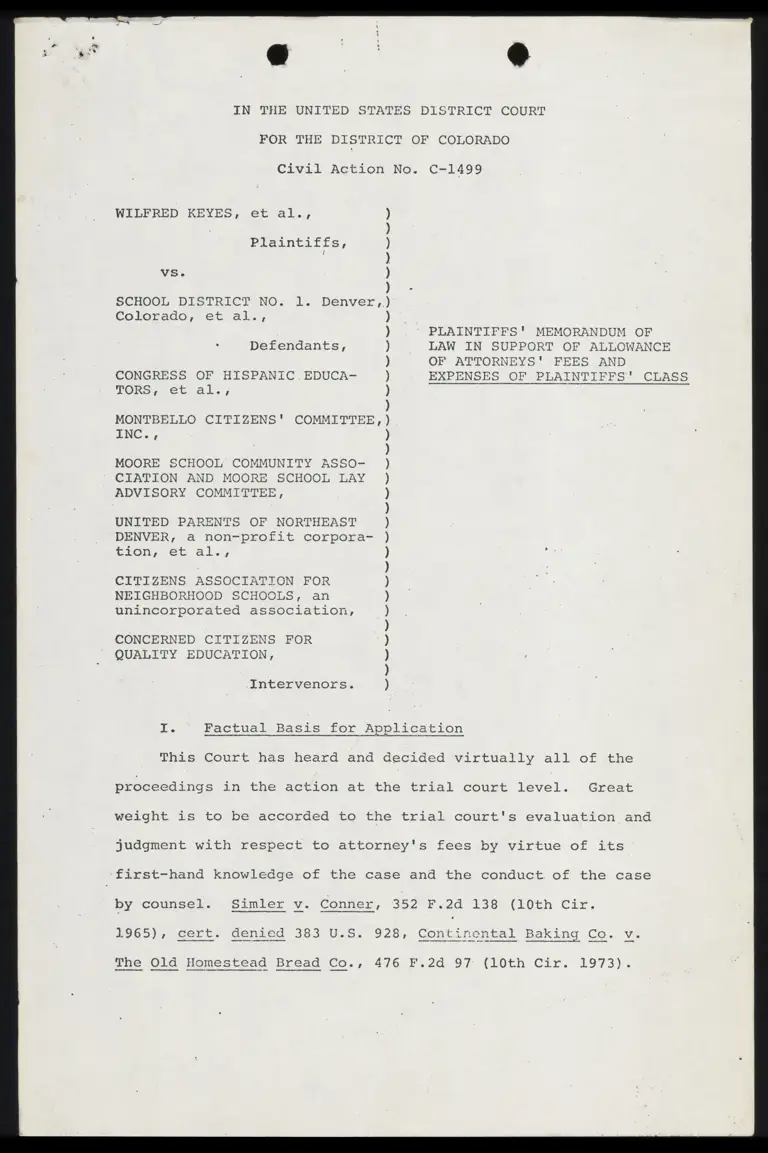
IN THE UNITED STATES DISTRICT COURT

FOR THE DISTRICT OF COLORADO

Civil Action No. C-1499

WILFRED KEYES, et al.,

Plaintiffs,

VS.

SCHOOL, DISTRICT NO. 1. Denver,

Colorado, et al.,

PLAINTIFFS' MEMORANDUM OF

LAW IN SUPPORT OF ALLOWANCE

OF ATTORNEYS' FEES AND

EXPENSES OF PLAINTIFFS' CLASS

Defendants,

CONGRESS OF HISPANIC. EDUCA-
TORS, et al.;

MONTBELLO CITIZENS' COMMITTEE,
INC.,

MOORE SCHOOL COMMUNITY ASSO-

ADVISORY COMMITTEE,

UNITED PARENTS OF NORTHEAST

DENVER, a non-profit corpora-
tion, et al.,

CITIZENS ASSOCIATION FOR

NEIGHBORHOOD SCHOOLS, an

unincorporated association,

CONCERNED CITIZENS FOR
QUALITY EDUCATION,

Intervenors.

;
N
o
?

C
a
n
t

N
s
?

N
a
t

N
w


n
i
t

a
r


i
t

w
i

C
w

S
a
i

N
u
i
t

o
p
t

N
a
w

u
t

a
t

w
i
l

S
w

“
w
i

“
t
t
l

N
a
s
?

“
u
i
?

u
l

S
u
i
t

p
l

g
t

S
u
?

“
w
l

w
t

“
o
g

S
u


“
o
u
t

“
u
g


I. Factual Basis for Application

This Court has heard and decided virtually all of the

proceedings in the action at the trial court level. Great

weight is to be accorded to the trial court's evaluation and

judgment with respect to attorney's fees by virtue of its

‘first-hand knowledge of the case and the conduct of the case

by counsel. Simler v. Conner, 352 F.2d 138 {10th Cir.

1965), cert. denied 3533 U.S. S28, Continental Baking Co. Yo.

The O14 Homegtead Bread Co., 476:F.24 97.(10th Cir, 1973).


A. The History of the Case

It is perhaps only necessary to recall the immense

burden wnieh this case has placed upon this Court and counsel

for the past six years. The case was filed on June 19,

1969, and set for hearing on plaintiffs' motion for prelim-

inary injunction. After a month of intensive trial prepa-

ration, briefing and discovery, plaintiffs in five days of

trial presented, primarily through expert witnessess George

Bardwell and Paul D. Klite an extensive analysis of the

segregative actions of the school district in Park Hill over

a l0-year period, including gerrymandering of school bound-

aries, discriminatory teacher assignments and use of mobile

units, rescission of desegregation resolutions, and dis-

criminatory decisions regarding the location and size of new

schools. Plaintiffs also presented testimony on the effects

of segregation on school children through Dr. Dan Dodson.

The Court preliminarily enjoined defendants from the rescis-

sion of the desegregation resolutions and placed the Resolutions

into effect.” 303 F.Supp. 279 (July 31, 1969).

The defendants, on July 31, 1969 requested this Court

to stay its preliminary injunction; encont for a temporary

10-day stay, the request was denied. Thereafter defendants

sought a stay in the Court of Appeals. On August 7, 1969

the Appellate Court vacated the injunction and remanded the

- case for consideration of the applicability of 42 U.S.C.

§ 2000c-6(a), and questioned whether the injunction met the

requirement of sufficient specificity.

A hearing was held the same day upon the remanded

issues, and on August 14, 1969 this Court issued its Supple-

mental Findings, Conclusions and Temporary Injunction, 303

P.Supp. 289.


® ®
Thereafter, on August 26, 1969 the Court of Appeals

granted defendants' motion for a stay. :

On August 27, 1969 plaintiffs filed with the Supreme

Court 2 Hotion to vacate the stay and reinstate the District

Court's order, which the Court granted on August 29, 1969

(396 U.S. 1215). This Court has not had the opportunity to

judge the extent and quality of the efforts of plaintiffs’

counsel in those appellate proceedings and the plaintiffs

pleadings and briefs are therefore attached hereto as Exhibits

1 and 2. :

The defendants then attempted to circumvent and frustrate

the Supreme Court's reinstatement of the injunction by

requesting the Circuit Court to rewrite its opinion to

include a finding that this Court abused its discretion in

- granting the injunction. After hearing cral argument the

Court of RovealS denied the request on September 15, 1969.

Plaintiff's memorandum brief is attached hereto as Exhibit 3.

The defendants next filed motions to dismiss the

complaint, which after extensive briefing and argument were

denied by this Court on October 17, 19609.

During the period from mid-September of 1969 to February

of 1970 plaintiffs' counsel and their expert and other

witnesses reviewed thousands of documents, conducted other

extensive discovery, did extensive research on the legal

issues involved, and prepared hides of exhibits, all

leading to 14 days of trial before this Court in February of

1970. This Court heard detailed statistical analysis of

avery aspect of the school system bearing on the consti-

tutional rights of the class, and testimony on the school

board's actions over several decades. The Court again found


de jure segregation affecting a very substantial number of

the district's schools (the "Resolution Schools") and ordered

them desegregated. It also found a denial of equal educa-

tional opportunity throughout the other predominately-

minority schools in the district and ordered a hearing on

measures to remedy that condition, 313 F.Supp. 61 (March 21,

1970). ;

Four days of hearings on remedy were held in May of

1970. Again the plaintiffs presented extensive evidence and

expert testimony from some of the nation's foremost author-

ities to demonstrate the measures which were necessary to

overcome the unconstitutional denial of equal protection

Cound by the Court and assisted the Court in analysis of the

efficacy of the alternatives to desegregation advocated by

defendants. The Court made permanent its injunction to

desegregate the Resolution schools and ordered the parties

to submit desegregation plans for relief of 8h6 balance of

the system, 313 F.Supp. 90 (May 21, 1970). Defendants

applied to the Court of Appeals for a complete stay of this

Court's action, which was denied.

The defendants appealed this Court's order to the Court

of Appeals. Again the case was extensively briefed and

argued in August of 1970. Plaintiffs' briefs in connection

with the appeal are included with this application for the

court's information as Exhibits 4 and 5.

During the pendency of the appeals this Court ordered

. the parties to submit desegregation plans for the inferior

schools and scheduled a hearing for selection and adoption

of a plan.


In March, 1971 the defendants again applied to the

Court of Appeitls for stay, as they wished to AVOLE complying

with this Court's orders for submission of desegregation

plans. On March 26, 1971, the Court of Appeals granted the

stay. On March .29, 1971 plaintiffs filed a motion to vacate

the stay with the United States Supreme Court. The Court,

on april 26, 1971, vacated the stay. 402 U.S. 182 (1971)

(per curiam). Plaintiff's pleadings and briefs in these

proceedings are attached hereto as Exhibits 6 and 7.

In May 1971, pursuant to this Court's reinstated orders,

a 3-day hearing was held considering the alternative deseg-

~regation plans submitted by the parties, and the Court

selected plans for implementation in September, 1971.

However, a few weeks after the May 1971 hearing the LSSiANCS

of the opinion of the Court of Appeals on June 11, 1971,

nullified the implementation of those COMER LAY orders. 445

F.24 990.

Thereafter, on June 23, 1971, plaintiffs filed a motion

seeking an order from this Court requiring a plan for the

desegregation of Hallett and Stedman Elementary Schools in

September, 1971. Defendants resisted this motion, claiming

the Court Tached Junisaiotion: This Court denied the motion

without prejudice. on July 28, 197), and at the Court's sug-

gestion plaintiffs filed with the Court of Appeals a "Motion

for Clarification" on August 2, 1971, which again was opposed

by defendants.

On August 30, 1971 the Court of Appeals granted plain-

tiffs' Motion for Clarification, holding that this court had

jurisdiction to consider desegregation plans for Hallett and

Stedman.

On September 9, 1971 the Court held a hearing on Hallett


and Stedman desegregation plans and ordered the selected

plan implemented by November 8, 1971. The order was reduced

to writing and entered on September 28, 1971. Defendants

filed a notice of appeal, which was subsequently voluntarily

dismissed when pursuant to stipulation the order was modified

and implementation rescheduled. The new order for Hallett

and Stedman was entered October 19, 1971 and was implemented

at the beginning of the second semester in January 1972.

Meanwhile, plaintiffs on October 8, 1971 petitioned for

certiorari in the Supreme Court of the United States, which

Petition is included with this application as Exhibit 8. The

Court granted certiorari on Janvary 17, 1972, 404 U.S. 1036.

The lengthy record in this case was designated and

printed, -and briefs, attached hereto as Exhibit 9 and 10 were

submitted by Plaintiffs' counsel. Plaintiffs' counsel

argued the case to the Court on October 12, 1972.

In its first major decision in a school desegregation

‘case outside the South the Supreme Court on June 21, 1973

affirmed this Court's findings of segregation in the Park

Hill schools and remanded the case for determination of,

among other things, whether the Park Hill area was separate

and unrelated to the rest of the city. 93 8.Ct. 2686.

While defendants conceded that Park Hill was not

separate and unrelated, they put the plaintiffs to four

additional days of trial in December of 1973, during which

they attempted to reopen and retry the fundamental issues of

segregation of the system already determined by this Court,

the Court of Appeals and the Supreme Court. The Court

determined that Park Hill was not separate and unrelated and

therefore that the district was a dual school system under


yt

the Supreme Court's decision, requiring district-wide deseg-

regation, 368 F.Supp. 207 (December 11, 1973).

Twelve more days of trial on plans to desegregate the

system were conducted in February of 1974. Because the

plans presented by the school district were predictably and

patently inadequate under the Court's decision in Swann v.

Charlotte-Mecklenburg, 402 U.S. 1 (1971) plaintiffs pre-

sented desegregation plans and extensive testimony and

evidence on the workable and feasible nature of the many

facets of desegregation plans, including pairing and trans-

portation. The Court, at the recommendation of plaintiffs’

counsel, hired its own expert, and drew its own final plan,

which was finally ordered on April 17, 1974, 380 F.Supp.

673.

The defendants' recalcitrance in carrying out the orders of

this Court atid obs irendrone resistance have been consistent

throughout the history of the case, extending even to the

issues presented by this motion for award of fees. Thus

plaintiffs' counsel, after the Bradley decision, infra,

inquired of the defendants, through their counsel, as to

‘whether (1) defendants would be willing to stipulate that

plaintiffs were entitled to an award of attorney's fees

under 20 U.S.C. § 1617, and (2) whether defendants would be

willing to discuss the amount of such fees in the hope of

arriving at a satisfactory stipnimues recommendation to the

Court. These offers were rejected by the defendants, neces-

sitating this legal memorandum and a hearing on the questions

of entitlement to and the proper amount of such attorneys’

fees. |

B. The Nature of the Case

This case has not been ordinary or routine litigation.


It has commanded extraordinary efforts and imposed enormous

burdens on the Court and counsel, often on the shortest of

notice. It has required considerable personal sacrifice and

risk to plaintiffs, their counsel and Che Court to effect

the transition to a nondiscriminatory school system. The

first—-named plaintiff in this case had his home bombed.

Threats to life, family and property have been common.

Serving to vindicate a national policy of the highest priority

has demanded extraordinary professional service as officers

of the Court, deserving of at least the level of compensation

paid defendants' attorneys, who throughout the case have

been assured of payment for their services, and of more than

attorneys are routinely paid for ordinary litigation, which

involves no contingency that compensation for services will

not be forthcoming.

The Court is further asked to consider whether the

school board's conduct and use of counsel and judicial

process constitutes obstinate noncompliances with the law

and delay. Plaintiffs submit that in numerous instances it

has. Among those instances are (1) attempting to circumvent

the Supreme Court's reinstatement of the Court's order in

the Court of Appeals, (2) resisting the desegregation of

. Hallett and Stedman, (3) knowingly submitting an inadequate

plan for relief, (4) contesting minor expenditures and

actions of the Community Education Council, (5) seeking to

retry issues already decided by the Supreme Court, and (6)

contesting any allowance of attorneys fees in this case

despite the clear pronouncement of the Supreme Court in Bradley

v. Richmond School Board, 416 U.S. 696 (1974).


311. Plaintiffs' Counsel Are Entitled to a Reasonable

Attorney's Fee Under § 718 of Title VII, 20
U.S.C. 5 1617.

Section 718 of the Education Amendments of 1972, which

became effective on July 1, 1972, provides that:

Upon the entry of a final order by a court
of the United States against a local educa-
tional agency, a state (or any agency thereof),
or the United States (or any agency thereof),
for failure to comply with any provision of
this chapter or for discrimination on the
basis of race, color, or national origin in
violation of title VI of the Civil Rights
Act of 1964, or the Fourteenth Amendment
to the Constitution of the United States as
they pertain to elementary and secondary edu-
cation, the court, in its discretion, upon
a finding that the proceedings were necessary
to bring about compliance, may allow the
prevailing party, other than the United

States, a reasonable attorney's fee as part
Of the costs. 20:.0.8.C. § 1617

The Supreme Court of the United States has ruled under

this section that in school desegregation cases "the successful

plaintiff 'should ordinarily recover an attorney's fee

unless special circumstances would render such an award

unjust.'" Northcross v. Board of Education of the Memphis

City Schools 412 U.S. 427, 428 (1973). Plaintiffs! counsel

know of no such special circumstances in this case.

The applicability of § 718 to allow attorney's fees in

circumstances nearly identical to those in this case was

explored in depth by the Supreme Court in Bradley v. Richmond

School Board, supra, which deserves treatment at some length

here. In Bradley the district court had awarded attorney's

fees to plaintiess in the amount of more than $43,000 for

Sekvices rendered between March 10, 1970 and January 29,

1971, and expenses of more than $13,000. The latter date

was the date on which the district court had rejected the

plaintiffs' proposed desegregation plan. On April 5... 19373

the district court had ordered into effect the third plan

proposed by the School Board.


As the Supreme Court later noted, the district court.

had based its award of attorney's fees, made on May 26,

1971, and prior to the enactment of Section 718, on two

grounds rooted in its wendicional equity powers, the first

ground being:

« « « the propriety of awarding counsel
fees when the evidence revealed obstinate
noncompliance with the law or the use of
judicial process for purposes of harassment
or delay in affording rights clearly owed.
[notes omitted] Bradley v. Richmond School
Board, 416 U.S. at 706.

In that connection, the Court stated that:

While reluctant to characterize the 1liti-
gation engendered by that default as un-
necessary in view of the ongoing develop-

ment of relevant legal standards, the
court observed that the actions taken and
the defenses asserted by the Board had
caused an unreasonable delay in the deseg-
regation of the schools and, as a result,
had caused the plaintiffs to incur substan-
tial expenditures of time and money to
secure thelr constitutional rights. Id. at 707.

noting from the district court that

It is no argument to the contrary that
political realities may compel school

administrators to insist on integration
by judicial decree and that this is the
ordinary, usual means of achieving com-
pliance witli constitutional desegregation
standards. If such considerations lead
parties to mount defenses without hope
of success, the judicial process is
nonetheless imposed upon and the plain-
tiffs are callously put to unreasonable
and unnecessary expense. 53 F.R.D., at
39. Ibid.

The second ground of the district court's award, the Court

summarized, was that the plaintiffs acted as "private attorneys

general":

In 1970-71, cases of this kind were
characterized by complex issues pressed
on behalf of large classes and thus in-
volved substantial expenditures of lawyers’
time with little likelihood of compensation

-10~-


or award of monetary damages. If forced to
bear the burden of attorneys' fees, few
aggrieved persons would be in a position
to secure their and the public's interests
in a nondiscriminatory public school system.
Reasoning from this Court's per curiam
decision, in Newman v. Piggie Park Enter-
prises, Inc., 390 U.S. 400, 402 (1968), the
District Judge held that plaintiffs in
actions of this kind were acting as private
attorneys general in leading school boards
into compliance with the law, thereby ef-
fectuating the constitutional guarantee of
nondiscrimination and rendering appropriate
the award of counsel fees. 53 F.R.D., at
41-42. Id. at p. 708.

The Court of Appeals for the Fourth Circuit reversed

the district court's award, and the Supreme Court granted

.gertiorari on plaintiff's petition. The issue, in Bradley

as the Court stated it was:

« « «'whether § 718 authorizes an award
of attorneys' fees insofar as those expenses
were incurred prior to the date that that
Section came into effect! . i 4.

* * *

The question, properly viewed, then, is not
simply one relating to the propriety of retro-
active application of § 718 to services rendered
prior to its enactment but rather, one relating
to the applicability of that section tc a
situation where the propriety of a fee award
‘was pending resolution on appeal when the statute .
became law. Id. at p. 710 [Emphasis supplied]

In deciding this question affirmatively the Court stated that:

In this litigation the plaintiffs may be
recognized as having rendered substantial
service both to the Board itself, by bringing
it into compliance with its constitutional
mandate, and to the community at large by
securing for it the benefits assumed to

flow from a nondiscriminatory education
system. [note and citation omitted].
fd. at p. 7318.

The. Court held that school desegregation actions were private

in form only, with plaintiff's counsel acting as a "private

attorney general" vindicating a national policy of the

-11-


highest priority. Id. at 719.

With respect to the soetiie application of § 718 to

the case before it, the Court held that the section applied

and allowed the district court to award attorney's fees.

Id. at 724.

In arriving at that decision the Court treated two

matters of statutory interpretation which are also relevant

in this case. The first matter was whether a "final order"

for purposes of § 718 existed. The Court said:

Since most school cases can be expected
to involve relief of an injunctive nature
that must prove its efficacy only over
time and often with frequent modifications,
many final orders may issue in the course
of the litigation. To delay a fee award
until the entire litigation is concluded
would work substantial hardship on plain-
tiffs and their counsel, and discourage

the institution of actions despite the
"clear congressional intent to the contrary
evidenced by the passage of § 718. A
district court must have discretion to award
fees and costs incident to the final dispo-

sition of interim matters. Id. at pp. 722-23.

noting that:

Without wishing affirmatively to construe
the statute in detail in the absence of
consideration of the issue by the lower
courts, we venture to say only that the

- entry of any order that determines sub-
stantial rights of the parties may be
an appropriate occasion upon which to
‘consider the propriety of an award of
counsel fees in school desegregation
cases. Id. alt p. 723, note 28.

The second matter was the time at which the plaintiffs

in that case became the "prevailing party" under § 718. The

Court held that the plaintiffs had not yet "prevailed" in

‘January of 1971, and 4id not prevail until) April 5, 1971,

the date on which the district court ordered the Board's

third plan into effect, 416 U.S. at 724. It is worth noting

that as in Keyes, appeals on orders in the Richmond school

2

Lat


desegregation case continued for several years after 1971.

Section 718 also requires a finding that "the pro-

ceedings were necessary: to bring about compliance . . ."

The defendants’ past and continuing steadfast recalcitrance

to these proceedings testifies more than adequately to the

fact that this action was essential to achieve a nondis-

criminatory public school system "in Denver in compliance

with the mandate of the Fourteenth Amendment of the Consti-

tution of the United States.

Section 718 and the Bradley case dispose of the case

here. The propriety of a fee award was pending resolution

on July 1, 1972 when § 718 became law; as was the case with

the Bradley district court's order of April 5, 1971, this

Court's Final Judgment and Decree of April 17, 1974 is a

"final order" within § 718. It is appealable. It determines

substantial rights of the parties. The plan it put into

-. effect is not interim but final. As the Court determined in

pragiel plaintiffs became the "prevailing party" on the

date on which a noninterim plan was first put into effect,

e.g. April 17, 1974.

III. Factors To Be Considered In Determining
Reasonable Attorneys Fees

The United States Court of Appeals for the Tenth Circuit

has emphasized the following factors in approving the award

of attorney's fees: (a) the acs that the award of attorney's

fees is within the trial court's discretion, (b) the fact

“that the trial court's award of fees will not be disturbed

except upon a strong showing, especially in those cases

where the trial judge who has made the award is the same

judge who handled the litigation proceedings and is intimately

familiar with the services rendered, (c) the risk and burden

-]13-


inherent in undertaking legal representation where fees will

be recovered only if a plaintiff is successful, (d) the

benefit conferred by the litigation, and (e) that the amount

of the fee awarded should depend upon the particular facts

of ‘each case. ‘Simler v. Conner, 352 F.24 138, 14) (10th

Cir.) , cert. denied, 38 U.5. 928 (1965), Union Carbide §&

Carbon Corp. v. Nisley, 300 'P.24, 561, 587 {10th Cir. 13961),

appeal dismissed, 371 U.S. 801 (1962), and Continental

Baking Co. v. The Old Homestead Bread Co., 476 r.24 97

{10th Cir. 1873).

Recently Judge McMillan has considered and applied

Section 718 in the awarding of $175,000 in plaintiffs

attorneys fees in the Charlotte-Mecklenburg school desegregation

case. Swann v. Charlotte-Mecklenburg Bd. of Educ., (No.

}Jo974, U.8.D.C. W. .Div'n., February 24, 1975). We have

appended a copy of that opinion to this memorandum. Judge

McMillan cited the following factors in resol his deter-

mination of a reasonable fee award: (1) The results obtained;

(2) the difficulty and novelty of the case; (3) fees paid to

opposing counsel; (4) time and labor involved; (5) loss of

other business; (6) fees customarily charged for similar

services; (7) fixed or contingent fee; (8) reputation,

experience and ability of plaintiffs' counsel.

The Supreme Court, in the Bradley case, supra, did not

address itself directly to the question of what factors must

"be: considered in determining attorney's fees in the school

desegregation area. However, the Court, in both Northcross

and Bradley equated attorney's fees to be awarded in school

desegregation cases with those awarded under the Public

- Accommodations section of the Civil Rights Act of 1964, 42

U.S.C. § 2000(a-b). Bradley v. Richmond School Board, 416

U.S. 696, 719(1974).

lq


In a recent case under Title VII of the Civil Rights

Act of 1964 Judge Peckam, in a Memorandum Decision awarding

attorney's fees, discussed at length the factors to be

weighed and considered in determining reasonable attorney's

fees in such civil rights cases. After emphasizing the

Congressional intention to encourage such litigation, Judge

- Peckam listed several additional considerations: (1) the

extent to which the plaintiff prevails, (2) the time devoted

to the case, (3) the experience, reputation and ability of

the attorneys, (4) the novelty and difficulty of the legal

athens involved, (5) the contingent nature of any recovery

of attorney's fees, and (6) fee customarily charged by other

attorneys in the vicinity for similar services. Perez, et

al. v. Operating Engineers Local Union No.
——

>. €t 4l., Memo~

randum Decision No. 71-898 RFP, (November 8, 1973).

In other important areas of Congressional policy where

the Congress has entrusted enfoncensnt primarily to private

actions the courts have emphasized many of the same factors.

In the anti-trust area in which plaintiffs' chief counsel

" would have been working primarily but for this case, the

most common standards are those affirmed by the United

States Court of Appeals for the Second Circuit in Transworld

Airlines v. Hughes, 449 P.24'51 (2nd Cir. 1971), rev'd. on

other grounds, 409 U.S. 363 (1973), which set forth the

following considerations:

(1) Whether plaintiff's counsel had the benefit
of a prior judgment or decree in a case
brought by the government,

(2) the standing of counsel at the bar--both
counsel receiving the award and opposing
counsel, ;

(3) time and labor spent,
(4) magnitude and complexity of the litigation,

“a


(5) responsibility undertaken,
(6) the amount recovered,

(7) the knowledge the court has of the confe-
rences, arguments that were presented and of
work shown by the record to have been done by
attorneys for the plaintiff prior to trial,

(8) what it would be reasonable for counsel to
charge a victorious plaintiff. TWA v.
Hughes, 312 P.Supp. 478, 480 (8.B.N.¥. 1970).

Another factor which is frequently taken into account

is the contingency of compensation on the successful outcome

of the suit. B.g9., Philadelphia v. Chas. Pfizer & Co., 345

F.Supp. 454 (S.D.N.Y. 1972).

The Supreme Court in a case involving the enforcement

of the Securities and Exchange Commission's proxy rules has

clearly held that no pecuniary benefit need be demonstrated,

Mills v. Electric Autolite Co., 396 U.S. 375, 392-93 (1970),

where the Court also emphasized the importance of such suits

in the enforcement of an Important national policy. In

another important securities litigation, Por lunk v. Feldman,

160 F.Supp. 310 (D. Conn. 1958), District Judge Anderson

stated: |

Great weight is given to the contingent
nature of fees with its accompanying risk
that stupendous labor and a substantial
overhead and expense might go for naught
‘e+ oo. Consideration is given to the pre-
vailing hourly rates of pay for attorneys
of different degrees of skill, experience
and standing, both in Connecticut and New
York during the years of the pendency of
this case; the amount of recovery; the

industry, perseverance and skill of individual
attorneys and their experience and eminence
in this field of law; the great benefit to
the clients which otherwise would not have
accrued to them; the intricacy and

complexity of the issues; the outstanding
determination, resourcefulness and skill
of the opposition and the novelty of the

concept of the application of the rules
of law to the facts of the case, which has
made it a landmark in its field.

-16—


In addition, the American Bar Association has suggested that

the following criteria be used in fixing fees:

DR 2-106 - Fees for legal services.

(1) The time and labor required, the
novelty and difficulty of the questions
involved, and the skill requisite to
perform the legal service properly.

- (2) The likelihood, if apparent to the
client, that the acceptance of the
particular employment will preclude
other employment by the lawyer.

(3) The fee customarily charged in
the locality for similar legal service.

(4) The amount involved and the results
obtained.

(5) The time limitations imposed by the
client or by the circumstances. 2

(6) The nature and length of the

professional relationship with the
client.

(7) The experience, reputation and
ability of the lawyer or lawyers per-
forming the services.

(8) Whether the fee is fixed or con-
‘tingent.

In view of the legal standards suggested by the courts for

civil rights and analogous cases discussed above, plaintiffs

suggest that the relevant factors, to be discussed separately

below, are as follows:

Xl. Time devoted to representation.

2. Experience, reputation and ability of attorneys.

3. Customary charges for similar services.

4. Compensation contingent upon success.

Be Magnitude and complexity of factual legal issues.

6. Benefit achieved for the Sinads

7. The extent to which plaintiff prevails.

8. Fees paid to opposing counsel.

J Considerations unique to this case.

17


l. Time Devoted To Representation

Total number of hours devoted to the case by plain-

tiffs' counsel through April 17, 1974 is 8,643.4 hours

ranking it with the largest and most complex antitrust and

securities litigations handled by the courts. This time has

been recorded accurately on a daily basis as the case proceeded

and is shown in that daily detail in Exhibit B. As the

Court may note from the detail sheets, plaintiffs' counsel

have excluded time entries representing 56.8 hours where they

deemed the benefit to be at all questionable to the class.

The time detailed in Exhibit B also does not include hundreds

of hours of time devoted by volunteer attorneys to research

the various legal issues in the case for which no fee is

sought but which has benefited the class and the Board. Nor

does the time detailed in Exhibit B include the time of

numerous volunteers who researched various factual issues in

the case.

Of the total hours devoted to the case, Mr. Greiner has

devoted 5,195 hours. This has necessitated forgoing other

employment in Mr. Greiner's field of practice and expertise,

antitrust law and has imposed a huge burden of overhead and

out-of-pocket expenses, detailed in Plaintiffs' Motion for

Dhation of Costs, with recompense, if any, completely

dependent upon this Court's discretion and success tn the

case. As an examination of the detailed accounts of time will

show, a substantial amount of the time devoted by plaintiffs

has resulted from the obstinate noncompliance of the School

Board, which has sent its attorneys into action on the

slimmest and most insubstantial pretext on numerous occasions.

-18-


.

2. Experience, Reputation and Ability of Attorneys

Plaintiffs' chief counsel, Gordon G. Greiner, is a

graduate of Northwestern University and Northwestern School

of Law, where he was an associate editor of its Law Review

and a member of the Order of the Coif. He is a partner in

the Denver law firm of Holland & Hart, with more than 15

years of experience $5 Lares and complex litigations,

specializing in antitrust law. As with the other attorneys

discussed in this section, plaintiffs defer to this Court's

judgment with respect to the skill and ability shown by

plaintiffs' counsel in this case.

James M. Nabrit, III, staff counsel for the NAACP Legal

Defense Fund, is a graduate of Bates College and Yale Uni-

. versity Law School. He is a lawyer of national reputation

and has argued school desegregation cases before the Supreme

Court of the United States on numerous occasions. He has

brought to this case an expertise in school desegregation

cases which has greatly reduced the amount of time which

otherwise would have been necessary.

Craig S. Barnes is a graduate of Stanford University

‘and Stanford University School of Law, as well as Tufts

University School of International Law and Diplomacy. He

was associated with the law firm of Holland & Hart for

approximately three years, and is currently in private

practice in Denver, Colorado.

Norman D. Chachkin, staff attorney for the NAACP Legal

Defense Fund is a graduate of The University of Pennsylvania and

New York University School of Law. He has specialized in school

desegregation cases, supervising more than 150 such cases

for the Legal Defense Fund as staff attorney in charge of

education litigation.


Robert T. Connery is a graduate of Yale University and

Harvard Law School. He is a partner of the law firm of

Holland & Hart, with more than nine years of practice in

corporate and securities law and litigation and environmental

law and litigation.

Resumes of the principal attorneys for plaintiffs are

attached to Exhibit B, and reflect the number of hours spent

on this case and the experience of each attorney in more

detail.

3. Customary Charges For Similar Services

The rates charges by lawyers for legal services in
ay

Colorado and New York are relevant in this case. Plaintiffs’

counsel intend to offer proof at the hearing on this matter

with respect to the customary charges for lawyers of the

experience, eminence and ability of plaintiffs' counsel in

this case.

4. Compensation Contingent Upon Success .

It is well established that compensation in addition to

that normally charged for routine practice is appropriate

where recovery of any attorney's fee or overhead expenses

depends upon his success. This factor, often referred to as

the contingency factor, has additional significance in the

area of public interest litigation as detailed by the Supreme

Court in the Bradley opinion and in the case of Newman v.

Plggie Park Enterprises, iInc,., 3950 U.S. 400, 402 (1968).

The purpose of a contingent award in such litigation is to

encourage legal counsel to undertake the enforcement of

rights established by Congress or the Constitution. There

has been and is virtually no possibility of relief for

discrimination in the Denver public schools without the

efforts of private litigants.

-20-


In order to encourage private counsel to undertake such

litigation as Congress intended, the fees provided must

provide a meaningful incentive to undertake such work rather

than ordinary routine legal work where payment is certain.

As a review of Exhibit C to this Application will

demonstrate, awards of one hundred and fifty dollars an hour

to two hundred dollars an hour for litigation on a contingent

basis 1s common, with higher fee awards in many cases. The

higher hourly rate awarded by the courts in contingent

cases, often a factor of two or more times the ordinary

hourly rate, reflects the fact that an attorney involved in

such work may expect to lose as many cases as he wins, cor in

general to recover only 50% of the time he devotes to such

work.

Indicative of the fact that such contingency considera-

tions are appropriate in civil rights litigation is the case

of WACO v. Alioto, No. C-70-1335WTS (See Findings and

Recommendations re Attorneys Fees attached in Exhibit CQ)

where the court awarded $200,000 in attorney's fees for 841

hours of work or approximately $240 per hour.

5. Magnitude, Novelty and Complexity of Factual and

Legal Issues

The Denver public school system, with over a hundred

schools, is complex. The proof in this case has covered

discriminatory practices over twenty years in teacher assign-

ments, school boundaries, mobile units, transportation,

administration and numerous other aspects of the school

system. The legal issues involved have ranged from the most

straightforward, common acts of school segregation such as

teacher assignment policies, gerrymandering of boundari:: and

location of new schools, to some of the most difficult and

-21-


complex, such as the legal effect of illegal segregatory

actions in a substantial part of the school system upon the

rest of the school system. The result has been a vandmark

ruling from the En Court Of the United States. The

Court is fully familiar with the factual and legal com-

plexity of the case, with the novelty of the legal issues

presented and with the magnitude of the effort required to

make factual proof and legal argument in the cases.

6. Benefit Achieved for the Class

As quoted supra, p. 11 from the Court in the Bradley

case, the benefit achieved is that of a nondigcriminatory

system of public education in the City and County of Denver.

Plaintiffs' counsel have served the Constitutionally and

Conane sionally tend dat ross of leading the School Board

“into compliance with the Fourteenth Amendment. The benefits

to school children of a nondiscriminatory system of public

education are incalculable, and fundamental to the equal

. protection of the laws in our society.

7. The Extent to Which Plaintiffs Prevailed

This Court's Order of April 17, 1974 embodies the

corpo relief sought by plaintiffs, namely the elimination,

root and branch, of discrimination in the public school

system. This subject has already been discussed above in

connection with prevailing party status under the Bradley

case, where the Court held shat pratneitis prevailed upon

the issuance of a non-interim plan to desegregate the school

system, even though it was not the plaintiffs' plan which

was decreed by the court, and even though the matter was

under appeal.

8. Fees Paid to Opposing Counsel

In opposing the efforts of plaintiffs and their classes

—-22=-


for the enforcement of their rights under the Fourteenth

) Amendment, the defendants herein have paid $302,315,58 in

attorneys' fees to their counsel from the inception of the

litigation through the entry of this Court's Final Judgment

and Decree of April 17, 1974.

According to information furnished by defendant's

counsel, the breakdown of these fees is as follows:

No. of Fees
Attorney Hours Paid

William K. Ris 1,764 3/4 $77,510.40

Robert Manley (Not known) | 11,599.18

Kenneth M. Wormwood (Not known) 9,143.00

Henry, Cockrell, Quinn 6,559.7 204,063.00
& Creighton

$302,315.58

These statistics do sk include any allocation of the

substantial retainer paid to Henry, Cockrell, Quinn &

Creighton or payments for other time billed and paid to that

firm for advising the Denver Public Schools administration

and the Board of Education on matters arising from or related

to the case where other matters were also discussed, and

are therefore decidedly conservative and understated. The

foregoing fees were based upon the following hourly rates:

William K. Ris: From January, 1970 through October,

1973, $40 per hour; from November, 1973 through April, 1974,

$50 per hour for office time and $75 per hour for court

time.

Robert Manley: Mr. Manley's hourly rate is not certain,

but believed to be $50 per hour.

Kenneth M. Wormwood: Mr. Wormwood's hourly rate is not

known.

“DB


Henry, Cockrell, Quinn & Creighton: From June, 1969

through August, 1973, tile firm charged a flat rate of $30

per hour for all time of partners and associates devoted to

the case; from September, 1973 through May, 1974, a flat

rate of $40 per hour was charged.

The Swann case, supra, recognizes that the fee paid to

counsel opposing plaintiffs in school desegregation cases is

one of the appropriate factors to be considered by this

Court in determining a reasonable fee. As noted supra,

opposing counsel were assured of payment for their services;

no contingency was involved.

The number of hours devoted to the case by both counsel

for plaintiffs and defendants is remarkably similar. Ignoring

. the efforts of defendant-intervenors such as CANS and

Barnett, et al., and considering the number of hours devoted

to the case for defendants by Mr. Manley and Mr. Wormwood to

have been compensated at $50 per hour, the principal attorneys

for defendants have expended a total of 8739.45 hours (1764.75

by Mr. Ris and 6,559.7 by the firm of Henry, Cockrell, Quinn

& Creighton and 415 hours by Messrs. Manley and Wormwood),

compared to a total of 8643.4 hours for plaintiffs (1215 by Mr.

Nabrit and his associates, 1182.5 hours by Mr. Barnes, and

6,245.9 hours by partners and associates of Holland & Hart).

Thus overall, plaintiffs' counsel have expended fewer hours

in the successful prosecution of this complex case than have

defendants’ counsel in their largely unsuccessful defense.

No small part of this differential should be attributed

to Messrs. Nabrit and Chachkin of the NAACP Legal Defense

and Education Fund, whose expertise in and continuing,

concurrent knowledge of the ongoing evolution of school

desegregation law consistently saved plaintiffs' local


counsel time and effort in researching and presenting legal

authorities and practical approaches to solving the many

complex procedural and legal issues spawned by the litigation.

9. Considerations Unique to This Case

The Court is entitled to consider the special problems

which have been encountered in this case by plaintiffs’

unde) and the Court, and the special impacts which have

been visited upon them. The defendants have exhibited

continuing bad faith and noncompliance with the law, as

discussed above under "Factual Basis of the Application."

While perhaps politically understandable, the School Board's

exploitation of and resistance to school desegregation has

Vasbiy Lnondised the burden on plaintiffs' counsel and this

Court. The actions of defendant School Board, in public and

in private, to impede and complicate this Court's task (as

with the payment of this Court's expert for planning school

desegregation), have been numerous, have caused delay, and

have required judicial and legal process which would Have

been completely unnecessary if, rather than defaulting at

every opportunity, the Board had, for example, come forward

with a proper district-wide desegregation plan. Defendant

School Board should be held responsible for such actions.

The Court is also entitled to take into account the

impact which representation of the plaintiffs in elie class

in this case has had upon the reputation of the counsel in

the case. The undertaking of the representation of an

unpopular cause, rendered more unpopular by defendant School

Board's actions, has had predictable effects upon the

reputation in the community of the lawyers involved and

their affiliates. There is perhaps no way meaningfully to

compensate counsel for the personal abuse, threats, and

ome


attacks on their reputation which have been engendered by

this controversy, but certainly such factors are entitled to

consideration in determining what meaningful incentive is

required to encourage counsel to undertake such cases.

10. Plaintiffs' Request For An Award of Reasonable

Attorneys' Fees

The data submitted herewith shows the following:

With regard to Holland & Hart, based upon the then

current hourly rates of the lawyers devoting time to the

case, the 6,245.9 hours represents a total of $254,344.40;

based upon the hourly rates now being charged by those

lawyers, the 6,245.9 hours represents a total of $355,754.30.

Ordinarily Holland & Hart would charge a fee in excess

of its ordinary regular rates for legal services in a case

such as this, due to the following factors in particular:

3, The contingency of recovery of a fee being dependent

upon successful prosecution of the case;

24 The complexity and magnitude of the case and the

concomitant responsibility assumed by the lawyers;

3. The fact that no remuneration has been received

although the case is now going into its seventh

year of activity;

4. The degree to which the primary objective of the

clients, in this case district-wide school dese-

gregation, has been attained;

5. The numerous occasions of and necessity for

appellate proceedings during the course of the

litigation, including the successful prosecution

of the appeal in the United States Supreme Court,

requiring the highest degree of skill from the

lawyers involved.

-26~—


$  @

6. The quantity of trial days in court required by .

the case, the number of conferences with the

Court, often on short notice and necessitated by

the defendants' reluctance or failure to observe

both the letter and spirit of the Court's orders,

again requiring the highest degree of responsibility,

skill and concentration by the lawyers involved.

In view of the foregoing factors, the law firm of

Holland & Hart respectfully submits that a fee in excess of

$450,000 would be reasonable, and requests an award of

$375,000 for the legal services of the partners and associates

of the firm through April 17, 1974, or an average hourly

rate of $60 for the 6,245.9 hours expended.

With respect to Craig S. Barnes, who served as co-

cousel for plaintiffs from the inception of the case through

May 25, 1971, he has expended 1,182.5 hours in the prosecu-

tion of the case. If the fees had been fully paid at the

time incurred, based upon the regular hourly rate of $40 per

~ hour then being charged by Mr. Barnes, this would.have totalled

$47,300. Based upon the regular fee being charged at the

present time of $50 per hour, this would be $59,125.

As is the case with the other plaintiffs' attorneys,

Mr, Barnes' services in this case were subject to several

unusual factors including, as applicable in this case, com-

plexity and difficulty of the litigation, the uncertainty

of payment, degree of success, unusual time pressures,

diversity and variation of expert factual and legal backgrounds

coordinated and assembled to obtain the result, and adverse

effect of the undertaking upon other paying matters in the of-

fice which were displaced. The last of these factors,

-2 7]


o »
Plus the uncertainty of payment, take on significance perhaps

greater than other factors in a small, two-man office such as

that maintained by Mr. Barnes during his participation.

When the litigation commenced, no payment of fees by

those represented as anticipated nor was there any promise

of payment made to any lawyer. The Denver Equal Educational

Opportunity Fund was sublsbgnentiy formed and made partial

payment to Mr. Barnes of $28,600 for his services.

In view of the circumstances of this case, Mr. Barnes

believes that a reasonable fee award to him would be $59,125

(a rate Of $50 per hour for the 1,182.5 hours devoted to the

case), undimished by the payments of $28,600 he has received.

This $28,600 will be returned to the Fund and be made

. available to defray the expenses incurred by, and to pay the

fees of, witnesses in the case where the Court has determined

that inclusion of their fee is not appropriate either as

taxable costs or expenses of litigation.

With regard to the NAACP Legal Defense and sduoation

Fund, and its attorneys, Messrs. Nabrit, Chachkin Harper and

Ms. Martinez, they have participated in the trial court and/or

appellate proceedings since the inception of the case; Mr.

Chachkin was the principal author of the successful petition

for certiorari; Mr. Habrit co-authored the plaintiffs' brief

in the Supreme Court with Mr. Greiner and has served actively

as co-counsel in the case since remand from the Court; he

also argued the case to the Supreme Court along with Mr.

Greiner.

It is submitted that a reasonable fee for the services

of the attorneys for the NAACP Legal Defense and Education

Fund would be as follows:

-2 8-~


Mr. Nabrit 829 hours at $75 per hour $62,175

Mr. Chachkin 100 hours at $50 per. hour 5,000

Mr. Harper 212 hours at $50 per hour 10,600

Ms. Martinez 50 hours at $50 per hour 2,500

Mr. Greenberg 24 hours at $75 per hour 1,800

Total 1215 hours : £82,075

The attorneys for plaintiffs therefore jointly request

that the Court award a total of $502,575, representing

8643.4 hours of legal services, to be apportioned between

them in accordance with their respective contributions

to the case, as set forth above, to be taxed as costs herein

against the defendant School District No. 1, Denver, Colorado.

Iv. Expenses Incident To Litigation

The out-of-pocket expenses of plaintiffs' counsel in

conducting litigation, and the expenses of expert witnesses

necessary to assist counsel, are frequently allowed when

attorney's fees are awarded (see several avaTds of accountants

and other expert witness fees detailed in Exhibit C, as well

as the award of expenses in the Bradley case, supra). The

expense of expert witness fees in this action have been

applied for as taxable costs. However, plaintiffs believe

that expert witness expenses more appropriately are classified

as expenses incidental to attorney's fees which may be

awarded within the general equitable power of the court and

hereby also apply for them as such.

CONCLUSION

In view of all of the above considerations, plaintiffs’

counsel respectfully submit that they are entitled to a just

and reasonable attorneys' fee for their professional services

" rendered in this case.

-20-


Respectfully submitted,

' i re G Greiner

We
pi £1 a

Robert T. Cha SF

d A

500 Equitable Building
730 Seventeenth Street

- Denver, Colorado 80202
(303) 292-9200

-30- [||3ecf815c-d4d3-41fd-b894-63c281e1e0db||]