Amicus Brief of the School Board of Manatee County, Florida
Public Court Documents
1970
7 pages
-
Case Files, Swann v. Charlotte-Mecklenburg Hardbacks. Amicus Brief of the School Board of Manatee County, Florida, 1970. 637a8f16-2e34-f111-88b4-0022482cdbbc. LDF Archives, Thurgood Marshall Institute. https://ldfrecollection.org/archives/archives-search/archives-item/9ed42592-692e-4ea0-bb77-450c18527ed6/amicus-brief-of-the-school-board-of-manatee-county-florida. Accessed October 16, 2026.
Copied!
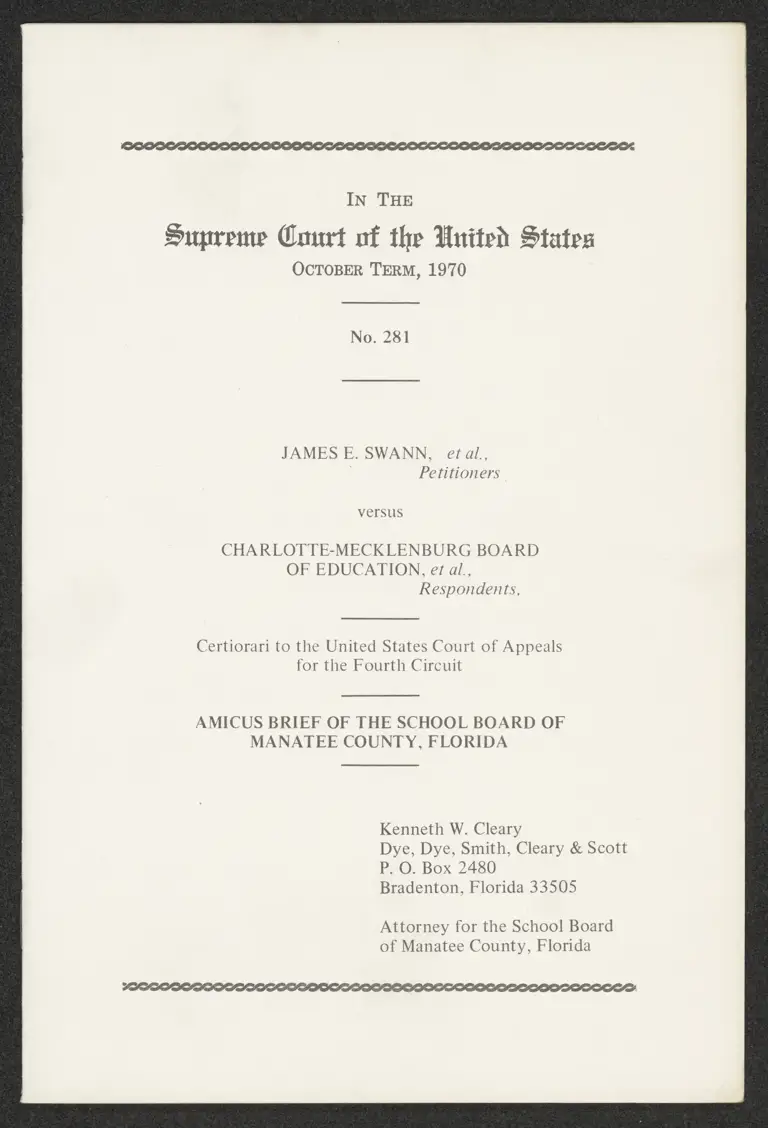
     [||bd844b9a-b143-40f0-86d4-d16e01ffb8d2||] IN THE

Supreme mut of the United States
OCTOBER TERM, 1970

JAMES E. SWANN, etal,

Petitioners

versus

CHARLOTTE-MECKLENBURG BOARD
OF EDUCATION, et al.,

Respondents,

Certiorari to the United States Court of Appeals
for the Fourth Circuit

AMICUS BRIEF OF THE SCHOOL BOARD OF
MANATEE COUNTY, FLORIDA

Kenneth W. Cleary

Dye, Dye, Smith, Cleary & Scott

P. O. Box 2480

Bradenton, Florida 33505

Attorney for the School Board

of Manatee County, Florida

Had I IC So Yo oo EH DD A ar CA SH ADI AI AAS


TABLE OF CONTENTS


Page

Natureof Interest of Amicus. . .. .. . cv i vs vos ons 2

Ouestions Presented . ... ..........¢c....:0:.. 2

Argument. ........... cc eae 2

Conclusion =... . :. . . .... . cs viosle.nicir: 4

Certificate of Service... . . .. . cc vd. i viens ois 5

TABLE OF AUTHORITIES

Case Page

Alexander v. Holmes County Board of Education, 396

S19 sei es a eee see 2

Brown v. Board of Education1,347 U.S. 483 ......... 2

Deal v. Cincinnati Board of Education, 369 F. 2d 535, cert.

denied 3891. 85.847. 88S. Ct.39, 19. Bd24114 .... 3

Ellis v. Board of Public Instruction of Orange County, 423

F. 24203. ves ie 4

Graves v. Walton County Board of Education, 403 F. 2d 184. 3

Green v. County School Board of New Kent County, 88 S.

Ct. 1689. 391 11.S.430 ......... ...:. viii: 4

Jackson v. Marvell School District, 416 F.2d 380 ..... .. 3

Swann v. Charlotte-Mecklenburg Board of Education, 369

E2429 Uh ie anes i hes 3

United States v. Jefferson County Board of Education, 372

F. 2d 836. cert. denied sub nom. Caddo Parish School

Board v. United States, 339 U.8.8406 ........ .. .. .. 3


IN THE

SUPREME COURT OF THE UNITED STATES

OCTOBER TERM, 1970

No. 281

JAMES E. SWANN, etal,

Petitioners

Versus

CHARLOTTE-MECKLENBURG BOARD
OF EDUCATION, et al.,

Respondents,

Certiorari to the United States Court of Appeals
for the Fourth Circuit

AMICUS BRIEF OF THE SCHOOL BOARD OF
MANATEE COUNTY, FLORIDA


NATURE OF INTEREST OF AMICUS CURIAE

This brief is filed in behalf of the School Board of the

County of Manatee, a political subdivision of the State of
Florida, and is sponsored by the attorney for the School Board

of Manatee County, Florida, the authorized law officer thereof,

under Rule 42 (4) of the Rules of the Supreme Court of the

United States.

The interest of the School Board of Manatee County arises
because the Fifth Circuit Court of Appeals in Caroline Harvest,
et al. The Board of Public Instruction, Manatee County,

Florida, et al, vs. Jerome Pratt, et al, 5S Cir. 1970 ——F.

2d.—— [No. 29.425, June 26, 1970], affivmed an order of the

District Court, Middle District of Florida, entered on January
29, 1970, which order directed the pairing and clustering of
certain elementary schools in a manner which achieved an

artificial racial balance in all elementary schools. The same

order, in effect, necessarily required the bussing of students

from their neighborhood school areas to another neighborhood

school area where classes were to be held, a condition which did

not previously exist prior to the entry of the aforementioned

orders.

QUESTIONS PRESENTED

1. Does the Constitution require substantial racial balance in

the system? :
2. Does the United States Constitution authorize a court to

order a plan which, of necessity, requires bussing for its

implementation?

ARGUMENT

The Constitution requires wholly non-racial public school

systems. This Court has never ruled that a unitary school system

is one in which substantial racial balance as to student body

composition is required. There appears to be a subliminal theme

in desegregation cases decided by this Court indicating that race

must not be considered. This starts in Brown v. Board of

Education 1, 347 U.S. 483, and runs through Alexander v.

Holmes County Board of Education, 396 U.S. 19. This Court in


Alexander held that a unitary system is one within which “no

person is to be effectively excluded from any school because of
race or color.” (emphasis added). There is no requirement that a
person be included because of race or color, and, in fact, to so

require would result in an exclusion from another school solely

on the basis of race or color.

The necessity or non-necessity of racial balance is an

important question of federal law which should be settled by

this Court. It is a question in which there is a conflict among
the decisions of the Courts of Appeal in the several circuits. The

Sixth Circuit in Deal v. Cincinnati Board of Education, 369 F.

2d. 55, cert. denied 389 11.S. 847, 88° 8. Ct. 39, 19 L.Ed. 2d.
114 held that there is no constitutional duty on the part of a
Board to bus Negro or white children out of their

neighborhoods or to transfer classes for the sole purpose of

alleviating racial imbalance. The Fourth Circuit in Swann v.

Charlotte-Mecklenburg Board of Education, 369 F. 2d. 29,

holds that substantial racial balance is not necessary. Other

cases in other circuits have made similar rulings. The Fifth

Circuit is unsettled but in recent cases has become extremely

color conscious and has demanded racial balance. See United

States v. Jefferson County Board of Education, 372 F. 2d. 836,

cert. denied sub nom. Caddo Parish School Board v. United

States, 389 U.S. 840.

Another question which arises, assuming this Court

unitary system is whether or not each school within a system

must have both black students and white students within its

student body composition. It is obvious that the lower Court in

this case ruled that there must be blacks and whites in every

school whenever possible. The various Circuits are in conflict
over this question. This problem appears in the Fifth Circuit

case of Graves v. Walton County Board of Education, 403 F.

2d. 184, wherein the Court holds that if there are still all-Negro
schools, the plan fails, as a matter of law, to meet constitutional

standards established in the Green case. This theorem is carried
forward in the Eighth Circuit in Jackson v. Marvell School

District, 416 F. 2d. 380. The Fourth Circuit in Swann ».

Charlotte-Mecklenburg Board of Education, supra, holds that
the presence of an all black school will not invalidate an


4

otherwise unitary system. The same conclusion is reached in the

Sixth Circuit in the Deal cases and has also been reached in the

Fifth Circuit in Ellis v. Board of Public Instruction of Orange

County, 423 F. 2d. 203. The contradictory positions reached in

the Fifth Circuit may be attributed to the fact that different

panels sat in these cases.

Nothing in the Constitution of the United States permits,

much less requires, the bussing of school children to achieve

racial balancing. The direction (Alexander v. Board of

Education, 396 U.S. 19) “to operate as unitary school systems

within which no person is to be effectively excluded from any

school because of race or color” forbids the result obtained

below, which in fact excludes several hundred white children

from the walk-in schools nearest their homes simply because

admitting them there fails to achieve racial balancing within the

entire system. Past discrimination in one direction does not

justify present discrimination in another.

CONCLUSION

The issues are of concern throughout the country and the

lack of answers and guidelines have caused confusion, endless

litigation and inflamed emotions. The answers must be supplied

and supplied now. Amicus urges the Court to set forth

comprehensive guidelines and to hold that racial balance is not

required for a unitary system; that neighborhood schools should

be preserved and that education must be the primary concern in

a unitary school system.

Respectfully submitted,

Kenneth W. Cleary

Dye, Dye, Smith, Cleary & Scott

P. O. Box 2480
Bradenton, Florida 33505

Attorney for the School Board

of Manatee County, Florida


CERTIFICATE OF SERVICE

This is to certify that copies of Amicus Brief of the School

Board of Manatee County, Florida were served upon each of the

attorneys named below by depositing the same in the United

States mail, postage prepaid on this

William J. Waggoner

1100 Barringer Office

Tower

426 North Tyron Street

Charlotte, North Carolina

Benjamin S. Horack

806 East Trade Street

Charlotte, North Carolina

Julius LeVonne Chambers

216 West Tenth Street

Charlotte, North Carolina

Jack Greenberg

10 Columbus Circle

New York, New York

Conrad O. Pearson

203 2 East Chapel Hill
Street

Durham, North Carolina

Jerris Leonard
Assistant Attorney General

U. S. Department of Justice
Washington, D. C.

davof___ 1970.

Honorable Erwin N. Griswold

Solicitor General of United

States

Department of Justice
Washington, D.C. 20530

Honorable Robert Morgan

Attorney General

State of North Carolina

Department of Justice
Raleigh, North Carolina

William C. Cramer, M.C.

2165 Rayburn Building
Washington, D. C. 20515

Stephen J. Pollak
Benjamin W. Boley

Richard M. Sharp
734 Fifteenth Street, N.W.

Washington, D. C. 20036

Gerald Mager

General Counsel to the Governor

The Capitol
Tallahassee, Florida

Kenneth W. Cleary [||bd844b9a-b143-40f0-86d4-d16e01ffb8d2||]